Part 1 — OLD MEXICO. (continued 3)
Reading edition
Picking up the little volume by Manuel Payno, used in the schools, and opening it at random, I find—
“Question.—What events followed?
“Answer.—Truly imagination is lost, and memory confounds itself, among so many plans and pronunciamentos; but we will follow the thread as best we can.”
The period referred to is that of the revolt of Texas, which proceeded to constitute itself “The Lone Star Republic.” Looking a little farther with interest to see how this is accounted for, we find:
“The settlers were North Americans, a portion, as we have said, colonized by Stephen Austin. They set up the pretext that they were not permitted to sell their lands, and, later, that the Federal Constitution had been violated; and they rose against the Government. The latter felt it necessary to put down the rebellion, and took measures to assail that remote and sterile State.”
These dispositions, as we know, ended in the defeat and capture of Santa Anna at San Jacinto. There is always a fascination in being behind the scenes, and I confess that this little opportunity of finding out what was thought of itself by a country which has jarred so much with our own was one of the attractions of being in Mexico. The American war is accounted for as a wicked attempt to sustain and annex the revolted province of Texas; and equally good solutions are found for the various other invasions by foreign powers.
What! is there no absolute right? Are all combatants alike striking for their altars and their fires, and resisting wanton aggression? Will not these Mexicans even yet admit, though beaten, and though it has passed into history, that they terrorized our frontier, and oppressed an industrious and enterprising province? Why, then, perhaps both sides were wrong; and let us aspire for the day when all such quarrels may be settled by an international arbitration.
II.
The young Mexican learns first about his Aztec ancestry, the mild semi-civilized aborigines, who built cities and temples, and were ruled by luxurious Montezuma and scholarly Nezhualcoyotl. The latter, at Texcoco, was a maker of verses and stoical maxims like another Marcus Aurelius.
Cortez conquered the Aztecs in 1519. Then followed a government of nearly three hundred years by sixty-four Spanish viceroys. A rebellion, of eleven years’ duration, marked by many of the features of a servile uprising, drove out the Spaniards in 1821. Grasping and inconsiderate in their colonial management as their way has always been, the Spaniards had probably only themselves to thank for it.
Iturbide, who commanded the revolt at the end, made himself briefly Emperor. His generals, notably the irrepressible Santa Anna, who first here comes into view, rose against him, and proclaimed a Federal Republic. Santa Anna, when the opportunity offered, made himself Dictator, and changed the Federal Republic to a centralized republic, and the states to departments. Santa Anna had numberless ups and downs, having obtained possession of the supreme power no less than six times, with intervals of overthrow and banishment.
The Federal Republic was reconstituted in time, with twenty-seven states, one territory and a federal district, pretty much on the model of our own, and it still retains this form, as it is likely to. There is no doubt about the democratic tendency of the people, but perhaps it is something in the impulsive blood of the Latin race which has prevented the leaders from conceiving a republic on the Anglo-Saxon plan. They have been inspired almost without exception by a craving for the sweets of power. Their rampant patriotism has been like the religion of those persons who would die for a cause, but will not live in accordance with the least of its dictates. There seems to have been no conception until lately of that larger patriotism which educates the people in their duties, and constitutes a state of society where the rights of all are guaranteed and people go about their avocations without interference.
III.
Would you recall, by-the-way, what became of Santa Anna? He, who had so indignantly shaken off the yoke of Iturbide, wrote a missive of congratulation, while living in banishment in the West Indies, to Maximilian, and endeavored to take service under him. His aid was rejected, whereupon he turned to Juarez, only to be repulsed again. In a rage at both sides, he fitted out an expedition on his own account, landed in the country, and was well-nigh being shot, after the model, and almost on the same ground, as that Iturbide whom he had pronounced against forty-two years before. The court-martial, however, spared his life, “in consideration of the ancient services done to his country in Texas, at Tampico, and Vera Cruz,” and sent him again, superannuated and poor (for he had squandered an ample fortune in this attempt), to finish his days in banishment.
I cannot forbear going a little farther into the questions and answers of the little history. Of the gallant generals who fought so well for the Independence, Victoria was the first President. Bravo pronounced against him, and was exiled to South America. Guerrero, defeated as a candidate for the succession by Pedraza, took up arms and seized it by force. He repelled, while in office, a new attempt by the Spaniards to recover the country.
“Question.—I suppose that with this triumph the government of Guerrero was firmly established?
“Answer.—This was to have been hoped, but that happened which always happens in Mexico—just the contrary.”
Bustamente, in fact, pronounced against Guerrero; and when the latter would have returned to the capital from an expedition designed to put down the revolt, he found it closed against him, and in favor of Bustamente also.
“Q.—What end had this revolution?
“A.—The most terrible that can be imagined. The Government at Mexico, feeling that it could not overcome Guerrero ... bought over, for $70,000, a Genoese named Picaluga, who commanded a vessel anchored in the harbor of Acapulco. Picaluga invited Guerrero to dine on board, and this manifestation of hospitality was accepted in good faith. When they had dined the Genoese signified to Guerrero that he was a prisoner, and set sail with him to the port of Huatulco and delivered him into the hands of his enemies. This great and good man, valiant and worthy of the respect and gratitude of the nation ... was shot in the puebla of Cuilapa, on the 15th of February, 1831.”
It was not till 1848, for the first time, that the Presidency was transferred without violence, and under the law. The incumbent was General Herrera, and he was succeeded peaceably by General Arista. These two administrations “will forever place themselves before historians, both Mexican and foreign,” says the history, “as models of honor, economy, and order.” But Arista was deposed in two years, and in the next three months there were four Presidents, the last of them Santa Anna, on one of his periodic returns.
Thus the turmoil of revolutions has continued down to recent times. A certain Don José Maria Gutierrez Estrada directed a letter to the authorities in 1840, proposing, as a measure of relief, that a monarchical government should be established in Mexico; and the idea, in the distracting state of things we have seen, cannot be considered wholly without reason. It caused great scandal nevertheless, but Gutierrez Estrada stuck to it tenaciously, and, by a very singular coincidence, he was one of those who, twenty-four years after, went to Miramar to present the imperial crown to the Archduke Maximilian.
If I cite a number of such events from the past it is not for the purpose of being disagreeable or arguing that the same state of things is to last. It is partly because they are amusing, and partly to obtain a more encouraging point of view for the present. It will be seen that the later administrations, though not without their faults, are a vast improvement upon their predecessors, and do not constitute a declining ratio.
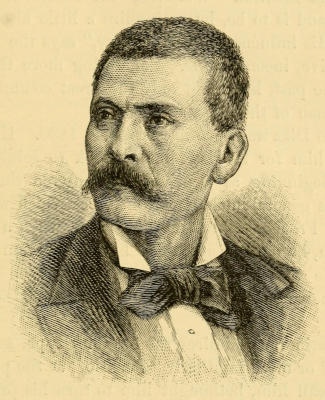
GENERAL PORFIRIO DIAZ, EX-PRESIDENT OF MEXICO.
General Porfirio Diaz occupied unmolested a full term, from 1876 to 1880, and handed over the place to General Manuel Gonzales, who holds it at present in the same security. Diaz began the current career of improvement by his liberal chartering of railroads, and Gonzales follows in his track. Both must be considered to have made a most exemplary and promising use of their powers. But, since we have arrived at “Don Porfirio,” let us see how he entered upon office in the beginning.
IV.
Since he is, by general admission, the power behind the throne, the Mexican “Warwick,” the President who has been, is, and is to be, let us inquire a little also who he was. “His influence in the country,” says the Monitor, “is decisive, incontestable. Something more than Benitez in the past, he is not only the great commoner, but the one man of the present.”
Porfirio Diaz was born in Oaxaca, in 1830. His family destined him for the law, but he took to soldiering instead. Beginning as a private, he entered the city of Mexico as general-in-chief of the forces which wrested it from the French. Once in these wars, when a prisoner at Puebla, he let himself down by a rope from a tower and made his escape. His career is studded with romantic incidents, but the career of what Mexican leader is not?
The Latin race admires the military type, and “Don Porfirio,” or more familiarly “Porfirio,” as the people delight to call him, bethought him to turn his prestige in the field to account. He offered himself for the Presidency against Juarez, on the platform of no re-election, in 1871. Lerdo de Tejada, Chief Justice of the Supreme Court, was also in the field as a third candidate. Let the figures in this remarkable election be noted, as an indication of the acute interest the Mexican voters take in their own balloting. In a population of 8,836,411 a total of only 12,361 votes were cast. Juarez received 5837, Diaz 3555, Lerdo 2874, and 95 are recorded as “scattering.”
“Q.—Relate to me what happened thereafter.
“A.—General Porfirio Diaz issued, from his hacienda of La Noria, a manifesto, hence called the Plan of La Noria, repudiating the existing powers, and proposing to retain military command until the establishment of a new order of things.”
A bloody war of more than a year followed, in which the Porfiristas were utterly routed. Diaz, amnestied, presented himself at the capital, and was affably received by Lerdo, who assured him, on the part of the Government, that he might live tranquil without fear of persecution or harm. “Nothing,” breaks forth our historian, in enthusiasm about these times, “gives a better idea of the constancy and elevation of the Mexican character, a heritage from its Spanish ancestry, than what passes in our wars, both civil and foreign. It appears that defeats but serve as stimulus and fresh aliment to the fray.”
Upon what possible theory these ambitious chiefs have always made their partisans so ready to be slaughtered for them, is a speculation which I shall not go into. Porfirio now remained quiet till 1876, when he issued the Plan of Palo Blanco, and rose against Lerdo, who had succeeded Juarez. He captured Matamoras by a bold stroke of strategy; was himself captured on shipboard; and escaped from the Lerdists by leaping into the sea, through the connivance of the French captain, whom he afterward made consul to St. Nazaire. After a series of such-like adventures his persistence won the day, and Lerdo took to flight. “Don Sebastian” Lerdo is spoken of as probably the most scholarly and accomplished President the republic ever had. He had been a school-master, however, and tried to govern the country in the pedagogue spirit to which he had been used. He lost favor, too, by his lack of military talent, and fled when his fortunes were by no means desperate. The country people were strongly on his side at first, but this singular thing happened—that, finding him unable to protect them against the roving bands of revolutionists favoring Diaz, they joined them in disgust, and went on with them to the capital.
It is upon such original guarantees that the authority which Porfirio has devoted to the extension of law and order and the benefits of civilization reposes.
V.
The subject of these remarks is a person neither talkative nor taciturn. He is of commanding height, a swarthy, half-Indian complexion, a figure stalwart but not heavy, and of a military yet somewhat nonchalant bearing, all of which may form a part of his attraction. He knows how to utilize the arts of peace as well as war. Perhaps he believes a little in the motto, “Let me make the songs of a nation, and I care not who makes its laws;” for the ballad-singers at Santa Anita, on the Viga Canal, whither the populace swarm on Sundays to indulge in dancing, pulque, tamales, and flowers from the floating gardens, have many a long-drawn refrain to the praises of Don Porfirio Di-i-i-az. It is hardly fair, perhaps, to suggest that these are subsidized, since they may rest upon pure admiration of his merits, after all.
The Mexican law prohibits re-election, except after an interval of four years, and Porfirio Diaz was too ardent a one-termer to be able to overstep this prohibition with any consistency. He has placed his friend and fellow-soldier Gonzales in office as his locum tenens. He will assume it himself for the next term, dating from 1884. After that—so the plan is supposed to be arranged—he will give it to General Treviño, his companion in arms and strong auxiliary in his pronunciamentos. Treviño has married the daughter of an American general, Ord, and it may be supposed that American interests will not suffer in his hands.
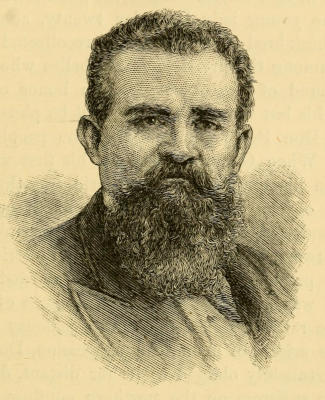
GENERAL MANUEL GONZALES, PRESIDENT OF MEXICO.
Porfirio is romantic even in his Machiavellianism. The only source from which he might have had anything to fear was perhaps a lingering Lerdist sentiment. It represents, or represented, a conservative element, of better social position than the rude democratic force in power. He set to work to conciliate this Lerdist sentiment. He has been able to take of late the effectual means of marrying into the very midst of it, having chosen for his third wife the daughter of Senator Romero Rubio. Romero Rubio was the right-hand man of Lerdo, and his companion in exile. He is now president of the Senate, and the official who is empowered by law to call and control a new election, in case of a vacancy in the Presidency of the nation. Gonzales suffers from an old wound, received at Puebla, and it has been thought by some that Diaz might need to be called to the chair even before the appointed limit of time.
Nor could he have had any personal repugnance to overcome in this match. His usual good-fortune attends him. The young lady is under twenty, accomplished, and of a high-bred air. She will be recollected by Americans as among the prettiest of the belles who took part in the round of festivities given in honor of General Grant at his last visit. This, too, will be pleasing to the people. Don Porfirio means that the people shall be pleased. When General Grant, on his first visit to the country in his tour around the world, was the curiosity and hero of the hour, Porfirio was his inseparable attendant and courteous host. A certain resemblance was traced between them. Both had been illustrious generals, both presidents. When Grant returned a second time, and was now less popular, on account of his interest in the railway concessions, and a jealousy which had meantime arisen of American aggression, Don Porfirio was unfortunately obliged to be far distant, distributing charity to sufferers on the northern confines of the republic.
The work of conciliation has long been going on. Old functionaries have been reinstated in place; veteran army officers have been approached and offered new commands. One of these latter told me that President Gonzales had sent for him, after having kept an espionage on his conduct for some time, and asked him, in a bluff way,
“Why do you continue to talk against the Government, and pass your time in idleness—you who were once so good a soldier?”
“Sir,” he replied, “you know my sentiments, and the cause for which I fought. I cannot deny that I hold them still. I take the consequences. I have pawned my valuables and clothing for food. If I rust in idleness it is because I have no occupation to turn to.”
“I admire your manliness,” the President replied. “Here is your appointment to the command of a regiment. Your cause is dead, as you know, and cannot be revived. I ask of you no political services. I ask of you only to be as before—a soldier.”
It is needless to say that after this there was at least one Lerdist the less.
I do not wish to be understood as finding fault with this policy of astute conciliation; far from it. The hammer-and-tongs method has been so long in vogue that it is a delightful relief. The chicanery of matrimonial alliances, and assumption of frank and soldierly manners, will be welcomed by all the foreign capital in the country as a great improvement upon throat-cutting.
From vast estates in Oaxaca, which with a commendable economy he has amassed meantime, the Mexican Warwick, controls the destinies of his country with an ease like moving one’s little finger. He pleases himself in the interim to be governor, and commander of the forces, of this fighting state. In the absence of any efficient electoral system the country is under his absolute dictatorship; while, with the ostensible division of powers, there is no way of tracing the responsibility to its source.
Not that there is the least danger of anybody’s trying to do so. There are apparent Brutuses in both Houses of Congress, orators and poets who have turned off many a diatribe and many an ode to freedom on the best classic and French republican models, but they have nothing to say against this Cæsar. They are not very free agents, to tell the truth. They are really sent by the governors of the respective states, and these governors have been manipulated in advance. Porfirio can undoubtedly make threats as well as promises; and an unlucky representative, if content to forego a better place, may even lose the one he has. He cannot depend upon adequate support, either, should he have a notion to resist. The “boys” are much given to “going back” on one another in Mexican history.
I shall be found fault with by some persons, as likely as not, for undue severity. He is a beneficent Cæsar, after all, compared with former times; he has brought back something like a Golden Age; he oppresses nobody, at least, not the foreigners, and gives a stimulus to every worthy enterprise.
So be it; and probably there is no more genial government than a Cæsarism of the beneficent sort, fairly established. But it is too full of dangers. Porfirio is doing nothing to educate the nation. “In effect,” one of his own papers says to him, “it is not alone with railways that a nation so disorganized as ours can reconstitute itself; not alone the locomotive and the telegraph that can make us happy. There should emanate from the regions of power something like an impulse of obedience to the law and observance of the institutions upon which the social and political well-being of the country rests.”
It is not probable that there will soon again be serious disturbances. “All the grabbers have got places,” say some critics of a cynical turn, “and there will be no more revolutions.” A better saying, however, is current: “A bad government is preferable to a good revolution.” There is a weariness of fighting. The country seems to savor the little-known luxury of peace with a positive gusto. The railways diminish the chance of trouble by for the first time furnishing ample employment to the idle, who formerly occupied themselves in plunder and were ready to follow the banners of insurgent chiefs. They will be a potent military engine in enabling the Government to mass its forces at points of danger. The fear, too, may be present of interference by foreign governments, should the enterprises of their citizens be threatened with serious damage by new upheavals.
Still, there are great administrative abuses. The civil service is notoriously corrupt. Opportunities for galling oppression are open to the governments, both federal and state, and, most ominous of trouble, redress by the ballot is not possible. The anomaly is presented of a republic in which there is no census nor registration of voters, no scrutiny of the ballot-box except by the party in power. There is hardly a ray of interest in the political machine by the people themselves. The number of votes cast at elections is pitifully small, as we have seen. It is not considered worth while to vote. The lower classes read no informing journals, have no public speakers. No organized opposition exists. Such opposition as there is is purely personal. All contests for office are personal, and not a matter of principles. The Government—that of the centre influencing the states, and these in turn the communities—sustains and counts in what candidates it pleases. There are no data for objection, since nobody can point to the real number of voters in a given place, nor their names.
When this is understood it seems to account for almost all that has happened. There is absolutely no remedy for oppressive domination but in rebellion. With the best of dispositions, the most entire patience, what has happened in the past may happen again.
If there be any statesmanship in Mexico, may we not hope to see some champion arise to remedy this, instruct the masses in their rights, enumerate and register them, and insure them the first essential of a free government—an accurate and unfettered suffrage?
XII. CUATITLAN, AND AROUND LAKES XOCHIMILCO AND CHALCO.
I.
The saying is current that “Outside of Mexico all is Cuatitlan.”
It shows that the capital entertains a true Parisian esteem for itself, and a corresponding contempt for the rest of the country. Cuatitlan is a little village twenty-five miles to the northward, reached by a narrow-gauge railroad, built by Mexicans, but purchased by the Mexican Central. It was at Cuatitlan that I saw my first bull-fight. It is one of the two places in the vicinity where the capital thus amuses itself, the sport being prohibited in town. In some states, as Zacatecas, it is abolished entirely.
There were five bulls killed that day, and three horses, but no men—unfortunately, the novice in these cowardly and disagreeable representations is inclined to think. Each bull came in ignorant of the fate of his predecessor, and ran at the streamers with a playful air. You felt like scratching his back and calling him “good old fellow,” instead of waiting to see presently his pained astonishment and torture, his glazing eye and staggering step, and death like that of an actor in melodrama. The horses were wretched hacks, allowed to be gored purposely as a part of the spectacle. They were driven around the ring afterward till they dropped, and their life-blood poured with an audible noise, like the spatter of a rivulet. Upon which the boisterous youth of Mexico, of the lower class, cried “Bello!” “Bellissimo!” in frenzied delight.
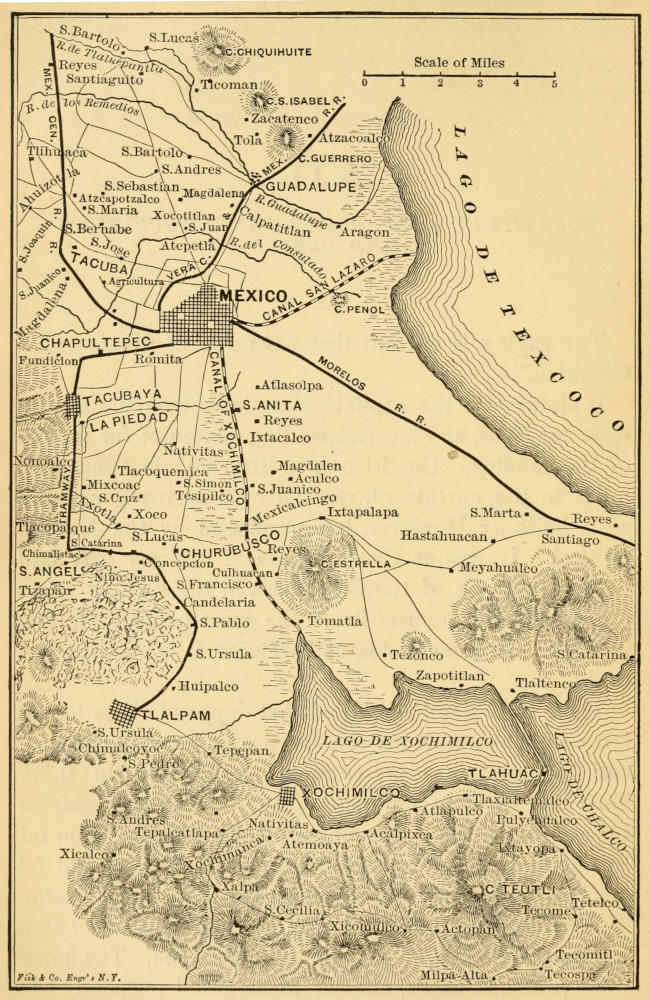
ENVIRONS OF MEXICO.
The gray old walls of the parish church, immense, and of excellent design (as they all are), rise above the amphitheatre. Within are figures of saints grotesquely adorned, or realistically horrible, in the usual style. The devout Indians are not archæologists, and have no idea of paying honor other than as they understand it. I have it on authority that when left to themselves they have been known to equip the Saviour of the World in a twenty-dollar hat, chaparreras (a kind of riding breeches), spurs, sabre, and revolver, sparing no expense to make him a cavalier of the first fashion.
The houses of the town, built of concrete or adobe, sometimes plastered and tinted, are of one story. There are some small portals for the use of out-of-door merchants, a few pulquerias, and thread-needle shops, and a meson, or inn, “of the Divine Providence,” where enormous-wheeled wagons are corralled in line, and muleteers sleep upon their packs, as in the times of Don Quixote.
This is Cuatitlan, this the Mexican village, which can be dreary enough to one who does not look at it with the fresh interest of a new-comer. You cannot take as much comfort in the lower class of people as you would like, on account of their habits. There is no denying that in the neighborhood of Mexico at least they are very dirty. They do not clean up even for their festivals. I saw them dancing at a public ball at the Theatre Hidalgo, which, among other amusements, the municipality provided for them free, on the national festival of the 5th of May. There were charcoal dealers and such persons, with their women, and they had not taken the pains to remove a single smudge of their working-day condition.
Cuatitlan was the birth-place of the simple peon Juan Diego, who in 1531 saw the miraculous apparition of the Virgin of Guadalupe. He was passing the barren hill where her elaborate pilgrimage church now stands, and she gave him roses which had flowered where no flower had ever been seen before. A banner with the image of this miraculous Virgin was carried all through the wars of the Independence. Guadalupe is still one of the spots to be visited, and you buy such sacred knick-knacks there as at Lourdes or Einsiedlen, but the church is stripped of its treasures now, and the surroundings have a shabby aspect.
II.
At San Angel, Tlalpam, and other similar points in the vicinity of the capital, there was formerly an extensive villa life. It has curiously decayed, even while the security of living in such a way has increased. There are no fierce heats, however, to drive people to the country. It is always comfortable in town. No watering-places nor summer resorts in our sense of the word exist. People who go to their haciendas visit them more to look after their business interests than in need or love of country life. Bills are up in the grated windows of the long, low, one-storied villas at San Angel, and the fruits fall untasted in the orange and myrtle gardens. The villagers endeavor to atone for this neglect of them by feasts of flowers, and little fairs, which last a week at a time. On these occasions, among other attractions, existing ordinances against gambling are set aside, and their small plazas are filled with games of hazard.
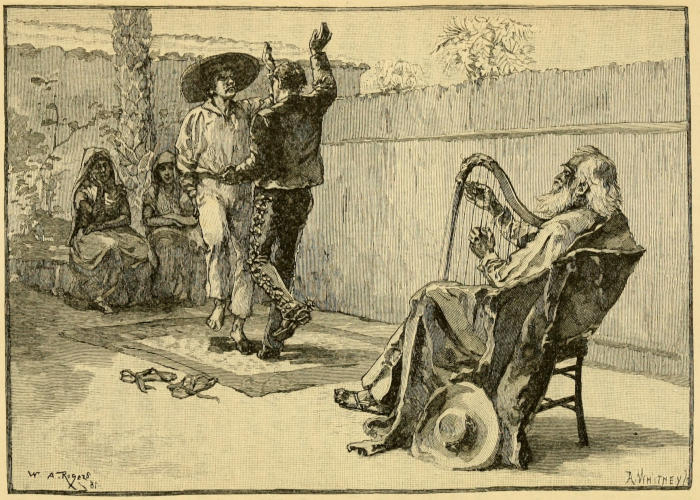
SUNDAY DIVERSIONS AT SANTA ANITA.
The Viga Canal, as far as Santa Anita, is a livelier and more unique resort. Santa Anita is the St. Cloud or Bougival of Mexico. Thither go, especially on Sundays, lively persons to disport themselves on the water and pass a day of the picnic order, taking lunch with them, or depending on such cheap viands as the place offers. The wide yellow canal is more Venetian than French at first. A mouldering red villa or two on its banks, with private water-gates, might belong to the Brenta. Afterward lines of willows and poplars are reflected in the water, and then it is French again.
Flat-boats coming on, piled up with bales of hay and wood, echo each other peacefully from distance to distance. Swift, small chalupas (dug-outs) follow, managed by the Indian master in poses for a sculptor, while his wife—or it is as often an Indian woman alone—is ensconced among flowers and vegetables, with which it overflows. This is the region of the chinampas, the gardens from which the markets of Mexico are most liberally supplied. They are formed by the division of what was once a marsh, by narrow branch canals, into small oblong patches. The patches are so small that the owner passes around the borders in his canoe, and keeps all portions moist with water, which he throws out upon them with a calabash. By this care, and the rich character of the redeemed soil, luxuriant crops are produced.
The houses of the village are generally of bamboo, and without windows, sufficient light penetrating through the interstices. The first business of the participants in the Sunday festivities here is to provide themselves with large, thick wreaths of lovely poppies and blue and white cornflowers, which are sold for the merest trifle. They wear these upon their heads, in their caperings, with a highly classic effect. A general frizzling sound is heard, where eatables, of which peppers form a large ingredient, are prepared on little charcoal furnaces without and primitive fire-places within. “Come in!” the busy venders cry; “come in, señors, señoras, and señoritas, and be seated! Aqui los niños! Here is the place for the children! Here is the place where they are appreciated, and by no means considered a nuisance!”
“Tamales calientitos! dear little tamales, very nice and hot!” they cry. In the same caressing way a cabman in want of a job will call you patroncito, “dear little patron,” though you may be as large as a grenadier.
They decorate their little stands with turnips and radishes cut into ingenious shapes of flowers, and with a profusion of little birds in wax, and the Mexican Goddess of Liberty astride of an eagle. A swarm of flat-boat men cluster at the edge of the canal, bidding for your patronage. Dancing is going on in almost every court-yard; the ballad-singers strike up lazy refrains; and in the Carcel, in a dirty little plaza, by a fountain, a single prisoner monotonously rattles his wooden grating, and glares out at the gayety like a madman. No self-respecting American prisoner could be induced to stay in a place so easy to escape from. But there is no accounting for tastes.
III.
But are there no real chinampas, no gardens that actually float, according to the tradition? Was all that, then, a myth?
Not at all. The soil hereabouts is solidified now, anchored down, as it were; but it has in its time floated, and in that condition borne crops. Farther on whole expanses are found only kept in position by stakes, with four feet of water below, and yet strong enough to sustain grazing cattle. An expedition was organized, in which I was privileged to set off, under the hospitable guidance of the Director of the Drainage of the Valley, to witness these marvels in person. We had a large row-boat, rowed by five oarsmen; and in our party was an amiable English traveller, who has written a book about Mexico,[2] and described, among others, this very expedition.
We started about seven o’clock in the morning from the garita of La Viga, an old Spanish water-gate, at which toll is taken from the market boats. The current was against us. The canal of La Viga, a stretch of about sixteen miles, is the outlet of Lake Xochimilco into Texcoco. Chalco and Xochimilco are practically the same lake, being separated only by a narrow causeway of ancient date, which is open at the centre and spanned by a little bridge.
There are numerous hamlets along the way, built like Santa Anita, and each with a few venerable palm-trees in its plaza. The Jefe Politico of one embraced our Director of the Desagüe and kissed his hand. At another a solid little bridge had lately been thrown across the canal, and we heard of a banquet that had been given on the occasion. The orator of the day had delivered a resounding address on human progress, and declared that he was proud to be a resident of a village which could accomplish such a feat. We lunched at a fort-like hacienda at Ixtapalapa, the point where the canal issues from the lake, and there found horses awaiting to take us to the top of the Hill of the Star. Upon this eminence, according to Prescott, were rekindled the extinguished fires and the beautiful captive sacrificed at the end of each of the cycles of fifty years, when the Aztecs thought the existence of the world was to be terminated.
We found nothing on the summit but a few heavy foundation stones, possibly remains of a sacrificial altar. Our horses had to be walked actively about, to prevent their taking serious cold from the rapid evaporation. It is chiefly memories that are found on such places. I plucked there, however, to send in a letter, a dark-red common flower, and pleased myself with the fancy that it might have drawn its sanguinary hue from the ground so steeped in slaughter.
Though at the entrance of the lake, no shining expanse of water was visible. The greater part of the surface, in fact, is covered with a singular growth of entwined roots and débris, supporting a verdant meadow. Passage through it is effected by canals and shifting natural channels, which change with the wind.
Two of our men after a time got out and towed the boat. The ostensible terra firma sank under their weight like the undulations of “benders” in thin ice. Now and then one floundered and went in waist-deep, whereat the others laughed. The margins are kept in place along the permanent channels by pinning them down with long stakes.
We fell in with wandering strips of growing verdure, called cintas (ribbons), and larger ones, bandoleros (bandits), drifting about at their own sweet will. Our host told us, though this he would not guarantee as of his own experience, that in the earlier times a garden of flowers and vegetables was now and then wrecked along-shore after a gale of wind, as if it had been a bark. Contrabandists, robbers who occasionally beset the market-boats, and political refugees have sometimes found this a favorable place of refuge, and escaped pursuit by diving under the illusive area and coming up elsewhere.
We dined al fresco at Mas Arriba, a place named quite in the American style, literally Farther On. The margins were full of yellow water-lilies, and the clear spaces reflected distant mountains. Evening drew on, and then night. The frogs and crickets waked up their lonesome refrain, and fire-flies twinkled brightly in the morass. A few drops of rain fell, which increased in time to a shower.
IV.
We reached the long causeway between the two lakes late at night, in pitch darkness and torrents of rain, and screened ourselves a while under the little bridge, which barely accommodated the boat. Here was Tlahuac, an ancient island town or village, at the centre of the causeway. Waiting was useless. We landed in the rain, bought candles at a wretched tienda kept by Indians as solemn as statues, and set out in search of a lodging. A mozo preceded us, like a great fire-bug, sheltering a burning candle under a straw mat as best he could, to aid us in keeping out of the deeper puddles.
We were recommended to the Padre, as the only person capable of entertaining visitors of our distinction, and found him in an ancient Dominican convent looming up in the darkness. He received us with many apologies, gave us a good supper, manifested an interest in the late gossip of Mexico, and put us to sleep on the church carpets on the floor of a vast, bare room, provided with a few old religious pictures and bits of furniture.
Any temporary discomforts of this night of adventure were amply atoned for by the beautiful bright morning of the next day. We found Tlahuac a kind of Venetian island, a Torcello, as it were, on which some population of New Zealanders might have put up their thatched huts. The church rising in the centre had one of the usual shining tiled domes, and was preceded by a court and arched gate-way. Its outer walls were covered with a large pattern of quatre-foils in red and yellow. I do not recollect just such a design again till I came later to the old Spanish mission of San Juan Capistrano, in Southern California. The island has sunk, or rather the lake has risen, in course of time, and the bases of the columns in the church are some four feet below the level of the ground.
Near by was the village school, and, as we got under way, we heard the shrill little voices of the children reciting their spelling in concert. All the shock-headed adult residents, in their garments of white cotton, looked as stupid as possible; but it is not always safe to judge by appearances.
From here the view of the two great snow-clad volcanoes is uninterrupted and glorious. We were told to feel with the oars at one place in the canal the pavements of a submerged Aztec city. Cortez mentions such a one in his letters. In 1855 the rumor of a new Pompeii spread abroad, based upon the finding of a few submerged Aztec huts in Lake Chalco, but no remains of any real importance have ever come to light.
V.
On this day, in Lake Chalco, we took our mid-day meal at the base of Xico, a little island volcano now extinct. It is of solid granite, without so much as a blade of grass externally, and the ascent is smooth and difficult. The boatmen sometimes see “Will-o’-the-wisps” on its summit, which, they say, are kindled by the witches. We climbed it, notwithstanding, and found a gently sloping crater, filled with maize-fields, which could easily have been approached from the other side.
The water began to be charmingly clear, and the bottom was full of a red weed like coral. We gathered ferns, lilies, the fragrant little white flower of St. John—flor de San Juan, sold in large bunches in the market—and other flowers, yellow, purple, and vivid scarlet, of unknown names.
The clouds still hung threateningly about, and gave us now and then a slight sprinkle of rain. But as we drew near to Chalco and the end of our two days’ voyage they cleared away.
The prospect from this point is the subject for a landscape painting of the grand order. The town of Chalco, with an ancient and noble church edifice, supplies the element of human interest. In front is the blue water in spaces, with their reflection, and a wealth of marsh plants, arrow and lance heads, ferns, and flowers. In the distance is the great snow-clad mountains, upon which wreathing mists throw changing lights and shadows. Ixtacihuatl, the White Woman, though the lesser, I continually find the more picturesque of the two, in its sharp and rugged outline. Popocatepetl, in the more perfect symmetry of its cone, is a little monotonous, like Orizaba.
We came, by a short branch canal, to the station of La Compañia, on the Morelos railway, and took the train back to town. We were just in time to hear of a disturbance near by by General Tiburcio Montiel, and his arrest by the Government forces. It was said that he had headed a communistic uprising of Indians for the recovery of their lands. He declared through the press afterward that he had but gathered a posse to aid him in the execution of some legal process. Quaint risings of a communistic sort, however, have not been uncommon. Demagogues have more than once told the simple-minded peons that the lands of the country were theirs—had been wrested from their ancestors by the Spanish conquerors—and it was high time to get them back. An ingenious hacendado, waited upon by such a delegation, admitted their view, but met it with another.
“Yes,” said he, “the Spaniards took your lands, it is true; but before that you Aztecs took them from the Toltecs. Find me first, therefore, some Toltecs; I will yield my title only to them.”
XIII. TO OLD TEXCOCO.
I.
My next journey was by lake across Texcoco to the old capital of that name. I had hoped to take El Nezhualcoyotl, which lay in the mud by the Garita of San Lazaro, when I went to make preliminary inquiries. There would have been a certain fitness in approaching the ancient capital in a boat named after the sovereign who made it illustrious; but it was not its day for sailing.
The Nezhualcoyotl was clipper-built, as it were, a long, rusty, gondola-like scow, devoted exclusively to passenger traffic. We took instead a freight-boat of much larger and heavier build, La Ninfa Encantadora, or “the Enchanting Nymph.” She would have been called the Mary Ann or Betsy Jane elsewhere, but such is the difference in the tropical imagination.
A cabin sheltered the passengers and some budgets of goods which were done up in the inevitable petates, rush mats, and included two bags of silver. There were a couple of young women going to pasear—take a little vacation—at Texcoco. “It will be triste, of course,” they said, “like everything out of Mexico; still, we are going to try it for a while.” They offered a part of their lunch, as travelling companions were continually doing wherever I went, and the skipper offered us pulque. Two older women, in blue rebosas, sat like statues, holding their parcels and an Indian baby in their laps, from one end of the long journey to the other.
The canal of San Lazaro on this side extends about a league to the lake. It is very much less attractive than that of Chalco. Its terminus in the city is the point of a most animated and Venetian-like market scene, but one earns his pleasure in dealing with this canal at the expense of many a bad odor. Six men put a sort of harness on themselves and dragged us along, plodding on the tow-path, as Russian peasants drag their boats in some of their rivers. A man on horseback with a tow-rope also assisted, on the other side.
The water, shoal in the beginning, shoaled more as we went on, till we were aground on flats in the edge of the lake. The city sewage was aground with us. Still, the situation was relieved by the striking prospect. The teocalli-like Peñol, where there are warm baths, was close at hand. Sky and water were of an identical blue; the shallow expanse reflected the circuit of dark and purplish foot-hills and great snow-peaks beyond as perfectly as if it had been as deep as they were high.
Our crew walked for an hour in the mud, pushing against long poles projected from the sides, before we could be said to be fairly afloat. Then they came aboard and poled the rest of the way. They walked up an inclined plane, carrying the poles over their heads, and came down, pushing, with them supported against their shoulders, in a bold and striking motion. It was eight o’clock when we set out, and four when we reached the mouth of the short branch canal which makes up to Texcoco. The distance must be about thirty miles. A cross arose out of the lake half way over, and our polemen stopped at it and shouted three times, with startling effect, “Alabo al gran poder de Dios! Ave Maria purissima!”—“Hail to the almighty power of God! Hail, Mary the purest!”
Unexpectant of anything of the sort, I hurried out from the cabin, taking it to be some defiance at enemies, or disturbance among ourselves. We met other packets like our own, loaded with people. A considerable part of the cargoes was the fine large red earthen jars and dishes we saw at Mexico, which are made at Texcoco. The piled-up bales and pottery, the strange figures, and the flashing poles of one of these craft, coming on, make it a highly original and spirited subject.
Then we fell in with one of the curiosities of the lake—disbelieved in by some—swarms of the mosca, a little water-fly, so thickly settled on the water that we took them for flats and reefs. They resemble mosquitoes, but neither sting nor even alight on the boat. They are taken in fine nets and carried to Mexico, as food for the birds; and they have eggs, which are sold in the market and made into tortillas, which are said to be very palatable.
The shores are encrusted with native alkali, which has its share in the production of the disagreeable odors. Peasants gather the crude product and load it upon donkeys, to carry to a salt and soda works, and a manufactory of glass, situated at Texcoco.
Was it in this same branch canal that Cortez launched his brigantines for the destruction of the naval power of the Aztecs? There is water in but a part of it now; and traces of substantial locks are found, where grass is growing and cows feeding.
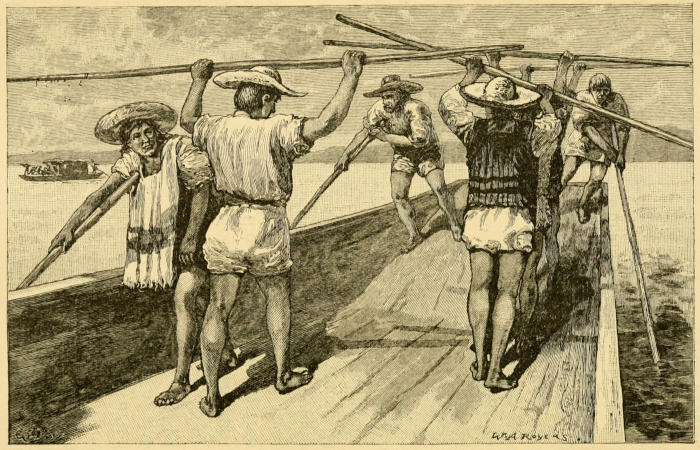
CREW OF “LA NINFA ENCANTADORA.”
II.
I spent nearly a week at Texcoco assimilating the quiet interior life of the country. I dined at the Restaurante Universo, both cheaply and better as a rule than at Mexico, and found a chamber with the keeper of the principal tienda, there being no inn. I even became something of an expert in pulque. The true connoisseur takes it mitad y mitad: half of agua miel newly from the maguey field, and half the stronger beverage of longer standing. I made the acquaintance of the Jefe Politico, a polite, youngish man, said to be a terror to evil-doers. He had made the roads safe. He had a way of shooting at brief notice, and transporting to Yucatan, or if he contented himself with a mere fine it was a sounding one. The pulquerias must be closed at six o’clock, and other shops at nine. One day the Deputy returned from his seat in Congress, and was given a characteristic reception. A troop of twenty or so of his constituents mounted on horseback, and preceded the omnibus in which he was drawn, from the railway station back into the town, at the top of their speed, shouting and firing pistols. Crackers and pistols were fired also from the omnibus.
I made the acquaintance also of the local druggist, an intelligent person, who had a collection of antiquities. He was of the pure Indian race, and professed himself proud of being an Indian, and proud of being a Texcocan. He had lately brought out a very strong distillation of pulque, a kind of patent medicine, and asked my advice about introducing it in the United States. He evidently thought we were made of money, for I am sure we never should have been willing to pay so much a bottle.
The place has now about six thousand people. Its churches are immense. It has a long, shabby plaza, with a market arcade on one side, and an Alameda, also in poor condition. The Jefe Politico might extend his protection next to a few internal improvements. Hamlets cluster near together in a fertile area round about. I noted one day two peons soberly carrying on their shoulders, among the magueys, what appeared to be a dead body. It proved to be instead the saint of the village church, which they were quaintly conveying, as a loan, to one of the others, to assist in a festival of the morrow.
In the hamlet of Santa Cruz the population are potters. Each has a little round tower of a furnace attached to his house, works on his own account, and sets out the large, ruddy jars on his roof to dry. He could acquire a competence if persevering, but the moment he has a dollar ahead he stops work till it is spent. In other houses persons were seen at looms weaving blue cotton stuffs for apparel.
Numbers of ancient carven stones occur, let into the church walls and pavement, and set up in the Alameda. Remains of teocallis are also numerous, as they might well be in a place once the seat of the Augustinian age of Aztec culture. They are treated with no respect at all. They are worn down into mere knolls, and planted with crops. From the site of one now levelled a proprietor was said to have taken out a treasure. What with its age, the destruction of haciendas in the wars, and the practice of the Indians, still prevailing, of burying their money in the ground, there ought to be treasure-trove in Mexico, if anywhere. Certain it is that my host at the tienda, Señor Macedonia, had in his till some beautiful old Spanish coins, which he displayed to the gossips who came in the evening to sip beverages and play dominos.
Among the gossips thus sociably tomando copas (taking cups) at the tienda there was one, a certain “Don Santiago,” who told me that he was pulling down, in his garden, the largest pyramid of the place, to sell the material for building purposes. This was of real interest. Going thither, his pyramid was found to be indeed of imposing size. It was laid up in regular courses of sun-dried brick, and there were vestiges of a facing and superposed pavements of cement, as at San Juan Teotihuacan. There was present in the place with me an archæologist—a newspaper archæologist, I should call him. He termed himself an “expedition;” he had an omnivorous taste for unearthing things, without knowledge of the language, or apparent acquaintance with any previous researches or theories; and his discoveries were intended principally to redound to the fame of a journal which had sent him out. Between us we brought to light a section of a great bass-relief which now occupies a place in the National Museum at Mexico. It was probably seven feet in its longest dimension and five in the other, and must have been a quarter or so of the whole work. It contained a calendar circle, no doubt establishing the date, and part of the figure of a warrior in elaborate regalia, possibly that of old Nezhualcoyotl himself. The archæologist, whom perhaps I unfairly disparage for the auspices under which he appeared, set to work with a will, and soon had half a dozen natives taking the surface off the rest of the soil in the vicinity, for the remaining fragments, but without success. It was the fierce practice of the Spaniards to break the religious emblems of the conquered pagans, to prevent them, as far as possible, from returning to their idolatrous practices, and most likely they rolled down one fragment of the great stone one way, and another another, to separate them as widely as possible; so that they will be found on different sides of the pyramid. All day long it was “Don Santiago!” here, and “Don Santiago!” there, as the excavators plied their labors; while I spent some part of it, shaded by an impromptu awning of mats, noting down in a drawing the peculiarities of the “find” we had made. I do not profess myself an archæologist, except from the picturesque point of view. It is my private surmise that a great deal of good investigation is lavished upon these matters which had much better be spent upon the present; but here was a case in which the sentiment of the picturesque was amply gratified. There was a genuine pleasure in being one of the first to salute this interesting fragment of antiquity after its long sleep, to tenderly brush the dirt from it and trace its enigmatic lines.
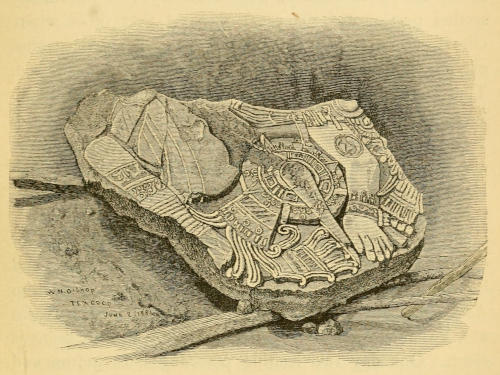
THE “FIND.”
III.
There is a decided resemblance, to this day, in looks and habits, between the Mexican peon and the Chinaman. Writers on the subject have generally represented America as originally peopled from Asia, the Asiatics having crossed over, perhaps, at Behring’s Straits, and made their way south. One Mexican writer stoutly maintains that Mexico was the cradle of the race, and the migration was in the opposite sense. This accords, at any rate, with Buckle’s general theory, that the thickly settled portions of the earth were at first those where climate and a natural food-supply made the maintenance of life easy. In these places, too, civilization began. The warm and fertile area of Central America, therefore, would have teemed with humanity before the waste North was peopled. There may have been sculptured cities, one upon another, long before even Uxmal and Palenque, the origin of which was lost in obscurity to the Aztecs.
However this may be, the Aztecs themselves, whether descendants of a race expatriated from the South and become rugged in the North, or having crossed over from Asia, came down from the colder regions, like the Goths and Vandals upon Italy. The tradition on this point is clear. One day two leading personages, Huitziton and Tecpultzin, in their far-off northern regions, wherever they were, heard a small bird singing in the branches ti-hui! ti-hui!—let us go! They listened intently and took counsel together. “This is really very singular,” we may suppose Huitziton saying, while Tecpultzin sagely laid a finger beside his nose and listened again. One would like a historic picture by some competent humorist of these two simple worthies deciding the fate of their nation. Ti-hui! ti-hui! piped the little songster inexorably, and that there seemed nothing for it but that the Aztec people should move southward, which they proceeded to do.
They overwhelmed the civilized Toltec capital at Tula in their progress. They had a farther oracle saying that they were to stop when they should arrive where an eagle was sitting on a nopal plant; and this they found at Mexico, on the very spot which now is the plaza of San Domingo. The whole district became filled in time with small kings and princes tributary to the Montezumas. The most refined and peaceable type of them all arose at Texcoco.
In the Cerro of Texcocingo, some ten or twelve miles back of the town, remain extensive vestiges of an architectural magnificence which show that the accounts of the historians are not made of whole cloth. We had a trooper appointed us, as an escort and guide, by the Jefe Politico, and rode out to visit them.
Ascending the hill, of perhaps two thousand feet in height, overgrown with hardy nopal and maguey, you come to excellent flights of steps cut in the solid rock, giving access to aqueducts, bathing tanks, cisterns, and caverns, heavily sculptured within and without, which are remains of temples and palaces.
Our trooper had little ambition in these matters, and after showing us a part declared that there was no more, and went comfortably to sleep. It was only by climbing alone to the top that I found the principal display. Here the philosophic Nezhualcoyotl, in his retirement, hung in the air, above the wide prospect of his capital, the lake, and his rival of Mexico. And here, in the deserted mountain, with a guide who had gone fast asleep below, his ghost might be half expected to be met with wandering in the still sunshine, but unfortunately it was not. He wrote poems of a pensive cast. He reflected even in his time as to whether life is worth living, and his general theme was the vanity of all things mortal.
“Where is Chalchintmet, the Chicameca?” he asks. “Mitl, the venerator of the gods; Tolpiltzin, last of the Toltecs; and the beautiful Xinlitzal—where are they?”
These no doubt once famous personages can be the better spared now, on account of their unpronounceable names, but to the writer they represented something very tangible and solid.
“Very brief is the realm of flowers,” he continues, “and brief is human life.... Our careers are like the streams, which but run on to excavate their own graves the more surely.... Let us look, then, to the immortal life.... The stars that now so puzzle us are but the lamps that light the palaces of the heavens.”
Such, if he be properly presented by Spanish adapters, were the sentiments of this early monarch. Truly the latent capacities even of the natural man are not so far below the surface; and it may be that no agency will be found so potent to awaken them with a rush as the modern facility in railway transportation.
IV.
On the return we visited a country residence, combined with large mills for making paper and grinding grain. It was called the Molino del Flores, and belonged to the wealthy Cervantes family of Mexico. One of this Cervantes family was the subject, in 1872, of a celebrated exploit by the plagiarios, or kidnappers. He was seized while coming out of the theatre at night, a cloak was thrown over his head, and he was bundled into a cab. He was buried a long time under the floor of a house, just enough food being given him to sustain life. The plagiarios did not secure the large ransom they demanded, after all, but were finally apprehended, and shot—three of them—against the wall of the house, the Callejon Zacate, No. 8, where they had detained their victim.
The Molino del Flores was not only charming in itself, but may serve as a text for mentioning the very different sentiment thrown around anything in the shape of a manufactory from that prevailing with us. Mills, residence, granaries, and chapel, terraced up into a steep hill-side from a little entrance court, are constructed upon the same motif, and form a single establishment. It is set in a striking little gorge. The water-power, after turning the mills, is utilized for lovely gardens, in which there are a hundred fantastic jets and surprises. There is an out-of-door bathing tank, for instance, at the end of a secluded walk, screened by shrubbery. The disrobing seat is managed in a small cave in the cliff, and the shower, on pulling a ring, falls from the summit, forty feet above. It is a place that might have served for such an adventure as that of Susannah and the Elders.
In the novel of “Maria,” one of the most charming of stories, with which I first made acquaintance in Mexico, though its scene is laid among similar customs in South America, the heroine is represented as preparing the bath for the hero in such a tank by scattering fresh roses into it with her own fair hands.
A rustic bridge, on which La Sonnambula might have walked, is thrown across the cataract to a quaintly frescoed, rock-cut mortuary chapel, where, among others, the last titled ancestor of the house lies buried. He had ten distinct surnames—was Marques de Flores, a General of Brigade, signer of the Declaration of Independence, Captain in Iturbide’s Guard, Cavalier of the Order of Guadalupe, Regidor, Governor, Notabile under Maximilian, and more; from which it will be seen that the pomp of the hidalgos well survived in Mexico.
The same caressing way of looking at industrial establishments here noticed is universal, and is, in part, no doubt, due to their rarity and a thorough appreciation of their usefulness. I recollect everywhere the sugar haciendas, “beneficiating” haciendas, or ore-reducing works, and cotton-mills treated in similar fashion.
One voyage across Lake Texcoco was quite sufficient of its kind, and I returned by diligencia to the junction point of the since completed railway, and thence by rail to the capital. The pulling-gear of our diligencia was a thing of shreds and patches. A boy ran beside the mules all the way to mend the broken ropes and supplement, with whistling and flapping, the exertions of the driver. The houses in the villages are of unwhitewashed adobe, with palings of organ-cactus. It was like riding through a brick-yard. Fine irrigating canals, fed from the mountains, frequently crossed our course, indicating the substantial scale on which agricultural works are conducted. More than one monumental ruined hacienda, too, showed that they had formerly been on even a more elaborate scale than now.
XIV. POPOCATEPETL ASCENDED.
I.
I do not know whether I advise everybody to climb Popocatepetl. There it is always on the horizon, the highest mountain in North America, and one of the few highest in the world—a standing inducement to the adventurous. Few accept it, however, though among those who have done so are said to be ladies. I should somewhat doubt this, but, even if so, there seem to be some features of this ascent which make it uncertain whether the effort “pays” quite as well as Alpine mountaineering.
At any rate, if one will go, let him have all the particulars and the necessary outfit in advance, at the capital itself. Little aid or comfort will be found elsewhere on his way. The proper preliminary for ascending Popocatepetl is to find some one who has been there and knows all about it, and to bear in mind besides the few following points, for his informant will be sure to have forgotten them.
The feet are to be kept dry and warm, for there are hours of climbing in wet snow. This is, perhaps, best accomplished by superposed pairs of stout woollen stockings. The guides usually recommend strips of coarse cotton cloth, to be bound around in Italian contadino fashion; but this is a delusion and a snare, and they mean it to be so. They consider, very justly, that if the traveller can be made so uncomfortable as to quit the ascent before it is half accomplished they shall collect the price agreed upon and be saved a great part of their trouble.
There should be shoes provided with some arrangement of spikes in the soles, against the painful slipping backward. There should be a supply of food and warm covering for camping-out, since absolutely nothing is to be had, and the temperature is very cold at the shelter of Tlamaca, where probably two nights will have to be passed.
I accomplished the ascent with two companions. We had in the beginning such assurances of special assistance that it seemed about to be robbed of all its terrors. The volcano is regularly owned, and worked as a sulphur mine, by General Sanchez Ochoa, Governor of the Military School. We were put in charge of one of his superintendents, who was to see that we had every convenience, and that the malacate, or windlass, was put in order for us to descend into the crater. I surmise that this particular superintendent did not greatly care to encounter the needed hardships on his own account, for certain it is that in the sequel we were left short of many elementary necessities, and there was no malacate for the descent, nor any reference to it.
You arrive at Amecameca, forty miles from Mexico, by train. Everybody should go there. It is one of the loveliest of places, and has inns for the accommodation of visitors. Amecameca will one day be frequented from many climes, if I am not much mistaken. It has features like Interlaken. Cool airs are wafted down to it from the mountains, and its site resembles an Alpine vale. There are points of view in the vicinity whence a sharp minor peak separates itself from the main snow mass of Popocatepetl, like the Silberhorn from the Jungfrau, at Interlaken. The streets are clean, and the houses almost all neatly lime-washed in white or colors. The market-place is a scene for an opera—a long arcade, full of bright figures; behind this is a group of churches and court-yards; behind these the vast snow mountains, as at Chalco, but nearer. A little hill at the left, across a strip of maize-fields, is called the Sacro Monte, and has a sacred chapel of some kind. I climbed thither while the negotiations for horses and guides were in their first tedious stage, and found a quaint Christ in the chapel, and a most engaging view from its terrace.
II.
We set off with a captain, or chief guide, who called himself Domingo Tenario; a peon guide, Marcellino Cardoba, who had worked for three years at sulphur-mining in the volcano. He also acted as muleteer. We had four horses and a mule—the whole for eight dollars a day. Domingo Tenario would also ascend the mountain for a dollar more. We were to be gone three days, the greater part of which the expedition consumes.
The first part of the way wound among softly undulating slopes, yellow with barley, out of which projected here and there an ancient pyramid, planted with a crop also. By the roadside grew charming white thistles, tall blue lupines, and columbines. We crossed arroyos, brooks, and barrancas, gorges. The aspect changed to that of an Alpine pasture. There were bunch grass, tender flowering mosses, and cattle feeding. An eccentric dog, who was attached, it seemed, to one of the horses, and had the ambition to ascend the mountain also, instead of saving his strength for it, here ran up and down and bit at the heels of the herds in the most wasteful manner. It seems a small detail of an enterprise of pith and moment to mention, but “Perro,” as we called him, for want of acquaintance with his name, if he had one, contrived a score of sage and amusing devices to attract an attention to himself beyond his deserts. The horses were frescoed on the flanks with a kind of Eastlake decoration made up of the brands of successive owners.
The English landed proprietor in our small party occupied himself with collecting specimens, and soon had a kind of geological and botanical pudding in his satchel. The American engineer took observations with his barometer and thermometer. Crosses are set up at intervals along the way. These indicate places where a death by violence has occurred, but not always a death by the hand of man. Did the custom prevail of setting up a cross in New York, for instance, wherever a violent death had occurred, we too should have a liberal share of these emblems.
We entered the deep, solemn pine-woods; the night came on, and a sharp cold seemed to penetrate to the marrow. Buildings appeared in the gloom, with red flames dancing merrily through the windows. Aha! the rancho of Tlamaca, with hospitable fires made up, no doubt, expressly for our reception!
What a disappointment! The buildings proved to be but some shelters of rough boards, with plentiful interstices, and not a whole pane of glass. The cabin devoted to the uses of the superintendent contained but a single cot. The dancing flames were those from the process of smelting the crude sulphur, which is done in brick furnaces in the principal structure. Two Indian boys stirred the fires, and coughed in a distressing way all night long. We threw ourselves down to sleep among the sulphur-sacks. One was choked by the fumes, if near the furnaces, and penetrated by the draughts through crevice and broken window-pane, if remote. Tlamaca is itself 12,500 feet above the sea, and its thermometer ranges about 40° Fahrenheit. Without other covering than a light rubber overcoat—for I had not been instructed to bring other—it was impossible to sleep. I went out and paced the yard, sentry fashion, at three o’clock in the morning, as the only resource for keeping the blood in circulation. It was moonlight, and I had the partial compensation of studying the volcano, bathed in a lovely silver radiance.
Mountains are rather given to making their poorest possible figure. Here we are, at this point, already 12,500 feet above the sea, and this is to be subtracted from the total. Shall we ever meet with a good, honest mountain rising its whole 19,673 feet at once, without these shuffling evasions? I fear not. They are only to be found in the designs of tyro pictorial art.
I say 19,673 feet, because so much General Ochoa insists that Popocatepetl is, by a late measurement with the barometer of Gay-Lussac. He even estimates 1700 feet more for the upper rim of the crater, which has never been scaled. I do not know that this has ever passed into any official form, but I had it from his own lips. The latest Mexican atlas makes it but 5400 metres, or 17,884 feet, which coincides with the measurement of Humboldt. I much prefer to rally to General Ochoa, for my part, and to believe that I have climbed a mountain of 21,373 feet, instead of one of a mere 17,884.
The barometer of our own expedition, unfortunately, stopped at 17,000 feet, the limit for which it was set—a limit which barometers are not often called upon to surpass.
III.
We left the Rancho, at six in the morning, on horseback, and rode three hours toilsomely over rocks of basalt, and black sand. The poor animals suffered painfully, but we needed all our own strength for the later work, and could not spare them. They were left at a point called Las Cruces, where a cross tops a ledge of black, jaggedly-projecting volcanic rock. The lines of composition in this part of the ascent were noble and magnificent, the contrasts startling. Across the vast, black undulations, on which our shadows fell purple-black, appeared and disappeared in turn the rich red castellated Pico del Fraile, and the dazzling white breadths of the greater mountain engaging our efforts.
Backward from Las Cruces lay a dizzy view of the world below. Across was the height of Ixtacihuatl, the White Woman, keeping us company in our ascent. The valley of Mexico could be seen in one direction, the valley of Puebla, and even the peak of Orizaba, 150 miles away, in the other. Against the mysterious vastness stood the figures of our men and horses on the ledge of volcanic rock, as if in trackless space.
It was here that “Perro” charged down the slope after crows, which tantalized him and drifted lazily out of his reach, and so wasted his forces that he was obliged to abandon the expedition. Las Cruces was 14,150 feet up. The climb now began on foot, in a soft black sand. One of the leading difficulties of the climb is said to arise from the exceeding thinness of the air, which makes breathing difficult. I cannot say that I discriminated between this and the shortness of breath due to the natural fatigue.
Isolated pinnacles of snow stood up like monuments in the black sand, as precursors of the permanent snow-line. The cool snow-line was a luxury for the first few moments. We sat down and lunched by it, and from there took our last views backward. Cumulus clouds presently filled up the valley with a symmetrical arrangement like pavement. Such bits as appeared through furtive openings recalled the charming lines of Holmes’s, in which a spirit, “homesick in heaven,” looks back on the earth it has left:
“To catch perchance some flashing glimpse of green, Or breathe some wild-wood fragrance, wafted through The opening gates of pearl.”
Up to this point—a little higher, let us say—the effort is rewarded. A view of “the kingdoms of the world and the glory thereof” has been had which could not be got elsewhere. But above this it has little more reward than that of being able to boast of it to your friends. A few steps in the snow, and imperfectly protected feet were sodden, numb with cold, and not to be dried again till the final descent. There was a painful slipping and falling in the snow, and blood-marks were left by ungloved hands. The grade is excessive, the top invisible. Who can estimate when he shall attain it? The prospect consists of jagged snow-pinnacles without cessation, an endless staircase of them reaching up into the sky. Sometimes, in the sun, all the pinnacles glitter; again, thick fogs, like a gray smoke, gather round. There is no more casting yourself down now in warm scoriæ and sand. If you sit you are chilled. Yet rest you must continually. Every step is a calculation and an achievement. You calculate that you will allow yourself a rest after ten, after twenty more. The snow is not dangerous; there are no crevasses to fall into, as in the Alps; it is only monotonous and fatiguing. I seem to have gone on for an hour after farther endurance was intolerable. The guides encourage you—when they find that you really mean to go up—with the adjuration, “Poco á poco” (little by little); so that we paraphrased our mountain as “Poco-a-poco-catepetl.”
Finally, with sighs and groans of labored effort, instead of the lightness with which one might be expected to salute a point of so extreme high heaven, we staggered over the edge of the crater at about two o’clock in the afternoon. I had doubted at one time whether the English landed proprietor would be able to reach it. He had grown purple in the face. Perhaps I had even hoped that he might need a friendly arm to assist him down again on the instant; but he said, with the true British tenacity,
“Oh, bless you, I am going to the top, you know.”
And so he did.
IV.
It was a supreme moment. One seemed very near to eternity. It seemed easy to topple through the ice minarets guarding the brink, and down into the terrific chasm.
There is no comfort at the top when reached. It is frigidly cold. None of the expected heat comes up from the interior. An elemental war rages around, and it is no place for human beings. There is a kind of fearful exaltation. A slope of black sand descends some fifty feet to an inner edge, broken by rocks of porphyry and flint, which the imagination tortures into fantastic shapes. Hence a sheer precipice drops two thousand feet, a vast ellipse in plan. There was snow in the bottom of the crater. Jets of steam spouted from ten sulfataras, or sources, from which the native sulphur is extracted. The hands who work there are said to live in the shelter of caves, and remain for a month at a time without exit. They are lowered down by windlass, on a primitive contrivance they call a caballo de minas—horse of the mines. The sulphur is hoisted in bags and slid down a long groove in the snow to the neighborhood of the rancho. It takes the palm in purity over all sulphurs in the world. A company has been formed, it is said, for the purpose of working the deposits more effectually and utilizing the steam-power in the bottom for improved hoisting machinery.
The men were on strike at the time, as it happened, and the windlass was not in place, and was not adjusted. If it had been, and we had descended, we might have found the warmth for which we were well-nigh perishing. Snow began to drive from the heavy cloud-banks. When it snows the crater within is darkened, roarings are said to be heard, and strange-colored globules and flames play above the sulfataras.
“What if there should be an eruption?” suggested the alarmist of the party, as we began to beat our retreat from the untenable position.
“There has not been an eruption for at least seven thousand years,” said the scientific member, with contempt. “A certain kind of lignite in the bottom, requiring that length of time to form, establishes it.”
“So much the more reason, then,” said the alarmist: “it is high time there was another.”
With that we slipped and floundered down the snow-mountain with the same celerity with which Vesuvius is descended. We crossed again the black volcanic fields, mounted our horses, and spent once more the night at Tlamaca, having learned by experience how to make it slightly more comfortable than the other. The next day we rode back to Amecameca.
When Señor Llandesio, Professor of the Fine Arts at Mexico, made this ascent, as he did in 1866, he says that he found two attempts necessary before he succeeded. I have the pamphlet in which he describes it. “The guide and peon whispered together continually,” he says, “which made me think they were going to play us some trick.”
Sure enough, they did. After a good way up they represented that it was perilous, impossible, to go farther. He descended, and had taken his seat in the diligencia to return to Mexico, when he met another party, with more honest guides, and, turning back with them, this time succeeded. He describes a young man so fatigued on the mountain that he desired, with tears in his eyes, to be left to die. Another succumbed owing to the singular cause, that he had fancied that ardent spirits would have no effect in the peculiarly attenuated atmosphere, and had emptied nearly a whole bottle of brandy.
Señor Llandesio was told by the Indians that they believed in a genius of the mountain, whom they called Cuantelpostle. He was a queer little man, who dwelt about the Pico del Fraile, helped the workmen at their labors when in a good humor, and embarrassed them as much as possible when in a bad. They said, also, that presents were offered by some to propitiate the volcano, for the purpose of obtaining rain, and the like. These were buried in the sand, and the places marked by a flat stone. This practice may account for some of the discoveries of Charnay, who unearthed about the foot of the mountain much interesting pottery.
XV. A BANQUET, AND A TRAGEDY, AT CUAUTLA-MORELOS.
I.
When I saw Amecameca again it was to pass it on board a gala train going down to celebrate the completion of the Morelos railway to Cuautla, in Tierra Caliente. The Morelos railway is a native Mexican work. It was built under the auspices of Delfin Sanchez, a son-in-law of President Juarez, was rushed forward with great expedition, in order to secure valuable premiums, added to the regular subsidy by Government, and there was much defective work in its construction. It is laid to the narrow gauge, and projected ultimately to reach Acapulco, but this latter need hardly be looked for in any predicable time. At present it reaches about seventy-five miles—to Cuautla-Morelos, capital of the state of Morelos.
All official and distinguished Mexico was aboard that day—the President, the justices of the Supreme Court, generals, senators, littérateurs, and, greatest of all, Porfirio Diaz. “Porfirio” wore a felt hat with a tall top, and his manner with his friends was easy and unpretentious. Had the accident of a week later happened that day instead, the Republic of Mexico would have needed to be reconstructed from the bottom upward.
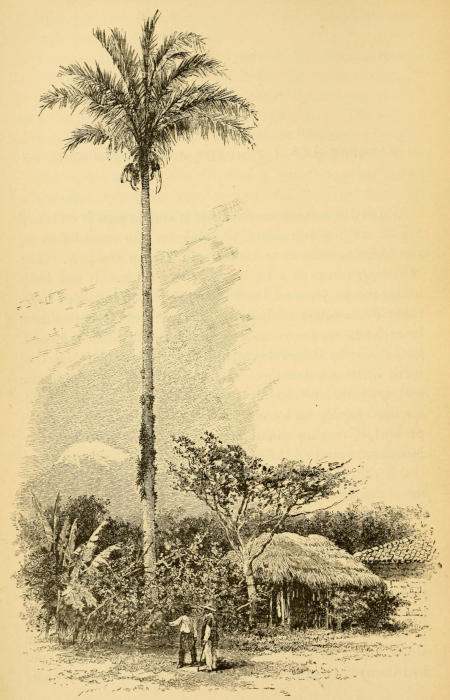
IN TIERRA CALIENTE.
A locomotive exploradora, a lookout engine, went on ahead of us to see that all was safe. Every little place had its music and firing of crackers, and the local detachment of Rurales reined up at the station. At Amecameca there were as many as fifty of the latter, with drawn swords, all on white horses, which the firing made plunge with great spirit. At Ozumba was a battalion of mounted riflemen, under command of a handsome young officer in an eye-glass, who might have come fresh from the military school of Saint Cyr. The Indian populations, who could never have seen the locomotive before, maintained nevertheless, as their way is, a certain stoicism. There were no wild manifestations of surprise, no shouts; they even fired off their crackers with a serious air.
The line is a congeries of curves without end, to overcome the three-quarters of a mile grade perpendicular from Amecameca to Cuautla. Cuautla has seven thousand people. For the ten years, up to this time, there had not been even diligence communication with it, and the railway was an event indeed. The enterprise was carried through chiefly by the exertions of a Señor Mendoza Cortina, who has great sugar estates in the neighborhood.
The streets were decorated with triumphal arches, and borders of tall banana-plants. They were shabby, and the place more squalid than is the rule in the temperate climates above. The Indians had an apathetic look. Few young and interesting faces were seen among them, but an extraordinary number of hags. I found in use some very pretty pottery, which I was told was made at Cuernavaca, forty miles away. Simple bits of stone and shell were impasted in the common earthen-ware with an effect like that of old Roman mosaic. There was a distinctly Indian Christ in the parish church. In the plaza in front stands a great tree, somehow connected with a noche triste of the patriot Morelos. Like Cortez at Mexico, he was forced to retreat one night in 1812, after a gallant resistance of sixty-two days to a siege by the Spaniards.
II.
The extremely civilized company pouring down to this shabby little place had a grand banquet in an old convent now adapted to the uses of a railway station, and plentiful speech-making afterward. There were a number of merry young journalists of the party, and they comported themselves as merry young journalists are apt to. They rapped on the table and called “otro!” “otro!”—another!—with pretended enthusiasm, even after the dullest speeches. It seemed typical of something curiously illogical in the Mexican mind that in festoons about the banqueting hall were set impartially the names of the presidents and other great men of the past, from Iturbide down to Manuel Gonzales. Iturbide adjoined Bravo and Guerrero, by whom he was shot as a usurper and enemy of the public peace; and Lerdo Porfirio Diaz, by whom he was ousted as traitor and tyrant. In the same way these personages, alternately one another’s Cæsars and Brutuses, are honored impartially in the series of portraits in the long gallery of the National Palace.
There was naturally prominent here the portrait of the Padre Morelos, with the usual handkerchief around his head, and bold air of bandit chief. It is curious that priests should have taken such a share in the early insurrection. They recall those warrior ecclesiastics of the Middle Ages, who used to put on quite as often the secular as the spiritual armor. Probably the oppressions of the Spaniards were often too intolerable even for ecclesiastical endurance. Morelos, strangely enough, when the revolt broke out, was curate under Hidalgo at Valladolid, in Michoacan, and followed him to the field. He came, in his turn, to be generalissimo of the Mexican forces, and to have the name of Valladolid changed to Morelia in his honor. He had undoubtedly the military gift. His defence of Cuautla is considered one of the most glorious deeds of Mexican history. It was the third in the trio of priests, Matamoras, his intimate and lieutenant, who broke the siege with a hundred horse and aided his retreat when it finally became necessary.
Matamoras in due course was taken and shot, at Valladolid, by no other than Iturbide, the future liberator. Iturbide, then in the Spanish forces, “had signalized himself,” to quote our history again, “by his repeated victories over the insurgents, and the excessive cruelty of which he made use on frequent occasions.” He routed Matamoras at Puruapan, took him prisoner, and put him to death, as has been said. To repay this, Morelos butchered two hundred Spanish prisoners in cold blood. So the strife of incarnate cruelty went on. Morelos himself was made prisoner by an act of treachery, and shot, after the customary fate of Mexican leaders, at San Cristobal Ecatapec, at four o’clock in the afternoon of the 21st of December, 1815.
Iturbide’s account, in his minutes, of the insurgent chiefs whom he was so active in exterminating is very far from flattering. And here they are all apotheosized together. Verily it seems as if some high court of inquiry and review should be constituted for apportioning out a little the relative merits and defects of the past. The Mexican national anthem, a stirring and martial air, invokes among other things the sacred memory of Iturbide. But if Iturbide really deserved to be shot on setting foot on shore after his banishment, it seems much as if Americans should invoke the sacred name of Benedict Arnold. Arnold, too, rendered excellent services to his country. Nobody was a braver or better soldier than he before he attempted to betray it to the British.
Well, I suppose the Mexicans understand it, but I don’t. Are they content with such a mixed ideal of good? Can a person have been such a patriot at one time that no subsequent crimes can weigh against him? One very simple lesson from it all would seem to be a less impatience with the ruling powers, on the one hand, and much less haste with powder and shot, on the other.
III.
I stayed a couple of days at Cuautla, to visit the sugar haciendas. The sugar product is large, and the district one of the most convenient sources of supply for central Mexico. A week afterward the newly inaugurated road was the scene of an accident unequalled, I think, in the annals of railway horrors. Five hundred lives were lost, in a little barranca, an insecure bridge over which had been washed out by the rain. A regiment in garrison at Cuautla was ordered to Mexico, and started in a train of open “flat” cars, there not having been passenger cars sufficient for the purpose. On other flat cars was a freight of barrels of aguardiente. The start was made in the afternoon. There was delay on the track. The shower came on, the night fell, and the men, pelted by the storm, without protection, broke open the aguardiente, and drank their fill. Some say that the engineer reported the road unsafe, but was forced by an exasperated officer to go on with a pistol at his head. They came to the broken bridge, and the train went through. The soldiers who were not mangled and incapacitated outright—drunk, and crazed with excitement—stabbed and shot one another. The barrels of aguardiente burst and took fire; the cartridges in the belts exploded; the swollen torrent claimed its own; and the fury of a tropical storm, in a night as black as Erebus, beat down upon the writhing mass of horror.
It was at this price that the extra subventions for speedy completion of the work were earned. A whitewashing report was made afterward, I believe, but the Government caused the road to be put in order before it was again opened; and the case may serve as a needed lesson to all railway builders in Mexico.
XVI. SAN JUAN, ORIZABA, AND CORDOBA REVISITED.
I.
The impressions of the first journey upward from the coast are too vague to satisfy, yet it is better to push on to the capital and not take off the edge of the novelty by dallying on the way. The intervening places are returned to afterward.
How different the feeling now! The things that had seemed so formidable are harmless enough. You take now with gusto the pulque, handed up at Apam. You understand the motley figures, the interiors, the flavors of the strange fruits and cakes, the proper expressions to use, and prices to pay. The helpless feeling of standing in need of continual directions is got rid of, and travel has become a matter of confidence and pleasure. Our Mexicans of the lower class are not over-quick in the matter of directions, to tell the truth. I recollect, as an example, asking a small shop-keeper, one day, the way to a neighboring street.
“There it is,” he said; “but” (insisting, in a flustered way, on being puzzled by my accent, though he had comprehended what I meant) “no hablamos Americano aqui”—“We don’t speak American here.”
I found a lodging at a tienda at San Juan Teotihuacan, the ancient city of the dead. The owner had before entertained Americans. He had a dog to which he had given, in pleasant recollection of one of them, as he said, the remarkable name of “Lovis,” which afterward proved to be “Lewis.” Adjoining was a barracks of Rurales, whose bugles sounded a cheerful réveille in the morning. The central plaza is perhaps three miles from the station. On the way you cross a handsome stone bridge built by Maximilian. The river San Juan had vanished from under it and left a mere gulch, as is the way with most of the streams in the dry season.
The inhabitants have their houses, gardens, and all, often above the cement floors left by the extinct race, and the edges of these floors crop out beside the road, worn down through them. Nobody has framed a satisfactory theory of the place, but it is supposed to have been a great pantheon, or burial-place, for the dead of importance. Maximilian encouraged excavations, and a great Egyptian-looking head, unearthed in his time, is seen. Charnay dug there later, and so did my friend of the newspaper expedition. Probably a commission ought to be issued by the Government for tunnelling, without impairing their form, the two pyramids, to ascertain if there be not something of importance within. It is at present both conservative and apathetic in such matters. The larger pyramid, that of the Sun, has an excellent zigzag plane approaching its summit. A long road, called the “Street of the Dead,” strewn on both sides with heaps of weather-worn stones, indicating constructions, extends from it to that of the Moon. Both are now grown with scrubby nopals and pepper-trees.
A couple of children ran out from a cottage at the foot of the Pyramid of the Sun, to sell “caritas,” the little antiquities, the day I approached to climb it. From the top you see other villages, as San Francisco, Santa Maria Cuatlan, San Martin. The inhabitants of San Francisco have erected a cross here, where an idol, with a burnished shield, once stood to catch the first rays of the rising sun, and come in procession each year, on the 3d of May, to conduct a religious ceremonial and drape it with flowers. The white summit of Popocatepetl barely shows itself above the intervening range of the Rio Frio. The officiators at the pagan altar may have hailed it sparkling afar, like another sacrificial fire. The country round about is garden-like, abounding in maize and maguey, sheep and cattle. I observed some large straw-ricks, fashioned by leisurely employés, in the prevailing taste for adornment, into the form of houses, with a figure of a saint chopped out in bass-relief. It was a calm, lovely Sunday. A fresh breeze played, though the sun was warm; cumulus clouds piled themselves up magnificently; and the tinkle of the church-bells came up from the surrounding villages.
The clouds—“luminous Andes of the air,” as a poet has aptly called them—are of especial impressiveness, I think, above this great plain. I noted them again with great pleasure at Huamantla, in the state of Tlaxcala. It is a shabby place of unpainted adobe, out of which rise the fine domes and belfries of a dozen churches, as if they were enclosed in a brick-yard. Thither Santa Anna retired for his last futile resistance, after the Americans under Scott had taken the capital; and there, according to the school history, “the terrible American guerilla, Walker, was killed in personal combat by an intrepid Mexican officer, Eulalio Villaseñor.” Near by is Malinche, a mountain dubbed with a nickname given by the Aztecs to Cortez, which is a feature of all this part of the country. It is not of great height, but of peculiar, volcanic shape. It is a long slope, made up of knobs and jags, reaching to a central point as sharp as an arrow-head. Peons are ploughing, with oxen and the primitive wooden plough, in fertile ground around its base, and its dark mass is thrown out boldly against dazzling banks of cloud.
II.
At Orizaba you are down in the tropics again, but not tropics of too oppressive a kind. A young friend from Mexico was making a visit there in a family to which I was admitted, and I was glad to see something of the place in a domestic way. It has, say, fifteen thousand inhabitants. The Alameda, with its two fountains, stone seats, orange-trees, and other shrubberies, is very charming; so is the little Zocalo, by the Cathedral. There grows in the gardens here the splendid tulipan, a shrub in size like the oleander, the large flowers of which glow from a distance like scarlet lanterns. Tall bananas bend over the neatly whitened houses. My Hotel de Diligencias was white and attractive. Next to it a torrent tumbled down a wild little gorge, amid a growth of bananas, and, passing under a bridge, turned flouring and paper mills. I had this under my eyes from my window; and I had also an expanse of red-tiled roofs, gray belfries and domes, and the bold hill of El Borrego beyond. The city is enclosed by a rim of hills. It was now the season when the rains were growing frequent; and a humid atmosphere, and wet clouds, dragging low and occasionally dropping their contents, kept the vegetation of a fresh, vivid green.
At the hotel table d’hôte a couple of young men of very Indian physiognomy—lawyers, I should judge, by profession—talked pantheism and such-like subjects in the tone of Victor Hugo’s students. A lady whose husband was a general officer told me that she had been in the United States—at New Orleans—accounting thus for a little knowledge of English. That meant that she had shared her husband’s exile there. One comes to understand and smile at it after a while. “Tomo el rumbo á la costa, y salio de la Republica, embarcandose para Orleans”—“He took the road to the coast and sallied from the Republic, embarking himself for New Orleans”—has passed almost into a formula in the accounts of public men, New Orleans having always been a notable place of temporary refuge and plotting for their return.
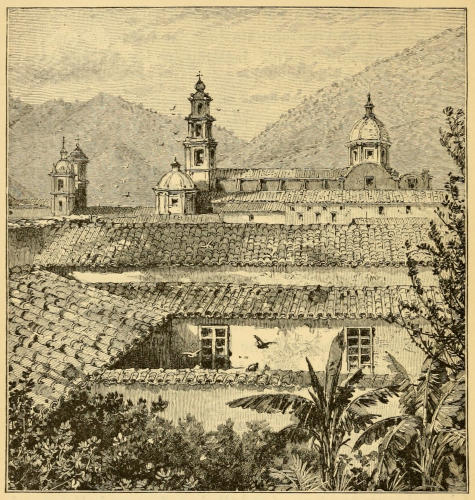
THE HILL OF EL BORREGO, AT ORIZABA.
There was a gay party, of station, who had come down to pasear a little, in a private car, and were taking back with them a great supply of the flowers and fruits of the tropics. Shall I reluctantly admit that they all ate with their knives, and with the sharp edge foremost? Our waiter gave us, smilingly, soup without a spoon, this and that other dish without a fork, and hastened off for long absences; or he would apathetically say, “No hay”—“There is none”—of a dish, but would bring it if it were insisted on with decision. A fellow-guest informed me at dessert that he had been in New York, and that the American fruits and dulces—sweets—were all alike and insipid. This shows that there is a natural equilibrium in things, for it is precisely the complaint that visitors from the North first make of those of the tropics.
My acquaintances in the place were the family of the Licenciado—let us say—Herrera y Arroyo. The names of both masculine and feminine progenitors are thus usually linked together by the “y”—and. They told me that there was very little formal entertaining done. They occupied themselves with embroidery, studying English, and domestic matters. Their house was roomy, but had little furniture. The rocking-chair can never again be called a peculiarly Yankee feature by anybody who has seen it in the lower latitudes. The typical Mexican parlor, or living-room, has, like the one here, a mat spread down in the centre, on a brick floor, and two cane rocking-chairs on one side and two on the other, in which the inmates spend much of their time.