Part 2 — THE LOST PROVINCES. (continued 2)
Reading edition
At Monterey is found an old mission of the delightfully ruinous sort. It is in the little Carmel Valley, which is bare and brown again, after the green woods are passed, four miles from the town. The mission fathers once had here ninety thousand cattle, and other things to correspond. There are now only some vestiges, resembling earth-works, of their extensive adobe walls, and, on a rise overlooking the sea, the yellowish, low, rococo church of San Carlos.
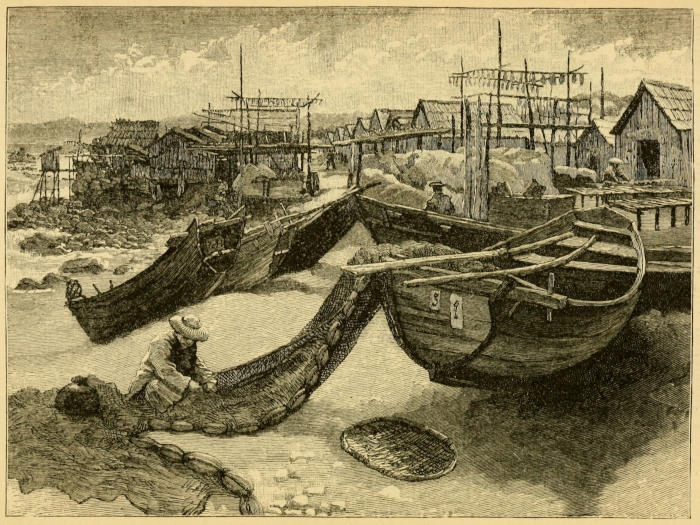
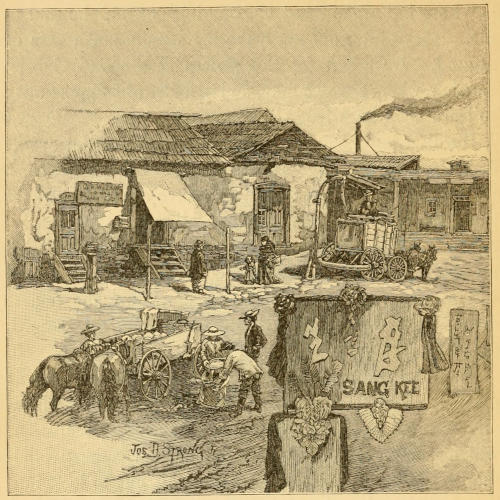
CHINESE FISHING VILLAGE.
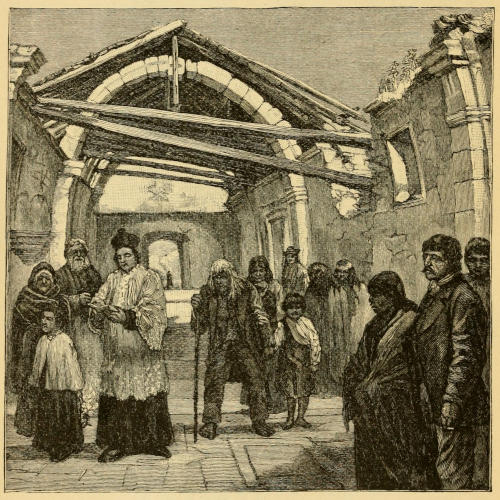
SAN CARLOS’S-DAY AT THE OLD MISSION.
The Mexican traditions in design and proportion accompanied them here, but the workmanship as they went farther from home became curiously rude, and speaks of the disadvantages under which it was done. A dome of concrete on the bell-tower is unequally bulged; a star window in the front has very irregular points. The interior does not yield, as a picture of sentimental ruin, to Muckross Abbey or any broken temple of the Roman Campagna. The roof, open now to the sky, with grasses and wild mustard growing from its crevices, was of stone arches, supplemented with timber-work tied with raw-hides. The whole body of the church—pilasters, capitals, frieze, and all—is set on a curve springing from the floor—a peculiarity I have never seen elsewhere. There are grasses growing within, sculptured stones tumbled down, vestiges of a tile pavement, tombs, bits of fresco, and over all the autograph scribblings of a myriad of A. B. Smiths and J. B. Joneses, visitors here in their time like ourselves.
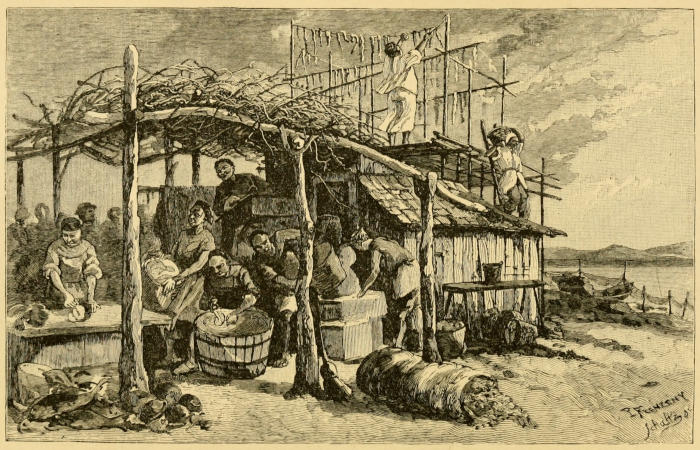
DRYING FISH AT CHINESE VILLAGE.
Once a year, on St. Charles’s-day, in early November, a memorial service is held, attended by all the shabby Spanish-Indian life remaining in the country round about. The place is unique. It seems even more lonely than ruins of the same kind in the mother country, through standing amid surroundings of such a different class. Nothing is more conducive to pensiveness of a pleasant kind than, lying within this ruined enclosure, to watch the waving in the wind of the long grasses on its walls and listen to the plash of the sea on the shore, but a few steps distant.
XXVI. A WONDROUS VALLEY, AND A DESERT THAT BLOSSOMS LIKE THE ROSE.
I.
The Yosemite, currently spoken of as the “Valley,” is comprised in the belt formed by drawing lines across the State from San Francisco and Monterey respectively. It is a wild, strange nook among the Sierras, one of the few places not only not disappointing, but worthy of far more praise than has ever been bestowed upon it. It is like one of those mysterious regions on the outskirts of the fairy-land of the story-books—a standing resource of adventure to all the characters who enter it, and it is proper enough that our earthly Paradise of Southern California should have such a region of enchantment also adjoining it.
I reached it by stage-ride of sixty miles, from the Southern Pacific Railroad, at Madera, to Clark’s Station, and thence by stage and horseback of twenty-five miles to the Valley. The autumn days were lovely there. The foliage, turned by a local climate quite as severe as that of New England, glowed with a vivid richness. The Merced River, a gentle stream, pursuing a devious way in the bottom, which is as level as a floor, reflected the color from many a mirror-like pool and sudden bend. Walls of rock rise on either hand to an elevation of three-quarters of a mile, varying from one-half to one-eighth of a mile in width. It is rather a chasm than a valley. At night the radiance of a full yellow moon invested all its wonders with an added enchantment. The cliffs are exactly what we think cliffs ought to be, but what they seldom are. They are of the hardest granite, pleasantly gray in color, and terminate in castle and dome like forms. The precipices are sheer and unbroken to the base, with almost none of those slopes of débris that detract from precipices in general. It is a little valley suitable, without a hair’s-breadth alteration, to the purposes of any giant, enchanter, or yellow dwarf of them all. It is such scenery as Doré has imagined for the “Idyls of the King.” One half feels himself a Sir Lancelot or Sir Gawain, riding along this lovely and majestic mountain trail; and as if he should wear chain-armor, a winged helmet, and a sword upon which he had sworn to do deeds of redoubtable valor.
It was the coast valleys and some coast towns that we took on our first journey. This time we have come down the main line of the Southern Pacific Railway through the central plain of the State. The railway is traced along the great central valley known as the San Joaquin, on a line nearly midway between the Sierra Nevadas and the Coast Range.
The road is still comparatively new, and the settlements have attained no great dimensions. It did not as a rule touch at the older towns existing, but pursued a direct course through a country where all had to be opened up. As some of the places passed by were of considerable size no little dissatisfaction ensued, and the mutterings are still heard. Frequent mention of this grievance is heard by the traveller through Southern California. Some of the neglected places even maintain that they would have been better without any railroad at all. References are thrown out to former glories of a dazzling sort which it is sometimes difficult to credit, though a railroad naturally effects great innovations in trade. To the ordinary observer it would appear that the introduction of a splendidly equipped railway, even if it distribute its blessings a little unequally at first, and its tariff be high, must be a great and permanent advantage to everything remote as well as near. For the first time an adequate means has been afforded for the transport of immigrants and supplies through the whole length of the State.
The Southern Pacific Railway has completed connections which give it a transcontinental route from San Francisco, across Arizona, New Mexico, and Texas, to New Orleans. Immigrants are to be brought in by steamer from Liverpool to New Orleans, and thence by rail at a rate not to exceed that to the central West. The fares to California heretofore have been almost prohibitive, which is one of the reasons why so rich a country contains as yet less than a million of people. The languid movement hither of the valuable class of immigration which pours into the West, though ascribed by some alarmists to the presence of the Chinese, is due to the cost of travel and the lack of cheap lands for settlement. The Chinese are certainly not rivals in the matter of land, since they acquire little or none of it.
The new opportunities opened to transportation, the depression of the mining interest, and rapid increase of the Chinese, have awakened of late an exceptional interest in white immigration. A committee of some of the most prominent persons in the State has opened an inquiry into the most effectual means of promoting it. It will no doubt set forth more clearly than has ever been done before an account of such territory as is open to settlers, whether offered by the government, the railroads, or the great ranches, its advantages and the methods of reaching it.
It seems a little singular at first that lack of suitable lands can be adduced as a reason for lack of population in so vast a region, with the climate and other natural advantages of which so much has been said. It can only be understood by taking into account the unusual atmospheric dryness, and the important part played by water, which has to be brought upon the soil by costly contrivances; The locations where there is sufficient natural moisture for the maturing of crops are of small extent. They were among the first taken up. In much of the central and southern portions of the State the annual rain-fall is almost infinitesimal in quantity. At Bakersville, the capital of Kern County—whither our journey presently leads us—it is no more than from two to four inches. Light crops of grain and pasturage for stock may occasionally be got even under these conditions, but the only certain reliance is irrigation.
The springs and small streams were early appreciated at their value, and seized upon by persons who controlled with them great tracts of surrounding country, valueless except as watered from these sources. These tributary tracts are used chiefly as cattle and sheep ranges. A person owning five thousand acres will often have for his stock the free run of twenty thousand more. Cultivation is confined to the springs and water-courses, and becomes a succession of charming oases in a desert the superficial sterility of which is phenomenal.
The tenure of land by thousands of acres under a single ownership is a tradition from the Spanish and Mexican times. It has been much decried, as a great evil, and it is said that the State would be much more prosperous in a series of small farms. This is probably true, and the system as it exists may be ascribed in part to the greed of individuals, but it arises principally out of the natural features of the country. The wealth of the large holders alone enables them to undertake works of improvement, such as canal-making, drainage, and tree-planting, on an effectual scale. Perhaps the State will have to lend its assistance, and establish a public system of irrigation and drainage, before the land can be fully prepared for the small settler.
Water! water! water! How to slake the thirst of this parched, brown country, and turn it over to honest toil and thrift, is the great problem as we go southward, and the processes of irrigation are the most distinctive marks upon the landscape wherever it is improved.
II.
It is in early November that we begin to traverse the long San Joaquin Valley from Lathrop Junction, just below Stockton, southward. The side tracks of the railroad are crowded with platform-cars laden with wheat for the sea-board. The “elevator” system is not yet in use, and the grain is contained in sacks for convenient handling.
Hereabouts are some of the most famous wheat ranches. A man will plough but a single furrow a day on his farm, but this may be twenty miles long. There is sufficient rain-fall for the cereals, but not for the more exacting crops. The land gives but few bushels to the acre under the easy system of farming, but it must be remembered that there are a great many acres. The stubble of the grain-fields is whitened with wild-fowl. At a way-station a small rustic in an immense pair of boots goes over to a pool and blazes away with a shot-gun. Presently he returns, dragging by the necks an immense pair of wild-geese, almost beyond his strength to pull. The tawny color of the fields, and the great formal stacks of straw piled up in them, recall some aspects of the central table-land of Mexico. Many or spacious buildings are not necessary in the mild, dry climate of California. The prosperous ranches have, in consequence, a somewhat thin, unfurnished appearance compared with Eastern farms.
The most prominent object at each station is a long, low warehouse of the company, for the accommodation of grain. Like the station buildings generally it is painted Indian red, in “metallic” paint. The station of Merced is one of the two principal points of departure for the Yosemite Valley, Madera the other. At Merced an immense wooden hotel, for travellers bound to the Valley, overshadows the rest of the town. It rises beside the track, and the town is scattered back on the plain.
At Madera appears the end of a V-shaped wooden aqueduct, or flume, for rafting down lumber from the mountains fifty miles away to a planing-mill. Some of the hands also occasionally come down the flume in temporary boats. As the speed is prodigious these voyages abound in excitement and peril. The structure, supported on trestles, according to the formation of the ground, stretches away in interminable perspective to the mountains, which are rose-pink and purple at sunset. The scene is suggestive of the Roman Campagna, with this slight, essentially American work as a parody of the broken aqueducts and temples of the classic ancients. The lumber flume, however, is a bold and costly enterprise, though we be prone to smile at it.
By degrees we draw away from the wheat ranches, more and more on the uncultivated plain. The town of Fresno, two hundred miles below San Francisco, and about midway between two important streams, the San Joaquin and Kings Rivers, is in the midst of a particularly desolate tract, known, up to a very recent period, as the San Joaquin Desert. One should alight here. There is no better place for examining the marvellous capabilities of a soil which appears at first sight inhospitable to the last degree. Fresno is in the hands of enterprising persons, who push and advertise it very actively. We heard at San Francisco of the Fresno Colony, the Central Colony, American Colony, Scandinavian Colony, Temperance Colony, Washington Colony, and others of similar names clustered around Fresno. It is advertised as one of those genial places, alluring to the imagination of most of us, where one can sit down under his own vine and fig-tree, secure from the vicissitudes of climate, and find a profitable occupation open to him in the cultivation of the soil, and all at a moderate cost.
The aspect of things on alighting is very different from what had been expected, but all the substantial advantages claimed seemed realized, and the process of founding a home may be witnessed in all its stages.
The town has a population of two thousand, most of which it has gained in the past five years. It is set down on the east side of the railroad highway, with a thin scattering of foliage slightly veiling the formality of its lines. It consists of a few streets of two-story wooden and brick buildings. The streets cross one another at right angles, and have planked sidewalks. A slight eminence above the general level is the site of the County Court-house, which somewhat resembles an Italian villa in design, and has Italian cypresses in front. The court-houses of half a dozen counties down the line, from Modesto, the capital of Stanislaus, to Bakersfield, capital of Kern, are identical in pattern, so that it is both typical of its kind and evidence of an economical spirit.
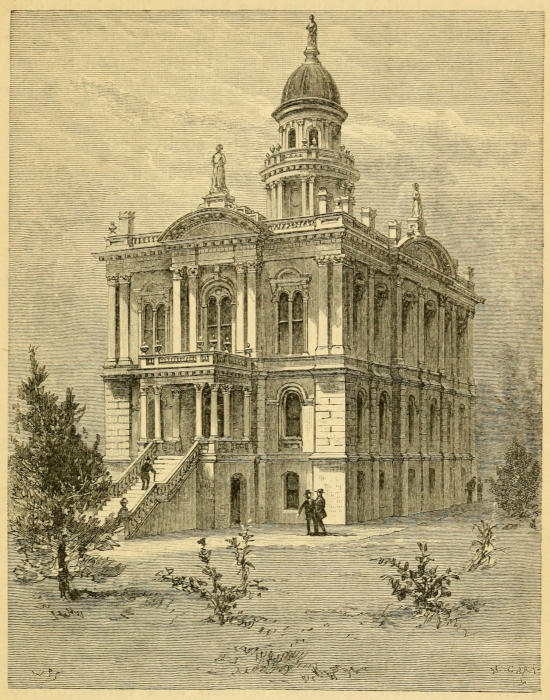
COURT-HOUSE AT FRESNO.
A sharp distinctness of outline is characteristic of these cities of the plain. Separated from the main part of Fresno by the railroad, as by a wide boulevard, is a row of low wooden houses and shops, as clearly cut out against the desert as bathing-houses on a beach. This is the Chinese quarter. It tells at a glance the story of the peculiar people who tenant it: the social ostracism on the one hand, and their own indomitable clannishness on the other.
There is now hardly any hamlet so insignificant, even in the wastes of Arizona, that the Chinese have not penetrated it, in search of labor and opportunities. Every settlement of the Pacific slope has its Chinese quarter, as mediæval towns had their Ghetto for the Jews. It is not always without the place, as at Fresno; but, wherever it be, it constitutes a close corporation and a separate unit. In dress, language, and habits of life it adheres to Oriental tradition with all the persistence the new conditions will admit.
The Celestials do not introduce their own architecture, and they build little but shanties. They adapt what they find to their own purposes, as has been said, distinguishing them with such devices that the character of the dwellers within cannot be mistaken.
A great incongruity is felt between the little Yankee wooden dwellings and the tasselled lanterns, gilded signs, and hieroglyphics upon red and yellow papers with which they are profusely overspread. Here Ah Coon and Sam Sing keep laundries like the Chinese laundry the world over. Yuen Wa advertises himself as a contractor for laborers. Hop Ling, Sing Chong, and a dozen others have miscellaneous stores. In their windows are junk-shaped slippers, opium pipes, bottles of saki, rice-brandy, dried fish, goose livers, gold and silver jewelry, and packets of face-powder and hair ornaments for the women. The pig-tailed merchants themselves sit within, on odd-looking chests and budgets, and gossip in animated cackle with customers, or figure up their profits gravely in brown-paper books, with a brush for a pen. Women—much more numerous in proportion to the men than is commonly supposed—occasionally waddle by. Their black hair is very smoothly greased, and kept in place by long silver pins. They wear wide jackets and pantaloons of a cheap black “paper cambric,” which increase the natural awkwardness of their short and ungainly figures.
Up-stairs, in unpainted, cobwebby, second stories, are the joss-houses. Here hideous but decorative idols grin as serenely as if in the centre of their native Tartary, and as if there were no spires of little Baptist and Methodist meeting-houses rising indignantly across the way. Pastilles burn before the idols, and crimson banners are draped about; and there are usually a few pieces of antique bronze upon which the eye of the connoisseur rests enviously.
Other interiors are cabarets, which recall those of the French working-classes. A boisterous animation reigns within. The air is thick with tobacco-smoke of the peculiar Chinese odor. Games of dominoes are played with magpie-like chatter by excited groups around long, wooden tables. Most of those present wear the customary blue cotton blouse and queer little black soft hat, and all have queues, which either dangle behind or are coiled up like the hair of women. Some, however—teamsters, perhaps here only temporarily—are dressed in the slop clothing and cowhide boots of ordinary white laborers.
The Chinamen are servants in the camps, the ranches, and the houses of the better class, track-layers and section hands on the railroad, and laborers in the factories and fields. What Southern California, or California generally, could do without them it is difficult to see. They seem, for the most part, capable, industrious, honest, and neat. One divests himself rapidly of the prejudice against them with which he may have started. Let us hope that laborers of the better class, by whom they are to be succeeded, may at least have as many praiseworthy traits.
The town of Fresno is as yet chiefly a supply and market point for the numerous colonies by which it is environed. These colonies straggle out in various directions, beginning within a mile or two of the town. The intervening land still lies in its natural condition for settlement. It is difficult to convey an idea of its seemingly hopeless barrenness. Instead of complaining of dry grass here one would be grateful for a blade of grass of any kind. The surface is as arid as that of a gravelled school-yard. It is even worse, for it is undermined with holes of gophers, owls, jack-rabbits, and squirrels. To ride at any speed is certain to bring one to grief through the entangling of his horse’s legs in these pitfalls. As the traveller passes there is a scampering on all sides. The gray squirrels speed for their holes with flying leaps, the jack-rabbits with kangaroo-like bounds. They run toward us, if they chance to have been absent from home in an opposite direction. Not one considers himself safe from our clearly malicious designs till he has dived headlong into his own proper tenement.
Here and there are tracts white with alkali. Flakes of this substance, at once bitter and salt to the taste, can be taken up in an almost pure condition. Elsewhere we pass through tracts of wild sunflower—a tall weed, charming in flower, but now thoroughly desiccated, and rattling together like dry bones.
This description applies, for the greater part of the year, not only to Fresno, but in an almost equal degree to Bakersfield, Los Angeles, and nearly the whole of Southern California. Without it the wonders which have been produced by human agency could not be understood. The face of nature in all this district was a blank sheet of paper. The cultivator had absolutely everything to do. He discovered on trial that he had a soil of remarkable capacity, and, with the aid of water and the genial climate, he could draw from it whatever he pleased.
Water is the salvation of the waste places, and makes the desert blossom like the rose. One’s respect for this pleasant element is, if possible, increased upon seeing what it is here capable of. It seems that, if used with sufficient art, it might almost draw a crop from cast-iron. The vegetation of Southern California is thoroughly artificial. It consists of a series of scattered plantations created by the use of water. In these the traveller finds his flowers, palms, vineyards, and orange groves, and, burying himself among them, like the ostrich with its head in the sand, he may refuse briefly to recognize that there is anything else; but, as a matter of fact, only a small beginning has been made. What has been done, however, is an earnest of what can be done. It is found that, as irrigation is practised, the land stores up part of the water, and less is needed each year. In wells, too, the water is found nearer the surface, proving that the soil acts as a natural reservoir. As time goes on, and canals and vegetation increase, no doubt important climatic changes may be looked for. In the end Southern California may be as different from what it is at present as can be imagined.
The several Fresno colonies for the most part join one another, and form a continuous belt of cultivation. On entering their confines the change is most agreeable. Close along-side the desert, the home of the gopher and jack-rabbit, only separated from it by a narrow ditch of running water, are lovely vineyards, orchards of choice fruits, ornamental flowers and shrubs, avenues of shade-trees, fields of corn, and green pastures of the alfalfa, a tall and strong clover, which gives half a dozen crops a year. Embowered among these are the homes of happy families, larger establishments for the drying of fruits and converting the munificent crops of grapes into wine. Many of the homes are as yet but modest wooden cottages. Others, of a better class, are of adobe, treated in an ornamental way, with piazzas and Gothic gables.
The most important residence is that of a late member of the San Francisco Stock Board, who has gone into the cultivation of grapes here on a large scale. It is a handsome villa that would do credit to any town. The improvements of the Barton place were in but an incipient state at the time of our visit. A great array of young vines brightened the recently sterile soil, but timidly and as if not quite certain of approval. Young orange and lemon trees in the door-yard were muffled in straw till they should have gained a greater hardihood to withstand the frosts. Elsewhere water was being run out from irrigating ditches over fields in preparation for the first time. It is the custom to soak them, in order that they may be perfectly levelled. Knolls or any other inequalities must not be left to hinder the equal distribution of water to the crop. A wide canal stretched back from the numerous out-buildings toward the horizon. On the verge of the wide plain showed the blue Sierras, veiled by a slight chronic dustiness of the atmosphere.
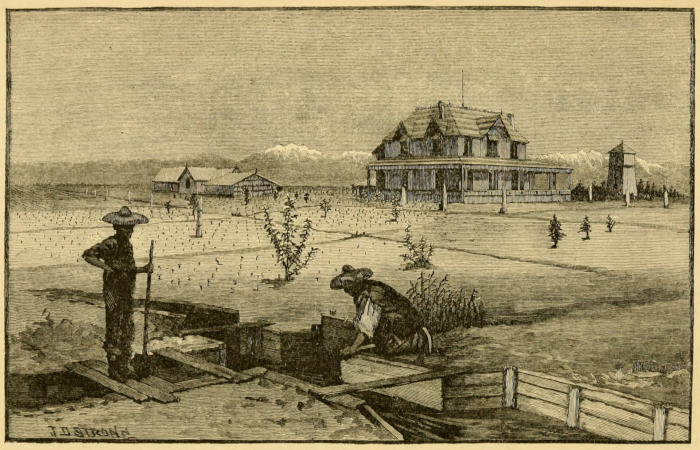
PRIVATE RESIDENCE AT FRESNO.
In the more established portions of the colonies some charming bits of landscape are found. The Chinese farm-hand wears a blue blouse and a wide basket-hat which he calls mow. He pronounces this hat “heap good” if complimented upon it. He prunes the vines or collects the generous clusters of grapes; or else he digs a vegetable garden by the side of a canal, in which himself, his vegetables, his cabin, a row of poplar-trees, and the blue sky overhead are all reflected together. Poplars, willows, and cottonwoods are planted along the canals to strengthen their banks. At Eisen’s wine-making place, for a considerable distance, oleanders in flower are seen spaced between the trees. The water runs clear and swift. At Eisen’s it turns a mill. No doubt devices for bathing in it might also be contrived if desired.
The long, symmetrical lines of trees have a foreign, or at least un-American, air. It is not difficult to recall to mind the mulberries and elms that bend over the irrigating canals of Northern Italy and drop their yellow leaves upon them in autumn like these. It might be Lombardy again, and the glimpses of distant blue the Alps instead of the Sierras. The locks and gates for the water are of an ephemeral structure as yet, made of planking instead of substantial brick and stone. The smaller ditches are often stopped with mere bits of board let down into grooves, instead of gates with handles. It is urged, however, that handles offer inducement to idlers to lift them up out of pure mischief, and waste the water.
The colonies are not quite colonies in the usual sense; that is to say, they were not founded by persons who combined together and came at one and the same time. The lands they occupy were distributed into parcels by an original owner, and, after being provided with water facilities by an irrigation company, put upon the market at the disposal of whoever would buy. No doubt a certain general consistency rules them in keeping with the names respectively set up, but it is not rigorous. Probably nothing need prevent a native American from joining the Scandinavian Colony, or a Scandinavian the American Colony, should he desire to do so.
As to the Temperance Colony, it must be sorely tried in a locality the most liberal and profitable yield of which is the wine grape. It seems hardly a propitious place to have chosen. Scoffers say that in some instances while settlers will not make wine themselves they will sell their grapes to the wine-making establishments. This I merely note as “important, if true.”
The standard twenty-acre lot, as prepared for market at Fresno, has its main irrigating ditch, of perhaps four feet in width, connecting with the general irrigating system. For twelve and a half dollars a year it receives a water-right entitling it to the use of whatever water it may need. The buyer must make his own minor ditches, and prepare his ground from this point. He usually aims to establish in his fields a number of slightly differing levels, that the water may be led to one after the other. For ground in the preliminary condition described about fifty dollars per acre is demanded. Most of the earlier settlers bought for less, and the price named strikes one as high, considering the newness of the country, and the excellent farming land to be had in the older parts of the country for less. Prices are less here, however, than at Los Angeles, Riverside, or San Diego, farther south.
It is argued in answer to objectors that though land be not nominally it is really cheap, in consideration of its extraordinary productiveness. It is held that an investment here gives better returns than anywhere, and at the same time that the climate and other conditions promise a more pleasurable existence than could be enjoyed elsewhere. This Fresno land, for instance, yields four and five crops of alfalfa a year. Vineyards planted but two and a half years are shown which produce five tons of grapes to the acre. Five years is the period required for the vines to come into full bearing. It is estimated that an acre of vines in that condition will have cost one hundred and twenty-five dollars, allowing fifty dollars as the price of the ground, and it is then counted upon for an annual yield of ten tons of grapes, at twenty dollars a ton. The rate of growth in vegetation is one of the things to note. Fruit-trees are said to advance as far in three years as in seven on the Eastern sea-board.
The personal stories of the colonists are often interesting. They have generally had some previous hard experience of the world. Such a man, working sturdily in the field preparing the ground around a new cottage of his own, lost a fortune in the San Francisco Stock Board. The funds for his present enterprise were provided by his wife, who had turned to keeping boarders, and sent him her small profits monthly until he should have made ready a place for their joint occupancy. Instances were heard of where nice properties had been secured with no other original capital than a pair of brawny hands. These, however, were exceptional. The country appears to be one where it is most desirable for the new-comer to have a small capital.
In the Central Colony a comfortable estate was owned by four spinster school-teachers of San Francisco. They had combined to purchase eighty acres. One of them lived on the place and managed it. The others contributed from their earnings until it had reached a paying basis, passed only their vacations there at present, but looked forward to making it their ultimate retreat.
The idea seems both a praiseworthy new departure in the direction of female emancipation and charming in itself. I had the pleasure of making the acquaintance of the resident manager of the experiment. Her experiences, written out, would, I think, be interesting and instructive. There was an open piano in the pleasant cottage interior, and late books and magazines were scattered about. It was a bit of refined civilization dropped down in the midst of the desert.
This lady had come, she said, for rest. She took pleasure, too, in the country, and in seeing things grow. She had made mistakes in her management at first, mainly through trusting too much to others, but now had things in good control. Four farm-hands—Chinamen—were employed. The eighty acres were distributed into vineyard, orchard, and alfalfa, about one-half devoted to the vineyard. Its product was turned, not into wine, but raisins. Apricots and nectarines had been found up to this time the most profitable orchard fruits. Almonds were less so, owing to the loss of time in husking them for market. There was among other crops a field of Egyptian corn, a variety which grows tall and slender, and runs up to a bushy head instead of forming ears. The sight of it carried one back to the Biblical story of Joseph and his brethren, and the picture-writing in the Pyramids.
The grapes for raisin-making are of the sweet Muscat variety. There was a “raisin-house” piled full of the flat boxes in which raisins are traditionally packed. The process of raisin-making is very simple. The bunches of grapes are cut from the vines, and laid in trays in the open fields. They are left there, properly turned at intervals, for a matter of a fortnight. There are neither rains nor dews to dampen them and delay the curing. Then they are removed to an airy building known as a “sweat-house,” where they remain possibly a month, till the last vestiges of moisture are gone. Hence they go to be packed and shipped to market.
One must walk rather gingerly at present not to discern through the young and scattering plantations the bareness beyond, but in another ten years the scene can hardly fail to be one of rich luxuriance. The site is flat and prairie-like, and I should prefer, for my part, to locate my earthly Paradise nearer the hills. Still, the taste of the time runs to earthly Paradises which are at the same time shrewd commercial ventures, and the cultivation of the plain is much easier than that of the slopes.
XXVII. VISALIA, BAKERSFIELD, AND LIFE ON A SPACIOUS RANCH.
I.
Visalia, capital of Tulare County, thirty-four miles south of Fresno, is one of the older towns left aside by the railroad. I put it in the most obvious way, but a patriotic Visalian, on the other hand, said to me with warmth, “Left by the railroad! Visalia left by the railroad! I guess not. It is the railroad that is left by Visalia, as it will find out.”
Visalia is reached, from the junction of Goshen, by a short branch-road of its own. It is larger than Fresno, but less animated. It has perhaps twenty-five hundred people, a court-house of the pattern described, and a United States land-office.
When the epithet “old” is used of any California town not of Spanish origin it simply means an approximation to the year 1849. The building of most hoary antiquity in Visalia dates only from the year 1852. It has been government-house, jail, and store in turn, and is now decorated with the legend “Mooney’s Brewery.” The town was founded by one Vise, an erratic person, who came across the plains from Texas, and had followed in his life such various professions, besides that of pioneer, as preacher, trader, gambler, foot-racer, and jockey. It happened that the quarter section of land upon which he settled was at the time unsurveyed, and not legally open to pre-emption. This irregularity was not discovered till years later, when the town had grown up on the site. It was brought to light by an employé of the land-office, who thereupon ingeniously undertook to pre-empt the ground for himself.
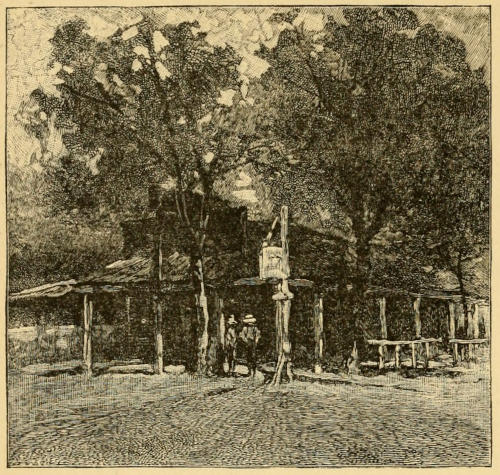
FIRST BUILDING IN VISALIA.
“And what came of this bold attempt upon vested interests?”
“The party was promptly fired out of town,” was the reply.
Visalia is rather prolific in stories, if an “old-timer” of the right sort can be happened up to tell them. Cattle kings, whose herds once filled the San Joaquin Valley, have retired hither. You may hear how Cattle King “Pat Murray” won his wife. She was a fascinating person in her youth, the daughter of a landlady with whom Pat Murray, then struggling and impecunious, boarded, in company with numerous mates. There was great aspiration and rivalry for her hand. Pat Murray stole a march in this wise. As they were setting off in company on an expedition he said, “The trip is a rough and dangerous one, boys. I propose that we leave our money and valuables with the old lady for safe-keeping.” The rest agreed, and handed over to him their property to deliver to her. The shrewd Pat Murray represented it all as his own, and obtained in this way such consideration in her eyes—as a person exceptionally well-to-do in the world—that she advised her daughter to “set her cap” at him, and all was happily accomplished before the ruse was discovered.
On another occasion—whether in this same courtship or not the chronicles do not say—Pat Murray disposed of rivals, who visited in the evenings a comely damsel of the general acquaintance, by soft-soaping the log serving as approach to her cabin across a small stream. Having thus arranged, he sat calmly enjoying the fair one’s society, and listening with appreciative ear to the splash of the successive victims as they slid off into the water.
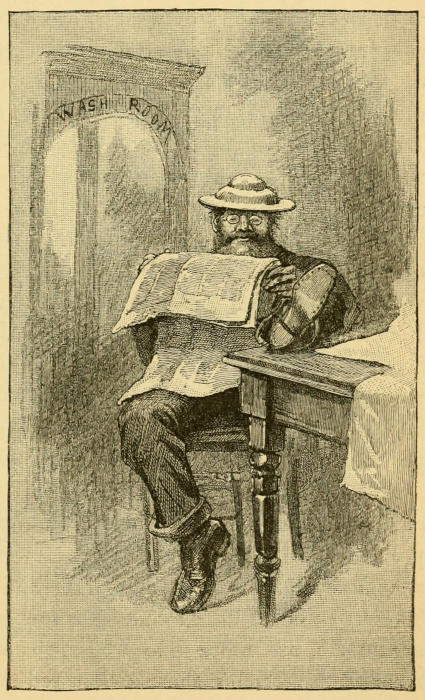
AN OLD-TIMER.
Stories are told of Spanish bandits and treasure of precious metals in the mountains, and of the wild administration of justice in early times, when offenders were occasionally executed first and sentenced afterward.
The first treasurer of the county is said to have carried the records of his office in his hat, and, being a person given to travel and of an absent mind, he scattered these documents far and wide behind him, even to the confines of Utah and Arizona.
At Visalia I first observed “Spanishtown,” a community which begins to appear regularly along-side of “Chinatown” as we go southward. It is composed of persons of Mexican blood, poor, shiftless, and not always of the most reputable character.
Charming views of the high Sierras, now powdered with the first snows of winter, are had. The surface is more rolling than at Fresno, and strewn with fine clumps of chestnut-oaks. There are big trees back in the great mountains equalling in size those of the Yosemite. Lumbermen at work there cut down numbers which, though insignificant as compared to the very largest, are monstrous in themselves.
The water for the irrigation of this district is drawn out of Kings, Tule, and Kaweah rivers by companies, who give to their principal canals such names as the People’s Ditch, the Last Chance Ditch, the Mussel Slough Ditch, and the Lower Kings River Ditch. The main ditches or canals range from twelve to forty feet in width. Wing dams confine and direct into them such portions as are desired of the wide, meandering rivers.
A California river of the south is something of a curiosity. Extravagantly wide, it is in compensation preposterously shallow. Only a few last over the dry season at all; the most evaporate and wholly disappear. Their dry beds, variegated by a few islets studded with sycamores, are more like wagon-roads than the beds of rivers. Sometimes these exhausted water-courses differ in color from the surrounding soil, and are seen stretching as rivers of gray or silvery sand through the general yellow of the desert.
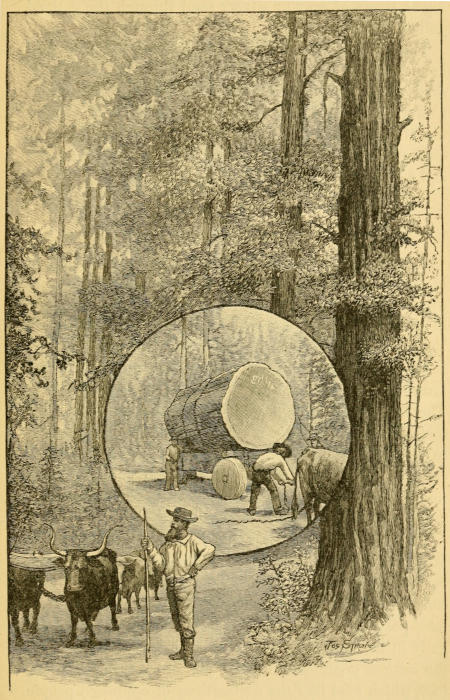
LOGGING, BACK OF VISALIA.
Though irrigation be yet in its infancy its belongings have attained great dimensions. There are three hundred miles of canals of the requisite size in Tulare County, and more than three thousand miles in California all together. One main canal, that of the San Joaquin and Kings River, has a length of seventy-four miles and a width of nearly seventy feet.
II.
A branch-road westward from Goshen, a continuation of that from Visalia, conveys the traveller to the bustling, fast-growing little towns of Hanford and Lemoore, in the Mussel Slough country. This district, adjoining Tulare Lake, was recently part desert and part swamp. It has been redeemed so as to rank now among the best farming land in California. Its chief product is wheat. The inhabitants raise hardly the vegetables needed for their own use. Malaria is rather prevalent, but it is said to arise, as in many other irrigated districts, from the careless use of water rather than the fundamental situation. The water, instead of being carefully drained off, is too often allowed to lie in stagnant pools.
The Mussel Slough was the scene, in the month of May, 1880, of a bloody conflict between the settlers and railroad authorities which has become celebrated. Officers of the law, acting for new claimants, attempted to take possession of the land under a railroad title. Legally in the wrong, though perhaps morally in the right, the settlers organized to resist, put out stirring manifestoes, which read like the declarations of oppressed people struggling for their liberty, and called on gods and men to witness the justice of their cause. In the fight that ensued five settlers lost their lives, all at the hands of a single man—one Crowe, a United States marshal, who displayed a prowess and coolness under fire never surpassed in any of the narratives of sensational literature. Crowe himself was despatched. A number of the survivors were tried for their part in the affair, condemned to eight months’ imprisonment, and served out their term in Santa Clara jail. They had but just been released, say a month before our arrival. Their brethren and well-wishers had received them on their return with an ovation, the noise of which hardly yet ceased to ring in the air.
III.
Bakersfield, capital of Kern County, seventy-five miles farther south, somewhat smaller than Visalia, boasted at one time the distinction of a malady peculiar to itself. The Bakersfield form of malarial fever, whatever the fine difference that distinguished it from others, had a position apart in the medical works. The sanitary condition of the place, however, has been greatly improved by the extension of drainage and irrigation works, and can, no doubt, be made all that could be desired.
Of the three lakes, Tulare, Buena Vista, and Kern, which make so large a showing on the map, the latter two, with their surrounding marshes, have been dried up, and the former is on its way to extinction also. These lakes had for me, on the map, a mysterious and important air. I seized the first opportunity to penetrate their mystery, by riding down to Tulare Lake on horseback. You cannot reach the margin, for fear of miring. Nor is the approach on foot much easier. The tules, or rushes, rise high above your head, and are infested with a dangerous breed of wild hogs, descended from vagrant deserters from the ranches. In such fragmentary glimpses as are had between and over the tules an expanse of dreary surface appears which may be either water or the alkali-whitened bed from which the water has receded. The vicinity swarms with wild fowl. Their multitudinous chatter has a kind of metallic clang in it. Now white, now dark, as they are before or against the sunlight, they flutter above the reeds and stubble-fields like autumn leaves blown by the wind.
The drying up of the lakes is occasioned by the diversion of the surplus waters of the Kern River for the redemption of desert lands. This gave rise to a controversy, lately settled by a legal decision which is a step in the crystallization into shape of a system of water jurisdiction for California. The great firm of real-estate men and ranchmen, Miller & Lux, owned the lands below; the almost equally great firm of Haggin, Carr & Tevis, those, for the improvement of which the water was taken out, above. The first-named complained of the diversion of the waters as a detriment to them, and an infringement of their riparian rights. Riparian right, it will be remembered, in the English common law, gives to the resident on a stream the right to have it flow as it was wont through his grounds without diminution or alteration.
The contest at first promised to be one of physical force. Miller & Lux endeavored to close the sluices at which the water was taken out. Just, as in Scripture, the herdsmen of Gerara strove against the herdsmen of Isaac, saying, “It is our water,” the hardy vaqueros of Haggin, Carr & Tevis were mustered in opposition to them, with orders to lasso and throw into the canal anybody who should interfere with the sluices. This determined show of resistance prevented a conflict, and the case went to the civil courts.
The decision spoken of holds that the doctrine which prevails in California is not that of riparian right, but that of “prior appropriation for beneficial uses.”
That is to say, the greatest good of the greatest number is consulted. The point had been raised before in controversies about the diversion of water for mining purposes. In these cases the ruling was, that the doctrine of riparian right is “inapplicable, or applicable only in a very limited extent, to the necessity of miners, and inadequate for their protection.” It was farthermore held that all of the English common law is not in force in California, but only such portions of it as are adapted to the peculiar conditions of the State. The agricultural and mining interests, therefore, are now put, in this respect, on the same footing.
Bakersfield takes its tone essentially from live stock. It has special resorts for drovers and sheep-herders. Its streets are generally full of horses, caparisoned in the Spanish style, tied to hitching-posts and awaiting their owners before the stores and taverns. The sheep-herders, a lonely race, become morose and melancholy in their long wanderings with their flocks apart from the habitations of men and human speech. They are far removed from the shepherds of Boucher and Watteau. Some are said to go insane through the monotony of their lives; and it is an occupation taken up only as a last resort, and unfitting him who pursues it for any other. Strangely enough, there is a rather English tone among them. Young prodigals of good family are found who, after trying their fortunes in Australia, India, and elsewhere, are eating the husks of repentance here in true Scriptural fashion.
The shops in Bakersfield, as throughout our travels, are kept principally by the Jews, who are great pioneers. No people are growing up more ardently with the new West; and where they are found business is pretty sure to be good.
The Chinatown is a district of compact little streets, of an extent that indicates a population almost equal to that of the rest of the place. An irrigating ditch surrounds it like a moat. The cabins along this, picturesquely reflected in it, are gray and weather-beaten, varied with patches of bright Orientalism, and shaded by a line of tall poplar-trees. The Spanishtown, close by, is a cluster of dance-houses and corrals, between which swarthy Josés and Juanitas are seen passing.
As if this were not foreignness enough already, we stumble upon a camp of strolling gypsies, their tents pitched on the borders of Spanishtown. They are English, and have come from Australia, dropping their “h’s” all along the way, no doubt, as liberally as here. They are like types of Cruikshank and Dickens. An apple-faced Mrs. Jarley appears in a large velvet bonnet with plumes. A very tightly-dressed, slender individual, with a weed on his hat, might pass for Sam Weller. He is a horse-tamer and jockey. At his heels follows a belligerent bull-dog. Behind one of the tents a child of nine, Cassie by name, with fine, dark eyes, is making a toilet before a bit of cracked mirror. She pastes down her wet hair into a semblance of the “water-waves” of fashionable society. When interrupted with a compliment on the arrangement she affects displeasure, and tosses it all abroad again with a native coquetry.
The Mrs.-Jarley-looking woman is the fortune-teller. She declares that there are persons whose fortunes she would not tell for twenty—no, not for fifty dollars.
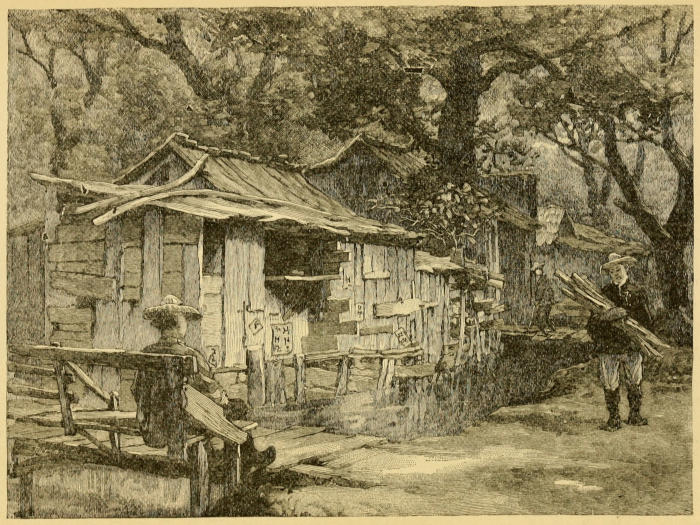
CHINATOWN, BAKERSFIELD.
Mine, however, through an especial liking she affects to have taken to me, and the dulness of trade, she promises to tell, in the most effective manner, for two dollars only.
IV.
The possessions of some of the great land-owners are prodigious. It is a favorite story that certain ones can drive a herd of cattle from the northern counties of the State to San Diego, its southern limit, and quarter them every night on their own ground. Haggin, Carr & Tevis, whose property I was privileged to examine in detail, have at Bakersfield four hundred thousand acres nearly in one body. Much of this was secured for a trifle in the condition of desert land, and has been redeemed.
One ranchman who had acquired a great estate of this kind chiefly while surveyor-general of the United States was the occasion of drawing forth one of the best bon mots of Lincoln.
“I congratulate you,” said our martyred President. “You have become monarch of about all you have surveyed.”
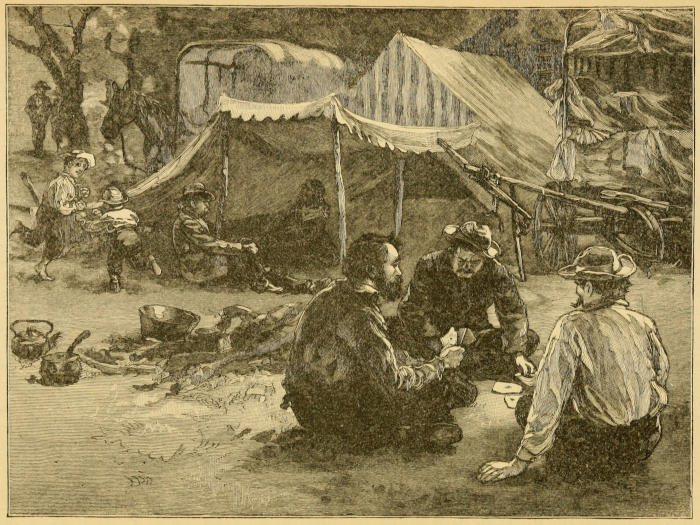
GYPSY CAMP AT BAKERSFIELD.
The owners do not often live upon their estates; they leave them in the hands of managers, and draw the revenues. The Haggin, Carr & Tevis property is divided into a number of separate ranches, each with its resident superintendent. The “Bellevue Ranch” is the centre and focus of authority. Here are the residence and office of the general manager, and a force of book-keepers, engineers, and mechanics, who keep the accounts, map, plan, supervise, construct, repair, and give to the whole the clock-work regularity of a great commercial enterprise. The numerous buildings constitute a considerable settlement. There is a “store” of general merchandise and supplies. A dormitory and a dining-hall have been erected for the laboring hands. A tower-like water-tank, surmounted by a wind-mill, and accommodating a milk-room below, rises at one side. There are shops for the mechanics, capacious barns, and long sheds filled with an interminable array of agricultural implements. It is worth while to take a walk past this collection of reapers, threshers, sulky-ploughs, and rakes, and study out their uses. The immense “header and separator” rises from the rest like a leviathan. A whole department is devoted to “road-scrapers,” “buck-scrapers,” and ploughs of various sorts used in the construction and dredging of the irrigating ditches. The soil is, fortunately, free from stones, and the work, for the most part, easy. One enormous plough is seen which was designed to be drawn by sixty yoke of oxen, and to cut at once a furrow five feet wide by four deep. Like the famous Great Eastern, it has defeated itself by its own mass, and its use has been abandoned.
More than $500,000 has been expended in the item of fencing alone. An average of four hundred laborers is employed, and, in the harvest season, seven hundred. The rate of wages is from two and a half to three dollars per day for mechanics, and a dollar per day for common hands. This seems low as compared with information from other sources, and the chronic complaints of the scarcity of farm labor, in the California papers.
No great portion of this domain appears to be in the market for settlers of small means, though the intention is avowed of offering some of it in this way when thoroughly reclaimed. Tracts, however, are occupied on favorable terms by “renters,” who take from 120 to 600 acres. Very many of these are Portuguese and Italians. They are usually unmarried, and work in companies of from six to fifteen persons. You see them, dark and swarthy, going about in the traditional Garibaldi shirt, with hardly a word of English among them.
The renter is provided with a house, artesian well, credit to a moderate amount at the store, and the use of some cows. He has the milk of these, but must give their increase to the estate. His lease runs three years, and he pays in rent one-third of his crop. Instances of large profits are frequent among these persons, and the same opportunities are open to others who wish to follow their example.
The superintendents and upper employés on the place are largely Southern men. California, was a favorite point for Southern immigration at one time, so much that the course of the State in the war, influenced by the historic Judge Terry and Senator Gwin, was considered problematical. These that I speak of, however, are gentlemen who have come here to repair their fortunes at a later period. They have for the most part titles from the service of the extinct Confederacy, and the gentle voices and friendly courtesy characteristic of the Southern type.
A typical ranch-house, that, for instance, of our hospitable friend Major McClung, on his section of the subdivided property, is a long, two-story dwelling, painted in the Indian-red so popular throughout the country. It is raised on posts considerably above the ground, to allow of a free circulation of air underneath. There is an open hall through the centre for the same purpose. An irrigating ditch resembling a moat passes in front, crossed by a little rustic bridge.
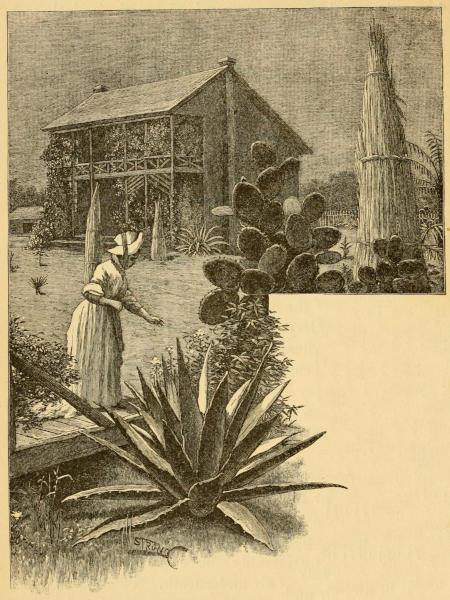
A TYPICAL RANCH-HOUSE.
Traces of alkali yet show white in the soil of orchard and garden, but do not prevent a plentiful growth of oleanders, roses, pear, peach, cherry, almond, and apricot trees. The young orange-trees were, as at Fresno, put up in mufflings of straw for the winter. The weather is very hot at noon-day, but so cool at morning and evening that wood-fires are burned. The chill in the air is of a penetrating kind, felt the more by contrast with the heat of the day, and fire is a necessity. The house-servants were clean, white-aproned Chinamen; those out-of-doors, Mexicans. One of these latter had trained a goose, “Dick,” to follow him like a pet dog, and nothing was more curious than to see the pride of both master and biped in this ridiculous relation.
Cattle-raising is the leading industry; alfalfa, for carrying the stock over periods of scarcity, is the leading crop. Stacks of alfalfa of great size, one containing seven hundred tons, were seen. It is the ordinary color of hay externally, but when cut into is green.
A successful experiment has also been made in the raising of cotton. The hands were in the field going about among the white pods for the second picking.
Though out of season, a rodeo was organized for our benefit, to show the method of handling the roving cattle on a large scale. A number of vaqueros rode out in various directions till lost to sight. Presently traces of dust arose on the several horizons. The plain, on which a few cows had been peacefully feeding, was filled with stamping and lowing herds, driven toward the centre by the careering vaqueros. When gathered in sufficient numbers feats of lassoing the animals, by either leg or horn, separating special animals or classes, and the like, were undertaken, and carried through with marvellous dexterity. As a culmination, hats and ropes were picked up from the ground, the rider going at full speed. A silver half-dollar, placed on edge in the dust of the roadway, was seized after several attempts by a swarthy Aztec.
The herders are usually Mexicans, equipped in the Mexican style, but with the greater part of the finery left out. The bosses, who often even excel them in pure horsemanship, are generally Americans.
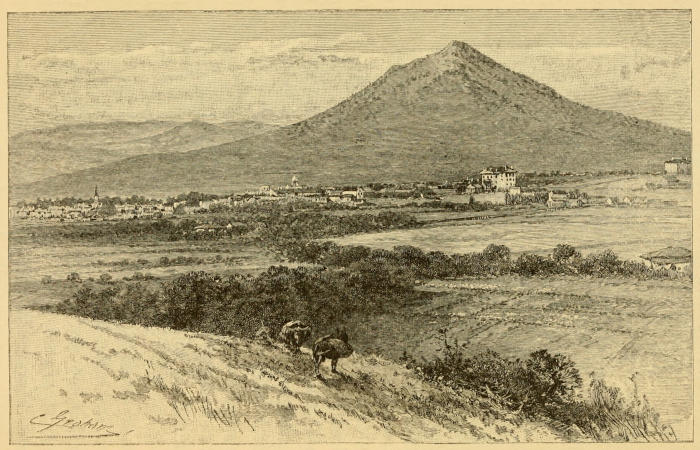
SAN LUIS OBISPO.
The ranch known as the Livermore borders Kern and Buena Vista Lakes, and is the southernmost in the tier. The herds are gathered there in the early spring, and driven to the ranch of San Emidio, in the mountains. They pick up their subsistence at San Emidio till the middle of September, when they are conducted back again. Such migrations from plain to mountain pasture, and back again, recall some features of the Norwegian pastoral life of Boyesen’s charming romance, “Gunnar.”
At the Livermore Ranch you are at the apex of the San Joaquin Valley. Here the Sierra Nevada and the Coast Range effect a junction, and oppose a natural barrier to farther progress. The railroad has to cross this barrier by a wonderful piece of engineering, the Tehachapi (Te-hatch-a-pe) Pass. At one place five different lengths of track pass and repass at different levels. By the singular “Loop” the road enters a tunnel, emerges, twists spirally round the mountain, and reappears directly above itself.
At San Emidio we are on the boundary-line of San Luis Obispo County, and could make our way directly, no doubt, to its pretty, mountain-encompassed capital. This is more easily reached, however, with attractive Santa Barbara below, by steamer, or stage-road along the coast.
Returning to Bakersfield, you may ride west to the wild cañon of the Kern River, and the mining towns of Kernville and Havilah. The mining industry has never taken the same development south of the San Joaquin River as north. It is probable both that there is less ore and that the ventures have been managed with less skill. At Kernville is a quartz-mill, with a hundred stamps, which after many vicissitudes has fallen into the hands of its former workmen for debt, and is now run by them on the co-operative principle.
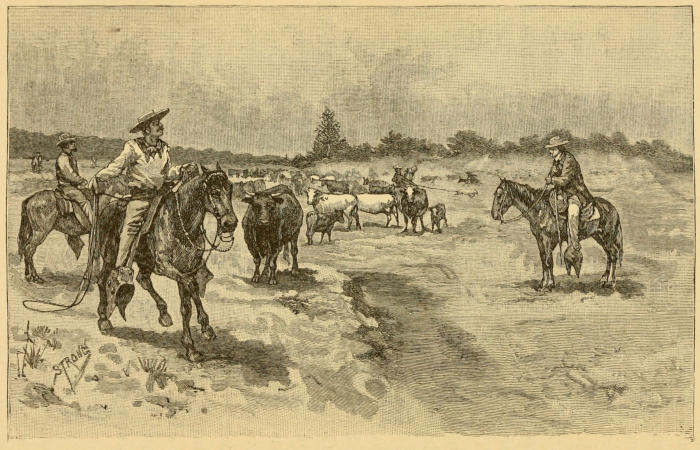
A RODEO.
The rolling country by which the Kern River Cañon is approached is, if possible, even more desolate than the plain. There is almost a necessary connection in our usual impressions between hills and trees, and when foliage is missing from hills its lack is doubly notable. An utterly parched, verdureless surface, with a texture like that of gravel, here follows all the inequalities of the ground, up hill and down dale, to the savage and splintered granite gorge.
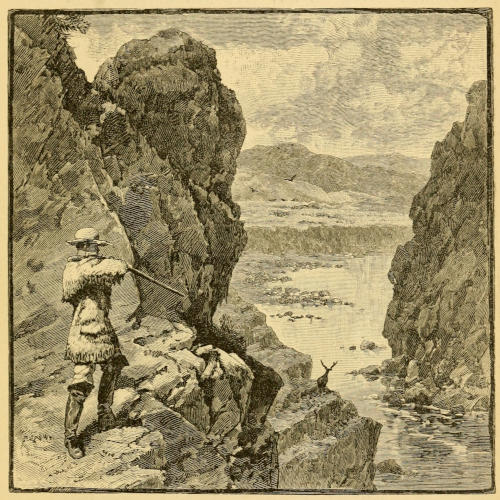
THE KERN RIVER CAÑON.
We fell in with an isolated sheep ranchman, “Captain Jack Barker,” an enterprising man, who had created a garden spot in the waste, and showed what even this is capable of. He was engaged on a project for leading the water, by means of a flume and ditches, from the river at the cañon’s mouth down upon several thousand acres of land under cultivation. In the spring-time, he told us, all this bareness is hidden by a perfect carpet of flowers, chiefly a small orange-scarlet poppy. His sheep at present seemed living on air. He had among them some Angora goats, a hardy animal, once very profitable, but now, since the decline in alpaca-goods, being used by him for food.
The Kern River tumbles down a gorge four miles in length, between granite walls six hundred feet high. Its water is translucent green in deep, untroubled pools, again churned into milk-white floods, with black bowlders among them. The cañon is all but impassable. It acts like a funnel, and produces a local disturbance of its own on the atmosphere. While all around is still, a column of air will blow out of it, and, striking the table-land a quarter of a mile away, raise a chronic dust at the point of contact, like a cannon-shot.
Driving across the front of it we were nearly blown out of our wagon. We descended into it, nevertheless, and upon this experience returned to dine on ribs of Captain Jack Barker’s Angora goats, and then take the railway and cross the Tehachapi Pass.
XXVIII. LOS ANGELES.
I.
Over the Tehachapi Pass, we are in Southern California proper. We have met already, it is true, with pretty Spanish names, old missions, leather breeches, jingling spurs, vineyards, raisin-making, and occasional orange and palm trees. But when the dividing mountain-range, four thousand feet above the sea at Tehachapi, is passed, all these are found in their greatest development. The country is older, the Spanish names are more musical; orange and lemon are not grown for ornament, but as a principal crop; and the climate is of that genial mildness which is most to the taste of seekers for health.
Famed Los Angeles, City of the Angels, is the terminus of the first day’s journey which brings us into it. The watering-place of Santa Monica and the important points of San Buenaventura and Santa Barbara are not far distant to the west, while San Diego lies at a moderate remove to the southward, near the Mexican frontier. In the intervals scatter colonies of vine and orange growers, the numbers and dimensions of which are rapidly increasing.
The mountain barrier across the State is deemed by some to be of such importance that it should be a political as well as a natural division. They call for the construction of a distinct new State, to be called South California, its capital at Los Angeles.
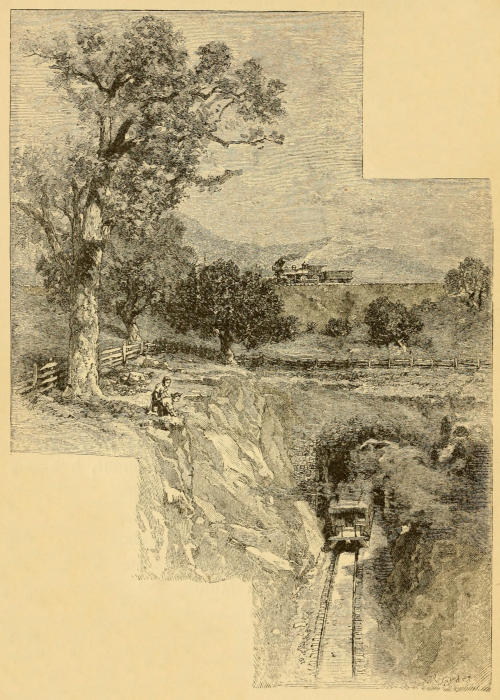
TEHACHAPI PASS.
“We are different peoples,” writes one of them in the Californian. “We are different in pursuits, in tastes, manner of thought, and manner of life; ... our hopes and aspirations for the future are different. The restless, uneasy population of the North, ever drifting, without local attachments, has no counterpart in Southern California; neither has the wild spirit of mining speculation ever flourished here. With this peaceable life, possibly in part as a result of it, there has grown up in the people an intense love of their land.
“And it is for their own section of the State,” he goes on, “that this love exists. They call themselves, not Californians, but Southern Californians. The feeling is intense. I can only liken it to the overmastering love of the old Greek for the sunny shores that lay around the Ægean.
“For myself, I feel more and more each time that I visit the upper portion of the State that I am going into a strange land. And the impression never leaves me till upon my return I look down from the crest of the Tehachapi over the warm South-land.”
I have thought it worth while to quote these passages, partly because they are amusing, partly because they accentuate the topographical situation, and also because they attribute a character almost the opposite of that which exists. Everywhere is bustle, push, and enterprise. This people will sell you a corner lot or quarter-section of land with as great a gusto as any other, and at its full value. Whatever effect lapse of time may have upon them, the present inhabitants, few of whom are born here or even drafted from indolent climes, if lotus-eaters, are of a very wide-awake sort.
II.
The City of the Angels is, in general, only another San José, upon a more hilly site. Its population must be about fourteen thousand. The long thoroughfare of Main Street proceeds, from the depot, at first through a shabby Spanish quarter, locally known as “Sonora,” consisting of one-story, whitewashed, adobe houses. Passing a small Spanish plaza, set with pointed cypresses, and the principal hotel, the Pico House, it becomes lined with excellent buildings of the modern pattern. Of these the handsome “Baker Block” is most notable. Continuing to the ornate “Los Angeles Bank,” Spring Street diverges at a small angle, and contributes, with Main Street, to give the commercial skeleton of the town the shape of a Y with a very long stem.
On Spring Street you find a common little post-office, the municipal offices, and a brown, Dutch-looking, brick building, standing free, originally constructed for a market, and now the Court-house. If you look into the lobby of the small adobe jail you will find that some leisurely prisoner of the frescoer’s trade has converted it into a resemblance to a dungeon scene at the theatre. These two streets, with a shorter one, Los Angeles Street, parallel to Main, containing fruit and produce commission houses, comprise the commercial portion of the city.
New buildings are seen going up; the shops are large and well-appointed, and placards offer, in the usual shibboleth of trade, “To Reduce Stock!” “At Wholesale Slaughter,” and “For the Next Sixty Days.”
A serious depression afflicted Los Angeles in 1875, at the time of the general depression throughout the State, but that has been succeeded by a new reign of activity. Trim, large residences of the more prosperous merchants are seen in the outskirts of the town. Farther out yet these become villas, in the midst of plantations of orange and lemon, ruled off into formal plots by ditches for irrigation. The class of modest means abide in the side streets, in frame cottages. The German Turn-hall serves also the purpose of theatre for such companies as come this way.
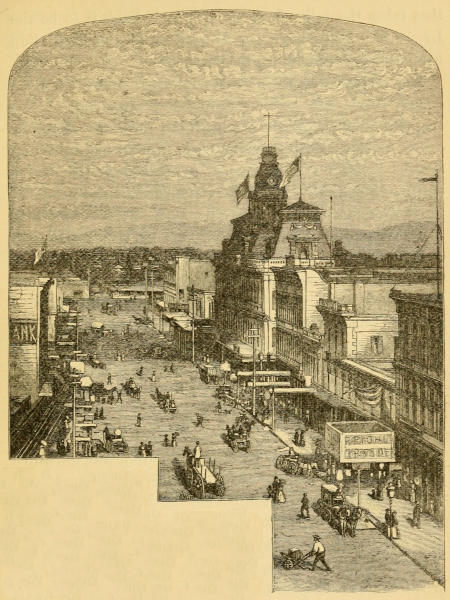
MAIN STREET, LOS ANGELES.
It is held that Los Angeles, with its port of Wilmington, thirty miles away, should be now, upon the completion of the Southern Pacific railroad, the entrepôt and Pacific terminus of a new commercial departure. San Francisco, it is said, has too long sat at the Golden Gate “levying toll on every pound of freight that passes through,” and this selfish greed is to be properly rebuked by the diversion of a part of its trade. Enthusiastic San Diego expects also to have its share. The wickedness of the proceeding would seem to depend largely upon who it is that takes the toll. Los Angeles, it is held, is to be the Lyons, and San Diego the Marseilles, of the State, San Francisco still remaining its Paris.
The pepper-tree, with its scarlet berries and fern-like leaves, forms the leading shade and ornament of Los Angeles streets. Apart from these a clump of palms grows on San Pedro Street, and, before an odd, octagon-shaped house on Main Street, a Mexican nopal of the size of an apple-tree. In the court-yard of the principal hotel droops a single ragged banana. Tropical features in the vegetation are scarce, but it is evident that this is not the fault of the climate, but of failure to encourage them. In the door-yards are the Mexican aloe and the Spanish bayonet, from the adjacent deserts of Mohave and Arizona. The castor-oil plant grows a tall weed in neglected places. The extraction of castor-oil was at one time an industry of the place, but is now abandoned.
III.
The Mexican element must be something like one-third of the entire population of the place. In the Spanish town, “Sonora,” the recollection of Mexico is revived, but a very shabby, provincial Mexico. You find mescal and tequila, the two varieties of intoxicating liquor distilled from the maguey, or aloe. The dingy little adobe shops contain samples of dingy little stocks of goods in their shuttered loop-holes of windows. A few swarthy, lantern-jawed old-timers hang about the corners, and gossip in patois, and women with black shawls over their heads pass by. Much of the quarter is in a ruinous condition. There remain vestiges of the arcade system of the kind known in some form to all tropical or semi-tropical climates. The arcades of Sonora are not of massive brick and stone, but are wooden roofs, such as are put out by our corner grocers, on light wooden posts. Here and there only the battered skeletons remain, attached to ruinous houses. Most California municipalities have borrowed something of this Spanish idea. At Sacramento the thriving but flat and not attractive capital of the State, you can walk nearly all over the business part of town under cover.
There is a very respectable-looking restaurant—a vine-embowered cottage—opposite the Pico House, where the familiar tortillas, or pancakes, and frijoles, or stewed beans, may be had. Along-side is an adobe church, quaint in pattern, but modern and devoid of farther interest. From its belfry the chimes jangle loudly several times a day in familiar Mexican fashion. Out of Sonora emerges, on the 16th of September, the Juarez Guard, which escorts a triumphal car bearing the national colors of red, white, and green, and, aided by a cortége of dark little maidens, in white muslin and slippers, proceeds to celebrate with appropriate ardor the anniversary of Mexican independence.
This people, who have gone so much to the wall, wear no very pathetic aspect in their adversity. They are for the most part engaged in coarse labor, are improvident, and apparently contented. It is only rarely that a Spanish name—a Pacheco, a Sepulveda, or Estudillo—rises into prominence in the public affairs of the State of which they were once owners. Old Don Pio Pico, the last of the Spanish Governors, resides here, impoverished, in a little cottage, in sight of property of great value which was formerly his, and of the plaza once the centre of his authority.
Don Pio is one of the picturesque features of Los Angeles, and with his history would be esteemed interesting anywhere. Above eighty years of age, with stocky figure, square head, and bright eyes, contrasting with his bronzed skin and close-cropped white hair and beard, he has a certain resemblance to Victor Hugo. He has a rather florid taste for jewelry. He carries himself about town, in his short overcoat with velvet collar and cuffs, with a bearing still erect and stately. It is strange to tell, but true, and it is evidence of the conservatism and lack of adaptability of his race, that the old gentleman, though once Governor of the State, and a continuous resident of it, as an American citizen, since he surrendered it to Fremont and Stockton in 1847, does not yet speak a word of any other language than Spanish. The talk of this historic personage gave but a rude picture of the state of society in his youth. Was there anything in the world so remote as the California of the years 1810 to 1848?
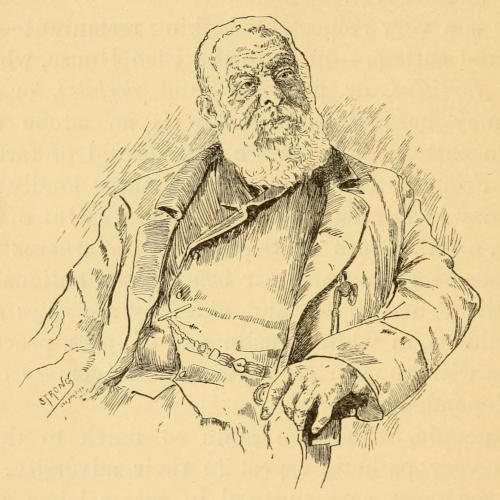
DON PIO PICO.
“I am but a plain and unassuming person,” he said to me. “My father did not leave me a mule nor a vara of ground. I worked for the padres at the San Gabriel Mission when I was a boy, and I had little opportunity to learn book knowledge.”
He disclaimed being an authority even on the events of his own fall and the encroachments of the Americans. “There are many,” he said, “who have a better head for those things than I, and who will tell you better than I.”... “I was a just man, however. I treated the rich no better than the poor. Hence when they asked who was lo mas justo y honrado—the most just and honest man—for Governor, it was answered with one accord, ‘Don Pio Pico.’”
There are differences of opinion about those ancient officials. Some of them have been charged with a wholesale issue of land-patents after the American occupation, which patents ostensibly belonged to their respective administrations. Edwin M. Stanton, sent out to look into these matters by the Attorney-general of the United States, reported at the time that “the making of false grants, with the subornation of false witnesses to prove them, has become a trade and a business.”
The treaty of Guadalupe Hidalgo, in 1847, by which the war with Mexico was concluded, made valid and of full force whatever had been done before the American occupation. Spanish governors were numerous in those last days, and went in and out of office with extraordinary frequency, by reason of plots, counterplots, and the inability of the home government to enforce its own will. Alvarado, Carillo, Micheltorena, and Pio Pico reigned separately, or together, or by turns, in a revolutionary, confused, and overlapping way, which furnished excellent opportunity for fraud. One prefers, however, not to linger upon unpleasant suspicions, but rather to esteem these fallen dignitaries, few of whom now survive after their misfortunes and romantic histories.
MONGOLIAN AND MEXICAN.
Even the Chinese, singularly enough, show greater enterprise than the Spanish. Perhaps they may have a somewhat better warrant for coming in here than elsewhere, since a Chinaman is found in the list of the twelve original settlers of the town, in 1781. They have pushed into the best of the old Spanish adobe houses, once the best of their kind in the State. They occupy all those which flank the little plaza with an entire street, others debouching from it.
The populace, however, have not always been the better reconciled to the hapless Mongolians. In an outburst of deadly prejudice, in the year 1871, they were dragged out of their Spanish houses and hung to lamp-posts, wagon-tongues, and their own door-ways, to the number of eighteen, of all ages and sizes. The riot was occasioned by their resistance to some process of a deputy-sheriff. My informant described them to me as hanging like bunches of carrots.
At present they were putting up, near the site of these sanguinary scenes, an ornate open-air theatre or temple, for a triennial religious festival, to last a week or more.
IV.
One of my pleasantest days at Los Angeles was that which I spent in a drive with the Zanjero.
The Zanjero, indeed! who or what is a Zanjero?
His title is derived from the Spanish zanja—ditch—continued down from the times of the original settlement, and he is the official overseer of water and irrigation. He took me about with him to observe this important and entertaining part of the economy of civilization in these thirsty regions. Not that Los Angeles is so dry in comparison, for it has thirteen inches of rain against two at Bakersfield, but it is in abundant need of irrigation.
The Zanjero is elected by the City Council annually. Six deputies aid him in the summer, reduced to three in the winter, when the rains render irrigation hardly necessary. All are invested with the authority and badges of policemen.
The city, the Zanjero tells us, as we ride along, controls in its corporate capacity all the waters of the Los Angeles River. The Los Angeles River is a Southern California stream of the typical sort. It has a wide, shallow bed, almost dry at the moment, but in spring and winter it brawls in dangerous fashion, and often carries away its bridges. We ride up to the point near a certain railroad bridge where the water is first diverted. It is taken out by two small canals, one for the city proper, one for the thriving suburb of East Los Angeles. We find that the dam by which the river is checked for this purpose is constructed of earth, with a facing of stout posts and planking. At the beginning of winter the planking is removed, and the stream allowed to sweep away the rampart of earth, which is replaced by a new one, the succeeding spring. Chain-gangs of convicts from the prison are set upon this labor.
A canal is taken out of the same river twelve miles above, which supplies water for drinking and irrigating the higher levels. There are two very different levels in the configuration of the city, one rising from the other with great abruptness, as at Santa Cruz.
Upon the height are remains of the fort built by Fremont when he entered the city. Directly at its foot is the cottage of Pio Pico; the big hotel, still bearing his name, in which he sunk a handsome share of his fortune; the little cypress-studded plaza; and the shabby white quarter of Sonora. The mass of the city lies to the right, without striking features. Beyond it, toward the river, stretch breadths of a russet bloom which we know to be vineyards, together with lines and parallelograms of orange and eucalyptus, as formal as the conventional trees in boxes of German toys. Across the river, “Brooklyn Heights” and “Boyle Heights” rise to a wide, rolling table-land (mesa), which extends back to the blue Sierra Madre Mountains. Toward most of the horizon stretch expanses of a garden-like vegetation of a mysterious quality—the dreamed-of orange-groves in mass.
The city has created a considerable part of its debt by its water system, in which it has spent probably $200,000. The works are of an ephemeral character, which will in time be replaced by something more substantial. The simple trenches and wooden flumes permit of wasted water, and are costly to keep in repair. One of the principal ditches, however, is carried through a hill some three-quarters of a mile in a tunnel of six feet in section. There have been formed also numbers of durable reservoirs or artificial lakes for the storage of additional water in winter to supplement the river at its lowest.
We rode out among the villas and gardens and observed the practical application of the water. The main ditches are three feet by two, the lesser about two by one. The “head” is the nominal standard of measurement of the babbling fluid. The head should be a section of one hundred square inches, delivered under a certain uniform pressure, but it is in practice loosely administered.
“The irrigators want their work done” says the Zanjero; “that is the main point. Some lands take more, others less, according as they are sandy or hold water. A head of fifty inches on the east side will do as much as one hundred and twenty around the city.”
Fan-palms, India-rubber-trees, and tall bananas grow freely on the lawns where a little pains is taken. You stop now to exclaim at a comfortable home embowered in myrtle, orange, and vines, the dark, glossy foliage starred with golden fruit and red roses, a spot for any romance. Again, it is a long arcade or temple of arborvitæ, extending across the whole front of a garden, and framing in its arches delicious views of distant blue mountains, their tops now powdered with snow.
This land of running brooks should be a famous place for the children to sail their boats, though as a matter of fact we do not see them doing it. Perhaps there is a law against it. There are laws, at any rate, against stealing the water, wantonly raising the gates to waste it, or transferring it to irrigators outside the city limits. These latter are entitled to it only upon an extra payment and after those within the city have been supplied.
As all irrigators cannot be supplied at once, the manner of serving it out is as follows: Applications have to be made in the last week of each month. The Zanjero then apportions the supply so that it may go round among the applicants in the most convenient way. The complete circuit takes about twenty days. The applicant receives a ticket, on the payment of a fee, entitling him to receive the water on such a day at such an hour. The right for that time is exclusively his. The rates are so fixed as to reimburse the public treasury, and are not intended as a source of profit. The average charge for water is about fifty cents an hour, two dollars a day, and a dollar and twenty-five cents a night.
The subscriber has the water delivered to him by the deputy at his connecting-gate. At all other times the gate must be kept fastened with a padlock. The wooden gate, sliding smoothly in its grooves, is like a little guillotine.
Chop! goes the guillotine, when it has been raised long enough, and off goes the head, as it were, of the little stream. Thus surprised on its way among the orchards and gardens, it writhes and twists a while, rises again in its confining box, and is soon ready to begin life again on a new basis.
V.
Los Angeles is the metropolis of the orange trade, but the greater part of the culture itself is in tracts of the surrounding country, each with a thriving settlement as its nucleus. The lands are usually laid out and subdivided by capitalists, under the “colony” system, as described. Ten or even five acres in a crop of such value are a comfortable property. On Lake Guarda half an acre in lemons is sufficient for the support of a family. It is in evidence here that returns of from $500 to $1000 an acre are had from orange, lemon, and lime, after the trees have arrived at full bearing.
The piazzas of the orange-planters command attractive views; rose and heliotrope bloom round them; and specimens of all the fruits are offered for our tasting with lavish hospitality and honest pride in their perfection.
We begin with Pasadena, which is reached by a drive of ten miles from Los Angeles. Pasadena, the Indiana Colony, San Gabriel, the Lake Vineyard tract, the Alhambra, Santa Anita, and Sierra Madre tracts, and others, all of the same general character, adjoin one another. The dwellings in them are those of people of means and a certain taste. Even the least show ambition. There are pretty chapels in the Gothic style, and neat schoolhouses. Well-dressed children of a city air are met with on the roads. The roads are excellent. No violent storms or thawing snows in this climate tear them up, and they are kept in order with little trouble.
The door-yards are enclosed with hedges of lime, arborvitæ, or rose-bushes. Curious small circles from time to time attract attention, either filled with water, or dry, like the rings of a departed circus. These are reservoirs, supplementing the irrigation system. They are usually filled by artesian wells, which flow from iron pipes a few feet above the ground, the water overspreading the top in a thin film, like a globe of glass, reflecting neighboring objects. Such globe-like films, sparkling from a distance, are a frequent item in the prospect. As there has never been any forest, no unsightly stumps indicate recent clearings. The country, in consequence, does not look new. Where settled at all, it has a surprisingly old and civilized air.
The temperature, this late November day—on which there are telegrams in the papers of snow-storms at the North and East—is perfection. It is neither hot nor cold. A sybarite would not alter it. Bees hum in the profuse clusters of heliotrope about the porches. A single Jacqueminot rose on a tall stem, a beauty whose sway will not be gainsaid, makes its vivid crimson felt from the greensward a long way off. Among the older estates this is pointed out as the home of “Don Benito,” that of “Don Tomas,” so and so, the family name being usually American. Audacious in love as in other things, enterprising Americans have married into the Spanish families, both before and since the conquest, and succeeded to their acres. Very few of Spanish stock still retain any property of note.
If there be or ever existed any real earthly Paradise, I think it might bear some such complexion as that of the Sierra Madre Villa, on the first bold rise of the mountains at San Gabriel. I cannot vouch for it as a hotel, for hotel it is, but I vouch for it as a situation.
The air was heavy with the fragrance of extensive avenues of limes as I came up to it. The orange-trees were propped up, to prevent their breaking under their weight of fruit. Forty oranges on a single bough! I saw it with my own eyes. Some of the trees, by the freak of a recent gale, had been denuded of their leaves, which left only the globes of golden fruit, a lovely decorative effect, on their bare stems. A view of thirty miles is had across the garden-like San Gabriel Valley, to a strip of blue sea on the horizon. On the strip of blue sea rests a slight brown spot, the jewel of Santa Catalina Island.
PARADISE.
Flowering vines clustered along a piazza, part enclosed in glass. In a warm nook a couple reclined in steamer-chairs, one reading aloud a novel in a gentle murmur. They were a couple of recent date, and as the place for a honey-moon it was ideal. The orange bears a close resemblance to the formal tree which the mediæval painters used to represent as the “tree of the knowledge of good and evil” of Genesis. It is appropriately placed, therefore, in our earthly Paradise.
Hist! The young woman who had been reading takes her stand archly at one side of such a tree. The man who had been listening rises also, and, with a slight yawn, places himself on the other. Oh, what is this? Is she a new Eve? She plucks a fruit, and hands it to him. Oh, this is terrible! Is there to be a fall again in Eden, and all its direful consequences? There should be some Cranach or Dürer here to take down once more the particulars of the distressing scene. What does Eve wish Adam to do? Perhaps she wishes him to buy lands—above their value—and go into orange-planting himself. Alas! he will be lost forever to the higher financial life. Perhaps Satan is the invidious real-estate man.
But really there is no pressing need of such a display of fancy because a young matron offers her husband a fresh orange before dinner.
Certain drawbacks—drawbacks attending upon an injudicious entering into this apparently fascinating kind of life—should not be overlooked. The orange-tree grows all the time, and calls for incessant care, winter as in summer. Not a few invalids who had looked to its culture as a pastime have broken down through this cause, and through having taken up more land than they could manage. The lesson of such cases is, not to attempt too much, but to keep to the five, or ten, acres, as the case may be, within one’s capacity. Nor has it been politic to put everything into the single crop of oranges. The smaller fruits—peaches, plums, and especially apricots—for canning, which come into bearing quickly, are useful in tiding over the tedious period of waiting for the orange-trees to mature, and are always in profitable demand. To start existence comfortable here the new-comer should have a capital of from five to ten thousand dollars, though peculiar energy may do with less.
It requires about nine years to bring an orange-tree from the seed into full bearing. On the other hand, it is found that by deftly inserting an orange-bud into the bark of a lemon-shoot slitted in an X, and setting this in the ground, a tree can be obtained which bears marketable fruit after the second year. The controversy rages as to whether it is worth while to do this, since the product is dwarf, like the dwarf pear-tree. Though it yield early it will never yield much, and its fruit does not stand shipment as well as that of the seedling. Against this it is maintained that it lives longer than the seedling, and yields choicer varieties of fruit, and that the fruit is more uniform in size and quality, and not subject to a singular form of destruction which sometimes overtakes that of the seedling—being dashed upon its own thorns.
In the same way conflicting theories of irrigation prevail. A person who bought grapes in large quantities for the purpose of making them into wine told me that over-irrigation was rendering them watery and insipid. He proposed to meet this by establishing a standard. He would pay twenty dollars a ton for grapes containing twenty-three per cent. of sugar, and for those below standard less. Plentiful irrigation, however, is relied upon to counteract that fatal pest of the vine, the phylloxera. Some advocate the theory of irrigation in the winter or rainy season only. All the water possible is to be conducted upon the land at the time it naturally falls, leaving the soil to act as its own reservoir, and store up a portion for the dry season ahead. Others even deny the need of irrigation altogether. They write to the papers that it is only necessary to keep the surface well scratched with a cultivator, and a supply of moisture will always be found a few inches below it. It is certain that crops both of grapes and the cereals have been produced from unirrigated ground, even for a series of years. But then comes a dry year, in which everything, animals as well as plants, is scorched from off the face of the earth.
“Certainty is what is wanted,” says a lively informant. “You may not need water, as you may not a revolver, all the time; but when you do, you need it awful bad.”
VI.
In the plain, just under the mountains, lies the old village and mission church of San Gabriel. The mission dates from 1761. It was founded, like the other missions of California, by friars sent out from the college of San Fernando, in the city of Mexico. I recollect well the original San Fernando. It stands on the street which was the scene of Cortez’s disastrous retreat from the city, and is marked with an inscription commemorating the famous Leap of Alvarado.
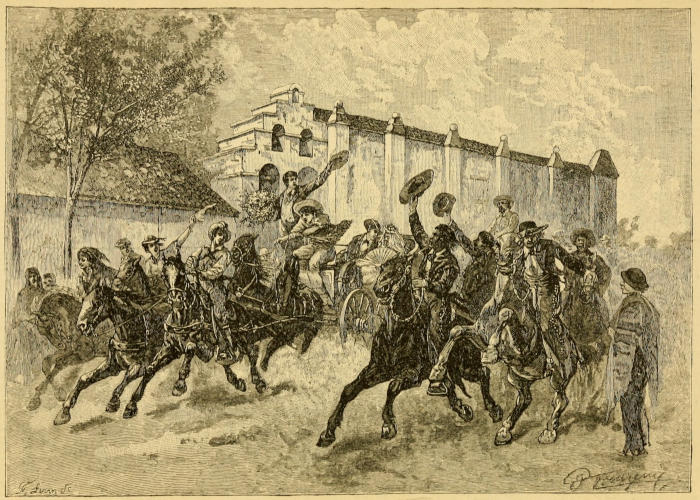
A MEXICAN WEDDING AT SAN GABRIEL.
The Mission of San Gabriel is worthy of its picturesque origin. It has the same massiveness, color, and quaint rococo details, including the peculiar battlement, or Spanish horn of dominion. Six old green bronze bells hang in as many niches together. The fern-like shadows of a line of pepper-trees print themselves in the sunshine against the time-stained wall. No more than the church edifice now remains. Great agricultural establishments connected with all these missions were swept away, years before the American occupation, by edict of the Mexican government. Some bits of broken aqueduct, and a few orange-trees, above a hundred years old, in what was once the mission garden, are the only vestiges of former prosperity. The interior of the church contains a few battered old religious paintings, the worst of their kind. It is doubtful if the luxury of really good pictures was ever superadded to the excellent architecture, for which there was a natural instinct. It is a commentary on the popular estimate in which the poor old masters are held, I fear, that I was told by the neighborhood:
“You must see them. They are all Raphaels and Michael Angelos.”
The village is piquantly foreign. Its single street is composed entirely of white adobe houses. One of them, with a tumbling, red-tiled roof, is so full of holes that it looks as if it had been shelled. All the signs are in Spanish. Here is the zapatero, or shoemaker, and here the panaderia, or bakery. The south walls are hung with a drapery of red peppers drying in the sun to prepare the favorite condiment. The population are a humble class, who gain their livelihood for the most part by day-labor on the surrounding estates. They are not too poor, however, to retain their taste for festivity still. On the occasion of some notable wedding among them they will manage to mount on horseback, and, surrounding a bridal carriage, driven postilion-fashion, return from the ceremony, at the old mission, whooping and firing pistols in the air, in the most gallant and hilarious fashion.
Near by is the large estate of Sunny Slope, known as one of the most successful instances of the putting in practice of the sanguine theories about the country. It has been acquired, and developed, from very small beginnings. It consists of some nineteen hundred acres of land, most of it in vines and oranges. There is a large wine and brandy making establishment. Eight thousand boxes of oranges and lemons, four hundred thousand gallons of wine and one hundred thousand of brandy, have been produced in a year.
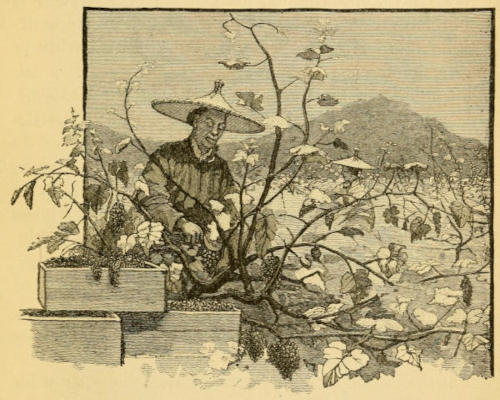
THE VINTAGE, SAN GABRIEL.
The dwelling-house was approached by a stately avenue of orange-trees, in double lines, three-quarters of a mile in length. The road to the large, substantial buildings of the winery was bordered by an orchard of orange on one side and olive on the other. The vineyards stretched out in distant effect like vast reddish-tawny meadows. At the winery, blacksmithing and cooperage were going on on a large scale, and a deft Chinaman was constructing the orange-boxes. The rich juice of the grape poured in floods, and its more concentrated form as brandy came from its still as clear as water. All distilled spirit is naturally colorless, and the hues it obtains for market are given by burned sugar, to gratify an artificial taste.
The hands are Chinamen and Mexicans. The superintendent tells us that the former do the most work and get less pay, but that there are certain things which they cannot do. They cannot plough, nor prune the vines, and they are awkward in the management of animals. Indeed, a Chinaman on horseback, or even in a wagon, seems almost as incongruous as Jack Tar.
We visited, one evening, the Chinese quarters, and it would have been hard to find a more clean, domestic-looking interior among men of any other nationality in the same circumstances of life. They seemed much more orderly in their arrangements than the Mexicans, either those from the village or those who had a settlement on a bold slope of the estate above.
There is much native Indian blood among these latter, and their dwellings were half wigwams, patched up of rubbish. Mongrel dogs, a donkey, and a foundered horse wandered at ease among them. A reddish-brown urchin, with large, liquid eyes, coming out, paused to gaze at us.
“Cor-r-re, demonio de muchacho!” (R-r-run, demon of a boy!) cried a slatternly mother, who appeared behind, endeavoring to urge him upon some errand of peculiar expedition.
But the demon of a boy, exemplifying the traits of his race, had no idea whatever of being in a hurry. On the contrary, having removed to a safe distance, he dawdled in the most exasperating way, and continued to stare round-eyed during all of our critical tour of inspection.
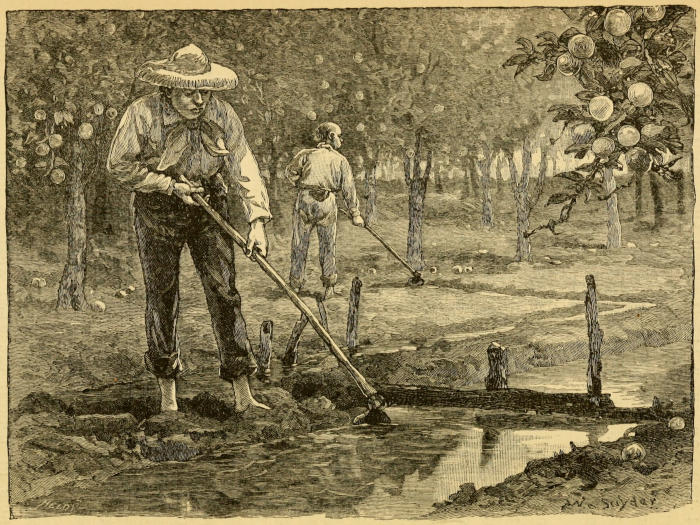
IRRIGATING AN ORANGE-ORCHARD.
The work of the year was now the pruning of the vines. Stripped of every superfluity, the rugged little stocks, regimented veterans, were to stand bare till the exuberance of a new spring should again break forth in leaves. Faustino, Gaetano, Incarnacion, and the rest, for so they are called, appear to picturesque advantage in this work. Their swarthy faces are framed in slouch sombreros. They wear red-and-blue shirts, and bright handkerchiefs about their necks. They move forward in a line, pruning-knife in hand, and a small saw at the belt for the tougher knots. The spots of color twinkle upon the russet of the vineyard; the pruning-knives flash as they turn to the sun; the ground has a gentle, agreeable fall; and splintered granite mountains, with deep cañons among them for exploration, softened by a veil of atmosphere, back up the whole.
The orange-tree, even at a great age, is not as large as one may have expected. Even those of a hundred years in the mission garden are not above two feet in diameter. It is gratifying to be at full liberty to examine this attractive vegetation, known heretofore only in its tub in the conservatory, or on the staircase at a ball. There seems but one drawback to an orange-grove, and that is that it cannot have greensward below to lie upon. It is very exacting—requires all the nourishment the soil can give, and the soil must be kept loose and open around the roots. It is irrigated about once a month, and the surface gone over with a cultivator afterward, to prevent baking up in the sun.
The orange-grove is lovely at all times, mysterious when the long alleys are dark against the red sunset, the fruit glimmering like a feast of lanterns at twilight; and in the pleasant mornings sparkling among the glossy leaves like little suns newly risen; while we catch the perfume of blossoms heralding in a new crop, though the last still hangs upon the bough. Here and there is an example of the enormous shaddock, which resembles the orange in appearance but the lemon in character. The lemon is less hardy to rear than the orange, and is not cultivated on as large a scale. Chinamen, with ladders and baskets, gather the fruit, and chatter to one another from the trees like magpies. It is irrigation-day, and all at once the water is let on. Twisting and turning this way and that, it runs out upon the thirsty soil, as if with an eager curiosity in the embrace. Chinamen with hoes follow it, here throwing up little dams, which it tries to evade; there, when it runs sluggishly, opening little channels, and leading it where it should go. The whole orchard is soon babbling musically with running water, and in process of being thoroughly soaked.
XXIX. TO SAN DIEGO, AND THE MEXICAN FRONTIER.
I.
These and kindred scenes are to be met with in fifty, I know not how many more, localities of a similar sort. San Fernando, Florence, Compton, Downey City, Westminster, Orange, Tustin City, Centralia, Pomona, and Artesia may be mentioned as leading examples. The “colony” government is of a simple sort, and consists of a justice of the peace, constable, water overseer, and school trustees. Anaheim, settled by Germans, was one of the first established colonies, and has become a town of importance. Santa Ana had a special bustle at present, as the terminus, for the time being, of the railroad in process of building from Los Angeles to San Diego.
Perhaps, however, the greatest general air of distinction is worn by Riverside. This colony seems to have been sought to an exceptional degree by persons in good circumstances. It is fifty-seven miles lower down than Los Angeles, and reached by a drive of seven miles southward from the Southern Pacific Railroad at Colton. Four miles north of Colton, on the other hand, takes you to San Bernardino, an important place of six thousand people, originally settled by Mormons. The regular Mormons withdrew to Utah by order of Brigham Young on the threat of the coercive war there in 1857, and only a few “Josephites” now remain, whose practices do not differ greatly from those of other people.