Part 1 — OLD MEXICO. (continued 2)
Reading edition
This may be well enough, and is aimed principally at the United States, as a way of preventing any gradual encroachments from the borders; but farther, and more important: no foreigner may own real property at all, except on condition of remaining permanently and looking after it. If he be absent from the country for two years, his property may be denounced and entered by the first comer, the same as if it were a mine. He cannot even have an agent in the country to hold it for him. Nor, even should he comply with the rigid condition named, could he then sell it to another foreigner.
The transient foreigner, so far as he is concerned, cannot acquire real estate on any condition.
All this is set down in the Code in the most explicit terms. The most driving improvement company, therefore, could sell lots only to Mexicans. The class of wealthy Americans expected as winter residents would be ruled out of the calculation, though, of course, they may stop at the hotel.
There is also some ambiguity as to what commercial corporations, with one-third of their directors resident in the country, may or may not do, since the construction of the term “corporation” is not the same as with us. Some construing or explanatory enactments are needed to remedy the ambiguity last mentioned, and an entire sweeping away is needed of all the rest.
If there be sincerity in the manifestations of desire for progress, and aid from without, Mexico must sweep away narrow and benighted restrictions. If outside capital be demanded for works of amelioration and embellishment, how can it be expected at such a price?
And why, in the name of goodness, in this enlightened day, should not the foreigner be put upon the same footing as the native in these matters, and allowed to hold property wherever he will throughout the civilized world?
Let the foreigner bear in mind, too, that he must be matriculated at the Department of Foreign Affairs, through the Consul-general, in order to have any recognized standing in a court of justice, in cases of difficulty. Without this formality even his foreignness is not necessarily conceded to him as a protection.
VI. THE FERRO-CARRILES.
I.
The ferro-carriles, the caminos de fierro, or railways, were the business of the hour. In speaking of the coming greatness of the capital I mentioned glibly the principal ones which are supposed to have a part in it. They are by no means all built. Far from it! It is not even certain that some of the most promising of them, on paper, ever will be built.
The matter of granting railroad charters in Mexico is by no means new. They have been granted for thirty years or so, to Europeans and natives, who did little or nothing with them. It was only when, under the adoption of a more enlightened policy, they came to be granted to Americans that the roads were built and the charters had a value. At once everybody who prided himself upon the necessary influence began to desire a charter also. He might not want to use it at once, but could keep it and see what turn things were to take. Or he might transfer it to some more powerful ownership to which it would be worth a consideration. This new ownership, too, might wait to see what was likely to happen. If railways promised to be profitable in the country, it was well for certain great corporations in the United States to have their feeders or extensions there; at any rate, they could keep others from the field till they should be satisfied of its character.
It is in this way, I surmise, that some of the present franchises have been got, and are reflectively held. There have been henchmen to procure them and turn them over to patrons, who wait a while before going to work, trusting to influence to procure the proper extensions and renewals of time, if needed.
Stories were afloat of practices employed in the obtaining of concessions and subsidies, which I should prefer to believe falsifications. I heard one or two of them, it is true, from somewhat inside sources, and such practices are not unknown elsewhere; yet I like much better to think that there are no persons of standing and influence in Mexico who could prostitute their high position, and put a shameless greed for gain before the public interest in a crisis like the present, as these stories seem to indicate.
“Why, in our great West,” said an American visitor, settling himself back in his chair to complain vigorously of certain treatment he had received, “if an immigrant comes among us, we give him a lift. We help him build his house, or perhaps put him up a barn; and are glad to do it. If he has capital to start some kind of factory, we give him a piece of land free of charge. That is the American style. We put our hands in our pockets and pay out a little, knowing full well that we shall get it back in time in the greater prosperity of the town.”
“Yes,” I said, by way of sympathy with his aggrieved situation, and a proper pride in the American style of doing things, “and I am told that, in Chicago and St. Louis, they pay his hotel bills a while, and try to keep him, if not as a permanent resident, at least long enough to get out a new census, in which he may be included.”
“But here,” my interlocutor continued, “there is nothing of the kind. The first thing they ask about a new-comer is, ‘How much can we make out of him?’ They want pay for permitting him to do something for them. There is no public spirit, no local pride. What they want is exorbitant gains.”
He went on to tell of an application for a charter by an American company, which was absolutely refused. They were afterward approached and told that the privilege would be granted to a committee of Mexican senators, who would in their turn transfer it to the company for a handsome consideration. The go-betweens in this negotiation declared that the personages who were to have the final voice in the granting of the charter, as well as themselves, would require to be paid, which might have been true, and might not. A liberal share of the subsidy to be voted for the railway was to be exhausted in this way.
I do not know whether this be anything more than political “striking,” or black-mailing, with which we are familiar at Albany and elsewhere, and whether the corruption ever really reaches to head-quarters. At any rate, it was said that some part of the aid devoted to each several enterprise was diverted in this way to private benefit. The drainage of the valley had been offered in the United States at a reduction of forty per cent. from the amount voted by the appropriation bill, the difference to be retained by the purveyors of the opportunity. One hundred thousand dollars in cash was demanded, again, as a preliminary, for the opportunity to fill in the works of a certain harbor with stone at a reasonable rate. Such accounts may be worth looking into by Mexican authority, with the interest of good and economical work and the abatement of scandal at heart. There is probably no better form of patriotism for Mexico just now than a strict and uncompromising honesty of administration.
II.
There were entered in the convenient statistical hand-book known as the “Annuario Universal,” for the year, a list of forty-one railways as in explotacion (running), or under construction. But after many of those enumerated was inserted a note, to the effect that, owing to some unforeseen delay, the works were not yet begun. Taking out these, and a larger number on which, though technically begun, little or no labor had been expended, there was still an unlooked for array of constructed roads. Taking out the English road from Vera Cruz, and what had been done by the American companies, almost at the moment, these were found to consist of short bits of local line scattered throughout the country. There was not a through line among them; many were operated by animal traction only; they had been built by natives, been afflicted by bankruptcies and other troubles; and represented the railway situation of the country apart from outside assistance. You were even drawn a good part of the way by animals on the English branch from Vera Cruz to Jalapa; and in going from Mexico to the mines at Pachuca, after leaving the main line at Ometusco, we took first a diligence, and were then pulled by mules in a Philadelphia-built horse-car. The number of these isolated bits has not increased in the mean time, several of them having been bought up and incorporated in the larger enterprises.
In the mean time, however, the list of projected roads at least has been liberally increased. The Congressional session of 1881 was the most active ever known in the authorization of new enterprises on a great scale. The great Mexican Central, trunk line, had, however, been chartered in 1878, and the Mexican National in 1880. The first charter under the modern movement dates from October, 1867; and since then the Mexican Government has issued charters for over 20,000 miles of road, with subsidies probably to the amount of $200,000,000. Many of these, with their subsidies, have lapsed, of course. The Government is now held for about 15,000 miles of road, and subsidies of $90,000,000.
The enterprises on a great scale are all American, and the chief ones among them may be estimated roughly as follows:
Miles.
Mexican Central (Boston Company) 2,000
Mexican National (Palmer-Sullivan) 2,000
Sonora (Boston Company) 500
Mexican Southern (General Grant, President) 1,000
Oriental (De Gress and Jay Gould) 1,200
Topolobambo (Senator Windom, President) 1,200
International (Frisbie and Huntington) 1,400
Pacific Coast (Frisbie) 3,000
Total 12,300
To these may be added the Sinaloa and Durango, from the city of Culiacan to the port of Altata, in Sinaloa; the Tehuantepec railway, and Captain Eads’s ship railway across the same isthmus, to take the place of a ship canal. The privilege to build an American railway across Tehuantepec, it may be remembered, was secured (at the same time with the lower belt of Arizona) by the Gadsden treaty of 1853, supplementary to that of Guadalupe Hidalgo. The road was supposed to be needed for the consolidation of relations with our then newly acquired territory of California. The Pacific railroad filled its place, however, and the project, taken up and dropped from time to time, has since had but a lingering existence.
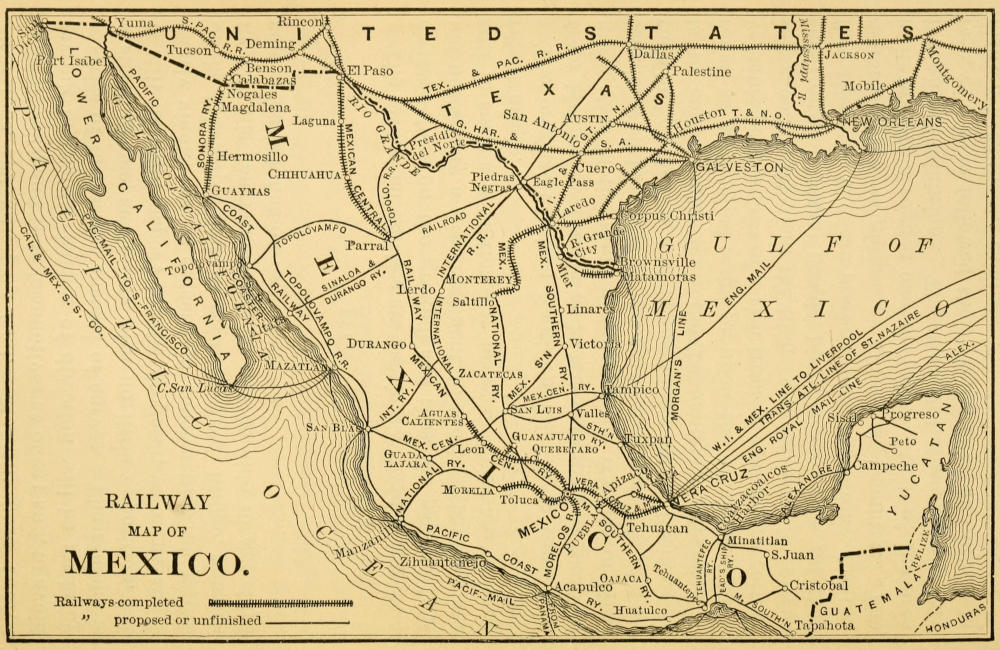
GENERAL RAILWAY SYSTEM OF MEXICO.
Captain Eads proposes to transport bodily ships of 4000 tons, 190 miles, by land. He will have twelve lines of rails, and four locomotives at once; and, to avoid jarring in transit, changes of direction will be made by a series of turn-tables instead of curves. The scheme is a startling one, and meets with no little opposition. It is still only on paper; but its proposer, who has abundantly vindicated his sagacity in constructing the jetties of the Mississippi and the great St. Louis bridge, remains firm in his conviction that he will be able to sail ships across the isthmus on dry land.
III.
The several enterprises are succinctly divided into two classes—those on the ground, and those on paper. It is not necessarily a disparagement to the last that they are still in such a condition, for many of them are of very recent origin.
The original Mexican Southern road is to run south from Mexico, by Puebla and Oaxaca (capital of the populous state of the same name) and the frontier of Guatemala, with branches to the ports of Anton Lizardo, on the Gulf of Mexico, and Tehuantepec, on the Pacific. It is to connect also with the Tehuantepec railway. It relies, as a principal resource, upon the transport of the valuable productions of a rich tropical country, as cotton, sugar, coffee, rice, and the like. Oaxaca is an important small city of 28,000 people, birth-place of General Porfirio Diaz, the Mexican power behind the throne, and undoubtedly the weightiest person in the country. The route will be a rugged one to build. Much of the area is high and salubrious. The Oaxacan Indians are a sturdy race, who have followed their leader, Diaz, and others in many a hard-fought campaign.
This company, however, has lately effected a consolidation with the Mexican Oriental, and both will henceforth be known under the name of the Mexican Southern.
The Mexican Oriental sets out from Laredo, on the Texas frontier, and proceeds to the capital by way of Victoria, the capital of the state of Tamaulipas. It claims to have a bee-line, and to be 200 miles shorter than any other. Its mission is to occupy the district between the coast and the Mexican National. It throws out a branch from Victoria to San Luis Potosi; and has a coast-line connecting Tuxpan, Nautla, and Vera Cruz. It is fed by some 12,000 miles of road under control of Jay Gould in the United States.
The International is chartered to run from Eagle Pass, in Texas, to the city of Mexico, occupying a field left vacant between the Mexican Central and National; and is allowed to have also a cross-line to a point between Matamoras and Tampico, east, and between Mazatlan and Zihuataneso, west. The theory of each, it will be seen, is to have an interoceanic line as well as a main line north and south.
The Pacific Coast road covers the right to a vast stretch, beginning at a point below Fort Yuma, Arizona, and connecting the whole series of Pacific ports down to Guatemala. The Topolobampo has also a long extension southward, to touch at some of the same points.
The Topolobampo route (Texas, Topolobampo, and Pacific) crosses the northern border states. It professes to be a shorter transcontinental route to Australia and Asia than any other that can be laid down on the map. It claims to have at Topolobampo, just within the Gulf of California, the ancient Sea of Cortez, one of the few fine harbors of the Pacific coast.
These harbors are spaced at wide intervals apart. That of the Columbia River of Oregon is the highest up. Then, 600 miles south, comes San Francisco; 441 miles below this is San Diego; 650 miles farther on, in a direct line, or 936, doubling Cape St. Lucas, is Topolobampo; and 740 miles south of this again is Acapulco. Between them all there is nothing worthy the name of harbor.
Topolobampo city, within the confines of the state of Sinaloa, exists only on paper as yet, but nothing is more impressive in its elegant regularity and finish than a paper city. It claims to be 800 miles nearer New York than San Francisco by railroad travel, and that a person coming from Liverpool to Sydney, Australia, would save 600 miles in laying out a course from Fernandina, Florida, by New Orleans and Topolobampo, which is indicated as a route of the future. If some of these representations be correct, no doubt it will be. We live in times of a ruthless commercial greed which is stopped by no sentimental considerations of vested rights and convenience. We have but to see a short, through line, with possible economies, to build it with all possible despatch.
The road in question is to start from Piedras Negras, on the frontier of Texas, and make for Topolobampo, across the states of Coahuila, Chihuahua, and Sonora, with branches to Presidio del Norte, also on the Texas frontier, and to Alamos, in Sonora, and the port of Mazatlan, down the coast. These routes pass near, and would greatly facilitate operations in some of the large silver-mining districts, of late entered with success by American capital and immigration. The reports of its surveys chronicle an engaging prospect in various other ways. It passes from belts of tropical products to those of white pine, oak, and cedar, and others fitted for cereals, grass, and cotton, with a rich iron mountain, and deposits of copper as well as silver.
The maxim is laid down that a railroad pays, in local traffic, in proportion as one section of its line supplies what another lacks. If the situation be as represented, Topolobampo seems provided with most of the essential conditions of success.
VII. THE RAILWAYS AT WORK.
I.
The Sonora road is already built, and in operation as I write. It is a stretch of three hundred miles, from the Arizona frontier, to the port of Guaymas, near the centre of the shore line of the Gulf of California. Its United States connection is by a branch of the Atchison, Topeka, and Santa Fé, from Benson, through Calabasas, to the border at Nogales; and another is proposed, from the Southern Pacific at Tucson. The management of this enterprise, as well as of the Great Mexican Central, is practically that of the Atchison, Topeka, and Santa Fé.
Its course is across the state of Sonora. It abolishes the old system of ox-train transportation and the dusty stage-line from Tucson. It will be found fault with, among others, by the savage Apaches, whose refuge Northern Mexico has so long been. Their depredations, with their territory penetrated by railroads, must soon come to an end once for all. The other Indians of the state—Yaquis, Mayos, and Opatas—are docile, and a principal reliance for cheap labor. The road taps mines, and, by means of a branch, what is even more important for Mexico, the valuable Santa Clara coal-fields. It has the little city of Hermosillo, with its plantations, irrigated by aqueducts, in its course; and its port of Guaymas is commodious and sheltered.
II.
I have purposely reserved to the last—the better, perhaps, to present them to view—the two great trunk lines of principal importance, the Mexican Central and the Mexican National. These two represent the bulk of the entire movement as it is at present. Neither had many miles in actual operation during my stay; but the works, railway stations, city offices, and army of employés of both, were constantly in sight at the capital, and were the principal evidences by which the manner of the railway invasion of Mexico could be judged.
Energy of movement, ingenuity in planning, and an almost limitless expenditure, all indicated here conscientious work, and not simply railroad building on paper.
The Central begins at El Paso, the terminus of the Atchison, Topeka, and Santa Fé, as well as a station on the Southern Pacific, at the frontier of New Mexico. It extends to the capital, a distance of thirteen hundred miles, tapping on the way a long series of the leading cities of the republic, most of these as well capitals of states. It has also a great interoceanic cross-line, which is to pass from the port of Tampico, on the Gulf of Mexico, through the cities of San Luis Potosi, Lagos (the junction with the main line), and Guadalajara, to San Blas, on the Pacific. It is expected that the main line will be completed about July, 1884.
The first reached in the chain of leading cities is Chihuahua, with about eighteen thousand inhabitants. The line is already running to this point, and is completed in all three hundred and thirty-one miles southward from Paso del Norte. The visitor by rail may already have in Chihuahua a glimpse of a place presenting most of the typical Mexican features. It has Aztec remains, and a large cathedral, built out of a percentage of the proceeds of a silver-mine in bonanza. It is the scene where the patriot Hidalgo, who first raised the standard of insurrection against Spanish rule, was shot, having been treacherously betrayed by his friends. This story is, unhappily, of but too frequent repetition in Mexican annals.
Durango, three hundred miles farther, has twenty-eight thousand people. It has been spoken of as the Ultima Thule of civilized Mexico, the barren plains to the north—which are, indeed, very common in all these uppermost states—not having been considered worthy to be included with the country below. There are places where water is not to be had for two and three days at a time, but must be carried by the traveller. The inhabitants have had to depend considerably upon themselves for defence, as is seen in the occasional fort-like haciendas, with walls turreted and pierced for musketry.
Zacatecas, moving onward now into a country of recognized civilization, has 62,000 people; San Luis Potosi, 45,000; Aguas Calientes, 35,000; Lagos, 25,000; Leon, 100,000; handsome Guanajuato, capital of the state which is the richest of the whole interior, 63,000; Celaya, 30,000; Silao, 38,000; Irapuato, 21,000; Salamanca, 20,000; and luxurious Guadalajara, 94,000.
The mining of the precious metals is a leading industry over all the area thus described, which abounds also in the agricultural products of a gentle and temperate climate. The railroad is now running northward from the city of Mexico to Lagos, and is completed for three hundred and thirty-four miles from this lower end.
Lastly in the chain of cities may be mentioned Queretaro, which has a population of 48,000. It is the site of flourishing cotton-mills, an aqueduct which is compared with the works of the Romans, and it saw the final resistance and execution of Maximilian. Mexico itself has 200,000 inhabitants. I have summed up here nearly a million of people; and it would seem that a railroad along the line of which are scattered such communities as these, grown to their present dimensions without even tolerable means of approach, need not lack for support.
True, large numbers of the people are Indians and very poor; but I point to the example of Don Benito Juarez, the liberator of his country from the French, an Indian of the purest blood, and to numerous others accessible on every hand, to show that there is nothing inherent in the race itself to debar it from the highest development with increase of opportunities. And if any suppose that they do not like to travel, let him simply inspect the excursion trains where third-class cars are supplied to them in sufficient numbers.
III.
I made the trip over the section of the Central to the small city of Tula. Its principal feature is the passage through the great Spanish drainage cut, along one side of which it has been allowed to terrace its track. This cut—the Tajo of Nochistongo, before mentioned, designed for keeping the lakes from inundating the valley—was begun under the viceroys as far back as 1607, and continued for a couple of hundred years. Such mammoth earth-cutting—a ditch twelve miles long, a couple of hundred feet deep, and three hundred and sixty wide—was never seen elsewhere in the world; and it is said to have cost the lives of seventy thousand peons, or Indian laborers, in the course of construction. Why this should have been, and how they died—whether by slipping in and being buried, or under the exactions of cruel task-masters, and whether those who passed away simply of old age (for which it will be seen there was ample time) are included—does not appear.
I went partly by construction train, dining in their car with a group of jolly young engineers, and partly on horseback over the terre-plaine (the graded road-bed), which makes an excellent surface for riding. The peons, swarming on the work, in white cotton shirts and drawers, have reddish skins, bristly black hair, and a sudden, wild-eyed way of addressing you. They have an analogy to the Chinese type. They got at this time two and a half reals (thirty-one cents) a day. They are very suspicious, and have absolutely no idea of trust, or waiting over the appointed time. Dangerous strikes have resulted from some slight putting off of the pay-day, which usually takes place once a week. In other respects they are very tractable.
There were said to be thirty thousand of them at work on railroads at this date. The rate of wages, so favorable to the contractors at first, has been gradually rising under the active demand in the mean time, and I have heard, since my return, of a strike on one of the northern roads for as high as $1 a day. They buy gay clothes for Sunday, and pulque, and save nothing. Many will not even work steadily. Two such form a partnership to take a single place, and one works half the week and the other the rest. There were some who walked all Saturday night to spend Sunday at Queretaro, and returned Monday morning. On the haciendas they are generally in debt, and as they cannot leave when in debt, they are so far attached to the land, like serfs. Each gang has a Cabo (or head), who is simply an enterprising one of themselves, and gets an allowance of two cents extra for each man he controls. The Cabo is a great man among the railway laborers, and out of cabos arise the Benito Juarezes, and hopes indefinite for the evolution of the race.
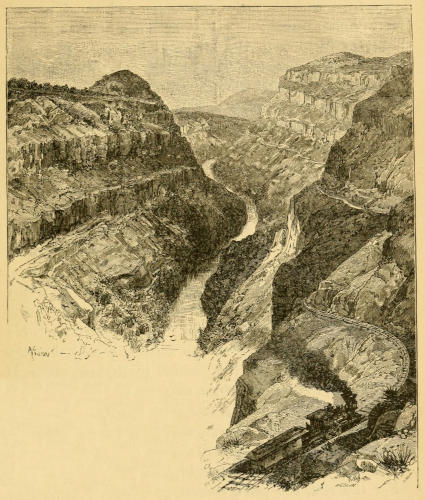
THE GREAT SPANISH DRAINAGE CUT.
I spent the night at Tula. It was the capital of the Toltecs before the day of the Aztecs. I climbed the Hill of the Treasure, to inspect some ruins over which archæologists have made a stir. There are no sculptures nor carved stones, nothing but some opened cellars and heavy walls, with patches of a red plaster, as at Pompeii, adhering to them. But we stayed our horses, and looked down, from a thicket of organ-cactus and nopal, upon a lovely sunset over the valley of Tula. It is a little pocket of fertility in the hills, and it does not seem at all wonderful that the Toltecs stopped there in their migrations southward.
My mozo pointed out a ruin in the thick woods, which he declared was Toltec, knowing that to be what I was in search of. It was picturesque enough, its walls having been split by an irrepressible vegetable growth; but it had the same style of battlements (a kind of Spanish horn of dominion) as the fortress-like church in the town, dating from 1553, and was much more modern.
I went into this cool old church—vast enough for a cathedral—next day, when the temperature was warm without. It was entirely vacant. Fatigued with my journeying, I sat on a comfortable old wooden bench, and dozed till awakened sharply by the striking of a little cuckoo-clock. I seem to have dreamed that the numerous quaint figures of saints, in dresses made of actual stuffs, had somehow an every-day existence there, in addition to their sacred character, and that they were taking notice of the intruder, and offering audible comments. This is one of the ways, I suppose, in which very good miracles have been wrought before now.
For the rest, the place consisted of a plaza, with two or three pulque-shops; a shop of general traps, with the ambitious title of “Los Leones;” a botica (or drug-shop), kept by one Perfecto Espinoza; a Hotel de las Diligencias; and a little jail, at one corner of the plaza, where a couple of soldiers walked up and down, and the prisoners peeped out through a large wooden, grated door.
And there was a good restaurant, kept by a little Frenchman, who moved on with it from time to time to the head of the line.
IV.
The Mexican National, or “Palmer-Sullivan,” road is due to the same enterprise which established the successful Denver and Rio Grande system in Colorado and New Mexico. It is, like that, a narrow gauge, instead of a standard gauge, line, and a connection is to be ultimately established between the two. In some respects it may claim to be the pioneer in the modern movement, since its agent in Mexico, James Sullivan, had obtained a charter and begun to raise money in 1872, but was stopped in his project by the panic of the following year.
The National takes a much shorter line to the capital than the Central, say eight hundred miles, as against thirteen hundred. Its initial point is Laredo, on the Texas frontier. It is running already into Monterey, the capital of Nuevo Leon, and built below Saltillo. Of the charms of the little city of Monterey, which has medicinal springs beside it, travellers begin to speak in the warmest terms. It touches San Luis Potosi and Celaya as well as the Central, and has along or near its course other cities, well peopled, though less known to fame, as Matchuala, the population of which is 25,000. Its eastern port is Corpus Christi, Texas, though it will have a branch also to Matamoras. Its westward extension (only less important than the main line) winds round about, through the cities of Toluca, Maravatio, Morelia, Guadalajara, and Colima, down to the port of Manzanillo.
Four of these are capitals, and all are populous, and have wide, well-paved streets and handsome buildings, public and private. Toluca, at a great height, 8825 feet, above the sea, is often afflicted by a rather frigid temperature; Colima is distinctly in the tropics; but Morelia affords the happy medium, and its whole state of Michoacan has charms upon which the appreciative never have done expatiating. Humboldt speaks of the lake found at Patzcuaro as one of the loveliest on the globe. Madame Calderon de la Barca, in her journey here, could hardly refrain from regretting the lavishing by Nature of what seemed (so few were there then to enjoy it) almost a wasted beauty. “We are startled,” she says, “by the conviction that this enchanting variety of hill and plain, wood and water, is for the most part unseen by human eye and untrod by human footstep.”
The route winds, too, on its way to Guadalajara, around the great lake of Chapala. Truly, it seems they are to be happy travellers, those of the immediate future, to whom the simple device of the railway is to open up so much of the wildness and loveliness of nature, combined with the quaintness of an old Spanish civilization. We are apt to forget, in our preconceived impressions, what an important part Old Spain played in the country during three hundred years, what treasures she spent there. She had made a beginning of some of these solid, regular cities, which surprise one like enchantment on emerging upon them from forests and wastes, a hundred years before the Pilgrims landed at Plymouth Rock. Very little, in fact, has been added to what the Spanish domination left. The modern movement, since 1821, is to be credited with very little in the way of new buildings. Such compliments as are paid in the course of these descriptions to the architecture belong chiefly to that remaining from a much earlier date. The reputation of the republic is still to be made in all such matters when it shall have outgrown the ample legacies bequeathed it, and have need of farther accommodations peculiarly its own.
V.
In all, the National has completed four hundred and sixty miles. It is said of late to have been sold to an English company. We need not forego our American pride in its early achievements, even if this be so. Perhaps such a transfer might be of benefit, in allaying the dread of an overweening American influence.
It was not done even to Toluca in my time. It has to face its most arduous engineering difficulties at the very beginning, and fortunately goes far more smoothly afterward. No less than seventeen bridges, of solid construction, had to be thrown across the little stream of the Rio Hondo in two or three miles of its course.
A pay-train on horseback started out from the central office every Saturday, to convoy the silver coin for the wages of the army of hands employed on the first section of twenty miles.
“Ride with us!” its members often hospitably urged, and I more than once accepted the invitation.
It is an all-day adventure, and a fatiguing one. Behold us at early morning clattering out of the court-yard to ride up into the fastnesses of the mountains, a curious cavalcade. The treasure is packed upon the backs of a dozen mules, which are placed in the centre. A troop of Rurales (the efficient force organized by Porfirio Diaz for the better protection of the rural districts) takes the van. A numerous retinue of armed mozos of the company, with ourselves, bring up the rear. The young engineers, paymasters, and contractors, well mounted, with long boots and revolvers, present a handsome, half-military aspect.
We have presently lost sight of the city, and are upon high rolling barrens, where the surface is volcanic and rent into an infinity of seams, and the only vegetation is that of nopal, or prickly-pear, as large as apple-trees with us. Here and there a cluster of white tents is seen at a distance, and cotton-clad peons delving in gulch or on mountain-side are like some strange species of white insects.
The whole expedition wears a most un-nineteenth-century air. We might be some band of marauders returned from an ancient foray. The Rurales have something in their cut—the buff leather jackets, crossed by ample sword-belts, and wide, gray felt hats—of the troopers of Cromwell. Each has a rifle in his holster at the saddle-bow, and a gray-and-scarlet blanket strapped behind him. Nothing could be more spirited, in color, than these costumes, dismounted beside a cactus-tree, or thrown out against the blue of distant mountains. On the harness of some of the mules are embroidered in red and blue their names, or that of some hacienda, as “Santa Lucia,” to which they have belonged.
It is understood that an individual with a crimson handkerchief around the back of his head, under his silver-bordered sombrero, is the titular cacique of San Bartolito by descent from ancient chiefs. He precedes us, being employed by the company to look out for plots and ambuscades. When we have passed what he considers the dangerous points—these are generally in the neighborhood of elevations, whence an intending bandit could spy the road for a distance in both directions, and where are ravines on either side for concealment and escape—he rejoins the troop, and converses upon the propriety of his receiving more salary for his arduous duties. No molestation has ever yet been offered these caravans, and there is hardly likely to be. From a considerable experience in remote parts of Mexico I am satisfied that, however prudent ample precautions may be in exceptional cases like this, the ordinary traveller runs little if any more danger of robbery than at home.
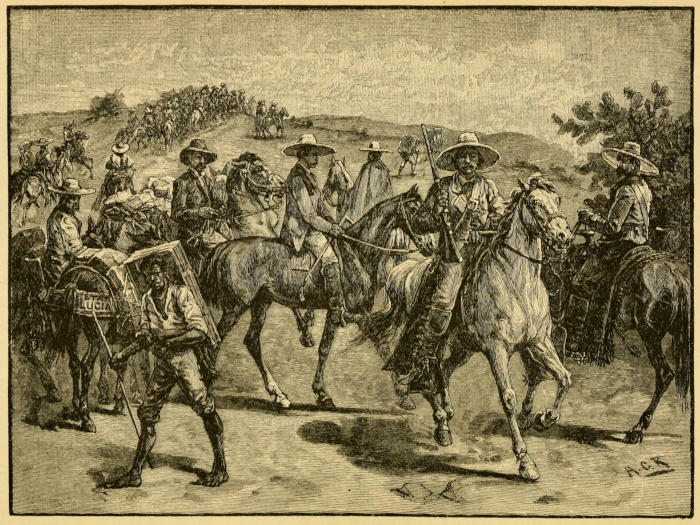
PAY CARAVAN ON THE MEXICAN NATIONAL ROAD.
At the pay-stations we breast our way through crowds of the peons so thick that the horses can hardly be prevented from trampling upon them, always with their narrow foreheads, bristling hair, staring, wild eyes, and large, undecided mouths. Their money is jingled out to them through a pay-window into their shabby sombreros. Venders of small commodities and pulque wait for them, and profit by the new supply of funds.
At these stations the engineers lead a kind of barrack life. The interior contains some beds, a dining-table, and a safe; outside is a storehouse of picks, shovels, and barrows. Whether here, in their construction-car, or tents, they extend the stranger a cheery hospitality. They are hearty, robust fellows—“not here for their health,” as their saying is. Many of them have seen service in war and in other climes, and their company is both amusing and instructive.
VI.
The right of way usually given in all the concessions is for a width of two hundred and thirty feet. Material and supplies for the road, and connected telegraph line, are exempted from duty generally for the period of twenty years. Neither the concession, property, nor shares can be alienated to any foreign government, nor can a foreign government be admitted as a shareholder. The fear of foreign domination crops out everywhere in Mexican legislation; and perhaps the weakness of the nation, and the sad experience of its seizure by Napoleon on the pretext of debt, are sufficient excuse for such nervousness. At any rate, all companies organized under its charters agree to be strictly Mexican, and to renounce all rights and exemptions as foreigners.
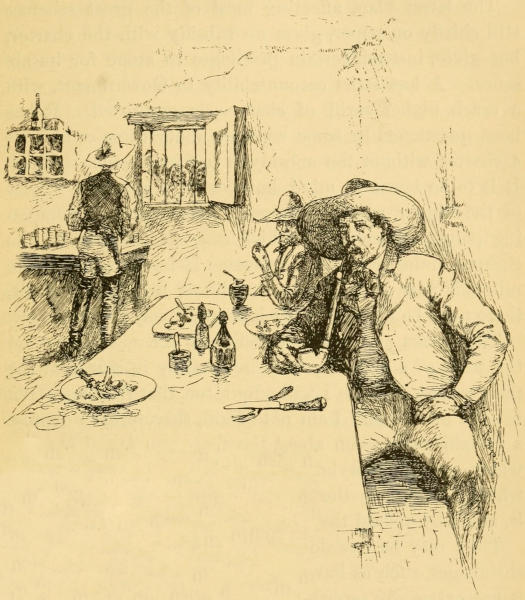
“NOT HERE FOR THEIR HEALTH.”
There is no great vacant public domain, as with us, and the Government has not aided the new enterprises with land grants. Up to a recent period, however, it has attached to each concession a cash subsidy of $10,000 to $15,000 a mile. Both the Central and National are thus subsidized. In order that the burden may not fall too heavily upon an exchequer always weak, the payments are made to depend upon the pledge of six per cent. in the one case, and four in the other, of receipts at the custom-houses. Certificates for the several amounts as they become due are issued to the companies, which must wait for collection till there are funds to meet them.
The latest plan, affecting most of the great schemes still chiefly on paper, gives no subsidy with the charter, but gives, instead, certain privileges to atone for its absence. A less strict accountability to Government, with a much higher tariff of charges, is permitted. It has been questioned by some whether under these conditions a charter without the subsidy is not better than with it. It is to be borne in mind, however, so far as the matter of the higher rates is concerned, that between competing points the company which can afford to run at the cheapest rates gets the business. If but a tithe of the railroads now covering the map like a net-work be built, there need be no fear of the lack of a lively competition.
The stocks and bonds of railroads are not bought on the word of a desultory traveller mainly in search of the picturesque—though I will admit, too, that they are often bought upon less. I am not afraid, therefore, to express a certain enthusiasm about the ferro-carriles of Mexico, which are in everybody’s mouth. It is the railways which have made the modern world elsewhere what it is, and why should they fail of the usual effect here?
They may be overdone, and there may be panics and shrinkages, such as have occurred elsewhere, though this is not extremely probable, owing to the reasons for wariness which lie very much on the surface. The conditions to be conformed to must not be sought in a parallel situation of things in the United States, but rather in such countries, perhaps, as Russia and India, with a large peasant population to be developed, instead of a new population to be created. We have built railroads in advance of settlement, and depended upon immigration to fill up in their wake. Mexico has but an infinitesimal immigration, and presents no great inducements to it at present. It must depend upon the local carrying trade and natural development of the industries and commerce of the country. It has a population per square mile but little less than that of the United States. These are of a natural intelligence, and capable of the stimulus of ambition when opportunities are opened. They are to be encouraged to be no longer satisfied with a bare subsistence for themselves, but to produce from their fertile lands a surplus, for which a market is now opened. They are to trade upon it and become amassers of wealth.
No less than 10,000 miles of railways are spread over what were once the old Mexican provinces of California, Arizona, New Mexico, Colorado, Wyoming, Nevada, Utah, and Texas. Railways have brought these out of the nothingness in which they recently lay so vast and desolate. What must they not inevitably do at last for Old Mexico itself, so fully peopled, and scattered with centres of trade and of the arts of civilized life?
VIII. THE QUESTION OF MONEY, AND SHOPPING.
I.
It is perhaps thought that the work of improvement is to be effected entirely from without, the Mexican himself remaining passive, and allowing everything to be done for him. The view is supported by the extent to which the business of the country is already in the hands of foreigners. The bankers and manufacturers are English. The Germans control hardware and “fancy goods.” French and Italians keep the hotels and restaurants; Spaniards the small groceries and pawn-shops, and deal in the products of the country. These latter have a repute for somewhat Jewish style of thrift. They are enterprising as administrators of haciendas, and often marry the proprietors’ daughters, and possess themselves on their own account of the properties to which they were sent as agents. Whether it be due to such rivalry or not, it is to be noted that there are few Jews in Mexico. Finally, the Americans build the railroads.
The Mexican proper is a retail trader, an employé, or, if rich, draws his revenues from haciendas, which in many cases he never sees, and where his money is made for him. These are on an enormous scale. The chief part of the land is comprised in great estates, on which the peasants live in a semi-serfdom. Small farms are scarcely known. For his fine hacienda in the state of Oaxaca ex-President Diaz is said to have paid over a million of dollars; on another the appliances alone cost a million. The revenues of Mexican proprietors have been heretofore devoted to the purchase of more real estate, or loaned out at interest; at any rate, “salted down” in some such way as to be of little avail in setting the wheels of industry in motion.
Before adopting, however, the conventional view that this state of things is due to inferiority of race or enervating climate, considerations on the other side are to be looked at. In the first place is the revolutionary condition of the country, which until a recent date subjected the citizen who ventured to place his property beyond his immediate recall to a thousand embarrassments from one or another of the contending parties. Such immunities and advantages as there were, were enjoyed by foreigners alone, under the protection of their diplomatic representatives.
Again, there have been peculiar inequalities of fortune, coming down from the old Spanish monarchical times. There has been at one extreme of society a class too abject, and at the other, one in too leisurely circumstances, to greatly aspire to farther improvement, and the middle class has been of slow formation. The difficulties in the way of travel and communication with foreign parts for the middle class, from the bosom of which financial success chiefly springs, have been of a repressive sort.
The climate, of the central table-land at least, must not be considered enervating. One must lay his ideas of climate, as depending upon latitude, aside, and comprehend that here it is a matter of elevation above the sea. Individual Mexicans are to be met with who, under the stimulus of the new feeling of security, have embarked their capital, put plenty of irons in the fire, and appear to handle them with skill. The street railways of the capital, an extensive and excellent system, are under native management exclusively. It is as successful in mining. It was only when the great Real del Monte Company at Pachuca, formerly English, passed into Mexican hands that its mines became profitable.
I should be strongly of the opinion that the backwardness of the Mexican is not the result of a native incapacity or lack of appetite for gain, but chiefly of the physical conformation of the country. The mule-path is traced like a vast hieroglyphic over the face of it, and in this is read the secret—lack of transportation.
But the zealous advocate of race and “Northern energy” objects: “How long is it since we had no railroads ourselves? And yet did we not reach a very pretty degree of civilization without them?”
But Mexico not only had no railways, but not even rivers nor ports. It was waterways which made the prosperity of nations before the day of steam. It is hardly credible, the completeness of the deprivations to which this interesting country has been so long subjected. The wonder is, to any experienced in the diligence travel, and the dreary slowness of the journeys, at a foot-pace, by beasts of burden, not that so little, but so very much, has been done. On the trail to the coast at Acapulco, for instance—in popular phrase a mere camino de pajaros (road for birds)—have grown up some charming towns, like Iguala, the scene of the Emperor Iturbide’s famous Plan, which, it seems to me, the Anglo-Saxon race would hardly ever have originated under such circumstances.
Commerce and trade in such a land naturally have their peculiar aspects. There is, in the first place, the complicated tariff, already referred to. Americans should not let a new-born enthusiasm for a promising market hurry them into consignments without a thorough understanding of the premises. As to engaging in undertakings in the country itself, one who had done so held that the new-comer should make his residence there for six months or a year, and first acquaint himself with the people, their customs, and language.
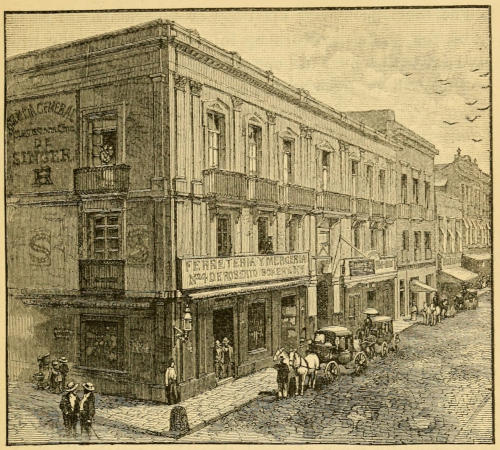
MODERN SHOP-FRONTS AT MEXICO.
“Better make it two years, on the whole,” he said, reflectively, “and then he will go home again and let it alone altogether.”
Without sharing this saturnine view, the importance of some preliminary acquaintance cannot be too strongly insisted upon. The great inertia of customs and ways of looking at things so different from our own is appreciated more and more as time goes on.
The most promising openings at present would seem to be, for capital, to work up into manufactures the raw material with which the country abounds. These opportunities will increase with the growth of transportation. Labor is cheap. The peons have little inventive but sufficient imitative talent, and make excellent mill-hands. They work for twenty-five and thirty-seven cents a day, and have no trades-unions nor strikes. There is little opening as yet for persons of small means. The government has taken but its first rudimentary steps toward the encouragement of immigration, and the path is beset with difficulties.
A commercial treaty is now in the hands of the Senate of the United States. It will be adopted in some form before long, and may result in the improvement of local business opportunities, as it must in the volume of trade, between the two countries. What we want is such a reduction of duties as to put us on the same footing at least as England (in favor of which there is a certain discrimination), so that our goods and machinery can be sold in the country on reasonable terms. It is predicted that a trade which is now about $30,000,000 per annum (including both exports and imports) can be made $100,000,000. The Mexicans, on their side, desire admission for their sugar and hemp. The treaty has met with its chief opposition thus far from our Southern sugar-planters. Their fear of competition is hardly reasonable at present. Our own product seems more likely to go to Mexico at first. It is a matter of note that sugar has been selling at eighteen cents a pound of late at old Monterey, in the country which professes to raise it.[1] The total value of the exports from Mexico for the past fiscal year has been $29,000,000. Of these $14,000,000 came to us, and $10,000,000 went to England. Our own exports to Mexico for 1881 were somewhat over $11,000,000.
II.
At present Mexico is perhaps the most difficult country in which to do business in the civilized world. A customer four or five hundred miles off, even on the best roads, is five or six days’ journey distant. In preparing for it it is not long since he was accustomed to first make his will. The merchant has friendly as well as commercial relations with his customer. He is more or less his banker at the same time, not for the resulting profit, but because it is expected of him. If he does not offer such, accommodation some other house will. Credits are long, and it is not expected that interest will be charged even on quite liberal overlaps of time.
Payment is made in the bulky silver currency of the country; and this is sent in large sums by guarded convoys, the conductas, which converge upon the capital four times a year—in January, April, August, and November. There were but two banks issuing bills at this time, and these to but a small amount, and receivable only at short distances from the capital. One of these was a private corporation, the other the National Monte de Piedad, or pawn-shop.
The visitor becomes early acquainted with the Mexican “dollar of the fathers,” to his sorrow. Sixteen of them weigh a solid pound. It is obviously impossible to carry even a moderate quantity of this money concealed, or to carry it at all with comfort. The unavoidable exhibition of it, held in laps, chinking in valises, standing in bags, and poured out in prodigious streams at the banks and commercial houses, is one of the features of life.
Guadalajara, the supply from which unites with that from Zacatecas at Queretaro, is the northernmost point from which money is despatched by conducta to Mexico. A portion of that even from here is despatched to San Francisco, by the port of San Blas, just as a part of that from Zacatecas goes to Tampico through San Luis Potosi. The country north of San Luis to the east ships its funds to Matamoras; those of Durango are divided between Matamoras and Mazatlan; while Puebla, Oaxaca, and the rest of the south find their natural outlet at Vera Cruz.
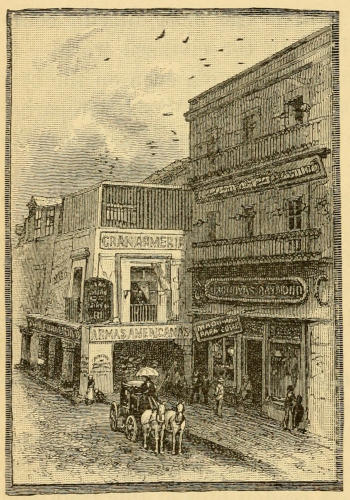
THE “PORTALES” AT MEXICO.
The importance of the great conducta in these times is diminished by the growing safety of the transport of money by private hands. Its days are numbered with the progress of the railways, nearing so rapidly the central cluster of cities in which it has its origin. Even now it no longer came wholly to town, but took the Central train at the first feasible point, at Huehuetoca, the Spanish cut for the drainage of the valley. Its place as a spectacle is filled by the pay conductas of the railroads.
A revision of these accounts is needed almost from moment to moment as I write, to keep pace with the rapid changes in affairs. A National Bank and banks of foreign incorporators have been established in the mean time, with authority to issue large amounts of but inefficiently secured paper. The Mexican National Bank may now issue bills to the amount of $60,000,000, upon a capital of $20,000,000. They are legal tender from individuals to the government, but not from the government to individuals, nor between individuals. One of the arguments in favor of this bank, our minister was assured, was that it would counteract in some sort the influence of the United States: the usual patriotic leaven cropping up, it will be seen; though how it should accomplish the purpose in view it is by no means easy to understand. A flood of depreciated paper is driving the solid coin out of circulation; so that, while the traveller may be now able to carry his money comfortably about him, there may be much worse in store for the Mexicans themselves than the handling of bags of unwieldy dollars. It is not pleasant to see also that the government shows some unusual pecuniary embarrassment. Its expenditures for the last fiscal year exceeded its revenues by ten per cent., and a loan is talked of. Should a spirit of recklessness enter into the management of the finances, in all this whirl of novelties, complicated by the issues of paper, a crisis might be precipitated, which would, of course, have to be counted among the retarding influences on the railways.
III.
Shops and shopping in Mexico follow much more European than American traditions. A fanciful title over the door of the shop takes the place of the name of a firm or single proprietor. You have no Smith & Brown, but, instead—on the sign of a dry-goods store, for instance—“The Surprise,” or “The Spring-time,” or “The Explosion.” A jeweller’s is apt to be called “The Pearl,” or “The Emerald;” a shoe-store, “The Foot of Venus,” or “The Azure Boot.”
The windows are tastefully draped, after the way of shop-windows. Within stand a large force of clerks, touching shoulder to shoulder. They seem democratic in their manners, even by an American standard. They shake hands over the counter with a patron with whom they have enjoyed a slight previous acquaintance; ask a mother of a family, perhaps, after the health of “Miss Lolita” and “Miss Soledad,” her daughters, who may have accompanied her thither. One of them, they hear, is going to be married. Perhaps this is accounted for by the presence among the minor clerks of some of considerable social position—some of the class you meet with afterward at the select entertainments of the Minister of Guatemala, for instance. But a limited choice of occupations has been open to the youth of Mexico, and those who cared to work have had to take such places as they could. They apply now with great eagerness for the positions of every sort offering under the new enterprises.
It was not etiquette of late for ladies of the upper class to do shopping in public, except from their carriages, the goods being brought out to them at the curb-stone. Now they may enter shops. A considerable part of the buying, as of furniture and other household goods, is still done by the men of the family. Nor was it etiquette for ladies to be seen walking in the streets, even with a maid, except to and from mass in the morning.
The change in both respects is ascribed to the horse-cars. The point of ceremony, it appears, was founded somewhat upon the difficulty of getting about.
Americanism now appears in the streets with increasing frequency, in the signs of dealers in arms, sewing-machines, and other of our useful inventions. Our insurance companies, too, are a novel idea, to which the Mexicans seem to take with much readiness. The principal shopping hours are from four to six o’clock of the afternoon. From one till three, or even four, little is done. Even the horse-cars do not run in the middle of the day. There is a general stoppage of affairs for dinner. It is but a short time since that enterprising person, the commercial traveller, was unknown in the country, but now he begins to flourish here as elsewhere.
The profits of favorably situated houses, in the absence of keen competition, have been very large, and methods of doing business correspondingly loose. The Mexican merchant does not go into a fine calculation of the proportionate value of each item of a foreign invoice, but “lumps” the profit he thinks he ought to receive on the whole. Some articles, in consequence, can be bought at less than their real value, while others, in compensation, are exorbitantly advanced.
It is the smaller trade, and that most removed from metropolitan influences, which is the gayest and most entertaining as a spectacle. How many picturesque market scenes does not one linger in! Each community has its own market-day, not to interfere with others. The flags of the plaza and market-houses, which are commodious and well built, are hidden under fruits, grains, cocoa sacks and mats, striped blankets and rebosos, sprawling brown limbs, embroidered bodices and kirtles, as if spread with a thick, richly colored rug. A grade above the open market is the Parian, a bazaar of small shops, in which goods, sales-people, and customers alike might all be put upon canvas only with the most vivid of hues.
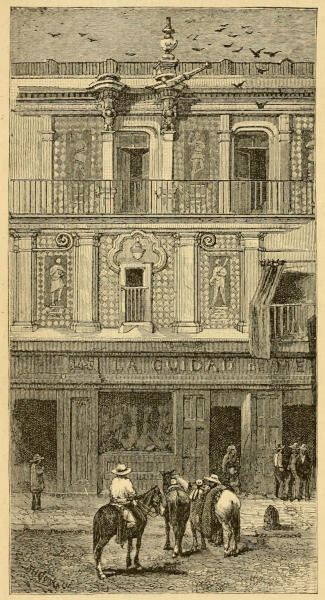
A “MERCERIA” AT PUEBLA.
I give some examples of the street architecture of the more important shops. The approach to many is under the welcome portales, shady in sunshine and dry in the wet. Not a few of the shops have been old Spanish palaces before being adapted to their present use. I transferred to my sketch-book a bit from the leading merceria (dry-goods store) of the important minor city of Puebla which I thought particularly interesting. It was called, after the prevailing fashion, “The City of Mexico.” The entire front—upon which still remained the carved escutcheon, showing that it had been the residence of a family of rank—was faced up between carvings, in a gay pattern in tiles, the figures glazed, the rest an unglazed ground of red.
IX. SOCIAL LIFE, AND SOME NOTABLE INSTITUTIONS.
I.
The persons who once lived in these old Spanish palaces, and descendants of the titles of nobility existing before the Independence, are still much esteemed in a certain small circle in the country. There are pointed out to you those who should by right be marquises and counts, and the titles are occasionally given them. The Mexican nobles, from the time of Cortes down, lived in magnificent style in their day. The Count of Regla, who has left his trace after him in many directions, must have enjoyed almost the state of royalty. A single hacienda of his in Michoacan was thirty leagues in length by seventeen in breadth, and, sloping down from the temperate plateau to the tropic, comprised in its extent the products of almost every clime. He fitted out two ships of the largest size, building them of mahogany and cedar, and presented them to the King of Spain. Inviting his majesty to visit the country, he assured him that his horse should tread on nothing but ingots of silver from the coast to the capital.
A remnant of the old noblesse rallied around Maximilian when he came to assume the Emperor’s crown. With this, and what remains of Maximilian’s court, and some few other families of a peculiarly exclusive turn, a circle is constituted somewhat corresponding to the Parisian Faubourg St. Germain. They are sometimes stigmatized as “Mochos,” literally hypocrites. They are rich, pass much of their time abroad, protest against the sequestration of the Church property, and exhibit a refined horror at the vandalism of these later times.
“The government,” they tell you, “is in the hands of the populacho, the rabble; the gente honrada, respectable society, has nothing to do with it.”
In a novel which I have by a Mexican writer, Cuellar, a secretary of legation at Washington, the scene is laid in this faction or clique. “Chona,” or Incarnacion, the heroine, or leading feminine character, “had been brought up from childhood more to abhor than admire. The conversations in the family continually turned upon the utter antipathy which the men and things of Mexico inspired.”
“They had for visitors Church notables and those of the wealthy who still retained the parchments of their ancestry. If they made any new acquaintance it was some Spaniard lately come into relations with them through the business of their estates.”
The fashionable men in the story have been educated at Paris, and become elegantly blasé there as well. In contrast to these is shown one Sanchez, a vulgar, pushing fellow, upheaved from the depths by the revolutions. He has the “gift of gab,” which he has utilized to make himself a figure in politics; has enriched himself with the spoils of the Church establishment, and secured a good place under government. He more than hints, however, when he is found to have finally lost it, that he is ready to engage in upsetting “Don Benito”—it is now under the régime of President Juarez that the scene is laid—or in any other convulsion that may promise to again mend his fortunes.
II.
I do not quite know which side the writer himself is on, in this satirical work; it is so bitter all around. It is certainly interesting as showing two such boldly distinct types, one of them at least picturesque, evolved out of the peculiar conflicts of the country. Let us hope that there are few of the dangerous Sanchez pattern in the present juncture of affairs. The Mochos cannot now be numerous nor dangerous, with the wholesale victory of middle or lower class republicanism around them. They have taken little part, voluntarily, in the successive revolutions since their own overthrow, leaving them rather to be fought out by professional soldiers of fortune. They temporize a little; attend, perhaps, the wedding of some rich railway contractor’s daughter, in order, as they say, not to draw upon themselves a direct enmity; but they do not open their own houses in return; they do not “entertain.”
Don Sebastian Lerdo, spoken of as the most scholarly President the country ever had, is conceded to have been to a considerable extent “in society.” He was expelled by Porfirio Diaz, and is now in retirement at New York. The political class since that time has either not been well received in the circle spoken of, or, perhaps too busy with other affairs, has not greatly cared for it.
Such being the case, there are few reunions, and these of an informal character. Nor do the officials give entertainments themselves. Social gayeties, as we understand them, can hardly be said to exist in Mexico. It is only under the neutral roofs of the foreign ministers that they take place with some satisfaction. I had the good fortune to be at the capital during the visit of General Grant, and to see a social movement which, by the general testimony, was quite phenomenal. There was, among the rest, a fashionable wedding, attended by the President and his cabinet. A “reception” and banquet were given in the evening on the occasion of the signing of a civil contract between the parties. The religious ceremony took place at church next day. The interior courts of the house were wreathed with flowers, and lent themselves palatially to the festivity, as they always do. The banquet was spread along the bases of the columns of the arcade.
The young Mexican women are still kept apart from the other sex, and made love to chiefly on their balconies in the good old-fashioned, romantic style. Their manners when met with in public, however, are not so unusual as might be expected. They seem neither more nor less diffident than elsewhere. They are allowed to take part at balls in a slow waltz called the danza—so slow as hardly to be a dance at all—which is chiefly an opportunity for conversation.
The high-contracting parties to the marriage above-mentioned were by no means young, and in general the exceeding precocity of development and early age of entering into the marriage relation supposed to be characteristic of the tropics were not apparent. It was said that mercenary considerations were not frequent, and claim was laid to a good deal of simplicity and honest affection in the settlement of these matters; though how the parties get at each other, under the restrictive system, sufficiently to enter upon a simple and honest affection, is one of those things that remain a mystery. It is said that the young woman who remains single is not stigmatized for it in the common way as “old maid.” They say very charmingly instead: “She is difficult. She is hard to suit.”
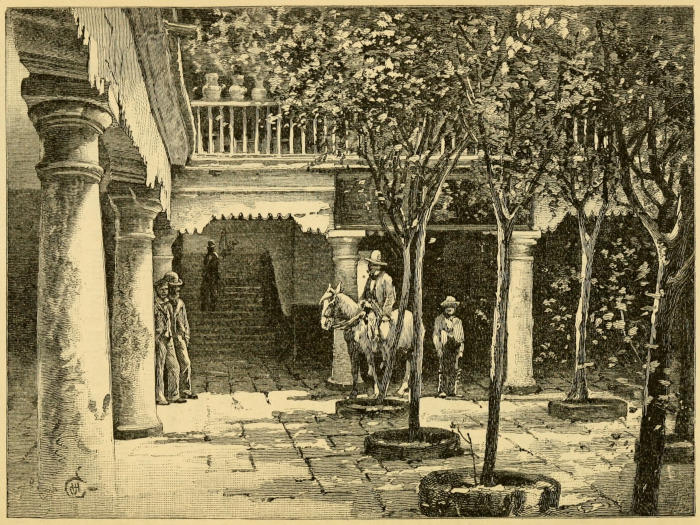
INTERIOR COURT-YARD OF MEXICAN RESIDENCE.
In the country the match-making is often taken charge of by the village priest, who brings the parties together finally at dinner.
As a general remark, the manners of the lower class of the country are much better than ours, and those of the upper are not as good—not as often based upon real kindliness of heart and genuine desire to be of service. The Mexican promises a hundred things which he has no intention, often no ability, of performing. The American is not without his faults—the more’s the pity—but in a general way he aims to do as he agrees. He will often make against the Mexican the reproach of a certain slipperiness—a lack of appreciation of the importance of adhering to his word.
III.
Each considerable group of foreign residents, as the French, Germans, and Spaniards, has its handsome casino, or club-house, which is a standing resource for the diversion of members.
A French traveller as far back as 1838 complains of the unsociable conduct of the Mexicans. If something of the kind be still observed, therefore, it is not new. “They abound,” he says, “in a superfluity of fine phrases, and it is in this easy way that they discharge themselves of their obligations.”
All who know European life, however, are aware that the theatre and the café, with people of the Latin race, largely take the place of the social visiting and entertaining at home prevailing among Anglo-Saxons. Our next-door neighbors, after all, may only have followed, making a little more severe, the traditions of Old Spain. Ladies do not often appear at the cafés, but they are often at their boxes at the theatres, to which they subscribe by the season; and they would go more frequently yet, no doubt, were the pieces as a rule better worth their consideration. There are three large, well-built theatres, the Nacional, Principal, and Arbeu, and minor ones for the working-class.
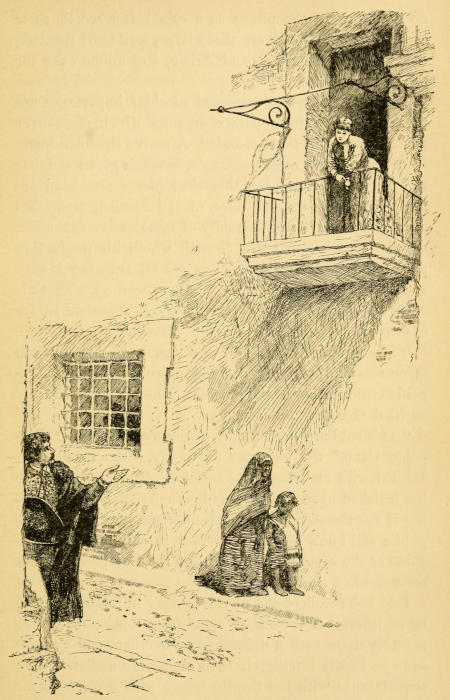
MEXICAN COURTSHIP.
The entertainments esteemed of chief importance are those of the French opera companies which come over from Havana, on their rounds. A native Spanish opera-bouffe and ballet, called zarzuela, is much given at other times. For the rest, the theatrical pieces presented are the works, in prose and verse, of the Spanish dramatists current at home, or occasionally of some native dramatist, announced with an extra flourish which his production does not usually justify. They are all announced with a sufficient flourish, so far as that is concerned. There is always going on some especially Gran Funcion, as, for example:
“The grand Drama of Customs, Entirely New, in three acts and verse, by the distinguished poet, D. Leopoldo Cano, author of the precious comedy, ‘La Mariposa,’ entitled ‘La Opinion Publica.’
“This sublime work of the distinguished poet, D. Leopoldo Cano,” the bill goes on to say, “was received at Madrid with an astounding acclaim. The Spanish Press has lavished upon it a thousand eulogies.... In choosing it for the second subscription night, we feel that the public will know how to value it as it truly merits, and to value at the same time the skill of the Company in their most finished studies and essays.”
I do not recollect any of this as very novel, or likely to be of interest if translated, apart from some portions depending upon such a difference of manners and customs as to be hardly intelligible to an American audience. My acquaintance with the theatre began with a piece at the Nacional, called “The First Patient.” There was a young doctor on the stage, and an acquaintance of his had fallen in love with his wife, and put a note in her work-basket by way of telling her so. The note was conveyed to the husband, who, instead of shooting the imprudent writer, took occasion presently to assume a look of horror, and pretend that the latter had gone blind. Before the Lothario could protest, a bandage was clapped over his eyes, medicaments given to make him believe in his own misfortune, and he was put under a course of onerous treatment.
After a series of absurd situations he was finally released, persuaded by degrees that he was cured. The patient raised the bandage. “Veo! veo!”—“I see!”—he exclaimed, in wild delight.
“Very well, then—see that!” said the husband, thrusting the offending letter under his nose.
This was amusing enough, but I was quite as much amused all the time with the studious efforts of a companion who had come with me—the French engineer sent out to examine mines, before mentioned—who proposed to turn the theatre into a school of languages. He grasped at every word a semblance of which he seemed to catch, and dived for verifications of it into his grammar and dictionary. He resented in his ambition any interpretation of passages which he did not himself originate, and constructed such a theory of the play as its author would by no means have recognized. When the dénouement came, in the bold “Veo!” he seized upon it with avidity.
“‘Veo,’ c’est bien trouvé ça—‘veo,’” he said, reflectively, digesting it at his leisure. “Je vais le retenir ce ‘veo;’ vous-allez voir.”
And so he did, and proceeded to use it vigorously in the restaurants and the like on the following day.
IV.
Though so much more be still proposed, there are certainly some reasons for self-complacency in the country even from the American point of view. Education is found to be provided for in a manner that awakens admiration and surprise. The primary schools are least looked after, but the pupils who pass through these with a disposition to go farther have an array of advantages open to them at the capital superior to anything of a parallel sort in the United States. The Government maintains national schools respectively of engineering, law, medicine, agriculture, mechanic arts, and trades (for both sexes), a conservatory of music, an academy of fine arts, and a library, provided with an edifice that New York well might envy. It maintains a museum, institutions for blind, deaf and dumb, and insane, for orphans, and young criminals, and a long list besides of the usual charities of enlightened communities. The schools are open without money and without price to all, and there are even funds to provide board, lodging, and pocket-money for students from a distance, who are selected on certain easy conditions.
The students in agriculture pass some months of the year at the haciendas to observe different crops and climates. The graduates of the School of Arts and Measures go out into the world prepared to make their living as carpenters, masons, photographers, electro-platers, and at numerous other trades. Before an opinion is passed upon Mexican civilization the accommodations and neat uniforms of the pupils of the blind institute should be seen; the noble building erected in the last century for the School of Mines; the beautifully clean, wide corridors, sunny class-rooms, embroidery-rooms, dormitories, and drawing-rooms of the Viscaynas, the national college for girls; and the arcades and charming central garden of the National Preparatory School (in the professions) for young men.
There was a fountain spouting among tropical plants in the garden of the Preparatory School the day I went there, and by the fountain was a young panther, or lion, of the country, as they call it, confined in a cage. The students, young fellows, who did not differ so greatly from Yale and Harvard undergraduates in aspect, except for the dusky Indian complexions among them, came now and then and stirred up the lion a little, making him play with a ball in his cage. They seemed to prepare their recitations walking around the garden or sitting in the ample corridors.
The principal text-books are studied in French or English, in which languages they are apt to be written, and the recitations are conducted in the same languages; so that, what is so rare with us, graduates emerge from these schools very tolerable linguists without ever having been out of their own country.
All these institutions are housed for the most part in the vast ancient convent edifices, which furnish ample quarters to whatever is in need of them—to barracks, hospitals, post-offices, prisons, railway stations, iron founderies, and cotton-mills.
Each state of the republic, again, has its free college. Judging from that of the state of Hidalgo, however, which I saw at Pachuca—its internal arrangements in a very filthy condition—all do not follow very closely the example of the capital.
In the department of jails, unhappily, there is a deficiency. As at present arranged, they can present but moderate terrors to evil-doers. The really fine penitentiary at Guadalaxara is the only one in which modern ideas of penal discipline are followed. There is by law no death penalty at present. The number of nefarious criminals is kept down by semi-official lynchings, shooting on capture, into which nobody ever inquires. Others are transported to Yucatan. There still remain enough, however, to make one look with uneasiness on the slightness of the means of restraint employed. The bolts and bars are often only lattices of wood instead of iron. At the city prison of Belen some two thousand persons are confined. It seemed to me that a large part of them must be much more comfortable than at their own squalid homes. They made a strange spectacle indeed, looked down upon in their large courts. Of all ages, and for sentences of all durations, they eat, sleep, and work at various light occupations together. No attempt is made to prevent their communicating or staring about. They have good air, light, and food, and are allowed a part of their own earnings. They take a siesta at noon, play checkers, gossip, and even bathe luxuriously in a central tank.
The liberality toward education spoken of is the more creditable since the Mexican treasury is not flourishing, and a yearly deficit is more common than a surplus. These expenses appear to be regarded as essential, whatever else may suffer. It is the more creditable, too, since the heads of the government do not indulge themselves in expensive surroundings. The American legislator is not himself without his marble colonnades and his furniture of black walnut upholstered in Russia leather; but President and Cabinet ministers here walk upon threadbare carpets in the National Palace. The chamber of the Senate is a modest little hall; and the Deputies sit in shabby quarters in another part of town, which were once simply a place of amusement, the Theatre Iturbide.
The museum, chiefly of Aztec antiquities, to which one turns with interest, is not of the extent or informing character that may have been expected, and is under by no means brilliant management. Its greatest attraction is the arrangement of some of the larger fragments, particularly the great sacrificial stone from the ancient temple of the war-god, in the court-yard. There is a setting of shrubbery and vines about them, and the sunlight striking in among these upon the gray old remains, produces some charming effects.
X. THE FINE ARTS AND LITERATURE.
I.
The school of fine arts, on the other hand, the Academy of San Carlos—which was to celebrate with a special exhibition the one hundredth anniversary of its foundation—produces, both in its collections and the ability of its directing professors, a most satisfactory and agreeable impression. You enter galleries which carry you back again to the Louvre and Uffizi. They used a great deal of bitumen, the old painters here. In its darkening it has left now and then only isolated lights upon a face or bits of drapery to glimmer out of a midnight gloom. It is an artificial taste, no doubt, to like it, and “caviare to the general;” but like it one does, at its most artificial, after a long absence from anything of the kind.
The walls recall such galleries as that of Bologna in the liberal scale of the works displayed. With such models before them, there is no reason why students should fall into a niggling and petty style. As a matter of fact, they do not. They seem to excel in a bold, large composition and the rendering of grandiose ideas. This, rather than color, is their strong point. If our New York schools of art are able to equal the portfolio of drawings I saw as the result of a fortnightly exercise, they are certainly not in the habit of doing so. Nor were they at all equalled by those of the prize competition of the students of the British Royal Academy which I saw in the first year of the presidency of Sir Frederick Leighton. This devotion to large academical ideas—the fortunes of Orestes, Regulus, and Belisarius—it is true, is a source of weakness rather than strength from the money point of view. The market of the time demands a domestic, genre, realistic, and not a grandiose art. The market for art of any kind in Mexico is extremely small. There are no government commissions farther than an occasional portrait or two, and enlightened patrons hardly exist. There are no pictures of consequence in the best Mexican houses. The predictions at Havana were not verified. The abundance of native talent receives little encouragement. Many a bright genius is forced to paint his inventions on the walls of pulque shops, and finally to quit the profession for lack of support.
The subjects are, for the most part, severely religious, in consonance with the taste of the wealthy convents, the patrons of art for whom they were originally painted. The series is in a declining order of merit chronologically. The earliest Mexican masters are the best. They came from Europe, contemporaries of Murillo, Ribera, the Caracci, trained in the splendid Renaissance period at its acme, and they left here works which do it no discredit. Mexico was a hundred years old already, and it was high time that art should arise when Baltazar Echave began, somewhat after the year 1600. There is a romantic tradition that it was his wife who first taught him to paint.
The genius of this early school is very decorative, and marked at once by refinement of sentiment, breadth, and vigor. It delights in rich stuffs and patterns, in the glitter of plate and weapons. It fills up all portions of the canvas symmetrically, and colors with a subdued richness. I recall a St. Ildefonso, by Luis Juarez, as an exquisite work. The saint, in a rich red mantle, by a praying-desk and chair, both draped in the same color, is receiving from angels the paraphernalia of a bishop. The mantle of the nearest angel is in burnt sienna, and these warm red hues, relieved by cool whites, are repeated throughout. There is a group of six angel heads composed in an ellipse, and, in the air, a Virgin, with that bevy of fluttering angels about that take the place of clouds in landscape. The minor heads, painted chiefly from the same model, are full of sweetness and intelligence.
Arteaga has a noble St. Thomas; José Juarez, a quaint couple of child martyrs, Saints Justo and Pastor, who trudge along hand-in-hand like a pair of burgomaster’s children (the scenes of their martyrdom shown in the background), while angels rain down upon them single pinks, roses, and forget-me-nots, carefully painted. A younger Baltazar Echave, and Juan and Nicolas Rodriguez, are of almost equal force.
A second period begins with Ibarra and Cabrera—the latter very much the better—at the end of the same century. They are without the same distinction. Their figures have a bourgeois air. They aim to be pictorial instead of decorative. The crude red and blue garments with which we are monotonously familiar in religious art come in with them; and the draperies, in smooth, large folds, are apparently made up out of their heads.
The foreign gallery boasts many excellent works of the school of Murillo, and an original each of Murillo, Ribera, Carreño, Leonardo da Vinci, Teniers the elder, and Ingres, with also probable Vandycks and Rembrandts.
A collection has also been formed of works of merit, contributed to the regular biennial exhibitions, and purchased by the Academy to illustrate modern Mexican art. The religious tradition still prevails to a large extent, though the subjects are now taken from the Scriptures instead of the Bollandists. They are Hagar and Ishmael, the good Samaritan, the Hebrews by the waters of Babylon, and Noah receiving the olive-branch, and the like.
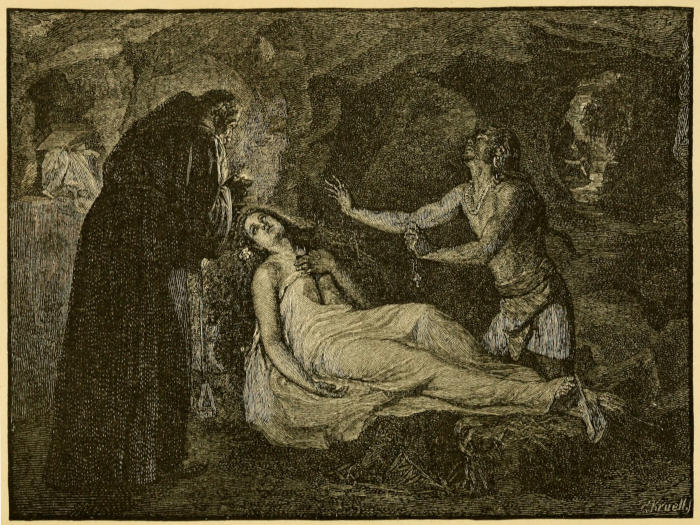
THE DEATH OF ATALA. [By Luis Monroy.]
There is in this contemporary work the general fault of an over-delicacy and smoothness of painting, and a lack of realism, while the design is excellent. These voyagers in the ark have not experienced the woes of a deluge, and the shepherds have the complexion of Lady Vere de Vere. Rebull, who studied at Rome under Overbeck, repeats here the dove-colors, violets, and lemon-yellows of the modern decorations of the Vatican done under that school.
The works of the latest period, under the able direction of Señor Salome Pina, a pupil of Gleyre, are much more virile, and the subjects more secular. We have now Bacchus and Ariadne; the death of Atala; the slaying of the sons of Niobe; an arch and dainty Cupid poisoning a flower, by Ocaranza; a charming fisher-boy, by Gutierrez. Some of the artists have had the advantage of study also abroad. The strongest of them all, Felix Parra, now enjoying a grand prize of Rome, produced the masterpiece, a great canvas representing the friar Las Casas protecting the Aztecs (from slaughter by the Spaniards)—a work in sentiment, drawing, and color worthy to hang in any exhibition in the world—before he had seen any other country than his own.
Velasco has set a powerful lead in landscape. He is especially a master of great distance. His favorite theme is the curious, sienna-colored Valley of Mexico, which he paints to the life.
There are some scattered works of the early school, besides, in the houses of a few dilettanti at the capital and Puebla; and some few in the cathedrals of the same places, though scarcely to be seen, from their disadvantageous positions. Good pictures need not be looked for in the churches. No doubt they were once numerous, but they have been sacked from the country by invaders and others, and found a profitable market abroad.
II.
In sculpture there is talent corresponding to that in painting. The stately system of burial, in the panteons, lends itself to sculpture and furnishes opportunities which with us are relegated to the commonplace tombstone-makers. The panteon is a solid city of the dead, walled in, paved, and with courts and arcades like a city of the living. The monument of greatest note is that, by Manuel Islas, at the Pantheon of San Fernando, to Benito Juarez, “the second Washington” of his country, old Padre Hidalgo having been the first. His effigy in marble, so realistic and corpse-like that it seems to have been modelled from an actual cast in plaster, lies upon a mausoleum, with a figure of Fame bending over it. The realism of the principal figure is almost repulsive, but it is redeemed by the grace of the angel, and nobody can deny to this large work great vigor and dignity.
The bodies are not buried, but sealed up in mausolea, or in niches in a wall, which present somewhat the aspect of a Roman columbarium. Some of the monuments are of the lovely Mexican onyx, with letters in gilt. I noted one bearing only the initials M. M. They were alluring to the curiosity, and on inquiring I found that it was that of Miramon, general-in-chief of Maximilian, who fell by the executioners’ bullets, with his master, and General Mejia, at Queretero.
There were no flowers on this one to-day, but the tombs of the patriots were elaborately decked, for it was the great festival of the Cinco de Mayo.
I walked out and stood in the round-point by the colossal bronze statue of Charles IV. The Paseo de la Reforma and the causeways glittered with bayonets; the cadets were coming down from the Military School back of Chapultepec, and the garrison from the Citadel, to join in the procession. The troops were reviewed in front of the National Palace—as troops in smaller numbers seem always being reviewed there. They are mainly of Indian blood, and small in stature. The cavalry especially had a rusty look in their outfit, and did not compare with the dashing Rurales. The officers, on the other hand, are trimly uniformed and quite French in aspect. There were patriotic speeches in the Zocalo; the main thoroughfare was strung with lanterns; and our Iturbide hotel was very picturesque, with its three tiers of balconies draped in the national colors—green, white, and red.
From time to time, as the procession moved, cannon were fired in the Plaza, and the bells of the cathedral turned over and over, like the wheels of machinery. I never saw a better-conducted crowd. There was no fighting, no inconvenient elbowing, no drunkenness. In the evening the lanterns were lighted, and the great square was filled with venders of fruits and knick-knacks, around little bonfires of sticks, where they would bivouac for the night. Later, red lights were kindled in the towers of the cathedral, and every detail within stood out upon a lurid ground as if they were burning. One could imagine the camped venders in the square to be the ancient Aztecs resting upon their arms, in order to attack Cortez in his quarters on the morrow.
III.
Scarcely the same improvement is to be got from Mexican literature as from Mexican art, but it is not without its interest, both in itself and as an aid to knowledge of the people.
Journals are very numerous. They are started upon slight provocation, and as easily disappear. They attain, as a rule, but a circulation of a few hundred copies. It is thought that the Monitor Republicano, by far the most important, may circulate from six to eight thousand. The problem of existence for many of them would be difficult without government aid. Subventions are given, without public objection, so far as I have observed, to the greater part of those managed with ability. The system of subventions to the press was begun by our old friend of school history, Santa Anna, and has been continued ever since by governments which could not afford to have anything more than the truth told about them, at any rate. It is an encouraging sign, however, that the Monitor is not a subventioned organ, yet speaks its mind temperately and without apparent malice.
There is no efficacious law of libel, since extreme violence of language is often indulged in by the periodicals in their controversies with each other and outsiders. The duel, which still survives, is somewhat of a corrective upon this. The newspaper is about such a one in appearance as at Paris, and includes a daily section of a serial story. A Sunday edition is published, with literary selections, and particularly poems, in large supply.
Actual literature as such is poorly paid. The reading public is small. A thousand copies is a good edition even for a popular book. The chief literary lights are found, as a rule, not of the shy, scholastic order, but possessed of talent for oratory and bustling affairs. They take posts in Congress, and are appointed as cabinet ministers. General Riva Palacio, Juan Mateos, Prieto, Paz, Altimirano, Justo Sierra, Peza, are deputies; Payno, a senator; Cuellar, who wrote under the pseudonym of “Facundo,” a secretary of legation. These are the native writers whose works are more frequently in the hands of the public than any others.
Prieto, who is chiefly a poet, however, has written a book of his travels in the United States, in which some amusing things will be discovered. He finds that with us “the totality [lo colectivo] is grand and admirable, but the individual egoistic and vulgar.” He saw Booth’s Theatre, which is all of white marble (el Teatro de Both, todo de marmol blanco); and, besides our hotels, the establishment which we call a “Boarding” (el Boarding). The Hudson and East rivers, he says, are two arms of the sea, which freeze in winter, and even the immense quantity of ice collected from these does not suffice for the demands of the summer.
The poetical talent, of which we had a premonition in Cuba, is that which principally abounds. There is plentiful skill in versifying, with here and there a strain of something very much higher, in the volumes of the numerous authors. Prieto, above-mentioned, is found principally a poet of “occasions.” He writes for the unveiling of statues, to steam, electricity, and the like. Juan Mateos strikes a fierce patriotic note. Altimirano, a fiery Indian orator, who models himself in Congress rather after Mirabeau, chooses as his themes for poetry bees, oranges, poppies, morn, the pleasures of rural life. They are excellent subjects in themselves, but it is an artificial, and not a real, existence he describes. He would like to be Horatian, summons nymphs to disport with him in the shade, and abounds in florid terms, without thought.
Carpio is inspired more or less by Biblical subjects, as Pharaoh and Belshazzar. In De Castro, Zaragoza, Gustave Baz, and Cuenca are found charming conceits, of pensive cast, and bits of description of a limpid purity. Jewellers in words they may be called at their best, affiliated to the Venetian school.
The argument of Zaragoza’s “Armonias” (Harmonies) is briefly as follows: “When the flowers are dead, and spring is over, the swallows take their flight; and when again the flowers of spring adorn the mead, they, too, return, bringing blessings on their wings.
“But when the illusions depart and leave behind them only the thorns of the passions, in vain we invoke and wait for them to return. The illusions, the swallows of the heart, return, alas! never.”
So Gustave Baz, brooding in the sere winter over some heavy sorrow, reflects upon the return of spring. But the very contrast of its joyousness, the fresh rippling of the brooks and melody of the birds, will but render his sadness the heavier. “Then most keenly,” he laments, “will break forth my grief. Then weightiest will the air be laden with my sighs.”
The gem of the Lyra Mexicana is undoubtedly a certain fugitive sonnet, “A Rosario,” by an unfortunate young man, Acuña, who ended by taking his own life. The poem expresses the charming ideals in love and the bitterness of its disappointment, in a youth of fine and sensitive nature. It has a poignancy and realism which have, perhaps, never been surpassed. He returned from a long journey, as the story is told, and found his betrothed the wife of another. The shock proving unendurable, he committed suicide, leaving to the faithless one the poem, a part of which may be thus rendered:
“Well, then, I have to say that I love you still, that I worship you with all my being. I comprehend that your kisses are never to be mine, that into your dear eyes I am never to look.... Sometimes I try to sink you into oblivion, to execrate you.... But alas, how vain it is! my soul will not forget you. What will you, then, that I should do, oh, part of my life? What will you that I should do with such a heart?... Oh, figure to yourself how beautiful might have been our existence together!... But now that to the entrancing dream succeeds the black gulf that has opened between us—farewell! love of my loves, light of my darkness, perfume of all flowers that bloomed for me! my poet’s lyre, my youth, farewell!”
IV.
If one try to select the most obvious trait in the native fiction it is undoubtedly patriotism. This patriotism is rampant in the press, and in the forms of official life. The authorities are Citizen President, Citizen General, and the like, as in the first French Republic, and they conclude their official documents with the formula: “Liberty In The Constitution.” The usurpation of Maximilian served to bind the country into a certain unity and awake this feeling to its utmost.
Two romancers, General Riva Palacio, and Juan Mateos, have made use of the events of the French invasion in a curious class of bulky novels, to call them so, which have scored a popular success. “The Hill of Las Campañas,” and “The Sun of May,” of Mateos, are respectively more or less authentic accounts of the final defeat and execution of Maximilian, and the defence of Puebla, slightly disguised. The “Calvary and Tabor,” Riva Palacio, treats of the career of the Army of the Centre in the same wars. Numbers of the characters therefore are persons actually living, to be met with every day, which gives to this fiction a singular effect.
Thus, in “El Sol de Mayo,” Manuel Payno, Altimirano, and Riva Palacio himself are mentioned and their manners described in the debate on the financial measure which brought on the Intervention. Lerdo, long since an exile, resident in New York, was at that time “el profeta inspirada de nuestra nacionalidad” (the inspired prophet of our nationality).
I pick out from the same book this paragraphic mention of our own civil war: “And Edmundo Lee shone like a star in the victories of Springfield and Bull Run.” Perhaps the friends of General Robert E. Lee would have some difficulty in recognizing him under such a description.
These novels are printed with each sentence as a separate paragraph, for easier reading. They first began to rival somewhat the popular Fernandez y Gonzalez, by some called “the Spanish Dumas,” whose works are printed in the journals, together with translations of those of Gaboriau and Dickens. Another flimsy series, in covers of green, white, and red, called “Episodios Nacionales,” aim to sugar-coat a didactic exhibition of the events of the War of Independence. One individual after another tells a long, dreary narrative about what happened; these fall in with somebody else who tells more, and so it goes.
These stories are read chiefly by the middle and lower classes, the upper class, as in most provincial states of society, preferring books from abroad. Their favorable reception may be accounted for in part by the lack of regular histories and of newspaper intelligence, so that the populace may to some extent be getting their information for the first time.
Riva Palacio has written also, with Manuel Payno, a large work appropriately called El Libro Rojo (The Red Book). It gives an account (and graphic illustrations) of the heroes and other notables in Mexican history who have come to violent ends. This is a fate that has overtaken aspirants to distinction quite regularly, and the plates from the book, hung up at the book-stalls in the Portales, are a ghastly chamber of horrors. The three fighting curates of the early insurrection, Hidalgo, Morelos, and Matamoras begin the series; and Maximilian, Mejia, and Miramon, standing with bandaged eyes at the Hill of las Campañas, for the present conclude it.
Several minor writers have feebly essayed the Aztec material for fiction. Riva Palacio has availed himself also of the picturesque life under the Spanish viceroys. Of him it is to be said that, though of the sensational school, and careless in plan, he has, not unfrequently, passages of genuine force, and unhackneyed incidents that enchain the attention.
XI. SOME TRAITS OF PECULIAR HISTORY, AND THE MEXICAN “WARWICK.”
I.
It would seem that history in Mexico might be a somewhat confusing study; and so, in fact, it is. There have been fifty-four Presidents, one regency, and one Emperor, in fifty-six years, and a violent change of government with nearly every one.