Part 1 — OLD MEXICO. (continued 5)
Reading edition
It was designed in its day for much greater state. The furniture, though battered and ruined now, was of the charming artistic pattern of the First Empire, and all the rooms were large and of fine proportions. In one of the two principal bedrooms the bed is raised upon a daïs, ascended by steps. In the other the corners are cut off by columns, so as to give it an octagon shape. In three of these corners the beds are regularly built in between the columns; the fourth is taken for a door. It so happened that I had not read Madame de la Barca before leaving home. Perhaps I had but a rather disparaging idea of a work descriptive of Mexico coming down no later than 1839. On taking it up after my return I had an opportunity to find how little the country had changed. She too visited this hacienda of Tepenacasco. She noted, among other items, a quaint wall-paper, of a Swiss pattern, on the octagon room. That very paper is there to this day.
The proprietor was of quite a different sort in those times. He used to give bull-fights in the court before his portal, which is now a threshing-floor, and is said to have entertained half the population of Tulancingo at his table. He finally ruined himself by his extravagance. It is said, among other things, that if he took a sudden notion to go to Mexico, a hundred and twenty miles away, he rode his horses so hard that they sometimes dropped dead under him.
XX. ON HORSEBACK AND MULEBACK TO ACAPULCO.
I.
The time came at length—all too soon—for my final Mexican journey—to the Pacific coast at Acapulco, where I was to take the steamer for San Francisco.
I was advised not to go to Acapulco. There are always persons ready to advise you not to do perfectly feasible things. It was now August, and the rainy season had begun in town itself. It began one afternoon with a rush. I had been reading at the National Library, and, coming out at four o’clock, found the streets a couple of feet deep in water. The cabs, now at a premium, and some few men on horseback, who could give a friend a lift, served as impromptu gondolas upon these impromptu canals. There were also cargadores, who, for a medio, carried you on their backs from corner to corner. I was told that ladies in the balconies, watching the animated sight, now and then slyly held up a real, in consideration of which the cargador dropped some gallant in the water, presenting a ridiculous sight. Such inundations last several hours before the sluggish sewers can carry off the surplus water, and they leave the ground-floor habitations of the poor in but a cheerless condition, as may be imagined.
If this were to be added to the other embarrassments of life every afternoon, it was not interesting to think of remaining longer at the capital. And yet, with Macbeth, there seemed “nor flying hence, nor tarrying here.” The journey to Acapulco was represented as very difficult and dangerous. The route was a mere trail or foot-path, a buen camino de pajaros—a good road for birds. No wheeled vehicle ever had passed or ever could pass over it. All this was, indeed, the case. Three large rivers were to be crossed, and these unbridged.
“Suppose,” said the advisers, putting the case in that bold and alarming way in which advisers delight, “that these should be swollen by the floods, as is naturally to be expected now in the rainy season. You would then be delayed so long on their banks as to miss your steamer, which touches at Acapulco only once a fortnight. Again, the road lies, for days at a time, in ravines and the beds of streams; but when the waters occupy their channels what room is there for travellers?”
If to this were added the natural reflections of the novice on the score of danger to property and person in entering upon so wild a section, the prospect was not at all a pleasing one. Nevertheless it would be almost too much to expect that a person bound for California should come back to the United States again in order to go there, and I had a firm conviction that the Acapulco trip could be made.
II.
I had negotiated a little already with an arriero, or muleteer, named Vincente Lopez, in a street called Parque del Conde. He would furnish a horse to ride, and a mule to transport my baggage, each for $20—all other expenses to be defrayed personally along the way—which makes the three hundred miles come a good deal higher than so much railway travel. I had thus dallied with the idea, and my decision was precipitated by the sudden coming down of the rain. I hurried to Parque del Conde Street, and closed with Vincente Lopez. I was glad to learn from him that he had also another patron who was going, in the person of a colonel of the army. The journey, under the most favorable auspices, consumes ten days on horseback, besides the day occupied in going down by stage-coach to the provincial city of Cuernavaca, where the bridle-path begins. Considering all the circumstances as stated, there were many companions one would much less prefer to have than so presumably bold and well-informed a person as a Mexican regular officer.
He proved to be a veritable military man, a colonel who had seen twenty years’ service in different wars of his country, and bore bullet-holes in his body as the result of them. He had begun in the War of the Reform, which overthrew the Church and aristocratic party; he had fought against the French and Maximilian in the second War of Independence; and, lastly, for the government of Lerdo against Porfirio Diaz. To the party of the latter he was, however, now reconciled, and he was going to take a command on the disturbed northern frontier. If more were needed, he had lately fought a duel, as he told me, in which the weapons were sabres, and had so slashed his opponent, a brother officer, that the latter was laid up in a grievous state at the hospital. A vacant barracks had been set apart, by the War Department, for this proceeding. Army duelling, as on the Continent, is connived at. The case seems to be that, if you fight, you are afterward reprimanded; but if you do not, you are likely to be cashiered as pusillanimous.
Not that the colonel was in all respects the most agreeable of travelling companions. He was much wrapped up in his own affairs at first, and later displayed some traits of a certain childish selfishness.
Vincente Lopez collected our baggage at the appointed time. He was a plausible person, and when he desired the full amount of his bill in advance I had well-nigh yielded to him. I submitted, however, as more equitable, that one-half should be paid down and the remainder on the completion of the journey according to contract.
“That would be equitable, indeed, for ordinary arrieros,” said Vincente Lopez, “but I am one of especial probity. It is my habit to watch over the persons who confide themselves to my care with a tender solicitude, and in the present instance I have intended to multiply even my usual pains. I am one of those who have never known what it is to encounter on the way the slightest delay or annoyance.”
He seemed wounded in his finest sensibilities by an appearance of mistrust, which was to him hitherto unknown. There were considerations in his favor. He said that the colonel, at another hotel, had paid the full sum in advance, and this proved true. Whatever money was to be taken, besides, must be in the heavy silver coinage of the country, $16 to the pound, and to be rid of the weight and jingling of even a part of it was desirable. Still, on the whole, the contract was drawn in my way, by the advice of the dark secretary of the Iturbide Hotel. Though it seemed almost cruel at the time to act in this formal manner with so good a man, the precaution proved in the sequel to be very useful.
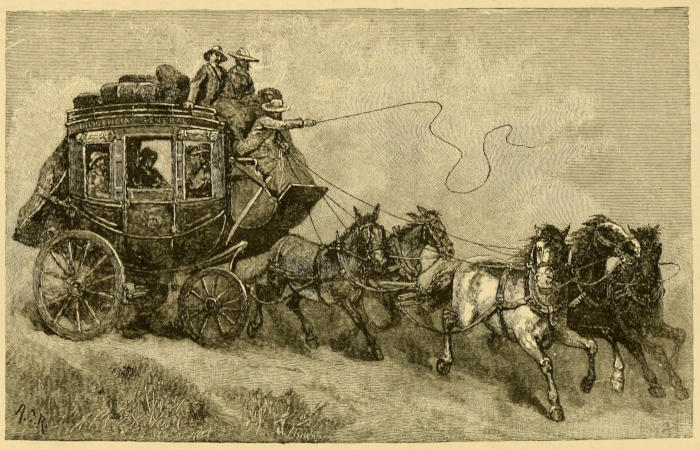
THE “DILIGENCIA.”
III.
My colonel was accompanied down to Cuernavaca in the diligencia—in which we were all extremely jolted, dusty, and uncomfortable together—by two generals. They had apparently come to give him parting directions about his mission. One of them was a thick-set, black-bearded man, with a husky voice, and a conspicuous scar upon his face. I must not branch off too much into side issues, but the history of the scar was that, while commanding in Yucatan, he had ordered to be shot, on some of the ordinary revolutionary pretexts, a member of the powerful family of Gutierrez Estrada, a family with commercial houses in Paris, Mexico, and Merida, and noted, among other things, for the beauty and intelligence of its women. A brother of the victim came over from Paris as an avenger, sought out the general in question, met him in a duel, and left this mark, which, at the time of its infliction, brought the recipient to death’s door.
The city of Mexico is some 7500 feet above the sea, and, having come up, we now followed a great downward slope. It abounds in bold points of view, from which the prospects spread vision-like at vast distances below. Cuernavaca presents one of the most thrilling of these. What is yonder singular detail in the valley? A hacienda set in the open side of an extinct volcanic crater, of which the whole interior has been brought under smiling cultivation. And yonder yellowish spot? The sugar-cane fields of the Duke of Monteleone. He is an Italian nobleman of Naples, who inherits, by right of descent, a part of the estates reserved here for himself by Cortez. The Conqueror was made “Marquis of the Valley,” with his port at Tehuantepec, and an estate comprising twenty large towns and villages, and 23,000 vassals.
Nowhere is there a quainter group of old rococo churches than that in this solid little city. They have flying buttresses, of two arches in width, descending quite to the ground, domes, and other inlay in colored porcelain tiles; and they are all clustered together, with tombs and a battlemented wall about them. A student of architecture coming this way with his sketch-book in his hand could find material here for a month. I am not sure that the trip could not be made enjoyably, as it certainly could economically, on foot, with an attendant to carry a knapsack, as we met some German naturalists and prospectors making it farther on. Close by is a garden on a great scale—the Jardin Borda—to which one obtains admittance for a fee. It has a stone fish-pond as large as a lake, terraces, urns, and statues worthy of the most luxurious prince in Europe. I was told that it could be bought for $5000. I asked the custodian about the owner—what he had been remarkable for.
“He had altos pesos,” replied the man, which is Spanish for “a pile of money.” Bushels of delicious mangoes were rotting untouched along the walks. From the outer terrace you look down into the barranca which Alvarado crossed by a fallen tree when sent by his indefatigable general against the disaffected Gonzalo Pizarro. Here are guava, mango, pine-apple, banana, and plenty of other fruits, but not yet the cocoa-nut, which only flourishes lower down.
Behold us ready to set forth on the trail! Vincente Lopez is not present, strange to say, to cast about us the fostering care he has promised. On the contrary, he has quietly sold out his contract and gone back to the Parque del Conde with his profits. We are in the hands of a new muleteer, “Don Marcos,” who has never made the journey to Acapulco before, and a fourteen-year-old boy, “Vincente,” who is depended upon to find the way. Every cavalcade in Mexico is bizarre, and ours, ordinary enough there, would attract attention elsewhere. First, upon the mule “Venado” rides the colonel, a tall, spare man, in military boots, wide hat with silver braid, and a linen blouse, through which project the handles of huge revolvers. He is aiming, not at display, but comfort. Of myself I shall say nothing. It is a privilege of the narrator to let it be supposed that he is always gallant and imposing in appearance, and exactly adapted to the circumstances of the case. I rode the rather large bay horse “Pajaro.” Don Marcos, a deprecating, tricky person, with a purpose, soon evident, of making up from us his bad bargain, wore a crimson poncho and cotton drawers, and bestrode the small white horse “Palomito” (“Little Dove”). Thus appreciatively had he thought fit to name all the animals, though he had but on the instant come into possession of them. The trunks, first securely sewn up in cocoa-mats, were tied, the colonel’s upon the back of the mule “Niña,” and mine upon “Aceituna.” Vincente, the boy, ran barefoot most of the way to Acapulco behind the mules, crying, “Eh! machos!” and cracking at them with a combination whip and blinder. With this same blinder their eyes were covered while their loads were being put on and taken off, at morning, noon, and night.
There was a bit of wagon-road at first, as there is outside of each of the more important places along the way. This soon merged in the trail, which was of increasing wildness. The huts and hamlets we fell in with were of cane, well thatched. There were fields of cane, trains of mules laden with sugar-loaves, and an occasional stately sugar hacienda. Now and then there were the remains of one ruined in the wars. At noon the mules were unpacked at some favorable point, and the expedition rested for several hours. It was the custom to take a siesta during the extreme heat of the day. At night there were occasional mesons, or rude inns, but generally our stopping-place was such accommodation as could be offered by the inhabitants of the villages. The baggage was piled up under a thatched pavilion. Beds, consisting of mats of stiff canes resting upon trestles, were arranged for us along-side, or in open piazzas. These, in the warm nights, were more agreeable than might be supposed. À la guerre comme à la guerre! Sleeping almost under the belle étoile, you could study the constellations, the outlines of strange, dark hills, your own thoughts, and hear the dogs bark, down at remote Sacocoyuca, Rincon, and Dos Arroyos, and there was not a little pleasant novelty in the situation. At the gray of dawn we were off.
The people, all of Aztec blood, were gentle with us, honest, and not much less comfortable in their circumstances than farmers newly established at the West. The predicted difficulties of the undertaking largely melted away. It rained chiefly at night; there were but one or two showers in the daytime, though of these one was very hard. The food obtained along the way was of rustic quality, and occasionally scanty, but, on the other hand, it was often excellent. Chickens were generally to be had, with fried bananas as the most frequent vegetable accompaniment. The national dish of frijoles (black beans) was always palatable. There was milk in the morning, but not at night, the cows being milked but once a day. We foraged more or less for ourselves. The colonel would demand a couple of eggs under the off-hand formula of un par de blanquillos, which can hardly be translated, but is as much as to say, “A pair of little white ’uns.” He declared it “a miserable population” where they were not to be had.
On the very first day out Don Marcos came to say that he had no money with which to buy feed for the animals. It was with the reserve I had retained, doled out little by little, that this necessary purpose was thereafter accomplished, and the arriero perhaps kept from leaving us in the lurch.
It was à propos of this incident that my first glimpse into the peculiar nature and inclinations of the colonel was obtained. It was now evident that it would have been better not to have paid the man in advance. But the colonel refused either to regret that he had done so or to regard it as a lesson for the future.
“I am a philosopher,” he said. “The philosopher makes no account of such things.”
These views he professed also on other occasions, and seemed, with a bravado of stoicism, almost to go in search of inconveniences.
“But is it not rather philosophy,” I argued, “to avoid such inconveniences as one can by a little exercise of forethought, and then endure the inevitable with equanimity?”
“No; that is the civilian’s, not the soldier’s, point of view,” he persisted, with obstinacy.
IV.
This route, probably no better, and certainly no worse, was travelled, as now, nearly a hundred years before the Pilgrims landed at Plymouth Rock. It was the sole highway between Acapulco, the only really excellent port on the Pacific Coast, and the capital. It has seen the transit of convoys of treasure, slaves, silks, and spices from the Indies, bound in part for Old Spain. A regular galleon used to sail from Acapulco for supplies of Oriental goods. It has seen the march of royalist troops, under the sixty-four viceroys, and of many a wild insurgent troop. Morelos operated here, with his bandit handkerchief round his head, and kept the district clear of Spaniards down to the sea at Acapulco. By one of the rivers still lies the massive stone-work for a bridge, the construction of which was abandoned in the War of Independence, seventy years ago.
Most momentous of all the processions it has seen, however, must be counted that of Iturbide, who returned along it, with his new tri-colored flag of the three guarantees—Religion, Union, and Independence—to the capital, to make himself, for a brief season, Emperor. This brilliant figure, of such an ignominious end, is still greatly honored in Mexico, and there is something rather typical of Mexico, or of Spanish America generally, in his history. Taking the position which would have been that of a Tory here, he fought against the earlier insurrection of his country, from its outbreak, in 1808, till 1820. Sent in command of an army against the rebel chief Guerrero in the latter year, he united with instead of attacking him, seized a convoy of treasure to serve as sinews of war, and drew up at Iguala—a charming little city on the route—a plan of independence of his own. The Viceroy, in despair, tried to buy him back with promises of pardon, money, and higher command, but without success. He made a triumphal entry into the capital in September, 1821. In May of the following year a sedition, which he had without doubt artfully set on foot, roused him at his hotel at night, with a clamor that he should become Emperor. He appeared upon his balcony and affected to reluctantly consent to the popular will.
He modelled himself after Napoleon, nearly his contemporary. There is a portrait of him at the National Palace, in the same gorgeous coronation robes affected by the latter, though in his own whiskered countenance he is more like the English Prince Regent of the same date. In August he imprisoned some Deputies, and in October, still following his illustrious prototype, put his troublesome Congress out-of-doors. But in October also the country rose against him, and he was obliged to leave it and take refuge in England. He returned again in July of the next year—another Napoleon from Elba; but, instead of sweeping the country with enthusiasm, he was seized upon landing, and ordered to prepare for death within two hours. Four days of grace were finally given him, and then he was shot.
Iturbide was a person of a highly politic turn, as has been seen. A thorough devotee of expediency, he maintained (and there was not a little truth in this) that a people made up so largely of Indian serfs suddenly released from tyranny was not ready for self-government. He said that he had meant the Empire to be only temporary. He had shown no personal valor in the service of his country, as there had been no occasion for it; all his actual fighting had been against it. Yet he is commemorated in the national anthem,[3] and a certain hold, in the Napoleonic way, which he had upon the popular imagination, was relied upon by the French when they endeavored to establish Maximilian in Mexico. A grandson of Iturbide still lives who was adopted by Maximilian, in order to give his dynasty a more indigenous effect, and made heir to the succession. The boy’s mother, who at first acquiesced in the usurping order of things, later repented, and endeavored to get him away. This was finally effected through the mediations of Secretary Seward and Mr. John Bigelow, then Minister to France.
XXI. CONVERSATIONS BY THE WAY WITH A COLONEL.
I.
Iturbide was the subject of confab between the colonel and myself as we jogged along the way; and this led naturally up to Maximilian. My companion had served under Escobedo in the campaign in which Maximilian was overthrown, and had witnessed his execution at the tragic Cerro de las Campañas.
“He died like a true soldier,” said the colonel. “He was not afraid; though he deserved his fate, and I would not have had it otherwise.”
It seems to be the general verdict that this ill-starred ruler was not without the physical fortitude which is esteemed a part of the heritage of princes. But he was better fitted for many other things than the task of fastening a monarchy upon belligerent Mexico. I drew the conversation, when an opening appeared, to the present novel relations of Mexico with our own country.
“Had I the authority,” said the colonel, frankly, “I would never have granted the railroad charters which are making this great bustle. I fear the aggressions of the Americans. The conservative Mexican policy is to grant you such privileges only when they are balanced by others to Europeans. This was the consistent policy of Juarez and Lerdo. It was Porfirio Diaz, during his presidency, who first broke it down and brought this invasion upon us.”
“We, on the contrary, incline to make it one of his merits,” I said—“a proof of his superior enlightenment. He stepped over the boundaries of narrow prejudice and jealousy, and allowed a beginning to be made of developing the country by those who were ready to do it, without waiting farther for those who would not.”
“His enemies say he was bought,” rejoined the colonel, who had evidently no great love for Porfirio. “He has not been wholly above corruption in his time. He made fabulous sums out of the liquidation of the military arrears, for instance. He paid a million dollars for his magnificent hacienda in the state of Oaxaca. Where did that come from? That is a great weakness among us for official corruption. There are too many examples of it. A defaulting person in a high place is rarely punished. When I see a case of that kind treated with severity I shall begin to conceive new hopes.”
“But,” I argued, “the Americans certainly have no other designs than that of commercial profit. They do not want your country. What Americans have anything to gain by taking it? Who would put his hand in his pocket to pay the expenses of a war of annexation? We look out for ourselves as individuals, and we fail to see where the profit comes in. We are large enough now to gratify our own vanity on that score. Love of glory and territorial aggrandizement is not one of our national traits. Spoliation might rather be feared at the hands of some ambitious prince, if you had any such for a neighbor, who could turn it to personal account.”
“You will not annex us with bayonets,” he returned; “you will annex us with dollars. I feel it; I know it. Your great commercial enterprises will insensibly get hold of the vitals of our country, and the rest will follow. Perhaps there may be disturbances, and your government called in to protect the property of investors. There will naturally be sympathy for them at home, and they will move heaven and earth rather than lose. A thousand times better that our country were not developed at all than at such a price.”
As I still insisted upon the unreasonableness of this notion, the colonel continued: “Even granting that you are sincere in what you say of the wishes of your people, I feel that it is the manifest destiny of Mexico to be taken by the United States. In former times the Latin races ruled the world, but in this and the coming ages the Saxon race will do it. You are a strong, commercial people, and commerce is the breath of the nostrils of modern civilization. Look at what you have done in California since it ceased to be a Spanish province. I have been at San Francisco—a great, splendid city; I looked upon it with amazement. ‘This was once Mexican,’ I said to myself. ‘Ah, what a different genius from that of Mexico!’ Yes, you will get us. It will be the amelioration of many abuses, and our greater prosperity, without doubt; but I hope I shall never live to see the day. As a patriot, as a soldier, I would give my life fifty times over rather than consent to it.”
“But, since you concede such benefits as probable,” I ventured to say, “what is this patriotism upon which you so strongly insist? We do not want you, and have no designs upon you, but—purely for the sake of argument, and talking as enlightened persons—is it not rather fantastic? Is a boundary-line such an object in itself? May not a good deal that has stood for patriotism in the past be a mere provincial narrowness? Supposing that Mexico, or Canada, without force, but in its own judgment of what was for the good of its people, should desire to become a part of the Union, maintaining its organization in states and its local self-government as now, and merely sending delegates to Washington to represent it in national affairs, would you, as a Mexican citizen, feel bound to resist, as if it were the consummation of something scandalous and recreant? Is not the enjoyment of life, liberty, and the pursuit of happiness to the greatest advantage, the object of a rational being? Is there any virtue in an essential Mexicanism, Americanism, or Anglicism, that it should be preserved at all hazards?”
And, having asked many such-like questions, I endeavored, farther, to explain a view that we may be all approaching a great cosmopolitan period, when we shall be members of a republic of nations, and foreigners, as such, shall nowhere any longer be either dreaded or despised.
“That is all very well,” said the colonel, stubbornly, “since the advantage is to fall on your side; but I tell you I would give my heart’s blood rather than see it.”
As to the value of his prognostication I have no opinion; but this seriousness of conviction about the plans of the Americans from such a source was full of interest. It is held by the bulk of the Mexican people, and it means trouble ahead for the enterprises, since it must increase with their very success.
“Has any party ever been heard of, with you, in favor of annexation?” I went on to ask.
“There is no such party,” he replied. “There are none who could favor it—unless, singularly enough, it might be the Church party. Protestant country though you are, with you they could enjoy a greater freedom than here. Since their suppression under the War of the Reform there can be no convents, religious orders, nor monastic schools; but in the United States, I understand, they could have as many as they wished.”
The colonel was rather fond, as stated, of dwelling upon the soldier’s point of view. One day, when he had been writing, as he said, to his mother, he declared, in a gloomy mood, not without its pathos: “That is the only tie that binds me to life. At forty-four, as you see me, I have passed through many disappointments and chagrins. I have little pleasure in the present and no great hopes for the future. Well, that is a proper state of mind for the soldier.
“The soldier,” he went on to say, “should be one who either sets little value upon life, and looks to death as a release, or one having a supreme sense of honor, of pride in his profession, and duty to his government. He makes a contract, as it were, with authority. He is well paid and highly considered; in return, he must be ready to spill his blood whenever his employer demands it.”
II.
The display of childish selfishness on my companion’s part to which I have adverted consisted in getting up one morning and riding off on my horse, without saying so much as “By your leave.” He had cast eyes on it as we went along, judged it to be on the whole preferable to his mule, and in this direct way took possession. The matter was adjusted, but not till it had assumed at one time an almost international aspect. It was in the coolness resulting from this incident that I rode on alone and first saw Iguala.
The expedition had stopped, after its usual day’s march, before sunset, at the tropical hamlet of Platanillo. I was anxious, however, to pass the night instead in the notable city named. The twilight shuts down very rapidly here, and from the estimates of casual informants I had miscalculated the distance. “Adelantito, señor,” they said, after the inaccurate way of such informants—“Just a little way ahead;” “Aca bajito, no mas”—“Right down there; a mere trifle, that is all.” I had a distant glimpse or two of it from the pass, while the sun glowed like a beacon-fire on the crests of vast mountains encompassing its little valley. A small lake sparkled in its vicinity, and plantations of cane near it showed a brighter green. Of the town itself, which might have been a mammoth hacienda, only a dome and a few white spots appeared out of the midst of a quadrangle of foliage marked off on all sides to an even line. Then night came on, a dark and cloudy one, though without rain. My horse slipped with me on the steep over rolling stones. It was no longer safe to ride after that, and I led him most of the way, picking out the path in the dark. The view had been very deceptive, and we had many miles to go.
Lonely gulches, brooks, and bits of wood were passed. Cows had gone to sleep in upland pastures, and one occasionally loomed up, a mysterious shape, in the path and took herself out of the way. The rays of a clouded moon gleamed now and then on a white patch of the lake, but the city seemed to have vanished out of existence. At last, however, a dim light in a dome, then a barking of dogs, and audible human voices. All this time there had been neither house nor hut. It was after nine o’clock. I came close up to one of the formal lines of trees, opened a gate in it, and was in the midst of Iguala.
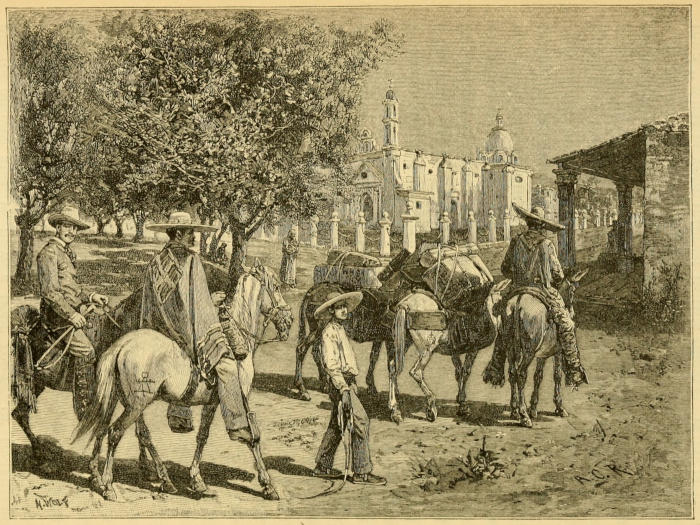
OUR CAVALCADE AT IGUALA.
I do not know whether the place has quite advantages enough to offset so much discomfort. What there is to be seen could easily have been taken in the next day on the march. There is no other vestige of Iturbide yielded to inquiry than the house in which the Plan of Iguala is said to have been signed—the oldest, as it is one of the shabbiest, in the place. It is of one story, like most provincial Mexican houses, with the whitewash badly rubbed off its adobes, and is now a poor fonda, or restaurant, without so much as a sign.
But Iguala is charming. A row of clean, white colonnades, made up of square pillars of masonry, supporting red-tiled roofs, extends around a central plaza. The windows of the better residences are closed, not with glass, but projecting wooden gratings of turned posts, painted green. The market, a little paved plaza, opening from the other, consists of a series of double colonnades, light, commodious, and very attractive. The church, of a noble, massive form, made gay by an azure belfry and clock, stands in a grassy enclosure surrounded by posts and chains. Across the way is the zocalo, with brick benches, deep, grateful shade of tamarindos, as large as elms, and arbors draped with sweet-peas in blossom. Such a park, such a church, and such a market could be conscientiously recommended as worthy of any populace in the world. The heads of palm-trees star the heavier, Northern-looking foliage. Grass sprouts plentifully between the cobble-stones, and gives a rural air. A band played in the zocalo in the evening, though there was but a small scattering of persons to hear it.
As I was making a sketch of the zocalo from a portal some very well-dressed young men and a professor came out. It proved that this house was a school, and a pleasant one it seemed.
“Amigo”—friend—they said, in a rather patronizing tone, “what is your interest in this place? What is your picturing designed for?”
Three days farther on is Chilpancingo, to which also complimentary terms—in a lesser measure than Iguala—may be applied. It is the capital of this rugged Guerrero, a state named after the patriot general, who was once, like our own Marcos and Vincente Lopez, a muleteer. It contains an ornate Government-house, a zocalo with a music-stand; and we met here a colonel of the detachment of cavalry guarding the country, gotten up in such dapper civilian riding-dress as if for a promenade in Central Park. Population—but populations are hard to get at in Mexico. I should say, at random, for either place, about three thousand people.
At Chilpancingo you see the place in which the original Declaration of Independence of Mexico was proclaimed, in 1813. It had to be fought for many a long year till the day of Iturbide. This is merely a white house with a tablet, and not of farther interest. It was a wild and problematic cause, truly, when remote Chilpancingo was resorted to by the first constituent Congress, assembled by Padre Morelos, to throw off the yoke of Spain.
But how has all this been done? These little bits of ornate civilization are like enchanted places which we happen upon in penetrating the fastnesses of the mountains. Perhaps we had better take out at once some such commission as that of the Adelantado of the Seven Cities; and yet greater discoveries may await us, never before heard of by man. Each lies in its miniature valley, smiling and fertile, with wagon-roads for a little space around; but their inhabitants can hardly be conceived as going over the wild trail to supply themselves with the fashions and comforts they possess.
Candid judges from without would pronounce it impassable, and think it a practical joke that they were asked to consider it a road. We crossed and recrossed swift, small streams, the water reaching to the animals’ shoulders. The colonel had a way of dangling his military boots on such occasions in the water, to let me see how excellently they were made; but one night, I observed, he could not get them off, and the next morning he could not get them on. All of one day we traversed the cañada, or gorge, of Cholitea, over a sandy bed of which the flood had not yet taken possession; another day, the Cañada del Zopilote. Our old friend of the North, the ailanthus, was common where other natural features were dreariest, and often filled the air insufferably with its odor. The three rivers crossing our way were swollen indeed, as had been predicted. When we came down to the wide Mescala it was opaque with red soil, and tearing past at twenty miles an hour. We were transported across it in a flat skiff guided by an oar. There was no plank to aid in the embarking of the horses, and one of them fell into such a panic as caused a terrific combat of well-nigh half an hour. He was finally thrown on board, more dead than alive, with lassoed legs.
“Ah, what a soul you have!” (Ah, que alma tienes!) cried Marcos fervently to his animal, which had well-nigh kicked us all into the river; and losing all policy in his rage, he begged to borrow my revolver, that he might despatch such a brute, of the ownership of which he was ashamed.
The Papagallo River succeeding, we crossed in a dug-out, and the animals swam. I asked the colonel, in my simplicity, if this were not more or less like war, meaning the manner of travel, our foraging, half open-air way of sleeping, and the like. He smiled in disdain, and gave me a sketch of his campaigns in the day of the French usurpation. The rightful government had had at one time so little foothold in the country that it was called the Government of Paso del Norte, from the farthest town on the northern frontier, to which it was driven. Eating and sleeping seem hardly to have been the custom at all till, by an unremitting guerilla warfare, the tide was turned.
When we came to “the Cajones,” however, he admitted that this was a little like war. We slipped and slid all one day down the Cajones—natural, or rather most wofully unnatural, steps in the solid rock, in the midst of a dark forest. The perpendiculars are three and four feet at a time, and often there are mud-holes at the bottom; and besides, there are vines that aim to take you under the chin. The sagacious steadiness of the pack-mules, picking their steps unaided in the most critical situations, was wonderful to see.
We met peons, in white cotton, coming up with barrels of ardent spirits on their shoulders, and we came to a full stop to allow the passage of jingling mule-trains of goods. The water ran in the path with us, courteously sharing its right of way. At one place it increased and converged from every side, and the wood was full of its murmurs, as if another universal deluge were coming to overwhelm us. It was full, also, of patches of pale-green light upon moss-covered stones, and limpid pools, and delicate ferns, like snow crystals turned vegetable. Now and then some white cascade stood out of the semi-obscurity like a beckoning Undine.
Among vegetable growths on the way was the gum-copal, not unlike our white birch. There was a tree, the cuahuete—if I may trust the pronunciation of Marcos—smooth, bronze-colored, and often of a repulsive red, as if full of blood. We saw a good many charming red-and-yellow flowers on a high bush, like butterflies alighted, and once or twice a sprig of heliotrope and a calla-lily. The amape, found in the villages, and somewhat like the chestnut, was the finest shade-tree. There was a notable absence throughout the journey of what we are accustomed to deem the essentially tropical features. Very often one might have been riding in the woods of Connecticut. There was not even a rank luxuriance of growth, just as there were no serpents nor the swarms of pestiferous insects (other than a few gnats) to have been expected. We saw once a couple of coyote wolves trotting demurely along, and, again, a large iguana, a harmless reptile, one of which I also noted later, gliding around an old bronze gun at the fort of Acapulco.
Birds I hardly recollect at all, except a white heron or two, charmingly reflected in an upland pool one early morning, and the tecuses, a kind of black-bird. Vincente pelted at these latter with small stones, by way of trying his aim. The organ-cactus, however, should be exempted from the complaint of a want of tropicality. It abounds thickly about the gorges and on the mountain slopes. Rising twenty-five feet and more in height, the plants are like seven-branched candlesticks of the Mosaic law, or spears of the gods hurled down and yet quivering in the earth. The fan-palm, too, must be excepted. It crops out on the bleak hill-sides as common as mullein-stalks with us. I can never respect it, in the conservatories, again. To see it thus was a kind of shock: it was like seeing some exotic belle of society masquerading as a kitchen wench. For one day before reaching the coast we had the cocoa-nut-palms. Nobody in the hamlets would get the fruit down for us except on a wholesale order, for munificent prices, which brought the cost above what it is in New York. There was often a shortage of the other fruits and commodities, as sugar, in the same way, in or near the very places where they grew.
Toward the concluding stages of the march we fell in with another travelling-companion, an officer in the Customs service. When he learned that the colonel was going to the frontier, with a view, among other things, to suppress the extensive smuggling carried on there, he said, “You had better make your little $20,000 or $30,000 by protecting it. That will be much less trouble. The smugglers will buy up your soldiers, anyway; so it amounts to the same thing.”
I must not represent that the colonel was always of an oppressively serious carriage. On the contrary, he developed a vein of humor, the more amusing from the simple good-faith of those at whose expense it was generally exercised.
“Do you charge no more than this to persons of our consideration, my good woman?” he said to a peasant, whose bill was modest, though but in keeping with the primitive nature of the accommodations. “It is a species of affront, as one might say. Do you comprehend that I am a colonel in the army, and this gentleman a learned traveller, noting down the manners and customs of foreign lands? When strangers of our position come this way again understand that double what you have demanded is the least that you should take.”
The woman, abashed, received double her fee, and replied that she would bear the lesson in mind for the benefit of future comers.
Again, meeting three honest-faced Indian maids, with pitchers on their heads, going to the spring, he said, “Good-day, Marias!” and turning to me, in an aside, “Not that I know, from Adam, whether one of them is Maria or not.”
He praised glaringly, to her face, as of exceeding comeliness, a servant-maid who wore gold ear-rings and necklace, and was, perhaps, not of more than average dumpiness and plainness. She waited on us at table at Tierra Colorada. The colonel desired to know her name.
“Victoria.”
“Well are you named Victoria!” he cried, in simulated enthusiasm. “Que cara simpatica!” (“What a sympathetic face!”) he repeated at intervals.
Meekly, and with no suspicion of raillery, she replied, each time, “Mil gracias (“A thousand thanks”), señor.”
“Give thanks rather to Heaven, which made you so, and not us, who do but recognize it,” rejoined the colonel, piously.
At La Venta de Peregrino the night was hot, and it still rained, after having rained all day. A garden of bananas twenty feet tall grew next the basket-like house of canes where we stopped. We hung up our wet garments and properties on the poles of the thatched porch, or pavilion, till it resembled one of those very numerous national establishments, the empeños, or pawn-shops. Dogs, cats, donkeys, horses, pigs and fowls—“shooed” out, when they became too familiar, with an emphatic Ooch-t!—gathered under the same shelter, as if it had been a Noah’s ark. We supped on pepper-sauce, tough chicken, frijoles, tortillas, cream-cheese, and coffee without milk, spread out upon a mat on the ground. The proprietor in person—a man in an embroidered shirt and cotton drawers, whose talk was not of the wisest sort—held pitch-pine splints to light the feast.
“Now, how does it happen, hombre,” inquired the colonel, as if in a speculative way, “that a person of your fine appearance; a person of manners, intelligence, education, hospitality; a statesman, as one might say, who goes to Dos Arroyos to see who is going to be elected mayor” (the man had been there that day, as he told us), “with a fine house like this—how does it happen, I say, that you have not a table of any sort to serve two travellers a supper upon?”
“Pos bien,” said the illiterate host, both pleased and flustered, scratching his head. “Tables? Yes, tables, now, to be sure. All that you say is very true, but there is a great scarcity of carpenters in this part of the country. Si, escasen muncho (Yes, they are mighty scarce), I can tell you.”
III.
Two days after this we came down to Acapulco. It is a town for the most part of straggling huts, with a straggling thirty-five hundred of people. It has no vestiges of its antiquity but an old Spanish fort, after the order of Morro Castle, dismantled by Maximilian’s French on their abandonment of the place.
Near the fort lay a couple of rusted rails in position on a bit of washed-out embankment, the beginning of a railroad inaugurated here with a flourish on the 5th of May, 1881. Having passed over the line, one would judge that it might be much more than dread of American aggressions which would prevent its speedy completion.
There was no small pleasure in discovering at last, like another Balboa, the Pacific Ocean, in boarding the fine steamer of the Pacific Mail Company, the City of Grenada, which had come her long jaunt from Panama northward, and re-establishing connection with the outer world.
With this, too, began an acquaintance with the western ports of Mexico. One of the semi-monthly steamers, rightly chosen, each month puts into them all. An idea of the country can thus be got which would not be possible otherwise without much greater fatigue and expense, but it is not at all as favorable as that presented by the interior.
Neither of the three lower ports is of great size. Acapulco has the most complete and charming harbor. Manzanillo is a small strip of a place, on the beach, built of wood, with quite an American look. The volcano of Colima appears inland, with a light cloud of smoke above it.
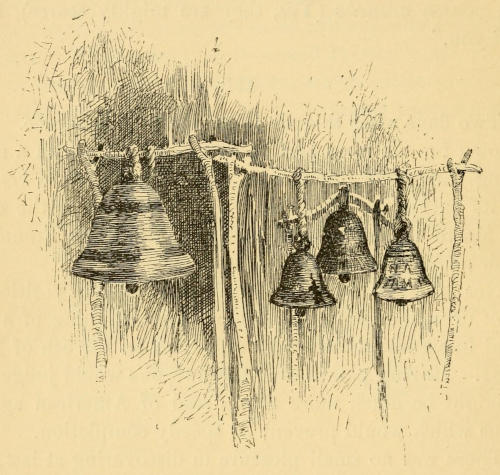
THE BELLS OF SAN BLAS.
San Blas is larger, but still hardly more than an extensive thatched village. On the bluff beside it exist the ruins of an ancient, substantial San Blas, shaken to pieces by an earthquake. Some old bronze bells from its church have been brought down and set up on some rude wooden trestles, on the ground in front of the poor chapel, without a belfry, which now fills the ecclesiastical needs of the place. This arrangement is sometimes referred to satirically as la torre de San Blas—the steeple of San Blas. My slight sketch of these bells, made on a fly-leaf of my note-book in the first instance, came to have an importance far beyond its own merits. I have the gratification of knowing that it proved to be the source of nothing less than the last inspiration of Longfellow. The great and good poet died on the 24th of March, 1882. In his portfolio was found his final work, “The Bells of San Blas,” dated March 15, which afterward appeared in the Atlantic Monthly. His memorandum-book contained a reference, as a suggestion for a poem, to the number and page of Harper’s Magazine of the same month, in which the sketch was published.
At Mazatlan we are in a bustling harbor, and a well and handsomely built little city, with improvements and shops of the better sort, which other countries than Mexico might be satisfied with. It seems surprising, until we comprehend the extensive back country which is tributary to it, how a city of but fourteen thousand people can be justified in maintaining so elaborate a stock of goods.
We steam finally across the Gulf of California and up the coast of that peninsula which seems one of the remotest points of the globe. The days are calm and blue; the bold outlines of the shores offer constant novelty. An arbitrary line is passed: we have lost Mexico, but gained California—the richest and most marvellous of her provinces.
It is remarkable now to recall that, upon the accession of the Emperor Iturbide, Mexico boasted of being, with the exception of Russia and China, the most extensive empire in the world.