Part 2 — THE LOST PROVINCES. (continued 3)
Reading edition
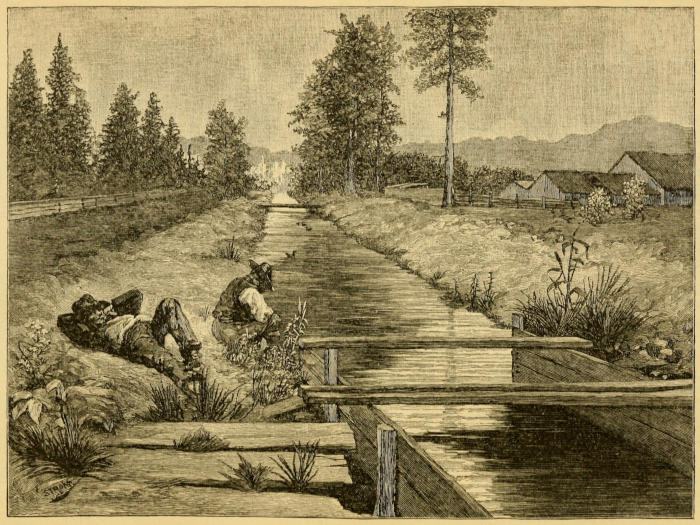
A SYLVAN GLIMPSE AT RIVERSIDE.
At Riverside is found a continuous belt of settlement and cultivation twelve miles long, by two miles in average width. It will be twenty long when all complete. The population is not large, but revels in a great deal of room. The general situation is a valley of about forty miles square, at an elevation of twelve hundred feet above the sea. The access to this valley is by four several passes, one each on the north, south, east, and west, as if so many doors had been providentially left open in the encompassing mountain ranges. The settlement forms an oasis in the midst of the desert, after the general plan. Its fresh greenness, and canals of clear water, along which sylvan glimpses, almost English, are met with, derive added charm and interest from the desert. The rest of the high, quadrangular valley, capable, no doubt, of as great development, if water can be brought upon it, remains in its natural condition.
A lovely drive, called Magnolia Avenue, planted with double rows of pepper and eucalyptus trees, extends through the length of the place from north to south. It is bordered with homes, making pretensions to much more than comfort. The best of these are at the division called Arlington, four miles below the post-office of Riverside proper. The native adobe, or sun-dried brick, supplemented with ornamental wood-work, has been used as material with excellent effect. In the interiors are found rugs, portières, Morris’s wall-papers, and all the paraphernalia of the latest Eastern civilization; and there is an archery club and a “German.”
Invalidism is heard of with considerable frequency as an excuse for the migration hither. Certainly many advantages offer to the invalid. The climate permits him to be almost constantly out-of-doors. The sky is blue, the sun unclouded, nearly every day in the year, and he can go into his orchard and concern himself about his Navel or Brazilian oranges, his paper-rind St. Michaels, and his Tahiti seedlings, with little let or hinderance. Orange culture affords him both a career and a revenue. If the unchanging blue of the sky grow sometimes monotonous, there are other distractions in the noble mountain ranges. Riverside has in this resource a touch of the charm of Switzerland. Your entertainer points out to you from his piazza the great peaks of Greylock, San Bernardino, and San Jacinto, from ten to twelve thousand feet in height, and crowned with snow for a considerable part of the year, just as the Jungfrau is pointed out from Interlaken and Mont Blanc from Geneva.
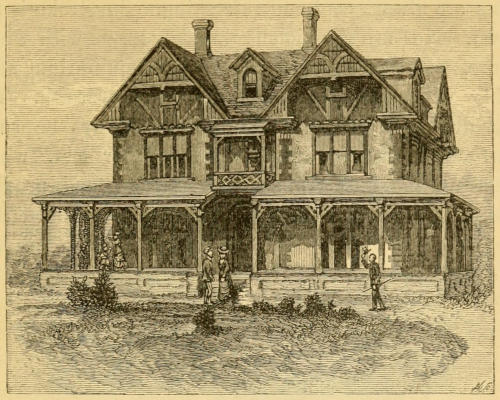
ADOBE RESIDENCE AT RIVERSIDE.
It is a description that applies to all of Southern California, that, however great the heat by day—in midsummer often a hundred and five in the shade—the nights are always cool and refreshing. Sunstroke is not known. Nor are the violent thunder-storms with which Nature, with us, endeavors to restore equilibrium after having exhausted its most oppressive warmth. The great drawback here, as there must always be some drawback, consists in occasional heavy “northers,” which gather up the dust from the dry surface and produce painful dust-storms of two or three days’ duration.
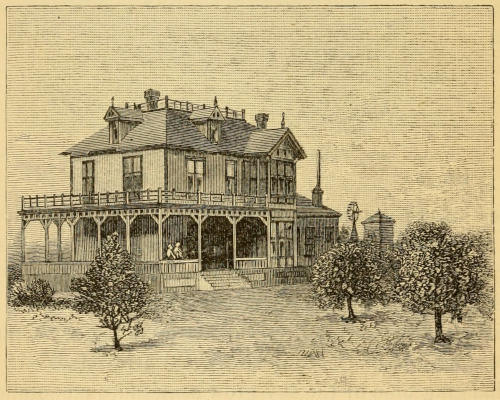
ADOBE RESIDENCE AT RIVERSIDE.
In autumn and winter the temperature is chilly enough to make fires a necessity morning and evening, and even all day long in apartments shut off from the influence of the sun. I was astonished to find the air so keen at these times, and a scum of ice forming upon water in the mornings even as far down as San Diego. The cold has a penetrating quality beyond its register by the thermometer. This, though usually overlooked, is important, since fuel is very scarce and correspondingly dear. Fagots of the prunings of the cottonwoods, sycamores, and mesquit-trees along the beds of the streams are the principal resource. Such coal as can be obtained is both costly and of poor quality.
The water for the irrigation of Riverside is taken from the swift little stream of the Santa Ana River, which falls so rapidly within a short compass that it is feasible to take out two separate canals with a difference of thirty-five feet in their levels. On all sides lands are held at $200 and $300 per acre, and when the orange-trees have come into good bearing, at $1000, which but a few years ago were purchased at a dollar and a quarter an acre.
All these places have their local rivalries, though Southern California as a whole is ready to unite in vindicating its peculiar claims, against the outside world. All have their pamphlets to distribute, containing their tables of mean temperatures, altitudes, analyses of soils, and claims to regard, as based upon nearness to, or absence from, some particular natural feature. Thus the coast counties take leave to pride themselves upon a genial average of temperature, owing to their proximity to the sea. They are free, they say, from the extremes of heat and cold afflicting those which are shut in behind the mountain barriers. The inland counties, on the other hand, congratulate themselves that their lot is cast where the mountains form an efficient defence against the raw fogs and gusts which must necessarily afflict those directly exposed to the chilly ocean.
These petty rivalries are a part of the history of all new countries, and pass away with the development of population and trade. There seems no need of jealousies, since there is encouragement enough for all in their several ways. The Territories of Arizona and New Mexico have just been opened to transportation by rail from this quarter. The lands suitable for the cultivation of the “citrus fruits” are limited in extent. The market is much more likely to improve than decline, even when production shall have largely increased beyond its present rate. High railroad freights were at one time a cause of alarm. The making of an “orange wine” was proposed as a resource for using up the surplus crop of this kind. The experiment was not a success, but it is not likely to be needed. Freights have declined, and will decline more with the building of projected new roads. Shipments of oranges have been successfully made from this section as far away as Denver, Chicago, and St. Louis.
II.
Great things are predicted for Wilmington, a little port twenty-two miles to the south-west of Los Angeles. The extensive works undertaken here by the railroad and the United States government are still incomplete, and it is but a dreary little place in its present condition. However, great ports have never been selected primarily for picturesqueness, but in accordance with such commercial necessities as short lines of transit, easy grades, and convenience for shipping. Wilmington had few natural conveniences to offer. There were originally but eighteen inches of water on its bar. This has been increased to ten feet. An enormous jetty, 6700 feet long, extending out to what is called Dead Man’s Island, is under construction. It is to force the tide itself to do the duty of scouring out the bottom, so that a ship channel several miles long will eventually be secured.
Santa Monica is another small port at the end of a branch railroad from Los Angeles, sixteen miles directly west, and somewhat famed as a sea-side resort. It has a hotel of considerable size, and a bold situation on a pretty horseshoe bay. The beach is of fine, hard sand; and the temperature admits of bathing, if one be inclined for it, all the year round. The hopes which were at one time entertained by capitalists, like Senator Jones, of Nevada, of making the place a great shipping point, have been for the present abandoned. It was to have been the Pacific terminus of a new through line from the East, coming by way of the Cajon Pass. A wharf 1500 feet long was built, and a breakwater proposed.
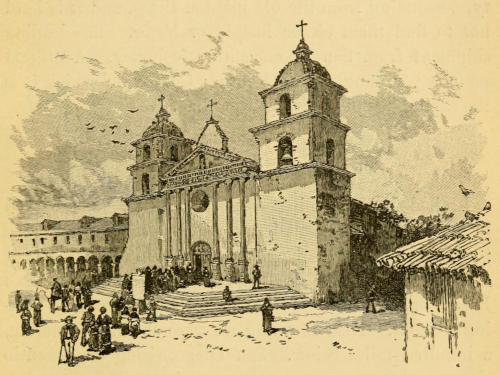
OLD MISSION AT SANTA BARBARA.
From here, or from Wilmington, you sail up the coast to San Buenaventura and Santa Barbara—favored by invalids. These places have as yet no railroad, but must before long come into the general system. Both are on that sheltered stretch of the coast which, from Point Conception, makes a sharp turn to the eastward, and has direct southern exposure and a view of the islands of Santa Barbara Channel. Santa Barbara, on its practical side, has devoted more attention than most places to the culture of the olive—an industry still much in its infancy. Some of the cultivators have provided themselves with a machinery, which costs about a thousand dollars, for expressing the oil. As a condiment the fruit is not pickled green here, like the Spanish olive, but ripe and black. It may be that a special education is needed for liking each variety of olives, as it is for acquiring the taste in the beginning. Those here are of a small variety, descending from the old mission times, and it is hard not to find them either insipid or bitter. The leading shipment from San Buenaventura is honey. A million pounds per annum from Ventura County, of which it is the capital, is not an unusual product.
III.
I sailed from Wilmington to San Diego. I embarked in the evening in a small tug, which steamed down the tortuous windings of the channel, past black lighters that Whistler would have liked to etch, and past Dead Man’s Island, and transferred us on board a coast steamer waiting without. Next morning we were at our destination, a hundred miles below. San Diego, rising on a gentle slope, makes a pretty appearance from the water. A United States barracks (yellow), with a flag-staff rising in the centre, is the most prominent object in front. You round an immensely long, narrow sand-spit of a peninsula, which contributes to form the excellent small harbor, and make fast to an immensely long mooring wharf. It is a feature of all California ports to have immensely long wharves. To the left is “Old Town,” its beach where Dana once loaded hides in his famous “Two Years Before the Mast,” now the site of a Chinese fishing village. To the right is brand-new “National City,” the location of the shops and extensive depot grounds for the new railway. In the centre, at about four miles from either, lies “New Town,” San Diego proper. All together have a population of about five thousand.
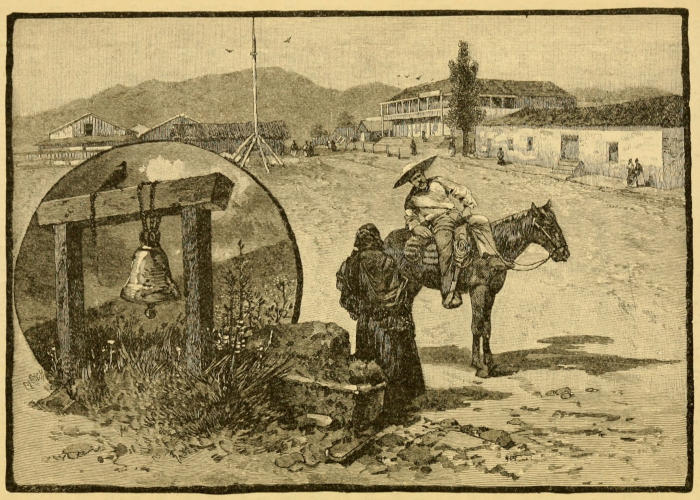
PLAZA OF SAN DIEGO, OLD TOWN.
As we came up to the wharf a locomotive, starting from National City on the new track, made the circuit of the water-front, with one long, shrill scream, which was taken up by the hills and echoed back. Gods and men were no longer to remain ignorant that San Diego had at last caught up with its future and had its railroad.
It was cruelly disappointed when it was to be the terminus of the Texas Pacific, transcontinental, road. The panic of ’73 prevented the capitalist “Tom Scott” from negotiating the foreign loan which was needed for its completion. That enterprise was abandoned, and a half-mile of graded road-bed alone remains as a sort of tumulus to the blighted hopes and bitter memories of the time. The name of the unfortunate “Tom Scott”—since defunct—remains also a byword and a reproach. Now, however, the “California Southern” is actually at work, and under contract to complete the one hundred and sixteen miles necessary to meet the Southern Pacific, at a point near San Bernardino, within a short time. It is to be a link in the new “Atlantic and Pacific,” which is to follow the thirty-fifth parallel, and become a transcontinental road by means of connection with the Atchison, Topeka, and Santa Fé.
The capital and management of the California Southern are largely supplied by the same Boston company directing the Mexican Central, the line to Guaymas from the Arizona frontier, and others. A farther road is projected by them eastward from San Diego to Calabasas, passing through Port Ysabel, at the head of the Gulf of California. This can be more cheaply built below the Mexican frontier than on this side, owing to special exemptions there to be had from taxation, and the lower rates of labor. It is thought that the Southern Pacific will also be compelled by competition to build across from Yuma. Hopes are still entertained also of the derelict Texas Pacific. With all this in prospect, it will be seen that San Diego has justification for making a good deal of stir. It claims to be hundreds of miles nearer, than San Francisco, to New Orleans and New York, on the one hand, and the Orient on the other, and is correspondingly cheerful.
A hand-car on the long wharf conveyed our baggage into the town while we walked beside it. The town, being reached, is found a place of loose texture. It has a disproportionately large hotel, the Horton House, built in anticipation of the rapid arrival of its future greatness, and a loss to its original proprietor. The blue shades were down and the plate-glass windows dusty also, with an expectant look, in much of the “Horton Block,” opposite. After ’73 half the shutters in San Diego were put up. They have come down now, however, and probably to stay.
There is a charming view of the harbor and blue ocean from the upper slopes of the town. Part of the view is a group of bold Mexican islands, the boldest of these, Coronado, a solid mass of red sandstone, which Americans have tried to get for a quarry, without success. Yes, here is Old Mexico once more; we have come back to it. The high, flat-topped peak of Table Mountain marks it unmistakably. It is customary to drive down to “the Monument,” set up on the dividing line of Baja (Lower) California, but the excursion is without special interest.
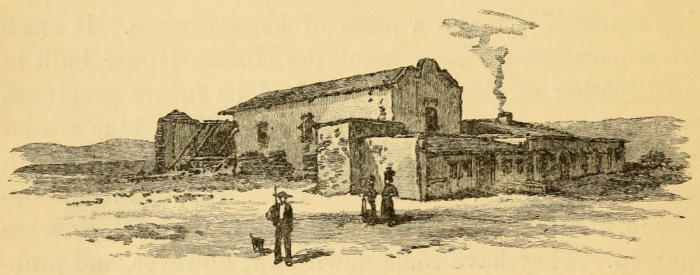
OLD MISSION AT SAN DIEGO.
The chronic condition of shutters in San Diego “Old Town” is to be “up,” that is, so far as it can be said to have any shutters yet remaining. It dates from 1769. Disadvantageously situated in regard to the bay, it began to be deserted in favor of the newer site about ten years ago. Nothing could seem more desolate than it is now. The usual old mission, with a few palms and olives about it, stands in a valley, up the pretty San Diego River, and the earth-works of Commodore Stockton, who threw them up one night before the enemy knew he was ashore, are seen on a hill. Rents should be cheap in Old Town, but, according to the gossips who still sit around the decayed old plaza, they are not. The owners hold them stiffly yet, on what theory Heaven only knows. The plaza has a toppling flag-staff, a decayed music-stand, and vestiges of a number of burned edifices, which have never been worth anybody’s while to build up again. The “Merchants’ Exchange” will never supply cocktails to thirsty soul again; the Cosmopolitan Hotel is without a guest; whole rows of weather-beaten adobes—whole quarters—stand vacant. It should be a great place for ghosts. But perhaps they do not care for one another’s society. The children, coming from school—for there is, it seems, a school—amuse themselves with knocking at and rattling the vacant doors; then they peer in at the broken window-panes and shout, and run laughing away.
IV.
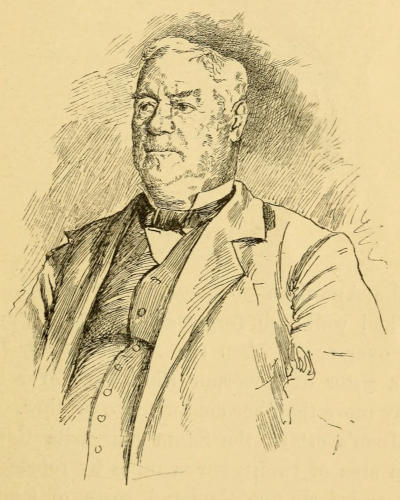
DON JUAN FORSTER.
In leaving San Diego I traversed the surveyed line of the new railroad almost due northward. A thirty-mile section of the railroad was already built. The rest of the journey was made by wagon, with an occasional half-day’s pedestrianism, for which the dry, smooth surface of the ground is well adapted. It afforded opportunity of making the acquaintance in a leisurely way of some of the ranchmen, small and great, of the old school. The principal one of these was Don Juan Forster (deceased since this visit), well known in his section. He was English by birth, but sailed with his father in a trading vessel, and became a Mexican subject and resident of California long before the American conquest. It was so long before that he had well-nigh forgotten his English, and had to learn it over again when the Americans arrived. The Señora, a sister of Governor Pio Pico, never learned it at all, any more than her conservative brother.
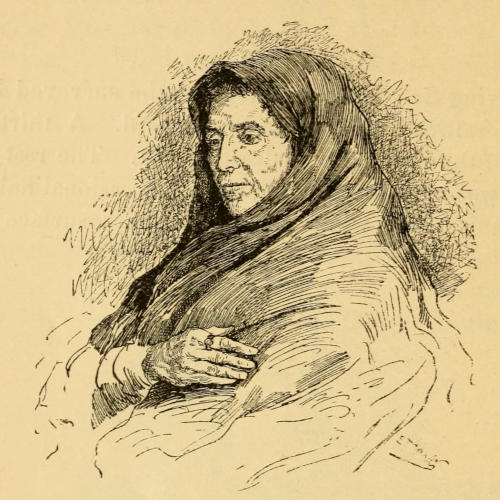
SEÑORA FORSTER.
Don Juan’s estate, the Santa Margarita Ranch, comprised an area of twenty-seven miles by fourteen, or one hundred and forty-five thousand acres of land. There was one fence seventeen miles in length, and another ten. The owner had made two distinct efforts to colonize a portion of his land, without great success. He had offered in London to give forty acres and the use of three cows and two horses to whoever would put upon the land improvements, in the shape of houses, vineyards, etc., to the amount of $1000.
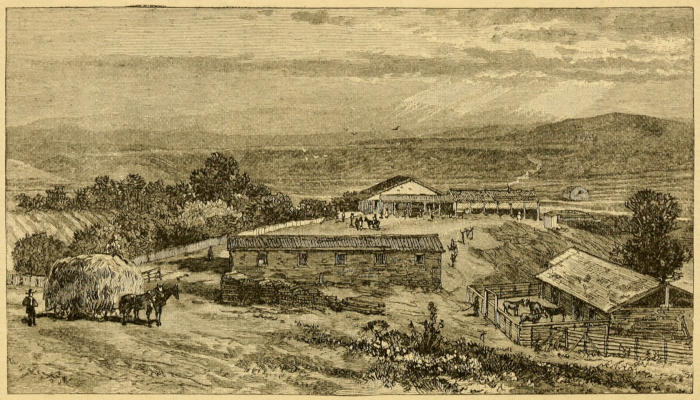
FORSTER’S RANCH.
The Santa Margarita ranch-house is of adobe, very thick-walled, with a terrace in front, and an interior court. The waiting at table was by a broad-faced Indian woman in calico. All the domestic service was performed by mission Indians, except the cooking, for which a Chinaman had lately been secured, with the view of having meals on time. The manner of living on these great places was found comfortable, but without the “princely” features attributed to it in some of the highly colored narratives of former travellers.
The greater part of the available land in the section was devoted to pasture. The cereals were cultivated, but not much fruit. Barley is the favorite cereal, as less liable to “rust” and spoil than wheat. Hay is made, not of grass, but of wheat and barley straw, cut green, with the milk still in it. Bee-culture is an important industry. A number of varieties of wild sage, wild buckwheat and sumac, furnish the bees exceptionally good provender. Rows of the square hives, painted in colors, were often seen districted into little streets on the hill-side, or at the mouth of some small cañon, like a miniature city.
Before reaching Don Juan Forster’s the old mission of San Luis Rey is encountered, in the hamlet of the same name. It is almost Venetian in aspect. The whole exterior was at one time faced with a diagonal pattern recalling that of the Ducal Palace. The pile was ruined by a Mormon contingent of the American forces engaged in the conquest of the State. Parts of the heavy adobe walls and buttresses have fallen in, and resolved themselves back into their original element as mere earth-heaps. The images have been shot and hacked down, and a yawning cavern was excavated behind the main altar in search of fancied treasure. Upon a floor strewn with such débris and with fragments of red tiles the daylight falls curiously, through holes in the broken roof and dome.
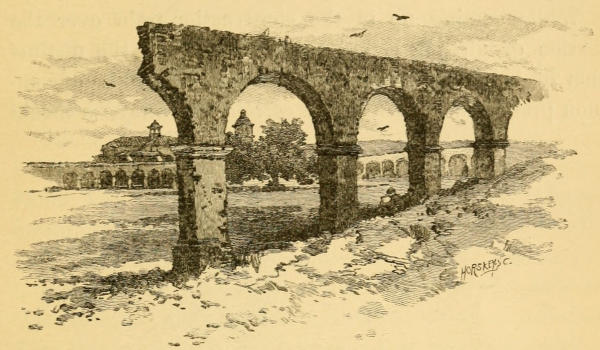
SAN LUIS REY.
The railroad traverses some striking natural scenery. Most notable is the Temecula Cañon, a gorge of a wild and grand description, ten miles in length, through the Coast Range. A brawling stream runs down its centre. The gorge was filled with a busy force, as we passed, terracing up the track along its sides, sometimes on the natural rock, sometimes on a cyclopean retaining-wall of immense bowlders. Toward evening every day the firing of heavy blasts reverberated up the defile like a cannonade. The main part of the laboring force consisted of Chinamen. They had utilized the shelving ledges and random nooks by the stream for their tents and cooking-ovens with great ingenuity. The Mexicans and Indians, who formed the contingent next in importance, were in every way less provident. The surveyors were found pleasant and hospitable fellows, as surveyors at the scene of their labors are apt to be. Compactness and convenience had been reduced to the lowest terms, but a pleasant existence seemed possible in their small tents. A Chinese cook was attached to each camp, and the provisions and fare were excellent.
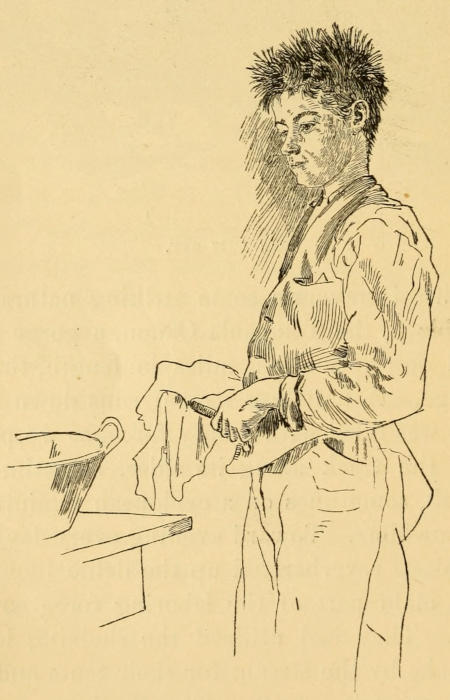
A TICHBORNE CLAIMANT.
While coming up in the construction-train over the section of already completed road we had the distinction of being waited on by a servant of rather uncommon pretensions. This was a certain “Charley,” a shock-headed boy of fourteen, son of a later Tichborne claimant, who had strangely arisen at San Diego just then, and announced his purpose of again contesting the title. Though serving in a menial capacity—while his father, who claimed to have good and sufficient reason for having kept quiet till now, was taking the necessary steps to secure the long-lost title and fortune—“Charley” was deaf to all banter on the subject. He was supercilious and firm in the faith that he too was a Tichborne.
“And don’t you forget it,” he threw out to us by way of a parting injunction.
Out of the cañon, at the van of the construction work, we were on the Temecula Plains, a part of the Upper Santa Ana Valley. The course of the road was marked henceforth only by an occasional surveyor’s stake. We rode over fifty miles of absolutely treeless, verdureless desert. It was desert, however, with a certain fascination in its sterility. It had a distinct beauty of coloring. The brown, drab, and blackish waste, catching sparkles of light on its flinty surface, shimmered in the sunshine. The heat was tempered by a gentle breeze. Crags of black, water-worn rock, which had once been reefs in an inland sea, rose in bold, fantastic shapes, and noble mountain ranges stood up along the distant horizons, their rugged harshness softened into blues and purples by a delicious veiling atmosphere.
Half-way across we fell in with a single sign of human life, in the shape of an abandoned pine shanty. On going around to the rear the boards were found to have been knocked off, probably to be used for fuel. Some former travellers, halting here like ourselves, had occupied a part of their leisure with writing inscriptions in lead-pencil. One had written a direction about drinkable water in the neighborhood. Another, apparently finding this erroneous, had inscribed below it, with much more vigor than regard for adopted usages in spelling, “Lyor!!”
The sole piece of furniture remaining was a rusted cooking-stove, standing on three legs. It had a certain almost diabolic, knowing air. You suspected it of having lost its other leg in waltzing about and holding high carnival, as no doubt it did, with the coyotes, gophers, tarantulas, and lizards who dropped in to pay it visits.
XXX. ACROSS ARIZONA.
I.
If there be anything politically disrupting in mere topography, the section cut off by the range below the Los Angeles and Riverside country should also be made a separate State. It should clamor at any rate to be joined to Arizona, since it is Arizona that it follows in climate, and not California. South-east of the low San Gorgonio Pass the seasons are the same as those of Mexico; that is to say, the rains fall in summer, while northward they fall in the winter and spring. Thunder-storms on each side of the mountains may be plainly visible from the other, but do not pass the limit.
I myself saw, from the Arizona side, in December, in hot, clear sunshine at the time, murky clouds billowing above the range, and the lightnings playing in them, and, on returning to Los Angeles, found it drenched in its first showers of the season.
There is one excellent reason why the inhabitants of the section do not raise such a clamor, which is, that there are no inhabitants worth mentioning. For a hundred and fifty miles, from the pass, to the Arizona frontier at Yuma, the railroad hardly knows any local traffic. Its route is over the celebrated “Colorado Desert,” in comparison with which previous deserts are of small importance. There are various stopping-places, with designations on the map, but these are rarely more than signal-stations where the locomotive, like the passengers, stops to slake its thirst at a series of artesian wells.
The plain is not of great extent laterally. Black and purplish mountains are always in sight, and spurs cross the track. Bowlders and pebbles are scattered thickly on the surface at first, among patches of bunch-grass. Then, near Seven Palms, the jaws of the black and purple mountains open and receive us into the genuine desert. It is strewn with bowlders still, but is itself a waste of drifting white sand, with large dunes and hills of sand. One might be riding on the shores of Coney Island or Long Branch.
A singular depression below the level of the sea for a hundred miles, and at its lowest point nearly three hundred feet, is traversed. At Dos Palmas, in the very bottom of it, a board shanty, covered with signs in amateurish lettering, indicating that it is a saloon, stands entirely alone. Surely the bar-keeper must consume his own drinks, and lead an existence unprecedented among his kind. No; a horseman in Mexican accoutrements dashes across the plain—though where he should dash from, and how he should ride anything, here in the bottom of the sea, but the skeleton, say, of a dolphin or a sea-horse, is a mystery—pulls up, and enters.
And it appears, on a better acquaintance with Dos Palmas, that a stage starts every other day for points on the Colorado River, and Prescott, the capital of Arizona Territory, and that this is but a faint survival of bustle which once reigned here before the advent of the railroad. The route of the Southern Overland Mail then came this way, and long trains of immigrant and freight wagons, carrying water in casks for two and three days’ supply, were passing continually over these wastes.
Nothing, on general principles, would appear more depressing than such a country, but as a matter-of-fact it is a stimulus to the curiosity, and furnishes real entertainment. One would not wish to be abandoned there without resources, it is true, but he does not tire of looking at it from the car-window. Its blazing dryness is disinfectant and preservative. There can never exist the last extreme of sadness where the element of decay by damp and mould is not present. Chemical processes are those which are principally going on. Wonders of almost any sort may be expected, and you almost look for phantoms not of earth among the shifting mirages.
A considerable part of Arizona, as well, is of the same character, but it is estimated by competent authority that with irrigation thirty-seven per cent. of that Territory can be redeemed for agriculture, and sixty per cent. as pasturage. It will be called to mind that even the apparently hopeless Colorado Desert, which is below the level of the sea, is also below the level of the Colorado River, from which water might perhaps be spread over it with comparative ease.
The truly patriotic Arizonian in their neighborhood is not ashamed of his encompassing deserts, but rather proud of them, and with a certain reason. The desert is in reality a laboratory of useful products. Paper is made from the yucca, or Spanish-bayonet, which abounds in parts of it. There are tracts of salt, borax, gypsum, sulphur, asbestos, and kaolin, and quarries of pumice-stone, only waiting shipment. It is maintained, also, that it has deposits of the same precious metals which, mined in places where water is more accessible, have given the Territory most of its present fame.
Our train runs out upon a long wooden drawbridge, across the Colorado River, and we arrive at Yuma. The company has placed here the first of its series of hotels of uniform pattern. It is both station and hotel. Such provision on an equal scale of comfort would hardly have been judicious yet as an investment for private persons. These structures therefore become not only a typical feature of the scenery, but an indication of the extent to which the railroad has had to, and has been able to, by reason of its ample resources, take this bare new country into its own hands. They are of the usual reddish-brown, two stories in height, and surrounded by piazzas of generous width—an indispensable adjunct under the dazzling light and heat of the country.
II.
The heat of Yuma is proverbial. The thermometer ranges up to 127° in the shade. There is an old story of a soldier who died at the fort and went to the place which Bob Ingersoll says does not exist, and, finding it chilly there by comparison, sent back after his blankets.
Great heat, nevertheless, is not equally formidable everywhere. It is well attested that there is no sunstroke here, and no such suffering as from a much lower temperature in moister climates. Distinct sanitary properties are even claimed for this well-baked air. So near the sea-level, it is said to be less rarefied, and to comprise, therefore, a greater quantity of oxygen to a given bulk, than that of mountain districts, which, in purity and dryness, it resembles. It is thought to be beneficial in lung troubles. Yuma, among its arid sand-hills, has aspirations to be a sanitarium. Civilized people also may yet resort there to engage in a sensible sun-worship, basking in the genial heat, and then plunging into the river, after the fashion of the resident Indians, who make of it in this way a kind of natural Turkish bath.
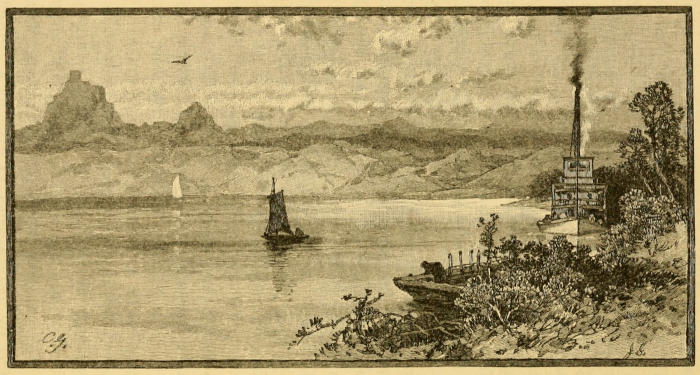
THE COLORADO RIVER AT YUMA.
A transition state may have disadvantages, even when a step toward something better. Yuma has now its railroad, and is to have a shipping-port of its own, by the construction of another to Port Ysabel, on the Gulf of California. Still, it laments a greater activity it once enjoyed, as chief distributing point for the mines and upper river towns. It expects the Port Ysabel Railroad to have the effect of doubling its population in two years. It will not be a very stupendous population even then, as it is but fifteen hundred at present.
The town is a collection of inferior adobe houses, a few of the very best being altered from the natural mud-color by a coating of whitewash. The ordinary part of it resembles more the poor tropical hamlets on the trail to Acapulco than even the ordinary villages of Mexico. The houses consist of a framework of cottonwood or ocotilla wattles, plastered with mud inside and out, making a wall two or three inches thick. The roof is thatched, the floor is the bare ground. Around them are generally high palisades of ocotilla sticks, and corrals of the same adjoining.
The waiters in a Yuma hotel are of a highly miscellaneous character. You are served, in the same dining-room, by Mexicans, Chinamen, Irish, Americans, and a tame Apache Indian. One and all had a certain astounded air, ending in something like confirmed depression, on finding that we were to remain, would dine at our leisure, and did not wish to have the dishes shot at us as if out of a catapult, after the practice with the ordinary traveller pausing here his allotted half-hour. One does not expect too much of his waiter in Arizona, however. There are reported instances in which he makes you eat your steak with his hand on his pistol-pocket, and the threat of wearing it out on you if you object.
The Colorado at Yuma makes about the same impression as to width as the Sacramento at Sacramento, the Ohio at Pittsburg, or the Connecticut at Hartford. It is a turbulent yellow stream. It cuts into high sand bluffs on the Arizona side, and spreads out their contents in wide bars on the California side. It is without wharves. The light-draught, high-decked steamboats, or barges, that ply up and down its interminable reaches tie up when necessary to the banks.
Mountains of a jagged, eccentric formation follow its general course northward. Peaks impressively counterfeiting human work, Castle Dome, Chimney Peaks, Picacho, and Cargo Muchacho, loom up along the horizon, a fitting prelude to the marvels of Arizona.
It was at the close of an Indian war that this visit was made. It had been said, in rumors much exaggerated, that the whole white civilization of the Territory was in danger by the outbreak, and troops—but now on their return—had been hurried thither from all sides. The first view of Indians, therefore, at Yuma was of a double interest. They were not Apaches, it is true, but a subsequent acquaintance with the general field proved them to be even more picturesque. They are of that highly satisfactory style of savages who wear but little clothing, and none of it European. They are to be seen in numbers about the railway-station by the most casual passenger. The railroad is still new to them, and they have not satiated their curiosity. They bring friends from a distance to see it, and are observed describing to these visitors how the drawbridge swings, and how the cars are switched from one track to another.
They are met with coming across this bridge from the patch of river-bottom near the fort on the California side, where their principal settlement is. The young men run or stride at great speed, so as to throw out behind them a long red sash or band, depending from the breech-cloth, which is, in summer, the principal part of their attire. To this is added, in winter, a close-fitting gray or crimson under-shirt. They wear their thick, coal-black hair “banged” low on their foreheads, and bushy about their necks. The effect at a little distance is not unlike that of the Florentine period, when the young gallants wore jerkins and trunk hose fitting them like their skins, and just such bushy locks, which they crowned, however, instead of going bare-headed, with jaunty velvet caps.
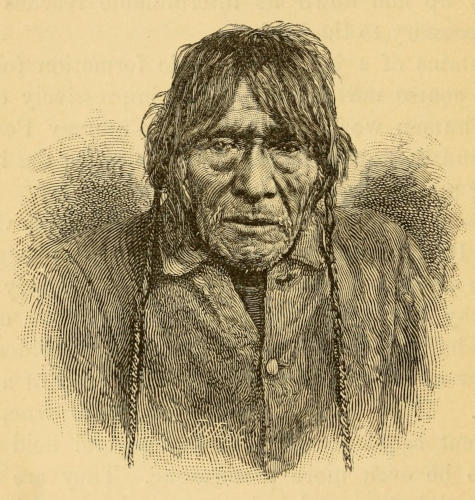
PASQUAL, CHIEF OF THE YUMAS.
The fort is without guns, other than a howitzer for firing salutes, and has no strength, as it no longer needs to have, except from its position on a commanding bluff. The military policy of the government now is to station its troops along a railroad or other easy line of communication, where they can be quickly massed for mutual support. All the Arizona posts, such as Camp Lowell, with its grassy parade and fine avenue of cottonwoods; Camp Grant, on its table-land; and Camp Apache, at the junction of two charming trout streams, in the White River Cañon; and the others, have only this strategic importance, and no intrinsic strength. The barracks at Yuma consist of a series of comfortable, large, adobe houses, plastered, and painted green, around an oblong plaza. They have in front a peculiar screen-work of green blinds, which shuts out the glare arising from the yellow ground, and makes both a cool promenade and comfortable sleeping apartments for the summer.
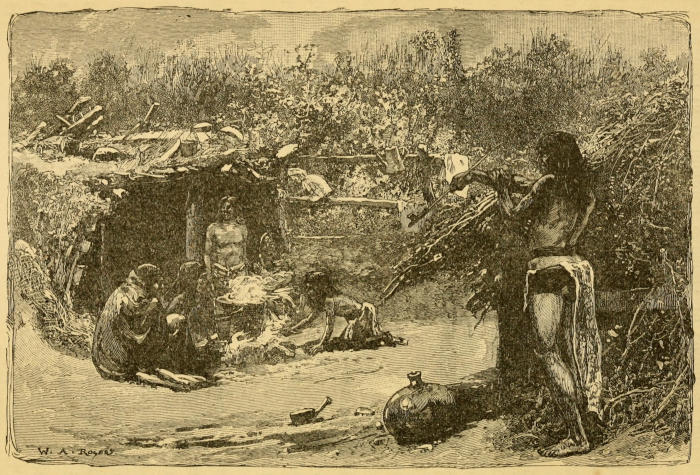
YUMA INDIANS AT HOME.
The chief of the Yumas, on whose settlement the fort looks down, chooses his sub-chiefs, but is himself appointed by the military commandant. The last investiture was made as long ago as 1852, by General, then Major, Heintzelman. He conferred it upon the now wrinkled and decrepit Pasqual, described at the time as “a tall, fine-looking man, of an agreeable disposition.”
Pasqual’s people cultivate little patches of vegetables and hay in the river-bottom, fertilized by the annual overflow. Their principal sustenance, however, is the sweet bean of the mesquit-tree. This they pound, in mortars, into a kind of flour. Sometimes, when on the move, the Indians float their hay across the river on rafts, which they push before them, swimming. They propel the small children in the same way, placing them in their large, Egyptian-looking ollas, or water-jars.
The crop of mesquit beans was so large one year as to be beyond their unaided capacity to consume, and they hospitably invited in their friends, the Pimas, to aid them. Old Pasqual describes with graphic gestures how haggard and lank were these visitors on their arrival, and what an unctuous corpulence they had attained in the end, when, after nearly eating their hosts out of house and home, they were only got rid of at last by force.
III.
Few things are more curious at this time of day than to look back at the old maps of our Western possessions previous to the annexation of Texas. Texas was not then ours; nor were a considerable part of Indian Territory, Kansas, half of Colorado, all of Utah, Nevada, California, Arizona, and New Mexico. All of this belonged to our sister republic of Mexico, which, as I have said, was within an ace as large as ourselves, and, except for its internal dissensions, could by no means be considered a puny antagonist.
An impressive vagueness attended the delineation of most things west of the Mississippi. There were great tracts hardly more known than the centre of Africa. The upper regions of Mexico were distinguished as Interna; New Mexico and Arizona were simply Apacheria—Apache Land. Our frontier ran along the line of the Sabine River to the Red, from the Red to the Arkansas, and from the Arkansas, on the 42d Parallel of latitude, straight west to the Pacific Ocean. By the peace of Guadalupe Hidalgo our frontier became the Rio Grande and Gila instead, and the line had dropped from Parallel 40° to Parallel 32°.
I have called this territory heretofore, by way of figure of speech, an Alsace-Lorraine of Mexico, though it is not probable, vacant as it was, and Americanized as it now is, that a serious grudge is still borne us for it, or that there will ever be momentous wars for its recovery. However this may be, it has been the making of us. We should be in but sorry shape indeed had we to go back to the limits of the thirteen original British Colonies, or even to these with Florida, purchased from the Spaniards, and Louisiana, purchased from the French, added. The Mexican acquisition gave us one-third of our domain—that which is now most open to the teeming millions of Europe and that which avails us our repute for essential Americanism abroad. It gave us the field of the Bret Harte school in literature, our chief marvels and wonders, our mines of the precious metals, and the command of the Pacific Ocean.
The lower belt of Arizona was not even comprised in this. An area of 460 miles by 130, below the Gila River, was not obtained till “the Gadsden Purchase,” in 1853. By the payment of the sum of $10,000,000 under this treaty we obtained a number of decided advantages. We rectified our boundary line, confused through the inaccuracy of the map of one Dwinelle, on which it was based. We got rid of an embarrassing engagement, of the treaty of Guadalupe Hidalgo, to protect the Mexican frontier from Apaches—leaving them to regulate this service for themselves. We secured the right of way for a railroad across the Isthmus of Tehuantepec, which was thought desirable for speedier communication with our new possessions of California.
But above all we acquired, in the easy levels below the Gila, the natural route for a Southern Pacific transcontinental railway. The files of the Congressional Globe of that date are full of the necessity of binding our Pacific acquisitions securely to the rest of the country, and the most effectual of all the means proposed was considered to be a transcontinental railway.
Well, we are bowling at last along that now actually constructed Southern Pacific Railroad, once discussed in musty debates of the Congressional Globe. It increases our respect for predecessors to whom we may not have given any great consideration heretofore to find how sagacious they were. We reach Stanwix, with its lava beds; Painted Rock, named from huge, mysteriously-decorated bowlders; Casa Grande, from its architectural ruins of the Toltecs; and Tucson.
Adopting the policy of leaving Tucson to be examined on the return, let us push on to the extreme end of the Territory—to the eccentrically-named Tombstone. Benson, the point of departure, from the railroad, for Tombstone, is 1024 miles from San Francisco, and probably 2500 from New York.
XXXI. TOMBSTONE.
I.
Tombstone is the very latest and liveliest of those mushroom civilizations which so often gather around a “find” of the precious metals. They live at a headlong pace; draw to them wild and lawless spirits; confer great fortunes here, the grave of the drunkard, the suicide, or the victim of violence elsewhere. A school of literature, with Bret Harte as its exponent, has arisen to celebrate their doings. At the present rate of advance of population and conventional usages westward they must shortly disappear as effectually as the dodo of tradition. While things go well with them the prices of commodities are hardly considered. Nobody haggles. The most expensive of everything is what is most wanted.
“Diamonds—two-hundred-dollar watches and chains—Lord! we couldn’t hand ’em out fast enough,” says an ex-jeweller, describing his experience at one of the camps in its palmy days. “Champagne wasn’t good enough for me then,” says a seedy customer, recalling his doings after the discovery and sale of a rich mine. He sighed for a repetition of the event, not to make provision for his old age, which sadly needed it, but that he might have “one more glorious spree” before he died.
Oftentimes this rush of life departs as quickly as it came. Some fine day the “lead” is exhausted, there is found to be no more treasure in the mines. The heterogeneous elements scatter, and the town, be it never so well built, is left as desolate as Tadmor of the Wilderness. In a certain Nevada mining town, which once numbered some thousands of inhabitants, Indians are living in rows of good brick houses, having adapted them to their peculiar conditions by taking out doors and windows and knocking holes in the roof.
A six-horse Concord coach carried us, not too speedily, over the twenty-five miles of dusty road to Tombstone. It was called the “Grand Central,” after one of the prosperous silver mines of the place. A rival line was named the “Sandy Bob,” from its proprietor; who preferred to be himself thus known, instead of by a conventional family appellation such as anybody might have. We should certainly have taken the “Sandy Bob Line” for its greater suggestiveness, except that it seemed to be coming down when we wanted to go up, and always coming up when we wanted to go down.
Our own proved to have plenty of suggestiveness too. A guard got up with a Winchester rifle, and posted himself by the Wells-Fargo Express box, and the driver began almost at once to relate robber stories. His stage had been stopped and “gone through” twice within the past six months. The affair had been enlivened on the one occasion by a runaway and turnover, and on the other by the shooting and killing of the driver. Of this last item his successor spoke with a natural disgust. If the line could not be drawn at drivers, he said, things had indeed come to a pretty pass. He respected a man who took to the road and robbed those who could afford it. At least, he considered it more honorable than borrowing money of a friend which you knew you could never repay, or than gobbling up the earnings of the poor, like a large firm lately suspended in Pima County. But as to shooting a driver, even in mistake for somebody else, he had no words to express his sense of its meanness.
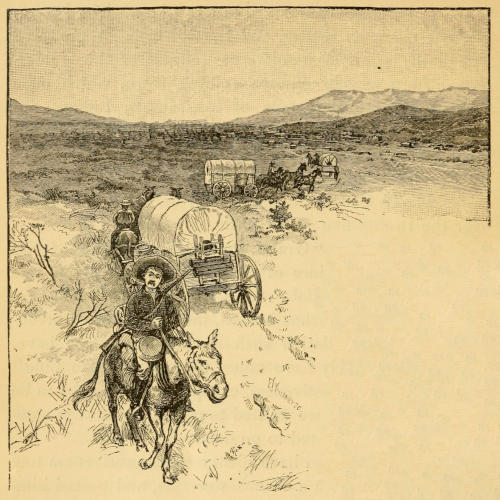
DISTANT VIEW OF TOMBSTONE.
He threw stones at his horses, as in Mexico, that is, at the leaders, beyond the reach of his long lash. The same stone was made to “carom” from one to the other, such was his skill, and startle them both. Long string-teams of mules or Texas steers, sixteen to a team, with ore-wagons, were met with along the road. Mexican-looking drivers trudged beside them in the deep, yellow dust, cracking their animals lustily with huge “black-snakes.” Mesquit-bushes, and long grass dried to hay—not as good as it looked—covered portions of the surface; the rest was bare and stony.
We rode for a certain distance beside the branch railroad in course of construction between Benson and Tombstone. A series of lateral valleys along the tributaries of the Gila, north and south, as the Santa Cruz, Salt River, San Carlos, San Pedro, and San Simon Valleys, afford excellent stock ranges, promise of a flourishing agriculture, and easy routes for tributary railways. They have already begun to be utilized. The San Pedro has the Southern Pacific branch above mentioned, and the Santa Cruz will have the Arizona Southern, connecting the centre of the Territory at Florence, on the Atlantic and Pacific, with Mexico at Calabasas. The transcontinental road—or roads, when the Atlantic and Pacific shall have been built—will draw through these tributary valleys, as the Gila draws its waters, a trade from Northern Mexico, where mining enterprises in particular, in the hands of Americans, are making great headway.
The route began to be very much up-hill. We changed horses and lunched at Contention City. One naturally expected a certain belligerency in such a place, but none appeared on the surface during our stay. There were plenty of saloons—the “Dew-drop,” the “Head-light,” and others—and at the door of one of them a Spanish señorita smoked a cigarette and showed her white teeth.
Contention City is the seat of stamp-mills for crushing ore, which is brought to it from Tombstone. The latter place is without an efficient water-power. The stamps are rows of heavy beams, which drop upon the mineral, on the mortar and pestle plan, with a continuous dull roar, by night as well as day.
“That’s the music I like to hear,” said our driver, gathering up his reins, “poundin’ out the gold and silver. There ain’t no brass bands ekils it.”
The route grew steeper yet. On the few wayside fences that exist were painted flaring announcements, as “Go To Bangley and Schlagenstein’s At Tombstone. They Are The Bosses, You Bet.”
Then over the edge of bare hills appeared Tombstone itself, a large, circular water-tank, big enough for a fort, painted with advertisements, the most conspicuous object in the foreground.
II.
At the beginning of the year 1878 there was not so much as a tent at Tombstone. One “Ed” Schieffelin and his brother started thither prospecting. It was supposed to be an adventure full of dangers. At the Santa Rita silver mines, in the Santa Cruz Valley, for instance, nothing like so far away, three superintendents had been murdered by Indians in rapid succession.
His friends therefore said to Ed, “Better take your coffin with you; you will find your tombstone there, and nothing else.”
But Ed Schieffelin—a young man yet, who has not discarded a picturesque way of dressing of which he was fond, nor greatly altered his habits otherwise—found instead the Tough Nut and Contention Mines. He made a great fortune out of them, and was so pleased at the difference between the prediction and the result that he gave the name of Tombstone to the town itself.
One of two well-printed daily papers has assumed the corresponding title of the Epitaph. The unreliability of epitaphs—if the remark may be safely ventured even at this distance—is proverbial. Nevertheless, they may occasionally tell the truth. From appearances it would seem that this was one of the occasions. Almost any eulogy of its subject by the Epitaph would seem justified. The city, but two years old at this date, had attained to a population of 2000, and a property valuation, apart from that of the mines, of $1,050,980. A desirable lot of 30 by 80 feet, on Allen Street, between Fourth and Sixth—such was the business-like nomenclature used already in this settlement of yesterday—was worth $6000. A shanty that cost $50 to build rented for $15 a month. A nucleus of many blocks at the centre consisted of substantial, large-sized buildings, hotels, banks—Schieffelin Hall, for meetings and amusements—and stores stocked with goods of more than the average excellence in many older and larger towns.
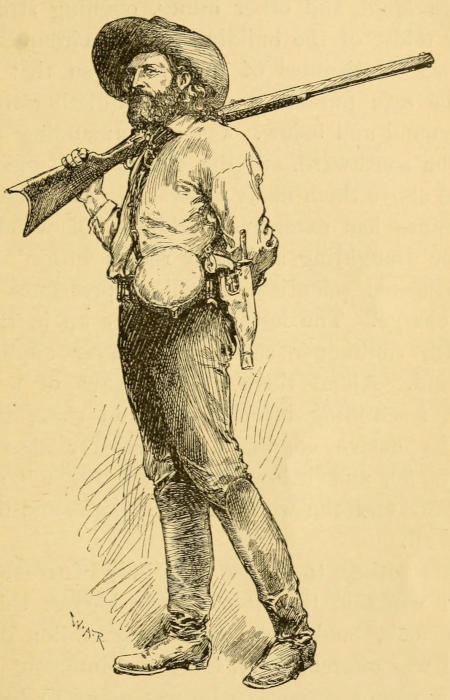
“ED” SCHIEFFELIN.
The mining claims run under the city itself. From the roof of the Grand Hotel you look down at the shafts, hoist-works, and heaps of extracted ore of the Vizina, the Gilded Age (close to the Palace Lodging-house), the Mountain Maid, and other mines, opening strangely in the very midst of the buildings. This circumstance has given rise to disputes of ownership, so that whoever would be safe purchases all the conflicting titles, both above ground and below. On a commanding hill close by, to the southward, are the Tough Nut and Contention, and above them many others later discovered. The larger mines had extensive buildings, of wood, and in handsome draughting and assay rooms within were regularly educated scientists, ex-college professors and the like, in charge. The lesser mines put up in the beginning with commoner sheds and poorer appliances of every kind. About them all lie heaps of a blackish material, resembling inferior coal and slate, the silver ore in its native condition. A laborer above-ground earned $3.50, and below-ground $4, for a “shift” of eight hours, and the work went on night and day, Sundays and all.
I leave to others to estimate the bulk of treasure in the place. I was told that it was “the biggest thing since the Comstock,” and there were forty million dollars in sight. I was offered, daily, fractional interests in mines, now by a young surveyor who was going to be married and needed money for his wedding outfit; now by new friends who were straitened for assessment funds to carry out the provisions of the law; and again by others who would kindly make any sacrifice for the pleasure of associating a traveller from a distance with the interests of the place; and yet it will be well for the novice to be wary of these seductive openings at Tombstone, as elsewhere.
This I know, however, that I descended four hundred feet or so into the Contention Mine, and found great chambers hollowed out, from which mineral had been taken, showing a generous width in the vein. The yield, from its discovery up to March, 1881, had been $2,000,000. The Tough Nut, with the Lucky Cuss, Good Enough, Owl’s Nest, and Owl’s Last Hoot—the racy vernacular of their names will be observed—had yielded $1,000,000.
The outskirts of Tombstone consisted still of huts and tents. A burly miner could be seen stretched upon his cot in a windowless cabin, barely large enough to contain him. There were some tents provided with wooden doors and adobe chimneys. New as it was, the business portion of the place had been once swept out of existence by a devastating fire, which originated from a characteristic incident—the explosion of a whiskey-barrel in the Oriental Saloon. Within fourteen days all was rebuilt far better than before.
I took the pains to count the number of establishments in a single short block of Allen Street at which intoxicating liquors were sold. There were the bar-rooms of two hotels, the Eagle Brewery, the Cancan Chop-house, the French Rôtisserie, the Alhambra, Maison Doré, City of Paris, Brown’s Saloon, Fashion Saloon, Miners’ Home, Kelly’s Wine-house, the Grotto, the Tivoli, and two saloons apparently unnamed. At these places gambling also went on without let or hinderance. The absence of savings-banks or other opportunity for depositing money, in these wild communities, and the temptation arising from having it always under the eye, no doubt has something to do with the general passion for gambling. Whiskey and cold lead are named as the leading diseases at Tombstone. What with the leisure that seems to prevail, the constant drinking and gambling at the saloons, and the universal practice of carrying deadly weapons, there is but one source of astonishment, and that is that the cold-lead disease should claim so few victims. Casualties are, after all, infrequent, considering the amount of vaporish talk indulged in, and the imminent risks that are run. The small cemetery, over toward Contention Hill, so far from being glutted with the slaughtered, is still comparatively virgin ground.
III.
A farther element in addition to that of the miners is to be cited as having a good deal to do with the exceptional liveliness of Tombstone—the “Cow-boys.”
The term cow-boy, once applied to all those in the cattle business indiscriminately, while still including some honest persons, has been narrowed down to be chiefly a term of reproach for a class of stealers of cattle, over the Mexican frontier, and elsewhere, who are a terror in their day and generation. Exceptional desperadoes of this class, such as “Billy the Kid,” “Curly Bill,” and “Russian George,” have been the scourges of whole districts in Colorado, New Mexico, and Arizona, and have had their memories embalmed in yellow-covered literature.
I bought on the train, on leaving, a pamphlet purporting to be an account of the exploits of Billy the Kid. He had committed, it appeared, at least a score of horrid murders, but “so many cities have claimed the honor of giving him birth,” said my pamphlet, “that it is difficult to locate with any accuracy the locality where he passed his youth.” It was finally determined, however, in favor of New York. “It was on the Bowery,” said the author, whose ideas of morality were peculiar even for a sensationalist, “that his mates learned to love him for his daring and prowess, and delighted to refer to him as Billy the Kid.”
This promising life was cut off at the early age of twenty-two. “Curly Bill,” also died young, and so did “Man-killer Johnson.” I remarked upon this peculiarity, of their youth, to a philosopher of the region itself.
“Yes,” he said, “they don’t seem to live to be very old; that’s so.”
The recipe for a long life in this country was described as being very quick and getting “the drop” on an antagonist; that is to say, being ready to shoot first. Unless this can be done, it is the custom even to put up with some ignominious abuse at the time, and await a more favorable opportunity.
The cow-boys frequenting Tombstone were generally from the ranches in the San Pedro and San Simon valleys. There were said to be strongholds in the San Simon Valley where they concealed stolen cattle until re-branded and sent to market, and where no officer of the law ever dared to venture. They looked upon the running off of stock from Mexico, as far as that was concerned, only as a more dashing form of smuggling, though it was marked by frequent bloody tragedies on both sides.
Not to fix upon all the misdeeds of but a few, no doubt there were on the streets of Tombstone plenty of cow-boys of a legitimate sort, whose only faults were occasional boisterousness and too free lavishing of their money. There appeared to be something of a standing feud between the miners and the cow-boys, and there was besides a faction of “town cow-boys” organized against the “country cow-boys.”
The leading cattle-men had a Southern cut and accent, and hailed originally from Missouri or Texas. Some appeared in full black broadcloth, accompanied by the usual wide sombrero. The landlord of our hotel described them as “perfect gentlemen,” some of them good at the bar for as high as $20 or $25 a day.
The great object in life of the various factions, or of individuals who arose from time to time in search of notoriety, was to “run the town.” This consisted largely in the privilege of blustering in the saloons, whooping and firing occasional pistol-shots, if thought good, in the streets, and having a moderate security from arrest, inspired by dread of their prowess.
This was necessarily a very insecure preëminence. New aspirants and rebels were continually piqued into appearing against it whenever it seemed fairly attained. Our visit happened upon the heels of a conflict making the most tragic page yet written in the annals of Tombstone. Opinions seemed divided about it—even official opinions. The sheriff extended his sympathy to one side, the city marshal, who was, in fact, its leader, to the other.
City Marshal Earp, with his two brothers, and one “Doc Holliday,” a gambler, had come down the street, armed with rifles, and opened fire on two Clanton brothers and two McLowry brothers. The latter party had been practically first disarmed by the sheriff, who feared such a meeting, and meant to disarm the others as well. Three of the assailed men fell, and died. “Ike” Clanton alone escaped.
The slayers were imprisoned, but released on bail. The Grand Jury was now in session, hearing evidence in the case. It was rumored that the town party—the Earps—would command a sufficient personal influence to go free of indictment. The cow-boys were flocking into town to await the result, and on a certain quiet Sunday wore an ominous look. It was said that, should justice fail to be done them, the resolute-looking men conferring together darkly at the edges of the sidewalk would take the matter into their own hands. The jury, I have since learned, did not find an indictment, and the remaining parties to the affair, with many others, I believe, have since died with their boots on in the same cause. If anything could reconcile us to the untimely taking-off of these paladins, it would be partly their own contemptuous indifference to it.
It would seem that we ought to have at least half a dozen lives apiece, to account for such an indifference, but to be ready to toss away the only one on any and every pretext or no pretext is not at all so intelligible. It is certainly not the desperation of poverty by which it is occasioned. Many of them are in very good circumstances. The younger McLowry, a boy under twenty, had $3000 in his pocket, the proceeds of a sale of cattle, the day he fell.
The elder Clanton had played cards most of the night before with two of his deadly enemies, both parties keeping a hand on their pistols meanwhile. When “Billy” Clanton, a boy, like McLowry, lay prone on the ground in the fight, dying of his mortal wound, he still managed to get out a pistol, steadied it on a shattered arm, and fired once more at “Doc Holliday,” saying,
“I’ll get one of you, any way.”
“You are a daisy if you do,” replied Doc Holliday, continuing to advance as coolly as if at target practice, and emptying another barrel of his own into him.
And the last words of Billy Clanton, in the Nibelungen-like contest—which I am quite aware will not be quoted, in school-readers, with those of Lawrence, Nelson, and Montcalm, since there was no sense at all in this frenzied display of pluck and tenacity—were: “For God’s sake more cartridges!”
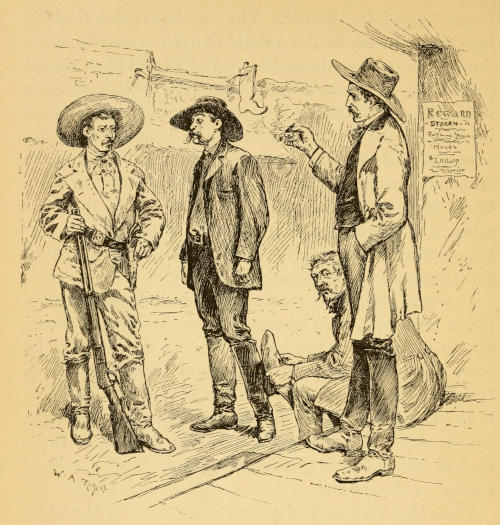
A TOMBSTONE SHERIFF AND CONSTITUENTS.
Meantime the whistles of the mining works were shrieking notes of alarm, the miners pouring forth from underground, and the reputable citizens, who might have exclaimed, “A plague o’ both your houses!” arming themselves in hot haste, and coming to their doors, to prevent the spread of general anarchy.
There is a grimly humorous element in it all. It seems such an excellent joke to idly snuff out the most precious of human possessions. A cow-boy shoots a tumbler from the hand of another, just raised to his lips, saying, “When you drink with me I will teach you to take whiskey plain, and no mixtures.”
A group of others sit around in a saloon where lies a fresh-made corpse. An officer of the law enters, and says, “Who claims this man?” whereupon all jump to their feet to dispute the honor.
There is a large supply of these amusing stories. To kill your man seems a way of winning your spurs, as it were, and establishing yourself on a proper footing in the community. Even the defunct, in various cases, could he be heard from, would probably find no great fault with the manner of his taking off, but only with the “luck” of it which had gone against him.
XXXII. CAMP LOWELL, TUCSON, AND SAN XAVIER DEL BAC.
I.
The night journey returning by stage to Benson was enlivened by more shooting stories. I heard, among others, of the doings of the late Brazelton of Tucson, and at Tucson I bought his photograph, taken, after death, in his mask and other paraphernalia of his craft. He robbed stages for years while apparently working quietly as a hostler in a corral. He was finally tracked to his fate through some peculiar marks of the horse he rode.
One of our passengers had just recovered from wounds received in a fight over cards with a Mexican, whom he had killed, and was now able, with the aid of morphine, to pursue his journey toward his home in New Mexico. The train men at Benson were chary of carrying their lanterns about the depot yard, a habit having arisen, it seemed, among the cow-boys of trying to snuff out these moving targets with revolvers from a distance.
There seemed a certain tameness even in the Apaches after this wild product of the higher civilization of the whites. The principal group of prisoners taken after the attempted massacre of General Carr’s command was found in confinement at Camp Lowell, nine miles north of Tucson. There were forty-two of them, with Sanchez, their chief. They were of fairly regular features, and their expression, with the war-paint washed off, not unamiable. They were handcuffed together in couples, their legs also manacled, and now wore gray army under-shirts and cotton drawers, the rags in which they had come having been taken from them. Their long black hair hung about their ears, not frowzy, like that of the Yumas, but smoothly parted in the middle, and brushed back. A number wore red bands or kerchiefs around their heads.
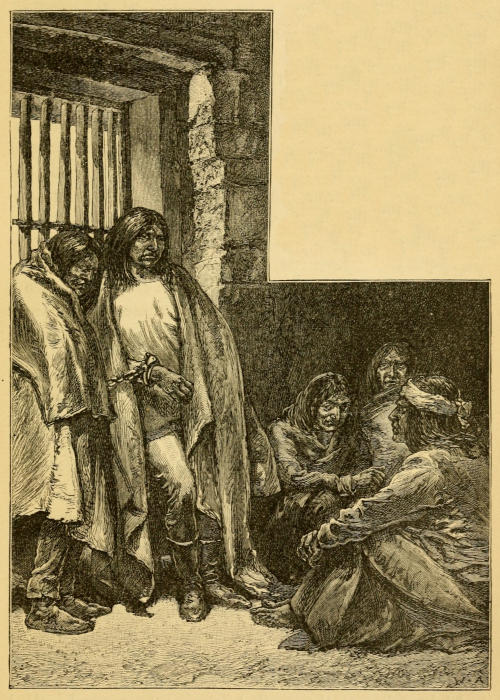
APACHE PRISONERS AT CAMP LOWELL.
Seen obscurely in the chief prison-room by side-light from a grated window, they had a certain resemblance to Greek insurgents, or the sans culottes of 1793, or, again, the wild Vendean peasants who fought with Rochejaquelein and Jean Chouan for religion and the king.
They were taken out for an airing in the mornings, and allowed to squat in the sun at the edge of the pleasant parade-ground, flanked by its well-shaded row of officers’ dwellings. The recent rising had been the result of a fanatical delusion. A medicine-man persuaded them that he had received a revelation to drive all the whites from the land. As soon as the corn was ripe, he said, their dead brethren would arise and take arms to aid them in carrying out the decree of Heaven. He had, as many prophets have not, the courage of his convictions. Though taken in charge himself by the troops, he gave a signal agreed upon for the massacre of these to begin, calling to his people not to be concerned about his fate, as he would come to life and join them again in three days.
The bluff Arizonians are apt to indulge in a derisive way of talking of the army and its relation to the savages. They would make but short work of these latter, they say, if they took the matter into their own hands. They imply that the army does not wish to kill off, or even wholly put down, the Indians, but rather to preserve them, as a gentle stimulus to public dread, to hasten promotions, and also to furnish occasion for profitable supply-contracts. However this may be, it would seem that after the repression of this revolt, and the rapid penetration of railroads into the Territory, Indians need no longer be a deterring influence of great moment with the intending settler. This old historic source of apprehension seems as good as abolished from its last stronghold.
Eight miles to the north brings us to a ranch called Fuller’s Hot Springs. This is one of the few places where a beginning of systematic cultivation has been made, and interesting besides as a typical Arizona summer resort. There was a young orchard of twenty-five acres, sheltered by a wind-break of three rows of ash-trees, doing very well in an alkali soil. The buildings consisted of a number of unpainted adobe houses, each of a single large, comfortable room, roofed with strips of cactus.
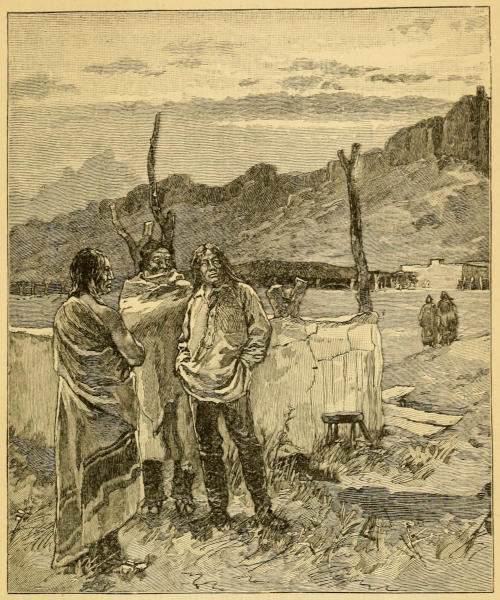
AN ARIZONA WATERING-PLACE.
There was a “summer dining-room” made of ocotilla sticks, the intervals open; and a “winter dining-room,” with tight walls, and a fireplace, in which a wood-fire was burned mornings and evenings. The hot spring, a clear, pleasant water, said to resemble English Harrogate, ran out from below a bath-house, consisting of a patched canvas tent. It became, below, a pretty brook, a pond for the cattle, and source of supply for irrigating the orchard. The mountains behind the place, the Santa Catalinas, are like the Sierra Madres behind Los Angeles. They are of the same sharp fracture, but higher and grander, jutting up here and there into as perfect castles as those of Harlech, the Trostberg, or Rheinstein. Forests of pine of large dimensions crown a part of their summits. South and south-west, across the wide plain, appear the Rincons and silver-bearing Santa Ritas.
There was a fascination in being able to examine at leisure the strange growths of the plain, and not merely to know them in glimpses from the car-windows. I made haste especially to cut down for inspection an example of the enormous saguara, the organ-cactus. Taller than that on the hill-sides of Guerrero along the Acapulco trail, it often rises to a height of sixty feet, bristles over the landscape like masts or columns, or, again, like the seven-branched candlestick of the Mosaic law. Inside it consists of a white, juicy pulp, imbedding a bundle of fibres in the form of long wands, which, when dried, serve a number of useful purposes. It has a palatable fruit, which the Indians collect from its top in August with forked sticks.
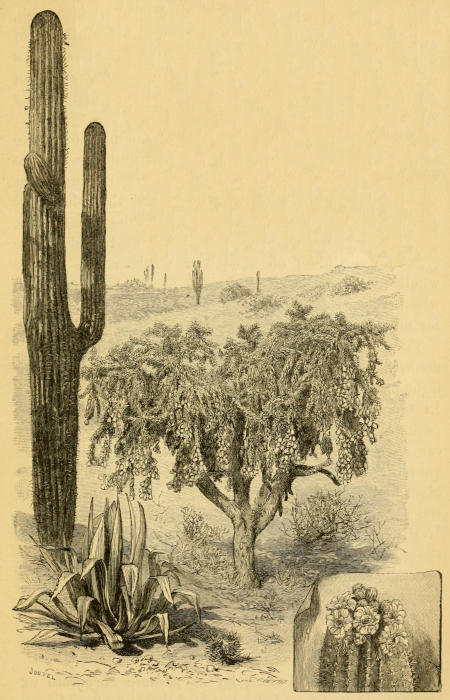
CACTUS GROWTHS OF THE DESERT.
The ocotilla is simply a shrub growing as a wattle of sticks, fifteen or twenty together, only waiting to be cut down and turned into palings. The bisnaga is a thorny cactus like an immense watermelon growing on end. One need never die of thirst where it is found. The cholla is a mass of spines, which are even barbed, on the fish-hook principle. It is considered funny to hear of somebody’s falling into a cholla, and nothing could better represent the traditional “bramble-bush” in which the man who was so wondrous wise met with the famous adventure of scratching out his eyes. The “deer-brush” somewhat resembles the horns of the animal. The palo verde—green stick—grows as large as an apple-tree, with the texture of a mammoth sea-weed. The “grease-wood” is a large bush, said to burn just as well when green as dry. Most of this vegetation is leafless, or rather the plant seems a leaf itself, since coarse bark is lacking, and the green of chlorophyll and the tenderness of structure seem equally distributed throughout.
There are homely legends and superstitions about these plants of the desert. A certain one, for instance, poisons any white spot on a horse, but not one of any other color. Another, eaten by horses, makes them lazy and imbecile. The loco, or rattle-weed, on the other hand, drives them raving crazy, and they try to run themselves to death. I do not know whether this last be wholly a superstition, for I rode in California a horse whose eccentric proceedings could hardly be accounted for on any other basis.
Tucson, from a distance, in early morning or late afternoon, is level, low, square, and brown, with a mellow light upon it and the castellated mountains behind it. In the foreground you see lazy ox-wains, a prospector, perhaps, with his pots and kettles, and a mounted Mexican towing by a lariat a bull, which ducks its head in vain resistance. From a distance it is thoroughly foreign, and of attractive promise. There is something of the Dead Sea apple in the realization of this promise. If Ruskin be right in holding that a house should be of the general color of the soil on which it stands, Tucson may lay claim to great artistic merit. It is entirely of adobe brick of the natural mud-color. Violent rainstorms occur, to the detriment of paint and kalsomine, on such a friable surface, and their use becomes a serious question of economy.
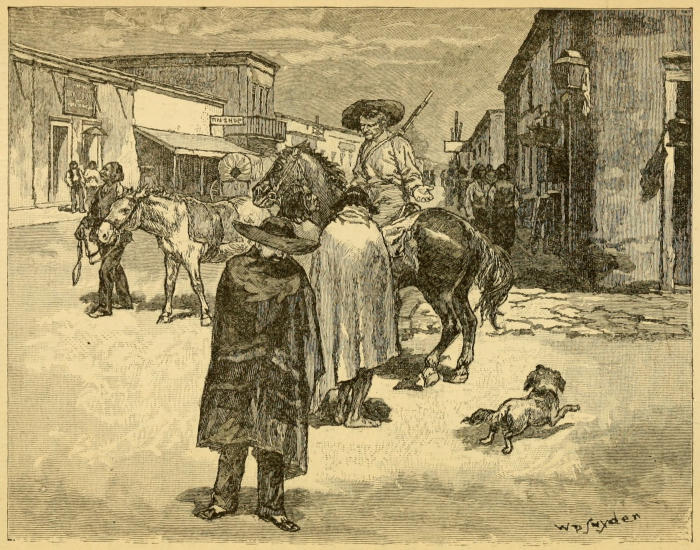
STREET VIEW IN TUCSON.
Tucson has great antiquity as a mere corporate existence. It was founded by one of the early Spanish expeditions that came up the Santa Cruz Valley in quest of the reputed treasure of the Aztecs in the fabled “land of Cibola,” but retains no visible trace of age. If there were ever any monuments of importance, they have effectually vanished. Even the church is new. Such foreignness as there is consists of a very provincial Mexican squalor.
The considerations of interest about it are of a purely utilitarian character, as: how it is to be paved, drained, lighted, provided with an adequate water supply, so as not to have to pay four cents a bucket for it, as at present; and how it is to get rid of its malarial fevers and shabby rookeries.
A writer in one of the papers one day paid a glowing eulogy to its peculiar situation, in the desert. He held that this was a matter not only of those material products which I have mentioned, but also of the highest moral and intellectual advantages. It was apropos of the establishment of a public library. No great idea has ever been evolved in the usual scenes of human habitation (so the argument ran), and that there is no place for study and contemplation like the desert. Christ, Mahomet, Zoroaster, and Confucius all formulated their creeds in the desert. I gathered that we are to expect from Arizona, at the proper time, some new prophet or sage, to sway again the destinies of men in the same way.
The correspondent was satisfied, at any rate, that, with a public library, Tucson could shortly become another Alexandria of the desert, “a seat of learning and fountain-head of ideas, to be sought by students from Mexico, from the Pacific Islands, from China and Japan, and the mountains and valleys of the Rio Grande,” and I for one shall be very glad to see it so.
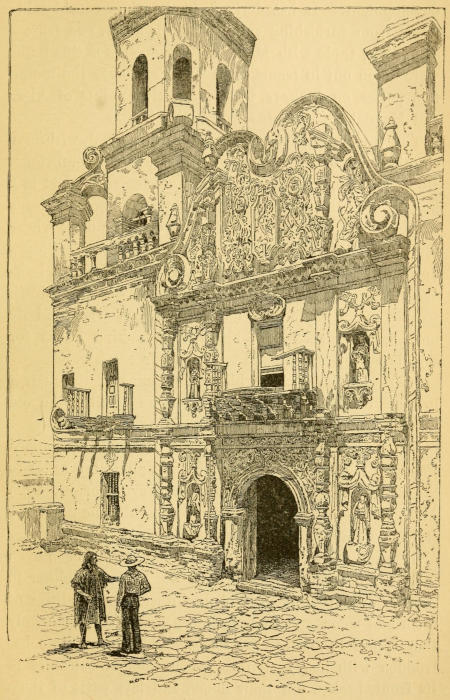
EXTERIOR OF MISSION CHURCH OF SAN XAVIER DEL BAC.
It is the commercial centre of the important Southern mining district, and has an eligible situation for future development. It has derived in its time considerable profit from furnishing supplies to the army, and from a smuggling trade with Mexico. The goods for this latter were taken out in teams, then “packed” over the mountain passes, on donkeys, to the objective points of Altar and Magdalena, in cactus-grown, arid Sonora.
The traders at Tucson, again, are largely Jewish. A certain kind of “life” prevails freely, as at Tombstone. Roulette, faro, and other games of chance are played in a large way in the leading saloons, while the poor Mexicans gamble for small stakes at fondas of their own, where some wretched lithograph of Hidalgo or Zaragoza looks down on them from the walls. There is lacking, however, the choleric and dangerous air of Tombstone. People make way for you to pass if you wish, and do not seem exclusively occupied with looking about for somebody to tread on the tails of their coats.
If Tucson be without historic remains of its own, it has one of the loveliest possible in its vicinity, the old mission church of San Xavier del Bac.
San Xavier is on the reservation of the Christianized Papago Indians, in the Santa Cruz Valley, ten miles to the southward. It is a new sensation even for one from Mexico who may have flattered himself that he knew the style completely. This ancient landmark of a frontier civilization which, since its destruction, has not been even faintly approached in its kind, is not surpassed either in Mexico or out of it for the quaintness, the qualities of form and color, and the gentle sentiment of melancholy that appeal to the artistic sense. Old Father Time has trodden with heavy step on green wooden balconies in its front, broken out their floors, and left parts of them dangling free. The original sweet-toned bronze bells still hang in one of the towers. The space, terminating in a scrolled gable, between the towers is enriched with escutcheons and rampant lions, wreathed in foliage. Niches hold grotesque broken statues, and complicated pilasters flank the entrance door-way, the whole formed in stucco upon a basis of moulded bricks. Where a portion has fallen away it can be seen that the pilasters are constructed upon or held together by a centre consisting of a stick of timber.
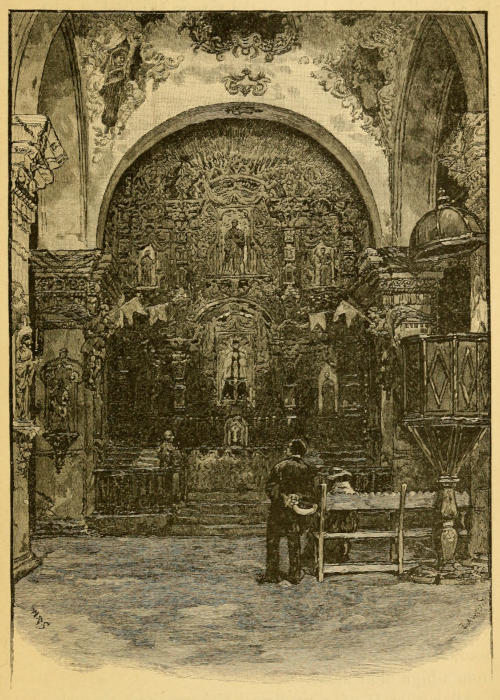
INTERIOR OF CHURCH OF SAN XAVIER DEL BAC.
The designer, whoever he may have been, was inspired by Venetian-Byzantine traditions. It is roofed with numerous simple domes and half-domes. The interior of these, frescoed with angels and evangelists, the chancel walls, almost covered with gilding, but stained and battered, and the painted and gilded lions on the chancel rails, recall to the least observant Saint Mark’s at Venice. The style is not quite consistently carried out, however. A later rococo decoration, as exuberant as the vagaries of East Indian work, mingles with and at places overrides it. A Henri II. candlestick will give a certain idea of the pattern of the columns.
The date has disappeared from the façade, but it is believed to be about 1768, and the present edifice was built on the ruins of a former one, going back much nearer to 1654, when the mission to the Papagos was first begun. Large angels, with bannerets, their draperies formed of papier-maché or gummed muslin, are attached to the main chancel piers; and a painted and gilded Virgin, with a long face, and hair brushed up from a high forehead, as in the sculptures of Jean Goujon, looks down from a high altar niche.
All within is of a mediæval richness and obscurity. All without is broad sunshine falling upon the peaceful Papago village. A few old men trudge about, concerning themselves with their bake-ovens and some water-jars and strings of dried squashes, and women pass by with tall loads of hay and other produce carried in the kijo, a singular hamper of sticks and netting, on their backs. Nobody concerns himself about visitors, except a foolishly smiling boy, one Domingo, who has brought us the key.
To have come from that spasm of aggressive modernism, Tombstone, and to be at ancient San Xavier del Bac—it seemed to me that contrast could little farther go.
THE END.