“WISH TO GOODNESS!” By LAURENCE HOUSMAN
Reading edition
In spite of his name, Mr. Peter Comely was a very ordinary-looking person; and but for one initial circumstance his life had not contained any event worth recording. The initial circumstance took place upon the day of his birth: though the son of poor but honest parents, he managed by accident to get a fairy-godmother.
This is how it came about. His mother, having previously had eleven daughters, in pairs or in triplets, remarked at the moment when she was most expecting him: “Well, I hope to gracious goodness that this time they’ll bring a boy.”
Now it so happened that the fairy Gracious Goodness was passing by at the time—out of employment and looking for something to do; and hearing her name thus invoked, she stopped and gave the matter her attention.
Peter Comely was born a boy, and without accompaniments, as his mother had desired; and the fairy, having seen him into the world, in order that she might know him again when necessary, made a neat finish of the matter by appearing before the eyes of his astonished parents, to whom she announced her name and calling. Then, having bestowed upon the child a birthday gift suitable to his station in life, she vanished into thin air, and seemed thenceforth to have washed her fairy hands of him.
171The gift she left to him, though to his parents it seemed humdrum and useless, to Peter himself was quite satisfactory. She gave him contentment; and so through life contented he remained though poor, and therefore—in spite of the efforts of his parents to sow in him the seeds of a criminal ambition—honest, meek, unassuming, and to most people rather uninteresting.
As he grew up, having few wants, he had also few ideas; and though upon each of his birthdays, unknown to his parents, his fairy-godmother paid him a private visit to ask whether he wanted for anything, his answer always was that he wanted nothing; nor did he even trouble to tell anybody of the fairy’s visits, or give a thought himself to the brilliant bargains he might have got out of life from the offers made to him.
So when he came to man’s estate, though he might have had anything for the asking, he turned to and worked for a weaver’s wage, as his father had occasionally done before him, and lived as all other poor men have to do—with only this unfortunate difference, that he remained quite contented with his lot; and though he worked well, and was worth much more than his master paid him, he never asked for a rise; which, while it mattered little to him, was bad for his master.
That, however, is only by the way; but I don’t want any of my readers to think that contentment is everything, or good under all circumstances. Disturbance is sometimes far better: water, in a kettle that doesn’t boil over, makes bad tea.
Now one day—one of his birthdays—a certain young person of the village, who had a sharp eye for the main chance, happened to look in and see him over his loom, talking to a beautiful lady with wings; and all of a sudden it came to her 172that a certain queer story she had heard told by his disreputable parents, and had never believed, was true after all; and that poor simple Peter Comely really had a fairy-godmother. It seemed also—and this made the discovery more valuable—that the fairy still took an interest in him.
Instantly she made up her mind to marry him; and Peter, though he would have been quite content to remain a bachelor, was equally content when, by the various ways available to that end, the young woman managed to become first “his young woman,” as the saying goes, and then his wife.
Having got him, Mrs. Comely lost no time in tackling him on the subject of his fairy birthright. Peter was quite simple and open about it; and his wife discovered that, having been given a contented nature from his birth, he had made no further use of it in spite of the opportunities which the fairy’s repeated visits afforded him.
“I wish to goodness you’d told me sooner!” was her complaining remark, when she found that it was only on his birthday that the fairy visited him. For now there was nearly a year to run; and with the knowledge that her married circumstances could so easily have been altered for the better, had only the right remedy been applied at the start, Mrs. Comely became deeply discontented with her surroundings, with Peter’s wages as a weaver, and with Peter himself as a man. In fact, there was nothing now that pleased her; and what pleased her least of all was her husband’s contentment with things as they were.
The consequence was she was always in a bad temper; and, as is the way with people when they are far from a state of goodness themselves, “Wish to goodness!” became the daily expression of her impatience against one who took everything so patiently. But nothing she could do—though she tried her best—ever made him discontented.
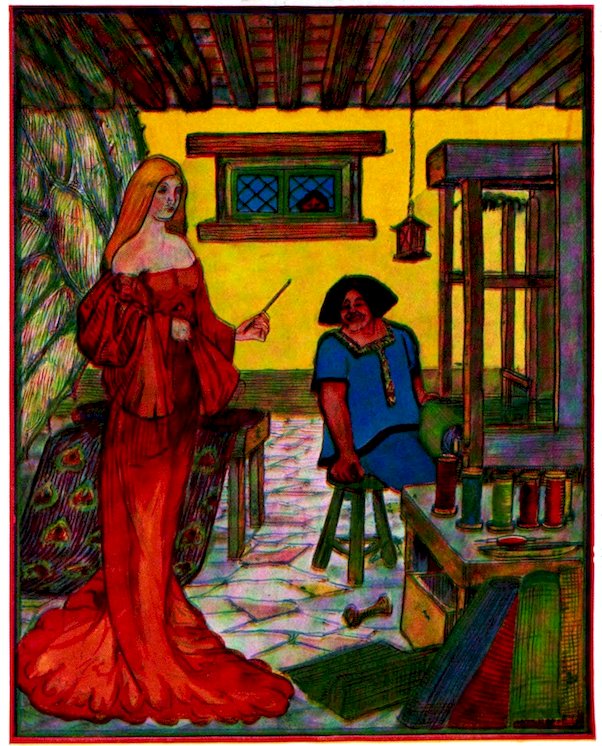
173Behind her back, friends—who saw what sort of a wife he had become saddled with—would come to condole. “Your wife’s a bit of a handful, isn’t she?” one would say. And “Oh, aye!” Peter would answer; “a nice handful she is, for sure—or would be, if you tried to hold her. But let her go her own way, it’s no odds to me.”
“Hard to please, isn’t she? I’ve been told so.”
“I’ve never seen anything please her yet,” said Peter, smiling, “except to tell me what a fool she thinks me! And put it that way, you might say that I do manage always to please her. Well, if that suits her, it suits me all right; gives her something to talk about, and me something to listen to that I can understand. For I’m not clever, you know, and if I’d any doubt about it myself, I’ve got her word for it.”
“Peter, you are too easy,” said his friend. “You’ve got your senses like all the rest of us. The mistake you make is to think too little of yourself. The fact is your wife has got a bad temper.”
“Oh yes,” said Peter, “her temper’s bad, I know. But it’s beautifully bad; it suits her.”
And just then Mrs. Peter put her head in at the door, and cried: “Wish to goodness, you wouldn’t have lazy giddygaddies coming in talking and wasting your time all day, when you ought to be at work. Goodness gracious! I might as well have married a turnstile, the way you let folk in for the asking, as ought to be stopped if they don’t know any better themselves, coming in work-time.”
Before she had finished her commentary, Peter’s friend had slunk away, having had enough of it.
174But Peter only said: “We were talking about you, my dear.”
“And what were you saying about me, I’d like to know?”
“I was saying that whatever you did suited you.”
“Did? Suited me? Like what?”
“Well, for instance—losing your temper.”
“If I ever lost my temper with a fool like you, there’d be no finding it again.”
“No, my dear; but you never do. When you are with me you are always in a temper.”
“And reason enough, too!”
“Yes, my dear; I’ve never denied it.”
“Better not. If you did there’d be trouble.”
“Yes, my dear; and I don’t like giving trouble, you see.”
“Giving, indeed!” she cried; “it’s I have to pay for it!” and off she flounced. Try as she would, she could never get at him. Peter always remained amiable and contented, and also—which is what tried her most—slightly amused. Whatever she did to make him do otherwise, Peter always appreciated her qualities at their full worth. Once, losing all patience with him, she gave him quite a hard knock over the head with a rolling-pin.
Peter looked at her with admiration.
“Now I should never have thought you could hit me as hard as that,” he said—“a little woman like you. I wonder if I could hit you as hard?”
“You’d better not try!” she retorted.
“No, my dear: you mightn’t like it,” explained Peter, smiling, as he put court sticking-plaster on his forehead, tied a piece of string round it to keep it in place, and stuck it with sealing-wax for a neat finish.
175Mrs. Comely was beaten, and knew it. “I don’t know what’s the matter with him!” she would say to herself sometimes. “It’s not human; it’s not reasonable. It’s that fairy of his has gone and got into his blood, and made him into something that’s more like a ball of wool or a piece of putty than a man. And I wish to goodness his birthday would come round quick, so that I could put things right for us!”
Poor woman! during that time of waiting she was sadly tried. But at last his birthday did come round again.
Mrs. Comely was full of expectation and hope. She was almost nice to him on the morning of the day, feeling her cares so nearly at an end; for, of course, now, being his wife and upon the spot, she meant to do the wishing, and had instructed him accordingly. When the fairy came he was to be sure to call for her before doing anything.
But it so happened that Peter, being short of yarn for his weaving, had to go out and buy more.
Mrs. Comely let him go, for she could not bear to see him not working; but she called after him to be quick home again, being afraid that the fairy might come while he was out.
Unfortunately he met the fairy before he had got back from his errand. Just as he was coming through the wood, she slid down the tree on which she had been waiting for him, and standing before him, radiant with gracious goodness, cried: “Many happy returns of the day, Peter. Is there anything you want?”
Peter stood considering: “No,” he said, “there’s nothing I want for myself; but my wife wants me to be quick home again.”
And scarcely had he said it, when home he was, and the fairy—having done her duty by him—nowhere to be seen for the whole of another year.
176
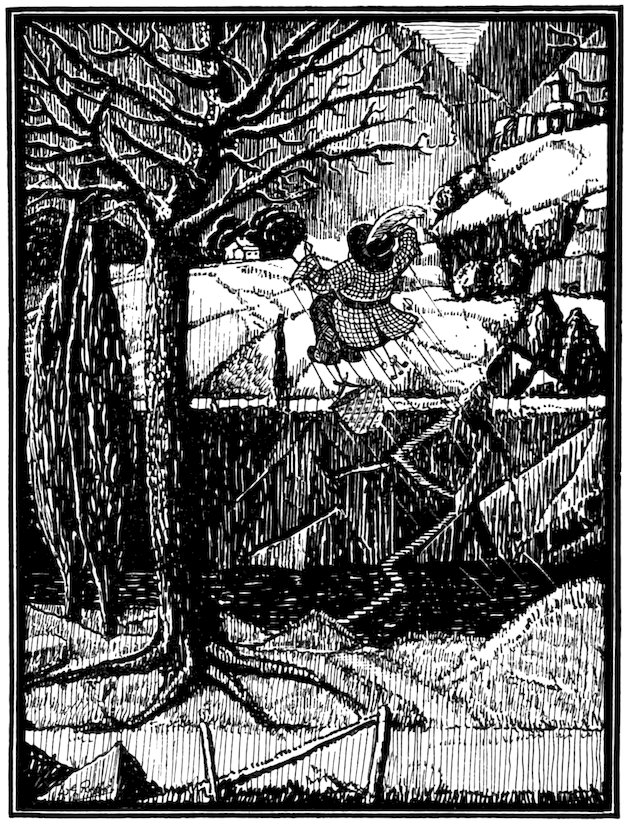
“... My wife wants me to be quick home again,”
177
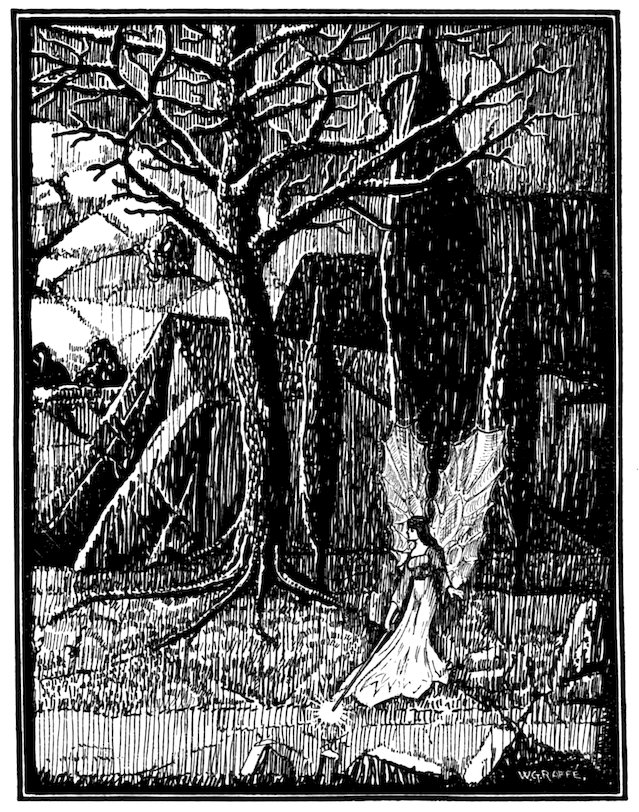
and scarcely had he said it, when home he was.
178“Gracious goodness! you have been quick!” cried his wife, as he came in. “I’ll say that for you.”
“Yes, I have rather,” said Peter, as he moved off to his work. Then he bethought him, and stopped to explain. “You see, it happened like this: while I was out I met godmother. She said, Did I want anything? I said I didn’t, but you wanted me quick home again. So here I am. Very kind of her, wasn’t it?”
What Mrs. Comely said then, cannot be set down upon the printed page. And what she continued to say, for a whole year whenever she thought of it, was so similar that the only thing one can do in decency is to leave it at that, and let the year go by unrecorded till it bring us to the morning of Peter’s next birthday.
Peter was in bed with a cold, an extremely bad cold—the sort of cold that is called double pneumonia, which, though it sounds like the name of a flower, is really something much more ugly and dangerous and hard to get rid of. And only the night before, the Doctor had come and told Mrs. Comely that he was very much afraid Peter was going to die.
Mrs. Comely was much put out by the news. “Can’t you make him live just for another day, Doctor?” she enquired complainingly; and the Doctor said he would do his best.
“You see, he hasn’t made his will,” said Mrs. Comely by way of explanation, not wishing to let more be known about her actual expectations than was necessary.
To Peter, also, she said much the same thing. “I do really think,” she exclaimed, “after all I’ve had to put up with, marrying you, and only finding out after what a fool you are, that you might at least do that for me—keep alive till your 179godmother has come to make it more worth while to me than it’s ever been yet.”
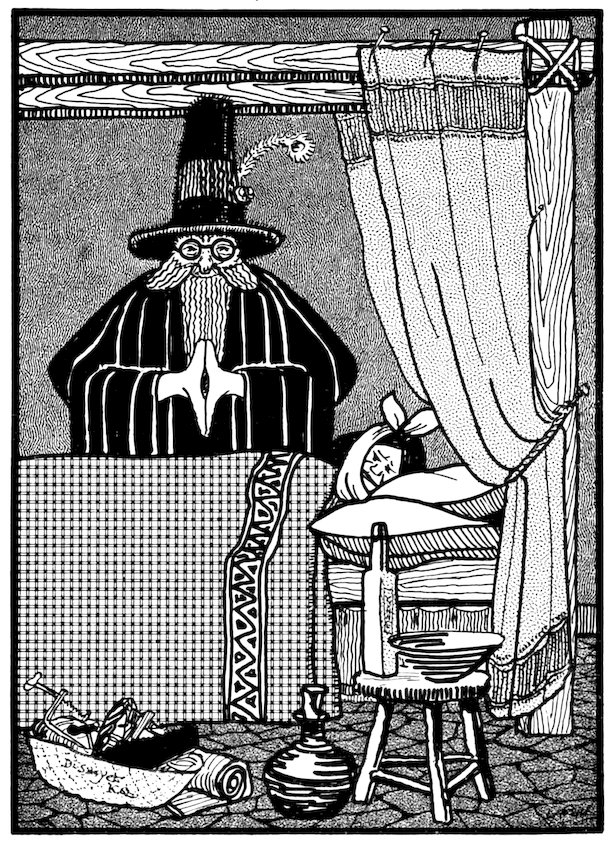
The Doctor thought he would die....
180“What exactly is it you want this time?” enquired Peter. “You’d better let me know so that I don’t make any mistake.”
“Well, I want you to keep alive,” she replied; “you do that, and I’ll see to the rest.”
And having him there in bed, and she being herself on the spot to answer the door, she made sure that this time at all events the situation was fool-proof, and that all would be right.
But things did not happen quite as she had expected, she not being accustomed to the ways of fairies, who can, if they like, be quite independent of such gradual methods of approach as front-doors with door-mats, and door-bells with some one to answer them; a fairy who really knows her job is right in the middle of things before you know that she is there at all.
And so, when Mrs. Comely went down to make some beef-tea for her husband, the fairy arrived, this time not down a tree but down the chimney; and very sorry to find him so ill, wished Peter much happier returns of the day than could be said of the present one. “And what,” she then enquired, “can I do for you?”
Peter said he didn’t know that there was anything she could do for him. He had got double pneumonia, and had got it so well that the Doctor—so his wife told him—thought he would die of it.
“And I don’t know,” he added, “whether she wants me not to die of it. All she has said she does want is that I may live for another day.”
181“You shall live for another day,” said the fairy, “and for many another day too. Here’s life to you! Take your own time, and get well! A year hence I will come again and see how you are doing.”
Scarcely had the fairy departed when Mrs. Comely returned with the beef-tea. Her husband, though with the fairy’s word for it he might now be said to be on the mend, showed so little sign of a change for the better that she would not have noticed it, had he not himself told her.
“You have got your wish, my dear,” he said. “I am not going to die to-day. She has just been and promised that I shan’t—that I am going to get well.”
Mrs. Peter was so amazed and so angry to think that she had again missed meeting the fairy through her husband’s stupidity, that with a flounce and a bounce she upset the soup over him.
“Well, that’s an easy way of taking it, isn’t it?” he remarked, as he watched it slide over the bed-clothes in a large shifting pattern of brownish yellow. “I suppose if you leave it it’ll soak in all right.”
“It’s my belief,” snapped his wife, ignoring the discomfort she had caused him, “that you haven’t got a fairy godmother at all, and that what I saw was only a young woman out of the circus, and one no better than she should be—with wings stuck on for her to act with; and that you’ve been deceiving me all this time!”
“Very well, my dear,” replied Peter, “believe what you like to believe, if it makes you happier. But you’ll have to believe your eyes presently, when you see me get well. Only yesterday, you told me, the Doctor said I was dying.”
182“Doctors make mistakes,” she retorted. “I almost wish you were going to die!”
“Now what a pity,” said Peter, “that I didn’t know that sooner, and then I might have asked for it. But what you told me, you know, my dear, was just the contrary. You wanted me to live, you said.”
“Only a day!” said his wife. “And now I’ve got to have another year of you, and then perhaps find out that it’s all a lie, and that fairy-godmother of yours just straw and moonshine, like all the rest of you. Goodness gracious! I wish I’d never married you!”
She had now got it so fixed in her head that he had only been deceiving her, that she said the same thing several times—most days, in fact—during the year. And especially she would say it whenever he was in a state not of doing anything that she could find fault with, but just being himself. It was his quiet, contented character which most infuriated her. For, as she said to herself when she considered him in this sure setting which Heaven had bestowed on him: “There’s no getting at him! He’s so made you’ve just got to lump it or leave it.”
So when for the third time his birthday came round, and Mrs. Comely, waking as the alarm-clock went off, sat up in bed and looked at him still peacefully sleeping, in spite of the racket which her friend the alarm-clock was making—so like herself in its way, yet only doing its duty—as she sat up and looked at him lying there undisturbed by the noise, all her stored-up resentment against him broke out once more, and, “Goodness gracious!” she cried, “I wish I weren’t married to him!”
183Now it so happened that on this particular birthday Goodness Gracious had come early, having a good many other things in the day that she wanted to do. So there she was already in the room when the alarm-clock sounded, sitting on the foot of the bed where Mrs. Comely’s hot-water bottle had not yet got cold, and Peter’s feet, which had no hot-water bottle to comfort them, were sticking out from under the coverlet.
So sitting there, unnoticed as yet by Mrs. Comely, who was too much occupied looking at her husband and hating him, she gave a sharp pinch to one of Peter’s toes which made him wake up.
“Yes, yes, my dear!” said Peter, thinking it was his wife giving him his birthday greeting. “The same to you, and more of them!”
“Peter,” said the fairy—and Mrs. Peter, starting up, stared at her in sudden hope and astonishment—“Peter, your wife says she wishes she wasn’t married to you. Do you wish it too?”
“I’ve no wish in the matter for myself,” said Peter. “It’s not for me to decide. But if she wishes it, then I do.”
“Then you shall have your wish, both of you,” said the fairy, while Mrs. Comely, seeing too late the mistake she had made, started screaming and protesting that that was not the thing she wished most, or first, or indeed at all, if the fairy would only wait and let her think a minute.
But fairies don’t wait, or only when it suits them in order to drive home a moral. And here the fairy was going to drive home a moral simply by not waiting—having it already up her sleeve, as you shall now hear.
184“Very well, Mrs. Comely,” she said; “then as you wish it you shall not be married to him any longer. And as there are only three ways in which that can possibly be brought about I now give you your choice of them. Either he must die, or you must die, or you must have been married to somebody else before you married him, somebody about whom you may have entirely forgotten.”
“I never was married to anybody else!” exclaimed Mrs. Peter, fastening upon the last alternative with great indignation. “Of what wickedness are you accusing me?”
“Of none,” said the Fairy; “as I say, you may have entirely forgotten it.”
But this did not appease Mrs. Peter. “I’m not likely to forget a thing like that,” she protested. “I’m no fool like him; and if you think so, you’re the same, and nothing to choose between you! Goodness gracious! if you haven’t more sense than that, and you a fairy, I wish I’d never set waking eyes on you!”
“Have your wish!” said the fairy. “You never have.” And so saying, she vanished.
Mrs. Peter rubbed her eyes. It was hard to believe, but it was true. The meeting with the fairy had been a dream. And now she was gone—or the dream had gone—and there was nothing to be done for another year.
Mrs. Comely turned in bewilderment to her husband. “I’ve been having a dream,” she said.
“Have you, my dear?” replied Peter cautiously. “I hope it has done you good. What was it about?”
“It was about that fairy of yours. I don’t believe in her. She’s only a dream. I had my suspicions about it before; and now I know.”
185“Very well then, my dear, we must do without,” said Peter. “It’s much easier to be contented with life if you don’t expect anything. Your believing that I had a fairy-godmother who could do things for me has made you discontented. Now you’ll feel better.”
Mrs. Peter would not admit it; but as a matter of fact it did. Having nothing miraculous to look forward to in her married life, she became resigned to it; and for a year was just an ordinary wife as other people’s wives are, only complaining of Peter twice as often as she had cause, which was not often, he being such a very easily contented and accommodating character.
And on Peter’s next birthday, having no curiosity or expectation left about the fairy, whom she no longer believed in, she left Peter, without instructions, to see the fairy alone. And alone he was when the fairy called on him.
“Well, Peter,” said the fairy, “is there anything you want this time?”
“Not that I want,” said Peter; “but last year you gave my wife a disappointment. She doesn’t believe in you any more, she thinks you are only a dream. She’s been very good hiding it; but I can’t help thinking she feels it.”
“Well, what do you want for her?” enquired the fairy.
“If it isn’t too much to ask,” said Peter, “and if it isn’t too much trouble, can’t you make her contented like you’ve made me?”
“Of course I can,” said the fairy. “Why didn’t you ask that before.”
Peter thought awhile.
186“She didn’t want it,” he said. “She’d got other ideas. Now that she’s got none left, I can think for her.”
“Very well,” said Goodness Gracious, “then from this moment your wife shall be as contented as you are.”
And just then, from outside came Mrs. Peter’s voice calling to him, as she mopped the kitchen floor.
“Goodness gracious, Peter, who’s that you’re talking to?”
The question embarrassed him. He felt it was so much better to let sleeping dogs lie.
“Never you mind!” he said roguishly.
“Oh, all right!” replied his wife, and went on with her mopping.
“There!” said the fairy.
“Goodness Gracious!” cried Peter. “You’ve done it!”
187