OLD JOE By WALTER DE LA MARE
Reading edition
The house in which old Mr. Bolsover lived was of a faded primrose colour, and, apart from a high gable in which showed the windows of the guest-room and an attic, it was long and low. Its other back windows looked out across meadows which now lay spreading out before them into the distance, bright green beneath a merry morning sun. A narrow terrace skirted the house. At either end of this was a worn, grey stone pedestal on which stood two dancing fauns, for ever piping one to another above the wallflowers and the pinks. And it was the pinks that were now in full bloom, filling the air with their fragrance.
Along the terrace leaning down from the house wall was a canopy made of copper, and painted green; and this was supported by slim pillars, around which clematis and jessamine clambered. It was just after breakfast-time, and old Mr. 80Bolsover at this very moment was coming out at the French windows of the breakfast-room with his small niece, Letitia. She had a nimble way of walking and a quick way of turning her head that was like a bird, and she was chattering away to her old uncle as she stepped along beside him. They came to a standstill together, looking out across the meadows.
“Oh, Uncle Tim, what a perfectly lovely morning!” said she.
“A lovely morning,” repeated Uncle Tim. “One of the most beautiful I can remember, simply because a small person of the name of Letitia is here to share it with me.”
“Oh, Uncle Tim,” said Letitia; “that's flattery.”
“No, my dear, not exactly flattery,” replied Uncle Tim, squinnying at her from under the glasses of his spectacles; “but just the plain, beautiful, solemn truth.”
“Ah, I know all about that!” said she.... “And to think, Uncle Tim, it's exactly a year since I was here before. Why, you wouldn't believe a single flower was different. And there,” she went on hastily, twisting her head on her slender neck—“why there's that curious old Guy Fawkes thing still, over there by the willows.”
“Why, yes, so it is,” said Uncle Tim.
Letitia continued to gaze at it. “You know, he is a little alarming, Uncle Tim, if you look at him long enough. And you don't seem to remember,” she went on solemnly, “that the very last morning I was here you promised faithfully to tell me what it's there for. And then you didn't, because Mother came in just when I was asking you, and you forgot all about it.”
“Well, so I did,” said Uncle Tim. “That's just what comes of the piecrust which promises are made of. It melts 81in your mouth.... That's Old Joe right enough. Old Joe indeed, poor soul, for he must be at least as old as I am. Ninety-nine, Letitia, if he's a day!”
“You're please not to say that, Uncle Tim. You are the youngest, kindest Uncle Tim there ever was. So there! But what is Old Joe? Where did he come from? What is he for? Isn't there a tune about an Old Joe, Uncle Tim? Is that him? Tell me now,” cried Letitia. “Let's sit down here comfily on the stones—they're as warm as toast in the sun. And now go straight on. Please.”
Down sat old Mr. Bolsover; down sat Letitia—side by side like an ancient Pharaoh and his bride. And this is his story of Old Joe:
“I must tell you first, Letitia,” he began, “that when I was about your age I used frequently to stay with an old friend of my mother's—your grandmother's, that is—whose name was Mrs. Lumb. She was a stout woman, and used, I remember, to wear an amethyst-coloured velvet cap flat over her ears, and a lace thingummy over her shoulders. I can see her now: her wide face all creased up in smiles, and her fat fingers with the emeralds and the sapphires; and even the cameo brooch at her neck. She wasn't even so much as my godmother, but she was immensely kind to me. She had a cook, too, that could make every sort of prime rich cake there is. Jams, jellies, raspberry-fool, apple charlotte, tipsy-cake—they were the best I've ever tasted. So were her stuffed eggs.”
“Oh, Uncle Tim,” said Letitia, “you greedy thing!”
82
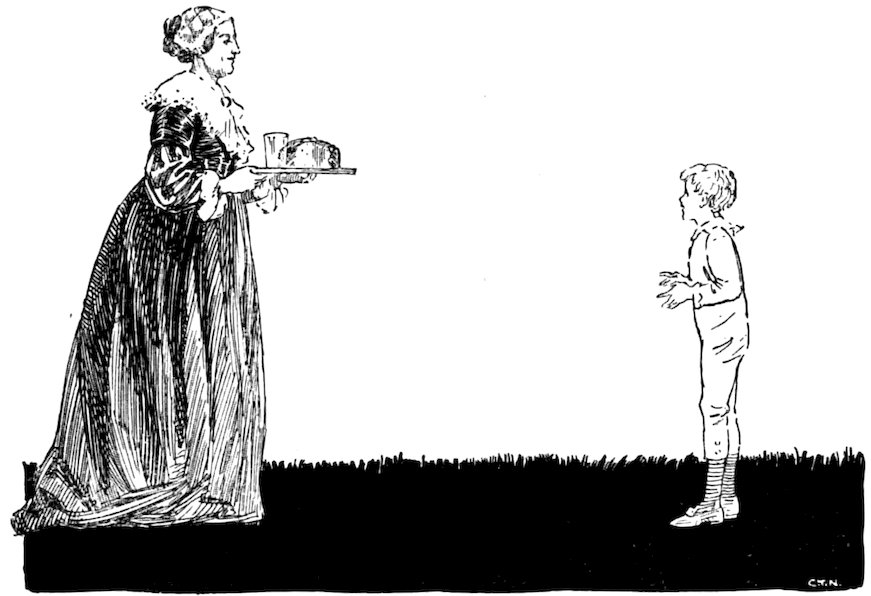
“You shall see for yourself at lunch,” said her uncle; “for if I'm not an unprophetic Dutchman, I can smell apple charlotte. But never mind about that. You'll agree, at any rate, that my friend Mrs. Lumb was the right kind of person to stay with. It was always during the holidays, and in those days, while there was plenty of honest hard tack at school—impots, ferrules, bread-and-scrape and what-not—there was no such thing as a holiday task. You hadn't, I mean, to sit and hate reading a book you'd have loved to read for its own sake if you had never been told to. But never mind about that either. At Mrs. Lumb's I did just what I liked. Hers was an old, roaming house; a good deal older than this, and twice the size; and there was beautiful country all around it. Wide sweeping hills with ploughed fields stretching down their sunny slopes; little woods and copses, too, on the crests and in the folds and valleys; and a stream meandering its way along and actually brawling over stones at the foot of our long, sloping 83garden. If ever I go to heaven, my dear, I hope to see that house and garden again.”
“But isn't it here still?” said Letitia. “I mean wherever in the world it used to be?”
“Alas, my dear, no,” said old Mr. Bolsover. “The house was destroyed by fire—burned clean to the ground—forty years ago. But not, I am thankful to say, before Mrs. Lumb had left it and had gone out to live with her younger brother in Ceylon—where the strong tea comes from.
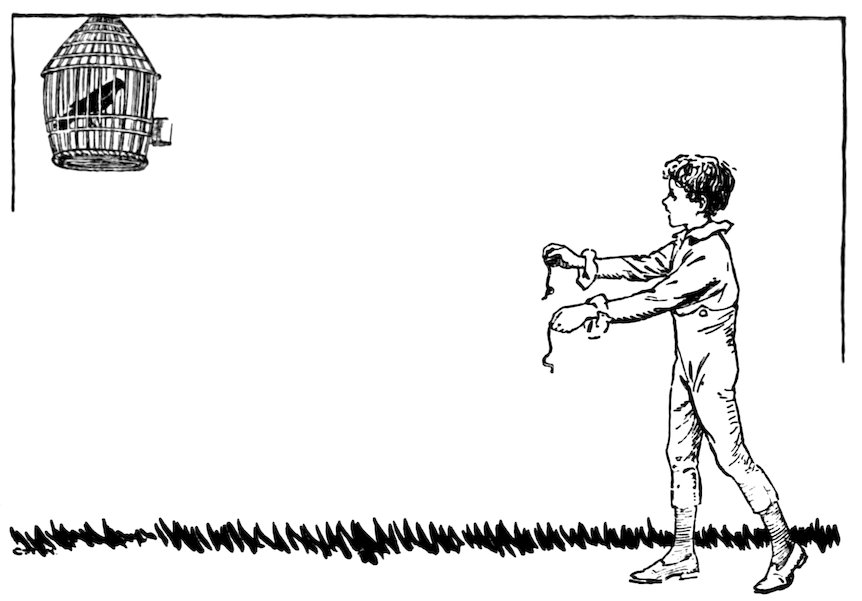
“In those days I was uncommonly fond of birds; too fond of them to carry a catapult, but not too fond of them to set traps and try to catch and keep them, poor creatures, for pets. How would you like to be a linnet or a starling or a blackbird 84barred up inside a cage by an oaf of a boy like me when I was nine or thereabouts?”
“Not at all,” said Letitia; “though I would sooner be kept by you than by any other boy.”
“Thank you, my dear,” said Mr. Bolsover; “that's a bargain. Still, caging wild birds is usually very poor fun for the wild birds. But I was a boy and I did as boys do, bless their hearts. My traps were scattered everywhere, sometimes in places where they had no business to be. What I was after was rare birds, and deep down my one desire was for a bird unspeakably marvellous in colour and appearance and song, and one that nobody had ever seen. Which means I was a little cracked on the subject. There was a particular place that I had in mind for a trap for a long time before I ventured to make the attempt. It was at the edge of a field where I used to notice a great many birds were accustomed to visit, and that in spite of Old Joe there.”
“That Old Joe there?” enquired Letitia, pointing with her finger at the queer, stooping figure with its head and old hat on one side which stood blankly gazing at them from under the willow where she had noticed him before.
“Yes, that same Old Joe there,” said Uncle Tim. “Between you and me, my dear—though please not to look his way for a minute, as I shouldn't like to hurt his feelings—Old Joe is a Scarecrow, an antiquated hodmadod. And he has never been anything else; though, after all these years he and I have been together, of course he's now a kind of twin brother. He's Joseph, you see (in the coat), and I'm Benjamin; and as you see, my dear, we are much alike.”
“How can you say such things, Uncle Tim,” cried Letitia, pushing her hand in under his arm. “You know quite 85well that's a kind of flattery, too—of yourself, you bad thing!”
“No,” said Uncle Tim, “but of Old Joe. But never mind about that. The first time I saw him, he gave me a real fright. I had come creeping along on the other side of the hedge, keeping a wary eye open for anybody that might be in the field; even though there was very little likelihood of this, for, unless the field was being ploughed or harrowed or sown or hoed, there never was anybody. The field belonged to a farmer called Jones. It was a good-sized, sloping, forty-acre field, with a plantation of spruce down along all one side of it.
“That particular morning was in March; and the field was just waiting—and on a morning rather like this, but much 86colder—for its crops to come up. I was skirting along the hedge, as I say, carrying the snare I had with me under my jacket, and hardly able to breathe for excitement. For, thought I to myself as I peered through the hedge in which the thornbuds were just breaking, that's the place for me. I could just see across to the lower edge of it, where lay a ditch and another hedge that had been allowed to sprout. It was truly a little paradise of birds, my dear. There seemed to be hundreds busying and disporting and delighting themselves there in the early sunshine.
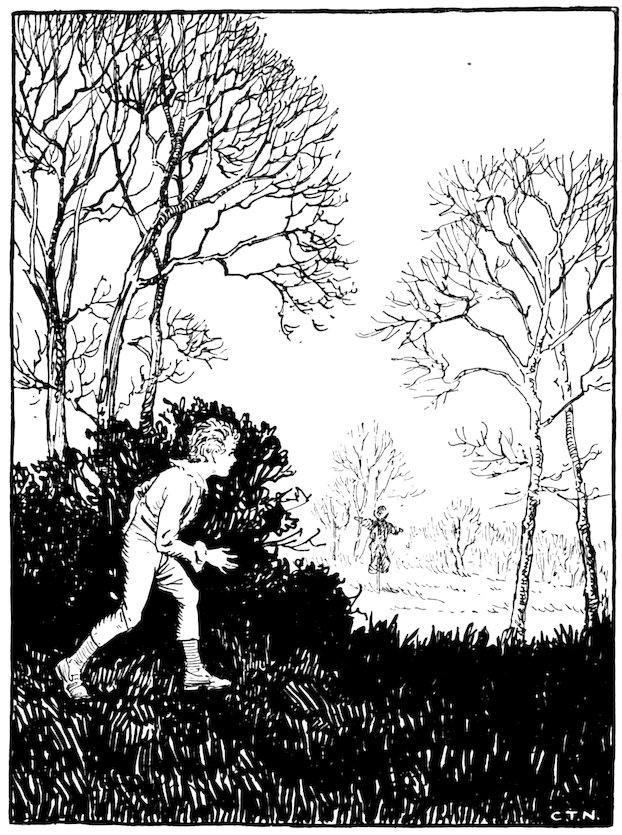
“As bold as paint I turned the corner by the old gate, and at that precise moment caught sight of what I supposed was either Farmer Jones himself or one of his men staring at me across the field not thirty yards away. I fairly jumped in my clodhoppers at sight of him, turned hot, then cold, and waited, staring back. It seemed almost as if I could see his very eyeballs moving. But not he! No common human he! It was Old Joe. My Old Joe—that Old Joe there!
“I have seen a good many scarecrows in my time, but never one at which you must look longer before you can be perfectly sure he is not real—alive. After all, what is life, Letitia?”
“That's perfectly true, Uncle Tim,” whispered Letitia, edging a little closer. “He might be alive at this very moment.”
“You must remember, too,” went on Mr. Bolsover, “all this was in Old Joe's better days. He was young then. He has been peacocked up in many a new suit of old clothes since then, and more hats than I could count on my fingers. But then he was in his heyday—in the very bloom of his youth, the glass of fashion and the Knave of Trumps! But still, even as he stands now under his old willow there, I wouldn't part 87with him not for a bulging fat bag of guineas. Not for twenty bags. Chiefly for his own sake; but in part, my dear Letitia—in part because one doesn't too often actually see fairies in this world.”
88Letitia burst out laughing. “Fairies, Uncle Tim!” she cried, dragging in her amusement her skirts tight over her knees. “Why, you don't mean to say, you poor thing, that Old Joe's a fairy?”
“No, I don't mean to say quite that,” said Mr. Bolsover. “Then, as now, Old Joe was the scaringest of scaring scarecrows I have ever set eyes on. But like the primrose in the poem he was nothing more. No, indeed, it wasn't Old Joe was the fairy. But he was all but next best, for he was one of her rendez-vouses, as the old word goes. That morning he was wearing immense loose great trousers and a greenish-black coat very wide on the shoulders. Apart from the stick for his arms, another had been pushed up one of his coat-sleeves for a cudgel. Another with a lump at the top made his head, and on that was a high, hard, battered, square hat like the hats old-fashioned farmers and churchwardens used to wear. He was stooping forward, cudgel in hand. And the eyes from under the penthouse brim of the shadowy battered hat seemed to be fixedly staring straight towards the corner by the gate and at me.
“I hugged the wire snare closer and stared back. And whether it was due to the hot air coming up from the flinty soil, or some cheating effect of the light on the white field, I can't say, Letitia. But even while I watched him, his head seemed to be ever so gently turning on his shoulders, as if for all the world he were furtively endeavouring to get a better view of me without my noticing it.
89
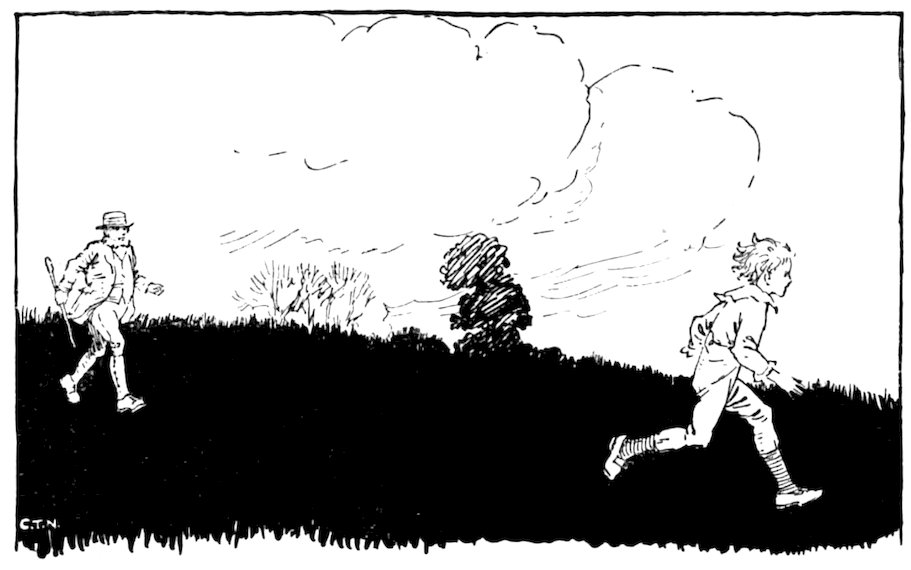
“I was still pretty well startled, I can tell you, my dear. For in those days young trespassers on seedling fields might find themselves in for a smart walloping, if not for something worse. The amusing thing is that this Old Joe was alarming me a great deal more than he was alarming the birds. They seemed to be perfectly used to him. A couple of tits were positively playing hide-and-seek, with him for goal. And there were rooks in their black coats pacing up and down and preening themselves in the sunshine not more than a few paces away from where he stood.
“Well, at last, after confronting him like this for a minute or two together—at last I became sure he was not an angry farmer, but merely Old Joe. Yet, something in the look of him was different from any other scarecrow I had seen up to that moment. Even from where I stood I could spy a few 90wild flowers already blooming at his feet, and I felt, too, that even if there were no real eyes in his head, somebody or something was actually looking at me from under that hat or from out of his sleeve—from somewhere.
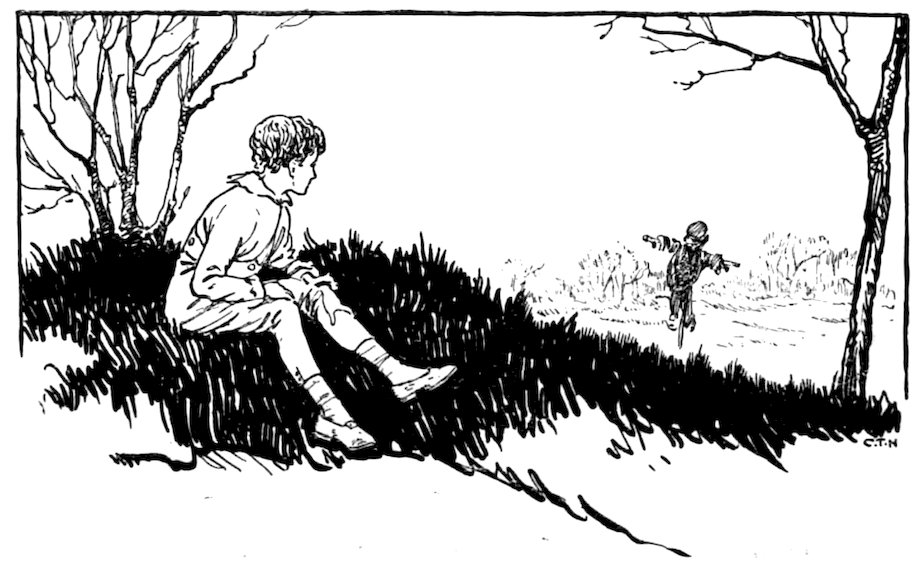
“Already the birds were becoming accustomed to me being there, simply because I stood so still. I squatted on my haunches and began to set the trap, but the whole time I was thinking of that queer old creature half-way up the field, and knew I was being watched. And whenever I stooped, I took a little secret look at him either over my shoulder or between my legs. And then I sat down on the grass of the bank under the hedge and steadily fixed my eyes on him for I should think a full half-hour.
“Nothing happened, however. The sun climbed a little higher into the sky; the shadows cast by the trees shifted a 91little on the wide-stretching field, and at last I turned back home again. At the corner under an old thorn-tree I stooped down for yet another moment and had yet another look. And at that very instant I was perfectly sure I had caught a glimpse of something moving there. It was as if a face had peered out and had as swiftly been withdrawn again into hiding.
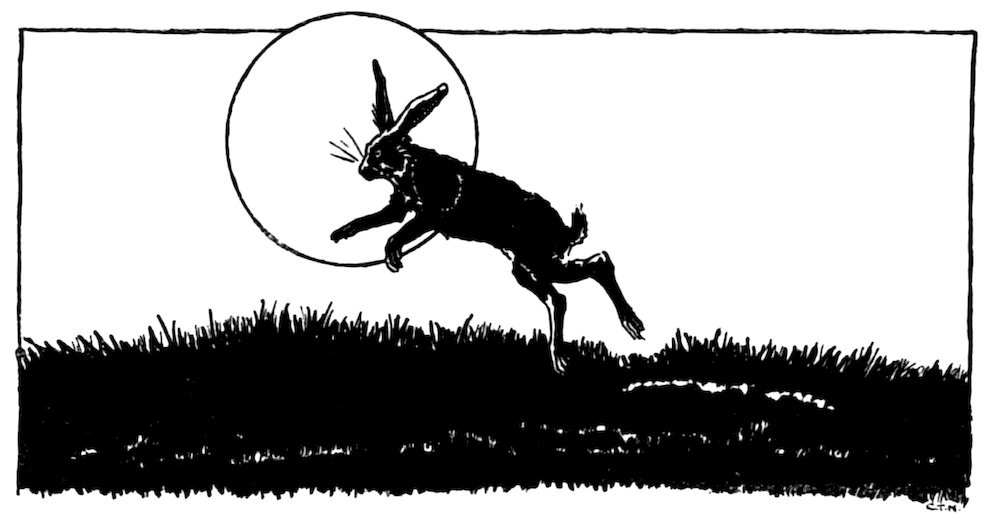
“All the rest of that day I could think of nothing else but Old Joe, assuring myself that my eyes had deceived me, or that perhaps a bird had fluttered down, or that a little breeze had moved his sleeve—something of that kind. And yet I knew inside me that this wasn't true.”
“It might,” said Letitia—“it might, you know, of course, have been not a bird but a little animal you saw, mightn't it, Uncle Tim? I once saw a hare skipping about in the middle of a field. Or mightn't a bird have been building its nest in him? Robins, you know, will build their nests even in an old boot. And look! There's a bird actually sitting on Old Joe's shoulder now.”
92“Well, you shall hear,” said Uncle Tim. “I am sure, my dear, if you had seen Old Joe that morning you would have agreed that there was something different about him from what he looks like now. I can't quite explain, except that it was the difference between an empty house and one with people living in it. The difference between a pond with fish in it and one with none. The difference between you yourself when you are really asleep and when you are only foxing and pretending to be. And sure enough, I was right.
“I had my bedtime at Mrs. Lumb's, and always an apple and a glass of milk. But she was not one of those Uncle Tims who want everything done exactly at the right moment. She didn't wait till the clock struck eight and them come peeping in to see if one was safe in bed.”
“Why, you know very well,” said Letitia, “you don't do that yourself.”
“Ha, ha! Never mind,” said Mr. Bolsover. “That evening, about seven o'clock, I made my way down to the field again, just creeping from bush to bush, tree to tree as cautiously as I could—so cautiously that I actually nearly trod on a bunny's tail that happened to be enjoying a dandelion on the other side of a bramble. And when I reached my hawthorn, I sat down by its root very low to the ground, having made up my mind I would watch until it really began to grow dark. It was towards the end of April, you will remember, so the evenings were a good deal shorter and duskier than they are now. And as it began to be twilight, it seemed almost that Old Joe was steadily moving nearer. And then at the very instant when I noticed the first star in the sky, I saw—well, what do you think I saw?”
“Why, the fairy, of course,” said Letitia, and sighed.
93
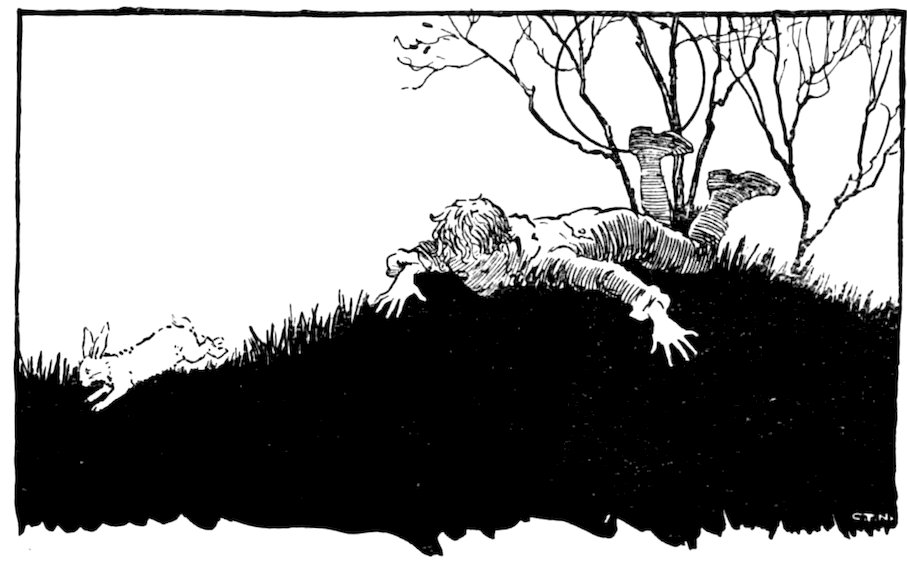
“Full marks, my dear,” cried Mr. Bolsover. “The fairy. The odd thing is that I can't really describe her. Maybe the light was not very good; maybe my young eyes were strained with watching. But it was not only that. For I seemed to be looking at her partly as if I was imagining her, though I knew she was really there. She was leaning a little forward, and reached, I should say, about up to what you might call Old Joe's waist. Her face was rather long and narrow, and there was fair hair hanging down from side to side, something between gold and grey, rather like the colour you see on a phosphorescent fish in the dark, only more golden. She stood unearthly still, looking out towards my thorn. And the very sight of her filled me with a sensation I simply cannot describe.
“It was as if I was in the middle of a dream in another world, and cold prickles went down my back just as if unawares 94I had heard the sound of enchanted music. There was not a breath stirring, everything about me seemed suddenly to grow sharp and clear, even though the light was dim. The flowers were different; the trees; the birds. Like that old story of the Cap of Invisibility, it was as if I knew deep down what the flowers were feeling, what it was like to be a tendril of ivy creeping up a tree-stem, or to have feathers all over me, and to be looking with a bright small eye at my own bird-world. I can't explain it, my dear, but I am sure you will understand.”
Letitia gave two solemn nods. “I think so, Uncle Tim—a little.”
“Now I believe,” Uncle Tim went on, “that the fairy knew I was there, but that she could not delay what she wanted to do any longer. For presently—after a minute or two—she drew back and began to hasten away over the field towards the utmost corner furthest away from me, keeping all the time so that Old Joe stood in between us and prevented me from seeing her clearly, however much I dodged my head from side to side. Now that, you will agree, was a difficult thing to do, and I don't know how she did it. Only a fairy could—without once looking back.”
“And what was she like from behind?” said Letitia.
“She was like wood-smoke going up from a bonfire; she was like a puff of wind over snow; or a silver cloud in the sky. She moved, I mean, my dear, as if she were hovering on her way, and yet she never left the ground. Far, far lighter than a gazelle, and so lovely to watch it fairly took my breath away. And me only a clodhopping boy of ten.”
Mr. Bolsover took a large coloured silk handkerchief out of his pocket and blew his nose. “I ought to say, at once,” 95he continued, pushing the handkerchief back into his pocket, “that this is not really a story at all.”
“Well, I think, Uncle Tim, it's a lovely story,” said Letitia. “Please go on.”
“Well, you see, Letitia, a story ought to be like a piece of embroidery: it ought to have a beginning and a middle and an end. It ought to be like a whiting with its tail in its mouth. But this one just goes off into nothing.”
“I think I understand,” said Letitia once more. “But please go on with the fairy, Uncle Tim.”
“Well,” continued Uncle Tim, “as soon as the fairy was out of sight my one desire was to steal into the field and take a look at Old Joe at close quarters. And yet I hadn't the courage. He was her dwelling; her hiding-place; her habitation—that was certain. Now that she was absent, had hied away, the very look of him had changed. He was empty, vacant, a husk.
“I fear, Letitia, you must be thinking I was a remarkably stupid boy. Indeed I was. And, anyhow, I must confess that I simply could not make up my mind to go any nearer. Old Joe was quite empty now, but after what I had seen I felt a dreadful strangeness all about me. I felt I had been a spy, and that every living thing around me knew it, and hated my company. I didn't even go to my trap—and when I went again it had disappeared.
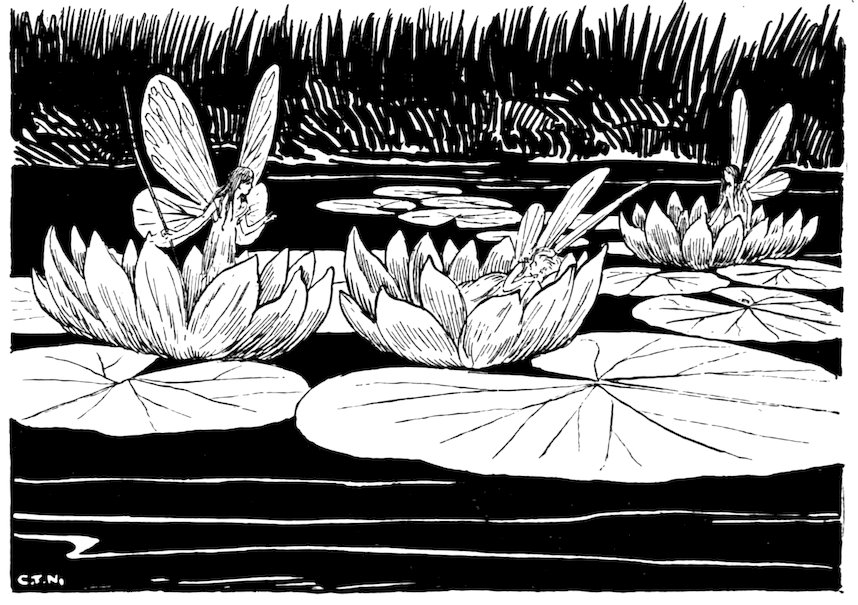
“I talked about fairies next morning to my old friend Mrs. Lumb at breakfast, just to see if she knew anything about them. She believed in them right enough, but she had never seen one. I asked her what she thought a fairy would be like if she ever did see one, and I can see her now as she sat there 96in her chair, looking out of the window munching her toast. 'Well, between you and me, my dear Tim,' she said—crunch, crunch—'I never have cared much about those little flibbety-gibbety creatures that are supposed to find a water-lily as big as we human beings find a four-post bed. And I don't believe myself that they'd pay much attention to me. I expect'—crunch, crunch—'there are not very many of them left now—not in these parts. Mr. Lumb, as you know was an entomologist. He'd have been able to tell you more about it. And he—had once seen a ghost.'”
“A ghost, Uncle Tim?”
“That's what Mrs. Lumb said, my dear. And I asked her what that was like. 'Well, it was like,' she said (and I can remember her very words), 'it was like'—crunch, crunch—'seeing something with your eyes shut. It made him feel very cold; the room grew darker, but he was not frightened.'”
Letitia sidled yet a little closer to her uncle. “Between you and me, Uncle Tim,” she said, “I think that ghost would have given me the shudders. But please let's go back to the fairy. Did you tell Mrs. Lumb about that?”
“I never breathed so much as a syllable; though, if you were to ask me why, I couldn't say. It's just like small boys, I suppose, and small girls too, eh?”
“I think I'd have told you, Uncle Tim,” said Letitia. “And what happened then?”
“Two whole days went by before I went near the field again, though I doubt if an hour went by without my thinking about it. I forgot about my bird-traps and everything else, and just loafed about wondering if perhaps all that I had seen had not been a dream or a trick of fancy. And then on the 97third afternoon, I was so ashamed of myself that I determined to go down to the field and keep watch again.
98“This time I made my way to its upper corner by the plantation where I had seen the fairy disappear. I crept down under some bushes, and had taken with me a little pocket telescope that my father had given me. Through this I could see everything that happened near Old Joe as clearly as if I was at the bottom of the field. It was later in the evening than before, and already the sun had set. But my legs and arms were cramped and my left eye tired out with being kept shut long before anything unusual occurred.
“And then suddenly I knew not only that the fairy was preparing to take her walks abroad, but that she knew also I was there. She had stolen out of her hiding-place, though I had seen no actual movement, and was openly and steadily gazing across the faint green of the sprouting wheat of the field in my direction. After a while she advanced a few paces towards the corner of the field in which I was lying hid.
“Then in a breath she hesitated; turned and sped away, just as she had done on that first evening, towards the very thorn-tree from which I had first spied out on her. And somehow the conviction that she was doing this in order to avoid coming near me awakened my curiosity more than ever, and gave me courage. She was setting her wits against mine, and I determined to try and meet her face to face. Even then, I confess, the thought of what I should do if we did so meet was not very pleasant. I lay there till it was almost dark, in the hope of seeing her come back, and then made my way to the house and crept in at a side door a good two hours after my bedtime.
99“It was a warm still evening for the time of year, and while I was undressing a full-moon began to rise. I could see it shining through my bedroom blind, for I had not lit my candle. I drew up the blind and looked out of the window, and the whole world looked as if it was enchanted. There was not a sound in the air, and though here I was in Mrs. Lumb's house, it seemed as if no human being had ever been there before. And, what is more, Letitia, the same queer feeling came over me as when I first caught sight of Old Joe, and I knew in my very bones, as they say, that the fairy was concealing herself somewhere not very far from the house, and was watching my window.”
“Oh, Uncle Tim,” said Letitia, “and did you go out?”
“No, my dear, I didn't dare. But not from fear. No; I stood steadily watching until presently a bird began to sing, a bird which I can't think was a nightingale. It was not too early in the year for nightingales, mind you; and there was a hurst or thicket near the house to which they always resorted. The song was as sweet and sorrowful, too, as theirs; but it was more shrill, more human, than a nightingale's, and there seemed to be more tune in it—more melody, you know. And a curious sadness came over me at the sound of it, and even when I got to bed it was hours before the echo of it had died away in my mind and I was able to fall asleep.
“It was just my stupidity, perhaps, to persist in persecuting the fairy. But then I had become used to persecuting birds, and perhaps I didn't quite realize that my company in her field was as disquieting as hers would be to us if she came to afternoon tea.”
“Oh, Uncle Tim, if only she would!”
“Well, Letitia,” said her uncle, “it's no good denying it: they don't. We ourselves may pine for them; but not they, 100alas, for us. She didn't want me there. Old Joe was company enough. And her own world's solitude. But I met her face to face, none the less. It was the day before I had to go home again, and two or three visits to the field had been quite in vain. I could tell by now almost at first glance at Old Joe whether she was there or not. Just as you could tell at one glance at me if I was here or not. Not just my body and bones, I mean, eyes and nose and mouth and so on, but the spirit of me which is really and truly, I hope, your Uncle Tim.”
“Yes,” said Letitia.
“This particular evening I was in just as morose and sulky a temper as a small boy can be. My legs were aching because, I suppose, the ground was damp on which I had been lying, and night after night had been so crowded with dreams that I had had little real sleep. It seemed that the fairy had deserted the field. It seemed that all my hope and longing and watching had been in vain. I scowled at Old Joe as if he were to blame. Just vanity and fretfulness. Besides, Mrs. Lumb had found out that I was creeping into the house while she was at dinner. And though she never scolded me, she had a tart tongue, and could smile at you with her handsome face and be uncommonly sarcastic at the same time.”
“There's a mistress at school, Miss Jennings, just like that,” cried Letitia. “And then ... you saw her?”
“Yes, I saw her, face to face. I was on my way back through the copse at the upper corner where two hedges met at the end of a little lane. And as I came stumping along, I suddenly went cold all over, and I really believe my cap got pushed up a little on top of my head, for certainly my hair seemed to stand up beneath it. And yet I was not really frightened. Startled, but not frightened. It was the loveliness 101of that face. I can't even tell you, Letitia, what clothes she was wearing, but, as I recall her, it was as if she were surrounded with a haze like that of wood-smoke. She was the colour of a drift of bluebells in the distance. That may or may not be, but I did see her face, for I was staring steadily into her eyes. They were blue, like the blue of flames in a wood-fire, and they were gazing at me out of a face all pale and wan, the hair on either side hanging in one long strand down to the narrow sloping shoulder.
“All else then in the world was completely forgotten. Just me, a small, uncouth human animal, looking as if into another world into those set unearthly eyes. There was no movement between us; not the least stir of recognition or reproach or apprehension on her face. But as I looked—how can I describe it, my dear?—there came a faint far-away change in her eyes. It was as if, while you were looking out to sea some summer's evening, a flight of distant sea-birds appeared in the blue and vanished. We poor mortals can smile with our eyes alone, but not like that. That was her way of smiling at me. It told me in my heart of hearts that she was not unfriendly to me, and yet that she was entreating me to trespass no more near her lair. There was what she must do in the world to consider, she was assuring me, though I hadn't then, nor have now, the least notion of what it was. And those eyes were telling me also as best she could—for she had no language she could share with my dull wits—that though she wished me no harm, all she asked me was not to keep a watch upon her, not to spy, not to intrude. And then she was gone.
“It was easy to take hiding in the evening dusk of the woods, and the copse and the hedges grew dense just there. She was 102gone, my dear, and I have never seen her since—nor her like.... But you can't call that a story,” added Uncle Tim, vigorously polishing his spectacles with his silk handkerchief and blinking at his small niece rather like an owl in the morning sun.
Letitia remained silent. “I do call it a story, Uncle Tim,” she said at last. “And oh, how I wish.... But then what about Old Joe?”
“Ah, Old Joe, the rascal! Look at him there. You see, my dear, I never forgot that evening. Years and years afterwards—I suppose I must have been then in my early twenties—I stayed a night or two with my old friend Mrs. Lumb again. She was very much older then, alas—and the first walk I took was to my field.
“Would you believe it? There was Old Joe in his customary place, though the barley-crop he was guarding that particular summer was now well above his knees. And whether I myself was changed or had gone a little blind in some respects; or whether, as I think, the fairy had long since given up her hiding-place; or whether perhaps this had always been merely her way of getting into and out of our world, I don't know. Old Joe in any case looked, well, just as he looks now, absolutely empty—forsaken, abandoned. He had brand-new old clothes on, of course, and a rare old wide-brimmed hat, green as a robin's back. And what do you think I did?”
“You didn't steal him, Uncle Tim?” whispered Letitia.
“No, Letitia; I purchased him; I bought him,” said Uncle Tim. “But 'ssh! I went to the old farmer—old Farmer Jones—and asked him how many guineas he'd take 103for his hodmadod as a curiosity. Just told him I knew Old Joe when I was a boy, and had a sentimental affection for him.
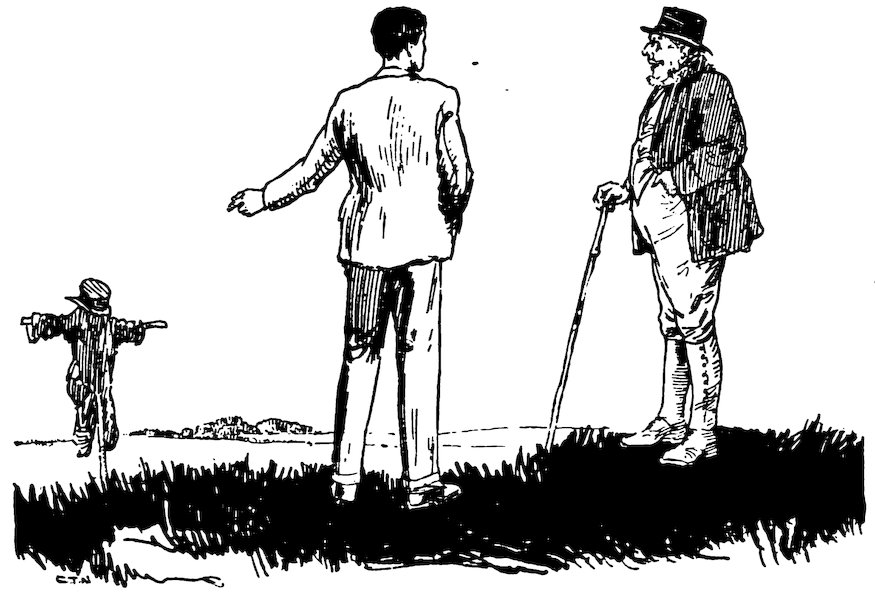
“Farmer Jones was as fat as a porpoise, with a large mulberry red face and eyes like bits of agate. He laughed at me. And what do you think he charged?”
Letitia pondered rapidly, blinking her eyes. “I suppose £5 would be a good deal, wouldn't it, Uncle Tim? Even for Old Joe. Though, of course,” she added in a slightly louder voice, in case the old creature should hear, “it would be 'strordinarily cheap, too.”
“Guess again, my dear! Nothing like £5—nothing like even tuppence. 'Give me a pipe of that plug tobacco of yours,' said the farmer, 'and he's yours for ever.'
“So mine he was; and I am glad it wasn't money.”
104
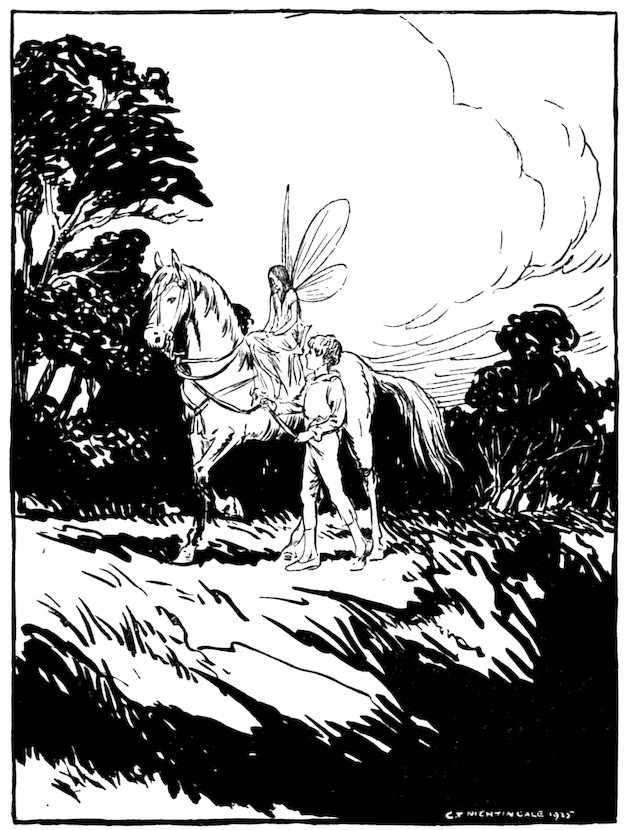
“I set her on my pacing steed....”
105“And so am I,” said Letitia. “A pipe of tobacco was much better than money. It doesn't hurt your feelings, Uncle Tim. And you never saw the fairy again?”
“In a manner of speaking,” said Uncle Tim in a rather solemn voice, “I don't think, Letitia, I have ever really seen anything else. Nothing—even in the dreams that flock into my old head nowadays—nothing ever resembles in loveliness that face, those deep-dark, unsmiling eyes. I set her on my pacing steed, and nothing else saw all day long.... You know how it goes, my child; but I dare say in your dreams....”
Letitia shook her head violently. “Oh no! Oh, how I wish,” she cried; then fell silent. “You know, I believe, Uncle Tim,” she went on in a low ruminative voice—“I believe it was almost as if you must have fallen in love with that fairy. Was it that, Uncle Tim?”
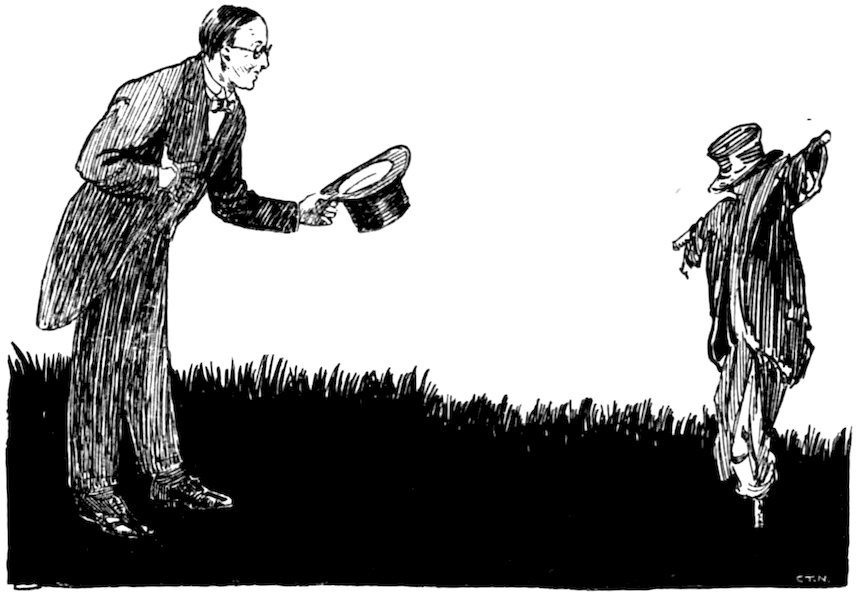
“Ah, my dear!” replied old Mr. Bolsover. “But if you don't think the long grass under the willows over there is still too wet with the night's dew, we might venture across and ask Old Joe.”
106