MABEL IN QUEER STREET By COMPTON MACKENZIE
Reading edition
“Will you walk on the pavement like a little lady, Miss Mabel, and not keep on bobbing up and down in and out of the gutter as if I hadn’t have told you thirteen times to the dozen every day of your life how to walk properly.”
Nurse was feeling very cross this morning, because the strings of her bonnet would keep blowing about, and Baby would keep throwing his rattle out of the perambulator, and Robert would keep shuffling his feet, and she had had an argument with Cook about the way Cook had burnt a milk-pudding; and her sister had written to say that she could not come to see her, after all, this week, but she hoped she’d be able to come next week, but she wasn’t sure, and she couldn’t come the week after, what’s more, because the family was going down into the country.
Mabel made matters worse by being argumentative:
“Well, a dozen is the same as twelve, Nannie,” she pointed out, “so I don’t think you could have told me thirteen times to twelve.”
“Will you not be so argumentative, Miss Mabel! I’m sure, ever since you won that blessed prize for writing a letter to that blessed paper there’s been no doing anything with you, such a dictatorial, domineering, proctorising little girl as it’s made you.”
112
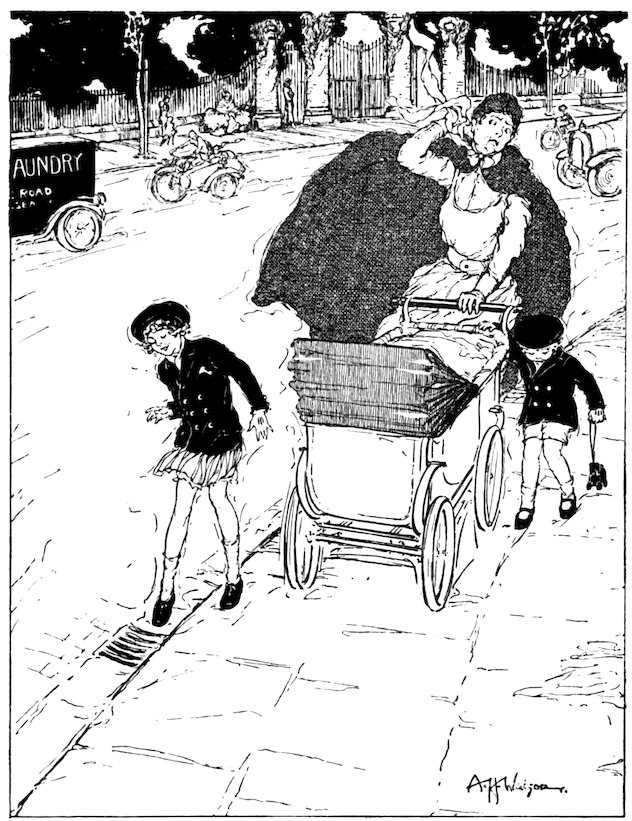
“Will you walk on the pavement!”
113But Mabel liked to be called all these long words. It made her feel years older and yards taller to be so many long words that she didn’t know how to spell, and was pretty sure Nannie didn’t know how to spell either; because she had asked her once how to spell “dictatorial” and Nannie had said, “Hush, what’s that?” which was what she always said when she didn’t want to answer an uncomfortable question.
“Well, you couldn’t,” Mabel obstinately repeated.
“Now, that’s quite enough, Miss! One more word from you and straight up to bed you go the very moment we get home.”
Mabel was bursting to say that she couldn’t go straight up to bed, because she had to turn round and walk along two landings before she could reach her bedroom. However, Nannie was in such an unpleasant humour that she held her tongue. To tell the truth, before coming out this afternoon, Mabel had caught a glimpse in the pantry of a particularly pleasant-looking pink cake, which was likely to appear at tea, but most unlikely to appear in her bedroom.
“What’s the harm in hopping up and down from the gutter?” she asked.
“Why, before you know where you are, you’ll be getting your foot stuck in a drain, and there you’ll be till doomsday, and that’ll be a nice state of affairs.”
114
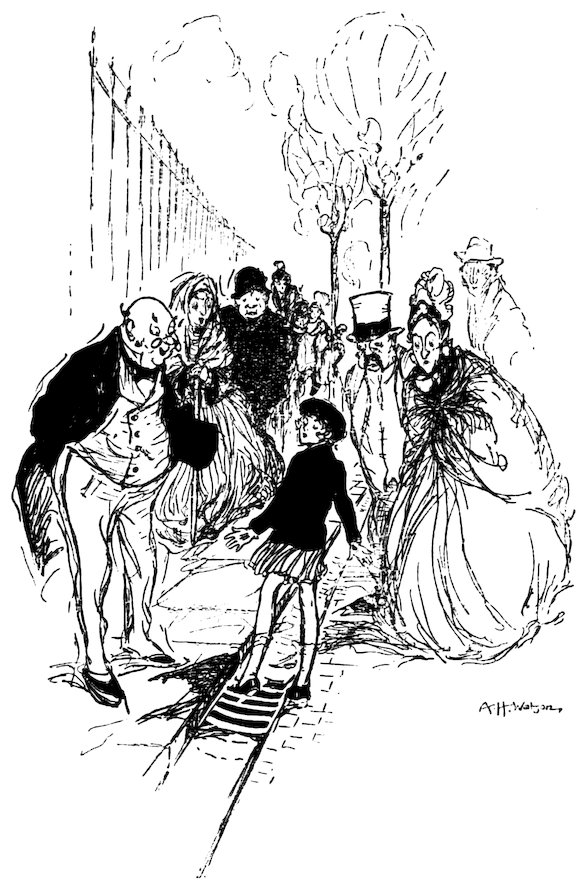
A big crowd would collect.
As a matter of fact, it would be rather nice, Mabel thought; and she walked along, imagining what a big crowd would collect to watch a little girl with her foot stuck in a drain till doomsday, and making up in her head all sorts of remarks that the people would be saying about her when they saw her plight. By this time they had reached the place where they 115always crossed the road to go into Kensington Gardens. Robert was picked up and plumped down into the perambulator opposite Baby; and when Nurse had looked first to the right and then to the left, and then behind her, and then in front of her, she called out in a voice trembling with excitement, “Come along now and mind how you step or we shall all be run over.” Mabel was always thrilled by this crossing. It made her think of the “Charge of the Light Brigade” which the Vicar had read aloud last Christmas at the children’s party in the Parish Hall, and which she had read lots of times since to herself.
“Half-a-league! Half-a-league! Half-a-league onward,” Mabel murmured as they swept on toward the greenness and the safety of the Gardens.
“Don’t chatter,” Nurse snapped, panting on across the wide road while a most enormous policeman held up the traffic for them.
“Suppose he fell right down dead at this moment?” Mabel asked herself. “Then all the buses would come charging on, and there’d be nothing left of the pram, or of Baby, or of Nannie, or of Robert, or of me.”
“Will you not dawdle, you bad girl!” Nurse was gasping irritably. And just then with a bump the perambulator landed safely on the opposite pavement.
“Charge for the guns, Nolan said,” Mabel dreamily murmured.
“What are you muttering to yourself now?” Nurse asked.
“Poetry,” Mabel replied loftily. Then she returned to the subject of the gutter. “But suppose I didn’t hop up and down, Nannie?” she asked. “Suppose I just walked all the 116time in the gutter and didn’t ever walk on the pavement at all? What would happen then?”
“What would happen then? Why, you’d precious soon find yourself in Queer Street,” Nurse told her. But before Mabel had time to ask any more questions about Queer Street Nannie’s attention was occupied by Robert, who had put in his mouth a broken piece of shell that he had picked up from the path.
“You dare do such a thing ever again, you naughty boy,” she exclaimed, “and in the pram you’ll stay for the rest of the afternoon.”
Robert scowled; but he spat out the piece of shell, and he did nothing more that was naughty until he began to stroke the tyres of the perambulator-wheels.
Mabel gazed longingly at some little ragged children who were climbing up the railings beside the path and jumping off them, and balancing themselves on the top of them, and rolling over and over in the grass on the other side.
“Do those children live in Queer Street?” she asked.
“They live anywhere,” said Nurse. “And if I’ve told you once, Miss Mabel, not to turn round and stare after common children I’ve told you twenty times.”
Mabel yawned.
“Well, will you tell me a story, Nannie?”
“I’ll tell you a story about good Queen Victoria when she was a little girl and lived in Kensington Palace.”
Mabel yawned again.
“If you’ve told me that story once, you’ve told me twenty times,” she ventured to say.
117
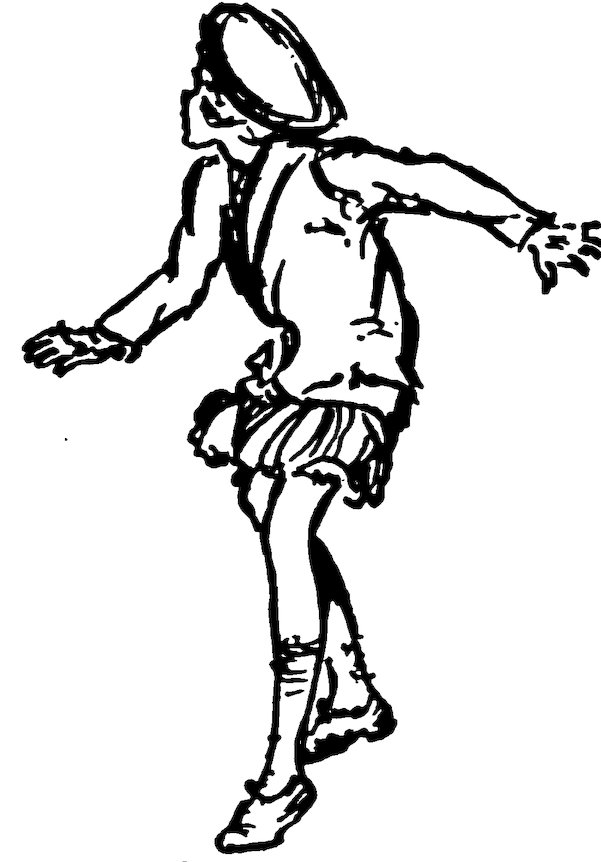
Mabel had an idea that she was being rather rude in thus mimicking Nannie’s way of talking; but she was really astonished to find quite how angry it did make her. Nannie’s face turned such a bright purple that Mabel backed away from her in alarm, because she thought that she was going to be picked up as Robert was picked up and plumped down in the perambulator opposite Baby. And that would have been a most terrible disgrace. Luckily at that moment two large dogs began to fight close by. Nurse who was always afraid of dogs picked up Robert instead and, turning the perambulator quickly round, hurried away from the noise and confusion.
Mabel never knew just how it happened, but all of a sudden she was lost.
The last thing she remembered was hurrying after Nannie away from the confusion and crashing into a lot of other people that were running towards it. And then, when all was quiet again she found herself standing in the middle of the Broad Walk completely alone. Her heart began to beat very fast, and an uneasy lump came into her throat and she found that she was making a strange little noise that wasn’t exactly crying, but was rather like it. She twirled round and round in despair; but Nurse and Robert and Baby and the perambulator had utterly vanished. Crowds of most enormous trees stared down at her until she felt smaller and smaller and more and more frightened. Crowds of strange nurses and crowds of strange children went walking past. And then she saw coming towards her a KEEPER.
118“A keeper,” she whispered in horror. Oh, where could Nurse have gone? A KEEPER!
She turned and fled.
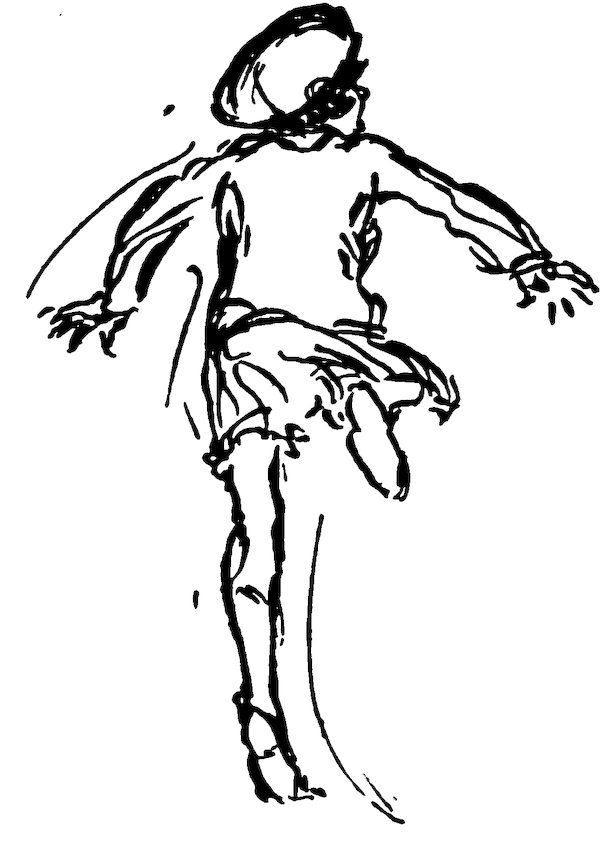
Now, of course, if Mabel had been a sensible little girl, she would have waited for the keeper and told him that she was lost. Unfortunately she had often been so naughty during walks in Kensington Gardens that Nannie had threatened her more than once that, if she could not behave herself better, the keeper would come and lock her up in his little green house. She had no reason to believe that the keeper was not a savage and brutal man, because several times she had heard him shout in a very loud and angry voice at boys who were misbehaving themselves. She had seen him shake his stick, and once she had actually dared to peep into his little green house and had seen inside it a live baby. Ugh!
My goodness, how fast Mabel did run, and when she stopped running she was more lost than ever. At least, that was the way she felt she ought to feel, though as a matter of fact, after she had got over her first fright she found that she had reached one of the gates of the Gardens and began to say to herself that if the worst did come to the worst she could find her way home alone.
“My name is Mabel Evangeline Marjorie Deane, and I live at Forty-three Cherrington Gardens, and my father is Doctor Deane, and I’m seven and a half years old.”
119It sounded extremely grand when she repeated all that quickly over to herself.
“And it wasn’t my fault,” she went on, “it was Nannie who ran away from the dogs. It wasn’t me who ran away from Nannie.”
While she was trying to make up her mind to take the plunge out of the quiet green Gardens and set out home along the noisy street, a ragged boy came by, playing a tune on a penny whistle. Naturally, Mabel took advantage of being lost to stare at him as hard as she could. The ragged boy did not appear to pay much attention to her; but when he had passed her he turned right round and came marching by again, still playing his jolly tune. This time he did look at her and deliberately winked one of his blue eyes. Mabel turned rather pink and felt inclined to rush off. She had never in all her life been able to stare long enough at a ragged boy to be winked at, and really she did not quite know what she ought to do. Perhaps if she had been able to wink well she might have winked back; but Uncle Tom had laughed at her so much the last time she had tried to wink for his benefit that Mabel had decided to be content with being able to make a noise like a cork by putting her forefinger in her cheek and letting it go with a pop. Uncle Tom had told her that she did this splendidly. So, while the ragged boy walked up and down before her, whistling and winking, Mabel could only stand still and look pink and uncomfortable.
“What’s the matter, kid?” said the ragged boy at last. “Lost your mammy?”
“No, she’s at home; but I’ve lost my nurse.”
The ragged boy went off into another tune that made his listener want to go dancing along beside him anywhere he chose to play her on.
120“What are you going to do about it, kid?”
“Well, I’m going to walk home by myself,” Mabel announced.
The ragged boy piped a long trill on his whistle that seemed to say better than any words could have done how very much astonished he was to hear this.
“Ain’t you afraid the copper’ll nab you?” he asked.
Mabel, who had never before heard a policeman called a copper and had not the least idea what “nab” meant, but had no intention of admitting to a ragged boy that she could be frightened of anything, shook her head.
“Coo! You’re a plucky kid. I’ll walk along with you a bit of the way if you like. My name’s Bill Hawkins. Only mostly they calls me Piping Billie.”
Mabel hesitated a moment before she accepted this offer. She was really most anxious to enjoy the ragged boy’s company, but she felt rather afraid of meeting any of her little girl friends in case they should fancy that he was a relation of hers. It would be terrible if it went round the dolls’ tea-parties of Kensington that Mabel Evangeline Marjorie Deane had such a very ragged relation. Still, there was that crossing to be managed, and she did not feel quite so much as if she was riding at the head of the Light Brigade, now that she might have to cross the road all by herself.
“You can come with me to the pavement over there, if you like,” she told him.
121
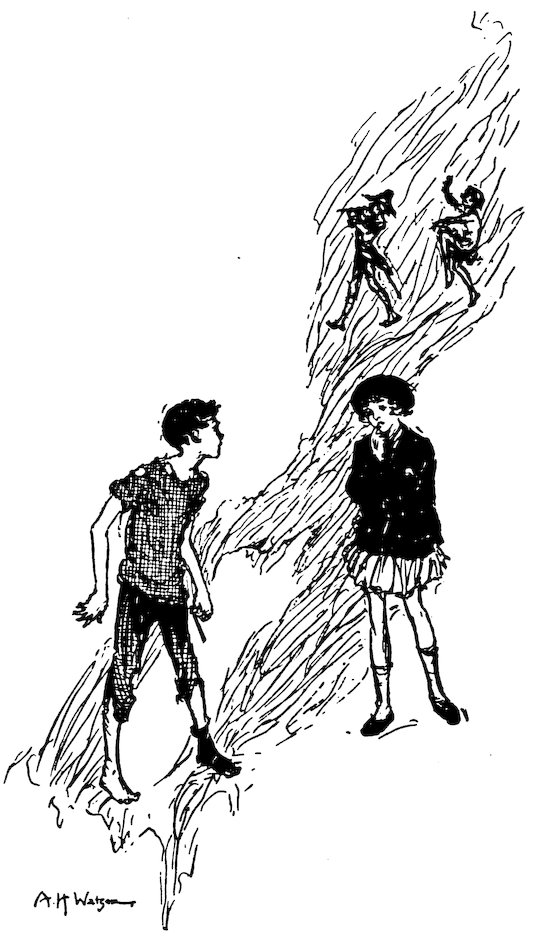
... a red coat and cocked hat.
The ragged boy struck up the jolliest tune that she had ever heard and led the way. Mabel wondered if the policeman who was holding back the great grumbling buses and the irritable taxis supposed that she was a princess. It was a 122pity that Bill Hawkins was not wearing a red coat and a cocked hat and white gaiters. She wished that next Christmas she could have enough money in her money-box to buy him such a dress. If she could, she would ask if she might not keep him always to march before her and play these jolly tunes. Where would he sleep, though? There were only two spare-rooms, and they were nearly always full of uncles and aunts. To be sure, as he was dressed at present, he might easily sleep in the coal-cellar; but if he ever had that lovely uniform he could hardly sleep there. The larder was too small, and besides he might get smeared with bacon fat. The pantry would do, if Mary didn’t mind. But Mary was a bit fussy about her china, as she called it. Why shouldn’t he sleep outside her own little room? No need then to be afraid of fire, or of witches, or of burglars, or of cats, or even of murderers.
Mabel walked on toward Cherrington Gardens, dreaming away to the tunes that Bill Hawkins was piping on his whistle. Once she nearly grazed her forehead on an old gentleman’s watch-chain, and once she had to take a step to the right and then a step to the left and then another to the right and then another to the left, while a lady in a great hurry coming from the other direction did just the opposite until at last she and Mabel discovered that if both of them stepped to the right at the same time they could pass each other quite easily. Apart from these two small accidents Mabel threaded her way along the busy pavements as easily as if there was nobody in all the world except herself and the ragged boy. She did not want to talk to him. Just to walk along behind his playing was as good as the most interesting talk that was ever known. Once he stopped for a moment and asked Mabel where she 123lived, and when she told him he nodded his head and started to play Cherry Ripe.
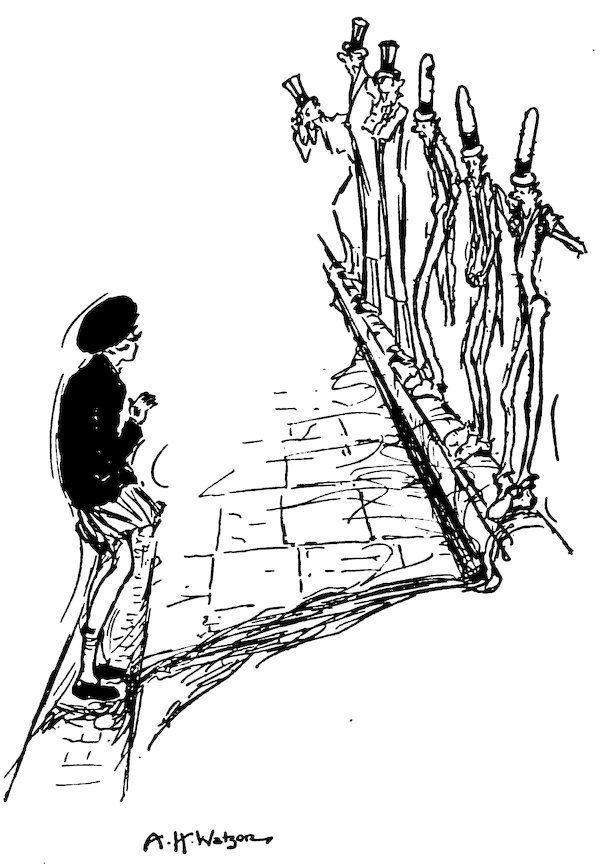
The pavements were not so crowded now that they had passed the big shops, and presently they turned off the main road into an old-fashioned square. Mabel found that she was once more beginning to hop up and down from the gutter as she walked along. And then she began to take two steps in the gutter for one she took on the pavement. And then she began to take only one step on the pavement for half-a-dozen in the gutter. And then Bill Hawkins began to play a jollier tune than any he had yet played so far. And then Mabel forgot to step back on the pavement at all, but went walking along all the time in the gutter. And then the most extraordinary thing happened, because she suddenly heard a tremendous argument going on, and when she looked up to see who it was she saw that all the railings of the square were quarrelling with each other.
“I don’t care,” one rusty old railing was saying to another very smart railing who had just been painted a rich peacock blue, “beauty’s only paint deep, and if you rail at me I’ll rail at you.”
“Old iron! Old iron!” retorted the painted railing. “Don’t you speak in that ironical tone of voice to me.”
Mabel didn’t at all like the voices of these quarrelsome railings, which grated on her ears horribly.
“Don’t you stare at me, little girl,” one of them creaked.
“Pooh!” said Mabel. “You want a good oiling, you disagreeable, rusty old thing.”
At this the railings turned palings, and Mabel wondered if railings objected to being given oil as much as she objected 124to being given castor-oil when she would go on being naughty. But she had no time to go into this question, because she suddenly realized that she was once more quite alone. She began to wish that she had not spoken so rudely to the railings, and she crossed the road to the side of the Square where the houses lived. But now another extraordinary thing happened. When she tried to step up on the opposite pavement her foot at once came back into the gutter. She tried jumping on it with both feet, but the pavement might have been made of indiarubber the way she bounded off again back into the gutter.
“Oh, well,” said Mabel aloud, trying to appear calm. “I may as well be phisolophical.”
This was what her mother said when Mary came in to tell her that the cat had broken one of the best glasses. Mabel had practised the word in bed, but this was the 125first time she had ventured to say it right out in broad daylight.
“If I can’t walk on the pavement, I’ll just have to walk in the gutter,” she went on.
And then she gave her shoulders a most tremendous shrug. After all, there was something to be said for being lost. At any rate, you could shrug your shoulders without being lectured for doing so.
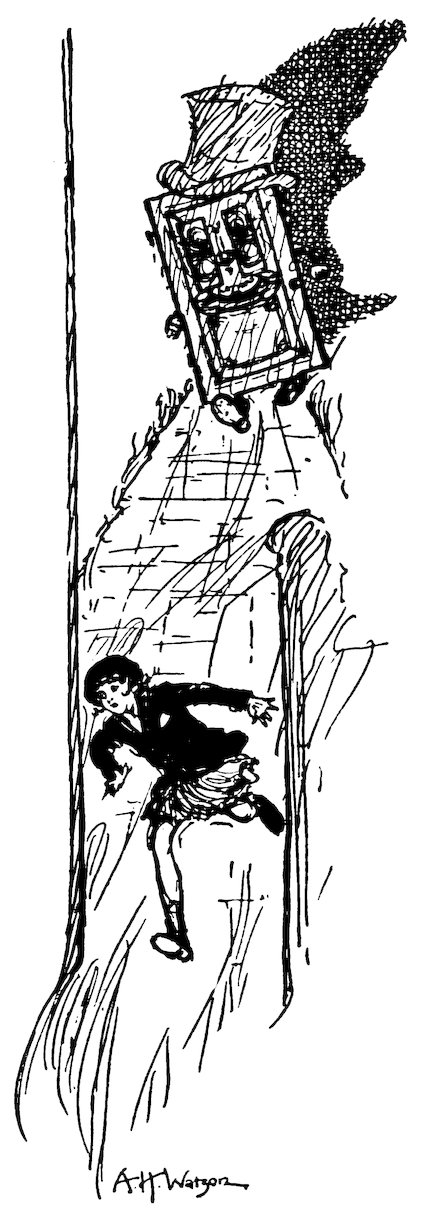
Mabel walked on in the direction of Cherrington Gardens, hoping every moment to hear the sound of Billie Hawkins’ piping. In spite of her philosophical shrugs she was beginning to feel just a little bit uneasy. Somehow or other the square did not look the same as usual, and when she saw one of the front-doors suddenly leave its hinges and come walking down the little front garden, its letter-box stretched in a wide grin, and wave its handle at her, she started to run. But the faster she ran, the faster the door bolted after her, and if Mabel had not found a funny little passage too narrow for the door to follow her it would soon have caught her.
126“Slam!” the door ejaculated angrily, when it perceived that Mabel had escaped.
Mabel, however, did not stop to listen to its exclamations of baffled rage, but hurried along the narrow passage until she came out in a street that she had never seen before in all her walks, and looking up to find out what its name was, she saw a huge pointed finger write QUEER STREET on a signpost.
And it certainly was.
All the houses were a different colour and they had the most extraordinary shapes; but Mabel could not see anybody about who might tell her how to reach Cherrington Gardens and when she got to the other end of Queer Street she found that there was no way out and that a bright red house as round and nearly as tall as a lighthouse took up all the space. Mabel did not feel at all inclined to venture back by the small passage down which she had run to escape from the door. However, when she found that she could not get out of Queer Street at the far end she went back cautiously to see if she could somehow muster up enough courage to discover if the door was still hanging about. But things were getting queerer every minute. The passage was gone now. There was nothing but an immense blank wall on which was written in gigantic letters: NO ADMITTANCE EXCEPT ON OMNIBUSINESSES.
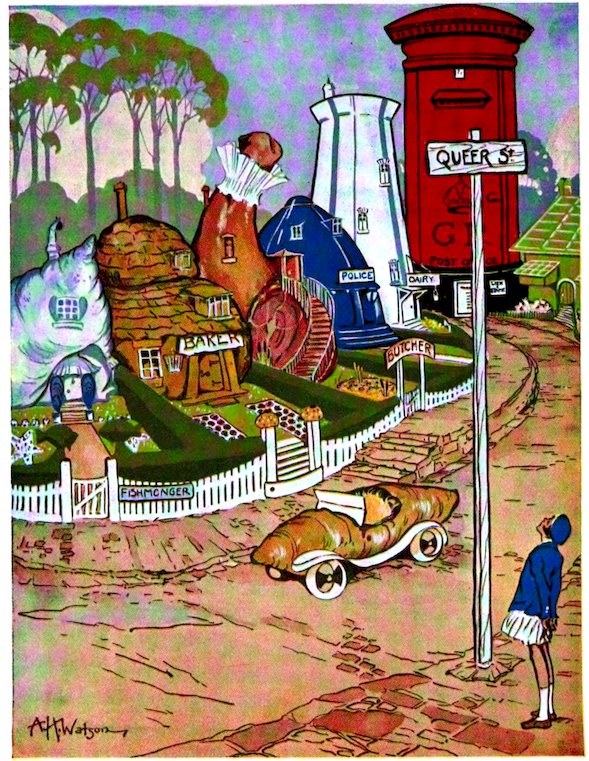
Mabel really was frightened now. There was nobody to be seen at any of the windows of these strange-coloured houses, and she simply did not know what to do next. It had sounded rather exciting when Nannie had told her that she would one day find herself in Queer Street. Now that she really was in Queer Street it was horrid. At last she collected enough courage to make up her mind to ring the bell of one of the houses and, if anybody answered it, to ask the way out of 127Queer Street. She finally decided to try the tall red house, which at first she had thought was rather like a lighthouse, but which now that she examined it more closely was apparently an enormous pillar-box. The door was painted white and covered with sums. There was only one window that she could see; and that was very high up and shaped like the hole up to which she used often to be lifted to post the letters when she was quite a little girl. Mabel could not find any sign of a bell or a knocker, but after she had walked round the red house several times she found a white plate on which was printed LICK AND STAMP.
“Yes, but what am I to lick?” Mabel asked herself.
“The licker’s broken,” came a gruff voice from what seemed miles above, where she was standing. Mabel stepped back to look up and see who it was speaking; but she had only just time to catch sight of a head disappearing inside as the flap of the window shut with a clang.
“Bother!” Mabel exclaimed.
She wasn’t allowed to say “bother” at home, but being in Queer Street she did not care how much she let herself go. No sooner had she stepped back to the door than the gruff voice was heard again from above.
“As the licker’s broken, half a stamp will bring an answer.”
“But I haven’t got a stamp,” Mabel shouted.
“You’ve got feet, haven’t you?” the gruff voice called down.
Once more Mabel stepped back to try to catch sight of the owner; but once more the flap of the window dropped with a clang.
128“You’ve got feet, haven’t you,” the gruff voice repeated when Mabel was once more outside the door.
“Yes, I’ve got feet.”
“Then you’ve got a stamp. And if you’ve got a stamp you’ve got half a stamp.”
“Do you mean I ought to stamp with one foot?” Mabel shouted.
“Certainly not. That’s a whole stamp. Of course, if you like to waste shoe-leather you can use a whole stamp, but you won’t get the answer any quicker if you do. You may just as well stamp with the sole only. Don’t bother about putting on your gum-boots.”
Mabel was anxious to get an answer as soon as possible, so she stamped as hard as she could. Whereupon the door flew back and she saw standing in the entrance behind a cage, a lump of wood dressed in dark blue and wearing a cap peaked in front and behind.
“Yes, good-morning. I’m the Postman. What can I do for you?”
“I want to find the way home to Cherrington Gardens, please,” said Mabel very politely.
“You’ll have to address yourself first,” the Postman snapped.
“But how can I address myself?”
“You can dress yourself, can’t you?”
“Well, nearly everything,” said Mabel. “Only, my nurse helps me with my frock.”
“You can undress yourself, can’t you?”
“Oh, yes,” said Mabel eagerly. “At least I can if Nurse undoes the buttons at the back and if there aren’t any knots.”
129
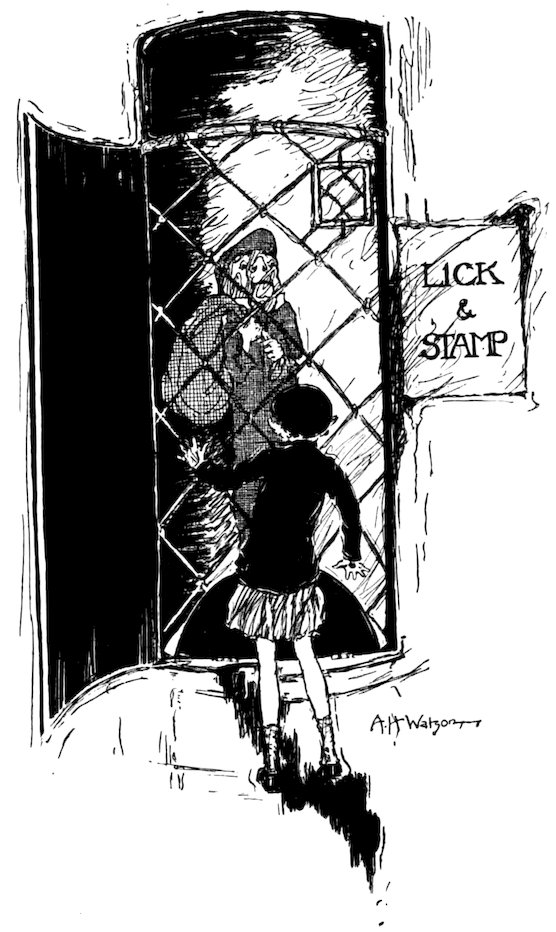
“Good-morning. I’m the Postman....”
130She rather wished that she had kept off the subject of knots, because the Postman’s face was full of them. However, he did not seem to mind the allusion.
“Then you ought to be able to address yourself,” he told her severely. “Addressing is twice as easy as dressing or undressing. Can you undress an envelope?”
“No, I don’t think I could.”
“Can you dress an envelope?”
“No, I’m sure I couldn’t.”
“You can address one, can’t you?”
“Yes, if the lines are ruled,” Mabel said.
“There you are,” the Postman cried triumphantly. “So the sooner you set about addressing yourself the sooner you’ll get home. In fact, if you can address yourself in another minute, you’ll get home by the first delivery to-morrow morning.”
“But where shall I be all night?” Mabel gasped.
“You’ll be addressed and put to bed.”
“Yes, but where?” Mabel persisted.
“In my pillow-box.”
“But I thought it was a pillar-box.”
“It’s a pillar-box by day, stupid, but by night it’s a pillow-box, of course. Why, I knew that long before I was your age. I knew that when I was quite a twig. There’s only one thing you want to look out for. Sleep well up in the corner of the pillow-box, otherwise you’ll be getting woken up all the time by parcels coming back late and tumbling down on top of you.”
“Yes, but Mother will be anxious if I don’t come home all night,” said Mabel, who didn’t at all relish the idea of 131going to bed with a lot of parcels. “Couldn’t you tell me the way to walk home?”
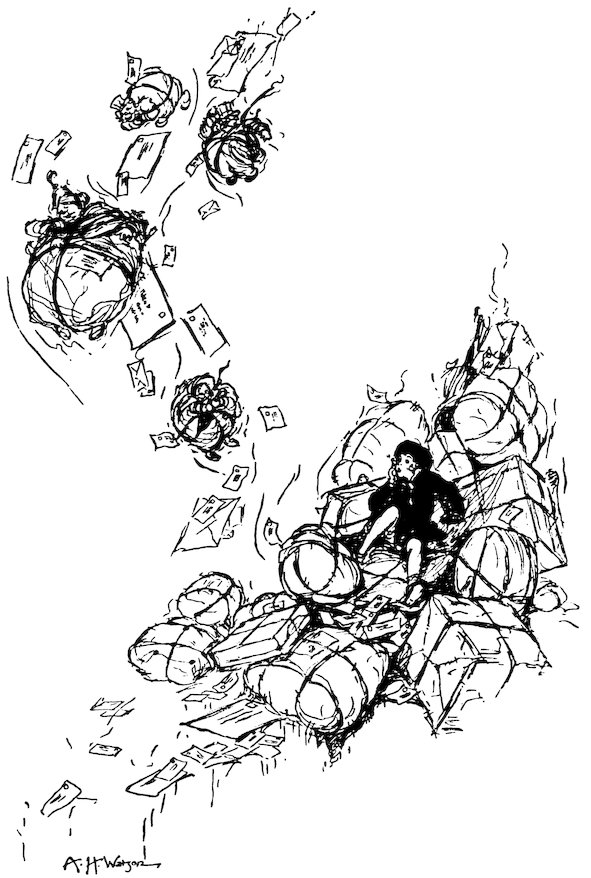
“... parcels tumbling down.”
132The Postman shook his wooden head so vigorously that his neck squeaked.
“Well, I think I’ll ask at another house first if you don’t mind, because really Mother will be terribly anxious....”
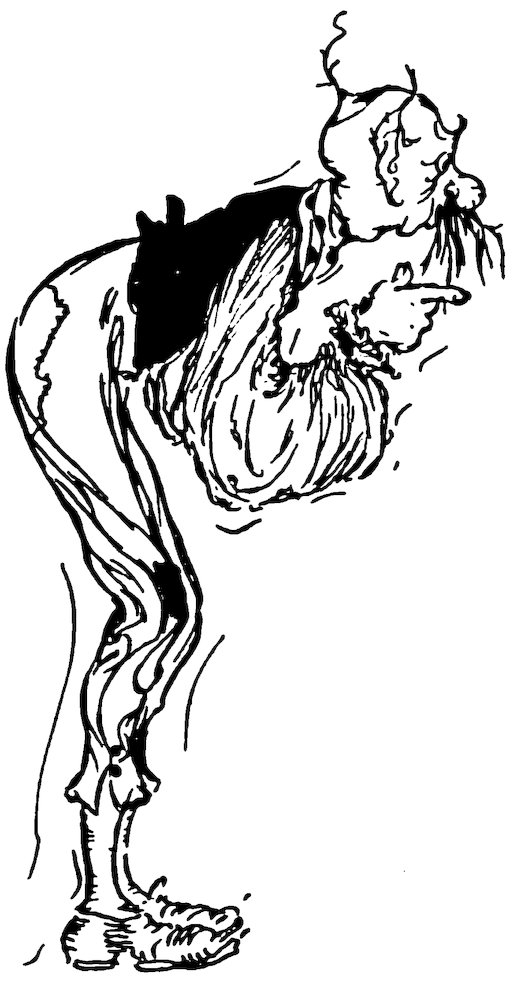
But Mabel need not have bothered herself about being polite, for the Postman shut the door abruptly and vanished.
A moment afterwards she heard his gruff voice again from above:
“This was a letter-box,” he called down angrily. “But since you won’t be sensible, as far as you’re concerned, in future it’s a don’t-letter-box.”
Mabel turned round and decided to try another house. She chose a green one. This was much more like an ordinary house than the Postman’s, and, indeed, except that it was green all over and that the windows were like cucumber-frames it might not have been situated in Queer Street. She rang the bell, and presently the door was opened by a bulbous-nosed man in a mouldy suit with lawn sleeves, and an apron of green bays. There was only one thing that was very queer about him which was that he had a grass moustache.
“Please, could you tell me the way to Cherrington Gardens?” Mabel asked.
133“I could,” said the Greengrocer, for that was who it was, of course.
“Oh, thank you!” Mabel exclaimed.
“But it’s a very heavy weigh from here. It’s a good three pecks, and perhaps a pint or two over. You take the second turnip to the right and the first turnip to the left beyond that, and then if you’re lucky you’ll find a taxi-cabbage or a motor-carrot to lift you the rest of the weigh. It’ll be quite a nice little spinach for you.”
“But, please....” Mabel began.
“Do you mean ‘peas’?” the Greengrocer interrupted.
“Well, I didn’t exactly,” said Mabel.
The Greengrocer shook his head.
“Politeness weighs nothing, you know,” he said severely. “Didn’t your nurse ever tell you that?”
“But I did say ‘please.’”
“You ought to have said ‘peas.’”
Mabel thought she would be wise to humour him.
“Peas, Mr. Greengrocer....” she began again.
“Do you mean ‘peas, Mr. Greengrow, sir?’”
Poor Mabel was getting so fussed by all these interruptions that she could have cried.
“Peas, Mr. Greengrow, sir, I can’t find any turnings—I mean turnips—anywhere.”
“Well, of course, if you can’t find them, you can’t take them, can you?”
“No, I couldn’t, could I?”
“And that’s that?”
She nodded her head dolefully.
134“Well, we all have our disappointments,” said the Greengrocer. “I’ve tried for years to find a future for beans. But there isn’t one. So there it is, and we’ll leave it at that.”
With which the Greengrocer retired into his house and shut the door in Mabel’s face. She waited for a moment or two outside in the hope that he would come out again; but a shower of brussels-sprouts came tumbling down on her from one of the upper windows and drove her away from the green-house.
Once more Mabel walked up and down Queer Street trying to find a way out. But the great blank wall was still there, and she began to think that she should have to spend all the rest of her life looking vainly at these strange-coloured houses. The tears rolled down poor Mabel’s pink cheeks, and there’s no knowing how much she would have cried if she had not discovered that she had lost her pocket-handkerchief. So she even had to stop crying, which made her feel terribly sad. At last, after another long examination of the various houses, she decided to try a white house with a zinc door and curious glass windows which instead of having curtains were half full of milk. When Mabel rang the bell she heard the most tremendous jangling you can imagine, such a jangling that she was afraid she had broken something inside, and she was just going to turn round and run away when the door was opened by a very tall, thin man in a long white coat and a face that looked exactly as if it was made of cheese, which in fact it was.
“Please, I can’t....” Mabel began.
“My business is ‘cans,’” he sang. “I’ve nothing to do with ‘can’ts.’ And just mind where you’re treading. You’re trampling down all my buttercups and dairies.”
135“I beg your pardon,” said Mabel, moving quickly to one side.
“You can borrow my pardon,” sang the Milkman. “Or if you’re quick enough you can steal my pardon. But don’t start begging it, if you don’t want the Policeman in the blue house next door to jug you on the spot.”
“Please, can you tell me the way out of Queer Street?”
“Which way? The milky way, the buttery way, or the curds and way?”
“Oh, any way,” Mabel sighed in desperation.
“Then you’d better take the buttery one. You can slip out more easily that way,” he sang in a very high voice.
“Well, which is the way to the buttery way?”
“Take the first churning to the left or the first churning to the right, whichever you cheese. Then skim the ground and tell the first person you meet the cream of the joke.”
“Yes, but supposing I don’t meet anybody?” poor Mabel asked.
“Why, if it’s a question of meat, you’d better enquire from the Butcher who lives at the flesh-coloured house two doors down. You can’t mistake it. The garden is full of cowslips, bullrushes, and ox-eyed daisies. But mind he doesn’t chop you up when he’s chopping them down.”
The zinc door closed behind him with a rattle and jangle.
“Well, wherever I ask,” Mabel decided, “I won’t ask the Butcher anything. Or the Policeman either.”
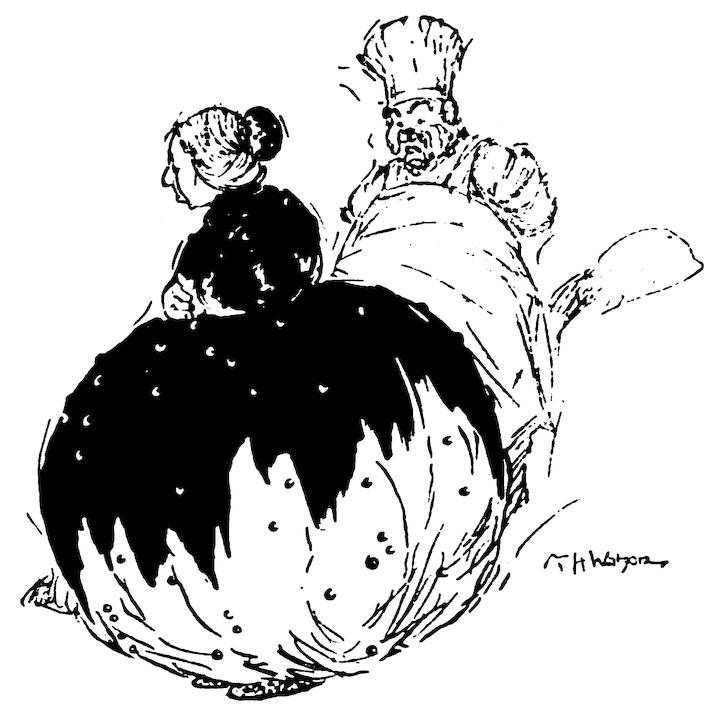
Accordingly, she walked past the flesh-coloured house and the blue house without lingering for a moment. The next house was a brown one shaped like a cottage loaf. There was 136a breakfast Rolls-Royce car outside the gate, which was much more like a fender than a gate. Mabel was on the point of asking at the oven-door if the car could drive her home when the oven-door opened and a woman with her hair done in a hot cross bun puffed out, followed by such a terribly crusty old man that Mabel was afraid to make any enquiries here, and determined to give the Baker and his wife as wide a berth as the Butcher and the Policeman. The next house she came to was the silver house of the Fishmonger. He was leaning over his gate, and as he looked fairly pleasant Mabel asked him to tell her the way out of Queer Street.
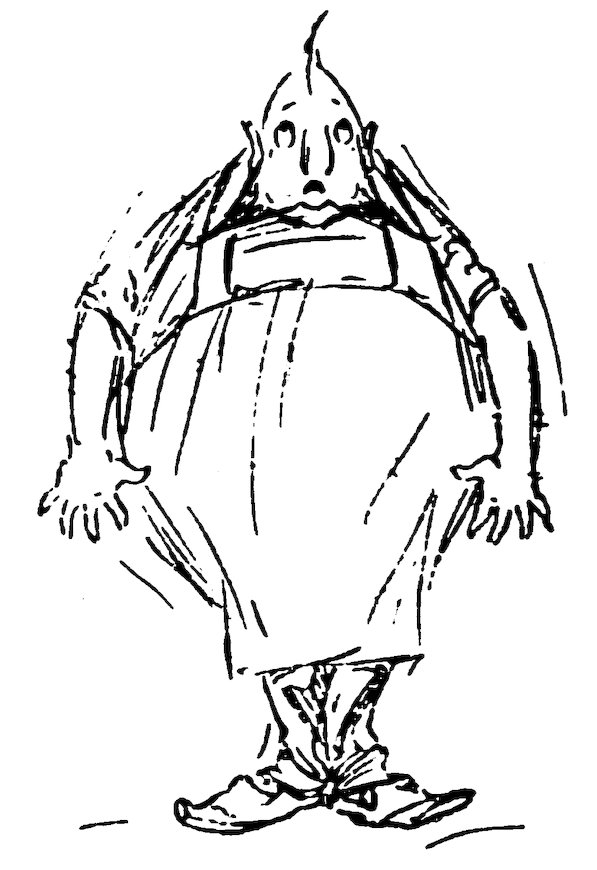
“You might row out,” he suggested in a strange gurgling kind of a voice like water running out of a bath. “But it’s not at all a soft row, you know. Oh no, it’s a very hard row. Yes, Queer Street is a very fishy plaice to row out of.”
“But couldn’t I walk out?”
“Oh, you could. But you’ll wear out your soles and your eels long before you 137walk out of Queer Street. Take my advice, young lady, for I wouldn’t cod you, and trust to boats not boots if you want to get out of Queer Street. Still, if you insist on walking, why, take the first turbot to the right, and the second turbot to the....”
But Mabel put her hands up to her ears and ran away.
“I think all these people must be mad,” she said to herself. “Oh dear, I wish I hadn’t ever walked in the gutter. Nannie always says so many things that don’t come true, but this did come true.”
While Mabel was talking to herself, she suddenly became aware that it was growing dark, and just as she settled to risk being jugged (whatever that might mean) by the Policeman for begging the Greengrocer’s pardon and ask him to take her home, she heard close behind her a horrible voice that sounded like somebody being sick. A moment later she was popped into a large black bag, swung up in the air, and carried off.
“Help! Help!” Mabel shrieked, but the louder she shrieked the more her mouth was filled with some kind of dust. And then she turned perfectly black with fright, for she suddenly realized that it must be the Sweep who had caught her up like this and popped her in his bag. She was on the point of fainting right away, when she was hauled out of the bag by the scruff of the neck and found herself (at least, she didn’t exactly find herself because it was too dark to find anything) in a black room.
“So you want to find your way home, do you?” the horrible voice demanded.
“Yes, please, Mr. Sweep,” she whispered.
138“Then up the chimney you’ll go,” the voice whooped.
“Oh, please, I’d rather not go up a chimney,” Mabel screamed.
“Up the chimney you’ll go,” the voice whooped. “We don’t want inquisitive little girls like you in Queer Street.”
“I won’t ever be inquisitive again, Mr. Sweep, if only you’ll show me another way home.”
But it was no use for Mabel to beg for mercy. She felt a pair of bony arms seize her and gasping for breath she found herself being pushed further and further up the chimney by a long pole. Up and up she was pushed, and the further up she got the narrower the chimney became, and then just as she felt she simply must burst she heard the sound of Billie Hawkins’ whistle. The sound seemed to be tumbling down on her like delicious drops of water and looking up she found herself lying on the grass under a great big tree. There was Nannie bending over her with a cup in her hand, and beyond her a little ragged boy was playing a penny whistle, and beyond him a lot of other little ragged boys and girls were staring at her.
“Why ever don’t you look where you’re going?” Nannie was saying. “You gave me a terrible turn when you bumped into that tree and knocked yourself insensible for I don’t know how long.”
“I’m sorry I gave you such a terrible turbot, Nannie, I mean turnip, Nannie.”
“Pore little mite, she’s still feeling queer,” a woman in the crowd said.
“Oh, shan’t I ever get out of Queer Street?” Mabel cried, bursting into tears.
139
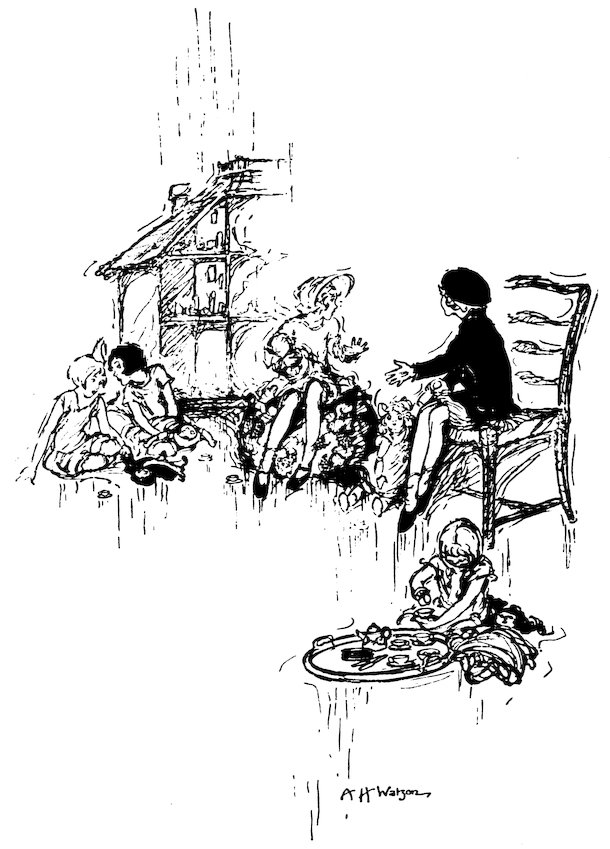
The dolls’ tea-parties in Kensington.
140“Why, you silly girl, you’re in Kensington Gardens.”
“Was I quite insensible, Nannie?” she asked.
And I really can’t tell you how proud Mabel was of having been knocked insensible and how jealous all her little girl friends were when Mabel used to boast at the dolls’ tea-parties in Kensington about her exciting adventures in Queer Street.
141