THE LUSITANIA’S “GUNS”
Reading edition
In a Washington dispatch of June 2, 1915, to The New York Times, the following report appeared:
In his conversation with President Wilson today the German Ambassador said that he had obtained evidence through means of affidavits that the Lusitania was an armed vessel, as asserted by the German Government. The affidavits to which Count von Bernstorff referred have been placed in possession of the State Department, which has turned them over to the Department of Justice for an investigation as to the statements sworn to and the character of the individuals making them.
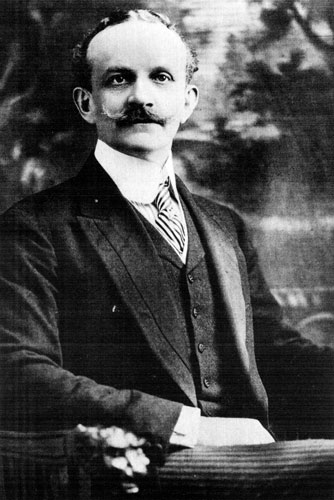
HIS EXCELLENCY COUNT JOHANN VON BERNSTORFF German Ambassador to the United States
One of the affidavits is made by Gustav Stahl of 20 Leroy Street, New York City. He says:
On the day prior to the sailing of the Lusitania, I was asked by my friend, A. Lietch, who was employed as first cabin steward, to help him to bring his trunk aboard. In the course of the evening we went on board, without being hindered by the quartermaster on guard. After having remained some time in the "gloria," (steward's quarters,) we went to the stern main deck. About fifteen to eighteen feet from the entrance to the "gloria," on port and starboard, respectively, I saw two guns of twelve to fifteen centimeters. They were covered with leather, but the barrel was distinctly to be seen. To satisfy my curiosity I unfastened the buckles to ascertain the calibre of the guns. I could also ascertain that the guns were mounted on deck on wooden blocks. The guns were placed about three feet from the respective ship sides and the wall could be removed at that particular place.
On the foredeck there were also two guns of the same calibre and covered in the same manner. They were placed at about fifteen to twenty feet from the entrance of the crew's quarters, and four feet from the ship side, where the wall could also be removed.
Josephine Weir, who describes herself as a New York boarding house keeper, provided another affidavit. She swore that Lietch, who is named in Stahl's statement, told her he was to sail on the Lusitania as a steward, and when she spoke of the danger from German submarines, he said:
"Oh, I am not afraid. We have four big brightly polished copper guns."
A man named Grieve has an affidavit that he heard Lietch make this statement to Mrs. Weir.
In an affidavit furnished by one Bruckner it is stated that he saw a cannon on the Lusitania. He was standing on the dock in New York at the time, he avers.
The affidavits were supplied to the State Department by the German Embassy in order to support the allegation, contained in the German response to President Wilson's note of May 13, that the Lusitania was an armed vessel.
By The Associated Press.
WASHINGTON, June 2.—The four affidavits as presented to the State Department by the German Embassy alleging that guns were carried by the Lusitania are believed to constitute the evidence to which the German Government referred in its last note. Should it develop that the Foreign Office had been misinformed, German diplomatists said, an acknowledgment of the mistake would not be withheld.
These affidavits were not made public by either the embassy or the State Department, but the character of the individuals who made them and their testimony is being made the subject of a quiet investigation. Those officials who had seen the statements, however, were confident that they could not be accepted as disproving the testimony given by Inspectors whose duty it was to search for guns.
THE ARREST OF STAHL.
The following report appeared in The New York Times June 11, 1915:
Gustav Stahl, the former German soldier who made an affidavit that he saw four guns mounted on the Lusitania on the night before it sailed from this port on its last voyage and who disappeared immediately after the affidavit was made public, was produced by Secret Service men before the Federal Grand Jury yesterday afternoon at a proceeding to determine whether Paul Koenig, alias Stemler, who is the head of the detective bureau of the Hamburg-American Line, and others unnamed, had entered into a conspiracy to defraud the United States Government. The fraud is not stated specifically, and the charge is a technical one that may cover a variety of acts.
Stahl, who speaks little English, affirmed through an interpreter to the Grand Jury that he had seen the guns on the Lusitania. He was questioned for two hours and a half and told his story with great detail.
As he was leaving the Grand Jury room he was arrested by United States Marshal Thomas B. McCarthy on a complaint made on information and belief by Assistant District Attorney Raymond H. Sarfaty that Stahl had committed perjury in his testimony before the Federal Grand Jury. Stahl was held in bail of $10,000 by United States Commissioner Houghton and locked up in the Tombs.
Stahl was the only witness heard by the Grand Jury in the proceedings against Koenig. It was learned that Stahl had been in conference with Koenig before he made the affidavit, and that his affidavit had passed through Koenig's hands before it went to Ambassador Bernstorff, who submitted it to Secretary of State Bryan.
The proceedings against Koenig were initiated to establish the charge that Koenig used improper influence to induce Stahl to make the affidavit.
While Stahl was waiting in the Marshal's chamber in the Federal Building, after his arrest, for the arrival of Edward Sandford, a lawyer, of 27 William Street, who had been assigned to act as his counsel, he was asked, through an interpreter:
"Would you be willing to spend twenty years in jail for your Fatherland?"
"Make it a hundred!" he replied, in German, and then broke into a hearty laugh.
Stahl is about 27 years old and slightly under middle size. He has a round, somewhat rosy countenance, dark hair getting very thin in front, and parted in the middle, dark-brown eyes and a small, closely-cropped dark mustache. He was calm and smiling, ready with his answers, and very insistent and emphatic in repeating that he had seen the guns on the Lusitania.
He was neatly dressed in a dark mixed suit, with a new straw hat, a green tie on which was a stickpin with a dog's head in porcelain, brightly polished tan shoes, and lavender socks with scarlet-embroidered flowers.
Following is the complaint on which he was held:
Raymond H. Sarfaty, being duly sworn, deposes and says that he is an Assistant United States Attorney for the Southern District of New York.
That on the 10th day of June, 1915, there was then and there pending before the Grand Jury of the United States in and for the Southern District of New York, a certain proceeding against one Paul Koenig, alias Stemler, and others, upon a charge of having conspired to defraud the United States, in violation of Section 37, U.S.C.C.; that on the said 10th day of June, 1915, the foreman of said Grand Jury, Frederick M. Delano, an officer duly empowered and qualified to administer oaths in the proceedings before said Grand Jury, duly administered an oath to the said Gustav Stahl, that he would testify to the truth, the whole truth, and nothing but the truth, with respect to the aforesaid matter then being presented before the said Grand Jury; that the said Gustav Stahl, at the time and place aforesaid, and within the district aforesaid, and within the jurisdiction of this court, after said oath was administered, knowingly and fraudulently committed perjury, and that he testified in part, in substance, and effect as follows:
That on the 30th day of April, 1915, the said Gustav Stahl went aboard the steamship Lusitania at the City of New York, in the Southern District of New York, with one Neal J. Leach; that while on said steamship he saw four guns on one of the decks of said steamship, two forward and two aft; that the said guns were mounted on wooden blocks; that the said guns were covered with leather.
That affiant is informed and believes, and therefore avers, that, whereas, in truth and in fact, the said Gustav Stahl did not, on the 30th day of April, 1915, go aboard the steamship Lusitania at the City of New York, in the Southern District of New York, with one Neal J. Leach, nor did he, the said Gustav Stahl, go aboard the steamship Lusitania on said last mentioned date; and the said Gustav Stahl did not see four guns on the deck of the said steamship, two forward and two aft, nor did he, the said Gustav Stahl, see four guns on the deck of said steamship mounted on wooden blocks; nor did he, the said Gustav Stahl, see four guns on the deck of said steamship covered with leather.
That the said matters testified to before the said Grand Jury by the said Gustav Stahl, as aforesaid, were material matters in the investigation aforesaid; against the peace of the United States and their dignity, and contrary to the form of the statute of the United States in such case made and provided.
That to disclose the source of affiant's information at this time might defeat the ends of justice.
Wherefore, affiant prays that said Gustav Stahl may be arrested and imprisoned, or bailed, as the case may be.
This complaint was read to Stahl when he was taken before Commissioner Houghton, being interpreted for him, sentence by sentence. When the name of Neal J. Leach was read as the alleged steward who had taken him aboard the Lusitania, Stahl exclaimed: "Not Neal." In his affidavit he had described the steward as "A. Leach." A steward named Neal J. Leach went down when the Lusitania was torpedoed.
When that part of the complaint was read which said that Stahl had not seen guns on the Lusitania, he exclaimed in German:
"Yes, I did see them."
After the complaint had been read, Commissioner Houghton asked about bail. Assistant District Attorney Roger B. Wood, who conducted the proceedings before the Grand Jury, said:
"Ten thousand dollars, not a cent less."
Commissioner Houghton fixed bail at that figure. He then asked Stahl if he had anything to say, and the prisoner replied:
"Before I say anything I would like to see several gentlemen."
Commissioner Houghton then asked if he had a lawyer. Stahl replied that he had not, and that he had no means to employ one.
"Shall I assign one for you?" asked the Commissioner.
"No," replied Stahl; "I should like to have Mr. Sandford, who acted for me yesterday and the day before."
He referred to Edward Sandford of 27 William Street, who was counsel for Carl Buenz, a Director of the Hamburg-American Line, and for other officials of that line, who were indicted by the Federal Grand Jury on March 1 on the charge of conspiring against the United States by making out false clearance papers and false manifests for the collection of customs in connection with the steamships Fram, Somerstadt, Lorenzo, and Berwind, which were loaded with coal and provisions intended for the German cruiser Karlsruhe and the auxiliary cruiser Kaiser Wilhelm der Grosse.
Commissioner Houghton assigned Mr. Sandford as counsel for Stahl. The Commissioner then asked Stahl if he had any friends in the room, to which Stahl with a smile, replied in the negative.
"I would like to have the date of June 24 set for the hearing," said Assistant District Attorney Wood. "The Grand Jury which is now holding this investigation will probably continue its hearings until then."
Commissioner Houghton fixed the date accordingly.
After the hearing adjourned Stahl was asked where he had been since his disappearance. He replied in German:
"I told the Grand Jury all I have to say."
He was asked where he would live if he got bail.
"I don't want anybody to know," he said. "I have had so many visitors in the past few days that I don't want any more, if I can help it."
He was asked if he was a German reservist, and he replied that that was his business. Other questions got the same response. He denied that he knew Paul Koenig, the Hamburg-American detective, but he admitted he knew Stemler, which is a name sometimes used by the detective. When he was informed that he was to spend the night in the Tombs he said:
"Will Stemler be with me?"
He seemed disappointed when he was told that he would have to go there alone. Stahl was asked if Josephine Weir, who had signed a corroborative affidavit, knew of his whereabouts during his hiding. He refused to answer this question, but of Josephine Weir he said in English:
"Oh, that's a nice girl."
Stahl sat smoking a cigar and laughing in the best of temper until a flashlight powder was exploded unexpectedly. He put both hands to his face and hid in a corner made by a wall and a filing cabinet, but when he realized that his picture had been taken he ran to a man whom he thought to be a Federal employe, and protested in German. A little later Mr. Sandford arrived with another interpreter and went into consultation with his client.
Stahl went to Albany on June 4, the day after his affidavit was made public. While a search was being conducted in this city and surrounding cities by Federal agents and newspapers, Stahl was in hiding in Albany, his expenses there being paid for him by a confidential adviser sent with him.
Instead of relaxing after a few days, the search for Stahl grew more rigorous. When it was seen that there was little chance of keeping Stahl in permanent seclusion and that the extraordinary character of the disappearance of the German Ambassador's chief witness against the Lusitania was arousing intense nationwide interest, Paul Koenig, the Secret Service man of the Hamburg-American Line, decided that it would be better if he were found at once.
On Monday of this week Koenig and Mr. Sandford called on Inspector Lamb of the Customs Service and told him that Stahl was at Albany and would be available if the Federal officials wanted him. Superintendent William M. Offley, of the special agents of the Department of Justice, had at that time some strong clues as to Stahl's whereabouts.
On Tuesday Stahl and his personal conductor arrived in this city from Albany and were met by Superintendent Offley and Special Agents Adams and Pigniullo. Stahl was taken to the office of Superintendent Offley in the presence of Mr. Sandford, who was asked to take part in the proceedings in the interests of fair play, although he was not then Stahl's lawyer.
At this examination and at a second one held on Wednesday, Stahl repeated his charge that he had seen guns on the Lusitania. He showed great familiarity with the details of the construction of the Lusitania.
At the end of the examination it was urged by representatives of the Hamburg-American Line that Stahl should stay under the watch of the Federal agents in order that, if he told a different story later, there could be no charge that outsiders had tampered with him. Stahl remained with the Government detectives on Tuesday, Wednesday and yesterday, although he was not under arrest. When he appeared yesterday before the Grand Jury it was under a subpoena.
Assistant District Attorney Wood said yesterday that the charge of perjury had been lodged against Stahl on the strength of the statement by the Collector of the Port, Dudley Field Malone, that there were no guns aboard the Lusitania.
"We can bring fifty witnesses," he said, "to prove that the Lusitania had no guns on board and that Stahl is guilty of perjury."
Mr. Wood was asked if there was any evidence that Stahl had ever been in the employ of the German Consul-General at this port or of Captain Boy-Ed, Naval Attaché of the German Embassy, who is said to be the head of the German Secret Service here. Mr. Wood refused to discuss either question. When he was asked if the investigation promised to involve any man of importance, he said:
"I don't know. We are holding the Grand Jury investigation to find out all that we can about the case."
After consulting with Stahl, Mr. Sandford said that he would not represent the prisoner but would seek to get a good lawyer for him at once. When asked if he represented Koenig, he refused to say. He was asked if he knew anything about the charge against Koenig. He said:
"No. The charge of attempting to defraud the Government is a charge on which the Government can get anybody at any time for anything."
CAPT. TURNER’S DENIAL.
A London cable dispatch of June 15 to The New York Times said:
At the opening of the Court of Inquiry today into the torpedoing of the steamship Lusitania on May 7, two outstanding points were vividly impressed. One was that the Cunarder was unarmed. The other was that the ship was proceeding at reduced speed, eighteen knots an hour, only nineteen of her twenty-five boilers being used, the result of her effort to save in coal and labor.
Sir Edward Carson, the Attorney General, in outlining the evidence in the hands of the Crown, adverted impressively to President Wilson's note to Germany on the sinking of the Lusitania in which the President informed the German Government that it was wrong in assuming that the Lusitania was equipped with masked guns and manned by trained gunners. "We have ample evidence to disprove the German lie that the Lusitania was armed," said the Attorney General. "Aside from the word of witnesses we have that of President Wilson in his recent note to Germany, based upon investigation made by officials under him. The sinking of the Lusitania was murder."
Sir Edward lifted a newspaper clipping of the President's note from the table and slowly read the passage disposing of the German allegation that the Lusitania was an armed auxiliary.
Captain W.T. Turner, who seemed slightly grayer than before the Lusitania was torpedoed, in that way alone showing the strain under which he has been since his ship was sunk under him, gave evidence that there was not one gun on the Lusitania's deck, and declared that the German assertion that the steamer was armed was a "sheer lie."
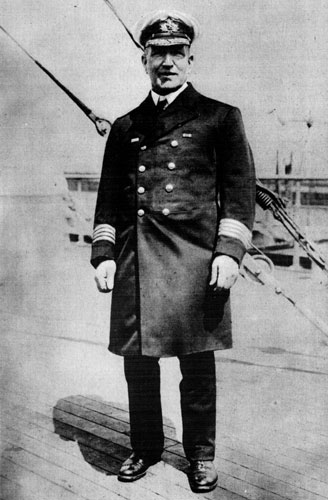
CAPTAIN WILLIAM T. TURNER, R.N.R. Commander of the R.M.S. Lusitania (Photo from Underwood & Underwood)
STAHL INDICTED FOR PERJURY.
In The New York Times of June 19 appeared the following report of the Grand Jury's indictment of Stahl on a charge of perjury and the announcement that the Federal investigation will be continued:
Gustav Stahl, the alleged German reservist, who made an affidavit that he had seen guns on board the Lusitania on the day before she sailed on her last voyage, was indicted on a charge of perjury by the Federal Grand Jury yesterday. The perjury charge is based on his testimony before the Grand Jury, during which examination he repeated that he had seen the guns on the Lusitania as set forth in his affidavit filed by the German Embassy in Washington and now in the hands of the State Department.
The name of Paul Koenig, who, it is said, was known to Stahl as Stemler, and who is the chief of the secret service of the Hamburg-American Line, is mentioned by name in the indictment. The indictment sets forth that on June 10 there was pending before the Grand Jury an investigation concerning Koenig and others and that Stahl was among the witnesses called in the course of that investigation. It then goes on to say that Stahl testified in substance and to the effect that on April 30 he went aboard the Lusitania, then with one Leach, and that while on the vessel he saw four guns on one of the decks of the steamship, two forward and two aft, and all mounted on wooden blocks and covered with leather. The indictment further charges that at the time of so swearing Stahl did not believe it to be true that he had been on board the Lusitania and had seen the four guns.
The indictment, in conclusion, charges that there were no guns upon the decks of the Lusitania on April 30. "Therefore," the Grand Jury charges, "that Stahl, after taking an oath before a competent officer to truly depose and testify, did willfully, knowingly and feloniously and contrary to his said oath, depose and state material matters which were not true and which he did not then believe to be true, and thereby did commit willful and corrupt perjury against the peace of the United States and their dignity and contrary to the form of the statute of the United States in such cases made and provided."
Stahl will be arraigned before Judge Russell in the criminal branch of the United States District Court on Monday. He is now in the Tombs in default of $10,000 bail. Should he be convicted of perjury he may be sentenced to prison for five years or fined $10,000, or both.
The indictment of Stahl does not mean that the Government's investigation of the Lusitania affidavits, and the way in which they were procured, is at an end. On the other hand it is proceeding vigorously. Three witnesses, all Government officials, were before the Grand Jury yesterday in connection with the case. Heinz Hardenberg, who was found in Cincinnati a week ago today and brought here to be examined by the Grand Jury, has not yet appeared before that body, although the Government agents insist they can produce him when his testimony is desired.
THE NEBRASKAN CASE.
An Associated Press dispatch dated at London on May 26, 1915, reported:
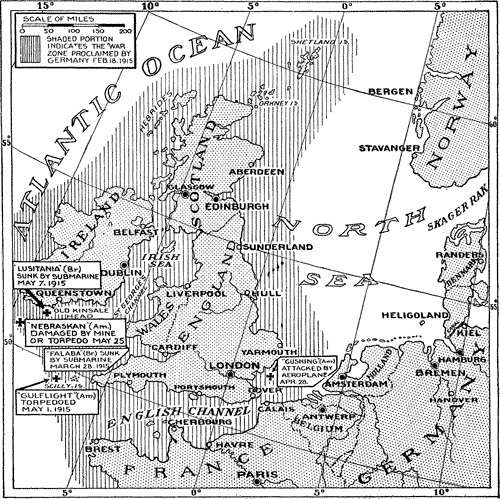
The American steamer Nebraskan, Captain Greene, from Liverpool May 24 for Delaware Breakwater, was torpedoed yesterday evening by a submarine at a point forty miles west-southwest of Fastnet, off the south coast of Ireland. [Captain Greene's report, given below, says the Nebraskan was "struck by either mine or torpedo."]
The sea was calm at the time. The crew at once took to the boats and stood by the steamer. It was soon ascertained that the Nebraskan was not seriously damaged, but she had been struck forward, and her foreholds were full of water.
The crew returned on board and got the vessel under way. No lives were lost among the crew. The Nebraskan did not carry any passengers.
This information was received at the British Admiralty in London, and it was at once communicated to the American Embassy.
Immediately she was struck the Nebraskan began calling for help by wireless. Brow Head received the wireless communication at 9 P.M. yesterday from Crookhaven.
A message to Lloyd's from Kinsale, Ireland, says that the Nebraskan passed that point at 11 o'clock this morning. She was down at the bows, but was proceeding under her own steam, and flying the signal: "I am not under control."
The vessel passed Queenstown in the afternoon on the way to Liverpool. She was proceeding at eight knots.
A message to The Star from Liverpool says that the name and nationality of the Nebraskan were painted in large letters on her sides. She was in water ballast.
A message to Lloyd's says that an armed trawler went to the assistance of the Nebraskan and stood by her all night.
The report that the Nebraskan had been torpedoed caused surprise to American officials here. Apparently the affair occurred before 9 o'clock last night.
Last evening was clear, and the period between 8 and 9 o'clock is the twilight hour in the British islands at this season.
The German submarine campaign is continuing actively. Dispatches from Norway state that the people of that country have been aroused by the sinking last week of the Norwegian steamer Minerva and the attempt to torpedo the Iris, which went to her assistance.
The steamer Cromer, loaded with passengers, had a narrow escape from being torpedoed while bound for Rotterdam yesterday. A submarine fired a torpedo without warning. It missed the ship by only fifteen yards. According to the Captain's story, told to Rotterdam correspondents, the periscope was seen 500 yards distant, and then the wash of the torpedo, which was moving so rapidly that nothing could be done to avoid it. The attack occurred at a point four miles north of North Hinder Lightship.
The first news of the Nebraskan having been disabled off the southwest coast of Ireland was received on May 26, at the office of the American-Hawaiian Line in a message from the Captain, which read:
Struck by either mine or torpedo, forty-eight miles west of Fastnet. Am steaming under convoy to Liverpool. Water in lower hold. No one injured.
GREENE.
[Enlarge]
Map indicating sites of attacks on American ships or American lives in the German submarine war zone. The damage to the Nebraskan was sustained on May 25, last.
Three dispatches concerning the Nebraskan incident were received at the State Department at Washington on May 26—one from Walter H. Page, the American Ambassador in London, and two from Robert P. Skinner, the United States Consul General in London. The dispatch from the Ambassador said:
Urgent. Report at midnight last night to British Admiralty from Lands End states that American steamer Nebraskan torpedoed forty-five miles south by west of Southcliffe, crew taking to boats. British trawler standing by now reports Nebraskan still afloat and making for Liverpool with four holds full of water. No lives reported lost.
The first dispatch from Consul General Skinner was as follows:
Admiralty reports American steamer Nebraskan, Liverpool for Delaware Breakwater, torpedoed forty miles south by west of Fastnet. Crew in boats. Standing by. Weather fine.
The following cablegram came from the Consul General:
Nebraskan proceeding to Liverpool under own steam about 8½ knots, crew having returned on board. Apparently no lives lost. Extent of damage unknown.
In an Associated Press dispatch from Crookhaven, Ireland, on May 26, this report appeared:
It was learned today that a submarine was seen last night off the southern coast of Ireland. She was sighted soon after 9 P.M., near Barley Cove, which is about ten miles from Fastnet. The mishap to the steamer Nebraskan is reported to have occurred shortly before 9 o'clock, about forty miles from Fastnet.
A steamer was seen outside Crookhaven, which lies just north of Barley Cove, at about 9 o'clock last night. As she approached in the direction of Fastnet Lighthouse two loud reports of a gun were heard. A boat in Crookhaven Harbor went in the direction of the steamer which put about and was lost to sight.
Several residents of Crookhaven turned out and went along the shore, keeping a sharp lookout. They sighted a submarine off Cove, near the mouth of a little creek. One of the men on shore fired two shots with a rifle at the man in the conning tower of the submarine. The submarine dived immediately, but soon rose again further out. Three more shots were fired at her and she again disappeared.
The detailed report on the Nebraskan incident by Lieutenant Towers of the American Embassy in London, as submitted by Ambassador Gerard to the State Department, is thus described in a Washington dispatch to The New York Times of June 16, 1915:
Evidence indicating that the American steamer Nebraskan was torpedoed by a German submarine on May 25, was obtained by the State Department today when it received a long mail report from Ambassador Page at London containing the results of the investigation conducted by the American Consul General at Liverpool upon the arrival of the Nebraskan at that port.
Ambassador Page's mail report contained the detailed report made by Lieutenant John H. Towers, Naval Attaché of the American Embassy at London, who made a technical and expert examination of the Nebraskan in drydock at Liverpool. Lieutenant Towers's report contained a number of photographs of the shattered fore section of the hull of the Nebraskan, but the most interesting feature of the report consisted of exhibits in the form of what Secretary Lansing described as "fragments of metal."
While officials would not make known the character of these fragments or the details of the report until they had opportunity to carefully examine the data, it was learned tonight that the report indicated that the Nebraskan was torpedoed, and that the fragments sent with the report consisted of portions of the shell of a torpedo, which were found in the hull of the Nebraskan.
The report also contained the depositions of three of the officers of the Nebraskan, taken by the Consul at Liverpool, including the statement of the Captain and the Chief Engineer. The latter stated that at 8:24 o'clock on the night of May 25, after the flag of the Nebraskan had been hauled down, he observed a white streak in the water perpendicular to the ship on the starboard side and a severe shock was almost instantly felt, followed by a violent explosion abreast of No. 1 hold.
The report of Lieutenant Towers showed that the hatch covers of No. 1 hold were blown off, also the cargo booms above it, and that the bottom plating and pieces of the side of the ship were blown up through two decks of the ship.
THE “FRAGMENTS OF METAL”
The following appeared as a special dispatch from Washington to The New York Times, dated June 17:
Despite the extreme secrecy of officials, indications were abundant in Washington tonight that the case of the American steamer Nebraskan, believed to have been torpedoed by a German submarine, was assuming great importance in the eyes of the United States Government. One evidence of this is found in the unusual pains that are being taken to determine by indisputable evidence whether the Nebraskan, which was damaged by an external explosion off Fastnet Rock, on May 25, was the victim of a torpedo or a mine.
Despite the reports forwarded by Ambassador Page, the Administration is unwilling to base its conclusions in the Nebraskan case on the verbal evidence it already possesses. It has determined upon an independent expert, technical, and scientific examination of the "fragments of metal" that have been sent by Ambassador Page, in conjunction with the photographs that have been received. This investigation is being conducted by experts of the Navy Department, and will probably take about ten days. Robert Lansing, the Secretary of State ad interim, refused tonight to discuss the "fragments of metal" received from Ambassador Page in connection with the Nebraskan case further than to say that the reports received yesterday, with the photographs and accompanying exhibits, had been referred to the Navy Department. Josephus Daniels, Secretary of the Navy, said tonight that the report had been referred to experts of the Navy Department for a confidential report to be submitted to the State Department.
Neither at the State Department nor from any official or officer of the Navy Department was it possible to obtain any further clue as to the character of the reports.
It was learned that the reports accompanying the set of photographs and "fragments of metal" were not the original reports on the Nebraskan case, made by Lieutenants Towers and McBride, which were received by the State Department last week, but were in the nature of a second set of supplementary reports, based on actual examination of the battered bow of the Nebraskan and the technical examination of the interior of her forward compartment. This examination was made by Lieutenants Towers and McBride, while the Nebraskan was in a drydock at Liverpool. Photographs of the interior and exterior of the steamer's hull were taken by the naval experts.
The "fragments" in question will be analyzed metallurgically for the purpose of ascertaining precisely what metal they contain. Generally speaking, torpedoes are made of a higher grade of metal, within and without, than that used in the construction of mines. The exterior metal of torpedoes consists of nickel steel and copper, and the interior mechanism includes the same kinds of metal and brass. The exterior shell of a mine is generally made of less expensive material, such as galvanized iron, but the interior mechanism and clock-work are of finer metal.
In the examination being conducted by the Navy Department the metallurgical nature of the fragments will be ascertained after their size, shape, contour and character have been very carefully studied by a large number of naval experts who will endeavor to ascertain not only the character of the naval engine of destruction these fragments once fitted, but also the particular portion of torpedo or mine the fragments constituted. These studies and tests are to be conducted partly in the Navy Department, partly at the Washington Navy Yard, partly at the naval proving grounds at Indian Head, Md., and partly at the experimental station at the Naval Academy at Annapolis.
All the naval experts in Washington qualified to have a hand in the tests will be utilized. There are some naval experts outside of Washington, within a few days' reach of the city, who will be summoned here to participate in the examination. It is understood the examination will continue about ten days before any report can be formulated for submission to the State Department.
While this unusual care is being exercised in the tests of the fragments, it is understood that there is nothing in the conclusions thus far drawn in the reports to indicate that the fragments were once part of a mine, and that the reports as they stand indicate that the Nebraskan was hit by a torpedo. This is the conclusion the Administration is expected to draw from the evidence unless the technical examination of the fragments nullifies this evidence.