Progress of the Allies in June Slow and Difficult
Reading edition
In his speech at Dundee on June 5, from which the passage concerning the Dardanelles is reproduced below, Winston Spencer Churchill's reference to "losses of ships" constituted the official comment on the sinking by submarine attack on May 26 and 27 of the British battleships Triumph in the Gulf of Saros, and Majestic off Sedd-el-Bahr. That increased to six the sum of battleships lost to the Allies in the Dardanelles operations. The review of the operations from May 15 to June 17, shows a development of slow trench warfare on land, which postpones the attainment of a few miles to a victory confidently predicted by Mr. Churchill.
A FEW MILES FROM VICTORY.
In the course of his speech at Dundee on June 5, 1915, Winston Spencer Churchill said:
The operations which are now proceeding at the Dardanelles will give him (Mr. Balfour) the opportunity of using that quality of cool, calm courage and inflexibility which fifteen years ago prevented Ladysmith from being left to its fate and surrendered to the enemy. I have two things to say to you about the Dardanelles.
First, you must expect losses both by land and sea. But the fleet you are employing there is your surplus fleet, after all other needs have been provided for. Had it not been used in this great enterprise it would have been lying idle in your southern ports. A large number of the old vessels, of which it is composed, have to be laid up in any case before the end of the year, because their crews are wanted for the enormous reinforcements of new ships which the industry of your workships is hurrying into the water. Losses of ships, therefore, as long as the precious lives of the officers and men are saved—which in nearly every case they have been—losses of that kind, I say, may easily be exaggerated in the minds both of friend and foe. Military operations will also be costly, but those who suppose that Lord Kitchener—(loud cheers)—has embarked upon them without narrowly and carefully considering their requirements in relation to all other needs and in relation to the paramount need of our army in France and Flanders—such people are mistaken, and not only mistaken, they are presumptuous.
My second point is this. In looking at your losses squarely and soberly you must not forget at the same time the prize for which you are contending. The army of Sir Ian Hamilton, the fleet of Admiral de Robeck are separated only by a few miles from a victory such as this war has not yet seen. When I speak of victory I am not referring to those victories which crowd the daily placards of any newspapers. I am speaking of victory in the sense of a brilliant and formidable fact shaping the destinies of nations and shortening the duration of the war. Beyond those few miles of ridge and scrub on which our soldiers, our French comrades, our gallant Australian and New Zealand fellow-subjects are now battling, lie the downfall of a hostile empire, the destruction of an enemy's fleet and army, the fall of a world-famous capital, and probably the accession of powerful allies. The struggle will be heavy, the risks numerous, the losses cruel, but victory when it comes will make amend for all. There never was a great subsidiary operation of war in which a more complete harmony of strategic, political, and economic advantages were combined, or which stood in truer relation to the main decision, which is in the central theatre. Through the Narrows of the Dardanelles and across the ridges of the Gallipoli Peninsula lie some of the shortest paths to a triumphant peace.
[Enlarge]
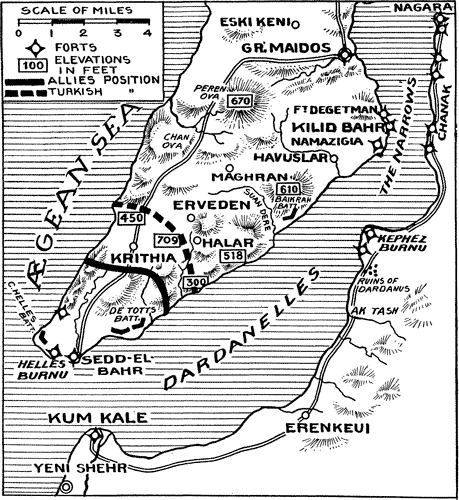
Scene of the Dardanelles operations. The black line marks the approximate allied position, the dotted line the approximate Turkish position, on June 18, 1915.
TWO WEEKS’ FIGHTING.
By The Associated Press.
PARIS, June 14.—An official note given out today presents a summary of the operations in the Dardanelles from May 15 to June 1 as follows:
Heavy fighting has taken place during this time. Today our progress is somewhat slower than it was in the beginning, but every inch of ground gained has been organized in such a manner as to permit the repelling of counter-attacks, and each advance has been held. The physical aspects of the country make fighting extremely difficult and dangerous, as the battle front presents the form of a triangle.
During the second half of May there were attacks on the Turkish line of intrenchments in front of Kereves Dere and the redoubt called the 'Bouchet,' which we took May 8. All the Turkish counter-attacks failed completely.
Our position being assured here, we endeavored to capture a small fortress situated on the extreme left of the enemy's line. On account of the strategic position of this fortress it was impossible to take it in the ordinary way by an artillery attack, followed by a bayonet charge; such a method would have resulted in heavy loss of life. The attack had to be a surprise. On the night of May 28 a mixed company composed of thirty-four white and thirty-two negro troops, all volunteers, under the command of a Lieutenant, received orders to slip out of our first trench one by one and crawl on their hands and knees to the opposing trench. Here they were to surprise the occupants and kill them without a shot. Two other companies bringing up the rear were to go at once to the assistance of the first company if the plan failed.
At 11:45 P.M. our men, having gone forward in accordance with instructions, rushed over the embankments of the enemy trenches. The Turks were completely surprised. They discharged their guns into the air and immediately took to flight. Thanks to the rapidity of our attack our only casualties were one Sergeant and two men wounded.
The Turks attacked twice without success, and dawn saw us firmly established in our new positions.
A GENERAL ASSAULT.
LONDON, June 6.—Official announcement was made tonight that the British troops at the Dardanelles, as a result of their new offensive movement last week, captured two lines of Turkish trenches along a three-mile front. The statement follows:
On the night of June 3-4 the Turks, having heavily bombarded a small fort in front of the extreme right French position, which previously had been captured, launched an infantry attack against it which was repulsed with heavy loss to the enemy. At the same time the Turks set fire to scrub in front of the left centre of the position occupied by the British division and attacked, but with no success.
On the morning of the 4th of June Sir Ian Hamilton ordered a general attack on the Turkish trenches in the southern area of the Gallipoli Peninsula, preceded by a heavy bombardment by all guns, assisted by battleships, cruisers, and destroyers.
At a given signal the troops rushed forward with the bayonet. They were immediately successful all along the line except in one spot, where the heavy wire entanglement was not destroyed by the bombardment.
Indian troops on our extreme left made a magnificent advance. They captured two lines of trenches, but, owing to the fact that the troops on their right were hung up by this wire entanglement, they were obliged to retire to their original line. The regular division made good progress on the left centre, capturing a strong redoubt and two lines of trenches beyond it, about 500 yards in advance of their original line.
The Territorial Division on our centre did brilliantly, advancing 600 yards and capturing three lines of trenches, but though the advanced captured trench was held all day and half of the ensuing night, they had to be ordered back in the morning to the second captured line, as both their flanks were exposed.
The Naval Division on our right centre captured a redoubt and a formidable line of trenches constructed in three tiers 300 yards to their front, but they, too, had to be ordered back, owing to the heavy enfilading fire.
The French Second Division advanced with great gallantry and élan. They retook for the fourth time that deadly redoubt they call 'Le Haricot,' but unfortunately the Turks developed heavy counter-attacks through prepared communication trenches, and under cover of an accurate shell fire were able to recapture it.
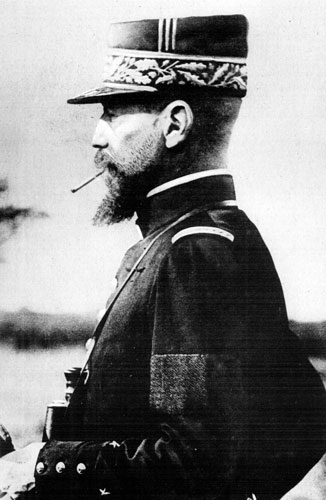
GENERAL GOURAUD Commander of the French Land Forces Operating Against the Dardanelles (Photo from Medem)
On the French extreme right the French captured a strong line of trenches which, though heavily counter-attacked twice during the night, they still occupy.
We captured 400 prisoners, including ten officers. Among the prisoners were five Germans, the remains of a volunteer machine gun detachment from the Goeben (the Turkish cruiser Sultan Selim). Their officer was killed and the machine gun was destroyed.
During the night information was received that enemy reinforcements were advancing from the direction of Maidos toward Kithia. Thereupon Lieutenant General Birdwood arranged to attack the trenches in front of Quinn's post at 10 P.M., which was successfully carried out, and the captured trenches held throughout the night. The Turkish casualties were heavy.
At 6:30 A.M. the enemy heavily counter-attacked, and by means of heavy bombs forced our men out of the most forward trench, though we still hold communication trenches made during the night.
The result of these operations is that we have made an advance of 500 yards, which includes two lines of Turkish trenches along a front of nearly three miles. We are now consolidating our new positions and strengthening the lines.
MR. ASQUITH’S PREDICTION.
LONDON, June 15.—There have been so many rumors recently that the Allies had forced the Dardanelles that Sir James H. Dalziel asked Premier Asquith this afternoon in the House of Commons if there was any truth in such reports.
"None whatever," was the reply. The Premier said that it was not in the public interest to say anything now about the Dardanelles. "The operations are of the highest importance," he added, "and they will be pushed to a successful conclusion."
The following announcement concerning the operations was given out officially today:
The situation on the Gallipoli Peninsula has developed into trench warfare. After our success on the 4th instant the Turks have evinced a great respect for our offensive, and by day and by night they have to submit to captures of trenches.
On the night of the 11th-12th of June two regiments of a British regular brigade made a simultaneous attack on the advanced Turkish trenches, and after severe fighting, which included the killing of many snipers, succeeded in maintaining themselves, in spite of bombs, in the captured position.
On the morning of the 13th a counter-attack was made by the Turks, who rushed forward with bombs, but coming under the fire of the naval machine gun squadron were annihilated. Of the fifty who attacked, thirty dead bodies were counted in front of that part of our trenches.
The situation is favorable to our forces, but is necessarily slow on account of the difficulties of the ground. The Turkish offensive has sensibly weakened.
FROM THE TURKISH SIDE.
[Staff Correspondence of The Brooklyn Eagle.]
CONSTANTINOPLE, June 5, (by Courier to Berlin and Wireless to Sayville, L.I.)—The forces of the Allies on the Gallipoli Peninsula at Ari Burnu and Sedd-el-Bahr are in the greatest danger, as a result of the withdrawal of the bombarding fleets—made necessary by the activity of German submarines—and the consequent difficulty of maintaining communications oversea from the Aegean Islands.
The English position is at present desperate.
The inability to land heavy artillery was at first compensated for by the protection given by the guns of the fleet, but the withdrawal of the ships from Ari Burnu leaves the shore forces resting almost on the water's edge without means of meeting attacks.
Heavy Turkish batteries are mounted on the surrounding heights.
These statements are made after a week spent in the Turkish field under the first personal pass issued to a newspaper correspondent by Field Marshal Liman von Sanders, the Commander in Chief of the Turkish Army.
The Turks are fighting confidently, aided by a few German machine gun squads.
The farthest advance made by the English at Ari Burnu is 1,000 yards from shore; at Sedd-el-Bahr, about two miles.
Have seen Forts Chanak and Kalid Bahr, and find they are still intact.
The net results of the English attempt to force the Dardanelles are at present almost nil.
The general impression at Constantinople and Berlin is that the attack as at present conducted is a failure.
The bombardment of March 18 was ineffectual, owing to the inadequacy of the landing forces, and the failure of the Entente powers to embroil Bulgaria against Turkey.
[By The Associated Press.]
KRITHIA, Dardanelles, June 17, (via London, June 19.)—The allied troops who landed at Sedd-el-Bahr, on the Gallipoli Peninsula, hold about ten square miles of the extreme southern part of the peninsula, the occupancy of which is maintained with the greatest difficulties.
The ground held by the Allies consists principally of a small plateau to the north of Sedd-el-Bahr and two adjoining ridges to the northwest, between which the Turks are pushing advance trenches.
The Associated Press correspondent, who spent two days in the trenches, found the Turkish troops in excellent condition and spirits, in spite of the fact that the Allies were using every conceivable means to carry on the operations, including bombs thrown from catapults and from aeroplanes.
From the Turkish station of artillery fire control the effect of the Turkish fire upon the allied trenches could be observed today, and the shells were reaching the mark. The sanitary and supply services of the Turks are being carried on efficiently. The number of wounded at the hospital bases at the front was small, although the fighting during the night had been fairly severe.
During the daytime both sides are usually inactive, the Turks preferring night bayonet attacks. Many Turkish batteries are in position, but the nearness of the opposing trenches makes their work difficult, and for the most part they are directing their attention to the reserves of the Allies and to changing shifts which are exposed at certain points. The Turks, in this, have the support of their heavy batteries on the Asiatic side, which, since the retirement of the allied fleet, work without fear of being molested, bombarding chiefly the allied right wing, composed of French, home, and Colonial troops.
Weber Pasha, the German General commanding the south group, gave the correspondent every opportunity to visit the Sedd-el-Bahr district, placing no restrictions whatever upon his movements. The result was a thorough inspection of the ground. Weber Pasha made no comment on the situation himself beyond saying that "the failure of the Allies to consummate their plan of forcing the Dardanelles is too obvious for discussion."
Weber Pasha, who is a member of the German military mission which undertook the improvement of the Ottoman Army organization, is fully confident that the Turks will be able to meet the Gallipoli situation, and that the Allies will never advance against the Dardanelles forts.
It has been ascertained that only a few German officers are active in the south group. German privates are employed in special lines.
Krithia, once a thriving village of about 4,000 inhabitants, is probably the most ruined place in all Europe. The Allies left no house standing during their bombardment.