Inspired Press Opinions from the Capitals of Greece, Bulgaria, and Rumania
Reading edition
THE GREEK VIEW.
From the Embros, an independent daily of Athens, of May 23, 1915.
In what degree the Triple Entente would have respected the rights of Greece had we entered the war before Italy's intervention is demonstrated by the conduct of the Allies toward Serbia. The whole of the Adriatic is now an Italian sea, by virtue of a mutual agreement between the Entente powers and Italy, and only the slightest hope of obtaining Durazzo and Cattero is left to Serbia.
Greece therefore must congratulate herself for holding back and watchfully awaiting developments. It is generally admitted that the European war will last long and that the new ally will not give a decisive turn to its final conclusion. Those, therefore, who have their swords sharpened will be always in time to join. In a struggle that has such a wide field of adventures those who will intervene later will be more welcome than those who have already joined and offered all the strength they possessed. And, lastly, if this war will not show in the end a single victor, then the interests of each one of the participants will be settled by a European congress, where, again, those who will have preserved untouched their forces will be the real victors.... Greece is not going to be neutral for a long time; meanwhile she must husband her resources and her strength up to the day when events themselves will force her to enter the war, whether she likes it or not.
A PLEA FOR WAR.
From the Patris, Mr. Venizelos's organ, of Athens, of May 14.
We say in one word that the dangers that threaten us as long as we are neutral are immensely greater than those which we might incur in joining in the war. Greece cannot accept a comparison with Bulgaria and Rumania. Bulgaria, by remaining neutral, is sure to receive the Enos-Midia line, and in case of co-operating with the entente powers she may also be sure of getting Dobrudja and Serbian Macedonia. Rumania, on the other hand, if neutral will take a slice of Transylvania, and if she sides with the Allies in the war, may obtain the whole of Bukowina. But Greece has no alternative. She must by political necessity act in common with the Triple Entente. Of course, by so doing she runs certain risks, but we defy the Government [of Mr. Gounaris] to prove that the dangers threatening Greece are less in the case of a protracted neutrality than in the case of her joining in the war.
GREECE AFTER ITALY’S INTERVENTION.
From the Athenae, the Ministerial paper, of May 25.
Italy has entered the war on the Allies' side, because in the territorial negotiations England and France outbid Austria and Germany. And now does any one imagine that the Triple Entente would hesitate to sacrifice Hellenic interests in favor of Italy even if Greece had been the first to indorse their cause? But have we not seen how the Serbian national aspirations have been sacrificed by the Entente in its effort to secure the co-operation of Italy? And has not the Entente sacrificed Greek interests when Italy was occupying Vallona? Was that a token of sympathy with Greek interests? And did ever the Triple Entente say to Greece that they would not allow Italy to impose her rule on Greek countries and Greek populations? And the twelve Islands of the Aegean, the Dodekanisos—have they not been shown to Italy as a present and reward for her co-operation whether or not Greece joined the Entente?
How could Greece, in such circumstances, abandon her neutrality and risk everything for the Allies?
[Enlarge]
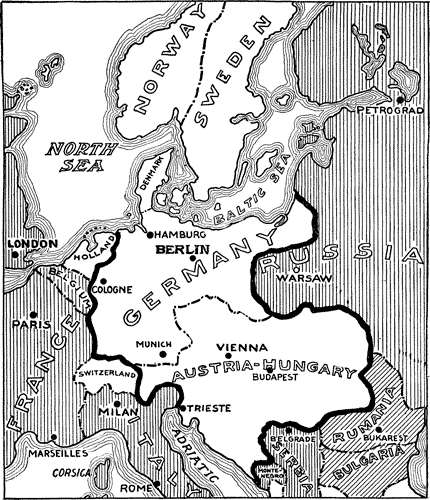
The shaded portion of the map shows how, if Rumania and Bulgaria join the Allies in the field, Germany and Austria-Hungary will be almost entirely surrounded by enemies, the only considerable outlet then remaining being over the Dutch frontier.
BULGARIAN VIEWS.
FAVORING NEUTRALITY.
From Narodni Prava, the mouthpiece of the Liberal Party and the Premier of Bulgaria, Mr. B. Radoslavoff, April 1, 1915.
In his statement to the Sobranjie (the Bulgarian Parliament) the Prime Minister yesterday categorically said that those wishing to march with either side of the belligerents are free to do so, if they are courageous enough and if they are aware of their duties to the interests of the country.... The Parliamentary majority and the nation at large are satisfied with the policy of the Government, which consists in preserving a strict neutrality and the peace of the country and in developing meanwhile the patriotic and military spirit of the nation, in order that we may be ready when the time comes to act for the interests of the fatherland.
OPPOSING NEUTRALITY.
From Mir, organ of the Nationalists and of ex-Premier I. Gueshoff, April 26, 1915.
Greece is hoping to profit from the present situation without any sacrifices, or with as few as possible, and Venizelos fell because the Greek people did not wish to give the Allies the assistance he promised them. In order to explain and justify their stand, the Greeks found an argument in the Bulgarian danger.... "Do you want us to prove that we are not willing to play the game of Germany? Here are the proofs: We are ready to shield Serbia against any possible attack from Bulgaria and to help you, not against Turkey but against Bulgaria"—that is what the Greeks said and wrote to the Entente powers. And the chief newspapers of the Allies are full of articles trying to prove that the Bulgarians, under the guidance of Germany and Austria, are endangering the Balkan situation. According to what we learn, Germany is straining every nerve to incite an armed conflict between Greece and Bulgaria. In this way Germany hopes to guarantee Turkey against any possible attack from Bulgaria, and thus promote her own interests. To this fact we most earnestly call the attention of the Bulgarian people.
OPPOSING GREECE, SERBIA, AND RUSSIA.
From the Nationalist Kambana of Sofia, May 4, 1915.
Greece and Serbia are, first of all, threatened by Bulgaria, and they both know that they must step out of Bulgarian Macedonia. The struggle for Macedonia does not date from yesterday or today; this is an age-long struggle, which will end only when Bulgaria shall have assured her frontier, when Greece shall return to her peninsula, and when Serbia shall be entirely wiped off the map of the Balkans. Aside from the Greeks and Serbs, Bulgaria constitutes a danger also for Russia, inasmuch as we do not want to be the bridge for any further Russian expansion. Russian diplomacy has done everything in its power to alienate Bulgarian sympathy and to make us unfriendly to Rumania and Turkey; but Russia is today severely punished for her misdeeds. Russia, Serbia, and Greece are finding themselves in a pretty hard position, and are looking for our help. But we must not hurry. Every day that passes weakens our enemies, and the future of Bulgaria becomes daily brighter.
THE RUMANIAN VIEW.
A PRO-GERMAN OPINION.
From the Moldava of Bucharest, organ of the Conservative Party, of April 1, 1915.
For a long time public opinion in Rumania has been lulled into believing that we shall take Transylvania, but not a word has been said about Bessarabia. We do not know why our political predecessors wanted to create a strong barrier in the face of Russia, behind which live, condemned to perpetual isolation, 3,000,000 Rumanians. That territory which lies between the Rivers Pruth and Bug contains a population of more than 5,000,000, of which 3,500,000 are Moldavians; it comprises, also, the mouth of the Danube, fertile lands, an extended shore, and the City of Odessa itself. The budget of that part of Bessarabia which lies between the Rivers Pruth and Dniester amounts to 250,000,000 lei, ($50,000,000,) or nearly as much as half of the entire budget of Rumania. But this wealth is not used for the benefit of the country which produces it. There are neither schools nor highways nor hospitals in Bessarabia. Ignorance and misery are the sole companions of that population, every national sentiment of which is smothered under the sway of Russian absolutism.
We in Rumania are ignorant of all these facts because our education is such as to make us ignore such vital issues. But only because we do not know ought we forsake Bessarabia?... Or is it that the national ideal of Rumania is to live at the mercy of Russia, by abandoning old Moldavia?
FOR A BALKAN UNION.
From Le Journal des Balkans of the Liberal T. Jonescu, of March 13, 1915.
It is of the utmost importance that the Balkan States get together—quite apart from the present circumstances—for their own vital benefit. No matter what the outcome of the present war will be, the duty of the Balkan States is to act in unison, for mutual support and for the preservation of their future.
Under whatever form constituted, the alliance of the Balkan States is essential to the existence of the countries of Southeastern Europe.
To begin with, a Balkan congress must be called together, which should deal principally with the question of organizing a common network of communication, both on rail and water, strictly Balkan in character, which would contribute to a specific political purpose, and at the same time assure to the Balkan countries the monopoly of East Indian trade.
IN CASE OF WAR.
From the Government organ, Indépendance Roumaine, of May 18, 1915.
It is most essential that, should neutral countries decide to enter the European war, their first duty should be that of asking beforehand explicit and definite guarantees from the powers that solicit their assistance. Without such guarantees not one of the Balkan States would be willing to enter the war, because there is not a statesman who in like circumstances would plunge his country into an action which, on the face of it, is only an adventurous enterprise.