France’s Victory in the Chief Western Operation Since the Marne
Reading edition
The Battle of the Labyrinth, technically described in French communiqués as "operations in the section north of Arras," really began in October, 1914, when General de Maud-Huy stopped the Prussian Guard before Arras. Because of their great strength the labyrinth of German trenches and fortifications southeast of Neuville-St. Vaast formed a dangerous salient which the French troops had to dispose of before they could make progress eastward from north and south of that point. The decisive part of the battle—or series of battles extending over fifty miles of front—is described in the brief review of the French official observer at the front, and in the two accounts by Wythe Williams cabled to The New York Times after a trip to the front specially arranged for him and three editors of Paris newspapers by the French War Ministry.
By The Associated Press.
Account of the French Official Observer At the Front
PARIS, June 22.—A terrific combat from May 30 to June 19 has resulted in the conquest by the French of the formidable system of works and trenches called the "Labyrinth." The operations are described today in a dispatch from an official observer at the front.
The Labyrinth, lying between Neuville-St. Vaast and Ecurie, formed a salient of the German line, and its position, a strong one, had been greatly reinforced from time to time. The "Observer" writes:
French attacks on May 9 and days thereafter failed to modify the situation. At the end of May the French decided to finish things, and the order was given to take the Labyrinth inch by inch.
This meant an operation of two principal phases of different nature. It was necessary, first, by well-prepared and vigorous assaults, to get a footing in the enemy organization, and then to progress to the interior of the communicating trenches, repulsing the enemy step by step. These two operations lasted more than three weeks and resulted in complete success.
The debouch must have been difficult, as numerous German batteries, composed of 77-millimeter guns, the 150, 210, 280, and even 305 millimeter guns, concentrated their fire on us. They were stationed at Givenchy, La Folie, Thelus, Farbus, and Beaurains, south of Arras. Nevertheless, our men understood, and prepared to do their duty.
It was on May 30 that the assaults began, our regiments marching out from different points. Their ardor was admirable.
Everywhere, except on the right, we captured the first line. Behind this were a great number of barricades and fortlets. We took some of these, while others stopped us. One hundred and fifty prisoners, surprised in their holes by the furious charge of the French infantry, fell into our hands.
From this moment the war of the communicating trenches began. There were the trenches of von Kluck, Eulenburg, and the Salle des Fêtes, without counting innumerable numbered works, giving a feeling of unheard-of difficulties which our troops had to overcome.
Without a stop, from May 30 to June 17, they fought on this ground, full of big holes and filled with dead. The combat never ceased, either day or night. The attacking elements, constantly renewed, crushed the Germans with hand grenades and demolished their earth barricades. There was not an hour of truce nor an instant of repose. The men were under a sun so hot in the trenches that they fought bareheaded and in their shirtsleeves.
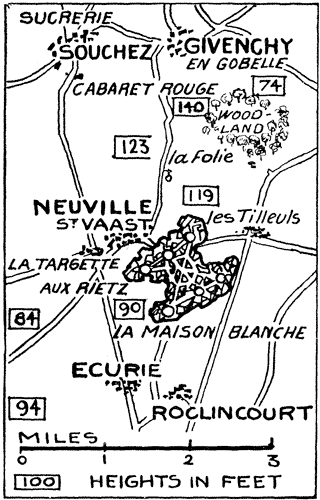
[Enlarge]
"The Labyrinth"
On each of these bloody days there were acts of incomparable heroism. From three sides at a time we made way where the Germans had dug formidable shelters, ten meters under ground. The enemy artillery continued firing on our line without interruption.
Our reserves suffered, for in this upturned earth, where every blow from the pickaxe would disinter a body, one can prepare but slowly the deep shelters which the situation demands.
We lost many men, but the morale of the others was unshaken. The men asked only one thing—to go forward to fight with grenades, instead of waiting, gun in hand, the unceasing fall of shells.
They were hard days, and it was necessary constantly to carry to the fighting men munitions and food, and especially water. Everybody did his best, and we continued our success. Little by little our progress, indicated by a cloud of dust, resulting from the combat of the grenades, brought us to an extremity north of the Labyrinth. The fighting continued in the Eulenburg and other trenches daily, and ultimately the Labyrinth belonged to us.
The Germans lost an entire regiment. We took a thousand prisoners. The rest were killed. A Bavarian regiment also was cut to pieces.
Our losses were 2,000 men, among whom many were slightly wounded.
The resistance was as fierce as the attack. Despite the nature of the ground and the organized defenses, which had been in preparation for seven months, and despite the artillery, the bomb-throwers, and the quick-firers, we remained the victors.
THE FRENCH “CURTAIN OF IRON.”
By Wythe Williams.
[Special Cable to The New York Times.]
Paris, June 1.—I have just completed another trip to the front, probably the most important one accorded any correspondent since the war began. For several days, in the company of three Paris editors, I was escorted by an officer of the General Staff through the entire sector north of Arras where the French have been making brilliant gains in the last few weeks.
The trip was arranged suddenly by the War Ministry in order to prove the truth of the French official communiqués and the falsity of the German reports. I was the only neutral in the party. In fact, the day before we started I was informed that trips to the front had temporarily been abandoned because the fighting was too hot to take correspondents to any place on the line. During the entire time I was under heavy artillery fire and got more intimately acquainted with modern war than on all my previous trips to the front. I was especially fortunate to be picked out by the War Office over all competitors as the single foreigner permitted to go, for it so happened that we covered the same sector of fighting as that traversed last February on my first officially authorized visit to the battle zone. Thus I was able to make comprehensive comparisons of just what had been accomplished since that time.
On this trip I covered a large stretch of territory that until a few weeks ago—some places only a few days ago—Germany had claimed as her own by right of conquest. I walked through miles of trenches that only last February I peered at from other trenches through a periscope; cautiously, because they were then occupied by Germans; fearfully, because any instant the periscope was likely to be struck from my eyes and shattered by a hostile bullet.
The result of this long walk taught me many things. First in importance was that my confidence in the superiority of German trenches had been sadly misplaced. Since the trench fighting began after the battle of the Marne we have been regaled in Paris with stories of the marvelous German trenches. Humorists went so far as to have them installed with baths and electric lights, but we have all believed them to be dry, cement lined, with weather-proof tops and comfortable sleeping quarters, and as hygienically perfect as the German organization has ever made anything. This belief for me had been borne out in accounts of the German trench life reported for American newspapers and magazines.
What I can now say is that the correspondents who permitted this legend to go over the world must have been grandly entertained by the Germans in special sections of their trenches set aside as quarters for the officers. I believe that these trenches, which I saw on this trip, must compare favorably with any they hold, for they form part of what is called "the labyrinth." Some of the most desperate fighting of the war is still going on there, with the French literally blasting the Germans out yard by yard, trench by trench. In fact, this trench line was to have formed part of the new boundary line of Germany—they dug themselves in to stay.
I entered these trenches following a long passage leading from the rear of the original French lines. I thought I was still in the French trenches, when suddenly I found myself in a mud ditch, much narrower than any I had ever traversed. The bottom, instead of being corduroy lined, was rough and uneven, making very hard walking. I said to the Major with me, "You must have made these trenches in a hurry; they are not so good as your others." He replied, "We did not make them. The Germans are responsible."
Then we came to a wide place where a sign announced the headquarters of the German commandant. The sides of his underground cavern were all solid concrete, with cement inner walls separating four rooms. Paper and artistic burlaping covered the walls and ceilings, and rugs were on the floors. The furniture was all that could be desired. There was a good iron bed, an excellent mattress, a dresser with a pier glass, and solid tables and chairs. The rooms consisted of an office, dining room, bedroom, and a kitchen, with offshoots for wine, and sleeping quarters for the orderlies and cook. Kultur demanded that the Kaiser's office should have the best accommodation transportable to the firing line, but the fare of the common soldier, I should judge, averaged quite a third below that of the French—both privates and officers, all of whom share the common lot, with straw for bedding and either mud or stars for the roof.
Leaving this commandant's late magnificence, we soon found ourselves in another wide, corduroy-lined trench, with straw dugouts. My Major, without attempting any comparison, but merely to get my geography right, said quite simply: "We are now in the parallel French trench to that German one we just visited."
All this particular bit of trenches was where the Germans cleared out precipitately after French night attacks, and without waiting for the fearful "rideau de fer," or iron curtain, with which the French usually devastate everything before advancing. Littered through them were hundreds of unused cartridges, rifles, knapsacks, bayonets, and clothing of every description. The dead had been taken away just before our arrival. The prisoners—hundreds of them—we met going to the rear.
The second great lesson I learned on this trip I already had a good understanding of from my previous trip. It is that the "rideau de fer" is the most terrible thing ever devised by man to devastate not only men but every single object upon which it descends.
This time I saw the results of the "rideau de fer" on another long stretch of what had lately been German trenches. The "rideau de fer" is simply the French method of converging artillery fire upon a single point where they intend to attack or where they are being attacked. The fact that it is possible is due to the enormous number of guns and the unlimited supply of high explosive shells.
Behind the entire infantry lines there seems to be an endless row of batteries of "seventy-fives," close up to the trenches. These terrible little destroyers can whirl in any direction at will, so when the order comes for the "rideau de fer" at any point, literally hundreds of guns within a few seconds are converging their fire there, dropping a metal curtain through which no mortal enemy can advance.
In this section the French dropped nearly a quarter of a million shells in one day. Unlike the English shrapnel, which makes little impression against earthworks, the French use explosive shells almost entirely.
As I walked over this section after the curtain had been lifted, I was absolutely baffled for descriptive words. All the earth in that vicinity seemed battered out of shape. The dead needed no burial there. Down under the wreck and ruin the dead all lie covered just where they fell.
Among the places I either visited or at least was able to see plainly, all of which were held by the Germans at the time of my last trip, were Saint Eloi, Carrency, Notre Dame de Lorette, Souchez, and Neuville Saint Vaast, where the fighting still continues from house to house.
I found the same efficient, imperturbable army that I discovered previously, all absolutely sure of complete victory not very far off. I got an illustration on this trip of the imperturbability of the French soldier in such a way as I never before believed existed. We were walking along a country lane to a turning where a trench boyau began. Just at the turning the nose of a "seventy-five" poked across the path. Although the gun was speaking at its high record of twenty shots per minute, several soldiers lolled idly about within a few yards, smoking cigarettes. We stood off at an angle slightly in front, but about thirty yards away.
It was evening. We could see the spurt of flame from the mouth of the gun as the shell departed to the distant Germans.
Across the road in the direction the gun pointed was a field. There, almost in the path of the gun, which, instead of being raised at an angle, was pointed horizontally, and only fifteen yards away, I saw a man grubbing in the soil. He seemed so directly in the path of the shells that I don't believe they missed blowing off his head by more than two feet. But he just grubbed away, almost on his hands and knees. If the gunners saw him they paid not the slightest attention, but just calmly went on firing.
One of our party called the situation to the attention of an officer, who immediately began dancing up and down, calling to the man to "Come out of that before you are killed."
The man then raised his head and looked our way. He was a soldier. His cap was slanted over one eye, his pipe dangled from his mouth, and his face wore an expression of irritation. Seeing the officer, he saluted, but did not trouble to stand up.
"What are you doing there?" the officer called. The man raised his dirty fist to his cap, and said, "Digging carrots."
As we gasped our astonishment he calmly went back to his grubbing, this time, it seemed, slightly nearer to the flash of the cannon than before.
Another impressive sight afforded me was the manoeuvres behind the lines. I do not mean strategic manoeuvres bearing upon real operations, but manoeuvres such as were held in previous years—mimic warfare within the sound of real war and only a couple of miles away. Approaching the front, we were continually passing through these manoeuvres. I calculated that I saw thousands of soldiers playing at war and snapping empty rifles who the day before stood in the trenches firing bullets, and who will do it again tomorrow. The manoeuvres come during "days of repose" from the trenches, when the men know they at least have that day more to live. Every field, every road was full of them.
We motored along country lanes preferably to the main highways, where our autos would be more easily discerned by the German aeroplanes constantly hovering about. In these lanes we found lines of men sneaking along, sometimes crawling inch by inch, to surprise an imaginary enemy down around the bend. In the fields we saw charges and counter-charges from trench to trench. We saw cavalry manoeuvres across the open country and cavalry on foot facing each other in long lines along the roadsides, fighting desperately with lance and clubbed carbine.
Occasionally a real shell would come popping over from somewhere to tear a hole in the roadside to make our automobiling more difficult. In fact, we discovered that during "Joffre's offensive" days of repose mean drill, drill, and more drill, and when the men are not drilling many of them are guarding prisoners.
Along other roadsides we saw hundreds of prisoners, usually in charge of a cavalry company marching them to the rear. At one place we stopped and talked with them—several could speak French. There were many well set up, fine-looking fellows, who seemed perfectly content to do no more fighting. About a dozen under one guard were across the road in a meadow, tossing a tennis ball about, laughing and joking. Others were eating luncheon. It was just 1 o'clock. They had the same fare as their captors, the only difference in service being that the captors got theirs first.
Our officer talked to the Captain of the guard, who explained that his lot of about 400 had just been taken at Neuville Saint Vaast. Our officers then talked to the prisoners. I was surprised to note the extraordinary decency of their attitude and conversation. There was no boasting, no arrogance, no animosity. On the contrary, I heard one Captain telling the prisoners considerable they apparently did not know about the progress of the fighting in that neighborhood. He smiled as he talked, and concluded by telling the men they would be well fed and well treated.
I also noted the attitude of the prisoners. As a French officer approached the German soldier, true to his years of iron discipline, leaped to his feet and stood rigid as a poker through the talk, but never the raising of a hand to cap, never the salute to the Frenchman.
I strolled down the road and found another with whom I was able to talk. He was a non-commissioned officer, young and very intelligent. I told him I was an American, which aroused his interest. He wanted to talk about America. He had friends there. I asked him:
"How long do you think Germany can hold out against so many enemies?"
He stood very straight, looked me directly in the eye, and said: "Germany knows she is beaten, but she will fight to the last cartridge."
He spoke French. His final words, "La derniere cartouche," rang out. His eyes flashed. Several others crowded about.
Just then a company of Spahis cavalry came clattering down the road—a more ferocious-looking lot I have never seen—and disappeared in a cloud of dust. All of us turned to look, the prisoner remarking: "I'll say one thing, though: we never thought we would have to fight men like those."
Coming from the trenches at night, we waited in a little hamlet about a kilometer in the rear for our automobiles. About 1,000 soldiers were there, waiting to return to the trenches in the morning. They completely surrounded us, singling me out for observation on account of my khaki clothes. I heard one ask our Captain about me. The Captain replied that I was a correspondent of The New York Times. Many had never seen an American before. I was conscious that I was an object of intense curiosity.
I saw one little chap pushing through the crowd. He stood before me and thrust out his hand. "Hello!" he said. I thought his "Hello!" might be French quite as easily as American, so I merely returned his handshake. He grinned, and then said in perfectly good "American": "You forget me, huh?" I admitted my shortcoming in memory; but his beard was very thick and stubby and his uniform was very dirty. I complimented his linguistic ability. He waved his arms, saying: "Huh, didn't I live eight years in little old New York?" Then he came still nearer, saying: "You don't remember me, and I have served you many a cocktail. I don't know your name; but I am sure."
After something like a jar I gasped out, "Where?"
"Five years ago, at Mouquin's," he replied, and then I did remember him, and while the others stood about marveling at their "educated" comrade who could actually converse with the American, we talked about many of the old newspaper crowd in New York who frequented that restaurant. He had sailed on Aug. 4 to rejoin his regiment.
The automobiles arrived, and I climbed aboard. He reached up his hand.
"Tell those folks back in America that we are all doing fine," he said. Then his voice sank to an impressive whisper: "And take it from me, you can say we are giving the Germans hell now."
As our automobile jerked suddenly away into the night I could hear my ex-waiter excitedly introducing American journalism, particularly The New York Times, to his regiment on the battlefield.
WYTHE WILLIAMS.
THE LABYRINTH.
[Special Cable to The New York Times.]
Paris, June 2.—This is a story about what, in the minds of the French military authorities, ranks as the greatest battle of the war in the western theatre of operations, excepting the battle of the Marne, which has already taken its place among the decisive battles of the world's history. This battle is still raging, although its first stages have been definitely settled in favor of the French, who are continuing their progress with less and less opposition.
So far the battle has received no name. The French official communiqués laconically refer to it as "operations in the section north of Arras."
I cannot minutely describe the conflict; no one can do that at this stage. I can, however, write about it and tell what I have seen these past few days when the Ministry of War authorized me to accompany a special mission there, to which I was the only foreigner accredited. I purpose to call this struggle the battle of the Labyrinth, for "labyrinth" is the name applied to the vast system of intrenchments all through that region, and from which the Germans are being literally blasted almost foot by foot by an extravagant use of French melinite.
There have been successive chapters by different writers describing and disposing of as finished—though it is not finished—still another battle which, from the English point of view, takes top rank, namely, the battle of Ypres. While a British defeat at Ypres might mean the loss of Dunkirk and possibly of Calais, a French defeat at the Labyrinth would allow the Germans to sweep clear across Northern France, cutting all communication with England.
The battle of the Labyrinth really began last October, when General de Maud-Huy stopped the Prussian Guard before Arras with his motley array of tired Territorials, whom he gathered together in a mighty rush northward after the battle of the Marne. The crack Guards regiments afterward took on the job at Ypres, while the Crown Prince of Bavaria assumed the vain task of attempting to break the more southward passage to the sea.
All the Winter de Maud-Huy worried him, not seeking to make a big advance, but contenting himself with the record of never having lost a single trench. With the return of warm weather, just after the big French advance in Champagne, this sector was chosen by Joffre as the place in which to take the heart out of his enemy by the delivery of a mighty blow.
The Germans probably thought that the French intended to concentrate in the Vosges, as next door to Champagne; so they carted all their poison gases there and to Ypres, where their ambition still maintains ascendency over their good sense. But where the Germans think Joffre is likely to strike is usually the place furthest from his thoughts. Activities in the Arras sector were begun under the personal command of the Commander in Chief, who was still personally directing operations during my visit only two days ago.
I doubt whether, until the war is over, it will be possible adequately to describe the battle, or rather, the series of battles extending along this particular front of about fifty miles. "Labyrinth" certainly is the fittest word to call it. I always had a fairly accurate sense of direction; but, standing in many places in this giant battlefield, it was impossible for me to say where were the Germans and where the French, so completely was I turned around on account of the constant zigzag of the trench lines. Sometimes, when I was positive that a furious cannonade coming from a certain position was German, it turned out to be French. At other times, when I thought I was safely going in the direction of the French, I was hauled back by officers, who told me I was heading directly into the German line of fire. I sometimes felt that the German lines were on three sides, and often I was quite correct. On the other hand, the French lines often almost completely surrounded the German positions.
One could not tell from the nearness of the artillery fire whether it was from friend or foe. Artillery makes three different noises; first, the sharp report followed by detonations like thunder, when the shell first leaves the gun; second, the rushing sound of the shell passing high overhead; third, the shrill whistle, followed by the crash when it finally explodes. In the Labyrinth the detonations which usually indicated the French fire might be from the German batteries stationed quite near us, but where they could not get the range on us, and firing at a section of the French lines some miles away. I finally determined that when a battery fired fast it was French; for the German fire is becoming more intermittent every day.
I shall attempt to give some idea of what this fighting looks like. Late one afternoon, coming out of a trench into a green meadow, I suddenly found myself planted against a mudbank made of the dirt taken from the trenches. We were just at the crest of a hill. In khaki clothes I was of the same color as the mudbank; so an officer told me I was in a fairly safe position.
Modern war becomes quite an ordinary—often even a sedate, methodical—affair after the first impressions have been rubbed off.
We flattened ourselves casually against our mudbank, carefully adjusting our glasses, turned them toward the valley before us, whence came the sound of exploding shells, and calmly watched a village developing into nothingness in the sunset. It was only about a thousand yards away—I didn't even bother to ask whether it was in French or German possession. There was a loud explosion, a roll of dense smoke, which was penetrated quickly enough by the long, horizontal rays of the descending sun to permit the sight of tumbling roofs and crumbling walls. After a few seconds' intermission there was another explosion, and what looked like a public school in the main street sagged suddenly in the centre. With no entre-acte came a succession of explosions, and the building was prone upon the ground—just a jagged pile of broken stones.
We turned our glasses on the other end of the village. A column of black smoke was rising where the church had caught fire. We watched it awhile in silence. Ruins were getting very common. I swept the glasses away from the hamlet altogether and pointed out over the distant fields to the left.
"Where are the German trenches?" I rather uninterestedly asked the Major.
"I'll show you—just a moment!" he answered, and at the same time signaling to a soldier squatting in the entrance to a trench near by, he ordered the man to convey a message to the telephone station which connected with a "seventy-five" battery at our rear. I was on the point of telling the officer not to bother about it. The words were on my lips. Then I thought "Oh, never mind! I might as well know where the trenches are, now that I have asked."
The soldier disappeared. "Watch!" said the officer. We looked intently across the field to the left. In less than a minute there were two sharp explosions behind us, two puffs of smoke out on the horizon before us, about a mile away.
"That's where they are!" the officer said. "Both shells went right in them."
"Ah! Very interesting!" I replied.
Away to the right of the village, now reduced to ruins, was another larger village; we squared around on our mud bank to look at that. This town was more important; it was Neuville-St. Vaast, which is still occupied by both French and Germans, the former slowly retaking it, house by house. We were about half a mile away. We could see little; for, strangely, in this business of house-to-house occupation, most of the fighting is in the cellars. But I could well imagine what was going on, for I had already walked through the ruins of Vermelles, another town now entirely in French possession, but taken in the same fashion after two months' dogged inch-by-inch advances.
So, when looking at Neuville-St. Vaast, I suddenly heard a tremendous explosion and saw a great mass of masonry and débris of all descriptions flying high in the air, I knew just what had happened. The French—for it is always the French who do it—had burrowed, sapped and dug themselves laboriously, patiently, slowly, by tortuous, narrow underground routes from one row of houses under the foundations, gardens, backyards, and streets to beneath the foundations of the next row of houses. There they had planted mines. The explosion I had just witnessed was of a mine. Much of the débris I saw flying through space had been German soldiers a few seconds before.
Before the smoke died away we heard a savage yell. That was the French cry of victory. Then we heard a rapid crackling of rifles. That was the sign that the French had advanced across the space between the houses to finish the work their mine had left undone. When one goes to view the work of those mines afterward all that one sees is a great, round, smooth hole in the ground—sometimes thirty feet deep, often twice that in diameter. Above it might have been either a château or a stable; unless one has an old resident for guide it is impossible to know.
It takes many days and nights to prepare these mines. It takes careful mathematical precision to determine that they are correctly placed. It takes morale, judgment, courage, and intelligence—this fighting from house to house. And yet the French are called a frivolous people!
A cry from a soldier warned us of a German aeroplane directly overhead; so we stopped gazing at Neuville-St. Vaast. A French aeroplane soon appeared, and the German made off rapidly. They usually do, as the majority of German aeronauts carry only rifles; the French now all have mitrailleuses. A fight between them is unequal, and the inequality is not easily overcome, for the German machines are too light for mitrailleuses.
Four French machines were now circling above, and the German batteries opened fire on them. It was a beautiful sight. There was not a cloud in the sky, and the sun had not yet gone. We could not hear the shells explode, but we could see little feathery white clouds suddenly appear as if some giant invisible hand had just put them there—high up in the sky. Another appeared, and another. There were several dozen little white clouds vividly outlined against the blue before the French machines, all untouched, turned back toward their own lines.
Again our thoughts and actions were rudely disturbed by the soldier with us, who suddenly threw himself face down on the ground. Before we had time to wonder why a German shell tore a hole in the field before us, less than a hundred yards away. I asked the officer if we had been seen, and if they were firing at us. He said he did not think so, but we had perhaps better move. As a matter of fact, they were hunting the battery that had so accurately shown us their trenches a short time before.
Instead of returning to the point where we had left our motors by the trench, we walked across an open field in quite another direction than I thought was the correct one. All the time we heard, high overhead, that rushing sound as of giant wings. Occasionally, when a shell struck in the neighborhood, we heard the shrill whistling sound, and half a dozen times in the course of the walk great holes were torn in our field, some times quite near. But artillery does not cause fear easily; it is rifles that accomplish that. The sharp hissing of the bullet that resembles so much the sound of a spitting cat seems so personal—as if it was intended just for you.
Artillery is entirely impersonal; you know that the gunners do not see you; that they are firing by arithmetic at a certain range; that their shell is not intended for anyone in particular. So you walk on striking idly with your stick at the daisies and buttercups that border your path. You calculate, almost indifferently, the distance between you and the bursting shell. You somehow feel that nothing will harm you. You are not afraid; and if you are lucky, as we were, you will find the automobiles waiting for you just over there beyond the brow of the hill.