The Armed Strength of Italy
Reading edition
By Colonel A.M. Murray, C.B.
The article presented below originally appeared in The London Daily News of May 21, 1915.
The organization of the military forces of Italy is based upon the law of organization of 1887 and the recruiting law of 1888. Modifications have been made in these laws from time to time in regard to the strength of the annual contingent trained with the colors and the duration of the periods of training, but the original laws have not been altered in principle, and have now had time to completely materialize.
Every man in Italy is liable to military service for a period of nineteen years from the age of 20 to 39. All young men on reaching the age of 20, if passed medically fit for military service, are divided into three categories—first, those who are taken by lot for color service; second, those for whom there is no room with the colors, and, third, those who are exempted from military service for family reasons specified by law. Men placed in the first category serve for two years with the colors, after which they go to the active army reserve for six years. Men in the second category are sent at once into the active army reserve for the period of eight years, after which both they and the men in the first category are passed into the mobile militia reserve for four years, and subsequently into the territorial militia for seven years, making nineteen years altogether. The men in the third category pass all their nineteen years' obligatory period of military service in the territorial militia, receiving no training whatever till they are called up to their depots when mobilization is ordered. The following table shows the periods of service of the men according to the categories in which they are placed by the recruiting authorities. The figures are years:
ACTIVE ARMY.RESERVE ARMY.
Categories.With the Colors.In the Reserve.Mobile Militia.Territorial Militia.Tot. Yrs.
First.264719
Second.—84719
Third.———1919
In the above table the mobile militia corresponds to the German Landwehr, and the territorial militia to the Landsturm.
After deducting emigrants, men put back for the following year, those who are medically unfit, and one-year volunteers, the average number of recruits placed each year in the first category is approximately 150,000, in the second category 36,000, and in the third category 28,000. All men in the first category are fully trained, while those in the second category, who correspond to the German Ersatz Reserve, are only partially trained, being called up at the discretion of the War Minister for one or more periods of training not exceeding twelve months altogether during their eight years' service.
Last year's returns, which were published in the Italian press, gave the approximate war strength of the army as under:
Officers41,692
Active army (with colors)289,910
Reserve (including men of first and second categories)638,979
Mobile militia299,596
Territorial militia1,889,659
Total war strength3,159,836
According to a calculation, which need not be given in detail here, the above number of total men available includes upward of 1,200,000 fully trained soldiers, who have been through the ranks, with perhaps another 800,000 partially trained men of the second category, the remaining million being completely untrained men, who have passed all their nineteen years of obligatory service in the third category.
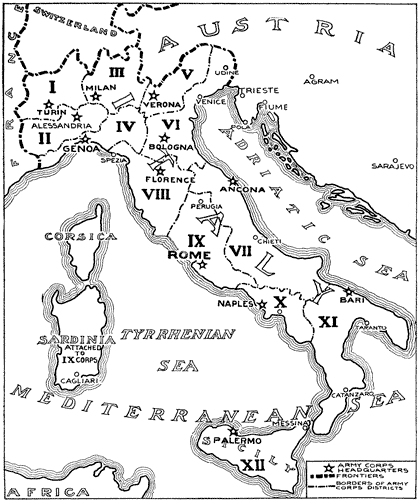
The organization for putting the above numbers of men into the field is as follows: The fully trained men are organized in four armies, each army consisting of three corps, one cavalry division, and a number of troops for the lines of communication. The twelve corps are recruited and organized on a territorial basis, each corps having its allotted area, as shown in the sketch, which also indicates the locality of corps headquarters. The Italian army corps, which is larger than that in other European armies, is composed of two active army divisions, with thirty guns each, one mobile militia division, brought up to strength from the territorial militia, one regiment of Bersaglieri, or light infantry, one cavalry regiment, one field artillery regiment of six batteries, (corps artillery,) and other technical and administrative units. The strength of the corps amounts to 50,000 men, with 8,400 horses and 126 guns, and this gives each of the four armies a strength of 150,000 men, 25,200 horses, and 378 guns, with the addition of a cavalry division of 4,200 sabres. The first line Italian army, therefore, which can be put into the field seven days after mobilization is ordered amounts to 600,000 men, 100,800 horses, 1,512 guns, and 16,200 sabres. But these cadres only absorb half the fully trained men called out on mobilization; duplicate corps will consequently be formed to take the place of the twelve first-line corps as soon as they have been dispatched to their concentration rendezvous. It is believed that sufficient guns have now been provided for these twelve duplicate corps, but it is unlikely that more than two cavalry divisions could be formed in addition to the four divisions with the first-line armies. These duplicate corps would be ready to take the field three or four weeks after the concentration of the first twelve corps. The above calculations show that within a few weeks after the declaration of war Italy can place in the field a force of 1,200,000 men, (24 corps,) and would still have 1,800,000 men of fighting age left at the depots after the field armies had been dispatched to the front.
[Enlarge]
Map showing the Military Districts of Italy.
The infantry are armed with the Mannlicher (1891) rifle, the field artillery with the 75-millimeter quick-firing Krupp gun, (1906,) and the mountain batteries, of which there are twenty-four, with a new 65-millimeter (2.56-inch) quick-firing gun of Italian construction. The heavy artillery is armed with a 149-millimeter field howitzer, also of Italian construction.
The organization of the Italian Army and the quality of the troops composing it were both tested in the Tripoli campaign, (1911-12,) and all military judges agree that the results prove the army to have reached a high standard of efficiency. The mobilization was only partial, but it was well carried out, and between October and December, 1911, 90,000 men, with 12,000 horses, were transported to Tripoli and Benghasi without a single hitch. Italian officers are well educated, and the men are brave and disciplined. Unlike the Austro-Hungarian Army, which is composed of men split into a variety of racial sections, the Italian Army is absolutely homogeneous, and the troops will enter the European struggle with the moral consciousness that they are fighting, not with aggressive intentions, but for the principle of nationality, which is the keynote to that marvelous progress which Italy has made since she became a nation in 1860.
The Italian Navy has ten up-to-date battleships in commission, all armed with twelve-inch guns, six of these being pre-dreadnoughts and four quite recently built dreadnoughts. These four latter ships carry a more powerful primary armament than the battleships of any other European country, the Dante Alighieri, the first of the type built, carrying twelve and the Conte di Cavour, Leonardo-da-Vinci, and Giulio Cesare thirteen twelve-inch guns mounted on the triple-turret system. Two more ships of the same class—the Caio Duilio and Andrea Dorea—are due to be commissioned this Autumn, and their completion will doubtless now be accelerated. Then there are four more battleships under construction, known as the Dandolo class—the Dandolo, Morosini, Mazzini, and Mameli—two of which are due to be launched in 1916 and two others in 1917. When completed these ships will be equal in gun power and speed to the ships of the Queen Elizabeth class, for they will carry eight fifteen-inch guns paired in four turrets—the triple-turret system having been abandoned—twenty six-inch and twenty-two fourteen-pr. guns, their speed being 25 knots. Besides these ten, or practically twelve, completed battleships, Italy has ten armored cruisers in commission and three twenty-eight knot light cruisers, but no fastgoing battle cruisers corresponding to those in the British and German Navies. She has also twenty-seven completed destroyers and thirteen thirty-two knot destroyers laid down, along with fifty-one torpedo boats and sixteen submarines, with four others building. With this fleet, which is half as strong again as the Austrian fleet, Italy can secure complete control of the Adriatic Sea and lock up the Austrian ships in Pola.