The Italian Invasion and Italo-Germanic Differences
Reading edition
Official reviews of the first month, ending June 23, of Italy's war with Austria-Hungary are still lacking.[4] On May 24 it was officially reported in London that Italy had given her adhesion to the agreement, already signed by the allied powers, not to conclude a separate peace. Active war operations were begun by Austria on the same day; bombs were dropped on Venice and five other Adriatic ports, shelled from air and some from sea. The attackers were driven off.
The rapid advance of the Italian armies which invaded Austria on the east had by May 27 carried part of the forces across the Isonzo River to Monfalcone, sixteen miles northwest of Trieste. Another force penetrated further to the north in the Crownland of Goritz and Gradisca. On June 4 the censored news from Udine, Italy, reported that encounters with the enemy thus far had been merely outpost skirmishes, but had allowed Italy to occupy advantageous positions in Austrian territory. The first important battle of the Italian campaign, for the possession of Tolmino, was reported on June 7.
A general Italian advance took place on June 7 across the Isonzo River from Caporetto to the sea, a distance of about forty miles. On June 12 reports from the Trentino indicated an Italian advance on Rovereto in Tyrol, thirteen miles southwest of Trent, and upon Mori, near by. Monfalcone was taken by the Italians on June 10—the first serious blow against Trieste—as Monfalcone is a railway junction and its electrical works operate the light and power of Trieste. In the extreme north, on the threshold of the Carnic Alps, after three days' fighting it was reported on June 10 that the Italians had swept the Austrians from Monte Croce and possessed themselves of Freikofel. The Austrian city of Gradisca was reported taken on June 11, as indicated in an official statement signed by Lieut. Gen. Count Cadorna, Chief of Staff of the Italian Army. The defenses of Goritz were shelled by the Italian artillery on June 13, and on June 14 the Italian eastern army had pushed forward along the Gulf of Trieste toward the town of Nabresina, nine miles from Trieste.
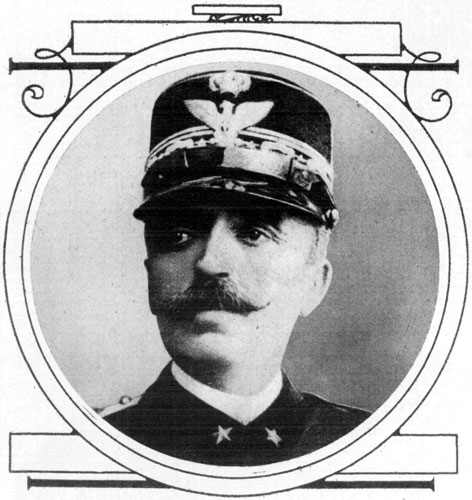
LIEUT. GEN. COUNT CADORNA Chief of the Italian General Staff (Photo from Paul Thompson)
The Italian advance was checked—but not until June 16, more than three weeks after the beginning of the war—by an elaborate system of intrenchments prepared by the Austrians along the Isonzo River. On June 17 the Italians in the Trentino had arrived at the town of Mori, where their forces were blocked by the fortifications between that town and Rovereto. On June 18 a dispatch of The Associated Press from Rome reported that the Austrians had then so strengthened their forces that they were taking the offensive both from Mori and Rovereto against the Italians, who were encamped at Brentanico at the foot of Mount Altissimo, at Serravale, situated in the Lagardina Valley, and also in the Arsa Valley. Tolmino, on Austria's battlefront to the north of Goritz, was being heavily fortified by the Austrians with a garrison of some 30,000 men, this place being considered indispensable to their operations as the key to the Isonzo Valley. On June 20, the fourth week of the war, was reported by General Cadorna as marking a brilliant victory at Plava. But on the following day reports from Rome indicated that the Italians were encountering strong and better-organized resistance from the Austrians. On June 22 dispatches from the Italian front to Berlin declared that serious reverses had been experienced by the Italians in their attempts to storm the Austro-Hungarian line along the Isonzo River.
Two things have puzzled the public: First, the status of Germany in regard to Italy declaring war against Austria-Hungary, arraying herself on the side of the Entente powers, and pledging herself, in turn, as each of them had done, not to make a separate peace with the enemy, and, second, the apparent weakness of the Austrian defensive in the Trentino and on the eastern frontier of Venetia.
Diplomatic relations between Rome and Berlin have been severed, but neither Chancellery has yet (June 23) found the other guilty of an aggression sufficiently grave to warrant a declaration of war. There is nothing astonishing in this situation. A similar situation obtained between Paris and Vienna and London and Vienna long after a state of war existed between Germany and Russia, France, and England.
The Italian plan of campaign apparently consists (1) in neutralizing the Trentino by capturing or "covering" her defenses and cutting her two lines of communication with Austria proper—the railway which runs south from Innsbruck and that which runs southwest from Vienna and joins the former at Franzensfeste, and (2) in a movement in force from the eastern frontier, with Trieste captured or "covered" on the right flank, in the direction of the Austrian fortress of Klagenfurt and Vienna, only 170 miles northeast from the present base of operations—a distance equal to that from New York City to Cape Cod.
The initial weakness of the Austrian defensive, which will doubtless be strengthened as troops can be spared from the seat of war in Galicia, is due to the fact that the invaded regions are normally defended by the Fourteenth and Third Army Corps, which were, in August, sent with two reserve corps to defend the Austrian line in Galicia. To fill the casualties in these corps the drain on the population has been great, so that when Italy began her invasion the defenses of the country were chiefly in the hands of the hastily mobilized youths below the military age of 19 and men above the military age of 42.
During the last six months, when Vienna gradually came to realize that war with Italy was inevitable, the Austro-Hungarian military authorities enrolled a new army of men who had already seen military service, but, for various reasons, had not been availed of in the present war. They were men of an unusually high mental and physical standard and had received additional training under German officers. Their ages were from 35 to 40, and they numbered from 700,000 to 800,000. On the desire of the German War Office this new army, which should have been sent to the Italian frontiers, was diverted to Galicia toward the last of April, and since then has been the backbone of the Teutonic drive against Russia in that region.
Below are given a sketch of the Alpine frontier by G.H. Perris, appearing in The London Chronicle of May 29; Colonel Murray's article on Italy's armed strength, and the speeches of mutual defiance uttered by the German Imperial Chancellor in the Reichstag on May 28 and the Italian Premier at the Capitol in Rome on June 2.