A Coalition Ministry with Lloyd George in a New Office
Reading edition
The formation of a British coalition Cabinet was announced on May 25, 1915, with the creation of a new office of Minister of Munitions, to which Lloyd George was transferred from the Chancellorship of the Exchequer. Below is given the official list of the new Ministers and their offices. In the third column are indicated the same offices as held under the late Liberal Administration. The eight members of the Opposition included in the new Cabinet are indicated by an asterisk:
Coalition Cabinet.Late Liberal Cabinet.
Prime MinisterMr. AsquithMr. Asquith.
Minister without portfolioLord Lansdowne*——
Lord ChancellorSir S. BuckmasterLord Haldane.
President of CouncilLord CreweLord Beauchamp.
Lord Privy SealLord Curzon*Lord Crewe.
Chancellor of the ExchequerMr. McKennaMr. Lloyd George.
Home SecretarySir J. SimonMr. McKenna.
Foreign MinisterSir E. GreySir E. Grey.
Colonial SecretaryMr. Bonar Law*Mr. Harcourt.
India OfficeMr. Chamberlain*Lord Crewe.
War OfficeLord KitchenerLord Kitchener.
Minister of Munitions (new)Mr. Lloyd George——
AdmiraltyMr. Balfour*Mr. Churchill.
Board of TradeMr. RuncimanMr. Runciman.
Local Government BoardMr. Long*Mr. H. Samuel.
Duchy of LancasterMr. ChurchillHon. E. Montagu.
Irish SecretaryMr. BirrellMr. Birrell.
Scottish OfficeMr. McKinnon WoodMr. McKinnon Wood.
AgricultureLord Selborne*Lord Lucas.
Works OfficeMr. HarcourtLord Emmott.
Education BoardMr. A. HendersonMr. J.A. Pease.
Attorney GeneralSir E. Carson*Sir John Simon.
THE NEW BRITISH COALITION CABINET
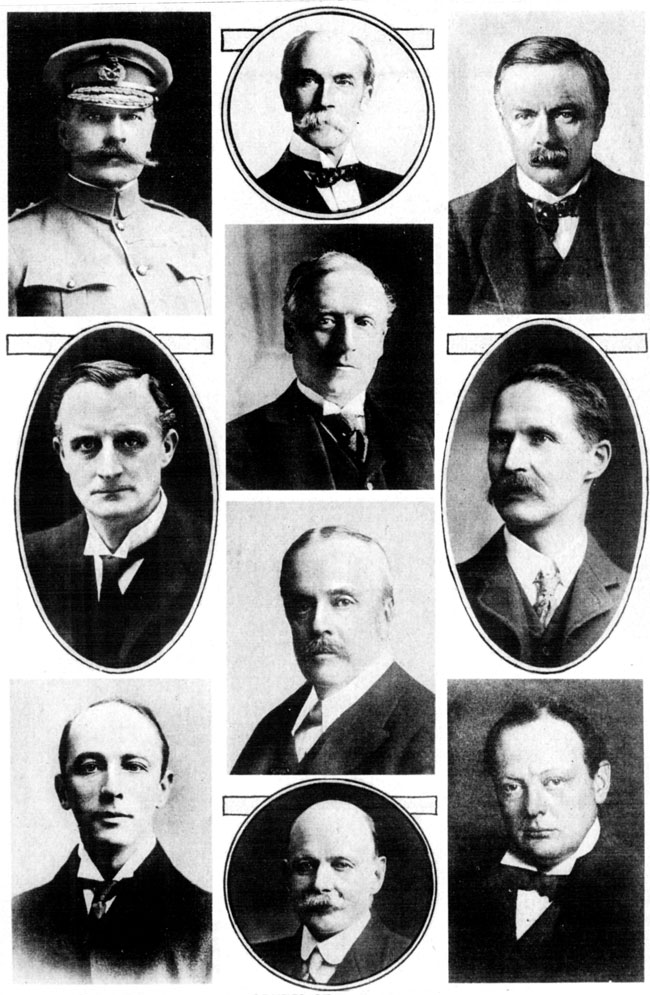
EARL KITCHENER Secretary of State for War SIR EDWARD GREY Secretary of State for Foreign Affairs BARON BUCKMASTER Lord High Chancellor MARQUESS OF LANSDOWNE Minister Without Portfolio H.H. ASQUITH Prime Minister ARTHUR J. BALFOUR First Lord of the Admiralty WALTER HUME LONG President of the Local Government Board DAVID LLOYD GEORGE Minister of Munitions ANDREW BONAR LAW Secretary for the Colonies WINSTON S. CHURCHILL Chancellor of the Duchy of Lancaster
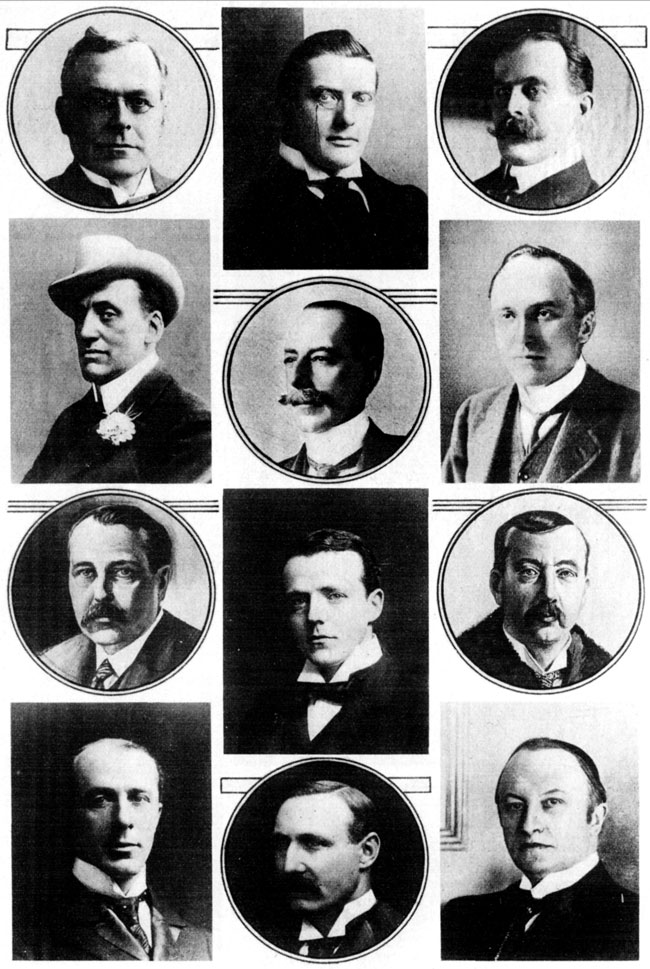
AUGUSTINE BIRRELL Chief Secretary for Ireland SIR EDWARD CARSON Attorney General THOMAS McK. WOOD Secretary for Scotland REGINALD McKENNA Chancellor of the Exchequer AUSTEN CHAMBERLAIN Secretary for India LEWIS HARCOURT First Commissioner of Works WALTER RUNCIMAN President of the Board of Trade EARL OF SELBORNE President of the Board of Agriculture MARQUESS OF CREWE Lord President of the Council SIR JOHN SIMON Secretary of State for Home Affairs ARTHUR HENDERSON President of the Board of Education EARL CURZON Lord Privy Seal
The reconstruction of the Liberal Ministry that had ruled the British Empire for ten years was announced by Prime Minister Asquith in the following statement in the House of Commons on May 19:
I cannot say more at the moment than that steps are in contemplation which involve a reconstruction of the Government on a broader personal and political basis. Nothing is yet definitely arranged, but to avoid any possible misapprehension I wish here and now—as the House is to adjourn—to make clear to every one three things:
First, that any change that takes place will not affect the offices of the head of the Government or of the Foreign Secretary. [Cheers.] They will continue to be held as they are now. [Renewed cheers.]
The second is, there is absolutely no change of any kind in contemplation in the policy of the country in regard to the continued prosecution of the war with all possible energy, and by means of every available resource. [Loud cheers.]
The third and the last point—one of great importance, not only to my friends behind me, but also of importance no doubt to the Opposition—is this: Any reconstruction that may be made will be for the purpose of the war alone, and is not to be taken in any quarter as any reason for indicating anything in the nature of surrender or compromise on the part of any person or body of persons of their several political purposes and ideals.
That is really as far as I can go at the moment. Nothing definite has yet taken place. When and if an arrangement of this kind should become an accomplished fact the House will have the fullest opportunity of expressing itself, if it so desires, upon it. [Cheers.]
Mr. Bonar Law, leader of the Opposition, rose immediately after the Prime Minister and said:
I think it only necessary to say on behalf of my friends and myself that at the stage which this has reached our sole consideration in taking into account what further steps should be taken will be what is the best method of finishing the war successfully, and we shall leave out of our minds absolutely all considerations, political or otherwise, beyond the war; while, of course, if such an arrangement should take place, it is obvious our convictions on other subjects will remain unchanged, and will be settled when this danger is over.
CAUSES OF THE CHANGE.
At least four causes which were regarded as contributing to bring about a coalition Ministry, or War Government, are tersely outlined by A.P. Nicholson, Parliamentary correspondent of The London Daily News, as follows:
First—The quarrel between Mr. Churchill and Lord Fisher at the Admiralty, a conflict which began with the undertaking of the Dardanelles expedition. Mr. Churchill carried the War Council on this, and it was undertaken before the Cabinet were informed. The Cabinet were committed to it by the movement of ships before they had any formal notification. Lord Fisher, for his part, considered that the enterprise should not have been begun unless it was supported by land forces, but he also was committed to it. Mr. Churchill was counting on the support of Greek forces on land, a calculation which was not justified by the event.
Lately the quarrel between Lord Fisher and Mr. Churchill proved to be irreconcilable, and Lord Fisher sent in his resignation at the week-end. It is now hoped that he will withdraw his resignation, and the possibility of Mr. Churchill replacing Lord Crewe at the India Office or taking another office is being discussed.
Second—The Cabinet have not been kept informed by Lord Kitchener as to the supplies of high explosive shells sent out to our troops at the front. It is the fact that huge supplies of shells have been and are being sent out, but the proportion of shrapnel is greater than the proportion of high explosive shells, and the army command require that the proportion of high explosive shells should be greater. The fact that the Cabinet have been to some extent in the dark of late on this matter accounts for some apparent discrepancies in recent Ministerial statements.
Third—The Opposition leaders were in possession of the facts as to the high explosive shells, and threatened a debate in the House of Commons, in which their statements should be proved. Such a debate would have gravely undermined the authority of the Government, and, coupled with the tendered resignation of Lord Fisher, and the consequent disappearance either of the First Sea Lord or Mr. Churchill, would in all human probability have led to the disastrous downfall of the King's Government in the midst of the national peril of this war, with consequences most lamentable.
Fourth—There have been on both sides some leading statesmen in favor of a coalition Ministry for the prosecution of the war. They are few, but influential. They perceived that the curious circumstances that had arisen offered a brilliant opportunity to achieve a coalition, and they seized the opportunity. It should certainly be assumed that they were actuated by national motives, since their action may have averted the downfall of one of the greatest Governments of modern times in a time of national peril.