Volume 2 — Three Speeches By President Wilson
Reading edition
In New York at the annual luncheon of The Associated Press on April 20, 1915; at Philadelphia in Convention Hall on May 10, in an address to 4,000 newly naturalized citizens, and again at New York in his speech on the navy, May 17, delivered at the luncheon given for the President by the Mayor's Committee formed for the naval review, Mr. Wilson set forth the principles on which he would meet the crises of the European war as they affect the United States. The texts of the three speeches appear below.
I.—"AMERICA FIRST."
[President Wilson's address on April 20, 1915, to the members of The Associated Press at their annual luncheon in New York:]
I am deeply gratified by the generous reception you have accorded me. It makes me look back with a touch of regret to former occasions when I have stood in this place and enjoyed a greater liberty than is granted me today. There have been times when I stood in this spot and said what I really thought, and I pray God that those days of indulgence may be accorded me again. But I have come here today, of course, somewhat restrained by a sense of responsibility that I cannot escape.
For I take The Associated Press very seriously. I know the enormous part that you play in the affairs not only of this country, but the world. You deal in the raw material of opinion and, if my convictions have any validity, opinion ultimately governs the world.
It is, therefore, of very serious things that I think as I face this body of men. I do not think of you, however, as members of The Associated Press. I do not think of you as men of different parties or of different racial derivations or of different religious denominations, I want to talk to you as to my fellow-citizens of the United States. For there are serious things which as fellow-citizens we ought to consider.
The times behind us, gentlemen, have been difficult enough, the times before us are likely to be more difficult because, whatever may be said about the present condition of the world's affairs, it is clear that they are drawing rapidly to a climax, and at the climax the test will come, not only of the nations engaged in the present colossal struggle, it will come for them of course, but the test will come to us particularly.
Do you realize that, roughly speaking, we are the only great nation at present disengaged? I am not speaking, of course, with disparagement of the greater of those nations in Europe which are not parties to the present war, but I am thinking of their close neighborhood to it. I am thinking how their lives much more than ours touch the very heart and stuff of the business; whereas, we have rolling between us and those bitter days across the water three thousand miles of cool and silent ocean.
Our atmosphere is not yet charged with those disturbing elements which must be felt and must permeate every nation of Europe. Therefore, is it not likely that the nations of the world will some day turn to us for the cooler assessment of the elements engaged?
I am not now thinking so preposterous a thought as that we should sit in judgment upon them. No nation is fit to sit in judgment upon any other nation, but that we shall some day have to assist in reconstructing the processes of peace. Our resources are untouched; we are more and more becoming by the force of circumstances the mediating nation of the world in respect to its finances. We must make up our minds what are the best things to do and what are the best ways to do them.
We must put our money, our energy, our enthusiasm, our sympathy into these things; and we must have our judgments prepared and our spirits chastened against the coming of that day. So that I am not speaking in a selfish spirit when I say that our whole duty for the present, at any rate, is summed up in this motto, "America first." Let us think of America before we think of Europe, in order that America may be fit to be Europe's friend when the day of tested friendship comes. The test of friendship is not now sympathy with the one side or the other, but getting ready to help both sides when the struggle is over.
The basis of neutrality, gentlemen, is not indifference; it is not self-interest. The basis of neutrality is sympathy for mankind. It is fairness, it is good-will at bottom. It is impartiality of spirit and of judgment. I wish that all of our fellow-citizens could realize that.
There is in some quarters a disposition to create distempers in this body politic. Men are even uttering slanders against the United States as if to excite her. Men are saying that if we should go to war upon either side there will be a divided America—an abominable libel of ignorance. America is not all of it vocal just now. It is vocal in spots.
But I for one have a complete and abiding faith in that great silent body of Americans who are not standing up and shouting and expressing their opinions just now, but are waiting to find out and support the duty of America. I am just as sure of their solidity and of their loyalty and of their unanimity, if we act justly, as I am that the history of this country has at every crisis and turning point illustrated this great lesson.
We are the mediating nation of the world. I do not mean that we undertake not to mind our own business and to mediate where other people are quarreling. I mean the word in a broader sense. We are compounded of the nations of the world. We mediate their blood, we mediate their traditions, we mediate their sentiments, their tastes, their passions; we are ourselves compounded of those things.
We are, therefore, able to understand all nations; we are able to understand them in the compound, not separately, as partisans, but unitedly, as knowing and comprehending and embodying them all. It is in that sense that I mean that America is a mediating nation. The opinion of America, the action of America, is ready to turn and free to turn in any direction.
Did you ever reflect upon how almost all other nations, almost every other nation has through long centuries been headed in one direction? That is not true of the United States. The United States has no racial momentum. It has no history back of it which makes it run all its energies and all its ambitions in one particular direction; and America is particularly free in this, that she has no hampering ambitions as a world power.
If we have been obliged by circumstances or have considered ourselves to be obliged by circumstances, in the past to take territory which we otherwise would not have thought of taking, I believe I am right in saying that we have considered it our duty to administer that territory, not for ourselves, but for the people living in it, and to put this burden upon our consciences not to think that this thing is ours for our use, but to regard ourselves as trustees of the great business for those to whom it does really belong, trustees ready to hand over the cosmic trust at any time when the business seems to make that possible and feasible. That is what I mean by saying we have no hampering ambitions.
We do not want anything that does not belong to us. Isn't a nation in that position free to serve other nations, and isn't a nation like that ready to form some part of the assessing opinion of the world?
My interest in the neutrality of the United States is not the petty desire to keep out of trouble. To judge by my experience I have never been able to keep out of trouble. I have never looked for it, but I have always found it. I do not want to walk around trouble. If any man wants a scrap—that is, an interesting scrap and worth while—I am his man. I warn him that he is not going to draw me into the scrap for his advertisement, but if he is looking for trouble—that is, the trouble of men in general—and I can help a little, why, then, I am in for it. But I am interested in neutrality because there is something so much greater to do than fight, because there is something, there is a distinction waiting for this nation that no nation has ever yet got. That is the distinction of absolute self-control and self-mastery.
Whom do you admire most among your friends? The irritable man? The man out of whom you can get a "rise" without trying? The man who will fight at the drop of the hat, whether he knows what the hat is dropped for or not?
Don't you admire and don't you fear, if you have to contest with him, the self-mastered man who watches you with calm eye and comes in only when you have carried the thing so far that you must be disposed of? That is the man you respect. That is the man who you know has at bottom a much more fundamental and terrible courage than the irritable, fighting man.
Now, I covet for America this splendid courage of reserve moral force, and I wanted to point out to you gentlemen simply this: There is news and news. There is what is called news from Turtle Bay, that turns out to be falsehood, at any rate in what it is said to signify, and which if you could get the nation to believe it true might disturb our equilibrium and our self-possession. We ought not to deal in stuff of that kind. We ought not to permit things of that sort to use up the electrical energy of the wires, because its energy is malign, its energy is not of the truth, its energy is of mischief.
It is possible to sift truth. I have known some things to go out on the wires as true when there was only one man or one group of men who could have told the originators of the report whether it was true or not, and they were not asked whether it was true or not for fear it might not be true. That sort of report ought not to go out over the wires.
There is generally, if not always, somebody who knows whether that thing is so or not, and in these days above all other days we ought to take particular pains to resort to the one small group of men or to the one man, if there be but one, who knows whether those things are true or not.
The world ought to know the truth, but the world ought not at this period of unstable equilibrium to be disturbed by rumor, ought not to be disturbed by imaginative combinations of circumstances or, rather, by circumstances stated in combination which do not belong in combination. For we are holding—not I, but you and gentlemen engaged like you—the balances in your hand. This unstable equilibrium rests upon scales that are in your hands. For the food of opinion, as I began by saying, is the news of the day. I have known many a man go off at a tangent on information that was not reliable. Indeed, that describes the majority of men. The world is held stable by the man who waits for the next day to find out whether the report was true or not.
We cannot afford, therefore, to let the rumors of irresponsible persons and origins get into the atmosphere of the United States. We are trustees for what I venture to say is the greatest heritage that any nation ever had, the love of justice and righteousness and human liberty. For fundamentally those are the things to which America is addicted and to which she is devoted.
There are groups of selfish men in the United States, there are coteries where sinister things are purposed, but the great heart of the American people is just as sound and true as it ever was. And it is a single heart; it is the heart of America. It is not a heart made up of sections selected out of other countries.
So that what I try to remind myself of every day when I am almost overcome by perplexities, what I try to remember, is what the people at home are thinking about. I try to put myself in the place of the man who does not know all the things that I know and ask myself what he would like the policy of this country to be. Not the talkative man, not the partisan man, not the man that remembers first that he is a Republican or Democrat, or that his parents were Germans or English, but who remembers first that the whole destiny of modern affairs centres largely upon his being an American first of all.
If I permitted myself to be a partisan in this present struggle I would be unworthy to represent you. If I permitted myself to forget the people who are not partisans I would be unworthy to represent you. I am not saying that I am worthy to represent you, but I do claim this degree of worthiness—that before everything else I love America.
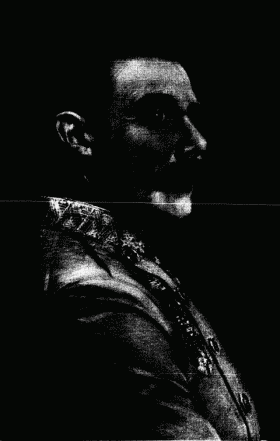
THE LATE ARCHDUKE FERDINAND— Whose Assassination at Serajevo Precipitated the European War
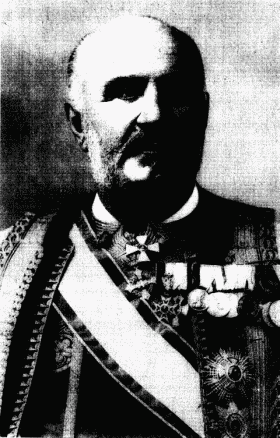
H.M. NICHOLAS I.—King of Montenegro, the Smallest of the Allied Powers— (Photo © American Press Assn.)
II.—"HUMANITY FIRST."
[President Wilson's speech in Convention Hall, Philadelphia, Penn., May 10, 1915, before 4,000 newly naturalized citizens:]
It warms my heart that you should give me such a reception, but it is not of myself that I wish to think tonight, but of those who have just become citizens of the United States. This is the only country in the world which experiences this constant and repeated rebirth. Other countries depend upon the multiplication of their own native people. This country is constantly drinking strength out of new sources by the voluntary association with it of great bodies of strong men and forward-looking women. And so by the gift of the free will of independent people it is constantly being renewed from generation to generation by the same process by which it was originally created. It is as if humanity had determined to see to it that this great nation, founded for the benefit of humanity, should not lack for the allegiance of the people of the world.
You have just taken an oath of allegiance to the United States. Of allegiance to whom? Of allegiance to no one, unless it be God. Certainly not of allegiance to those who temporarily represent this great Government. You have taken an oath of allegiance to a great ideal, to a great body of principles, to a great hope of the human race. You have said, "We are going to America," not only to earn a living, not only to seek the things which it was more difficult to obtain where you were born, but to help forward the great enterprises of the human spirit—to let men know that everywhere in the world there are men who will cross strange oceans and go where a speech is spoken which is alien to them, knowing that, whatever the speech, there is but one longing and utterance of the human heart, and that is for liberty and justice.
And while you bring all countries with you, you come with a purpose of leaving all other countries behind you—bringing what is best of their spirit, but not looking over your shoulders and seeking to perpetuate what you intended to leave in them. I certainly would not be one even to suggest that a man cease to love the home of his birth and the nation of his origin—these things are very sacred and ought not to be put out of our hearts—but it is one thing to love the place where you were born and it is another thing to dedicate yourself to the place to which you go. You cannot dedicate yourself to America unless you become in every respect and with every purpose of your will thorough Americans. You cannot become thorough Americans if you think of yourselves in groups. American does not consist of groups. A man who thinks himself as belonging to a particular national group in America has not yet become an American, and the man who goes among you to trade upon your nationality is no worthy son to live under the Stars and Stripes.
My urgent advice to you would be not only always to think first of America, but always, also, to think first of humanity. You do not love humanity if you seek to divide humanity into jealous camps. Humanity can be welded together only by love, by sympathy, by justice, not by jealousy and hatred. I am sorry for the man who seeks to make personal capital out of the passions of his fellow-men. He has lost the touch and ideal of America, for America was created to unite mankind by those passions which lift and not by the passions which separate and debase.
We came to America, either ourselves or in persons of our ancestors, to better the ideals of men, to make them see finer things than they had seen before, to get rid of things that divide, and to make sure of the things that unite. It was but a historical accident no doubt that this great country was called the "United States," and yet I am very thankful that it has the word "united" in its title; and the man who seeks to divide man from man, group from group, interest from interest, in the United States is striking at its very heart.
It is a very interesting circumstance to me, in thinking of those of you who have just sworn allegiance to this great Government, that you were drawn across the ocean by some beckoning finger of hope, by some belief, by some vision of a new kind of justice, by some expectation of a better kind of life.
No doubt you have been disappointed in some of us; some of us are very disappointing. No doubt you have found that justice in the United States goes only with a pure heart and a right purpose as it does everywhere else in the world. No doubt what you found here didn't seem touched for you, after all, with the complete beauty of the ideal which you had conceived beforehand.
But remember this, if we had grown at all poor in the ideal, you brought some of it with you. A man does not go out to seek the thing that is not in him. A man does not hope for the thing that he does not believe in, and if some of us have forgotten what America believed in, you, at any rate, imported in your own hearts a renewal of the belief. That is the reason that I, for one, make you welcome.
If I have in any degree forgotten what America was intended for, I will thank God if you will remind me.
I was born in America. You dreamed dreams of what America was to be, and I hope you brought the dreams with you. No man that does not see visions will ever realize any high hope or undertake any high enterprise.
Just because you brought dreams with you, America is more likely to realize the dreams such as you brought. You are enriching us if you came expecting us to be better than we are.
See, my friends, what that means. It means that Americans must have a consciousness different from the consciousness of every other nation in the world. I am not saying this with even the slightest thought of criticism of other nations. You know how it is with a family. A family gets centred on itself if it is not careful and is less interested in the neighbors than it is in its own members.
So a nation that is not constantly renewed out of new sources is apt to have the narrowness and prejudice of a family. Whereas, America must have this consciousness, that on all sides it touches elbows and touches hearts with all the nations of mankind.
The example of America must be a special example. The example of America must be the example not merely of peace because it will not fight, but of peace because peace is the healing and elevating influence of the world and strife is not.
There is such a thing as a man being too proud to fight. There is such a thing as a nation being so right that it does not need to convince others by force that it is right.
So, if you come into this great nation as you have come, voluntarily seeking something that we have to give, all that we have to give is this: We cannot exempt you from work. No man is exempt from work anywhere in the world. I sometimes think he is fortunate if he has to work only with his hands and not with his head. It is very easy to do what other people give you to do, but it is very difficult to give other people things to do. We cannot exempt you from work; we cannot exempt you from the strife and the heart-breaking burden of the struggle of the day—that is common to mankind everywhere. We cannot exempt you from the loads that you must carry; we can only make them light by the spirit in which they are carried. That is the spirit of hope, it is the spirit of liberty, it is the spirit of justice.
When I was asked, therefore, by the Mayor and the committee that accompanied him to come up from Washington to meet this great company of newly admitted citizens I could not decline the invitation. I ought not to be away from Washington, and yet I feel that it has renewed my spirit as an American.
In Washington men tell you so many things every day that are not so, and I like to come and stand in the presence of a great body of my fellow-citizens, whether they have been my fellow-citizens a long time or a short time, and drink, as it were, out of the common fountains with them and go back feeling that you have so generously given me the sense of your support and of the living vitality in your hearts, of its great ideals which made America the hope of the world.
III.—AMERICA FOR HUMANITY.
[President Wilson's address to the Mayor's Committee in New York, May 17, 1915, on the occasion of the naval parade and review in the Hudson:]
Mr. Mayor, Mr. Secretary, Admiral Fletcher, and Gentlemen of the Fleet: This is not an occasion upon which it seems to me that it would be wise for me to make many remarks, but I would deprive myself of a great gratification if I did not express my pleasure in being here, my gratitude for the splendid reception which has been accorded me as the representative of the nation, and my profound interest in the navy of the United States. That is an interest with which I was apparently born, for it began when I was a youngster and has ripened with my knowledge of the affairs and policies of the United States.
I think it is a natural, instinctive judgment of the people of the United States that they express their power appropriately in an efficient navy, and their interest is partly, I believe, because that navy somehow is expected to express their character, not within our own borders where that character is understood, but outside our borders, where it is hoped we may occasionally touch others with some slight vision of what America stands for.
But before I speak of the navy of the United States I want to take advantage of the first public opportunity I have had to speak of the Secretary of the Navy, to express my confidence and my admiration, and to say that he has my unqualified support, for I have counseled with him in intimate fashion. I know how sincerely he has it at heart that everything that the navy does and handles should be done and handled as the people of the United States wish them handled—because efficiency is something more than organization. Efficiency runs into every well-considered detail of personnel and method. Efficiency runs to the extent of lifting the ideals of a service above every personal interest. So that when I speak my support of the Secretary of the Navy I am merely speaking my support of what I know every true lover of the navy to desire and to purpose, for the navy of the United States is a body specially trusted with the ideal of America.
I like to image in my thought this ideal. These quiet ships lying in the river have no suggestion of bluster about them—no intimation of aggression. They are commanded by men thoughtful of the duty of citizens as well as the duty of officers—men acquainted with the traditions of the great service to which they belong—men who know by touch with the people of the United States what sort of purposes they ought to entertain and what sort of discretion they ought to exercise in order to use those engines of force as engines to promote the interests of humanity.
For the interesting and inspiring thing about America, gentlemen, is that she asks nothing for herself except what she has a right to ask for humanity itself. We want no nation's property; we wish to question no nation's honor; we wish to stand selfishly in the way of the development of no nation; we want nothing that we cannot get by our own legitimate enterprise and by the inspiration of our own example, and, standing for these things, it is not pretention on our part to say that we are privileged to stand for what every nation would wish to stand for, and speak for those things which all humanity must desire.
When I think of the flag that those ships carry, the only touch of color about them, the only thing that moves as if it had a settled spirit in it, in their solid structure, it seems to me I see alternate strips of parchment upon which are written the rights of liberty and justice and strips of blood spilt to vindicate those rights, and then, in the corner, a prediction of the blue serene into which every nation may swim which stands for these great things.
The mission of America is the only thing that a sailor or soldier should think about; he has nothing to do with the formulation of her policy; he is to support her policy, whatever it is—but he is to support her policy in the spirit of herself, and the strength of our policy is that we, who for the time being administer the affairs of this nation, do not originate her spirit; we attempt to embody it; we attempt to realize it in action we are dominated by it, we do not dictate it.
And so with every man in arms who serves the nation—he stands and waits to do the thing which the nation desires. America sometimes seems perhaps to forget her programs, or, rather, I would say that sometimes those who represent her seem to forget her programs, but the people never forget them. It is as startling as it is touching to see how whenever you touch a principle you touch the hearts of the people of the United States. They listen to your debates of policy, they determine which party they will prefer to power, they choose and prefer as ordinary men; but their real affection, their real force, their real irresistible momentum, is for the ideas which men embody.
I never go on the streets of a great city without feeling that somehow I do not confer elsewhere than on the streets with the great spirit of the people themselves, going about their business, attending to the things which concern them, and yet carrying a treasure at their hearts all the while, ready to be stirred not only as individuals, but as members of a great union of hearts that constitutes a patriotic people.
And so this sight in the river touches me merely as a symbol of that, and it quickens the pulse of every man who realizes these things to have anything to do with them. When a crisis occurs in this country, gentlemen, it is as if you put your hand on the pulse of a dynamo, it is as if the things which you were in connection with were spiritually bred. You had nothing to do with them except, if you listen truly, to speak the things that you hear. These things now brood over the river, this spirit now moves with the men who represent the nation in the navy, these things will move upon the waters in the manoeuvres; no threat lifted against any man, against any nation, against any interest, but just a great, solemn evidence that the force of America is the force of moral principle, that there is not anything else that she loves and that there is not anything else for which she will contend.