Volume 2 — The Warning And The Consequence—
Reading edition
THE GERMAN WARNING.
[On Saturday, May 1, the day that the Lusitania left New York on her last voyage, the following advertisement bearing the authentication of the German Embassy at Washington appeared in the chief newspapers of the United States, placed next the advertisement of the Cunard Line:
NOTICE!
TRAVELLERS intending to embark on the Atlantic voyage are reminded that a state of war exists between Germany and her allies and Great Britain and her allies; that the zone of war includes the waters adjacent to the British Isles; that, in accordance with formal notice given by the Imperial German Government vessels flying the flag of Great Britain, or of any of her allies, are liable to destruction in those waters and that travellers sailing in the war zone on ships of Great Britain or her allies do so at their own risk.
IMPERIAL GERMAN EMBASSY
WASHINGTON, D.C., APRIL 22, 1915.
Despite this warning, relying on President Wilson's note to Germany of Feb. 10, 1915, which declared that the United States would "hold the Imperial Government of Germany to a strict accountability" for such an act within the submarine zone; relying, also, on the speed of the ship, and hardly conceiving that the threat would be carried out, over two thousand men, women, and children embarked. The total toll of the dead was 1,150, of whom 114 were known to be American citizens.
The German Embassy's warning advertisement was repeated on May 8, the day following the loss of the Lusitania. On May 12 the German Embassy notified the newspapers to discontinue publication of the advertisement, which had been scheduled to appear for the third time on the following Saturday.]
GERMAN OFFICIAL REPORT.
[By The Associated Press.]
BERLIN, May 14, (via Amsterdam to London, May 15.)—From the report received from the submarine which sank the Cunard Line steamer Lusitania last Friday the following official version of the incident is published by the Admiralty Staff over the signature of Admiral Behncke:
The submarine sighted the steamer, which showed no flag, May 7 at 2:20 o'clock, Central European time, afternoon, on the southeast coast of Ireland, in fine, clear weather.
At 3:10 o'clock one torpedo was fired at the Lusitania, which hit her starboard side below the Captain's bridge. The detonation of the torpedo was followed immediately by a further explosion of extremely strong effect. The ship quickly listed to starboard and began to sink.
The second explosion must be traced back to the ignition of quantities of ammunition inside the ship.
It appears from this report that the submarine sighted the Lusitania at 1:20 o'clock, London time, and fired the torpedo at 2:10 o'clock, London time. The Lusitania, according to all reports, was traveling at the rate of eighteen knots an hour. As fifty minutes elapsed between the sighting and the torpedoing, the Lusitania when first seen from the submarine must have been distant nearly fifteen knots, or about seventeen land miles. The Lusitania must have been recognized at the first appearance of the tops of her funnels above the horizon. To the Captain on the bridge of the Lusitania the submarine would have been at that time invisible, being below the horizon.
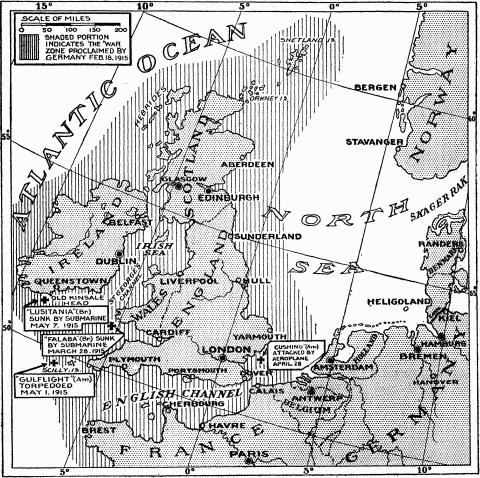
Map Showing Locations of Ships Attacked in Submarine War Zone with American Citizens Aboard.
BRITISH CORONER'S VERDICT.
[By The Associated Press.]
KINSALE, Ireland, May 10.—The verdict, rendered here today by the coroner's jury, which investigated five deaths resulting from the torpedoing of the Lusitania, is as follows:
We find that the deceased met death from prolonged immersion and exhaustion in the sea eight miles south-southeast of Old Head of Kinsale, Friday, May 7, 1915, owing to the sinking of the Lusitania by torpedoes fired by a German, submarine.
We find that the appalling crime was committed contrary to international law and the conventions of all civilized nations.
We also charge the officers of said submarine and the Emperor and the Government of Germany, under whose orders they acted, with the crime of wholesale murder before the tribunal of the civilized world.
We desire to express sincere condolences and sympathy with the relatives of the deceased, the Cunard Company, and the United States, many of whose citizens perished in this murderous attack on an unarmed liner.
GERMAN NOTE OF REGRET.
BERLIN, (via London,) May 10.—The following dispatch has been sent by the German Foreign Office to the German Embassy at Washington:
Please communicate the following to the State Department: The German Government desires to express its deepest sympathy at the loss of lives on board the Lusitania. The responsibility rests, however, with the British Government, which, through its plan of starving the civilian population of Germany, has forced Germany to resort to retaliatory measures.
In spite of the German offer to stop the submarine war in case the starvation plan was given up, British merchant vessels are being generally armed with guns and have repeatedly tried to ram submarines, so that a previous search was impossible.
They cannot, therefore, be treated as ordinary merchant vessels. A recent declaration made to the British Parliament by the Parliamentary Secretary in answer to a question by Lord Charles Beresford said that at the present practically all British merchant vessels were armed and provided with hand grenades.
Besides, it has been openly admitted by the English press that the Lusitania on previous voyages repeatedly carried large quantities of war material. On the present voyage the Lusitania carried 5,400 cases of ammunition, while the rest of her cargo also consisted chiefly of contraband.
If England, after repeated official and unofficial warnings, considered herself able to declare that that boat ran no risk and thus light-heartedly assumed responsibility for the human life on board a steamer which, owing to its armament and cargo, was liable to destruction, the German Government, in spite of its heartfelt sympathy for the loss of American lives, cannot but regret that Americans felt more inclined to trust to English promises rather than to pay attention to the warnings from the German side.
FOREIGN OFFICE.
ENGLAND ANSWERS GERMANY. 1
[By The Associated Press.]
LONDON, Wednesday, May 12.—Inquiry in official circles elicited last night the following statement, representing the official British view of Germany's justification for torpedoing the Lusitania which Berlin transmitted to the State Department at Washington:
The German Government states that responsibility for the loss of the Lusitania rests with the British Government, which through their plan of starving the civil population of Germany has forced Germany to resort to retaliatory measures The reply to this is as follows:
As far back as last December Admiral von Tirpitz, (the German Marine Minister,) in an interview, foreshadowed a submarine blockade of Great Britain, and a merchant ship and a hospital ship were torpedoed Jan. 30 and Feb. 1, respectively.
The German Government on Feb. 4 declared their intention of instituting a general submarine blockade of Great Britain and Ireland, with the avowed purpose of cutting off supplies for these islands. This blockade was put into effect Feb. 18.
As already stated, merchant vessels had, as a matter of fact, been sunk by a German submarine at the end of January. Before Feb. 4 no vessel carrying food supplies for Germany had been held up by his Majesty's Government except on the ground that there was reason to believe the foodstuffs were intended for use of the armed forces of the enemy or the enemy Government.
His Majesty's Government had, however informed the State Department on Jan. 29 that they felt bound to place in a prize court the foodstuffs of the steamer Wilhelmina, which was going to a German port, in view of the Government control of foodstuffs in Germany, as being destined for the enemy Government and, therefore, liable to capture.
The decision of his Majesty's Government to carry out the measures laid down by the Order in Council was due to the action of the German Government in insisting on their submarine blockade.
This, added to other infractions of international law by Germany, led to British reprisals, which differ from the German action in that his Majesty's Government scrupulously respect the lives of noncombatants traveling in merchant vessels, and do not even enforce the recognized penalty of confiscation for a breach of the blockade, whereas the German policy is to sink enemy or neutral vessels at sight, with total disregard for the lives of noncombatants and the property of neutrals.
The Germans state that, in spite of their offer to stop their submarine war in case the starvation plan was given up, Great Britain has taken even more stringent blockade measures. The answer to this is as follows:
It was not understood from the reply of the German Government that they were prepared to abandon the principle of sinking British vessels by submarine.
They have refused to abandon the use of mines for offensive purposes on the high seas on any condition. They have committed various other infractions of international law, such as strewing the high seas and trade routes with mines, and British and neutral vessels will continue to run danger from this course, whether Germany abandons her submarine blockade or not.
It should be noted that since the employment of submarines, contrary to international law, the Germans also have been guilty of the use of asphyxiating gas. They have even proceeded to the poisoning of water in South Africa.
The Germans represent British merchant vessels generally as armed with guns and say that they repeatedly ram submarines. The answer to this is as follows:
It is not to be wondered at that merchant vessels, knowing they are liable to be sunk without warning and without any chance being given those on board to save their lives, should take measures for self-defense.
With regard to the Lusitania: The vessel was not armed on her last voyage, and had not been armed during the whole war.
The Germans attempt to justify the sinking of the Lusitania by the fact that she had arms and ammunition on board. The presence of contraband on board a neutral vessel does render her liable to capture, but certainly not to destruction, with the loss of a large portion of her crew and passengers. Every enemy vessel is a fair prize, but there is no legal provision, not to speak of the principles of humanity, which would justify what can only be described as murder because a vessel carries contraband.
The Germans maintain that after repeated official and unofficial warnings his Majesty's Government were responsible for the loss of life, as they considered themselves able to declare that the boat ran no risk, and thus "light-heartedly assume the responsibility for the human lives on board a steamer which, owing to its armament and cargo, is liable to destruction." The reply thereto is:
First—His Majesty's Government never declared the boat ran no risk.
Second—The fact that the Germans issued their warning shows that the crime was premeditated. They had no more right to murder passengers after warning them than before.
Third—In spite of their attempts to put the blame on Great Britain, it will tax the ingenuity even of the Germans to explain away the fact that it was a German torpedo, fired by a German seaman from a German submarine, that sank the vessel and caused over 1,000 deaths.
CAPTAIN TURNER TESTIFIES.
[By The Associated Press.]
KINSALE, Ireland, May 10.—The inquest which began here Saturday over five victims of the Lusitania was concluded today. A vital feature of the hearing was the testimony of Captain W.T. Turner of the lost steamship. Coroner Horga questioned him:
"You were aware threats had been made that the ship would be torpedoed?"
"We were," the Captain replied.
"Was she armed?"
"No, Sir."
"What precautions did you take?"
"We had all the boats swung when we came within the danger zone, between the passing of Fastnet and the time of the accident."
The Coroner asked him whether he had received a message concerning the sinking of a ship off Kinsale by a submarine. Captain Turner replied that he had not.
"Did you receive any special instructions as to the voyage?"
"Yes, Sir."
"Are you at liberty to tell us what they were?"
"No, Sir."
"Did you carry them out?"
"Yes, to the best of my ability."
"Tell us in your own words what happened after passing Fastnet."
"The weather was clear," Captain Turner answered. "We were going at a speed of eighteen knots. I was on the port side and heard Second Officer Hefford call out:
"'Here's a torpedo.'
"I ran to the other side and saw clearly the wake of a torpedo. Smoke and steam came up between the last two funnels. There was a slight shock. Immediately after the first explosion there was another report, but that may possibly have been internal.
"I at once gave the order to lower the boats down to the rails, and I directed that women and children should get into them. I also had all the bulkheads closed.
"Between the time of passing Fastnet, about 11 o'clock, and of the torpedoing I saw no sign whatever of any submarines. There was some haze along the Irish coast, and when we were near Fastnet I slowed down to fifteen knots. I was in wireless communication with shore all the way across."
Captain Turner was asked whether he had received any messages in regard to the presence of submarines off the Irish coast. He replied in the affirmative. Questioned regarding the nature of the message, he replied:
"I respectfully refer you to the Admiralty for an answer."
"I also gave orders to stop the ship," Captain Turner continued, "but we could not stop. We found that the engines were out of commission. It was not safe to lower boats until the speed was off the vessel. As a matter of fact, there was a perceptible headway on her up to the time she went down.
"When she was struck she listed to starboard. I stood on the bridge when she sank, and the Lusitania went down under me. She floated about eighteen minutes after the torpedo struck her. My watch stopped at 2:36. I was picked up from among the wreckage and afterward was brought aboard a trawler.
"No warship was convoying us. I saw no warship, and none was reported to me as having been seen. At the time I was picked up I noticed bodies floating on the surface, but saw no living persons."
"Eighteen knots was not the normal speed of the Lusitania, was it?"
"At ordinary times," answered Captain Turner, "she could make 25 knots, but in war times her speed was reduced to 21 knots. My reason for going 18 knots was that I wanted to arrive at Liverpool bar without stopping, and within two or three hours of high water."
"Was there a lookout kept for submarines having regard to previous warnings?"
"Yes, we had double lookouts."
"Were you going a zigzag course at the moment the torpedoing took place?"
"No. It was bright weather, and land was clearly visible."
"Was it possible for a submarine to approach without being seen?"
"Oh, yes; quite possible."
"Something has been said regarding the impossibility of launching the boats on the port side?"
"Yes," said Captain Turner, "owing to the listing of the ship."
"How many boats were launched safely?"
"I cannot say."
"Were any launched safely?"
"Yes, and one or two on the port side."
"Were your orders promptly carried out?"
"Yes."
"Was there any panic on board?"
"No, there was no panic at all. It was all most calm."
"How many persons were on board?"
"There were 1,500 passengers and about 600 crew."
By the foreman of the jury—In the face of the warnings at New York that the Lusitania would be torpedoed, did you make any application to the Admiralty for an escort?
"No, I left that to them. It is their business, not mine. I simply had to carry out my orders to go, and I would do it again."
Captain Turner uttered the last words of this reply with great emphasis.
By the Coroner—I am very glad to hear you say so, Captain.
By a juryman—Did you get a wireless to steer your vessel in a northern direction?
"No," replied Captain Turner.
"Was the course of the vessel altered after the torpedoes struck her?"
"I headed straight for land, but it was useless. Previous to this the watertight bulkheads were closed. I suppose the explosion forced them open. I don't know the exact extent to which the Lusitania was damaged."
"There must have been serious damage done to the watertight bulkheads?"
"There certainly was, without doubt."
"Were the passengers supplied with lifebelts?"
"Yes."
"Were any special orders given that morning that lifebelts be put on?"
"No."
"Was any warning given before you were torpedoed?"
"None whatever. It was suddenly done and finished."
"If there had been a patrol boat about might it have been of assistance?"
"It might, but it is one of those things one never knows."
With regard to the threats against his ship Captain Turner said he saw nothing except what appeared in the New York papers the day before the Lusitania sailed. He had never heard the passengers talking about the threats, he said.
"Was a warning given to the lower decks after the ship had been struck?" Captain Turner was asked.
"All the passengers must have heard the explosion," Captain Turner replied.
Captain Turner, in answer to another question, said he received no report from the lookout before the torpedo struck the Lusitania.
Ship's Bugler Livermore testified that the watertight compartments were closed, but that the explosion and the force of the water must have burst them open. He said that all the officers were at their posts and that earlier arrivals of the rescue craft would not have saved the situation.
After physicians had testified that the victims had met death through prolonged immersion and exhaustion the Coroner summed up the case.
He said that the first torpedo fired by the German submarine did serious damage to the Lusitania, but that, not satisfied with this, the Germans had discharged another torpedo. The second torpedo, he said, must have been more deadly, because it went right through the ship, hastening the work of destruction.
"Lusitania's" First Cabin List
May 22, 1915.
List of
SALOON PASSENGERS
BY THE QUADRUPLE-SCREW TURBINE
R.M.S. "Lusitania"
Captain
* W.T. Turner, R.N.R.
Staff-Captain
@ J.C. ANDERSON
@ CHIEF ENGINEER—A. BRYCE
@ SURGEON—J.F. McDERMOTT
@ ASST SURGEON—J. GARRY
@ CHIEF OFFICER—J.T. PIPER
@ PURSER—J.A. McCUBBIN
* 2ND PURSER—P. DRAPER
* CHIEF STEWARD—J.V. JONES
From New York to Liverpool, May 1st 1915.
Mr. Henry Adams England.
Mrs. Adams England.
Mr. A.H. Adams London, Eng.
* Mr. William McM. Adams London, Eng.
* Lady Allan Montreal, Can.
* and maid (Emily Davies)
Miss Anna Allan Montreal, Can.
@ Miss Gwen Allan Montreal, Can.
* and maid (Annie Walker)
* Mr. N.N. Alles New York, N.Y.
* Mr. Julian de Ayala Liverpool, Eng. (Consul General for Cuba at Liverpool)
* Mr. James Baker England.
Miss Margaret A. Baker New York, N.Y.
* Mr. Allan Barnes Toronto, Ont.
* Mr. G.W.B. Bartlett London, Eng.
Mrs. Bartlett London, Eng.
Mr. Lindon Bates Jr. New York, N.Y.
* Mr. J.J. Battersby Stockport, Eng.
* Mr. Oliver Bernard Boston, Mass.
* Mr. Charles P. Bernard New York, N.Y.
@ Mr. Albert C. Bilicke Los Angeles, Cal.
* Mrs. Bilicke Los Angeles, Cal.
Mr. Harry B. Baldwin New York, N.Y.
Mrs. Baldwin New York, N.Y.
Mr. Leonidas Bistis Greece.
Mr. James J. Black Liverpool, Eng.
Mr. Thomas Bloomfield New York, N.Y.
* Mr. James Bohan Toronto, Canada.
* Mr. Harold Boulton Jr. Chicago, Ill.
* Mr. Charles W. Bowring New York, N.Y.
Miss Dorothy Braithwaite Montreal, Can.
* Miss Josephine Brandell New York, N.Y.
@ Mr. C.T. Brodrick Boston, Mass.
* Mr. J.H. Brooks Bridgeport, Conn.
Mrs. Mary C. Brown New York, N.Y.
@ Mr. H.A. Bruno Montclair, N.J.
Mrs. Bruno Montclair, N.J.
* Mrs. J.S. Burnside Toronto, Ont.
* and maid (Martha Waites) Toronto, Ont.
Miss Iris Burnside Toronto, Ont.
* Mr. A.J. Byington London, Eng.
* Mr. Michael G. Byrne New York, N.Y.
* Mr. Peter Buswell England.
@ Mr. William H.H. Brown Buffalo, N.Y.
* Mr. Hy. G. Burgess England.
* Mr. Robert W. Cairns Booked on Board
Mr. Conway S. Campbell-Johnston Los Angeles, Cal.
@ Mrs. Campbell-Johnston Los Angeles, Cal.
Mr. Alexander Campbell London, Eng.
@ Mr. David L. Chabot Montreal, Can.
* Mrs. W. Chapman Toronto, Canada.
* Mr. John H. Charles Toronto, Canada.
* Miss Doris Charles Toronto, Canada.
* Rev. Cowley Clarke London, Eng.
* Mr. A.R. Clarke Toronto, Canada.
@ Mr. W. Broderick Cloete San Antonio, Tex.
* Mr. H.G. Colebrook Toronto, Canada.
* Miss Dorothy Conner New York, N.Y.
@ Mr. George R. Copping Toronto, Canada.
Mrs. Copping Toronto, Canada.
@ Mrs. William Crichton New York, N.Y.
Mr. Paul Crompton Philadelphia, Pa.
Mrs. Crompton Philadelphia, Pa.
Master Peter Crompton (8 months) and nurse (Dorothy D. Allen)
@ Master Steven Crompton Philadelphia, Pa. (17 years)
Master John David Crompton Philadelphia. Pa. (6 years)
Master Paul Romelly Crompton Philadelphia, Pa. (9 years)
Miss Alberta Crompton Philadelphia, Pa. (12 years)
Miss Catherine Crompton Philadelphia, Pa. (10 Years)
@ Mr. Robert W. Crooks Toronto, Canada.
* Mr. A.B. Cross F. Malay States.
* Mr. Harold M. Daly Ottawa, Ont.
@ Mr. Robert E. Dearbergh New York, N.Y.
@ Mrs. A. Depage Belgium.
Mr. C.A. Dingwall London, Eng.
Miss C. Dougall Guelph, Ont.
Mr. Audley Drake Detroit, Mich.
Mr. Alan Dredge British Honduras.
Mrs. Dredge British Honduras.
Mr. James Dunsmuir Toronto, Canada.
Mr. W.A. Emond Quebec, Can.
Mr. John Fenwick Switzerland
* Dr. Howard Fisher New York, N.Y.
Mr. Justin M. Forman New York, N.Y.
Mr. Chas. F. Fowles New York, N.Y.
@ Mrs. Fowles New York, N.Y.
Mr. Richard R. Freeman Jr. Boston, Mass.
Mr. J. Friedenstein London, Eng.
Mr. Edwin W. Friend Farmington, Ct.
@ Mr. Charles Frohman New York, N.Y.
@ and valet (Wm. Stainton)
* Mr. Fred. J. Gauntlett New York, N.Y.
Mr. Mathew Gibson Glasgow, Scot.
Mr. George A. Gilpin England.
Mr. Edgar Gorer London, Eng.
* Mr. Oscar F. Grab New York, N.Y.
Mr. Montagu T. Grant Chicago, Ill.
Mrs. Grant Chicago, Ill.
Mr. Frederick S. Hammond Toronto, Canada.
* Mrs. F.S. Hammond Toronto, Canada.
* Mr. O.H. Hammond New York, N.Y.
Mrs. O.H. Hammond New York, N.Y.
* Mr. C.C. Hardwick New York, N.Y.
Mr. John H. Harper New York, N.Y.
* Mr. Dwight C. Harris New York, N.Y.
Mr. F.W. Hawkins Winnipeg, Man.
@ Miss Katheryn Hickson New York, N.Y.
* Mr. Charles T. Hill London, Eng.
Mr. William S. Hodges Philadelphia, Pa.
Mrs. Hodges Philadelphia, Pa.
@ Master W.S. Hodges Jr. Philadelphia, Pa.
Master Dean W. Hodges Philadelphia, Pa.
* Master W.R.G. Holt Montreal, Can.
* Mr. Thomas Home Toronto, Canada.
@ Mr. Albert L. Hopkins New York, N.Y.
* Dr. J.T. Houghton Saratoga Springs, N.Y.
Mr. Elbert Hubbard E. Aurora, N.Y.
Mrs. Hubbard E. Aurora, N.Y.
Miss P. Hutchinson England.
* Mr. C.T. Jeffery Chicago, Ill.
* Mr. Francis B. Jenkins New York, N.Y.
* Miss Rita Jolivet Paris, France.
@ Miss Margaret D. Jones Honolulu, Hawaii.
* Mr. W. Keeble Toronto, Canada.
* Mrs. Keeble Toronto, Canada.
Mr. Francis C. Kellett Tuckahoe, N.Y.
* Mr. Maitland Kempson Toronto, Canada.
* Dr. Owen Kenan New York, N.Y.
Mrs. C. Hickson Kennedy New York, N.Y.
Mr. Harry J. Keser Philadelphia, Pa.
@ Mrs. Keser Philadelphia, Pa.
* Mr. Geo. A. Kessler New York, N.Y.
@ Mr. Thos. B. King New York, N.Y.
Mr. Charles Klein London, Eng.
Mr. C. Harwood Knight Baltimore, Md.
Miss Elaine H. Knight Baltimore, Md.
* Mr. S.M. Knox Philadelphia, Pa.
Sir Hugh Lane England.
* Mrs. H.H. Lassetter London, Eng.
* Mr. F. Lassetter London, Eng.
* Mr. Charles E. Lauriat Jr. Boston, Mass.
Mr. C.A. Learoyd Sidney, Aus.
* Mrs. Learoyd Sidney, Aus.
* and maid (Marg't Hurley)
* Mr. James Leary New York, N.Y.
Mr. Evan A. Leigh Liverpool, Eng.
* Mr. Isaac Lehmann New York, N.Y.
* Miss Dilane Lehmann Booked on Board
* Mr. Martin Lehmann Booked on Board
Mr. Joseph Levinson Jr. Canada.
Mr. Gerald A. Letts New York, N.Y.
Mr. F. Guy Lewin England.
* Mrs. Popham Lobb New York, N.Y.
* Mr. R.R. Lockhart Toronto, Canada.
Mr. Allen D. Loney New York, N.Y.
Mrs. Loney New York, N.Y. and maid (Elise Boutellier)
* Miss Virginia Loney New York, N.Y.
Mrs. A.C. Luck Worcester, Mass.
Master Eldridge C. Luck Worcester, Mass.
Master Kenneth T. Luck Worcester, Mass.
* Mr. John W. McConnel Manchester, Eng.
Mr. William McLean France.
Mr. F.E. MacLennan Glasgow, Scot.
* Mr. Louis McMurray Toronto, Canada.
Mr. Fred. A. McMurtry New York, N.Y.
@ Mrs. Henry D. Macdona New York, N.Y.
* Lady Mackworth Cardiff, Wales.
Mr. Stewart S. Mason Boston, Mass.
@ Mrs. Mason Boston, Mass.
* Mr. Arthur T. Mathews Montreal, Can.
@ Rev. Basil W. Maturin Oxford, Eng.
Mr. George Maurice London, Eng.
Mr. Maurice B. Medbury New York, N.Y.
Capt. J.B. Miller Washington, D.C.
Mr. Charles V. Mills New York, N.Y.
Mr. James D. Mitchell England.
Mr. R.T. Moodie Gainesville, Tex.
* Mrs. M.S. Morell Toronto, Canada.
Mr. K.J. Morrison Canada.
* Mr. G.G. Mosley England.
Mrs. C. Munro Liverpool, Eng.
Mr. Herman A. Myers New York, N.Y.
* Mr. Joseph L. Myers New York, N.Y.
@ Mr. F.G. Naumann England.
@ Mr. Gustaf Adolf Nyblom Canada.
* Mr. F. Orr-Lewis Montreal, Can.
* and manservant (Geo. Slingsby)
* Mrs. A.B. Osborne Hamilton, Ont.
Mrs. T.O. Osbourne Glasgow, Scot.
* Mrs. F. Padley Liverpool, Eng.
@ Mr. Frederico G. Padila Liverpool, Eng. (Consul Gen'l for Mexico at Liverpool)
Mr. J.H. Page New York, N.Y.
@ Mr. M.N. Pappadopoulo Greece.
* Mrs. Pappadopoulo Greece.
* Mr. Frank Partridge New York, N.Y.
@ Mr. Charles E. Paynter Liverpool, Eng.
* Miss Irene Paynter Liverpool, Eng.
Mr. F.A. Peardon Toronto, Can.
@ Dr. F.S. Pearson New York, N.Y.
@ Mrs. Pearson New York, N.Y.
* Major F. Warren Pearl New York, N.Y.
* Mrs. Pearl New York, N.Y.
* infant and maid (Greta Lorenson)
Miss Amy W.W. Pearl New York, N.Y.
Miss Susan W. Pearl New York, N.Y.
* and maid (Alice Lines)
* Master Stuart Duncan D. Pearl New York, N.Y.
Mr. Edwin Perkins England.
* Mr. Frederick J. Perry Buffalo, N.Y.
@ Mr. Albert Norris Perry Buffalo, N.Y.
* Mr. Wallace B. Phillips New York, N.Y.
* Mr. Robinson Pirie Hamilton, Ont.
* Mr. William J. Pierpoint Liverpool, Eng.
@ Mr. Charles A. Plamondon Chicago, Ill.
@ Mrs. Plamondon Chicago, Ill.
Mr. Henry Pollard Washington, D.C.
* Miss Theodate Pope Farmington, Ct.
and maid (Emily Robinson) London, Eng.
* Mr. Eugene H. Posen New York, N.Y.
Mr. George A. Powell Toronto, Ont.
* Mr. Norman A. Ratcliff England.
* Mr. Robert Rankin New York, N.Y.
* Mr. A.L. Rhys-Evans Cardiff, Wales.
Mr. Chas. E. Robinson Philadelphia, Pa.
Mrs. Robinson Philadelphia, Pa.
Mr. Frank A. Rogers Toronto, Canada.
@ Mrs. Rogers Toronto, Canada.
* Mr. Percy W. Rogers Toronto, Can.
Mr. Thos. W. Rumble Toronto, Canada.
Mrs. G. Sterling Ryerson Toronto, Canada.
* Miss Laura Ryerson Toronto, Canada.
Mr. Leo M. Schwabacher Baltimore, Md.
* Mr. August W. Schwarte New York, N.Y.
Mr. Max M. Schwarcz New York, N.Y.
Mr. A.J. Scott Manila, P.I.
@ Mr Percy W. Seccombe Peterboro, N.H.
Miss Elizabeth Seccombe Peterboro, N.H.
Mr. Victor E. Shields Cincinnati, Ohio.
Mrs. Shields Cincinnati, Ohio.
@ Mrs. R.D. Shymer New York, N.Y.
Mr. Jacobus Sigurd Sweden.
Mr. Thomas J. Silva Temple, Texas.
* Mr. Thomas Slidell New York, N.Y.
* Mrs. Jessie Taft Smith Braceville, O.
Mr. Henry B. Sonneborn Baltimore, Md.
@ Comd'r. J. Foster Stackhouse London, Eng.
@ Mrs. George W. Stephens Montreal, Can.
and maid (Elise Oberlin)
Master John H.C. Stephens Montreal, Can.
and nurse (Carolina Milten)
Mr. Duncan Stewart Montreal, Can.
Mr. Herbert S. Stone New York, N.Y.
@ Mr. Martin van Straaten London, Eng.
Mr. Julius Strauss Hamilton, Ont.
Mr. Alex. Stuart Glasgow, Scot.
* Mr. Charles F. Sturdy Montreal, Can.
* Mr. R.L. Taylor Montreal, Can.
Mr. F.B. Tesson Philadelphia, Pa.
Mrs. Tesson Philadelphia, Pa.
* Mr. D.A. Thomas Cardiff, Wales.
Mr. E. Blish Thompson Seymour, Indiana.
* Mrs. Thompson Seymour, Indiana.
@ Mr. Georges Tiberghien France.
* Mr. R.J. Timmis Gainesville, Texas.
* Mr. F.E.O. Tootal London, Eng.
* Mr. Ernest Townley Toronto, Canada.
@ Mr. Isaac F. Trumbull Bridgeport, Conn.
* Mr. Scott Turner Lansing, Mich.
* Mr. G.H. Turton Melbourne, Australia.
Mr. Alfred G. Vanderbilt New York, N.Y.
and valet (Ronald Denyer)
* Mr. W.A.F. Vassar London, Eng.
@ Mr. G.L.P. Vernon London, Eng.
* Mrs A.T. Wakefield Honolulu, Hawaii.
Mr. David Walker New York, N.Y.
Mrs. Wallace Watson Montreal, Can.
Mrs. Anthony Watson England.
@ Mrs. Catherine E. Willey Lake Forest, Ill.
Mr. Thomas H. Williams Liverpool, Eng.
Mr. Charles F. Williamson New York, N.Y.
Mr. Winter Liverpool, Eng.
* Mrs. A.S. Witherbee New York, N.Y.
Master A.S. Witherbee Jr. (3 yrs.) New York, N.Y.
Mr. Lothrop Withington Boston, Mass.
Mr. Walter Wright Scotland.
@ Mr. Arthur John Wood England.
* Mr. Robt. C. Wright Cleveland, Ohio.
Mr. J.M. Young Hamilton, Ont.
Mrs. Young Hamilton, Ont.
* Mr. Philip J. Yung Antwerp, Belgium
Total number of Saloon Passengers 293
Survivors marked *
Identified Dead marked @
[This list, as corrected to May 22, 1915—the final revision—is a facsimile of the broadside issued by the Cunard Company. It will be noted that all of Paul Crompton's family perished, including himself, his wife, and six children.]
The characteristic courage of the Irish and British people was manifested at the time of this terrible disaster, the Coroner continued, and there was no panic. He charged that the responsibility "lay on the German Government and the whole people of Germany, who collaborated in the terrible crime."
"I propose to ask the jury," he continued, "to return the only verdict possible for a self-respecting jury, that the men in charge of the German submarine were guilty of willful murder."
The jury then retired and prepared their verdict.