Volume 2 — Fighting of the Second Week in May on French and Russian Fronts.
Reading edition
[By a Military Expert of THE NEW YORK TIMES.]
The sinking of the Lusitania has, for the week ended May 15, so completely absorbed the attention of the press and the interest of the public that the military operations themselves have not received the notice that otherwise would have been awarded them. The sinking of this ship, with the delicate diplomatic situation between Germany and the United States which the act brought about, is not a military or naval operation as such, and comments on it have no place in this column. At the same time there is an indirect effect of the drowning of hundreds of British citizens which will have a very direct bearing on Britain's military strength and policy.
The British public is notably hard to stir, are slow to act, and almost always underrate their adversary. In almost every war, from 1775 down to and including the South African war, England, with a self-assurance that could only be based on ignorance of true conditions, has started with only a small force, and it has been only when this force has been defeated and used up that the realization of the true needs of the situation has dawned. Then, and then only, has recruiting been possible at a pace commensurate with the necessity.
In the Boer war, for example, every one in England, official and civilian, believed that 30,000 men would be more than enough to defeat the South African burghers. Yet ten times 30,000 British soldiers were operating in the Transvaal and Orange Free State before the war ended.
In the present conflict Lord Kitchener himself admits that there are many times the number of British soldiers in France than was thought would be necessary when war was declared. And even up to May 6 the British public was not thoroughly aroused. Many of the peasants in the back counties hardly believed the war was a reality. Recruiting was slow, there was but little enthusiasm, and Lord Haldane's thinly veiled hint that a draft might soon become necessary was almost unnoticed.
But the sinking of the Lusitania has brought the war home to England as nothing else has or could have done, and all England is aflame with a bitterness against Germany which is already increasing the flow of recruits and cannot but add to the fighting efficiency of the men now at the front. The effect will be far-reaching throughout the British Empire, and will do much to solve the problem which faced the organizers of Great Britain's forces of how to get sufficient volunteers to swell the volume of the French expeditionary force and to replace the casualties.
To turn to the direct military operations in the various theatres of war, no week since last Fall has witnessed more important activities or offensive movements conducted on such a scale. On both western and eastern fronts truly momentous actions involving great numbers of men have been under way, and though not yet concluded, have advanced so far as to give a reasonable basis for estimating the results.
ON THE WESTERN FRONT.
On the western front the principal scenes of action have been the front from Nieuport to Arras, the Champagne district, and the southern side of the German wedge from its apex at St. Mihiel to Pont-à-Mousson. On the northern part of the Allies' line from Ypres to Nieuport the Germans have been the aggressors. They have selected as the principal points of attack the Belgian line back of the Yser just south of Nieuport and the point of juncture of the British with the Belgian lines.
Both attacks have the same general object—the bending back of the line between these two points with a vision, for the future, of Dunkirk and Calais. The attack along the Yser has not been pushed to any extent, and what advantage there is rests with the Belgians. In fact, the Belgians have advanced somewhat and have been able to throw a bridge across the Yser near St. George, just east of Nieuport, on the Nieuport-Bruges road.
Around Ypres the fighting has been more than usually fierce and desperate. Blow after blow has been struck, first by one side, then by the other. Both German and British have admittedly suffered enormous losses, but the positions of their respective lines are almost unchanged from those occupied a week ago. The German gains of last week in the vicinity of Steenstraate produced in the British lines around Ypres a sharp salient, and it is against the sides of this salient that the Germans have been hurling their forces.
The town of Ypres is now in complete ruins, and, although it would normally be of importance because of the fact that it is the point of crossing of a number of roads, this importance is destroyed by the fact that it is entirely dominated by the German artillery. As long as this state of affairs exists the town has practically no strategic value. All that the Germans can accomplish if they take Ypres will have been a flattening out of the British salient.
Germany cannot be content with occasional bending of the Allies' line. The process is too slow and too costly. Germany has almost, if not quite, reached her maximum strength, and the losses she now suffers will be difficult to replace. Viewing the situation entirely from the German standpoint, success can only mean breaking through and attacking the two exposed flanks at the point pierced. This would force a retreat as in the case of the Russian lines along the Dunajec, which will be taken up later on. No other form of action can be decisive, though it might permit a little more of Belgian or French territory to change hands. This would, of course, in case the war were declared a draw, give Germany an additional advantage in the discussion of terms of peace, especially if the rule of uti posseditis were applied as a basis from which to begin negotiations. But this contingency is too remote for present consideration.
As to the probability of German success around Ypres, it seems to grow less as time passes. After the first rush was over and the British lines had time to re-form Germany has accomplished nothing. Moreover, it is certain that in back of the short twenty-five miles of line held by the British troops there is a reserve of almost a half million men. No other portion of the battle line in either theatre has such great latent strength ready to be thrown in when the critical moment comes. Just why it has not been used so far is a mystery, the solution of which can be found only in the brain of Sir John French. But it is known to be in France and is there for a purpose.
From Loos to Arras the French have undertaken the most ambitious and the most successful offensive movement made in the west since Winter set in. The entire French line along this front of twenty-five miles, taking the Germans by surprise, has gone forward a distance varying from one-half to two and a half miles. The attack was launched at an extremely opportune moment. The Germans were, in the first place, extremely busy in the north at Ypres, and were making every effort to drive that attack home. The probabilities were, therefore, that the line in front of the Arras-Loos position was none too strong, and that such reserves as could be spared had been sent north. Then, again, it would tend to divert attention from the Ypres line, and so relieve somewhat the pressure on the British lines at that point.
The objective of the French attack seems to have been the town of Lens, which is the centre of the coal district of France. Loos, which is about three miles north of Lens, has been one of the centres of fighting. This indicates how close the French are to their objective. Lens is an important railroad centre, and is the point of junction of many roads which radiate in all directions. As yet the French advance is not sufficient to denote anything, but another step in the "nibbling" process by means of which the French have kept the Germans occupied for some months.
In the German angle, from Etain to St. Mihiel to Pont-à-Mousson, the French achieved what will probably prove to be the greatest local success of the past week. That is, the complete occupation of the Le Prêtre woods. Sooner or later the continual French encroachments on the German area of occupation must cause the straightening out of this line and the retirement of the Germans to the supporting forts of Metz. The object of all the French moves against this angle has been the town of Thiancourt, on the German supply line from Metz. The capture of the last German line of trenches in the Prêtre Forest brings the French within six miles of this town. When the French reach the northern edge of this forest, and they must be very close to it now, it will be a simple matter to drop shells into Thiancourt and seriously endanger every train that comes in.
On the rest of the western front there have been a number of isolated actions, notably in the Champagne district, in the Argonne Forest and north of Flirey, between St. Mihiel and Pont-à-Mousson. They have been of no particular advantage however, and seem to have had no definite purpose beyond making additions to the casualty lists.
Considering the results of the week's operations in the west, therefore, it is safe to say that the advantage lies with the Allies. That part of the line which has been thrown on the defensive has more than held its own, while the French offense has resulted in a considerable advance over a wide front. If we may draw any comparison at all from this, it must be that the German line is not nearly so impenetrable as the British, and that when the Allies think the attempt will justify the losses that will be inevitably sustained, the German line can be broken even though the rupture may be quickly healed.
IN THE EASTERN THEATRE.
In the eastern theatre interest still centres in the battles in Galicia. In Western Galicia, between the Dunajec and the San, the Russian forces are steadily giving way before the attacks of the Germanic allies. Their retreat, which, during the past week, has been rapid, has been well protected by heavy rear guard actions, which have temporarily delayed the pursuing Austrians at various points. At the same time, however, but little respite was given to the Russians.
German and Austrian reports as to the number of prisoners and amount of booty will bear scrutiny, and, taken into consideration with recent disturbances in Italy, may safely be discounted. The surrender of such large bodies of troops, even in the Russian Army, cannot be forced when the lines of retreat are open or when sufficient notice is given that such lines are dangerously menaced. It is only when troops are surrounded or when a large hostile force is thrust in between units, as happened some months ago with the Tenth Russian Army in the Masurian Lakes district, that such surrenders occur.
This does not apply, of course, to the wounded, and in the present case the Russians, through the enforced rapidity of their retreat, must necessarily in many instances have left their wounded on the field of battle to fall into the hands of the pursuing enemy. Certainly the Russian losses were heavy. Equally certain is it that the battle for the Carpathian passes is now history.
This is evident from a brief review of the Russian position on the Carpathian front, with particular reference to the necessary lines of communications and an outline of the present Russian position as accurately as it can at present be determined. It must be stated at this point, however, that this position is a matter of doubt, as reports from Vienna and from Petrograd are greatly at variance as to what has been accomplished.
It was noted last week that the Russian line formed a huge crescent, the longer arc of which (and this was the Carpathian front) extended from Bartfeld north, then east along the Carpathian crests, north of Uzsok to a point on the Stryi River. This line is over 100 miles long. It was dependent for supplies on five roads, three of which were fairly good dirt roads, the other two railroads; of the latter one runs through Uzsok, and is so far east that only a small section of the line was reached by it.
The main line, however, has been supplied from the remaining four, all of which turn off either from the one lateral railroad from Przemysl to Jaslo or from the dirt road between Jaslo and Sanok, and run south to the various passes. As this latter road simply loops the railroad between these two points, the entire Russian Carpathian line may be considered to have been supplied by the lateral railroad from Sanok to Jaslo. In proportion to the number of troops that had to be fed and supplied, these lines were only too few, and the marvel is that Russia was able to keep up the necessary flow of food and ammunition throughout her effort against the Carpathian passes. The possession of all of these roads was the sine qua non of Russian success. The loss of any one of them would affect so many miles of her line that the whole line would have felt the influence.
The Austrian troops are said to have reached the lower San, but no particular point is mentioned. Nothing is said about the upper San or the stretch of Galicia between the two. It may, therefore, be assumed that the Russian left is on the Vistula, near the confluence of the San, and that the general line runs from there south, probably through Rzeszow along the valley of the Wistok River, occupying the wooded hills east of that river, and bending eastward slightly toward the upper San. This means that all of the lines of communication that supplied the Carpathian front except the line through Uzsok Pass are now in Austrian hands.
Russia still clings tenaciously to Uzsok, however, doubtless having under consideration the possibility that Italy may enter the war, and that another advance against the Carpathians may then be made. In such a contingency the Russian losses in the various engagements around Uzsok would not have been in vain.
Russia has answered the Austrian drive from the west by a vigorous offense against the defenses of Bukowina Province. The Austrian forces east of the San River are divided—one part which has been extremely active against the Russians being on the east bank of the Stryi, and the other, which has been quiescently defensive, along the Bistritza, the latter line running almost due east and west. This latter force the Russians struck, using large bodies of Cossack cavalry in a flanking movement from the north. The Austrian retreat has been more precipitate, and the losses greater in proportion than in the Russian retreat from the Dunajec.
If in addition the Rumanians came across Transylvania and caught the Austrians in the rear the defeat would almost offset that of the Russians in the west. Rumania's advent into the war is, however, still a matter of doubt, and any conclusions predicated on that assumption are entirely speculative.
The two known facts in regard to the Galician situation are that in Western Galicia the Russian Dunajec line is retreating, uncovering and therefore involving in its retreat the troops in the Carpathians, and in Eastern Galicia the Russians seem to have the greater measure of success. Of the two, however, the operations in Western Galicia are of infinitely greater importance. Eventually the Russian retreat will probably reach the general line of the San River north of Jaroslau, where there will be an opportunity to re-form on a much shorter line, and after recuperation of men and supplies preparations for a new offense may be begun.
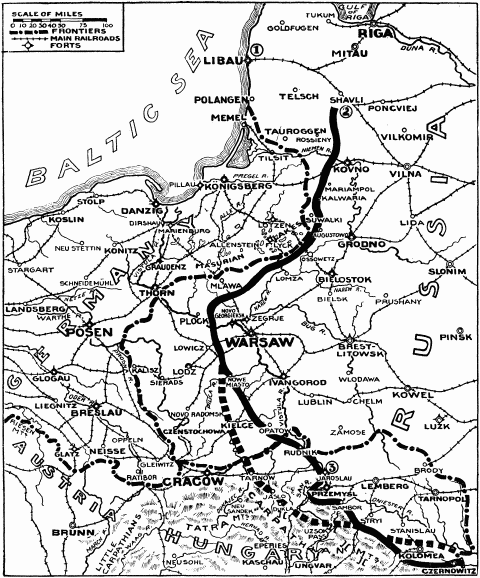
Operation on the Russian Front
This map records the action for the week ended May 15. In the extreme north, in the Russian Baltic Province of Courland, the Germans still held the port of Libau, (1,) and a fierce battle was in progress south of Shavli, (2,) where the Russians stopped the raid toward Mitau.
In South Poland and West Galicia the changes brought about by the great Austro-German drive of 1,500,000 men from Cracow are shown by the heavy dotted and solid lines. The dotted line shows the approximate position of the German battle front when the drive began and the solid line its approximate position according to latest advices from Berlin and Vienna, Jaroslau (3) being the latest important position reported captured.
In extreme Eastern Galicia the situation was reversed, the dotted line showing roughly the position of the Russian line when the counter-drive by the Czar's forces was launched and the solid line its position, so far as was ascertainable, on May 15.
Their defeat, however, has been a severe blow, and has cost Russia a terrible price in men and in guns, the latter of which she could less afford to lose. On the other hand, they have inflicted terrible punishment on the victors, so that the victory partakes of a Pyrrhian character.
In the meantime operations in the Dardanelles are being pressed, but are not reported with sufficient definiteness to give an idea as to the probable result.