Volume 2 — Russian Victory Succeeded by Reverses and Defeat.
Reading edition
THE VICTORY IN APRIL.
[By the Correspondent of The London Times.]
Petrograd, April 18.
A dispatch from the Headquarters Staff of the Commander in Chief says:
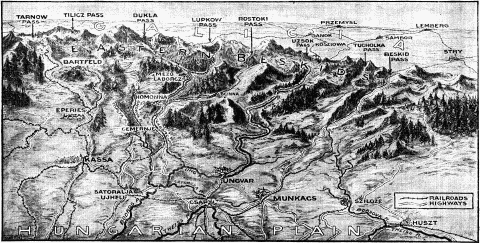
At the beginning of March, (Old Style,) in the principal chain of the Carpathians, we only held the region of the Dukla Pass, where our lines formed an exterior angle. All the other passes—Lupkow and further east—were in the hands of the enemy.
In view of this situation, our armies were assigned the further task of developing, before the season of bad roads due to melting snows began, our positions in the Carpathians which dominated the outlets into the Hungarian plain. About the period indicated great Austrian forces, which had been concentrated for the purpose of relieving Przemysl, were in position between the Lupkow and Uzsok Passes.
It was for this sector that our grand attack was planned. Our troops had to carry out a frontal attack under very difficult conditions of terrain. To facilitate their attack, therefore, an auxiliary attack was decided upon on a front in the direction of Bartfeld as far as the Lupkow. This secondary attack was opened on March 19 and was completely developed.
On the 23rd and 28th of March our troops had already begun their principal attack in the direction of Baligrod, enveloping the enemy positions from the west of the Lupkow Pass and on the east near the source of the San.
The enemy opposed the most desperate resistance to the offensive of our troops. They had brought up every available man on the front from the direction of Bartfeld as far as the Uzsok Pass, including even German troops and numerous cavalrymen fighting on foot. His effectives on this front exceeded 300 battalions. Moreover, our troops had to overcome great natural difficulties at every step.
Nevertheless, from April 5—that is, eighteen days after the beginning of our offensive—the valor of our troops enabled us to accomplish the task that had been set, and we captured the principal chain of the Carpathians on the front Reghetoff-Volosate, 110 versts (about 70 miles) long. The fighting latterly was in the nature of actions in detail with the object of consolidating the successes we had won.
To sum up: On the whole Carpathian front, between March 19 and April 12, the enemy, having suffered enormous losses, left in our hands, in prisoners only, at least 70,000 men, including about 900 officers. Further, we captured more than thirty guns and 200 machine guns.
On April 16 the actions in the Carpathians were concentrated in the direction of Rostoki. The enemy, notwithstanding the enormous losses he had suffered, delivered, in the course of that day, no fewer than sixteen attacks in great strength. These attacks, all of which were absolutely barren of result, were made against the heights which we had occupied further to the east of Telepovce.
Our troops, during the night of the 16th-17th, after a desperate fight, stormed and captured a height to the southeast of the village of Polen, where we took many prisoners. Three enemy counter-attacks on this height were repulsed.
In other sectors all along our front there is no change.
THE GRAND DUKE'S STRATEGY.
Petrograd, April 19.
Today's record of the brilliant feats of the Russian Army in the Carpathians during the past month, contained in the survey of the Grand Duke, presents only one aspect—the discomfiture of the Austro-German forces. The Neue Freie Presse gives some indication of the other aspect.
In a recent issue it stated that "the fortnight's battle around the Lupkow and Uzsok Passes has been one of the most obstinate in history. The Russians succeeded in forcing the Austrians out of their positions. The difficulties of the Austro-Hungarian Army are complicated by the weather and the lack of ammunition and food." The question naturally suggests itself, why did these difficulties not equally disturb the Russian operations? On our side the difficulties of transport were, if anything, greater. The enemy was backed by numerous railways, with supplies close at hand, and was fighting on his native soil, and these advantages undoubtedly compensated for the greater difficulties of commissariat for the larger numbers of Austro-Germans. But from the avowal of the Neue Freie Presse it is suggested here that the Austrians were disorganized. The causes of this disorganization are attributed by military observers to the mixing up of German with Austrian units, rendering the task of command and supply very difficult.
The Grand Duke is fully prepared to take the field as soon as the allied commanders decide that the time for a general action has come. Never has the spirit of the Russian Army been firmer.
The critics this morning comment on the official communiqué detailing a gigantic task brilliantly fulfilled by the Carpathian army during March. Our position in the region of the Dukla Pass early last month exposed us to pressure from two sides, and might have involved the necessity of evacuating the main range. Our army thus required to extend its positions commanding the outlets to the Hungarian plain, before the Spring thaws, in face of a large hostile concentration between Lupkow and Uzsok. The chief attack was directed against the latter section, and an auxiliary attack against the Bartfeld-Lupkow section. The auxiliary attack began on March 19 against the Austro-German left flank and reached its full development four days later. Mistaking the auxiliary for the principal attack, the enemy began an advance from the Bukowina, hoping to divert us from Uzsok, but, instead, the larger portion of our army assailed the enemy's flanks while a smaller body advanced against Rostoki, surmounting the immense difficulties of mountain warfare in Springtime.
By means of the envelopment of both his flanks the enemy was, by April 5, dislodged from the main range on the entire seventy-mile front from Regetow to Wolosate. Convinced that we were directing our chief efforts against his flanks, the enemy now strove to break our resistance in the Rostoki direction, but, after sixteen futile attacks, he was obliged to cede the commanding height of Telepovce, our occupation of which will probably compel him to evacuate his positions at Polen and Smolnik and withdraw to the valley of the Cziroka, a tributary of the Laborez.
DEFEAT IN EARLY MAY.
[By The Associated Press.]
VIENNA, May 13, (via Amsterdam to London, May 14.)—An official statement issued here tonight after recalling that in November and December at Lodz and Limanowa the Austro-Germans compelled the Russians to draw back on a front to the extent of 400 kilometers, (about 249 miles,) thereby stopping the Russian advance into Germany, continues:
From January to the middle of April the Russians vainly exerted themselves to break through to Hungary, but they completely failed with heavy losses. Thereupon the time had come to crush the enemy in a common attack with a full force of the combined troops of both empires.
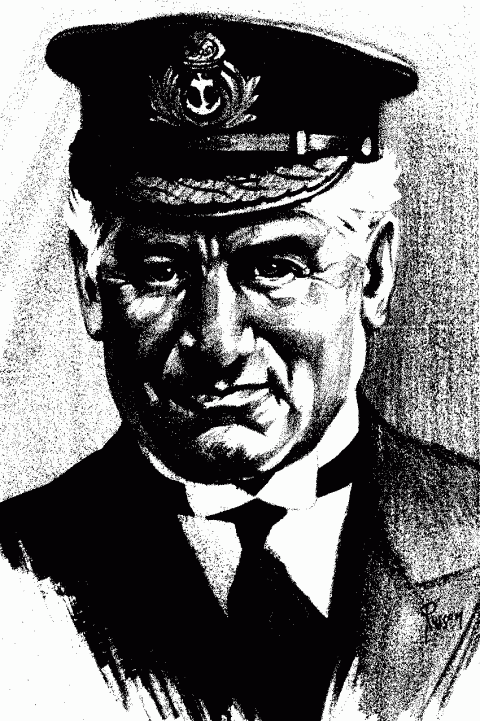
VICE ADMIRAL JOHN M. DE ROBECK— Commanding the Allied Fleet Operating Against the Dardanelles— (Photo © American Press Assn.)

FIELD MARSHAL BARON VON DER GOLTZ— Commander of the First Turkish Army, Formerly Military Governor of Belgium—(Photo from Paul Thompson.)
A victory at Tarnow and Gorlice freed West Galicia from the enemy and caused the Russian fronts on the Nida and in the Carpathians to give way. In a ten days' battle the victorious troops beat the Russian Third and Eighth Armies to annihilation, and quickly covered the ground from the Dunajec and Beskids to the San River—130 kilometers (nearly 81 miles) of territory.
From May 2 to 12 the prisoners taken numbered 143,500, while 100 guns and 350 machine guns were captured, besides the booty already mentioned. We suppressed small detachments of the enemy scattered in the woods in the Carpathians.
Near Odvzechowa the entire staff of the Russian Forty-eighth Division of Infantry including General Korniloff, surrendered. The best indication of the confusion of the Russian Army is the fact that our Ninth Corps captured in the last few days Russians of fifty-one various regiments. The quantity of captured Russian war material is piled up and has not yet been enumerated.
North of the Vistula the Austro-Hungarian troops are advancing across Stopnica. The German troops have captured Kielce.
East of Uzsok Pass the German and Hungarian troops took several Russian positions on the heights and advanced to the south of Turka, capturing 4,000 prisoners. An attack is proceeding here and in the direction of Skole.
In Southeast Galicia strong hostile troops are attacking across Horodenka.
BERLIN, (via London,) May 13.—The German War Office announced today that in the recent fighting in Galicia and Russian Poland 143,500 Russians had been captured. It also stated that 69 cannon and 255 machine guns had been taken from the Russians, and that the victorious Austrian and German forces, continuing their advance eastward in Galicia, were approaching the fortress of Przemysl. The statement follows:
The army under General von Mackensen in the course of its pursuit of the Russians reached yesterday the neighborhood of Subiecko, on the lower Wisloka, and Kolbuezowa, northeast of Debica. Under the pressure of this advance the Russians also retreated from their positions north of the Vistula. In this section the troops under General von Woyrech, closely following the enemy, penetrated as far as the region northwest of Kielce.
In the Carpathians Austro-Hungarian and German troops under General von Linsingen conquered the hills east of the upper Stryi and took 3,650 men prisoners, as well as capturing six machine guns.
At the present moment, while the armies under General von Mackensen are approaching the Przemysl fortress and the lower San, it is possible to form an approximate idea of the booty taken. In the battles of Tarnow and Gorlice, and in the battles during the pursuit of these armies, we have so far taken 103,500 Russian prisoners, 69 cannon, and 255 machine guns. In these figures the booty taken by the allied troops fighting in the Carpathians and north of the Vistula is not included. This amounts to a further 40,000 prisoners.