Volume 2 — Need of Further Protecting Neutral Rights Set Forth.
Reading edition
By GEORGE W. WICKERSHAM.
Formerly United States Attorney General.
To the Editor of The New York Times:
The destruction of the Lusitania by the Germans, and the wanton killing of American men, women, and children, without warning, brings sharply before the American people the question of how long the present sexless policy of the conduct of our affairs is to be continued. Germany has apparently decided to run amuck with civilization. It is now for the American people to decide whether this nation has any virility left, or if it is content to sink to the level of China.
A very clear course, it seems to me, is open for us to pursue: We should cancel all diplomatic relations with a country which has declared war upon civilization, recall our Ambassador from Berlin, and hand Count Bernstorff his passports. Congress should be summoned in extra session, and an appropriation of at least $250,000,000 asked to put us in a condition to protect our rights as a neutral civilized power. At the same time we should invite all neutral nations of the world to join us in a council of civilization to agree upon the steps to be taken to protect the interests of all neutral powers and their citizens from such wanton acts of destruction of life and property as those which Germany has been committing and which have culminated in the destruction of the Lusitania and of so many of her passengers.
Until now the National Administration has been proceeding not only on the basis of "safety first," but of safety first, last, and all the time. The time has arrived when we must remember the truth of what Lowell so well expressed, that
'Tis man's perdition to be safe, when for the truth he ought to die.
GEORGE W. WICKERSHAM.
BY THE NATIONAL SECURITY LEAGUE.
[From THE NEW YORK TIMES, May 11, 1915.]
The army, navy, and coast defenses of the United States are declared to be inadequate in an open letter signed by Joseph H. Choate, Alton B. Parker, Henry L. Stimson, and S. Stanwood Menken, which was given out yesterday in support of the plans of the National Security League. This organization, which maintains offices at 31 Pine Street, has embarked on a national campaign for better war defenses, and its appeal for members and supporters is expressed by the catch-phrase, "a first defense army of 1,000,000 workers."
The letter of Messrs. Choate, Parker, Stimson, and Menken contains most of the arguments put forth by the league in asking public support and enrollment. Its text follows:
Careful investigation by our committees who have looked into the question of national defense brings to light the following conditions of affairs:
According to official Government reports, there are barely 30,000 mobile troops in continental United States. These are distributed among fifty-two widely scattered posts, which would make it impossible to mobilize quickly at any given point. Even this small force is short of officers, ammunition, and equipment. Furthermore, it has no organized reserve.
Our National Guard, with negligible exceptions, is far below its paper strength in men, equipment, and efficiency.
Our coast defenses are inadequate, our fortifications insufficiently manned and without adequate organized reserves.
Our navy is neither adequate nor prepared for war. This, our first line of defense, is inadequately manned, short of ammunition, and has no organized reserve of trained men. Our submarine flotilla exists chiefly upon paper. Fast scout cruisers, battle cruisers, aeroplanes, mine layers, supply ships, and transports are lacking. Target practice has been neglected or altogether omitted.
In view of this condition of affairs, and since there is no assurance that the United States will not again become involved in war, "and since a peaceful policy even when supported by treaties, is not a sufficient guarantee against war, of which the subjugation of Belgium and the present coercion of China by a foreign power are noteworthy examples; and the United States cannot safely intrust the maintenance of its institutions and nationality to the mere negations of peace, and since we are not adequately prepared to maintain our national policies, and since the present defenseless condition of the nation is due to the failure of Congress not only to follow the carefully considered plans of our naval and military advisers, but also to provide any reasonable measure for gradually putting such plans into practice, it is manifest that until a workable plan for a world alliance has been evolved and agreed to by the principal nations, with proper guarantee of good faith, the United States must undertake adequate military preparations for its defense."
In the meantime the National Security League feels impelled to call public attention to our deplorable condition of unpreparedness. At the same time the league issues an appeal for public support in behalf of the following program for better national defense:
1. Legislation correcting present wasteful methods of military appropriations and disbursement.
2. Adoption of a definite military policy.
3. A stronger, better balanced navy.
4. An effective mobile army.
5. Larger and better equipped National Guard.
6. The creation of an organized reserve for each branch of our military service.
All those interested in the work of the league are invited to send their names and contributions to the National Security League, 31 Pine Street, New York City.
[The letter is addressed to "present and former members of the Cabinet, to members of Congress, to Governors of our States and Territories, to Mayors of all American cities, to Chambers of Commerce and Boards of Trade, to merchants' associations, to colleges and universities, to university clubs and alumni associations, to all patriotic organizations, to all women's clubs, and to all American citizens."
"Until a satisfactory plan of disarmament has been worked out and agreed upon by the nations of the world," says a statement, "the United States must be adequately prepared to defend itself against invasion. A military equipment sufficient for this purpose can be had without recourse to militarism. The league was formed as a preparation not for war, but against war."]
BY THE NAVY LEAGUE.
[From THE NEW YORK TIMES, May 12, 1915.]
The Navy League of the United States, of which General Horace Porter is President and which includes in its membership Herbert L. Satterlee, George von L. Meyer, Beekman Winthrop, J. Pierpont Morgan, Governor Emmet O'Neal of Alabama, Senator James D. Phelan of California, Cardinal Gibbons, Theodore Roosevelt, Elihu Root, Edward T. Stotesbury, Benjamin Ide Wheeler, Joseph H. Choate, George B. Cortelyou, C. Oliver Iselin, Seth Low, Myron T. Herrick, Alton B. Parker, and scores of other men prominent in the public and business life of the country, through its Executive Committee adopted a resolution yesterday calling upon President Wilson to call Congress in extra session to authorize a bond issue of $500,000,000, which sum, it is stated, is "needed to provide this country with adequate means of naval defense."
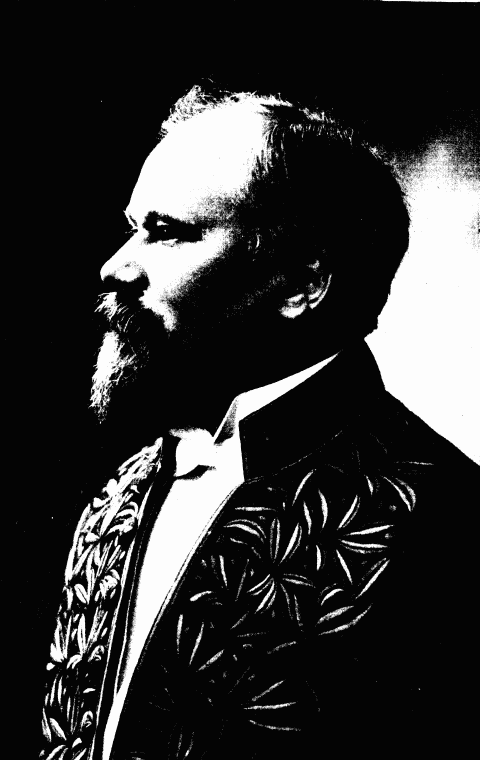
RAYMOND POINCARÉ— President of the French Republic Since Feb. 18, 1913— (Photo from P.S. Rogers.)

THE RIGHT HON. H.H. ASQUITH— Prime Minister of Great Britain and Ireland— (Photo from Brown Bros.)
The resolution, which was adopted at a session at which members of the Executive Committee consulted by long-distance telephone, some of them being in Washington and others in New York at the Union League Club, read:
"In view of the crisis in our foreign relations, we, as representatives of the Navy League of the United States, express our emphatic belief that Congress should be immediately assembled and that measures should be taken at once to strengthen our national defense. Our most pacific country should, because of its supreme love of peace, possess preponderant naval strength and adequate military strength. A large bond issue of, if necessary, $500,000,000 should be authorized at once. These bonds would be rapidly absorbed by the American people for such a purpose. Equipped with a mighty fleet, American life and American rights would be scrupulously respected by all belligerents. In such case there would be no thought of our entering into war.
"GENERAL HORACE PORTER, President;
"ROBERT M. THOMPSON, Chairman Executive Committee;
"CHARLES A. FOWLER,
"PERRY BELMONT,
"JOHN C. O'LAUGHLIN,
"FRANK J. SYMES."