Volume 2 — Last Phase of Italian Neutrality and Causes of the Struggle
Reading edition
DECLARATION OF WAR.
[By The Associated Press.]
VIENNA, May 23, (via Amsterdam and London, May 24.)—The Duke of Avarna, Italian Ambassador to Austria, presented this afternoon to Baron von Burian, the Austro-Hungarian Foreign Minister, the following declaration of war:
Vienna, May 23, 1915.
Conformably with the order of his Majesty the King, his august sovereign, the undersigned Ambassador of Italy has the honor to deliver to his Excellency, the Foreign Minister of Austria-Hungary, the following communication:
"Declaration has been made, as from the fourth of this month, to the Imperial and Royal Government of the grave motives for which Italy, confident in her good right, proclaimed annulled and henceforth without effect her treaty of alliance with Austria-Hungary, which was violated by the Imperial and Royal Government, and resumed her liberty of action in this respect.
"The Government of the King, firmly resolved to provide by all means at its disposal for safeguarding Italian rights and interests, cannot fail in its duty to take against every existing and future menace measures which events impose upon it for the fulfillment of national aspirations.
"His Majesty the King declares that he considers himself from tomorrow in a state of war with Austria-Hungary."
The undersigned has the honor to make known at the same time to his Excellency the Foreign Minister, that passports will be placed this very day at the disposal of the Imperial and Royal Ambassador at Rome, and he will be obliged to his Excellency if he will kindly have his passports handed to him.
Avarna.
FRANCIS JOSEPH'S DEFIANCE.
[By The Associated Press.]
LONDON, May 24, 5:45 A.M.—A Reuter dispatch from Amsterdam says the Vienna Zeitung publishes the following autograph letter from Emperor Francis Joseph to Count Karl Stuergkh:
Dear Count Stuergkh: I request you to make public the attached manifesto to my troops:
"VIENNA, May 23.—Francis Joseph to his troops:
"The King of Italy has declared war on me. Perfidy whose like history does not know was committed by the Kingdom of Italy against both allies. After an alliance of more than thirty years' duration, during which it was able to increase its territorial possessions and develop itself to an unthought of flourishing condition, Italy abandoned us in our hour of danger and went over with flying colors into the camp of our enemies.
"We did not menace Italy; did not curtail her authority; did not attack her honor or interests. We always responded loyally to the duties of our alliance and afforded her our protection when she took the field. We have done more. When Italy directed covetous glances across our frontier we, in order to maintain peace and our alliance relation, were resolved on great and painful sacrifices which particularly grieved our paternal heart. But the covetousness of Italy, which believed the moment should be used, was not to be appeased, so fate must be accommodated.
"My armies have victoriously withstood mighty armies in the north in ten months of this gigantic conflict in most loyal comradeship of arms with our illustrious ally. A new and treacherous enemy in the south is to you no new enemy. Great memories of Novara, Mortaro, and Lissa, which constituted the pride of my youth; the spirit of Radetzky, Archduke Albrecht, and Tegetthoff, which continues to live in my land and sea forces, guarantee that in the south also we shall successfully defend the frontiers of the monarchy.
"I salute my battle-tried troops, who are inured to victory. I rely on them and their leaders. I rely on my people for whose unexampled spirit of sacrifice my most paternal thanks are due. I pray the Almighty to bless our colors and take under His gracious protection our just cause."
ITALY'S CABINET EMPOWERED.
[By The Associated Press.]
Rome, May 20.—Amid tremendous enthusiasm the Chamber of Deputies late today adopted, by a vote of 407 to 74, the bill conferring upon the Government full power to make war.
The bill is composed of a single article and reads as follows:
The Government is authorized in case of war and during the duration of war to make decisions with due authority of law, in every respect required, for the defense of the State, the guarantee of public order, and urgent economic national necessities. The provisions contained in Articles 243 to 251 of the Military Code continue in force. The Government is authorized also to have recourse until Dec. 31, 1915, to monthly provisional appropriations for balancing the budget. This law shall come into force the day it is passed.
All members of the Cabinet maintain absolute silence regarding what step will follow the action of the Chamber. Former Ministers and other men prominent in public affairs declare, however, that the action of Parliament virtually was a declaration of war.
When the Chamber reassembled this afternoon after its long recess there were present 482 Deputies out of 500, the absentees remaining away on account of illness. The Deputies especially applauded were those who wore military uniforms and who had asked permission for leave from their military duties to be present at the sitting.
All the tribunes were filled to overflowing. No representatives of Germany, Austria, or Turkey were to be seen in the diplomatic tribune. The first envoy to arrive was Thomas Nelson Page, the American Ambassador, who was accompanied by his staff. M. Barrère, Sir J. Bennell Rodd, and Michel de Giers, the French, British, and Russian Ambassadors, respectively, appeared a few minutes later and all were greeted with applause, which was shared by the Belgian, Greek, and Rumanian Ministers. George B. McClellan, former Mayor of New York, occupied a seat in the President's tribune.
A few minutes before the session began the poet, Gabriele d'Annunzio, one of the strongest advocates of war, appeared in the rear of the public tribune, which was so crowded that it seemed impossible to squeeze in anybody else. But the moment the people saw him they lifted him shoulder high and passed him over their heads to the first row. The entire Chamber and all those occupying the other tribunes rose and applauded for five minutes, crying, "Viva d'Annunzio!" Later thousands sent him their cards, and in return received his autograph, bearing the date of this eventful day.
Signor Marcora, President of the Chamber, took his place at 3 o'clock. All the members of the House and everybody in the galleries stood up to acclaim the old follower of Garibaldi.
Premier Salandra, followed by all the members of the Cabinet, entered shortly afterward. It was a solemn moment. Then a delirium of cries broke out. "Viva Salandra!" roared the Deputies, and the cheering lasted for five minutes. Premier Salandra appeared to be much moved by the demonstration.
After the formalities of the opening Premier Salandra arose and said:
"Gentlemen: I have the honor to present to you a bill to meet the eventual expenditures of a national war"—an announcement that was greeted by further prolonged applause.
The Premier began an exposition of the situation of Italy before the opening of hostilities in Europe. He declared that Italy had submitted to every humiliation from Austria-Hungary for the love of peace. By her ultimatum to Serbia Austria had annulled the equilibrium of the Balkans and prejudiced Italian interests there.
Notwithstanding this evident violation of the treaty of the Triple Alliance, Italy endeavored during long months to avoid a conflict, but these efforts were bound to have a limit in time and dignity. "This is why the Government felt itself forced to present its denunciation of the Triple Alliance on May 4," said Premier Salandra, who had difficulty in quieting the wild cheering that ensued. When he had succeeded in so doing he continued, amid frequent enthusiastic interruptions:
Italy must be united at this moment, when her destinies are being decided. We have confidence in our august chief, who is preparing to lead the army toward a glorious future. Let us gather around this well-beloved sovereign.
Since Italy's resurrection as a State she has asserted herself in the world of nations as a factor of moderation, concord, and peace, and she can proudly proclaim that she has accomplished this mission with a firmness which has not wavered before even the most painful sacrifices.
In the last period, extending over thirty years, she maintained her system of alliances and friendships chiefly with the object of thus assuring the European equilibrium, and, at the same time, peace. In view of the nobility of this aim Italy not only subordinated her most sacred aspiration, but has also been forced to look on, with sorrow, at the methodical attempts to suppress specifically the Italian characteristics which nature and history imprinted on those regions.
The ultimatum which the Austro-Hungarian Empire addressed last July to Serbia annulled at one blow the effects of a long-sustained effort by violating the pact which bound us to that State, violated the pact, in form, for it omitted to conclude a preliminary agreement with us or even give us notification, and violated it also in substance, for it sought to disturb, to our detriment, the delicate system of territorial possessions and spheres of influence which had been set up in the Balkan Peninsula.
But, more than any particular point, it was the whole spirit of the treaty which was wronged, and even suppressed, for by unloosing in the world a most terrible war, in direct contravention of our interests and sentiments, the balance which the Triple Alliance should have helped to assure was destroyed and the problem of Italy's national integrity was virtually and irresistibly revived.
Nevertheless, for long months, the Government has patiently striven to find a compromise, with the object of restoring to the agreement the reason for being which it had lost. These negotiations were, however, limited not only by time, but by our national dignity. Beyond these limits the interests both of our honor and of our country would have been compromised.
Signor Salandra was interrupted time and time again by rounds of applause from all sides, and the climax was reached when he made a reference to the army and navy. Then the cries seemed interminable, and those on the floor of the House and in the galleries turned to the Military Tribune, from which the officers answered by waving their hands and handkerchiefs. At the end of the Premier's speech there were deafening "vivas" for the King, war, and Italy.
Only thirty-four Intransigent Socialists refused to join in the cheers, even in the cry "Viva Italia!" and they were hooted and hissed.
After the presentation of the bill conferring full powers upon the Government the President of the Chamber submitted the question whether a committee of eighteen members should be elected. Out of the 421 Deputies who voted 367 cast their ballot in the affirmative. The other 54 were against. The opposition was composed of Socialists and some adherents of ex-Premier Giolitti.
Foreign Minister Sonnino then rose, and, taking a copy of the "Green Book" from his pocket, said: "I have the honor to present to the Chamber a book containing an account of all the pourparlers with Austria from the 9th of September to the 4th of May." He handed the book to Signor Marcora.
The Chamber then adjourned until 5 o'clock, when the committee reported in favor of the bill, and it was adopted.
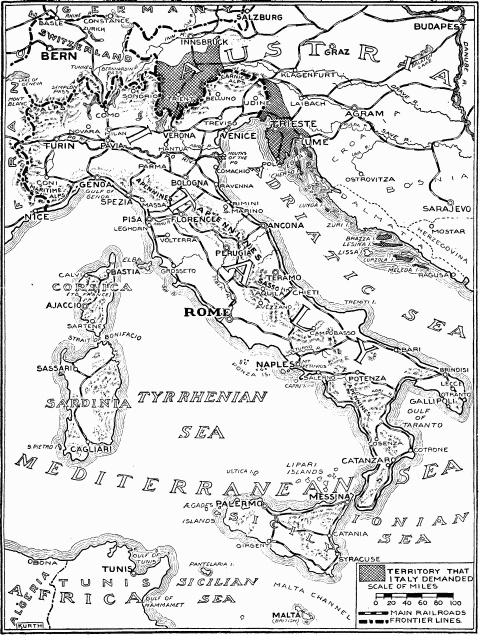
Italy and the Austrian Frontier—The shaded portions on the Austrian frontier represent the provinces of "Italia Irredenta," which Italy would win back.
ITALY'S JUSTIFICATION.
The first complete official statement of the difficulties between Italy and Austria-Hungary, which forced the Italian declaration of war against the Dual Monarchy, was made public in Washington on May 25 by Count V. Macchi di Cellere, the Italian Ambassador. It took the form of a carefully prepared telegraphic statement to the Ambassador from Signor Sonnino, the Italian Minister of Foreign Affairs, with instructions that it be delivered in the form of a note to the Government of the United States. After presenting the communication to Secretary Bryan, Count Cellere made public the following translation of its full text:
The Triple Alliance was essentially defensive and designed solely to preserve the status quo, or, in other words, the equilibrium, in Europe. That these were its only objects and purposes is established by the letter and spirit of the treaty as well as by the intentions clearly described and set forth in official acts of the Ministers who created the alliance and confirmed and renewed it in the interest of peace, which always has inspired Italian policy.
The treaty, as long as its intents and purposes had been loyally interpreted and regarded and as long as it had not been used as a pretext for aggression against others, greatly contributed to the elimination and settlement of causes of conflict, and for many years assured to Europe the inestimable benefits of peace.
But Austria-Hungary severed the treaty by her own hands. She rejected the response of Serbia, which gave to her all the satisfaction she could legitimately claim. She refused to listen to the conciliatory proposals presented by Italy in conjunction with other powers in the effort to spare Europe from a vast conflict certain to drench the Continent with blood and to reduce it to ruin beyond the conception of human imagination, and finally she provoked that conflict.
Article I. of the treaty embodied the usual and necessary obligation of such pacts—the pledge to exchange views upon any fact and economic questions of a general nature that might arise pursuant to its terms. None of the contracting parties had the right to undertake, without a previous agreement, any step the consequence of which might impose a duty upon the other signatories arising out of the Alliance, or which would in any way whatsoever encroach upon their vital interests. This article was violated by Austria-Hungary when she sent to Serbia her note dated July 23, 1914, an action taken without the previous assent of Italy.
Thus, Austria-Hungary violated beyond doubt one of the fundamental provisions of the treaty. The obligation of Austria-Hungary to come to a previous understanding with Italy was the greater because her obstinate policy against Serbia gave rise to a situation which directly tended to the provocation of a European war.
As far back as the beginning of July, 1914, the Italian Government, preoccupied by the prevailing feeling in Vienna, caused to be laid before the Austro-Hungarian Government a number of suggestions advising moderation, and warning it of the impending danger of a European outbreak. The course adopted by Austria-Hungary against Serbia constituted, moreover, a direct encroachment upon the general interests of Italy, both political and economical, in the Balkan Peninsula. Austria-Hungary could not for a moment imagine that Italy could remain indifferent while Serbian independence was being trodden upon.
On a number of occasions theretofore Italy gave Austria to understand, in friendly but clear terms, that the independence of Serbia was considered by Italy as essential to Balkan equilibrium. Austria-Hungary was further advised that Italy could never permit that equilibrium to be disturbed to her prejudice. This warning had been conveyed not only by her diplomats in private conversations with responsible Austro-Hungarian officials but was proclaimed publicly by Italian statesmen on the floors of Parliament.
Therefore when Austria-Hungary ignored the usual practices and menaced Serbia by sending her an ultimatum without in any way notifying the Italian Government of what she proposed to do, indeed leaving that Government to learn of her action through the press rather than through the usual channels of diplomacy, when Austria-Hungary took this unprecedented course she not only severed her alliance with Italy but committed an act inimical to Italy's interests.
The Italian Government had obtained trustworthy information that the complete program laid down by Austria-Hungary with reference to the Balkans was prompted by a desire to decrease Italy's economical and political influence in that section, and tended directly and indirectly to the subservience of Serbia to Austria-Hungary, the political and territorial isolation of Montenegro, and the isolation and political decadence of Rumania.
This attempted diminution of the influence of Italy in the Balkans would have been brought about by the Austro-Hungarian program, even though Austria-Hungary had no intention of making further territorial acquisitions. Furthermore attention should be called to the fact that the Austro-Hungarian Government had assumed the solemn obligation of prior consultation of Italy as required by the special provisions of Article VII. of the treaty of the Triple Alliance, which, in addition to the obligation of previous agreements, recognized the right of compensation to the other contracting parties in case one should occupy temporarily or permanently any section of the Balkans.
To this end, the Italian Government approached the Austro-Hungarian Government immediately upon the inauguration of Austro-Hungarian hostilities against Serbia, and succeeded in obtaining reluctant acquiescence in the Italian representations. Conversations were initiated immediately after July 23, for the purpose of giving a new lease of life to the treaty which had been violated and thereby annulled by the act of Austria-Hungary.
This object could be attained only by the conclusion of new agreements. The conversations were renewed, with additional propositions as the basis, in December 1914. The Italian Ambassador at Vienna at that time received instructions to inform Count Berchtold, the Austro-Hungarian Minister for Foreign Affairs, that the Italian Government considered it necessary to proceed without delay to an exchange of views and consequently to concrete negotiations with the Austro-Hungarian Government concerning the complex situation arising out of the conflict which that Government had provoked.
Count Berchtold at first refused. He declared that the time had not arrived for negotiations. Subsequently, upon our rejoinder, in which the German Government united, Count Berchtold agreed to exchange views as suggested. We promptly declared, as one of our fundamental objects, that the compensation on which the agreement should be based should relate to territories at the time under the dominion of Austria-Hungary.
The discussion continued for months, from the first days of December to March, and it was not until the end of March that Baron Burian offered a zone of territory comprised within a line extending from the existing boundary to a point just north of the City of Trent.
In exchange for this proposed cession the Austro-Hungarian Government demanded a number of pledges, including among them an assurance of entire liberty of action in the Balkans. Note should be made of the fact that the cession of the territory around Trent was not intended to be immediately effective as we demanded, but was to be made only upon the termination of the European war. We replied that the offer was not acceptable, and then presented the minimum concessions which could meet in part our national aspirations and strengthen in an equitable manner our strategic position in the Adriatic.
These demands comprised: The extension of the boundary in Trentino, a new boundary on the Isonzo, special provision for Trieste, the cession of certain islands of the Curzolari Archipelago, the abandonment of Austrian claims in Albania, and the recognition of our possession of Avlona and the islands of the Aegean Sea, which we occupied during our war with Turkey.
At first our demands were categorically rejected. It was not until another month of conversation that Austria-Hungary was induced to increase the zone of territory she was prepared to cede in the Trentino and then only as far as Mezzo Lombardo, thereby excluding the territory inhabited by people of the Italian race, such as the Valle del Noce, Val di Fasso, and Val di Ampezzo. Such a proposal would have given to Italy a boundary of no strategical value. In addition the Austro-Hungarian Government maintained its determination not to make the cession effective before the end of the war.
The repeated refusals of Austria-Hungary were expressly confirmed in a conversation between Baron Burian and the Italian Ambassador at Vienna on April 29. While admitting the possibility of recognizing some of our interests in Avlona and granting the above-mentioned territorial cession in the Trentino, the Austro-Hungarian Government persisted in its opposition to all our other demands, especially those regarding the boundary of the Isonzo, Trieste, and the islands.
The attitude assumed by Austria-Hungary from the beginning of December until the end of April made it evident that she was attempting to temporize without coming to a conclusion. Under such circumstances Italy was confronted by the danger of losing forever the opportunity of realizing her aspirations based upon tradition, nationality, and her desire for a safe position in the Adriatic, while other contingencies in the European conflict menaced her principal interests in other seas.
Hence Italy faced the necessity and duty of recovering that liberty of action to which she was entitled and of seeking protection for her interests, apart from the negotiations which had been dragging uselessly along for five months and without reference to the Treaty of Alliance which had virtually failed as a result of its annullment by the action of Austria-Hungary in July, 1914.
It would not be out of place to observe that the alliance having terminated and there existing no longer any reason for the Italian people to be bound by it, though they had loyally stood by it for so many years because of their desire for peace, there naturally revived in the public mind the grievances against Austria-Hungary which for so many years had been voluntarily repressed.
While the Treaty of Alliance contained no formal agreement for the use of the Italian language or the maintenance of Italian tradition and Italian civilization in the Italian provinces of Austria, nevertheless if the alliance was to be effective in preserving peace and harmony it was indisputably clear that Austria-Hungary, as our ally, should have taken into account the moral obligation of respecting what constituted some of the most vital interests of Italy.
Instead, the constant policy of the Austro-Hungarian Government was to destroy Italian nationality and Italian civilization all along the coast of the Adriatic. A brief statement of the facts and of the tendencies well known to all will suffice.
Substitution of officials of the Italian race by officials of other nationalities; artificial immigration of hundreds of families of a different nationality; replacement of Italian by other labor; exclusion from Trieste by the decree of Prince Hohenlohe of employes who were subjects of Italy; denationalization of the judicial administration; refusal of Austria to permit an Italian university in Trieste, which formed the subject of diplomatic negotiations; denationalization of navigation companies; encouragement of other nationalities to the detriment of the Italian, and, finally, the methodical and unjustifiable expulsion of Italians in ever-increasing numbers.
This deliberate and persistent policy of the Austro-Hungarian Government with reference to the Italian population was not only due to internal conditions brought about by the competition of the different nationalities within its territory, but was inspired in great part by a deep sentiment of hostility and aversion toward Italy, which prevailed particularly in the quarters closest to the Austro-Hungarian Government and influenced decisively its course of action.
Of the many instances which could be cited it is enough to say that in 1911, while Italy was engaged in war with Turkey, the Austro-Hungarian General Staff prepared a campaign against us, and the military party prosecuted energetically a political intrigue designed to drag in other responsible elements of Austria. The mobilization of an army upon our frontier left us in no doubt of our neighbor's sentiment and intentions.
The crisis was settled pacifically through the influence, so far as known, of outside factors; but since that time we have been constantly under apprehension of a sudden attack whenever the party opposed to us should get the upper hand in Vienna. All of this was known in Italy, and it was only the sincere desire for peace prevailing among the Italian people which prevented a rupture.
After the European war broke out, Italy sought to come to an understanding with Austria-Hungary with a view to a settlement satisfactory to both parties which might avert existing and future trouble. Her efforts were in vain, notwithstanding the efforts of Germany, which for months endeavored to induce Austria-Hungary to comply with Italy's suggestions, thereby recognizing the propriety and legitimacy of the Italian attitude. Therefore Italy found herself compelled by the force of events to seek other solutions.
Inasmuch as the Treaty of Alliance with Austria-Hungary had ceased virtually to exist and served only to prolong a state of continual friction and mutual suspicion, the Italian Ambassador at Vienna was instructed to declare to the Austro-Hungarian Government that the Italian Government considered itself free from the ties arising out of the Treaty of the Triple Alliance in so far as Austria-Hungary was concerned. This communication was delivered in Vienna on May 4.
Subsequently to this declaration, and after we had been obliged to take steps for the protection of our interests, the Austro-Hungarian Government submitted new concessions, which, however, were deemed insufficient and by no means met our minimum demands. These offers could not be considered under the circumstances.
The Italian Government, taking into consideration what has been stated above, and supported by the vote of Parliament and the solemn manifestation of the country, came to the decision that any further delay would be inadvisable. Therefore, on this day (May 23) it was declared in the name of the King to the Austro-Hungarian Ambassador at Rome that, beginning tomorrow, May 24, it will consider itself in a state of war with Austria-Hungary. Orders to this effect were also telegraphed yesterday to the Italian Ambassador at Vienna.