Part 8.
Reading edition
Tapestry—Opus Pectineum.
It is necessary to define precisely what is meant by the word “tapestry.”[380] The term has been applied to all hangings, and so caused confusion between those that are embroidered with a design, on a plain or brocaded woven material, and those which are inwoven with the design from the first.[381] This latter was called in classical language, “opus pectineum,” because it was woven with the help of a comb (the “slay”),[382] to push the threads tight between each row of stitches; and the individual stitches were put in with a sort of a needle, or by the fingers only, and laid on the warp. It was thus practised by the Egyptians, by the Persians, Indians, and Peruvians; and in Egypt was often finished by embroidery. (Pl. 46.) In Egyptian tombs we have evidence of their tapestry, from the mural paintings representing men and women weaving pictures in upright looms. The comb which served to push the threads together after the stitches were laid in is sometimes found in the weaver’s tomb.
We have, in the British Museum, pieces of “opus pectineum” from Saccarah, in Egypt; and also fragments from a Peruvian tomb, of barbarous design, but the weaving is equal to the Egyptian; and both resemble the Gobelins weaving of to-day. Whence came the craft of the Peruvians?
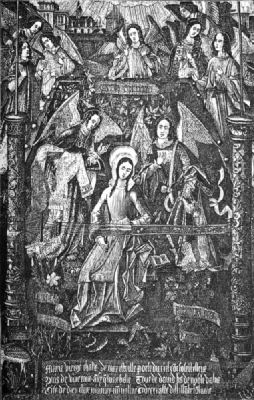
Tapestry is woven in two ways, by a high or by a low-warp loom (haute-lisse or basse-lisse), vertical or horizontal. The “slay” is the implement which is peculiar to the craft. I shall not enter into any description of the mode of working the looms, as this has been thoroughly well done by masters of the art.[383] But I would call attention to the Frontispiece, copied from a Greek vase, where Penelope is portrayed sitting by her haute-lisse frame. I also refer the reader to the illustration from the Rheims tapestries, in which a mediæval artist shows the Blessed Virgin weaving at one that is horizontal or “basse-lisse.” (Pl. 47.)
Pl. 47.
See larger image
Portion of a Tapestry Hanging. Cathedral. Rheims. The Virgin weaves and embroiders at a basse-lisse frame.
For the best information I have been able to obtain regarding tapestry weaving, I must acknowledge my indebtedness to M. Albert Castel’s “Bibliothèque des Merveilles.”[384] He has given great care to the consideration of this subject, and has collected good evidences to prove his conclusions, which I willingly accept en bloc. Of course he has chiefly dealt with the French branch of the art, and with the Flemish, from which it immediately descends. He begins, however, by quoting Pliny, to prove the antiquity of weaving, and gives a verse of Martial’s to this effect: “Thou owest this work to the land of Memphis, where the slay of the Nile has vanquished the needle of Babylon.”[385]
Homer makes Helen weave the story of the siege of Troy; this may have been partly embroidered; and there are some pieces of woven tapestry introduced most ingeniously into the web of a linen shirt or garment, of which the sleeve is in the Egyptian department of the British Museum, proving that figures were pictured by weaving quite as early as the date of Troy, and unmistakably finished with the needle (Plate 18); at any rate, as early as the days of Homer. Arachne’s web was interwoven with figures. She and Minerva rivalled each other in ingenious design and perfect execution. The description of the beautiful hangings they wove, the glorious colours with their tenderly graduated tints, and the graceful borders, appear to be almost prophetic of the highest efforts of the looms of the Gobelins.[386][387] Arachne’s name is derived from the Hebrew word for weaving, “Arag.”
It appears that the town now called Arras, but anciently Nomenticum, was always a centre of the trade of the weavers;[388] for Flavius Vopiscus, writing in A.D. 282, says that thence came the Byrri—woven cloaks with hoods, which were much in vogue amongst all classes in the later Roman Empire. The craft of weaving, which flourished in the Flemish and other adjacent countries, seems to have become native to that soil, and to have clung to it, surviving many historical cataclysms.[389]
Though in the fifth century the inhabitants of that country were transported wholesale to Germany by the Vandals, and among them those of the town of Arras, yet, thanks to the monasteries, there was a survival and a revival; the craftsmen grouping themselves round the religious houses. Specimens as models were brought from the East. Aster, Bishop of Amasis (a town in Asiatic Turkey), describes these Oriental hangings in one of his homilies. He says that animals and scenes from the Bible were woven on white grounds.[390]
Sidonius Apollinaris, Bishop of Clermont Ferrand,[391] says that some foreign tapestries are “pictured” with the summits of Ctesiphon and Nephates, “wild beasts running rapidly across void canvas, and also by a miracle of art, the Parthian of wild aspect with his head turned backwards.” This might be a description of a Chinese composition, and probably it is so.[392]
Woven tapestry is also called “Arras,”[393] because that town in the Netherlands was the home and school of the art of picture weaving in the Middle Ages. It has been hitherto excluded from the domain of needlework, because of the different use of the needle employed in it. It has always been woven on a loom, and is, in fact, embroidery combined with the weaving; for the shuttle, or slay, or comb completes each row of stitches. It belongs as much to our art as does tambour work, which is done with a hook instead of a needle. Tapestry weaving is the intelligent craft of a practised hand guided by artistic skill. The forms of the painted design must be copied by a person who can draw; and the colours require as much care in selection, as in painting with oils or water-colours. Such a thing as a purely mechanical exact copy is impossible in any art; and the difficulties are increased a hundredfold when it is a translation into another material, and another form of art. Besides, in this case, the copies are worked from the back, and the picture is reversed. The question is this: Can it be claimed as belonging to the same craft as embroidery? I answer in the affirmative, and I claim it.
“When the Saracens began to weave tapestry we cannot tell; but the workers in woven pictures were called Sarassins, and their craft, the ‘opus Saracenicum.’”[394] The French and Flemish artisans who continued to weave in the old upright frames (haute-lisse) were, whether Christians or not, called “Sarassins.” Probably they came through Spain, possibly from Sicily to Flanders and to France, or else from Byzantium. Viollet-le-Duc says that the “Saracinois” was a term applied to the makers of velvety carpets (tapis veloutés).[395] This is possible.[396] Woven carpets of Oriental type were spreading themselves as articles of luxury through Europe early in the Middle Ages; and the Persian style of design was much the same then, when the first models were brought to Spain, and thence to Arras, as it is now in the carpets we buy just woven in Persia.[397] The oldest specimens known here have been exhibited in the Indian Museum, and may be of the thirteenth and fourteenth centuries. The perishable nature of the material makes us dependent on the sculptured records of all artistic design for our knowledge of carpets and hangings of more than a thousand years ago; and we must confess that we find nothing really resembling a Persian pattern in any classical tomb or sculpture of the Dark Ages.[398]
I have allowed myself to touch upon carpet weaving, as it is germane to tapestry; though it is a branch that soon loses itself and leaves artistic work in the distance. Except the first design, it has become purely mechanical.
After what has been quoted from Ovid’s “Metamorphoses,” and bearing in mind the pictured webs described by Homer, and likewise the evidence of the frescoes in Egypt, and the woman weaving on the Greek fictile vase found at Chiusi, we may be justified in concluding that, like all other arts, that of tapestry existed in very early days, died out, and had to begin afresh, and gradually return to life, during the Middle Ages.
Bishop Gaudry, about 925, possessing a piece of tapestry with an inscription in Greek letters surrounded by lions “parsemé,” was much put about till he obtained something to match it, to hang on the opposite side of his choir at Auxerre.[399] And it is known that the monks of St. Florent, at Saumur, wove tapestries about 985, and continued to do so for two centuries. St. Angelme of Norway,[400] Bishop of Auxerre, who died in 840, caused many tapestries to be executed for his church. At Poitiers this manufactory was so famous in the eleventh century, that foreign kings, princes, and prelates sought to obtain them, “even for Italy.” The rules of their order of the monks of the Abbey of Cluny, dated 1009, were followed by those of St. Wast and of the Abbey of Fleury, and others in France, who all wove wool and silk for tapestries. Le Père Labbé, from whom much of this information is drawn and acknowledged by M. Charton (my authority), says that in 876, at Ponthièvre, in presence of the Emperor Charles the Bold, the hall of the council-chamber was hung with pictured tapestries, and the seats were covered with them.[401]
Pl. 48.
See larger image
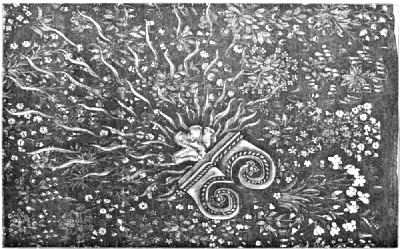
Order of the Golden Fleece. Tapestry at Berne, taken from Charles the Bold at the Battle of Grandson, 1476.
Sufficient has been said to show that during the dark ages hangings were woven in France, Germany, and Belgium,[402] and that England was not behind the rest of the civilized world in this craft. I think, also, that we have indicated its Oriental origin.[403]
Arras continued to lead as the great tapestry factory till the end of the fifteenth century, when the commercial failure of the city began, at the death of Charles le Téméraire, Duke of Burgundy.[404] Plate 48 shows a portion of his tent hangings woven with the order of the golden fleece taken at the battle of Grandson—now in the museum at Berne. Till then Arras had supplied most of the splendid decorations of which we find such marvellous lists. Every possible subject—religious, romantic, historical, and allegorical—was pressed into the service, and pictured hangings were supposed to instruct, amuse, and edify the beholders. The dark ages were illuminated, and their barbarity softened, by these constant appeals to men’s highest instincts, and to the memories of their noblest antecedents and aspirations, which clothed their walls, and so became a part of their daily lives. The great Flemish and French workshops became the illustrators of the history of the world, as it was then read or being enacted. It is a record of faiths, religious and political; and of national and family lives and their changes. The Exhibition at Brussels in 1880 showed, by its “Catalogue Raisonné,” how much could be extracted from its storied tapestries of both archæological and artistic information.[405]
Though the art continued to be the servant of refined luxury in the fifteenth century, Arras itself had done its work,[406] and was superseded as the greatest weaver of artistic tapestry by a neighbour and rival. Brussels, which had been gradually asserting itself as a weaving community, from that date absorbed most of the trade of Arras, and thence forwards, till Henri IV. established the works of the Savonnerie, Brussels led European taste, and employed the best artists. Brussels employed Leonardo da Vinci and Mantegna, Giovanni da Udine, Raphael, and later, Rubens and the great Dutch painters, to design cartoons for tapestry works. Raphael’s pupil, Michael Coxsius, of Mechlin, superintended the copying of his master’s cartoons. Shortly afterwards, Antwerp, Oudenarde, Lille, Tournai, Valenciennes, Beauvais, Aubusson, and Bruges all had their schools;[407] and the adept can trace their differences and peculiarities, and name their birthplace, without referring to their trade-mark, or to that of the manufacturer, which is usually to be found in the outer border. Poitiers, Troyes, Beauvais, Rheims, and St. Quentin likewise had their schools, and became famous.
Want of space prevents my entering more fully into this subject of the northern tapestries, and I must refer my readers to the authorities I have quoted from so largely.
ITALIAN TAPESTRY.
The word Arrazzi shows us whence the Italians drew their art. Doubtless there were looms in the Italian cities, and especially under ecclesiastical patronage, through the dark ages. Rome was in communication with the Atrebates in the third century, by whom she was supplied with the Byrri, or hooded cloaks then worn; and as it had been a centre for weaving commerce, it is probable that Rome received from Arras the craftsmen as well as the produce of their looms. At the Renaissance we find factories for pictured webs in Florence, Rome, Milan, Mantua, and elsewhere. The best artists of the Italian schools—Mantegna, Leonardo, Raphael and his scholars, &c., &c.—gave their finest designs to be executed in Italy, before they were sold to Arras, Brussels, France, or England, and they are accumulated in the treasure-room of every palace in Italy. But the finest collections are those of the Vatican, and of the Pitti in Florence. A splendid volume might be edited of these grand artistic works; such a record would be invaluable. Vasari[408] and Passevant give us occasional glimpses of local factories for tapestry, but, as we have before said, this subject has still to be investigated.
FRENCH TAPESTRY.
In France, as elsewhere, tapestry was probably woven in private looms and in the religious houses from early days. M. Jubinal believes that it was made at Poitiers, Troyes, Beauvais, Rheims, and St. Quentin as early as 1025.[409] Froissart describes the entry of Isabel of Bavaria as a bride into Paris, when the houses were covered with hangings and tapestries representing historical scenes.[410] The Cluny Museum possesses a most curious mediæval suite of hangings from the Chateau de Boussac, of the early part of the fifteenth century. They tell the story of the “Dame au Lion,” and are brilliantly coloured and charmingly quaint and gay in design. Hangings designed by Primaticcio were woven at Fontainebleau, where Francis I. started the manufacture in 1539. However, the first national school of tapestry weaving was that at Chaillot, under the experienced teaching of workmen from Arras; afterwards transferred to the town of Gobelins, 1603, by Henri Quatre.[411] Louis Quatorze and his minister Colbert splendidly protected this manufacture by law, privilege, and employment; so did Louis Quinze. Before the Revolution, other considerable tapestry works were flourishing at Aubusson in Auvergne, at Felletin in the upper Marches, and at Beauvais. These two last were especially famed for velvety tapestries (veloutés).
As usual, the French have surpassed all other nations in this textile art. The pictorial tapestries of the Gobelins have carried the beauty of wall hangings to the utmost perfection. Nothing can be more festive than a brilliantly lighted hall, glowing with these woven pictures or arabesques, framed in gilded carvings or stuccoes. Still we must acknowledge that, in choice of worthy subjects, the Flemish ideal, which had been left far behind, was the highest. The weavers of the time of Louis Quatorze aspired only to teach the glories of France, not the moralities of society and civilization, in their historical compositions, which were then superseded by classical mythology, or else by scenes from rustic life, of the Watteau School. La Fontaine’s fables gave some of the prettiest and gayest designs, and were generally the centres of splendid arabesques. The drawing and execution were perfect.
It is to be feared that in the future, great works of textile decoration will be few and far between. It is only when the State, or the monarch that represents the dignity of the State, protects and fosters these artistic factories, that they can continue to thrive. Without such powerful encouragement, fashion, commercial depression, or a war will stop for a time the orders without which funds fail, discouragement sets in, and ruin quickly follows; and the best workman when unemployed, or forced for some years to wield the sword, loses his practised skill never to be restored. In France, whatever has been the form of government, the old traditions of protection for the Gobelins have been acted up to and maintained. The consequence is that science and art still contribute their efforts in the machinery, the colouring, and the designing of hangings of which the materials[412] and the execution are unrivalled. Probably there will never again be a Tuileries or a Versailles to adorn, but an Hôtel de Ville, especially if it is occasionally destroyed, may give from time to time opportunity for such decorations.
ENGLISH TAPESTRY.
When we consider the antiquity and the excellence of the art of tapestry on the Continent, we cannot pretend that there can be the same general interest in that of our English looms. But to ourselves it naturally assumes the greatest importance; and I have tried to trace the efforts of our ancestors in this direction, by noting every certain sign of English production, in what must have been an imitation of Flemish or Oriental weaving. The few facts here collected may be of service to the future writer of the history of English tapestries.
Comnenus, Prince of Arras, fled before the Romans from Nomenticum to England; and he and his Atrebates settled themselves between Silchester and Sarum, and the Belgæ and Parisi did the same. The Romans found them here when they invaded England. Wherever the Belgic tribes spread themselves, the art of weaving was established. Comnenus probably brought over, and left to his descendants, the inheritance of this craft.
Dr. Rock thinks that pictured tapestry was woven at an early period in the Middle Ages by the monks in England. The earliest proof of this that we possess, is the notice by Matthew Paris (thirteenth century) describing the three reredos for St. Alban’s Abbey; the first, a large one, depicting the finding of the body of the Protomartyr; the others, “The Prodigal Son” and “The Man who fell among Thieves.” All these were executed by the orders of Abbot Geoffrey.[413]
While in London in 1316, Simon, Abbot of Ramsay, bought for the use of his monks, looms, shuttles, and a slay. “Pro weblomes emptes xxd. Et pro staves ad eadem vjd. Item pro iiij Shittles, pro eadem opere vjd. Item j sloy pro textoribus viiid.”[414]
In Edward II.’s time there were hangings woven in England which appear to have been absolutely tapestries. They were much valued abroad, and were called “Salles d’Angleterre.” Charles V. of France (1364) possessed among his articles of costly furniture, “Une salle d’Angleterre vermeille brodée d’azur, et est la bordure a vignettes, et le dedans de Lyons, d’Aigles, et de Lyopars.”[415]
Our trade with Arras must have improved our tapestries. We are told of Edward III. selling his wools to that town, and being therefore called by Philip de Valois, his “Marchant de Laine.” Horace Walpole refers to an act, “De Mysterâ Tapiciarorum,” of the time of Edward III., 1327, “regarding certain malpractices of the craft,” which proves its existence in England at that period.[416]
Mr. French, in his catalogue of the Exhibition in London, 1851, quotes the tapestries of St. Mary’s Hall at Coventry, to prove that there was a manufactory in England, temp. Henry VI. There were certainly individual looms, though we doubt whether it had yet become a national industry, as we have so few specimens remaining. The St. Mary’s tapestries contain portraits of Henry VI., Cardinal Beaufort, &c., and are probably contemporary works. The subject is the marriage of Henry VI.
There is also a piece of tapestry at Bude, in Cornwall, the property of Mr. Maskell, which came from a royal sale. Here the marriage of Henry VII. is depicted, and the style resembles that of the Coventry hangings. The costumes are certainly English, and the original pictures must have been English, though they might have been wrought at Arras, reminding one of the groups of figures and the dresses on the Dunstable Pall (see Plate 78).
Dr. Rock also quotes the reredos belonging to the Vintners’ Company, representing St. Martin sharing his cloak with a beggar. He thinks this is executed by the monks of St. Alban’s, and attributes to those of Canterbury the fine tapestries of the legends of the Virgin at Aix, in Provence, of which we have the history. They were originally given to Canterbury Cathedral by Prior Godstone, and were called Arras work. There is no doubt that there were looms and artists in the convents and monasteries before there was any recognized school of such work in England. Probably till the Reformation such hangings were being woven all over Europe, and only then ceased in Germany and England. One cannot but regret that the weight of the evil which preponderated over the good in the Houses of the Church, should have caused so much that was beautiful in art to be crushed by their ruin.
Chaucer speaks of “tapestry of verd.”[417] This green tapestry seems to have been intended to give a bowery effect to the room it hung; and one can imagine that it pleased the taste of the poet of the “Flower and the Leaf.” It seems to have been much the fashion in England and elsewhere about that period, and generally represented landscapes and woody foregrounds only; but sometimes figures and animals were portrayed, and always in the same tints of bluish-green.
Dr. Rock gives us an extract from the wardrobe accounts of Edward II., containing the following items: “To a mercer of London for a green hanging of wool, woven with figures of kings and earls upon it; for the king’s service upon solemn feast days in London;” therefore the “tapestry of verd” was not a novelty even in the time of Chaucer.[418]
Oudenarde was famous for these “hallings” or “salles.” All the specimens mentioned in the catalogue of tapestries exhibited at Brussels in 1880, are said to be from thence. But we see no reason why it should not have been an English style of weaving also. The first establishment of a permanent manufactory in England, did not, however, take place until the latter end of the reign of Henry VIII., when Robert Sheldon “allowed” his manor-house at Barcheston, in Warwickshire, to “one Hicks,” whom he signalizes in his will as “the author and beginner of all tapestry of Arras in England.” This will is dated 1576.[419]
See larger image
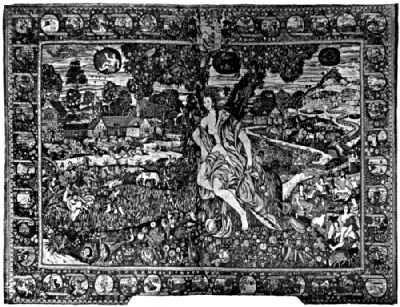
SUMMER English Tapestry, Temp. Henry VIII. at Hatfield
There are four pieces of tapestry representing the Seasons, removed from an old family house and placed by Lord Salisbury at Hatfield House, where they hang in the great corridor. These were probably woven in Barcheston. (Plate 49.) The style is English Renaissance, and the design full of intention; in fact, they have the seal of the time of Henry VIII. Only one characteristic reminds one of Flemish art, and that is the mode of drawing the plants and flowers, which might have been taken out of an old German herbal. The landscapes and peasantry are unmistakably English. The pictures are worked with strong black outlines which emphasize every detail and give the effect of a highly coloured outlined engraving; reminding one of the children’s books by Marcus Ward or by Walter Crane.[420]
The tapestries called the “Spanish Armada hangings” were probably woven here late in Elizabeth’s reign. In her time we find in catalogues of household goods, descriptions of splendid hangings, furnishings of palaces and private houses. The MS. inventory of the Earl of Leicester’s belongings, in the library at Longleat, astonishes us with the abundance of suites of hangings of tapestry that it enumerates, as well as those embroidered by hand, and others of stamped and painted leather.
It was in the reign of James I. that the manufacture was set up at Mortlake, in Surrey. Aubrey, in his “History of Surrey, i. p. 82,” however, dates the institution in the subsequent reign; but Lloyd[421] is not only positive for the former date, but affirms it was “of the motion of King James himself,” who gave £2000 towards the undertaking; and we have further proofs extant that he spent largely, and encouraged it in every way. He gave to Sir Francis Crane, who erected the house at Mortlake, “the making of three Baronets” towards his project for manufacture of tapestry.[422]
Another curious item which we quote, shows that the funds for the enterprise were not easily forthcoming. It is a warrant “to Sir Francis Crane: £2000 to be employed in buying £1000 per ann. of pensions or other gifts made of the king, and not yet payable, for ease of His Majesty’s charge of £1000 a year towards the maintenance of Sir Francis Crane’s tapestry manufacture.”[423]
Apparently this little arrangement did not succeed, for there is an acknowledgment by Charles I., in the first year of his reign,[424] that he is in debt to Sir F. Crane: “For three suits of gold tapestry we stand indebted to Sir Francis Crane £6000. Also Sir F. Crane is allowed £1000 annually for the better maintenance of said works for ten years to come.” The king also granted the estate of Stoke Bruere, near Stamford, in Northamptonshire, as part payment of £16,400 due to him on the tapestry works at Mortlake.[425] The great value of these tapestries is shown by the prices named in the Domestic Papers of the State Paper Office, and in private inventories; they were woven in silk, wool, and gold, which last item accounts both for their price and for their disappearance.
William, Archbishop of York and Lord Keeper, gave £2500 for four pieces of Arras representing the four Seasons.[426] Their value, however, fell during the civil wars, for the tapestries of the five Senses from the Palace of Oatlands, which were from the Mortlake looms, were sold in 1649 for £270. The beautiful tapestries at Houghton were woven at Mortlake: these are all silk, and contain whole length portraits of James I. and Charles I., and their Queens, with heads of the royal children in the borders. A similar hanging is at Knowle, wrought in silk, containing portraits of Vandyke and Sir Francis Crane.[427]
Francis Cleyne was a decorator and painter employed in the works at Mortlake by Charles I., who, while he was still Prince of Wales, brought him over to England from Rostock, in Mecklenburg (his native place), while the Prince was in Spain wooing the Infanta. Cleyne was great in grotesques, and also undertook in historical designs.[428]
Three of the Raphael cartoons were sent to be copied at Mortlake.[429] The purchase of these cartoons by the king, showed how high was the standard to which he tried to raise the art in England. The “Triumph of Cæsar,” by Mantegna, was obtained for the same purpose in 1653; and certain Dutch prisoners were forwarded to the manufactory to be employed on the work.[430] It was entrusted to the care of Sir Gilbert Pickering, who was either an artist or the superintendent of the works.
After the death of Sir Francis, his brother, Sir Richard Crane, sold the premises to Charles I. During the civil wars, the property was seized upon and confiscated as having belonged to the Crown. It occupied the site of what is now Queen’s Head Court. The old house opposite was built by the king for the residence of Cleyne the artist. Gibson, the dwarf, and portrait painter, who had been page to a lady at Mortlake, was one of his pupils.[431]
The value of the king’s collection of tapestries was well understood during the Protectorate. The tapestry house remained in the occupation of John Holliburie, the “master-workman.” After the Restoration, Charles II. appointed Verrio as designer, intending to revive the manufactory. This was not, however, carried out; but the work still lingered on, and must have been in some repute, for Evelyn names some of these hangings as a fit present among those offered by a gallant to his mistress.[432]
Arras is said to have been woven at Stamford, but we have no data of its establishment or its suppression. Burleigh House contains much of it; and there is a suite of hangings at Belton House, near Grantham, of which there are duplicates at Wroxton House, in Oxfordshire, all having the same traditional origin at Stamford. Possibly Sir Francis and Sir Richard Crane may have received orders at their house at Stoke Bruere, which lay near enough to Stamford to account for the magnates of the town and neighbourhood obtaining furnishings of their tapestries, and, perhaps, vying with each other in decorating their apartments with them.[433]
In Northumberland House there was a fine suite of tapestry, woven in Lambeth, 1758.[434] This is the only sample of that loom of which we ever find any mention. There were also works at Fulham, where furniture tapestry in the style of Beauvais was made. This manufactory was closed in 1755.[435] It may be hoped that the revival of tapestry weaving at Windsor in our own day may be a success, but without the royal and noble encouragement it receives, it would probably very soon fall into disuse.
Unless it is supported by the State, such an exceptionally expensive machinery cannot possibly be kept at work. It requires the superintendence of the best artists, and the weavers themselves must needs have the highest technical education to enable them to copy really fine designs. These artistic requirements, besides the extreme tediousness of the work, make it the most expensive of all luxurious decorations—even more costly than embroideries by the hand, covering the same spaces. However, the two styles of hangings never can enter into competition, except in a financial point of view. Tapestries are the best fitted for wall coverings, and embroideries for curtains of all kinds—for beds, for windows, and for portières.
The old hangings are now again having their day, and we are striving to save and restore all that remain to us. We must continue to guard these treasures from the moths, their worst enemies; and science should be invoked to assist us in the preservation of these precious works of art, of which the value is now again understood and appreciated, and which increases with every decade that is added to their antiquity.
Tapestry, as art, has its own peculiar beauties, and one of them is the softening, yet brilliant effect of the alternate lights and shadows of the ridge-like surface; the separation of each stitch and thread also casting minute shadows in the opposite direction, and giving an iridescent effect. It is a mistake to struggle against this inherent quality, instead of seeking to utilize it. The coarser and simpler tapestries of our ancestors are really more beautiful and effective in large spaces—flat in the arrangement of colours, and sharply outlined—than the imitations of paintings of the last two centuries, in which every detail of form and colour is sought to be expressed.[436]
M. Blanc says that tapestries were intended to cover the bare walls, but not to make us forget their existence. The wall being intended for comfort and defence, the mind is solaced with the idea it conveys. It is a mistake, therefore, to substitute a surface picture, so real that it at once does away with this impression of security, while a certain conventional art should amuse the mind with shadowy representations and suggestions.
It is, perhaps, fortunate that the possibilities of tapestry weaving are restricted, and thus its very imperfections become the sources of its best qualities as decoration and comfort. One element of textile weaving, the use of gold, both in the backgrounds and in the draperies, takes it at once out of the region of naturalism, while giving it light and splendour.
The designer for tapestry need not be a great genius. Harmony, repose, grace, and tender colouring are the qualities most valuable to such an artist. Battle-pieces, and other exciting and awful subjects, are only bearable in apartments that are used for state occasions, or for hanging corridors and anterooms. They are painful to live with.
All tapestries are liable to suffer by the double nature of their materials—their woollen surface and linen threads which are affected by both damp and heat crinkling the forms and puckering the faces, and bringing out unexpected expressions and deformities. For this reason the design should be as flat and as simple in its outline and shading as is consistent with beauty.