Part 5.
Reading edition
Opus Plumarium (or plumage work).
The “Opus Plumarium” is one of the most ancient groups, and includes all flat stitches, of which the distinguishing mark is, that they pass each other, overlap, and blend together. “Stem,” “twist,” “Japanese stitch,” and “long and short” or “embroidery stitch,” belong to this class, to which I propose to restore its original title of plumage work.
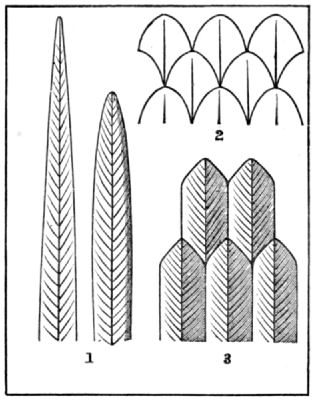
The origin of the name is much disputed, but it is supposed to have pointed to a decoration of plumage work, and we find that feathers have been an element in artistic design from the earliest times. There were patterns in Egyptian painting which certainly had feathers for their motive (fig. 21, p. 208).
Semper, finding that birds’-skins were a recognized article for trade in China, 2205 B.C.,[333] believes that they were used as onlaid application for architectural decoration; and this is possible, for we still obtain from thence specimens of work in different materials partly onlaid in whole feathers, whereas sometimes the longer threads of the feathers are woven by the needle into the ground web. In Her Majesty’s collection there are some specimens from Burmah—creatures resembling sphinxes or deformed cherubim, executed in feathers, applied on silk and outlined in gold. We have likewise from Burmah, in the Indian Museum, two peacocks[334] similarly worked; the legs and beaks are solidly raised in gold thread; and the outlines also are raised in gold, giving the appearance of enamelling. The cloisonné effect of brilliant colours, contrasted and enhanced by the separation of the gold outlines, can be seen to perfection in specimens of the beautiful Pekin jewellers’ work, where the feathers are inlaid in gold ornaments for the head and in the handles of fans. Nothing but gems can be more resplendent.
Fig. 21. Feather patterns, Egyptian.
These survivals help us to understand the casual mention we find in classical authors, of the works of the Plumarii, which appellation was given at last to all embroiderers who were not Phrygians.[335]
We have other glimpses of Oriental feather-work in different parts of India.[336]
The use of feathers is common in the islands of the Pacific. It is native to the Sandwich islanders; and M. Jules Remy describes the Hawaiian royal mantle, which was being constructed of yellow birds’ feathers through seven consecutive reigns, and was valued in Hawaii at 5,000,000 francs. A mantle of this description is the property of Lady Brassey.
In Africa, ancient Egyptian art furnishes us with traditional feather patterns and head-dresses; and Pigafetta tells us of costumes of birds’ skins, worn in the kingdom of Congo in the sixteenth century for their warmth; sea-birds’ feathers being highly esteemed.[337]
In America, where birds are most splendid, the art of the feather worker was carried to the greatest perfection. It was found there by the Spaniards, and recorded in all their writings for its beauty of design and execution, and for its great value, equal to that of gold and precious stones.
Though now looked down upon, as being a semi-barbarous style of decoration, because it exists no longer except in semi-barbarous countries, we must consider feather work as a relic of a past higher civilization which has died out, rather than simply as the effort of the savage to deck himself in the brightest colours attainable.
Feather-work is a lost art, but the name of “opus plumarium” remains, and proves that it was still recognized as such in the days of Roman luxury. The name survived when the practice was all but forgotten in Europe,[338] and the art itself disused, probably, because the birds of our continent rarely have any lovely plumage to tempt the eye.
But the glory of feather-work was found again in Mexico and Peru, and the surrounding nations, in the sixteenth century—praised, exalted, demoralized, and crushed out by the cruelties of conquest. The Spaniards at first brought home beautiful garments and hangings, representing gods and heroes, all worked in feathers.[339] Under their rule the natives produced pictures agreeable to the taste of their masters. Pope Sixtus V. accepted a head of St. Francis, which had been executed by one of the ablest of the “amantecas” (the name for an artist in feathers). Sixtus was struck with surprise and admiration at the beauty and artistic cleverness of the work, and, until he had touched and examined it closely, would not believe that plumage was the only material used.
There are beautiful hangings and bed furniture at Moritzburg, near Dresden, said to have belonged to Montezuma. They were given to Augustus the Strong, King of Poland, by a king of Spain.
In the seventeenth century, and later, feather work was still an art in Mexico, the convents continuing to preserve its traditions. Bustamente says that this industry was still in operation in the beginning of our century. The Mexican Museum preserves specimens of the last three hundred years, from the time of the conquest of Mexico.
There is in the Cluny Museum, in Paris, a beautiful triptych, evidently of the sixteenth century. It is worked in feathers, with delicate outlines in fine gold thread. Nothing can exceed the tenderness and harmony of the colouring in shades of blue, and warm and cool brown tints. This is probably a survival of that lost art of Mexico which was carried on in their convents, and may have been a copy of a treasured relic of European art.
Among the few noteworthy specimens that have survived, is the mitre of St. Carlo Borromeo at Milan, described by M. F. Denis as being both artistic and beautiful. He tells us in his Appendix that even now, a tissue of feathers is woven in France, as soft and flexible as a silk damask; and rivalling the Mexican scarlet feather fabric, which the Spaniards admired so greatly. He also speaks of the inlaid feather work, invented by M. Le Normant of Rouen, in the last century, and afterwards continued in Paris by his English pupil, Mr. Levet, who sold two of his works to the then Duke of Leeds, in 1735. The first is a vase of flowers, the second a peacock, designed by M. Oudry (peintre du Roi). Both of these, framed as screens, are now at Hornby Castle.
Unfortunately feathers are, by their nature, most attractive to that greatest destroyer, next to Attila—the moth. Ghirlandajo called mosaic in marble and glass, “painting for eternity;” we may call feather work, “painting for a day.”
From the essays of M. Ferdinand Denis,[340] much may be learned of the arte plumaria of the Mexicans and their neighbours of Brazil, Guatemala, Peru, and Yucatan, and the land of the Zapotecas, &c., where it was also cultivated. He says that their civilization is so mysterious that we have as yet no means of judging whence came their art.
Fergusson suggests the similarity between Central Asian and Central American art, both in architectural forms and plastic and sculptured remains. He thinks that its tradition was transmitted from Asia to America in the third and fourth centuries of our era. If so, it was an unlucky moment for the recipients, as the art of Asia, as well as that of Europe, was then at its lowest and most debased phase; perhaps, however, the more fit for the fertilization of that of a perfectly barbarous people. There is something fascinating in the suggestions on this subject in Mr. Donelly’s “Atlantis;” but when conjecture is only founded on tradition, and without proof, we must not take it into serious consideration.
Having proved the universal use of feathers, it is not difficult to appreciate the causes which suggested everywhere the transfer of this decorative art to another craft, employing less perishable materials. Embroidery probably followed it closely and absorbed it throughout Asia and in Egypt; and the survivals now are only an accidental specimen, a tradition, and a name.[341]
The name “Plumarii,” for the embroideries, is thus fully accounted for, and we need seek no further elucidation. It was commonly used in classical Roman times. “Opus plumarium” seems to have become the legitimate term for all needlework. The Plumarii were the embroiderers, whether their work was in wool, or thread, or in silk (at a later period),[342] with or without admixture of gold or silver (as the Argentarii were the jewellers).
The article on the word “plumarius” in Hoffman’s Lexicon,[343] after describing two kinds of Plumarii, Phrygians and Babylonians, proceeds to say, “These latter, who wove garments and hangings of various colours, were called ‘Plumarii;’ but though this name was at first confined to craftsmen who wove patterns in the shape of feathers, in course of time the name was extended to those artists who, with the needle or by painting, embellished robes.”[344]
The “opus plumarium” included, as I before said, all flat stitches; and I repeat that “feather application” was certainly its first motive; and next came the stitches that conveyed the same desired effect, though a new material was employed, fitted for the needle, which, having served its apprenticeship in “plain work,” now came to the front as a decorative agent.
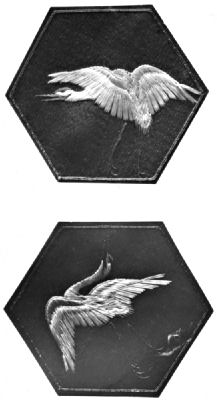
Painting with the needle began with an attempt to model with it; the lay of stitches being so arranged as to give the whole effect of light and shadow, so as to delineate the forms without changing the shades of the material used. I give on the opposite page some Japanese birds, which will explain what I mean. The stitches are so intelligently placed as absolutely to give the forms of the birds imitated. They represent plumage, and a more artistic representation cannot be imagined. (Pl. 43.)
The same stitch which we find prevailing in China and Japan as plumage work, is employed in embroidering flowers. Here satin, stem, and plumage stitches are blended together, and excellent decorative effects are produced; but the texture of flowers is not to be imitated, as is that of the plumage of birds. “Satin” stitch is a more restricted form of plumage stitch; and “stem” is another variety of these flat stitches, very useful in its place. I therefore have assigned the name of “plumage stitch” to that hitherto called “embroidery” or “long and short” stitches; and I give the term “plumage work” to include all the “flat” stitches.
Practically, it is allowed that these flat stitches, especially the plumage stitch, give most scope for freedom in needlework, as they are laid on at once, and according to the inspiration of the worker, and may cover the outline and efface it. The stitches are not counted, and have more of the nature of touch than any others, as their length, thickness, and closeness may be varied at will. The artist’s design thus admits of interpretation according to the taste and feeling of the needlewoman.
Pl. 43.
See larger image
Japanese Opus Plumarium.