Part 1.
Reading edition
Stitches.
Stitches in needlework correspond to the touches of the pencil or brush in drawing or painting, or to the strokes of the chisel in sculpture. The needle is the one implement of the craft by which endless forms of surface-work are executed. With a thread through its one eye, it blindly follows each effort of its pointed foot, urged by the intelligent or mechanical hand grouping the stitches, which, being long or short, single or mixed, slanting, upright, or crossed, are selected as the best fitted for the design and purpose in hand. The word “stitches” does not, however, in this chapter represent merely the plural of one particular process of needle insertion, but the produce and effect of each different kind of stitch by grouping and repetition, according to its most ancient nomenclature. That which is astonishing is the endless variety of surface, of design, of hints and suggestions, of startling effects, and of lovely combinations, resulting from the direction of the needle and manipulation of the materials, and differing from each other according to the power or the caprice of the worker. But the machine is always the same—the threaded needle strikes the same interval, forming the “stitch.”
This venerable implement, the needle, has, through the ages, varied but little in form. The attenuated body, the sharp foot, the rounded head, and the eye to hold the thread, are the same in principle, whether it is found in the cave-man’s grave, formed of a fish’s bone or shaped from that of a larger animal; hammered of the finest bronze, as from Egypt, or of gold, like those found in Scandinavia. A bronze needle was lately discovered in the tomb of a woman of the Vikings in Scotland, and its value is shown by its being placed in a silver case. Steel needles were first made in England in 1545, by a native of India. His successor, Christopher Greening, established a workshop in 1560 at Long Crendon, in Bucks, which existed there as a needle factory till quite lately. The rustic poetic drama, entitled “Gammer Gurton’s Needle,” performed at Ch. Coll., Cambridge, in 1566, was a regular comedy, of which a lost needle was the hero. In those days the village needle was evidently still a rare and precious possession.
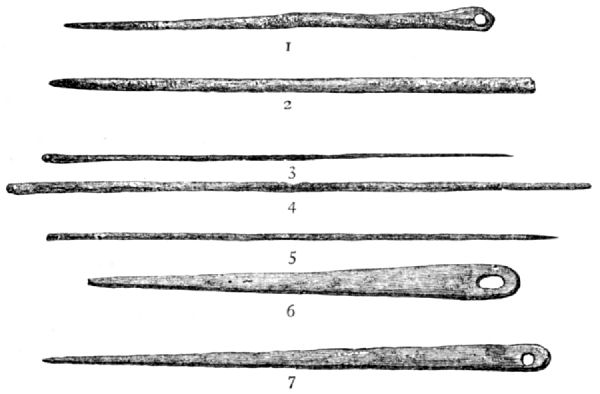
Fig. 20. 1, 2, 3, 4, 5, Bronze needles from Egyptian tombs now in British Museum. 6. Cave-man’s needle from the Pinhole, Churchfield, Ereswell Crag. 7. Bone needle from La Madeleine, Dordogne.
The art of embroidery consists of a design, which includes the pattern, and the handicraft or stitches—the “motive” and the “needlework.”
In painting, as in sculpture, the first idea, as well as the last touch, must come from the same head and hand. But in needlework it is not so. The pattern is the result of tradition. It is almost always simply a variation of old forms, altered and renewed by surrounding circumstances and sudden or gradual periods of change.
However much the design may alter, rising often to the highest point of decorative art, and as often falling back to the lowest and most meaningless repetitions and imitations, the stitches themselves vary but little. The same are to be found in Egyptian and Greek specimens, and the classical names are those used by mediæval writers, and have come down to us, “floating like bubbles on the waves of time.”
Sir George Birdwood[317] thinks that every kind of stitch is found in traditional Indian work. I confess that I have not been able hitherto to trace any of the “mosaic” stitches to India, nor do we ever see them in Chinese or Japanese embroidery, which shows every other variety. They are, however, occasionally found in Egyptian work.
The following is a list of stitches, under the nomenclature of classical, Roman and mediæval authors:—
Opus Phrygionium or Phrygium. Passing or metal thread work.
Opus Pulvinarium. Shrine or cushion work.
Opus Plumarium. Plumage or feather work.
Opus Consutum. Cut work.
Opus Araneum or Filatorium. Net or lace work.
Opus Pectineum. Tapestry or combed work.
Here are two English lists of stitches; their quaintness must be my excuse for copying them. The first is from Taylor, the water-poet’s “Praise of the Needle” (sixteenth century):—
“Tent work, raised work, laid work, prest work, Net work, most curious pearl or rare Italian cut work, Fine fern stitch, finny stitch, new stitch, and chain stitch, Brave bred stitch, fisher stitch, Irish stitch, and queen’s stitch, The Spanish stitch, rosemary stitch, and maw stitch, The smarting whip stitch, back stitch, and the cross stitch.— All these are good, and these we must allow, And these are everywhere in practice now.”
The second list is from Rees’ “Cyclopædia” (Stitches), 1819:—
“Spanish stitch, Tent stitch on the finger, Tent stitch in the tent or frame, Irish stitch, Fore stitch, Gold stitch, Twist stitch, Fern stitch, Broad stitch, Rosemary stitch, Chip stitch, Raised work, Geneva work, Cut work, Laid work, Back stitch, Queen’s stitch, Satin stitch, Finny stitch, Chain stitch, Fisher’s stitch, Bow stitch, Cross stitch, Needlework purl, Virgin’s device, Open cut work, Stitch work, Through stitch, Rock work, Net work, and Lent work.
“All which are swete manners of work wroughte by the needle with silke of all natures, purls, wyres, and weft or foreign bread (‘braid’), etc., etc.”