Part 2.
Reading edition
Plain Work and White Work.
We are told that the primal man and woman sewed in Paradise.
To “sew,” in contradistinction to the word to “embroider,” is derived from the Sanskrit su, suchi, and thence imported into Latin, suo.[318] To prove how highly esteemed needlework was among the Romans, I may mention that the equivalent of the phrase “to hit the right nail on the head” was rem acu tangere, “to touch the question with the point of the needle.”
“Plain work” is that which is necessary. As soon as textiles are needed for covering and clothing, the means are invented for drawing the cut edges together, and for preventing the fraying where the material is lacerated by the shaping process. Hence the “seam,” the “hem,” and all the forms of stitches that bind and plait. These necessary stitches constitute plain needlework, and are closely followed by decorative stitches, which in gradation cover the space between plain needlework and embroidery.
Semper has given us his archæological theories for the origin of needlework and its stitches.
These are his arguments, if not always his words. He says: “The seam is one of the first human successful efforts to conquer difficulties.”[319]
A string, a ribbon, a band, may serve to keep together several loose things; but by means of the seam, small things actually become large ones. For example: a full-grown man can, by its help, cover himself with a garment made of the skins of many small animals. When Eve sewed fig-leaves together, she made of these small pieces a garment of patchwork.
Acting on the principle of making a virtue of necessity, accepting and adorning the severe facts of life, seams came to be an important vehicle of ornament. The Gauls and Britons embroidered the seams of their fur garments. “We may judge of the antiquity of the seam by its universal and mythological meaning. The seam, the tie, the knot, the plait, and the mesh are the earliest symbols of fate uniting events.”[320]
We find but little mention of plain work in mediæval writings. When linen was worked for some honourable purpose, such as a gift to a friend or a royal personage, it was generally embroidered or stitched in some fancy fashion. Queen Elizabeth presented Edward VI., on his second birthday, with a smock made by herself. Fine linen was about this time constantly edged with bone laces.
Mrs. Floyer has written so well, and given us so much practical information on plain needlework, that I feel it unnecessary to enter at any length into the principles of plain sewing, as my theme is needlework as decorative art.
Mrs. Floyer has, as it were, unpicked and unravelled every stitch in plain work, till she has discovered and laid bare its intention, its construction, and effect. She, has also given us rules made clear to the dullest understanding, instructing us how to teach the young and ignorant. She shows us the quickest and most perfect way of working different materials for different purposes, and tells us how to select them. I will, therefore, refer my readers to her most useful and instructive books,[321] and pass on at once from the craft of plain needlework, to stitches as the art of embroidery.
The link between plain and decorative work deserves attention. This link is “white embroidery.” I imagine it was not a very ancient form of the art, and was practised first in mediæval days; when we begin to have constant notices of it. The first white laces appear to have followed close upon the first white embroideries.
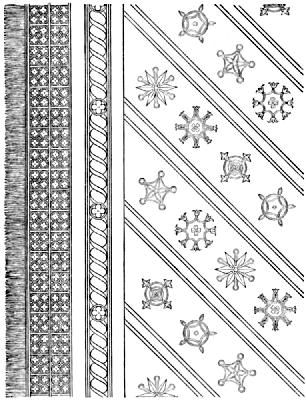
There is a tomb of the fourteenth century in the Church of the Ara Cœli at Rome, where the effigy of a knight lies on his bed, draped with a sheet and a coverlet, both embroidered. These are evidently of linen worked in white.[322] I give a drawing of them in illustration (pl. 39).
From that date we find continually mention of such work by nuns and ladies.[323] In England it was especially called “nuns’ work” (plate 42). There is a great survival of this stitchery in Italy amongst the peasantry. They have always adorned their smocks and aprons, and their linen head-coverings, and the borders of sheets for great occasions, with patterns in “flat stitches,” “cut stitches,” and “drawn work.” The Greek peasants do the same. In Germany will be found much curious white embroidery, of designs which show their antiquity; and from Spain we get “Spanish work” in black, on white linen, which is nearly allied to the stitches of white work.
Pl. 39.
See larger image
Embroidery imitated in marble on the tomb of a knight, in the Church of the Ara Cœli, Rome.
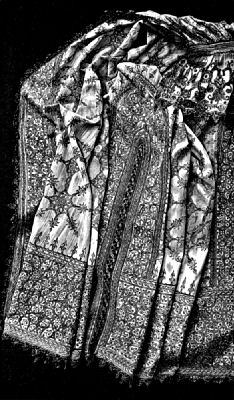
Lord Arundel of Wardour possesses a linen cover for a tabernacle (or else it is a processional cloak) which is of the purest Hispano-Moorish design, and unrivalled in beauty. It is embroidered in Spanish stitches in white thread, on the finest linen, and is intersected with fine lace insertion (pl. 40). It is said to have been found in the time of Elizabeth with some other articles in a dry well; among them a little satin shoe, of which the shape proves its date to be of the end of Henry VIII.’s reign. Russian embroidery, consisting of geometrical patterns in red, blue, and black thread, is of this class.
Pl. 40.
See larger image
Processional Cloak, time of Henry VIII., belonging to Lord Arundel of Wardour.
In England alone, the peasantry do no white work for home use, and we must suppose it has never been a domestic occupation. Indeed, the love of the needle is by no means an English national tendency, in the lower classes. Nothing but the plainest work is taught in our schools. Anything approaching to decorative art, with us, has been the accomplishment of educated women, and not the employment of leisure moments in the houses of the poor.
Semper, in “Der Stil,”[324] gives rules for white embroidery, and the reasons from which he deduces them are good. He says, that allowing it as a maxim that each textile has its own uses and its own beauties, we should place nothing on linen which would militate against its inherent qualities and merits; and that, as the great beauty of flax is its smoothness and purity, all projections and roughnesses should be avoided which would catch dust or throw a shadow. Carrying out this idea, it would appear that satin, and not lace stitches are therefore, the most suitable for this kind of decoration. The accepted rule for selecting the stitch for each piece of work is this: on stout grounds the thread should be round and rich, whereas delicate materials carry best the most refined and shining thread work; and in embroidering the smooth surface of linen fabrics, the flattest stitches are the most appropriate.