Part 7.
Reading edition
Lace.—Opus Filatorium or Araneum.
Mrs. Palliser says that from the earliest times the art of lace-making has been so mixed up with that of needlework, that it is impossible to enter upon the one without naming the other. This is, in fact, what she has done, showing the intimate connection between the two in her charming work on lace, where much information about embroideries in general, may be found in the introduction.[353]
M. Blanc also considers that there is but a slight transition between embroidery and guipure, which he says was the first lace.[354] As all the earliest specimens and designs for guipure were Venetian, the art was, therefore, probably an Italian invention, though an Oriental origin has sometimes been attributed to it. The objection to this last theory is that we find no ancient specimens, and no modern continuation of such work in the East.
The word “guipure” is a stumbling-block. It has been applied to many forms in the varying art of lace-making; which same variableness has caused its nomenclature to assume the terms belonging to other textile arts where they approach or touch each other, (as in netting, fringes, or embroideries). The nearest approach to laces before the thirteenth century was more in the nature of what we now call guimp.[355]
Embroidery differs from lace, in that it is worked on already woven tissues; whereas lace is manufactured at once, both ground and design.[356] But the link between the two is not missing.
In the twelfth century they worked “opus filatorium,” which consisted of embroidery with the needle on linen, of which half the threads had been drawn out, and the remainder were worked into a net by knotting them into groups, then dividing, and knotting them again. [357] There is a piece of work described in an old catalogue quoted by Rock. “St. Paul’s, London, had a cushion covered with knotted thread: Pulvinar copertum de albo filo nodato.” Here lace and embroidery touch each other.[358] Sir Gardiner Wilkinson notices some early Egyptian work in the Louvre as “a piece of white network pattern, each mesh containing an irregular cubic figure.” This sounds much like lace-work.
It may be fairly asserted that the term “embroidery” embraces the craft of lace-making, as almost all ancient and much modern lace is simple embroidery, and formed entirely by the needle.
Some kinds of lace, however, are made by plaiting and twisting the threads attached to bobbins round pins which are previously arranged in the holes of a pattern, pricked on parchment or glazed paper.[359] The original motive and idea of lace is a net. The patterns called by the ancients “de fundata,” are netted designs meshed. You will see them constantly in Egyptian and Greek art, both in wall painting and textile decoration. Homer speaks of golden cauls, and so does Isaiah,[360] as adorning women’s heads. They also mention nets of flax.
The capitals of the brazen columns adorned with “nets of chequer work” in Solomon’s Temple are very curious.[361] And the author of “Letters from Italy, 1776,” tells of the garment of a statue at Portici, edged with a border resembling fine netting. Egyptian robes of state appear to have been sometimes trimmed with an edging of a texture between lace and fringe.[362]
Lace has been made of many materials in many ways. We may instance “passementerie,” made with bobbins (bone lace), with or without pins, or with the needle only, by hand. The materials have been gold, silver, silk, thread (these two last white or coloured), the fibres of plants, and human hair.[363] A lace called “yak” is made of wool or hair.
Bone laces in gold and silver, or the two mixed and interchanged, are continually mentioned in the inventories of the fifteenth, sixteenth, and seventeenth centuries. Bed hangings, chair and cushion covers, and table cloths were constantly trimmed with gold and silver bone lace, and fringes of the same.[364] Laces in coloured silks were made in Spain and the Balearic Isles late in the last century.[365]
In 1542, a sumptuary law was passed in Venice, forbidding the metal laces embroidered in silk to be wider than “due dita,” i.e. about two inches. This paternal interference in the details of life is truly Venetian. It was intended to “protect the nobles and citizens from injuring themselves and setting a bad example.”
Perhaps this strict rule was relaxed in favour of crowned heads and royal personages; for there is at Ashridge, among the relics of Queen Elizabeth’s enforced visit, a toilet-cover of red and gold striped silk, with a trimming of lace, four inches broad, of Venice gold and silver lace embroidered in coloured silk. Specimens of these laces are rare, owing to the intrinsic value of the metal. We must suppose the origin of these golden trimmings to belong to a very early period. A piece of gold wire lace guimp was lately found in a tomb near Wareham, and is supposed, with reason, to be Scandinavian.[366]
M. Blanc describes lace as a “treillage” or network, and says it is made in three ways. You may complete the ground first, and then work the pattern with the needle. This he calls lace “pure et simple;” and he considers that it differs from guipure in that the latter consists of flowers and arabesques worked separately, and then connected with bars, lines, or meshes. This guipure is the second mode of lace-making.[367] The third is by machinery; but this has the inherent defect of all machine-made fabrics, to a practised eye; i.e. a certain rigidity and coldness in the exactly repeated forms, in which the human touch is wanting. It is curious how in art, even a “pentimento” is valuable, recalling the hand that erred as well as created; the attention that strayed, or reconsidered the design.[368]
M. Blanc, speaking of the beauty of point d’Alençon, praises it especially as being entirely needlework. He names the different modes of lace-making, and judges their merits. Of needle-made lace he says: “And the value of this lace not only arises from its representing a considerable amount of labour, but also because nothing can replace in human estimation the fabrics produced by a man’s, and still less by a woman’s handicraft. However the hand may have been restrained by the necessity of faithfully following, on green parchment, the designs imagined and traced by another person, there is always, even in copying an outline, an individuality, an imperceptible deviation to the right or to the left, above or below the tracing, which impresses on the design the accent of strength or weakness, of indecision or determination.”[369] I would add, of intelligence or stupidity; of knowledge or ignorance.
This is not the first time, and will certainly not be the last, that I shall have sought to impress on the needlewoman the fact that her individuality cannot fail to be strongly marked in her work; and I would urge her to carry out the suggestions that her experience and her taste afford her, while seeking to render faithfully the original motive of the designer. In lace-making, as in all art, the interest and the life, as it were, is imparted to each specimen by the attention and thought bestowed upon it.
Mrs. Palliser shows us, by her beautiful illustrations, how much variety may be given to designs for lace-making, which have changed with each period of contemporary art, and are markedly distinctive of their nationalities.
Mr. A. Cole’s lectures on lace, his volume of photographs, and M. Seguin’s valuable work, are full of information.
M. Urbani de Gheltof’s “Technical History of Venetian Laces,” translated into English by Lady Layard, is a beautiful little book and a worthy imitation of the ancient lace-books of the sixteenth and seventeenth centuries.[370]
The subject has been so thoroughly discussed by adepts in connection with its revival as a local industry in its original cradle, that I will confine myself to a few observations on its history and its place in decorative art.
Fringes, Knotting, Netting, Knitting, Crochet, Tatting, and Lace-making, are all parts of the same branch of ornamental needlework. They are all “trimmings,” in the sense of being decorative edges to more solid materials. They are not available as coverings for warmth or decency; but they serve to give the grace of mystery to the object they drape or veil. They soften the outlines and the colours beneath them, while they permit them to peep through their meshes. They are hardly to be included in what is called high art, having more affinity with grace, refinement and coquetry, than with æsthetic culture or noble thought.
This tendency in lace work may be the reason that the masculine mind does not, in general, appreciate these lovely textures, but rather despises them (even when the designs are beautiful and ingenious), as being flimsy and deficient in honest intention; whereas women have always greatly prized them for their delicacy and refinement, and their great value, on account of the time, trouble, and eyesight expended upon them. Their knowledge of stitches also enables them to appreciate their variety, and the taste shown in their selection and arrangement for carrying out each design.
Lace stitches are almost innumerable.[371] Upwards of a hundred are named, and their variations are endless. But a volume would not suffice us for entering into the details of the craft; many of its stitches have been imported into embroideries in gold, silk, and crewels; and such adaptations are always allowable, provided the effect is good.
We have every reason to believe that the claims of Venice as the first and original school of lace-making have been satisfactorily proved.[372] Genoa, Florence, Milan, especially the last,[373] followed suit. Germany, France,[374] and Spain soon started their schools; but Lady Layard believes that Spain received all her inspiration and the greater part of her laces from Venice, which likewise sent teachers to France and to Brussels—or rather, we may say, had many first-class workwomen decoyed from her manufactories to assist in starting rival industries in other countries.[375]
The first pattern-books were printed in Venice in the sixteenth century; and these “Corone di belle e virtuose donne,” as they are sometimes entitled,[376] were imitated in France and Germany.
Venice was proud of her industry, and of the noble ladies who fostered it. It is recorded in the “Virtù in Giocco of Giovanna Palazzi” that Giovanna Dandolo, or “la Dandola,” (wife of the Doge Malapiero,) was the first patroness of Venice laces. She also fostered the art of printing in Venice, and is spoken of as a “principessa di gran’ spirito, ne di private fortune,” and her memory is cherished in connection with these proofs of her patriotism. We hear also that Morosin or Marosin, wife of the Doge Marin Grimani, patronized Venetian lace-making. Her forewoman, or maestra, was a certain Cattina Gardin, and through her the art was settled at Burano, where it has been so lately revived.
At the Cathedral of Burano, is kept in the sacristy, perhaps the finest existing piece of artistic lace of the sixteenth century. It contains many groups of figures from the history of our Lord, beautiful both in design and execution, worked in “Punti Fogliami,” and filled in with exquisite tracery. This was the border of an antipendium.
Mrs. Palliser laments the extinction of the art in Venice, and says that but one woman of the old craft had survived; but her elegy was premature, as that old woman, by name Cencia Scarpariola, has lived to see hundreds of girls at Burano reviving all the old traditions, having learnt from her the secrets of the “mestiere,” or “mystery.” Under the patronage of the Princess Margherita, now Queen of Italy, and with the active help and superintendence of Countess Adriana Marcello and Princess Giovanelli, most beautiful laces are now made in every old point, French and Flemish, as well as Venetian. Pezzi, merli, and merletti are executed in the different styles which include all lace-making, and of which we here give a list from M. de Gheltof’s book:—
Net lace. Cut lace. Open lace. Flowered lace. Knotted lace. Darning or square netting. Venice point. Burano point. Drawn lace.[377] Embroidered linen.[378]
The price of these laces is very high, but not beyond their value when we consider the vast amount of skilled labour bestowed on them. We are often told that old lace is cheaper than new, as an absurd fact, because the antiquity of lace is supposed to add to its value. Yes, but principally as an object of archæological interest; whereas that which is being made now is supporting by its daily wage the needlewoman and her family, and perhaps providing for her old age; and as the strain on the eye is very heavy, many lace-workers early in life lose their sight, at least for all the purposes of their craft.[379] For these reasons we cannot say that the prices required for such luxurious trimmings are unreasonable. Zanon da Udine gives us an idea of how costly they were in old times. He says that Giuseppe Berardi, a lace merchant in Venice, made a profit of 75,000 francs on a commission for a set of lace bed-hangings for the wedding of Joseph II., Emperor of Germany, which proves the high prices paid for the new laces of their day.
Blond laces, which take their turn occasionally as fashionable trimmings, veils, and Spanish mantillas, are so called from their original Venetian name, “merletti biondi,” pale laces. De Gheltof derives this appellation from the celebrated collar of Louis Quatorze, and fancies it was made of the fair hair of the workers; but this is only vague conjecture. The term was applied in the seventeenth century to laces in silk, gold, and silver—never to thread laces. I confess I do not find the reason for the name, but accept De Gheltof’s information that it was given by the authority of the magistrates of Mercanzia in 1759.
This is but a very slight sketch of the history of lace. Venice being its birthplace, and likewise the busy scene of its rehabilitation, I have lingered over its school, and left but little space for the discussion of those of Spain, Flanders, Belgium, and France. But these have been thoroughly investigated, and their individual merits are well appreciated, both as antique and modern dress decoration.
I have already said that the lace schools in France were instituted by Colbert, who placed one at Auxerre, under the especial care of his brother, the bishop of that city. Louis Quatorze made it one of his splendid caprices, and not only set the example, but forced the fashion into this luxurious and extravagant channel.
In Spain, lace was made to look its best by being worn stretched over the great hoops of the “Guard-Infante;” and the fashion spread all over Europe. The white laces, resembling carved ivory or those in gold and silver, which remind one of solid jewellers’ work, when spread over the surface of these fortified outworks, guarding from all approach the persons of the Infantas of Spain, assume in the portraits by Velasquez, a dignity which is in keeping with their value. The splendid designs show brilliantly on a background of scarlet, rose colour, or black silk; and that which, hanging loosely, looks only tawdry and ragged, had a magnificent effect when thus displayed.
For ecclesiastical purposes, these grand solid laces seem most appropriate, being effective in large spaces, and easily seen at a distance, hanging over the edge of the altar, as a border to the linen cloths, or finishing the white alb of the officiating priest.
One cannot but agree with M. Blanc, who points out that each piece of lace had its intention, and that a fashionable ball-dress trimmed with the edging of an antique altar-cloth in loops, is in false taste, to say no worse of the misappropriation.
Though we have had no schools of lace in England (unless we can call our imitative industries schools), we have samplers of the time of Queen Elizabeth, and down to the middle of the last century, showing that drawn lace and cut lace were regularly taught, probably as an accomplishment, by Italians. The laces of Devonshire and the Isle of Wight (called Honiton) form a group totally distinct from those of Northamptonshire, Bedfordshire, and Oxfordshire, which last are very simple cushion bobbin-laces.
From the sixteenth century English ladies have, for their amusement, made cut laces. Still, we must confess we have no national style of lace, and the only enduring ones have been those of France and Belgium, which have always kept the lead since their establishment, though fluctuating in design with the varying fashions of each epoch. Perhaps the reason of their longevity is that they have followed always the taste of their day. That of our time being decidedly archæological, ancient patterns are now the most successful.
There is a kind of embroidery darned-work, called “Limerick lace,” which is said to be only made in Ireland, and being partly machine-made, is not pure lace, and therefore little esteemed. Very fine thread laces have been produced at Irish work schools; but no commercial result has followed. Clever imitations of Venice point have come from Ireland lately, called “raised crochet.” This is a novelty, and it is extremely fine and beautiful work.
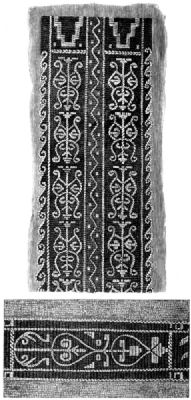
Pl. 46.
See larger image
Egyptian “Gobelins,” Woven and Embroidered.
The Exhibition of Irish Lace in London (June, 1883), shows how widespread have been the efforts of Irish ladies to employ the peculiar genius of the sister island for delicate work with the needle, which has always been shown in their beautiful embroideries on muslin and cambric. It appears that every kind of lace, except, perhaps, Brussels point, has been made in Ireland within the last 180 years; but as in each case the effort was always that of one individual woman, the school fell away when she died.
The names of these ladies are now worthily recorded in the official catalogue of the exhibition, with photographs of the specimens produced under their superintendence and care. Perhaps a permanent industry may crown, however late, their exertions to help the women of Ireland.