Part 6.
Reading edition
Opus Consutum (or cut work).
This is “Patchwork,” or “Appliqué” (“inlaid” and “onlaid”). Vasari calls it “Di commesso,” and says that Botticelli invented it for the use of Church banners, as being much more effective than any other style of work, or even than painting, as the outlines remained firm (non si stinguano), and were not affected by the weather (as in painted cloths) and were visible on both sides of the banner. Botticelli drew with his own hand the baldachino of Or San Michele, and the embroideries on a frieze carried in procession by the monks of Santa Maria Novella; he died 1515. Perhaps he may have revived the art of application in his own day.
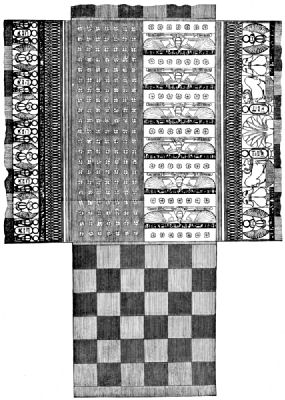
There are, however, much earlier examples of patchwork, of which the first and most remarkable is the Egyptian funeral tent of Queen Isi-em-Kheb, mother-in-law of Shishak, who besieged and took Jerusalem three or four years after the death of Solomon, B.C. 980. It may be described as a mosaic, or patchwork of prodigious size, made of thousands of pieces of gazelles’ skins, dyed, and neatly sewn together with threads of colour to match, resembling the stitching of a glove, the outer edges bound with a cord of twisted pink leather, sewn on with stout pink thread (pl. 44). The colours are described as being wonderfully preserved, when it is remembered that they are nearly as old as the Trojan War; though perhaps their preservation is less surprising than that the flowers wreathed about several royal mummies of the same period should have shown their colours and forms when the cases were first opened, so as to be recognized as blue larkspur, yellow mimosa, and a red Abyssinian flower, massed closely together on the foundation of a strong leaf cut in zigzags. Among the flowers lay a dead wasp, whose worthless little form and identity were as perfectly preserved as those of the mighty monarch on whose bosom it had completed its short existence. The tent itself consists of a centre or flat top, divided down the middle, and covered over one half with pink and yellow rosettes on a blue ground; on the other half are six large vultures, each surrounded with a hieroglyphic text which is really an epitaph. The side flaps are adorned first with some narrow bands of colour; then with a fringe pattern; then with a row of broad panels, red, green, and yellow, with a device or picture and inscription in the two other colours; on this border there are kneeling gazelles, each with a pink Abyssinian lotus blossom hanging to its collar. The rest of the side flaps and the whole of the front and back flaps are composed of large squares, alternately pink and green. This, for its antiquity, its style, its stitchery, materials, and colours, is a most interesting work of early art, and an example of the perfection to which it had attained. It is remarkable how much variety of effect has been produced with only four colours, by the artistic manner of placing and contrasting them. To our more advanced taste, however, the whole effect of the contrasting colours is inharmonious and gaudy, though certainly striking and typical.[345]
Another piece of Egyptian application, from the Museum at Turin, is a pretty leaf pattern cut out in red stuff, laid on a white ground, and worked down with a darker outline of the same colour.[346]
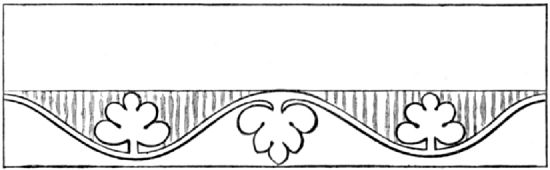
Fig. 22. Piece of appliqué in red stuff and red outlines from Egypt.
Pl. 44.
See larger image
Funeral Tent of Isi-em-Kheb. From Villiers Stuart’s “Funeral Tent of an Egyptian Queen.”
We have an instance of ancient “application” of about 600 years later, Greek in its beauty of design and execution. Alas! we can only ascertain, from tattered fragments taken out of a tomb in the Crimea, that it was parsemé with figures on horseback or in chariots. The border is very beautiful. Compare the fragments of which we have obtained a copy with the mantle of Demeter, from a Greek vase, and you will perceive how the styles correspond (Pl. 16, Fig. 23). The ground material is of the finest woven wool, of a deep violet or purple colour, enriched with application of another fine woollen fabric of a most brilliant green, worked down, outlined and embroidered in white, black, and gold-coloured wool, apparently in stem stitches.[347] The accompanying illustration gives the effect and general design of the outer border only, in which the applied leaf is worked down in red, gold, and white.
It is much to be regretted that the centre of the mantle is so tattered and discoloured that it is impossible to do more than ascertain that the design that is embroidered on it consists of figures on horseback or in chariots, in spirited attitudes. The second and broader border is to be found (pl. 17).
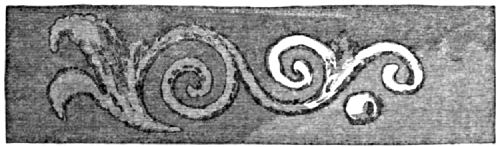
Fig. 23. Narrow border of a Greek mantle.
“Opus consutum” cannot in any sense perhaps be the name of a stitch or stitches. But it applies to a peculiar style of embroidery employing certain stitches. It is the term given to all work cut out of plain or embroidered materials, and applied by “working down” to another material as grounding. It includes all raised and stuffed application in silk, woollen, and metal thread work. It has been given to all work in which the scissors are active agents, whether in cutting out the outlines or in incising the pattern, as in much of the linen and muslin embroideries of our day, now called “Madeira work,” of which a great deal was made in the first part of the century by English ladies who designed and collected patterns from each other, and gave the produce of their industry as gifts to their friends for collars, cuffs, and trimmings.[348]
“Cut work” is named by Chaucer, and is constantly to be found in inventories from his time to the beginning of the last century. At Coire, in the Grisons, is a very beautiful chasuble, of which the orphrey is of the school of the elder Holbein or Lucas Cranach, applied and raised so as to form a high relief. The figures are covered with satin and embroidered. The chasuble itself is of fine Saracenic silk, woven with golden inscriptions in broad stripes. The colours are brown, crimson, and gold.
See larger image
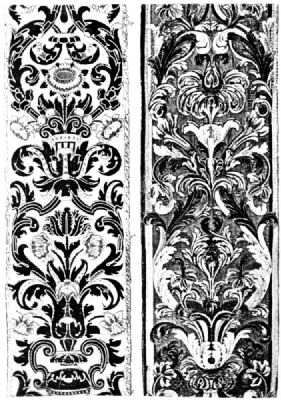
Wall Pilasters Appliqué Cut-work, Italian XVI. Centry Property of Countess Somers
In the later Middle Ages, a good deal of this work was executed in Germany for wall hangings; figures were cut out in different materials, and embroidered down and finished by putting in the details in various stitches. As art they are generally a failure, being more gaudy than beautiful. This, however, is not necessarily the case, for there is at the Hotel Cluny a complete suite of hangings of the time of Francis the First, partly applied and partly embroidered, which are beautiful in design and colouring, especially the fruit and trophies in the borders.
In the sixteenth and seventeenth centuries cut work was much employed in Italy for large flowered arabesque designs, commonly in velvet or silk, making columnar wall hangings, which are often very effective; giving the rooms an architectural decoration, without interfering with the arrangement of works of art, pictures, statues and cabinets, placed in front of them. Besides, it was supposed that the utmost effect of richness was thus accomplished with the least labour, and very large spaces and very high walls covered, without losing anything of beauty by distance, as must be the case when the work’s highest merit is in the delicacy of the stitches and the details of form. (Pl. 45.)
The Earl of Beauchamp has inherited a most beautiful suite of hangings of “appliqué work;” silks of many kinds are laid on a white brocade ground with every possible variety of stitch, forming richly and gracefully designed patterns; and showing to what cut work can aspire.
A great deal of “opus consutum” has been done in the School of Art Needlework, in the way of restoration of old embroideries. Here may be seen copies of different models of many periods; amongst other British specimens, part of a bed at Drumlanrig, in which James I. slept. In this work the application is cut out, raised and stuffed, and “couched” with cords, and the whole thing is as stiff, strong, conventional, and enduring as if it were a piece of upholstery that was carpentered yesterday, instead of being needlework of at least 250 years ago.
One of the most remarkable large works of this style that exists was shown in 1881, at the South Kensington Museum, during the Spanish Exhibition.[349] It was of the kind called “on the stamp.” This was a landscape seen between columns wreathed with flowers and creepers. In the foreground couched a stag, the size of life—a wonderful reproduction of the hide of the creature in stitches. The relief is so high that the columns appear to be circular by the shadows they throw; and the stag is stuffed so as to be raised about six inches. The work is superb, and causes pleasure as well as wonder; and yet, in spite of the beauty of the design, and the richness of the materials—gold, silver, silk, and wool profusely used—it is a divergence from the legitimate art of embroidery, and is simply the attempt of the needlewoman to combine again the arts of sculpture and painting with the help of so inadequate an implement as the needle. Therefore, except as being a marvellous and beautiful curiosity, it is a failure; it is not art.[350]
Practically, cut work is the best mode of arriving at splendid effects by uniting rich and varied tissues.[351] The Italian curiosity vendors know this well, and often cut up the remnants and rags of rich stuffs, old faded silks, and scraps of gold and silver tissues, and with them copy fine old designs, and sell them as authentic specimens of such and such a date.
I was once requested to give an opinion as to the date of a curtain border bought in Italy, and on consideration I gave the following verdict: “The design is of the sixteenth century; the applied velvet and gold cord, of the seventeenth century; the brocaded silk ground, eighteenth century; the thread with which the whole was worked—machine-made silk thread (English)—middle of nineteenth century.” The whole effect was excellent, and very antique.
This art of “application” is the distinctive part of the “opus consutum,” and it is the best and most economical method for restoration of old embroideries, of which the grounding material is generally worn out long before the stitches laid upon it. Much beautiful work has thus been rescued from annihilation, and restored to use from its long imprisonment in the boxes and drawers of the garret and store-room. But it is cruel to transfer historical or typical works, and so puzzle the artist and the historian.
It is so troublesome to embroider on velvet or plush, or gold tissues, that application is the easiest and most effective mode of dealing with these fabrics.[352] The outlines laid down in cord have the best effect, while binding the edges and securing them from fraying, and it is almost certain that the eye receives most pleasure, in flat art, from a defined outline, which satisfies it; where there are no cast shadows, it lifts the work from the background, and separating the colours, it enhances their beauty. It would appear, however, as a rule, that either black or gold metal should invariably be employed, because they do not interfere with any colour they approach. White is distracting and aggressive. The Greeks sometimes used gold colour instead of gold, as we see in the mantle from the Crimea already referred to; but this is not nearly so agreeable to the eye as pure gold.
A great deal of modern “opus consutum,” or application cut work, has been done in Constantinople of late years. The designs in general, are not artistic; nor are the colouring and materials very commendable. The onlaid material is, in general, sewn down with chain stitches, and cut out afterwards.