Volume 4 — Introductory material (continued 4)
Reading edition
SS Lieutenant Colonel Sievers therefore suggests that the Reichsfuehrer SS write a letter to Reich Governor Dr. Seyss-Inquart saying that it is request that the Reich Governor put the appliances of the University Institutes concerned at the disposal of the Ancestral Heritage Organization [Ahnenerbe], initially on a loan basis.
(signed) Dr. Rascher
Munich, 12 November 1942
[Handwritten notation] Dr. Brandt to Reuter
TRANSLATION OF DOCUMENT 1637-PS
1938 REICHS MINISTERIALBLATT, i. V., PAGES 1089-1091
Acceptance of members of the Security Police into the SS of the N.S.D.A.P. of 23 June 1938.
Ministerial-Blatt of the Reich and Prussian Ministries of the Interior, Berlin, 1938
No. 28, p. 1090
Appointments, Wages, Maintenance, Service Regulations
Circular of the Reichsfuehrer SS and Chief of the German Police in the Reich Ministry of the Interior for 23.6.1938—S-V 3 No. 72/38
The The Corresponds to the
Criminal-assistant aspirant in preparatory service [Kriminal-Assist-Aniv. im Verbereitungsvienst Office helper [Amtsgehilfe Betenmeister] SS Sergeant [SS Unterscharfuehrer]
Criminal-Assistant aspirant [Kriminal-Assist-Aniv] Superintendant [Hausmeister] SS-Staff Sergeant [SS-Scharfuehrer]
Criminal assistant [Kriminal-Assist] Police office assistant. [Pol-Buereassist] Police-Prison-Technical Sergeant. [Poli-Gefaengnisoberwachtm] SS-Technical Sergeant [SS-Oberscharfuehrer]
Chief Criminal Assistant. [Krim-Oberassist] Police-Prison-Master Sergeant [Pol-Gefaengnis-Hauptwachtm] SS-Master Sergeant [SS Hauptscharfuehrer]
Criminal secretary [Krim-Sekretar] Criminal district secretary [Krim-Bez. Sekretar] Police-secretary [Pol-Sekretar] Office-Secretary [Kanzleisekretaer] Police secretary first class [Pol-Obersekretaer] Technical secretary [Techn-Sekretaer] SS-Lieutenant [SS-Untersturmfuehrer]
Criminal inspector [Krim-Inspektor] Criminal commissar up to 15 years of service [Krim-Kommissar] Ministerial registrator [Min-Registrator] Police inspector [Pol-Inspektor] Assessor [Assessor] SS-First Lieutenant [SS-Obersturmfuehrer]
Criminal commissar with over 15 years of service [Krim-Kommissar] Criminal counsellor [Krim-Rat] up to 15 years of service. Police inspector [Pol-Inspektor] with 300 Reichsmark additional salary. Police inspector first class [Pol-Oberinspektor] Government-Assessor [Reg-Assessor] Police counsellor up to 15 years of service. [Pol-Rat] SS-Captain [SS-Hauptsturmfuehrer]
Criminal counsellor with over 15 years of service [Krim-Rat] Criminal director [Krim-Direktor] Government and criminal counsellor [Reg. u. Krim-Rat] Police counsellor with over 15 years of service. [Pol-Rat] Office-counsellor [Amtsrat] Government-counsellor [Reg-Rat] SS-Major [SS-Sturmbannfuehrer]
Government counsellor first class and criminal counsellor. [Oberreg.-und Krim.-Rat] Government counsellor first class [Oberreg-Rat] SS-Lieutenant Colonel [SS-Obersturmbannfuehrer]
Government and criminal director [Reg.-und Krim.-Direktor] Reich-criminal director [Reichskrim-Direktor] Government director [Reg-Direktor] Ministerial counsellor [Min-Rat] SS-Colonel [SS-Standartenfuehrer]
With the aim of fusing members of the German Police with the “Schutzstaffel” of the National Socialist German Workers Party into one uniformly turned out State Protective Corps [Staatsschutzkorps] of the National Socialist Reich, I decree as follows:
I. (1) Members of the Security Police can upon request be received into the Schutzstaffel of the NSDAP if they
1. fulfill the general requirements of the SS and
2. a. Up to 30.1.1933 (inclusive) have been members of the NSDAP or of its affiliates (the Sturmabteilung, the National Socialist Motor Corps, the Hitler Youth) even if they have meanwhile honorably resigned from these affiliates.
or
b. for a static period [seit einem ... liegenden Zeitpunkt] before 30.1.1933 were sponsoring members of the SS [Foerderndes Mitglied]
or
c. Have seen service for at least three years in the Security Police under the direction of the Reichsfuehrer SS and have proven themselves.
(2) Permit for admission of a wider circle of persons I reserve for myself.
(3) Admission according to the general requirements is not affected by this circular.
II. 1. Upon transfer into the SS, the grade held in the police will be changed to a corresponding one in the SS. Former members of the SS, SA, NSKK (National Socialist Drivers Corps) who held a higher rank, will be incorporated with the same high rank. When promoted within the security police, an assimilation of ranks will take place in every case.
3. I myself will make decisions about incorporation of members of the security police with higher ranks.
4. The employees of the security police will be put into that SS rank which corresponds to their rank as civil servant, according to their jobs.
5. Members of the security police incorporated into the SS up to the publication of these ordinances will be promoted to the SS rank corresponding to their police rank, provided they do not already hold such, or a higher SS rank.
III. 1. Members of the security police incorporated into the SS will be assigned to the units of the security service of the Reichsfuehrer-SS, according to more detailed instructions of the chief of the security police and of the security main office of the Reichsfuehrer-SS.
2. The chief of the security police and of the security main office regulates the SS-service relations [Dienstverhaltnisse] and obligations of the members of the security police who were incorporated into the SS.
IV. 1. The applications of members of the security police for admission to the SS are to be directed to the chief of the security police through service channels.
2. The applications are to be submitted according to the following sample:
SAMPLE:
(Place and date)
I herewith request admission to the security service of the Reichsfuehrer-SS in conformity with the circular of the Reichsfuehrer-SS and Chief of the German police in the Ministry of the Interior of June 23rd, 1938-S.V.3 number 72/38 (R M Bli V. page 1089)
First and last name: _______________________________________ _______________________________________________________ (rank and office) Day, month and year of birth: _______________________________ Place of birth: ___________________________________________ Party membership number, district [Ortsgruppe]: _______________ Last SS-, SA-, NSKK or HJ rank and number, last SS, SA-, respectively HJ district [Dienststelle]: ____________________________________________ ________________________________________________________ Separated from the SS etc. on the _____________________________ (with indication, whether transferred directly to the police, or, if otherwise, which service relations in the meantime) Day of joining the NSDAP, SS, SA, HJ _________________________ Helping member [Foerderndes Mitglied] of the SS since: ___________ Working in the security police since: ___________________________ To The Chief of the security police through channels.
* * * * * * *
V. This circular is to be brought to the attention of all members of the security police.
To the Reichsstatthalter, the state governments, the Reichscommissioner for the Saarland, the Prussian supreme and government presidents, the office of the secret state police [Gestapo], the Reich criminal police office [Reichskrim-Pol-Amt], the federal police main offices [Staatspol-Leitstellen] and federal police office [Staatspol-Stellen], the criminal police main offices [Krim-Pol. Leitstellen] and criminal police offices [Krim-Pol Stellen], the commander of the leaderschool of the security police [Kommandeur der Fuehrerschule der Sicherheitspol].
To the SS main office, the main office for security [Sicherheitshauptamt], the security service leaders [SD-Fuehrer] of the higher levels of the SS [SS-Oberabschnitte] and the security service lower levels [SD-Unterabschnitte]. by copy.
TRANSLATION OF DOCUMENT 1638-PS
1938 REICHS MINISTERIALBLATT, iV, PAGE 1906
Cooperation of the Agencies of the General and Interior Administration with the S.D. of the Reichsfuehrer SS (SD) of 11 Nov. 1938
(1) The Security Service of the Reichsfuehrer SS (SD) has, as the intelligence organization for Party and nation—in particular for the support of the Security Police—important missions to fulfill. The SD thereby becomes active on a national mission. This necessitates a close and sympathetic cooperation between the SD and the authorities for general and internal administration. Therefore, inquiries of the SD are to be answered in the same way as inquiries of all national office are treated. Likewise, the sections of the SD are obligated to furnish information to the general and internal administration.
(2) Business between the SD and the Reich Ministry of the Interior proceeds solely through the Chief of the Sicherheitshauptamt, business between the SD and the remaining authorities of general and internal administration only through the higher levels of the SD. Business between the authorities for general and internal administration of the SHA proceeds through the Reich Ministry of the Interior, business between the authorities for general and internal administration and the other SD offices in Prussia through the Regierungs-Praesident or Ober-Praesident, in the other provinces through the corresponding authorities. In doubtful cases the combined decision of the Reich Ministry of the Interior and of the Reichsfuehrer SS should be obtained.
Supplement for municipalities, municipal groups, other corporate bodies of the public law: I request, to act accordingly.
To lower authorities municipalities, municipal groups, other corporate bodies of the public law.
PARTIAL TRANSLATION OF DOCUMENT 1639-A-PS
Mobilization Book for the Civil Administration 1939 Edition [Pages 2-18]
Armed Forces High Command No. 265/39 g.Kdos. I IVa.
Berlin, 18th Feb 1939 125 copies, 101st copy
Re: Reprint of Mobilization Book for the Civil Administration.
1. Enclosed is the Reprint for 1939 of the “Mobilization Book for the Civil Administration” with the request to destroy Mobilization Books (Z), hereby made obsolete, at the beginning of the new mobilization year.
2. The Reprint takes effect on the 1st April 1939. The annexes V, XIX, and XX will be forwarded after their completion.
3. An expression of opinion on the proposals handed in here will not take place in detail any more, insofar as the expression has not already been made.
4. The necessity of cooperation between Ministers and the highest Reich agencies is not always pointed out in the column “Remarks”. It is to be understood that the cooperation needed for preparations and carrying out of the measures must be guaranteed, even without an express directive.
Chief of the Armed Forces High Command. Keitel.
Distribution list on the next page.
Distribution’s List: Copy
Fuehrer and Reich Chancellor 1
Deputy of the Fuehrer 2- 3
Attention SS Brigadier General Knoblauch Prussian State-Ministry 4- 5
Attention Counsellor of the Ministry Bergbohm Ministry for Foreign Affairs 6- 7
Attention Counsellor of the Legation Dr. Freiherr v.d. Heyden-Rynsch
GBV [Plenipotentiary-General for Administration] Chief of Operational Staff
Attention State Secretary Dr. Struckart
for Reich Ministry of the Interior 8- 9
for Reich Ministry of Justice 11-12
for Reich Ministry of Science, Education and Popular Culture 13-14
for Central Reich Office for regional planning 15-16
GBW [Plenipotentiary-General for Economics] Chief of the Operational Staff
Attention Ministerial Director Sarnow
for GBW [Operational Staff] 17-18
for Reich Ministry of Economics 19-20
for Reich Ministry of Food and Agriculture 21-22
for Reich Labor Ministry 23-24
for Reich Chief Forester 25-26
Reich Ministry of Finance 27-28
Attention Counsellor of the Minister, Privy Counsellor Dr. Bender
Reich Ministry of Finance 29-30
Attention Finance President von Dietz Reich Ministry of Communications 31-33
Attention Chief of Section of the Ministry Baur Reich Ministry of Communications 34-35
Attention State Railway Director Dr. Ebeling Reich Postal Ministry 36-37
Attention Counsellor of the Ministry Honold
Reich Ministry for Popular Enlightenment and Propaganda 38-39
Attention Lt Colonel Wentscher Reichbank Directorate 40-41
Attention Reichsbank Director Dr. Mueller Inspector General of the German Highways 42-43
Attention Government Construction Counsellor Henne
OKH (Army High Command) (2nd Section of the General Staff of the Army) 44-73
OKM (Navy High Command) (A.II) 74-81
Reich Ministry for Air Travel and Air Force High Command (2nd Section of the General Staff of the Air Force) 82-93
OKW: (Armed Forces High Command)
L Ia 94
L Ia Prop. 95
L II 96
L IVa 97
L IVb 98
L IVd 99
WNV 100
W Stb 101-103
A Ausl./Abw. (Foreign Intelligence Section) 104-106
AWA (J) 107
WH 108
Being kept by L IVa 109-125
Part I
of the Mobilization Schedule for the Civil Administrative Authorities
Introduction to the Mobilization Schedule for the Civil Administrative Authorities.
A. Principles & Concepts
1. Preparedness for defense on the part of the whole nation is the condition for an effective defense of the Reich.
2. It is through mobilization that Wehrmacht, Economy, State and People are carried over from a state of peace to a state of war.
The mobilization of the Wehrmacht comprises:
(a) The securing of the necessary foundations for the establishment, leadership and supplying of the needs of the war-Wehrmacht,
(b) the building up of peace units to war strength,
(c) the establishment of new war units,
(d) the establishment of the reserve Wehrmacht.
The Mobilization of Economy comprises the collecting of all economic forces and holding them in readiness to work at their highest capacity in the service of the conduct of the war.
The Mobilization of State & People comprises:
(a) the turn-over of State Leadership and the life of the people to the requirements of the conduct of the war as regards politics, sociology and constitutional law; and
(b) making available for the conduct of the war all the material forces of the people.
3. A case of war can arise instantaneously or start as a result of foreign political tension. The preparation and schedule of mobilization must take both possibilities into account.
The “state of defense” and the “state of war” in the sense of R.V. Law will be ordered expressly in accordance with the Reichs defense law by the Fuehrer and Reichs Chancellor.
With the declaration of the “state of war”, the war laws and regulations come into force without further orders. The legal consequences provided in other laws for the state of war also become effective.
If no “state of defense” has previously been ordered, the regulations concerning the state of defense will come into force with the declaration of the state of war.
It is to be reckoned with that foreign political considerations (war guilt question, etc.) will not give rise to a declaration of a state of war, even if it should come to armed conflict with a foreign enemy. Legal provision is therefore to be made by which regulations for “war” in various laws will come into force for the case in question. These regulations must be formulated in such a way that no “war” exists as understood in international law.
For this reason the legal consequences provided in the various laws for the “the case of war” will not come into force with the mobilization decree (X or mobilization case).
4. The period of tension possibly preceding a case of war must be exploited to the limit of foreign political endurance in order that the Reich may be made ready for war.
For these reasons the 3 following stages must be distinguished from each other in the schedule of mobilization.
4. a. “The period of tension”
During the period of tension the fundamentals for the reliable execution of the mobilization proper should be created, and individual measures for mobilization should be taken in advance, whereby as far as possible foreign political liability and any kind of provocation abroad are to be avoided.
These “advance measures” will be arranged in the mobilization plans of the armed forces, according to stages of tension. Within these advance measures there will be no distinction of special stages for the civil administration, since it is necessary to have a much more flexible regulation.
The advance measures will be executed on the basis of peace legislation. The fact and the purpose of the advance measures are to be camouflaged as much as possible within the civil administration concerned.
The “period of tension” as such will not be ordered; it is merely the technical term for a period of special political tension in foreign relations, during which preparatory measures (advance measures) can be ordered.
4. b. Mobilization without public announcement (“X case”):
While its purpose is to be camouflaged as far as possible, it is to bring about the systematic mobilization of the armed forces, and if necessary the camouflaged mobilization of the state, economy and people. A possibility exists that “Case X” will only be ordered for the armed forces or parts of it.
If no official announcement of the state of defense is made, the execution of the mobilization must be assured through administrative channels. The peace time laws: Law relating to Participation in Defense measures, emergency service decree, etc. (Wehrleistungsgesetz, Notdienstverordnung, u.a.) adapted for camouflaged mobilization will serve as legal basis.
Case X may be ordered without being preceded by the measures provided in sub 4a.
4. c. General mobilization with public announcement. (“Mobilization case”—“Mob case”):
This includes the mobilization of the armed forces and the state of the national economy as well as of the entire people, if no special limitations have been ordered in the mobilization decree (for instance local limitations). In the normal case, the order for general mobilization initiates the provided mobilization measures of the armed forces, and of all civil authorities and offices, with the exception however of specially designated measures for the supervision and checking of the information service.
In all cases these measures will only come into force by a special order of the Supreme High Command of the Armed Forces.
Just as in Case X, the execution of general mobilization is based on the peace laws adapted for a camouflaged mobilization.
The general mobilization (Mob case) can be ordered without being preceded by the period of tension or by mobilization without official announcement (Case X).
5. Publication and Execution of Mobilization Measures.
5. a. The measures provided for the period of tension will be ordered singly, in groups or in their entirety by the Fuehrer & Reich Chancellor (after considering proposals from the appropriate Reich Dept.) on the application of the Chief of the OKW, or of the Plenipotentiary for the Reich Administration or the Plenipotentiary for Economy who will act in conjunction with the Chief of the OKW. The measures ordered by the Fuehrer and Reichs Chancellor will be communicated to the highest civil administrative authorities through the OKW, and to the Departments under the Plenipotentiaries for the Reich Administration and Economy through the latter.
The measures ordered have to be carried out according to the instructions of the highest Reich authorities, provided that the authorities of the Armed Forces have not been specially ordered to charge the intermediate and lower civil authorities with the execution of the measures.
This is applicable for the following cases (or, as circumstances may dictate, not till the incidence of Case X or general mobilization).
(1) Evacuation and clearing of battle territory according to directives for the “evacuation of Reichs territory threatened by the enemy”, Vol. 1, Nos. 14 and 15, or (respectively) “clearing of the battle territory of the west” and the corresponding provisions for the East.
(2) Establishment of the Frontier Guards incl. initiation of the attached special intelligence network acc. to the provisions for the VGAD of Sept. 1937 No. 24 & Appendix 10, No. 12.
(3) Establishment of the VGAD incl. initiation of the special intelligence network acc. to the provisions for the VGAD of Sept. 1937, App. 1, No. 2 & App. 10, No. 12.
(4) Establishment of Field Police Units—Key Words (not code numbers) may be agreed with the military authorities for these measures.
The purpose of all other key words made known to the civil authorities by the military commands is exclusively that of informing the authorities concerned about measures coming within the military sphere. Those key words are not to be entered in the mobilization calendar, but are to be added on a special sheet.
Notwithstanding all this, a mutual understanding with military authorities concerning the preparation of the various measures in time of peace and their execution (after proclamation through civilian channels) in war time is absolutely necessary wherever military and civil measures come into contact.
5. b. Case X (Mobilization without public announcement) is ordered by the Fuehrer and Reichs Chancellor. Publication to the highest Reichs authorities is carried out in the same manner as for the “advance measures”.
Various mobilization measures will be decreed within the civil sphere through release [Ausloesung] of code words, or through special order if Case X applies only to the armed forces or parts of it.
The measures for mobilization are carried out by the highest Reichs authorities under their exclusive responsibility with the limitation that the fact of mobilization must not be mentioned publicly (diplomatic channels, press, public proclamations and announcements, radio, etc.). To achieve this purpose it must be stressed that it is necessary to camouflage the individual measures as much as possible without endangering their execution ... The main purpose is not to offer legal grounds to the prospective enemy for the opening of hostilities or their own mobilization. For that purpose, the necessary suspension of various measures contained in Section II (mobilization) of the mob. calendar will be ordered by the High Command of the Armed Forces.
In principle every proclamation and suspension of code numbers during the period of tension or in case X must be made known to the High Commands of the three branches of the Armed Forces by the High Command of the Armed Forces.
5. c. General mobilization with public announcement (case of mobilization):
The general mobilization will be decreed publicly by the “Mobilization-order” of the Fuehrer and Reichs Chancellor.
5. d. Preparations are being made to enable parts of the Wehrmacht to move out at increased speed. In order that the units of the Army & the Navy to whom this applies may be prepared to move out and the Luftwaffe prepared to take off, the civil administration authorities are required to render special assistance. This measure may be ordered during the period of tension.
As this preparedness (for moving out or taking off) only applies to certain territories of the Reich and only affects certain administrative authorities, the latter will receive their instructions direct from those Wehrmacht authorities in whose territory the preparedness for moving out or taking off is being established. In addition, the order to prepare for the march-out or take-off will be communicated to the appropriate Reich ministries, the G.B. and so on, by the OKW.
6. Dissemination of the mobilization orders through the various administrative channels:
In case of mobilization the general mobilization with public announcement (case of mob.) will be announced to the Reichs authorities etc., the intermediate and lower civil authorities by a mob. cable through the DRP [German Reichs Postal Service].
The DRP organizes for that purpose a dissemination plan in agreement with the other Reichs authorities. The “general mobilization” will also be made public by means of radio, public announcements, etc.
The highest Reichs authorities will issue individual orders in their spheres for the “period of tension” and for “Case X”. Announcements concerning the stages of mobilization and the measures to be taken therefor will not be circulated through district cables by the DRP.
All mobilization orders are to be passed on by the quickest means to the subordinate authorities.
If the orders are passed on by phone, the identity of the civil servant transmitting the order is to be ascertained by appropriate questioning, in order to guard against deception. If doubts remain as to the identity of the person calling, they are to be dispelled by a further call.
The ordering of measures which concern, directly or indirectly, offices of the armed forces or authorities of other departments must be made known to those authorities.
If an authority learns about the stages of mobilization through unofficial channels, then it must immediately be ascertained through contact with superior authorities whether measures may be taken. The means of dissemination of mob. orders must be defined in the mob. calendars of the authorities. It is assumed that the night and day telephone service will be organized within the framework of the advance measures for the period of tension.
B. Preparations for Mobilization.
Principles for the drafting of the “Mobilization Schedule for the Civil Administrative Authorities”.
7. The mobilization plans of the Wehrmacht and the Mobilization Schedule for the civil administration provide the responsible State Government with a general survey of the volume of preparations for mobilization and of their political scope. They have been so adjusted to each other that the unification of the entire mobilization is secured.
8. The mobilization schedule for the civil administrative authorities comprises in general all the measures of the civil state administration which on the one hand directly support the operational capacity of the Wehrmacht, or on the other hand serve the preparedness for war on the part of state, economy and people.
9. The mobilization stages discussed sub. no. 4—
(a) period of tension
(b) mobilization without public announcement (Case X)
(c) general mobilization with public announcement (mob. case)
form the basis for the drafting of the “mobilization schedule for the civil administration”.
9. a. The advance measures for the period of tension form the content of Section I in every part of the mobilization schedule.
The advance measures for the civil administrative authorities in the period of tension are made flexible to conform to any development of the political & economic situation. Insofar as the advance measures for the civil administration give direct support to the Wehrmacht, they will be ordered from case to case so as to conform to the advance measures of the Wehrmacht.
9. b. The measures for mobilization form the content of Section II in every part of the mob. schedule, with the proviso that in the case of “mobilization without public announcement (Case X)” they will be carried out according to the provisions of No. 4.b without publication, whereas in the case of general mobilization with public announcement (mob. case) they will as a rule be subject to no restrictions. The specially designated measures (code number) for the supervision and checking of the intelligence service will in no case, however, come into force except by special order of the OKW (No. 4.c).
The advance measures for the period of tension are printed in red in Section II (mobilization).
The purpose of the said summary in Section II is to afford a complete survey in case mobilization should arise suddenly (without a previous period of tension).
The mob. measures common to all administrative authorities are listed in a special Part II of the mobilization schedule. They are not included in the separate parts of the mob. schedule.
10. Every part of the “Mobilization Schedule for the civil administrative authorities” (and therewith all the highest Reich Departments) is furnished with certain code numbers with which the various measures are to be designated at all times.
The purpose of these code numbers is to enable certain measures to be put into effect quickly and under certain circumstances to be camouflaged. In order to guard against confusion with the code numbers of the Wehrmacht units, the letter Z (for Zivilverwaltungen- i.e. civil administration) is to be set before the code number wherever code numbers are given in the mob. schedule of the civil administration.
11. The “mobilization schedule for the civil administrative authorities” contains in—
Part I
The introduction to the mob. schedule for the civil administrative authorities No. 1-100
Part II
Measures applicable to all administrations and in its subsequent parts measures of the various supreme Reich Departments. Code No. 0101-0500
Part III
Foreign Office Code No. 0501-1000
Part IV
Reich Ministry of the Interior Code No. 1001-1500
Part V
Reich Ministry for Popular Enlightenment & Propaganda Code No. 1501-2000
Part VI
Reich Ministry of Justice Code No. 2001-2500
Part VII
Reich Ministry for Science, Education and Popular Culture Code No. 2501-3000
Part VIII
Reich Traffic Ministry (Motor traffic, shipping & waterways) Code No. 3001-3500
Part IX
Reich Post Code No. 3501-4000
Part X
Reich Traffic Ministry (Railway Sections) Code No. 4001-4500
Part XI
General Inspector for German roadways Code No. 4501-5000
Part XII
Special measures of the Plenipotentiary for Economy Code No. 5001-5500
Part XIII
Reich Ministry for Economy Code No. 5501-6000
Part XIV
Reich Ministry for Food and Agriculture Code No. 6001-6500
Part XV
Reich Ministry of Finance Code No. 6501-7000
Part XVI
Reich Ministry of Labor Code No. 7001-7500
Part XVII
Reich Forests Director Code No. 7501-8000
Part XVIII
Reichbank Directorate Code No. 8001-8500
Part XIX
Reich Department for Space Regulation Code No. 8501-9000
Part XX
NSDAP Code No. 9001-9500
12. The various civil administrations will in their own sphere of authority keep mobilization calendars based on the general measures set forth in the “mobilization schedule for civil administrative authorities”.
These calendars will comprise the individual measures and explanations necessary for the execution of the general measures in the same order and with the same code numbers as in the mobilization schedule.
That the code numbers of the mobilization schedule should agree with those on all mob. calendars is necessary to enable the measures ordered in accordance with the mob. schedule to be passed on quickly and camouflaged.
The mobilization calendars of the civil administrative authorities shall be drafted and passed on in the same way in compliance with the executory provisions laid down by the OKW.
C. Securing of sufficient money to cover mobilization.
13. The money set aside in the Reichsbank establishments for the purposes of the armed forces and the civil administration in the case of mobilization may be used for the advance measures and for the mobilization without public announcement (“Case X”).
The absolutely necessary payments before the publication of a mobilization order are to be entered under a special section of the present budget appropriations for the time being and will be transferred to the war budget later on, unless otherwise directed. This regulation is to be added to all mobilization calendars.
D. Dates for Mob. Preparations in the Civil Administration.
14. In order that a new measure should be included in the mobilization schedule for the civil administrative authorities, application must be made to the Chief of the Reich Defense Committee (Section Defense of the Reich in the OKW).
15. In order that consistency may be preserved in preparing measures for the calendar for any mobilization year, alterations, and where possible, new measures should only be applied for once a year—at the latest—November 1st.
On the basis of such applications the mob. schedule will be altered by the following 1st of February in such a way that it will be decisive for calendar preparations for the current mob. year (April 1-March 31).
TRANSLATION OF DOCUMENT 1642-PS
Distribution List for the Secret map of the Soviet Union (European part)
OKW—(Supreme Command Armed forces):
Keitel, Jodl, Warlimont, Munch, Wedell, Canaris 6
Office for the Four year plan:
Koerner, Neuman, Gramsch and 12 others 15
Foreign office:
Grosskopf 2
OKH—(High Command Army):
Brauchitsch and Quartermaster-General 3
OKM—(High Command Navy):
Raeder and 1 other 2
Propaganda Ministry:
Goebbels, Gutterer 3
Reichs Ministry for Economy:
Funk 11
Police:
Himmler and 3 others 4
—
36
Own Ministry:
Sch., Mall., Leibl, Siew., Korpp, Meyer, Dreyer 8
—
44
[illegible] 2
—
46
and 50 persons
Title of map: Union of the Socialist Soviet republics European part scale 1 : 400000000 kilometer
Map I
OKW /(Supreme Command of the armed forces) Office for Economy and armament/ Economy (Wi Rue Amt/Wi) 1. March 1941
[Explanatory note: The map was found among the Rosenberg documents in a red folder carrying the remark “Frontiers”, with a distribution list in Rosenberg’s own handwriting. This distribution list refers apparently to plans worked out by Rosenberg for the administration of the occupied territories as the map shows lines in blue pencil indicating possibly the extent of the intended administration through the Rosenberg Ministry.]
SYNOPSIS OF DOCUMENT 1643-PS
Synopsis of letter written 29 November 1942 by Dr. Casdorf to various Reich officials: Leader of the SS; Chief of the German police; Main Government Office of Economics of the SS.
Invitation extended to various responsible officials for a meeting to be held on 17 December 1942 at 10 o’clock, for the purpose of discussing the legal aspects of the confiscation of property by the SS for enlarging the concentration camp at Auschwitz as suggested in the attached letter.
Synopsis of letter written 7 November 1942 by SS General Pohl to the Reich Minister of Finance for the enlargement of the concentration camp at Auschwitz.
The Reichsfuehrer of the SS expressed the wish that the territory of Auschwitz concentration camp should be increased to about 4640 acres and become a private estate owned by the Reich. The area in question (to be confiscated as soon as possible) belonged to various owners such as (1) Jewish and Polish private land owners, (2) towns in which most of the industrial property belonged to the Poles and the Jews, (3) the Polish State, (4) the community, (5) the church, (6) racial Germans.
Different authorities were in charge and different rules had to be applied which made the transfer of property an impractical legal procedure. For this reason, the Minister of Justice introduced a new regulation on 23 May 1942 which made a new system of property registration possible.
The SS suggests that the Reichskommissar, for the securing of the German element, should be authorized to transfer estates under categories 2-6. Racial Germans should be compensated for their estates in money or in allotting other ground properties to them.
It is desired that all authorities concerned should be notified and invited for a discussion on this subject. In this meeting, Dr. Fiedler (Office of the Reichskommissar for the strengthening of the German element) and Mr. Korch [Zentralbodenamt] should participate.
Synopsis of teletype letter from the Chief of the ORPO to the Regierungspraesident in Kattowitz, 8 December 1942, forwarded to the Reich Minister on 9 December 1942.
The chief of police orders:
The creation of an independent police district for the concentration camp and quarters [Lager und Wehnsiedlung] for inmates in Auschwitz, headed by the camp commandant. This new regulation will not affect the police functions of the Landsrat in Bielitz or of the Regierungspraesident in Kattowitz. The commander of the camp will be the police chief of the town of Auschwitz. The disciplinary measures ordered by the camp commander against the camp inmates should not have the character of police measures, and his functions as camp commander and police chief should be kept distinct. The field police can be ordered by the camp commandant for special duty within the camp itself; but such an order can be given only by the camp commander.
Synopsis of a copy of minutes of meeting held on 17 and 18 December 1942 about the confiscation of territory for the enlargement of the Auschwitz concentration camp.
In order to be able to enlarge the territory of the Auschwitz concentration camp, it would be expedient to transfer all the estates to be confiscated to the “Zentralbodenamt” which is an agency of the Reichsfuehrer SS. However, in order to carry out this transaction, all those agencies which are at present responsible for the various types of real estate in question, have to give their approval.
The officials in charge of the church property and of the former Polish State property gave their consent to release the estates under their jurisdiction to the Zentralbodenamt. However, the representative of the Reich Minister of the Interior claimed that he had no authority to dispose of the property.
Of the community, in spite of arguments to the contrary from other officials, a further discussion on 21 December 1942 was to be held between the representatives of the Reich Ministry of the Interior and the Reichsfuehrer SS.
On 18 December 1942 the representative of the Haupttreuhandstelle Ost agreed to release the estates under their jurisdiction and empower the officials in charge to initiate the transactions. The still remaining legal requirements for the release of properties belonging to industrial enterprises, racial Germans, and the town of Auschwitz were finally discussed. The list of participants appears on page 4. Attached, an authorization from the Reich Minister of Finance (Haupttreuhandstelle Ost) issued 12 January 1943, giving full power of attorney to the Bodenamt of the Reichsfuehrer SS to make out the necessary declarations in regard to the real estates.
Synopsis of teletype letter from Dr. Hoffman, representing the Reich Ministry of the Interior, to the Regierungspraesident in Kattowitz, dated 22 January 1943.
The territory of the Auschwitz concentration camp will be changed into an independent estate. For this purpose it must become the property of the Reich, represented by the Reichsfuehrer SS. This transaction must be carried out quickly. Land belonging to the Auschwitz district or to former Reich communities will be transferred after individual agreements have been made between the owners and the Reichsfuehrer SS or his agencies. The other community property will be transferred to the Bodenamt from the respective communities through the mediation of the Regierungspraesident. Regardless of how much of a property will become part of the new concentration camp estate, it will have to be purchased in its entirety. After the measurements have been completed, the part not needed for the camp estate will be returned to the original owner. In the Interior the Reichsfuehrer will administer the property.
Finally the legal aspects of the compensation are discussed.
Synopsis of letter from Dr. Hoffman, representative of the Reich Ministry of the Interior, to the Oberpraesident of Kattowitz, dated 9 June 1943.
Inquiry as to whether the new Auschwitz estate has already been formed.
Synopsis of letter from the Chief President of Upper Silesia to the Reich Minister of the Interior, dated 16 August 1943.
Since the new estate of the concentration camp Auschwitz could not be created fast enough because two private properties could not be purchased, the President of Upper Silesia issued a decree creating a new district for Auschwitz. This decree, issued 31 May 1943, is attached in two copies. It gives a detailed description of the border line of the newly created Auschwitz district. Relevant maps are enclosed in folder.
TRANSLATION OF DOCUMENT 1650-PS
SECRET STATE POLICE—STATE POLICE OFFICE COLOGNE
Branch Office, Aachen
To be transmitted in secret—To be handled as a secret government matter.
DOR. BERLIN NUE 19 507 March 4 1944 1430—WF—
To all State Police Directorates except PRAGUE and BRUNN—Inspectors of the Security Police and of the Security Service.
Subject: Measures to be taken against captured escaped prisoners of war who are officers or not working non-commissioned officers, except British and American prisoners of war.
The Supreme Command of the Army has ordered as follows:
1. Every captured escaped prisoner of war who is an officer or a not working non-commissioned officer, except British and American prisoners of war, is to be turned over to the Chief of the Security Police and of the Security Service under the classification “Step III” regardless of whether the escape occurred during a transport, whether it was a mass escape or an individual one.
2. Since the transfer of the prisoners of war to the security police and security service may not become officially known to the outside under any circumstances other prisoners of war may by no means be informed of the capture. The captured prisoners are to be reported to the Army Information Bureau as “escaped and not captured”. Their mail is to be handled accordingly. Inquiries of representatives of the Protective Power of the International Red Cross, and of other aid societies will be given the same answer.
3. If escaped British and American prisoners of war who are officers or not working non-commissioned officers, respectively, are captured they are to be detained at first outside the prisoner of war camps and out of sight of prisoners of war; if Army owned buildings are unavailable they are to be placed in police custody. In every instance the Corps Area Command will request speedily the Supreme Command of the Army (Chief, Prisoner of War Section) for a decision as to whether they are to be turned over to the Chief of the Security Police and of the Security Service.
In reference to this, I order as follows:
1. The State Police Directorates will accept the captured escaped officer prisoners of war from the prisoner of war camp commandants and will transport them to the Concentration Camp Mauthausen following the procedure previously used, unless the circumstances render a special transport imperative. The prisoners of war are to be put in irons on the transport—not on the station if it is subject to view by the public. The camp commandant at Mauthausen is to be notified that the transfer occurs within the scope of the action “Kugel” [translator’s note: the literal translation of “Kugel” is “bullet”]. The State Police Directorates will submit semi-yearly reports on these transfers giving merely the figures, the first report being due on 5 July 1944 (sharp). The report is to be made under the reference “Treatment of Captured Escaped Prisoners of War who are officers within the Scope of the Action ‘Kugel’.” In the case of special events, reports are to be submitted immediately. The State Police Directorates will maintain exact records.
2. For the sake of secrecy, the Supreme Command of the Armed Force has been requested to inform the prisoner of war camps to turn the captured prisoners over to the local State Police Office and not to send them directly to Mauthausen.
3. Captured escaped British and American officers and not working non-commissioned officers are to be detained in police custody in a city in which a State Police office is located provided the Army has no suitable quarters. In view of the existing crowding of police prisons, the State Police officer will accept captured prisoners only if the Army actually does not dispose of any suitable space. The prisoner of war camp commandants are to be contacted in reference to their quarters immediately after the receipt of this order. In the interest of the secrecy of this order, confinement outside of police jails, e.g. in Labor Education Camps is not permissible.
4. If escaped prisoners of war who are officers and not working non-commissioned officers except British and American prisoners of war are captured by police authorities, reasons of practicability render it unnecessary to return the prisoner to the prisoner of war camp commandant once the facts have been clarified adequately. The prisoner of war camp is to be informed of the capture and is to be requested for a transfer under the classification “Step III”. Captured escaped British and American prisoners of war who are officers and non-commissioned officers are always to be turned over to the Army.
5. The city and county police authorities are not to be informed of this order.
Chief of the Security Police and of the Security Service IV D5d—B.NR. 61/44 GRS.—For the Chief—(signed) Mueller. SS General.
Branch Office Aachen.
Aachen 6 March 1944
IV D No. 26/44 g Rs 1. Two extract copies were made of this order. 1st Copy to IV A—6 March. 2nd Copy to IV D—2 March. 2. To be filed with IV C.—IV 3 Noted.
ROSCHER 19 June [two illegible signatures]
TRANSLATION OF DOCUMENT 1652-PS
1933 REICHSGESETZBLATT, PART I, PAGE 135
Decree of the Reichs President for Protection against treacherous Attacks on the Government of the Nationalist Movement 21 March 1933
On the basis of Article 48, Par. 2 of the constitution the following is decreed:
Par. 1
1. Any person possessing a uniform of an organization supporting the government of the nationalist movement without being entitled thereto through membership in the organization or otherwise, will be punished with imprisonment up to two years.
2. Any person wearing the uniform or an insignia representing membership of an organization designated in Par. 1, without being a member of the organization, will be punished with imprisonment of at least one month.
Par. 2
1. Whoever commits a punishable act against persons or objects or threatens the same and while so doing wears or carries with him the uniform or insignia designating membership in an organization of the kind listed in Section 1 (1) without being a member of the organization, will be punished with a penitentiary sentence; in case of mitigating circumstances, with imprisonment of not less than 6 months.
2. If the offense was committed with the intention to incite a revolt or to create fear or panic among the populace or to cause difficulties for the German Reich in its foreign affairs, the punishment is a penitentiary sentence of from 3 years to life. In especially severe cases the death penalty may be exacted.
3. According to these regulations a German can also be prosecuted if he has committed the offense in a foreign country.
Par. 3
1. Whoever purposely makes or circulates a statement of a factual nature which is untrue or grossly exaggerated or which is apt to seriously harm the welfare of the Reich or of a state or the reputation of the national government or of a state government or of the parties or organizations supporting these governments, is to be punished, insofar as no more severe punishment is decreed in other regulations, with imprisonment up to two years and, if he makes or spreads the statement publicly, with imprisonment of not less than three months.
2. If through this deed, heavy damage for the Reich or a state resulted, penitentiary punishment can be exacted.
3. Whoever commits an act through negligence, will be punished with imprisonment up to 3 months, or by a fine.
Par. 4
Whoever has acquired membership in an organization surreptitiously is counted as a non-member in the application of this decree.
Par. 5
This decree becomes effective on the day following its publication.
Berlin, 21 March 1933
Reichs President von HINDENBURG Reichs Chancellor Adolf HITLER Reichs Minister of the Interior FRICK For the Reichs Minister for Justice The Deputy of the Reichs Chancellor von PAPEN
TRANSLATION OF DOCUMENT 1653-PS
1934 REICHSGESETZBLATT, PART I, PAGE 81
First regulation concerning the new building of the Reich of 2 February 1934
Under the authority of Article 5 of the law on the Reconstruction of the Reich from 30 January 1934 (Reichsgesetzblatt I, page 75), the following decree is published herewith:
Article 1
To exercise sovereign rights—a function which was transferred from the provinces onto the Reich—shall be a function exercised by the provincial governments as a mandate and on behalf of the Reichs, since the Reich shall not make use of its right to exercise this function, either generally or in individual cases.
Article 2
Treaties or agreements in the realm of administration which the provinces may have concluded among each other or with the Reich shall not be affected by this transfer of the sovereign rights from the provinces onto the Reich.
Article 3
1. Laws need the assent of the competent Minister of the Reich.
2. In his own domain the competent Minister of the Reich may order that the drafts of laws be submitted to him before the law is published.
Article 4
The highest echelons of the provincial governments shall, within the realm of their tasks, obey the orders issued by the competent Ministers of the Reich.
Article 5
Employees of the provincial governments may be transferred into the Reich’s civil service, and employees of the government of the Reich may be transferred into the civil service of the provinces.
Article 6
This decree became valid on 30 January 1934.
Berlin, 2 February 1934
The Minister of the Interior FRICK
TRANSLATION OF DOCUMENT 1654-PS
1935 REICHSGESETZBLATT, PAGE 369, Nr. 28 dated 16 March 1935
TO THE GERMAN PEOPLE!
When in November 1918, the German people trusting the assurances given in Wilson’s 14 points, laid down their arms, after four and a half years of glorious resistance in a war which they never wanted, they believed, not only to have rendered a service to tortured mankind but also toward a great idea. Suffering the most, under the consequences of this insane battle, millions of our people faithfully grasped at the thought of a reorganization of the relationship between people. This would be improved by the elimination of secret diplomatic cabinet politics on one hand, and the horrible means of war on the other. The harshest results of defeat which are history appeared, to many German people as the necessary sacrifices in order to free the world once and for all of similar horrors.
The idea of the League of Nations has probably not aroused a more hearty approval in other nations than in the German which lost all earthly happiness. And so it was easy to understand, why the German people occupied and fulfilled the inane requests for destruction of armaments. The German people, and especially the administration, were convinced that through their fulfillment of orders for disarmament, laid down at Versailles, an international disarmament program was going to be started and guaranteed. For only in a fulfillment of these orders, by both sides, lies a moral sensible justification for a demand, which if unilaterally imposed and executed, will lead to eternal discrimination and with that, to a declaration of inferiority, of a great nation. But such a peace treaty could never be the prerequisite for a real inner reconciliation of the people and with that lead to a pacification of the world; but it would only create an eternal burning hatred. Germany has fulfilled the imposed disarmament obligations laid down by the Inter-Allied Control Commission.
The following were the works of the destruction of the German military power and its means which were certified to, by this commission.
A. Army
59 897 guns and barrels
130 558 machine guns
31 470 trench mortars and barrels
6007 000 rifles and carbines
243 957 machine gun barrels
28 001 gun carriages
4 390 trench mortar carriages
38750 000 projectiles
16550 000 hand and rifle grenades
60400 000 fuzes
491000 000 small arms ammunition
335 000 shells
23 515 cartridges and bullets
37 600 powder
79 500 empty shells
212 000 telephones
1 072 flamethrowers
31 armored trains
59 tanks
1 762 observation cars
8 982 wireless stations
1 240 Field bakeries
2 199 pontoons
981 pieces of equipment for soldiers and
8230 350 sets of equipment for soldiers
7 300 pistols and revolvers
180 machine gun sleighs
21 mobile workshops
12 AA gun carriers
11 caissons
64 000 steel helmets
174 000 gas masks
2 500 machines of former war industry
8 000 rifle barrels
B. Air
15 714 fighter planes and bombers
27 757 Airplane engines
C. Navy
26 battleships
4 coast guard vessels
4 destroyers
19 small destroyers
21 school and special ships
83 torpedo boats
315 U-Boats
Remarks to A and B
Further under the destruction duties; vehicles of all kinds, means of gas attack and partly gas defense, gas and explosives, searchlights, sighting mechanisms, range-finding and sound-ranging devices, optical apparatus of all kinds, harnesses for horses, narrow gauge equipment, field printing shops, field kitchens, workshops, slash and stabbing weapons, steel helmets, ammunition transport material, normal and special machines of the War industry as, buildings, blueprints thereof, airplane and zeppelin hangars, etc.
Following this unprecedented historical fulfillment of a treaty, the German people had the right to expect the redemption of the introduced duties also from the other side.
Because:
1. Germany has disarmed.
2. In the peace treaty it was plainly required that Germany must be disarmed in order to set precedent for general disarmament; this means, it was said that only in Germany’s armament alone lies the basis for the armament of other nations.
3. The German people were filled with such principles in its governments and in its Parties which completely agreed with the pacifistic-democratic ideals of the League of Nations and its founders.
While Germany however had fulfilled its obligations on one side of the treaty, there remained the redeeming of the obligations on the other side. That means: the high treaty-makers of the former victorious states have unilaterally released themselves from the obligations of the Versailles treaty!
Not enough that every disarmament, was in some way or another comparable to the German destruction of arms, discontinued, no: Not even a standstill in the armament was seen, on the contrary the armament of a whole number of states became visible. What was discovered during the War in the way of new destructive machinery now was completed in a methodical-scientific way. In the field of creating mighty tanks, fighters and bombers, uninterrupted and terrible improvements took place. New large guns were constructed, new high explosive, incendiary and gas bombs were developed.
In the meantime however, the world resounded again with war cries as if there never had been a World War and never a Versailles Treaty. Germany was an empty powerless space, among these highly armed War states, which continually made available the most modern motorized equipment [Kraefte] and had no defense against any menace or threat. The German people recall the disaster and suffering from fifteen years of economical distress, political and moral humiliation. It is therefore easily understood when Germany began to ask loudly for the redeeming of the promise of the disarmament of the other nations.
Because this is clear, the world would not tolerate a hundred year long peace but it must be an unmeasurable blessing to her. But it would not endure a hundred year long break between conqueror and conquered.
The feeling regarding the moral rectification and necessity of an international disarmament was not only active in Germany but also within many other nations. Out of the pursuance of these strengths resulted attempts to try and direct an armament reduction by means of conferences and thereby bring about a general international assimilation on a lower level.
And so resulted the first proposition for an international armament abrogation, of which we have the memory of the MacDonald Plan as being significant.
Germany was prepared to accept this plan and to take it as foundation of a final agreement.
It failed due to the rejection by other nations and was finally abandoned. Since the German people and Reich under such circumstances found no realization in the equality of rights solemnly guaranteed in the December declaration of 1932, the new German government saw in themselves, the guardians of the honor and the living rights of the German people; they were not in the position to continue to take part in such conferences or to belong to the League of Nations.
Even after the leaving of Geneva, the German Government was still prepared not only to consider proposals by other nations but also to make several practical proposals themselves. They undertook thereby the conception, which was coined by other nations themselves, that the creation of short services Armies are inappropriate for purposes of aggression and therefore are to be recommended for a peaceful defense.
They were therefore prepared to convert the long-service Reichswehr into a short service Army according to the wishes of other nations. Their proposals of the winter 1933/34 were practical and easy to accomplish. Their rejection as well as the final rejection of the similar proposed Italian and English plan however led us to believe that the inclination toward a further sensible fulfillment of the Versailles disarmament provision no longer exists.
Under these circumstances, the German government was forced to take every necessary measure which would guarantee the termination of conditions, which are just as unworthy as menacing; of the helpless defenselessness of a great people and Reich.
They started out from the same motivations as the very true expression given by Minister Baldwin in his last speech:
“A country, which is not willing to seize the necessary precautionary measures for its own protection will never have might in this world, neither moral nor material might.”
The Government of the present day German Reich however, only wishes one single moral and material might; it is the power to be able to protect the peace for the Reich and with that, peace for all of Europe!
Therefore she did everything that was in her power and what could serve toward the furtherance of the peace.
1. For a long period of time she has proposed to all her neighbor nations, the signing of non-aggression pacts.
2. She has sought and found an agreeable arrangement with the eastern neighbor nation, which, thanks to the great arbitrary understanding, has for ever decontaminated the menacing atmosphere which existed when they took over the power, and it will lead to a lasting understanding and friendship between the two peoples.
3. She has finally given France the solemn security that Germany, after the effectuated arrangement of the Saar question will not place or raise any more territorial claims against France. She believes thereby to have created, in a historically rare form the prerequisite for the termination of a hundred year long conflict between two large nations through a great political and essential sacrifice.
However, the German government must witness to its regret, that for months a continually rising rearmament is taking place in the world. She sees in the creation of a Soviet-Russian Army of 101 Divisions, which means 960,000 men in present peacetime strength, an element which could not be foreseen at the time of the composition of the Versailles Treaty.
She sees further signs of rejecting the disarmament idea, proclamated in its time, in the overdoing of similar measures. It is far from the German Government to reproach any nation. However, she sees today that through the present resolved introduction of the two-year military service in France, the basic ideas of the creation of a short service defense Army has been abandoned in favor of a long-service organization.
This, however, was one of the arguments used in the demands on Germany, to surrender its Reichswehr.
* * * Under these circumstances, the German government feels that it is impossible longer to postpone taking the necessary measures for the security of the Reich, or even to hide them from the knowledge of the world.
Therefore, if it now complies with the desire, expressed in the speech of the English Minister Baldwin on November 28, 1934 for a clarification of the German intentions, then this is done:
1. IN ORDER TO GIVE THE GERMAN PEOPLE THE CONVICTION AND THE OTHER STATES THE KNOWLEDGE THAT THE MAINTAINING OF THE HONOR AND SECURITY OF THE GERMAN REICH WILL, FROM NOW ON, AGAIN BE ENTRUSTED TO THE GERMAN NATION’S OWN POWER.
2. But in order, by fixing the extent of the German measures, to invalidate these assertions which wish to imply that the German people are striving for a position of military hegemony in Europe.
What the German government desires, as the guardian of the honor and interests of the German nation, is to guarantee the extent of those means of power which are required not only for maintaining the integrity of the German Reich, but also for the international respect and esteem of Germany as a co-guarantor of the general peace.
For in this hour the German government renews, before the German people and before the whole world, the assurance of its determination never to trespass the limit of guarding German honor and the freedom of the Reich, and especially of its determination to (wish to) form, in the national German armament, not an instrument of military attack, but rather exclusively one for defense, and thus for maintaining the peace.
In so doing, the German Reich Cabinet expresses the confident hope that the German people, which thus regains its honor, may be permitted, with independent equal right, to make its contribution to the pacification of the world in a free and open cooperation with the other nations and their governments.
In this spirit the German Reich Cabinet has today passed the following law:
Law for the Organization of the Armed Forces of March 16, 1935.
The Reich Cabinet has passed the following law which is herewith promulgated:
Section 1
Service in the Armed Forces is based upon compulsory military duty.
Section 2
In peace time, the German Army, including the police troops transferred to it is organized into:
12 Corps and 16 Divisions.
Section 3
The Reich Minister of War is charged with the duty of submitting immediately to the Reich Ministry, detailed laws on compulsory military duty.
Berlin, March 16, 1935
The Fuehrer and Reich Chancellor ADOLF HITLER
The Reich Minister of Foreign Affairs FREIHERR VON NEURATH
The Reich Minister of the Interior FRICK
The Reich Minister of Finance GRAF SCHWERIN VON KROSIGK
The Reich Minister of Economics Acting: HJALMAR SCHACHT President of the Board of Directors of the Reichsbank.
The Reich Minister of Labor FRANZ SELDTE
The Reich Minister of Justice DR. GUERTNER
The Reich Minister of Defense VON BLOMBERG
The Reich Minister of Post and Traffic FREIHERR VON TELTZ
The Reich Minister of Nutrition and Agriculture R. WALTER DARRE
The Reich Minister for Public Enlightenment and Propaganda DR. GOEBBELS
The Reich Minister for Air HERMANN GOERING
The Reich Minister of Science Education and Popular Culture RUST
The Reich Minister without Portfolio R. HESS
The Reich Minister without Portfolio KERRL
The Reich Minister without Portfolio Dr. HANS FRANK
TRANSLATION OF DOCUMENT 1659-PS
1938 REICHSGESETZBLATT, PART I, PAGE 303
Second order concerning plebiscite and election for the greater German Reichstag of 24 March 1938
On the basis of par. 4 of the Second Decree regarding the Reichstag election law of 18 March 1938 (RGBl I, p. 258) the following is decreed in supplement to pars. 8 and 32 of the First Decree of 22 March 1938 for the people’s vote and for the election to the Greater German Reichstag:
Article 1
1. The ballot is printed as follows:
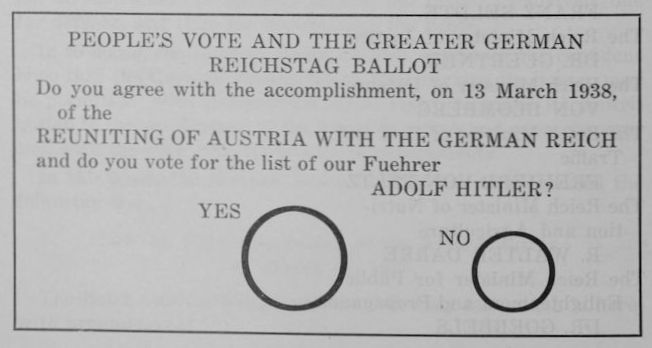
PEOPLE’S VOTE AND THE GREATER GERMAN REICHSTAG BALLOT
Do you agree with the accomplishment, on 13 March 1938, of the
REUNITING OF AUSTRIA WITH THE GERMAN REICH and do you vote for the list of our Fuehrer ADOLF HITLER?
YES NO
2. The ballot for the qualified voters with the exception of the Austrian qualified voters (par 8 of the First Decree) consists of white or yellow paper.
3. The ballot for the Austrian qualified voters (par. 32 section 1 of the First Decree) consists of green paper.
Article 2
1. The ballot for soldiers of the former Austrian Army (par 32 section 2 of the First Decree) is printed as follows:
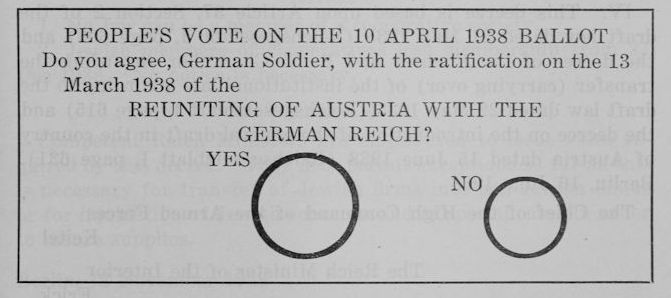
PEOPLE’S VOTE ON THE 10 APRIL 1938 BALLOT
Do you agree, German Soldier, with the ratification on the 13 March 1938 of the
REUNITING OF AUSTRIA WITH THE GERMAN REICH?
YES NO
TRANSLATION OF DOCUMENT 1660-PS
1938 REICHSGESETZBLATT, PART I, PAGE 631
Decree for the registration for the active service in Austria in the year 1938 of 16 June 1938
I. The registration for the active service in the army for the year 1938 in the country of Austria will be conducted during the time from 16 August until 10 September 1938.
II. To be called for registration:
1. All those subject to duty, born in the year 1917, without regard to their physical fitness and regardless whether they were exempt from induction in spring of the year 1938;
2. All those volunteers of other years of birth who were considered “general service”;
3. All those subject to duty considered “general service” or “limited service” at the time of induction of the class of 1915 and 1916 who have registered with reserve commands and who have as yet not been trained;
4. The volunteers who have reported, or want to report, in June 1938, for induction into active service for the fall of 1938 (for the Luftwaffe also for the spring of 1939), without regard whether or not they have been physically examined.
III. Charged with this task are—
in the higher administrative echelons:
The Landeshauptmaenner (governors of provinces); in Vienna the mayor,
in the district police echelons:
in the cities, the mayor, and the State police officer, as far as they are on hand,
in Vienna the Chief of Police,
in the rural districts the district governors.
IV. This decree is based upon Article 37, Section 2 of the draft law dated 21 May 1935 (Reichsgesetzbl. I, page 609) and the decree of the Fuehrer and Reich Chancellor regarding the transfer (carrying over) of the institutional law according to the draft law dated 22 May 1935 (Reichsgesetzblatt I, page 615) and the decree on the introduction of the general draft in the country of Austria dated 15 June 1938 (Reichsgesetzblatt I, page 631).
Berlin, 16 June 1938
The Chief of the High Command of the Armed Forces Keitel The Reich Minister of the Interior Frick
TRANSLATION OF DOCUMENT 1662-PS
1938 REICHSGESETZBLATT, PART I, PAGE 1580
Order eliminating Jews from German economic life of 12 November 1938
On the basis of the Decree of 18 October 1936 for the execution of the Four Year Plan (RGBl I, p. 887), the following is ordered:
Article 1
1. From January 1, 1938, operation of retail shops, mail order houses, independent exercise of handicrafts is forbidden to Jews. (Article 5 of the First Decree to Reich citizenship law [Reichsbuergergesetz] of 14 Nov 1935—RGBl I, 1933).
2. Moreover it is forbidden to Jews from the same date to offer goods or services in the markets of all kinds, fairs, or exhibitions or to advertise such or accept orders therefor.
3. Jewish shops operated in violation of this order will be closed by police. (Third Decree to Reich citizenship law of 14 June 1938-RGBl I, 627).
Article 2
1. No Jew can manage a firm according to the interpretation of the term “manager” under the law for national labor of 20 Jan 1934. (RGBl I, 45).
2. If a Jew is a leading employee in a business concern he may be dismissed with notice of six weeks. At expiration of this period all claims resulting from the employee’s contract, especially claims of compensation or pensions, become null.
Article 3
1. No Jew can be a member of a cooperative society.
2. Jewish members of cooperatives lose membership from 21 Dec 1938. No notice is necessary.
Article 4
Competent Reich Ministers are empowered to issue rules required by this decree. They may permit exceptions so far as this is necessary for transfer of Jewish firms into non-Jewish hands or for liquidation of Jewish concerns and in special cases in order to insure supplies.
Berlin, 12 November 1938
The Commissioner for the Four Year Plan Goering General Field Marshal
TRANSLATION OF DOCUMENT 1665-PS
1940 REICHSGESETZBLATT, PART I, PAGE 1270
Order concerning treatment of property of Nationals of the former Polish State of 17 September 1940
On the basis of the Decree to Implement the Four Year Plan of 18 October 1936 (RGBl I, 887) in conjunction with the Decree for the Introduction of the Four Year Plan in the Eastern Territories of 30 October 1939 (RGBl I, 2125) the following is decreed for the area of the Greater German Reich, including annexed Eastern territories:
Article 1
1. Property of nationals of the former Polish State within the area of the Greater German Reich, including annexed Eastern territories, is subject to confiscation, administration by commissioner and sequestration in accordance with the following regulations.
2. This does not apply to the property of persons who have gained German citizenship in accordance with Article 6 of the edict of the Fuehrer and Reich Chancellor concerning organization and administration of Eastern territories, dated 8 October 1939 (RGBl I, 2042). The competent authority (Article 12) may permit additional exceptions.
3. Nationals of the former Free City of Danzig who are of Polish nationality are considered as nationals of the former Polish State.
Article 2
1. Confiscation will be applied in case of property belonging to:
a. Jews.
b. Persons who have fled or who have absented themselves for longer than temporary period.
2. Confiscation may be applied:
a. If the property is needed for the public good, especially for purposes of national defense or the strengthening of German folkdom.
b. If the owners or other persons entitled to it immigrated into the, then, area of the German Reich after 1 October 1918.
3. Confiscation may be limited to individual articles of property.
4. As a rule the following articles are to be exempted from confiscation:
a. Movable articles destined exclusively for personal use.
b. Cash, bank and savings bank deposits as well as stocks and bonds up to a total value of one thousand marks.
Article 3
Properties are stationary and movable objects (with all accessories), credits, shares, judgments, and interests of all sorts.
Article 4
1. With the sequestration the previous owners lose the rights of disposal of the sequestered properties. The competence of the general governor in accordance with the ordinance for public administration of farm and forestry industries and territories in the annexed Eastern areas of 12 Feb 1940 (RGBl I, 355) remains unaffected.
2. Whoever has sequestered property in his possession or custody, must administer it until further notice. Changes or disposal of the property or its profits are only to be permitted within the limits of regular business. All measures which go beyond this, especially the disposal of plots of land, must have the permission of the competent office (Article 12).
Article 5
1. The commissarial administration can be ordered for property which is subject to sequestration, insofar as ordinary administration demands it.
2. Orders by the commissarial administration serve as confiscation at the same time.
Article 6
1. The commissarial administrator is appointed by the competent office (Article 12). He will receive a written appointment. He can be recalled at any time.
2. In the direction of businesses, he must use the same caution which a regular businessman or administrator would and is responsible for all the damages which result through breach of duty. He must report to the competent office (Article 12) at all times all of the information requested by it and insofar as nothing else is determined he still must report it concerning his administrative activity monthly without further request.
3. The commissarial administrator can be held to the fulfillment of his obligations by the competent office—without prejudice to his criminal responsibility—by means of an automatic fine of up to 10,000 RM.
Article 7
1. The commissarial administrator is empowered to take all judicial and extrajudicial actions, which the administration of the property entails within the limits of ordinary business.
2. The administrator needs a special permission of the competent office (Article 12) prior to:
a. Selling or mortgaging lots.
b. Changing the subject or the legal form of an enterprise.
c. Doing legal business which results in the sale or winding-up of an enterprise or of a management or the sale of an administrated stock of goods or other property which is not divided.
d. Renting professional, agriculture and lumber enterprises and farm and timber lots over 10 hectars.
e. Undertaking other legal business whose settlement is made dependent upon previously established authority of the competent office (Article 12) by means of public announcement in the German Reichsanzeiger and the Prussian Staatsanzeiger.
3. Legal affairs which are undertaken without the authority required by Article 2 are not valid.
Article 8
1. The administrator will receive a remuneration for his activity which will be determined by the competent office.
2. The costs of the commissarial administration including the remuneration will be borne by the concern, property, or portion of property, administered.
Article 9
1. Sequestered property can be confiscated in favor of the Reich by the competent office if the public weal, particularly the defense of the Reich or the consolidation of the German nationality [Volkstums], requires it.
2. Before confiscation the sequestered property is to be determined according to more detailed directives of the competent office (Article 12).
The Reich is the security for the debts of the confiscated property up to the amount of the sale value of the confiscated property. Judgments against confiscated properties remain valid.
4. The disposal of confiscated property is granted the office which was competent for the confiscation (Article 12). In the case of disposal of agricultural property an accord will be reached between the Reich Commissar for the strengthening of German nationality and the Reich Minister for Food and Agriculture.
5. The regulation of the type and extent of compensation which will be granted for property losses attendant upon the carrying out of this decree remains withheld. For measures of the competent agency (Article 12), on the basis of Articles 16 and 17, no compensation will be granted.
Article 10
1. A commissarial (provisional) administration can also be established over the property of legal persons, societies, clubs and other associations of individuals in which subjects of the former Polish State in the year 1939 still either had a preponderant capital interest or whose administration was decisively influenced by members of the former Polish State.
2. During the existence of the commissarial administration the authority of chief and of the other persons authorized for representation or administration will be dormant; the same thing for the powers of all other organs.
3. Only the shares and holdings of subjects of the former Polish State are subject to confiscation in this case.
Article 11
1. The sequestration or the regulation of the commissarial administration are upon request of the competent authority (Article 2) to be entered into the register of deeds or any other appropriate public register. The entry of the name of the commissarial administrator can also be demanded.
2. Insofar as the register of deeds or other appropriate public register becomes incorrect as a result of measures on the basis of this decree, it is upon request of the competent authority to be corrected. Article 1, section 3 to 5 of the second decree for the execution and completion of the law on the granting of compensation in case of confiscation or transferral of property of 18 March 1938 (RGBl I, 317) is to be applied appropriately.
Article 12
1. For measures and decisions on the basis of this decree the commissioner for the four year plan—chief-trusteeship East—is the competent authority; for agriculture including agricultural side-enterprises, the Reich Commissar for the strengthening of German nationality.
2. The competent authorities according to subparagraph (1) can delegate the exercise of their powers entirely or partially to other agencies. Complaints against their decisions will be directed to the competent authority according to Sect (1). The complaint will have no delaying effect. It is not permissible if more than one year has gone by since the issuance of the disputed decision.
Article 13
If anybody opposes the sequestration or the ruling of the commissarial administration with the assertion that he is a member of the German people, then the proceedings are to be suspended. The competent authority (Article 12) will entrust the decision concerning membership in the German people to the local governor [Regierungspraesident]. The person concerned also has the right of requesting that his nationality be determined. Complaint against the decision of the Regierungspraesident to the Reich Minister of the Interior is permissible. The decision on membership in the German people is binding, upon the proceedings of the competent authority (Article 12) on the basis of this decree.
Article 14
The regulations to be issued according to Article 2, 5 and 10 will be effected by a written order which is to be made known to person concerned. This personally making known may be substituted by a sign, poster, or public proclamation.
Article 15
1. Disposal of property and property rights of subjects of the former Polish State, who do not come under the regulations governing exceptions of Article 1, Section 2, need the approval of the competent authority (Article 12) to be valid. This is not true for the disposition of claims upon interest and other continuous earnings.
2. The competent authority decides whether approval according to Section 1 is necessary. The decision is binding upon courts and administrative agencies. The competent authority (Article 12) must upon demand issue a certificate that approval is not necessary.
Article 16
1. All sorts of compulsory sales of objects are by this decree subject to sequestration may only be begun with the assent of the competent authority (Article 12). If one of the competent authorities according to Article 12 has assented, it has no influence upon further proceedings, if it has wrongly asserted its competence.
2. If it is to be feared that the debtor will escape the compulsory sale, or an immediate seizure is called for, for some other reason, then upon order of the court authorizing the compulsory sale the compulsory sale can be begun before issuance of the necessary approval, according to Section 1. It should, in this case, be limited to the measures permissible in the execution of an attachment and be continued from this point only when the approval has been issued. Upon demand of the competent authority (Article 12) the court authorizing a compulsory sale must order the lifting of the temporary attachment measures.
Article 17
1. If in the incorporated Eastern territories bankruptcy proceedings are opened on the property of a bankrupt, then the provisions of Article 16 are valid accordingly, for the liquidation of the property belonging to the estate of the bankrupt.
2. If the opening or discontinuance of bankruptcy proceedings in the incorporated Eastern territories depends upon whether the value of the bankrupt estate corresponds to the cost of the proceedings, then objects which according to this decree are subject to confiscation, shall only be regarded as belonging to the bankrupt estate, if the competent authority (Article 12) has agreed to their liquidation in bankruptcy proceedings.
Article 18
It can be publicly announced that property coming into consideration for sequestration is to be registered. The announcement of registration for agricultural property takes place in agreement with the Reich Minister for Food and Agriculture.
Article 19
The competent authority (Article 12) can demand information of everybody for the carrying out of its tasks. Administrative agencies and courts must give it official help, especially they must question witnesses and experts upon its demand.
Article 20
1. Whoever undertakes to deprive the agencies indicated in Article 12 or those empowered to dispose of the property by said agencies or otherwise in any way undertakes to thwart, to evade, or to prejudice the effect of the sequestration in order to create a profit for himself or another, will be punished with imprisonment and fine or one of these penalties.
2. In aggravated cases the punishment will be confinement to a penitentiary. If the culprit acts out of insubordination against the political new order or the case is otherwise especially aggravated the sentence of death is to be given.
Article 21
1. Whoever intentionally or carelessly fails to fulfill or fulfills incorrectly, or incompletely, an obligation to report or give information incumbent upon him according to an executionary regulation issued to implement this law or a regulation issued according to Articles 18 and 19, will be punished with imprisonment and fine.
2. The criminal prosecution will be instituted only upon request of the competent authority (Article 12).
Article 22
1. The following remain unprejudiced:
a. The regulation for the securing of the necessary establishments for the fitting out of the Reich’s war harbor Gdynia of 21 December 1939 (RGBl I, 2475);
b. The decree on the public exploitation of agricultural and sylvicultural enterprises and real estate in the incorporated Eastern territories of 12 February 1940 (RGBl I, 355) with the provision that upon the undertaking subject to public exploitation the provisions of Articles 1, 2, 3, 4 Section 1, Articles 9, 11, 12 Section 1, Articles 14, 18, 19, 20, 21 and 23 of this decree will be applied;
c. The ordinance on the handling of enemy property of 15 Jan 1940 (RGBl I, 191) with the provision that property of the subjects of the former Polish State, who have their residence or permanent domicile in the territory of an enemy state, will be treated according to this decree, insofar as it is located in the Greater German Reich including the incorporated Eastern territories.
d. The decree on confiscation in the occupied former Polish territories (except Eastern Upper Silesia) of 5 Oct 1939, P. 25.
e. The decree on the employment of Jewish property of 3 Dec 1938 (RGBl I, 1709) with following:
1. The sequestration according to Article 2 and the regulation of a commissarial administration according to Articles 5 and 10 of this decree do not take place in the case of property of Jews, which the Jewish owners had already been ordered to sell on the basis of Articles 1 to 6 of the decree on the disposal of Jewish property at the time this law came into effect. The proceeds of this sale can be confiscated.
2. The approval according to Article 15 of this decree is not necessary insofar as a license is prescribed by Article 8 of decree on employment of Jewish property;
f. The decree of the Reich protector in Bohemia and Moravia on Jewish property of 21 June 1939 [Verordnungsblatt des Reichsprotektors in Boehmen und Maehren p. 45] and the decree of the Reich protector in Bohemia and Moravia on the removal of the Jews from the economy of the protectorate of 26 Jan 1940 [Verordnungsblatt des Reichsprotektors in Boehmen and Maehren P. 45] with the provision that the proceedings for the removal of Jews will also be carried out in regard to the property of subjects of the former Polish State according to these provisions, in agreement with the chief-trusteeship East; for the sequestration and confiscation the agencies named in Article 12 remain competent.
2. Furthermore all regulations conflicting with this one, issued since 28 August 1939 in the incorporated Eastern territories including the territory of the former Free City of Danzig, especially such regulations which grant the right to sequester, to install commissarial administrators or trustees, or to confiscate, become invalid.
3. The measures and legal transactions of the commissariat administrator undertaken with the approval of the competent agencies are not subject to the necessity of being approved according to the decree to assure the orderly development of the economy in the incorporated Eastern territories of 31 Jan 1940 (RGBl I, 255). In the case of property disposal an understanding will be established with the competent Reichs governor or provincial governor or the highest Reichs authority, which according to Article 3 Section 2 of the decree of 31 Jan 1940 have withheld their consent. If in cases of especial importance such an understanding cannot be established, then the commissioner for the four year plan will make the decision.
4. Measures of the competent authorities (Article 12) which have been taken before this decree became effective, are valid if they are in accordance with the provisions of this decree or with the law as it stood previously.
5. Insofar as sequestrations, confiscations, or the installation of commissarial administrators have been carried out by anyone else but the competent agencies (Article 12), their confirmation is to be applied for in writing. If the confirmation of them is not then forthcoming, the previously directed measures become null and void. The same is true if a decision is not reached on the confirmation before 31 October 1940. The competent agencies are authorized to prolong this period to a reasonable degree in individual cases.
6. The provisions of Section 5 are not valid for trustees, who at the time this law came into effect were installed according to Articles 2 and 6 of the decree on the employment of Jewish property of 3 Dec 1938 (RGBl I, 1709) for the temporary carrying on, transferral, or winding up of Jewish business undertakings or for the administration or transferral of other property of Jews. The legal position of these trustees remains unchanged.
Article 23
1. The commissioner for the four year plan will issue the necessary legal regulations for the carrying out of this law—for agriculture including subsidiary enterprises pertaining to agriculture—with the agreement of Reich commissar for the strengthening of German nationality and of the Reich Minister for Food and Agriculture.
2. The commissioner for the four year plan in agreement with the Reich Minister of Finance and the Reich Minister for Economic Affairs can decree by means of legal regulations a simplified settlement, diverging from the provisions of the law as it stands, of the legal affairs of those persons whose property is subject to confiscation according to this decree.
3. The necessary administrative regulations for the carrying out of this decree will be issued by the commissioner for the four year plan—Chief Trusteeship East—in agreement with the competent authorities.
Article 24
1. This decree becomes effective one week after its proclamation.
2. The commissioner for the four year plan will fix the time of its becoming invalid.
Berlin, 17 September 1940
The chairman of the ministerial council for the defense of the Reich and commissioner for the four year plan GOERING Reichs Marshal
TRANSLATION OF DOCUMENT 1666-PS
1942 REICHSGESETZBLATT, PART I, PAGE 179
Decree of the Fuehrer concerning a plenipotentiary general for the utilization of labor of 21 March 1942
In order to secure the manpower requisite for the war industries as a whole, and particularly for armaments, it is necessary that the utilization of all available manpower, including that of workers recruited [angeworbenen] abroad and of prisoners of war, should be subject to a uniform control, directed in a manner appropriate to the requirements of war industry, and further that all still incompletely utilized manpower in the Great German Reich, including the Protectorate, and in the General Gouvernement and in the Occupied Territories, should be mobilized.
Reichsstatthalter and Gauleiter Fritz Sauckel will carry out this task within the framework of the Four Years Plan, as Plenipotentiary General for the utilization of labor. In that capacity he will be directly responsible to the Commissioner for the Four Years Plan.
Section III (wages) and Section V (utilization of labor) of the Reich Labor Ministry, together with their subordinate authorities, will be placed at the disposal of the Plenipotentiary General for the accomplishment of his task.
Fuehrer-Headquarters, 21 March 1942
The Fuehrer Adolf Hitler The Reich Minister and Head of the Reich Chancellery Dr. Lammers The Chief of the High Command of the Armed Forces Keitel
1942 REICHSGESETZBLATT, PART I, PAGE 180
Ordinance for the execution of the Fuehrer’s decree concerning a Plenipotentiary General for Arbeitseinsatz of 27 March 1942
In pursuance of the Fuehrer’s Decree of 21 March 1942 (RGBl I, 179), I decree as follows:
1. My manpower sections [Geschaeftsgruppen Arbeitseinsatz] are hereby abolished. (Circular letter of 22 Oct 1936/St. M. Dev. 265). Their duties (recruitment and allocation of manpower, regulations for labor conditions [Arbeitsbedingungen]) are taken over by the Plenipotentiary General for Arbeitseinsatz, who is directly under me.
2. The Plenipotentiary General for Arbeitseinsatz will be responsible for regulating the conditions of labor (wage policy) employed in the Reich Territory, having regard to the requirements of Arbeitseinsatz.
3. The Plenipotentiary General for Arbeitseinsatz is part of the Four Year Plan. In cases where new legislation is required, or existing laws require to be modified, he will submit appropriate proposals to me.
4. The Plenipotentiary General for Arbeitseinsatz will have at his disposal for the performance of his task the right delegated to me by the Fuehrer for issuing instructions to the higher Reich authorities, their branches and the Party offices, and their associated organisms and also to the Reich protector, the General-Governor, the Commander-in-Chief, and heads of the civil administrations.
In the case of ordinances and instructions of fundamental importance report is to be submitted to me, in advance.
Berlin, 27 March 1942
The Deputy for the Four Year Plan Goering Reich Marshal
TRANSLATION OF DOCUMENT 1669-PS
NATIONAL SOCIALIST GERMAN WORKERS PARTY
Deputy of the Fuehrer H/J
Munich, Briennerstrasse 45 Tel: 54901 and 58344 Munich, 28 August 1933.
Mr. Dr. Albrecht Hanshofer
BERLIN
Society of Geography, Wilhelmstr, BERLIN My dear Doctor:
Many thanks for both your letters of the 23 and 24 of this month. I made all necessary arrangements concerning the Standartenfuehrers, immediately.
I would like very much to speak to Haselblatt before his convention starts. Probably I will be at Berlin around September 7. I don’t know yet if I shall be able to attend the Convention myself.
Concerning the American, would you please tell him, that in one case it is no longer the question of a “party” in the sense of the “custom” practiced since Washington’s time, that we are striving for, but this party is a section of the State itself. It is of utmost interest to me to know, whether any American official representatives ever attended meetings of the fascist party.
I reported the statements of the Polish Chief of Staff.
With hearty greetings your [Signature] Rudolf Hess.
Registered!
Berlin, August 1933.
EAST PRUSSIA Dear Mr. Hess:
Today I have only two reports to pass on to you, having received them from a generally well informed source.
Primarily: Assertion of the Polish Chief of staff: “Once the damned civilians thwarted our East Prussian aim with their scruples & hesitation. That will not happen again. Precaution has been taken that these people are sent to a Concentration Camp if they should still dare to obstruct us.”
Secondly: A very delicate matter. It is known to yourself, that at some place in your organization, there are people, unable to subordinate their personal initiative for the benefit of the common good. I am informed that a personage very highly esteemed abroad, but completely retired at home, H * * * h B * * * g has to fear for her individual safety. The source of this insecurity, I was told is S.A. Standartleader Schoeneberg. I don’t have to point out to you the repercussions, abroad, which any personal accident would provoke. * * * Could you take care of internal curbing.
With hearty Greetings Always Your
TRANSLATION OF DOCUMENT 1674-PS
1938 REICHSGESETZBLATT, PAGE 1044, 17 Aug. 1938
The second decree for the execution of the law regarding the change of the surnames and forenames of 17th August 1938.
On the basis of Article 13, of the law of 5 January 1938 (Reichsgesetzblatt I.S.9) concerning the change of the surnames and given-names, the following is ordered:
Art. 1
1. Jews may be given only such given-names as are cited in the directives issued by the Ministry of Interior concerning the utilization of given-names.
2. Para. (1) is not applicable to Jews who are foreign citizens.
Art. 2
1. In so far as the Jews are still using some other given-names different from those which are at their disposal according to Art. 1,—they are obliged to assume by the 1st January 1939, a second, additional given-name as follows; for males, the given-name Israel and for females the given-name Sara.
2. The person having to assume an additional forename according to para (1) is obliged to give a written notification in this matter to the registration office at which his birth, and marriage are registered. The same notification is to be given to the proper police-official in the registerer’s place of residence or customary habitat. The notifications are to be reported within a month from the date requiring him to assume an additional given-name.
3. In so far as the birth or marriage of the person who must register has been verified by a German diplomatic representative of a Consul, or has been verified in a German protectorate,—the notification, which must be made, is to be forwarded to the Register-Office I, Berlin. If the place of residence or customary habitat of the person registering is abroad, the notification in question, mentioned in Para (2), sentence (1) is to be forwarded to the competent German Consul instead of to the competent police-official.
4. For people who are unable, or are partially unable to conduct their own affairs, the obligation to register rests upon the legal representative.
Art. 3
As far as is customary in juridical and business procedure to indicate the given-names, the Jews are obliged always to indicate at least one of their given-names. In so far as they are required to assume an additional given-name as mentioned in Art. 2,—this additional given-name is to be indicated also. The present directives regarding the management of a business are not hereby altered.
Art. 4
1. Whoever deliberately disobeys the directives of Art. 3 is to be punished by imprisonment of up to six months. Cases of negligent disobedience will be punished by imprisonment of no more than one month.
2. Whoever deliberately or carelessly neglects to give the proper notification according to Art. 2 is to be fined or punished by imprisonment of no more than one month.
Berlin, 17th, August 1938.
Reichs Minister of the Interior: Representative, Dr. Stuckart. Reichs Minister of Justice: Dr. Guertner.
TRANSLATION OF DOCUMENT 1676-PS
Voelkischer Beobachter Southern Germany Edition 28/29 May 1944
A Word on the enemy air-terror by Reichsminister Dr. Goebbels
Nowadays, it is no longer disputed by anyone that the enemy air-terror pursues almost exclusively the aim of breaking the morale of the German civil population. The enemy wages war against the defenseless, against women and children in particular, in order to compel the men of our country to yield. This intention of his is proved on one hand by the facts themselves and on the other hand by the abundance of existing statements by enemy publicists. As far as the facts are concerned one needs only to visit one of the often bombed towns in the Reich or in the occupied territory in order to determine without doubt by one’s own examination that our war potential is damaged by perhaps at the most only 1% by enemy air-terror and the remaining 99% plainly falls upon the civil sector.
A short time ago, the leading representatives of the French, and Belgian Episcopate, who certainly cannot be suspected of acting according to German orders, objected with flaming protest directed to the international public against the enemy’s barbarous methods of aerial warfare, which kills old people, women and children, as well as destroys churches, venerable cultural monuments and thickly settled civilian residential sections, without any military objectives being apparent. To this we need to add nothing more.
Our enemies do not try to conceal their intentions in this matter. One does not need to look far in British and American press in order to find substantial proof of this. “Lay the great cities in ruins and you will crush the will to fight”. Thus wrote the English air expert T. M. Epaight in his book “Air power and the cities” in 1930. Nothing in this tendency of the British aerial warfare has changed since then. “It is not possible to draw a boundary-line between the civil population and the combatants”. With this cowardly excuse the “Daily Mail” attempts to justify publicly this rough and low method of the enemy aerial warfare. Much more explicit becomes influential British naval officer who states in the English military publication “The Army Quarterly”: “Does the concept of non-combatants exist at all? A small child is neither in peace nor in war a useful member of the national community. No one has in reality the right to demand inviolability for himself even if he can attempt to do so in the name of humanity. Germany must become more desolate than the Sahara Desert”.
The well known London’s newspaper “News Chronicle” is not missing in this choir of hatred. It adds “We favor that every living being in Germany be wiped out. Man, woman, child, bird and insect. We would not let even a blade of grass grow”. This causes the respected British author H. G. Wells to name the following demand: “Treat the German people like a troublesome native tribe”. The American publicists are no less robust. One of their leading spokesmen Raymond Clapper writes with evident pleasure: “Terror and brutality are the best sides of aerial warfare!” One might object, perhaps, that not all influential Americans and Englishmen think this way. Wrong! Even the Anglican High Church declares in its official organ “Church of England” on the 28 of May 1943: “It is a perverse view of Christianity to suppose that civilians must not be killed”. Even the Archbishop of York, Dr. Cysill Barbett, blesses the barbaric methods of the Anglo-American aerial terrorism in his pastoral letter of June 1943 with the words: “It is only a small evil to bomb German civilians.”
We had so far desisted from making known to the German people the meanest of the statements from which we have only presented a small selection and which all together represent a simple demand for the murder of women and children, because we were afraid that in view of this cynicism it would take measures of self-defense and revenge itself with the same measures upon the enemy pilots who bail out of shot down enemy planes. In the meantime, however, circumstances have arisen which prevent us from continuing to maintain this reserve in the future.