LEGENDS. (continued 3)
Reading edition
350. “Where shall I find Tséʻnagahi (Travelling Stone)?” he said after he had returned from his encounter with Pursuing Bear and shown his trophy to his people. “You will find him in a lake near where Tséʻespai points up,” answered Estsánatlehi; but she implored him not to go near the lake. He did not heed her, and next morning he went off to seek the Travelling Stone.
351. He approached the lake on the north side, while the wind was blowing from the south, but he saw nothing of the stone. Thence he went around to the south side of the lake. When he got here the stone scented him, rose to the surface, poised itself a moment, and flew toward Nayénĕzgạni as if hurled by a giant hand. Raising his lightning arrow, he held it in the course of the stone and knocked a piece off the latter. When the stone fell he struck another piece off with his knife. Tséʻnagahi now saw it had a powerful foe to contend against; so, instead of hurling itself at him again, it fled and Nayénĕzgạni went in pursuit. He chased it all over the present Navaho land, knocking pieces off it in many places152 as he followed, until at length he chased it into the San Juan River at Tsĭntáhokata, where a point of forest runs down toward the river.
352. Travelling Stone sped down with the current and Nayénĕzgạni ran along the bank after it. Four times he got ahead of the stone, but three times it escaped him by dipping deep into the river. When he headed it off for the fourth time, he saw it gleaming like fire under the water, and he stopped to gaze at it. Then the stone spoke and said: “Sawé (my baby, my darling), take pity on me, and I shall no longer harm your people, but do good to them instead. I shall keep the springs in the mountains open and cause your rivers to flow; kill me and your lands will become barren.” Nayénĕzgạni answered: “If you keep this promise I shall spare you; but if you ever more do evil as you have done before, I shall seek you again, and then I shall not spare you.” Tséʻnagahi has kept his promise ever since, and has become the Tiéholtsodi of the upper world.
353. He brought home no trophy from the contest with Tséʻnagahi. It had now been eight days since he left the house of the Sun.153 He was weary from his battles with the anáye, and he determined to rest four days. During this time he gave his relatives a full account of his journeys and his adventures from first to last, and as he began he sang a song:—
Nayénĕzgạni to Atsé Estsán began to tell,
About Bĭtéelgĕti he began to tell,
From homes of giants coming, he began to tell.
Toʻbadzĭstsíni to Estsánatlehi began to tell,
About the Tseʻnă′hale he began to tell,
From homes of giants coming, he began to tell.
Léyaneyani to Atsé Estsán began to tell,
Of Tseʻtahotsĭltáʻli he began to tell,
From homes of giants coming, he began to tell.
Tsówenatlehi to Estsánatlehi began to tell,
About Bĭnáye Aháni he began to tell,
From homes of giants coming, he began to tell.277
354. There were still many of the anáye to kill; there was White under the Rock, Blue under the Rock, Yellow under the Rock, Black under the Rock, and many yélapahi, or brown giants. Besides these there were a number of stone pueblos, now in ruins, that were inhabited by various animals (crows, eagles, etc.),154 who filled the land and left no room for the people. During the four days of rest, the brothers consulted as to how they might slay all these enemies, and they determined to visit again the house of the Sun. On the morning of the fourth night they started for the east. They encountered no enemies on the way and had a pleasant journey. When they entered the house of the Sun no one greeted them; no one offered them a seat. They sat down together on the floor, and as soon as they were seated lightning began to shoot into the lodge. It struck the ground near them four times. Immediately after the last flash Tsápani, Bat, and Tóʻnenĭli, Water Sprinkler, entered. “Do not be angry with us,” said the intruders; “we flung the lightning only because we feel happy and want to play with you:” still the brothers kept wrathful looks on their faces, until Nĭ′ltsi whispered into their ears: “Be not angry with the strangers. They were once friends of the anáye and did not wish them to die; but now they are friends of yours, since you have conquered the greatest of the anáye.” Then, at last, Tsóhanoai spoke to his children, saying: “These people are rude; they respect no one. Heed them not. Here are seats for you. Be seated.” Saying this, he offered the brothers a seat of shell and a seat of turquoise; but Nĭ′ltsi told the brothers not to take them. “These are seats of peace,” he said; “you still want help in war. Nayénĕzgạni, take the seat of red stone, which is the warrior’s seat; and you, Toʻbadzĭstsíni, stand.” They did as the Wind bade them.
355. “My children, why do you come to me again?” asked Tsóhanoai, the bearer of the sun. “We come for no special purpose; we come only to pass away the time,” Nayénĕzgạni answered. Three times he asked this question and got the same reply. When he asked for the fourth time, he added, “Speak the truth. When you came to me before I gave you all you asked for.” Now it was Toʻbadzĭstsíni who replied: “Oh, father! there are still many of the anáye left, and they are increasing. We wish to destroy them.” “My children,” said Tsóhanoai, “when I helped you before, I asked you for nothing in return. I am willing to help you again; but I wish to know, first, if you are willing to do something for me. I have a long way to travel every day, and often, in the long summer days, I do not get through in time, and then I have no place to rest or eat till I get back to my home in the east. I wish you to send your mother to the west that she may make a new home for me.” “I will do it,” said Nayénĕzgạni; “I will send her there.” But Toʻbadzĭstsíni said: “No, Estsánatlehi is under the power of none; we cannot make promises for her, she must speak for herself, she is her own mistress; but I shall tell her your wishes and plead for you.” The room they were in had four curtains which closed the ways leading into other apartments. Tsóhanoai lifted the curtain in the east, which was black, and took out of the room in the east five hoops: one of these was colored black, another blue, a third yellow, and a fourth white, the fifth was many-colored and shining. Each hoop had attached to it a knife of the same color as itself. He took out also four great hailstones, colored like the four first hoops. He gave all these to his sons and said: “Your mother will know what to do with these things.”
356. When they got their gifts they set out on their homeward journey. As they went on their way they beheld a wonderful vision. The gods spread before them the country of the Navahoes as it was to be in the future when men increased in the land and became rich and happy. They spoke to one another of their father, of what he had said to them, of what they had seen in his house, and of all the strange things that had happened. When they got near their journey’s end they sang this song:—
Nayénĕzgạni, he is holy,
Thus speaks the Sun,
Holy he stands.
Toʻbadzĭstsíni, he is holy,
Thus speaks the Moon,
Holy he moves.
Léyaneyani, he is holy,
Thus speaks the Sun,
Holy he stands.
Tsówenatlehi, he is holy,
Thus speaks the Moon,
Holy he moves.278
357. When they got within sight of their home they sang this song:—
Slayer of Giants,
Through the sky I hear him.
His voice sounds everywhere,
His voice divine.
Child of the Water,
Through the floods I hear him.
His voice sounds everywhere,
His voice divine.
Reared ’neath the Earth,
Through the earth I hear him.
His voice sounds everywhere,
His voice divine.
The Changing Grandchild,
Through the clouds I hear him.
His voice sounds everywhere,
His voice divine.279
358. When the brothers got home they said to Estsánatlehi: “Here are the hoops which our father has given us, and he told us you knew all about them. Show us, then, how to use them.” She replied: “I have no knowledge of them.” Three times she thus answered their questions. When they spoke to her for the fourth time and Nayénĕzgạni was becoming angry and impatient, she said: “I have never seen the Sun God except from afar. He has never been down to the earth to visit me. I know nothing of these talismans of his, but I will try what I can do.” She took the black hoop to the east, set it up so that it might roll, and spat through it the black hail, which was four-cornered; at once the hoop rolled off to the east and rolled out of sight. She took the blue hoop to the south, set it up, and spat through it the blue hail, which was six-cornered. Then the hoop rolled away to the south and disappeared. She carried the yellow hoop to the west, set it up, and spat through it the eight-cornered yellow hail; the hoop rolled off to the west and was lost to sight. She bore the white hoop to the north; spat through it the white hail, which had eleven corners, and the hoop sped to the north until it was seen no more. She threw the shining hoop up toward the zenith, threw the four colored knives in the same direction, and blew a powerful breath after them. Up they all went until they were lost to sight in the sky. As each hoop went away thunder was heard.155
359. During four days after this nothing of importance happened, and no change came in the weather. At the end of four days they heard thunder high up in the sky, and after this there were four days more of good weather. Then the sky grew dark, and something like a great white cloud descended from above. Estsánatlehi went abroad; she saw in all directions great whirlwinds which uprooted tall trees as if they had been weeds, and tossed great rocks around as if they had been pebbles. “My son, I fear for our house,” she said when she came back. “It is high among the mountains, and the great winds may destroy it.” When he heard this, Nayénĕzgạni went out. He covered the house first with a black cloud, which he fastened to the ground with rainbows; second, with a black fog, which he fastened down with sunbeams; third, with a black cloud, which he secured with sheet-lightning; and fourth, with a black fog, which he secured with chain-lightning. At sunset that evening they caught a little glimpse of the sun; but after that, continuously for four days and four nights, it was dark; a storm of wind and hail prevailed, such as had never been seen before, and the air was filled with sharp stones carried before the wind. The people stayed safe in the lodge, but they could hear the noise of the great storm without. On the morning of the fifth day the tumult ceased, and Nayénĕzgạni, going out, found that all was calm, though it was still dark. He now proceeded to remove the coverings from the lodge and threw them upwards toward the heavens. As the first covering, a sheet of fog, ascended, chain-lightning shot out of it (with chain-lightning it had been fastened down). As the second covering, a cloud, ascended, sheet-lightning came forth from it. As the third covering, a fog, went up, sunbeams streamed from it; and as the fourth cover, a robe of cloud, floated up, it became adorned with rainbows. The air was yet dark, and full of dust raised by the high wind; but a gentle shower of rain came later, laying the dust, and all was clear again. All the inmates of the lodge now came out, and they marvelled to see what changes the storm had wrought: near their house a great canyon had been formed; the shape of the bluffs around had been changed, and solitary pillars of rock156 had been hewn by the winds.
360. “Surely all the anáye are now killed,” said Estsánatlehi. “This storm must have destroyed them.” But Nĭ′ltsi whispered into Nayénĕzgạni’s ear, “San (Old Age) still lives.” The hero said then to his mother: “Where used Old Age to dwell?” His mother would not answer him, though he repeated his question four times. At last Nĭ′ltsi again whispered in his ear and said: “She lives in the mountains of Depĕ′ntsa.”
361. Next morning he set out for the north, and when, after a long journey, he reached Depĕ′ntsa, he saw an old woman who came slowly toward him leaning on a staff. Her back was bent, her hair was white, and her face was deeply wrinkled. He knew this must be San. When they met he said: “Grandmother, I have come on a cruel errand. I have come to slay you.” “Why would you slay me?” she said in a feeble voice, “I have never harmed any one. I hear that you have done great deeds in order that men might increase on the earth, but if you kill me there will be no increase of men; the boys will not grow up to become fathers; the worthless old men will not die; the people will stand still. It is well that people should grow old and pass away and give their places to the young. Let me live, and I shall help you to increase the people.” “Grandmother, if you keep this promise I shall spare your life,” said Nayénĕzgạni, and he returned to his mother without a trophy.
362. When he got home Nĭ′ltsi whispered to him: “Hakáz Estsán (Cold Woman) still lives.” Nayénĕzgạni said to Estsánatlehi: “Mother, grandmother, where does Cold Woman dwell?” His mother would not answer him; but Nĭ′ltsi again whispered, saying: “Cold Woman lives high on the summits of Depĕ′ntsa, where the snow never melts.”
363. Next day he went again to the north and climbed high among the peaks of Depĕ′ntsa, where no trees grow and where the snow lies white through all the summer. Here he found a lean old woman, sitting on the bare snow, without clothing, food, fire, or shelter. She shivered from head to foot, her teeth chattered, and her eyes streamed water. Among the drifting snows which whirled around her, a multitude of snow-buntings were playing; these were the couriers she sent out to announce the coming of a storm. “Grandmother,” he said, “a cruel man I shall be. I am going to kill you, so that men may no more suffer and die by your hand,” and he raised his knife-club to smite her. “You may kill me or let me live, as you will. I care not,” she said to the hero; “but if you kill me it will always be hot, the land will dry up, the springs will cease to flow, the people will perish. You will do well to let me live. It will be better for your people.” He paused and thought upon her words. He lowered the hand he had raised to strike her, saying: “You speak wisely, grandmother; I shall let you live.” He turned around and went home.
364. When Nayénĕzgạni got home from this journey, bearing no trophy, Wind again whispered in his ear and said: “Tieín (Poverty) still lives.” He asked his mother where Poverty used to live, but she would not answer him. It was Wind who again informed him. “There are two, and they dwell at Dsĭldasdzĭ′ni.”
365. He went to Dsĭldasdzĭ′ni next day and found there an old man and an old woman, who were filthy, clad in tattered garments, and had no goods in their house. “Grandmother, grandfather,” he said, “a cruel man I shall be. I have come to kill you.” “Do not kill us, my grandchild,” said the old man: “it would not be well for the people, in days to come, if we were dead; then they would always wear the same clothes and never get anything new. If we live, the clothing will wear out and the people will make new and beautiful garments; they will gather goods and look handsome. Let us live and we will pull their old clothes to pieces for them.” So he spared them and went home without a trophy.
366. The next journey was to seek Dĭtsĭ′n, Hunger, who lived, as Nĭ′ltsi told him, at Tlóhadaskaí, White Spot of Grass. At this place he found twelve of the Hunger People. Their chief was a big, fat man, although he had no food to eat but the little brown cactus. “I am going to be cruel,” said Nayénĕzgạni, “so that men may suffer no more the pangs of hunger and die no more of hunger.” “Do not kill us,” said the chief, “if you wish your people to increase and be happy in the days to come. We are your friends. If we die, the people will not care for food; they will never know the pleasure of cooking and eating nice things, and they will never care for the pleasures of the chase.” So he spared also the Dĭtsĭ′n, and went home without a trophy.
367. When Nayénĕzgạni came back from the home of Hunger, Nĭ′ltsi spoke to him no more of enemies that lived. The Slayer of the Alien Gods said to his mother: “I think all the anáye must be dead, for every one I meet now speaks to me as a relation; they say to me, ‘my grandson,’ ‘my son,’ ‘my brother.’ ”157 Then he took off his armor—his knife, moccasins, leggings, shirt, and cap—and laid them in a pile; he put with them the various weapons which the Sun had given him, and he sang this song:—
Now Slayer of the Alien Gods arrives
Here from the house made of the dark stone knives.
From where the dark stone knives dangle on high,
You have the treasures, holy one, not I.
The Offspring of the Water now arrives,
Here from the house made of the serrate knives.
From where the serrate knives dangle on high,
You have the treasures, holy one, not I.
He who was Reared beneath the Earth arrives,
Here from the house made of all kinds of knives.
From where all kinds of knives dangle on high,
You have the treasures, holy one, not I.
The hero, Changing Grandchild, now arrives,
Here from the house made of the yellow knives.
From where the yellow knives dangle on high,
You have the treasures, holy one, not I.280
368. His song had scarcely ceased when they heard, in the far east, a loud voice singing this song:—
With Slayer of the Alien Gods I come,
From the house made of dark stone knives I come,
From where dark knives dangle on high I come,
With implement of sacred rites I come,
Dreadful to you.
With Offspring of the Waters now I come,
From the house made of serrate knives I come,
From where the serrate knives hang high I come,
With implement of sacred rites I come,
Divine to you.
With Reared beneath the Earth now do I come,
From house of knives of every kind I come,
Where knives of every kind hang high I come,
With implement of sacred rites I come,
Dreadful to you.
Now with the Changing Grandchild here I come,
From the house made of yellow knives I come,
From where the yellow knives hang high I come,
With implement of sacred rites I come,
Dreadful to you.281
369. As the voice came nearer and the song continued, Estsánatlehi said to the youths: “Put on quickly the clothes you usually wear, Tsóhanoai is coming to see us; be ready to receive him,” and she left the lodge, that she might not hear them talk about the anáye.
370. When the god had greeted his children and taken a seat, he said to the elder brother: “My son, do you think you have slain all the anáye?” “Yes, father,” replied the son, “I think I have killed all that should die.” “Have you brought home trophies from the slain?” the father questioned again. “Yes, my father,” was the reply; “I have brought back wing-feathers, and lights and hair and eyes, and other trophies of my enemies.” “It is not well,” said Tsóhanoai, “that the bodies of these great creatures should lie where they fell; I shall have them buried near the corpse of Yéitso.” (He got the holy ones to carry the corpses to San Mateo and hide them under the blood of Yéitso, and this is the reason we do not see them lying all over the land now, but sometimes see them sticking out of the rocks.)159 He took the trophies and the armor and said: “These I shall carry back to my house in the east and keep them safe. If you ever need them again, come and get them.” Promising to come back again in four days, and meet Estsánatlehi on the top of Tsolíhi, he departed.
371. At the end of four days Estsánatlehi went to the top of Tsolíhi and sat down on a rock. Tsóhanoai came, sat beside her, and sought to embrace her; but she avoided him, saying: “What do you mean by this? I want none of your embraces.” “It means that I want you for my own,” said the bearer of the Sun. “I want you to come to the west and make a home for me there.” “But I do not wish to do so,” said she. “What right have you to ask me?” “Have I not given your boys the weapons to slay the alien gods?” he inquired, and added: “I have done much for you: now you must reward me.” She replied, “I never besought you to do this. You did not do it on my account; you did it of your own good will, and because your sons asked you.” He urged another reason: “When Nayénĕzgạni visited me in the east, he promised to give you to me.” “What care I for his promise?” she exclaimed; “I am not bound by it. He has no right to speak for me.” Thus four times she repulsed him. When he pleaded for the fifth time, saying: “Come to the west and make a home for me,” she said: “Let me hear first all you have to promise me. You have a beautiful house in the east. I have never seen it, but I have heard how beautiful it is. I want a house just the same built for me in the west; I want to have it built floating on the water, away from the shore, so that in the future, when people increase, they will not annoy me with too many visits. I want all sorts of gems—white shell, turquoise, haliotis, jet, soapstone, agate, and redstone—planted around my house, so that they will grow and increase. Then I shall be lonely over there and shall want something to do, for my sons and my sister will not go with me. Give me animals to take along. Do all this for me and I shall go with you to the west.” He promised all these things to her, and he made elk, buffalo, deer, long-tail deer, mountain sheep, jack-rabbits, and prairie-dogs to go with her.
372. When she started for her new home the Hadáhonestiddĭneʻ and the Hadáhonigedĭneʻ, two tribes of divine people,160 went with her and helped her to drive the animals, which were already numerous. They passed over the Tuĭntsá range at Péslĭtsi (Red Knife or Red Metal), and there they tramped the mountain down so that they formed a pass. They halted in Tsĭnlí valley to have a ceremony161 and a foot-race, and here the animals had become vastly more numerous. When they crossed Dsĭllĭzĭ′n (Black Mountain),162 the herd was so great that it tramped a deep pass whose bottom is almost on a level with the surrounding plain; at Black Mountain all the buffaloes broke from the herd and ran to the east; they never returned to Estsánatlehi and are in the east still. At Hostóditoʻ the elks went to the east and they never returned. From time to time a few, but not all, of the antelope, deer, and other animals left the herd and wandered east. Four days after leaving Tsĭnlí valley they arrived at Dokoslíd (San Francisco Mountain), and here they stopped to perform another ceremony. What happened on the way from this mountain to the great water in the west, we do not know, but after a while Estsánatlehi arrived at the great water and went to dwell in her floating house beyond the shore. Here she still lives, and here the Sun visits her, when his journey is done, every day that he crosses the sky. But he does not go every day; on dark, stormy days he stays at home in the east and sends in his stead the serpents of lightning, who do mischief.
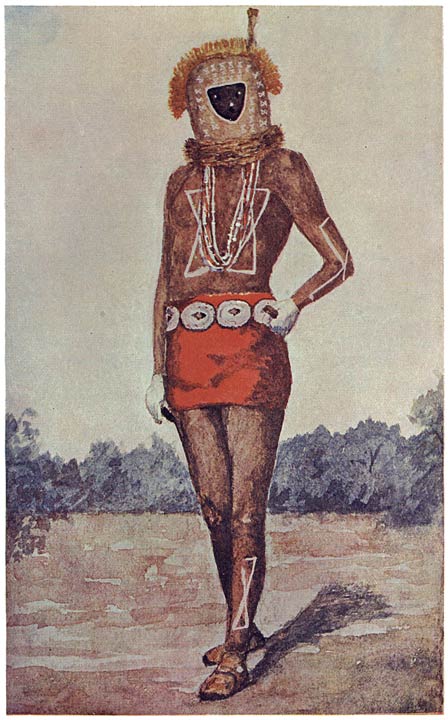
Plate VII. TOʻBADZĬSTSÍNI. (See pars. 76 and 105 and note 270.)
373. As he journeys toward the west, this is the song he sings:—
In my thoughts I approach,
The Sun God approaches,
Earth’s end he approaches,
Estsánatlehi’s hearth approaches,
In old age walking
The beautiful trail.
In my thoughts I approach,
The Moon God approaches,
Earth’s end he approaches,
Yolkaí Estsán’s hearth approaches,
In old age walking
The beautiful trail.282
374. When Estsánatlehi had departed, Nayénĕzgạni and Toʻbadzĭstsíni went, as their father had bidden them, to Toʻyĕ′tli,163 where two rivers join, in the valley of the San Juan; there they made their dwelling, there they are to this day, and there we sometimes still see their forms in the San Juan River.164 The Navahoes still go there to pray, but not for rain, or good crops, or increase of stock; only for success in war, and only the warriors go.
IV. GROWTH OF THE NAVAHO NATION.
375. Before Estsánatlehi left, she said to Yolkaí Estsán: “Now, younger sister, I must leave you. Think well what you would most like to do after I am gone.” The younger sister replied: “I would most like to go back to Depĕ′ntsa, where our people came from.” “Alas! you will be lonely there,” said the elder sister. “You will want for some one around you to make a noise and keep you company.” Still, when Estsánatlehi left, Yolkaí Estsán turned her face toward Depĕ′ntsa. She went with the two brothers as far as Toʻyĕ′tli, and, when these stopped there, she set out alone for the mountains.
376. When she got to Depĕ′ntsa (the San Juan Mountains), she went first to a place lying east of Hadzinaí (the Place of Emergence), named Dsĭlladĭltéhi; in an old ruined pueblo on its side she rested during the day, and at night she went to the top of the mountain to sleep. On the second day she went to a mountain south of the Place of Emergence, called Dsĭlĭ′ndĭltéhi; rested on the side of the mountain during the day, and on its top at night. She began now to feel lonely, and at night she thought of how men might be made to keep her company. She wandered round in thought during the third day, and on the third night she slept on top of Dsĭltagiĭltéhi, a mountain west of Hadzinaí. On the fourth day she walked around the Place of Emergence, and wandered into the old ruins she found there. On the fourth night she went to the top of Dsĭltĭnĭltéz, the mountain which lies to the north of the Place of Emergence, and there she rested, but did not sleep; for she thought all the time about her loneliness, and of how people might be made. On the fifth day she came down to the shores of the lake which surrounded the Place of Emergence, and built a shelter of brush. “I may as well stay here,” she said to herself; “what does it avail that I wander round?” She sat up late that night thinking of her lonely condition. She felt that she could not stay there longer without companionship. She thought of her sister in the far west, of the Twelve People, of the gods that dwelt in the different mountains, and she thought she might do well to go and live with some of them.
377. The next morning she heard faintly, in the early dawn, the voice of Hastséyalti shouting his usual “Wuʻhuʻhuʻhú,” in the far east. Four times the cry was uttered, each time louder and nearer. Immediately after the last call the god appeared. “Where did you save yourself?” he asked the White Shell Woman, meaning, “Where were you, that you escaped the anáye when they ravaged the land?” “I was at Dsĭlnáotĭl with my sister,” she said; “but for five nights I have been all alone in these mountains. I have been hoping that something might happen to relieve my great loneliness,—that I might meet some one. Sítsaí (Grandfather), whence do you come?” He replied: “I come from Tseʻgíhi,165 the home of the gods. I pity your loneliness and wish to help you. If you remain where you are, I shall return in four days and bring Estsánatlehi, the divine ones of all the great mountains, and other gods, with me.” When he left, she built for herself a good hut with a storm door. She swept the floor clean, and made a comfortable bed of soft grass and leaves.
378. At dawn on the fourth day after the god departed, Yolkaí Estsán heard two voices calling,—the voice of Hastséyalti, the Talking God, and the voice of Hastséhogan, the House God. The voices were heard, as usual, four times, and immediately after the last call the gods appeared. It was dark and misty that day; the sun did not rise. Soon after the arrival of the first two, the other promised visitors came, and they all formed themselves in a circle east of the lodge, each in the place where he or she belonged. Thus the divine ones of Tsĭsnadzĭ′ni stood in the east; those of Tsótsĭl (San Mateo Mountain) in the south; those of Dokoslíd (San Francisco Mountain) in the west; those of Depĕ′ntsa (San Juan Mountain) in the north. Each one present had his appropriate place in the group. At first Yolkaí Estsán stood in the west; but her sister, Estsánatlehi, said to her: “No, my young sister; go you and stand in the east. My place is in the west,” and thus they stood during the ceremony. Estsánatlehi brought with her two sacred blankets called Dĭlpĭ′l-naská, the Dark Embroidered, and Lakaí-naská, the White Embroidered. Hastséhogan brought with him two sacred buckskins, and the Nalkénaaz (a divine couple who came together walking arm in arm) brought two ears of corn,—one yellow, one white,—which the female carried in a dish of turquoise.
379. Hastséyalti laid the sacred blankets on the ground, and spread on top of these one of the sacred buckskins with its head to the west. He took from the dish of the female Nalkénaaz the two ears of corn, handing the white ear to Tseʻgádĭnatĭni Asiké, the Rock Crystal Boy of the eastern mountain, and the yellow ear to Natáltsoi Atét, the Yellow Corn Girl of San Francisco Mountain. These divine ones laid the ears on the buckskin,—the yellow with its tip toward the west, the white with its tip toward the east. Hastséyalti picked up the ears, and nearly laid them down on the buckskin with their tips to the east, but he did not let them touch the buckskin; as he did this he uttered his own cry of “Wuʻhuʻhuʻhú.” Then he nearly laid them down with their tips to the south, giving as he did so Hastséhogan’s cry of “Ha-wa-u-ú.” With similar motions he pointed the ears to the west and the north. Next he raised them toward the sky, and at length laid them down on the buckskin, with their tips to the east. He accompanied each act with a cry of his own or of Hastséhogan, alternating as in the beginning. So the ears were turned in every direction, and this is the reason the Navahoes never abide in one home like the Pueblos, but wander ever from place to place. Over the ears of corn he laid the other sacred buckskin with its head to the east, and then Nĭ′ltsi, the Wind, entered between the skins. Four times, at intervals, Hastséyalti raised the buckskins a little and peeped in. When he looked the fourth time, he saw that the white ear of corn was changed to a man, and the yellow ear to a woman. It was Nĭ′ltsi who gave them the breath of life. He entered at the heads and came out at the ends of the fingers and toes, and to this day we see his trail in the tip of every human finger. The Rock Crystal Boy furnished them with mind, and the Grasshopper Girl gave them voices. When Hastséyalti at last threw off the top buckskin, a dark cloud descended and covered like a blanket the forms of the new pair. Yolkaí Estsán led them into her hogán, and the assembled gods dispersed. Before he left, Hastséyalti promised to return in four days.
380. No songs were sung and no prayers uttered during their rites, and the work was done in one day. The hogán near which all these things happened still stands; but since that time it has been transformed into a little hill. To-day (A.D. 1884) seven times old age has killed since this pair was made by the holy ones from the ears of corn. The next very old man who dies will make the eighth time.166
381. Early on the fourth morning after his departure Hastséyalti came again as he had promised, announcing his approach by calling four times as usual. When White Shell Woman heard the first call, she aroused the young people and said: “Get up, my children, and make a fire. Hastséyalti is coming.” He brought with him another couple, Hadáhonige Asiké (Mirage Boy) and Hadáhonestid Atét (Ground-heat Girl). He gave Yolkaí Estsán two ears of corn, saying, “Grind only one grain at a time,” and departed. Yolkaí Estsán said to the newly-arrived couple: “This boy and girl of corn cannot marry one another, for they are brother and sister; neither can you marry one another, for you are also brother and sister, yet I must do something for you all.” So she married the boy made of corn to the Ground-heat Girl, and the Mirage Boy to the girl made of corn. After a time each couple had two children,—a boy and a girl. When these were large enough to run around, this family all moved away from Hadzinaí, where they had lived four years, to Tseʻlakaíia (White Standing Rock). The two men were busy every day hunting rabbits, rats, and other such animals, for on such game they chiefly lived. From these people are descended the gens of Tseʻdzĭnkĭ′ni,167 House of the Dark Cliffs; so named because the gods who created the first pair came from the cliff houses of Tseʻgíhi, and brought from there the ears of corn from which this first pair was made.
382. After they had lived thirteen years at Tseʻlakaíia, during which time they had seen no sign of the existence of any people but themselves, they beheld one night the gleam of a distant fire. They sought for the fire all that night and the next day, but could not find it. The next night they saw it again in the same place, and the next day they searched with greater vigilance, but in vain. On the third night, when the distant gleam shone again through the darkness, they determined to adopt some means, better than they had previously taken, to locate it. They drove a forked stick firmly into the ground; one of the men got down on his hands and knees, spreading them as wide apart as possible, and sighted the fire through the fork of the stick. Next morning he carefully placed his hands and knees in the tracks which they had made the night before, and once more looked through the fork. His sight was thus guided to a little wooded hollow on the side of a far-off mountain. One of the men walked over to the mountain and entered the little hollow, which was small and could be explored in a few moments; but he discovered no fire, no ashes, no human tracks, no evidence of the presence of man. On the fourth night all the adults of the party took sight over the forked stick at the far twinkle, and in the morning when they looked again they found they had all sighted the same little grove on the distant mountain-side. “Strange!” said the man who had hunted there the day before; “the place is small. I went all through it again and again. There was no sign of life there, and not a drop of water that could reflect a ray from a star or from the moon.” Then all the males of the family, men and boys, went to explore the little wood. Just as they were about to return, having found nothing, Wind whispered into the ear of one: “You are deceived. That light shines through a crack in the mountain at night. Cross the ridge and you will find the fire.”168 They had not gone far over the ridge when they saw the footprints of men, then the footprints of children, and soon they came to the camp. One party was as much rejoiced as the other to find people like themselves in the wilderness. They embraced one another, and shouted mutual greetings and questions. “Whence do you come?” said the strangers. “From Tseʻlakaíia,” was the response. “And whence come you?” asked the men of the White Standing Rock. “We tarried last,” replied the strangers, “at Toʻĭ′ndotsos, a poor country, where we lived on ducks and snakes.169 We have been here only a few days, and now we live on ground-rats, prairie-dogs, and wild seeds.” The new party consisted of twelve persons,—five men, three women, one grown girl, one grown boy, and two small children. The Tseʻdzĭnkĭ′ni people took the strangers home with them, and Yolkaí Estsán welcomed them, saying: “Ahaláni sastsíni!” (Greeting, my children!) The place where the Tseʻdzĭnkĭ′ni found the strangers encamped was called Tséʻtlana (Bend in a Canyon); so they gave them the name of Tseʻtláni, or Tseʻtlánidĭneʻ, and from them is descended the present gens of Tseʻtláni in the Navaho nation.
383. The next morning after the arrival of the Tseʻtláni, Hastséyalti came once more to the lodge of the White Shell Woman; but he talked with her apart from the others, and when he was gone she told no one what he said. In three days he came back again; again they talked apart, and when Hastséyalti was gone she remained silent. It was her custom to sleep with one of the little girls, who was her favorite and companion. In the morning after the second visit of Hastséyalti she said to this little girl: “I am going to leave you. The gods of Tseʻgíhi have sent for me; but I shall not forget your people, and shall come often to watch over them and be near them. Tell them this when they waken.” When she had spoken she disappeared from the sight of the little girl, and when the people woke they searched, but could find her nowhere. They supposed she had gone to Tseʻgíhi and tarried there a while before she went to Depĕ′ntsa to dwell forever in the house of White Shell, which had been prepared for her there. The fourth night after the departure of Yolkaí Estsán the little girl had a dream, which she related to her people in the morning. In the vision she saw Yolkaí Estsán, who said to her: “My grandchild, I am going to Depĕ′ntsa to dwell. I would take you with me, for I love you, were it not that your parents would mourn for you. But look always for the she-rain when it comes near your dwelling, for I shall ever be in the she-rain.”
384. While at White Standing Rock the men wandered much around the country in search of food. Some who had been to Toʻdokónzi (Saline Water) said the latter was a better place than than that in which they lived; that there were some porcupines there, an abundance of rats, prairie-dogs, and seed-bearing plants; and that there were steep-sided mesa points in the neighborhood where they might surround large game.170 After the departure of Yolkaí Estsán the people all moved to Toʻdokónzi;171 but they remained here only a few days, and then went to Tsaʻolgáhasze. Here they planted some grains of corn from the two ears that Hastséyalti had given them long ago. This was a very prolific kind of corn; when planted, several stalks sprouted from each grain, and a single grain, when ground, produced a large quantity of meal, which lasted them many days.
385. When they had been fourteen years at Tsaʻolgáhasze they were joined by another people, who came from the sacred mountain of Dsĭlnáotĭl, and were therefore called Dsĭlnaotĭ′lni, or Dsĭlnaotĭ′ldĭneʻ. These were regarded as dĭnéʻ dĭgíni, or holy people, because they had no tradition of their recent creation, and were supposed to have escaped the fury of the alien gods by means of some miraculous protection. They did not camp at first with the older settlers, but dwelt a little apart, and sent often to the latter to borrow pots and metates. After a while all joined together as one people, and for a long time these three gentes have been as one gens and have become close relations to one another. The new-comers dug among old ruins and found pots and stone axes; with the latter they built themselves huts.
386. Seven years after the arrival of the Dsĭlnaotĭ′lni a fourth gens joined the Navahoes. The new arrivals said they had been seeking for the Dsĭlnaotĭ′lni all over the land for many years. Sometimes they would come upon the dead bushes of old camps. Sometimes they would find deserted brush shelters, partly green, or, again, quite green and fresh. Occasionally they would observe faint footprints, and think they were just about to meet another people like themselves in the desolate land; but again all traces of humanity would be lost. They were rejoiced to meet at last the people they so long had sought. The new-comers camped close to the Dsĭlnaotĭ′lni, and discovered that they and the latter carried similar red arrow-holders,172 such as the other gentes did not have, and this led them to believe that they were related to the Dsĭlnaotĭ′lni. The Navahoes did not then make large skin quivers such as they have in these days; they carried their arrows in simpler contrivances. The strangers said that they came from a place called Haskánhatso (much Yucca baccata), and that they were the Haskándĭneʻ, or Yucca People; but the older gentes called them Haskánhatso, or Haskanhatsódĭneʻ, from the place whence they came.173
387. Fourteen years after the accession of the fourth gens, the Navahoes moved to Kĭntyél (which was then a ruin), in the Chaco Canyon. They camped there at night in a scattering fashion, and made so many fires that they attracted the attention of some strangers camped on a distant mountain, and these strangers came down next day to find out who the numerous people were that kindled so many fires. As the strangers, who were also dĭnéʻ dĭgíni, or holy people, said they came from Nahopá (Place of the Brown Horizontal Streak), the Navahoes called them Nahopáni. They joined the tribe, camping near the Haskánhatso and Dsĭlnaotĭ′lni.
388. It was autumn when the fifth gens was received. Then the whole tribe moved to the banks of the San Juan River and settled at a place called Tsĭntóʻbetlo174 (Tree Sweeping Water), where a peculiar white tree hangs over the stream and sweeps the surface of the water with its long branches: there is no other tree of its kind near by. Here they determined to remain some time and raise crops; so they built warm huts for the winter, and all the fall and winter, when the days were fair, they worked in the bottom-lands grubbing up roots and getting the soil ready for gardens to be planted in the spring. The elder gentes camped farther down the stream than those more newly arrived.
389. In those days the language which the Navahoes spoke was not the same they speak now. It was a poor language then; it is better in these days.
390. When the tribe had been living six years on the banks of the San Juan, a band joined them who came from Tsĭ′nadzĭn175 (Black Horizontal Forest), and were named as a gens from the place whence they came. The Navahoes observed that in this band there was a man who talked a great deal to the people almost every morning and evening. The Navahoes did not at first understand what this meant; but after a while they learned he spoke to his people because he was their chief. His name was Nabĭnĭltáhi.
391. While living at the San Juan the people amused themselves much with games. They played mostly nánzoz76 in the daytime and kĕsĭtsé176 at night. They had as yet no horses, domestic sheep, or goats. They rarely succeeded in killing deer or Rocky Mountain sheep. When they secured deer it was sometimes by still-hunting them, sometimes by surrounding one and making it run till it was exhausted, and sometimes by driving them over precipices. When a man got two skins of these larger animals he made a garment of them by tying the fore-legs together over his shoulders. The woman wore a garment consisting of two webs of woven cedar bark, one hanging in front and one behind; all wore sandals of yucca fibre or cedar bark. They had headdresses made of weasel-skins and rat-skins, with the tails hanging down behind. These headdresses were often ornamented with colored artificial horns, made out of wood, or with the horns of the female mountain sheep shaved thin. Their blankets were made of cedar bark, of yucca fibre, or of skins sewed together.177 Each house had, in front of the door, a long passageway, in which hung two curtains,—one at the outer, the other at the inner end,—made usually of woven cedar bark. In winter they brought in plenty of wood at night, closed both curtains, and made the house warm before they went to sleep. Their bows were of plain wood then; the Navahoes had not yet learned to put animal fibre on the backs of the bows.178 Their arrows were mostly of reeds tipped with wood; but some made wooden arrows.180 The bottom-land which they farmed was surrounded by high bluffs, and hemmed in up-stream and down-stream by jutting bluffs which came close to the river. After a time the tribe became too numerous for all to dwell and farm on this spot, so some went up in the bluffs to live and built stone storehouses in the cliffs,179 while others—the Tsĭnadzĭ′ni—went below the lower promontory to make gardens. Later yet, some moved across the San Juan and raised crops on the other side of the stream.180
392. Eight years after the coming of the Tsĭnadzĭ′ni, some fires were observed at night on a distant eminence north of the river, and spies were sent out to see who made them. The spies brought back word that they had found a party of strangers encamped at a place called Thaʻnĕzáʻ, Among the Scattered (Hills). Soon after, this party came in and joined the Navahoes, making a new gens, which was called Thaʻnĕzáʻni. The strangers said they were descended from the Hadáhonigedĭneʻ, or Mirage People. The remains of their old huts are still to be seen at Thaʻnĕzáʻ.
393. Five years after the Thaʻnĕzáʻni were added, another people joined the tribe; but what gods sent them none could tell. They came from a place called Dsĭltláʻ (Base of Mountain), and were given the name of Dsĭltláʻni. As they had headdresses, bows, arrows, and arrow-holders similar to those of the Thaʻnĕzáʻni they concluded they must be related to the latter. Ever since, these two gentes have been very close friends,—so close that a member of one cannot marry a member of the other. The Dsĭltláʻni knew how to make wicker water-bottles, carrying-baskets, and earthen pots, and they taught their arts to the rest of the people.
394. Five years later, they were joined on the San Juan by a numerous band who came originally from a place called Tháʻpahahalkaí, White Valley among the Waters, which is near where the city of Santa Fé now stands. These people had long viewed in the western distance the mountains where the Navahoes dwelt, wondering if any one lived there, and at length decided to go thither. They journeyed westward twelve days till they reached the mountains, and they spent eight days travelling among them before they encountered the Navahoes. Then they settled at Toʻĭ′ndotsos and lived there twelve years, subsisting on ducks and fish,169 but making no farms. All this time they were friendly to the Navahoes and exchanged visits; but, finding no special evidences of relationship with the latter, they dwelt apart. When at length they came to the San Juan to live, marriages had taken place between members of the two tribes, and the people from Among the Waters became a part of the Navaho nation, forming the gens of Tháʻpaha. They settled at a place called Hyíĕtyĭn (Trails Leading Upward), close to the Navahoes. Here was a smooth, sandy plain, which they thought would be good for farming, and the chief, whose name was Góntso, or Big Knee, had stakes set around the plain to show that his people claimed it. The people of the new gens were good hunters, skilled in making weapons and beautiful buckskin shirts, and they taught their arts to the other gentes.
395. The Tháʻpaha then spoke a language more like the modern Navaho than that which the other gentes spoke. The languages were not alike. The chief of the Tsĭnadzĭ′ni and Góntso often visited one another at night, year after year, for the purpose of uniting the two languages and picking out the words in each that were best. But the words of the Tháʻpaha were usually the best and plainest;182 so the new language resembles the Tháʻpaha more than it resembles the old Navaho.
396. While the Tháʻpaha lived at Hyíĕtyĭn they had always abundant crops,—better crops than their neighbors had. Sometimes they could not harvest all they raised, and let food lie ungathered in the field. They built stone storehouses, something like pueblo houses, among the cliffs, and in these stored their corn. The storehouses stand there yet. The Tháʻpaha remained at Hyíĕtyĭn thirteen years, during which time many important events occurred, as will be told, and then they moved to Azdeltsígi.
397. Góntso had twelve wives; four of these were from the gens of Tsĭnadzĭ′ni, four from the gens of Dsĭltláʻni, and four from the gens of Thaʻnĕzáʻni. He used to give much grain from his abundant harvests to the gentes to which his wives belonged; but, in spite of his generosity, his wives were unfaithful to him. He complained to their relations and to their chiefs; these remonstrated with the wives, but failed to improve their ways. At last they lost patience with the women and said to Góntso: “Do with them as you will. We shall not interfere.” So the next wife whom he detected in crime he mutilated in a shameful way, and she died in consequence. He cut off the ears of the next transgressor, and she, too, died. He amputated the breasts of the third wife who offended him, and she died also. He cut off the nose of the fourth; she did not die. He determined then that cutting the nose should, in future, be the greatest punishment imposed on the faithless wife,—something that would disfigure but not kill,—and the rest of the people agreed with him.183 But this had no effect on the remaining wives; they continued to lapse from virtue till all were noseless. Then they got together and began to plot mischief against their husband, Big Knee. They spoke so openly of their evil intentions that he feared to let any of them stay in his lodge at night and he slept alone.
398. About this time the people determined to have a great ceremony for the benefit of Big Knee; so they made great preparations and held a rite of nine days’ duration.184 During its progress the mutilated women remained in a hut by themselves, and talked about the unkindness of their people and the vengeance due to their husband. They said one to another: “We should leave our people and go elsewhere.” On the last night of the ceremony there was a series of public exhibitions in a corral, or circle of branches, such as the Navahoes have now on the last night of the ceremony of the mountain chant,185 and among the different alíli, or entertainments of the night, was a dance by the mutilated women. When their time came they entered the circle, each bearing a knife in her hand, and danced around the central fire, peering among the spectators as if searching for their husband; but he was hidden in the wall of branches that formed the circle. As they danced they sang a song the burden of which was “Pésla asilá.” (It was the knife that did it to me.) When they had finished their dance they left the corral, and, in the darkness without, screamed maledictions at their people, saying: “May the waters drown ye! May the winters freeze ye! May the fires burn ye! May the lightnings strike ye!” and much more. Having cursed till they were tired, they departed for the far north, where they still dwell, and now, whenever they turn their faces to the south, we have cold winds and storms and lightning.
399. Not long after this memorable ceremony a number of Utes visited the Navahoes. They came when the corn-ears were small, and remained till the corn was harvested. They worked for the Navahoes, and when their stomachs were filled all left except one family, which consisted of an old couple, two girls, and a boy. These at first intended to stay but a short time after their friends had gone; but they tarried longer and longer, and postponed their going from time to time, till they ended by staying with the Navahoes till they died. They made particular friends with the Tháʻpaha, and got into the way of speaking to the latter people as they would to relations. One of the girls, whose name was Tsáʻyĭskĭd (Sage-Brush Hill), lived to be an old woman and the mother of many children. From her is descended the gens of Tsaʻyĭskĭ′dni, which is so closely allied to the Tháʻpaha that a member of one of these gentes may not marry a member of the other.
400. Soon after the departure of the Utes the Navahoes were joined by a group of people who, when they came to tell their story, were found to have come from Tháʻpaha-halkaí, and to have made wanderings similar to those of the people who first came from that place. The new people spoke, also, the same language as the Tháʻpaha. For these reasons they were not formed into a new gens, but were joined to the gens of Tháʻpaha.
401. Some years later a large band came from the south to the settlement on the San Juan. It consisted of Apaches, who told the Navahoes that they had left their old tribe forever and desired to become Navahoes. They had not come to visit, they said, but to stay. They all belonged to one gens among the Apaches,—the gens of Tseʻzindiaí (Trap-dyke),186 and they were admitted into the tribe as a new gens with their old name. From the beginning they showed a desire to associate with Tháʻpaha, and now they are closely related to the latter and must not marry with them. Another band of Apaches, which came a little later, was added to the same gens.
402. About this time there was a great famine in Zuñi, and some people from this pueblo came to the San Juan to dwell with the Navahoes. They came first to the Tháʻpaha, and, although they had women in the party, they were not formed into a new gens, but added to Tháʻpaha. The gens of Zuñi was formed later.
403. The famine prevailed also at other pueblos, and some starving people came to the Navahoes from an old pueblo named Klógi, which was near where the pueblo of Jemez now stands. These formed the gens of Klógi, and made special friends of the Tháʻpaha.
404. The next accession was a family of seven adults, who came from a place called Tóʻhani (Near the Water). They first visited the Dsĭltláʻni and remained, forming the gens of Tóʻhani, affiliated now with Dsĭltláʻni.
405. The people who joined the Navahoes next after the Tóʻhani came from a place called Thaʻtsí, Among the Red (Waters or Banks), which was west of the San Juan settlement. From their traditions it appeared that they were not a newly created people; they had escaped in some way from the alien gods, and were for these reasons regarded as dĭnéʻ dĭgíni, or holy people. They were divided into two gentes, Tháʻtsini and Kaídĭneʻ, or Willow People, and for a while they formed two gentes among the Navahoes; but in these days all traces of this division have been lost, and all their descendants are now called, without distinction, sometimes Tháʻtsini and sometimes Kai or Kaídĭneʻ.
406. Before this time the Navahoes had been a weak and peaceable tribe; but now they found themselves becoming a numerous people and they began to talk of going to war. Of late years they had heard much of the great pueblos along the Rio Grande, but how their people had saved themselves from the anáye the Navahoes did not know. A man named Napaílĭnta got up a war party and made a raid on a pueblo named Kĭnlĭtsí (Red House), and returned with some captives, among whom was a girl captured by Napaílĭnta. From her is descended the gens of Kĭnlĭtsí, whose members are now close relations to Tsĭnadzĭ′ni (the gens of Napaílĭnta), and cannot intermarry with the latter.
407. The captives from Kĭnlĭtsí were, at first, slaves among the Navahoes;187 but their descendants became free and increased greatly, and from them came another gens, Tlĭziláni, Many Goats, also closely related to Tsĭnadzĭ′ni.
408. Next in order came a band of Apaches from the south representing two gentes,—Dĕstsíni (Red Streak People), and Tlastsíni (Red Flat Ground People). These were adopted by the Navahoes as two separate gentes and became close relations to the Tsĭnadzĭ′ni.
409. Not long after the arrival of these Apaches some Utes came into the neighborhood of the Navahoes, camping at a place called Tséʻdiʻyikáni (a ridge or promontory projecting into the river), not far from Hyíĕtyĭn. They had good arms of all kinds, and two varieties of shields,—one round and one with a crescentic cut in the top. They lived for a while by themselves, and were at first unruly and impertinent; but in the course of time they merged into the Navahoes, forming the gens of Notá or Notádĭneʻ, Ute People.
410. About the time they were incorporated by the Navahoes, or soon after, a war party of the Utes made a raid on a Mexican settlement, somewhere near where Socorro now is, and captured a Spanish woman. She was their slave; but her descendants became free among the Navahoes and formed the Nakaídĭneʻ (White Stranger People), or Mexican gens, who cannot now intermarry with Notádĭneʻ.
411. Góntso, or Big Knee, chief of the Tháʻpaha, was still alive and was a famous old man; but he had become feeble and had many ailments. There was a great ceremony practised in those days called natsĭ′d, which lasted all winter,184 from harvest-time to planting-time; but the Navahoes have long ceased to celebrate it. This ceremony was held one winter for the benefit of Big Knee at the sacred place of Toʻyĕ′tli, the home of the War Gods. One night, while the rites were being performed, some strangers joined the Navahoes coming from the direction of the river. Adopted by the Navahoes, they formed the gens of Toʻyĕtlíni, and became closely allied to Notádĭneʻ and Nakaídĭneʻ.
412. On another occasion during the same winter some Apaches came from their country in the south to witness the ceremony of natsĭ′d. Among the women of the Tháʻpaha was one who visited the Apache camp and remained all night there. She became attached to an Apache youth, with whom she secretly absconded when the visitors left. For a long time her people did not know what had become of her; but many years after, learning where she was, some of her relations went to the Apache country to persuade her to return. She came back an old woman, bringing her husband and a family of three girls. The girls were handsome, had light skins and fair hair. Their grandmother, who admired them very much, insisted that a new gens should be made of them. So they were called Háltso, Yellow Bodies,188 and originated the gens of that name. Their father died an old man among the Navahoes.
413. On another night of the same winter, while the ceremony for Big Knee was going on, two strange men, speaking the Navaho language, entered the camp. They said they were the advanced couriers of a multitude of wanderers who had left the shores of the great waters in the west to join the Navahoes. You shall now hear the story of the people who came from the western ocean:—
414. Surrounding Estsánatlehi’s home were four mountains, located like those at the Place of Emergence—one in the east, one in the south, one in the west, and one in the north. She was in the habit of dancing on these mountains,—on the mountain in the east to bring clouds; on the mountain in the south, to bring all kinds of goods,—jewels, clothing, etc.; on the mountain in the west, to bring plants of all kinds; and on the mountain in the north, to bring corn and animals. On these journeys for dancing she passed from the east mountain to the south, the west, and the north mountain, the way the sun goes; and when she was done dancing on the north mountain she retraced her course (without crossing it) to the east; but she never completed the circle, i.e., she never passed from the north directly to the east. Over the space between the north and the east mountains she never travelled. This is the way her trail lay:—
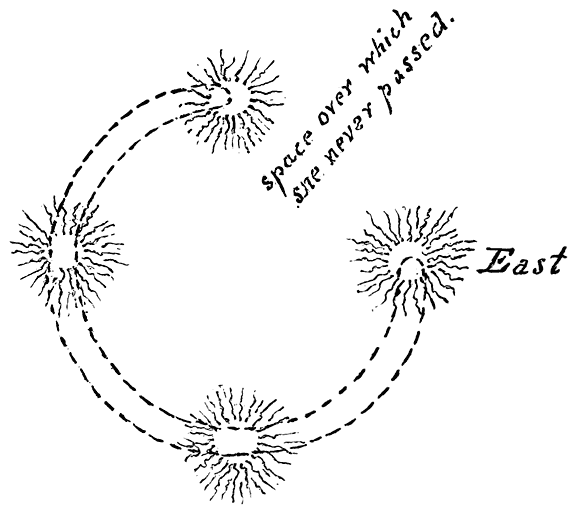
Fig. 33. Trail of Estsánatlehi.
415. Estsánatlehi had not been long in her western home when she began to feel lonely. She had no companions there. The people who had accompanied her thither did not stay with her. She thought she might make people to keep her company, so one day, when she had completed one of her dancing journeys, she sat down on the eastern mountain. Here she rubbed epidermis from under her left arm with her right hand; she held this in her palm and it changed into four persons,—two men and two women,—from whom descended a gens to which no name was then given, but which afterwards (as will be told) received the name of Honagáʻni. She rubbed the epidermis with her left hand from under her right arm, held it in her palm as before, and it became two men and two women, from whom descended the gens afterwards known as Kinaáʻni. In a similar way, of epidermis rubbed from under her left breast she created four people, from whom descended the gens later known as Toʻdĭtsíni; of epidermis from under her right breast, four persons, from whom descended the gens called Bĭtáni; of epidermis from the middle of her chest, the four whose descendants were called Haslĭ′zni; and of epidermis from her back between her shoulders, the four whose descendants were called Bĭtáʻni in later times.
416. She said to these: “I wish you to dwell near me, where I can always see you; but if you choose to go to the east, where your kindred dwell, you may go.” She took them from her floating home to the mainland; here they lived for thirty years, during which time they married and had many children. At the end of this time the Twelve People (Dĭnéʻ Nakidáta), or rather what was left of them, appeared among Estsánatlehi’s people and said to them: “We have lost our sister who kept our house for us; we have no home; we know not where else to go; so we have come here to behold our mother, our grandmother. You have kindred in the far east who have increased until they are now a great people. We do not visit them, but we stand on the mountains and look at them from afar. We know they would welcome you if you went to them.” And many more things they told about the people in the far east.
417. Now all crossed on a bridge of rainbow to the house of Estsánatlehi on the sea, where she welcomed them and embraced them. Of the Dĭnéʻ Nakidáta but ten were left, for, as has been told, they lost their sister and their younger brother; but when they came to the home of Estsánatlehi she made for them two more people out of turquoise, and this completed their original number of twelve. She knew with what thoughts her children had come. She opened four doors leading from the central chamber of her house into four other rooms, and showed them her various treasures, saying: “Stay with me always, my children; these things shall be yours, and we shall be always happy together.”
418. When the people went back from the house of Estsánatlehi to the mainland, all was gossip and excitement in their camp about what they had heard of the people in the east. Each one had a different part or version of the tale to tell,—of how the people in the east lived, of what they ate, of the way in which they were divided into gentes, of how the gentes were named, and of other things about them they had heard. “The people are few where we live,” they said; “we would be better off where there are so many.” They talked thus for twelve days. At the end of that time they concluded to depart, and they fixed the fourteenth day after that as the day they should leave.
419. Before they left, the Dĭnéʻ Nakidáta and Estsánatlehi came to see them. She said: “It is a long and dangerous journey to where you are going. It is well that you should be cared for and protected on the way. I shall give you five of my pets,189—a bear, a great snake, a deer, a porcupine, and a puma,—to watch over you. They will not desert you. Speak of no evil deeds in the presence of the bear or the snake, for they may do the evil they hear you speak of; but the deer and the porcupine are good,—say whatever you please to say in their presence.”
420. Besides these pets she gave them five magic wands. To those who were afterwards named Honagáʻni she gave a wand of turquoise; to those who later were called Kinaáʻni, a wand of white shell; to those who became Toʻdĭtsíni, a wand of haliotis shell; to those who became Bĭtáʻni, a wand of black stone; and to those who in later days became Haslĭ′zni, a wand of red stone. “I give you these for your protection,” she said, “but I shall watch over you myself while you are on your journey.”
421. On the appointed day they set out on their journey. On the twelfth day of their march they crossed a high ridge and came in sight of a great treeless plain, in the centre of which they observed some dark objects in motion. They could not determine what they were, but suspected they were men. They continued their journey, but did not directly approach the dark objects; they moved among the foothills that surrounded the plain, and kept under cover of the timber. As they went along they discerned the dark objects more plainly, and discovered that these were indeed human beings. They got among the foothills to one side of where the strangers were, and camped in the woods at night.
422. In spite of all the precautions taken by the travellers, they had been observed by the people of the plain, and at night two of the latter visited their camp. The visitors said they were Kĭltsói, or Kĭltsóidĭneʻ (People of the Bigelovia graveolens); that their tribe was numerous; that the plain in which they dwelt was extensive; and that they had watermelons getting ripe, with corn and other food, in their gardens. The people of the west concluded to remain here a while. The second night they had two more visitors, one of whom became enamored of a maiden among the wanderers, and asked for her in marriage. Her people refused him at first; but when he came the second night and begged for her again, they gave her to him. He stayed with her in the camp of her people as long as they remained in the valley, except the last two nights, when she went and stayed with his people. These gave an abundance of the produce of their fields to the wanderers, and the latter fared well. When the travellers were prepared to move, they implored the young husband to go with them, while he begged to have his wife remain with him in the valley. They argued long; but in the end the woman’s relations prevailed, and the Kĭltsói man joined them on their journey. In the mean time four other men of Kĭltsói had fallen in love with maidens of the wanderers, and asked for them in marriage. The migrating band refused to leave the girls behind, so the enamored young men left their kindred and joined the travellers. The Kĭltsói tried to persuade the others to dwell in their land forever, but without avail.
423. They broke camp at last early in the morning, and travelled all day. At night a great wind arose, and the bear would not rest, but ran around the camp all night, uneasy and watchful. The men looked out and saw some of the Kĭltsói trying to approach; but the bear warded them off and they disappeared without doing harm. In the morning it was found that the men of the Kĭltsói who had joined them on their journey had now deserted them, and it was supposed that in some way they were in league with their brethren outside.
424. The second day they journeyed far, and did not make camp until after dark. As on the previous night, the bear was awake, watchful, and uneasy all night. They supposed he was still looking out for lurking Kĭltsói. Not until daybreak did he lie down and take a little sleep while the people were preparing for the day’s march.
425. On the third night the bear was again wakeful and on guard, and only lay down in the morning while the people were breaking camp. “My pet, why are you troubled thus every night?” said one of the men to the bear. The latter only grunted in reply, and made a motion with his nose in the direction whence they had come.
426. On the fourth night they camped, for mutual protection, closer together than they had camped before. The bear sat on a neighboring hill, from which he could watch the sleepers, but slept not himself all night. As before, he took a short sleep in the morning. Before the people set out on their march some one said: “Let us look around and see if we can find what has troubled our pet.” They sent two couriers to the east and two to the west. The former returned, having found nothing. The latter said they had seen strange footprints, as of people who had approached the camp and then gone back far to the west. Their pursuers, they thought, had returned to their homes.
427. They had now been four days without finding water, and the children were crying with thirst. On the fifth day’s march they halted at noon and held a council. “How shall we procure water?” said one. “Let us try the power of our magic wands,” said another. A man of the gens who owned the wand of turquoise stuck this wand into the ground, and worked it back and forth and round and round to make a good-sized hole. Water sprang from the hole. A woman of another gens crouched down to taste it. “It is bitter water,” she cried. “Let that, then, be your name and the name of your people,” said those who heard her; thus did the gens of Toʻdĭtsíni, Bitter Water People, receive its name.
428. When the people had cooked and eaten food and drunk their fill of the bitter water, they said: “Let us try to reach yonder mountain before night.” So they pushed on to a distant mountain they had beheld in the east. When they got near the mountain they saw moccasin tracks, and knew there must be some other people at hand. At one place, near the base of the mountain, they observed a cluster of cottonwood trees, and, thinking there might be a spring there, they went straight to the cottonwood. Suddenly they found themselves among a strange people who were dwelling around a spring. The strangers greeted the wanderers in a friendly manner, embraced them, and asked them whence they came. The wanderers told their story briefly, and the strangers said: “We were created at this spring and have always lived here. It is called Maitóʻ, Coyote Water (Coyote Spring), and we are the Maídĭneʻ” (Coyote People). The Navahoes called them Maitóʻdĭneʻ.
429. The travellers tarried four days at the Coyote Spring, during which time they talked much to their new friends, and at length persuaded the latter to join them on their eastern journey. Before they started, the Coyote People declared that their spring was the only water in the neighborhood; that they knew of no other water within two days’ journey in any direction. On the morning of the fifth day they all moved off toward the east. They travelled all day, and made a dry camp at night. The next day at noon they halted on their way, and decided to try again the power of a magic wand. This time the white shell was used by a member of the gens to whom it had been given, in the same way that the turquoise wand was used before. Water sprang up. A woman of another gens said: “It is muddy; it may make the children sick.” “Let your people then be named Haslĭ′zni, Mud People,” cried voices in the crowd. Thus the gens of Haslĭ′z, or Haslĭ′zni, was named.
430. The second night after leaving Coyote Spring, darkness overtook the wanderers at a place where there was no water, and they rested there for the night. At noon on the following day all were thirsty, and the children were crying. The people halted, and proposed to try again the efficacy of a sacred wand. The wand of haliotis was used this time. When the water sprang up, a woman of the Coyote People stooped first and drank. “It is Toʻdokónz, alkaline (or sapid) water,” she exclaimed. To her and her children the name Toʻdokónzi was then given, and from them the present gens of that name is descended. Its members may not marry with Maitóʻdĭneʻ, to whom they are related.
431. On the night after they found the alkaline water, they encamped once more at a place where no water was to be found, and on the following day great were their sufferings from thirst. At midday they rested, and begged the bearers of the black stone wand to try the power of their magic implement. A stream of fine, clear water sprang up when the wand was stuck in the ground. They filled their vessels and all drank heartily, except a boy and a girl of the gens that bore the black stone wand. “Why do you not come and drink before the water is all gone?” some one asked. The children made no reply, but stood and looked at the water. The girl had her arms folded under her dress. They gave then to her and to her gens the name of Bĭtáʻni,190 which signifies the arms under the dress.
432. The night after the Bĭtáʻni was named, the travellers slept once more at a place where no water was to be found, and next day they were very thirsty on their journey. In the middle of the day they stopped, and the power of the red stone wand was tried. It brought forth water from the ground, as the other wands had done, and all drank till they were satisfied; but no member of the gentes still unnamed said anything and no name was given.
433. After this they camped two nights without water. On the second noon they arrived at a spring in a canyon known to the Maídĭneʻ and called by them Halkaítoʻ, Water of the White Valley. They journeyed no farther that day, but camped by the water all night.
434. From Halkaítoʻ they travelled steadily for twenty-five days, until they came to a little river near San Francisco Mountain, and west of it. During this part of the journey they found sufficient water for their needs every day. They stopped at this river five nights and five days and hunted. Here one man, and one only,—whose name was Baĭnilĭ′ni (Looks on at a Battle),—killed a deer, a large one, which he cut into small pieces and distributed around so that every one might get a taste.
435. From the banks of this stream they came to the east side of San Francisco Mountain, to where, beside a little peak, there is a spring that has no name. Here the travellers stopped several days, and built around their camp a stone wall that still stands.
436. The puma belonged to the gens that bore the black stone wand, and that was afterwards called Kinaáʻni. While the people were camped at this spring he killed a deer. The bear sometimes killed rabbits. The snake and the porcupine were of no use, but were a trouble instead, since they had to be carried along. The deer ran among the crowd and did neither good nor harm. The people lived mostly on rabbits and other small animals and the seeds of wild plants.
437. From the spring near San Francisco Mountain they travelled to Bĭtáhotsi (Red Place on Top),191 and from there to Tséʻzĭntsĭdĭlya. Here they held a council about the big snake. He was of no use to them, and a great encumbrance. They turned him loose among the rocks, and his descendants are there in great numbers to this day. At Natsĭsaán (Navaho Mountain) they turned the porcupine loose, and that is why there are so many porcupines on the Navaho Mountain now.
438. They next went to the place now called Agála,192 or Agálani, Much Wool, or Hair, and were now in the land of the Ozaí (Oraibes). They camped all around the peak of Agála and went out hunting. Some who wore deer-masks for decoys, and went to get deer, succeeded in killing a great number. They dressed many skins, and the wind blew the hair from the skins up in a great pile. Seeing this, one of the Honagáʻni proposed that the place be called Agála, so this name was given to it.
439. From Agála the wanderers went to Tseʻhotsóbiazi, Little Place of Yellow Rocks, and from there to Yótso, Big Bead. On the way they camped often, and sometimes tarried a day or two to hunt. It was now late in the autumn. At Yótso they saw moccasin tracks, evidently not fresh, and they said to one another: “Perhaps these are the footprints of the people whom we seek.” Now there were diverse counsels among the immigrants. Some were in haste to reach the end of the journey, while others, as the season was late, thought it prudent to remain where they were. Thus they became divided into two parties, one of which remained at Yótso, while the other (containing parts of several gentes) continued the journey. Soon after the latter was gone, those who remained at Yótso sent two messengers, and later they sent two more, to induce the seceders to return; but the latter were never overtaken. The couriers came to a place where the runaways had divided into two bands. From one of these the Jicarilla Apaches are supposed to have descended. The other band, it is thought, wandered far off and became part of the Dĭnéʻ Nahotlóni.193
440. The last two messengers sent out pursued one of the fugitive bands some distance, gave up the task, and returned to Yótso. The messengers sent first pursued the other band. After a while they saw its camp-fires; but at such a great distance that they despaired of overtaking it and turned toward the San Juan River, where they found at length the long-sought Navahoes. These two messengers were the men, of whom you have heard before, who entered the camp of Big Knee at Toʻyĕ′tli while the dance of natsĭ′d was going on, and announced the approach of the immigrants from the west. (See par. 143.)
441. When spring-time came, the people who had remained at Yótso set out again on their journey; but before long some of the Toʻdĭtsíni got tired. They said that the children’s knees were swollen, that their feet were blistered, and that they could not go much farther. Soon after they said this they came to a place where a great lone tree stood, and here they declared: “We shall stop at this tree. After a while the people will come here and find us.” They remained and became the gens of Tsĭnsakádni, People of the (Lone) Tree, who are closely related to Toʻdĭtsíni and cannot marry with the latter.
442. At Pĭnbĭtóʻ, Deer Spring, some more of the gens of Toʻdĭtsíni halted, because, they said, their children were lame from walking and could travel no farther. Here they formed a new gens of Pinbĭtóʻdĭneʻ, People of Deer Spring,194 who are also closely related to Toʻdĭtsíni. At this place they wanted their pet deer to leave them, but he would not go; he remained at the spring with the people who stayed there. What finally became of him is not known.195
443. The main body of the immigrants kept on their way, and, soon after passing Deer Spring, arrived at Hyíĕtyĭn, where the people of Tháʻpaha had their farms. Big Knee was still alive when they came; but he was very old and feeble, and was not respected and obeyed as in former days. When Tháʻpaha and Haslĭ′zni met, they traced some relationship between the two gentes: their names had much the same meaning; their headdresses and accoutrements were alike; so the Haslĭ′zni stopped with Tháʻpaha and became great friends with the latter. Yet to-day a member of one of these gentes may marry a member of the other.
444. The bear was the last of their five pets which the immigrants retained. When they were done their journey they said to him: “Our pet, you have served us well; but we are now safe among our friends and we need your services no more. If you wish you may leave us. There are others of your kind in Tsúskai (the Chusca Mountains). Go there and play with them.” They turned him loose in Tsúskai, and bears have been numerous there ever since.
445. Of the people from the west, there was yet one gens—that to which Estsánatlehi had given the wand of turquoise—which had no name. This nameless people did not stay long on the banks of the San Juan before they wandered off far toward the south. One day two men of the party, while hunting, came to a place called Tséʻnahapĭl, where there were high overhanging rocks. Here they saw the fresh prints of unshod human feet. They followed these tracks but a short distance when they beheld a man watching them from a rocky pinnacle. As soon as he saw that he was observed, he crouched and disappeared. They ran quickly behind the rock on which they had seen him and again observed him, running as fast as he could. “Why do you fly from us?” they shouted. “We mean no harm to you.” Hearing this he stopped till they came up to him. Then they found he spoke the same language they did, and they addressed him in terms of relationship. “Where do you live?” they asked. “In a canyon high on the mountain,” he replied. “What do you live on?” they queried. “We live mostly on seeds,” he answered; “but sometimes we catch wood-rats, and we raise small crops.” “We shall have many things to tell one another,” said the hunters; “but your home is too far for our people to reach to-day. Tell your people to come to this spot, and we shall tell ours to come up here and meet them.” When the hunters got home they found their friends cooking rabbits and making mush of wild seeds. When the meal was finished all climbed the mountain to the appointed place and found the strangers awaiting them. The two parties camped together that night and related to one another their histories and adventures. The strangers said that they had been created at the place where they were all then camped only seven years previously; that they were living not far off at a place called Natanbĭlhátĭn, but that they came often to their natal place to pick cactus fruit and yucca fruit. They said they called themselves Tséʻdĭneʻ, or Rock People; but the nameless ones gave them the name of Tseʻnahapĭ′lni, Overhanging Rocks People, from the place where they met. With this name they became a gens of the Navahoes.
446. The Tseʻnahapĭ′lni told their new friends that they had some corn and pumpkins cached at a distance, and they proposed to open their stores and get ready for a journey. They knew of some Apaches to the south, whom they would all visit together. These Apaches, they said, had some gentes of the same names as those of the Navahoes. Then they all went to where the provisions were stored, and they made corn-cakes to use on the journey. When they were ready they went to the south and found, at a place called Tsóhanaa, the Apaches, who recognized them as friends, and treated their visitors so well that the latter concluded to remain for a while.
447. At the end of three years the Tseʻnahapĭ′lni went off to join the Navahoes on the San Juan. The nameless people stayed four years longer. About the end of that time they began to talk of leaving, and their Apache friends tried to persuade them to remain, but without avail. When they had all their goods packed and were ready to start, an old woman was observed walking around them. She walked around the whole band, coming back to the place from which she started; then she turned towards them and said: “You came among us without a name, and you have dwelt among us, nameless, for seven years; no one knew what to call you; but you shall not leave us without a name. I have walked around you, and I call you Honagáʻni (Walked-around People).”196
448. When the Honagáʻni got back to the San Juan they found that the Tseʻnahapĭ′lni had been long settled there and had become closely related to Tlastsíni, Dĕstsíni, Kĭnlĭtsíni, and Tsĭnadzĭ′ni. The Honagáʻni in time formed close relationships with Thaʻnĕzáʻni, Dsĭltláʻni, Tóʻhani, and Nahopáni. These five gentes are now all the same as one gens, and no member of one may marry a member of another.
449. It happened about this time, while some of the Tháʻpaha were sojourning at Agála, that they sent two children, one night, to a spring to get water. The children carried out with them two wicker bottles, but returned with four. “Where did you get these other bottles?” the parents inquired. “We took them away from two little girls whom we met at the spring,” answered the children. “Why did you do this, and who are the girls?” said the elders. “We do not know. They are strangers,” said the little ones. The parents at once set out for the spring to find the strange children and restore the stolen bottles to them; but on their way they met the little girls coming toward the Tháʻpaha camp, and asked them who they were. The strange children replied: “We belong to a band of wanderers who are encamped on yonder mountain. They sent us two together to find water.” “Then we shall give you a name,” said the Tháʻpaha; “we shall call you Toʻbaznaázi,” Two Come Together for Water. The Tháʻpaha brought the little girls to their hut and bade them be seated. “Stay with us,” they said. “You are too weak and little to carry the water so far. We will send some of our young men to carry it for you.” When the young men found the camp of the strangers they invited the latter to visit them. The Tháʻpaha welcomed the new-comers as friends, and told them they had already a name for them, Toʻbaznaázi. Under this name they became united to the Navahoes as a new gens, and they are now closely affiliated with Tháʻpaha.197
450. Shortly after the coming of Toʻbaznaázi, the Navahoes were joined by a band of Apaches, who were adopted by Tháʻpaha and not formed into a new gens. About the same time a band of Pah Utes came and were likewise adopted by Tháʻpaha. A little later some more Apaches arrived and became a part of Tháʻpaha; but, although no distinct name is now given them, their descendants are known among the Tháʻpaha as a people of different origin from the others.
451. Another party of Apaches, who came afterwards, dwelt a long time among the Toʻdokózi; but later they abode with the Tháʻpaha, and became closely related to the latter. They are still affiliated with Tháʻpaha, but these call them Toʻdokózi.
452. Some years passed before the next accession was made. This was another party of Zuñi Indians, and they were admitted into the gens of the Tháʻpaha. Soon after them came the Zuñi People, who were at last formed into a separate gens,—that of Nanastĕ′zin. This is the Navaho name for all the Zuñians, and means Black Horizontal Stripe Aliens.198 All these people deserted the Zuñi villages on account of scarcity of food.
453. A new people, with painted faces, came from the west about the same time as those who formed the gens of Zuñi, or a little later. They are supposed to have been a part of the tribe now called Mohaves on the banks of the Colorado. They bore the name of Dildzéhi, and their descendants now form a gens of that name among the Navahoes. At first they affiliated with Nanastĕ′zin; but to-day they are better friends with Tháʻtsini than with Nanastĕ′zin.
454. A war-party, consisting of members of different gentes, was now organized among the Navahoes to attack a pueblo called Saíbehogan, House Made of Sand. At that place they captured two girls and brought them home as slaves. There was a salt lake near their old home, and the girls belonged to a gens of Salt People there. So their numerous descendants now among the Navahoes form the gens of Ásihi, or Salt. The captives were taken by members of the Tseʻdzĭnkĭ′ni, hence Ásihi and Tseʻdzĭnkĭ′ni are now affiliated.
455. Then a war party was gotten up to attack the people of Jemez pueblo. On this raid one of the Tlastsíni captured a Jemez girl, but sold her to one of the Tseʻdzĭnkĭ′ni. She was the progenitor of the gens of Maidĕskĭ′zni, People of Wolf Pass (i.e., Jemez), which is now affiliated with Tseʻdzĭnkĭ′ni.
456. After the Navahoes attacked Saíbehogan there was a famine there, and some of the people abandoned their homes and joined the Navahoes. They said that in their pueblo there was a gens of Tháʻpaha, and hearing there was such a gens among the Navahoes they came to join it. Therefore they sought Tháʻpaha till they found it and became a part of it.
457. There came once a party of seven people from a place called Tseʻyanatóʻni, Horizontal Water under Cliffs, to pay a short visit to the Navahoes; but from time to time they delayed their departure, and at last stayed forever with the Navahoes. They formed the gens of Tseʻyanatóʻni, which is now extinct.
458. The people whom Estsánatlehi created from the skin under her right arm, and to whom she gave the wand of white shell, was called, after they came among the Navahoes, Kinaáʻni, High Stone House People; not because they built or dwelt in such a house, but because they lived near one.199
459. When the Bĭtáʻni were encamped at a place called Tóʻtso, or Big Water, near the Carrizo Mountains, a man and a woman came up out of the water and joined them. From this pair is descended the gens of Tóʻtsoni, People of the Big Water, which is affiliated with Bĭtáʻni.
NATĬ′NĔSTHANI.
460. Natĭ′nĕsthani,201 He Who Teaches Himself, lived, with his relations, near the mountain of Dsĭlnáotĭl. The few people who lived there used to wander continually around the mountain, hence its name, Encircled Mountain. Natĭ′nĕsthani delighted in gambling, but was not successful. He lost at game, not only all his own goods, but all the goods and jewels of his relations, until there was only one article of value left—a necklace consisting of several strings of white beads. His parents and brother lived in one lodge; his grandmother and niece lived in another, a little distance from the first. When the gambler had parted with everything except the necklace, his brother took this to the lodge of his grandmother and gave it to her, saying: “My brother has gambled away everything save this. Should he lose this at game, it is the last thing he will ever lose, for then I shall kill him.”