LEGENDS. (continued 4)
Reading edition
461. Natĭ′nĕsthani did not spend all his time gambling; sometimes he hunted for wood-rats and rabbits in the mountains. The day the necklace was brought, in returning from his hunt, he came to the house of his grandmother and saw the necklace hanging up there. “Why is this here?” he asked. “It is put here for safe-keeping,” replied his niece. “Your brother values it and has asked us to take care of it. If you lose it in gambling, he has threatened to kill you. I have heard the counsels of the family about you. They are tired of you. If you lose this necklace at play, it is the last thing you will ever lose.” On hearing this he only said to his niece, “I must think what I shall do,” and he lay down to rest.
462. Next morning he rose early, made his breakfast of wood-rats, and went out to hunt, travelling toward the east. He stopped at one place, set fall-traps for wood-rats, and slept there all night. During the night he pondered on many plans. He thought at first he would go farther east and leave his people forever; but again he thought, “Who will hunt wood-rats for my niece when I am gone?” and he went back to her lodge and gave her all the little animals he had killed.
463. In the morning he breakfasted again on wood-rats, and said to himself: “I shall go to-day to the south and never return.” Such was his intention as he went on his way. He travelled to the south, and spent the night out again; but in the morning he changed his mind, and came back to his niece with wood-rats and rabbits and the seeds of wild plants that he had gathered. The women cooked some of the wood-rats for his supper that night. When he lay down he thought of his brother’s threats, and made plans again for running away. He had not touched the beads, though he longed to take them.
464. Next morning he went to the west, hunted there all day, and camped out at night as before; but again he could not make up his mind to leave his people, though he thought much about it; so he returned to his niece with such food as he had been able to get for her, and slept in the lodge that night.
465. On the following day he went to the north and hunted. He slept little at night while camping out, for his mind was filled with sad thoughts. “My brother disowns me,” he said to himself. “My parents refuse me shelter. My niece, whom I love most, barely looks at me. I shall never go back again.” Yet, for all these words, when morning came he returned to the lodge.19
466. By this time he was very poor, and so were his grandmother and niece. His sandals, made of grass and yucca-fibre, were worn through, and the blanket made of yucca-fibre and cedar-bark, which covered his back, was ragged.177 But the people in the other lodge were better off. They gave the grandmother and niece food at times; but always watched these closely when they came for food, lest they should carry off something to give the gambler. “Let him live,” said his parents, “on wood-rats and rabbits as well as he can.”
467. The night after he returned from his hunt to the north he slept little, but spent the time mostly in thinking and making plans. What these plans were you shall soon know, for the next day he began to carry them out. His thought for his niece was now the only thing that made him care to stay at home.
468. In the morning after this night of thought he asked his niece to roast for him four wood-rats; he tied these together and set out for the San Juan River. When he got to the banks of the river he examined a number of cottonwood trees until he found one that suited him. He burned this down and burned it off square at the base. He kept his fire from burning up the whole trunk by applying mud above the place to be burned. His plan was to make a hollow vessel by which he could go down the San Juan River. It was his own plan. He had never heard of such a thing before. The Navahoes had never anything better than rafts, and these were good only to cross the river. He lay down beside the log to see where he should divide it, for he had planned to make the vessel a little longer than himself, and he burned the log across at the place selected. All this he did in one day, and then he went home, collecting rats on the way; but he told his niece nothing about the log. He slept that night in the lodge.
469. He went back, next morning, to his log on the banks of the San Juan, and spent the day making the log hollow by means of fire, beginning at the butt end. He succeeded in doing only a part of this work in one day. It took him four days to burn the hole through from one end of the log to the other and to make it wide enough to hold his body. At the end of each day’s work he returned to his grandmother’s lodge, and got wood-rats and rabbits on his way home.
470. The next day, after the hole was finished, was spent in making and inserting plugs. He moistened a lot of shredded cedar-bark and pounded it between stones so as to make a soft mass. He shoved a large piece of this in at the butt end and rammed it down to the tip end. In burning out the log, he had burned, where the tree branched, four holes which he did not need, and these he filled with plugs of the cedar-bark. He prepared another plug to be rammed into the butt from the inside, after he entered the log, and when this was finished he went home to his grandmother’s house, collecting wood-rats from his traps as he went.
471. The next morning his niece cooked several wood-rats and ground for him a good quantity—as much as could be held in two hands—of the seeds of tloʻtsózi (Sporobolus cryptandrus). This meal she put in a bag of wood-rat skins sewed together. Thus provided he went back to his log. He put the provisions into the hole and then proceeded to enter, in person, to see if the log was sound and the hole big enough. He entered, head foremost, and crawled inwards until half of his chest was in the log, when he heard a voice crying, “Wuʻhuʻhuʻhú!”26 and he came out to see who called. He looked in every direction and examined the ground for tracks, but seeing no signs of any intruder he proceeded again to enter the log. This time he got in as far as his waist, when again he heard the cry of “Wuʻhuʻhuʻhú,” but louder and nearer than before. Again he came out of the log and looked around farther and more carefully than he did the first time, going in his search to the margin of the river; but he saw no one, found no tracks, and returned to his log. On the next trial he entered as far as his knees, when for the third time the cry sounded, and he crept out once more to find whence it came. He searched farther, longer, and more closely than on either of the previous occasions, but without success, and he went back to enter the log again. On the fourth trial, when he had entered as far as his feet, he heard the cry loud and near, and he felt some one shaking the log. He crept out for the fourth time and beheld Hastséyalti, the Talking God,73 standing over him.
472. Hastséyalti did not speak at first, but told the man by signs that he must not get into the log, that he would surely be drowned if he did, and that he must go home. Then Hastséyalti walked off a distance from the log and motioned to the Navaho to come to him. When Natĭ′nĕsthani came near the god, the latter spoke, saying: “My grandchild, why are you doing all this work? Where do you intend to go with this log?” The man then told the god all his sad story, and ended by saying: “I am an outcast. I wish to get far away from my people. Take pity on me. Stop me not, but let me go in this log as far as the waters of the Old Age River (San Juan) will bear me.” Hastséyalti replied: “No. You must not attempt to go into that log. You will surely be drowned if you do. I shall not allow you.” Four times Natĭ′nĕsthani pleaded, and four times the god denied him. Then the god said: “Have you any precious stones?” “Yes,” replied the man. “Have you white shell beads? Have you turquoise?” and thus the god went on asking him, one by one, if he had all the original eighteen sacred things202 that must be offered to the gods to gain their favor. To each of his questions the man replied “Yes,” although he had none of these things, and owned nothing but the rags that covered him. “It is well,” said the god. “You need not enter that log to make your journey. Go home and stay there for four nights. At daylight, after the fourth night, you may expect to see me again. Have yourself and your house clean and in order for my coming. Have the floor and all around the house swept carefully. Have the ashes taken out. Wash your body and your hair with yucca suds the night before I arrive, and bid your niece to wash herself also with yucca. I shall go off, now, and tell the other divine ones about you.”
473. As soon as he came home, Natĭ′nĕsthani told his niece what things he wanted (except the baskets and the sacred buckskins); but he did not tell her for what purpose he required them, and he asked her to steal them from their neighbors. This she did, a few things at a time, and during many visits. It took her three days to steal them all. On the evening of the third day, after they had washed themselves with the yucca suds, he told her about the baskets and the sacred buckskins which he needed. She went to the neighboring lodge and stole these articles, wrapping the baskets up in the buckskins. When she returned with her booty, he wrapped all the stolen goods up in the skins, put them away in the edge of the lodge, and lay down to rest. He was a good sleeper, and usually slept all night; but on this occasion he woke about midnight, and could not go to sleep again.
474. At dawn he heard, faintly, the distant “Wuʻhuʻhuʻhú” of Hastséyalti. At once he woke his grandmother, saying: “I hear a voice. The dĭgíni (holy ones, divine ones) are coming.” “You fool,” she replied. “Shut your mouth and go to sleep. They would never come to visit such poor people as we are,” and she fell asleep again. In a little while he heard the voice a second time, louder and nearer, and again he shook his grandmother and told her he heard the voices of the gods; but she still would not believe him, and slept again. The third time that he awoke her, when he heard the voices still more plainly, she remained awake, beginning to believe him. The fourth time the call sounded loud and clear, as if cried by one standing at the door. “Hear,” he said to his grandmother. “Is that not truly the voice of a divine one?” At last she believed him, and said in wonder: “Why should the dĭgíni come to visit us?”
475. Hastséyalti and Hastséhogan were at the door, standing on the rainbow on which they had travelled. The former made signs to the man, over the curtain which hung in the doorway, bidding him pull the curtain aside and come out. “Grandmother,” said the Navaho, “Hastséyalti calls me to him.” “It is well,” she answered. “Do as he bids you.” As he went out, bearing his bundle of sacrificial objects, he said: “I go with the divine ones, but I shall come back again to see you.” The niece had a pet turkey203 that roosted on a tree near the lodge, Hastséyalti made signs to the Navaho to take the turkey along. The Navaho said: “My niece, the gods bid me take your turkey, and I would gladly do it, for I am going among strange people, where I shall be lonely. I love the bird; he would be company to me and remind me of my home. Yet I shall not take him against your will.” “Then you may have my turkey pet,” replied the niece. The old woman said to the god: “I shall be glad to have my grandchild back again. Will you let him return to us?” Hastséyalti only nodded his head. The gods turned the rainbow around sunwise, so that its head,204 which formerly pointed to the door of the lodge, now pointed in a new direction. Hastséyalti got on the bow first. He made the Navaho get on behind him. Hastséhogan got on behind the man. “Shut your eyes,” commanded Hastséyalti, and the Navaho did as he was bidden.
476. In a moment Hastséyalti cried again: “Open your eyes.” The Navaho obeyed and found himself far away from his home at Tséʻtadi, where the dĭgíni dwelt. They led him into a house in the rock which was full of divine people. It was beautiful inside—the walls were covered with rock crystal, which gave forth a brilliant light. Hastséyalti ordered food brought for his visitor. The latter was handed a small earthen cup only so big (a circle made by the thumb and index finger joined at the tips) filled with mush. “What a poor meal to offer a stranger!” thought the Navaho, supposing he would finish it in one mouthful. But he ate, and ate, and ate, and ate, from the cup and could not empty it. When he had eaten till he was satisfied the little cup was as full as in the beginning.205 He handed the cup, when he was done, back to Hastséyalti, who, with one sweep of his finger, emptied it, and it remained empty. The little cup was then filled with water and given to the guest to drink. He drank till his thirst was satisfied; but the cup was as full when he was done as it was when he began. He handed it again to Hastséyalti, who put it to his own lips and emptied it at a single swallow.
477. The gods opened the bundle of the Navaho and examined the contents to see if he had brought all they required, and they found he had done so. In the mean time he filled his pipe and lighted it. While he was smoking, the gods Nayénĕzgạni, Tóʻbadzĭstsíni, and Hastséoltoi206 arrived from Toʻyĕ′tli and entered the house. Nayénĕzgạni said to the visitor: “I hear that you were found crawling into a hole which you had made in a log by burning. Why were you doing this?” In reply the Navaho told his whole story, as he had told it to Hastséyalti, and ended by saying: “I wished to go to Toʻyĕ′tli, where the rivers meet, or wherever else the waters would bear me. While I was trying to carry out this plan, my grandfather, Hastséyalti, found me and bade me not to go. For this reason only I gave my plan up and went home.” “Do you still wish to go to Toʻyĕ′tli?” said Nayénĕzgạni. “Yes,” said the Navaho, “I wish to go to Toʻyĕ′tli or as far down the San Juan as I can get.” “Then you shall go,” said the god.
478. Nayénĕzgạni went forth from the house and the other gods followed him. They went to a grove of spruce, and there picked out a tree of unusual size. They tied rainbow ropes to it, so that it might not fall with too great force and break in falling. Nayénĕzgạni and Toʻbadzĭstsíni cut it near the root with their great stone knives, and it fell to the north. Crooked Lightning struck the fallen tree and went through it from butt to tip. Straight Lightning struck it and went through it from tip to butt. Thus the hole was bored in the log, and this was done before the branches were cut away. The hole that Crooked Lightning bored was too crooked. Straight Lightning made it straight, but still it was too small. Black Wind was sent into the hole, and he made it larger, but not large enough. Blue Wind, Yellow Wind, and White Wind entered the hole, each in turn, and each, as he went through, made it a little larger. It was not until White Wind had done his work that the hole was big enough to contain the body of a man. Hastséyalti supplied a bowl of food, a vessel of water, and a white cloud for bedding. They wrapped the Navaho up in the cloud and put him into the log. They plugged the ends with clouds,—a black cloud in the butt and a blue cloud in the tip,—and charged him not to touch either of these cloudy plugs. When they got him into the log some one said: “How will he get light? How will he know when it is night and when it is day?” They bored two holes in the log, one on each side of his head, and they put in each hole, to make a window, a piece of rock crystal, which they pushed in so tightly that water could not leak in around it.
479. While some of the gods were preparing the log, others were getting the pet turkey ready for his journey, but they did this unknown to the Navaho. They put about his body black cloud, he-rain, black mist, and she-rain. They put under his wings white corn, yellow corn, blue corn, corn of mixed colors, squash seed, watermelon seed, muskmelon seed, gourd seed, and beans of all colors. These were the six gods who prepared the turkey: four of the Gánaskĭdi207 from a place called Depéhahatil, one Hastséhogan from Tseʻgíhi,165 and the Hastséhogan from Tséʻtadi,—the one who found the Navaho entering his cottonwood log and took him home to the house in the rocks.
480. The next thing they had to think about was how they should carry the heavy log to the river with the man inside of it. They put under the log (first) a rope of crooked lightning, (second) a rope of rainbow, (third) a rope of straight lightning, and (fourth) another rope of rainbow. They attached a sunbeam to each end of the log. All the gods except those who were engaged in preparing the turkey tried to move the log, but they could not stir it; and they sent for the six who were at work on the turkey to come to their aid. Two of the Gánaskĭdi were now stationed at each end, and two of the Hastséhogan in the middle. The others were stationed at other parts. The Gánaskĭdi put their wands under the log crosswise, thus, X. All lifted together, and the log was carried along. Some of them said: “If strength fail us and we let the log fall, we shall not attempt to raise it again, and the Navaho will not make his journey.” As they went along some became tired and were about to let the log go, but the winds came to help them—Black Wind and Blue Wind in front, Yellow Wind and White Wind behind, and soon the log was borne to the margin of the river. As they went along, Tóʻnenĭli,98 the Water Sprinkler, made fun and played tricks, as he now does in the dances, to show that he was pleased with what they were doing. While the gods were at work the Navaho sang five songs, each for a different part of the work; the significant words of the songs were these:—
First Song, “A beautiful tree they fell for me.”
Second Song, “A beautiful tree they prepare for me.”
Third Song, “A beautiful tree they finish for me.”
Fourth Song, “A beautiful tree they carry with me.”
Fifth Song, “A beautiful tree they launch with me.”283
481. When they threw the log on the surface of the water it floated around in different directions, but would not go down stream, so the gods consulted together to determine what they should do. They covered the log first with black mist and then with black cloud. Some of the gods standing on the banks punched the log with their plumed wands, when it approached the shore or began to whirl round, and they kept this up till it got into a straight course, with its head pointed down stream, and floated on. When the gods were punching the log to get it into the current, the Navaho sang a song, the principal words of which were:—
1. “A beautiful tree, they push with me.”
When the log was about to go down the stream, he sang:—
2. “A beautiful tree is about to float along with me,”
and when the log got into the current and went down, he sang:—
3. “A beautiful tree floats along with me.”284
482. All went well till they approached a pueblo called Kĭ′ndotlĭz, or Blue House,208 when two of the Kisáni, who were going to hunt eaglets, saw the log floating by, though they could not see the gods that guided its course. Wood was scarce around Blue House. When the men saw the log they said, “There floats a big tree. It would furnish us fuel for many days if we could get it. We must try to bring it to the shore.” The two men ran back to the pueblo and announced that a great log was coming down the river. A number of people turned out to seize it. Most of them ran down the stream to a shallow place where they could all wade in, to await the arrival of the log, while a few went up along the bank to herald its approach. When it came to the shallow place they tried to break off branches, but failed. They tied ropes to the branches, and tried to pull it ashore; but the log, hurried on by the current, carried the crowd with it. But the next time the log got to a shallow place the Kisáni got it stranded, and sent back to the pueblo for axes, intending to cut off branches and make the log light. When the gods saw the people coming with axes they said: “Something must be done.” They sent down a great shower of rain, but the Kisáni held on to the log. They sent hail, with hailstones as big as two fists; but still the Kisáni held on. They sent lightning to the right—the people to the left held on. They sent lightning to the left—the people to the right held on. They sent lightning in all directions four times, when, at last, the Kisáni let go and the log floated on. Now the gods laid upon the log a cloud so thick that no one could see through it; they put a rainbow lengthwise and a rainbow crosswise over it, and they caused the zigzag lightning to flash all around it. When the Kisáni saw all these things they began to fear. “The gods must guard this log,” they said. “Yes,” said the chief. “Go to your homes, and let the log pass on. It must be holy.”
483. The log floated steadily with the stream till it came to a place where a ridge of rocks, standing nearly straight up, disturbs the current, and here the log became entangled in the rocks. But two of the Fringe-mouths209 of the river raised it from the rocks and set it floating again. They turned the log around, one standing at each end, until they got it lying lengthwise with the current, and then they let it float away.
484. Thence it floated safely to Tóʻhodotlĭz, where the gods on the bank observed it stopping and slowly sinking, until only a few leaves on the ends of the branches could be seen. It was the sacred people under the water who had pulled the log down this time. These were Tiéholtsodi, Tielín,210 Frog, Fish, Beaver, Otter, and others. They took the Navaho out of the log and bore him down to their home under the water. The gods on the bank held a council to consider why the tree stuck. They shook it and tried to get it loose, but they could not move it. Then they called on Tóʻnenĭli, Water Sprinkler, to help them. He had two magic water jars, Toʻsadĭlyĭ′l, the black jar, which he carried in his right hand, and Toʻsadotlĭ′z, the blue jar, which he carried in his left hand; with these he struck the water to the right and to the left, crying as he did so his call of “Tuʻwuʻwuʻwú!” The water opened before him and allowed him to descend. He went around the tree, and when he came to the butt he found that the plug had been withdrawn and that the Navaho was no longer there. He called up to his friends on the bank and told them what he had found. They spread a short rainbow211 for him to travel on, and he went to the house of the divine ones under the water. This house consisted of four chambers, one under another, like the stories of a pueblo dwelling. The first chamber, that on top, was black; the second was blue; the third yellow; the fourth white.18 Two of the Tielín, or water pets with blue horns, stood at the door facing one another, and roared as Tóʻnenĭli passed. He descended from one story to another, but found no one till he came to the last chamber, and here he saw Tiéholtsodi, the water monster; Tsal, Frog (a big rough frog); Tsa, Beaver, Tábastin, Otter, Tloʻayuĭnlĭ′tigi (a great fish), and the captive Navaho. “I seek my grandchild. Give him to me,” said Tóʻnenĭli. “Shut your mouth and begone,” said Tiéholtsodi. “Such as you cannot come here giving orders. I fear you not, Water Sprinkler; you shall not have your grandchild.” Then Tóʻnenĭli went out again and told his friends what had happened to him, and what had been said in the house of Tiéholtsodi under the water.
485. The gods held another council. “Who shall go down and rescue our grandchild?” was the question they asked one another. While they were talking Hastsézĭni212 (Black God), who owns all fire, sat apart and took no part in the council. He had built a fire, while the others waited, and sat with his back to it, as was his custom. “Go tell your grandfather there what has occurred,” said the others to Tóʻnenĭli. The latter went over to where Hastsézĭni sat. “Why are they gathered together yonder and of what do they talk so angrily?” said the Black God. In answer, Tóʻnenĭli told of his adventures under the water and what Tiéholtsodi had said to him. Hastsézĭni was angry when he heard all this. “I fear not the sacred people beneath the water,” he said. “I shall have my grandchild.” He hastened to the river, taking Tóʻnenĭli with him, for Tóʻnenĭli had the power to open the water, and these two descended into the river. When they reached the room where Tiéholtsodi sat, the Black God said, “We come together for our grandchild.” “Run out there, both of you. Such as you may not enter here,” said Tiéholtsodi. “I go not without my grandson. Give him to me, and I shall go,” said the other. “Run out,” repeated Tiéholtsodi, “I shall not release your grandchild.” “I shall take my grandchild. I fear you not.” “I shall not restore him to you. I heed not your words.” “I never recall what I have once spoken. I have come for my grandchild, and I shall not leave without him.” “I said you should not go with him, and I mean what I say. I am mighty.” Thus they spoke defiantly to one another for some time. At length Hastsézĭni said: “I shall beg no longer for my grandchild. You say you are mighty. We shall see which is the more powerful, you or I,” and Tiéholtsodi answered: “Neither shall I ask your permission to keep him. I should like to see how you will take him from me.” When Hastsézĭni heard this he took from his belt his fire-stick and fire-drill.213 He laid the stick on the ground, steadied it with both feet, and whirled the drill around, pausing four times. The first time he whirled the drill there was a little smoke; the second time there was a great smoke; the third time there was flame; the fourth time the surrounding waters all took fire. Then Tiéholtsodi cried: “Take your grandchild, but put out the flames.” “Ah,” said Hastsézĭni, “you told me you were mighty. Why do you implore me now? Why do you not put out the fire yourself? Do you mean what you say this time? Do you really want the fire quenched?” “Oh! yes,” cried Tiéholtsodi. “Take your grandchild, but put out the flames. I mean what I say.” At a sign from Black God, Water Sprinkler took the stoppers out of his jars and scattered water all around him four times, crying his usual “Tuʻwuʻwuʻwú” as he did so, and the flames died out. The water in Tóʻnenĭli’s jars consisted of all kinds of water—he-rain, she-rain, hail, snow, lake-water, spring-water, and water taken from the four quarters of the world. This is why it was so potent.67
486. When the fire was extinguished the three marched out in single file—Tóʻnenĭli in front, to divide the water, the Navaho in the middle, and Hastsézĭni in the rear. Before they had quite reached the dry land they heard a flopping sound behind them, and, looking around, they saw Tsal, the Frog. “Wait,” said he. “I have something to tell you. We can give disease to those who enter our dwelling, and there are cigarettes, sacred to us, by means of which our spell may be taken away. The cigarette of Tiéholtsodi should be painted black; that of Tielín, blue; those of the Beaver and the Otter, yellow; that of the great fish, and that sacred to me, white.” Therefore, in these days, when a Navaho is nearly drowned in the water, and has spewed the water all out, such cigarettes12 are made to take the water sickness out of him.
487. The gods took Natĭ′nĕsthani back to his log. Tóʻnenĭli opened a passage for them through the river, and took the water out of the hollow in the log. The Navaho crawled into the hollow. The gods plugged the butt again, and set the log floating. It floated on and on until it came to a fall in the San Juan River, and here it stuck again. The gods had hard labor trying to get it loose. They tugged and worked, but could not move it. At length the Dsahadoldzá, the Fringe-mouths of the water, came to help. They put the zigzag lightning which was on their bodies209 under the butt of the log,—as if the lightning were a rope,—and soon they got the log loose and sent it floating down the river.
488. At the end of the San Juan River, surrounded by mountains, there is a whirling lake or large whirlpool called Tóʻnihilin, or End of the Water. When the log entered here it whirled around the lake four times. The first time it went around it floated near the shore, but it gradually approached the centre as it went round again and again. From the centre it pointed itself toward the east and got near the shore; but it retreated again to the centre, pointed itself to the south, and at last stranded on the south shore of the lake. When it came to land four gods stood around it thus: Hastséhogan on the east, Hastséyalti on the south, one Gánaskĭdi on the west, and one on the north. They pried out one of the stoppers with their wands, and the Navaho came out on the land. They took out what remained of the food they had given him, a bow of cedar with the leaves on, and two reed arrows that they had placed in the log before they launched it. This done, they plugged the log again with a black cloud.
489. Then the gods spoke to the Navaho and said: “We have taken you where you wished to go. We have brought you to the end of the river. We have done for you all that in the beginning you asked us to do, and now we shall give you a new name. Henceforth you shall be called Áhodĭseli, He Who Floats. Go sit yonder” (pointing out a place), “and turn your back to us.” He went and sat as he was told, and soon they called to him and bade him go to a hill west of the lake. When he ascended it he looked around and saw the log moving back in the direction whence, he thought, he had come. He looked all around, but could see no one. The gods had disappeared, and he was all alone. He sat down to think. He felt sad and lonely. He was sorry he had come; yet, he thought, “This is my own deed; I insisted on coming here, and had I stayed at home I might have been killed.” Still the more he thought the sadder he felt, and he began to weep.
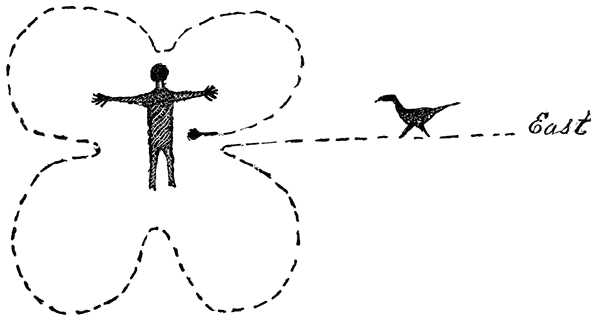
Fig. 34. Trail of turkey approaching his master.
490. The mountains all around the lake were very precipitous, except on the west side. Here they were more sloping, and he began to think of crossing, when he heard faintly in the distance the gobbling of a turkey. He paused and listened, and soon heard the gobbling again, more distinctly and apparently nearer. In a short time he heard the sound for the third time, but louder and clearer than before. The fourth time that the gobbling was heard it seemed very loud and distinct; and a moment later he beheld, running toward him, his pet turkey, whom he had thought he would never see again. The turkey, which had followed him all the way down the San Juan River, now approached its master from the east, as if it were coming to him at once; but when it got within arm’s length of the man it retreated and went round him sunwise, approaching and retreating again at the south, the west, and the north. When it got to the east again it ran up to its master and allowed itself to be embraced. (Fig. 34 shows the way it approached its master.) “Ahaláni, sĭlín (Welcome, my pet),” said Natĭ′nĕsthani, “I am sorry for you that you have followed me, I pity you; but now that you are here, I thank you for coming.”
491. The man now began to think again of crossing the mountain in the west, but suddenly night came on. He had not noticed the light fading until it was too dark to begin the journey, and he felt obliged to seek a resting-place for the night. They went to a gulch near at hand where there were a few small cedar-trees. They spread out, for a bed, the dead leaves and the soft débris which they found under the trees and lay down, side by side, to sleep. The Navaho spread his bark blanket over himself, and the turkey spread one of its wings over its master, and he slept well that night.
492. Next morning they rose early and went out to hunt wood-rats. They went down a small winding valley till they came to a beautiful flat, through which ran a stream of water. “This would be a good place for a farm if I had but the seeds to plant,” said the Navaho aloud. When he had spoken he observed that his turkey began to act in a very peculiar manner. It ran to the western border of the flat, circled round to the north, and then ran directly from north to south, where it rejoined its master, who had in the mean time walked around the edge of the flat from east to west. This (fig. 35) shows how they went. When they met they walked together four times around the flat, gradually approaching the centre as they walked. Here, in the centre, the man sat down and the turkey gambolled around him. “My pet,” said the Navaho, “what a beautiful farm I could make here if I only had the seeds.” The turkey gobbled in reply and spread out its wings.
493. Natĭ′nĕsthani had supposed that when the gods were preparing the log for him they had done something to the turkey, but what they had done he knew not. Now that his pet was acting so strangely, it occurred to him that perhaps it could aid him. “My pet,” he said, “can you do anything to help me make a farm here?” The turkey ran a little way to the east and shook its wings, from which four grains of white corn dropped out; then it ran to the south and shook from its wings four grains of blue corn; at the west it shook out four grains of yellow corn, and at the north four grains of variegated corn. Then it ran up to its master from the east and shook its wings four times, each time shaking out four seeds. The first time it dropped pumpkin seeds; the second time, watermelon seeds; the third time, muskmelon seeds; the fourth time, beans. “Eʻyéhe, sĭlín (Thanks, my pet). I thought you had something for me,” said Natĭ′nĕsthani.
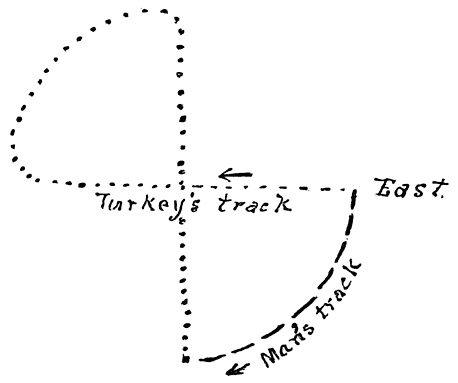
Fig. 35. Tracks of man and turkey.
494. He went away from the flat, roasted wood-rats for a meal, and when he had eaten he made two planting sticks, one of greasewood and one of tsĭntlĭ′zi214 (Fendleria rupicola). He returned to the flat and began to make his farm. He dug four holes in the east with the stick of tsĭntlĭ′zi, and dropped into each hole a grain of white corn. He dug four holes in the south with his greasewood stick, and placed in each hole one grain of blue corn. He dug four holes in the west with the tsĭntlĭ′zi stick, and planted in each one grain of yellow corn. He made four holes in the north with the greasewood, and put in each one grain of variegated corn. With the implement of tsĭntlĭ′zi he planted the pumpkin seed between the white corn and the blue corn. With the implement of greasewood he planted watermelon seed between the blue corn and the yellow corn. With the stick of tsĭntlĭ′zi he planted muskmelon seeds between the yellow corn and the variegated corn. With the stick of greasewood he planted beans between the variegated corn and the white corn.215 He looked all around to see if he had done everything properly, and he went to the west of his farm among the foothills and camped there.
495. He felt uneasy during the night, fearing that there might be some one else to claim the land, and he determined to examine the surrounding country to see if he had any neighbors. Next day he walked in a circle, sunwise, around the valley, and this he did for four consecutive days, taking a wider circle each day; but he met no people and saw no signs of human life, and he said: “It is a good place for a farm. No one claims the land before me.” Each morning, before he went on his journey, he visited his farm. On the fourth morning he saw that the corn had grown half a finger-length above the ground.
496. On the fourth night, after his long day’s walk around the valley, when darkness fell, he sat by his fire facing the east, and was surprised to see a faint gleam half way up the side of the mountains in the east. “Strange,” he said, “I have travelled all over that ground and have seen neither man nor house nor track nor the remains of fire.” Then he spoke to the turkey, saying: “Stay at home to-morrow, my pet; I must go and find out who builds that fire.”
497. Next day, leaving his turkey at home, he went off to search the mountain-side, where he had seen the gleam; but he searched well and saw no signs of human life. When he came home he told all his adventures to his turkey and said: “It must have been a great glow-worm that I beheld.” He got home pretty early in the day and went out to trap wood-rats, accompanied by his turkey. In the evening when he returned to his camp, he looked again, after dark, toward the eastern mountain, and saw the gleam as he had seen it the night before. He set a forked stick in the ground, got down on his hands and knees, and looked at the fire through the fork. (See par. 382.)
498. On the following morning he placed himself in the same position he was in the night before,—putting his hands and knees in the tracks then made,—and looked again over the forked stick. He found his sight directed to a spot which he had already explored well. Notwithstanding this he went there again, leaving his turkey behind, and searched wider and farther and with greater care than on previous occasions; but he still saw no traces of human life. When he returned to camp he told his turkey all that had happened to him. That night he saw the light again, and once more he sighted over the forked stick with care.
499. When morning came, he found that he had marked the same spot he had marked before; and though he had little hope he set out for the third time to find who made the distant fire. He returned after a time, only to tell his disappointment to his turkey. As usual he spent the rest of the day, accompanied by the turkey, setting traps for wood-rats and other small animals. After dark, when he saw the distant flame again, he set a second forked stick in the ground and laid between the two forks a long, straight stick, which he aimed at the fire as he would aim an arrow. When this was done he went to sleep.
500. Next morning he noted with great care the particular spot to which the straight stick pointed, and set out to find the fire. Before he left he said to his turkey: “I go once more to seek the distant fire; but it is the last time I shall seek it. If I find it not to-day, I shall never try again. Stay here till I return.” While he spoke the turkey turned its back on him, and showed its master that it was angry. It acted like a pouting child. He went to the place on the eastern mountain to which the stick pointed, and here he found, what he had not observed before, a shelf in the rocks, which seemed to run back some distance. He climbed to the shelf and discovered there two nice huts. He thought that wealthy people must dwell in them. He felt ashamed of his ragged bark blanket, of his garment of wood-rat skins, of his worn grass sandals; of his poor bow and arrows; so he took these off, laid them in the fork of a juniper-tree, and, retaining only his breech-cloth of wood-rat skins, his belt, tobacco pouch, and pipe, he approached one of the houses.
501. He pushed aside the curtain and saw, sitting inside, a young woman making a fine buckskin shirt which she was garnishing beautifully with fringes and shells. Ashamed of his appearance, he hung his head and advanced, looking at her under his eyebrows. “Where are the men?” he said, and he sat on the ground. The young woman replied: “My father and mother are in the other hut.” Just as the Navaho had made up his mind to go to the other house the father entered. Doubtless the Navaho had been observed while disrobing, for the old man, as he came in, brought the poor rags with him. “Why do you not take in my son-in-law’s goods?” said the old man to his daughter, as he laid the ragged bundle in a conspicuous place on top of a pile of fine fabrics. Poor Natĭ′nĕsthani hung his head again in shame and blushed, while the woman looked sideways and smiled. “Why don’t you spread a skin for my son-in-law to sit on?” said the old man to his daughter. She only smiled and looked sideways again. The old man took a finely dressed Rocky Mountain sheep-skin and a deer-skin,—skins finer than the Navaho had ever seen before,—spread them on the ground beside the woman, and said to the stranger: “Why do you not sit on the skins?” Natĭ′nĕsthani made a motion as if to rise and take the offered seat, but he sank back again in shame. Invited a second time, he arose and sat down beside the young woman on the skins.
502. The old man placed another skin beside the Navaho, sat on it, tapped the visitor on the knee to attract his attention, and said: “I long for a smoke. Fill your pipe216 with tobacco and let me smoke it.” The Navaho answered: “I am poor. I have nothing.” Four times this request was made and this reply given. On the fourth occasion the Navaho added: “I belong to the Ninokádĭneʻ (the People up on the Earth),217 and I have nothing.” “I thought the Ninokádĭneʻ had plenty of tobacco,” said the old man. The young man now drew from his pouch, which was adorned with pictures of the sun and moon, a mixture of native wild tobacco with four other plants.218 His pipe was made of clay, collected from a place where a wood-rat had been tearing the ground. He filled the pipe with the mixture, lighted it with the sun,219 sucked it four times till it was well kindled, and handed it to the old man to smoke. When the latter had finished the pipe and laid it down he began to perspire violently and soon fell into a swoon. The young woman thought her father was dead or dying, and ran to the other lodge to tell her mother. The mother gave the young woman a quantity of goods and said: “Give these to my son-in-law and tell him they shall all be his if he restores your father to life.” When the daughter returned to the lodge where her father lay, she said to the Navaho: “Here are goods for you. Treat my father. You must surely know what will cure him.” They laid the old man out on his side, in the middle of the floor, with his head to the north and his face to the east. The Navaho had in his pouch a medicine called kéʻtlo, or atsósi kéʻtlo,220 consisting of many different ingredients. Where he got the ingredients we know not; but the medicine men now collect them around the headwaters of the San Juan. He put some of this medicine into a pipe, lighted it with the sunbeams, puffed the smoke to the earth, to the sky, to the earth, and to the sky again; puffed it at the patient from the east, the south, the west, and the north. When this fumigation was done, the patient began to show signs of life,—his eyelids twitched, his limbs jerked, his body shook. Natĭ′nĕsthani directed the young woman to put some of the medicine, with water, to soak in an earthen bowl,—no other kind of bowl is now used in making this infusion,—and when it was soaked enough he rubbed it on the body of the patient.
503. “Sadáni, sĭtá (My son-in-law, my nephew),” said the old man, when he came to his senses once more, “fill the pipe for me again. I like your tobacco.” The Navaho refused and the old man begged again. Four times did the old man beg and thrice the young man refused him; but when the fourth request was made the young man filled the pipe, lit it as before, and handed it to the old man. The latter smoked, knocked out the ashes, laid down the pipe, began to perspire, and fell again into a deathly swoon. As on the previous occasion, the women were alarmed and offered the Navaho a large fee, in goods, if he would restore the smoker to life. The medicine being administered and the ceremonies being repeated, the old man became again conscious.
504. As soon as he recovered he said: “My son-in-law, give me another smoke. I have travelled far and smoked much tobacco; but such fine tobacco as yours I never smoked before.” As on the other occasions, the old man had to beg four times before his request was granted. A third time the pipe was filled; the old man smoked and swooned; the women gave presents to the Navaho; the atsósi kéʻtlo was administered, and the smoker came to life again.
505. But as soon as he regained his senses he pleaded for another smoke. “The smoke is bad for you,” said the Navaho. “It does you harm. Why do you like my tobacco so well?” “Ah! it makes me feel good to the ends of my toes. It smells well and tastes well.” “Since you like it so well,” said the young man, “I shall give you one more pipeful.” This time the old man smoked vigorously; he drew the smoke well into his chest and kept it there a long time before blowing it out. Everything happened now as before, but in addition to the medicine used previously, the Navaho scattered the fragrant yádidĭnil221 on the hot coals and let the patient breathe its fumes. The Navaho had now four large bundles of fine goods as pay for his services. When the old man recovered for the fourth time he praised loudly the tobacco of the Navaho. He said he had never felt so happy as when smoking it. He asked the Navaho: “How would you like to try my tobacco?” and he went to the other lodge to fetch his tobacco pouch. While he was gone the Wind People whispered into the ear of the Navaho: “His tobacco will kill you surely. It is not like your tobacco. Those who smoke it never wake again!”
506. Presently the old man returned with a pouch that had pictures of the sun and moon on it, and with a large pipe—much larger than that of the Navaho—decorated with figures of deer, antelope, elk, and Rocky Mountain sheep.222 The old man filled his pipe, lighted it, puffed the smoke to earth and sky, each twice, alternately, and handed the pipe to the Navaho. The young man said: “I allow no one to fill the pipe for me but myself. My customs differ from yours. You ask a stranger for a smoke. I ask no man for a smoke. I pick my own tobacco. Other people’s tobacco makes me ill; that is why I do not use it.” Thus he spoke, yet the stuff he had given the old man to smoke was not the same that he used himself. The latter consisted of four kinds of tobacco: glónạto, or weasel tobacco, depénạto, or sheep tobacco, dsĭ′lnạto, or mountain tobacco, and kósnạto, or cloud tobacco.223 He had different compartments in his pouch for his different mixtures. The old man invited him four times to smoke; but four times the Navaho refused, and said at last: “I have my pipe already filled with my own tobacco. I shall smoke it. My tobacco injures no one unless he is ill.” He proceeded to smoke the pure tobacco. When he had done smoking, he said: “See. It does me no harm. Try another pipeful.”
507. He now filled his pipe with the mixture of four kinds of real tobacco and handed it to the old man to smoke. When the latter had finished he said: “Your tobacco does not taste as it did before, and I do not now feel the same effect after smoking it as I did at first. Now it cools me; formerly it made me perspire. Why did I fall down when I smoked it before? Tell me, have I some disease?” The Navaho answered: “Yes. It is yasĭ′ntsogi, something bad inside of you, that makes the tobacco affect you so. There are four diseases that may cause this: they are the yellow disease, the cooked-blood disease, the water-slime disease, and the worm disease. One or more of these diseases you surely have.”224 The old man closed his eyes and nodded his head to show that he believed what was told him. Of course the Navaho did not believe what he himself had said; he only told this to the old man to conceal the fact that he had filled the pipe with poisoned tobacco.
508. While all these things were happening the Navaho had paid no heed to how the day was passing; but now he became suddenly aware that it was late in the afternoon and that the sun was about to set. “I must hasten away. It is late,” he said. “No, my son-in-law; do not leave us,” pleaded the old man. “Sleep here to-night.” He ordered his daughter to make a bed for the stranger. She spread on the floor fine robes of otter-skin and beaver-skin, beautifully ornamented. He laid down on the rugs and slept there that night.
509. Next morning the young woman rose early and went out. Soon after her departure the old man entered the lodge and said to his guest: “I and my daughter were so busy yesterday with all that you did to me, and all the cures you wrought on me, that we had no time to cook food and eat; neither had you. She has gone now to prepare food. Stay and eat with us.” Presently the young woman returned, bringing a dish of stewed venison and a basket filled with mush made of wild seeds. The basket was such a one as the Navahoes now use in their rites.5 On the atáatlo (the part where the coil terminates, the point of finish), the old man had, with the knowledge of his daughter, placed poison. She presented the basket to the stranger, with the point of finish toward him, as her father had directed her to do, saying: “When a stranger visits us we always expect him to eat from the part of the basket where it is finished.” As he took the basket the Wind People75 whispered to him: “Eat not from that part of the basket; death is there, but there is no death in the venison.” The young man turned the basket around and began to eat from the side opposite to that which was presented to him, saying: “It is my custom to eat from the edge opposite to the point of finish.” He did not eat all the mush. He tried the venison stew; but as it was made of dried meat he did not like it and ate very little of it. When he had done she took the dishes back to the other lodge. “From which side of the basket did my son-in-law eat?” asked the old man. “From the wrong side. He told me it was his custom never to eat from the side where the basket was finished,” said the young woman. Her father was surprised. When a visitor came to him he always tried the poisoned tobacco first; if that failed he next tried the poisoned basket. “My husband says he wants to go home now,” said the young woman. “Tell him it is not the custom for a man to go home the morning after his marriage. He should always remain four days at least,” said the old man. She brought this message back to the Navaho. He remained that day and slept in the lodge at night.
510. Next morning the young woman rose early again and went to the other lodge. Soon after she was gone the old man entered and said to Natĭ′nĕsthani: “You would do well not to leave till you have eaten. My daughter is preparing food for you.” In a little while, after he left, the young woman entered, bringing, as before, a dish of stewed venison and a basketful of mush, which she handed to the Navaho without making any remark. But Wind whispered: “There is poison all around the edge of the basket this time; there is none in the venison.” The Navaho ate some of the stew, and when he took the basket of mush he ate only from the middle, saying: “When I eat just as the sun is about to come up, it is my custom to eat only from the middle of the basket.” The sun was about to rise as he spoke. When she went back to the other lodge with the remains of the meal, her father asked: “How did he eat this morning?” She replied: “He ate the stew; but the mush he ate only from the middle of the basket.” “Ahăhăhá!” said the old man, “it never took me so long, before.” The Navaho remained in the lodge all that day and all night.
511. The next (third) morning things happened as before: the woman rose early, and while she was gone the old man came into the lodge, saying: “The women are cooking food for you. Don’t go out till you have eaten.” The reason they gave their visitor only one meal a day was that he might be so ravenous with hunger when it came that he would not notice the poison and would eat plenty of it. When the food was brought in, the Wind People whispered to the Navaho: “Poison is mixed all through the mush, take none of it.” He ate heartily of the stew, and when he was done he said to the young woman: “I may eat no mush to-day. The sun is already risen, and I have sworn that the sun shall never see me eat mush.” When she went back to the other lodge her father asked: “How did my son-in-law eat this morning?” “He ate only of the stew,” she said. “He would not touch the mush.” “Ahăhăhá,” said the old man in a suspicious tone; but he said no more. Again the Navaho stayed all day and all night.
512. On the fourth morning when the daughter went to prepare food and the old man entered the lodge, he said: “Go out somewhere to-day. Why do you not take a walk abroad every day? Is it on your wife’s account that you stay at home so much, my son-in-law?” When the young woman brought in the usual venison stew and basket of mush, Wind whispered: “All the food is poisoned this morning.” When she handed the food to the young man he said: “I do not eat at all to-day. It is my custom to eat no food one day in every four. This is the day that I must fast.” When she took the untasted food back to the other lodge, her father inquired: “What did my son-in-law eat this morning?” and she answered: “He ate nothing.” The old man was lying when he spoke; he rose when she answered him and carefully examined the food she had brought back. “Truly, nothing has been touched,” he said. “This must be a strange man who eats nothing. My daughter, do you tell him anything he should not know?” “Truly, I tell him nothing,” she replied.
513. When the young woman came back again from her father’s lodge, the Navaho said to her: “I have a hut and a farm and a pet not far from here; I must go home to-day and see them.” “It is well,” she said. “You may go.” He began to dress for the journey by putting on his old sandals. She brought him a pair of fine new moccasins, beautifully embroidered, and urged him to put them on; but he refused them, saying: “I may put them on some other time. I shall wear my old sandals to-day.”
514. When Natĭ′nĕsthani got back to his farm he found the tracks of his turkey all around, but the turkey itself he could not see. It was evident from the tracks that it had visited the farm and gone back to the hut again. The Navaho made four circuits around the hut—each circuit wider than the preceding—to see whither the tracks led. On the fourth circuit he found they led to the base of a mountain which stood north of the hut. “I shall find my pet somewhere around the mountain,” thought the Navaho. The tracks had the appearance of being four days old, and from this he concluded that the turkey had left the same day he had. It took him four days, travelling sunwise and going spirally up the mountain, to reach the summit, where he found many turkey tracks, but still no turkey. He fancied his pet might have descended the mountain again, so he went below and examined the ground carefully, but found no descending tracks. He returned to the summit and, looking more closely than at first, discovered where the bird had flown away from a point on the eastern edge of the summit and gone apparently toward the east.
515. The Navaho sat down, sad and lonely, and wept. “Dear pet,” he said, “would that I had taken you with me that day when I set out on my journey. Had I done so I should not have lost you. Dear pet, you were the black cloud; you were the black mist; you were the beautiful he-rain;225 you were the beautiful she-rain;137 you were the beautiful lightning; you were the beautiful rainbow; you were the beautiful white corn; you were the beautiful blue corn; you were the beautiful yellow corn; you were the beautiful corn of all colors; you were the beautiful bean. Though lost to me, you shall be of use to men, upon the earth, in the days to come—they shall use your feathers and your beard in their rites.” The Navaho never saw his pet again; it had flown to the east, and from it we think the tame turkeys of the white men are descended. But all the useful and beautiful things he saw in his pet are still to be seen in the turkey. It has the colors of all the different kinds of corn in its feathers. The black of the black mist and the black cloud are there. The flash of the lightning and the gleam of the rainbow are seen on its plumes when it walks in the sun. The rain is in its beard; the bean it carries on its forehead.
516. He dried his tears, descended the mountain, and sought his old hut, which was only a poor shelter of brush, and then he went to visit his farm. He found his corn with ears already formed and all the other plants well advanced toward maturity.226 He pulled one ear from a stalk of each one of the four different kinds of corn, and, wrapping the ears in his mantle of wood-rat skins, went off to see his wife. She saw him coming, met him at the door, and relieved him of his weapons and bundle. “What is this?” she said, pointing to the bundle after she had laid it down. He opened it. She started back in amazement. She had never seen corn before. He laid the ears down side by side in a row with their points to the east, and said: “This is what we call natán, corn. This (pointing to the first ear—the most northerly of the row) is white corn; this (pointing to the next) is blue corn; this (pointing to the third) is yellow corn, and this (pointing to the fourth) is corn of all colors.”227 “And what do your people do with it?” she asked. “We eat it,” he replied. “How do you prepare it to eat?” she inquired. He said: “We have four ways when it is green like this. We put it, husk and all, in hot coals to roast. We take off the husk and roast it in hot ashes. We boil it whole in hot water. We cut off the grains and mix it with water to make mush.”
517. She wrapped the four ears in a bundle and carried them to the other lodge to show them to her parents. Both were astonished and alarmed. The old man rose and shaded his eyes with his open hand to look at them. They asked her questions about the corn, such as she had asked her husband, and she answered them as he had answered her. She cooked the four ears of corn, each one in a different way, according to the methods her husband described. They increased in cooking so that they made food enough to furnish a hearty meal for all. The old people, who were greatly pleased, said the mush smelled like fawn-cheese.228 “Where does my son-in-law get this fine stuff? Ask him. I wish to know, it is so delicious. Does he not want some himself?” said the old man to his daughter. She brought a large dish of the corn to her husband in the other lodge, and they ate it together. The Navaho had no fear of poison this time, for the food did not belong to the old man.
518. At night when they were alone together she asked him where he got the corn. “I found it,” he said. “Did you dig it out of the ground?” she asked. “No. I picked it up,” was his answer. Not believing him, she continued to question him until at last he told her: “These things I plant and they grow where I plant them. Do you wish to see my field?” “Yes, if my father will let me,” the woman replied.
519. Next morning she told her father what she had found out on the previous night and asked his advice. He said he would like to have her go with Natĭ′nĕsthani to see what the farm looked like and to find out what kind of leaves the plant had that such food grew on. When she came back from her father’s lodge she brought with her pemmican made of venison and a basket of mush. The Wind People whispered to him that he need not fear the food to-day, so he ate heartily of it. When the breakfast was over, the Navaho said: “Dress yourself for the journey, and as soon as you are ready I shall take you to my farm.” She dressed herself for travel and went to the lodge of her parents, where she said: “I go with my husband now.” “It is well,” they said; “go with him.”
520. The Navaho and his wife set out together. When they came to a little hill from which they could first see the field, they beheld the sun shining on it; yet the rain was falling on it at the same time, and above it was a dark cloud spanned by a rainbow. When they reached the field they walked four times around it sunwise, and as they went he described things in the field to his wife. “This is my white corn, this is my blue corn, this is my yellow corn, and this is my corn of all colors. These we call squashes, these we call melons, and these we call beans,” he said, pointing to the various plants. The bluebirds and the yellowbirds were singing in the corn after the rain, and all was beautiful. She was pleased and astonished and she asked many questions,—how the seeds were planted, how the food was prepared and eaten,—and he answered all her questions. “These on the ground are melons; they are not ripe yet. When they are ripe we eat them raw,” he explained. When they had circled four times around the field they went in among the plants. Then he showed her the pollen and explained its sacred uses.11 He told her how the corn matured; how his people husked it and stored it for winter use, how they shelled, ground, and prepared it, and how they preserved some to sow in the spring. “Now, let us pluck an ear of each kind of corn and go home,” he said. When she plucked the corn she also gathered three of the leaves and put them into the same bundle with the corn; but as they walked home the leaves increased in number, and when she got to the house and untied the bundle she found not only three, but many leaves in it.
521. He explained to her how to make the dish now known to the Navahoes as dĭtlógi klesán,230 and told her to make this of the white corn. He instructed her how to prepare corn as dĭtlógĭn tsĭdĭkói,231 and told her to make this of the blue corn. He showed her how to prepare corn in the form of thábĭtsa,232 or three-ears, and bade her make this of the yellow corn. He told her to roast, in the husk, the ear of many colors. She took the corn to the other lodge and prepared it as she had been directed. In cooking, it all increased greatly in amount, so that they all had a big meal out of four ears.
522. The old people questioned their daughter about the farm—what it looked like, what grew there. They asked her many questions. She told them of all she had seen and heard: of her distant view of the beautiful farm under the rain, under the black cloud, under the rainbow; of her near view of it—the great leaves, the white blossoms of the bean, the yellow blossoms of the squash, the tassel of the corn, the silk of the corn, the pollen of the corn, and all the other beautiful things she saw there. When she had done the old man said: “I thank you, my daughter, for bringing me such a son-in-law. I have travelled far, but I have never seen such things as those you tell of. I thought I was rich, but my son-in-law is richer. In future cook these things with care, in the way my son-in-law shows you.”
523. The old man then went to see his son-in-law and said: “I thank you for the fine food you have brought us, and I am glad to hear you have such a beautiful farm. You know how to raise and cook corn; but do you know how to make and cook the pemmican229 of the deer?” “I know nothing about it,” said the Navaho. (The one knew nothing of venison; the other knew nothing of corn.) “How does it taste to you?” asked the old man. “I like the taste of it and I thank you for what you have given me,” replied the Navaho. “Your wife, then, will have something to tell you.” When he got back to the other lodge he said: “My son-in-law has been kind to us; he has shown you his farm and taught you how to prepare his food. My daughter, now we must show him our farm.” She brought to her husband a large portion of the cooked corn.
524. When night came and they were alone together she asked him to tell her his name. “I have no name,” he replied. Three times he answered her thus. When she asked for the fourth time he said: “Why do you wish to know my name? I have two names. I am Natĭ′nĕsthani, He Who Teaches Himself, and I am Áhodĭseli, He Who Has Floated. Now that I have told you my name you must tell me your father’s name.” “He is called Píniltani, Deer Raiser. I am Píniltani-bitsí, Deer Raiser’s Daughter, and my mother is Píniltani-baád, She Deer Raiser,” the young woman answered.
525. In the morning after this conversation they had a breakfast of mush and venison; but Natĭ′nĕsthani received no warning from the Wind People and feared not to eat. When the meal was over, the young woman said to her husband: “My father has told me that, as you have shown me your farm, I may now show you his farm. If you wish to go there, you must first bathe your body in yucca-suds and then rinse off in pure water.” After he had taken his bath as directed he picked up his old sandals and was about to put them on when she stopped him, saying: “No. You wore your own clothes when you went to your own farm. Now you must wear our clothes when you come to our farm.” She gave him embroidered moccasins; fringed buckskin leggings; a buckskin shirt, dyed yellow, beautifully embroidered with porcupine quills, and fringed with stripes of otter-skin; and a headdress adorned with artificial ears called Tsáhadolkohi—they wore such in the old days, and there are men still living who have seen them worn.
526. Dressed in these fine garments he set out with his wife and they travelled toward the southeast. As they were passing the other hut she bade him wait outside while she went in to procure a wand of turquoise. They went but a short distance (about three hundred yards)233 when they came, on the top of a small hill, to a large, smooth stone, adorned with turquoise, sticking in the ground like a stopple in a water-jar. She touched this rock stopple with her wand in four different directions—east, south, west, north—and it sprang up out of the ground. She touched it in an upward direction, and it lay over on its side, revealing a hole which led to a flight of four stone steps.
527. She entered the hole and beckoned to him to follow. When they descended the steps they found themselves in a square apartment with four doors of rock crystal, one on each side. There was a rainbow over each door. With her wand she struck the eastern door and it flew open, disclosing a vast and beautiful country, like this world, but more beautiful. How vast it was the Navaho knew not, for he could not see the end of it. They passed through the door. The land was filled with deer and covered with beautiful flowers. The air was filled with the odor of pollen and the odor of fragrant blossoms. Birds of the most beautiful plumage were flying in the air, perching on the flowers, and building nests in the antlers of the deer. In the distance a light shower of rain was falling, and rainbows shone in every direction. “This, then, is the farm of my father-in-law which you promised to show me,” said the Navaho. “It is beautiful; but in truth it is no farm, for I see nothing planted here.” She took him into three other apartments. They were all as beautiful as the first, but they contained different animals. In the apartment to the south there were antelope; in that to the west, Rocky Mountain sheep; in that to the north, elk.
528. When they closed the last door and came out to the central apartment they found Deer Raiser there. “Has my son-in-law been in all the rooms and seen all the game?” he asked. “I have seen all,” said Natĭ′nĕsthani. “Do you see two sacrificial cigarettes of the deer above the rainbow over the eastern door?” “I see them now,” responded the Navaho, “but I did not notice them when I entered.” The old man then showed him, over the door in the south, two cigarettes of the antelope; over the door in the west, two cigarettes of the Rocky Mountain sheep; over the door in the north, the single white cigarette of Hastséyalti234 (the elk had no cigarette), and at the bottom of the steps by which they had entered, two cigarettes of the fawn. “Look well at these cigarettes,” said the old man, “and remember how they are painted, for such we now sacrifice in our ceremonies.” “Are you pleased?” “Do you admire what you have seen?” “What do you think of it all?” Such were the questions the old man asked, and the Navaho made answer: “I thank you. I am glad that I have seen your farm and your pets. Such things I never saw before.”
529. “Now, my daughter,” said Deer Raiser, “catch a deer for my son-in-law, that we may have fresh meat.” She opened the eastern door, entered, and caught a big buck by the foot (just as we catch sheep in these days). She pulled it out. The Navaho walked in front; the young woman, dragging the buck, came after him, and the old man came last of all, closing the doors and putting in the stopple as he came. They brought the buck home, tied its legs together with short rainbows, cut its throat with a stone arrow point, and skinned it as we now skin deer.
530. Now Deer Raiser began again to plot the death of his son-in-law. He found he could not poison him, so he determined to try another plan. In a neighboring canyon, to which there was but one entrance, he kept four fierce pet bears. He determined to invite his son-in-law out to hunt with him, and get him killed by these bears. The rest of that day the Navaho remained at home with his wife, while the old man took the hoofs of the slain deer and made with them a lot of tracks leading into the canyon of the bears.
531. On the following morning, while the young woman was cooking in the other lodge, Deer Raiser came in where the Navaho sat and said: “My son-in-law, four of my pet deer have escaped from the farm. I have tracked them to a canyon near by, which has only one entrance. As soon as you have eaten I want you to help me to hunt them. You will stand at the entrance of the canyon while I go in to drive the deer toward you, and you can kill them as they come out. No,” said the old man after pausing for a while and pretending to think, “you must go into the canyon, my son-in-law, while I stay at the entrance and kill the deer. That will be better.” When about to start on his hunt, the Wind People whispered to the Navaho: “Do not enter the canyon.”
532. The two men walked along the steep side of the valley, following the tracks until they came to the high rugged cliffs that marked the entrance to the canyon. “When my deer escape, here is where they usually come,” said Deer Raiser. A little stream of water ran out of the canyon, and here the old man had raised a dam to make a pool. When they reached the pool he said: “Here I shall stop to shoot the deer. Go you in and drive them out for me.” “No, I fear the deer will pass me,” said Natĭ′nĕsthani. Four times these words were said by both. At last the old man, seeing that his companion was obstinate, said: “Stay here, then, but do not let the deer escape you, and do not climb the hillsides around for fear the deer should see you,” and he went himself into the canyon. In spite of all the warnings he had received, Natĭ′nĕsthani climbed a rocky eminence where he could watch and be out of danger. After waiting a while in silence he heard a distant cry like that of a wolf,235 woo-oo-oo-oo, and became aware that something was moving toward him through the brush. He soon descried four bears walking down the canyon in single file, about thirty paces apart, alternately a female and a male. The old man had probably told them there was some one for them to kill, for they advanced with hair bristling, snouts up, and teeth showing. When he saw them coming he said, “I am Nayénĕzgạni. I am Hastséyalti. I am Sasnalkáhi. I am a god of bears,” and he mentioned the names of other potent gods. As the bears were passing their hidden enemy he drew arrow after arrow to the head and slew them all, one by one. He killed them as they walked along a ledge of rock, and their bodies tumbled down on the other side of the ledge, where they were hidden from view. Soon the voice of the old man was heard in the distance crying: “Oh, my pets! Oh, Tsananaí! Oh, Tsĕ′skodi! (for the bears had names).236 Save a piece for me! Save a piece for me!” And a little later he came in sight, running and panting. He did not see his son-in-law till he was right beside him. He showed at once that he was surprised and angry, but he quickly tried to make it appear that he was angry from another cause. “I should have been here. You have let them run by,” he cried in angry tones. “Oh, no,” said the Navaho, “I have not let them run by. I have killed them. Look over the ledge and you will see them.” The old man looked as he was told, and was struck dumb with astonishment and sorrow. He sat down in silence, with his head hanging between his knees, and gazed at the bodies of his dead pets. He did not even thank his son-in-law.237
533. Why did Deer Raiser seek the life of his son-in-law? Now Natĭ′nĕsthani knew, and now you shall know. The old man was a dĭnéʻyiani, or man-eater, and a wizard. He wanted the flesh of the Navaho to eat, and he wanted parts of the dead body to use in the rites of witchcraft. But there was yet another reason; he was jealous of the Navaho, for those who practise witchcraft practise also incest.
534. “Why did you shoot them?” said the old man at last; “the deer went out before them. Why did you not shoot the deer? Now you may skin the bears.” “You never drove deer to me,” said the Navaho. “These are what you drove to me. When a companion in the hunt drives anything to me I kill it, no matter what it is. You have talked much to me about hunting with you. Now I have killed game and you must skin it.” “Help me, then, to skin it,” said Deer Raiser. “No. I never skin the game I kill myself.238 You must do the skinning. I killed for you,” said the Navaho. “If you will not help me,” said the old man, “go back to the house and tell my daughter to come and assist me to skin the bears. Go back by the way we came when we trailed the deer.”
535. Natĭ′nĕsthani set off as the Deer Raiser had directed him. As soon as he was out of sight the old man rushed for the house by a short cut. Reaching home, he hastily dressed himself in the skin of a great serpent, went to the trail which his son-in-law was to take, and lay in ambush behind a log at a place where the path led through a narrow defile. As the Navaho approached the log the Wind People told him: “Your father-in-law awaits you behind the log.” The Navaho peeped over the log before he got too near, and saw Deer Raiser in his snake-skin suit, swaying uneasily back and forth, poising himself as if preparing to spring. When he saw the young man looking in his direction he crouched low. “What are you doing there?” called the Navaho (in a way which let Deer Raiser know he was recognized),239 and he drew an arrow on the old man. “Stop! stop!” cried the latter. “I only came here to meet you and hurry you up.” “Why do you not come from behind, if that is so? Why do you come from before me and hide beside my path?” said the Navaho, and he passed on his way and went to his wife’s house.
536. When Natĭ′nĕsthani reached the house he told his wife that he had killed four animals for his father-in-law, but he did not tell her what kind of animals they were, and he told her that her father sent for her mother to help skin the animals and cut up the meat. The daughter delivered the message to her mother, and the latter went out to the canyon to help her husband. When Deer Raiser saw his wife coming he was furious. “It was my daughter I sent for, not you,” he roared. “What sort of a man is he who cannot carry my word straight, who cannot do as he is told? I bade him tell my daughter, not you, to come to me.” Between them they skinned and dressed the bears and carried them, one at a time, to his house. He sent to his son-in-law to know if he wanted some meat, and the Navaho replied that he did not eat bear meat. When he heard this, Deer Raiser was again furious, and said: “What manner of a man is this who won’t eat meat? (He did not say what kind of meat.) When we offer him food he says he does not want to eat it. He never does what he is told to do. We cook food for him and he refuses it. What can we do to please him? What food will satisfy him?”
537. The next morning after the bears were killed, the young woman went out as usual, and the old man entered during her absence. He said to Natĭ′nĕsthani: “I wish you to go out with me to-day and help me to fight my enemies. There are enemies of mine, not far from here, whom I sometimes meet in battle.” “I will go with you,” said the Navaho. “I have long been hoping that some one would say something like this to me,”
538. They went from the lodge toward a mountain which was edged on two sides by steep cliffs, which no man could climb. On the top of the mountain the old man said there was a round hole or valley in which his enemies dwelled. He stationed his son-in-law on one side of this round valley where no cliffs were, and he went to the opposite side to drive the enemy, as he said. He promised to join the Navaho when the enemy started. Deer Raiser went around the mountain and cried four times in imitation of a wolf. Then, instead of coming to his comrade’s help, he ran around the base of the hill and got behind his son-in-law. Soon after the old man made his cry, the Navaho saw twelve great ferocious bears coming toward him over the crest of the hill. They were of the kind called sasnalkáhi, or tracking bears, such as scent and track a man, and follow till they kill him. They were of all the sacred colors,—white, blue, yellow, black, and spotted. They came toward the Navaho, but he was well armed and prepared to meet them. He fought with them the hardest fight he ever fought; but at length he killed them all, and suffered no harm himself.240
539. In the mean time the old man ran off in the direction of his home, sure that his son-in-law was killed. He said: “I think we shall hear no more of Natĭ′nĕsthani. I think we shall hear no more of Áhodĭseli. Hereafter it will be Natĭ′nĕsthanini (the dead Natĭ′nĕsthani). Hereafter it will be Áhodĭselini (the dead Áhodĭseli).241 He can’t come back out of the tracking bears’ mouths.” After killing the bears, the Navaho found the old man’s trail and followed it. Presently he came to Deer Raiser, who was sitting on a knoll. The old man could not conceal his astonishment at seeing the Navaho still alive. “When we went out to this battle,” said the young man, “we promised not to desert one another. Why did you run away from me?” The Deer Raiser answered: “I am sorry I could not find you. I did not see where you were, so I came on this way. What did you do where I left you? Did you kill any of the bears?” “Yes, I killed all of them,” said Natĭ′nĕsthani. “I am glad you killed all and came away with your own life, my dear son-in-law,” said the old cheat.
540. They started to walk home together, but night fell when they reached a rocky ridge on the way; here they picked out a nice spot of ground to sleep on, built a shelter of brushwood, and made a fire. Before they went to rest the old man said: “This is a bad place to camp. It is called Kedĭdĭ′lyenaʻaʻ (Ridge of the Burnt Moccasins).” As they lay down to sleep, one on either side of the fire, each took off his moccasins and put them under his head. The old man said: “Take good care of your moccasins, my son-in-law. Place them securely.” “Why does he say these things?” asked the Navaho to himself. As he lay awake, thinking of the warning of the old man, he heard the latter snoring. He rose softly, took away the old man’s moccasins, put his own in their place, and lay down to sleep with Deer Raiser’s moccasins under his head. Later in the night the old man got up, pulled the moccasins from under the young man’s head, and buried them in the hot embers. He was anxious to get home next morning before his son-in-law.
541. At dawn the old man aroused his companion with “It is time we were on our road.” The young man woke, rubbed his eyes, yawned, and pretended to look for his moccasins. After searching a while he asked: “Where are my moccasins? Have I lost them?” “Huh!” said Deer Raiser. “You did not listen to what I told you last night. I said that this was the Ridge of the Burned Moccasins.” In the mean time, on the other side of the fire, the old man was putting on his companion’s moccasins, not noticing that they were not his own. “Look. You are putting on my moccasins instead of your own. Give me my moccasins,” said the Navaho, reaching across the fire. He took them out of his companion’s hands, sat down and put them on. “Now we must hurry back,” he said. “I can’t see what made you burn your moccasins, but I cannot wait for you. I am going now.”242
542. Before the young man left, his father-in-law gave him a message. “I cannot travel as fast as you on my bare feet. When you go home, tell my daughter to come out with a pair of moccasins and some food, and meet me on the trail.” When the Navaho got home he said to his wife: “I camped with your father last night, and he burned his moccasins. He is limping home barefoot. He bids his wife to come out and meet him with moccasins and food.” The daughter delivered the message to her mother, and the latter went out to meet her husband with moccasins, food, and a brand of burning cedar-bark. When the old man met her he was angry. “Why have you come? Why has not my daughter come?” he asked. “Your son-in-law said that I should come,” the old woman replied. “Oh, what a fool my son-in-law is,” cried Deer Raiser. “He never can remember what he is told to say.” He ate his food, put on his moccasins, and hurried home with his wife.
543. When Deer Raiser visited his son-in-law on the following morning he said: “I warn you never to stray alone to the east of the lodge in which you dwell. There is a dangerous place there.” The old man went home, and the Navaho pondered all day over what his father-in-law had said, and during the night he made up his mind to do just what the old man had told him not to do.
544. When Natĭ′nĕsthani had eaten in the morning he dressed himself for a journey, left the lodge, and travelled straight to the east. He came to a steep white ridge;243 when he had climbed this about half way, he observed approaching him a man of low stature. His coat, which fitted him skin-tight, was white on the chest and insides of the arms, while it was brown elsewhere, like the skin of a deer. He wore on his head a deer-mask, with horns, such as deer-hunters use. He carried a turquoise wand, a black bow with sinew on the back, and two arrows with featherings of eagle-tail. He was one of the Tsĭdastóidĭneʻ.244 When the men met, the stranger, who had a pale face,245 looked out from under his mask and said: “Whence come you, my grandchild?” “I come, my grandfather, from a place near here. I come from the house of Pínĭltani,” the Navaho answered. “My grandchild, I have heard of you. Do you know how my cigarette is made?” said the man with the deer-mask. “No, my grandfather, I never heard of your cigarette,” was the reply. “There is a cigarette12 for me, my grandson,” said the stranger. “It is painted white, with a black spot on it, and is so long (second joint of middle finger). It should be laid in the fork of a piñon-tree. I am now walking out, and am going in the direction whence you came. There are people living behind the ridge you are climbing. You should visit them, and hear what they will have to tell you.”
545. The Navaho climbed the ridge; and as he began to descend it on the other side, he observed below him two conical tents, such as the Indians of the plains use. The tents were white below and yellow above, representing the dawn and the evening twilight. As he approached the tents he observed that two games of nánzoz were being played,—one beside each tent,—and a number of people were gathered, watching the games. As he advanced toward the crowd a man came forward to meet him, saying: “Go to the lodge in the south. There are many people there.” He went to the lodge in the south, as he was bidden. A woman of bright complexion, fairer than the Navahoes usually are, the wife of the owner of the lodge, came out and invited him to enter.