Front matter
Reading edition
TRANSCRIBER'S NOTE.
Some pages of this work have been moved from the original sequence to enable the contents to continue without interruption. The page numbering remains unaltered.
PUNCH LIBRARY OF HUMOUR
Edited by J. A. Hammerton
Designed to provide in a series of volumes, each complete in itself, the cream of our national humour, contributed by the masters of comic draughtsmanship and the leading wits of the age to "Punch," from its beginning in 1841 to the present day
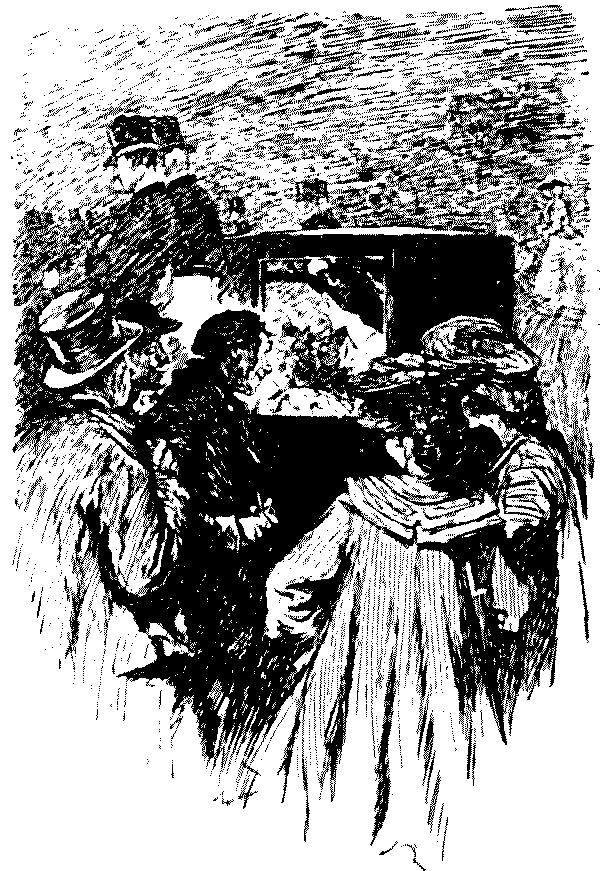
One of Nature's Gallants.
Loafer (to fair occupant on her way to Court). "Ullo, Ethel! All alone?"
MR. PUNCH'S COCKNEY HUMOUR
IN PICTURE AND STORY
WITH 133 ILLUSTRATIONS
BY
PHIL MAY, CHARLES KEENE, L. RAVEN-HILL, TOM BROWNE, C. SHEPPERSON, E. T. REED, BERNARD PARTRIDGE, J. A. SHEPHERD, G. D. ARMOUR, GEORGE DU MAURIER, AND OTHERS.
PUBLISHED BY ARRANGEMENT WITH THE PROPRIETORS OF "PUNCH" THE EDUCATIONAL BOOK CO. LTD.
THE PUNCH LIBRARY OF HUMOUR
Twenty-five volumes, crown 8vo. 192 pages fully illustrated LIFE IN LONDON COUNTRY LIFE IN THE HIGHLANDS SCOTTISH HUMOUR IRISH HUMOUR COCKNEY HUMOUR IN SOCIETY AFTER DINNER STORIES IN BOHEMIA AT THE PLAY MR. PUNCH AT HOME ON THE CONTINONG RAILWAY BOOK AT THE SEASIDE MR. PUNCH AFLOAT IN THE HUNTING FIELD MR. PUNCH ON TOUR WITH ROD AND GUN MR. PUNCH AWHEEL BOOK OF SPORTS GOLF STORIES IN WIG AND GOWN ON THE WARPATH BOOK OF LOVE WITH THE CHILDREN
EDITOR'S NOTE
Cockney humour smacks, of course, of the town and makes up in smartness and shrewdness what it lacks in mellowness. The Cockney is as a rule a conscious humorist; you laugh with him very often, whereas you nearly always laugh at the rustic humorist.
George Du Maurier concerned himself a good deal with Cockney character, but he was not in sympathy with the Cockney; generally he had an obvious contempt for him, and most of his jokes turn on the dropped H, the mispronounced word, and educational deficiencies. He portrays some of the Cockney's superficial characteristics; he despises him too much to be able to get at the heart of him and reveal his character.
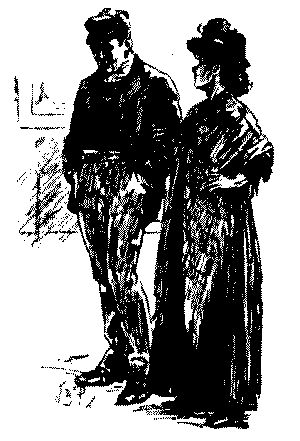
Take Phil May's pictures and jokes, and the difference is at once apparent. He was fully alive to the Cockney's deficiencies of manner and culture; now and then he quite genially and without the least touch of scorn or self-complacency makes fun of them; but he really gives you the Cockney character. Take, for instance, such a picture as his "Politics and Gallantry," his "I say, 'Arry, don't we look frights!" his "Informal Introduction"—(the self-consciousness of the girl's expression, and the blatant pride of the man's)—here, and in almost any of his drawings you turn to, you have the absolutely natural Cockney; his types are full of character and so true and free from condescension that not only are we moved irresistibly to laugh at them, but the Cockney himself would be the first to recognise their truth and to laugh joyously at them too. We may say pretty much the same of Charles Keene, of Mr. Raven-Hill, of Mr. Bernard Partridge, and of others of the "Punch" artists represented here, who illustrate the essential Cockney character, and do not go on the easy assumption that dropped H's and mispronounced words and aggressive vulgarity are the beginning and the end of it.
MR. PUNCH'S COCKNEY HUMOUR
"All's swell that ends swell," as 'Arry remarked when he purchased a pair of "misfits."
'Arry and 'Arriet's Favourite Italian Poet.—'Ariosto.
Mother Wit.—First Coster. I say, Bill, wot's the meanin' o' Congress?
Second Coster. A shee heel. Female of conger.
A Londoner's Rural Reflection.—The Hayfield is better than the Haymarket.