Front matter (continued 8)
Reading edition
“As a small vessel backing out from land, Her station quits; so thence the monster loos’d, And, when he felt himself at large, turn’d round There, where the breast had been, his fork’d tail. Thus, like an eel, outstretch’d at length he steer’d, Gathering the air up with retractile claws.”
And lastly, his name is told us: Geryon. Whereupon, looking back at Hesiod, we find that Geryon is Echidna’s brother. Man-serpent, therefore, in Dante, as Echidna is woman-serpent.
We find next that Geryon lived in the island of Erytheia, (blushing), only another kind of blushing than that of the Hesperid Erytheia. But it is on, also, a western island, and Geryon kept red oxen on it (said to be near the red setting sun); and Hercules kills him, as he does the Hesperian dragon: but in order to be able to reach him, a golden boat is given to Hercules by the Sun, to cross the sea in.
§ 15. We will return to this part of the legend presently, having enough of it now collected to get at the complete idea of the Hesperian dragon, who is, in fine, the “Pluto il gran nemico” of Dante; the demon of all evil passions connected with covetousness; that is to say, essentially of fraud, rage, and gloom. Regarded as the demon of Fraud, he is said to be descended from the viper Echidna, full of deadly cunning, in whirl on whirl; as the demon of consuming Rage, from Phorcys; as the demon of Gloom, from Ceto;—in his watching and melancholy, he is sleepless (compare the Micyllus dialogue of Lucian); breathing whirlwind and fire, he is the destroyer, descended from Typhon as well as Phorcys; having, moreover, with all these, the irresistible strength of his ancestral sea.
§ 16. Now, look at him, as Turner has drawn him (p. 298). I cannot reduce the creature to this scale without losing half his power; his length, especially, seems to diminish more than it should in proportion to his bulk. In the picture he is far in the distance, cresting the mountain; and may be, perhaps, three-quarters of a mile long. The actual length on the canvas is a foot and eight inches; so that it may be judged how much he loses by the reduction, not to speak of my imperfect etching,6 and of the loss which, however well he might have been engraved, he would still have sustained, in the impossibility of expressing the lurid color of his armor, alternate bronze and blue.
§ 17. Still, the main points of him are discernible enough; and among all the wonderful things that Turner did in his day, I think this nearly the most wonderful. How far he had really found out for himself the collateral bearings of the Hesperid tradition I know not; but that he had got the main clue of it, and knew who the Dragon was, there can be no doubt; the strange thing is, that his conception of it throughout, down to the minutest detail, fits every one of the circumstances of the Greek traditions. There is, first, the Dragon’s descent from Medusa and Typhon, indicated in the serpent-clouds floating from his head (compare my sketch of the Medusa-cloud, Plate 71); then note the grovelling and ponderous body, ending in a serpent, of which we do not see the end. He drags the weight of it forward by his claws, not being able to lift himself from the ground (“Mammon, the least erected spirit that fell”); then the grip of the claws themselves as if they would clutch (rather than tear) the rock itself into pieces; but chiefly, the designing of the body. Remember, one of the essential characters of the creature, as descended from Medusa, is its coldness and petrifying power; this, in the demon of covetousness, must exist to the utmost; breathing fire, he is yet himself of ice. Now, if I were merely to draw this dragon as white, instead of dark, and take his claws away, his body would become a representation of a greater glacier, so nearly perfect, that I know no published engraving of glacier breaking over a rocky brow so like the truth as this dragon’s shoulders would be, if they were thrown out in light; there being only this difference, that they have the form, but not the fragility of the ice; they are at once ice and iron. “His bones are like solid pieces of brass; his bones are like bars of iron; by his neesings a light doth shine.”
§ 18. The strange unity of vertebrated action, and of a true bony contour, infinitely varied in every vertebra, with this glacial outline;—together with the adoption of the head of the Ganges crocodile, the fish-eater, to show his sea descent (and this in the year 1806, when hardly a single fossil saurian skeleton existed within Turner’s reach), renders the whole conception one of the most curious exertions of the imaginative intellect with which I am acquainted in the arts.
§ 19. Thus far, then, of the dragon; next, we have to examine the conception of the Goddess of Discord. We must return for a moment to the tradition about Geryon. I cannot yet decipher the meaning of his oxen, said to be fed together with those of Hades; nor of the journey of Hercules, in which, after slaying Geryon, he returns through Europe like a border forager, driving these herds, and led into farther battle in protection or recovery of them. But it seems to me the main drift of the legend cannot be mistaken; viz., that Geryon is the evil spirit of wealth, as arising from commerce; hence, placed as a guardian of isles in the most distant sea, and reached in a golden boat; while the Hesperian dragon is the evil spirit of wealth, as possessed in households; and associated, therefore, with the true household guardians, or singing nymphs. Hercules (manly labor), slaying both Geryon and Ladon, presents oxen and apples to Juno, who is their proper mistress; but the Goddess of Discord, contriving that one portion of this household wealth shall be ill bestowed by Paris, he, according to Coleridge’s interpretation, choosing pleasure instead of wisdom or power;—there issue from this evil choice the catastrophe of the Trojan war, and the wanderings of Ulysses, which are essentially, both in the Iliad and Odyssey, the troubling of household peace; terminating with the restoration of this peace by repentance and patience; Helen and Penelope seen at last sitting upon their household thrones, in the Hesperian light of age.
§ 20. We have, therefore, to regard Discord, in the Hesperides garden, eminently as the disturber of households, assuming a different aspect from Homer’s wild and fierce discord of war. They are, nevertheless, one and the same power; for she changes her aspect at will. I cannot get at the root of her name, Eris. It seems to me as if it ought to have one in common with Erinnys (Fury); but it means always contention, emulation, or competition, either in mind or in words;—the final work of Eris is essentially “division,” and she is herself always double-minded; shouts two ways at once (in Iliad, xi. 6), and wears a mantle rent in half (Æneid, viii. 702). Homer makes her loud-voiced, and insatiably covetous. This last attribute is, with him, the source of her usual title. She is little when she first is seen, then rises till her head touches heaven. By Virgil she is called mad; and her hair is of serpents, bound with bloody garlands.
§ 21. This is the conception first adopted by Turner, but combined with another which he found in Spenser; only note that there is some confusion in the minds of English poets between Eris (Discord) and Até (Error), who is a daughter of Discord, according to Hesiod. She is properly—mischievous error, tender-footed; for she does not walk on the earth, but on heads of men (Iliad, xix. 92); i.e. not on the solid ground, but on human vain thoughts; therefore, her hair is glittering (Iliad, xix. 126). I think she is mainly the confusion of mind coming of pride, as Eris comes of covetousness; therefore, Homer makes her a daughter of Jove. Spenser, under the name of Até, describes Eris. I have referred to his account of her in my notice of the Discord on the Ducal palace of Venice (remember the inscription there, Discordia sum, discordans). But the stanzas from which Turner derived his conception of her are these—
“Als, as she double spake, so heard she double, With matchlesse eares deformed and distort, Fild with false rumors and seditious trouble, Bred in assemblies of the vulgar sort, That still are led with every light report: And as her eares, so eke her feet were odde, And much unlike; th’ one long, the other short, And both misplast; that, when th’ one forward yode, The other backe retired and contrárie trode. “Likewise unequall were her handës twaine; That one did reach, the other pusht away; That one did make the other mard againe, And sought to bring all things unto decay; Whereby great riches, gathered manie a day, She in short space did often bring to nought, An their possessours often did dismay: For all her studie was, and all her thought How she might overthrow the thing that Concord wrought. “So much her malice did her might surpas, That even th’ Almightie selfe she did maligne, Because to man so mercifull He was, And unto all His creatures so benigne, Sith she herself was of his grace indigne: For all this worlds faire workmanship she tride Unto his last confusion to bring, And that great golden chaine quite to divide, With which it blessed Concord hath together tide.”
All these circumstances of decrepitude and distortion Turner has followed, through hand and limb, with patient care: he has added one final touch of his own. The nymph who brings the apples to the goddess, offers her one in each hand; and Eris, of the divided mind, cannot choose.
§ 22. One farther circumstance must be noted, in order to complete our understanding of the picture,—the gloom extending, not to the dragon only, but also to the fountain and the tree of golden fruit. The reason of this gloom may be found in two other passages of the authors from which Turner had taken his conception of Eris—Virgil and Spenser. For though the Hesperides in their own character, as the nymphs of domestic joy, are entirely bright (and the garden always bright around them), yet seen or remembered in sorrow, or in the presence of discord, they deepen distress. Their entirely happy character is given by Euripides:—“The fruit-planted shore of the Hesperides,—songstresses,—where the ruler of the purple lake allows not any more to the sailor his way, assigning the boundary of Heaven, which Atlas holds; where the ambrosial fountains flow, and the fruitful and divine land increases the happiness of the gods.”
But to the thoughts of Dido, in her despair, they recur under another aspect; she remembers their priestess as a great enchantress; who feeds the dragon and preserves the boughs of the tree; sprinkling moist honey and drowsy poppy; who also has power over ghosts; “and the earth shakes and the forests stoop from the hills at her bidding.”
§ 23. This passage Turner must have known well, from his continual interest in Carthage: but his diminution of the splendor of the old Greek garden was certainly caused chiefly by Spenser’s describing the Hesperides fruit as growing first in the garden of Mammon:—
“There mournfull cypresse grew in greatest store; And trees of bitter gall; and heben sad; Dead sleeping poppy; and black hellebore; Cold coloquintida; and tetra mad Mortal samnitis; and cicuta bad, With which th’ uniust Atheniens made to dy Wise Socrates, who, thereof quaffing glad, Pourd out his life and last philosophy. * * * * “The gardin of Prosèrpina this hight: And in the midst thereof a silver seat, With a thick arber goodly over dight, In which she often usd from open heat Herselfe to shroud, and pleasures to entreat: Next thereunto did grow a goodly tree, With braunches broad dispredd and body great, Clothed with leaves, that none the wood mote see, And loaden all with fruit as thick as it might bee. “Their fruit were golden apples glistring bright, That goodly was their glory to behold; On earth like never grew, ne living wight Like ever saw, but they from hence were sold; For those, which Hercules with conquest bold Got from great Atlas daughters, hence began. * * * * “Here eke that famous golden apple grew, The which emongst the gods false Até threw.”
There are two collateral evidences in the picture of Turner’s mind having been partly influenced by this passage. The excessive darkness of the stream,—though one of the Cyrene fountains—to remind us of Cocytus; and the breaking of the bough of the tree by the weight of its apples—not healthily, but as a diseased tree would break.
§ 24. Such then is our English painter’s first great religious picture; and exponent of our English faith. A sad-colored work, not executed in Angelico’s white and gold; nor in Perugino’s crimson and azure; but in a sulphurous hue, as relating to a paradise of smoke. That power, it appears, on the hill-top, is our British Madonna; whom, reverently, the English devotional painter must paint, thus enthroned, with nimbus about the gracious head. Our Madonna,—or our Jupiter on Olympus,—or, perhaps more accurately still, our unknown god, sea-born, with the cliffs, not of Cyrene, but of England, for his altar; and no chance of any Mars’ Hill proclamation concerning him, “whom therefore ye ignorantly worship.”
§ 25. This is no irony. The fact is verily so. The greatest man of our England, in the first half of the nineteenth century, in the strength and hope of his youth, perceives this to be the thing he has to tell us of utmost moment, connected with the spiritual world. In each city and country of past time, the master-minds had to declare the chief worship which lay at the nation’s heart; to define it; adorn it; show the range and authority of it. Thus in Athens, we have the triumph of Pallas; and in Venice the assumption of the Virgin; here, in England, is our great spiritual fact for ever interpreted to us—the Assumption of the Dragon. No St. George any more to be heard of; no more dragon-slaying possible: this child, born on St. George’s Day, can only make manifest the Dragon, not slay him, sea-serpent as he is; whom the English Andromeda, not fearing, takes for her lord. The fairy English Queen once thought to command the waves, but it is the sea-dragon now who commands her valleys; of old the Angel of the Sea ministered to them, but now the Serpent of the Sea; where once flowed their clear springs now spreads the black Cocytus pool; and the fair blooming of the Hesperid meadows fades into ashes beneath the Nereid’s Guard.
Yes, Albert of Nuremberg; the time has at last come. Another nation has arisen in the strength of its Black anger; and another hand has portrayed the spirit of its toil. Crowned with fire, and with the wings of the bat.
1 Notes on the Turner Collection at Marlborough House. 1857. Catalogue of the Sketches of J. M. V. Turner exhibited at Marlborough House. 1858.
2 The regret I expressed in the third volume at Turner’s not having been educated under the influence of Gothic art was, therefore, mistaken; I had not then had access to his earlier studies. He was educated under the influence of Gothic architecture; but, in more advanced life, his mind was warped and weakened by classical architecture. Why he left the one for the other, or how far good influences were mingled with evil in the result of the change, I have not yet been able to determine.
3 They may be referred to with ease in Boone’s Catalogue of Turner’s Pictures, 1857.
4 Smith’s Dictionary of Greek and Roman Geography. Art. “Cyrenaica.”
5 Her name is also that of the Hesperid nymph; but I give the Hesperid her Greek form of name, to distinguish her from the goddess. The Hesperid Arethusa has the same subordinate relation to Ceres; and Erytheia, to Venus. Æglé signifies especially the spirit of brightness or cheerfulness including even the subordinate idea of household neatness or cleanliness.
6 It is merely a sketch on the steel, like the illustrations before given of composition; but it marks the points needing note. Perhaps some day I may be able to engrave it of the full size.

CHAPTER XI.
THE HESPERID ÆGLÉ.
§ 1. Five years after the Hesperides were painted, another great mythological subject appeared by Turner’s hand. Another dragon—this time not triumphant, but in death-pang; the Python, slain by Apollo.
Not in a garden, this slaying, but in a hollow, among wildest rocks, beside a stagnant pool. Yet, instead of the sombre coloring of the Hesperid hills, strange gleams of blue and gold flit around the mountain peaks, and color the clouds above them.
The picture is at once the type, and the first expression of a great change which was passing in Turner’s mind. A change, which was not clearly manifested in all its results until much later in his life; but in the coloring of this picture are the first signs of it; and in the subject of this picture, its symbol.
§ 2. Had Turner died early, the reputation he would have left, though great and enduring, would have been strangely different from that which ultimately must now attach to his name. He would have been remembered as one of the severest of painters; his iron touch and positive form would have been continually opposed to the delicacy of Claude and richness of Titian; he would have been spoken of, popularly, as a man who had no eye for color. Perhaps here and there a watchful critic might have shown this popular idea to be false; but no conception could have been formed by any one of the man’s real disposition or capacity.
It was only after the year 1820 that these were determinable, and his peculiar work discerned.
§ 3. He had begun by faithful declaration of the sorrow there was in the world. It is now permitted him to see also its beauty. He becomes, separately and without rival, the painter of the loveliness and light of the creation.
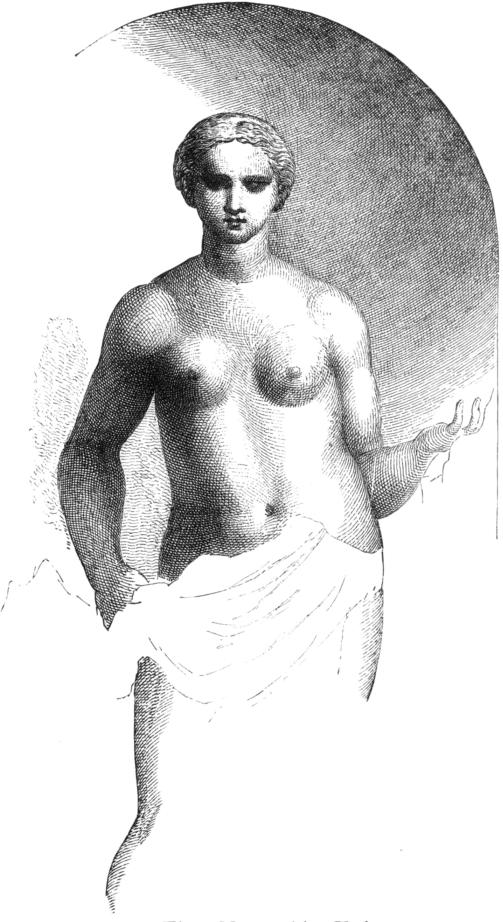
79. The Hesperid Æglé.
Of its loveliness: that which may be beloved in it, the tenderest, kindest, most feminine of its aspects. Of its light: light not merely diffused, but interpreted; light seen pre-eminently in color.
Claude and Cuyp had painted the sunshine, Turner alone the sun color.
Observe this accurately. Those easily understood effects of afternoon light, gracious and sweet so far as they reach, are produced by the softly warm or yellow rays of the sun falling through mist. They are low in tone, even in nature, and disguise the colors of objects. They are imitable even by persons who have little or no gift of color, if the tones of the picture are kept low and in true harmony, and the reflected lights warm. But they never could be painted by great colorists. The fact of blue and crimson being effaced by yellow and gray, puts such effect at once out of the notice or thought of a colorist, unless he has some special interest in the motive of it. You might as well ask a musician to compose with only three notes, as Titian to paint without crimson and blue. Accordingly the colorists in general, feeling that no other than this yellow sunshine was imitable, refused it, and painted in twilight, when the color was full. Therefore, from the imperfect colorists,—from Cuyp, Claude, Both, Wilson, we get deceptive effect of sunshine; never from the Venetians, from Rubens, Reynolds or Velasquez. From these we get only conventional substitutions for it, Rubens being especially daring1 in frankness of symbol.
§ 4. Turner, however, as a landscape painter, had to represent sunshine of one kind or another. He went steadily through the subdued golden chord, and painted Cuyp’s favorite effect, “sun rising through vapor,” for many a weary year. But this was not enough for him. He must paint the sun in his strength, the sun rising not through vapor. If you glance at that Apollo slaying the Python, you will see there is rose color and blue on the clouds, as well as gold; and if then you turn to the Apollo in the Ulysses and Polyphemus—his horses are rising beyond the horizon,—you see he is not “rising through vapor,” but above it; gaining somewhat of a victory over vapor, it appears.
The old Dutch brewer, with his yellow mist, was a great man and a good guide, but he was not Apollo. He and his dray-horses led the way through the flats, cheerily, for a little time; we have other horses now flaming out “beyond the mighty sea.”
A victory over vapor of many kinds; Python-slaying in general. Look how the Python’s jaws smoke as he falls back between the rocks:—a vaporous serpent! We will see who he was, presently.
The public remonstrated loudly in the cause of Python: “He had been so yellow, quiet, and pleasant a creature; what meant these azure-shafted arrows, this sudden glare into darkness, this Iris message; Thaumantian;—miracle-working; scattering our slumber down in Cocytus?” It meant much, but that was not what they should have first asked about it. They should have asked simply, was it a true message? Were these Thaumantian things so, in the real universe?
It might have been known easily they were. One fair dawn or sunset, obediently beheld, would have set them right; and shown that Turner was indeed the only true speaker concerning such things that ever yet had appeared in the world. They would neither look nor hear;—only shouted continuously, “Perish Apollo. Bring us back Python.”
§ 5. We must understand the real meaning of this cry, for herein rests not merely the question of the great right or wrong in Turner’s life, but the question of the right or wrong of all painting. Nay, on this issue hangs the nobleness of painting as an art altogether, for it is distinctively the art of coloring, not of shaping or relating. Sculptors and poets can do these, the painter’s own work is color.
Thus, then, for the last time, rises the question, what is the true dignity of color? We left that doubt a little while ago among the clouds, wondering what they had been made so scarlet for. Now Turner brings the doubt back to us, unescapable any more. No man, hitherto, had painted the clouds scarlet. Hesperid Æglé, and Erytheia, throned there in the west, fade into the twilights of four thousand years, unconfessed. Here is at last one who confesses them, but is it well? Men say these Hesperids are sensual goddesses,—traitresses,—that the Graiæ are the only true ones. Nature made the western and the eastern clouds splendid in fallacy. Crimson is impure and vile; let us paint in black if we would be virtuous.
§ 6. Note, with respect to this matter, that the peculiar innovation of Turner was the perfection of the color chord by means of scarlet. Other painters had rendered the golden tones, and the blue tones, of sky; Titian especially the last, in perfectness. But none had dared to paint, none seem to have seen, the scarlet and purple.
Nor was it only in seeing this color in vividness when it occurred in full light, that Turner differed from preceding painters. His most distinctive innovation as a colorist was his discovery of the scarlet shadow. “True, there is a sunshine whose light is golden, and its shadow gray; but there is another sunshine, and that the purest, whose light is white, and its shadow scarlet.” This was the essentially offensive, inconceivable thing, which he could not be believed in. There was some ground for the incredulity, because no color is vivid enough to express the pitch of light of pure white sunshine, so that the color given without the true intensity of light looks false. Nevertheless, Turner could not but report of the color truly. “I must indeed be lower in the key, but that is no reason why I should be false in the note. Here is sunshine which glows even when subdued; it has not cool shade, but fiery shade.”2 This is the glory of sunshine.
§ 7. Now, this scarlet color,—or pure red, intensified by expression of light,—is, of all the three primitive colors, that which is most distinctive. Yellow is of the nature of simple light; blue, connected with simple shade; but red is an entirely abstract color. It is red to which the color-blind are blind, as if to show us that it was not necessary merely for the service or comfort of man, but that there was a special gift or teaching in this color. Observe, farther, that it is this color which the sunbeams take in passing through the earth’s atmosphere. The rose of dawn and sunset is the hue of the rays passing close over the earth. It is also concentrated in the blood of man.
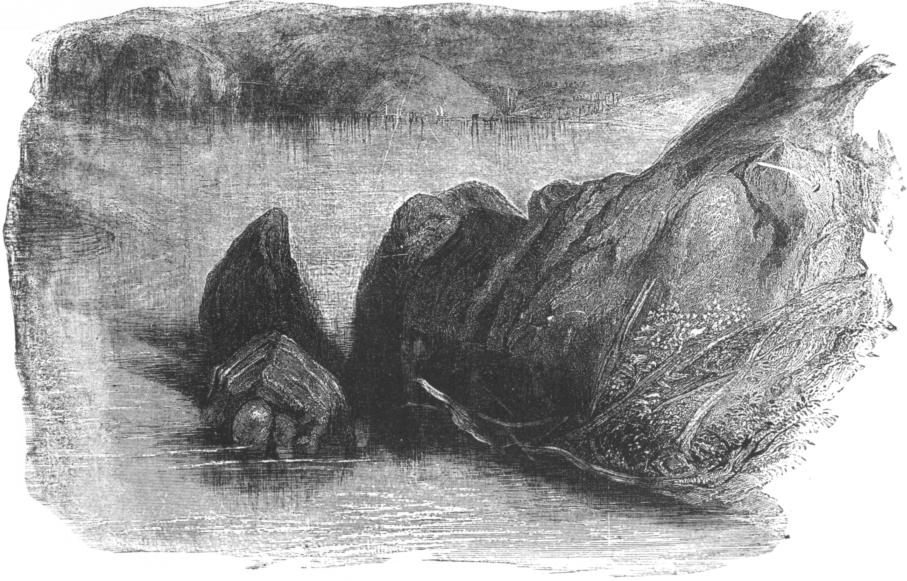
80. Rocks at Rest.
§ 8. Unforeseen requirements have compelled me to disperse through various works, undertaken between the first and last portions of this essay, the examination of many points respecting color, which I had intended to reserve for this place. I can now only refer the reader to these several passages,3 and sum their import: which is briefly, that color generally, but chiefly the scarlet, used with the hyssop, in the Levitical law, is the great sanctifying element of visible beauty inseparably connected with purity and life.
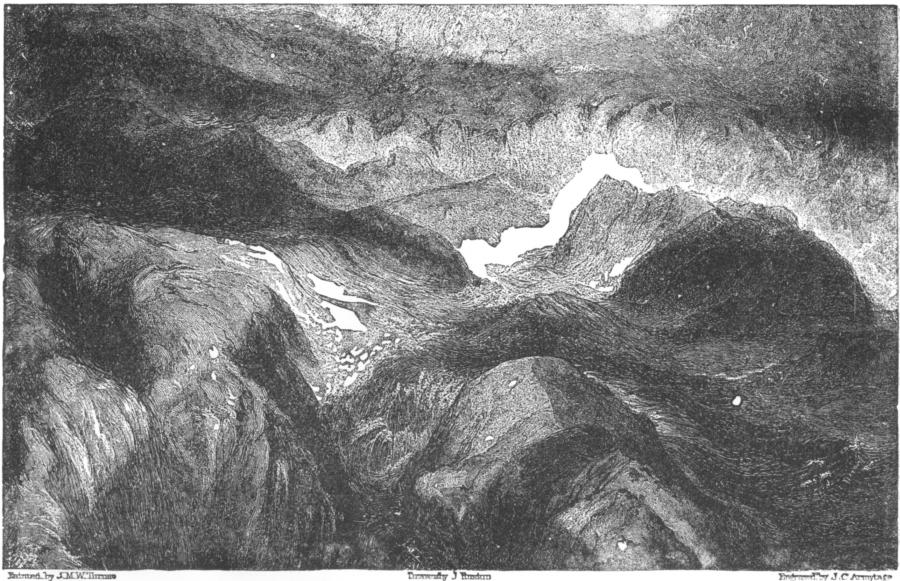
81. Rocks in Unrest.
I must not enter here into the solemn and far-reaching fields of thought which it would be necessary to traverse, in order to detect the mystical connection between life and love, set forth in that Hebrew system of sacrificial religion to which we may trace most of the received ideas respecting sanctity, consecration, and purification. This only I must hint to the reader—for his own following out—that if he earnestly examines the original sources from which our heedless popular language respecting the washing away of sins has been borrowed, he will find that the fountain in which sins are indeed to be washed away, is that of love, not of agony.
§ 9. But, without approaching the presence of this deeper meaning of the sign, the reader may rest satisfied with the connection given him directly in written words, between the cloud and its bow. The cloud, or firmament, as we have seen, signifies the ministration of the heavens to man. That ministration may be in judgment or mercy—in the lightning, or the dew. But the bow, or color, of the cloud, signifies always mercy, the sparing of life; such ministry of the heaven, as shall feed and prolong life. And as the sunlight, undivided, is the type of the wisdom and righteousness of God, so divided, and softened into color by means of the fundamental ministry, fitted to every need of man, as to every delight, and becoming one chief source of human beauty, by being made part of the flesh of man;—thus divided, the sunlight is the type of the wisdom of God, becoming sanctification and redemption. Various in work—various in beauty—various in power.
Color is, therefore, in brief terms, the type of love. Hence it is especially connected with the blossoming of the earth; and again, with its fruits; also, with the spring and fall of the leaf, and with the morning and evening of the day, in order to show the waiting of love about the birth and death of man.
§ 10. And now, I think, we may understand, even far away in the Greek mind, the meaning of that contest of Apollo with the Python. It was a far greater contest than that of Hercules with Ladon. Fraud and avarice might be overcome by frankness and force; but this Python was a darker enemy, and could not be subdued but by a greater god. Nor was the conquest slightly esteemed by the victor deity. He took his great name from it thenceforth—his prophetic and sacred name—the Pythian.
It could, therefore, be no merely devouring dragon—no mere wild beast with scales and claws. It must possess some more terrible character to make conquest over it so glorious. Consider the meaning of its name, “THE CORRUPTER.” That Hesperid dragon was a treasure-guardian. This is the treasure-destroyer,—where moth and rust doth corrupt—the worm of eternal decay.
Apollo’s contest with him is the strife of purity with pollution; of life, with forgetfulness; of love, with the grave.
§ 11. I believe this great battle stood, in the Greek mind, for the type of the struggle of youth and manhood with deadly sin—venomous, infectious, irrecoverable sin. In virtue of his victory over this corruption, Apollo becomes thenceforward the guide; the witness; the purifying and helpful God. The other gods help waywardly, whom they choose. But Apollo helps always: he is by name, not only Pythian, the conqueror of death; but Pæan—the healer of the people.
Well did Turner know the meaning of that battle: he has told its tale with fearful distinctness. The Mammon dragon was armed with adamant; but this dragon of decay is a mere colossal worm: wounded, he bursts asunder in the midst,4 and melts to pieces, rather than dies, vomiting smoke—a smaller serpent-worm rising out of his blood.
§ 12. Alas, for Turner! This smaller serpent-worm, it seemed, he could not conceive to be slain. In the midst of all the power and beauty of nature, he still saw this death-worm writhing among the weeds. A little thing now, yet enough; you may see it in the foreground of the Bay of Baiæ, which has also in it the story of Apollo and the Sibyl; Apollo giving love; but not youth, nor immortality: you may see it again in the foreground of the Lake Avernus—the Hades lake—which Turner surrounds with delicatest beauty, the Fates dancing in circle; but in front, is the serpent beneath the thistle and the wild thorn. The same Sibyl, Deiphobe, holding the golden bough. I cannot get at the meaning of this legend of the bough; but it was, assuredly, still connected, in Turner’s mind, with that help from Apollo. He indicated the strength of his feeling at the time when he painted the Python contest, by the drawing exhibited the same year, of the Prayer of Chryses. There the priest is on the beach alone, the sun setting. He prays to it as it descends;—flakes of its sheeted light are borne to him by the melancholy waves, and cast away with sighs upon the sand.
How this sadness came to be persistent over Turner, and to conquer him, we shall see in a little while. It is enough for us to know at present that our most wise and Christian England, with all her appurtenances of school-porch and church-spire, had so disposed her teaching as to leave this somewhat notable child of hers without even cruel Pandora’s gift.
He was without hope.
True daughter of Night, Hesperid Æglé was to him; coming between Censure, and Sorrow,—and the Destinies.
§ 13. What, for us, his work yet may be, I know not. But let not the real nature of it be misunderstood any more.
He is distinctively, as he rises into his own peculiar strength, separating himself from all men who had painted forms of the physical world before,—the painter of the loveliness of nature, with the worm at its root: Rose and cankerworm,—both with his utmost strength; the one never separate from the other.
In which his work was the true image of his own mind.
I would fain have looked last at the rose; but that is not the way Atropos will have it, and there is no pleading with her.
So, therefore, first of the rose.
§ 14. That is to say, of this vision of the loveliness and kindness of Nature, as distinguished from all visions of her ever received by other men. By the Greek, she had been distrusted. She was to him Calypso, the Concealer, Circe, the Sorceress. By the Venetian, she had been dreaded. Her wildernesses were desolate; her shadows stern. By the Fleming, she had been despised; what mattered the heavenly colors to him? But at last, the time comes for her loveliness and kindness to be declared to men. Had they helped Turner, listened to him, believed in him, he had done it wholly for them. But they cried out for Python, and Python came;—came literally as well as spiritually;—all the perfectest beauty and conquest which Turner wrought is already withered. The cankerworm stood at his right hand, and of all his richest, most precious work, there remains only the shadow. Yet that shadow is more than other men’s sunlight; it is the scarlet shade, shade of the Rose. Wrecked, and faded, and defiled, his work still, in what remains of it, or may remain, is the loveliest ever yet done by man, in imagery of the physical world. Whatsoever is there of fairest, you will find recorded by Turner, and by him alone.
§ 15. I say you will find, not knowing to how few I speak; for in order to find what is fairest, you must delight in what is fair; and I know not how few or how many there may be who take such delight. Once I could speak joyfully about beautiful things, thinking to be understood;—now I cannot any more; for it seems to me that no one regards them. Wherever I look or travel in England or abroad, I see that men, wherever they can reach, destroy all beauty. They seem to have no other desire or hope but to have large houses and to be able to move fast. Every perfect and lovely spot which they can touch, they defile.5
§ 16. Nevertheless, though not joyfully, or with any hope of being at present heard, I would have tried to enter here into some examination of the right and worthy effect of beauty in Art upon human mind, if I had been myself able to come to demonstrable conclusions. But the question is so complicated with that of the enervating influence of all luxury, that I cannot get it put into any tractable compass. Nay, I have many inquiries to make, many difficult passages of history to examine, before I can determine the just limits of the hope in which I may permit myself to continue to labor in any cause of Art.
Nor is the subject connected with the purpose of this book. I have written it to show that Turner is the greatest landscape painter who ever lived; and this it has sufficiently accomplished. What the final use may be to men, of landscape painting, or of any painting, or of natural beauty, I do not yet know. Thus far, however, I do know.
§ 17. Three principal forms of asceticism have existed in this weak world. Religious asceticism, being the refusal of pleasure and knowledge for the sake (as supposed) of religion; seen chiefly in the middle ages. Military asceticism, being the refusal of pleasure and knowledge for the sake of power; seen chiefly in the early days of Sparta and Rome. And monetary asceticism, consisting in the refusal of pleasure and knowledge for the sake of money; seen in the present days of London and Manchester.
“We do not come here to look at the mountains,” said the Carthusian to me at the Grande Chartreuse. “We do not come here to look at the mountains,” the Austrian generals would say, encamping by the shores of Garda. “We do not come here to look at the mountains,” so the thriving manufacturers tell me, between Rochdale and Halifax.
§ 18. All these asceticisms have their bright, and their dark sides. I myself like the military asceticism best, because it is not so necessarily a refusal of general knowledge as the two others, but leads to acute and marvellous use of mind, and perfect use of body. Nevertheless, none of the three are a healthy or central state of man. There is much to be respected in each, but they are not what we should wish large numbers of men to become. A monk of La Trappe, a French soldier of the Imperial Guard, and a thriving mill-owner, supposing each a type, and no more than a type, of his class, are all interesting specimens of humanity, but narrow ones,—so narrow that even all the three together would not make a perfect man. Nor does it appear in any way desirable that either of the three classes should extend itself so as to include a majority of the persons in the world, and turn large cities into mere groups of monastery, barracks, or factory. I do not say that it may not be desirable that one city, or one country, sacrificed for the good of the rest, should become a mass of barracks or factories. Perhaps, it may be well that this England should become the furnace of the world; so that the smoke of the island, rising out of the sea, should be seen from a hundred leagues away, as if it were a field of fierce volcanoes; and every kind of sordid, foul, or venomous work which in other countries men dreaded or disdained, it should become England’s duty to do,—becoming thus the off-scourer of the earth, and taking the hyena instead of the lion upon her shield. I do not, for a moment, deny this; but, looking broadly, not at the destiny of England, nor of any country in particular, but of the world, this is certain—that men exclusively occupied either in spiritual reverie, mechanical destruction, or mechanical productiveness, fall below the proper standard of their race, and enter into a lower form of being; and that the true perfection of the race, and, therefore, its power and happiness, are only to be attained by a life which is neither speculative nor productive; but essentially contemplative and protective, which (A) does not lose itself in the monk’s vision or hope, but delights in seeing present and real things as they truly are; which (B) does not mortify itself for the sake of obtaining powers of destruction, but seeks the more easily attainable powers of affection, observance, and protection; which (C), finally, does not mortify itself with a view to productive accumulation, but delights itself in peace, with its appointed portion. So that the things to be desired for man in a healthy state, are that he should not see dreams, but realities; that he should not destroy life, but save it; and that he should be not rich, but content.
§ 19. Towards which last state of contentment, I do not see that the world is at present approximating. There are, indeed, two forms of discontent: one laborious, the other indolent and complaining. We respect the man of laborious desire, but let us not suppose that his restlessness is peace, or his ambition meekness. It is because of the special connection of meekness with contentment that it is promised that the meek shall “inherit the earth.” Neither covetous men, nor the Grave, can inherit anything;6 they can but consume. Only contentment can possess.
§ 20. The most helpful and sacred work, therefore, which can at present be done for humanity, is to teach people (chiefly by example, as all best teaching must be done) not how “to better themselves,” but how to “satisfy themselves.” It is the curse of every evil nation and evil creature to eat, and not be satisfied. The words of blessing are, that they shall eat and be satisfied. And as there is only one kind of water which quenches all thirst, so there is only one kind of bread which satisfies all hunger, the bread of justice or righteousness; which hungering after, men shall always be filled, that being the bread of Heaven; but hungering after the bread, or wages, of unrighteousness, shall not be filled, that being the bread of Sodom.
§ 21. And, in order to teach men how to be satisfied, it is necessary fully to understand the art and joy of humble life,—this, at present, of all arts or sciences being the one most needing study. Humble life—that is to say, proposing to itself no future exaltation, but only a sweet continuance; not excluding the idea of foresight, but wholly of fore-sorrow, and taking no troublous thought for coming days: so, also, not excluding the idea of providence, or provision,7 but wholly of accumulation;—the life of domestic affection and domestic peace, full of sensitiveness to all elements of costless and kind pleasure;—therefore, chiefly to the loveliness of the natural world.
§ 22. What length and severity of labor may be ultimately found necessary for the procuring of the due comforts of life, I do not know; neither what degree of refinement it is possible to unite with the so-called servile occupations of life: but this I know, that right economy of labor will, as it is understood, assign to each man as much as will be healthy for him, and no more; and that no refinements are desirable which cannot be connected with toil.
I say, first, that due economy of labor will assign to each man the share which is right. Let no technical labor be wasted on things useless or unpleasurable;8 and let all physical exertion, so far as possible, be utilized, and it will be found no man need ever work more than is good for him. I believe an immense gain in the bodily health and happiness of the upper classes would follow on their steadily endeavoring, however clumsily, to make the physical exertion they now necessarily take in amusements, definitely serviceable. It would be far better, for instance, that a gentleman should mow his own fields, than ride over other people’s.
§ 23. Again, respecting degrees of possible refinement, I cannot yet speak positively, because no effort has yet been made to teach refined habits to persons of simple life.
The idea of such refinement has been made to appear absurd, partly by the foolish ambition of vulgar persons in low life, but more by the worse than foolish assumption, acted on so often by modern advocates of improvement, that “education” means teaching Latin, or algebra, or music, or drawing, instead of developing or “drawing out” the human soul.
It may not be the least necessary that a peasant should know algebra, or Greek, or drawing. But it may, perhaps, be both possible and expedient that he should be able to arrange his thoughts clearly, to speak his own language intelligibly, to discern between right and wrong, to govern his passions, and to receive such pleasures of ear or sight as his life may render accessible to him. I would not have him taught the science of music; but most assuredly I would have him taught to sing. I would not teach him the science of drawing; but certainly I would teach him to see; without learning a single term of botany, he should know accurately the habits and uses of every leaf and flower in his fields; and unencumbered by any theories of moral or political philosophy, he should help his neighbor, and disdain a bribe.
§ 24. Many most valuable conclusions respecting the degree of nobleness and refinement which may be attained in servile or in rural life may be arrived at by a careful study of the noble writings of Blitzius (Jeremias Gotthelf), which contain a record of Swiss character not less valuable in its fine truth than that which Scott has left of the Scottish. I know no ideal characters of women, whatever their station, more majestic than that of Freneli (in Ulric le Valet de Ferme, and Ulric le Fermier); or of Elise, in the Tour de Jacob; nor any more exquisitely tender and refined than that of Aenneli in the Fromagerie and Aenneli in the Miroir des Paysans.9
§ 25. How far this simple and useful pride, this delicate innocence, might be adorned, or how far destroyed, by higher intellectual education in letters or the arts, cannot be known without other experience than the charity of men has hitherto enabled us to acquire.
All effort in social improvement is paralyzed, because no one has been bold or clear-sighted enough to put and press home this radical question: “What is indeed the noblest tone and reach of life for men; and how can the possibility of it be extended to the greatest numbers?” It is answered, broadly and rashly, that wealth is good; that knowledge is good; that art is good; that luxury is good. Whereas none of them are good in the abstract, but good only if rightly received. Nor have any steps whatever been yet securely taken,—nor, otherwise than in the resultless rhapsody of moralists,—to ascertain what luxuries and what learning it is either kind to bestow, or wise to desire. This, however, at least we know, shown clearly by the history of all time, that the arts and sciences, ministering to the pride of nations, have invariably hastened their ruin; and this, also, without venturing to say that I know, I nevertheless firmly believe, that the same arts and sciences will tend as distinctly to exalt the strength and quicken the soul of every nation which employs them to increase the comfort of lowly life, and grace with happy intelligence the unambitious courses of honorable toil.
Thus far, then, of the Rose.
§ 26. Last, of the Worm.
I said that Turner painted the labor of men, their sorrow, and their death. This he did nearly in the same tones of mind which prompted Byron’s poem of Childe Harold, and the loveliest result of his art, in the central period of it, was an effort to express on a single canvas the meaning of that poem. It may be now seen, by strange coincidence, associated with two others—Caligula’s Bridge and the Apollo and Sibyl; the one illustrative of the vanity of human labor, the other of the vanity of human life.10 He painted these, as I said, in the same tone of mind which formed the Childe Harold poem, but with different capacity: Turner’s sense of beauty was perfect; deeper, therefore, far than Byron’s; only that of Keats and Tennyson being comparable with it. And Turner’s love of truth was as stern and patient as Dante’s; so that when over these great capacities come the shadows of despair, the wreck is infinitely sterner and more sorrowful. With no sweet home for his childhood,—friendless in youth,—loveless in manhood,—and hopeless in death, Turner was what Dante might have been, without the “bello ovile,” without Casella, without Beatrice, and without Him who gave them all, and took them all away.
§ 27. I will trace this state of his mind farther, in a little while. Meantime, I want you to note only the result upon his work;—how, through all the remainder of his life, wherever he looked, he saw ruin.
Ruin, and twilight. What was the distinctive effect of light which he introduced, such as no man had painted before? Brightness, indeed, he gave, as we have seen, because it was true and right; but in this he only perfected what others had attempted. His own favorite light is not Æglé, but Hesperid Æglé. Fading of the last rays of sunset. Faint breathing of the sorrow of night.
§ 28. And fading of sunset, note also, on ruin. I cannot but wonder that this difference between Turner’s work and previous art-conception has not been more observed. None of the great early painters draw ruins, except compulsorily. The shattered buildings introduced by them are shattered artificially, like models. There is no real sense of decay; whereas Turner only momentarily dwells on anything else than ruin. Take up the Liber Studiorum, and observe how this feeling of decay and humiliation gives solemnity to all its simplest subjects; even to his view of daily labor. I have marked its tendency in examining the design of the Mill and Lock, but observe its continuance through the book. There is no exultation in thriving city, or mart, or in happy rural toil, or harvest gathering. Only the grinding at the mill, and patient striving with hard conditions of life. Observe the two disordered and poor farm-yards, cart, and ploughshare, and harrow rotting away; note the pastoral by the brook side, with its neglected stream, and haggard trees, and bridge with the broken rail, and decrepit children—fever-struck—one sitting stupidly by the stagnant stream; the other in rags, and with an old man’s hat on, and lame, leaning on a stick. Then the “Hedging and ditching,” with its bleak sky and blighted trees—hacked, and bitten, and starved by the clay soil into something between trees and firewood; its meanly-faced, sickly laborers—pollard laborers, like the willow trunk they hew; and the slatternly peasant-woman, with worn cloak and battered bonnet—an English Dryad. Then the Water-mill, beyond the fallen steps overgrown with the thistle: itself a ruin, mud-built at first, now propped on both sides;—the planks torn from its cattle-shed; a feeble beam, splintered at the end, set against the dwelling-house from the ruined pier of the watercourse; the old millstone—useless for many a day—half buried in slime, at the bottom of the wall; the listless children, listless dog, and the poor gleaner bringing her single sheaf to be ground. Then the “Peat bog,” with its cold, dark rain, and dangerous labor. And last and chief, the mill in the valley of the Chartreuse. Another than Turner would have painted the convent; but he had no sympathy with the hope, no mercy for the indolence of the monk. He painted the mill in the valley. Precipice overhanging it, and wildness of dark forest round; blind rage and strength of mountain torrent rolled beneath it,—calm sunset above, but fading from the glen, leaving it to its roar of passionate waters and sighing of pine-branches in the night.
§ 29. Such is his view of human labor. Of human pride, see what records. Morpeth tower, roofless and black; gate of old Winchelsea wall, the flock of sheep driven round it, not through it; and Rievaulx choir, and Kirkstall crypt; and Dunstanborough, wan above the sea; and Chepstow, with arrowy light through traceried windows; and Lindisfarne, with failing height of wasted shaft and wall; and last and sweetest, Raglan, in utter solitude, amidst the wild wood of its own pleasance; the towers rounded with ivy, and the forest roots choked with undergrowth, and the brook languid amidst lilies and sedges. Legends of gray knights and enchanted ladies keeping the woodman’s children away at the sunset.
These are his types of human pride. Of human love: Procris, dying by the arrow; Hesperie, by the viper’s fang; and Rizpah, more than dead, beside her children.
§ 30. Such are the lessons of the Liber Studiorum. Silent always with a bitter silence, disdaining to tell his meaning, when he saw there was no ear to receive it, Turner only indicated this purpose by slight words of contemptuous anger, when he heard of any one’s trying to obtain this or the other separate subject as more beautiful than the rest. “What is the use of them,” he said, “but together?”11 The meaning of the entire book was symbolized in the frontispiece, which he engraved with his own hand: Tyre at sunset, with the Rape of Europa, indicating the symbolism of the decay of Europe by that of Tyre, its beauty passing away into terror and judgment (Europa being the mother of Minos and Rhadamanthus).12
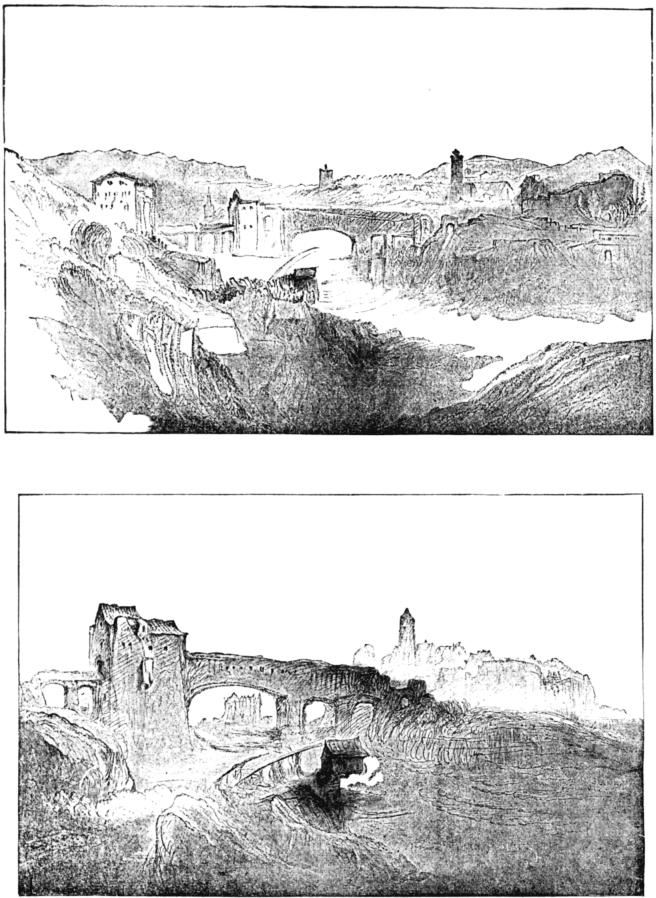
J. M. W. Turner J. H. Le Keux
82. The Nets in the Rapids.
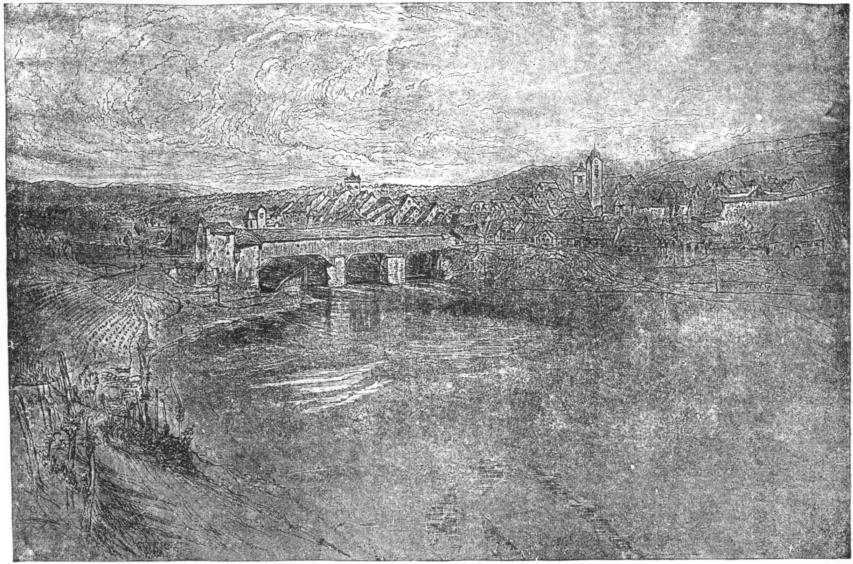
83. The Bridge of Rheinfelden.
§ 31. I need not trace the dark clue farther, the reader may follow it unbroken through all his work and life, this thread of Atropos.13 I will only point, in conclusion, to the intensity with which his imagination dwelt always on the three great cities of Carthage, Rome, and Venice—Carthage in connection especially with the thoughts and study which led to the painting of the Hesperides’ Garden, showing the death which attends the vain pursuit of wealth; Rome, showing the death which attends the vain pursuit of power; Venice, the death which attends the vain pursuit of beauty.
How strangely significative, thus understood, those last Venetian dreams of his become, themselves so beautiful and so frail; wrecks of all that they were once—twilights of twilight!
§ 32. Vain beauty; yet not all in vain. Unlike in birth, how like in their labor, and their power over the future, these masters of England and Venice—Turner and Giorgione. But ten years ago, I saw the last traces of the greatest works of Giorgione yet glowing, like a scarlet cloud, on the Fondaco de Tedeschi.14 And though that scarlet cloud (sanguigna e fiammeggiante, per cui le pitture cominciarono con dolce violenza a rapire il cuore delle genti) may, indeed, melt away into paleness of night, and Venice herself waste from her islands as a wreath of wind-driven foam fades from their weedy beach;—that which she won of faithful light and truth shall never pass away. Deiphobe of the sea,—the Sun God measures her immortality to her by its sand. Flushed, above the Avernus of the Adrian lake, her spirit is still seen holding the golden bough; from the lips of the Sea Sibyl men shall learn for ages yet to come what is most noble and most fair; and, far away, as the whisper in the coils of the shell, withdrawn through the deep hearts of nations, shall sound for ever the enchanted voice of Venice.
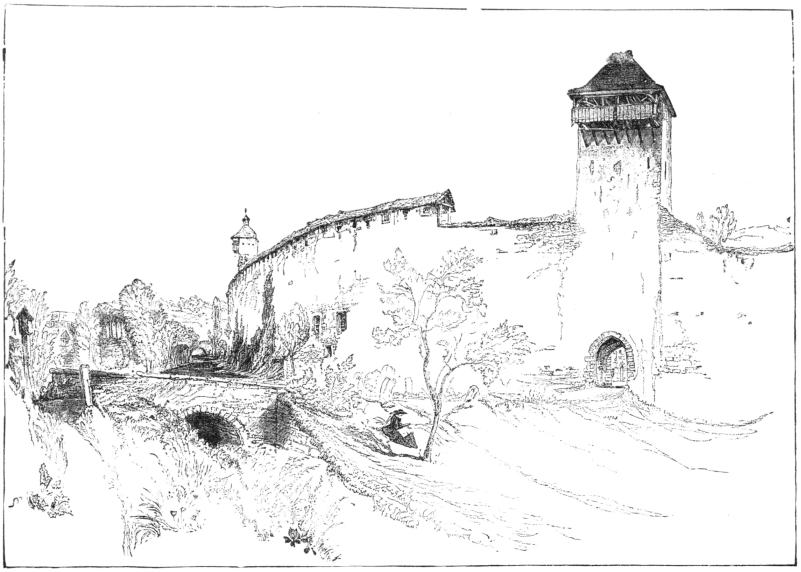
84. Peace.
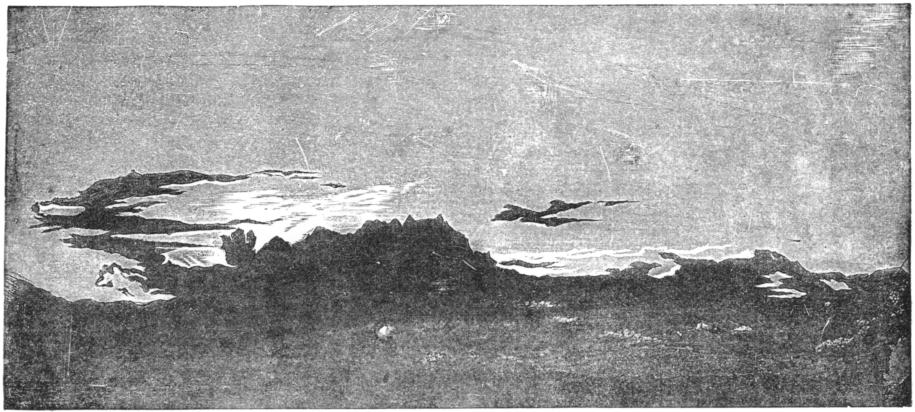
68. Monte Rosa. Sunset.
1 There is a very wonderful, and almost deceptive, imitation of sunlight by Rubens at Berlin. It falls through broken clouds upon angels, the flesh being chequered with sunlight and shade.
2 Not, accurately speaking, shadow, but dark side. All shadow proper is negative in color, but, generally, reflected light is warmer than direct light; and when the direct light is warm, pure, and of the highest intensity, its reflection is scarlet. Turner habitually, in his later sketches, used vermilion for his pen outline in effects of sun.
3 The following collected system of the various statements made respecting color in different parts of my works may be useful to the student:—
1st. Abstract color is of far less importance than abstract form (vol. i. chap. v.); that is to say, if it could rest in our choice whether we would carve like Phidias (supposing Phidias had never used color), or arrange the colors of a shawl like Indians, there is no question as to which power we ought to choose. The difference of rank is vast; there is no way of estimating or measuring it.
So, again, if it rest in our choice whether we will be great in invention of form, to be expressed only by light and shade, as Durer, or great in invention and application of color, caring only for ungainly form, as Bassano, there is still no question. Try to be Durer, of the two. So again, if we have to give an account or description of anything—if it be an object of high interest—its form will be always what we should first tell. Neither leopard spots nor partridge’s signify primarily in describing either beast or bird. But teeth and feathers do.
2. Secondly. Though color is of less importance than form, if you introduce it at all, it must be right.
People often speak of the Roman school as if it were greater than the Venetian, because its color is “subordinate.”
Its color is not subordinate. It is BAD.
If you paint colored objects, you must either paint them rightly or wrongly. There is no other choice. You may introduce as little color as you choose—a mere tint of rose in a chalk drawing, for instance; or pale hues generally—as Michael Angelo in the Sistine Chapel. All such work implies feebleness or imperfection, but not necessarily error. But if you paint with full color, as Raphael and Leonardo, you must either be true or false. If true, you will paint like a Venetian. If false, your form, supremely beautiful, may draw the attention of the spectator from the false color, or induce him to pardon it—and, if ill-taught, even to like it; but your picture is none the greater for that. Had Leonardo and Raphael colored like Giorgione, their work would have been greater, not less, than it is now.
3. To color perfectly is the rarest and most precious (technical) power an artist can possess. There have been only seven supreme colorists among the true painters whose works exist (namely, Giorgione, Titian, Veronese, Tintoret, Correggio, Reynolds, and Turner); but the names of great designers, including sculptors, architects, and metal-workers, are multitudinous. Also, if you can color perfectly, you are sure to be able to do everything else if you like. There never yet was colorist who could not draw; but faculty of perceiving form may exist alone. I believe, however, it will be found ultimately that the perfect gifts of color and form always go together. Titian’s form is nobler than Durer’s, and more subtle; nor have I any doubt but that Phidias could have painted as nobly as he carved. But when the powers are not supreme, the wisest men usually neglect the color-gift, and develope that of form.
I have not thought it worth while at present to enter into any examination of the construction of Turner’s color system, because the public is at present so unconscious of the meaning and nature of color that they would not know what I was talking of. The more than ludicrous folly of the system of modern water-color painting, in which it is assumed that every hue in the drawing may be beneficially washed into every other, must prevent, as long as it influences the popular mind, even incipient inquiry respecting color-art. But for help of any solitary and painstaking student, it may be noted that Turner’s color is founded more on Correggio and Bassano than on the central Venetians; it involves a more tender and constant reference to light and shade than that of Veronese; and a more sparkling and gem-like lustre than that of Titian. I dislike using a technical word which has been disgraced by affectation, but there is no other word to signify what I mean in saying that Turner’s color has, to the full, Correggio’s “morbidezza,” including also, in due place, conditions of mosaic effect, like that of the colors in an Indian design, unaccomplished by any previous master in painting; and a fantasy of inventive arrangement corresponding to that of Beethoven in music. In its concurrence with and expression of texture or construction of surfaces (as their bloom, lustre, or intricacy) it stands unrivalled—no still-life painting by any other master can stand for an instant beside Turner’s, when his work is of life-size, as in his numerous studies of birds and their plumage. This “morbidezza” of color is associated, precisely as it was in Correggio, with an exquisite sensibility to fineness and intricacy of curvature: curvature, as already noticed in the second volume, being to lines what gradation is to colors. This subject, also, is too difficult and too little regarded by the public, to be entered upon here, but it must be observed that this quality of Turner’s design, the one which of all is best expressible by engraving, has of all been least expressed, owing to the constant reduction or change of proportion in the plates. Publishers, of course, require generally their plates to be of one size (the plates in this book form an appalling exception to received practice in this respect); Turner always made his drawings longer or shorter by half an inch, or more, according to the subject; the engravers contracted or expanded them to fit the books, with utter destruction of the nature of every curve in the design. Mere reduction necessarily involves such loss to some extent; but the degree in which it probably involves it has been curiously exemplified by the 61st Plate in this volume, reduced from a pen-drawing of mine, 18 inches long. Fig. 101 is a facsimile of the hook and piece of drapery, in the foreground, in my drawing, which is very nearly true to the Turner curves: compare them with the curves either in Plate 61, or in the published engraving in the England series. The Plate opposite (80) is a portion of the foreground of the drawing of the Llanberis (England Series), also of its real size; and interesting as showing the grace of Turner’s curvature even when he was drawing fastest. It is a hasty drawing throughout, and after finishing the rocks and water, being apparently a little tired, he has struck out the broken fence of the watering-place for the cattle with a few impetuous dashes of the hand. Yet the curvature and grouping of line are still perfectly tender. How far the passage loses by reduction, may be seen by a glance at the published engraving.
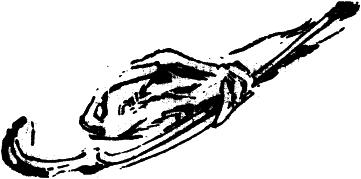
Fig. 101.
4. Color, as stated in the text, is the purifying or sanctifying element of material beauty.
If so, how less important than form? Because, on form depends existence; on color, only purity. Under the Levitical law, neither scarlet nor hyssop could purify the deformed. So, under all natural law, there must be rightly shaped members first; then sanctifying color and fire in them.
Nevertheless, there are several great difficulties and oppositions of aspect in this matter, which I must try to reconcile now clearly and finally. As color is the type of Love, it resembles it in all its modes of operation; and in practical work of human hands, it sustains changes of worthiness precisely like those of human sexual love. That love, when true, faithful, well-fixed, is eminently the sanctifying element of human life: without it, the soul cannot reach its fullest height of holiness. But if shallow, faithless, misdirected, it is also one of the strongest corrupting and degrading elements of life.
Between these base and lofty states of Love are the loveless states; some cold and horrible; others chaste, childish, or ascetic, bearing to careless thinkers the semblance of purity higher than that of Love.
So it is with the type of Love—color. Followed rashly, coarsely, untruly, for the mere pleasure of it, with no reverence, it becomes a temptation, and leads to corruption. Followed faithfully, with intense but reverent passion, it is the holiest of all aspects of material things.
Between these two modes of pursuing it, come two modes of refusing it—one, dark and sensual; the other, statuesque and grave, having great aspect of nobleness.
Thus we have, first, the coarse love of color, as a vulgar person’s choice of gaudy hues in dress.
Then, again, we have the base disdain of color, of which I have spoken at length elsewhere. Thus we have the lofty disdain of color, as in Durer’s and Raphael’s drawing: finally, the severest and passionate following of it, in Giorgione and Titian.
5. Color is, more than all elements of art, the reward of veracity of purpose. This point respecting it I have not noticed before, and it is highly curious. We have just seen that in giving an account of anything for its own sake, the most important points are those of form. Nevertheless, the form of the object is its own attribute; special, not shared with other things. An error in giving an account of it does not necessarily involve wider error.
But its color is partly its own, partly shared with other things round it. The hue and power of all broad sunlight is involved in the color it has cast upon this single thing; to falsify that color, is to misrepresent and break the harmony of the day: also, by what color it bears, this single object is altering hues all round it; reflecting its own into them, displaying them by opposition, softening them by repetition; one falsehood in color in one place, implies a thousand in the neighborhood. Hence, there are peculiar penalties attached to falsehood in color, and peculiar rewards granted to veracity in it. Form may be attained in perfectness by painters who, in their course of study, are continually altering or idealizing it; but only the sternest fidelity will reach coloring. Idealize or alter in that, and you are lost. Whether you alter by abasing, or exaggerating,—by glare or by decline, one fate is for you—ruin. Violate truth wilfully in the slightest particular, or, at least, get into the habit of violating it, and all kinds of failure and error will surround and haunt you to your fall.
Therefore, also, as long as you are working with form only, you may amuse yourself with fancies; but color is sacred—in that you must keep to facts. Hence the apparent anomaly that the only schools of color are the schools of Realism. The men who care for form only, may drift about in dreams of Spiritualism; but a colorist must keep to substance. The greater his power in color enchantment, the more stern and constant will be his common sense. Fuseli may wander wildly among gray spectra, but Reynolds and Gainsborough must stay in broad daylight, with pure humanity. Velasquez, the greatest colorist, is the most accurate portrait painter of Spain; Holbein, the most accurate portrait painter, is the only colorist of Germany; and even Tintoret had to sacrifice some of the highest qualities of his color before he could give way to the flights of wayward though mighty imagination, in which his mind rises or declines from the royal calm of Titian.
4 Compare the deaths of Jehoram, Herod, and Judas.
5 Thus, the railroad bridge over the Fall of Schaffhausen, and that round the Clarens shore of the lake of Geneva, have destroyed the power of two pieces of scenery of which nothing can ever supply the place, in appeal to the higher ranks of European mind.
6 “There are three things that are never satisfied, yea, four things say not, it is enough: the grave; and the barren womb; the earth that is not filled with water; and the fire, that saith not, It is enough!”
7 A bad word, being only “foresight” again in Latin; but we have no other good English word for the sense into which it has been warped.
8 I cannot repeat too often (for it seems almost impossible to arouse the public mind in the least to a sense of the fact) that the root of all benevolent and helpful action towards the lower classes consists in the wise direction of purchase; that is to say, in spending money, as far as possible, only for products of healthful and natural labor. All work with fire is more or less harmful and degrading; so also mine, or machine labor. They at present develope more intelligence than rural labor, but this is only because no education, properly so called, being given to the lower classes, those occupations are best for them which compel them to attain some accurate knowledge, discipline them in presence of mind, and bring them within spheres in which they may raise themselves to positions of command. Properly taught, a ploughman ought to be more intelligent, as well as more healthy, than a miner.
Every nation which desires to ennoble itself should endeavor to maintain as large a number of persons as possible by rural and maritime labor (including fishing). I cannot in this place enter into consideration of the relative advantages of different channels of industry. Any one who sincerely desires to act upon such knowledge will find no difficulty in obtaining it.
I have also several series of experiments and inquiries to undertake before I shall be able to speak with security on certain points connected with education; but I have no doubt that every child in a civilized country should be taught the first principles of natural history, physiology, and medicine; also to sing perfectly, so far as it has capacity, and to draw any definite form accurately to any scale.
These things it should be taught by requiring its attendance at school not more than three hours a day, and less if possible (the best part of children’s education being in helping their parents and families). The other elements of its instruction ought to have respect to the trade by which it is to live.
Modern systems of improvement are too apt to confuse the recreation of the workman with his education. He should be educated for his work before he is allowed to undertake it; and refreshed and relieved while he practises it.
Every effort should be made to induce the adoption of a national costume. Cleanliness and neatness in dress ought always to be rewarded by some gratification of personal pride; and it is the peculiar virtue of a national costume that it fosters and gratifies the wish to look well, without inducing the desire to look better than one’s neighbors—or the hope, peculiarly English, of being mistaken for a person in a higher position of life. A costume may indeed become coquettish, but rarely indecent or vulgar; and though a French bonne or Swiss farm-girl may dress so as sufficiently to mortify her equals, neither of them ever desires or expects to be mistaken for her mistress.
9 This last book should be read carefully by all persons interested in social questions. It is sufficiently dull as a tale, but is characterized throughout by a restrained tragic power of the highest order; and it would be worth reading, were it only for the story of Aenneli, and for the last half page of its close.
10 “The Cumæan Sibyl, Deiphobe, was, in her youth, beloved by Apollo; who, promising to grant her whatever she would ask, she took up a handful of earth, and asked that she might live as many years as there were grains of dust in her hand. She obtained her petition. Apollo would have granted her perpetual youth in return for her love, but she denied him, and wasted into the long ages—known, at last, only by her voice.”—(See my notes on the Turner Gallery.)
11 Turner appears never to have desired, from any one, care in favor of his separate works. The only thing he would say sometimes was, “Keep them together.” He seemed not to mind how much they were injured, if only the record of the thought were left in them, and they were kept in the series which would give the key to their meaning. I never saw him, at my father’s house, look for an instant at any of his own drawings: I have watched him sitting at dinner nearly opposite one of his chief pictures—his eyes never turned to it.
But the want of appreciation, nevertheless, touched him sorely; chiefly the not understanding his meaning. He tried hard one day for a quarter of an hour to make me guess what he was doing in the picture of Napoleon, before it had been exhibited, giving me hint after hint in a rough way; but I could not guess, and he would not tell me.
12 I limit myself in this book to mere indication of the tones of his mind, illustration of them at any length being as yet impossible. It will be found on examining the series of drawings made by Turner during the late years of his life, in possession of the nation, that they are nearly all made for the sake of some record of human power, partly victorious, partly conquered. There is hardly a single example of landscape painted for its own abstract beauty. Power and desolation, or soft pensiveness, are the elements sought chiefly in landscape; hence the later sketches are nearly all among mountain scenery, and chiefly of fortresses, villages or bridges and roads among the wildest Alps. The pass of the St. Gothard, especially, from his earliest days, had kept possession of his mind, not as a piece of mountain scenery, but as a marvellous road; and the great drawing which I have tried to illustrate with some care in this book, the last he made of the Alps with unfailing energy, was wholly made to show the surviving of this tormented path through avalanche and storm, from the day when he first drew its two bridges, in the Liber Studiorum. Plate 81, which is the piece of the torrent bed on the left, of the real size, where the stones of it appear just on the point of being swept away, and the ground we stand upon with them, completes the series of illustrations of this subject, for the present, sufficiently; and, if compared with Plate 80, will be serviceable, also, in showing how various in its grasp and its delight was this strange human mind, capable of all patience and all energy, and perfect in its sympathy, whether with wrath or quietness. Though lingering always with chief affection about the St. Gothard pass, he seems to have gleaned the whole of Switzerland for every record he could find of grand human effort of any kind; I do not believe there is one baronial tower, one shattered arch of Alpine bridge, one gleaming tower of decayed village or deserted monastery, which he has not drawn; in many cases, round and round, again and again, on every side. Now that I have done this work, I purpose, if life and strength are spared to me, to trace him through these last journeys, and take such record of his best-beloved places as may fully interpret the designs he left. I have given in the three following plates an example of the kind of work which needs doing, and which, as stated in the preface, I have partly already begun. Plate 82 represents roughly two of Turner’s memoranda of a bridge over the Rhine. They are quite imperfectly represented, because I do not choose to take any trouble about them on this scale. If I can engrave them at all, it must be of their own size; but they are enough to give an idea of the way he used to walk round a place, taking sketch after sketch of its aspects, from every point or half-point of the compass. There are three other sketches of this bridge, far more detailed than these, in the National Gallery.
A scratched word on the back of one of them, “Rheinfels,” which I knew could not apply to the Rheinfels near Bingen, gave me the clue to the place;—an old Swiss town, seventeen miles above Basle, celebrated in Swiss history as the main fortress defending the frontier toward the Black Forest. I went there the moment I had got Turner’s sketches arranged in 1858, and drew it with the pen (or point of brush, more difficult to manage, but a better instrument) on every side on which Turner had drawn it, giving every detail with servile accuracy, so as to show the exact modifications he made as he composed his subjects. Mr. Le Keux has beautifully copied two of these studies, Plates 83 and 84; the first of these is the bridge drawn from the spot whence Turner made his upper memorandum; afterwards, he went down close to the fishing house, and took the second; in which he unhesitatingly divides the Rhine by a strong pyramidal rock, in order to get a group of firm lines pointing to his main subject, the tower (compare § 12, p. 170, above); and throws a foaming mass of water away to the left, in order to give a better idea of the river’s force; the modifications of form in the tower itself are all skilful and majestic in the highest degree. The throwing the whole of it higher than the bridge, taking off the peak from its gable on the left, and adding the little roof-window in the centre, make it a perfectly noble mass, instead of a broken and common one. I have added the other subject, Plate 84,—though I could not give the Turner drawing which it illustrates,—merely to show the kind of scene which modern ambition and folly are destroying throughout Switzerland. In Plate 83, a small dark tower is seen in the distance, just on the left of the tower of the bridge. Getting round nearly to the foot of it, on the outside of the town, and then turning back so as to put the town walls on your right, you may, I hope, still see the subject of the third plate; the old bridge over the moat, and older wall and towers; the stork’s nest on the top of the nearest one; the moat itself, now nearly filled with softest grass and flowers; a little mountain brook rippling down through the midst of them, and the first wooded promontory of the Jura beyond. Had Rheinfelden been a place of the least mark, instead of a nearly ruinous village, it is just this spot of ground which, costing little or nothing, would have been made its railroad station, and its refreshment-room would have been built out of the stones of the towers.
13 I have not followed out, as I ought to have done, had the task been less painful, my assertion that Turner had to paint not only the labor and the sorrow of men, but their death. There is no form of violent death which he has not painted. Pre-eminent in many things, he is pre-eminent also, bitterly, in this. Durer and Holbein drew the skeleton in its questioning; but Turner, like Salvator, as under some strange fascination or captivity, drew it at its work. Flood, and fire, and wreck, and battle, and pestilence; and solitary death, more fearful still. The noblest of all the plates of the Liber Studiorum, except the Via Mala, is one engraved with his own hand, of a single sailor, yet living, dashed in the night against a granite coast,—his body and outstretched hands just seen in the trough of a mountain wave, between it and the overhanging wall of rock, hollow, polished, and pale with dreadful cloud and grasping foam.
And remember, also, that the very sign in heaven itself which, truly understood, is the type of love, was to Turner the type of death. The scarlet of the clouds was his symbol of destruction. In his mind it was the color of blood. So he used it in the Fall of Carthage. Note his own written words—
“While o’er the western wave the ensanguined sun, In gathering huge a stormy signal spread, And set portentous.”
So he used it in the Slaver, in the Ulysses, in the Napoleon, in the Goldau; again and again in slighter hints and momentary dreams, of which one of the saddest and most tender is a little sketch of dawn, made in his last years. It is a small space of level sea shore; beyond it a fair, soft light in the east; the last storm-clouds melting away, oblique into the morning air; some little vessel—a collier, probably—has gone down in the night, all hands lost; a single dog has come ashore. Utterly exhausted, its limbs failing under it, and, sinking into the sand, it stands howling and shivering. The dawn-clouds have the first scarlet upon them, a feeble tinge only, reflected with the same feeble blood-stain on the sand.
The morning light is used with a loftier significance in a drawing made as a companion to the Goldau, engraved in the fourth volume. The Lake of Zug, which ripples beneath the sunset in the Goldau, is lulled in the level azure of early cloud; and the spire of Aart, which is there a dark point at the edge of the golden lake, is, in the opening light, seen pale against purple mountains. The sketches for these two subjects were, I doubt not, made from the actual effects of a stormy evening, and the next following daybreak; but both with earnest meaning. The crimson sunset lights the valley of rock tombs, cast upon it by the fallen Rossberg; but the sunrise gilds with its level rays the two peaks which protect the village that gives name to Switzerland; and the orb itself breaks first through the darkness on the very point of the pass to the high lake of Egeri, where the liberties of the cantons were won by the battle-charge of Morgarten.
14 I have engraved, at the beginning of this chapter, one of the fragments of these frescos, preserved, all imperfectly indeed, yet with some feeling of their nobleness, by Zanetti, whose words respecting them I have quoted in the text. The one I saw was the first figure given in his book; the one engraved in my Plate, the third, had wholly perished; but even this record of it by Zanetti is precious. What imperfections of form exist in it, too visibly, are certainly less Giorgione’s than the translator’s; nevertheless, for these very faults, as well as for its beauty, I have chosen it, as the best type I could give of the strength of Venetian art; which was derived, be it remembered always, from the acceptance of natural truth, by men who loved beauty too well to think she was to be won by falsehood.
The words of Zanetti himself respecting Giorgione’s figure of Diligence are of great value, as they mark this first article of Venetian faith: “Giorgione per tale, o per altra che vi fosse, contrassegnolla con quella spezie di mannaja che tiene in mano; per altro tanto ci cercava le sole bellezze della natura, che poco pensando al costume, ritrasse qui una di quelle donne Friulane, che vengono per servire in Venezia; non alterandone nemmeno l’abito, è facendola alquanto attempata, quale forse ci la vedea; senza voler sapere che per rappresentare le Virtù, si suole da pittori belle è fresche giovani immaginare.”
Compare with this what I have said of Titian’s Magdalen. I ought in that place to have dwelt also upon the firm endurance of all terribleness which is marked in Titian’s “Notomie” and in Veronese’s “Marsyas.” In order to understand the Venetian mind entirely, the student should place a plate from that series of the Notomie always beside the best engraving he can obtain of Titian’s “Flora.”
My impression is that the ground of the flesh in these Giorgione frescos had been pure vermilion; little else was left in the figure I saw. Therefore, not knowing what power the painter intended to personify by the figure at the commencement of this chapter, I have called her, from her glowing color, Hesperid Æglé.
CHAPTER XII.
PEACE.
§ 1. Looking back over what I have written, I find that I have only now the power of ending this work; it being time that it should end, but not of “concluding” it; for it has led me into fields of infinite inquiry, where it is only possible to break off with such imperfect result as may, at any given moment, have been attained.
Full of far deeper reverence for Turner’s art than I felt when this task of his defence was undertaken (which may, perhaps, be evidenced by my having associated no other names with his—but of the dead,—in my speaking of him throughout this volume),1 I am more in doubt respecting the real use to mankind of that, or any other transcendent art; incomprehensible as it must always be to the mass of men. Full of far deeper love for what I remember of Turner himself, as I become better capable of understanding it, I find myself more and more helpless to explain his errors and his sins.
§ 2. His errors, I might say, simply. Perhaps, some day, people will again begin to remember the force of the old Greek word for sin; and to learn that all sin is in essence—“Missing the mark;” losing sight or consciousness of heaven; and that this loss may be various in its guilt: it cannot be judged by us. It is this of which the words are spoken so sternly, “Judge not;” which words people always quote, I observe, when they are called upon to “do judgment and justice.” For it is truly a pleasant thing to condemn men for their wanderings; but it is a bitter thing to acknowledge a truth, or to take any bold share in working out an equity. So that the habitual modern practical application of the precept, “Judge not,” is to avoid the trouble of pronouncing verdict, by taking, of any matter, the pleasantest malicious view which first comes to hand; and to obtain licence for our own convenient iniquities, by being indulgent to those of others.
These two methods of obedience being just the two which are most directly opposite to the law of mercy and truth.
§ 3. “Bind them about thy neck.” I said, but now, that of an evil tree men never gathered good fruit. And the lesson we have finally to learn from Turner’s life is broadly this, that all the power of it came of its mercy and sincerity; all the failure of it, from its want of faith. It has been asked of me, by several of his friends, that I should endeavor to do some justice to his character, mistaken wholly by the world. If my life is spared, I will. But that character is still, in many respects, inexplicable to me; the materials within my reach are imperfect; and my experience in the world not yet large enough to enable me to use them justly. His life is to be written by a biographer, who will, I believe, spare no pains in collecting the few scattered records which exist of a career so uneventful and secluded. I will not anticipate the conclusions of this writer; but if they appear to me just, will endeavor afterwards, so far as may be in my power, to confirm and illustrate them; and, if unjust, to show in what degree.
§ 4. Which, lest death or illness should forbid me, this only I declare now of what I know respecting Turner’s character. Much of his mind and heart I do not know;—perhaps, never shall know. But this much I do; and if there is anything in the previous course of this work to warrant trust in me of any kind, let me be trusted when I tell you, that Turner had a heart as intensely kind, and as nobly true, as ever God gave to one of his creatures. I offer, as yet, no evidence in this matter. When I do give it, it shall be sifted and clear. Only this one fact I now record joyfully and solemnly, that, having known Turner for ten years, and that during the period of his life when the brightest qualities of his mind were, in many respects, diminished, and when he was suffering most from the evil-speaking of the world, I never heard him say one depreciating word of living man, or man’s work; I never saw him look an unkind or blameful look; I never knew him let pass, without some sorrowful remonstrance, or endeavor at mitigation, a blameful word spoken by another.
Of no man but Turner, whom I have ever known, could I say this. And of this kindness and truth2 came, I repeat, all his highest power. And all his failure and error, deep and strange, came of his faithlessness.
Faithlessness, or despair, the despair which has been shown already (Vol. III., chap. xvi.) to be characteristic of this present century, and most sorrowfully manifested in its greatest men; but existing in an infinitely more fatal form in the lower and general mind, reacting upon those who ought to be its teachers.
§ 5. The form which the infidelity of England, especially, has taken, is one hitherto unheard of in human history. No nation ever before declared boldly, by print and word of mouth, that its religion was good for show, but “would not work.” Over and over again it has happened that nations have denied their gods, but they denied them bravely. The Greeks in their decline jested at their religion, and frittered it away in flatteries and fine arts; the French refused theirs fiercely, tore down their altars and brake their carven images. The question about God with both these nations was still, even in their decline, fairly put, though falsely answered. “Either there is or is not a Supreme Ruler; we consider of it, declare there is not, and proceed accordingly.” But we English have put the matter in an entirely new light: “There is a Supreme Ruler, no question of it, only He cannot rule. His orders won’t work. He will be quite satisfied with euphonious and respectful repetition of them. Execution would be too dangerous under existing circumstances, which He certainly never contemplated.”
I had no conception of the absolute darkness which has covered the national mind in this respect, until I began to come into collision with persons engaged in the study of economical and political questions. The entire naïveté and undisturbed imbecility with which I found them declare that the laws of the Devil were the only practicable ones, and that the laws of God were merely a form of poetical language, passed all that I had ever before heard or read of mortal infidelity. I knew the fool had often said in his heart, there was no God; but to hear him say clearly out with his lips, “There is a foolish God,” was something which my art studies had not prepared me for. The French had indeed, for a considerable time, hinted much of the meaning in the delicate and compassionate blasphemy of their phrase “le bon Dieu,” but had never ventured to put it into more precise terms.
6. Now this form of unbelief in God is connected with, and necessarily productive of, a precisely equal unbelief in man.
Co-relative with the assertion, “There is a foolish God,” is the assertion, “There is a brutish man.” “As no laws but those of the Devil are practicable in the world, so no impulses but those of the brute” (says the modern political economist) “are appealable to in the world.” Faith, generosity, honesty, zeal, and self-sacrifice are poetical phrases. None of these things can, in reality, be counted upon; there is no truth in man which can be used as a moving or productive power. All motive force in him is essentially brutish, covetous, or contentious. His power is only power of prey: otherwise than the spider, he cannot design; otherwise than the tiger, he cannot feed. This is the modern interpretation of that embarrassing article of the Creed, “the communion of saints.”
7. It has always seemed very strange to me, not indeed that this creed should have been adopted, it being the entirely necessary consequence of the previous fundamental article;—but that no one should ever seem to have any misgivings about it;—that, practically, no one had seen how strong work was done by man; how either for hire, or for hatred, it never had been done; and that no amount of pay had ever made a good soldier, a good teacher, a good artist, or a good workman. You pay your soldiers and sailors so many pence a day, at which rated sum one will do good fighting for you; another, bad fighting. Pay as you will, the entire goodness of the fighting depends, always, on its being done for nothing; or rather, less than nothing, in the expectation of no pay but death. Examine the work of your spiritual teachers, and you will find the statistical law respecting them is, “The less pay, the better work.” Examine also your writers and artists: for ten pounds you shall have a Paradise Lost, and for a plate of figs, a Durer drawing; but for a million of money sterling, neither. Examine your men of science: paid by starvation, Kepler will discover the laws of the orbs of heaven for you;—and, driven out to die in the street, Swammerdam shall discover the laws of life for you—such hard terms do they make with you, these brutish men, who can only be had for hire.
§ 8. Neither is good work ever done for hatred, any more than hire—but for love only. For love of their country, or their leader, or their duty, men fight steadily; but for massacre and plunder, feebly. Your signal, “England expects every man to do his duty,” they will answer; your signal of black flag and death’s head, they will not answer. And verily they will answer it no more in commerce than in battle. The cross bones will not make a good shop-sign, you will find ultimately, any more than a good battle-standard. Not the cross bones, but the cross.
§ 9. Now the practical result of this infidelity in man, is the utter ignorance of all the ways of getting his right work out of him. From a given quantity of human power and intellect, to produce the least possible result, is a problem solved, nearly with mathematical precision, by the present methods of the nation’s economical procedure. The power and intellect are enormous. With the best soldiers, at present existing, we survive in battle, and but survive, because, by help of Providence, a man whom we have kept all his life in command of a company forces his way at the age of seventy so far up as to obtain permission to save us, and die, unthanked. With the shrewdest thinkers in the world, we have not yet succeeded in arriving at any national conviction respecting the uses of life. And with the best artistical material in the world, we spend millions of money in raising a building for our Houses of Talk, of the delightfulness and utility of which (perhaps roughly classing the Talk and its tabernacle together), posterity will, I believe, form no very grateful estimate;—while for sheer want of bread, we brought the question to the balance of a hair, whether the most earnest of our young painters should give up his art altogether, and go to Australia,—or fight his way through all neglect and obloquy to the painting of the Christ in the Temple.
§ 10. The marketing was indeed done in this case, as in all others, on the usual terms. For the millions of money, we got a mouldering toy: for the starvation, five years’work of the prime of a noble life. Yet neither that picture, great as it is, nor any other of Hunt’s, are the best he could have done. They are the least he could have done. By no expedient could we have repressed him more than he has been repressed; by no abnegation received from him less than we have received.
My dear friend and teacher, Lowell, right as he is in almost everything, is for once wrong in these lines, though with a noble wrongness:—
“Disappointment’s dry and bitter root, Envy’s harsh berries, and the choking pool Of the world’s scorn, are the right mother-milk To the tough hearts that pioneer their kind.”