Front matter (continued 2)
Reading edition
§ 5. Hitherto we have considered the shoot as an ascending body, throwing off buds at intervals. This it is indeed; but the part of it which ascends is not seen externally. Look back to Plate 51. You will observe that each shoot is furrowed, and that the ridges between the furrows rise in slightly spiral lines, terminating in the armlets under the buds which bore last year’s leaves. These ridges, which rib the shoot so distinctly, are not on the ascending part of it. They are the contributions of each successive leaf thrown out as it ascended. Every leaf sent down a slender cord, covering and clinging to the shoot beneath, and increasing its thickness. Each, according to his size and strength, wove his little strand of cable, as a spider his thread; and cast it down the side of the springing tower by a marvellous magic—irresistible! The fall of a granite pyramid from an Alp may perhaps be stayed; the descending force of that silver thread shall not be stayed. It will split the rocks themselves at its roots, if need be, rather than fail in its work.
So many leaves, so many silver cords. Count—for by just the thickness of one cord, beneath each leaf, let fall in fivefold order round and round, the shoot increases in thickness to its root:—a spire built downwards from the heaven.
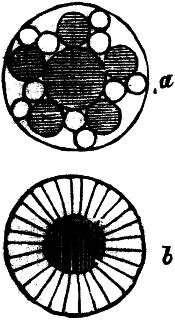
Fig. 36.
And now we see why the leaves dislike being above each other. Each seeks a vacant place, where he may freely let fall the cord. The turning aside of the cable to avoid the buds beneath, is one of the main causes of spiral curvature, as the shoot increases. It required all the care I could give to the drawing, and all Mr. Armytage’s skill in engraving Plate 51, to express, though drawing them nearly of their full size, the principal courses of curvature in even this least graceful of trees.
§ 6. According to the structure thus ascertained, the body of the shoot may at any point be considered as formed by a central rod, represented by the shaded inner circle, a, Fig. 36, surrounded by as many rods of descending external wood as there are leaves above the point where the section is made. The first five leaves above send down the first dark rods; and the next above send down those between, which, being from younger leaves, are less liable to interstices; then the third group sending down the side, it will be seen at a glance how a spiral action is produced. It would lead us into too subtile detail, if I traced the forces of this spiral superimposition. I must be content to let the reader peruse this part of the subject for himself, if it amuses him, and lead to larger questions.
§ 7. Broadly and practically, we may consider the whole cluster of woody material in Fig. 36 as one circle of fibrous substance formed round a small central rod. The real appearance in most trees is approximately as in b, Fig. 36, the radiating structure becoming more distinct in proportion to the largeness and compactness of the wood.4
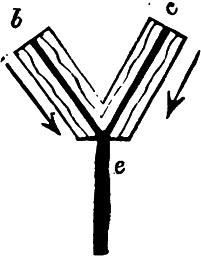
Fig. 37.
Now the next question is, how this descending external coating of wood will behave itself when it comes to the forking of the shoots. To simplify the examination of this, let us suppose the original or growing shoot (whose section is the shaded inner circle in Fig. 36) to have been in the form of a letter Y, and no thicker than a stout iron wire, as in Fig. 37. Down the arms of this letter Y, we have two fibrous streams running in the direction of the arrows. If the depth or thickness of these streams be such as at b and c, what will their thickness be when they unite at e? Evidently, the quantity of wood surrounding the vertical wire at e must be twice as great as that surrounding the wires b and c.
§ 8. The reader will, perhaps, be good enough to take it on my word (if he does not know enough of geometry to ascertain), that the large circle, in Fig. 38, contains twice as much area as either of the two smaller circles. Putting these circles in position, so as to guide us, and supposing the trunk to be bounded by straight lines, we have for the outline of the fork that in Fig. 38. How, then, do the two minor circles change into one large one? The section of the stem at a is a circle; and at b, is a circle; and at c, a circle. But what is it at e? Evidently, if the two circles merely united gradually, without change of form through a series of figures, such as those at the top of Fig. 39, the quantity of wood, instead of remaining the same, would diminish from the contents of two circles to the contents of one. So for every loss which the circles sustain at this junction, an equal quantity of wood must be thrust out somehow to the side. Thus, to enable the circles to run into each other, as far as shown at b, in Fig. 39, there must be a loss between them of as much wood as the shaded space. Therefore, half of that space must be added, or rather pushed out on each side, and the section of the uniting branch becomes approximately as in c, Fig. 39; the wood squeezed out encompassing the stem more as the circles close, until the whole is reconciled into one larger single circle.
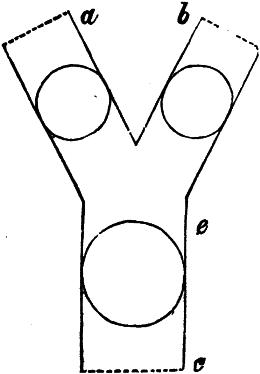
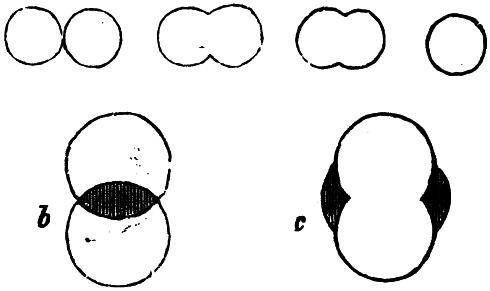
Fig. 38. Fig. 39.
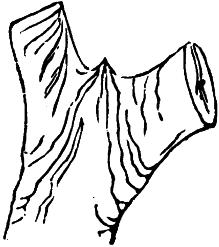
Fig. 40.
§ 9. I fear the reader would have no patience with me, if I asked him to examine, in longitudinal section, the lines of the descending currents of wood as they eddy into the increased single river. Of course, it is just what would take place if two strong streams, filling each a cylindrical pipe, ran together into one larger cylinder, with a central rod passing up every tube. But, as this central rod increases, and, at the same time, the supply of the stream from above, every added leaf contributing its little current, the eddies of wood about the fork become intensely curious and interesting; of which thus much the reader may observe in a moment by gathering a branch of any tree (laburnum shows it better, I think, than most), that the two meeting currents, first wrinkling a little, then rise in a low wave in the hollow of the fork, and flow over at the side, making their way to diffuse themselves round the stem, as in Fig. 40. Seen laterally, the bough bulges out below the fork, rather curiously and awkwardly, especially if more than two boughs meet at the same place, growing in one plane, so as to show the sudden increase on the profile. If the reader is interested in the subject, he will find strangely complicated and wonderful arrangements of stream when smaller boughs meet larger (one example is given in Plate 3, Vol. III., where the current of a smaller bough, entering upwards, pushes its way into the stronger rivers of the stem). But I cannot, of course, enter into such detail here.
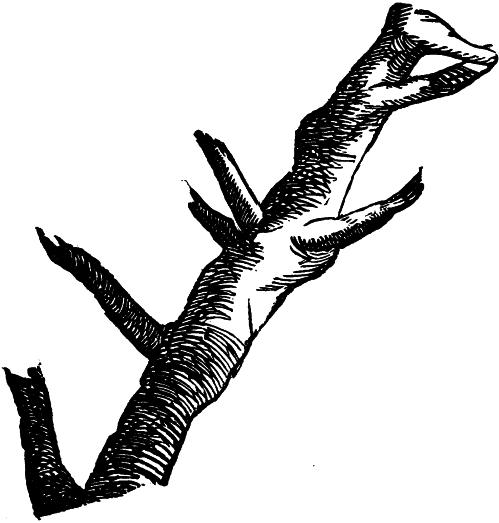
Fig. 41.
§ 10. The little ringed accumulation, repelled from the wood of the larger trunk at the base of small boughs, may be seen at a glance in any tree, and needs no illustration; but I give one from Salvator, Fig. 41 (from his own etching, Democritus omnium Derisor), which is interesting, because it shows the swelling at the bases of insertion, which yet, Salvator’s eye not being quick enough to detect the law of descent in the fibres, he, with his usual love of ugliness, fastens on this swollen character, and exaggerates it into an appearance of disease. The same bloated aspect may be seen in the example already given from another etching, Vol. III., Plate 4, Fig. 8.
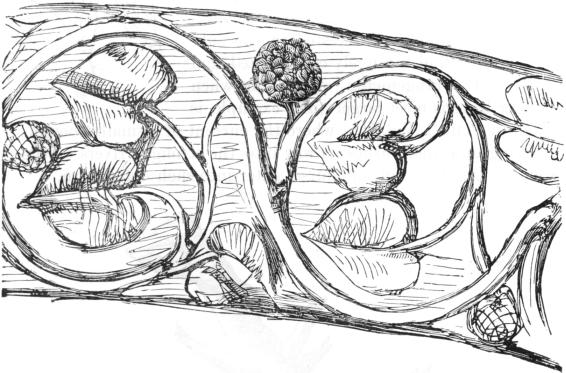
Fig. 42.
§ 11. I do not give any more examples from Claude. We have had enough already in Plate 4, Vol. III., which the reader should examine carefully. If he will then look forward to Fig. 61 here, he will see how Turner inserts branches, and with what certain and strange instinct of fidelity he marks the wrinkled enlargement and sinuous eddies of the wood rivers where they meet.
And remember always that Turner’s greatness and rightness in all these points successively depend on no scientific knowledge. He was entirely ignorant of all the laws we have been developing. He had merely accustomed himself to see impartially, intensely, and fearlessly.
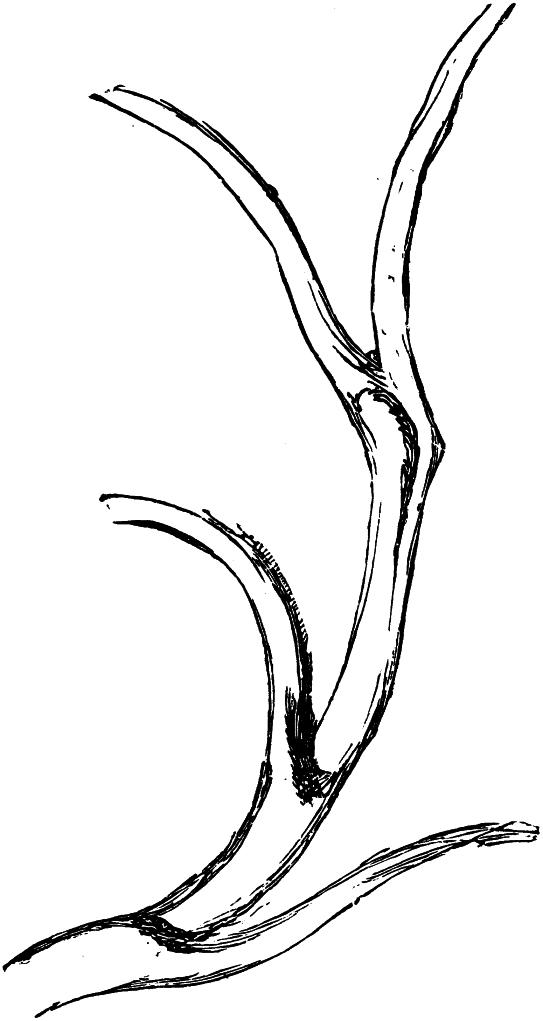
Fig. 43.
§ 12. It may, perhaps, be interesting to compare, with the rude fallacies of Claude and Salvator, a little piece of earliest art, wrought by men who could see and feel. The scroll, Fig. 42, is a portion of that which surrounds the arch in San Zeno of Verona, above the pillar engraved in the Stones of Venice, Plate 17, Vol. I. It is, therefore, twelfth, or earliest thirteenth century work. Yet the foliage is already full of spring and life; and in the part of the stem, which I have given of its real size in Fig. 43, the reader will perhaps be surprised to see at the junctions the laws of vegetation, which escaped the sight of all the degenerate landscape-painters of Italy, expressed by one of her simple architectural workmen six hundred years ago.
We now know enough, I think, of the internal conditions which regulate tree-structure to enable us to investigate finally, the great laws of branch and stem aspect. But they are very beautiful; and we will give them a separate chapter.
1 See the note on Fig. 11, at page 17, which shows these two directions in a shoot of lime.
2 I find that the office and nature of cambium, the causes of the action of the sap, and the real mode of the formation of buds, are all still under the investigation of botanists. I do not lose time in stating the doubts or probabilities which exist on these subjects. For us, the mechanical fact of the increase of thickness by every leaf’s action is all that needs attention. The reader who wishes for information as accurate as the present state of science admits, may consult Lindley’s Introduction to Botany, and an interesting little book by Dr. Alexander Harvey on Trees and their Nature (Nisbet & Co., 1856), to which I owe much help.
3 In the true sense a “mediator,” (μεσίτης).
4 The gradual development of this radiating structure, which is organic and essential, composed of what are called by botanists medullary rays, is still a great mystery and wonder to me.

CHAPTER VII.
THE STEM.
§ 1. We must be content, in this most complex subject, to advance very slowly: and our easiest, if not our only way, will be to examine, first, the conditions under which boughs would form, supposing them all to divide in one plane, as your hand divides when you lay it flat on the table, with the fingers as wide apart as you can. And then we will deduce the laws of ramification which follow on the real structure of branches, which truly divide, not in one plane, but as your fingers separate if you hold a large round ball with them.
The reader has, I hope, a clear idea by this time of the main principle of tree-growth; namely, that the increase is by addition, or superimposition, not extension. A branch does not stretch itself out as a leech stretches its body. But it receives additions at its extremity, and proportional additions to its thickness. For although the actual living shoot, or growing point, of any year, lengthens itself gradually until it reaches its terminal bud, after that bud is formed, its length is fixed. It is thenceforth one joint of the tree, like the joint of a pillar, on which other joints of marble may be laid to elongate the pillar, but which will not itself stretch. A tree is thus truly edified, or built, like a house.
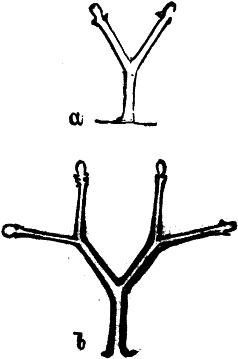
Fig. 44.
§ 2. I am not sure with what absolute stringency this law is observed, or what slight lengthening of substance may be traceable by close measurement among inferior branches. For practical purposes, we may assume that the law is final, and that if we represent the state of a plant, or extremity of branch, in any given year under the simplest possible type, Fig. 44, a, of two shoots, with terminal buds, springing from one stem, its growth next year may be expressed by the type, Fig. 44, b, in which, the original stems not changing or increasing, the terminal buds have built up each another story of plant, or repetition of the original form; and, in order to support this new edifice, have sent down roots all the way to the ground, so as to enclose and thicken the inferior stem.
But if this is so, how does the original stem, which never lengthens, ever become the tall trunk of a tree? The arrangement just stated provides very satisfactorily for making it stout, but not for making it tall. If the ramification proceeds in this way, the tree must assuredly become a round compact ball of short sticks, attached to the ground by a very stout, almost invisible, stem, like a puff-ball.
For if we take the form above, on a small scale, merely to see what comes of it, and carry its branching three steps farther, we get the successive conditions in Fig. 45, of which the last comes already round to the ground.

Fig. 45.
“But those forms really look something like trees!” Yes, if they were on a large scale. But each of the little shoots is only six or seven inches long; the whole cluster would but be three or four feet over, and touches the ground already at its extremity. It would enlarge if it went on growing, but never rise from the ground.
§ 3. This is an interesting question: one, also, which, I fear, we must solve, so far as yet it can be solved, with little help. Perhaps nothing is more curious in the history of human mind than the way in which the science of botany has become oppressed by nomenclature. Here is perhaps the first question which an intelligent child would think of asking about a tree: “Mamma, how does it make its trunk?” and you may open one botanical work after another, and good ones too, and by sensible men,—you shall not find this child’s question fairly put, much less fairly answered. You will be told gravely that a stem has received many names, such as culmus, stipes, and truncus; that twigs were once called flagella, but are now called ramuli; and that Mr. Link calls a straight stem, with branches on its sides, a caulis excurrens; and a stem, which at a certain distance above the earth breaks out into irregular ramifications, a caulis deliquescens. All thanks and honor be to Mr. Link! But at this moment, when we want to know why one stem breaks “at a certain distance,” and the other not at all, we find no great help in those splendid excurrencies and deliquescencies. “At a certain distance?” Yes: but why not before? or why then? How was it that, for many and many a year, the young shoots agreed to construct a vertical tower, or, at least, the nucleus of one, and then, one merry day, changed their minds, and built about their metropolis in all directions, nobody knows where, far into the air in free delight? How is it that yonder larch-stem grows straight and true, while all its branches, constructed by the same process as the mother trunk, and under the mother trunk’s careful inspection and direction, nevertheless have lost all their manners, and go forking and flashing about, more like cracklings of spitefullest lightning than decent branches of trees that dip green leaves in dew?
§ 4. We have probably, many of us, missed the point of such questions as these, because we too readily associated the structure of trees with that of flowers. The flowering part of a plant shoots out or up, in some given direction, until, at a stated period, it opens or branches into perfect form by a law just as fixed, and just as inexplicable, as that which numbers the joints of an animal’s skeleton, and puts the head on its right joint. In many forms of flowers—foxglove, aloe, hemlock, or blossom of maize—the structure of the flowering part so far assimilates itself to that of a tree, that we not unnaturally think of a tree only as a large flower, or large remnant of flower, run to seed. And we suppose the time and place of its branching to be just as organically determined as the height of the stalk of straw, or hemlock pipe, and the fashion of its branching just as fixed as the shape of petals in a pansy or cowslip.
§ 5. But that is not so; not so in anywise. So far as you can watch a tree, it is produced throughout by repetitions of the same process, which repetitions, however, are arbitrarily directed so as to produce one effect at one time, and another at another time. A young sapling has his branches as much as the tall tree. He does not shoot up in a long thin rod, and begin to branch when he is ten or fifteen feet high, as the hemlock or foxglove does when each has reached its ten or fifteen inches. The young sapling conducts himself with all the dignity of a tree from the first;—only he so manages his branches as to form a support for his future life, in a strong straight trunk, that will hold him well off the ground. Prudent little sapling!—but how does he manage this? how keep the young branches from rambling about, till the proper time, or on what plea dismiss them from his service if they will not help his provident purpose? So again, there is no difference in mode of construction between the trunk of a pine and its branch. But external circumstances so far interfere with the results of this repeated construction, that a stone pine rises for a hundred feet like a pillar, and then suddenly bursts into a cloud. It is the knowledge of the mode in which such change may take place which forms the true natural history of trees:—or, more accurately, their moral history. An animal is born with so many limbs, and a head of such a shape. That is, strictly speaking, not its history, but one fact of its history: a fact of which no other account can be given than that it was so appointed. But a tree is born without a head. It has got to make its own head. It is born like a little family from which a great nation is to spring; and at a certain time, under peculiar external circumstances, this nation, every individual of which remains the same in nature and temper, yet gives itself a new political constitution, and sends out branch colonies, which enforce forms of law and life entirely different from those of the parent state. That is the history of the state. It is also the history of a tree.
§ 6. Of these hidden histories, I know and can tell you as little as I did of the making of rocks. It will be enough for me if I can put the difficulty fairly before you, show you clearly such facts as are necessary to the understanding of great Art, and so leave you to pursue, at your pleasure, the graceful mystery of this imperfect leafage life.
I took in the outset the type of a triple but as the most general that could be given of all trees, because it represents a prevalently upright main tendency, with a capacity of branching on both sides. I would have shown the power of branching on all sides if I could; but we must be content at first with the simplest condition. From what we have seen since of bud structure, we may now make our type more complete by giving each bud a root proportioned to its size. And our elementary type of tree plant will be as in Fig. 46.
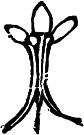
Fig. 46.
§ 7. Now these three buds, though differently placed, have all one mind. No bud has an oblique mind. Every one would like, if he could, to grow upright, and it is because the midmost one has entirely his own way in this matter, that he is largest. He is an elder brother;—his birthright is to grow straight towards the sky. A younger child may perhaps supplant him, if he does not care for his privilege. In the meantime all are of one family, and love each other,—so that the two lateral buds do not stoop aside because they like it, but to let their more favored brother grow in peace. All the three buds and roots have at heart the same desire;—which is, the one to grow as straight as he can towards bright heaven, the other as deep as he can into dark earth. Up to light, and down to shade;—into air and into rock:—that is their mind and purpose for ever. So far as they can, in kindness to each other, and by sufferance of external circumstances, work out that destiny, they will. But their beauty will not result from their working it out,—only from their maintained purpose and resolve to do so, if it may be. They will fail—certainly two, perhaps all three of them: fail egregiously;—ridiculously;—it may be agonizingly. Instead of growing up, they may be wholly sacrificed to happier buds above, and have to grow down, sideways, roundabout ways, all sorts of ways. Instead of getting down quietly into the convent of the earth, they may have to cling and crawl about hardest and hottest angles of it, full in sight of man and beast, and roughly trodden under foot by them;—stumbling-blocks to many.
Yet out of such sacrifice, gracefully made—such misfortune, gloriously sustained—all their true beauty is to arise. Yes, and from more than sacrifice—more than misfortune: from death. Yes, and more than death:—from the worst kind of death: not natural, coming to each in its due time; but premature, oppressed, unnatural, misguided—or so it would seem—to the poor dying sprays. Yet, without such death, no strong trunk were ever possible; no grace of glorious limb or glittering leaf; no companionship with the rest of nature or with man.
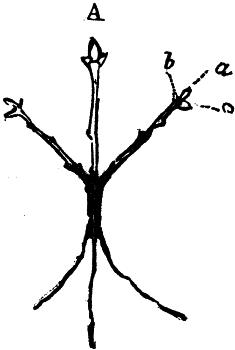
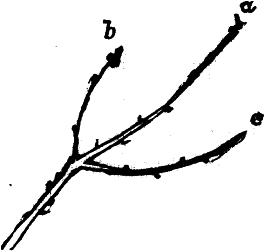
Fig. 47. Fig. 48.
§ 8. Let us see how this must be. We return to our poor little threefold type, Fig. 46, above. Next year he will become as in Fig. 47. The two lateral buds keeping as much as may be out of their brother’s way, and yet growing upwards with a will, strike diagonal lines, and in moderate comfort accomplish their year’s life and terminal buds. But what is to be done next? Forming the triple terminal head on this diagonal line, we find that one of our next year’s buds, c, will have to grow down again, which is very hard; and another, b, will run right against the lateral branch of the upper bud, A, which must not be allowed under any circumstances.
What are we to do?
§ 9. The best we can. Give up our straightness, and some of our length, and consent to grow short, and crooked. But b shall be ordered to stoop forward and keep his head out of the great bough’s way, as in Fig. 48, and grow as he best may, with the consumptive pain in his chest. To give him a little more room, the elder brother, a, shall stoop a little forward also, recovering himself when he has got out of b’s way; and bud c shall be encouraged to bend himself bravely round and up, after his first start in that disagreeable downward direction. Poor b, withdrawn from air and light between a and A, and having to live stooping besides, cannot make much of himself, and is stunted and feeble. c, having free play for his energies, bends up with a will, and becomes handsomer, to our minds, than if he had been straight; and a is none the worse for his concession to unhappy b in early life.
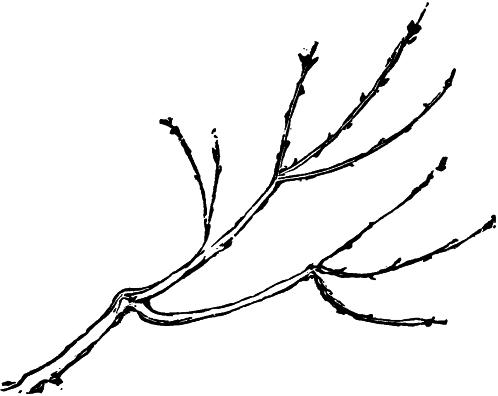
Fig. 49.
So far well for this year. But how for next? b is already too near the spray above him, even for his own strength and comfort; much less, with his weak constitution, will he be able to throw up any strong new shoots. And if he did, they would only run into those of the bough above. (If the reader will proceed in the construction of the whole figure he will see that this is so.) Under these discouragements and deficiencies, b is probably frostbitten, and drops off. The bough proceeds, mutilated, and itself somewhat discouraged. But it repeats its sincere and good-natured compliances, and at the close of the year, new wood from all the leaves having concealed the stump, and effaced the memory of poor lost b, and perhaps a consolatory bud lower down having thrown out a tiny spray to make the most of the vacant space near the main stem, we shall find the bough in some such shape as Fig. 49.
§ 10. Wherein we already see the germ of our irregularly bending branch, which might ultimately be much the prettier for the loss of b. Alas! the Fates have forbidden even this. While the low bough is making all these exertions, the boughs of A, above him, higher in air, have made the same under happier auspices. Every year their thicker leaves more and more forbid the light; and, after rain, shed their own drops unwittingly on the unfortunate lower bough, and prevent the air or sun from drying his bark or checking the chill in his medullary rays. Slowly a hopeless languor gains upon him. He buds here or there, faintly, in the spring; but the flow of strong wood from above oppresses him even about his root, where it joins the trunk. The very sap does not turn aside to him, but rushes up to the stronger, laughing leaves far above. Life is no more worth having; and abandoning all effort, the poor bough drops, and finds consummation of destiny in helping an old woman’s fire.
When he is gone, the one next above is left with greater freedom, and will shoot now from points of its sprays which were before likely to perish. Hence another condition of irregularity in form. But that bough also will fall in its turn, though after longer persistence. Gradually thus the central trunk is built, and the branches by whose help it was formed cast off, leaving here and there scars, which are all effaced by years, or lost sight of among the roughnesses and furrows of the aged surface. The work is continually advancing, and thus the head of foliage on any tree is not an expansion at a given height, like a flower-bell, but the collective group of boughs, or workmen, who have got up so far, and will get up higher next year, still losing one or two of their number underneath.
§ 11. So far well. But this only accounts for the formation of a vertical trunk. How is it that at a certain height this vertical trunk ceases to be built; and irregular branches spread in all directions?
First: In a great number of trees, the vertical trunk never ceases to be built. It is confused, at the top of the tree, among other radiating branches, being at first, of course, just as slender as they, and only prevailing over them in time. It shows at the top the same degree of irregularity and undulation as a sapling; and is transformed gradually into straightness lower down (see Fig. 50). The reader has only to take an hour’s ramble, to see for himself how many trees are thus constructed, if circumstances are favorable to their growth. Again, the mystery of blossoming has great influence in increasing the tendency to dispersion among the upper boughs: but this part of vegetative structure I cannot enter into; it is too subtle, and has, besides, no absolute bearing on our subject; the principal conditions which produce the varied play of branches being purely mechanical. The point at which they show a determined tendency to spread is generally to be conceived as a place of rest for the tree, where it has reached the height from the ground at which ground-mist, imperfect circulation of air, &c., have ceased to operate injuriously on it, and where it has free room, and air, and light for its growth.
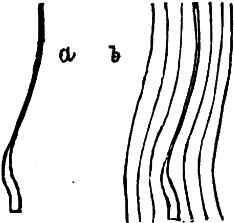
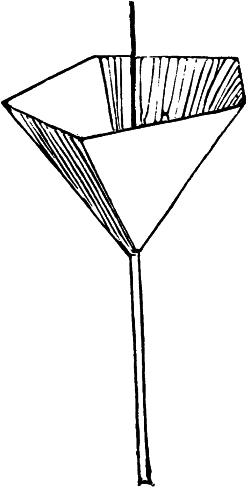
Fig. 50. Fig. 51.
§ 12. I find there is quite an infinite interest in watching the different ways in which trees part their sprays at this resting-place, and the sometimes abrupt, sometimes gentle and undiscoverable, severing of the upright stem into the wandering and wilful branches; but a volume, instead of a chapter or two, and quite a little gallery of plates, would be needed to illustrate the various grace of this division, associated as it is with an exquisitely subtle effacing of undulation in the thicker stems, by the flowing down of the wood from above; the curves which are too violent in the branches being filled up, so that what was at a, Fig. 50, becomes as at b, and when the main stem is old, passes at last into straightness by almost imperceptible curves, a continually gradated emphasis of curvature being carried to the branch extremities.
§ 13. Hitherto we have confined ourselves entirely to examination of stems in one plane. We must glance—though only to ascertain how impossible it is to do more than glance—at the conditions of form which result from the throwing out of branches, not in one plane, but on all sides. “As your fingers divide when they hold a ball,” I said: or, better, a large cup, without a handle. Consider how such ramification will appear in one of the bud groups, that of our old friend the oak. We saw it opened usually into five shoots. Imagine, then (Fig. 51), a five-sided cup or funnel with a stout rod running through the centre of it. In the figure it is seen from above, so as partly to show the inside, and a little obliquely, that the central rod may not hide any of the angles. Then let us suppose that, where the angles of this cup were, we have, instead, five rods, as in Fig. 52, A, like the ribs of a pentagonal umbrella turned inside out by the wind. I dot the pentagon which connects their extremities, to keep their positions clear. Then these five rods, with the central one, will represent the five shoots, and the leader, from a vigorous young oak-spray. Put the leaves on each; the five-foiled star at its extremity, and the others, now not quite formally, but still on the whole as in Fig. 3 above, and we have the result, Fig. 52, B—rather a pretty one.
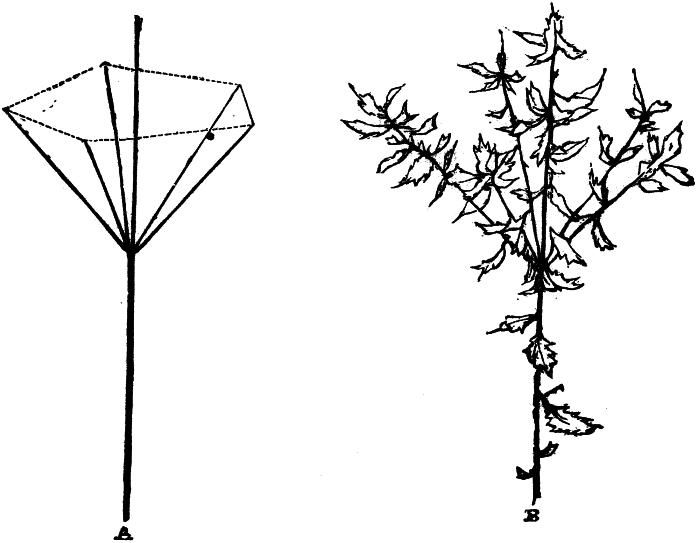
Fig. 52.
§ 14. By considering the various aspects which the five rods would take in Fig. 52, as the entire group was seen from below or above, and at different angles and distances, the reader may find out for himself what changes of aspect are possible in even so regular a structure as this. But the branchings soon take more complex symmetry. We know that next year each of these five subordinate rods is to enter into life on its own account, and to repeat the branching of the first. Thus, we shall have five pentagonal cups surrounding a large central pentagonal cup. This figure, if the reader likes a pretty perspective problem, he may construct for his own pleasure:—which having done, or conceived, he is then to apply the great principles of subjection and resilience, not to three branches only, as in Fig. 49, but to the five of each cup;—by which the cups get flattened out and bent up, as you may have seen vessels of Venetian glass, so that every cup actually takes something the shape of a thick aloe or artichoke leaf; and they surround the central one, not as a bunch of grapes surrounds a grape at the end of it, but as the petals grow round the centre of a rose. So that any one of these lateral branches—though, seen from above, it would present a symmetrical figure, as if it were not flattened (A, Fig. 53)—seen sideways, or in profile, will show itself to be at least as much flattened as at B.
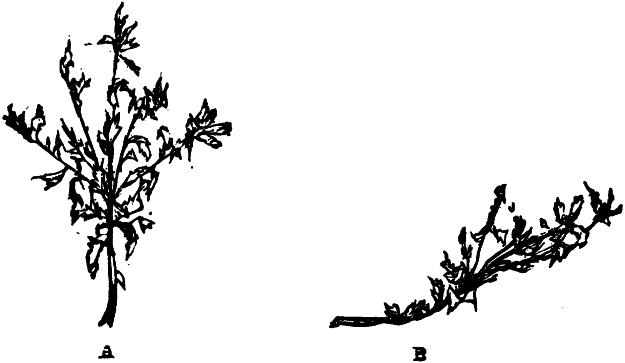
Fig. 53.
§ 15. You may thus regard the whole tree as composed of a series of such thick, flat, branch-leaves; only incomparably more varied and enriched in framework as they spread; and arranged more or less in spirals round the trunk. Gather a cone of a Scotch fir; begin at the bottom of it, and pull off the seeds, so as to show one of the spiral rows of them continuously, from the bottom to the top, leaving enough seeds above them to support the row. Then the gradual lengthening of the seeds from the root, their spiral arrangement, and their limitation within a curved, convex form, furnish the best severe type you can have of the branch system of all stemmed trees; and each seed of the cone represents, not badly, the sort of flattened solid leaf-shape which all complete branches have. Also, if you will try to draw the spiral of the fir-cone, you will understand something about tree-perspective, which may be generally useful. Finally, if you note the way in which the seeds of the cone slip each farther and farther over each other, so as to change sides in the middle of the cone, and obtain a reversed action of spiral lines in the upper half, you may imagine what a piece of work it would be for both of us, if we were to try to follow the complexities of branch order in trees of irregular growth, such as the rhododendron. I tried to do it, at least, for the pine, in section, but saw I was getting into a perfect maelström of spirals, from which no efforts would have freed me, in any imaginable time, and the only safe way was to keep wholly out of the stream.
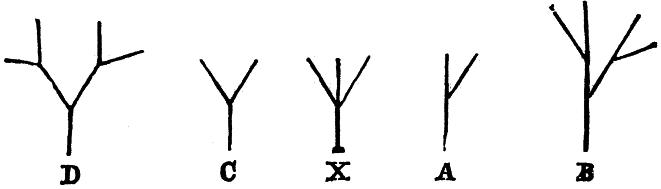
Fig. 54.
§ 16. The alternate system, leading especially to the formation of forked trees, is more manageable; and if the reader is master of perspective, he may proceed some distance in the examination of that for himself. But I do not care to frighten the general reader by many diagrams: the book is always sure to open at them when he takes it up. I will venture on one which has perhaps something a little amusing about it, and is really of importance.
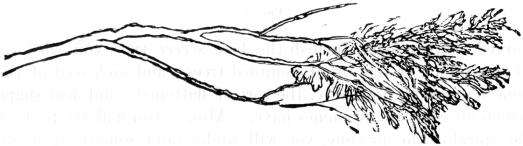
Fig. 55.
J. Ruskin J. Emslie
56. Sketch by a Clerk of the Works.
§ 17. Let X, Fig. 54, represent a shoot of any opposite-leaved tree. The mode in which it will grow into a tree depends, mainly, on its disposition to lose the leader or a lateral shoot. If it keeps the leader, but drops the lateral, it takes the form A, and next year by a repetition of the process, B. But if it keeps the laterals, and drops the leader, it becomes first, C and next year, D. The form A is almost universal in spiral or alternate trees; and it is especially to be noted as bringing about this result, that in any given forking, one bough always goes on in its own direct course, and the other leaves it softly; they do not separate as if one was repelled from the other. Thus in Fig. 55, a perfect and nearly symmetrical piece of ramification, by Turner (lowest bough but one in the tree on the left in the “Château of La belle Gabrielle”), the leading bough, going on in its own curve, throws off, first, a bough to the right, then one to the left, then two small ones to the right, and proceeds itself, hidden by leaves, to form the farthest upper point of the branch.
The lower secondary bough—the first thrown off—proceeds in its own curve, branching first to the left, then to the right.
The upper bough proceeds in the same way, throwing off first to left, then to right. And this is the commonest and most graceful structure. But if the tree loses the leader, as at C, Fig. 54 (and many opposite trees have a trick of doing so), a very curious result is arrived at, which I will give in a geometrical form.
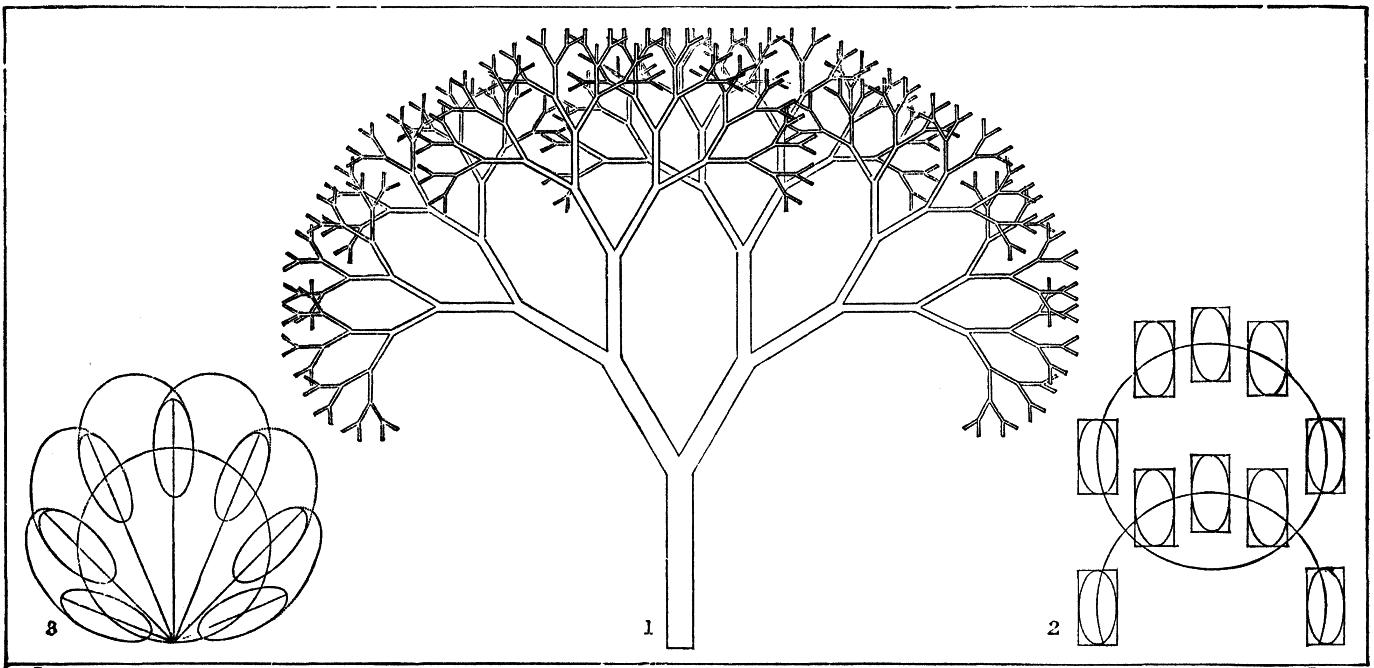
§ 18. The number of branches which die, so as to leave the main stem bare, is always greatest low down, or near the interior of the tree. It follows that the lengths of stem which do not fork diminish gradually to the extremities, in a fixed proportion. This is a general law. Assume, for example’s sake, the stem to separate always into two branches, at an equal angle, and that each branch is three quarters of the length of the preceding one. Diminish their thickness in proportion, and carry out the figure any extent you like. In Plate 56, opposite, Fig. 1, you have it at its ninth branch; in which I wish you to notice, first, the delicate curve formed by every complete line of the branches (compare Vol. IV. Fig. 91); and, secondly, the very curious result of the top of the tree being a broad flat line, which passes at an angle into lateral shorter lines, and so down to the extremities. It is this property which renders the contours of tops of trees so intensely difficult to draw rightly, without making their curves too smooth and insipid.
Observe, also, that the great weight of the foliage being thrown on the outside of each main fork, the tendency of forked trees is very often to droop and diminish the bough on one side, and erect the other into a principal mass.1
§ 19. But the form in a perfect tree is dependent on the revolution of this sectional profile, so as to produce a mushroom-shaped or cauliflower-shaped mass, of which I leave the reader to enjoy the perspective drawing by himself, adding, after he has completed it, the effect of the law of resilience to the extremities. Only, he must note this: that in real trees, as the branches rise from the ground, the open spaces underneath are partly filled by subsequent branchings, so that a real tree has not so much the shape of a mushroom, as of an apple, or, if elongated, a pear.
§ 20. And now you may just begin to understand a little of Turner’s meaning in those odd pear-shaped trees of his, in the “Mercury and Argus,” and other such compositions: which, however, before we can do completely, we must gather our evidence together, and see what general results will come of it respecting the hearts and fancies of trees, no less than their forms.
1 This is Harding’s favorite form of tree. You will find it much insisted on in his works on foliage. I intended to have given a figure to show the results of the pressure of the weight of all the leafage on a great lateral bough, in modifying its curves, the strength of timber being greatest where the leverage of the mass tells most. But I find nobody ever reads things which it takes any trouble to understand, so that it is of no use to write them.
CHAPTER VIII.
THE LEAF MONUMENTS.
§ 1. And now, having ascertained in its main points the system on which the leaf-workers build, let us see, finally, what results in aspect, and appeal to human mind, their building must present. In some sort it resembles that of the coral animal, differing, however, in two points. First, the animal which forms branched coral, builds, I believe, in calm water, and has few accidents of current, light, or heat to contend with. He builds in monotonous ramification, untormented, therefore unbeautiful. Secondly, each coral animal builds for himself, adding his cell to what has been before constructed, as a bee adds another cell to the comb. He obtains no essential connection with the root and foundation of the whole structure. That foundation is thickened clumsily, by a fused and encumbering aggregation, as a stalactite increases;—not by threads proceeding from the extremities to the root.
§ 2. The leaf, as we have seen, builds in both respects under opposite conditions. It leads a life of endurance, effort, and various success, issuing in various beauty; and it connects itself with the whole previous edifice by one sustaining thread, continuing its appointed piece of work all the way from top to root. Whence result three great conditions in branch aspect, for which I cannot find good names, but must use the imperfect ones of “Spring,” “Caprice,” “Fellowship.”
§ 3. I. Spring: or the appearance of elastic and progressive power, as opposed to that look of a bent piece of cord.—This follows partly on the poise of the bough, partly on its action in seeking or shunning. Every branch-line expresses both these. It takes a curve accurately showing the relations between the strength of the sprays in that position (growing downward, upward, or laterally), and the weight of leaves they carry; and again, it takes a curve expressive of the will or aim of those sprays, during all their life, and handed down from sire to son, in steady inheritance of resolution to reach forward in a given direction, or bend away from some given evil influence.
And all these proportionate strengths and measured efforts of the bough produce its loveliness, and ought to be felt, in looking at it, not by any mathematical evidence, but by the same fine instinct which enables us to perceive, when a girl dances rightly, that she moves easily, and with delight to herself; that her limbs are strong enough, and her body tender enough, to move precisely as she wills them to move. You cannot say of any bend of arm or foot what precise relations of their curves to the whole figure manifest, in their changeful melodies, that ease of motion; yet you feel that they do so, and you feel it by a true instinct. And if you reason on the matter farther, you may know, though you cannot see, that an absolute mathematical necessity proportions every bend of the body to the rate and direction of its motion; and that the momentary fancy and fire of the will measure themselves, even in their gaily-fancied freedom, by stern laws of nervous life, and material attraction, which regulate eternally every pulse of the strength of man, and every sweep of the stars of heaven.
§ 4. Observe, also, the balance of the bough of a tree is quite as subtle as that of a figure in motion. It is a balance between the elasticity of the bough and the weight of leaves, affected in curvature, literally, by the growth of every leaf; and besides this, when it moves, it is partly supported by the resistance of the air, greater or less, according to the shape of leaf;—so that branches float on the wind more than they yield to it; and in their tossing do not so much bend under a force, as rise on a wave, which penetrates in liquid threads through all their sprays.
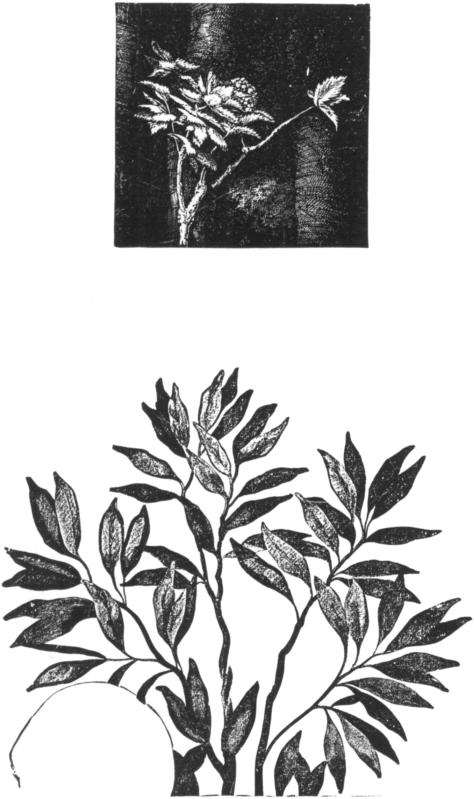
57. Leafage by Durer and Veronese.
To face page 65.
Fig. 56.
§ 5. I am not sure how far, by any illustration, I can exemplify these subtle conditions of form. All my plans have been shortened, and I have learned to content myself with yet more contracted issues of them after the shortening, because I know that nearly all in such matters must be said or shown, unavailably. No saying will teach the truth. Nothing but doing. If the reader will draw boughs of trees long and faithfully, giving previous pains to gain the power (how rare!) of drawing anything faithfully, he will come to see what Turner’s work is, or any other right work, but not by reading, nor thinking, nor idly looking. However, in some degree, even our ordinary instinctive perception of grace and balance may serve us, if we choose to pay any accurate attention to the matter.
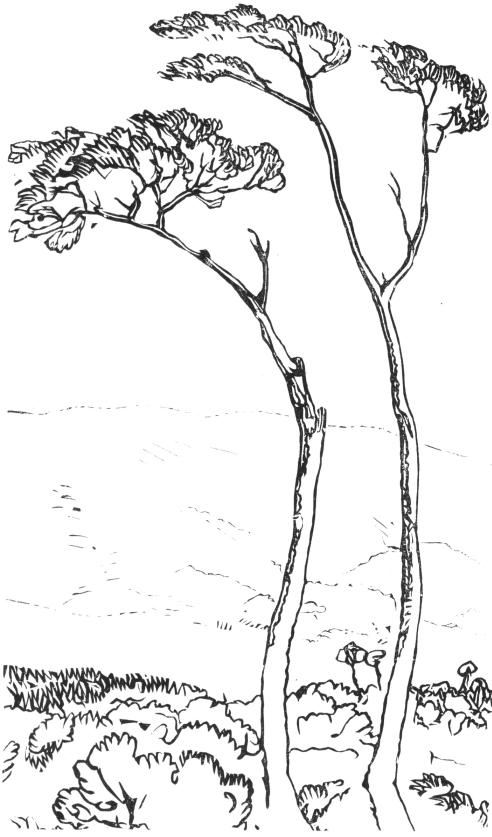
§ 6. Look back to Fig. 55. That bough of Turner’s is exactly and exquisitely poised, leaves and all, for its present horizontal position. Turn the book so as to put the spray upright, with the leaves at the top. You ought to see they would then be wrong;—that they must, in that position, have adjusted themselves more directly above the main stem, and more firmly, the curves of the lighter sprays being a deflection caused by their weight in the horizontal position. Again, Fig. 56 represents, enlarged to four times the size of the original, the two Scotch firs in Turner’s etching of Inverary.1 These are both in perfect poise, representing a double action: the warping of the trees away from the sea-wind, and the continual growing out of the boughs on the right-hand side, to recover the balance.
Turn the page so as to be horizontal, and you ought to feel that, considered now as branches, both would be out of balance. If you turn the heads of the trees to your right, they are wrong, because gravity would have bent them more downwards; if to your left, wrong, because the law of resilience would have raised them more at the extremities.
§ 7. Now take two branches of Salvator’s, Figs. 57 and 58.2 You ought to feel that these have neither poise nor spring: their leaves are incoherent, ragged, hanging together in decay.
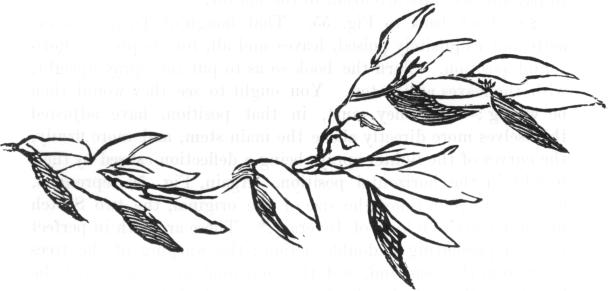
Fig. 57.
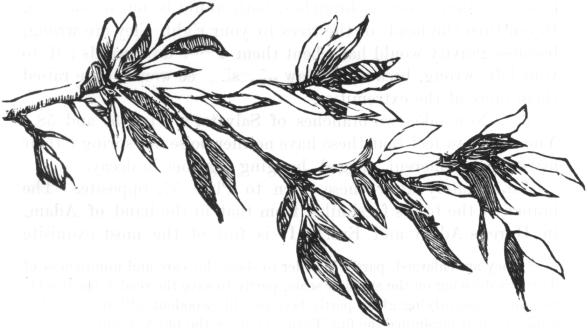
Fig. 58.
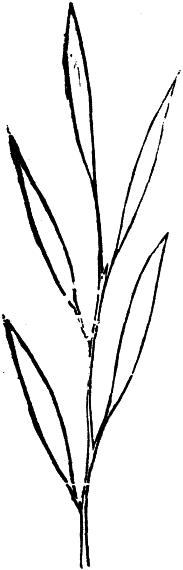
Fig. 59.
Immediately after these, turn to Plate 57, opposite. The branch at the top is facsimiled from that in the hand of Adam, in Durer’s Adam and Eve.3 It is full of the most exquisite vitality and spring in every line. Look at it for five minutes carefully. Then turn back to Salvator’s, Fig. 57. Are you as well satisfied with it? You ought to feel that it is not strong enough at the origin to sustain the leaves; and that if it were, those leaves themselves are in broken or forced relations with each other. Such relations might, indeed, exist in a partially withered tree, and one of these branches is intended to be partially withered, but the other is not; and if it were, Salvator’s choice of the withered tree is precisely the sign of his preferring ugliness to beauty, decrepitude and disorganization to life and youth. The leaves on the spray, by Durer, hold themselves as the girl holds herself in dancing; those on Salvator’s as an old man, partially palsied, totters along with broken motion, and loose deflection of limb.
§ 8. Next, let us take a spray by Paul Veronese4—the lower figure in Plate 57. It is just as if we had gathered one out of the garden. Though every line and leaf in the quadruple group is necessary to join with other parts of the composition of the noble picture, every line and leaf is also as free and true as if it were growing. None are confused, yet none are loose; all are individual, yet none separate, in tender poise of pliant strength and fair order of accomplished grace, each, by due force of the indulgent bough, set and sustained.
§ 9. Observe, however, that in all these instances from earlier masters, the expression of the universal botanical law of poise is independent of accuracy in rendering of species. As before noticed, the neglect of specific distinction long restrained the advance of landscape, and even hindered Turner himself in many respects. The sprays of Veronese are a conventional type of laurel; Albert Durer’s an imaginary branch of paradisaical vegetation; Salvator’s, a rude reminiscence of sweet chestnut; Turner’s only is a faithful rendering of the Scotch fir.
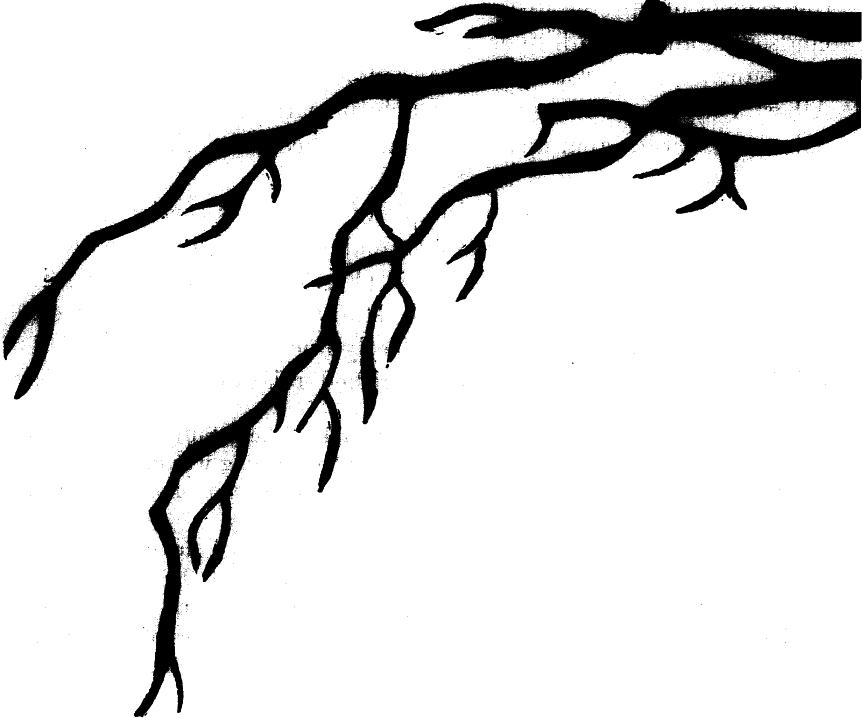
Fig. 60.
58. Branch Curvature.
To face page 69.
Fig. 61
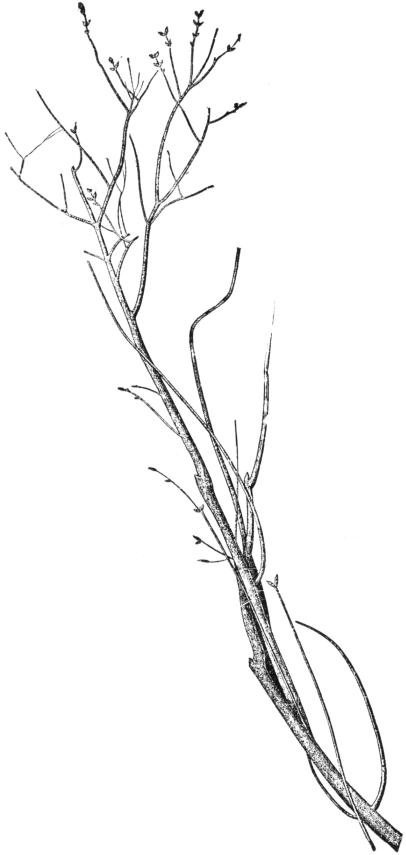
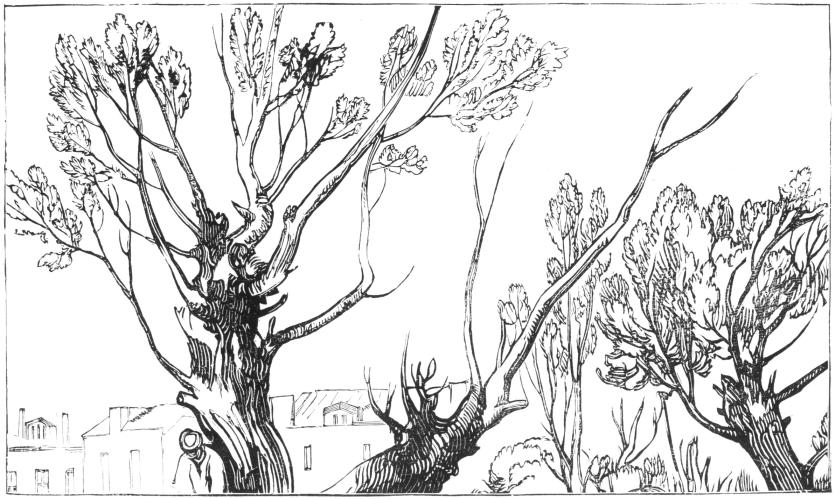
§ 10. To show how the principle of balance is carried out by Nature herself, here is a little terminal upright spray of willow, the most graceful of English trees (Fig. 59). I have drawn it carefully; and if the reader will study its curves, or, better, trace and pencil them with a perfectly fine point, he will feel, I think, without difficulty, their finished relation to the leaves they sustain. Then if we turn suddenly to a piece of Dutch branch-drawing (Fig. 60), facsimiled from No. 160, Dulwich Gallery (Berghem), he will understand, I believe, also the qualities of that, without comment of mine. It is of course not so dark in the original, being drawn with the chance dashes of a brush loaded with brown, but the contours are absolutely as in the woodcut. This Dutch design is a very characteristic example of two faults in tree-drawing; namely, the loss not only of grace and spring, but of woodiness. A branch is not elastic as steel is, neither as a carter’s whip is. It is a combination, wholly peculiar, of elasticity with half-dead and sapless stubbornness, and of continuous curve with pauses of knottiness, every bough having its blunted, affronted, fatigued, or repentant moments of existence, and mingling crabbed rugosities and fretful changes of mind with the main tendencies of its growth. The piece of pollard willow opposite (Fig. 61), facsimiled from Turner’s etching of “Young Anglers,” in the Liber Studiorum, has all these characters in perfectness, and may serve for sufficient study of them. It is impossible to explain in what the expression of the woody strength consists, unless it be felt. One very obvious condition is the excessive fineness of curvature, approximating continually to a straight line. In order to get a piece of branch curvature given as accurately as I could by an unprejudiced person, I set one of my pupils at the Working Men’s College (a joiner by trade) to draw, last spring, a lilac branch of its real size, as it grew, before it budded. It was about six feet long, and before he could get it quite right, the buds came out and interrupted him; but the fragment he got drawn is engraved in flat profile, in Plate 58. It has suffered much by reduction, one or two of its finest curves having become lost in the mere thickness of the lines. Nevertheless, if the reader will compare it carefully with the Dutch work, it will teach him something about trees.
§ 11. II. Caprice.—The next character we had to note of the leaf-builders was their capriciousness, noted, partly, in Vol. III. chap. ix. § 14. It is a character connected with the ruggedness and ill-temperedness just spoken of, and an essential source of branch beauty: being in reality the written story of all the branch’s life,—of the theories it formed, the accidents it suffered, the fits of enthusiasm to which it yielded in certain delicious warm springs; the disgusts at weeks of east wind, the mortifications of itself for its friends’ sakes; or the sudden and successful inventions of new ways of getting out to the sun. The reader will understand this character in a moment, by merely comparing Fig. 62, which is a branch of Salvator’s,5 with Fig. 63, which I have traced from the engraving, in the Yorkshire series, of Turner’s “Aske Hall.” You cannot but feel at once, not only the wrongness of Salvator’s, but its dulness. It is not now a question either of poise, or grace, or gravity; only of wit. That bough has got no sense; it has not been struck by a single new idea from the beginning of it to the end; dares not even cross itself with one of its own sprays. You will be amazed, in taking up any of these old engravings, to see how seldom the boughs do cross each other. Whereas, in nature, not only is the intersection of extremities a mathematical necessity (see Plate 56), but out of this intersection and crossing of curve by curve, and the opposition of line it involves, the best part of their composition arises. Look at the way the boughs are interwoven in that piece of lilac stem (Plate 58).
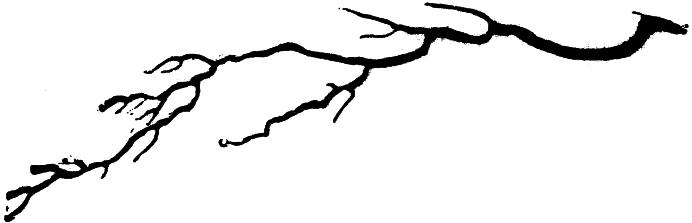
Fig. 62.
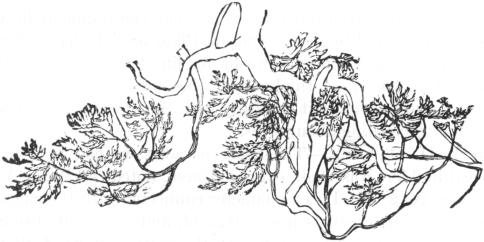
Fig. 63.
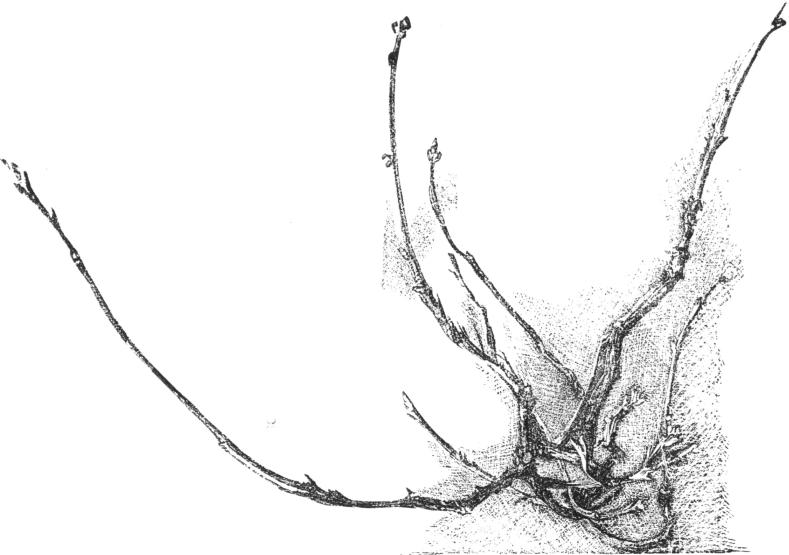
59. The Dryad’s Waywardness.
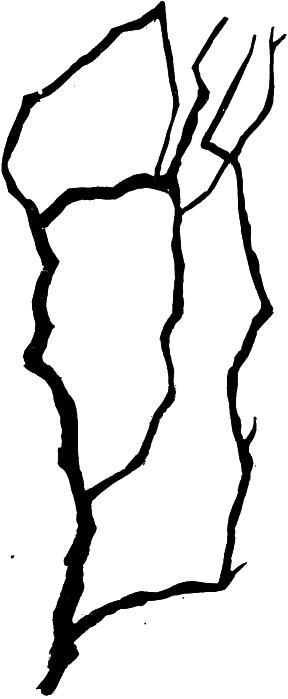
Fig. 64.
§ 12. Again: As it seldom struck the old painters that boughs must cross each other, so it never seems to have occurred to them that they must be sometimes foreshortened. I chose this bit from “Aske Hall,” that you might see at once, both how Turner foreshortens the main stem, and how, in doing so, he shows the turning aside, and outwards, of the one next to it, to the left, to get more air.6 Indeed, this foreshortening lies at the core of the business; for unless it be well understood, no branch-form can ever be rightly drawn. I placed the oak spray in Plate 51 so as to be seen as nearly straight on its flank as possible. It is the most uninteresting position in which a bough can be drawn; but it shows the first simple action of the law of resilience. I will now turn the bough with its extremity towards us, and foreshorten it (Plate 59), which being done, you perceive another tendency in the whole branch, not seen at all in the first Plate, to throw its sprays to its own right (or to your left), which it does to avoid the branch next it, while the forward action is in a sweeping curve round to your right, or to the branch’s left: a curve which it takes to recover position after its first concession. The lines of the nearer and smaller shoots are very nearly—thus foreshortened—those of a boat’s bow. Here is a piece of Dutch foreshortening for you to compare with it, Fig. 64.7
§ 13. In this final perfection of bough-drawing, Turner stands wholly alone. Even Titian does not foreshorten his boughs rightly. Of course he could, if he had cared to do so; for if you can foreshorten a limb or a hand, much more a tree branch. But either he had never looked at a tree carefully enough to feel that it was necessary, or, which is more likely, he disliked to introduce in a background elements of vigorous projection. Be the reason what it may, if you take Lefèvre’s plates of the Peter Martyr and St. Jerome—the only ones I know which give any idea of Titian’s tree-drawing, you will observe at once that the boughs lie in flakes, artificially set to the right and left, and are not intricate or varied, even where the foliage indicates some foreshortening;—completing thus the evidence for my statement long ago given, that no man but Turner had ever drawn the stem of a tree.
§ 14. It may be well also to note, for the advantage of the general student of design, that, in foliage and bough drawing, all the final grace and general utility of the study depend on its being well foreshortened; and that, till the power of doing so quite accurately is obtained, no landscape-drawing is of the least value; nor can the character of any tree be known at all until not only its branches, but its minutest extremities, have been drawn in the severest foreshortening, with little accompanying plans of the arrangements of the leaves or buds, or thorns, on the stem. Thus Fig. 65 is the extremity of a single shoot of spruce foreshortened, showing the resilience of its swords from beneath, and Fig. 66 is a little ground-plan, showing the position of the three lowest triple groups of thorn on a shoot of gooseberry.8 The fir shoot is carelessly drawn; but it is not worth while to do it better, unless I engraved it on steel, so as to show the fine relations of shade.
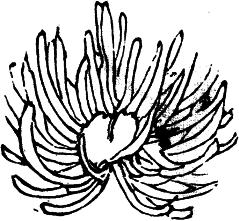
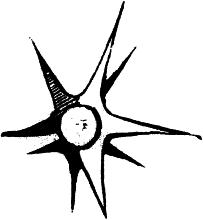
Fig. 65. Fig. 66.
§ 15. III. Fellowship.—The compactness of mass presented by this little sheaf of pine-swords may lead us to the consideration of the last character I have to note of boughs; namely, the mode of their association in masses. It follows, of course, from all the laws of growth we have ascertained, that the terminal outline of any tree or branch must be a simple one, containing within it, at a given height or level, the series of leaves of the year; only we have not yet noticed the kind of form which results, in each branch, from the part it has to take in forming the mass of the tree. The systems of branching are indeed infinite, and could not be exemplified by any number of types; but here are two common types, in section, which will enough explain what I mean.
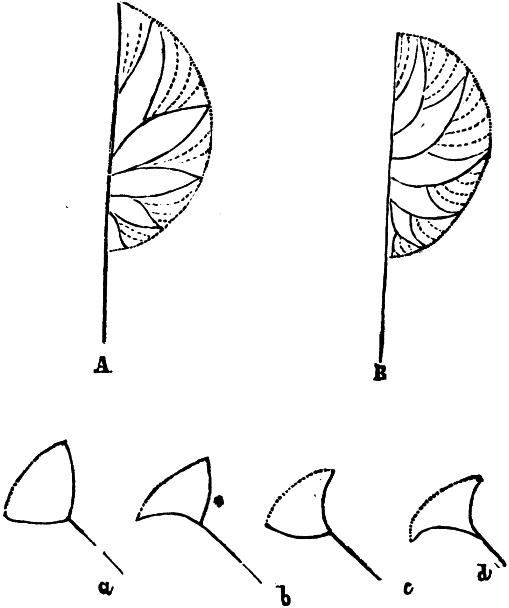
Fig. 67.
§ 16. If a tree branches with a concave tendency, it is apt to carry its boughs to the outer curve of limitation, as at A, Fig. 67, and if with a convex tendency, as at B. In either case the vertical section, or profile, of a bough will give a triangular mass, terminated by curves, and elongated at one extremity. These triangular masses you may see at a glance, prevailing in the branch system of any tree in winter. They may, of course, be mathematically reduced to the four types a, b, c, and d, Fig. 67, but are capable of endless variety of expression in action, and in the adjustment of their weights to the bearing stem.
§ 17. To conclude, then, we find that the beauty of these buildings of the leaves consists, from the first step of it to the last, in its showing their perfect fellowship; and a single aim uniting them under circumstances of various distress, trial, and pleasure. Without the fellowship, no beauty; without the steady purpose, no beauty; without trouble, and death, no beauty; without individual pleasure, freedom, and caprice, so far as may be consistent with the universal good, no beauty.
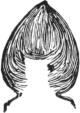
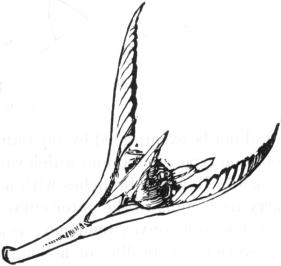
Fig. 68. Fig. 69.
§ 18. Tree-loveliness might be thus lost or killed in many ways. Discordance would kill it—of one leaf with another; disobedience would kill it—of any leaf to the ruling law; indulgence would kill it, and the doing away with pain; or slavish symmetry would kill it, and the doing away with delight. And this is so, down to the smallest atom and beginning of life: so soon as there is life at all, there are these four conditions of it;—harmony, obedience, distress, and delightsome inequality. Here is the magnified section of an oak-bud, not the size of a wheat grain (Fig. 68). Already its nascent leaves are seen arranged under the perfect law of resilience, preparing for stoutest work on the right side. Here is a dogwood bud just opening into life (Fig. 69). Its ruling law is to be four square, but see how the uppermost leaf takes the lead, and the lower bends up, already a little distressed by the effort. Here is a birch-bud, farther advanced, Fig. 70. Who shall say how many humors the little thing has in its mind already; or how many adventures it has passed through? And so to the end. Help, submission, sorrow, dissimilarity, are the sources of all good;—war, disobedience, luxury, equality, the sources of all evil.
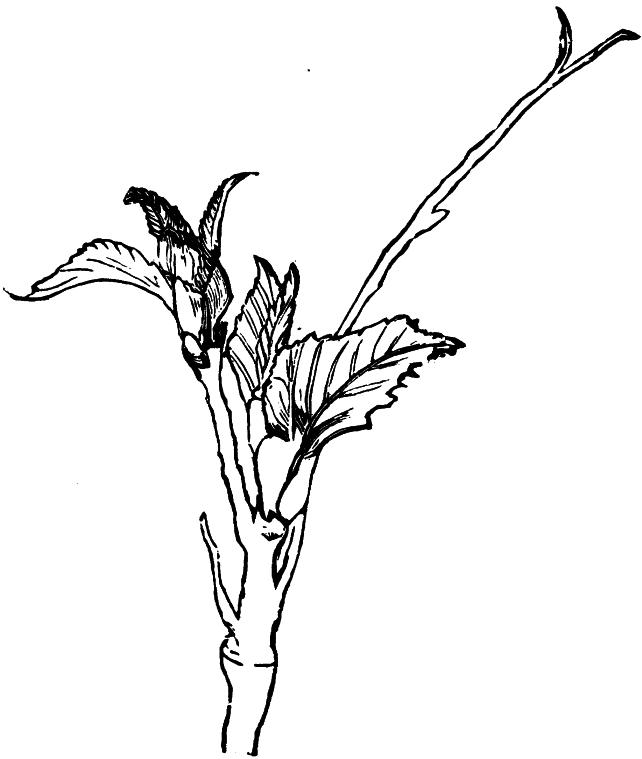
Fig. 70.
§ 19. There is yet another and a deeply laid lesson to be received from the leaf-builders, which I hope the reader has already perceived. Every leaf, we have seen, connects its work with the entire and accumulated result of the work of its predecessors. Their previous construction served it during its life, raised it towards the light, gave it more free sway and motion in the wind, and removed it from the noxiousness of earth exhalation. Dying, it leaves its own small but well-labored thread, adding, though imperceptibly, yet essentially, to the strength, from root to crest, of the trunk on which it had lived, and fitting that trunk for better service to succeeding races of leaves.
We men, sometimes, in what we presume to be humility, compare ourselves with leaves; but we have as yet no right to do so. The leaves may well scorn the comparison. We who live for ourselves, and neither know how to use nor keep the work of past time, may humbly learn,—as from the ant, foresight,—from the leaf, reverence. The power of every great people, as of every living tree, depends on its not effacing, but confirming and concluding, the labors of its ancestors. Looking back to the history of nations, we may date the beginning of their decline from the moment when they ceased to be reverent in heart, and accumulative in hand and brain; from the moment when the redundant fruit of age hid in them the hollowness of heart, whence the simplicities of custom and sinews of tradition had withered away. Had men but guarded the righteous laws, and protected the precious works of their fathers, with half the industry they have given to change and to ravage, they would not now have been seeking vainly, in millennial visions and mechanic servitudes, the accomplishment of the promise made to them so long ago: “As the days of a tree are the days of my people, and mine elect shall long enjoy the work of their hands; they shall not labor in vain, nor bring forth for trouble; for they are the seed of the blessed of the Lord, and their offspring with them.”
§ 20. This lesson we have to take from the leaf’s life. One more we may receive from its death. If ever in autumn a pensiveness falls upon us as the leaves drift by in their fading, may we not wisely look up in hope to their mighty monuments? Behold how fair, how far prolonged, in arch and aisle, the avenues of the valleys; the fringes of the hills! So stately,—so eternal; the joy of man, the comfort of all living creatures, the glory of the earth,—they are but the monuments of those poor leaves that flit faintly past us to die. Let them not pass, without our understanding their last counsel and example: that we also, careless of monument by the grave, may build it in the world—monument by which men may be taught to remember, not where we died, but where we lived.
1 They are enlarged, partly in order to show the care and minuteness of Turner’s drawing on the smallest scale, partly to save the reader the trouble of using a magnifying glass, partly because this woodcut will print safely; while if I had facsimiled the fine Turner etching, the block might have been spoiled after a hundred impressions.
2 Magnified to twice the size of the original, but otherwise facsimiled from his own etching of Œdipus, and the School of Plato.
3 The parrot perched on it is removed, which may be done without altering the curve, as the bird is set where its weight would not have bent the wood.
4 The largest laurel spray in the background of the “Susanna,” Louvre—reduced to about a fifth of the original. The drawing was made for me by M. Hippolyte Dubois, and I am glad it is not one of my own, lest I should be charged with exaggerating Veronese’s accuracy.
This group of leaves is, in the original, of the life-size; the circle which interferes with the spray on the right being the outline of the head and of one of the elders; and, as painted for distant effect, there is no care in completing the stems:—they are struck with a few broken touches of the brush, which cannot be imitated in the engraving, and much of their spirit is lost in consequence.
5 The longest in “Apollo and the Sibyl,” engraved by Boydell. (Reduced one-half.)
6 The foreshortening of the bough to the right is a piece of great audacity; it comes towards us two or three feet sharply, after forking, so as to look half as thick again as at the fork;—then bends back again, and outwards.
7 Hobbima. Dulwich Gallery, No. 131. Turn the book with its inner edge up.
8 Their change from groups of three to groups of two, and then to single thorns at the end of the spray, will be found very beautiful in a real shoot. The figure on the left in Plate 52 is a branch of blackthorn with its spines (which are a peculiar condition of branch, and can bud like branches, while thorns have no root nor power of development). Such a branch gives good practice without too much difficulty.
CHAPTER IX.
THE LEAF SHADOWS.
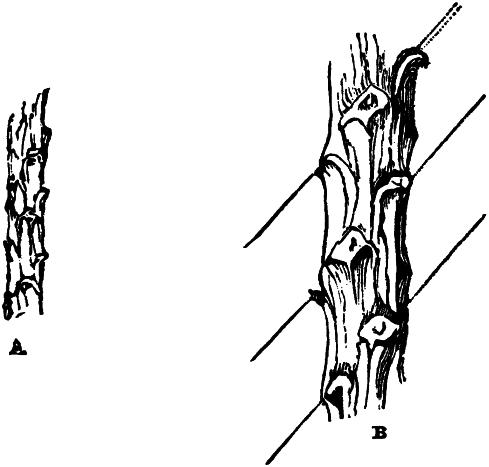
Fig. 71.
§ 1. It may be judged, by the time which it has taken to arrive at any clear idea of the structure of shield-builders, what a task would open to us if we endeavored to trace the more wonderful forms of the wild builders with the sword. Not that they are more complex; but they are more definite, and cannot be so easily generalized. The conditions which produce the spire of the cypress, and flaked breadth of the cedar, the rounded head of the stone pine, and perfect pyramid of the black spruce, are far more distinct, and would require more accurate and curious diagrams to illustrate them, than the graceful, but in some degree monotonous branching of leaf-builders. In broad principle they are, however, alike. The leaves construct the sprays in the same accumulative way: the only essential difference being that in the sword-builders the leaves are all set close, and at equal intervals. Instead of admitting extended and variable spaces between them, the whole spray is one tower of leaf-roots, set in a perfect spiral. Thus, Fig. 71, at A, represents a fragment of spray of Scotch fir of its real size. B is the same piece magnified, the diamond-like spaces being the points on which the leaves grew. The dotted lines show the regularity of the spiral. As the minor stems join in boughs, the scars left by the leaves are gradually effaced, and a thick but broken and scaly bark forms instead.
§ 2. A sword-builder may therefore be generally considered as a shield-builder put under the severest military restraint. The graceful and thin leaf is concentrated into a strong, narrow, pointed rod; and the insertion of these rods on them is in a close and perfectly timed order. In some ambiguous trees connected with the tribe (as the arbor vitæ) there is no proper stem to the outer leaves, but all the extremities form a kind of coralline leaf, flat and fern-like, but articulated like a crustacean animal, which gradually concentrates and embrowns itself into the stem. The thicker branches of these trees are exquisitely fantastic; and the mode in which the flat system of leaf first produces an irregular branch, and then adapts itself to the symmetrical cone of the whole tree, is one of the most interesting processes of form which I know in vegetation.
§ 3. Neither this, however, nor any other of the pine formations, have we space here to examine in detail; while without detail, all discussion of them is in vain. I shall only permit myself to note a few points respecting my favorite tree, the black spruce, not with any view to art criticism (though we might get at some curious results by a comparison of popular pine-drawing in Germany, America, and other dark-wooded countries, with the true natural forms), but because I think the expression of this tree has not been rightly understood by travellers in Switzerland, and that, with a little watching of it, they might easily obtain a juster feeling.
§ 4. Of the many marked adaptations of nature to the mind of man, it seems one of the most singular, that trees intended especially for the adornment of the wildest mountains should be in broad outline the most formal of trees. The vine, which is to be the companion of man, is waywardly docile in its growth, falling into festoons beside his cornfields, or roofing his garden-walks, or casting its shadow all summer upon his door. Associated always with the trimness of cultivation, it introduces all possible elements of sweet wildness. The pine, placed nearly always among scenes disordered and desolate, brings into them all possible elements of order and precision. Lowland trees may lean to this side and that, though it is but a meadow breeze that bends them, or a bank of cowslips from which their trunks lean aslope. But let storm and avalanche do their worst, and let the pine find only a ledge of vertical precipice to cling to, it will nevertheless grow straight. Thrust a rod from its last shoot down the stem;—it shall point to the centre of the earth as long as the tree lives.
§ 5. Also it may be well for lowland branches to reach hither and thither for what they need, and to take all kinds of irregular shape and extension. But the pine is trained to need nothing, and to endure everything. It is resolvedly whole, self-contained, desiring nothing but rightness, content with restricted completion. Tall or short, it will be straight. Small or large, it will be round. It may be permitted also to these soft lowland trees that they should make themselves gay with show of blossom, and glad with pretty charities of fruitfulness. We builders with the sword have harder work to do for man, and must do it in close-set troops. To stay the sliding of the mountain snows, which would bury him; to hold in divided drops, at our sword-points, the rain, which would sweep away him and his treasure-fields; to nurse in shade among our brown fallen leaves the tricklings that feed the brooks in drought; to give massive shield against the winter wind, which shrieks through the bare branches of the plain:—such service must we do him steadfastly while we live. Our bodies, also, are at his service: softer than the bodies of other trees, though our toil is harder than theirs. Let him take them as pleases him, for his houses and ships. So also it may be well for these timid lowland trees to tremble with all their leaves, or turn their paleness to the sky, if but a rush of rain passes by them; or to let fall their leaves at last, sick and sere. But we pines must live carelessly amidst the wrath of clouds. We only wave our branches to and fro when the storm pleads with us, as men toss their arms in a dream.
And finally, these weak lowland trees may struggle fondly for the last remnants of life, and send up feeble saplings again from their roots when they are cut down. But we builders with the sword perish boldly; our dying shall be perfect and solemn, as our warring: we give up our lives without reluctance, and for ever.1
§ 6. I wish the reader to fix his attention for a moment on these two great characters of the pine, its straightness and rounded perfectness; both wonderful, and in their issue lovely, though they have hitherto prevented the tree from being drawn. I say, first, its straightness. Because we constantly see it in the wildest scenery, we are apt to remember only as characteristic examples of it those which have been disturbed by violent accident or disease. Of course such instances are frequent. The soil of the pine is subject to continual change; perhaps the rock in which it is rooted splits in frost and falls forward, throwing the young stems aslope, or the whole mass of earth around it is undermined by rain, or a huge boulder falls on its stem from above, and forces it for twenty years to grow with weight of a couple of tons leaning on its side. Hence, especially at edges of loose cliffs, about waterfalls, or at glacier banks, and in other places liable to disturbance, the pine may be seen distorted and oblique; and in Turner’s “Source of the Arveron,” he has, with his usual unerring perception of the main point in any matter, fastened on this means of relating the glacier’s history. The glacier cannot explain its own motion; and ordinary observers saw in it only its rigidity; but Turner saw that the wonderful thing was its non-rigidity. Other ice is fixed, only this ice stirs. All the banks are staggering beneath its waves, crumbling and withered as by the blast of a perpetual storm. He made the rocks of his foreground loose—rolling and tottering down together; the pines, smitten aside by them, their tops dead, bared by the ice wind.
§ 7. Nevertheless, this is not the truest or universal expression of the pine’s character. I said long ago, even of Turner: “Into the spirit of the pine he cannot enter.” He understood the glacier at once; he had seen the force of sea on shore too often to miss the action of those crystal-crested waves. But the pine was strange to him, adverse to his delight in broad and flowing line; he refused its magnificent erectness. Magnificent!—nay, sometimes, almost terrible. Other trees, tufting crag or hill, yield to the form and sway of the ground, clothe it with soft compliance, are partly its subjects, partly its flatterers, partly its comforters. But the pine rises in serene resistance, self-contained; nor can I ever without awe stay long under a great Alpine cliff, far from all house or work of men, looking up to its companies of pine, as they stand on the inaccessible juts and perilous ledges of the enormous wall, in quiet multitudes, each like the shadow of the one beside it—upright, fixed, spectral, as troops of ghosts standing on the walls of Hades, not knowing each other—dumb for ever. You cannot reach them, cannot cry to them;—those trees never heard human voice; they are far above all sound but of the winds. No foot ever stirred fallen leaf of theirs. All comfortless they stand, between the two eternities of the Vacancy and the Rock: yet with such iron will, that the rock itself looks bent and shattered beside them—fragile, weak, inconsistent, compared to their dark energy of delicate life, and monotony of enchanted pride:—unnumbered, unconquerable.
§ 8. Then note, farther, their perfectness. The impression on most people’s minds must have been received more from pictures than reality, so far as I can judge;—so ragged they think the pine; whereas its chief character in health is green and full roundness. It stands compact, like one of its own cones, slightly curved on its sides, finished and quaint as a carved tree in some Elizabethan garden; and instead of being wild in expression, forms the softest of all forest scenery; for other trees show their trunks and twisting boughs: but the pine, growing either in luxuriant mass or in happy isolation, allows no branch to be seen. Summit behind summit rise its pyramidal ranges, or down to the very grass sweep the circlets of its boughs; so that there is nothing but green cone and green carpet. Nor is it only softer, but in one sense more cheerful than other foliage; for it casts only a pyramidal shadow. Lowland forest arches overhead, and chequers the ground with darkness; but the pine, growing in scattered groups, leaves the glades between emerald-bright. Its gloom is all its own; narrowing into the sky, it lets the sunshine strike down to the dew. And if ever a superstitious feeling comes over me among the pine-glades, it is never tainted with the old German forest fear; but is only a more solemn tone of the fairy enchantment that haunts our English meadows; so that I have always called the prettiest pine glade in Chamouni, “Fairies’ Hollow.” It is in the glen beneath the steep ascent above Pont Pelissier, and may be reached by a little winding path which goes down from the top of the hill; being, indeed, not truly a glen, but a broad ledge of moss and turf, leaning in a formidable precipice (which, however, the gentle branches hide) over the Arve. An almost isolated rock promontory, many-colored, rises at the end of it. On the other sides it is bordered by cliffs, from which a little cascade falls, literally down among the pines, for it is so light, shaking itself into mere showers of seed pearl in the sun, that the pines don’t know it from mist, and grow through it without minding. Underneath, there is only the mossy silence, and above, for ever, the snow of the nameless Aiguille.
§ 9. And then the third character which I want you to notice in the pine is its exquisite fineness. Other trees rise against the sky in dots and knots, but this in fringes.2 You never see the edges of it, so subtle are they; and for this reason, it alone of trees, so far as I know, is capable of the fiery change which we saw before had been noticed by Shakespeare. When the sun rises behind a ridge crested with pine, provided the ridge be at a distance of about two miles, and seen clear, all the trees, for about three or four degrees on each side of the sun, become trees of light, seen in clear flame against the darker sky, and dazzling as the sun itself. I thought at first this was owing to the actual lustre of the leaves; but I believe now it is caused by the cloud-dew upon them,—every minutest leaf carrying its diamond. It seems as if these trees, living always among the clouds, had caught part of their glory from them; and themselves the darkest of vegetation, could yet add splendor to the sun itself.
§ 10. Yet I have been more struck by their character of finished delicacy at a distance from the central Alps, among the pastoral hills of the Emmenthal, or lowland districts of Berne, where they are set in groups between the cottages, whose shingle roofs (they also of pine) of deep gray blue, and lightly carved fronts, golden and orange in the autumn sunshine,3 gleam on the banks and lawns of hill-side,—endless lawns, mounded, and studded, and bossed all over with deeper green hay-heaps, orderly set, like jewellery (the mountain hay, when the pastures are full of springs, being strangely dark and fresh in verdure for a whole day after it is cut). And amidst this delicate delight of cottage and field, the young pines stand delicatest of all, scented as with frankincense, their slender stems straight as arrows, and crystal white, looking as if they would break with a touch, like needles; and their arabesques of dark leaf pierced through and through by the pale radiance of clear sky, opal blue, where they follow each other along the soft hill-ridges, up and down.
§ 11. I have watched them in such scenes with the deeper interest, because of all trees they have hitherto had most influence on human character. The effect of other vegetation, however great, has been divided by mingled species; elm and oak in England, poplar in France, birch in Scotland, olive in Italy and Spain, share their power with inferior trees, and with all the changing charm of successive agriculture. But the tremendous unity of the pine absorbs and moulds the life of a race. The pine shadows rest upon a nation. The Northern peoples, century after century, lived under one or other of the two great powers of the Pine and the Sea, both infinite. They dwelt amidst the forests, as they wandered on the waves, and saw no end, nor any other horizon;—still the dark green trees, or the dark green waters, jagged the dawn with their fringe, or their foam. And whatever elements of imagination, or of warrior strength, or of domestic justice, were brought down by the Norwegian and the Goth against the dissoluteness or degradation of the South of Europe, were taught them under the green roofs and wild penetralia of the pine.
§ 12. I do not attempt, delightful as the task would be, to trace this influence (mixed with superstition) in Scandinavia, or North Germany; but let us at least note it in the instance which we speak of so frequently, yet so seldom take to heart. There has been much dispute respecting the character of the Swiss, arising out of the difficulty which other nations had to understand their simplicity. They were assumed to be either romantically virtuous, or basely mercenary, when in fact they were neither heroic nor base, but were true-hearted men, stubborn with more than any recorded stubbornness; not much regarding their lives, yet not casting them causelessly away; forming no high ideal of improvement, but never relaxing their grasp of a good they had once gained; devoid of all romantic sentiment, yet loving with a practical and patient love that neither wearied nor forsook; little given to enthusiasm in religion, but maintaining their faith in a purity which no worldliness deadened and no hypocrisy soiled; neither chivalrously generous nor pathetically humane, yet never pursuing their defeated enemies, nor suffering their poor to perish: proud, yet not allowing their pride to prick them into unwary or unworthy quarrel; avaricious, yet contentedly rendering to their neighbor his due; dull, but clear-sighted to all the principles of justice; and patient, without ever allowing delay to be prolonged by sloth, or forbearance by fear.
§ 13. This temper of Swiss mind, while it animated the whole confederacy, was rooted chiefly in one small district which formed the heart of their country, yet lay not among its highest mountains. Beneath the glaciers of Zermatt and Evolena, and on the scorching slopes of the Valais, the peasants remained in an aimless torpor, unheard of but as the obedient vassals of the great Bishopric of Sion. But where the lower ledges of calcareous rock were broken by the inlets of the Lake Lucerne, and bracing winds penetrating from the north forbade the growth of the vine, compelling the peasantry to adopt an entirely pastoral life, was reared another race of men. Their narrow domain should be marked by a small green spot on every map of Europe. It is about forty miles from east to west; as many from north to south: yet on that shred of rugged ground, while every kingdom of the world around it rose or fell in fatal change, and every multitudinous race mingled or wasted itself in various dispersion and decline, the simple shepherd dynasty remained changeless. There is no record of their origin. They are neither Goths, Burgundians, Romans, nor Germans. They have been for ever Helvetii, and for ever free. Voluntarily placing themselves under the protection of the House of Hapsburg, they acknowledged its supremacy, but resisted its oppression; and rose against the unjust governors it appointed over them, not to gain, but to redeem, their liberties. Victorious in the struggle by the Lake of Egeri, they stood the foremost standard-bearers among the nations of Europe in the cause of loyalty and life—loyalty in its highest sense, to the laws of God’s helpful justice, and of man’s faithful and brotherly fortitude.
§ 14. You will find among them, as I said, no subtle wit nor high enthusiasm, only an undeceivable common sense, and an obstinate rectitude. They cannot be persuaded into their duties, but they feel them; they use no phrases of friendship, but do not fail you at your need. Questions of creed, which other nations sought to solve by logic or reverie, these shepherds brought to practical tests: sustained with tranquillity the excommunication of abbots who wanted to feed their cattle on other people’s fields, and, halbert in hand, struck down the Swiss Reformation, because the Evangelicals of Zurich refused to send them their due supplies of salt. Not readily yielding to the demands of superstition, they were patient under those of economy; they would purchase the remission of taxes, but not of sins; and while the sale of indulgences was arrested in the church of Ensiedlen as boldly as at the gates of Wittenberg, the inhabitants of the valley of Frütigen4 ate no meat for seven years, in order peacefully to free themselves and their descendants from the seigniorial claims of the Baron of Thurm.
§ 15. What praise may be justly due to this modest and rational virtue, we have perhaps no sufficient grounds for defining. It must long remain questionable how far the vices of superior civilization may be atoned for by its achievements, and the errors of more transcendental devotion forgiven to its rapture. But, take it for what we may, the character of this peasantry is, at least, serviceable to others and sufficient for their own peace; and in its consistency and simplicity, it stands alone in the history of the human heart. How far it was developed by circumstances of natural phenomena may also be disputed; nor should I enter into such dispute with any strongly held conviction. The Swiss have certainly no feelings respecting their mountains in anywise correspondent to ours. It was rather as fortresses of defence, than as spectacles of splendor, that the cliffs of the Rothstock bare rule over the destinies of those who dwelt at their feet; and the training for which the mountain children had to thank the slopes of the Muotta-Thal, was in soundness of breath, and steadiness of limb, far more than in elevation of idea. But the point which I desire the reader to note is, that the character of the scene which, if any, appears to have been impressive to the inhabitant, is not that which we ourselves feel when we enter the district. It was not from their lakes, nor their cliffs, nor their glaciers—though these were all peculiarly their possession, that the three venerable cantons or states received their name. They were not called the States of the Rock, nor the States of the Lake, but the States of the Forest. And the one of the three which contains the most touching record of the spiritual power of Swiss religion, in the name of the convent of the “Hill of Angels,” has, for its own, none but the sweet childish name of “Under the Woods.”
§ 16. And indeed you may pass under them if, leaving the most sacred spot in Swiss history, the Meadow of the Three Fountains, you bid the boatman row southward a little way by the shore of the Bay of Uri. Steepest there on its western side, the walls of its rocks ascend to heaven. Far, in the blue of evening, like a great cathedral pavement, lies the lake in its darkness; and you may hear the whisper of innumerable falling waters return from the hollows of the cliff, like the voices of a multitude praying under their breath. From time to time the beat of a wave, slow lifted, where the rocks lean over the black depth, dies heavily as the last note of a requiem. Opposite, green with steep grass, and set with chalet villages, the Fron-Alp rises in one solemn glow of pastoral light and peace; and above, against the clouds of twilight, ghostly on the gray precipice, stand, myriad by myriad, the shadowy armies of the Unterwalden pine.5
I have seen that it is possible for the stranger to pass through this great chapel, with its font of waters, and mountain pillars, and vaults of cloud, without being touched by one noble thought, or stirred by any sacred passion; but for those who received from its waves the baptism of their youth, and learned beneath its rocks the fidelity of their manhood, and watched amidst its clouds the likeness of the dream of life, with the eyes of age—for these I will not believe that the mountain shrine was built, or the calm of its forest-shadows guarded by their God, in vain.
1 “Crœsus, therefore, having heard these things, sent word to the people of Lampsacus that they should let Miltiades go; and, if not, he would cut them down like a pine-tree.”—Herod. vi. 37.
2 Keats (as is his way) puts nearly all that may be said of the pine into one verse, though they are only figurative pines of which he is speaking. I have come to that pass of admiration for him now, that I dare not read him, so discontented he makes me with my own work: but others must not leave unread, in considering the influence of trees upon the human soul, that marvellous ode to Psyche. Here is the piece about pines:—
“Yes, I will be thy priest, and build a fane In some untrodden region of my mind, Where branchéd thoughts, new grown with pleasant pain, Instead of pines, shall murmur in the wind: Far, far around shall those dark-clustered trees Fledge the wild-ridged mountains, steep by steep; And there by zephyrs, streams, and birds, and bees, The moss-lain Dryads shall be lull’d to sleep; And in the midst of this wide quietness A rosy sanctuary will I dress With the wreath’d trellis of a working brain, With buds, and bells, and stars without a name, With all the Gardener Fancy e’er could feign, Who, breeding flowers, will never breed the same. And there shall be for thee all soft delight That shadowy thought can win; A bright torch, and a casement ope, at night, To let the warm Love in.”
3 There has been much cottage-building about the hills lately, with very pretty carving, the skill in which has been encouraged by travellers; and the fresh-cut larch is splendid in color under rosy sunlight.
4 This valley is on the pass of the Gemmi in Canton Berne, but the people are the same in temper as those of the Waldstetten.
5 The cliff immediately bordering the lake is in Canton Uri: the green hills of Unterwalden rise above. This is the grandest piece of the shore of Lake Lucerne; the rocks near Tell’s Chapel are neither so lofty nor so precipitous.
CHAPTER X.
LEAVES MOTIONLESS.
§ 1. It will be remembered that our final inquiry was to be into the sources of beauty in the tented plants, or flowers of the field; which the reader may perhaps suppose one of no great difficulty, the beauty of flowers being somewhat generally admitted and comprehended.
Admitted? yes. Comprehended? no; and, which is worse, in all its highest characters, for many a day yet, incomprehensible: though with a little steady application, I suppose we might soon know more than we do now about the colors of flowers,—being tangible enough, and staying longer than those of clouds. We have discovered something definite about colors of opal and of peacock’s plume; perhaps, also, in due time we may give some account of that true gold (the only gold of intrinsic value) which gilds buttercups; and understand how the spots are laid, in painting a pansy.
Art is of interest, when we may win any of its secrets; but to such knowledge the road lies not up brick streets. And howsoever that flower-painting may be done, one thing is certain, it is not by machinery.
§ 2. Perhaps, it may be thought, if we understood flowers better, we might love them less.
We do not love them much, as it is. Few people care about flowers. Many, indeed, are fond of finding a new shape of blossom, caring for it as a child cares about a kaleidoscope. Many, also, like a fair service of flowers in the greenhouse, as a fair service of plate on the table. Many are scientifically interested in them, though even these in the nomenclature rather than the flowers. And a few enjoy their gardens; but I have never heard of a piece of land, which would let well on a building lease, remaining unlet because it was a flowery piece. I have never heard of parks being kept for wild hyacinths, though often of their being kept for wild beasts. And the blossoming time of the year being principally spring, I perceive it to be the mind of most people, during that period, to stay in towns.
§ 3. A year or two ago, a keen-sighted and eccentrically-minded friend of mine, having taken it into his head to violate this national custom, and go to the Tyrol in spring, was passing through a valley near Landech, with several similarly headstrong companions. A strange mountain appeared in the distance, belted about its breast with a zone of blue, like our English Queen. Was it a blue cloud? A blue horizontal bar of the air that Titian breathed in youth, seen now far away, which mortal might never breathe again? Was it a mirage—a meteor? Would it stay to be approached? (ten miles of winding road yet between them and the foot of its mountain.) Such questioning had they concerning it. My keen-sighted friend alone maintained it to be substantial: whatever it might be, it was not air, and would not vanish. The ten miles of road were overpassed, the carriage left, the mountain climbed. It stayed patiently, expanding still into richer breadth and heavenlier glow—a belt of gentians. Such things may verily be seen among the Alps in spring, and in spring only. Which being so, I observe most people prefer going in autumn.
§ 4. Nevertheless, without any special affection for them, most of us, at least, languidly consent to the beauty of flowers, and occasionally gather them, and prefer them from among other forms of vegetation. This, strange to say, is precisely what great painters do not.
Every other kind of object they paint, in its due place and office, with respect;—but, except compulsorily and imperfectly, never flowers. A curious fact, this! Here are men whose lives are spent in the study of color, and the one thing they will not paint is a flower! Anything but that. A furred mantle, a jewelled zone, a silken gown, a brazen corslet, nay, an old leathern chair, or a wall-paper if you will, with utmost care and delight;—but a flower by no manner of means, if avoidable. When the thing has perforce to be done, the great painters of course do it rightly. Titian, in his early work, sometimes carries a blossom or two out with affection, as the columbines in our Bacchus and Ariadne. So also Holbein. But in his later and mightier work, Titian will only paint a fan or a wristband intensely, never a flower. In his portrait of Lavinia, at Berlin, the roses are just touched finely enough to fill their place, with no affection whatever, and with the most subdued red possible; while in the later portrait of her, at Dresden, there are no roses at all, but a belt of chased golden balls, on every stud of which Titian has concentrated his strength, and I verily believe forgot the face a little, so much has his mind been set on them.
§ 5. In Paul Veronese’s Europa, at Dresden, the entire foreground is covered with flowers, but they are executed with sharp and crude touches like those of a decorative painter. In Correggio’s paintings, at Dresden, and in the Antiope of the Louvre, there are lovely pieces of foliage, but no flowers. A large garland of oranges and lemons, with their leaves, above the St. George, at Dresden, is connected traditionally with the garlanded backgrounds of Ghirlandajo and Mantegna, but the studious absence of flowers renders it almost disagreeably ponderous. I do not remember any painted by Velasquez, or by Tintoret, except compulsory Annunciation lilies. The flowers of Rubens are gross and rude; those of Vandyck vague, slight, and subdued in color, so as not to contend with the flesh. In his portraits of King Charles’s children, at Turin, an enchanting picture, there is a rose-thicket, in which the roses seem to be enchanted the wrong way, for their leaves are all gray, and the flowers dull brick-red. Yet it is right.