Front matter (continued 4)
Reading edition
But this is not altogether so. The moss-lands have one great advantage over the forest-lands, namely, sight of the sky.
And not only sight of it, but continual and beneficent help from it. What they have to separate them from barren rock, namely, their moss and streams, being dependent on its direct help, not on great rivers coming from distant mountain chains, nor on vast tracts of ocean-mist coming up at evening, but on the continual play and change of sun and cloud.
§ 4. Note this word “change.” The moss-lands have an infinite advantage, not only in sight, but in liberty; they are the freest ground in all the world. You can only traverse the great woods by crawling like a lizard, or climbing like a monkey—the great sands with slow steps and veiled head. But bare-headed, and open-eyed, and free-limbed, commanding all the horizon’s space of changeful light, and all the horizon’s compass of tossing ground, you traverse the moss-land. In discipline it is severe as the desert, but it is a discipline compelling to action; and the moss-lands seem, therefore, the rough schools of the world, in which its strongest human frames are knit and tried, and so bent down, like the northern winds, to brace and brighten the languor into which the repose of more favored districts may degenerate.
§ 5. It would be strange, indeed, if there were no beauty in the phenomena by which this great renovating and purifying work is done. And it is done almost entirely by the great Angel of the Sea—rain;—the Angel, observe, the messenger sent to a special place on a special errand. Not the diffused perpetual presence of the burden of mist, but the going and returning of intermittent cloud. All turns upon that intermittence. Soft moss on stone and rock;—cave-fern of tangled glen; wayside well—perennial, patient, silent, clear; stealing through its square font of rough-hewn stone; ever thus deep—no more—which the winter wreck sullies not, the summer thirst wastes not, incapable of stain as of decline—where the fallen leaf floats undecayed, and the insect darts undefiling. Cressed brook and ever-eddying river, lifted even in flood scarcely over its stepping-stones,—but through all sweet summer keeping tremulous music with harp-strings of dark water among the silver fingering of the pebbles. Far away in the south the strong river Gods have all hasted, and gone down to the sea. Wasted and burning, white furnaces of blasting sand, their broad beds lie ghastly and bare; but here the soft wings of the Sea Angel droop still with dew, and the shadows of their plumes falter on the hills: strange laughings, and glitterings of silver streamlets, born suddenly, and twined about the mossy heights in trickling tinsel, answering to them as they wave.1
§ 6. Nor are those wings colorless. We habitually think of the rain-cloud only as dark and gray; not knowing that we owe to it perhaps the fairest, though not the most dazzling of the hues of heaven. Often in our English mornings, the rain-clouds in the dawn form soft level fields, which melt imperceptibly into the blue; or when of less extent, gather into apparent bars, crossing the sheets of broader cloud above; and all these bathed throughout in an unspeakable light of pure rose-color, and purple, and amber, and blue; not shining, but misty-soft; the barred masses, when seen nearer, composed of clusters or tresses of cloud, like floss silk; looking as if each knot were a little swathe or sheaf of lighted rain. No clouds form such skies, none are so tender, various, inimitable. Turner himself never caught them. Correggio, putting out his whole strength, could have painted them, no other man.2
§ 7. For these are the robes of love of the Angel of the Sea. To these that name is chiefly given, the “spreadings of the clouds,” from their extent, their gentleness, their fulness of rain. Note how they are spoken of in Job xxxvi. v. 29-31. “By them judgeth he the people; he giveth meat in abundance. With clouds he covereth the light.3 He hath hidden the light in his hands, and commanded that it should return. He speaks of it to his friend; that it is his possession, and that he may ascend thereto.”
That, then, is the Sea Angel’s message to God’s friends; that, the meaning of those strange golden lights and purple flushes before the morning rain. The rain is sent to judge, and feed us; but the light is the possession of the friends of God, and they may ascend thereto,—where the tabernacle veil will cross and part its rays no more.
§ 8. But the Angel of the Sea has also another message,—in the “great rain of his strength,” rain of trial, sweeping away ill-set foundations. Then his robe is not spread softly over the whole heaven, as a veil, but sweeps back from his shoulders, ponderous, oblique, terrible—leaving his sword-arm free.
The approach of trial-storm, hurricane-storm, is indeed in its vastness as the clouds of the softer rain. But it is not slow nor horizontal, but swift and steep: swift with passion of ravenous winds; steep as slope of some dark, hollowed hill. The fronting clouds come leaning forward, one thrusting the other aside, or on; impatient, ponderous, impendent, like globes of rock tossed of Titans—Ossa on Olympus—but hurled forward all, in one wave of cloud-lava—cloud whose throat is as a sepulchre. Fierce behind them rages the oblique wrath of the rain, white as ashes, dense as showers of driven steel; the pillars of it full of ghastly life; Rain-Furies, shrieking as they fly;—scourging, as with whips of scorpions;—the earth ringing and trembling under them, heaven wailing wildly, the trees stooped blindly down, covering their faces, quivering in every leaf with horror, ruin of their branches flying by them like black stubble.
§ 9. I wrote Furies. I ought to have written Gorgons. Perhaps the reader does not know that the Gorgons are not dead, are ever undying. We shall have to take our chance of being turned into stones by looking them in the face, presently. Meantime, I gather what part of the great Greek story of the Sea Angels, has meaning for us here.
Nereus, the God of the Sea, who dwells in it always (Neptune being the God who rules it from Olympus), has children by the Earth; namely, Thaumas, the father of Iris; that is, the “wonderful” or miracle-working angel of the sea; Phorcys, the malignant angel of it (you will find him degraded through many forms, at last, in the story of Sindbad, into the Old Man of the Sea); Ceto, the deep places of the sea, meaning its bays among rocks, therefore called by Hesiod “Fair-cheeked” Ceto; and Eurybia, the tidal force or sway of the sea, of whom more hereafter.
§ 10. Phorcys and Ceto, the malignant angel of the sea, and the spirit of its deep rocky places, have children, namely, first, Graiæ, the soft rain-clouds. The Greeks had a greater dislike of storm than we have, and therefore whatever violence is in the action of rain, they represented by harsher types than we should—types given in one group by Aristophanes (speaking in mockery of the poets): “This was the reason, then, that they made so much talk about the fierce rushing of the moist clouds, coiled in glittering; and the locks of the hundred-headed Typhon; and the blowing storms; and the bent-clawed birds drifted on the breeze, fresh, and aërial.” Note the expression “bent-clawed birds.” It illustrates two characters of these clouds; partly their coiling form; but more directly the way they tear down the earth from the hill-sides; especially those twisted storm-clouds which in violent action become the waterspout. These always strike at a narrow point, often opening the earth on a hill-side into a trench as a great pickaxe would (whence the Graiæ are said to have only one beak between them). Nevertheless, the rain-cloud was, on the whole, looked upon by the Greeks as beneficent, so that it is boasted of in the Œdipus Coloneus for its perpetual feeding of the springs of Cephisus,4 and elsewhere often; and the opening song of the rain-clouds in Aristophanes is entirely beautiful:—
“O eternal Clouds! let us raise into open sight our dewy existence, from the deep-sounding Sea, our Father, up to the crests of the wooded hills, whence we look down over the sacred land, nourishing its fruits, and over the rippling of the divine rivers, and over the low murmuring bays of the deep.” I cannot satisfy myself about the meaning of the names of the Graiæ—Pephredo and Enuo—but the epithets which Hesiod gives them are interesting: “Pephredo, the well-robed; Enuo, the crocus-robed;” probably, it seems to me, from their beautiful colors in morning.
§ 11. Next to the Graiæ, Phorcys and Ceto begat the Gorgons, which are the true storm-clouds. The Graiæ have only one beak or tooth, but all the Gorgons have tusks like boars; brazen hands (brass being the word used for the metal of which the Greeks made their spears), and golden wings.
Their names are “Steino” (straitened), of storms compressed into narrow compass; “Euryale” (having wide threshing-floor), of storms spread over great space; “Medusa” (the dominant), the most terrible. She is essentially the highest storm-cloud; therefore the hail-cloud or cloud of cold, her countenance turning all who behold it to stone. (“He casteth forth his ice like morsels. Who can stand before his cold?”) The serpents about her head are the fringes of the hail, the idea of coldness being connected by the Greeks with the bite of the serpent, as with the hemlock.
§ 12. On Minerva’s shield, her head signifies, I believe, the cloudy coldness of knowledge, and its venomous character (“Knowledge puffeth up.” Compare Bacon in Advancement of Learning). But the idea of serpents rose essentially from the change of form in the cloud as it broke; the cumulus cloud not breaking into full storm till it is cloven by the cirrus; which is twice hinted at in the story of Perseus; only we must go back a little to gather it together.
Perseus was the son of Jupiter by Danaë, who being shut in a brazen tower, Jupiter came to her in a shower of gold: the brazen tower being, I think, only another expression for the cumulus or Medusa cloud; and the golden rain for the rays of the sun striking it; but we have not only this rain of Danaë’s to remember in connection with the Gorgon, but that also of the sieves of the Danaïdes, said to represent the provision of Argos with water by their father Danaüs, who dug wells about the Acropolis; nor only wells, but opened, I doubt not, channels of irrigation for the fields, because the Danaïdes are said to have brought the mysteries of Ceres from Egypt. And though I cannot trace the root of the names Danaüs and Danaë, there is assuredly some farther link of connection in the deaths of the lovers of the Danaïdes, whom they slew, as Perseus Medusa. And again note, that when the father of Danaë, Acrisius, is detained in Seriphos by storms, a disk thrown by Perseus is carried by the wind against his head, and kills him; and lastly, when Perseus cuts off the head of Medusa, from her blood springs Chrysaor, “wielder of the golden sword,” the Angel of the Lightning, and Pegasus, the Angel of the “Wild Fountains,” that is to say, the fastest flying or lower rain-cloud; winged, but racing as upon the earth.
§ 13. I say, “wild” fountains; because the kind of fountain from which Pegasus is named is especially the “fountain of the great deep” of Genesis; sudden and furious, (cataracts of heaven, not windows, in the Septuagint);—the mountain torrent caused by thunderous storm, or as our “fountain”—a Geyser-like leaping forth of water. Therefore, it is the deep and full source of streams, and so used typically of the source of evils, or of passions; whereas the word “spring” with the Greeks is like our “well-head”—a gentle issuing forth of water continually. But, because both the lightning-fire and the gushing forth, as of a fountain, are the signs of the poet’s true power, together with perpetuity, it is Pegasus who strikes the earth with his foot, on Helicon,5 and causes Hippocrene to spring forth—“the horse’s well-head.” It is perpetual; but has, nevertheless, the Pegasean storm-power.
§ 14. Wherein we may find, I think, sufficient cause for putting honor upon the rain-cloud. Few of us, perhaps, have thought, in watching its career across our own mossy hills, or listening to the murmur of the springs amidst the mountain quietness, that the chief masters of the human imagination owed, and confessed that they owed, the force of their noblest thoughts, not to the flowers of the valley, nor the majesty of the hill, but to the flying cloud.
Yet they never saw it fly, as we may in our own England. So far, at least, as I know the clouds of the south, they are often more terrible than ours, but the English Pegasus is swifter. On the Yorkshire and Derbyshire hills, when the rain-cloud is low and much broken, and the steady west-wind fills all space with its strength,6 the sun-gleams fly like golden vultures: they are flashes rather than shinings; the dark spaces and the dazzling race and skim along the acclivities, and dart and dip from crag to dell, swallow-like;—no Graiæ these,—gray and withered: Grey Hounds rather, following the Cerinthian stag with the golden antlers.
§ 15. There is one character about these lower rain-clouds, partly affecting all their connection with the upper sky, which I have never been able to account for; that which, as before noticed, Aristophanes fastened on at once for their distinctive character—their obliquity. They always fly in an oblique position, as in the Plate opposite, which is a careful facsimile of the first advancing mass of the rain-cloud in Turner’s Slave Ship. When the head of the cloud is foremost, as in this instance, and rain falling beneath, it is easy to imagine that its drops, increasing in size as they fall, may exercise some retarding action on the wind. But the head of the cloud is not always first, the base of it is sometimes advanced.7 The only certainty is, that it will not shape itself horizontally, its thin drawn lines and main contours will always be oblique, though its motion is horizontal; and, which is still more curious, their sloping lines are hardly ever modified in their descent by any distinct retiring tendency or perspective convergence. A troop of leaning clouds will follow one another, each stooping forward at the same apparent slope, round a fourth of the horizon.
§ 16. Another circumstance which the reader should note in this cloud of Turner’s, is the witch-like look of drifted or erected locks of hair at its left side. We have just read the words of the old Greek poet: “Locks of the hundred-headed Typhon;” and must remember that Turner’s account of this picture, in the Academy catalogue, was “Slaver throwing overboard the Dead and Dying. Typhoon coming on.” The resemblance to wildly drifted hair is stronger in the picture than in the engraving; the gray and purple tints of torn cloud being relieved against golden sky beyond.
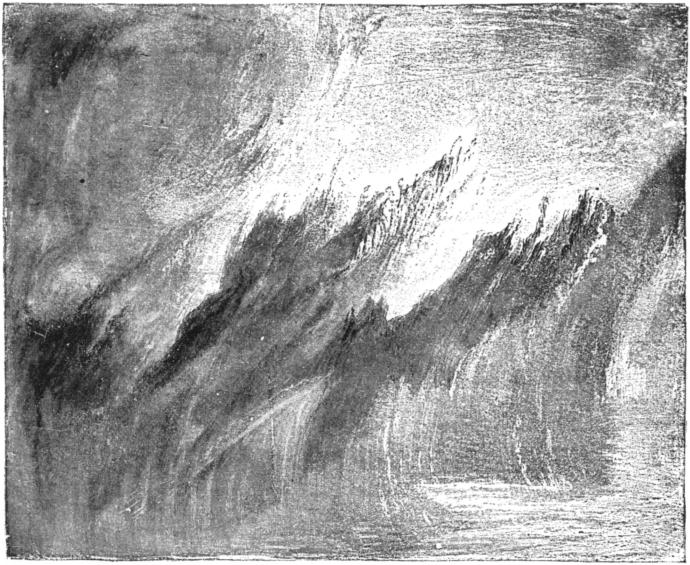
72. The Locks of Typhon.
§ 17. It was not, however, as we saw, merely to locks of hair, but to serpents, that the Greeks likened the dissolving of the Medusa cloud in blood. Of that sanguine rain, or of its meaning, I cannot yet speak. It is connected with other and higher types, which must be traced in another place.8
But the likeness to serpents we may illustrate here. The two Plates already given, 70 and 71 (at page 127), represent successive conditions of the Medusa cloud on one of the Cenis hills (the great limestone precipice above St. Michel, between Lanslebourg and St. Jean di Maurienne).9 In the first, the cloud is approaching, with the lee-side cloud forming beyond it; in the second, it has approached, increased, and broken, the Medusa serpents writhing about the central peak, the rounded tops of the broken cumulus showing above. In this instance, they take nearly the forms of flame; but when the storm is more violent, they are torn into fragments, and magnificent revolving wheels of vapor are formed, broken, and tossed into the air, as the grass is tossed in the hay-field from the toothed wheels of the mowing-machine; perhaps, in common with all other inventions of the kind, likely to bring more evil upon men than ever the Medusa cloud did, and turn them more effectually into stone.10
§ 18. I have named in the first volume the principal works of Turner representing these clouds; and until I am able to draw them better, it is useless to say more of them; but in connection with the subject we have been examining, I should be glad if the reader could turn to the engravings of the England drawings of Salisbury and Stonehenge. What opportunities Turner had of acquainting himself with classical literature, and how he used them, we shall see presently. In the meantime, let me simply assure the reader that, in various byways, he had gained a knowledge of most of the great Greek traditions, and that he felt them more than he knew them; his mind being affected, up to a certain point, precisely as an ancient painter’s would have been, by external phenomena of nature. To him, as to the Greek, the storm-clouds seemed messengers of fate. He feared them, while he reverenced; nor does he ever introduce them without some hidden purpose, bearing upon the expression of the scene he is painting.
§ 19. On that plain of Salisbury, he had been struck first by its widely-spacious pastoral life; and secondly, by its monuments of the two great religions of England—Druidical and Christian.
He was not a man to miss the possible connection of these impressions. He treats the shepherd life as a type of the ecclesiastical; and composes his two drawings so as to illustrate both.
In the drawing of Salisbury, the plain is swept by rapid but not distressful rain. The cathedral occupies the centre of the picture, towering high over the city, of which the houses (made on purpose smaller than they really are) are scattered about it like a flock of sheep. The cathedral is surrounded by a great light. The storm gives way at first in a subdued gleam over a distant parish church, then bursts down again, breaks away into full light about the cathedral, and passes over the city, in various sun and shade. In the foreground stands a shepherd leaning on his staff, watching his flock—bare-headed; he has given his cloak to a group of children, who have covered themselves up with it, and are shrinking from the rain; his dog crouches under a bank; his sheep, for the most part, are resting quietly, some coming up the slope of the bank towards him.11
§ 20. The rain-clouds in this picture are wrought with a care which I have never seen equalled in any other sky of the same kind. It is the rain of blessing—abundant, but full of brightness; golden gleams are flying across the wet grass, and fall softly on the lines of willows in the valley—willows by the watercourses; the little brooks flash out here and there between them and the fields. Turn now to the Stonehenge. That, also, stands in great light; but it is the Gorgon light—the sword of Chrysaor is bared against it. The cloud of judgment hangs above. The rock pillars seem to reel before its slope, pale beneath the lightning. And nearer, in the darkness, the shepherd lies dead, his flock scattered.
I alluded, in speaking before of this Stonehenge, to Turner’s use of the same symbol in the drawing of Pæstum for Rogers’s Italy; but a more striking instance of its employment occurs in a Study of Pæstum, which he engraved himself before undertaking the Liber Studiorum and another in his drawing of the Temple of Minerva, on Cape Colonna: and observe farther that he rarely introduces lightning, if the ruined building has not been devoted to religion. The wrath of man may destroy the fortress, but only the wrath of heaven can destroy the temple.
§ 21. Of these secret meanings of Turner’s, we shall see enough in the course of the inquiry we have to undertake, lastly, respecting ideas of relation; but one more instance of his opposed use of the lightning symbol, and of the rain of blessing, I name here, to confirm what has been noted above. For, in this last instance, he was questioned respecting his meaning, and explained it. I refer to the drawings of Sinai and Lebanon, made for Finden’s Bible. The sketches from which Turner prepared that series were, I believe, careful and accurate; but the treatment of the subjects was left wholly to him. He took the Sinai and Lebanon to show the opposite influences of the Law and the Gospel. The Rock of Moses is shown in the burning of the desert, among fallen stones, forked lightning cleaving the blue mist which veils the summit of Sinai. Armed Arabs pause at the foot of the rock. No human habitation is seen, nor any herb or tree, nor any brook, and the lightning strikes without rain.12 Over the Mount Lebanon an intensely soft gray-blue sky is melting into dewy rain. Every ravine is filled, every promontory crowned, by tenderest foliage, golden in slanting sunshine.13 The white convent nestles into the hollow of the rock; and a little brook runs under the shadow of the nearer trees, beside which two monks sit reading.
§ 22. It was a beautiful thought, yet an erring one, as all thoughts are which oppose the Law to the Gospel. When people read, “the law came by Moses, but grace and truth by Christ,” do they suppose that the law was ungracious and untrue? The law was given for a foundation; the grace (or mercy) and truth for fulfilment;—the whole forming one glorious Trinity of judgment, mercy, and truth. And if people would but read the text of their Bibles with heartier purpose of understanding it, instead of superstitiously, they would see that throughout the parts which they are intended to make most personally their own (the Psalms) it is always the Law which is spoken of with chief joy. The Psalms respecting mercy are often sorrowful, as in thought of what it cost; but those respecting the law are always full of delight. David cannot contain himself for joy in thinking of it,—he is never weary of its praise:—“How love I thy law! it is my meditation all the day. Thy testimonies are my delight and my counsellors; sweeter, also, than honey and the honeycomb.”
§ 23. And I desire, especially, that the reader should note this, in now closing the work through which we have passed together in the investigation of the beauty of the visible world. For perhaps he expected more pleasure and freedom in that work; he thought that it would lead him at once into fields of fond imagination, and may have been surprised to find that the following of beauty brought him always under a sterner dominion of mysterious law; the brightness was continually based upon obedience, and all majesty only another form of submission. But this is indeed so. I have been perpetually hindered in this inquiry into the sources of beauty by fear of wearying the reader with their severities. It was always accuracy I had to ask of him, not sympathy; patience, not zeal; apprehension, not sensation. The thing to be shown him was not a pleasure to be snatched, but a law to be learned.
§ 24. It is in this character, however, that the beauty of the natural world completes its message. We saw long ago, how its various powers of appeal to the mind of men might be traced to some typical expression of Divine attributes. We have seen since how its modes of appeal present constant types of human obedience to the Divine law, and constant proofs that this law, instead of being contrary to mercy, is the foundation of all delight, and the guide of all fair and fortunate existence.
§ 25. Which understanding, let us receive our last message from the Angel of the Sea.
Take up the 19th Psalm and look at it verse by verse. Perhaps to my younger readers, one word may be permitted respecting their Bible-reading in general.14 The Bible is, indeed, a deep book, when depth is required, that is to say, for deep people. But it is not intended, particularly, for profound persons; on the contrary, much more for shallow and simple persons. And therefore the first, and generally the main and leading idea of the Bible, is on its surface, written in plainest possible Greek, Hebrew, or English, needing no penetration, nor amplification, needing nothing but what we all might give—attention.
But this, which is in every one’s power, and is the only thing that God wants, is just the last thing any one will give Him. We are delighted to ramble away into day-dreams, to repeat pet verses from other places, suggested by chance words; to snap at an expression which suits our own particular views, or to dig up a meaning from under a verse, which we should be amiably grieved to think any human being had been so happy as to find before. But the plain, intended, immediate, fruitful meaning, which every one ought to find always, and especially that which depends on our seeing the relation of the verse to those near it, and getting the force of the whole passage, in due relation—this sort of significance we do not look for;—it being, truly, not to be discovered, unless we really attend to what is said, instead of to our own feelings.
§ 26. It is unfortunate also, but very certain, that in order to attend to what is said, we must go through the irksomeness of knowing the meaning of the words. And the first thing that children should be taught about their Bibles is, to distinguish clearly between words that they understand and words that they do not; and to put aside the words they do not understand, and verses connected with them, to be asked about, or for a future time; and never to think they are reading the Bible when they are merely repeating phrases of an unknown tongue.
§ 27. Let us try, by way of example, this 19th Psalm, and see what plain meaning is uppermost in it.
“The heavens declare the glory of God.”
What are the heavens?
The word occurring in the Lord’s Prayer, and the thing expressed being what a child may, with some advantage, be led to look at, it might be supposed among a schoolmaster’s first duties to explain this word clearly.
Now there can be no question that in the minds of the sacred writers, it stood naturally for the entire system of cloud, and of space beyond it, conceived by them as a vault set with stars. But there can, also, be no question, as we saw in previous inquiry, that the firmament, which is said to have been “called” heaven, at the creation, expresses, in all definite use of the word, the system of clouds, as spreading the power of the water over the earth; hence the constant expressions dew of heaven, rain of heaven, &c., where heaven is used in the singular; while “the heavens,” when used plurally, and especially when in distinction, as here, from the word “firmament,” remained expressive of the starry space beyond.
§ 28. A child might therefore be told (surely, with advantage), that our beautiful word Heaven may possibly have been formed from a Hebrew word, meaning “the high place;” that the great warrior Roman nation, camping much out at night, generally overtired and not in moods for thinking, are believed, by many people, to have seen in the stars only the likeness of the glittering studs of their armor, and to have called the sky “The bossed, or studded;” but that others think those Roman soldiers on their might-watches had rather been impressed by the great emptiness and void of night, and by the far coming of sounds through its darkness, and had called the heaven “The Hollow place.” Finally, I should tell the children, showing them first the setting of a star, how the great Greeks had found out the truest power of the heavens, and had called them “The Rolling.” But whatever different nations had called them, at least I would make it clear to the child’s mind that in this 19th Psalm, their whole power being intended, the two words are used which express it: the Heavens, for the great vault or void, with all its planets, and stars, and ceaseless march of orbs innumerable; and the Firmament, for the ordinance of the clouds.
These heavens, then, “declare the glory of God;” that is, the light of God, the eternal glory, stable and changeless. As their orbs fail not—but pursue their course for ever, to give light upon the earth—so God’s glory surrounds man for ever—changeless, in its fulness insupportable—infinite.
“And the firmament showeth his handywork.”
§ 29. The clouds, prepared by the hand of God for the help of man, varied in their ministration—veiling the inner splendor—show, not His eternal glory, but His daily handiwork. So He dealt with Moses. I will cover thee “with my hand” as I pass by. Compare Job xxxvi. 24: “Remember that thou magnify his work, which men behold. Every man may see it.” Not so the glory—that only in part; the courses of these stars are to be seen imperfectly, and but by a few. But this firmament, “every man may see it, man may behold it afar off.” “Behold, God is great, and we know him not. For he maketh small the drops of water: they pour down rain according to the vapor thereof.”
§ 30. “Day unto day uttereth speech, and night unto night showeth knowledge. They have no speech nor language, yet without these their voice is heard. Their rule is gone out throughout the earth, and their words to the end of the world.”
Note that. Their rule throughout the earth, whether inhabited or not—their law of right is thereon; but their words, spoken to human souls, to the end of the inhabited world.
“In them hath he set a tabernacle for the sun,” &c. Literally, a tabernacle, or curtained tent, with its veil and its hangings; also of the colors of His desert tabernacle—blue, and purple, and scarlet.
Thus far the psalm describes the manner of this great heaven’s message.
Thenceforward, it comes to the matter of it.
§ 31. Observe, you have the two divisions of the declaration. The heavens (compare Psalm viii.) declare the eternal glory of God before men, and the firmament the daily mercy of God towards men. And the eternal glory is in this—that the law of the Lord is perfect, and His testimony sure, and His statutes right.
And the daily mercy in this—that the commandment of the Lord is pure, and His fear is clean, and His judgments true and righteous.
There are three oppositions:—
Between law and commandment.
Between testimony and fear.
Between statute and judgment.
§ 32. I. Between law and commandment.
The law is fixed and everlasting; uttered once, abiding for ever, as the sun, it may not be moved. It is “perfect, converting the soul:” the whole question about the soul being, whether it has been turned from darkness to light, acknowledged this law or not,—whether it is godly or ungodly? But the commandment is given momentarily to each man, according to the need. It does not convert: it guides. It does not concern the entire purpose of the soul; but it enlightens the eyes, respecting a special act. The law is, “Do this always;” the commandment, “Do thou this now:” often mysterious enough, and through the cloud; chilling, and with strange rain of tears; yet always pure (the law converting, but the commandment cleansing): a rod not for guiding merely, but for strengthening, and tasting honey with. “Look how mine eyes have been enlightened, because I tasted a little of this honey.”
§ 33. II. Between testimony and fear.
The testimony is everlasting: the true promise of salvation. Bright as the sun beyond all the earth-cloud, it makes wise the simple; all wisdom being assured in perceiving it and trusting it; all wisdom brought to nothing which does not perceive it.
But the fear of God is taught through special encouragement and special withdrawal of it, according to each man’s need—by the earth-cloud—smile and frown alternately: it also, as the commandment, is clean, purging and casting out all other fear, it only remaining for ever.
§ 34. III. Between statute and judgment.
The statutes are the appointments of the Eternal justice; fixed and bright, and constant as the stars; equal and balanced as their courses. They “are right, rejoicing the heart.” But the judgments are special judgments of given acts of men. “True,” that is to say, fulfilling the warning or promise given to each man; “righteous altogether,” that is, done or executed in truth and righteousness. The statute is right, in appointment. The judgment righteous altogether, in appointment and fulfilment;—yet not always rejoicing the heart.
Then, respecting all these, comes the expression of passionate desire, and of joy; that also divided with respect to each. The glory of God, eternal in the Heavens, is future, “to be desired more than gold, than much fine gold”—treasure in the heavens that faileth not. But the present guidance and teaching of God are on earth; they are now possessed, sweeter than all earthly food—“sweeter than honey and the honeycomb. Moreover by them” (the law and the testimony) “is thy servant warned”—warned of the ways of death and life.
“And in keeping them” (the commandments and the judgments) “there is great reward:” pain now, and bitterness of tears, but reward unspeakable.
§ 35. Thus far the psalm has been descriptive and interpreting. It ends in prayer.
“Who can understand his errors?” (wanderings from the perfect law.) “Cleanse thou me from secret faults; from all that I have done against thy will, and far from thy way, in the darkness. Keep back thy servant from presumptuous sins” (sins against the commandment) “against thy will when it is seen and direct, pleading with heart and conscience. So shall I be undefiled, and innocent from the great transgression—the transgression that crucifies afresh.
“Let the words of my mouth (for I have set them to declare thy law), and the meditation of my heart (for I have set it to keep thy commandments), be acceptable in thy sight, whose glory is my strength, and whose work, my redemption; my Strength, and my Redeemer.”
1 Compare the beautiful stanza beginning the epilogue of the “Golden Legend.”
2 I do not mean that Correggio is greater than Turner, but that only his way of work, the touch which he has used for the golden hair of Antiope for instance, could have painted these clouds. In open lowland country I have never been able to come to any satisfactory conclusion about their height, so strangely do they blend with each other. Here, for instance, is the arrangement of an actual group of them. The space at A was deep, purest ultramarine blue, traversed by streaks of absolutely pure and perfect rose-color. The blue passed downwards imperceptibly into gray at G, and then into amber, and at the white edge below into gold. On this amber ground the streaks P were dark purple, and, finally, the spaces at B B, again, clearest and most precious blue, paler than that at A. The two levels of these clouds are always very notable. After a continuance of fine weather among the Alps, the determined approach of rain is usually announced by a soft, unbroken film of level cloud, white and thin at the approaching edge, gray at the horizon, covering the whole sky from side to side, and advancing steadily from the south-west. Under its gray veil, as it approaches, are formed detached bars, darker or lighter than the field above, according to the position of the sun. These bars are usually of a very sharply elongated oval shape, something like fish. I habitually call them “fish clouds,” and look upon them with much discomfort, if any excursions of interest have been planned within the next three days. Their oval shape is a perspective deception dependent on their flatness; they are probably thin, extended fields, irregularly circular.
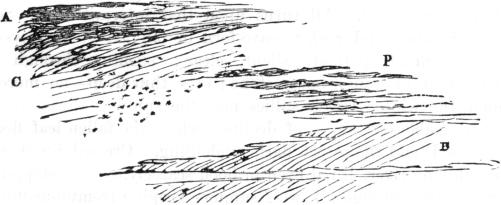
Fig. 98.
3 I do not copy the interpolated words which follow, “and commandeth it not to shine.” The closing verse of the chapter, as we have it, is unintelligible; not so in the Vulgate, the reading of which I give.
4 I assume the ἅυπνοι κρῆναι νομάδες to mean clouds, not springs; but this does not matter, the whole passage being one of rejoicing in moisture and dew of heaven.
5 I believe, however, that when Pegasus strikes forth this fountain, he is to be regarded, not as springing from Medusa’s blood, but as born of Medusa by Neptune; the true horse was given by Neptune striking the earth with his trident; the divine horse is born to Neptune and the storm-cloud.
6 I have been often at great heights on the Alps in rough weather, and have seen strong gusts of storm in the plains of the south. But, to get full expression of the very heart and meaning of wind, there is no place like a Yorkshire moor. I think Scottish breezes are thinner, very bleak and piercing, but not substantial. If you lean on them they will let you fall, but one may rest against a Yorkshire breeze as one would on a quickset hedge. I shall not soon forget,—having had the good fortune to meet a vigorous one on an April morning, between Hawes and Settle, just on the flat under Wharnside,—the vague sense of wonder with which I watched Ingleborough stand without rocking.
7 When there is a violent current of wind near the ground, the rain columns slope forward at the foot. See the Entrance to Fowey Harbor, of the England Series.
8 See Part IX. chap. 2, “The Hesperid Æglé.”
9 The reader must remember that sketches made as these are, on the instant, cannot be far carried, and would lose all their use if they were finished at home. These were both made in pencil, and merely washed with gray on returning to the inn, enough to secure the main forms.
10 I do not say this carelessly, nor because machines throw the laboring man “out of work.” The laboring man will always have more work than he wants. I speak thus, because the use of such machinery involves the destruction of all pleasures in rural labor; and I doubt not, in that destruction, the essential deterioration of the national mind.
11 You may see the arrangement of subject in the published engraving, but nothing more; it is among the worst engravings in the England Series.
12 Hosea xiii. 5, 15.
13 Hosea xiv. 4, 5, 6. Compare Psalm lxxii. 6-16.
14 I believe few sermons are more false or dangerous than those in which the teacher professes to impress his audience by showing “how much there is in a verse.” If he examined his own heart closely before beginning, he would often find that his real desire was to show how much he, the expounder, could make out of the verse. But entirely honest and earnest men often fall into the same error. They have been taught that they should always look deep, and that Scripture is full of hidden meanings; and they easily yield to the flattering conviction that every chance idea which comes into their heads in looking at a word, is put there by Divine agency. Hence they wander away into what they believe to be an inspired meditation, but which is, in reality, a meaningless jumble of ideas; perhaps very proper ideas, but with which the text in question has nothing whatever to do.

PART VIII.
OF IDEAS OF RELATION:—FIRST, OF INVENTION FORMAL.
—————
CHAPTER I.
THE LAW OF HELP.
§ 1. We have now reached the last and the most important part of our subject. We have seen, in the first division of this book, how far art may be, and has been, consistent with physical or material facts. In its second division, we examined how far it may be and has been obedient to the laws of physical beauty. In this last division we have to consider its relations of art to God and man. Its work in the help of human beings, and service of their Creator.
We have to inquire into the various Powers, Conditions, and Aims of mind involved in the conception or creation of pictures; in the choice of subject, and the mode and order of its history;—the choice of forms, and the modes of their arrangement.
And these phases of mind being concerned, partly with choice and arrangement of incidents, partly with choice and arrangement of forms and colors, the whole subject will fall into two main divisions, namely, expressional or spiritual invention; and material or formal invention.
They are of course connected;—all good formal invention being expressional also; but as a matter of convenience it is best to say what may be ascertained of the nature of formal invention, before attempting to illustrate the faculty in its higher field.
§ 2. First, then, of Invention Formal, otherwise and most commonly called technical composition; that is to say, the arrangement of lines, forms, or colors, so as to produce the best possible effect.1
I have often been accused of slighting this quality in pictures; the fact being that I have avoided it only because I considered it too great and wonderful for me to deal with. The longer I thought, the more wonderful it always seemed; and it is, to myself personally, the quality, above all others, which gives me delight in pictures. Many others I admire, or respect; but this one I rejoice in. Expression, sentiment, truth to nature, are essential; but all these are not enough. I never care to look at a picture again, if it be ill composed; and if well composed I can hardly leave off looking at it.
“Well composed.” Does that mean according to rule?
No. Precisely the contrary. Composed as only the man who did it could have done it; composed as no other picture is, or was, or ever can be again. Every great work stands alone.
§ 3. Yet there are certain elementary laws of arrangement traceable a little way; a few of these only I shall note, not caring to pursue the subject far in this work, so intricate it becomes even in its first elements: nor could it be treated with any approach to completeness, unless I were to give many and elaborate outlines of large pictures. I have a vague hope of entering on such a task, some future day. Meantime I shall only indicate the place which technical composition should hold in our scheme.
And, first, let us understand what composition is, and how far it is required.
§ 4. Composition may be best defined as the help of everything in the picture by everything else.
I wish the reader to dwell a little on this word “Help.” It is a grave one.
In substance which we call “inanimate,” as of clouds, or stones, their atoms may cohere to each other, or consist with each other, but they do not help each other. The removal of one part does not injure the rest.
But in a plant, the taking away of any one part does injure the rest. Hurt or remove any portion of the sap, bark, or pith, the rest is injured. If any part enters into a state in which it no more assists the rest, and has thus become “helpless,” we call it also “dead.”
The power which causes the several portions of the plant to help each other, we call life. Much more is this so in an animal. We may take away the branch of a tree without much harm to it; but not the animal’s limb. Thus, intensity of life is also intensity of helpfulness—completeness of depending of each part on all the rest. The ceasing of this help is what we call corruption; and in proportion to the perfectness of the help, is the dreadfulness of the loss. The more intense the life has been, the more terrible is its corruption.
The decomposition of a crystal is not necessarily impure at all. The fermentation of a wholesome liquid begins to admit the idea slightly; the decay of leaves yet more; of flowers, more; of animals, with greater painfulness and terribleness in exact proportion to their original vitality; and the foulest of all corruption is that of the body of man; and, in his body, that which is occasioned by disease, more than that of natural death.
§ 5. I said just now, that though atoms of inanimate substance could not help each other, they could “consist” with each other. “Consistence” is their virtue. Thus the parts of a crystal are consistent, but of dust, inconsistent. Orderly adherence, the best help its atoms can give, constitutes the nobleness of such substance.
When matter is either consistent, or living, we call it pure, or clean; when inconsistent, or corrupting (unhelpful), we call it impure, or unclean. The greatest uncleanliness being that which is essentially most opposite to life.
Life and consistency, then, both expressing one character (namely, helpfulness, of a higher or lower order), the Maker of all creatures and things, “by whom all creatures live, and all things consist,” is essentially and for ever the Helpful One, or in softer Saxon, the “Holy” One.
The word has no other ultimate meaning: Helpful, harmless, undefiled: “living” or “Lord of life.”
The idea is clear and mighty in the cherubim’s cry: “Helpful, helpful, helpful, Lord God of Hosts;” i.e. of all the hosts, armies, and creatures of the earth.2
§ 6. A pure or holy state of anything, therefore, is that in which all its parts are helpful or consistent. They may or may not be homogeneous. The highest or organic purities are composed of many elements in an entirely helpful state. The highest and first law of the universe—and the other name of life, is, therefore, “help.” The other name of death is “separation.” Government and co-operation are in all things and eternally the laws of life. Anarchy and competition, eternally, and in all things, the laws of death.
§ 7. Perhaps the best, though the most familiar example we could take of the nature and power of consistence, will be that of the possible changes in the dust we tread on.
Exclusive of animal decay, we can hardly arrive at a more absolute type of impurity than the mud or slime of a damp over-trodden path, in the outskirts of a manufacturing town. I do not say mud of the road, because that is mixed with animal refuse; but take merely an ounce or two of the blackest slime of a beaten footpath on a rainy day, near a large manufacturing town.
§ 8. That slime we shall find in most cases composed of clay (or brickdust, which is burnt clay) mixed with soot, a little sand, and water. All these elements are at helpless war with each other, and destroy reciprocally each other’s nature and power, competing and fighting for place at every tread of your foot;—sand squeezing out clay, and clay squeezing out water, and soot meddling everywhere and defiling the whole. Let us suppose that this ounce of mud is left in perfect rest, and that its elements gather together, like to like, so that their atoms may get into the closest relations possible.
§ 9. Let the clay begin. Ridding itself of all foreign substance, it gradually becomes a white earth, already very beautiful; and fit, with help of congealing fire, to be made into finest porcelain, and painted on, and be kept in kings’ palaces. But such artificial consistence is not its best. Leave it still quiet to follow its own instinct of unity, and it becomes not only white, but clear; not only clear, but hard; not only clear and hard, but so set that it can deal with light in a wonderful way, and gather out of it the loveliest blue rays only, refusing the rest. We call it then a sapphire.
Such being the consummation of the clay, we give similar permission of quiet to the sand. It also becomes, first, a white earth, then proceeds to grow clear and hard, and at last arranges itself in mysterious, infinitely fine, parallel lines, which have the power of reflecting not merely the blue rays, but the blue, green, purple, and red rays in the greatest beauty in which they can be seen through any hard material whatsoever. We call it then an opal.
In next order the soot sets to work; it cannot make itself white at first, but instead of being discouraged, tries harder and harder, and comes out clear at last, and the hardest thing in the world; and for the blackness that it had, obtains in exchange the power of reflecting all the rays of the sun at once in the vividest blaze that any solid thing can shoot. We call it then a diamond.
Last of all the water purifies or unites itself, contented enough if it only reach the form of a dew-drop; but if we insist on its proceeding to a more perfect consistence, it crystallizes into the shape of a star.
And for the ounce of slime which we had by political economy of competition, we have by political economy of co-operation, a sapphire, an opal, and a diamond, set in the midst of a star of snow.
§ 10. Now invention in art signifies an arrangement, in which everything in the work is thus consistent with all things else, and helpful to all else.
It is the greatest and rarest of all the qualities of art. The power by which it is effected is absolutely inexplicable and incommunicable; but exercised with entire facility by those who possess it, in many cases even unconsciously.3
In work which is not composed, there may be many beautiful things, but they do not help each other. They at the best only stand beside, and more usually compete with and destroy, each other. They may be connected artificially in many ways, but the test of there being no invention is, that if one of them be taken away, the others are no worse than before. But in true composition, if one be taken away, all the rest are helpless and valueless. Generally, in falsely composed work, if anything be taken away, the rest will look better; because the attention is less distracted. Hence the pleasure of inferior artists in sketching, and their inability to finish; all that they add destroys.
§ 11. Also in true composition, everything not only helps everything else a little, but helps with its utmost power. Every atom is in full energy; and all that energy is kind. Not a line, nor spark of color, but is doing its very best, and that best is aid. The extent to which this law is carried in truly right and noble work is wholly inconceivable to the ordinary observer, and no true account of it would be believed.
§ 12. True composition being entirely easy to the man who can compose, he is seldom proud of it, though he clearly recognizes it. Also, true composition is inexplicable. No one can explain how the notes of a Mozart melody, or the folds of a piece of Titian’s drapery, produce their essential effect on each other. If you do not feel it, no one can by reasoning make you feel it. And, the highest composition is so subtle, that it is apt to become unpopular, and sometimes seem insipid.
§ 13. The reader may be surprised at my giving so high a place to invention. But if he ever come to know true invention from false, he will find that it is not only the highest quality of art, but is simply the most wonderful act or power of humanity. It is pre-eminently the deed of human creation; ποίησις, otherwise, poetry.
If the reader will look back to my definition of poetry, he will find it is “the suggestion, by the imagination, of noble grounds for the noble emotions” (Vol. III. p. 10), amplified below (§ 14) into “assembling by help of the imagination;” that is to say, imagination associative, described at length in Vol. II., in the chapter just referred to. The mystery of the power is sufficiently set forth in that place. Of its dignity I have a word or two to say here.
§ 14. Men in their several professed employments, looked at broadly, may be properly arranged under five classes:—
1. Persons who see. These in modern language are sometimes called sight-seers, that being an occupation coming more and more into vogue every day. Anciently they used to be called, simply, seers.
2. Persons who talk. These, in modern language, are usually called talkers, or speakers, as in the House of Commons, and elsewhere. They used to be called prophets.
3. Persons who make. These, in modern language, are usually called manufacturers. Anciently they were called poets.
4. Persons who think. There seems to be no very distinct modern title for this kind of person, anciently called philosophers; nevertheless we have a few of them among us.
5. Persons who do: in modern language, called practical persons; anciently, believers.
Of the first two classes I have only this to note,—that we ought neither to say that a person sees, if he sees falsely, nor speaks, if he speaks falsely. For seeing falsely is worse than blindness, and speaking falsely, than silence. A man who is too dim-sighted to discern the road from the ditch, may feel which is which;—but if the ditch appears manifestly to him to be the road, and the road to be the ditch, what shall become of him? False seeing is unseeing,—on the negative side of blindness; and false speaking, unspeaking,—on the negative side of silence.
To the persons who think, also, the same test applies very shrewdly. Theirs is a dangerous profession; and from the time of the Aristophanes thought-shop to the great German establishment, or thought-manufactory, whose productions have, unhappily, taken in part the place of the older and more serviceable commodities of Nuremberg toys and Berlin wool, it has been often harmful enough to mankind. It should not be so, for a false thought is more distinctly and visibly no thought than a false saying is no saying. But it is touching the two great productive classes of the doers and makers, that we have one or two important points to note here.
§ 15. Has the reader ever considered, carefully, what is the meaning of “doing” a thing?
Suppose a rock falls from a hill-side, crushes a group of cottages, and kills a number of people. The stone has produced a great effect in the world. If any one asks, respecting the broken roofs, “What did it?” you say the stone did it. Yet you don’t talk of the deed of the stone. If you inquire farther, and find that a goat had been feeding beside the rock, and had loosened it by gnawing the roots of the grasses beneath, you find the goat to be the active cause of the calamity, and you say the goat did it. Yet you don’t call the goat the doer, nor talk of its evil deed. But if you find any one went up to the rock, in the night, and with deliberate purpose loosened it, that it might fall on the cottages, you say in quite a different sense, “It is his deed: he is the doer of it.”
§ 16. It appears, then, that deliberate purpose and resolve are needed to constitute a deed or doing, in the true sense of the word; and that when, accidentally or mechanically, events take place without such purpose, we have indeed effects or results, and agents or causes, but neither deeds nor doers.
Now it so happens, as we all well know, that by far the largest part of things happening in practical life are brought about with no deliberate purpose. There are always a number of people who have the nature of stones; they fall on other persons and crush them. Some again have the nature of weeds, and twist about other people’s feet and entangle them. More have the nature of logs, and lie in the way, so that every one falls over them. And most of all have the nature of thorns, and set themselves by waysides, so that every passer-by must be torn, and all good seed choked; or perhaps make wonderful crackling under various pots, even to the extent of practically boiling water and working pistons. All these people produce immense and sorrowful effect in the world. Yet none of them are doers: it is their nature to crush, impede, and prick: but deed is not in them.4
§ 17. And farther, observe, that even when some effect is finally intended, you cannot call it the person’s deed, unless it is what he intended.
If an ignorant person, purposing evil, accidentally does good, (as if a thief’s disturbing a family should lead them to discover in time that their house was on fire); or vice versâ, if an ignorant person intending good, accidentally does evil (as if a child should give hemlock to his companions for celery), in neither case do you call them the doers of what may result. So that in order to be a true deed, it is necessary that the effect of it should be foreseen. Which, ultimately, it cannot be, but by a person who knows, and in his deed obeys, the laws of the universe, and of its Maker. And this knowledge is in its highest form, respecting the will of the Ruling Spirit, called Trust. For it is not the knowledge that a thing is, but that, according to the promise and nature of the Ruling Spirit, a thing will be. Also obedience in its highest form is not obedience to a constant and compulsory law, but a persuaded or voluntary yielded obedience to an issued command; and so far as it was a persuaded submission to command, it was anciently called, in a passive sense, “persuasion,” or πίστις, and in so far as it alone assuredly did, and it alone could do, what it meant to do, and was therefore the root and essence of all human deed, it was called by the Latins the “doing,” or fides, which has passed into the French foi and the English faith. And therefore because in His doing always certain, and in His speaking always true, His name who leads the armies of Heaven is “Faithful and True,”5 and all deeds which are done in alliance with those armies, be they small or great, are essentially deeds of faith, which therefore, and in this one stern, eternal, sense, subdues all kingdoms, and turns to flight the armies of the aliens, and is at once the source and the substance of all human deed, rightly so called.
§ 18. Thus far then of practical persons, once called believers, as set forth in the last word of the noblest group of words ever, so far as I know, uttered by simple man concerning his practice, being the final testimony of the leaders of a great practical nation, whose deed thenceforward became an example of deed to mankind:
Ω ξεῖν᾿, ἀγγέλλειν Λακεδαιμονίοις, ὃτι τῇδε Κείμεθα, τοῖς κείνων ῥήμασί πειθόμενοι.
“O stranger! (we pray thee), tell the Lacedæmonians that we are lying here, having obeyed their words.”
§ 19. What, let us ask next, is the ruling character of the person who produces—the creator or maker, anciently called the poet?
We have seen what a deed is. What then is a “creation”? Nay, it may be replied, to “create” cannot be said of man’s labor.
On the contrary, it not only can be said, but is and must be said continually. You certainly do not talk of creating a watch, or creating a shoe; nevertheless you do talk of creating a feeling. Why is this?
Look back to the greatest of all creation, that of the world. Suppose the trees had been ever so well or so ingeniously put together, stem and leaf, yet if they had not been able to grow, would they have been well created? Or suppose the fish had been cut and stitched finely out of skin and whalebone; yet, cast upon the waters, had not been able to swim? Or suppose Adam and Eve had been made in the softest clay, ever so neatly, and set at the foot of the tree of knowledge, fastened up to it, quite unable to fall, or do anything else, would they have been well created, or in any true sense created at all?
§ 20. It will, perhaps, appear to you, after a little farther thought, that to create anything in reality is to put life into it.
A poet, or creator, is therefore a person who puts things together, not as a watchmaker steel, or a shoemaker leather, but who puts life into them.
His work is essentially this: it is the gathering and arranging of material by imagination, so as to have in it at last the harmony or helpfulness of life, and the passion or emotion of life. Mere fitting and adjustment of material is nothing; that is watchmaking. But helpful and passionate harmony, essentially choral harmony, so called from the Greek word “rejoicing,”6 is the harmony of Apollo and the Muses; the word Muse and Mother being derived from the same root, meaning “passionate seeking,” or love, of which the issue is passionate finding, or sacred INVENTION. For which reason I could not bear to use any baser word than this of invention. And if the reader will think over all these things, and follow them out, as I think he may easily with this much of clue given him, he will not any more think it wrong in me to place invention so high among the powers of man.7
Or any more think it strange that the last act of the life of Socrates8 should have been to purify himself from the sin of having negligently listened to the voice within him, which, through all his past life, had bid him “labor, and make harmony.”
1 The word composition has been so much abused, and is in itself so inexpressive, that when I wrote the first part of this work I intended always to use, in this final section of it, the word “invention,” and to reserve the term “composition” for that false composition which can be taught on principles; as I have already so employed the term in the chapter on “Imagination Associative,” in the second volume. But, in arranging this section, I find it is not conveniently possible to avoid the ordinary modes of parlance; I therefore only head the section as I intended (and as is, indeed, best), using in the text the ordinarily accepted term; only, the reader must be careful to note that what I spoke of shortly as “composition” in the chapters on “Imagination,” I here always call, distinctly, “false composition;” using here, as I find most convenient, the words “invention” or “composition” indifferently for the true faculty.
2 “The cries of them which have reaped have entered into the ears of the Lord of Sabaoth (of all the creatures of the earth).” You will find a wonderful clearness come into many texts by reading, habitually, “helpful” and “helpfulness” for “holy” and “holiness,” or else “living,” as in Rom. xi. 16. The sense “dedicated” (the Latin sanctus), being, of course, inapplicable to the Supreme Being, is an entirely secondary and accidental one.
3 By diligent study of good compositions it is possible to put work together so that the parts shall help each other, a little, or at all events do no harm; and when some tact and taste are associated with this diligence, semblances of real invention are often produced, which, being the results of great labor, the artist is always proud of; and which, being capable of learned explanation and imitation, the spectator naturally takes interest in. The common precepts about composition all produce and teach this false kind, which, as true composition is the noblest, being the corruption of it, is the ignoblest condition of art.
4 We may, perhaps, expediently recollect as much of our botany as to teach us that there may be sharp and rough persons, like spines, who yet have good in them, and are essentially branches, and can bud. But the true thorny person is no spine, only an excrescence; rootless evermore,—leafless evermore. No crown made of such can ever meet glory of Angel’s hand. (In Memoriam, lxviii.)
5 “True,” means, etymologically, not “consistent with fact,” but “which may be trusted.” “This is a true saying, and worthy of all acceptation,” &c., meaning a trusty saying,—a saying to be rested on, leant upon.
6 Χορούς τε ὠνομακέναι παρὰ τῆς χαρᾶς ἔμφυτον ονομα. (Dé leg. II. 1.)
7 This being, indeed, among the visiblest signs of the Divine or immortal life. We have got a base habit of opposing the word “mortal” or “deathful” merely to “im-mortal;” whereas it is essentially contrary to “divine” (to θείος, not to ἀθανάτος, Phaedo, 66), that which is deathful being anarchic or disobedient, and that which is divine ruling and obedient; this being the true distinction between flesh and spirit.
8 Πολλάκις μοι φοιτῶν τὸ αὐτὸ ἐνύπνιον ἐν τῷ παρελθόντι βίῳ, ἄλλοτ᾽ ἐν ἄλλη ὄψει φαινόμενον, τὰ αὐτὰ δὲ λέγον, Ω Σώκρα τες, ἔφη, μουδικὴν ποίει καὶ ἐργαζου. (Phaedo, 11.)
CHAPTER II.
THE TASK OF THE LEAST.
§ 1. The reader has probably been surprised at my assertions made often before now, and reiterated here, that the minutest portion of a great composition is helpful to the whole. It certainly does not seem easily conceivable that this should be so. I will go farther, and say that it is inconceivable. But it is the fact.
We shall discern it to be so by taking one or two compositions to pieces, and examining the fragments. In doing which, we must remember that a great composition always has a leading emotional purpose, technically called its motive, to which all its lines and forms have some relation. Undulating lines, for instance, are expressive of action; and would be false in effect if the motive of the picture was one of repose. Horizontal and angular lines are expressive of rest and strength; and would destroy a design whose purpose was to express disquiet and feebleness. It is therefore necessary to ascertain the motive before descending to the detail.
§ 2. One of the simplest subjects, in the series of the Rivers of France, is “Rietz, near Saumur.” The published Plate gives a better rendering than usual of its tone of light; and my rough etching, Plate 73, sufficiently shows the arrangement of its lines. What is their motive?
To get at it completely, we must know something of the Loire.
The district through which it here flows is, for the most part, a low place, yet not altogether at the level of the stream, but cut into steep banks of chalk or gravel, thirty or forty feet high, running for miles at about an equal height above the water.
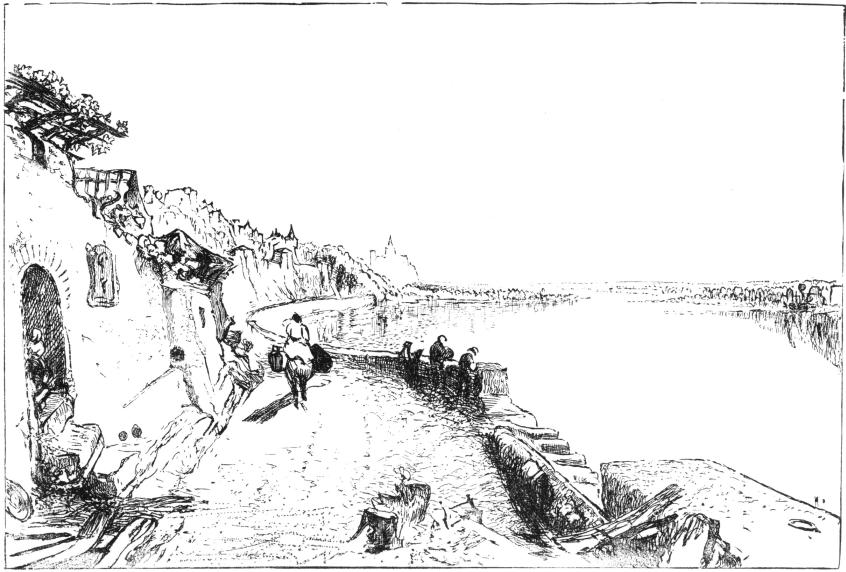
73. Loire-side.
These banks are excavated by the peasantry, partly for houses, partly for cellars, so economizing vineyard space above; and thus a kind of continuous village runs along the river-side, composed half of caves, half of rude buildings, backed by the cliff, propped against it, therefore always leaning away from the river; mingled with overlappings of vineyard trellis from above, and little towers or summer-houses for outlook, when the grapes are ripe, or for gossip over the garden wall.
§ 3. It is an autumnal evening, then, by this Loire side. The day has been hot, and the air is heavy and misty still; the sunlight warm, but dim; the brown vine-leaves motionless: all else quiet. Not a sail in sight on the river,1 its strong, noiseless current lengthening the stream of low sunlight.
The motive of the picture, therefore, is the expression of rude but perfect peace, slightly mingled with an indolent languor and despondency; the peace between intervals of enforced labor; happy, but listless, and having little care or hope about the future; cutting its home out of this gravel bank, and letting the vine and the river twine and undermine as they will; careless to mend or build, so long as the walls hold together, and the black fruit swells in the sunshine.
§ 4. To get this repose, together with rude stability, we have therefore horizontal lines and bold angles. The grand horizontal space and sweep of Turner’s distant river show perhaps better in the etching than in the Plate; but depend wholly for value on the piece of near wall. It is the vertical line of its dark side which drives the eye up into the distance, right against the horizontal, and so makes it felt, while the flatness of the stone prepares the eye to understand the flatness of the river. Farther: hide with your finger the little ring on that stone, and you will find the river has stopped flowing. That ring is to repeat the curved lines of the river bank, which express its line of current, and to bring the feeling of them down near us. On the other side of the road the horizontal lines are taken up again by the dark pieces of wood, without which we should still lose half our space.
Next: The repose is to be not only perfect, but indolent: the repose of out-wearied people: not caring much what becomes of them.
You see the road is covered with litter. Even the crockery is left outside the cottage to dry in the sun, after being washed up. The steps of the cottage door have been too high for comfort originally, only it was less trouble to cut three large stones than four or five small. They are now all aslope and broken, not repaired for years. Their weighty forms increase the sense of languor throughout the scene, and of stability also, because we feel how difficult it would be to stir them. The crockery has its work to do also;—the arched door on the left being necessary to show the great thickness of walls and the strength they require to prevent falling in of the cliff above;—as the horizontal lines must be diffused on the right, so this arch must be diffused on the left; and the large round plate on one side of the steps, with the two small ones on the other, are to carry down the element of circular curvature. Hide them, and see the result.
As they carry the arched group of forms down, the arched window-shutter diffuses it upwards, where all the lines of the distant buildings suggest one and the same idea of disorderly and careless strength, mingling masonry with rock.
§ 5. So far of the horizontal and curved lines. How of the radiating ones? What has the black vine trellis got to do?
Lay a pencil or ruler parallel with its lines. You will find that they point to the massive building in the distance. To which, as nearly as is possible without at once showing the artifice, every other radiating line points also; almost ludicrously when it is once pointed out; even the curved line of the top of the terrace runs into it, and the last sweep of the river evidently leads to its base. And so nearly is it in the exact centre of the picture, that one diagonal from corner to corner passes through it, and the other only misses the base by the twentieth of an inch.
If you are accustomed to France, you will know in a moment by its outline that this massive building is an old church.
Without it, the repose would not have been essentially the laborer’s rest—rest as of the Sabbath. Among all the groups of lines that point to it, two are principal: the first, those of the vine trellis: the second, those of the handles of the saw left in the beam:—the blessing of human life and its labor.
Whenever Turner wishes to express profound repose, he puts in the foreground some instrument of labor cast aside. See, in Roger’s Poems, the last vignette, “Datur hora quieti,” with the plough in the furrow; and in the first vignette of the same book, the scythe on the shoulder of the peasant going home. (There is nothing about the scythe in the passage of the poem which this vignette illustrates.)
§ 6. Observe, farther, the outline of the church itself. As our habitations are, so is our church, evidently a heap of old, but massive, walls, patched, and repaired, and roofed in, and over and over, until its original shape is hardly recognizable. I know the kind of church well—can tell even here, two miles off, that I shall find some Norman arches in the apse, and a flamboyant porch, rich and dark, with every statue broken out of it; and a rude wooden belfry above all; and a quantity of miserable shops built in among the buttresses; and that I may walk in and out as much as I please, but that how often soever, I shall always find some one praying at the Holy Sepulchre, in the darkest aisle, and my going in and out will not disturb them. For they are praying, which in many a handsomer and highlier-furbished edifice might, perhaps, not be so assuredly the case.
§ 7. Lastly: What kind of people have we on this winding road? Three indolent ones, leaning on the wall to look over into the gliding water; and a matron with her market panniers, by her figure, not a fast rider. The road, besides, is bad, and seems unsafe for trotting, and she has passed without disturbing the cat, who sits comfortably on the block of wood in the middle of it.
§ 8. Next to this piece of quietness, let us glance at a composition in which the motive is one of tumult: that of the Fall of Schaffhausen. It is engraved in the Keepsake. I have etched in Plate 74, at the top, the chief lines of its composition,2 in which the first great purpose is to give swing enough to the water. The line of fall is straight and monotonous in reality. Turner wants to get the great concave sweep and rush of the river well felt, in spite of the unbroken form. The column of spray, rocks, mills, and bank, all radiate like a plume, sweeping round together in grand curves to the left, where the group of figures, hurried about the ferry boat, rises like a dash of spray; they also radiating: so as to form one perfectly connected cluster, with the two gens-d’armes and the millstones; the millstones at the bottom being the root of it; the two soldiers laid right and left to sustain the branch of figures beyond, balanced just as a tree bough would be.
§ 9. One of the gens-d’armes is flirting with a young lady in a round cap and full sleeves, under pretence of wanting her to show him what she has in her bandbox. The motive of which flirtation is, so far as Turner is concerned in it, primarily the bandbox: this and the millstones below, give him a series of concave lines, which, concentrated by the recumbent soldiers, intensify the hollow sweep of the fall, precisely as the ring on the stone does the Loire eddies. These curves are carried out on the right by the small plate of eggs, laid to be washed at the spring; and, all these concave lines being a little too quiet and recumbent, the staggering casks are set on the left, and the ill-balanced milk-pail on the right, to give a general feeling of things being rolled over and over. The things which are to give this sense of rolling are dark, in order to hint at the way in which the cataract rolls boulders of rock; while the forms which are to give the sense of its sweeping force are white. The little spring, splashing out of its pine-trough, is to give contrast with the power of the fall,—while it carries out the general sense of splashing water.
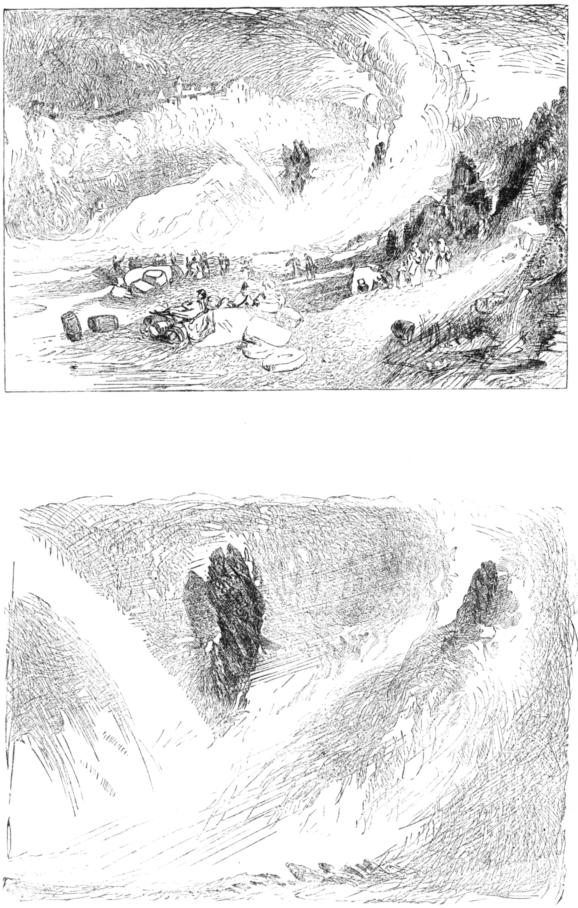
74. The Mill-stream.
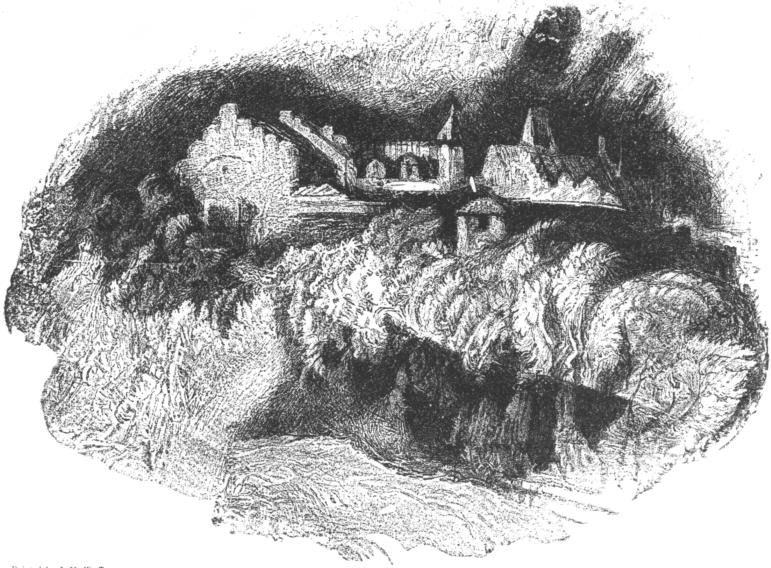
Painted by J. N. W. Turner Drawn by J. Ruskin. Engraved by R. P. Cuff.
75. The Castle of Lauffen.
§ 10. This spring exists on the spot, and so does everything else in the picture; but the combinations are wholly arbitrary; it being Turner’s fixed principle to collect out of any scene whatever was characteristic, and put it together just as he liked. The changes made in this instance are highly curious. The mills have no resemblance whatever to the real group as seen from this spot; for there is a vulgar and formal dwelling-house in front of them. But if you climb the rock behind them, you find they form on that side a towering cluster, which Turner has put with little modification into the drawing. What he has done to the mills, he has done with still greater audacity to the central rock. Seen from this spot, it shows, in reality, its greatest breadth, and is heavy and uninteresting; but on the Lauffen side, exposes its consumed base, worn away by the rush of water, which Turner resolving to show, serenely draws the rock as it appears from the other side of the Rhine, and brings that view of it over to this side. I have etched the bit with the rock a little larger below; and if the reader knows the spot, he will see that this piece of the drawing, reversed in the etching, is almost a bonâ fide unreversed study of the fall from the Lauffen side.3
Finally, the castle of Lauffen itself, being, when seen from this spot, too much foreshortened to show its extent, Turner walks a quarter of a mile lower down the river, draws the castle accurately there, brings it back with him, and puts it in all its extent, where he chooses to have it, beyond the rocks.
I tried to copy and engrave this piece of the drawing of its real size, merely to show the forms of the trees, drifted back by the breeze from the fall, and wet with its spray; but in the endeavor to facsimile the touches, great part of their grace and ease has been lost; still, Plate 75 may, if compared with the same piece in the Keepsake engraving, at least show that the original drawing has not yet been rendered with completeness.
§ 11. These two examples may sufficiently serve to show the mode in which minor details, both in form and spirit, are used by Turner to aid his main motives; of course I cannot, in the space of this volume, go on examining subjects at this length, even if I had time to etch them; but every design of Turner’s would be equally instructive, examined in a similar manner. Thus far, however, we have only seen the help of the parts to the whole: we must give yet a little attention to the mode of combining the smallest details.
I am always led away, in spite of myself, from my proper subject here, invention formal, or the merely pleasant placing of lines and masses, into the emotional results of such arrangement.
The chief reason of this is that the emotional power can be explained; but the perfection of formative arrangement, as I said, cannot be explained, any more than that of melody in music. An instance or two of it, however, may be given.
§ 12. Much fine formative arrangement depends on a more or less elliptical or pear-shaped balance of the group, obtained by arranging the principal members of it on two opposite curves, and either centralizing it by some powerful feature at the base, centre, or summit; or else clasping it together by some conspicuous point or knot. A very small object will often do this satisfactorily.
If you can get the complete series of Lefèbre’s engravings from Titian and Veronese, they will be quite enough to teach you, in their dumb way, everything that is teachable of composition; at all events, try to get the Madonna, with St. Peter and St. George under the two great pillars; the Madonna and Child, with mitred bishop on her left, and St. Andrew on her right; and Veronese’s Triumph of Venice. The first of these Plates unites two formative symmetries; that of the two pillars, clasped by the square altar-cloth below and cloud above, catches the eye first; but the main group is the fivefold one rising to the left, crowned by the Madonna. St. Francis and St. Peter form its two wings, and the kneeling portrait figures, its base. It is clasped at the bottom by the key of St. Peter, which points straight at the Madonna’s head, and is laid on the steps solely for this purpose; the curved lines, which enclose the group, meet also in her face; and the straight line of light, on the cloak of the nearest senator, points at her also. If you have Turner’s Liber Studiorum, turn to the Lauffenburg, and compare the figure group there: a fivefold chain, one standing figure, central; two recumbent, for wings; two half-recumbent, for bases; and a cluster of weeds to clasp. Then turn to Lefèbre’s Europa (there are two in the series—I mean the one with the two tree trunks over her head). It is a wonderful ninefold group. Europa central; two stooping figures, each surmounted by a standing one, for wings; a cupid on one side, and dog on the other, for bases; a cupid and trunk of tree, on each side, to terminate above; and a garland for clasp.
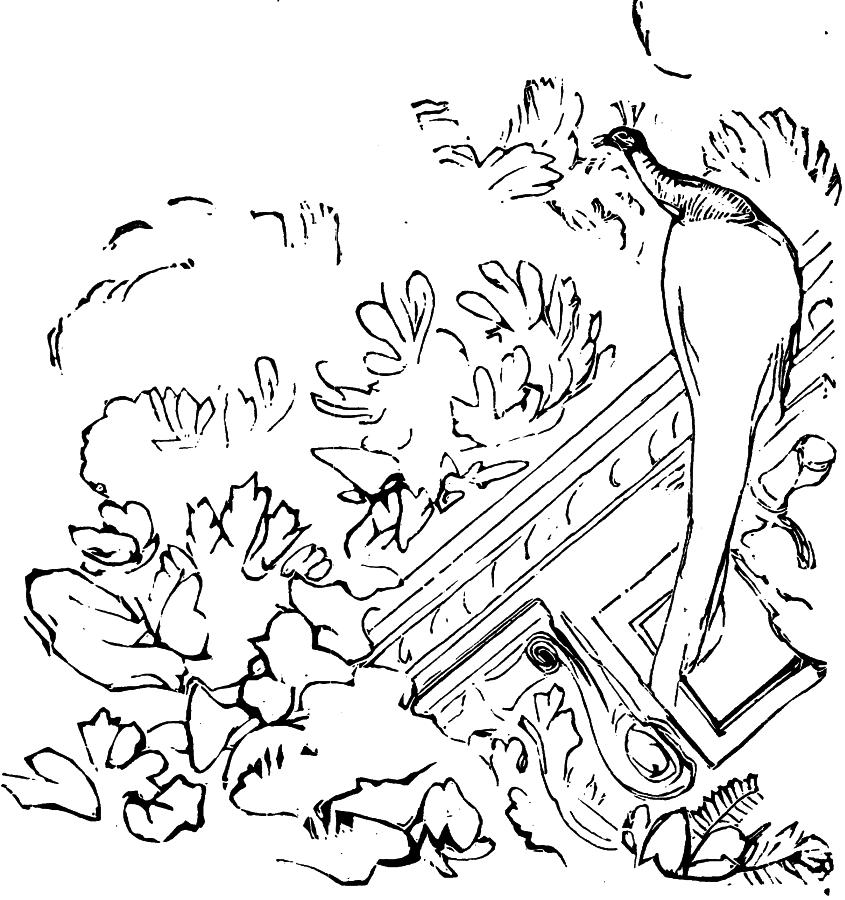
Fig. 94.
§ 13. Fig. 94, page 171, will serve to show the mode in which similar arrangements are carried into the smallest detail. It is magnified four times from a cluster of leaves in the foreground of the “Isis” (Liber Studiorum). Figs. 95 and 96, page 172, show the arrangement of the two groups composing it; the lower is purely symmetrical, with trefoiled centre and broad masses for wings; the uppermost is a sweeping continuous curve, symmetrical, but foreshortened. Both are clasped by arrow-shaped leaves. The two whole groups themselves are, in turn, members of another larger group, composing the entire foreground, and consisting of broad dock-leaves, with minor clusters on the right and left, of which these form the chief portion on the right side.
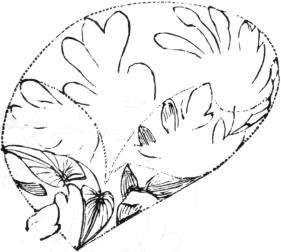
Fig. 95.
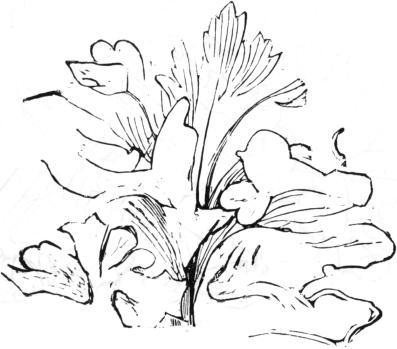
Fig. 96.
§ 14. Unless every leaf, and every visible point or object, however small, forms a part of some harmony of this kind (these symmetrical conditions being only the most simple and obvious), it has no business in the picture. It is the necessary connection of all the forms and colors, down to the last touch, which constitutes great or inventive work, separated from all common work by an impassable gulf.
By diligently copying the etchings of the Liber Studiorum, the reader may, however, easily attain the perception of the existence of these relations, and be prepared to understand Turner’s more elaborate composition. It would take many figures to disentangle and explain the arrangements merely of the leaf cluster, Fig. 78, facing page 97; but that there is a system, and that every leaf has a fixed value and place in it, can hardly but be felt at a glance.
It is curious that, in spite of all the constant talkings of “composition” which goes on among art students, true composition is just the last thing which appears to be perceived. One would have thought that in this group, at least, the value of the central black leaf would have been seen, of which the principal function is to point towards, and continue, the line of bank above. See Plate 62. But a glance at the published Plate in the England series will show that no idea of the composition had occurred to the engraver’s mind. He thought any leaves would do, and supplied them from his own repertory of hack vegetation.
§ 15. I would willingly enlarge farther on this subject—it is a favorite one with me; but the figures required for any exhaustive treatment of it would form a separate volume. All that I can do is to indicate, as these examples do sufficiently, the vast field open to the student’s analysis if he cares to pursue the subject; and to mark for the general reader these two strong conclusions:—that nothing in great work is ever either fortuitous or contentious.
It is not fortuitous; that is to say, not left to fortune. The “must do it by a kind of felicity” of Bacon is true; it is true also that an accident is often suggestive to an inventor. Turner himself said, “I never lose an accident.” But it is this not losing it, this taking things out of the hands of Fortune, and putting them into those of force and foresight, which attest the master. Chance may sometimes help, and sometimes provoke, a success; but must never rule, and rarely allure.
And, lastly, nothing must be contentious. Art has many uses and many pleasantnesses; but of all its services, none are higher than its setting forth, by a visible and enduring image, the nature of all true authority and freedom; Authority which defines and directs the action of benevolent law; and Freedom which consists in deep and soft consent of individual4 helpfulness.
1 The sails in the engraving were put in to catch the public eye. There are none in the drawing.
2 These etchings of compositions are all reversed, for they are merely sketches on the steel, and I cannot sketch easily except straight from the drawing, and without reversing. The looking-glass plagues me with cross lights. As examples of composition, it does not the least matter which way they are turned; and the reader may see this Schaffhausen subject from the right side of the Rhine, by holding the book before a glass. The rude indications of the figures in the Loire subject are nearly facsimiles of Turner’s.
3 With the exception of the jagged ledge rising out of the foam below which comes from the north side, and is admirable in its expression of the position of the limestone-beds, which, rising from below the drift gravel of Constance, are the real cause of the fall of Schaffhausen.
4 “Individual,” that is to say, distinct and separate in character, though joined in purpose. I might have enlarged on this head, but that all I should care to say has been already said admirably by Mr. J. S. Mill in his essay on Liberty.
CHAPTER III.
THE RULE OF THE GREATEST.
§ 1. In the entire range of art principles, none perhaps present a difficulty so great to the student, or require from the teacher expression so cautious, and yet so strong, as those which concern the nature and influence of magnitude.
In one sense, and that deep, there is no such thing as magnitude. The least thing is as the greatest, and one day as a thousand years, in the eyes of the Maker of great and small things. In another sense, and that close to us and necessary, there exist both magnitude and value. Though not a sparrow falls to the ground unnoted, there are yet creatures who are of more value than many; and the same Spirit which weighs the dust of the earth in a balance, counts the isles as a little thing.
§ 2. The just temper of human mind in this matter may, nevertheless, be told shortly. Greatness can only be rightly estimated when minuteness is justly reverenced. Greatness is the aggregation of minuteness; nor can its sublimity be felt truthfully by any mind unaccustomed to the affectionate watching of what is least.
But if this affection for the least be unaccompanied by the powers of comparison and reflection; if it be intemperate in its thirst, restless in curiosity, and incapable of the patient and self-commandant pause which is wise to arrange, and submissive to refuse, it will close the paths of noble art to the student as effectually, and hopelessly, as even the blindness of pride, or impatience of ambition.
§ 3. I say the paths of noble art, not of useful art. All accurate investigation will have its reward; the morbid curiosity will at least slake the thirst of others, if not its own; and the diffused and petty affections will distribute, in serviceable measure, their minute delights and narrow discoveries. The opposite error, the desire of greatness as such, or rather of what appears great to indolence and vanity;—the instinct which I have described in the “Seven Lamps,” noting it, among the Renaissance builders, to be an especial and unfailing sign of baseness of mind, is as fruitless as it is vile; no way profitable—every way harmful: the widest and most corrupting expression of vulgarity. The microscopic drawing of an insect may be precious; but nothing except disgrace and misguidance will ever be gathered from such work as that of Haydon or Barry.
§ 4. The work I have mostly had to do, since this essay was begun, has been that of contention against such debased issues of swollen insolence and windy conceit; but I have noticed lately, that some lightly-budding philosophers have depreciated true greatness; confusing the relations of scale, as they bear upon human instinct and morality; reasoning as if a mountain were no nobler than a grain of sand, or as if many souls were not of mightier interest than one. To whom it must be shortly answered that the Lord of power and life knew which were His noblest works, when He bade His servant watch the play of the Leviathan, rather than dissect the spawn of the minnow; and that when it comes to practical question whether a single soul is to be jeoparded for many, and this Leonidas, or Curtius, or Winkelried shall abolish—so far as abolishable—his own spirit, that he may save more numerous spirits, such question is to be solved by the simple human instinct respecting number and magnitude, not by reasonings on infinity:—
“Le navigateur, qui, la nuit, voit l’océan étinceler de lumière, danser en guirlandes de feu, s’égaye d’abord de ce spectacle. Il fait dix lieues; la guirlande s’allonge indéfiniment, elle s’agite, se tord, se noue, aux mouvements de la lame; c’est un serpent monstrueux qui va toujours s’allongeant, jusqu’à trente lieues, quarante lieues. Et tout cela n’est qu’une danse d’animalcules imperceptibles. En quel nombre? A cette question l’imagination s’effraye; elle sent là une nature de puissance immense, de richesse epouvantable.... Que sont ces petits des petits? Rien moins que les constructeurs du globe où nous sommes. De leurs corps, de leurs débris, ils ont préparé le sol qui est sous nos pas.... Et ce sont les plus petits qui ont fait les plus grandes choses. L’imperceptible rhizopode s’est bâti un monument bien autre que les pyramides, pas moins que l’Italie centrale, une notable partie de la chaîne des Apennins. Mais c’était trop peu encore; les masses énormes du Chili, les prodigieuses Cordillères, qui regardent le monde à leurs pieds, sont le monument funéraire où cet être insaisissable, et pour ainsi dire, invisible, a enseveli les débris de son espèce dïsparue.”—(Michelet: L’Insecte.)
§ 5. In these passages, and those connected with them in the chapter from which they are taken, itself so vast in scope, and therefore so sublime, we may perhaps find the true relations of minuteness, multitude, and magnitude. We shall not feel that there is no such thing as littleness, or no such thing as magnitude. Nor shall we be disposed to confuse a Volvox with the Cordilleras; but we may learn that they both are bound together by links of eternal life and toil; we shall see the vastest thing noble, chiefly for what it includes; and the meanest for what it accomplishes. Thence we might gather—and the conclusion will be found in experience true—that the sense of largeness would be most grateful to minds capable of comprehending, balancing, and comparing; but capable also of great patience and expectation; while the sense of minute wonderfulness would be attractive to minds acted upon by sharp, small, penetrative sympathies, and apt to be impatient, irregular, and partial. This fact is curiously shown in the relations between the temper of the great composers and the modern pathetic school. I was surprised at the first rise of that school, now some years ago, by observing how they restrained themselves to subjects which in other hands would have been wholly uninteresting (compare Vol. IV., p. 19); and in their succeeding efforts, I saw with increasing wonder, that they were almost destitute of the power of feeling vastness, or enjoying the forms which expressed it. A mountain or great building only appeared to them as a piece of color of a certain shape. The powers it represented, or included, were invisible to them. In general they avoided subjects expressing space or mass, and fastened on confined, broken, and sharp forms; liking furze, fern, reeds, straw, stubble, dead leaves, and such like, better than strong stones, broad-flowing leaves, or rounded hills: in all such greater things, when forced to paint them, they missed the main and mighty lines; and this no less in what they loved than in what they disliked; for though fond of foliage, their trees always had a tendency to congeal into little acicular thorn-hedges, and never tossed free. Which modes of choice proceed naturally from a petulant sympathy with local and immediately visible interests or sorrows, not regarding their large consequences, nor capable of understanding more massive view or more deeply deliberate mercifulness;—but peevish and horror-struck, and often incapable of self-control, though not of self-sacrifice. There are more people who can forget themselves than govern themselves.
This narrowly pungent and bitter virtue has, however, its beautiful uses, and is of special value in the present day, when surface-work, shallow generalization, and cold arithmetical estimates of things, are among the chief dangers and causes of misery which men have to deal with.
§ 6. On the other hand, and in clear distinction from all such workers, it is to be remembered that the great composers, not less deep in feeling, are in the fixed habit of regarding as much the relations and positions, as the separate nature, of things; that they reap and thrash in the sheaf, never pluck ears to rub in the hand; fish with net, not line, and sweep their prey together within great cords of errorless curve;—that nothing ever bears to them a separate or isolated aspect, but leads or links a chain of aspects—that to them it is not merely the surface, nor the substance, of anything that is of import; but its circumference and continence: that they are pre-eminently patient and reserved; observant, not curious;—comprehensive, not conjectural; calm exceedingly; unerring, constant, terrible in steadfastness of intent; unconquerable: incomprehensible: always suggesting, implying, including, more than can be told.