Front matter (continued 6)
Reading edition
§ 18. There is, moreover, one distinction of the very highest import between the treatment of sacred subjects by Venetian painters and by all others.
Throughout the rest of Italy, piety had become abstract, and opposed theoretically to worldly life; hence the Florentine and Umbrian painters generally separated their saints from living men. They delighted in imagining scenes of spiritual perfectness;—Paradises, and companies of the redeemed at the judgment;—glorified meetings of martyrs;—madonnas surrounded by circles of angels. If, which was rare, definite portraitures of living men were introduced, these real characters formed a kind of chorus or attendant company, taking no part in the action. At Venice all this was reversed, and so boldly as at first to shock, with its seeming irreverence, a spectator accustomed to the formalities and abstractions of the so-called sacred schools. The madonnas are no more seated apart on their thrones, the saints no more breathe celestial air. They are on our own plain ground—nay, here in our houses with us. All kind of worldly business going on in their presence, fearlessly; our own friends and respected acquaintances, with all their mortal faults, and in their mortal flesh, looking at them face to face unalarmed: nay, our dearest children playing with their pet dogs at Christ’s very feet.
I once myself thought this irreverent. How foolishly! As if children whom He loved could play anywhere else.
§ 19. The picture most illustrative of this feeling is perhaps that at Dresden, of Veronese’s family, painted by himself.
He wishes to represent them as happy and honored. The best happiness and highest honor he can imagine for them is that they should be presented to the Madonna, to whom, therefore, they are being brought by the three virtues—Faith, Hope, and Charity.
The Virgin stands in a recess behind two marble shafts, such as may be seen in any house belonging to an old family in Venice. She places the boy Christ on the edge of a balustrade before her. At her side are St. John the Baptist, and St. Jerome. This group occupies the left side of the picture. The pillars, seen sideways, divide it from the group formed by the Virtues, with the wife and children of Veronese. He himself stands a little behind, his hands clasped in prayer.
§ 20. His wife kneels full in front, a strong Venetian woman, well advanced in years. She has brought up her children in fear of God, and is not afraid to meet the Virgin’s eyes. She gazes steadfastly on them; her proud head and gentle, self-possessed face are relieved in one broad mass of shadow against a space of light, formed by the white robes of Faith, who stands beside her,—guardian, and companion. Perhaps a somewhat disappointing Faith at the first sight, for her face is not in any way exalted or refined. Veronese knew that Faith had to companion simple and slow-hearted people perhaps oftener than able or refined people—does not therefore insist on her being severely intellectual, or looking as if she were always in the best company. So she is only distinguished by her pure white (not bright white) dress, her delicate hand, her golden hair drifted in light ripples across her breast, from which the white robes fall nearly in the shape of a shield—the shield of Faith. A little behind her stands Hope; she also, at first, not to most people a recognizable Hope. We usually paint Hope as young, and joyous. Veronese knows better. That young hope is vain hope—passing away in rain of tears; but the Hope of Veronese is aged, assured, remaining when all else had been taken away. “For tribulation worketh patience, and patience experience, and experience hope;” and that hope maketh not ashamed.
She has a black veil on her head.
Then again, in the front, is Charity, red-robed; stout in the arms,—a servant of all work, she; but small-headed, not being specially given to thinking; soft-eyed, her hair braided brightly, her lips rich red, sweet-blossoming. She has got some work to do even now, for a nephew of Veronese’s is doubtful about coming forward, and looks very humbly and penitently towards the Virgin—his life perhaps not having been quite so exemplary as might at present be wished. Faith reaches her small white hand lightly back to him, lays the tips of her fingers on his; but Charity takes firm hold of him by the wrist from behind, and will push him on presently, if he still hangs back.
§ 21. In front of the mother kneel her two eldest children, a girl of about sixteen, and a boy a year or two younger. They are both wrapt in adoration—the boy’s being the deepest. Nearer us, at their left side, is a younger boy, about nine years old—a black-eyed fellow, full of life—and evidently his father’s darling (for Veronese has put him full in light in the front; and given him a beautiful white silken jacket, barred with black, that nobody may ever miss seeing him to the end of time). He is a little shy about being presented to the Madonna, and for the present has got behind the pillar, blushing, but opening his black eyes wide; he is just summoning courage to peep round, and see if she looks kind. A still younger child, about six years old, is really frightened, and has run back to his mother, catching hold of her dress at the waist. She throws her right arm round him and over him, with exquisite instinctive action, not moving her eyes from the Madonna’s face. Last of all, the youngest child, perhaps about three years old, is neither frightened nor interested, but finds the ceremony tedious, and is trying to coax the dog to play with him; but the dog, which is one of the little curly, short-nosed, fringy-pawed things, which all Venetian ladies petted, will not now be coaxed. For the dog is the last link in the chain of lowering feeling, and takes his doggish views of the matter. He cannot understand, first, how the Madonna got into the house; nor, secondly, why she is allowed to stay, disturbing the family, and taking all their attention from his dogship. And he is walking away, much offended.
§ 22. The dog is thus constantly introduced by the Venetians in order to give the fullest contrast to the highest tones of human thought and feeling. I shall examine this point presently farther, in speaking of pastoral landscape and animal painting; but at present we will merely compare the use of the same mode of expression in Veronese’s Presentation of the Queen of Sheba.
§ 23. This picture is at Turin, and is of quite inestimable value. It is hung high; and the really principal figure—the Solomon, being in the shade, can hardly be seen, but is painted with Veronese’s utmost tenderness, in the bloom of perfect youth, his hair golden, short, crisply curled. He is seated high on his lion throne; two elders on each side beneath him, the whole group forming a tower of solemn shade. I have alluded, elsewhere, to the principle on which all the best composers act, of supporting these lofty groups by some vigorous mass of foundation. This column of noble shade is curiously sustained. A falconer leans forward from the left-hand side, bearing on his wrist a snow-white falcon, its wings spread, and brilliantly relieved against the purple robe of one of the elders. It touches with its wings one of the golden lions of the throne, on which the light also flashes strongly; thus forming, together with it, the lion and eagle symbol, which is the type of Christ throughout mediæval work. In order to show the meaning of this symbol, and that Solomon is typically invested with the Christian royalty, one of the elders, by a bold anachronism, holds a jewel in his hand of the shape of a cross, with which he (by accident of gesture) points to Solomon; his other hand is laid on an open book.
§ 24. The group opposite, of which the queen forms the centre, is also painted with Veronese’s highest skill; but contains no point of interest bearing on our present subject, except its connection by a chain of descending emotion. The Queen is wholly oppressed and subdued; kneeling, and nearly fainting, she looks up to Solomon with tears in her eyes; he, startled by fear for her, stoops forward from the throne, opening his right hand, as if to support her, so as almost to drop the sceptre. At her side her first maid of honor is kneeling also, but does not care about Solomon; and is gathering up her dress that it may not be crushed; and looking back to encourage a negro girl, who, carrying two toy-birds, made of enamel and jewels, for presenting to the King, is frightened at seeing her Queen fainting, and does not know what she ought to do; while lastly, the Queen’s dog, another of the little fringy-paws, is wholly unabashed by Solomon’s presence, or anybody else’s; and stands with his fore legs well apart, right in front of his mistress, thinking everybody has lost their wits; and barking violently at one of the attendants, who has set down a golden vase disrespectfully near him.
§ 25. Throughout these designs I want the reader to notice the purpose of representing things as they were likely to have occurred, down to trivial, or even ludicrous detail—the nobleness of all that was intended to be noble being so great that nothing could detract from it. A farther instance, however, and a prettier one, of this familiar realization, occurs in a Holy Family, by Veronese, at Brussels. The Madonna has laid the infant Christ on a projecting base of pillar, and stands behind, looking down on him. St. Catherine, having knelt down in front, the child turns round to receive her—so suddenly, and so far, that any other child must have fallen over the edge of the stone. St. Catherine, terrified, thinking he is really going to fall, stretches out her arms to catch him. But the Madonna looking down, only smiles, “He will not fall.”
§ 26. A more touching instance of this realization occurs, however, in the treatment of the saint Veronica (in the Ascent to Calvary), at Dresden. Most painters merely represent her as one of the gentle, weeping, attendant women; and show her giving the handkerchief as though these women had been allowed to approach Christ without any difficulty. But in Veronese’s conception, she has to break through the executioners to him. She is not weeping; and the expression of pity, though intense, is overborne by that of resolution. She is determined to reach Christ; has set her teeth close, and thrusts aside one of the executioners, who strikes fiercely at her with a heavy doubled cord.
§ 27. These instances are enough to explain the general character of the mind of Veronese, capable of tragic power to the utmost, if he chooses to exert it in that direction, but, by habitual preference, exquisitely graceful and playful; religious without severity, and winningly noble; delighting in slight, sweet, every-day incident, but hiding deep meanings underneath it; rarely painting a gloomy subject, and never a base one.
§ 28. I have, in other places, entered enough into the examination of the great religious mind of Tintoret; supposing then that he was distinguished from Titian chiefly by this character. But in this I was mistaken; the religion of Titian is like that of Shakspere—occult behind his magnificent equity. It is not possible, however, within the limits of this work, to give any just account of the mind of Titian: nor shall I attempt it; but will only explain some of those more strange and apparently inconsistent attributes of it, which might otherwise prevent the reader from getting clue to its real tone. The first of these is its occasional coarseness in choice of type of feature.
§ 29. In the second volume I had to speak of Titian’s Magdalen, in the Pitti Palace, as treated basely, and that in strong terms, “the disgusting Magdalen of the Pitti.”
Truly she is so as compared with the received types of the Magdalen. A stout, redfaced woman, dull, and coarse of feature, with much of the animal in even her expression of repentance—her eyes strained, and inflamed with weeping. I ought, however, to have remembered another picture of the Magdalen by Titian (Mr. Rogers’s, now in the National Gallery), in which she is just as refined, as in the Pitti Palace she is gross; and had I done so, I should have seen Titian’s meaning. It had been the fashion before his time to make the Magdalen always young and beautiful; her, if no one else, even the rudest painters flattered; her repentance was not thought perfect unless she had lustrous hair and lovely lips. Titian first dared to doubt the romantic fable, and reject the narrowness of sentimental faith. He saw that it was possible for plain women to love no less than beautiful ones; and for stout persons to repent as well as those more delicately made. It seemed to him that the Magdalen would have received her pardon not the less quickly because her wit was none of the readiest; and would not have been regarded with less compassion by her Master because her eyes were swollen, or her dress disordered. It is just because he has set himself sternly to enforce this lesson that the picture is so painful: the only instance, so far as I remember, of Titian’s painting a woman markedly and entirely belonging to the lowest class.
§ 30. It may perhaps appear more difficult to account for the alternation of Titian’s great religious pictures with others devoted wholly to the expression of sensual qualities, or to exulting and bright representation of heathen deities.
The Venetian mind, we have said, and Titian’s especially, as the central type of it, was wholly realist, universal, and manly.
In this breadth and realism, the painter saw that sensual passion in man was, not only a fact, but a Divine fact; the human creature, though the highest of the animals, was, nevertheless, a perfect animal, and his happiness, health, and nobleness depended on the due power of every animal passion, as well as the cultivation of every spiritual tendency.
He thought that every feeling of the mind and heart, as well as every form of the body, deserved painting. Also to a painter’s true and highly trained instinct, the human body is the loveliest of all objects. I do not stay to trace the reasons why, at Venice, the female body could be found in more perfect beauty than the male; but so it was, and it becomes the principal subject therefore, both with Giorgione and Titian. They painted it fearlessly, with all right and natural qualities; never, however, representing it as exercising any overpowering attractive influence on man; but only on the Faun or Satyr.
Yet they did this so majestically that I am perfectly certain no untouched Venetian picture ever yet excited one base thought (otherwise than in base persons anything may do so); while in the greatest studies of the female body by the Venetians, all other characters are overborne by majesty, and the form becomes as pure as that of a Greek statue.
§ 31. There is no need, I should think, to point out how this contemplation of the entire personal nature was reconcilable with the severest conceptions of religious duty and faith.
But the fond introduction of heathen gods may appear less explicable.
On examination, however, it will be found, that these deities are never painted with any heart-reverence or affection. They are introduced for the most part symbolically (Bacchus and Venus oftenest, as incarnations of the spirit of revelry and beauty), of course always conceived with deep imaginative truth, much resembling the mode of Keats’s conception; but never so as to withdraw any of the deep devotion referred to the objects of Christian faith.
In all its roots of power, and modes of work;—in its belief, its breadth, and its judgment, I find the Venetian mind perfect.
How, then, did its art so swiftly pass away? How become, what it became unquestionably, one of the chief causes of the corruption of the mind of Italy, and of her subsequent decline in moral and political power?
§ 32. By reason of one great, one fatal fault;—recklessness in aim. Wholly noble in its sources, it was wholly unworthy in its purposes.
Separate and strong, like Samson, chosen from its youth, and with the spirit of God visibly resting on it,—like him, it warred in careless strength, and wantoned in untimely pleasure. No Venetian painter ever worked with any aim beyond that of delighting the eye, or expressing fancies agreeable to himself or flattering to his nation. They could not be either unless they were religious. But he did not desire the religion. He desired the delight.
The Assumption is a noble picture, because Titian believed in the Madonna. But he did not paint it to make any one else believe in her. He painted it because he enjoyed rich masses of red and blue, and faces flushed with sunlight.
Tintoret’s Paradise is a noble picture, because he believed in Paradise. But he did not paint it to make any one think of heaven; but to form a beautiful termination for the hall of the greater council.
Other men used their effete faiths and mean faculties with a high moral purpose. The Venetian gave the most earnest faith, and the lordliest faculty, to gild the shadows of an ante-chamber, or heighten the splendors of a holiday.
§ 33. Strange, and lamentable as this carelessness may appear, I find it to be almost the law with the great workers. Weak and vain men have acute consciences, and labor under a profound sense of responsibility. The strong men, sternly disdainful of themselves, do what they can, too often merely as it pleases them at the moment, reckless what comes of it.
I know not how far in humility, or how far in bitter and hopeless levity, the great Venetians gave their art to be blasted by the sea-winds or wasted by the worm. I know not whether in sorrowful obedience, or in wanton compliance, they fostered the folly, and enriched the luxury of their age. This only I know, that in proportion to the greatness of their power was the shame of its desecration and the suddenness of its fall. The enchanter’s spell, woven by centuries of toil, was broken in the weakness of a moment; and swiftly, and utterly, as a rainbow vanishes, the radiance and the strength faded from the wings of the Lion.
1 Anacreon, Ode 12th.
2 Herod, i. 59.
3 Lucian (Micyllus).
4 Aristophanes, Plutus.
5 Hippias Major, 208.

CHAPTER IV.
DURER AND SALVATOR.
“EMIGRAVIT.”
§ 1. By referring to the first analysis of our subject, it will be seen we have next to examine the art which cannot conquer the evil, but remains at war with, or in captivity to it.
Up to the time of the Reformation it was possible for men even of the highest powers of intellect to obtain a tranquillity of faith, in the highest degree favorable to the pursuit of any particular art. Possible, at least, we see it to have been; there is no need—nor, so far as I see, any ground, for argument about it. I am myself unable to understand how it was so; but the fact is unquestionable. It is not that I wonder at men’s trust in the Pope’s infallibility, or in his virtue; nor at their surrendering their private judgment; nor at their being easily cheated by imitations of miracles; nor at their thinking indulgences could be purchased with money. But I wonder at this one thing only; the acceptance of the doctrine of eternal punishment as dependent on accident of birth, or momentary excitement of devotional feeling. I marvel at the acceptance of the system (as stated in its fulness by Dante) which condemned guiltless persons to the loss of heaven because they had lived before Christ, and which made the obtaining of Paradise turn frequently on a passing thought or a momentary invocation. How this came to pass, it is no part of our work here to determine. That in this faith, it was possible to attain entire peace of mind; to live calmly, and die hopefully, is indisputable.
§ 2. But this possibility ceased at the Reformation. Thenceforward human life became a school of debate, troubled and fearful. Fifteen hundred years of spiritual teaching were called into fearful question, whether indeed it had been teaching by angels or devils? Whatever it had been, there was no longer any way of trusting it peacefully.
A dark time for all men. We cannot now conceive it. The great horror of it lay in this:—that, as in the trial-hour of the Greek, the heavens themselves seemed to have deceived those who had trusted in them.
“We had prayed with tears; we had loved with our hearts. There was no choice of way open to us. No guidance from God or man, other than this, and behold, it was a lie. ‘When He, the Spirit of Truth, is come, He shall guide you into all truth.’ And He has guided us into no truth. There can be no such Spirit. There is no Advocate, no Comforter. Has there been no Resurrection?”
§ 3. Then came the Resurrection of Death. Never since man first saw him, face to face, had his terror been so great. “Swallowed up in victory:” alas! no; but king over all the earth. All faith, hope, and fond belief were betrayed. Nothing of futurity was now sure but the grave.
For the Pan-Athenaic Triumph and the Feast of Jubilee, there came up, through fields of spring, the dance of Death.
The brood of weak men fled from the face of him. A new Bacchus and his crew this, with worm for snake and gall for wine. They recoiled to such pleasure as yet remained possible to them—feeble infidelities, and luxurious sciences, and so went their way.
§ 4. At least, of the men with whom we are concerned—the artists—this was almost the universal fate. They gave themselves to the following of pleasure only; and as a religious school, after a few pale rays of fading sanctity from Guido, and brown gleams of gipsy Madonnahood from Murillo, came utterly to an end.
Three men only stood firm, facing the new Dionysiac revel, to see what would come of it.
Two in the north, Holbein and Durer, and, later, one in the south, Salvator.
But the ground on which they stood differed strangely; Durer and Holbein, amidst the formal delights, the tender religions, and practical science, of domestic life and honest commerce. Salvator, amidst the pride of lascivious wealth, and the outlawed distress of impious poverty.
§ 5. It would be impossible to imagine any two phases of scenery or society more contrary in character, more opposite in teaching, than those surrounding Nuremberg and Naples, in the sixteenth and seventeenth centuries. What they were then, both districts still to all general intents remain. The cities have in each case lost their splendor and power, but not their character. The surrounding scenery remains wholly unchanged. It is still in our power, from the actual aspect of the places, to conceive their effect on the youth of the two painters.
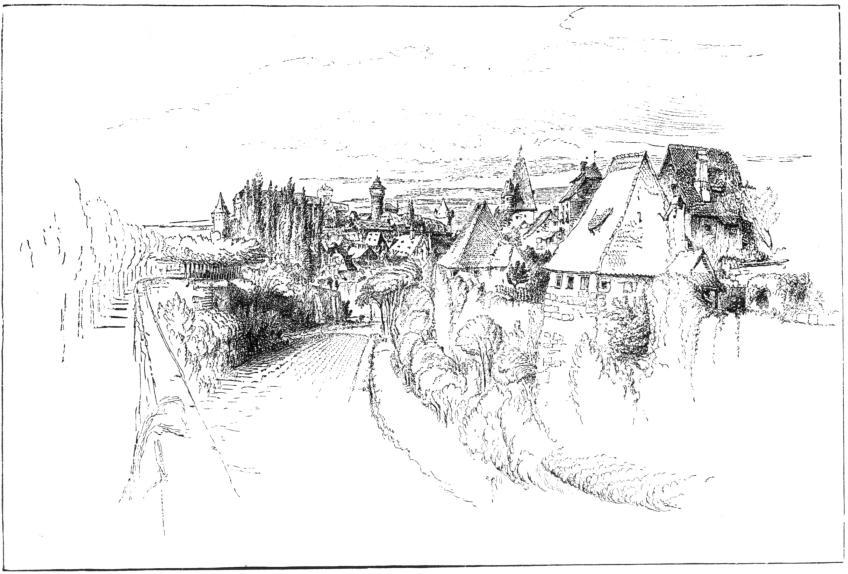
76. The Moat of Nuremberg.
§ 6. Nuremberg is gathered at the base of a sandstone rock, rising in the midst of a dry but fertile plain. The rock forms a prolonged and curved ridge, of which the concave side, at the highest point, is precipitous; the other slopes gradually to the plain. Fortified with wall and tower along its whole crest, and crowned with a stately castle, it defends the city—not with its precipitous side—but with its slope. The precipice is turned to the town. It wears no aspect of hostility towards the surrounding fields; the roads lead down into them by gentle descents from the gates. To the south and east the walls are on the level of the plain; within them, the city itself stands on two swells of hill, divided by a winding river. Its architecture has, however, been much overrated. The effect of the streets, so delightful to the eye of the passing traveller, depends chiefly on one appendage of the roof, namely, its warehouse windows. Every house, almost without exception, has at least one boldly opening dormer window, the roof of which sustains a pulley for raising goods; and the underpart of this strong overhanging roof is always carved with a rich pattern, not of refined design, but effective.1 Among these comparatively modern structures are mingled, however, not unfrequently, others, turreted at the angles, which are true Gothic of the fifteenth, some of the fourteenth, century; and the principal churches remain nearly as in Durer’s time. Their Gothic is none of it good, nor even rich (though the façades have their ornament so distributed as to give them a sufficiently elaborate effect at a distance); their size is diminutive; their interiors mean, rude, and ill-proportioned, wholly dependent for their interest on ingenious stone cutting in corners, and finely-twisted ironwork; of these the mason’s exercises are in the worst possible taste, possessing not even the merit of delicate execution; but the designs in metal are usually meritorious, and Fischer’s shrine of St. Sebald is good, and may rank with Italian work.2
§ 7. Though, however, not comparable for an instant to any great Italian or French city, Nuremberg possesses one character peculiar to itself, that of a self-restrained, contented, quaint domesticity. It would be vain to expect any first-rate painting, sculpture, or poetry, from the well-regulated community of merchants of small ware. But it is evident they were affectionate and trustworthy—that they had playful fancy, and honorable pride. There is no exalted grandeur in their city, nor any deep beauty; but an imaginative homeliness, mingled with some elements of melancholy and power, and a few even of grace.
This homeliness, among many other causes, arises out of one in chief. The richness of the houses depends, as I just said, on the dormer windows: but their deeper character on the pitch and space of roofs. I had to notice long ago how much our English cottage depended for expression on its steep roof. The German house does so in far greater degree. Plate 76 is engraved3 from a slight pen-and-ink sketch of mine on the ramparts of Nuremberg, showing a piece of its moat and wall, and a little corner of the city beneath the castle; of which the tower on the extreme right rises just in front of Durer’s house. The character of this scene approaches more nearly that which Durer would see in his daily walks, than most of the modernized inner streets. In Durer’s own engraving, “The Cannon,” the distance (of which the most important passage is facsimiled in my Elements of Drawing, p. 111) is an actual portrait of part of the landscape seen from those castle ramparts, looking towards Franconian Switzerland.
§ 8. If the reader will be at the pains to turn to it, he will see at a glance the elements of the Nuremberg country, as they still exist. Wooden cottages, thickly grouped, enormously high in the roofs; the sharp church spire, small and slightly grotesque, surmounting them; beyond, a richly cultivated, healthy plain bounded by woody hills. By a strange coincidence the very plant which constitutes the staple produce of those fields, is in almost ludicrous harmony with the grotesqueness and neatness of the architecture around; and one may almost fancy that the builders of the little knotted spires and turrets of the town, and workers of its dark iron flowers, are in spiritual presence, watching and guiding the produce of the field,—when one finds the footpaths bordered everywhere, by the bossy spires and lustrous jetty flowers of the black hollyhock.
§ 9. Lastly, when Durer penetrated among those hills of Franconia he would find himself in a pastoral country, much resembling the Gruyère districts of Switzerland, but less thickly inhabited, and giving in its steep, though not lofty, rocks,—its scattered pines,—and its fortresses and chapels, the motives of all the wilder landscape introduced by the painter in such pieces as his St. Jerome, or St. Hubert. His continual and forced introduction of sea in almost every scene, much as it seems to me to be regretted, is possibly owing to his happy recollections of the sea-city where he received the rarest of all rewards granted to a good workman; and, for once in his life, was understood.
§ 10. Among this pastoral simplicity and formal sweetness of domestic peace, Durer had to work out his question concerning the grave. It haunted him long; he learned to engrave death’s heads well before he had done with it; looked deeper than any other man into those strange rings, their jewels lost; and gave answer at last conclusively in his great Knight and Death—of which more presently. But while the Nuremberg landscape is still fresh in our minds, we had better turn south quickly and compare the elements of education which formed, and of creation which companioned, Salvator.
§ 11. Born with a wild and coarse nature (how coarse I will show you soon), but nevertheless an honest one, he set himself in youth hotly to the war, and cast himself carelessly on the current of life. No rectitude of ledger-lines stood in his way; no tender precision of household customs; no calm successions of rural labor. But past his half-starved lips rolled profusion of pitiless wealth; before him glared and swept the troops of shameless pleasure. Above him muttered Vesuvius; beneath his feet shook the Solfatara.
In heart disdainful, in temper adventurous; conscious of power, impatient of labor, and yet more of the pride of the patrons of his youth, he fled to the Calabrian hills, seeking, not knowledge, but freedom. If he was to be surrounded by cruelty and deceit, let them at least be those of brave men or savage beasts, not of the timorous and the contemptible. Better the wrath of the robber, than enmity of the priest; and the cunning of the wolf than of the hypocrite.
§ 12. We are accustomed to hear the south of Italy spoken of as a beautiful country. Its mountain forms are graceful above others, its sea-bays exquisite in outline and hue; but it is only beautiful in superficial aspect. In closer detail it is wild and melancholy. Its forests are sombre-leafed, labyrinth-stemmed; the carubbe, the olive, laurel, and ilex, are alike in that strange feverish twisting of their branches, as if in spasms of half human pain:—Avernus forests; one fears to break their boughs, lest they should cry to us from their rents; the rocks they shade are of ashes, or thrice-molten lava; iron sponge, whose every pore has been filled with fire. Silent villages, earthquake-shaken, without commerce, without industry, without knowledge, without hope, gleam in white ruin from hill-side to hill-side; far-winding wrecks of immemorial walls surround the dust of cities long forsaken: the mountain streams moan through the cold arches of their foundations, green with weed, and rage over the heaps of their fallen towers. Far above, in thunder-blue serration, stand the eternal edges of the angry Apennine, dark with rolling impendence of volcanic cloud.
§ 13. Yet even among such scenes as these, Salvator might have been calmed and exalted, had he been, indeed, capable of exaltation. But he was not of high temper enough to perceive beauty. He had not the sacred sense—the sense of color; all the loveliest hues of the Calabrian air were invisible to him; the sorrowful desolation of the Calabrian villages unfelt. He saw only what was gross and terrible,—the jagged peak, the splintered tree, the flowerless bank of grass, and wandering weed, prickly and pale. His temper confirmed itself in evil, and became more and more fierce and morose; though not, I believe, cruel, ungenerous, or lascivious. I should not suspect Salvator of wantonly inflicting pain. His constantly painting it does not prove he delighted in it; he felt the horror of it, and in that horror, fascination. Also, he desired fame, and saw that here was an untried field rich enough in morbid excitement to catch the humor of his indolent patrons. But the gloom gained upon him, and grasped him. He could jest, indeed, as men jest in prison-yards (he became afterwards a renowned mime in Florence); his satires are full of good mocking, but his own doom to sadness is never repealed.
§ 14. Of all men whose work I have ever studied, he gives me most distinctly the idea of a lost spirit. Michelet calls him “Ce damné Salvator,” perhaps in a sense merely harsh and violent; the epithet to me seems true in a more literal, more merciful sense,—“That condemned Salvator.” I see in him, notwithstanding all his baseness, the last traces of spiritual life in the art of Europe. He was the last man to whom the thought of a spiritual existence presented itself as a conceivable reality. All succeeding men, however powerful—Rembrandt, Rubens, Vandyke, Reynolds—would have mocked at the idea of a spirit. They were men of the world; they are never in earnest, and they are never appalled. But Salvator was capable of pensiveness, of faith, and of fear. The misery of the earth is a marvel to him; he cannot leave off gazing at it. The religion of the earth is a horror to him. He gnashes his teeth at it, rages at it, mocks and gibes at it. He would have acknowledged religion, had he seen any that was true. Anything rather than that baseness which he did see. “If there is no other religion than this of pope and cardinals, let us to the robber’s ambush and the dragon’s den.” He was capable of fear also. The gray spectre, horse-headed, striding across the sky—(in the Pitti Palace)—its bat wings spread, green bars of the twilight seen between its bones; it was no play to him—the painting of it. Helpless Salvator! A little early sympathy, a word of true guidance, perhaps, had saved him. What says he of himself? “Despiser of wealth and of death.” Two grand scorns; but, oh, condemned Salvator! the question is not for man what he can scorn, but what he can love.
§ 15. I do not care to trace the various hold which Hades takes on this fallen soul. It is no part of my work here to analyze his art, nor even that of Durer; all that we need to note is the opposite answer they gave to the question about death.
To Salvator it came in narrow terms. Desolation, without hope, throughout the fields of nature he had to explore; hypocrisy and sensuality, triumphant and shameless, in the cities from which he derived his support. His life, so far as any nobility remained in it, could only pass in horror, disdain, or despair. It is difficult to say which of the three prevails most in his common work; but his answer to the great question was of despair only. He represents “Umana Fragilita” by the type of a skeleton with plumy wings, leaning over a woman and child; the earth covered with ruin round them—a thistle, casting its seed, the only fruit of it. “Thorns, also, and thistles shall it bring forth to thee.” The same tone of thought marks all Salvator’s more earnest work.
§ 16. On the contrary, in the sight of Durer, things were for the most part as they ought to be. Men did their work in his city and in the fields round it. The clergy were sincere. Great social questions unagitated; great social evils either non-existent, or seemingly a part of the nature of things, and inevitable. His answer was that of patient hope; and twofold, consisting of one design in praise of Fortitude, and another in praise of Labor. The Fortitude, commonly known as the “Knight and Death,” represents a knight riding through a dark valley overhung by leafless trees, and with a great castle on a hill beyond. Beside him, but a little in advance, rides Death on a pale horse. Death is gray-haired and crowned;—serpents wreathed about his crown; (the sting of death involved in the kingly power). He holds up the hour-glass, and looks earnestly into the knight’s face. Behind him follows Sin; but Sin powerless; he has been conquered and passed by, but follows yet, watching if any way of assault remains. On his forehead are two horns—I think, of sea-shell—to indicate his insatiableness and instability. He has also the twisted horns of the ram, for stubbornness, the ears of an ass, the snout of a swine, the hoofs of a goat. Torn wings hang useless from his shoulders, and he carries a spear with two hooks, for catching as well as wounding. The knight does not heed him, nor even Death, though he is conscious of the presence of the last.
He rides quietly, his bridle firm in his hand, and his lips set close in a slight sorrowful smile, for he hears what Death is saying; and hears it as the word of a messenger who brings pleasant tidings, thinking to bring evil ones. A little branch of delicate heath is twisted round his helmet. His horse trots proudly and straight; its head high, and with a cluster of oak on the brow where on the fiend’s brow is the sea-shell horn. But the horse of Death stoops its head; and its rein catches the little bell which hangs from the knight’s horse-bridle, making it toll, as a passing bell.4
§ 17. Durer’s second answer is the plate of “Melencholia,” which is the history of the sorrowful toil of the earth, as the “Knight and Death” is of its sorrowful patience under temptation.
Salvator’s answer, remember, is in both respects that of despair. Death as he reads, lord of temptation, is victor over the spirit of man; and lord of ruin, is victor over the work of man. Durer declares the sad, but unsullied conquest over Death the tempter; and the sad, but enduring conquest over Death the destroyer.
§ 18. Though the general intent of the Melencholia is clear, and to be felt at a glance, I am in some doubt respecting its special symbolism. I do not know how far Durer intended to show that labor, in many of its most earnest forms, is closely connected with the morbid sadness, or “dark anger,” of the northern nations. Truly some of the best work ever done for man, has been in that dark anger;5 but I have not yet been able to determine for myself how far this is necessary, or how far great work may also be done with cheerfulness. If I knew what the truth was, I should be able to interpret Durer better; meantime the design seems to me his answer to the complaint, “Yet is his strength labor and sorrow.”
“Yes,” he replies, “but labor and sorrow are his strength.”
§ 19. The labor indicated is in the daily work of men. Not the inspired or gifted labor of the few (it is labor connected with the sciences, not with the arts), shown in its four chief functions: thoughtful, faithful, calculating and executing.
Thoughtful, first; all true power coming of that resolved, resistless calm of melancholy thought. This is the first and last message of the whole design. Faithful, the right arm of the spirit resting on the book. Calculating (chiefly in the sense of self-command), the compasses in her right hand. Executive—roughest instruments of labor at her feet: a crucible, and geometrical solids, indicating her work in the sciences. Over her head the hour-glass and the bell, for their continual words, “Whatsoever thy hand findeth to do.” Beside her, childish labor (lesson-learning?) sitting on an old millstone, with a tablet on its knees. I do not know what instrument it has in its hand. At her knees, a wolf-hound asleep. In the distance, a comet (the disorder and threatening of the universe) setting, the rainbow dominant over it. Her strong body is close girded for work; at her waist hang the keys of wealth; but the coin is cast aside contemptuously under her feet. She has eagles’ wings, and is crowned with fair leafage of spring.
Yes, Albert of Nuremberg, it was a noble answer, yet an imperfect one. This is indeed the labor which is crowned with laurel and has the wings of the eagle. It was reserved for another country to prove, for another hand to portray, the labor which is crowned with fire, and has the wings of the bat.
1 To obtain room for the goods, the roofs slope steeply, and their other dormer windows are richly carved—but all are of wood; and, for the most part, I think, some hundred years later than Durer’s time. A large number of the oriel and bow windows on the façades are wooden also, and of recent date.
2 His piece in the cathedral of Magdeburg is strangely inferior, wanting both the grace of composition and bold handling of the St. Sebald’s. The bronze fountains at Nuremberg (three, of fame, in as many squares) are highly wrought, and have considerable merit; the ordinary ironwork of the houses, with less pretension, is, perhaps, more truly artistic. In Plate 52, the right-hand figure is a characteristic example of the bell-handle at the door of a private house, composed of a wreath of flowers and leafage twisted in a spiral round an upright rod, the spiral terminating below in a delicate tendril; the whole of wrought iron. It is longer than represented, some of the leaf-links of the chain being omitted in the dotted spaces, as well as the handle, which, though often itself of leafage, is always convenient for the hand.
3 By Mr. Le Keux, very admirably.
4 This was first pointed out to me by a friend—Mr. Robin Allen. It is a beautiful thought; yet, possibly, an after-thought, I have some suspicion that there is an alteration in the plate at that place, and that the rope to which the bell hangs was originally the line of the chest of the nearer horse, as the grass-blades about the lifted hind leg conceal the lines which could not, in Durer’s way of work, be effaced, indicating its first intended position. What a proof of his general decision of handling is involved in this “repentir”!
5 “Yet withal, you see that the Monarch is a great, valiant, cautious, melancholy, commanding man”—Friends in Council, last volume, p. 269; Milverton giving an account of Titian’s picture of Charles the Fifth. (Compare Ellesmere’s description of Milverton himself, p. 140.) Read carefully also what is said further on respecting Titian’s freedom, and fearless with holding of flattery; comparing it with the note on Giorgione and Titian.
CHAPTER V.
CLAUDE AND POUSSIN.
§ 1. It was stated in the last chapter that Salvator was the last painter of Italy on whom any fading trace of the old faithful spirit rested. Carrying some of its passion far into the seventeenth century, he deserved to be remembered together with the painters whom the questioning of the Reformation had exercised, eighty years before. Not so his contemporaries. The whole body of painters around him, but chiefly those of landscape, had cast aside all regard for the faith of their fathers, or for any other; and founded a school of art properly called “classical,”1 of which the following are the chief characteristics.
§ 2. The belief in a supreme benevolent Being having ceased, and the sense of spiritual destitution fastening on the mind, together with the hopeless perception of ruin and decay in the existing world, the imagination sought to quit itself from the oppression of these ideas by realizing a perfect worldly felicity, in which the inevitable ruin should at least be lovely, and the necessarily short life entirely happy and refined. Labor must be banished, since it was to be unrewarded. Humiliation and degradation of body must be prevented since there could be no compensation for them by preparation of the soul for another world. Let us eat and drink (refinedly), for to-morrow we die, and attain the highest possible dignity as men in this world, since we shall have none as spirits in the next.
§ 3. Observe, this is neither the Greek nor the Roman spirit. Neither Claude, nor Poussin, nor any other painter or writer, properly termed “classical,” ever could enter into the Greek or Roman heart, which was as full, in many cases fuller, of the hope of immortality than our own.
On the absence of belief in a good supreme Being, follows, necessarily, the habit of looking to ourselves for supreme judgment in all matters, and for supreme government. Hence, first, the irreverent habit of judgment instead of admiration. It is generally expressed under the justly degrading term “good taste.”
§ 4. Hence, in the second place, the habit of restraint or self-government (instead of impulsive and limitless obedience), based upon pride, and involving, for the most part, scorn of the helpless and weak, and respect only for the orders of men who have been trained to this habit of self-government. Whence the title classical, from the Latin classicus.
§ 5. The school is, therefore, generally to be characterized as that of taste and restraint. As the school of taste, everything is, in its estimation, beneath it, so as to be tasted or tested; not above it, to be thankfully received. Nothing was to be fed upon as bread; but only palated as a dainty. This spirit has destroyed art since the close of the sixteenth century, and nearly destroyed French literature, our English literature being at the same time severely depressed, and our education (except in bodily strength) rendered nearly nugatory by it, so far as it affects common-place minds. It is not possible that the classical spirit should ever take possession of a mind of the highest order. Pope is, as far as I know, the greatest man who ever fell strongly under its influence; and though it spoiled half his work, he broke through it continually into true enthusiasm and tender thought.2 Again, as the school of reserve, it refuses to allow itself in any violent or “spasmodic” passion; the schools of literature which have been in modern times called “spasmodic,” being reactionary against it. The word, though an ugly one, is quite accurate, the most spasmodic books in the world being Solomon’s Song, Job, and Isaiah.
§ 6. The classical landscape, properly so called, is therefore the representative of perfectly trained and civilized human life, associated with perfect natural scenery and with decorative spiritual powers.
I will expand this definition a little.
1. Perfectly civilized human life; that is, life freed from the necessity of humiliating labor, from passions inducing bodily disease, and from abusing misfortune. The personages of the classical landscape, therefore, must be virtuous and amiable; if employed in labor, endowed with strength such as may make it not oppressive. (Considered as a practicable ideal, the classical life necessarily implies slavery, and the command, therefore, of a higher order of men over a lower, occupied in servile work.) Pastoral occupation is allowable as a contrast with city life. War, if undertaken by classical persons, must be a contest for honor, more than for life, not at all for wealth,3 and free from all fearful or debasing passion. Classical persons must be trained in all the polite arts, and, because their health is to be perfect, chiefly in the open air. Hence, the architecture around them must be of the most finished kind, the rough country and ground being subdued by frequent and happy humanity.
§ 7. 2. Such personages and buildings must be associated with natural scenery, uninjured by storms or inclemency of climate (such injury implying interruption of the open air life); and it must be scenery conducing to pleasure, not to material service; all cornfields, orchards, olive-yards, and such like, being under the management of slaves,4 and the superior beings having nothing to do with them; but passing their lives under avenues of scented and otherwise delightful trees—under picturesque rocks, and by clear fountains.
§ 8. 3. The spiritual powers in classical scenery must be decorative; ornamental gods, not governing gods; otherwise they could not be subjected to the principles of taste, but would demand reverence. In order, therefore, as far as possible, without taking away their supernatural power, to destroy their dignity, they are made more criminal and capricious than men, and, for the most part, those only are introduced who are the lords of lascivious pleasures. For the appearance of any great god would at once destroy the whole theory of the classical life; therefore, Pan, Bacchus, and the Satyrs, with Venus and the Nymphs, are the principal spiritual powers of the classical landscape. Apollo with the Muses appear as the patrons of the liberal arts. Minerva rarely presents herself (except to be insulted by judgment of Paris); Juno seldom, except for some purpose of tyranny; Jupiter seldom, but for purpose of amour.
§ 9. Such being the general ideal of the classical landscape, it can hardly be necessary to show the reader how such charm as it possesses must in general be strong only over weak or second-rate orders of mind. It has, however, been often experimentally or playfully aimed at by great men; but I shall only take note of its two leading masters.
§ 10. I. Claude. As I shall have no farther occasion to refer to this painter, I will resume, shortly, what has been said of him throughout the work. He had a fine feeling for beauty of form and considerable tenderness of perception. Vol. I., p. 76; vol. III., p. 318. His aërial effects are unequalled. Vol. III., p. 318. Their character appears to me to arise rather from a delicacy of bodily constitution in Claude, than from any mental sensibility; such as they are, they give a kind of feminine charm to his work, which partly accounts for its wide influence. To whatever the character may be traced, it reads him incapable of enjoying or painting anything energetic or terrible. Hence the weakness of his conceptions of rough sea. Vol. I., p. 77.
II. He had sincerity of purpose. Vol. III., p. 318. But in common with other landscape painters of his day, neither earnestness, humility, nor love, such as would ever cause him to forget himself. Vol. I., p. 77.
That is to say, so far as he felt the truth, he tried to be true; but he never felt it enough to sacrifice supposed propriety, or habitual method to it. Very few of his sketches, and none of his pictures, show evidence of interest in other natural phenomena than the quiet afternoon sunshine which would fall methodically into a composition. One would suppose he had never seen scarlet in a morning cloud, nor a storm burst on the Apennines. But he enjoys a quiet misty afternoon in a ruminant sort of way (Vol. III., p. 322), yet truly; and strives for the likeness of it, therein differing from Salvator, who never attempts to be truthful, but only to be impressive.
§ 11. III. His seas are the most beautiful in old art. Vol. I., p. 345. For he studied tame waves, as he did tame skies, with great sincerity, and some affection; and modelled them with more care not only than any other landscape painter of his day, but even than any of the greater men; for they, seeing the perfect painting of sea to be impossible, gave up the attempt, and treated it conventionally. But Claude took so much pains about this, feeling it was one of his fortes, that I suppose no one can model a small wave better than he.
IV. He first set the pictorial sun in the pictorial heaven. Vol. III., p. 318. We will give him the credit of this, with no drawbacks.
V. He had hardly any knowledge of physical science (Vol. I., p. 76), and shows a peculiar incapacity of understanding the main point of a matter. Vol. III., p. 321. Connected with which incapacity is his want of harmony in expression. Vol. II., p. 151. (Compare, for illustration of this, the account of the picture of the Mill in the preface to Vol. I.)
§ 12. Such were the principal qualities of the leading painter of classical landscape, his effeminate softness carrying him to dislike all evidences of toil, or distress, or terror, and to delight in the calm formalities which mark the school.
Although he often introduces romantic incidents and mediæval as well as Greek or Roman personages, his landscape is always in the true sense classic—everything being “elegantly” (selectingly or tastefully), not passionately, treated. The absence of indications of rural labor, of hedges, ditches, haystacks, ploughed fields, and the like; the frequent occurrence of ruins of temples, or masses of unruined palaces; and the graceful wildness of growth in his trees, are the principal sources of the “elevated” character which so many persons feel in his scenery.
There is no other sentiment traceable in his work than this weak dislike to entertain the conception of toil or suffering. Ideas of relation, in the true sense, he has none; nor ever makes an effort to conceive an event in its probable circumstances, but fills his foregrounds with decorative figures, using commonest conventionalism to indicate the subject he intends. We may take two examples, merely to show the general character of such designs of his.
§ 13. 1. St. George and the Dragon.
The scene is a beautiful opening in woods by a river side, a pleasant fountain springs on the right, and the usual rich vegetation covers the foreground. The dragon is about the size of ten bramble leaves, and is being killed by the remains of a lance, barely the thickness of a walking-stick, in his throat, curling his tail in a highly offensive and threatening manner. St. George, notwithstanding, on a prancing horse, brandishes his sword, at about thirty yards’ distance from the offensive animal.
A semicircular shelf of rocks encircles the foreground, by which the theatre of action is divided into pit and boxes. Some women and children having descended unadvisedly into the pit, are helping each other out of it again, with marked precipitation. A prudent person of rank has taken a front seat in the boxes,—crosses his legs, leans his head on his hand, and contemplates the proceedings with the air of a connoisseur. Two attendants stand in graceful attitudes behind him, and two more walk away under the trees, conversing on general subjects.
§ 14. 2. Worship of the Golden Calf.
The scene is nearly the same as that of the St. George; but, in order better to express the desert of Sinai, the river is much larger, and the trees and vegetation softer. Two people, uninterested in the idolatrous ceremonies, are rowing in a pleasure boat on the river. The calf is about sixteen inches long (perhaps, we ought to give Claude credit for remembering that it was made of ear-rings, though he might as well have inquired how large Egyptian ear-rings were). Aaron has put it on a handsome pillar, under which five people are dancing, and twenty-eight, with several children, worshipping. Refreshments for the dancers are provided in four large vases under a tree on the left, presided over by a dignified person holding a dog in a leash. Under the distant group of trees appears Moses, conducted by some younger personage (Nadab or Abihu). This younger personage holds up his hands, and Moses, in the way usually expected of him, breaks the tables of the law, which are as large as an ordinary octavo volume.
§ 15. I need not proceed farther, for any reader of sense or ordinary powers of thought can thus examine the subjects of Claude, one by one, for himself. We may quit him with these few final statements concerning him.
The admiration of his works was legitimate, so far as it regarded their sunlight effects and their graceful details. It was base, in so far as it involved irreverence both for the deeper powers of nature, and carelessness as to conception of subject. Large admiration of Claude is wholly impossible in any period of national vigor in art. He may by such tenderness as he possesses, and by the very fact of his banishing painfulness, exercise considerable influence over certain classes of minds; but this influence is almost exclusively hurtful to them.
§ 16. Nevertheless, on account of such small sterling qualities as they possess, and of their general pleasantness, as well as their importance in the history of art, genuine Claudes must always possess a considerable value, either as drawing-room ornaments or museum relics. They may be ranked with fine pieces of China manufacture, and other agreeable curiosities, of which the price depends on the rarity rather than the merit, yet always on a merit of a certain low kind.
§ 17. The other characteristic master of classical landscape is Nicolo Poussin.
I named Claude first, because the forms of scenery he has represented are richer and more general than Poussin’s; but Poussin has a far greater power, and his landscapes, though more limited in material, are incomparably nobler than Claude’s. It would take considerable time to enter into accurate analysis of Poussin’s strong but degraded mind; and bring us no reward, because whatever he has done has been done better by Titian. His peculiarities are, without exception, weaknesses, induced in a highly intellectual and inventive mind by being fed on medals, books, and bassi-relievi instead of nature, and by the want of any deep sensibility. His best works are his Bacchanalian revels, always brightly wanton and wild, full of frisk and fire; but they are coarser than Titian’s, and infinitely less beautiful. In all minglings of the human and brutal character he leans on the bestial, yet with a sternly Greek severity of treatment. This restraint, peculiarly classical, is much too manifest in him; for, owing to his habit of never letting himself be free, he does nothing as well as it ought to be done, rarely even as well as he can himself do it; and his best beauty is poor, incomplete, and characterless, though refined. The Nymph pressing the honey in the “Nursing of Jupiter,” and the Muse leaning against the tree, in the “Inspiration of Poet” (both in the Dulwich Gallery), appear to me examples of about his highest reach in this sphere.
§ 18. His want of sensibility permits him to paint frightful subjects, without feeling any true horror: his pictures of the Plague, the Death of Polydectes, &c., are thus ghastly in incident, sometimes disgusting, but never impressive. The prominence of the bleeding head in the Triumph of David marks the same temper. His battle pieces are cold and feeble; his religious subjects wholly nugatory, they do not excite him enough to develop even his ordinary powers of invention. Neither does he put much power into his landscape when it becomes principal; the best pieces of it occur in fragments behind his figures. Beautiful vegetation, more or less ornamental in character, occurs in nearly all his mythological subjects, but his pure landscape is notable only for its dignified reserve; the great squareness and horizontality of its masses, with lowness of tone, giving it a deeply meditative character. His Deluge might be much depreciated, under this head of ideas of relation, but it is so uncharacteristic of him that I pass it by. Whatever power this lowness of tone, light in the distance, &c., give to his landscape, or to Gaspar’s (compare Vol. II., Chapter on Infinity, § 12), is in both conventional and artificial.
I have nothing, therefore, to add farther, here, to what was said of him in Vol. I. (p. 89); and, as no other older masters of the classical landscape are worth any special note, we will pass on at once to a school of humbler but more vital power.
1 The word “classical” is carelessly used in the preceding volumes, to signify the characters of the Greek or Roman nations. Henceforward, it is used in a limited and accurate sense, as defined in the text.
2 Cold-hearted, I have called him. He was so in writing the Pastorals, of which I then spoke; but in after-life his errors were those of his time, his wisdom was his own; it would be well if we also made it ours.
3 Because the pursuit of wealth is inconsistent at once with the peace and dignity of perfect life.
4 It is curious, as marking the peculiarity of the classical spirit in its resolute degradation of the lower orders, that a sailing-vessel is hardly admissible in a classical landscape, because its management implies too much elevation of the inferior life. But a galley, with oars, is admissible, because the rowers may be conceived as absolute slaves.
CHAPTER VI.
RUBENS AND CUYP.
§ 1. The examination of the causes which led to the final departure of the religious spirit from the hearts of painters, would involve discussion of the whole scope of the Reformation on the minds of persons unconcerned directly in its progress. This is of course impossible.
One or two broad facts only can be stated, which the reader may verify, if he pleases, by his own labor. I do not give them rashly.
§ 2. The strength of the Reformation lay entirely in its being a movement towards purity of practice.
The Catholic priesthood was hostile to it in proportion to the degree in which they had been false to their own principles of moral action, and had become corrupt or worldly in heart.
The Reformers indeed cast out many absurdities, and demonstrated many fallacies, in the teaching of the Roman Catholic Church. But they themselves introduced errors, which rent the ranks, and finally arrested the march of the Reformation, and which paralyze the Protestant Church to this day. Errors of which the fatality was increased by the controversial bent which lost accuracy of meaning in force of declamation, and turned expressions, which ought to be used only in retired depth of thought, into phrases of custom, or watchwords of attack. Owing to which habits of hot, ingenious, and unguarded controversy, the Reformed churches themselves soon forgot the meaning of the word which, of all words, was oftenest in their mouths. They forgot that πίστις is a derivative of πείθομαι, not of πιστεύω, and that “fides,” closely connected with “fio” on one side, and with “confido” on the other, is but distantly related to “credo.”1
§ 3. By whatever means, however, the reader may himself be disposed to admit, the Reformation was arrested; and got itself shut up into chancels of cathedrals in England (even those, generally too large for it), and into conventicles everywhere else. Then rising between the infancy of Reformation, and the palsy of Catholicism;—between a new shell of half-built religion on one side, daubed with untempered mortar, and a falling ruin of outworn religion on the other, lizard-crannied, and ivy-grown;—rose, on its independent foundation, the faithless and materialized mind of modern Europe—ending in the rationalism of Germany, the polite formalism of England, the careless blasphemy of France, and the helpless sensualities of Italy; in the midst of which, steadily advancing science, and the charities of more and more widely extended peace, are preparing the way for a Christian church, which shall depend neither on ignorance for its continuance, nor on controversy for its progress; but shall reign at once in light, and love.
§ 4. The whole body of painters (such of them as were left) necessarily fell into the rationalistic chasm. The Evangelicals despised the arts, while the Roman Catholics were effete or insincere, and could not retain influence over men of strong reasoning power.
The painters could only associate frankly with men of the world, and themselves became men of the world. Men, I mean, having no belief in spiritual existences; no interests or affections beyond the grave.
§ 5. Not but that they still painted scriptural subjects. Altar-pieces were wanted occasionally, and pious patrons sometimes commissioned a cabinet Madonna. But there is just this difference between the men of this modern period, and the Florentines or Venetians—that whereas the latter never exert themselves fully except on a sacred subject, the Flemish and Dutch masters are always languid unless they are profane. Leonardo is only to be seen in the Cena; Titian only in the Assumption; but Rubens only in the Battle of the Amazons, and Vandyck only at court.
§ 6. Altar-pieces, when wanted, of course either of them will supply as readily as anything else. Virgins in blue,2 or St. Johns in red,3 as many as you please. Martyrdoms also, by all means: Rubens especially delights in these. St. Peter, head downwards,4 is interesting anatomically; writhings of impenitent thieves, and bishops having their tongues pulled out, display our powers to advantage, also.5 Theological instruction, if required: “Christ armed with thunder, to destroy the world, spares it at the intercession of St. Francis.”6 Last Judgments even, quite Michael-Angelesque, rich in twistings of limbs, with spiteful biting, and scratching; and fine aërial effects in smoke of the pit.7
§ 7. In all this, however, there is not a vestige of religious feeling or reverence. We have even some visible difficulty in meeting our patron’s pious wishes. Daniel in the lion’s den is indeed an available subject, but duller than a lion hunt; and Mary of Nazareth must be painted, if an order come for her; but (says polite Sir Peter), Mary of Medicis, or Catherine, her bodice being fuller, and better embroidered, would, if we might offer a suggestion, probably give greater satisfaction.
§ 8. No phenomenon in human mind is more extraordinary than the junction of this cold and worldly temper with great rectitude of principle, and tranquil kindness of heart. Rubens was an honorable and entirely well-intentioned man, earnestly industrious, simple and temperate in habits of life, high-bred, learned, and discreet. His affection for his mother was great; his generosity to contemporary artists unfailing. He is a healthy, worthy, kind-hearted, courtly-phrased—Animal—without any clearly perceptible traces of a soul, except when he paints his children. Few descriptions of pictures could be more ludicrous in their pure animalism than those which he gives of his own. “It is a subject,” he writes to Sir D. Carleton, “neither sacred nor profane, although taken from Holy Writ, namely, Sarah in the act of scolding Hagar, who, pregnant, is leaving the house in a feminine and graceful manner, assisted by the patriarch Abram.” (What a graceful apology, by the way, instantly follows, for not having finished the picture himself.) “I have engaged, as is my custom, a very skilful man in his pursuit to finish the landscapes solely to augment the enjoyment of Y. E.!”8
Again, in priced catalogue,—
“50 florins each.—The Twelve Apostles, with a Christ. Done by my scholars, from originals by my own hand, each having to be retouched by my hand throughout.
“600 florins.—A picture of Achilles clothed as a woman; done by the best of my scholars, and the whole retouched by my hand; a most brilliant picture, and full of many beautiful young girls.”
§ 9. Observe, however, Rubens is always entirely honorable in his statements of what is done by himself and what not. He is religious, too, after his manner; hears mass every morning, and perpetually uses the phrase “by the grace of God,” or some other such, in writing of any business he takes in hand; but the tone of his religion may be determined by one fact.
We saw how Veronese painted himself and his family, as worshipping the Madonna.
Rubens has also painted himself and his family in an equally elaborate piece. But they are not worshipping the Madonna. They are performing the Madonna, and her saintly entourage. His favorite wife “En Madone;” his youngest boy “as Christ;” his father-in-law (or father, it matters not which) “as Simeon;” another elderly relation, with a beard, “as St. Jerome;” and he himself “as St. George.”
§ 10. Rembrandt has also painted (it is, on the whole, his greatest picture, so far as I have seen) himself and his wife in a state of ideal happiness. He sits at supper with his wife on his knee, flourishing a glass of champagne, with a roast peacock on the table.
The Rubens is in the Church of St. James at Antwerp; the Rembrandt at Dresden—marvellous pictures, both. No more precious works by either painter exist. Their hearts, such as they have, are entirely in them; and the two pictures, not inaptly, represent the Faith and Hope of the 17th century. We have to stoop somewhat lower, in order to comprehend the pastoral and rustic scenery of Cuyp and Teniers, which must yet be held as forming one group with the historical art of Rubens, being connected with it by Rubens’ pastoral landscape. To these, I say, we must stoop lower; for they are destitute, not of spiritual character only, but of spiritual thought.
Rubens often gives instructive and magnificent allegory; Rembrandt, pathetic or powerful fancies, founded on real scripture reading, and on his interest in the picturesque character of the Jew. And Vandyck, a graceful dramatic rendering of received scriptural legends.
But in the pastoral landscape we lose, not only all faith in religion, but all remembrance of it. Absolutely now at last we find ourselves without sight of God in all the world.
§ 11. So far as I can hear or read, this is an entirely new and wonderful state of things achieved by the Hollanders. The human being never got wholly quit of the terror of spiritual being before. Persian, Egyptian, Assyrian, Hindoo, Chinese, all kept some dim, appalling record of what they called “gods.” Farthest savages had—and still have—their Great Spirit, or, in extremity, their feather idols, large-eyed; but here in Holland we have at last got utterly done with it all. Our only idol glitters dimly, in tangible shape of a pint pot, and all the incense offered thereto, comes out of a small censer or bowl at the end of a pipe. Of deities or virtues, angels, principalities, or powers, in the name of our ditches, no more. Let us have cattle, and market vegetables.
This is the first and essential character of the Holland landscape art. Its second is a worthier one; respect for rural life.
§ 12. I should attach greater importance to this rural feeling, if there were any true humanity in it, or any feeling for beauty. But there is neither. No incidents of this lower life are painted for the sake of the incidents, but only for the effects of light. You will find that the best Dutch painters do not care about the people, but about the lustres on them. Paul Potter, their best herd and cattle painter, does not care even for sheep, but only for wool; regards not cows, but cowhide. He attains great dexterity in drawing tufts and locks, lingers in the little parallel ravines and furrows of fleece that open across sheep’s backs as they turn; is unsurpassed in twisting a horn or pointing a nose; but he cannot paint eyes, nor perceive any condition of an animal’s mind, except its desire of grazing. Cuyp can, indeed, paint sunlight, the best that Holland’s sun can show; he is a man of large natural gift, and sees broadly, nay, even seriously; finds out—a wonderful thing for men to find out in those days—that there are reflections in water, and that boats require often to be painted upside down. A brewer by trade, he feels the quiet of a summer afternoon, and his work will make you marvellously drowsy. It is good for nothing else that I know of: strong; but unhelpful and unthoughtful. Nothing happens in his pictures, except some indifferent person’s asking the way of somebody else, who, by their cast of countenance, seems not likely to know it. For farther entertainment perhaps a red cow and a white one; or puppies at play, not playfully; the man’s heart not going even with the puppies. Essentially he sees nothing but the shine on the flaps of their ears.
§ 13. Observe always, the fault lies not in the thing’s being little, or the incident being slight. Titian could have put issues of life and death into the face of a man asking the way; nay, into the back of him, if he had so chosen. He has put a whole scheme of dogmatic theology into a row of bishops’ backs at the Louvre. And for dogs, Velasquez has made some of them nearly as grand as his surly kings.
Into the causes of which grandeur we must look a little, with respect not only to these puppies, and gray horses, and cattle of Cuyp, but to the hunting pieces of Rubens and Snyders. For closely connected with the Dutch rejection of motives of spiritual interest, is the increasing importance attached by them to animals, seen either in the chase or in agriculture; and to judge justly of the value of this animal painting it will be necessary for us to glance at that of earlier times.
§ 14. And first of the animals which have had more influence over the human soul, in its modern life, than ever Apis or the crocodile had over Egyptian—the dog and horse. I stated, in speaking of Venetian religion, that the Venetians always introduced the dog as a contrast to the high aspects of humanity. They do this, not because they consider him the basest of animals, but the highest—the connecting link between men and animals; in whom the lower forms of really human feeling may be best exemplified, such as conceit, gluttony, indolence, petulance. But they saw the noble qualities of the dog, too;—all his patience, love, and faithfulness; therefore Veronese, hard as he is often on lap-dogs, has painted one great heroic poem on the dog.
§ 15. Two mighty brindled mastiffs, and beyond them, darkness. You scarcely see them at first, against the gloomy green. No other sky for them—poor things. They are gray themselves, spotted with black all over; their multitudinous doggish vices may not be washed out of them,—are in grain of nature. Strong thewed and sinewed, however,—no blame on them as far as bodily strength may reach; their heads coal-black, with drooping ears and fierce eyes, bloodshot a little. Wildest of beasts perhaps they would have been, by nature. But between them stands the spirit of their human Love, dove-winged and beautiful, the resistless Greek boy, golden-quivered; his glowing breast and limbs the only light upon the sky,—purple and pure. He has cast his chain about the dogs’ necks, and holds it in his strong right hand, leaning proudly a little back from them. They will never break loose.
§ 16. This is Veronese’s highest, or spiritual view of the dog’s nature. He can only give this when looking at the creature alone. When he sees it in company with men, he subdues it, like an inferior light in presence of the sky; and generally then gives it a merely brutal nature, not insisting even on its affection. It is thus used in the Marriage in Cana to symbolize gluttony. That great picture I have not yet had time to examine in all its bearings of thought; but the chief purpose of it is, I believe, to express the pomp and pleasure of the world, pursued without thought of the presence of Christ; therefore the Fool with the bells is put in the centre, immediately underneath the Christ; and in front are the couple of dogs in leash, one gnawing a bone. A cat lying on her back scratches at one of the vases which hold the wine of the miracle.
§ 17. In the picture of Susannah, her little pet dog is merely doing his duty, barking at the Elders. But in that of the Magdalen (at Turin) a noble piece of bye-meaning is brought out by a dog’s help. On one side is the principal figure, the Mary washing Christ’s feet; on the other, a dog has just come out from beneath the table (the dog under the table eating of the crumbs), and in doing so, has touched the robe of one of the Pharisees, thus making it unclean. The Pharisee gathers up his robe in a passion, and shows the hem of it to a bystander, pointing to the dog at the same time.
§ 18. In the Supper at Emmaus, the dog’s affection is, however, fully dwelt upon. Veronese’s own two little daughters are playing, on the hither side of the table, with a great wolf-hound, larger than either of them. One with her head down, nearly touching his nose, is talking to him,—asking him questions it seems, nearly pushing him over at the same time:—the other, raising her eyes, half archly, half dreamily,—some far-away thought coming over her,—leans against him on the other side, propping him with her little hand, laid slightly on his neck. He, all passive, and glad at heart, yielding himself to the pushing or sustaining hand, looks earnestly into the face of the child close to his; would answer her with the gravity of a senator, if so it might be:—can only look at her, and love her.
§ 19. To Velasquez and Titian dogs seem less interesting than to Veronese; they paint them simply as noble brown beasts, but without any special character; perhaps Velasquez’s dogs are sterner and more threatening than the Venetian’s, as are also his kings and admirals. This fierceness in the animal increases, as the spiritual power of the artist declines; and, with the fierceness, another character. One great and infallible sign of the absence of spiritual power is the presence of the slightest taint of obscenity. Dante marked this strongly in all his representations of demons, and as we pass from the Venetians and Florentines to the Dutch, the passing away of the soul-power is indicated by every animal becoming savage or foul. The dog is used by Teniers, and many other Hollanders, merely to obtain unclean jest; while by the more powerful men, Rubens, Snyders, Rembrandt, it is painted only in savage chase, or butchered agony. I know no pictures more shameful to humanity than the boar and lion hunts of Rubens and Snyders, signs of disgrace all the deeper, because the powers desecrated are so great. The painter of the village ale-house sign may, not dishonorably, paint the fox-hunt for the village squire; but the occupation of magnificent art-power in giving semblance of perpetuity to those bodily pangs which Nature has mercifully ordained to be transient, and in forcing us, by the fascination of its stormy skill, to dwell on that from which eyes of merciful men should instinctively turn away, and eyes of high-minded men scornfully, is dishonorable, alike in the power which it degrades, and the joy to which it betrays.
§ 20. In our modern treatment of the dog, of which the prevailing tendency is marked by Landseer, the interest taken in him is disproportionate to that taken in man, and leads to a somewhat trivial mingling of sentiment, or warping by caricature; giving up the true nature of the animal for the sake of a pretty thought or pleasant jest. Neither Titian nor Velasquez ever jest; and though Veronese jests gracefully and tenderly, he never for an instant oversteps the absolute facts of nature. But the English painter looks for sentiment or jest primarily, and reaches both by a feebly romantic taint of fallacy, except in one or two simple and touching pictures, such as the Shepherd’s Chief Mourner.
I was pleased by a little unpretending modern German picture at Dusseldorf, by E. Bosch, representing a boy carving a model of his sheep-dog in wood; the dog sitting on its haunches in front of him, watches the progress of the sculpture with a grave interest and curiosity, not in the least caricatured, but highly humorous. Another small picture, by the same artist, of a forester’s boy being taught to shoot by his father,—the dog critically and eagerly watching the raising of the gun,—shows equally true sympathy.
§ 21. I wish I were able to trace any of the leading circumstances in the ancient treatment of the horse, but I have no sufficient data. Its function in the art of the Greeks is connected with all their beautiful fable philosophy; but I have not a tithe of the knowledge necessary to pursue the subject in this direction. It branches into questions relating to sacred animals, and Egyptian and Eastern mythology. I believe the Greek interest in pure animal character corresponded closely to our own, except that it is less sentimental, and either distinctly true or distinctly fabulous; not hesitating between truth and falsehood. Achilles’ horses, like Anacreon’s dove, and Aristophanes’ frogs and birds, speak clearly out, if at all. They do not become feebly human, by fallacies and exaggerations, but frankly and wholly.
Zeuxis’ picture of the Centaur indicates, however, a more distinctly sentimental conception; and I suppose the Greek artists always to have fully appreciated the horse’s fineness of temper and nervous constitution.9 They seem, by the way, hardly to have done justice to the dog. My pleasure in the entire Odyssey is diminished because Ulysses gives not a word of kindness or of regret to Argus.
§ 22. I am still less able to speak of Roman treatment of the horse. It is very strange that in the chivalric ages, he is despised; their greatest painters drawing him with ludicrous neglect. The Venetians, as was natural, painted him little and ill; but he becomes important in the equestrian statues of the fifteenth and sixteenth century, chiefly, I suppose, under the influence of Leonardo.
I am not qualified to judge of the merit of these equestrian statues; but, in painting, I find that no real interest is taken in the horse until Vandyck’s time, he and Rubens doing more for it than all previous painters put together. Rubens was a good rider, and rode nearly every day, as, I doubt not, Vandyck also. Some notice of an interesting equestrian picture of Vandyck’s will be found in the next chapter. The horse has never, I think, been painted worthily again, since he died.10 Of the influence of its unworthy painting, and unworthy use, I do not at present care to speak, noticing only that it brought about in England the last degradations of feeling and of art. The Dutch, indeed, banished all deity from the earth; but I think only in England has death-bed consolation been sought in a fox’s tail.11
I wish, however, the reader distinctly to understand that the expressions of reprobation of field-sports which he will find scattered through these volumes,—and which, in concluding them, I wish I had time to collect and farther enforce—refer only to the chase and the turf; that is to say, to hunting, shooting, and horse-racing, but not to athletic exercises. I have just as deep a respect for boxing, wrestling, cricketing, and rowing, as contempt of all the various modes of wasting wealth, time, land, and energy of soul, which have been invented by the pride and selfishness of men, in order to enable them to be healthy in uselessness, and get quit of the burdens of their own lives, without condescending to make them serviceable to others.
§ 23. Lastly, of cattle.
The period when the interest of men began to be transferred from the ploughman to his oxen is very distinctly marked by Bassano. In him the descent is even greater, being, accurately, from the Madonna to the Manger—one of perhaps his best pictures (now, I believe, somewhere in the north of England), representing an adoration of shepherds with nothing to adore, they and their herds forming the subject, and the Christ being “supposed” at the side. From that time cattle-pieces become frequent, and gradually form a staple art commodity. Cuyp’s are the best; nevertheless, neither by him nor any one else have I ever seen an entirely well-painted cow. All the men who have skill enough to paint cattle nobly, disdain them. The real influence of these Dutch cattle-pieces, in subsequent art, is difficult to trace, and is not worth tracing. They contain a certain healthy appreciation of simple pleasure which I cannot look upon wholly without respect. On the other hand, their cheap tricks of composition degraded the entire technical system of landscape; and their clownish and blunt vulgarities too long blinded us, and continue, so far as in them lies, to blind us yet, to all the true refinement and passion of rural life. There have always been truth and depth of pastoral feeling in the works of great poets and novelists; but never, I think, in painting, until lately. The designs of J. C. Hook are, perhaps, the only works of the kind in existence which deserve to be mentioned in connection with the pastorals of Wordsworth and Tennyson.
We must not, however, yet pass to the modern school, having still to examine the last phase of Dutch design, in which the vulgarities which might be forgiven to the truth of Cuyp, and forgotten in the power of Rubens, became unpardonable and dominant in the works of men who were at once affected and feeble. But before doing this, we must pause to settle a preliminary question, which is an important and difficult one, and will need a separate chapter; namely, What is vulgarity itself?
1 None of our present forms of opinion are more curious than those which have developed themselves from this verbal carelessness. It never seems to strike any of our religious teachers, that if a child has a father living, it either knows it has a father, or does not: it does not “believe” it has a father. We should be surprised to see an intelligent child standing at its garden gate, crying out to the passers-by: “I believe in my father, because he built this house;” as logical people proclaim that they believe in God, because He must have made the world.
2 Dusseldorf.
3 Antwerp.
4 Cologne.
5 Brussels.
6 Brussels.
7 Munich.
8 Original Papers relating to Rubens; edited by W. Sainsbury. London, 1859: page 39. Y. E. is the person who commissioned the picture.
9 “A single harsh word will raise a nervous horse’s pulse ten beats a minute.”—Mr. Rarey.
10 John Lewis has made grand sketches of the horse, but has never, so far as I know, completed any of them. Respecting his wonderful engravings of wild animals, see my pamphlet on Pre-Raphaelitism.
11 See “The Fox-hunter’s Death-bed,” a popular sporting print.
CHAPTER VII.
OF VULGARITY.
§ 1. Two great errors, coloring, or rather discoloring, severally, the minds of the higher and lower classes, have sown wide dissension, and wider misfortune, through the society of modern days. These errors are in our modes of interpreting the word “gentleman.”
Its primal, literal, and perpetual meaning is “a man of pure race;” well bred, in the sense that a horse or dog is well bred.
The so-called higher classes, being generally of purer race than the lower, have retained the true idea, and the convictions associated with it; but are afraid to speak it out, and equivocate about it in public; this equivocation mainly proceeding from their desire to connect another meaning with it, and a false one;—that of “a man living in idleness on other people’s labor;”—with which idea, the term has nothing whatever to do.
The lower classes, denying vigorously, and with reason, the notion that a gentleman means an idler, and rightly feeling that the more any one works, the more of a gentleman he becomes, and is likely to become,—have nevertheless got little of the good they otherwise might, from the truth, because, with it, they wanted to hold a falsehood,—namely, that race was of no consequence. It being precisely of as much consequence in man as it is in any other animal.
§ 2. The nation cannot truly prosper till both these errors are finally got quit of. Gentlemen have to learn that it is no part of their duty or privilege to live on other people’s toil. They have to learn that there is no degradation in the hardest manual, or the humblest servile, labor, when it is honest. But that there is degradation, and that deep, in extravagance, in bribery, in indolence, in pride, in taking places they are not fit for, or in coining places for which there is no need. It does not disgrace a gentleman to become an errand boy, or a day laborer; but it disgraces him much to become a knave, or a thief. And knavery is not the less knavery because it involves large interests, nor theft the less theft because it is countenanced by usage, or accompanied by failure in undertaken duty. It is an incomparably less guilty form of robbery to cut a purse out of a man’s pocket, than to take it out of his hand on the understanding that you are to steer his ship up channel, when you do not know the soundings.
§ 3. On the other hand, the lower orders, and all orders, have to learn that every vicious habit and chronic disease communicates itself by descent; and that by purity of birth the entire system of the human body and soul may be gradually elevated, or by recklessness of birth, degraded; until there shall be as much difference between the well-bred and ill-bred human creature (whatever pains be taken with their education) as between a wolf-hound and the vilest mongrel cur. And the knowledge of this great fact ought to regulate the education of our youth, and the entire conduct of the nation.1
§ 4. Gentlemanliness, however, in ordinary parlance, must be taken to signify those qualities which are usually the evidence of high breeding, and which, so far as they can be acquired, it should be every man’s effort to acquire; or, if he has them by nature, to preserve and exalt. Vulgarity, on the other hand, will signify qualities usually characteristic of ill-breeding, which, according to his power, it becomes every person’s duty to subdue. We have briefly to note what these are.
§ 5. A gentleman’s first characteristic is that fineness of structure in the body, which renders it capable of the most delicate sensation; and of structure in the mind which renders it capable of the most delicate sympathies—one may say, simply, “fineness of nature.” This is, of course, compatible with heroic bodily strength and mental firmness; in fact, heroic strength is not conceivable without such delicacy. Elephantine strength may drive its way through a forest and feel no touch of the boughs; but the white skin of Homer’s Atrides would have felt a bent rose-leaf, yet subdue its feeling in glow of battle, and behave itself like iron. I do not mean to call an elephant a vulgar animal; but if you think about him carefully, you will find that his non-vulgarity consists in such gentleness as is possible to elephantine nature; not in his insensitive hide, nor in his clumsy foot; but in the way he will lift his foot if a child lies in his way; and in his sensitive trunk, and still more sensitive mind, and capability of pique on points of honor.
§ 6. And, though rightness of moral conduct is ultimately the great purifier of race, the sign of nobleness is not in this rightness of moral conduct, but in sensitiveness. When the make of the creature is fine, its temptations are strong, as well as its perceptions; it is liable to all kinds of impressions from without in their most violent form; liable therefore to be abused and hurt by all kinds of rough things which would do a coarser creature little harm, and thus to fall into frightful wrong if its fate will have it so. Thus David, coming of gentlest as well as royalest race, of Ruth as well as of Judah, is sensitiveness through all flesh and spirit; not that his compassion will restrain him from murder when his terror urges him to it; nay, he is driven to the murder all the more by his sensitiveness to the shame which otherwise threatens him. But when his own story is told him under a disguise, though only a lamb is now concerned, his passion about it leaves him no time for thought. “The man shall die”—note the reason—“because he had no pity.” He is so eager and indignant that it never occurs to him as strange that Nathan hides the name. This is true gentleman. A vulgar man would assuredly have been cautious, and asked “who it was?”
§ 7. Hence it will follow that one of the probable signs of high-breeding in men generally, will be their kindness and mercifulness; these always indicating more or less fineness of make in the mind; and miserliness and cruelty the contrary; hence that of Isaiah: “The vile person shall no more be called liberal, nor the churl said to be bountiful.” But a thousand things may prevent this kindness from displaying or continuing itself; the mind of the man may be warped so as to bear mainly on his own interests, and then all his sensibilities will take the form of pride, or fastidiousness, or revengefulness; and other wicked, but not ungentlemanly tempers; or, farther, they may run into utter sensuality and covetousness, if he is bent on pleasure, accompanied with quite infinite cruelty when the pride is wounded, or the passions thwarted;—until your gentleman becomes Ezzelin, and your lady, the deadly Lucrece; yet still gentleman and lady, quite incapable of making anything else of themselves, being so born.
§ 8. A truer sign of breeding than mere kindness is therefore sympathy; a vulgar man may often be kind in a hard way, on principle, and because he thinks he ought to be; whereas, a highly-bred man, even when cruel, will be cruel in a softer way, understanding and feeling what he inflicts, and pitying his victim. Only we must carefully remember that the quantity of sympathy a gentleman feels can never be judged of by its outward expression, for another of his chief characteristics is apparent reserve. I say “apparent” reserve; for the sympathy is real, but the reserve not: a perfect gentleman is never reserved, but sweetly and entirely open, so far as it is good for others, or possible, that he should be. In a great many respects it is impossible that he should be open except to men of his own kind. To them, he can open himself, by a word, or syllable, or a glance; but to men not of his kind he cannot open himself, though he tried it through an eternity of clear grammatical speech. By the very acuteness of his sympathy he knows how much of himself he can give to anybody; and he gives that much frankly;—would always be glad to give more if he could, but is obliged, nevertheless, in his general intercourse with the world, to be a somewhat silent person; silence is to most people, he finds, less reserved than speech. Whatever he said, a vulgar man would misinterpret: no words that he could use would bear the same sense to the vulgar man that they do to him; if he used any, the vulgar man would go away saying, “He had said so and so, and meant so and so” (something assuredly he never meant); but he keeps silence, and the vulgar man goes away saying, “He didn’t know what to make of him.” Which is precisely the fact, and the only fact which he is anywise able to announce to the vulgar man concerning himself.