Front matter (continued 5)
Reading edition
§ 7. And this may be seen down to their treatment of the smallest things.
For there is nothing so small but we may, as we choose, see it in the whole, or in part, and in subdued connection with other things, or in individual and petty prominence. The greatest treatment is always that which gives conception the widest range, and most harmonious guidance;—it being permitted us to employ a certain quantity of time, and certain number of touches of pencil—he who with these embraces the largest sphere of thought, and suggests within that sphere the most perfect order of thought, has wrought the most wisely, and therefore most nobly.
§ 8. I do not, however, purpose here to examine or illustrate the nature of great treatment—to do so effectually would need many examples from the figure composers; and it will be better (if I have time to work out the subject carefully) that I should do so in a form which may be easily accessible to young students. Here I will only state in conclusion what it is chiefly important for all students to be convinced of, that all the technical qualities by which greatness of treatment is known, such as reserve in color, tranquillity and largeness of line, and refusal of unnecessary objects of interest, are, when they are real, the exponents of an habitually noble temper of mind, never the observances of a precept supposed to be useful. The refusal or reserve of a mighty painter cannot be imitated; it is only by reaching the same intellectual strength that you will be able to give an equal dignity to your self-denial. No one can tell you beforehand what to accept, or what to ignore; only remember always, in painting as in eloquence, the greater your strength, the quieter will be your manner, and the fewer your words; and in painting, as in all the arts and acts of life, the secret of high success will be found, not in a fretful, and various excellence, but in a quiet singleness of justly chosen aim.

CHAPTER IV.
THE LAW OF PERFECTNESS.
§1. Among the several characteristics of great treatment which in the last chapter were alluded to without being enlarged upon, one will be found several times named;—reserve.
It is necessary for our present purpose that we should understand this quality more distinctly. I mean by it the power which a great painter exercises over himself in fixing certain limits, either of force, of color, or of quantity of work;—limits which he will not transgress in any part of his picture, even though here and there a painful sense of incompletion may exist, under the fixed conditions, and might tempt an inferior workman to infringe them. The nature of this reserve we must understand in order that we may also determine the nature of true completion or perfectness, which is the end of composition.
§ 2. For perfectness, properly so called, means harmony. The word signifies, literally, the doing our work thoroughly. It does not mean carrying it up to any constant and established degree of finish, but carrying the whole of it up to a degree determined upon. In a chalk or pencil sketch by a great master, it will often be found that the deepest shades are feeble tints of pale gray; the outlines nearly invisible, and the forms brought out by a ghostly delicacy of touch, which, on looking close to the paper, will be indistinguishable from its general texture. A single line of ink, occurring anywhere in such a drawing, would of course destroy it; placed in the darkness of a mouth or nostril, it would turn the expression into a caricature; on a cheek or brow it would be simply a blot. Yet let the blot remain, and let the master work up to it with lines of similar force; and the drawing which was before perfect, in terms of pencil, will become, under his hand, perfect in terms of ink; and what was before a scratch on the cheek will become a necessary and beautiful part of its gradation.
All great work is thus reduced under certain conditions, and its right to be called complete depends on its fulfilment of them, not on the nature of the conditions chosen. Habitually, indeed, we call a colored work which is satisfactory to us, finished, and a chalk drawing unfinished; but in the mind of the master, all his work is, according to the sense in which you use the word, equally perfect or imperfect. Perfect, if you regard its purpose and limitation; imperfect, if you compare it with the natural standard. In what appears to you consummate, the master has assigned to himself terms of shortcoming, and marked with a sad severity the point up to which he will permit himself to contend with nature. Were it not for his acceptance of such restraint, he could neither quit his work, nor endure it. He could not quit it, for he would always perceive more that might be done; he could not endure it, because all doing ended only in more elaborate deficiency.
§ 3. But we are apt to forget, in modern days, that the reserve of a man who is not putting forth half his strength is different in manner and dignity from the effort of one who can do no more. Charmed, and justly charmed, by the harmonious sketches of great painters, and by the grandeur of their acquiescence in the point of pause, we have put ourselves to produce sketches as an end instead of a means, and thought to imitate the painter’s scornful restraint of his own power, by a scornful rejection of the things beyond ours. For many reasons, therefore, it becomes desirable to understand precisely and finally what a good painter means by completion.
§ 4. The sketches of true painters may be classed under the following heads:—
I. Experimental.—In which they are assisting an imperfect conception of a subject by trying the look of it on paper in different ways.
By the greatest men this kind of sketch is hardly ever made; they conceive their subjects distinctly at once, and their sketch is not to try them, but to fasten them down. Raphael’s form the only important exception—and the numerous examples of experimental work by him are evidence of his composition being technical rather than imaginative. I have never seen a drawing of the kind by any great Venetian. Among the nineteen thousand sketches by Turner—which I arranged in the National Gallery—there was, to the best of my recollection, not one. In several instances the work, after being carried forward a certain length, had been abandoned and begun again with another view; sometimes also two or more modes of treatment had been set side by side with a view to choice. But there were always two distinct imaginations contending for realization—not experimental modifications of one.
§ 5. II. Determinant.—The fastening down of an idea in the simplest terms, in order that it may not be disturbed or confused by after work. Nearly all the great composers do this, methodically, before beginning a painting. Such sketches are usually in a high degree resolute and compressive; the best of them outlined or marked calmly with the pen, and deliberately washed with color, indicating the places of the principal lights.
Fine drawings of this class never show any hurry or confusion. They are the expression of concluded operations of mind, are drawn slowly, and are not so much sketches, as maps.
§ 6. III. Commemorative.—Containing records of facts which the master required. These in their most elaborate form are “studies,” or drawings, from Nature, of parts needed in the composition, often highly finished in the part which is to be introduced. In this form, however, they never occur by the greatest imaginative masters. For by a truly great inventor everything is invented; no atom of the work is unmodified by his mind; and no study from nature, however beautiful, could be introduced by him into his design without change; it would not fit with the rest. Finished studies for introduction are therefore chiefly by Leonardo and Raphael, both technical designers rather than imaginative ones.
Commemorative sketches, by great masters, are generally hasty, merely to put them in mind of motives of invention, or they are shorthand memoranda of things with which they do not care to trouble their memory; or, finally, accurate notes of things which they must not modify by invention, as local detail, costume, and such like. You may find perfectly accurate drawings of coats of arms, portions of dresses, pieces of architecture, and so on, by all the great men; but you will not find elaborate studies of bits of their pictures.
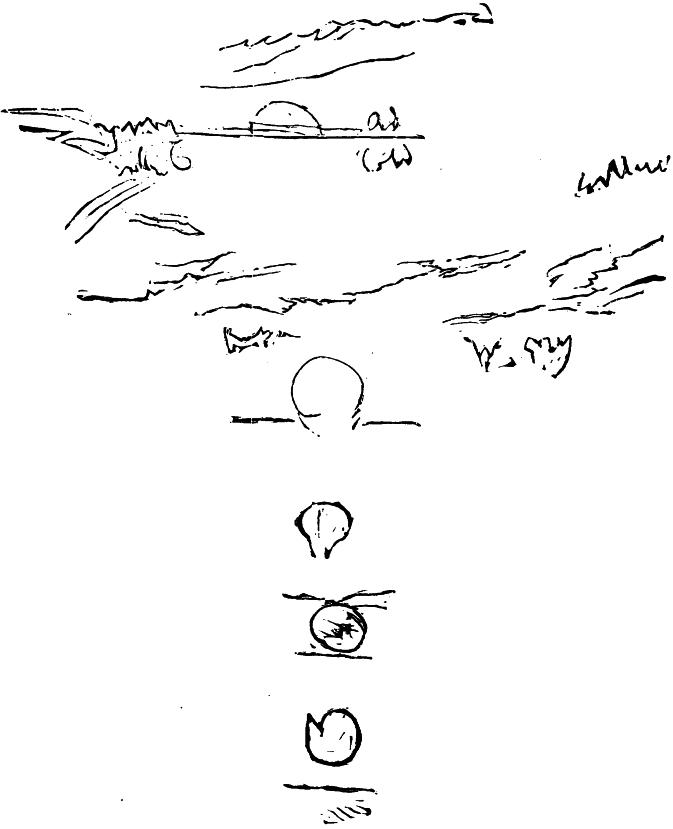
Fig. 97.
§ 7. When the sketch is made merely as a memorandum, it is impossible to say how little, or what kind of drawing, may be sufficient for the purpose. It is of course likely to be hasty from its very nature, and unless the exact purpose be understood, it may be as unintelligible as a piece of shorthand writing. For instance, in the corner of a sheet of sketches made at sea, among those of Turner, at the National Gallery, occurs this one, Fig. 97. I suppose most persons would not see much use in it. It nevertheless was probably one of the most important sketches made in Turner’s life, fixing for ever in his mind certain facts respecting the sunrise from a clear sea-horizon. Having myself watched such sunrise, occasionally, I perceive this sketch to mean as follows:—
(Half circle at the top.) When the sun was only half out of the sea, the horizon was sharply traced across its disk, and red streaks of vapor crossed the lower part of it.
(Horseshoe underneath.) When the sun had risen so far as to show three-quarters of its diameter, its light became so great as to conceal the sea-horizon, consuming it away in descending rays.
(Smaller horseshoe below.) When on the point of detaching itself from the horizon, the sun still consumed away the line of the sea, and looked as if pulled down by it.
(Broken oval.) Having risen about a fourth of its diameter above the horizon, the sea-line reappeared; but the risen orb was flattened by refraction into an oval.
(Broken circle.) Having risen a little farther above the sea-line, the sun, at last, got itself round, and all right, with sparkling reflection on the waves just below the sea-line.
This memorandum is for its purpose entirely perfect and efficient, though the sun is not drawn carefully round, but with a dash of the pencil; but there is no affected or desired slightness. Could it have been drawn round as instantaneously, it would have been. The purpose is throughout determined; there is no scrawling, as in vulgar sketching.1
§ 8. Again, Fig. 98 is a facsimile of one of Turner’s “memoranda,” of a complete subject,2 Lausanne, from the road to Fribourg.
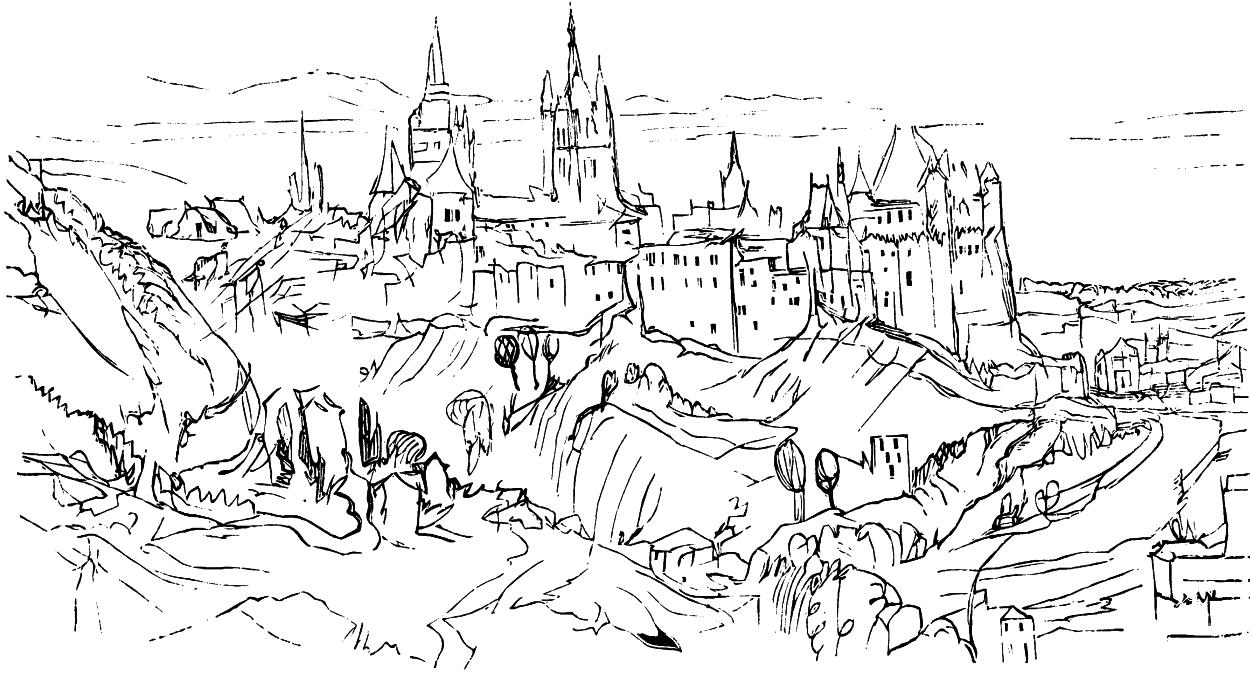
To face page 184.
Fig. 98.
This example is entirely characteristic of his usual drawings from nature, which unite two characters, being both commemorative and determinant:—Commemorative, in so far as they note certain facts about the place: determinant, in that they record an impression received from the place there and then, together with the principal arrangement of the composition in which it was afterwards to be recorded. In this mode of sketching, Turner differs from all other men whose work I have studied. He never draws accurately on the spot, with the intention of modifying or composing afterwards from the materials; but instantly modifies as he draws, placing his memoranda where they are to be ultimately used, and taking exactly what he wants, not a fragment or line more.
§ 9. This sketch has been made in the afternoon. He had been impressed as he walked up the hill, by the vanishing of the lake in the golden horizon, without end of waters, and by the opposition of the pinnacled castle and cathedral to its level breadth. That must be drawn! and from this spot, where all the buildings are set well together. But it lucklessly happens that, though the buildings come just where he wants them in situation, they don’t in height. For the castle (the square mass on the right) is in reality higher than the cathedral, and would block out the end of the lake. Down it goes instantly a hundred feet, that we may see the lake over it; without the smallest regard for the military position of Lausanne.
§ 10. Next: The last low spire on the left is in truth concealed behind the nearer bank, the town running far down the hill (and climbing another hill) in that direction. But the group oi spires, without it, would not be rich enough to give a proper impression of Lausanne, as a spiry place. Turner quietly sends to fetch the church from round the corner, places it where he likes, and indicates its distance only by aërial perspective (much greater in the pencil drawing than in the woodcut).
§ 11. But again: Not only the spire of the lower church, but the peak of the Rochers d’Enfer (that highest in the distance) would in reality be out of sight; it is much farther round to the left. This would never do either; for without it, we should have no idea that Lausanne was opposite the mountains, nor should we have a nice sloping line to lead us into the distance.
With the same unblushing tranquillity of mind in which he had ordered up the church, Turner sends also to fetch the Rochers d’Enfer; and puts them also where he chooses, to crown the slope of distant hill, which, as every traveller knows, in its decline to the west, is one of the most notable features of the view from Lausanne.
§ 12. These modifications, easily traceable in the large features of the design, are carried out with equal audacity and precision in every part of it. Every one of those confused lines on the right indicates something that is really there, only everything is shifted and sorted into the exact places that Turner chose. The group of dark objects near us at the foot of the bank is a cluster of mills, which, when the picture was completed, were to be the blackest things in it, and to throw back the castle, and the golden horizon; while the rounded touches at the bottom, under the castle, indicate a row of trees, which follow a brook coming out of the ravine behind us; and were going to be made very round indeed in the picture (to oppose the spiky and angular masses of castle) and very consecutive, in order to form another conducting line into the distance.
§ 13. These motives, or motives like them, might perhaps be guessed on looking at the sketch. But no one without going to the spot would understand the meaning of the vertical lines in the left-hand lowest corner.
They are a “memorandum” of the artificial verticalness of a low sandstone cliff, which has been cut down there to give space for a bit of garden belonging to a public-house beneath, from which garden a path leads along the ravine to the Lausanne rifle ground. The value of these vertical lines in repeating those of the cathedral is very great; it would be greater still in the completed picture, increasing the sense of looking down from a height, and giving grasp of, and power over, the whole scene.
§ 14. Throughout the sketch, as in all that Turner made, the observing and combining intellect acts in the same manner. Not a line is lost, nor a moment of time; and though the pencil flies, and the whole thing is literally done as fast as a piece of shorthand writing, it is to the full as purposeful and compressed, so that while there are indeed dashes of the pencil which are unintentional, they are only unintentional as the form of a letter is, in fast writing, not from want of intention, but from the accident of haste.
§ 15. I know not if the reader can understand,—I myself cannot, though I see it to be demonstrable,—the simultaneous occurrence of idea which produces such a drawing as this: the grasp of the whole, from the laying of the first line, which induces continual modifications of all that is done, out of respect to parts not done yet. No line is ever changed or effaced: no experiment made; but every touch is placed with reference to all that are to succeed, as to all that have gone before; every addition takes its part, as the stones in an arch of a bridge; the last touch locks the arch. Remove that keystone, or remove any other of the stones of the vault, and the whole will fall.
§ 16. I repeat—the power of mind which accomplishes this, is yet wholly inexplicable to me, as it was when first I defined it in the chapter on imagination associative, in the second volume. But the grandeur of the power impresses me daily more and more; and, in quitting the subject of invention, let me assert finally, in clearest and strongest terms, that no painting is of any true imaginative perfectness at all, unless it has been thus conceived.
One sign of its being thus conceived may be always found in the straightforwardness of its work. There are continual disputes among artists as to the best way of doing things, which may nearly all be resolved into confessions of indetermination. If you know precisely what you want, you will not feel much hesitation in setting about it; and a picture may be painted almost any way, so only that it can be a straight way. Give a true painter a ground of black, white, scarlet, or green, and out of it he will bring what you choose. From the black, brightness; from the white, sadness; from the scarlet, coolness; from the green, glow: he will make anything out of anything, but in each case his method will be pure, direct, perfect, the shortest and simplest possible. You will find him, moreover, indifferent as to succession of process. Ask him to begin at the bottom of the picture instead of the top,—to finish two square inches of it without touching the rest, or to lay a separate ground for every part before finishing any;—it is all the same to him! What he will do if left to himself, depends on mechanical convenience, and on the time at his disposal. If he has a large brush in his hand, and plenty of one color ground, he may lay as much as is wanted of that color, at once, in every part of the picture where it is to occur; and if any is left, perhaps walk to another canvas, and lay the rest of it where it will be wanted on that. If, on the contrary, he has a small brush in his hand, and is interested in a particular spot of the picture, he will, perhaps, not stir from it till that bit is finished. But the absolutely best, or centrally, and entirely right way of painting is as follows:—
§ 17. A light ground, white, red, yellow, or gray, not brown, or black. On that an entirely accurate, and firm black outline of the whole picture, in its principal masses. The outline to be exquisitely correct as far as it reaches, but not to include small details; the use of it being to limit the masses of first color. The ground-colors then to be laid firmly, each on its own proper part of the picture, as inlaid work in a mosaic table, meeting each other truly at the edges: as much of each being laid as will get itself into the state which the artist requires it to be in for his second painting, by the time he comes to it. On this first color, the second colors and subordinate masses laid in due order, now, of course, necessarily without previous outline, and all small detail reserved to the last, the bracelet being not touched, nor indicated in the last, till the arm is finished.3
§ 18. This is, as far as it can be expressed in few words, the right, or Venetian way of painting; but it is incapable of absolute definition, for it depends on the scale, the material, and the nature of the object represented, how much a great painter will do with his first color; or how many after processes he will use. Very often the first color, richly blended and worked into, is also the last; sometimes it wants a glaze only to modify it; sometimes an entirely different color above it. Turner’s storm-blues, for instance, were produced by a black ground, with opaque blue, mixed with white, struck over it.4 The amount of detail given in the first color will also depend on convenience. For instance, if a jewel fastens a fold of dress, a Venetian will lay probably a piece of the jewel color in its place at the time he draws the fold; but if the jewel falls upon the dress, he will paint the folds only in the ground color, and the jewel afterwards. For in the first case his hand must pause, at any rate, where the fold is fastened; so that he may as well mark the color of the gem: but he would have to check his hand in the sweep with which he drew the drapery, if he painted a jewel that fell upon it with the first color. So far, however, as he can possibly use the under color, he will, in whatever he has to superimpose. There is a pretty little instance of such economical work in the painting of the pearls on the breast of the elder princess, in our best Paul Veronese (Family of Darius). The lowest is about the size of a small hazel-nut, and falls on her rose-red dress. Any other but a Venetian would have put a complete piece of white paint over the dress, for the whole pearl, and painted into that the colors of the stone. But Veronese knows beforehand that all the dark side of the pearl will reflect the red of the dress. He will not put white over the red, only to put red over the white again. He leaves the actual dress for the dark side of the pearl, and with two small separate touches, one white, another brown, places its high light and shadow. This he does with perfect care and calm; but in two decisive seconds. There is no dash, nor display, nor hurry, nor error. The exactly right thing is done in the exactly right place, and not one atom of color, nor moment of time spent vainly. Look close at the two touches,—you wonder what they mean. Retire six feet from the picture—the pearl is there!
§ 19. The degree in which the ground colors are extended over his picture, as he works, is to a great painter absolutely indifferent. It is all the same to him whether he grounds a head, and finishes it at once to the shoulders, leaving all round it white; or whether he grounds the whole picture. His harmony, paint as he will, never can be complete till the last touch is given; so long as it remains incomplete, he does not care how little of it is suggested, or how many notes are missing. All is wrong till all is right; and he must be able to bear the all-wrongness till his work is done, or he cannot paint at all. His mode of treatment will, therefore, depend on the nature of his subject; as is beautifully shown in the water-color sketches by Turner in the National Gallery. His general system was to complete inch by inch; leaving the paper quite white all round, especially if the work was to be delicate. The most exquisite drawings left unfinished in the collection—those at Rome and Naples—are thus outlined accurately on pure white paper, begun in the middle of the sheet, and worked out to the side, finishing as he proceeds. If, however, any united effect of light or color is to embrace a large part of the subject, he will lay it in with a broad wash over the whole paper at once; then paint into it using it as a ground, and modifying it in the pure Venetian manner. His oil pictures were laid roughly with ground colors, and painted into with such rapid skill, that the artists who used to see him finishing at the Academy sometimes suspected him of having the picture finished underneath the colors he showed, and removing, instead of adding, as they watched.
§ 20. But, whatever the means used may be, the certainty and directness of them imply absolute grasp of the whole subject, and without this grasp there is no good painting. This, finally, let me declare, without qualification—that partial conception is no conception. The whole picture must be imagined, or none of it is. And this grasp of the whole implies very strange and sublime qualities of mind. It is not possible, unless the feelings are completely under control; the least excitement or passion will disturb the measured equity of power; a painter needs to be as cool as a general; and as little moved or subdued by his sense of pleasure, as a soldier by the sense of pain. Nothing good can be done without intense feeling; but it must be feeling so crushed, that the work is set about with mechanical steadiness, absolutely untroubled, as a surgeon,—not without pity, but conquering it and putting it aside—begins an operation. Until the feelings can give strength enough to the will to enable it to conquer them, they are not strong enough. If you cannot leave your picture at any moment;—cannot turn from it and go on with another, while the color is drying;—cannot work at any part of it you choose with equal contentment—you have not firm enough grasp of it.
§ 21. It follows also, that no vain or selfish person can possibly paint, in the noble sense of the word. Vanity and selfishness are troublous, eager, anxious, petulant:—painting can only be done in calm of mind. Resolution is not enough to secure this; it must be secured by disposition as well. You may resolve to think of your picture only; but, if you have been fretted before beginning, no manly or clear grasp of it will be possible for you. No forced calm is calm enough. Only honest calm,—natural calm. You might as well try by external pressure to smoothe a lake till it could reflect the sky, as by violence of effort to secure the peace through which only you can reach imagination. That peace must come in its own time; as the waters settle themselves into clearness as well as quietness; you can no more filter your mind into purity than you can compress it into calmness; you must keep it pure, if you would have it pure; and throw no stones into it, if you would have it quiet. Great courage and self-command may, to a certain extent, give power of painting without the true calmness underneath; but never of doing first-rate work. There is sufficient evidence of this, in even what we know of great men, though of the greatest, we nearly always know the least (and that necessarily; they being very silent, and not much given to setting themselves forth to questioners; apt to be contemptuously reserved, no less than unselfishly). But in such writings and sayings as we possess of theirs, we may trace a quite curious gentleness and serene courtesy. Rubens’ letters are almost ludicrous in their unhurried politeness. Reynolds, swiftest of painters, was gentlest of companions; so also Velasquez, Titian, and Veronese.
§ 22. It is gratuitous to add that no shallow or petty person can paint. Mere cleverness or special gift never made an artist. It is only perfectness of mind, unity, depth, decision, the highest qualities, in fine, of the intellect, which will form the imagination.
§ 23. And, lastly, no false person can paint. A person false at heart may, when it suits his purposes, seize a stray truth here or there; but the relations of truth,—its perfectness,—that which makes it wholesome truth, he can never perceive. As wholeness and wholesomeness go together, so also sight with sincerity; it is only the constant desire of, and submissiveness to truth, which can measure its strange angles and mark its infinite aspects; and fit them and knit them into the strength of sacred invention.
Sacred, I call it deliberately; for it is thus, in the most accurate senses, humble as well as helpful; meek in its receiving, as magnificent in its disposing; the name it bears being rightly given to invention formal, not because it forms, but because it finds. For you cannot find a lie; you must make it for yourself. False things may be imagined, and false things composed; but only truth can be invented.
1 The word in the uppermost note, to the right of the sun, is “red;” the others, “yellow,” “purple,” “cold” light gray. He always noted the colors of the skies in this way.
2 It is not so good a facsimile as those I have given from Durer, for the original sketch is in light pencil; and the thickening and delicate emphasis of the lines, on which nearly all the beauty of the drawing depended, cannot be expressed in the woodcut, though marked by a double line as well as I could. But the figure will answer its purpose well enough in showing Turner’s mode of sketching.
3 Thus, in the Holy Family of Titian, lately purchased for the National Gallery, the piece of St. Catherine’s dress over her shoulders is painted on the under dress, after that was dry. All its value would have been lost, had the slightest tint or trace of it been given previously. This picture, I think, and certainly many of Tintoret’s, are painted on dark grounds; but this is to save time, and with some loss to the future brightness of the color.
4 In cleaning the “Hero and Leander,” now in the National collection, these upper glazes were taken off, and only the black ground left. I remember the picture when its distance was of the most exquisite blue. I have no doubt the “Fire at Sea” has had its distance destroyed in the same manner.
PART IX.
OF IDEAS OF RELATION:—II. OF INVENTION SPIRITUAL.
—————
CHAPTER I.
THE DARK MIRROR.
§ 1. In the course of our inquiry into the moral of landscape (Vol. III., chap. 17), we promised, at the close of our work, to seek for some better, or at least clearer, conclusions than were then possible to us. We confined ourselves in that chapter to the vindication of the probable utility of the love of natural scenery. We made no assertion of the usefulness of painting such scenery. It might be well to delight in the real country, or admire the real flowers and true mountains. But it did not follow that it was advisable to paint them.
Far from it. Many reasons might be given why we should not paint them. All the purposes of good which we saw that the beauty of nature could accomplish, may be better fulfilled by the meanest of her realities than by the brightest of imitations. For prolonged entertainment, no picture can be compared with the wealth of interest which may be found in the herbage of the poorest field, or blossoms of the narrowest copse. As suggestive of supernatural power, the passing away of a fitful rain-cloud, or opening of dawn, are in their change and mystery more pregnant than any pictures. A child would, I suppose, receive a religious lesson from a flower more willingly than from a print of one, and might be taught to understand the nineteenth Psalm, on a starry night, better than by diagrams of the constellations.
Whence it might seem a waste of time to draw landscape at all.
I believe it is;—to draw landscape mere and solitary, however beautiful (unless it be for the sake of geographical or other science, or of historical record). But there is a kind of landscape which it is not inexpedient to draw. What kind, we may probably discover by considering that which mankind has hitherto contented itself with painting.
§ 2. We may arrange nearly all existing landscape under the following heads:—
I. Heroic.—Representing an imaginary world, inhabited by men not perhaps perfectly civilized, but noble, and usually subjected to severe trials, and by spiritual powers of the highest order. It is frequently without architecture; never without figure-action, or emotion. Its principal master is Titian.
II. Classical.—Representing an imaginary world, inhabited by perfectly civilized men, and by spiritual powers of an inferior order.
It generally assumes this condition of things to have existed among the Greek and Roman nations. It contains usually architecture of an elevated character, and always incidents of figure-action and emotion. Its principal master is Nicolo Poussin.
III. Pastoral.—Representing peasant life and its daily work, or such scenery as may naturally be suggestive of it, consisting usually of simple landscape, in part subjected to agriculture, with figures, cattle, and domestic buildings. No supernatural being is ever visibly present. It does not in ordinary cases admit architecture of an elevated character, nor exciting incident. Its principal master is Cuyp.
IV. Contemplative.—Directed principally to the observance of the powers of Nature, and record of the historical associations connected with landscape, illustrated by, or contrasted with, existing states of human life. No supernatural being is visibly present. It admits every variety of subject, and requires, in general, figure incident, but not of an exciting character. It was not developed completely until recent times. Its principal master is Turner.1
§ 3. These are the four true orders of landscape, not of course distinctly separated from each other in all cases, but very distinctly in typical examples. Two spurious forms require separate note.
(A.) Picturesque.—This is indeed rather the degradation (or sometimes the undeveloped state) of the Contemplative, than a distinct class; but it may be considered generally as including pictures meant to display the skill of the artist, and his powers of composition; or to give agreeable forms and colors, irrespective of sentiment. It will include much modern art, with the street views and church interiors of the Dutch, and the works of Canaletto, Guardi, Tempesta, and the like.
(B.) Hybrid.—Landscape in which the painter endeavors to unite the irreconcileable sentiment of two or more of the above-named classes. Its principal masters are Berghem and Wouvermans.
§ 4. Passing for the present by these inferior schools, we find that all true landscape, whether simple or exalted, depends primarily for its interest on connection with humanity, or with spiritual powers. Banish your heroes and nymphs from the classical landscape—its laurel shades will move you no more. Show that the dark clefts of the most romantic mountain are uninhabited and untraversed; it will cease to be romantic. Fields without shepherds and without fairies will have no gaiety in their green, nor will the noblest masses of ground or colors of cloud arrest or raise your thoughts, if the earth has no life to sustain, and the heaven none to refresh.
§ 5. It might perhaps be thought that, since from scenes in which the figure was principal, and landscape symbolical and subordinate (as in the art of Egypt), the process of ages had led us to scenes in which landscape was principal and the figure subordinate,—a continuance in the same current of feeling might bring forth at last an art from which humanity and its interests should wholly vanish, leaving us to the passionless admiration of herbage and stone. But this will not, and cannot be. For observe the parallel instance in the gradually increasing importance of dress. From the simplicity of Greek design, concentrating, I suppose, its skill chiefly on the naked form, the course of time developed conditions of Venetian imagination which found nearly as much interest, and expressed nearly as much dignity, in folds of dress and fancies of decoration as in the faces of the figures themselves; so that if from Veronese’s Marriage in Cana we remove the architecture and the gay dresses, we shall not in the faces and hands remaining, find a satisfactory abstract of the picture. But try it the other way. Take out the faces; leave the draperies, and how then? Put the fine dresses and jewelled girdles into the best group you can; paint them with all Veronese’s skill: will they satisfy you?
§ 6. Not so. As long as they are in their due service and subjection—while their folds are formed by the motion of men, and their lustre adorns the nobleness of men—so long the lustre and the folds are lovely. But cast them from the human limbs;—golden circlet and silken tissue are withered; the dead leaves of autumn are more precious than they.
This is just as true, but in a far deeper sense, of the weaving of the natural robe of man’s soul. Fragrant tissue of flowers, golden circlets of clouds, are only fair when they meet the fondness of human thoughts, and glorify human visions of heaven.
§ 7. It is the leaning on this truth which, more than any other, has been the distinctive character of all my own past work. And in closing a series of Art-studies, prolonged during so many years, it may be perhaps permitted me to point out this specialty—the rather that it has been, of all their characters, the one most denied. I constantly see that the same thing takes place in the estimation formed by the modern public of the work of almost any true person, living or dead. It is not needful to state here the causes of such error: but the fact is indeed so, that precisely the distinctive root and leading force of any true man’s work and way are the things denied concerning him.
And in these books of mine, their distinctive character, as essays on art, is their bringing everything to a root in human passion or human hope. Arising first not in any desire to explain the principles of art, but in the endeavor to defend an individual painter from injustice, they have been colored throughout,—nay, continually altered in shape, and even warped and broken, by digressions respecting social questions, which had for me an interest tenfold greater than the work I had been forced into undertaking. Every principle of painting which I have stated is traced to some vital or spiritual fact; and in my works on architecture the preference accorded finally to one school over another, is founded on a comparison of their influences on the life of the workman—a question by all other writers on the subject of architecture wholly forgotten or despised.
§ 8. The essential connection of the power of landscape with human emotion is not less certain, because in many impressive pictures the link is slight or local. That the connection should exist at a single point is all that we need. The comparison with the dress of the body may be carried out into the extremest parallelism. It may often happen that no part of the figure wearing the dress is discernible, nevertheless, the perceivable fact that the drapery is worn by a figure makes all the difference. In one of the most sublime figures in the world this is actually so: one of the fainting Marys in Tintoret’s Crucifixion has cast her mantle over her head, and her face is lost in its shade, and her whole figure veiled in folds of gray. But what the difference is between that gray woof, that gathers round her as she falls, and the same folds cast in a heap upon the ground, that difference, and more, exists between the power of Nature through which humanity is seen, and her power in the desert. Desert—whether of leaf or sand—true desertness is not in the want of leaves, but of life. Where humanity is not, and was not, the best natural beauty is more than vain. It is even terrible; not as the dress cast aside from the body; but as an embroidered shroud hiding a skeleton.
§ 9. And on each side of a right feeling in this matter there lie, as usual, two opposite errors.
The first, that of caring for man only; and for the rest of the universe, little, or not at all, which, in a measure, was the error of the Greeks and Florentines; the other, that of caring for the universe only;—for man, not at all,—which, in a measure, is the error of modern science, and of the Art connecting itself with such science.
The degree of power which any man may ultimately possess in landscape-painting will depend finally on his perception of this influence. If he has to paint the desert, its awfulness—if the garden, its gladsomeness—will arise simply and only from his sensibility to the story of life. Without this he is nothing but a scientific mechanist; this, though it cannot make him yet a painter, raises him to the sphere in which he may become one. Nay, the mere shadow and semblance of this have given dangerous power to works in all other respects unnoticeable; and the least degree of its true presence has given value to work in all other respects vain.
The true presence, observe, of sympathy with the spirit of man. Where this is not, sympathy with any higher spirit is impossible.
For the directest manifestation of Deity to man is in His own image, that is, in man.
§ 10. “In his own image. After his likeness.” Ad imaginem et similitudinem Suam. I do not know what people in general understand by those words. I suppose they ought to be understood. The truth they contain seems to lie at the foundation of our knowledge both of God and man; yet do we not usually pass the sentence by, in dull reverence, attaching no definite sense to it at all? For all practical purpose, might it not as well be out of the text?
I have no time, nor much desire, to examine the vague expressions of belief with which the verse has been encumbered. Let us try to find its only possible plain significance.
§ 11. It cannot be supposed that the bodily shape of man resembles, or resembled, any bodily shape in Deity. The likeness must therefore be, or have been, in the soul. Had it wholly passed away, and the Divine soul been altered into a soul brutal or diabolic, I suppose we should have been told of the change. But we are told nothing of the kind. The verse still stands as if for our use and trust. It was only death which was to be our punishment. Not change. So far as we live, the image is still there; defiled, if you will; broken, if you will; all but effaced, if you will, by death and the shadow of it. But not changed. We are not made now in any other image than God’s. There are, indeed, the two states of this image—the earthly and heavenly, but both Adamite, both human, both the same likeness; only one defiled, and one pure. So that the soul of man is still a mirror, wherein may be seen, darkly, the image of the mind of God.
These may seem daring words. I am sorry that they do; but I am helpless to soften them. Discover any other meaning of the text if you are able;—but be sure that it is a meaning—a meaning in your head and heart;—not a subtle gloss, nor a shifting of one verbal expression into another, both idealess. I repeat, that, to me, the verse has, and can have, no other signification than this—that the soul of man is a mirror of the mind of God. A mirror dark, distorted, broken, use what blameful words you please of its state; yet in the main, a true mirror, out of which alone, and by which alone, we can know anything of God at all.
“How?” the reader, perhaps, answers indignantly. “I know the nature of God by revelation, not by looking into myself.”
Revelation to what? To a nature incapable of receiving truth? That cannot be; for only to a nature capable of truth, desirous of it, distinguishing it, feeding upon it, revelation is possible. To a being undesirous of it, and hating it, revelation is impossible. There can be none to a brute, or fiend. In so far, therefore, as you love truth, and live therein, in so far revelation can exist for you;—and in so far, your mind is the image of God’s.
§ 12. But consider farther, not only to what, but by what, is the revelation. By sight? or word? If by sight, then to eyes which see justly. Otherwise, no sight would be revelation. So far, then, as your sight is just, it is the image of God’s sight.
If by words,—how do you know their meanings? Here is a short piece of precious word revelation, for instance. “God is love.”
Love! yes. But what is that? The revelation does not tell you that, I think. Look into the mirror, and you will see. Out of your own heart you may know what love is. In no other possible way,—by no other help or sign. All the words and sounds ever uttered, all the revelations of cloud, or flame, or crystal, are utterly powerless. They cannot tell you, in the smallest point, what love means. Only the broken mirror can.
§ 13. Here is more revelation. “God is just!” Just! What is that? The revelation cannot help you to discover. You say it is dealing equitably or equally. But how do you discern the equality? Not by inequality of mind; not by a mind incapable of weighing, judging, or distributing. If the lengths seem unequal in the broken mirror, for you they are unequal; but if they seem equal, then the mirror is true. So far as you recognize equality, and your conscience tells you what is just, so far your mind is the image of God’s: and so far as you do not discern this nature of justice or equality, the words “God is just” bring no revelation to you.
§ 14. “But His thoughts are not as our thoughts.” No: the sea is not as the standing pool by the wayside. Yet when the breeze crisps the pool, you may see the image of the breakers, and a likeness of the foam. Nay, in some sort, the same foam. If the sea is for ever invisible to you, something you may learn of it from the pool. Nothing, assuredly, any otherwise.
“But this poor miserable Me! Is this, then, all the book I have got to read about God in?” Yes, truly so. No other book, nor fragment of book, than that, will you ever find;—no velvet-bound missal, nor frankincensed manuscript;—nothing hieroglyphic nor cuneiform; papyrus and pyramid are alike silent on this matter;—nothing in the clouds above, nor in the earth beneath. That flesh-bound volume is the only revelation that is, that was, or that can be. In that is the image of God painted; in that is the law of God written; in that is the promise of God revealed. Know thyself; for through thyself only thou canst know God.
§ 15. Through the glass, darkly. But, except through the glass, in nowise.
A tremulous crystal, waved as water, poured out upon the ground;—you may defile it, despise it, pollute it at your pleasure, and at your peril; for on the peace of those weak waves must all the heaven you shall ever gain be first seen; and through such purity as you can win for those dark waves, must all the light of the risen Sun of righteousness be bent down, by faint refraction. Cleanse them, and calm them, as you love your life.
Therefore it is that all the power of nature depends on subjection to the human soul. Man is the sun of the world; more than the real sun. The fire of his wonderful heart is the only light and heat worth gauge or measure. Where he is, are the tropics; where he is not, the ice-world.
1 I have been embarrassed in assigning the names to these orders of art, the term “Contemplative” belonging in justice nearly as much to the romantic and pastoral conception as to the modern landscape. I intended, originally, to call the four schools—Romantic, Classic, Georgic, and Theoretic—which would have been more accurate; and more consistent with the nomenclature of the second volume; but would not have been pleasant in sound, nor to the general reader, very clear in sense.
CHAPTER II.
THE LANCE OF PALLAS.
§ 1. It might be thought that the tenor of the preceding chapter was in some sort adverse to my repeated statement that all great art is the expression of man’s delight in God’s work, not in his own. But observe, he is not himself his own work: he is himself precisely the most wonderful piece of God’s workmanship extant. In this best piece not only he is bound to take delight, but cannot, in a right state of thought, take delight in anything else, otherwise than through himself. Through himself, however, as the sun of creation, not as the creation. In himself, as the light of the world.1 Not as being the world. Let him stand in his due relation to other creatures, and to inanimate things—know them all and love them, as made for him, and he for them;—and he becomes himself the greatest and holiest of them. But let him cast off this relation, despise and forget the less creation around him, and instead of being the light of the world, he is as a sun in space—a fiery ball, spotted with storm.
§ 2. All the diseases of mind leading to fatalest ruin consist primarily in this isolation. They are the concentration of man upon himself, whether his heavenly interests or his worldly interests, matters not; it is the being his own interests which makes the regard of them so mortal. Every form of asceticism on one side, of sensualism on the other, is an isolation of his soul or of his body; the fixing his thoughts upon them alone: while every healthy state of nations and of individual minds consists in the unselfish presence of the human spirit everywhere, energizing over all things; speaking and living through all things.
§ 3. Man being thus the crowning and ruling work of God, it will follow that all his best art must have something to tell about himself, as the soul of things, and ruler of creatures. It must also make this reference to himself under a true conception of his own nature. Therefore all art which involves no reference to man is inferior or nugatory. And all art which involves misconception of man, or base thought of him, is in that degree false, and base.
Now the basest thought possible concerning him is, that he has no spiritual nature; and the foolishest misunderstanding of him possible is, that he has or should have, no animal nature. For his nature is nobly animal, nobly spiritual—coherently and irrevocably so; neither part of it may, but at its peril, expel, despise, or defy the other. All great art confesses and worships both.
§ 4. The art which, since the writings of Rio and Lord Lindsay, is specially known as “Christian,” erred by pride in its denial of the animal nature of man;—and, in connection with all monkish and fanatical forms of religion, by looking always to another world instead of this. It wasted its strength in visions, and was therefore swept away, notwithstanding all its good and glory, by the strong truth of the naturalist art of the sixteenth century. But that naturalist art erred on the other side; denied at last the spiritual nature of man, and perished in corruption.
A contemplative reaction is taking place in modern times, out of which it may be hoped a new spiritual art may be developed. The first school of landscape, named, in the foregoing chapter, the Heroic, is that of the noble naturalists. The second (Classical), and third (Pastoral), belong to the time of sensual decline. The fourth (Contemplative) is that of modern revival.
§ 5. But why, the reader will ask, is no place given in this scheme to the “Christian” or spiritual art which preceded the naturalists? Because all landscape belonging to that art is subordinate, and in one essential principle false. It is subordinate, because intended only to exalt the conception of saintly or Divine presence:—rather therefore to be considered as a landscape decoration or type, than an effort to paint nature. If I included it in my list of schools, I should have to go still farther back, and include with it the conventional and illustrative landscape of the Greeks and Egyptians.
§ 6. But also it cannot constitute a real school, because its first assumption is false, namely, that the natural world can be represented without the element of death.
The real schools of landscape are primarily distinguished from the preceding unreal ones by their introduction of this element. They are not at first in any sort the worthier for it. But they are more true, and capable, therefore, in the issue, of becoming worthier.
It will be a hard piece of work for us to think this rightly out, but it must be done.
§ 7. Perhaps an accurate analysis of the schools of art of all time might show us that when the immortality of the soul was practically and completely believed, the elements of decay, danger, and grief in visible things were always disregarded. However this may be, it is assuredly so in the early Christian schools. The ideas of danger or decay seem not merely repugnant, but inconceivable to them; the expression of immortality and perpetuity is alone possible. I do not mean that they take no note of the absolute fact of corruption. This fact the early painters often compel themselves to look fuller in the front than any other men: as in the way they usually paint the Deluge (the raven feeding on the bodies), and in all the various triumphs and processions of the Power of Death, which formed one great chapter of religious teaching and painting, from Orcagna’s time to the close of the Purist epoch. But I mean that this external fact of corruption is separated in their minds from the main conditions of their work; and its horror enters no more into their general treatment of landscape than the fear of murder or martyrdom, both of which they had nevertheless continually to represent. None of these things appeared to them as affecting the general dealings of the Deity with His world. Death, pain, and decay were simply momentary accidents in the course of immortality, which never ought to exercise any depressing influence over the hearts of men, or in the life of Nature. God, in intense life, peace, and helping power, was always and everywhere. Human bodies, at one time or another, had indeed to be made dust of, and raised from it; and this becoming dust was hurtful and humiliating, but not in the least melancholy, nor, in any very high degree, important; except to thoughtless persons, who needed sometimes to be reminded of it, and whom, not at all fearing the things much himself, the painter accordingly did remind of it, somewhat sharply.
§ 8. A similar condition of mind seems to have been attained, not unfrequently, in modern times, by persons whom either narrowness of circumstance or education, or vigorous moral efforts have guarded from the troubling of the world, so as to give them firm and childlike trust in the power and presence of God, together with peace of conscience, and a belief in the passing of all evil into some form of good. It is impossible that a person thus disciplined should feel, in any of its more acute phases, the sorrow for any of the phenomena of nature, or terror in any material danger which would occur to another. The absence of personal fear, the consciousness of security as great in the midst of pestilence and storm, as amidst beds of flowers on a summer morning, and the certainty that whatever appeared evil, or was assuredly painful, must eventually issue in a far greater and enduring good—this general feeling and conviction, I say, would gradually lull, and at last put to entire rest, the physical sensations of grief and fear; so that the man would look upon danger without dread,—accept pain without lamentation.
§ 9. It may perhaps be thought that this is a very high and right state of mind.
Unfortunately, it appears that the attainment of it is never possible without inducing some form of intellectual weakness.
No painter belonging to the purest religious schools ever mastered his art. Perugino nearly did so; but it was because he was more rational—more a man of the world—than the rest. No literature exists of a high class produced by minds in the pure religious temper. On the contrary, a great deal of literature exists, produced by persons in that temper, which is markedly, and very far, below average literary work.
§ 10. The reason of this I believe to be, that the right faith of man is not intended to give him repose, but to enable him to do his work. It is not intended that he should look away from the place he lives in now, and cheer himself with thoughts of the place he is to live in next, but that he should look stoutly into this world, in faith that if he does his work thoroughly here, some good to others or himself, with which, however, he is not at present concerned, will come of it hereafter. And this kind of brave, but not very hopeful or cheerful faith, I perceive to be always rewarded by clear practical success and splendid intellectual power; while the faith which dwells on the future fades away into rosy mist, and emptiness of musical air. That result indeed follows naturally enough on its habit of assuming that things must be right, or must come right, when, probably, the fact is, that so far as we are concerned, they are entirely wrong; and going wrong: and also on its weak and false way of looking on what these religious persons call “the bright side of things,” that is to say, on one side of them only, when God has given them two sides, and intended us to see both.
§ 11. I was reading but the other day, in a book by a zealous, useful, and able Scotch clergyman, one of these rhapsodies, in which he described a scene in the Highlands to show (he said) the goodness of God. In this Highland scene there was nothing but sunshine, and fresh breezes, and bleating lambs, and clean tartans, and all manner of pleasantness. Now a Highland scene is, beyond dispute, pleasant enough in its own way; but, looked close at, has its shadows. Here, for instance, is the very fact of one, as pretty as I can remember—having seen many. It is a little valley of soft turf, enclosed in its narrow oval by jutting rocks and broad flakes of nodding fern. From one side of it to the other winds, serpentine, a clear brown stream, drooping into quicker ripple as it reaches the end of the oval field, and then, first islanding a purple and white rock with an amber pool, it dashes away into a narrow fall of foam under a thicket of mountain ash and alder. The autumn sun, low but clear, shines on the scarlet ash-berries and on the golden birch-leaves, which, fallen here and there, when the breeze has not caught them, rest quiet in the crannies of the purple rock. Beside the rock, in the hollow under the thicket, the carcass of a ewe, drowned in the last flood, lies nearly bare to the bone, its white ribs protruding through the skin, raven-torn; and the rags of its wool still flickering from the branches that first stayed it as the stream swept it down. A little lower, the current plunges, roaring, into a circular chasm like a well, surrounded on three sides by a chimney-like hollowness of polished rock, down which the foam slips in detached snow-flakes. Round the edges of the pool beneath, the water circles slowly, like black oil; a little butterfly lies on its back, its wings glued to one of the eddies, its limbs feebly quivering; a fish rises and it is gone. Lower down the stream, I can just see, over a knoll, the green and damp turf roofs of four or five hovels, built at the edge of a morass, which is trodden by the cattle into a black Slough of Despond at their doors, and traversed by a few ill-set stepping-stones, with here and there a flat slab on the tops, where they have sunk out of sight; and at the turn of the brook I see a man fishing, with a boy and a dog—a picturesque and pretty group enough certainly, if they had not been there all day starving. I know them, and I know the dog’s ribs also, which are nearly as bare as the dead ewe’s; and the child’s wasted shoulders, cutting his old tartan jacket through, so sharp are they. We will go down and talk with the man.
§ 12. Or, that I may not piece pure truth with fancy, for I have none of his words set down, let us hear a word or two from another such, a Scotchman also, and as true hearted, and in just as fair a scene. I write out the passage, in which I have kept his few sentences, word for word, as it stands in my private diary:—“22nd April (1851). Yesterday I had a long walk up the Via Gellia, at Matlock, coming down upon it from the hills above, all sown with anemones and violets, and murmuring with sweet springs. Above all the mills in the valley, the brook, in its first purity, forms a small shallow pool, with a sandy bottom covered with cresses, and other water plants. A man was wading in it for cresses as I passed up the valley, and bade me good-day. I did not go much farther; he was there when I returned. I passed him again, about one hundred yards, when it struck me I might as well learn all I could about watercresses: so I turned back. I asked the man, among other questions, what he called the common weed, something like watercress, but with a serrated leaf, which grows at the edge of nearly all such pools. ‘We calls that brooklime, hereabouts,’ said a voice behind me. I turned, and saw three men, miners or manufacturers—two evidently Derbyshire men, and respectable-looking in their way; the third, thin, poor, old, and harder-featured, and utterly in rags. ‘Brooklime?’ I said. ‘What do you call it lime for?’ The man said he did not know, it was called that. ‘You’ll find that in the British ‘Erba,’ said the weak, calm voice of the old man. I turned to him in much surprise; but he went on saying something drily (I hardly understood what) to the cress-gatherer; who contradicting him, the old man said he ‘didn’t know fresh water,’ he ‘knew enough of sa’t.’ ‘Have you been a sailor?’ I asked. ‘I was a sailor for eleven years and ten months of my life,’ he said, in the same strangely quiet manner. ‘And what are you now?’ ‘I lived for ten years after my wife’s death by picking up rags and bones; I hadn’t much occasion afore.’ ‘And now how do you live?’ ‘Why, I lives hard and honest, and haven’t got to live long,’ or something to that effect. He then went on, in a kind of maundering way, about his wife. ‘She had rheumatism and fever very bad; and her second rib grow’d over her hench-bone. A’ was a clever woman, but a’ grow’d to be a very little one’ (this with an expression of deep melancholy). ‘Eighteen years after her first lad she was in the family-way again, and they had doctors up from Lunnon about it. They wanted to rip her open and take the child out of her side. But I never would give my consent.’ (Then, after a pause:) ‘She died twenty-six hours and ten minutes after it. I never cared much what come of me since; but I know that I shall soon reach her; that’s a knowledge I would na gie for the king’s crown.’ ‘You are a Scotchman, are not you?’ I asked. ‘I’m from the Isle of Skye, sir; I’m a McGregor.’ I said something about his religious faith. ‘Ye’ll know I was bred in the Church of Scotland, sir,’ he said, ‘and I love it as I love my own soul; but I think thae Wesleyan Methodists ha’ got salvation among them, too.’”
Truly, this Highland and English hill-scenery is fair enough; but has its shadows; and deeper coloring, here and there, than that of heath and rose.
§ 13. Now, as far as I have watched the main powers of human mind, they have risen first from the resolution to see fearlessly, pitifully, and to its very worst, what these deep colors mean, wheresoever they fall; not by any means to pass on the other side looking pleasantly up to the sky, but to stoop to the horror, and let the sky, for the present, take care of its own clouds. However this may be in moral matters, with which I have nothing here to do, in my own field of inquiry the fact is so; and all great and beautiful work has come of first gazing without shrinking into the darkness. If, having done so, the human spirit can, by its courage and faith, conquer the evil, it rises into conceptions of victorious and consummated beauty. It is then the spirit of the highest Greek and Venetian Art. If unable to conquer the evil, but remaining in strong, though melancholy war with it, not rising into supreme beauty, it is the spirit of the best northern art, typically represented by that of Holbein and Durer. If, itself conquered by the evil, infected by the dragon breath of it, and at last brought into captivity, so as to take delight in evil for ever, it becomes the spirit of the dark, but still powerful sensualistic art, represented typically by that of Salvator. We must trace this fact briefly through Greek, Venetian, and Dureresque art; we shall then see how the art of decline came of avoiding the evil, and seeking pleasure only; and thus obtain, at last, some power of judging whether the tendency of our own contemplative art be right or ignoble.
§ 14. The ruling purpose of Greek poetry is the assertion of victory, by heroism, over fate, sin, and death. The terror of these great enemies is dwelt upon chiefly by the tragedians. The victory over them by Homer.
The adversary chiefly contemplated by the tragedians is Fate, or predestinate misfortune. And that under three principal forms.
A. Blindness, or ignorance; not in itself guilty, but inducing acts which otherwise would have been guilty; and leading, no less than guilt, to destruction.2
B. Visitation upon one person of the sin of another.
C. Repression, by brutal or tyrannous strength, of a benevolent will.
§ 15. In all these cases sorrow is much more definitely connected with sin by the Greek tragedians than by Shakspere. The “fate” of Shakspere is, indeed, a form of blindness, but it issues in little more than haste or indiscretion. It is, in the literal sense, “fatal,” but hardly criminal.
The “I am fortune’s fool” of Romeo, expresses Shakspere’s primary idea of tragic circumstance. Often his victims are entirely innocent, swept away by mere current of strong encompassing calamity (Ophelia, Cordelia, Arthur, Queen Katharine). This is rarely so with the Greeks. The victim may indeed be innocent, as Antigone, but is in some way resolutely entangled with crime, and destroyed by it, as if it struck by pollution, no less than participation.
The victory over sin and death is therefore also with the Greek tragedians more complete than with Shakspere. As the enemy has more direct moral personality,—as it is sinfulness more than mischance, it is met by a higher moral resolve, a greater preparation of heart, a more solemn patience and purposed self-sacrifice. At the close of a Shakspere tragedy nothing remains but dead march and clothes of burial. At the close of a Greek tragedy there are far-off sounds of a divine triumph, and a glory as of resurrection.3
§ 16. The Homeric temper is wholly different. Far more tender, more practical, more cheerful; bent chiefly on present things and giving victory now, and here, rather than in hope, and hereafter. The enemies of mankind, in Homer’s conception, are more distinctly conquerable; they are ungoverned passions, especially anger, and unreasonable impulse generally (ἀτὴ). Hence the anger of Achilles, misdirected by pride, but rightly directed by friendship, is the subject of the Iliad. The anger of Ulysses (Ὀδυσσεὺς “the angry”), misdirected at first into idle and irregular hostilities, directed at last to execution of sternest justice, is the subject of the Odyssey.
Though this is the central idea of the two poems, it is connected with general display of the evil of all unbridled passions, pride, sensuality, indolence, or curiosity. The pride of Atrides, the passion of Paris, the sluggishness of Elpenor, the curiosity of Ulysses himself about the Cyclops, the impatience of his sailors in untying the winds, and all other faults or follies, down to that—(evidently no small one in Homer’s mind)—of domestic disorderliness, are throughout shown in contrast with conditions of patient affection and household peace.
Also, the wild powers and mysteries of Nature are in the Homeric mind among the enemies of man; so that all the labors of Ulysses are an expression of the contest of manhood, not only with its own passions or with the folly of others, but with the merciless and mysterious powers of the natural world.
§ 17. This is perhaps the chief signification of the seven years’ stay with Calypso, “the concealer.” Not, as vulgarly thought, the concealer of Ulysses, but the great concealer—the hidden power of natural things. She is the daughter of Atlas and the Sea (Atlas, the sustainer of heaven, and the Sea, the disturber of the Earth). She dwells in the island of Ogygia (“the ancient or venerable”). (Whenever Athens, or any other Greek city, is spoken of with any peculiar reverence, it is called “Ogygian.”) Escaping from this goddess of secrets, and from other spirits, some of destructive natural force (Scylla), others signifying the enchantment of mere natural beauty (Circe, daughter of the Sun and Sea), he arrives at last at the Phæacian land, whose king is “strength with intellect,” and whose queen, “virtue.” These restore him to his country.
§ 18. Now observe that in their dealing with all these subjects the Greeks never shrink from horror; down to its uttermost depth, to its most appalling physical detail, they strive to sound the secrets of sorrow. For them there is no passing by on the other side, no turning away the eyes to vanity from pain. Literally, they have not “lifted up their souls unto vanity.” Whether there be consolation for them or not, neither apathy nor blindness shall be their saviours; if, for them, thus knowing the facts of the grief of earth, any hope, relief, or triumph may hereafter seem possible,—well; but if not, still hopeless, reliefless, eternal, the sorrow shall be met face to face. This Hector, so righteous, so merciful, so brave, has, nevertheless, to look upon his dearest brother in miserablest death. His own soul passes away in hopeless sobs through the throat-wound of the Grecian spear. That is one aspect of things in this world, a fair world truly, but having, among its other aspects, this one, highly ambiguous.
§ 19. Meeting it boldly as they may, gazing right into the skeleton face of it, the ambiguity remains; nay, in some sort gains upon them. We trusted in the gods;—we thought that wisdom and courage would save us. Our wisdom and courage themselves deceive us to our death. Athena had the aspect of Deiphobus—terror of the enemy. She has not terrified him, but left us, in our mortal need.
And, beyond that mortality, what hope have we? Nothing is clear to us on that horizon, nor comforting. Funeral honors; perhaps also rest; perhaps a shadowy life—artless, joyless, loveless. No devices in that darkness of the grave, nor daring, nor delight. Neither marrying nor giving in marriage, nor casting of spears, nor rolling of chariots, nor voice of fame. Lapped in pale Elysian mist, chilling the forgetful heart and feeble frame, shall we waste on forever? Can the dust of earth claim more of immortality than this? Or shall we have even so much as rest? May we, indeed, lie down again in the dust, or have our sins not hidden from us even the things that belong to that peace? May not chance and the whirl of passion govern us there; when there shall be no thought, nor work, nor wisdom, nor breathing of the soul?4
Be it so. With no better reward, no brighter hope, we will be men while we may: men, just, and strong, and fearless, and up to our power, perfect. Athena herself, our wisdom and our strength, may betray us;—Phœbus, our sun, smite us with plague, or hide his face from us helpless;—Jove and all the powers of fate oppress us, or give us up to destruction. While we live, we will hold fast our integrity; no weak tears shall blind us, no untimely tremors abate our strength of arm nor swiftness of limb. The gods have given us at least this glorious body and this righteous conscience; these will we keep bright and pure to the end. So may we fall to misery, but not to baseness; so may we sink to sleep, but not to shame.
§ 20. And herein was conquest. So defied, the betraying and accusing shadows shrank back; the mysterious horror subdued itself to majestic sorrow. Death was swallowed up in victory. Their blood, which seemed to be poured out upon the ground, rose into hyacinthine flowers. All the beauty of earth opened to them; they had ploughed into its darkness, and they reaped its gold; the gods, in whom they had trusted through all semblance of oppression, came down to love them and be their helpmates. All nature round them became divine,—one harmony of power and peace. The sun hurt them not by day, nor the moon by night; the earth opened no more her jaws into the pit; the sea whitened no more against them the teeth of his devouring waves. Sun, and moon, and earth, and sea,—all melted into grace and love; the fatal arrows rang not now at the shoulders of Apollo the healer; lord of life and of the three great spirits of life—Care, Memory, and Melody. Great Artemis guarded their flocks by night; Selene kissed in love the eyes of those who slept. And from all came the help of heaven to body and soul; a strange spirit lifting the lovely limbs; strange light glowing on the golden hair; and strangest comfort filling the trustful heart, so that they could put off their armor, and lie down to sleep,—their work well done, whether at the gates of their temples5 or of their mountains;6 accepting the death they once thought terrible, as the gift of Him who knew and granted what was best.
1 Matt. v. 14.
2 The speech of Achilles to Priam expresses this idea of fatality and submission clearly, there being two vessels—one full of sorrow, the other of great and noble gifts (a sense of disgrace mixing with that of sorrow, and of honor with that of joy), from which Jupiter pours forth the destinies of men; the idea partly corresponding to the scriptural—“In the hand of the Lord there is a cup, and the wine is red; it is full mixed, and He poureth out of the same.” But the title of the gods, nevertheless, both with Homer and Hesiod, is given not from the cup of sorrow, but of good; “givers of good” (δωτὴρες ἐάων).—Hes. Theog. 664: Odyss. viii. 325.
3 The Alcestis is perhaps the central example of the idea of all Greek drama.
4
τῷ καὶ τεθνειῶτι νόον πόρε Περσεφόνεια, οἴω πεπνύσθαί τοὶ δὲ σκιαὶ ἀἴσσουσιν. Od. x. 495.
5 οὐκέτι ὰνέστησαν, αλλ᾽ ἐν τέλει τουτῳ ἔσχοντο. Herod, i. 31.
6 ὁ δὲ ὰποπεμπόμενος, αὐτὸς μὲν οὐκ άπελίπετο τὸν δὲ παῖδα συστρατευόμενον, ἐόντα οἱ μουνογενέα, ἀπέπεμψε. Herod, vii. 221.
CHAPTER III.
THE WINGS OF THE LION.
§ 1. Such being the heroic spirit of Greek religion and art, we may now with ease trace the relations between it and that which animated the Italian, and chiefly the Venetian, schools.
Observe, all the nobleness, as well as the faults, of the Greek art were dependent on its making the most of this present life. It might do so in the Anacreontic temper—Τί Πλειάδεσσι, κᾀμοί; “What have I to do with the Pleiads?” or in the defiant or the trustful endurance of fate;—but its dominion was in this world.
Florentine art was essentially Christian, ascetic, expectant of a better world, and antagonistic, therefore, to the Greek temper. So that the Greek element, once forced upon it, destroyed it. There was absolute incompatibility between them. Florentine art, also, could not produce landscape. It despised the rock, the tree, the vital air itself, aspiring to breathe empyreal air.
Venetian art began with the same aim and under the same restrictions. Both are healthy in the youth of art. Heavenly aim and severe law for boyhood; earthly work and fair freedom for manhood.
§ 2. The Venetians began, I repeat, with asceticism; always, however, delighting in more massive and deep color than other religious painters. They are especially fond of saints who have been cardinals, because of their red hats, and they sunburn all their hermits into splendid russet brown.
They differed from the Pisans in having no Maremma between them and the sea; from the Romans, in continually quarrelling with the Pope; and from the Florentines in having no gardens.
They had another kind of garden, deep-furrowed, with blossom in white wreaths—fruitless. Perpetual May therein, and singing of wild, nestless birds. And they had no Maremma to separate them from this garden of theirs. The destiny of Pisa was changed, in all probability, by the ten miles of marsh-land and poisonous air between it and the beach. The Genoese energy was feverish; too much heat reflected from their torrid Apennine. But the Venetian had his free horizon, his salt breeze, and sandy Lido-shore; sloped far and flat,—ridged sometimes under the Tramontane winds with half a mile’s breadth of rollers;—sea and sand shrivelled up together in one yellow careering field of fall and roar.
§ 3. They were, also, we said, always quarrelling with the Pope. Their religious liberty came, like their bodily health, from that wave-training; for it is one notable effect of a life passed on shipboard to destroy weak beliefs in appointed forms of religion. A sailor may be grossly superstitious, but his superstitions will be connected with amulets and omens, not cast in systems. He must accustom himself, if he prays at all, to pray anywhere and anyhow. Candlesticks and incense not being portable into the maintop, he perceives those decorations to be, on the whole, inessential to a maintop mass. Sails must be set and cables bent, be it never so strict a saint’s day, and it is found that no harm comes of it. Absolution on a lee-shore must be had of the breakers, it appears, if at all, and they give it plenary and brief, without listening to confession.
Whereupon our religious opinions become vague, but our religious confidences strong; and the end of it all is that we perceive the Pope to be on the other side of the Apennines, and able, indeed, to sell indulgences, but not winds, for any money. Whereas, God and the sea are with us, and we must even trust them both, and take what they shall send.
§ 4. Then, farther. This ocean-work is wholly adverse to any morbid conditions of sentiment. Reverie, above all things, is forbidden by Scylla and Charybdis. By the dogs and the depths, no dreaming! The first thing required of us is presence of mind. Neither love, nor poetry, nor piety, must ever so take up our thoughts as to make us slow or unready. In sweet Val d’Arno it is permissible enough to dream among the orange-blossoms, and forget the day in twilight of ilex. But along the avenues of the Adrian waves there can be no careless walking. Vigilance, might and day, required of us, besides learning of many practical lessons in severe and humble dexterities. It is enough for the Florentine to know how to use his sword and to ride. We Venetians, also, must be able to use our swords, and on ground which is none of the steadiest; but, besides, we must be able to do nearly everything that hands can turn to—rudders, and yards, and cables, all needing workmanly handling and workmanly knowledge, from captain as well as from men. To drive a nail, lash a spear, reef a sail—rude work this for noble hands; but to be done sometimes, and done well, on pain of death. All which not only takes mean pride out of us, and puts nobler pride of power in its stead; but it tends partly to soothe, partly to chasten, partly to employ and direct, the hot Italian temper, and make us every way greater, calmer, and happier.
§ 5. Moreover, it tends to induce in us great respect for the whole human body; for its limbs, as much as for its tongue or its wit. Policy and eloquence are well; and, indeed, we Venetians can be politic enough, and can speak melodiously when we choose; but to put the helm up at the right moment is the beginning of all cunning—and for that we need arm and eye;—not tongue. And with this respect for the body as such, comes also the sailor’s preference of massive beauty in bodily form. The landsmen, among their roses and orange-blossoms, and chequered shadows of twisted vine, may well please themselves with pale faces, and finely drawn eyebrows, and fantastic braiding of hair. But from the sweeping glory of the sea we learn to love another kind of beauty; broad-breasted; level-browed, like the horizon;—thighed and shouldered like the billows;—footed like their stealing foam;—bathed in cloud of golden hair, like their sunsets.
§ 6. Such were the physical influences constantly in operation on the Venetians; their painters, however, were partly prepared for their work by others in their infancy. Associations connected with early life among mountains softened and deepened the teaching of the sea; and the wildness of form of the Tyrolese Alps gave greater strength and grotesqueness to their imaginations than the Greek painters could have found among the cliffs of the Ægean. Thus far, however, the influences on both are nearly similar. The Greek sea was indeed less bleak, and the Greek hills less grand; but the difference was in degree rather than in the nature of their power. The moral influences at work on the two races were far more sharply opposed.
§ 7. Evil, as we saw, had been fronted by the Greek, and thrust out of his path. Once conquered, if he thought of it more, it was involuntarily, as we remember a painful dream, yet with a secret dread that the dream might return and continue for ever. But the teaching of the church in the middle ages had made the contemplation of evil one of the duties of men. As sin, it was to be duly thought upon, that it might be confessed. As suffering, endured joyfully, in hope of future reward. Hence conditions of bodily distemper which an Athenian would have looked upon with the severest contempt and aversion, were in the Christian church regarded always with pity, and often with respect; while the partial practice of celibacy by the clergy, and by those over whom they had influence,—together with the whole system of conventual penance and pathetic ritual (with the vicious reactionary tendencies necessarily following), introduced calamitous conditions both of body and soul, which added largely to the pagan’s simple list of elements of evil, and introduced the most complicated states of mental suffering and decrepitude.
§ 8. Therefore the Christian painters differed from the Greek in two main points. They had been taught a faith which put an end to restless questioning and discouragement. All was at last to be well—and their best genius might be peacefully given to imagining the glories of heaven and the happiness of its redeemed. But on the other hand, though suffering was to cease in heaven, it was to be not only endured, but honored upon earth. And from the Crucifixion, down to a beggar’s lameness, all the tortures and maladies of men were to be made, at least in part, the subjects of art. The Venetian was, therefore, in his inner mind, less serious than the Greek: in his superficial temper, sadder. In his heart there was none of the deep horror which vexed the soul of Æschylus or Homer. His Pallas-shield was the shield of Faith, not the shield of the Gorgon. All was at last to issue happily; in sweetest harpings and seven-fold circles of light. But for the present he had to dwell with the maimed and the blind, and to revere Lazarus more than Achilles.
§ 9. This reference to a future world has a morbid influence on all their conclusions. For the earth and all its natural elements are despised. They are to pass away like a scroll. Man, the immortal, is alone revered; his work and presence are all that can be noble or desirable. Men, and fair architecture, temples and courts such as may be in a celestial city, or the clouds and angels of Paradise; these are what we must paint when we want beautiful things. But the sea, the mountains, the forests, are all adverse to us,—a desolation. The ground that was cursed for our sake;—the sea that executed judgment on all our race, and rages against us still, though bridled;—storm-demons churning it into foam in nightly glare on Lido, and hissing from it against our palaces. Nature is but a terror, or a temptation. She is for hermits, martyrs, murderers,—for St. Jerome, and St. Mary of Egypt, and the Magdalen in the desert, and monk Peter, falling before the sword.
§ 10. But the worst point we have to note respecting the spirit of Venetian landscape is its pride.
It was observed in the course of the third volume how the mediæval temper had rejected agricultural pursuits, and whatever pleasures could come of them.
At Venice this negation had reached its extreme. Though the Florentines and Romans had no delight in farming, they had in gardening. The Venetian possessed, and cared for, neither fields nor pastures. Being delivered, to his loss, from all the wholesome labors of tillage, he was also shut out from the sweet wonders and charities of the earth, and from the pleasant natural history of the year. Birds and beasts, and times and seasons, all unknown to him. No swallow chattered at his window,1 nor, nested under his golden roofs, claimed the sacredness of his mercy;2 no Pythagorean fowl taught him the blessings of the poor,3 nor did the grave spirit of poverty rise at his side to set forth the delicate grace and honor of lowly life.4 No humble thoughts of grasshopper sire had he, like the Athenian; no gratitude for gifts of olive; no childish care for figs, any more than thistles. The rich Venetian feast had no need of the figtree spoon.5 Dramas about birds, and wasps, and frogs, would have passed unheeded by his proud fancy; carol or murmur of them had fallen unrecognized on ears accustomed only to grave syllables of war-tried men, and wash of songless wave.
§ 11. No simple joy was possible to him. Only stateliness and power; high intercourse with kingly and beautiful humanity, proud thoughts, or splendid pleasures; throned sensualities, and ennobled appetites. But of innocent, childish, helpful, holy pleasures, he had none. As in the classical landscape, nearly all rural labor is banished from the Titianesque: there is one bold etching of a landscape, with grand ploughing in the foreground, but this is only a caprice; the customary Venetian background is without sign of laborious rural life. We find indeed often a shepherd with his flock, sometimes a woman spinning, but no division of fields, no growing crops nor nestling villages. In the numerous drawings and woodcuts variously connected with or representative of Venetian work, a watermill is a frequent object, a river constant, generally the sea. But the prevailing idea in all the great pictures I have seen, is that of mountainous land with wild but graceful forest, and rolling or horizontal clouds. The mountains are dark blue; the clouds glowing or soft gray, always massive; the light, deep, clear, melancholy; the foliage, neither intricate nor graceful, but compact and sweeping (with undulated trunks), dividing much into horizontal flakes, like the clouds; the ground rocky and broken somewhat monotonously, but richly green with wild herbage; here and there a flower, by preference white or blue, rarely yellow, still more rarely red.
§ 12. It was stated that this heroic landscape of theirs was peopled by spiritual beings of the highest order. And in this rested the dominion of the Venetians over all later schools. They were the last believing school of Italy. Although, as I said above, always quarrelling with the Pope, there is all the more evidence of an earnest faith in their religion. People who trusted the Madonna less, flattered the Pope more. But down to Tintoret’s time, the Roman Catholic religion was still real and sincere at Venice; and though faith in it was compatible with much which to us appears criminal or absurd, the religion itself was entirely sincere.
§ 13. Perhaps when you see one of Titian’s splendidly passionate subjects, or find Veronese making the marriage in Cana one blaze of worldly pomp, you imagine that Titian must have been a sensualist, and Veronese an unbeliever.
Put the idea from you at once, and be assured of this for ever;—it will guide you through many a labyrinth of life, as well as of painting,—that of an evil tree, men never gather good fruit—good of any sort or kind;—even good sensualism.
Let us look to this calmly. We have seen what physical advantage the Venetian had, in his sea and sky; also what moral disadvantage he had, in scorn of the poor; now finally, let us see with what power he was invested, which men since his time have never recovered more.
§ 14. “Neither of a bramble bush, gather they grapes.”
The great saying has twofold help for us. Be assured, first, that if it were bramble from which you gathered them, these are not grapes in your hand, though they look like grapes. Or if these are indeed grapes, it was no bramble you gathered them from, though it looked like one.
It is difficult for persons, accustomed to receive, without questioning, the modern English idea of religion, to understand the temper of the Venetian Catholics. I do not enter into examination of our own feelings; but I have to note this one significant point of difference between us.
§ 15. An English gentleman, desiring his portrait, gives probably to the painter a choice of several actions, in any of which he is willing to be represented. As for instance, riding his best horse, shooting with his favorite pointer, manifesting himself in his robes of state on some great public occasion, meditating in his study, playing with his children, or visiting his tenants; in any of these or other such circumstances, he will give the artist free leave to paint him. But in one important action he would shrink even from the suggestion of being drawn. He will assuredly not let himself be painted praying.
Strangely, this is the action, which of all others, a Venetian desires to be painted in. If they want a noble and complete portrait, they nearly always choose to be painted on their knees.
§ 16. “Hypocrisy,” you say; and “that they might be seen of men.” If we examine ourselves, or any one else, who will give trustworthy answer on this point, so as to ascertain, to the best of our judgment, what the feeling is, which would make a modern English person dislike to be painted praying, we shall not find it, I believe, to be excess of sincerity. Whatever we find it to be, the opposite Venetian feeling is certainly not hypocrisy. It is often conventionalism, implying as little devotion in the person represented, as regular attendance at church does with us. But that it is not hypocrisy, you may ascertain by one simple consideration (supposing you not to have enough knowledge of the expression of sincere persons to judge by the portraits themselves). The Venetians, when they desired to deceive, were much too subtle to attempt it clumsily. If they assumed the mask of religion, the mask must have been of some use. The persons whom it deceived must, therefore, have been religious, and, being so, have believed in the Venetians’ sincerity. If therefore, among other contemporary nations with whom they had intercourse, we can find any, more religious than they, who were duped, or even influenced, by their external religiousness, we might have some ground for suspecting that religiousness to be assumed. But if we can find no one likely to have been deceived, we must believe the Venetian to have been, in reality, what there was no advantage in seeming.
§ 17. I leave the matter to your examination, forewarning you, confidently, that you will discover by severest evidence, that the Venetian religion was true. Not only true, but one of the main motives of their lives. In the field of investigation to which we are here limited, I will collect some of the evidence of this.
For one profane picture by great Venetians, you will find ten of sacred subjects; and those, also, including their grandest, most labored, and most beloved works. Tintoret’s power culminates in two great religious pictures: the Crucifixion, and the Paradise. Titian’s in the Assumption, the Peter Martyr, and Presentation of the Virgin. Veronese’s in the Marriage in Cana. John Bellini and Basaiti never, so far as I remember, painted any other than sacred subjects. By the Palmas, Vincenzo, Catena, and Bonifazio, I remember no profane subject of importance.