Front matter (continued 7)
Reading edition
§ 9. There is yet another quite as efficient cause of the apparent reserve of a gentleman. His sensibility being constant and intelligent, it will be seldom that a feeling touches him, however acutely, but it has touched him in the same way often before, and in some sort is touching him always. It is not that he feels little, but that he feels habitually; a vulgar man having some heart at the bottom of him, if you can by talk or by sight fairly force the pathos of anything down to his heart, will be excited about it and demonstrative; the sensation of pity being strange to him, and wonderful. But your gentleman has walked in pity all day long; the tears have never been out of his eyes: you thought the eyes were bright only; but they were wet. You tell him a sorrowful story, and his countenance does not change; the eyes can but be wet still; he does not speak neither, there being, in fact, nothing to be said, only something to be done; some vulgar person, beside you both, goes away saying, “How hard he is!” Next day he hears that the hard person has put good end to the sorrow he said nothing about;—and then he changes his wonder, and exclaims, “How reserved he is!”
§ 10. Self-command is often thought a characteristic of high-breeding: and to a certain extent it is so, at least it is one of the means of forming and strengthening character; but it is rather a way of imitating a gentleman than a characteristic of him; a true gentleman has no need of self-command; he simply feels rightly on all occasions: and desiring to express only so much of his feeling as it is right to express, does not need to command himself. Hence perfect ease is indeed characteristic of him; but perfect ease is inconsistent with self-restraint. Nevertheless gentlemen, so far as they fail of their own ideal, need to command themselves, and do so; while, on the contrary, to feel unwisely, and to be unable to restrain the expression of the unwise feeling, is vulgarity; and yet even then, the vulgarity, at its root, is not in the mistimed expression, but in the unseemly feeling; and when we find fault with a vulgar person for “exposing himself,” it is not his openness, but clumsiness; and yet more the want of sensibility to his own failure, which we blame; so that still the vulgarity resolves itself into want of sensibility. Also, it is to be noted that great powers of self-restraint may be attained by very vulgar persons, when it suits their purposes.
§ 11. Closely, but strangely, connected with this openness is that form of truthfulness which is opposed to cunning, yet not opposed to falsity absolute. And herein is a distinction of great importance.
Cunning signifies especially a habit or gift of over-reaching, accompanied with enjoyment and a sense of superiority. It is associated with small and dull conceit, and with an absolute want of sympathy or affection. Its essential connection with vulgarity may be at once exemplified by the expression of the butcher’s dog in Landseer’s “Low Life.” Cruikshank’s “Noah Claypole,” in the illustrations to Oliver Twist, in the interview with the Jew, is, however, still more characteristic. It is the intensest rendering of vulgarity absolute and utter with which I am acquainted.2
The truthfulness which is opposed to cunning ought, perhaps, rather to be called the desire of truthfulness; it consists more in unwillingness to deceive than in not deceiving,—an unwillingness implying sympathy with and respect for the person deceived; and a fond observance of truth up to the possible point, as in a good soldier’s mode of retaining his honor through a ruse-de-guerre. A cunning person seeks for opportunities to deceive; a gentleman shuns them. A cunning person triumphs in deceiving; a gentleman is humiliated by his success, or at least by so much of the success as is dependent merely on the falsehood, and not on his intellectual superiority.
§ 12. The absolute disdain of all lying belongs rather to Christian chivalry than to mere high breeding; as connected merely with this latter, and with general refinement and courage, the exact relations of truthfulness may be best studied in the well-trained Greek mind. The Greeks believed that mercy and truth were co-relative virtues—cruelty and falsehood co-relative vices. But they did not call necessary severity, cruelty; nor necessary deception, falsehood. It was needful sometimes to slay men, and sometimes to deceive them. When this had to be done, it should be done well and thoroughly; so that to direct a spear well to its mark, or a lie well to its end, was equally the accomplishment of a perfect gentleman. Hence, in the pretty diamond-cut-diamond scene between Pallas and Ulysses, when she receives him on the coast of Ithaca, the goddess laughs delightedly at her hero’s good lying, and gives him her hand upon it; showing herself then in her woman’s form, as just a little more than his match. “Subtle would he be, and stealthy, who should go beyond thee in deceit, even were he a god, thou many-witted! What! here in thine own land, too, wilt thou not cease from cheating? Knowest thou not me, Pallas Athena, maid of Jove, who am with thee in all thy labors, and gave thee favor with the Phæacians, and keep thee, and have come now to weave cunning with thee?” But how completely this kind of cunning was looked upon as a part of a man’s power, and not as a diminution of faithfulness, is perhaps best shown by the single line of praise in which the high qualities of his servant are summed up by Chremulus in the Plutus—“Of all my house servants, I hold you to be the faithfullest, and the greatest cheat (or thief).”
§ 13. Thus, the primal difference between honorable and base lying in the Greek mind lay in honorable purpose. A man who used his strength wantonly to hurt others was a monster; so, also, a man who used his cunning wantonly to hurt others. Strength and cunning were to be used only in self-defence, or to save the weak, and then were alike admirable. This was their first idea. Then the second, and perhaps the more essential, difference between noble and ignoble lying in the Greek mind, was that the honorable lie—or, if we may use the strange, yet just, expression, the true lie—knew and confessed itself for such—was ready to take the full responsibility of what it did. As the sword answered for its blow, so the lie for its snare. But what the Greeks hated with all their heart was the false lie; the lie that did not know itself, feared to confess itself, which slunk to its aim under a cloak of truth, and sought to do liars’ work, and yet not take liars’ pay, excusing itself to the conscience by quibble and quirk. Hence the great expression of Jesuit principle by Euripides, “The tongue has sworn, but not the heart,” was a subject of execration throughout Greece, and the satirists exhausted their arrows on it—no audience was ever tired hearing (τὸ Εὔριπιδειον ἐκεἶνο) “that Euripidean thing” brought to shame.
§ 14. And this is especially to be insisted on in the early education of young people. It should be pointed out to them with continual earnestness that the essence of lying is in deception, not in words; a lie may be told by silence, by equivocation, by the accent on a syllable, by a glance of the eye attaching a peculiar significance to a sentence; and all these kinds of lies are worse and baser by many degrees than a lie plainly worded; so that no form of blinded conscience is so far sunk as that which comforts itself for having deceived, because the deception was by gesture or silence, instead of utterance; and, finally, according to Tennyson’s deep and trenchant line, “A lie which is half a truth is ever the worst of lies.”
§ 15. Although, however, ungenerous cunning is usually so distinct an outward manifestation of vulgarity, that I name it separately from insensibility, it is in truth only an effect of insensibility, producing want of affection to others, and blindness to the beauty of truth. The degree in which political subtlety in men such as Richelieu, Machiavel, or Metternich, will efface the gentleman, depends on the selfishness of political purpose to which the cunning is directed, and on the base delight taken in its use. The command, “Be ye wise as serpents, harmless as doves,” is the ultimate expression of this principle, misunderstood usually because the word “wise” is referred to the intellectual power instead of the subtlety of the serpent. The serpent has very little intellectual power, but according to that which it has, it is yet, as of old, the subtlest of the beasts of the field.
§ 16. Another great sign of vulgarity is also, when traced to its root, another phase of insensibility, namely, the undue regard to appearances and manners, as in the households of vulgar persons, of all stations, and the assumption of behavior, language, or dress unsuited to them, by persons in inferior stations of life. I say “undue” regard to appearances, because in the undueness consists, of course, the vulgarity. It is due and wise in some sort to care for appearances, in another sort undue and unwise. Wherein lies the difference?
At first one is apt to answer quickly: the vulgarity is simply in pretending to be what you are not. But that answer will not stand. A queen may dress like a waiting maid,—perhaps succeed, if she chooses, in passing for one; but she will not, therefore, be vulgar; nay, a waiting maid may dress like a queen, and pretend to be one, and yet need not be vulgar, unless there is inherent vulgarity in her. In Scribe’s very absurd but very amusing Reine d’un jour, a milliner’s girl sustains the part of a queen for a day. She several times amazes and disgusts her courtiers by her straightforwardness; and once or twice very nearly betrays herself to her maids of honor by an unqueenly knowledge of sewing; but she is not in the least vulgar, for she is sensitive, simple, and generous, and a queen could be no more.
§ 17. Is the vulgarity, then, only in trying to play a part you cannot play, so as to be continually detected? No; a bad amateur actor may be continually detected in his part, but yet continually detected to be a gentleman: a vulgar regard to appearances has nothing in it necessarily of hypocrisy. You shall know a man not to be a gentleman by the perfect and neat pronunciation of his words: but he does not pretend to pronounce accurately; he does pronounce accurately, the vulgarity is in the real (not assumed) scrupulousness.
§ 18. It will be found on farther thought, that a vulgar regard for appearances is, primarily, a selfish one, resulting, not out of a wish, to give pleasure (as a wife’s wish to make herself beautiful for her husband), but out of an endeavor to mortify others, or attract for pride’s sake;—the common “keeping up appearances” of society, being a mere selfish struggle of the vain with the vain. But the deepest stain of the vulgarity depends on this being done, not selfishly only, but stupidly, without understanding the impression which is really produced, nor the relations of importance between oneself and others, so as to suppose that their attention is fixed upon us, when we are in reality ciphers in their eyes—all which comes of insensibility. Hence pride simple is not vulgar (the looking down on others because of their true inferiority to us), nor vanity simple (the desire of praise), but conceit simple (the attribution to ourselves of qualities we have not), is always so. In cases of over-studied pronunciation, &c., there is insensibility, first, in the person’s thinking more of himself than of what he is saying; and, secondly, in his not having musical fineness of ear enough to feel that his talking is uneasy and strained.
§ 19. Finally, vulgarity is indicated by coarseness of language or manners, only so far as this coarseness has been contracted under circumstances not necessarily producing it. The illiterateness of a Spanish or Calabrian peasant is not vulgar, because they had never an opportunity of acquiring letters; but the illiterateness of an English school-boy is. So again, provincial dialect is not vulgar; but cockney dialect, the corruption, by blunted sense, of a finer language continually heard, is so in a deep degree; and again, of this corrupted dialect, that is the worst which consists, not in the direct or expressive alteration of the form of a word, but in an unmusical destruction of it by dead utterance and bad or swollen formation of lip. There is no vulgarity in—
“Blythe, blythe, blythe was she, Blythe was she, but and ben, And weel she liked a Hawick gill, And leugh to see a tappit hen;”
but much in Mrs. Gamp’s inarticulate “bottle on the chumley-piece, and let me put my lips to it when I am so dispoged.”
§ 20. So also of personal defects, those only are vulgar which imply insensibility or dissipation.
There is no vulgarity in the emaciation of Don Quixote, the deformity of the Black Dwarf, or the corpulence of Falstaff; but much in the same personal characters, as they are seen in Uriah Heep, Quilp, and Chadband.
§ 21. One of the most curious minor questions in this matter is respecting the vulgarity of excessive neatness, complicating itself with inquiries into the distinction between base neatness, and the perfectness of good execution in the fine arts. It will be found on final thought that precision and exquisiteness of arrangement are always noble; but become vulgar only when they arise from an equality (insensibility) of temperament, which is incapable of fine passion, and is set ignobly, and with a dullard mechanism, on accuracy in vile things. In the finest Greek coins, the letters of the inscriptions are purposely coarse and rude, while the relievi are wrought with inestimable care. But in an English coin, the letters are the best done, and the whole is unredeemably vulgar. In a picture of Titian’s, an inserted inscription will be complete in the lettering, as all the rest is; because it costs Titian very little more trouble to draw rightly than wrongly, and in him, therefore, impatience with the letters would be vulgar, as in the Greek sculptor of the coin, patience would have been. For the engraving of a letter accurately3 is difficult work, and his time must have been unworthily thrown away.
§ 22. All the different impressions connected with negligence or foulness depend, in like manner, on the degree of insensibility implied. Disorder in a drawing-room is vulgar, in an antiquary’s study, not; the black battle-stain on a soldier’s face is not vulgar, but the dirty face of a housemaid is.
And lastly, courage, so far as it is a sign of race, is peculiarly the mark of a gentleman or a lady: but it becomes vulgar if rude or insensitive, while timidity is not vulgar, if it be a characteristic of race or fineness of make. A fawn is not vulgar in being timid, nor a crocodile “gentle” because courageous.
§ 23. Without following the inquiry into farther detail,4 we may conclude that vulgarity consists in a deadness of the heart and body, resulting from prolonged, and especially from inherited conditions of “degeneracy,” or literally “un-racing;”—gentlemanliness, being another word for an intense humanity. And vulgarity shows itself primarily in dulness of heart, not in rage or cruelty, but in inability to feel or conceive noble character or emotion. This is its essential, pure, and most fatal form. Dulness of bodily sense and general stupidity, with such forms of crime as peculiarly issue from stupidity, are its material manifestation.
§ 24. Two years ago, when I was first beginning to work out the subject, and chatting with one of my keenest-minded friends (Mr. Brett, the painter of the Val d’Aosta in the Exhibition of 1859), I casually asked him, “What is vulgarity?” merely to see what he would say, not supposing it possible to get a sudden answer. He thought for about a minute, then answered quietly, “It is merely one of the forms of Death.” I did not see the meaning of the reply at the time; but on testing it, found that it met every phase of the difficulties connected with the inquiry, and summed the true conclusion. Yet, in order to be complete, it ought to be made a distinctive as well as conclusive definition; showing what form of death vulgarity is; for death itself is not vulgar, but only death mingled with life. I cannot, however, construct a short-worded definition which will include all the minor conditions of bodily degeneracy; but the term “deathful selfishness” will embrace all the most fatal and essential forms of mental vulgarity.
1 We ought always in pure English to use the term “good breeding” literally; and to say “good nurture” for what we usually mean by good breeding. Given the race and make of the animal, you may turn it to good or bad account; you may spoil your good dog or colt, and make him as vicious as you choose, or break his back at once by ill-usage; and you may, on the other hand, make something serviceable and respectable out of your poor cur or colt if you educate them carefully; but ill bred they will both of them be to their lives’ end; and the best you will ever be able to say of them is, that they are useful, and decently behaved ill-bred creatures. An error, which is associated with the truth, and which makes it always look weak and disputable, is the confusion of race with name; and the supposition that the blood of a family must still be good, if its genealogy be unbroken and its name not lost, though sire and son have been indulging age after age in habits involving perpetual degeneracy of race. Of course it is equally an error to suppose that, because a man’s name is common, his blood must be base; since his family may have been ennobling it by pureness of moral habit for many generations, and yet may not have got any title, or other sign of nobleness attached to their names. Nevertheless, the probability is always in favor of the race which has had acknowledged supremacy, and in which every motive leads to the endeavor to preserve their true nobility.
2 Among the reckless losses of the right service of intellectual power with which this century must be charged, very few are, to my mind, more to be regretted than that which is involved in its having turned to no higher purpose than the illustration of the career of Jack Sheppard, and of the Irish Rebellion, the great, grave (I use the words deliberately and with large meaning), and singular genius of Cruikshank.
3 There is this farther reason also: “Letters are always ugly things”—(Seven Lamps, chap. iv. s. 9). Titian often wanted a certain quantity of ugliness to oppose his beauty with, as a certain quantity of black to oppose his color. He could regulate the size and quantity of inscription as he liked; and, therefore, made it as neat—that is, as effectively ugly—as possible. But the Greek sculptor could not regulate either size or quantity of inscription. Legible it must be, to common eyes, and contain an assigned group of words. He had more ugliness than he wanted, or could endure. There was nothing for it but to make the letters themselves rugged and picturesque; to give them—that is, a certain quantity of organic variety.
I do not wonder at people sometimes thinking I contradict myself when they come suddenly on any of the scattered passages, in which I am forced to insist on the opposite practical applications of subtle principles of this kind. It may amuse the reader, and be finally serviceable to him in showing him how necessary it is to the right handling of any subject, that these contrary statements should be made, if I assemble here the principal ones I remember having brought forward, bearing on this difficult point of precision in execution.
It would be well if you would first glance over the chapter on Finish in the third volume; and if, coming to the fourth paragraph, about gentlemen’s carriages, you have time to turn to Sydney Smith’s Memoirs and read his account of the construction of the “Immortal,” it will furnish you with an interesting illustration.
The general conclusion reached in that chapter being that finish, for the sake of added truth, or utility, or beauty, is noble; but finish, for the sake of workmanship, neatness, or polish, ignoble,—turn to the fourth chapter of the Seven Lamps, where you will find the Campanile of Giotto given as the model and mirror of perfect architecture, just on account of its exquisite completion. Also, in the next chapter, I expressly limit the delightfulness of rough and imperfect work to developing and unformed schools (pp. 142-3, 1st edition); then turn to the 170th page of the Stones of Venice, Vol. III., and you will find this directly contrary statement:—
“No good work whatever can be perfect, and the demand for perfection is always a sign of the misunderstanding of the end of art.” ... “The first cause of the fall of the arts in Europe was a relentless requirement of perfection” (p. 172). By reading the intermediate text, you will be put in possession of many good reasons for this opinion; and, comparing it with that just cited about the Campanile of Giotto, will be brought, I hope, into a wholesome state of not knowing what to think.
Then turn to p. 167, where the great law of finish is again maintained as strongly as ever: “Perfect finish (finish, that is to say, up to the point possible) is always desirable from the greatest masters, and is always given by them.”—§ 19.
And, lastly, if you look to § 19 of the chapter on the Early Renaissance, you will find the profoundest respect paid to completion; and, at the close of that chapter, § 38, the principle is resumed very strongly. “As ideals of executive perfection, these palaces are most notable among the architecture of Europe, and the Rio façade of the Ducal palace, as an example of finished masonry in a vast building, is one of the finest things, not only in Venice, but in the world.”
Now all these passages are perfectly true; and, as in much more serious matters, the essential thing for the reader is to receive their truth, however little he may be able to see their consistency. If truths of apparent contrary character are candidly and rightly received, they will fit themselves together in the mind without any trouble. But no truth maliciously received will nourish you, or fit with others. The clue of connection may in this case, however, be given in a word. Absolute finish is always right; finish, inconsistent with prudence and passion, wrong. The imperative demand for finish is ruinous, because it refuses better things than finish. The stopping short of the finish, which is honorably possible to human energy, is destructive on the other side, and not in less degree. Err, of the two, on the side of completion.
4 In general illustration of the subject, the following extract from my private diary possesses some interest. It refers to two portraits which happened to be placed opposite to each other in the arrangement of a gallery; one, modern, of a (foreign) general on horseback at a review; the other, by Vandyck, also an equestrian portrait, of an ancestor of his family, whom I shall here simply call the “knight:”
“I have seldom seen so noble a Vandyck, chiefly because it is painted with less flightiness and flimsiness than usual, with a grand quietness and reserve—almost like Titian. The other is, on the contrary, as vulgar and base a picture as I have ever seen, and it becomes a matter of extreme interest to trace the cause of the difference.
“In the first place, everything the general and his horse wear is evidently just made. It has not only been cleaned that morning, but has been sent home from the tailor’s in a hurry last night. Horse bridle, saddle housings, blue coat, stars and lace thereupon, cocked hat, and sword hilt—all look as if they had just been taken from a shopboard in Pall Mall; the irresistible sense of the coat having been brushed to perfection is the first sentiment which the picture summons. The horse has also been rubbed down all the morning, and shines from head to tail.
“The knight rides in a suit of rusty armor. It has evidently been polished also carefully, and gleams brightly here and there; but all the polishing in the world will never take the battle-dints and battle-darkness out of it. His horse is gray, not lustrous, but a dark, lurid gray. Its mane is deep and soft: part of it shaken in front over its forehead—the rest, in enormous masses of waving gold, six feet long, falls streaming on its neck, and rises in currents of softest light, rippled by the wind, over the rider’s armor. The saddle cloth is of a dim red, fading into leathern brown, gleaming with sparkles of obscure gold. When, after looking a little while at the soft mane of the Vandyck horse, we turn back to the general’s, we are shocked by the evident coarseness of its hair, which hangs, indeed, in long locks over the bridle, but is stiff, crude, sharp pointed, coarsely colored (a kind of buff); no fine drawing of nostril or neck can give any look of nobleness to the animal which carries such hair; it looks like a hobby-horse with tow glued to it, which riotous children have half pulled out or scratched out. The next point of difference is the isolation of Vandyck’s figure, compared with the modern painter’s endeavor to ennoble his by subduing others. The knight seems to be just going out of his castle gates; his horse rears as he passes their pillars; there is nothing behind but the sky. But the general is reviewing a regiment; the ensign lowers its colors to him; he takes off his hat in return. All which reviewing and bowing is in its very nature ignoble, wholly unfit to be painted: a gentleman might as well be painted leaving his card on somebody. And, in the next place, the modern painter has thought to enhance his officer by putting the regiment some distance back, and in the shade, so that the men look only about five feet high, being besides very ill painted to keep them in better subordination. One does not know whether most to despise the feebleness of the painter who must have recourse to such an artifice, or his vulgarity in being satisfied with it. I ought, by the way, before leaving the point of dress, to have noted that the vulgarity of the painter is considerably assisted by the vulgarity of the costume itself. Not only is it base in being new, but base in that it cannot last to be old. If one wanted a lesson on the ugliness of modern costume, it could not be more sharply received than by turning from one to the other horseman. The knight wears steel plate armor, chased here and there with gold; the delicate, rich, pointed lace collar falling on the embossed breastplate; his dark hair flowing over his shoulders; a crimson silk scarf fastened round his waist, and floating behind him; buff boots, deep folded at the instep, set in silver stirrup. The general wears his hair cropped short; blue coat, padded and buttoned; blue trowsers and red stripe; black shiny boots; common saddler’s stirrups; cocked hat in hand, suggestive of absurd completion, when assumed.
“Another thing noticeable as giving nobleness to the Vandyck is its feminineness: the rich, light silken scarf, the flowing hair, the delicate, sharp, though sunburnt features, and the lace collar, do not in the least diminish the manliness, but add feminineness. One sees that the knight is indeed a soldier, but not a soldier only; that he is accomplished in all ways, and tender in all thoughts: while the general is represented as nothing but a soldier—and it is very doubtful if he is even that—one is sure, at a glance, that if he can do anything but put his hat off and on, and give words of command, the anything must, at all events, have something to do with the barracks; that there is no grace, nor music, nor softness, nor learnedness, in the man’s soul; that he is made up of forms and accoutrements.
“Lastly, the modern picture is as bad painting as it is wretched conceiving, and one is struck, in looking from it to Vandyck’s, peculiarly by the fact that good work is always enjoyed work. There is not a touch of Vandyck’s pencil but he seems to have revelled in—not grossly, but delicately—tasting the color in every touch as an epicure would wine. While the other goes on daub, daub, daub, like a bricklayer spreading mortar—nay, with far less lightness of hand or lightness of spirit than a good bricklayer’s—covering his canvas heavily and conceitedly at once, caring only but to catch the public eye with his coarse, presumptuous, ponderous, illiterate work.”
Thus far my diary. In case it should be discovered by any one where these pictures are, it should be noted that the vulgarity of the modern one is wholly the painter’s fault. It implies none in the general (except bad taste in pictures). The same painter would have made an equally vulgar portrait of Bayard. And as for taste in pictures, the general’s was not singular. I used to spend much time before the Vandyck; and among all the tourist visitors to the gallery, who were numerous, I never saw one look at it twice, but all paused in respectful admiration before the padded surtout. The reader will find, farther, many interesting and most valuable notes on the subject of nobleness and vulgarity in Emerson’s Essays, and every phase of nobleness illustrated in Sir Kenelm Digby’s “Broad Stone of Honor.” The best help I have ever had—so far as help depended on the sympathy or praise of others in work which, year after year, it was necessary to pursue through the abuse of the brutal and the base—was given me, when this author, from whom I had first learned to love nobleness, introduced frequent reference to my own writings in his “Children’s Bower.”

CHAPTER VIII.
WOUVERMANS AND ANGELICO.
§ 1. Having determined the general nature of vulgarity, we are now able to close our view of the character of the Dutch school.
It is a strangely mingled one, which I have the more difficulty in investigating, because I have no power of sympathy with it. However inferior in capacity, I can enter measuredly into the feelings of Correggio or of Titian; what they like, I like; what they disdain, I disdain. Going lower down, I can still follow Salvator’s passion, or Albano’s prettiness; and lower still, I can measure modern German heroics, or French sensualities. I see what the people mean,—know where they are, and what they are. But no effort of fancy will enable me to lay hold of the temper of Teniers or Wouvermans, any more than I can enter into the feelings of one of the lower animals. I cannot see why they painted,—what they are aiming at,—what they liked or disliked. All their life and work is the same sort of mystery to me as the mind of my dog when he rolls on carrion. He is a well enough conducted dog in other respects, and many of these Dutchmen were doubtless very well-conducted persons: certainly they learned their business well; both Teniers and Wouvermans touch with a workmanly hand, such as we cannot see rivalled now; and they seem never to have painted indolently, but gave the purchaser his thorough money’s worth of mechanism, while the burgesses who bargained for their cattle and card parties were probably more respectable men than the princes who gave orders to Titian for nymphs, and to Raphael for nativities. But whatever patient merit or commercial value may be in Dutch labor, this at least is clear, that it is wholly insensitive.
The very mastery these men have of their business proceeds from their never really seeing the whole of anything, but only that part of it which they know how to do. Out of all nature they felt their function was to extract the grayness and shininess. Give them a golden sunset, a rosy dawn, a green waterfall, a scarlet autumn on the hills, and they merely look curiously into it to see if there is anything gray and glittering which can be painted on their common principles.
§ 2. If this, however, were their only fault, it would not prove absolute insensibility, any more than it could be declared of the makers of Florentine tables, that they were blind or vulgar because they took out of nature only what could be represented in agate. A Dutch picture is, in fact, merely a Florentine table more finely touched: it has its regular ground of slate, and its mother-of-pearl and tinsel put in with equal precision; and perhaps the fairest view one can take of a Dutch painter is, that he is a respectable tradesman furnishing well-made articles in oil paint: but when we begin to examine the designs of these articles, we may see immediately that it is his inbred vulgarity, and not the chance of fortune, which has made him a tradesman, and kept him one;—which essential character of Dutch work, as distinguished from all other, may be best seen in that hybrid landscape, introduced by Wouvermans and Berghem. Of this landscape Wouvermans’ is the most characteristic. It will be remembered that I called it “hybrid,” because it strove to unite the attractiveness of every other school. We will examine the motives of one of the most elaborate Wouvermans existing—the landscape with a hunting party, No. 208 in the Pinacothek of Munich.
§ 3. A large lake in the distance narrows into a river in the foreground; but the river has no current, nor has the lake either reflections or waves. It is a piece of gray slate-table, painted with horizontal touches, and only explained to be water by boats upon it. Some of the figures in these are fishing (the corks of a net are drawn in bad perspective); others are bathing, one man pulling his shirt over his ears, others are swimming. On the farther side of the river are some curious buildings, half villa, half ruin; or rather ruin dressed. There are gardens at the top of them, with beautiful and graceful trellised architecture and wandering tendrils of vine. A gentleman is coming down from a door in the ruins to get into his pleasure-boat. His servant catches his dog.
§ 4. On the nearer side of the river, a bank of broken ground rises from the water’s edge up to a group of very graceful and carefully studied trees, with a French-antique statue on a pedestal in the midst of them, at the foot of which are three musicians, and a well-dressed couple dancing; their coach is in waiting behind. In the foreground are hunters. A richly and highly-dressed woman, with falcon on fist, the principal figure in the picture, is wrought with Wouvermans’ best skill. A stouter lady rides into the water after a stag and hind, who gallop across the middle of the river without sinking. Two horsemen attend the two Amazons, of whom one pursues the game cautiously, but the other is thrown headforemost into the river, with a splash which shows it to be deep at the edge, though the hart and hind find bottom in the middle. Running footmen, with other dogs, are coming up, and children are sailing a toy-boat in the immediate foreground. The tone of the whole is dark and gray, throwing out the figures in spots of light, on Wouvermans’ usual system. The sky is cloudy, and very cold.
§ 5. You observe that in this picture the painter has assembled all the elements which he supposes pleasurable. We have music, dancing, hunting, boating, fishing, bathing, and child-play, all at once. Water, wide and narrow; architecture, rustic and classical; trees also of the finest; clouds, not ill-shaped. Nothing wanting to our Paradise: not even practical jest; for to keep us always laughing, somebody shall be for ever falling with a splash into the Kishon. Things proceed, nevertheless, with an oppressive quietude. The dancers are uninterested in the hunters, the hunters in the dancers; the hirer of the pleasure-boat perceives neither hart nor hind; the children are unconcerned at the hunter’s fall; the bathers regard not the draught of fishes; the fishers fish among the bathers, without apparently anticipating any diminution in their haul.
§ 6. Let the reader ask himself, would it have been possible for the painter in any clearer way to show an absolute, clay-cold, ice-cold incapacity of understanding what a pleasure meant? Had he had as much heart as a minnow, he would have given some interest to the fishing; with the soul of a grasshopper, some spring to the dancing; had he half the will of a dog, he would have made some one turn to look at the hunt, or given a little fire to the dash down to the water’s edge. If he had been capable of pensiveness, he would not have put the pleasure-boat under the ruin;—capable of cheerfulness, he would not have put the ruin above the pleasure-boat. Paralyzed in heart and brain, he delivers his inventoried articles of pleasure one by one to his ravenous customers; palateless; gluttonous. “We cannot taste it. Hunting is not enough; let us have dancing. That’s dull; now give us a jest, or what is life! The river is too narrow, let us have a lake; and, for mercy’s sake, a pleasure-boat, or how can we spend another minute of this languid day! But what pleasure can be in a boat? let us swim; we see people always drest, let us see them naked.”
§ 7. Such is the unredeemed, carnal appetite for mere sensual pleasure. I am aware of no other painter who consults it so exclusively, without one gleam of higher hope, thought, beauty, or passion.
As the pleasure of Wouvermans, so also is his war. That, however, is not hybrid, it is of one character only.
The best example I know is the great battle-piece with the bridge, in the gallery of Turin. It is said that when this picture, which had been taken to Paris, was sent back, the French offered twelve thousand pounds (300,000 francs) for permission to keep it. The report, true or not, shows the estimation in which the picture is held at Turin.
§ 8. There are some twenty figures in the mêlée whose faces can be seen (about sixty in the picture altogether), and of these twenty, there is not one whose face indicates courage or power; or anything but animal rage and cowardice; the latter prevailing always. Every one is fighting for his life, with the expression of a burglar defending himself at extremity against a party of policemen. There is the same terror, fury, and pain which a low thief would show on receiving a pistol-shot through his arm. Most of them appear to be fighting only to get away; the standard-bearer is retreating, but whether with the enemies’ flag or his own I do not see; he slinks away with it, with reverted eye, as if he were stealing a pocket-handkerchief. The swordsmen cut at each other with clenched teeth and terrified eyes; they are too busy to curse each other; but one sees that the feelings they have could be expressed no otherwise than by low oaths. Far away, to the smallest figures in the smoke, and to one drowning under the distant arch of the bridge, all are wrought with a consummate skill in vulgar touch; there is no good painting, properly so called, anywhere, but of clever, dotty, sparkling, telling execution, as much as the canvas will hold, and much delicate gray and blue color in the smoke and sky.
§ 9. Now, in order fully to feel the difference between this view of war, and a gentleman’s, go, if possible, into our National Gallery, and look at the young Malatesta riding into the battle of Sant’ Egidio (as he is painted by Paul Ucello). His uncle Carlo, the leader of the army, a grave man of about sixty, has just given orders for the knights to close: two have pushed forward with lowered lances, and the mêlée has begun only a few yards in front; but the young knight, riding at his uncle’s side, has not yet put his helmet on, nor intends doing so, yet. Erect he sits, and quiet, waiting for his captain’s orders to charge; calm as if he were at a hawking party, only more grave; his golden hair wreathed about his proud white brow, as about a statue’s.
§ 10. “Yes,” the thoughtful reader replies; “this may be pictorially very beautiful; but those Dutchmen were good fighters, and generally won the day; whereas, this very battle of Sant’ Egidio, so calmly and bravely begun, was lost.”
Indeed, it is very singular that unmitigated expressions of cowardice in battle should be given by the painters of so brave a nation as the Dutch. Not but that it is possible enough for a coward to be stubborn, and a brave man weak; the one may win his battle by a blind persistence, and the other lose it by a thoughtful vacillation. Nevertheless, the want of all expression of resoluteness in Dutch battle-pieces remains, for the present, a mystery to me. In those of Wouvermans, it is only a natural development of his perfect vulgarity in all respects.
§ 11. I do not think it necessary to trace farther the evidences of insensitive conception in the Dutch school. I have associated the name of Teniers with that of Wouvermans in the beginning of this chapter, because Teniers is essentially the painter of the pleasures of the ale-house and card-table, as Wouvermans of those of the chase; and the two are leading masters of the peculiar Dutch trick of white touch on gray or brown ground; but Teniers is higher in reach, and more honest in manner. Berghem is the real associate of Wouvermans in the hybrid school of landscape. But all three are alike insensitive; that is to say, unspiritual or deathful, and that to the uttermost, in every thought,—producing, therefore, the lowest phase of possible art of a skilful kind. There are deeper elements in De Hooghe and Gerard Terburg; sometimes expressed with superb quiet painting by the former; but the whole school is inherently mortal to all its admirers; having by its influence in England destroyed our perception of all purposes of painting, and throughout the north of the Continent effaced the sense of color among artists of every rank.
We have, last, to consider what recovery has taken place from the paralysis to which the influence of this Dutch art had reduced us in England seventy years ago. But, in closing my review of older art, I will endeavor to illustrate, by four simple examples, the main directions of its spiritual power, and the cause of its decline.
§ 12. The frontispiece of this volume is engraved from an old sketch of mine, a pencil outline of the little Madonna by Angelico, in the Annunciation preserved in the sacristy of Santa Maria Novella. This Madonna has not, so far as I know, been engraved before, and it is one of the most characteristic of the Purist school. I believe through all my late work I have sufficiently guarded my readers from over-estimating this school; but it is well to turn back to it now, from the wholly carnal work of Wouvermans, in order to feel its purity: so that, if we err, it may be on this side. The opposition is the most accurate which I can set before the student, for the technical disposition of Wouvermans, in his search after delicate form and minute grace, much resembles that of Angelico. But the thoughts of Wouvermans are wholly of this world. For him there is no heroism, awe, or mercy, hope, or faith. Eating and drinking, and slaying; rage and lust; the pleasures and distresses of the debased body—from these, his thoughts, if so we may call them, never for an instant rise or range.
§ 13. The soul of Angelico is in all ways the precise reverse of this; habitually as incognizant of any earthly pleasure as Wouvermans of any heavenly one. Both are exclusive with absolute exclusiveness;—neither desiring nor conceiving anything beyond their respective spheres. Wouvermans lives under gray clouds, his lights come out as spots. Angelico lives in an unclouded light: his shadows themselves are color; his lights are not the spots, but his darks. Wouvermans lives in perpetual tumult—tramp of horse—clash of cup—ring of pistol-shot. Angelico in perpetual peace. Not seclusion from the world. No shutting out of the world is needful for him. There is nothing to shut out. Envy, lust, contention, discourtesy, are to him as though they were not; and the cloister walk of Fiesole no penitential solitude, barred from the stir and joy of life, but a possessed land of tender blessing, guarded from the entrance of all but holiest sorrow. The little cell was as one of the houses of heaven prepared for him by his master. “What need had it to be elsewhere? Was not the Val d’Arno, with its olive woods in white blossom, paradise enough for a poor monk? or could Christ be indeed in heaven more than here? Was he not always with him? Could he breathe or see, but that Christ breathed beside him and looked into his eyes? Under every cypress avenue the angels walked; he had seen their white robes, whiter than the dawn, at his bedside, as he awoke in early summer. They had sung with him, one on each side, when his voice failed for joy at sweet vesper and matin time; his eyes were blinded by their wings in the sunset, when it sank behind the hills of Luni.”
There may be weakness in this, but there is no baseness; and while I rejoice in all recovery from monasticism which leads to practical and healthy action in the world, I must, in closing this work, severely guard my pupils from the thought that sacred rest may be honorably exchanged for selfish and mindless activity.
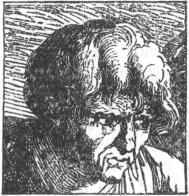
Fig. 99.
§ 14. In order to mark the temper of Angelico, by a contrast of another kind, I give, in Fig. 99, a facsimile of one of the heads in Salvator’s etching of the Academy of Plato. It is accurately characteristic of Salvator, showing, by quite a central type, his indignant, desolate, and degraded power. I could have taken unspeakably baser examples from others of his etchings, but they would have polluted my book, and been in some sort unjust, representing only the worst part of his work. This head, which is as elevated a type as he ever reaches, is assuredly debased enough; and a sufficient image of the mind of the painter of Catiline and the Witch of Endor.
§ 15. Then, in Fig. 100, you have also a central type of the mind of Durer. Complete, yet quaint; severely rational and practical, yet capable of the highest imaginative religious feeling, and as gentle as a child’s, it seemed to be well represented by this figure of the old bishop, with all the infirmities, and all the victory, of his life, written on his calm, kind, and worldly face. He has been no dreamer, nor persecutor, but a helpful and undeceivable man; and by careful comparison of this conception with the common kinds of episcopal ideal in modern religious art, you will gradually feel how the force of Durer is joined with an unapproachable refinement, so that he can give the most practical view of whatever he treats, without the slightest taint or shadow of vulgarity. Lastly, the fresco of Giorgione, Plate 79, which is as fair a type as I am able to give in any single figure, of the central Venetian art, will complete for us a series, sufficiently symbolical, of the several ranks of art, from lowest to highest.1 In Wouvermans (of whose work I suppose no example is needed, it being so generally known), we have the entirely carnal mind,—wholly versed in the material world, and incapable of conceiving any goodness or greatness whatsoever.
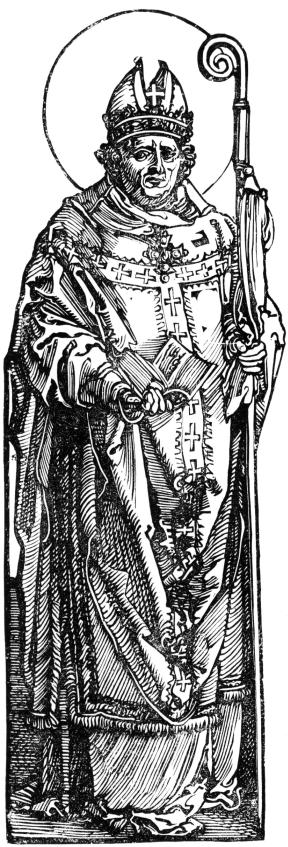
To face page 284.
Fig. 100.
In Angelico, you have the entirely spiritual mind, wholly versed in the heavenly world, and incapable of conceiving any wickedness or vileness whatsoever.
In Salvator, you have an awakened conscience, and some spiritual power, contending with evil, but conquered by it, and brought into captivity to it.
In Durer, you have a far purer conscience and higher spiritual power, yet, with some defect still in intellect, contending with evil, and nobly prevailing over it; yet retaining the marks of the contest, and never so entirely victorious as to conquer sadness.
In Giorgione, you have the same high spiritual power and practical sense; but now, with entirely perfect intellect, contending with evil; conquering it utterly, casting it away for ever, and rising beyond it into magnificence of rest.
1 As I was correcting these pages, there was put into my hand a little work by a very dear friend—“Travels and Study in Italy,” by Charles Eliot Norton;—I have not yet been able to do more than glance at it; but my impression is, that by carefully reading it, together with the essay by the same writer on the Vita Nuova of Dante, a more just estimate may be formed of the religious art of Italy than by the study of any other books yet existing. At least, I have seen none in which the tone of thought was at once so tender and so just.
I had hoped, before concluding this book, to have given it higher value by extracts from the works which have chiefly helped or guided me, especially from the writings of Helps, Lowell, and the Rev. A. J. Scott. But if I were to begin making such extracts, I find that I should not know, either in justice or affection, how to end.
CHAPTER IX.
THE TWO BOYHOODS.
§ 1. Born half-way between the mountains and the sea—that young George of Castelfranco—of the Brave Castle:—Stout George they called him, George of Georges, so goodly a boy he was—Giorgione.
Have you ever thought what a world his eyes opened on—fair, searching eyes of youth? What a world of mighty life, from those mountain roots to the shore;—of loveliest life, when he went down, yet so young, to the marble city—and became himself as a fiery heart to it?
A city of marble, did I say? nay, rather a golden city, paved with emerald. For truly, every pinnacle and turret glanced or glowed, overlaid with gold, or bossed with jasper. Beneath, the unsullied sea drew in deep breathing, to and fro, its eddies of green wave. Deep-hearted, majestic, terrible as the sea,—the men of Venice moved in sway of power and war; pure as her pillars of alabaster, stood her mothers and maidens; from foot to brow, all noble, walked her knights; the low bronzed gleaming of sea-rusted armor shot angrily under their blood-red mantle-folds. Fearless, faithful, patient, impenetrable, implacable,—every word a fate—sate her senate. In hope and honor, lulled by flowing of wave around their isles of sacred sand, each with his name written and the cross graved at his side, lay her dead. A wonderful piece of world. Rather, itself a world. It lay along the face of the waters, no larger, as its captains saw it from their masts at evening, than a bar of sunset that could not pass away; but, for its power, it must have seemed to them as if they were sailing in the expanse of heaven, and this a great planet, whose orient edge widened through ether. A world from which all ignoble care and petty thoughts were banished, with all the common and poor elements of life. No foulness, nor tumult, in those tremulous streets, that filled, or fell, beneath the moon; but rippled music of majestic change, or thrilling silence. No weak walls could rise above them; no low-roofed cottage, nor straw-built shed. Only the strength as of rock, and the finished setting of stones most precious. And around them, far as the eye could reach, still the soft moving of stainless waters, proudly pure; as not the flower, so neither the thorn nor the thistle, could grow in the glancing fields. Ethereal strength of Alps, dream-like, vanishing in high procession beyond the Torcellan shore; blue islands of Paduan hills, poised in the golden west. Above, tree winds and fiery clouds ranging at their will;—brightness out of the north, and balm from the south, and the stars of the evening and morning clear in the limitless light of arched heaven and circling sea.
Such was Giorgione’s school—such Titian’s home.
§ 2. Near the south-west corner of Covent Garden, a square brick pit or well is formed by a close-set block of houses, to the back windows of which it admits a few rays of light. Access to the bottom of it is obtained out of Maiden Lane, through a low archway and an iron gate; and if you stand long enough under the archway to accustom your eyes to the darkness, you may see on the left hand a narrow door, which formerly gave quiet access to a respectable barber’s shop, of which the front window, looking into Maiden Lane, is still extant, filled in this year (1860), with a row of bottles, connected, in some defunct manner, with a brewer’s business. A more fashionable neighborhood, it is said, eighty years ago than now—never certainly a cheerful one—wherein a boy being born on St. George’s day, 1775, began soon after to take interest in the world of Covent Garden, and put to service such spectacles of life as it afforded.
§ 3. No knights to be seen there, nor, I imagine, many beautiful ladies; their costume at least disadvantageous, depending much on incumbency of hat and feather, and short waists; the majesty of men founded similarly on shoebuckles and wigs;—impressive enough when Reynolds will do his best for it; but not suggestive of much ideal delight to a boy.
“Bello ovile dov’ io dormii agnello:” of things beautiful, besides men and women, dusty sunbeams up or down the street on summer mornings; deep furrowed cabbage leaves at the greengrocer’s; magnificence of oranges in wheelbarrows round the corner; and Thames’ shore within three minutes’ race.
§ 4. None of these things very glorious; the best, however, that England, it seems, was then able to provide for a boy of gift: who, such as they are, loves them—never, indeed, forgets them. The short waists modify to the last his visions of Greek ideal. His foregrounds had always a succulent cluster or two of greengrocery at the corners. Enchanted oranges gleam in Covent Gardens of the Hesperides; and great ships go to pieces in order to scatter chests of them on the waves. That mist of early sunbeams in the London dawn crosses, many and many a time, the clearness of Italian air; and by Thames’ shore, with its stranded barges and glidings of red sail, dearer to us than Lucerne lake or Venetian lagoon,—by Thames’ shore we will die.
§ 5. With such circumstance round him in youth, let us note what necessary effects followed upon the boy. I assume him to have had Giorgione’s sensibility (and more than Giorgione’s, if that be possible) to color and form. I tell you farther, and this fact you may receive trustfully, that his sensibility to human affection and distress was no less keen than even his sense for natural beauty—heart-sight deep as eye-sight.
Consequently, he attaches himself with the faithfullest child-love to everything that bears an image of the place he was born in. No matter how ugly it is,—has it anything about it like Maiden Lane, or like Thames’ shore? If so, it shall be painted for their sake. Hence, to the very close of life, Turner could endure ugliness which no one else, of the same sensibility, would have borne with for an instant. Dead brick walls, blank square windows, old clothes, market-womanly types of humanity—anything fishy and muddy, like Billingsgate or Hungerford Market, had great attraction for him; black barges, patched sails, and every possible condition of fog.
§ 6. You will find these tolerations and affections guiding or sustaining him to the last hour of his life; the notablest of all such endurances being that of dirt. No Venetian ever draws anything foul; but Turner devoted picture after picture to the illustration of effects of dinginess, smoke, soot, dust, and dusty texture; old sides of boats, weedy roadside vegetation, dung-hills, straw-yards, and all the soilings and stains of every common labor.
And more than this, he not only could endure, but enjoyed and looked for litter, like Covent Garden wreck after the market. His pictures are often full of it, from side to side; their foregrounds differ from all others in the natural way that things have of lying about in them. Even his richest vegetation, in ideal work, is confused; and he delights in shingle, débris, and heaps of fallen stones. The last words he ever spoke to me about a picture were in gentle exaltation about his St. Gothard: “that litter of stones which I endeavored to represent.”
§ 7. The second great result of this Covent Garden training was, understanding of and regard for the poor, whom the Venetians, we saw, despised; whom, contrarily, Turner loved, and more than loved—understood. He got no romantic sight of them, but an infallible one, as he prowled about the end of his lane, watching night effects in the wintry streets; nor sight of the poor alone, but of the poor in direct relations with the rich. He knew, in good and evil, what both classes thought of, and how they dwelt with, each other.
Reynolds and Gainsborough, bred in country villages, learned there the country boy’s reverential theory of “the squire,” and kept it. They painted the squire and the squire’s lady as centres of the movements of the universe, to the end of their lives. But Turner perceived the younger squire in other aspects about his lane, occurring prominently in its night scenery, as a dark figure, or one of two, against the moonlight. He saw also the working of city commerce, from endless warehouse, towering over Thames, to the back shop in the lane, with its stale herrings—highly interesting these last; one of his fathers best friends, whom he often afterwards visited affectionately at Bristol, being a fish-monger and glueboiler; which gives us a friendly turn of mind towards herring-fishing, whaling, Calais poissardes, and many other of our choicest subjects in after life; all this being connected with that mysterious forest below London Bridge on one side;—and, on the other, with these masses of human power and national wealth which weigh upon us, at Covent Garden here, with strange compression, and crush us into narrow Hand Court.
§ 8. “That mysterious forest below London Bridge”—better for the boy than wood of pine, or grove of myrtle. How he must have tormented the watermen, beseeching them to let him crouch anywhere in the bows, quiet as a log, so only that he might get floated down there among the ships, and round and round the ships, and with the ships, and by the ships, and under the ships, staring and clambering;—these the only quite beautiful things he can see in all the world, except the sky; but these, when the sun is on their sails, filling or falling, endlessly disordered by sway of tide and stress of anchorage, beautiful unspeakably; which ships also are inhabited by glorious creatures—redfaced sailors, with pipes, appearing over the gunwales, true knights, over their castle parapets—the most angelic beings in the whole compass of London world. And Trafalgar happening long before we can draw ships, we, nevertheless, coax all current stories out of the wounded sailors, do our best at present to show Nelson’s funeral streaming up the Thames; and vow that Trafalgar shall have its tribute of memory some day. Which, accordingly, is accomplished—once, with all our might, for its death; twice, with all our might, for its victory; thrice, in pensive farewell to the old Temeraire, and, with it, to that order of things.
§ 9. Now this fond companying with sailors must have divided his time, it appears to me, pretty equally between Covent Garden and Wapping (allowing for incidental excursions to Chelsea on one side, and Greenwich on the other), which time he would spend pleasantly, but not magnificently, being limited in pocket-money, and leading a kind of “Poor-Jack” life on the river.
In some respects, no life could be better for a lad. But it was not calculated to make his ear fine to the niceties of language, nor form his moralities on an entirely regular standard. Picking up his first scraps of vigorous English chiefly at Deptford and in the markets, and his first ideas of female tenderness and beauty among nymphs of the barge and the barrow,—another boy might, perhaps, have become what people usually term “vulgar.” But the original make and frame of Turner’s mind being not vulgar, but as nearly as possible a combination of the minds of Keats and Dante, joining capricious waywardness, and intense openness to every fine pleasure of sense, and hot defiance of formal precedent, with a quite infinite tenderness, generosity, and desire of justice and truth—this kind of mind did not become vulgar, but very tolerant of vulgarity, even fond of it in some forms; and, on the outside, visibly infected by it, deeply enough; the curious result, in its combination of elements, being to most people wholly incomprehensible. It was as if a cable had been woven of blood-crimson silk, and then tarred on the outside. People handled it, and the tar came off on their hands; red gleams were seen through the black, underneath, at the places where it had been strained. Was it ochre?—said the world—or red lead?
§ 10. Schooled thus in manners, literature, and general moral principles at Chelsea and Wapping, we have finally to inquire concerning the most important point of all. We have seen the principal differences between this boy and Giorgione, as respects sight of the beautiful, understanding of poverty, of commerce, and of order of battle; then follows another cause of difference in our training—not slight,—the aspect of religion, namely, in the neighborhood of Covent Garden. I say the aspect; for that was all the lad could judge by. Disposed, for the most part, to learn chiefly by his eyes, in this special matter he finds there is really no other way of learning. His father taught him “to lay one penny upon another.” Of mother’s teaching, we hear of none; of parish pastoral teaching, the reader may guess how much.
§ 11. I chose Giorgione rather than Veronese to help me in carrying out this parallel; because I do not find in Giorgione’s work any of the early Venetian monarchist element. He seems to me to have belonged more to an abstract contemplative school. I may be wrong in this; it is no matter;—suppose it were so, and that he came down to Venice somewhat recusant, or insentient, concerning the usual priestly doctrines of his day,—how would the Venetian religion, from an outer intellectual standing-point, have looked to him?
§ 12. He would have seen it to be a religion indisputably powerful in human affairs; often very harmfully so; sometimes devouring widows’ houses, and consuming the strongest and fairest from among the young; freezing into merciless bigotry the policy of the old: also, on the other hand, animating national courage, and raising souls, otherwise sordid, into heroism: on the whole, always a real and great power; served with daily sacrifice of gold, time, and thought; putting forth its claims, if hypocritically, at least in bold hypocrisy, not waiving any atom of them in doubt or fear; and, assuredly, in large measure, sincere, believing in itself, and believed: a goodly system, moreover, in aspect; gorgeous, harmonious, mysterious;—a thing which had either to be obeyed or combated, but could not be scorned. A religion towering over all the city—many buttressed—luminous in marble stateliness, as the dome of our Lady of Safety shines over the sea; many-voiced also, giving, over all the eastern seas, to the sentinel his watchword, to the soldier his war-cry; and, on the lips of all who died for Venice, shaping the whisper of death.
§ 13. I suppose the boy Turner to have regarded the religion of his city also from an external intellectual standing-point.
What did he see in Maiden Lane?
Let not the reader be offended with me; I am willing to let him describe, at his own pleasure, what Turner saw there; but to me, it seems to have been this. A religion maintained occasionally, even the whole length of the lane, at point of constable’s staff; but, at other times, placed under the custody of the beadle, within certain black and unstately iron railings of St. Paul’s, Covent Garden. Among the wheelbarrows and over the vegetables, no perceptible dominance of religion; in the narrow, disquieted streets, none; in the tongues, deeds, daily ways of Maiden Lane, little. Some honesty, indeed, and English industry, and kindness of heart, and general idea of justice; but faith, of any national kind, shut up from one Sunday to the next, not artistically beautiful even in those Sabbatical exhibitions; its paraphernalia being chiefly of high pews, heavy elocution, and cold grimness of behavior.
What chiaroscuro belongs to it—(dependent mostly on candlelight),—we will, however, draw considerately; no goodliness of escutcheon, nor other respectability being omitted, and the best of their results confessed, a meek old woman and a child being let into a pew, for whom the reading by candlelight will be beneficial.1
§ 14. For the rest, this religion seems to him discreditable—discredited—not believing in itself, putting forth its authority in a cowardly way, watching how far it might be tolerated, continually shrinking, disclaiming, fencing, finessing; divided against itself, not by stormy rents, but by thin fissures, and splittings of plaster from the walls. Not to be either obeyed, or combated, by an ignorant, yet clear-sighted youth; only to be scorned. And scorned not one whit the less, though also the dome dedicated to it looms high over distant winding of the Thames; as St. Mark’s campanile rose, for goodly landmark, over mirage of lagoon. For St. Mark ruled over life; the Saint of London over death; St. Mark over St. Mark’s Place, but St. Paul over St. Paul’s Churchyard.
§ 15. Under these influences pass away the first reflective hours of life, with such conclusion as they can reach. In consequence of a fit of illness, he was taken—I cannot ascertain in what year—to live with an aunt, at Brentford; and here, I believe, received some schooling, which he seems to have snatched vigorously; getting knowledge, at least by translation, of the more picturesque classical authors, which he turned presently to use, as we shall see. Hence also, walks about Putney and Twickenham in the summer time acquainted him with the look of English meadow-ground in its restricted states of paddock and park; and with some round-headed appearances of trees, and stately entrances to houses of mark: the avenue at Bushy, and the iron gates and carved pillars of Hampton, impressing him apparently with great awe and admiration; so that in after life his little country house is,—of all places in the world,—at Twickenham! Of swans and reedy shores he now learns the soft motion and the green mystery, in a way not to be forgotten.
§ 16. And at last fortune wills that the lad’s true life shall begin; and one summer’s evening, after various wonderful stage-coach experiences on the north road, which gave him a love of stage-coaches ever after, he finds himself sitting alone among the Yorkshire hills.2 For the first time, the silence of Nature round him, her freedom sealed to him, her glory opened to him. Peace at last; no roll of cart-wheel, nor mutter of sullen voices in the back shop; but curlew-cry in space of heaven, and welling of bell-toned streamlet by its shadowy rock. Freedom at last. Dead-wall, dark railing, fenced field, gated garden, all passed away like the dream of a prisoner; and behold, far as foot or eye can race or range, the moor, and cloud. Loveliness at last. It is here then, among these deserted vales! Not among men. Those pale, poverty-struck, or cruel faces;—that multitudinous, marred humanity—are not the only things that God has made. Here is something He has made which no one has marred. Pride of purple rocks, and river pools of blue, and tender wilderness of glittering trees, and misty lights of evening on immeasurable hills.
§ 17. Beauty, and freedom, and peace; and yet another teacher, graver than these. Sound preaching at last here, in Kirkstall crypt, concerning fate and life. Here, where the dark pool reflects the chancel pillars, and the cattle lie in unhindered rest, the soft sunshine on their dappled bodies, instead of priests’ vestments; their white furry hair ruffled a little, fitfully, by the evening wind, deep-scented from the meadow thyme.
§ 18. Consider deeply the import to him of this, his first sight of ruin, and compare it with the effect of the architecture that was around Giorgione. There were indeed aged buildings, at Venice, in his time, but none in decay. All ruin was removed, and its place filled as quickly as in our London; but filled always by architecture loftier and more wonderful than that whose place it took, the boy himself happy to work upon the walls of it; so that the idea of the passing away of the strength of men and beauty of their works never could occur to him sternly. Brighter and brighter the cities of Italy had been rising and broadening on hill and plain, for three hundred years. He saw only strength and immortality, could not but paint both; conceived the form of man as deathless, calm with power, and fiery with life.
§ 19. Turner saw the exact reverse of this. In the present work of men, meanness, aimlessness, unsightliness: thin-walled, lath-divided, narrow-garreted houses of clay; booths of a darksome Vanity Fair, busily base.
But on Whitby Hill, and by Bolton Brook, remained traces of other handiwork. Men who could build had been there; and who also had wrought, not merely for their own days. But to what purpose? Strong faith, and steady hands, and patient souls—can this, then, be all you have left! this the sum of your doing on the earth!—a nest whence the night-owl may whimper to the brook, and a ribbed skeleton of consumed arches, looming above the bleak banks of mist, from its cliff to the sea?
As the strength of men to Giorgione, to Turner their weakness and vileness, were alone visible. They themselves, unworthy or ephemeral; their work, despicable, or decayed. In the Venetian’s eyes, all beauty depended on man’s presence and pride; in Turner’s, on the solitude he had left, and the humiliation he had suffered.
§ 20. And thus the fate and issue of all his work were determined at once. He must be a painter of the strength of nature, there was no beauty elsewhere than in that; he must paint also the labor and sorrow and passing away of men; this was the great human truth visible to him.
Their labor, their sorrow, and their death. Mark the three. Labor; by sea and land, in field and city, at forge and furnace, helm and plough. No pastoral indolence nor classic pride shall stand between him and the troubling of the world; still less between him and the toil of his country,—blind, tormented, unwearied, marvellous England.
§ 21. Also their Sorrow; Ruin of all their glorious work, passing away of their thoughts and their honor, mirage of pleasure, Fallacy of Hope; gathering of weed on temple step; gaining of wave on deserted strand; weeping of the mother for the children, desolate by her breathless first-born in the streets of the city,3 desolate by her last sons slain, among the beasts of the field.4
§ 22. And their Death. That old Greek question again;—yet unanswered. The unconquerable spectre still flitting among the forest trees at twilight; rising ribbed out of the sea-sand;—white, a strange Aphrodite,—out of the sea-foam; stretching its gray, cloven wings among the clouds; turning the light of their sunsets into blood. This has to be looked upon, and in a more terrible shape than ever Salvator or Durer saw it. The wreck of one guilty country does not infer the ruin of all countries, and need not cause general terror respecting the laws of the universe. Neither did the orderly and narrow succession of domestic joy and sorrow in a small German community bring the question in its breadth, or in any unresolvable shape, before the mind of Durer. But the English death—the European death of the nineteenth century—was of another range and power; more terrible a thousand-fold in its merely physical grasp and grief; more terrible, incalculably, in its mystery and shame. What were the robber’s casual pang, or the rage of the flying skirmish, compared to the work of the axe, and the sword, and the famine, which was done during this man’s youth on all the hills and plains of the Christian earth, from Moscow to Gibraltar. He was eighteen years old when Napoleon came down on Arcola. Look on the map of Europe, and count the blood-stains on it, between Arcola and Waterloo.
§ 23. Not alone those blood-stains on the Alpine snow, and the blue of the Lombard plain. The English death was before his eyes also. No decent, calculable, consoled dying; no passing to rest like that of the aged burghers of Nuremberg town. No gentle processions to churchyards among the fields, the bronze crests bossed deep on the memorial tablets, and the skylark singing above them from among the corn. But the life trampled out in the slime of the street, crushed to dust amidst the roaring of the wheel, tossed countlessly away into howling winter wind along five hundred leagues of rock-fanged shore. Or, worst of all, rotted down to forgotten graves through years of ignorant patience, and vain seeking for help from man, for hope in God—infirm, imperfect yearning, as of motherless infants starving at the dawn; oppressed royalties of captive thought, vague ague-fits of bleak, amazed despair.
§ 24. A goodly landscape this, for the lad to paint, and under a goodly light. Wide enough the light was, and clear; no more Salvator’s lurid chasm on jagged horizon, nor Durer’s spotted rest of sunny gleam on hedgerow and field; but light over all the world. Full shone now its awful globe, one pallid charnel-house,—a ball strewn bright with human ashes, glaring in poised sway beneath the sun, all blinding-white with death from pole to pole,—death, not of myriads of poor bodies only, but of will, and mercy, and conscience; death, not once inflicted on the flesh, but daily, fastening on the spirit; death, not silent or patient, waiting his appointed hour, but voiceful, venomous; death with the taunting word, and burning grasp, and infixed sting.
“Put ye in the sickle, for the harvest is ripe.” The word is spoken in our ears continually to other reapers than the angels—to the busy skeletons that never tire for stooping. When the measure of iniquity is full, and it seems that another day might bring repentance and redemption,—“Put ye in the sickle.” When the young life has been wasted all away, and the eyes are just opening upon the tracks of ruin, and faint resolution rising in the heart for nobler things,—“Put ye in the sickle.” When the roughest blows of fortune have been borne long and bravely, and the hand is just stretched to grasp its goal,—“Put ye in the sickle.” And when there are but a few in the midst of a nation, to save it, or to teach, or to cherish; and all its life is bound up in those few golden ears,—“Put ye in the sickle, pale reapers, and pour hemlock for your feast of harvest home.”
This was the sight which opened on the young eyes, this the watchword sounding within the heart of Turner in his youth.
So taught, and prepared for his life’s labor, sate the boy at last alone among his fair English hills; and began to paint, with cautious toil, the rocks, and fields, and trickling brooks, and soft, white clouds of heaven.
1 Liber Studiorum. “Interior of a church.” It is worthy of remark that Giorgione and Titian are always delighted to have an opportunity of drawing priests. The English Church may, perhaps, accept it as matter of congratulation that this is the only instance in which Turner drew a clergyman.
2 I do not mean that this is his first acquaintance with the country, but the first impressive and touching one, after his mind was formed. The earliest sketches I found in the National Collection are at Clifton and Bristol; the next, at Oxford.
3 “The Tenth Plague of Egypt.”
4 “Rizpah, the Daughter of Aiah.”
CHAPTER X.
THE NEREID’S GUARD.
§ 1. The work of Turner, in its first period, is said in my account of his drawings at the National Gallery to be distinguished by “boldness of handling, generally gloomy tendency of mind, subdued color, and perpetual reference to precedent in composition.” I must refer the reader to those two catalogues1 for a more special account of his early modes of technical study. Here we are concerned only with the expression of that gloomy tendency of mind, whose causes we are now better able to understand.
§ 2. It was prevented from overpowering him by his labor. This, continual, and as tranquil in its course as a ploughman’s in the field, by demanding an admirable humility and patience, averted the tragic passion of youth. Full of stern sorrow and fixed purpose, the boy set himself to his labor silently and meekly, like a workman’s child on its first day at the cotton-mill. Without haste, but without relaxation,—accepting all modes and means of progress, however painful or humiliating, he took the burden on his shoulder and began his march. There was nothing so little, but that he noticed it; nothing so great but he began preparations to cope with it. For some time his work is, apparently, feelingless, so patient and mechanical are the first essays. It gains gradually in power and grasp; there is no perceptible aim at freedom, or at fineness, but the force insensibly becomes swifter, and the touch finer. The color is always dark or subdued.
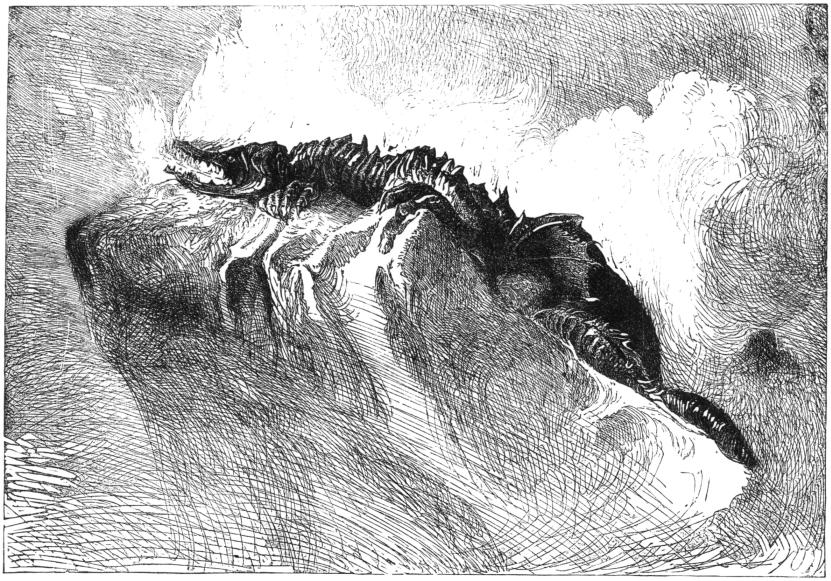
78. Quivi Trovammo.
§ 3. Of the first forty subjects which he exhibited at the Royal Academy, thirty-one are architectural, and of these twenty-one are of elaborate Gothic architecture (Peterborough cathedral, Lincoln cathedral, Malmesbury abbey, Tintern abbey, &c.). I look upon the discipline given to his hand by these formal drawings as of the highest importance. His mind was also gradually led by them into a calmer pensiveness.2 Education amidst country possessing architectural remains of some noble kind, I believe to be wholly essential to the progress of a landscape artist. The first verses he ever attached to a picture were in 1798. They are from Paradise Lost, and refer to a picture of Morning, on the Coniston Fells:—
“Ye mists and exhalations, that now rise From hill or streaming lake, dusky or gray, Till the sun paints your fleecy skirts with gold, In honor to the world’s great Author rise.”
By glancing over the verses, which in following years3 he quotes from Milton, Thompson, and Mallet, it may be seen at once how his mind was set, so far as natural scenes were concerned, on rendering atmospheric effect;—and so far as emotion was to be expressed, how consistently it was melancholy.
He paints, first of heroic or meditative subjects, the Fifth Plague of Egypt; next, the Tenth Plague of Egypt. His first tribute to the memory of Nelson is the “Battle of the Nile,” 1799. I presume an unimportant picture, as his power was not then availably developed. His first classical subject is Narcissus and Echo, in 1805:—
“So melts the youth and languishes away, His beauty withers, and his limbs decay.”
The year following he summons his whole strength, and paints what we might suppose would be a happier subject, the Garden of the Hesperides. This being the most important picture of the first period, I will analyze it completely.
§ 4. The fable of the Hesperides had, it seems to me, in the Greek mind two distinct meanings; the first referring to natural phenomena, and the second to moral. The natural meaning of it I believe to have been this:—
The Garden of the Hesperides was supposed to exist in the westernmost part of the Cyrenaica; it was generally the expression for the beauty and luxuriant vegetation of the coast of Africa in that district. The centre of the Cyrenaica “is occupied by a moderately elevated table-land, whose edge runs parallel to the coast, to which it sinks down in a succession of terraces, clothed with verdure, intersected by mountain streams running through ravines filled with the richest vegetation; well watered by frequent rains, exposed to the cool sea breeze from the north, and sheltered by the mass of the mountain from the sands and hot winds of the Sahara.”4
The Greek colony of Cyrene itself was founded ten miles from the sea-shore, “in a spot backed by the mountains on the south, and thus sheltered from the fiery blasts of the desert; while at the height of about 1800 feet an inexhaustible spring bursts forth amidst luxuriant vegetation, and pours its waters down to the Mediterranean through a most beautiful ravine.”
The nymphs of the west, or Hesperides, are therefore, I believe, as natural types, the representatives of the soft western winds and sunshine, which were in this district most favorable to vegetation. In this sense they are called daughters of Atlas and Hesperis, the western winds being cooled by the snow of Atlas. The dragon, on the contrary, is the representative of the Sahara wind, or Simoom, which blew over the garden from among the hills on the south, and forbade all advance of cultivation beyond their ridge. Whether this was the physical meaning of the tradition in the Greek mind or not, there can be no doubt of its being Turner’s first interpretation of it. A glance at the picture may determine this: a clear fountain being made the principal object in the foreground,—a bright and strong torrent in the distance,—while the dragon, wrapped in flame and whirlwind, watches from the top of the cliff.
§ 5. But, both in the Greek mind and Turner’s, this natural meaning of the legend was a completely subordinate one. The moral significance of it lay far deeper. In the second, but principal sense, the Hesperides were not daughters of Atlas, nor connected with the winds of the west, but with its splendor. They are properly the nymphs of the sunset, and are the daughters of night, having many brothers and sisters, of whom I shall take Hesiod’s account.
§ 6. “And the Night begat Doom, and short-withering Fate, and Death.
“And begat Sleep, and the company of Dreams, and Censure, and Sorrow.
“And the Hesperides, who keep the golden fruit beyond the mighty Sea.
“And the Destinies, and the Spirits of merciless punishment.
“And Jealousy, and Deceit, and Wanton Love; and Old Age, that fades away; and Strife, whose will endures.”
§ 7. We have not, I think, hitherto quite understood the Greek feeling about those nymphs and their golden apples, coming as a light in the midst of cloud; between Censure, and Sorrow,—and the Destinies. We must look to the precise meaning of Hesiod’s words, in order to get the force of the passage.
“The Night begat Doom;” that is to say, the doom of unforeseen accident—doom essentially of darkness.
“And short-withering Fate.” Ill translated. I cannot do it better. It means especially the sudden fate which brings untimely end to all purpose, and cuts off youth and its promise; called, therefore (the epithet hardly ever leaving it), “black Fate.”
“And Death.” This is the universal, inevitable death, opposed to the interfering, untimely death. These three are named as the elder children. Hesiod pauses, and repeats the word “begat” before going on to number the others.
“And begat Sleep, and the company of Dreams.”
“And Censure.” “Momus,” the Spirit of Blame—the spirit which desires to blame rather than to praise; false, base, unhelpful, unholy judgment;—ignorant and blind, child of the Night.
“And Sorrow.” Accurately, sorrow of mourning; the sorrow of the night, when no man can work; of the night that falls when what was the light of the eyes is taken from us; lamenting, sightless sorrow, without hope,—child of Night.
“And the Hesperides.” We will come back to these.
“And the Destinies, and the Spirits of Merciless Punishment.” These are the great Fates which have rule over conduct; the first fate spoken of (short-withering) is that which has rule over occurrence. These great Fates are Clotho, Lachesis, Atropos. Their three powers are—Clotho’s over the clue, the thread, or connecting energy,—that is, the conduct of life; Lachesis’ over the lot—that is to say, the chance which warps, entangles, or bends the course of life. Atropos, inflexible, cuts the thread for ever.
“And Jealousy,” especially the jealousy of Fortune, in balancing all good by evil. The Greeks had a peculiar dread of this form of fate.
“And Deceit, and sensual Love. And Old Age that fades, and Strife that endures;” that is to say, old age, which, growing not in wisdom, is marked only by its failing power—by the gradual gaining of darkness on the faculties, and helplessness on the frame, such age is the forerunner of true death—the child of Night. “And Strife,” the last and the mightiest, the nearest to man of the Night-children—blind leader of the blind.
§ 8. Understanding thus whose sisters they are, let us consider of the Hesperides themselves—spoken of commonly as the “Singing Nymphs.” They are four.
Their names are Æglé,—Brightness; Erytheia,—Blushing; Hestia,—the (spirit of the) Hearth; Arethusa,—the Ministering.
O English reader! hast thou ever heard of these fair and true daughters of Sunset, beyond the mighty sea?
And was it not well to trust to such keepers the guarding of the golden fruit which the earth gave to Juno at her marriage? Not fruit only: fruit on the tree, given by the earth, the great mother, to Juno (female power), at her marriage with Jupiter, or ruling manly power (distinguished from the tried and agonizing strength of Hercules). I call Juno, briefly, female power. She is, especially, the goddess presiding over marriage, regarding the woman as the mistress of a household. Vesta (the goddess of the hearth5), with Ceres, and Venus, are variously dominant over marriage, as the fulfilment of love; but Juno is pre-eminently the housewives’ goddess. She, therefore, represents, in her character, whatever good or evil may result from female ambition, or desire of power: and, as to a housewife, the earth presents its golden fruit to her, which she gives to two kinds of guardians. The wealth of the earth, as the source of household peace and plenty, is watched by the singing nymphs—the Hesperides. But, as the source of household sorrow and desolation, it is watched by the Dragon.
We must, therefore, see who the Dragon was, and what kind of dragon.
§ 9. The reader will, perhaps, remember that we traced, in an earlier chapter, the birth of the Gorgons, through Phorcys and Ceto, from Nereus. The youngest child of Phorcys and Ceto is the Dragon of the Hesperides; but this latest descent is not, as in Northern traditions, a sign of fortunateness: on the contrary, the children of Nereus receive gradually more and more terror and power, as they are later born, till this last of the Nereids unites horror and power at their utmost. Observe the gradual change. Nereus himself is said to have been perfectly true and gentle.
This is Hesiod’s account of him:—
“And Pontus begat Nereus, simple and true, the oldest of children; but they call him the aged man, in that he is errorless and kind; neither forgets he what is right; but knows all just and gentle counsel.”
§ 10. Now the children of Nereus, like the Hesperides themselves, bear a twofold typical character; one physical, the other moral. In his physical symbolism, Nereus himself is the calm and gentle sea, from which rise, in gradual increase of terror, the clouds and storms. In his moral character, Nereus is the type of the deep, pure, rightly-tempered human mind, from which, in gradual degeneracy, spring the troubling passions.
Keeping this double meaning in view, observe the whole line of descent to the Hesperides’ Dragon. Nereus, by the earth, begets (1) Thaumas (the wonderful), physically, the father of the Rainbow; morally, the type of the enchantments and dangers of imagination. His grandchildren, besides the Rainbow, are the Harpies. 2. Phorcys (Orcus?), physically, the treachery or devouring spirit of the sea; morally, covetousness or malignity of heart. 3. Ceto, physically, the deep places of the sea; morally, secretness of heart, called “fair-cheeked,” because tranquil in outward aspect. 4. Eurybia (wide strength), physically, the flowing, especially the tidal power of the sea (she, by one of the sons of Heaven, becomes the mother of three great Titans, one of whom, Astræus, and the Dawn, are the parents of the four Winds); morally, the healthy passion of the heart. Thus far the children of Nereus.
§ 11. Next, Phorcys and Ceto, in their physical characters (the grasping or devouring of the sea, reaching out over the land and its depth), beget the Clouds and Storms—namely, first, the Graiæ, or soft rain-clouds; then the Gorgons, or storm-clouds; and youngest and last, the Hesperides’ Dragon—Volcanic or earth-storm, associated, in conception, with the Simoom and fiery African winds.
But, in its moral significance, the descent is this. Covetousness, or malignity (Phorcys), and Secretness (Ceto), beget, first, the darkening passions, whose hair is always gray; then the stormy and merciless passions, brazen-winged (the Gorgons), of whom the dominant, Medusa, is ice-cold, turning all who look on her to stone. And, lastly, the consuming (poisonous and volcanic) passions—the “flame-backed dragon,” uniting the powers of poison, and instant destruction. Now, the reader may have heard, perhaps, in other books of Genesis than Hesiod’s, of a dragon being busy about a tree which bore apples, and of crushing the head of that dragon; but seeing how, in the Greek mind, this serpent was descended from the sea, he may, perhaps, be surprised to remember another verse, bearing also on the matter:—“Thou brakest the heads of the dragons in the waters;” and yet more surprised, going on with the Septuagint version, to find where he is being led: “Thou brakest the head of the dragon, and gavest him to be meat to the Ethiopian people. Thou didst tear asunder the strong fountains and the storm-torrents; thou didst dry up the rivers of Etham, πηγὰς καὶ χειμάῤῥους, the Pegasus fountains—Etham on the edge of the wilderness.”
§ 12. Returning then to Hesiod, we find he tells us of the Dragon himself:—“He, in the secret places of the desert land, kept the all-golden apples in his great knots” (coils of rope, or extremities of anything). With which compare Euripides’ report of him:—“And Hercules came to the Hesperian dome, to the singing maidens, plucking the apple fruit from the golden petals; slaying the flame-backed dragon, who twined round and round, kept guard in unapproachable spires” (spirals or whirls, as of a whirlwind-vortex).
Farther, we hear from other scattered syllables of tradition, that this dragon was sleepless, and that he was able to take various tones of human voice.
And we find a later tradition than Hesiod’s calling him a child of Typhon and Echidna. Now Typhon is volcanic storm, generally the evil spirit of tumult.
Echidna (the adder) is a descendant of Medusa. She is a daughter of Chrysaor (the lightning), by Calliröe (the fair flowing), a daughter of Ocean;—that is to say, she joins the intense fatality of the lightning with perfect gentleness. In form she is half-maiden, half-serpent; therefore she is the spirit of all the fatalest evil, veiled in gentleness: or, in one word, treachery;—having dominion over many gentle things;—and chiefly over a kiss, given, indeed, in another garden than that of the Hesperides, yet in relation to keeping of treasure also.
§ 13. Having got this farther clue, let us look who it is whom Dante makes the typical Spirit of Treachery. The eighth or lowest pit of hell is given to its keeping; at the edge of which pit, Virgil casts a rope down for a signal; instantly there rises, as from the sea, “as one returns who hath been down to loose some anchor,” “the fell monster with the deadly sting, who passes mountains, breaks through fenced walls, and firm embattled spears; and with his filth taints all the world.”
Think for an instant of another place:—“Sharp stones are under him, he laugheth at the shaking of a spear.” We must yet keep to Dante, however. Echidna, remember, is half-maiden, half-serpent;—hear what Dante’s Fraud is like:—
“Forthwith that image vile of Fraud appear’d, His head and upper part exposed on land, But laid not on the shore his bestial train. His face the semblance of a just man’s wore, So kind and gracious was its outward cheer; The rest was serpent all: two shaggy claws Reach’d to the armpits; and the back and breast, And either side, were painted o’er with nodes And orbits. Colors variegated more Nor Turks nor Tartars e’er on cloth of state With interchangeable embroidery wove, Nor spread Arachne o’er her curious loom. As oft-times a light skiff moor’d to the shore, Stands part in water, part upon the land; Or, as where dwells the greedy German boor, The beaver settles, watching for his prey; So on the rim, that fenced the sand with rock, Sat perch’d the fiend of evil. In the void Glancing, his tail upturn’d, its venomous fork With sting like scorpion’s arm’d.”
§ 14. You observe throughout this description the leaning on the character of the Sea Dragon; a little farther on, his way of flying is told us:—