Front matter (continued 3)
Reading edition
§ 6. One reason for this is that all great men like their inferior forms to follow and obey contours of large surfaces, or group themselves in connected masses. Patterns do the first, leaves the last; but flowers stand separately.
Another reason is that the beauty of flower-petals and texture can only be seen by looking at it close; but flat patterns can be seen far off, as well as gleaming of metal-work. All the great men calculate their work for effect at some distance, and with that object, know it to be lost time to complete the drawing of flowers. Farther, the forms of flowers being determined, require a painful attention, and restrain the fancy; whereas, in painting fur, jewels, or bronze, the color and touch may be varied almost at pleasure, and without effort.
Again, much of what is best in flowers is inimitable in painting; and a thoroughly good workman feels the feebleness of his means when he matches them fairly with Nature, and gives up the attempt frankly—painting the rose dull red, rather than trying to rival its flush in sunshine.
And, lastly, in nearly all good landscape-painting, the breadth of foreground included implies such a distance of the spectator from the nearest object as must entirely prevent his seeing flower detail.
§ 7. There is, however, a deeper reason than all these; namely, that flowers have no sublimity. We shall have to examine the nature of sublimity in our following and last section, among other ideas of relation. Here I only note the fact briefly, that impressions of awe and sorrow being at the root of the sensation of sublimity, and the beauty of separate flowers not being of the kind which connects itself with such sensation, there is a wide distinction, in general, between flower-loving minds and minds of the highest order. Flowers seem intended for the solace of ordinary humanity: children love them; quiet, tender, contented ordinary people love them as they grow; luxurious and disorderly people rejoice in them gathered: They are the cottager’s treasure; and in the crowded town, mark, as with a little broken fragment of rainbow, the windows of the workers in whose heart rests the covenant of peace. Passionate or religious minds contemplate them with fond, feverish intensity; the affection is seen severely calm in the works of many old religious painters, and mixed with more open and true country sentiment in those of our own pre-Raphaelites. To the child and the girl, the peasant and the manufacturing operative, to the grisette and the nun, the lover and monk, they are precious always. But to the men of supreme power and thoughtfulness, precious only at times; symbolically and pathetically often to the poets, but rarely for their own sake. They fall forgotten from the great workmen’s and soldiers’ hands. Such men will take, in thankfulness, crowns of leaves, or crowns of thorns—not crowns of flowers.
§ 8. Some beautiful things have been done lately, and more beautiful are likely to be done, by our younger painters, in representing blossoms of the orchard and the field in mass and extent. I have had something to do with the encouragement of this impulse; and truly, if pictures are to be essentially imitative rather than inventive, it is better to spend care in painting hyacinths than dead leaves, and roses rather than stubble. Such work, however, as I stated in my first essay on this subject, in the year 1851,1 can only connect itself with the great schools by becoming inventive instead of copyist; and for the most part, I believe these young painters would do well to remember that the best beauty of flowers being wholly inimitable, and their sweetest service unrenderable by art, the picture involves some approach to an unsatisfying mockery, in the cold imagery of what Nature has given to be breathed with the profuse winds of spring, and touched by the happy footsteps of youth.
§ 9. Among the greater masters, as I have said, there is little laborious or affectionate flower-painting. The utmost that Turner ever allows in his foregrounds is a water-lily or two, a cluster of heath or foxglove, a thistle sometimes, a violet or daisy, or a bindweed-bell; just enough to lead the eye into the understanding of the rich mystery of his more distant leafage. Rich mystery, indeed, respecting which these following facts about the foliage of tented plants must be noted carefully.
§ 10. Two characters seem especially aimed at by Nature in the earth-plants: first, that they should be characteristic and interesting; secondly, that they should not be very visibly injured by crushing.
I say, first, characteristic. The leaves of large trees take approximately simple forms, slightly monotonous. They are intended to be seen in mass. But the leaves of the herbage at our feet take all kinds of strange shapes, as if to invite us to examine them. Star-shaped, heart-shaped, spear-shaped, arrow-shaped, fretted, fringed, cleft, furrowed, serrated, sinuated; in whorls, in tufts, in spires, in wreaths endlessly expressive, deceptive, fantastic, never the same from footstalk to blossom; they seem perpetually to tempt our watchfulness, and take delight in outstripping our wonder.
§ 11. Secondly, observe, their forms are such as will not be visibly injured by crushing. Their complexity is already disordered: jags and rents are their laws of being; rent by the footstep they betray no harm. Here, for instance (Fig. 72), is the mere outline of a buttercup-leaf in full free growth; which, perhaps, may be taken as a good common type of earth foliage. Fig. 73 is a less advanced one, placed so as to show its symmetrical bounding form. But both, how various;—how delicately rent into beauty! As in the aiguilles of the great Alps, so in this lowest field-herb, where rending is the law of being, it is the law of loveliness.
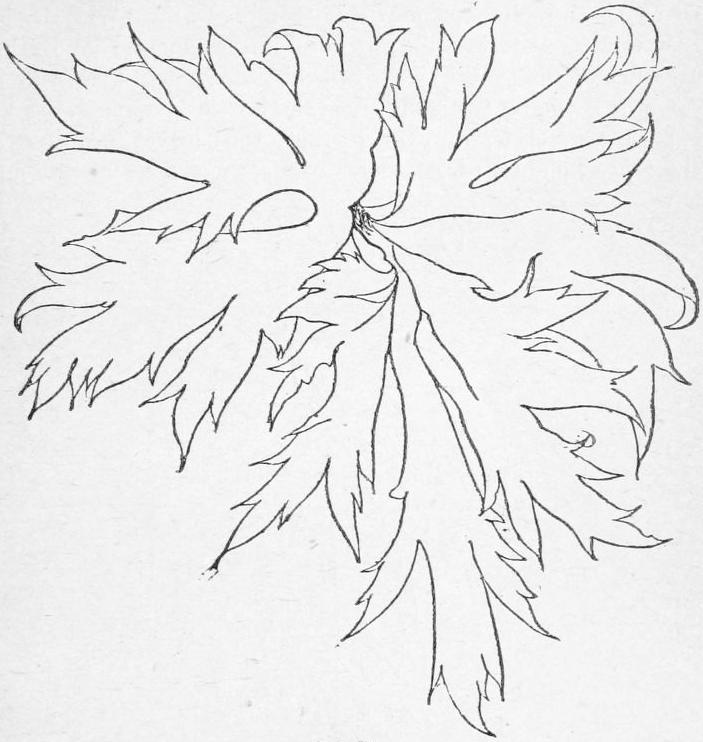
Fig. 72.
§ 12. One class, however, of these torn leaves, peculiar to the tented plants, has, it seems to me, a strange expressional function. I mean the group of leaves rent into alternate gaps, typically represented by the thistle. The alternation of the rent, if not absolutely, is effectively, peculiar to the earth-plants. Leaves of the builders are rent symmetrically, so as to form radiating groups, as in the horse-chestnut, or they are irregularly sinuous, as in the oak; but the earth-plants continually present forms such as those in the opposite Plate: a kind of web-footed leaf, so to speak; a continuous tissue, enlarged alternately on each side of the stalk. Leaves of this form have necessarily a kind of limping gait, as if they grew not all at once, but first a little bit on one side, and then a little bit on the other, and wherever they occur in quantity, give the expression to foreground vegetation which we feel and call “ragged.”
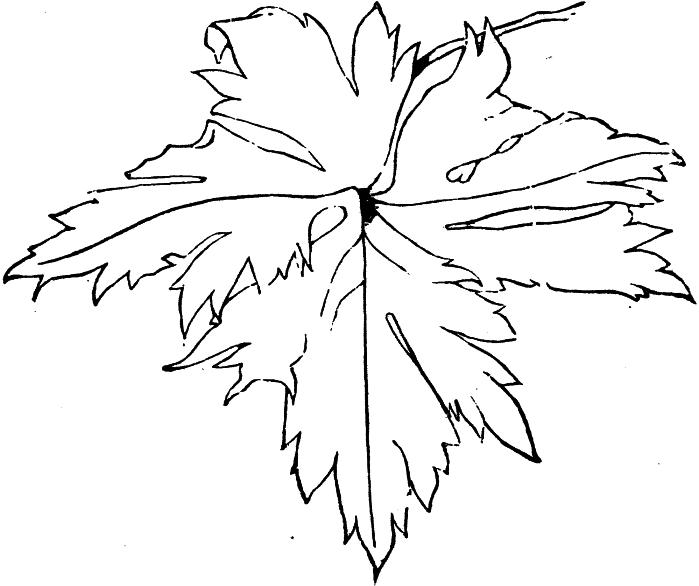
Fig. 73.
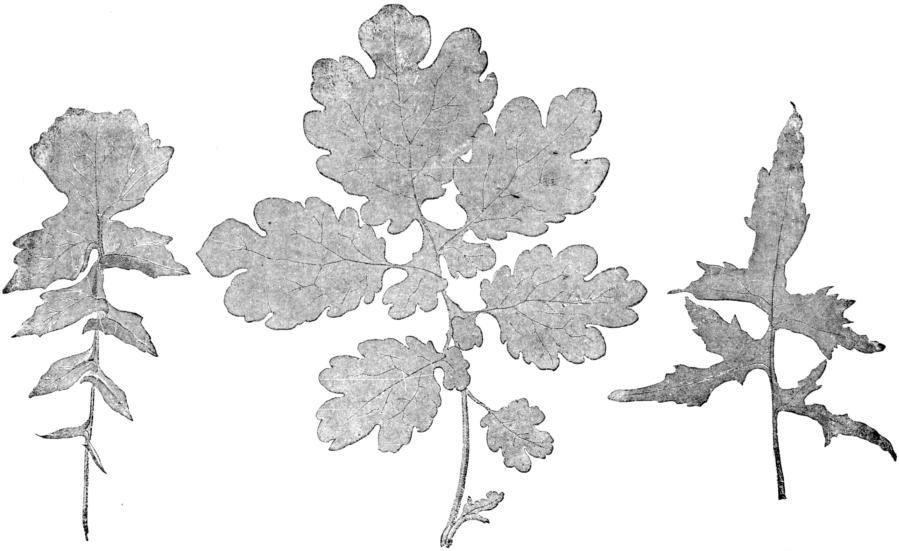
60. The Rending of Leaves.
§ 13. It is strange that the mere alternation of the rent should give this effect; the more so, because alternate leaves, completely separate from each other, produce one of the most graceful types of building plants. Yet the fact is indeed so, that the alternate rent in the earth-leaf is the principal cause of its ragged effect. However deeply it may be rent symmetrically, as in the alchemilla, or buttercup, just instanced, and however finely divided, as in the parsleys, the result is always a delicate richness, unless the jags are alternate, and the leaf-tissue continuous at the stem; and the moment these conditions appear, so does the raggedness.
§ 14. It is yet more worthy of note that the proper duty of these leaves, which catch the eye so clearly and powerfully, would appear to be to draw the attention of man to spots where his work is needed, for they nearly all habitually grow on ruins or neglected ground: not noble ruins, or on wild ground, but on heaps of rubbish, or pieces of land which have been indolently cultivated or much disturbed. The leaf on the right of the three in the Plate, which is the most characteristic of the class, is that of the Sisymbrium Irio, which grows, by choice, always on ruins left by fire. The plant, which, as far as I have observed, grows first on earth that has been moved, is the colts-foot: its broad covering leaf is much jagged, but only irregular, not alternate in the rent; but the weeds that mark habitual neglect, such as the thistle, give clear alternation.
§ 15. The aspects of complexity and carelessness of injury are farther increased in the herb of the field, because it is “herb yielding seed;” that is to say, a seed different in character from that which trees form in their fruit.
I am somewhat alarmed in reading over the above sentence, lest a botanist, or other scientific person, should open the book at it. For of course the essential character of either fruit or seed being only that in the smallest compass the vital principle of the plant is rendered portable, and for some time, preservable, we ought to call every such vegetable dormitory a “fruit” or a “seed” indifferently. But with respect to man there is a notable difference between them.
A seed is what we “sow.”
A fruit, what we “enjoy.”
Fruit is seed prepared especially for the sight and taste of man and animals; and in this sense we have true fruit and traitorous fruit (poisonous); but it is perhaps the best available distinction,2 that seed being the part necessary for the renewed birth of the plant, a fruit is such seed enclosed or sustained by some extraneous substance, which is soft and juicy, and beautifully colored, pleasing and useful to animals and men.
§ 16. I find it convenient in this volume, and wish I had thought of the expedient before, whenever I get into a difficulty, to leave the reader to work it out. He will perhaps, therefore, be so good as to define fruit for himself. Having defined it, he will find that the sentence about which I was alarmed above is, in the main, true, and that tented plants principally are herb yielding seed, while building plants give fruit. The berried shrubs of rock and wood, however dwarfed in stature, are true builders. The strawberry-plant is the only important exception—a tender Bedouin.
§ 17. Of course the principal reason for this is the plain, practical one, that fruit should not be trampled on, and had better perhaps be put a little out of easy reach than too near the hand, so that it may not be gathered wantonly or without some little trouble, and may be waited for until it is properly ripe: while the plants meant to be trampled on have small and multitudinous seed, hard and wooden, which may be shaken and scattered about without harm.
Also, fine fruit is often only to be brought forth with patience; not by young and hurried trees—but in due time, after much suffering; and the best fruit is often to be an adornment of old age, so as to supply the want of other grace. While the plants which will not work, but only bloom and wander, do not (except the grasses) bring forth fruit of high service, but only the seed that prolongs their race, the grasses alone having great honor put on them for their humility, as we saw in our first account of them.
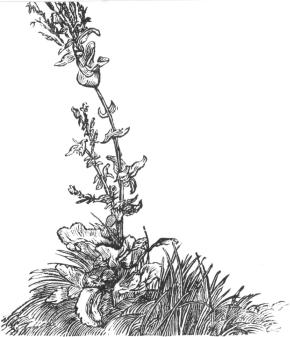
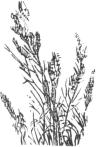
Fig. 74. Fig. 75. Fig. 76.
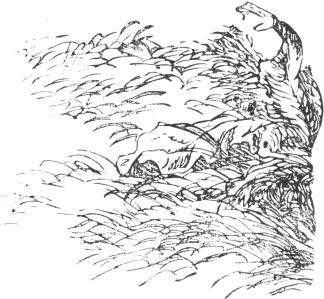
Fig. 77.
To face page 97.
Fig. 78.
§ 18. This being so, we find another element of very complex effect added to the others which exist in tented plants, namely, that of minute, granular, feathery, or downy seed-vessels, mingling quaint brown punctuation, and dusty tremors of dancing grain, with the bloom of the nearer fields; and casting a gossamered grayness and softness of plumy mist along their surfaces far away; mysterious evermore, not only with dew in the morning or mirage at noon, but with the shaking threads of fine arborescence, each a little belfry of grain-bells, all a-chime.
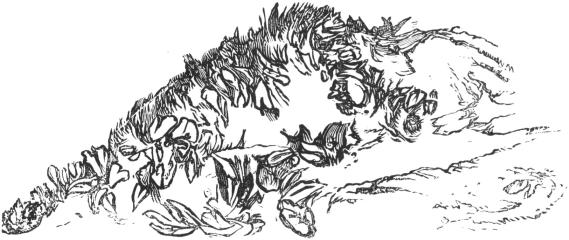
§ 19. I feel sorely tempted to draw one of these same spires of the fine grasses, with its sweet changing proportions of pendent grain, but it would be a useless piece of finesse, as such form of course never enters into general foreground effect.3 I have, however, engraved, at the top of the group of woodcuts opposite (Fig. 74), a single leaf cluster of Durer’s foreground in the St. Hubert, which is interesting in several ways; as an example of modern work, no less than old; for it is a facsimile twice removed; being first drawn from the plate with the pen, by Mr. Allen, and then facsimiled on wood by Miss Byfield; and if the reader can compare it with the original, he will find it still come tolerably close in most parts (though the nearest large leaf has got spoiled), and of course some of the finest and most precious qualities of Durer’s work are lost. Still, it gives a fair idea of his perfectness of conception, every leaf being thoroughly set in perspective, and drawn with unerring decision. On each side of it (Figs. 75, 76) are two pieces from a fairly good modern etching, which I oppose to the Durer in order to show the difference between true work and that which pretends to give detail, but is without feeling or knowledge. There are a great many leaves in the piece on the left, but they are all set the same way; the draughtsman has not conceived their real positions, but draws one after another as he would deliver a tale of bricks. The grasses on the right look delicate, but are a mere series of inorganic lines. Look how Durer’s grass-blades cross each other. If you take a pen and copy a little piece of each example, you will soon feel the difference. Underneath, in the centre (Fig. 77), is a piece of grass out of Landseer’s etching of the “Ladies’ Pets,” more massive and effective than the two lateral fragments, but still loose and uncomposed. Then underneath is a piece of firm and good work again, which will stand with Durer’s; it is the outline only of a group of leaves out of Turner’s foreground in the Richmond from the Moors, of which I give a reduced etching, Plate 61, for the sake of the foreground principally, and in Plate 62, the group of leaves in question, in their light and shade, with the bridge beyond. What I have chiefly to say of them belongs to our section on composition; but this mere fragment of a Turner foreground may perhaps lead the reader to take note in his great pictures of the almost inconceivable labor with which he has sought to express the redundance and delicacy of ground leafage.
§ 20. By comparing the etching in Plate 61 with the published engraving, it will be seen how much yet remains to be done before any approximately just representation of Turner foreground can be put within the reach of the public. This Plate has been reduced by Mr. Armytage from a pen-drawing of mine, as large as the original of Turner’s (18 inches by 11 inches). It will look a little better under a magnifying glass; but only a most costly engraving, of the real size, could give any idea of the richness of mossy and ferny leafage included in the real design. And if this be so on one of the ordinary England drawings of a barren Yorkshire moor, it may be imagined what the task would be of engraving truly such a foreground as that of the “Bay of Baiæ” or “Daphne and Leucippus,” in which Turner’s aim has been luxuriance.
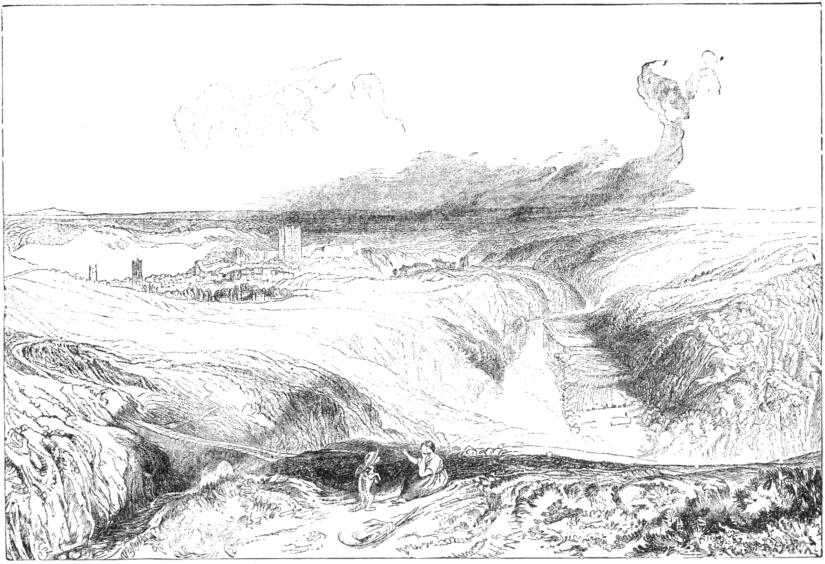
61. Richmond from the Moors.
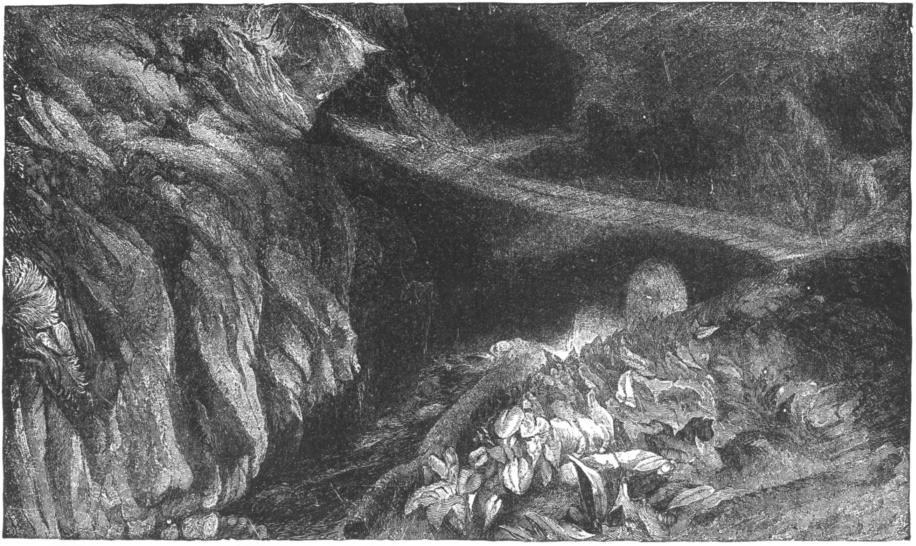
62. By the Brookside.
§ 21. His mind recurred, in all these classical foregrounds, to strong impressions made upon him during his studies at Rome, by the masses of vegetation which enrich its heaps of ruin with their embroidery and bloom. I have always partly regretted these Roman studies, thinking that they led him into too great fondness of pandering luxuriance in vegetation, associated with decay; and prevented his giving affection enough to the more solemn and more sacred infinity with which, among the mightier ruins of the Alpine Rome, glow the pure and motionless splendors of the gentian and the rose.
§ 22. Leaves motionless. The strong pines wave above them, and the weak grasses tremble beside them; but the blue stars rest upon the earth with a peace as of heaven; and far along the ridges of iron rock, moveless as they, the rubied crests of Alpine rose flush in the low rays of morning. Nor these yet the stillest leaves. Others there are subdued to a deeper quietness, the mute slaves of the earth, to whom we owe, perhaps, thanks, and tenderness, the most profound of all we have to render for the leaf ministries.
§ 23. It is strange to think of the gradually diminished power and withdrawn freedom among the orders of leaves—from the sweep of the chestnut and gadding of the vine, down to the close shrinking trefoil, and contented daisy, pressed on earth; and, at last, to the leaves that are not merely close to earth, but themselves a part of it; fastened down to it by their sides, here and there only a wrinkled edge rising from the granite crystals. We have found beauty in the tree yielding fruit, and in the herb yielding seed. How of the herb yielding no seed,4 the fruitless, flowerless lichen of the rock?
§ 24. Lichen, and mosses (though these last in their luxuriance are deep and rich as herbage, yet both for the most part humblest of the green things that live),—how of these? Meek creatures! the first mercy of the earth, veiling with hushed softness its dintless rocks; creatures full of pity, covering with strange and tender honor the scarred disgrace of ruin,—laying quiet finger on the trembling stones, to teach them rest. No words, that I know of, will say what these mosses are. None are delicate enough, none perfect enough, none rich enough. How is one to tell of the rounded bosses of furred and beaming green,—the starred divisions of rubied bloom, fine-filmed, as if the Rock Spirits could spin porphyry as we do glass,—the traceries of intricate silver, and fringes of amber, lustrous, arborescent, burnished through every fibre into fitful brightness and glossy traverses of silken change, yet all subdued and pensive, and framed for simplest, sweetest offices of grace. They will not be gathered, like the flowers, for chaplet or love-token; but of these the wild bird will make its nest, and the wearied child his pillow.
And, as the earth’s first mercy, so they are its last gift to us. When all other service is vain, from plant and tree, the soft mosses and gray lichen take up their watch by the head-stone. The woods, the blossoms, the gift-bearing grasses, have done their parts for a time, but these do service for ever. Trees for the builder’s yard, flowers for the bride’s chamber, corn for the granary, moss for the grave.
§ 25. Yet as in one sense the humblest, in another they are the most honored of the earth-children. Unfading, as motionless, the worm frets them not, and the autumn wastes not. Strong in lowliness, they neither blanch in heat nor pine in frost. To them, slow-fingered, constant-hearted, is entrusted the weaving of the dark, eternal, tapestries of the hills; to them, slow-pencilled, iris-dyed, the tender framing of their endless imagery. Sharing the stillness of the unimpassioned rock, they share also its endurance; and while the winds of departing spring scatter the white hawthorn blossom like drifted snow, and summer dims on the parched meadow the drooping of its cowslip-gold,—far above, among the mountains, the silver lichen-spots rest, star-like, on the stone; and the gathering orange stain upon the edge of yonder western peak reflects the sunsets of a thousand years.
1 Pre-Raphaelitism. The essay contains some important notes on Turner’s work, which, therefore, I do not repeat in this volume.
2 I say the “best available distinction.” It is, of course, no real distinction. A peapod is a kind of central type of seed and seed-vessel, and it is difficult so to define fruit as to keep clear of it. Pea-shells are boiled and eaten in some countries rather than pease. It does not sound like a scientific distinction to say that fruit is a “shell which is good without being boiled.” Nay, even if we humiliate ourselves into this practical reference to the kitchen, we are still far from success. For the pulp of a strawberry is not a “shell,” the seeds being on the outside of it. The available part of a pomegranate or orange, though a seed envelope, is itself shut within a less useful rind. While in an almond the shell becomes less profitable still, and all goodness retires into the seed itself, as in a grain of corn.
3 For the same reason, I enter into no considerations respecting the geometrical forms of flowers, though they are deeply interesting, and perhaps some day I may give a few studies of them separately. The reader should note, however, that beauty of form in flowers is chiefly dependent on a more accurately finished or more studiously varied development of the tre-foil, quatre-foil, and cinq-foil structures which we have seen irregularly approached by leaf-buds. The most beautiful six-foiled flowers (like the rhododendron-shoot) are composed of two triangular groups, one superimposed on the other, as in the narcissus; and the most interesting types both of six-foils and cinq-foils are unequally leaved, symmetrical on opposite sides, as the iris and violet.
4 The reader must remember always that my work is concerning the aspects of things only. Of course, a lichen has seeds, just as other plants have, but not effectually or visibly for man.

PART VII.
OF CLOUD BEAUTY.
—————
CHAPTER I.
THE CLOUD-BALANCINGS.
§ 1. We have seen that when the earth had to be prepared for the habitation of man, a veil, as it were, of intermediate being was spread between him and its darkness, in which were joined, in a subdued measure, the stability and insensibility of the earth, and the passion and perishing of mankind.
But the heavens, also, had to be prepared for his habitation.
Between their burning light,—their deep vacuity, and man, as between the earth’s gloom of iron substance, and man, a veil had to be spread of intermediate being;—which should appease the unendurable glory to the level of human feebleness, and sign the changeless motion of the heavens with a semblance of human vicissitude.
Between earth and man arose the leaf. Between the heaven and man came the cloud. His life being partly as the falling leaf, and partly as the flying vapor.
§ 2. Has the reader any distinct idea of what clouds are? We had some talk about them long ago, and perhaps thought their nature, though at that time not clear to us, would be easily enough understandable when we put ourselves seriously to make it out. Shall we begin with one or two easiest questions?
That mist which lies in the morning so softly in the valley, level and white, through which the tops of the trees rise as if through an inundation—why is it so heavy? and why does it lie so low, being yet so thin and frail that it will melt away utterly into splendor of morning, when the sun has shone on it but a few moments more? Those colossal pyramids, huge and firm, with outlines as of rocks, and strength to bear the beating of the high sun full on their fiery flanks—why are they so light,—their bases high over our heads, high over the heads of Alps? why will these melt away, not as the sun rises, but as he descends, and leave the stars of twilight clear, while the valley vapor gains again upon the earth like a shroud?
Or that ghost of a cloud, which steals by yonder clump of pines; nay, which does not steal by them, but haunts them, wreathing yet round them, and yet—and yet, slowly: now falling in a fair waved line like a woman’s veil; now fading, now gone: we look away for an instant, and look back, and it is again there. What has it to do with that clump of pines, that it broods by them and weaves itself among their branches, to and fro? Has it hidden a cloudy treasure among the moss at their roots, which it watches thus? Or has some strong enchanter charmed it into fond returning, or bound it fast within those bars of bough? And yonder filmy crescent, bent like an archer’s bow above the snowy summit, the highest of all the hill,—that white arch which never forms but over the supreme crest,—how is it stayed there, repelled apparently from the snow—nowhere touching it, the clear sky seen between it and the mountain edge, yet never leaving it—poised as a white bird hovers over its nest?
Or those war-clouds that gather on the horizon, dragon-crested, tongued with fire;—how is their barbed strength bridled? what bits are these they are champing with their vaporous lips; flinging off flakes of black foam? Leagued leviathans of the Sea of Heaven, out of their nostrils goeth smoke, and their eyes are like the eyelids of the morning. The sword of him that layeth at them cannot hold the spear, the dart, nor the habergeon. Where ride the captains of their armies? Where are set the measures of their march? Fierce murmurers, answering each other from morning until evening—what rebuke is this which has awed them into peace? what hand has reined them back by the way by which they came?
§ 3. I know not if the reader will think at first that questions like these are easily answered. So far from it, I rather believe that some of the mysteries of the clouds never will be understood by us at all. “Knowest thou the balancings of the clouds?” Is the answer ever to be one of pride? “The wondrous works of Him which is perfect in knowledge?” Is our knowledge ever to be so?
It is one of the most discouraging consequences of the varied character of this work of mine, that I am wholly unable to take note of the advance of modern science. What has conclusively been discovered or observed about clouds, I know not; but by the chance inquiry possible to me I find no book which fairly states the difficulties of accounting for even the ordinary aspects of the sky. I shall, therefore, be able in this section to do little more than suggest inquiries to the reader, putting the subject in a clear form for him. All men accustomed to investigation will confirm me in saying that it is a great step when we are personally quite certain what we do not know.
§ 4. First, then, I believe we do not know what makes clouds float. Clouds are water, in some fine form or another; but water is heavier than air, and the finest form you can give a heavy thing will not make it float in a light thing. On it, yes; as a boat: but in it, no. Clouds are not boats, nor boat-shaped, and they float in the air, not on the top of it. “Nay, but though unlike boats, may they not be like feathers? If out of quill substance there may be constructed eider-down, and out of vegetable tissue, thistle-down, both buoyant enough for a time, surely of water-tissue may be constructed also water-down, which will be buoyant enough for all cloudy purposes.” Not so. Throw out your eider plumage in a calm day, and it will all come settling to the ground: slowly indeed, to aspect; but practically so fast that all our finest clouds would be here in a heap about our ears in an hour or two, if they were only made of water-feathers. “But may they not be quill-feathers, and have air inside them? May not all their particles be minute little balloons?”
A balloon only floats when the air inside it is either specifically, or by heating, lighter than the air it floats in. If the cloud-feathers had warm air inside their quills, a cloud would be warmer than the air about it, which it is not (I believe). And if the cloud-feathers had hydrogen inside their quills, a cloud would be unwholesome for breathing, which it is not—at least so it seems to me.
“But may they not have nothing inside their quills?” Then they would rise, as bubbles do through water, just as certainly as, if they were solid feathers, they would fall. All our clouds would go up to the top of the air, and swim in eddies of cloud-foam.
“But is not that just what they do?” No. They float at different heights, and with definite forms, in the body of the air itself. If they rose like foam, the sky on a cloudy day would look like a very large flat glass of champagne seen from below, with a stream of bubbles (or clouds) going up as fast as they could to a flat foam-ceiling.
“But may they not be just so nicely mixed out of something and nothing, as to float where they are wanted?”
Yes: that is just what they not only may, but must be: only this way of mixing something and nothing is the very thing I want to explain or have explained, and cannot do it, nor get it done.
§ 5. Except thus far. It is conceivable that minute hollow spherical globules might be formed of water, in which the enclosed vacuity just balanced the weight of the enclosing water, and that the arched sphere formed by the watery film was strong enough to prevent the pressure of the atmosphere from breaking it in. Such a globule would float like a balloon at the height in the atmosphere where the equipoise between the vacuum it enclosed, and its own excess of weight above that of the air, was exact. It would, probably, approach its companion globules by reciprocal attraction, and form aggregations which might be visible.
This is, I believe, the view usually taken by meteorologists. I state it as a possibility, to be taken into account in examining the question—a possibility confirmed by the scriptural words which I have taken for the title of this chapter.
§ 6. Nevertheless, I state it as a possibility only, not seeing how any known operation of physical law could explain the formation of such molecules. This, however, is not the only difficulty. Whatever shape the water is thrown into, it seems at first improbable that it should lose its property of wetness. Minute division of rain, as in “Scotch mist,” makes it capable of floating farther,1 or floating up and down a little, just as dust will float, though pebbles will not; or gold-leaf, though a sovereign will not; but minutely divided rain wets as much as any other kind, whereas a cloud, partially always, sometimes entirely, loses its power of moistening. Some low clouds look, when you are in them, as if they were made of specks of dust, like short hairs; and these clouds are entirely dry. And also many clouds will wet some substances, but not others. So that we must grant farther, if we are to be happy in our theory, that the spherical molecules are held together by an attraction which prevents their adhering to any foreign body, or perhaps ceases only under some peculiar electric conditions.
§ 7. The question remains, even supposing their production accounted for,—What intermediate states of water may exist between these spherical hollow molecules and pure vapor?
Has the reader ever considered the relations of commonest forms of volatile substance? The invisible particles which cause the scent of a rose-leaf, how minute, how multitudinous, passing richly away into the air continually! The visible cloud of frankincense—why visible? Is it in consequence of the greater quantity, or larger size of the particles, and how does the heat act in throwing them off in this quantity, or of this size?
Ask the same questions respecting water. It dries, that is, becomes volatile, invisibly, at (any?) temperature. Snow dries, as water does. Under increase of heat, it volatilizes faster, so as to become dimly visible in large mass, as a heat-haze. It reaches boiling point, then becomes entirely visible. But compress it, so that no air shall get between the watery particles—it is invisible again. At the first issuing from the steam-pipe the steam is transparent; but opaque, or visible, as it diffuses itself. The water is indeed closer, because cooler, in that diffusion; but more air is between its particles. Then this very question of visibility is an endless one, wavering between form of substance and action of light. The clearest (or least visible) stream becomes brightly opaque by more minute division in its foam, and the clearest dew in hoar-frost. Dust, unperceived in shade, becomes constantly visible in sunbeam; and watery vapor in the atmosphere, which is itself opaque, when there is promise of fine weather, becomes exquisitely transparent; and (questionably) blue, when it is going to rain.
§ 8. Questionably blue: for besides knowing very little about water, we know what, except by courtesy, must, I think, be called Nothing—about air. Is it the watery vapor, or the air itself, which is blue? Are neither blue, but only white, producing blue when seen over dark spaces? If either blue, or white, why, when crimson is their commanded dress, are the most distant clouds crimsonest? Clouds close to us may be blue, but far off, golden,—a strange result, if the air is blue. And again, if blue, why are rays that come through large spaces of it red; and that Alp, or anything else that catches far-away light, why colored red at dawn and sunset? No one knows, I believe. It is true that many substances, as opal, are blue, or green, by reflected light, yellow by transmitted; but air, if blue at all, is blue always by transmitted light. I hear of a wonderful solution of nettles, or other unlovely herb, which is green when shallow,—red when deep. Perhaps some day, as the motion of the heavenly bodies by help of an apple, their light by help of a nettle, may be explained to mankind.
§ 9. But farther: these questions of volatility, and visibility, and hue, are all complicated with those of shape. How is a cloud outlined? Granted whatever you choose to ask, concerning its material, or its aspect, its loftiness and luminousness,—how of its limitation? What hews it into a heap, or spins it into a web? Cold is usually shapeless, I suppose, extending over large spaces equally, or with gradual diminution. You cannot have, in the open air, angles, and wedges, and coils, and cliffs of cold. Yet the vapor stops suddenly, sharp and steep as a rock, or thrusts itself across the gates of heaven in likeness of a brazen bar; or braids itself in and out, and across and across, like a tissue of tapestry; or falls into ripples, like sand; or into waving shreds and tongues, as fire. On what anvils and wheels is the vapor pointed, twisted, hammered, whirled, as the potter’s clay? By what hands is the incense of the sea built up into domes of marble?
And, lastly, all these questions respecting substance, and aspect, and shape, and line, and division, are involved with others as inscrutable, concerning action. The curves in which clouds move are unknown;—nay, the very method of their motion, or apparent motion, how far it is by change of place, how far by appearance in one place and vanishing from another. And these questions about movement lead partly far away into high mathematics, where I cannot follow them, and partly into theories concerning electricity and infinite space, where I suppose at present no one can follow them.
What, then, is the use of asking the questions?
For my own part, I enjoy the mystery, and perhaps the reader may. I think he ought. He should not be less grateful for summer rain, or see less beauty in the clouds of morning, because they come to prove him with hard questions; to which, perhaps, if we look close at the heavenly scroll,2 we may find also a syllable or two of answer illuminated here and there.
1 The buoyancy of solid bodies of a given specific gravity, in a given fluid, depends, first on their size, then on their forms.
First, on their size; that is to say, on the proportion of the magnitude of the object (irrespective of the distribution of its particles) to the magnitude of the particles of the air.
Thus, a grain of sand is buoyant in wind, but a large stone is not; and pebbles and sand are buoyant in water in proportion to their smallness, fine dust taking long to sink, while a large stone sinks at once. Thus, we see that water may be arranged in drops of any magnitude, from the largest rain-drop, about the size of a large pea, to an atom so small as not to be separately visible, the smallest rain passing gradually into mist. Of these drops of different sizes (supposing the strength of the wind the same), the largest fall fastest, the smaller drops are more buoyant, and the small misty rain floats about like a cloud, as often up as down, so that an umbrella is useless in it; though in a heavy thunder-storm, if there is no wind, one may stand gathered up under an umbrella without a drop touching the feet.
Secondly, buoyancy depends on the amount of surface which a given weight of the substance exposes to the resistance of the substance it floats in. Thus, gold-leaf is in a high degree buoyant, while the same quantity of gold in a compact grain would fall like a shot; and a feather is buoyant, though the same quantity of animal matter in a compact form would be as heavy as a little stone. A slate blows far from a house-top, while a brick falls vertically, or nearly so.
2 There is a beautiful passage in Sartor Resartus concerning this old Hebrew scroll, in its deeper meanings, and the child’s watching it, though long illegible for him, yet “with an eye to the gilding.” It signifies in a word or two nearly all that is to be said about clouds.
CHAPTER II.
THE CLOUD-FLOCKS.
§ 1. From the tenor of the foregoing chapter, the reader will, I hope, be prepared to find me, though dogmatic (it is said) upon some occasions, anything rather than dogmatic respecting clouds. I will assume nothing concerning them, beyond the simple fact, that as a floating sediment forms in a saturated liquid, vapor forms in the body of the air; and all that I want the reader to be clear about in the outset is that this vapor floats in and with the wind (as, if you throw any thick coloring matter into a river, it floats with the stream), and that it is not blown before a denser volume of the wind, as a fleece of wool would be.
§ 2. At whatever height they form, clouds may be broadly considered as of two species only, massive and striated. I cannot find a better word than massive, though it is not a good one, for I mean it only to signify a fleecy arrangement in which no lines are visible. The fleece may be so bright as to look like flying thistle-down, or so diffused as to show no visible outline at all. Still if it is all of one common texture, like a handful of wool, or a wreath of smoke, I call it massive.
On the other hand, if divided by parallel lines, so as to look more or less like spun-glass, I call it striated. In Plate 69, Fig. 4, the top of the Aiguille Dru (Chamouni) is seen emergent above low striated clouds, with heaped massive cloud beyond. I do not know in the least what causes this striation, except that it depends on the nature of the cloud, not on the wind. The strongest wind will not throw a cloud, massive by nature, into the linear form. It will toss it about, and tear it to pieces, but not spin it into threads. On the other hand, often without any wind at all, the cloud will spin itself into threads fine as gossamer. These threads are often said to be a prognostic of storm; but they are not produced by storm.
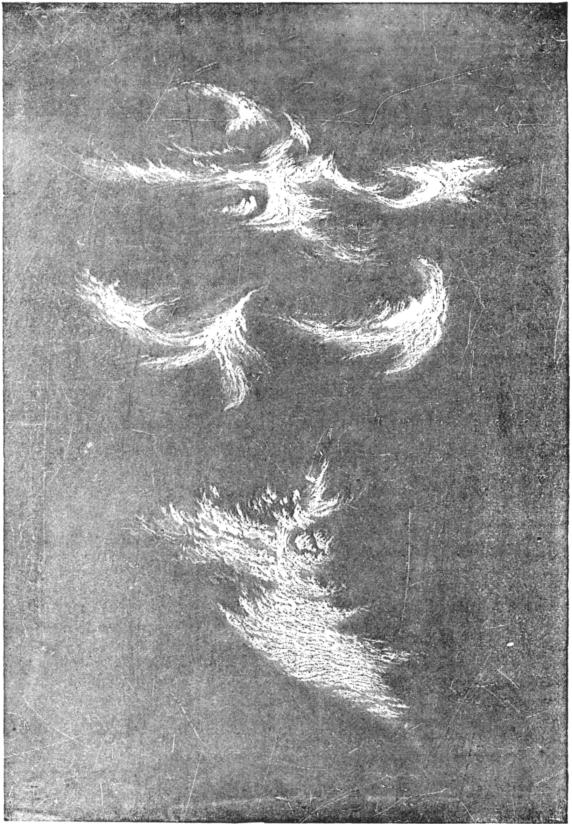
J. Ruskin J.C. Armytage
63. The Cloud-Flocks.
§ 3. In the first volume, we considered all clouds as belonging to three regions, that of the cirrous, the central cloud, and the rain-cloud. It is of course an arrangement more of convenience than of true description, for cirrous clouds sometimes form low as well as high; and rain sometimes falls high as well as low. I will, nevertheless, retain this old arrangement, which is practically as serviceable as any.
Allowing, also, for various exceptions and modifications, these three bodies of cloud may be generally distinguished in our minds thus. The clouds of upper region are for the most part quiet, or seem to be so, owing to their distance. They are formed now of striated, now of massive substance; but always finely divided into large ragged flakes or ponderous heaps. These heaps (cumuli) and flakes, or drifts, present different phenomena, but must be joined in our minds under the head of central cloud. The lower clouds, bearing rain abundantly, are composed partly of striated, partly of massive substance; but may generally be comprehended under the term rain-cloud.
Our business in this chapter, then, is with the upper clouds, which, owing to their quietness and multitude, we may perhaps conveniently think of as the “cloud-flocks.” And we have to discover if any laws of beauty attach to them, such as we have seen in mountains or tree-branches.
§ 4. On one of the few mornings of this winter, when the sky was clear, and one of the far fewer, on which its clearness was visible from the neighborhood of London,—which now entirely loses at least two out of three sunrises, owing to the environing smoke,—the dawn broke beneath a broad field of level purple cloud, under which floated ranks of divided cirri, composed of finely striated vapor.
It was not a sky containing any extraordinary number of these minor clouds; but each was more than usually distinct in separation from its neighbor, and as they showed in nearly pure pale scarlet on the dark purple ground, they were easily to be counted.
§ 5. There were five or six ranks, from the zenith to the horizon; that is to say, three distinct ones, and then two or three more running together, and losing themselves in distance, in the manner roughly shown in Fig. 79. The nearest rank was composed of more than 150 rows of cloud, set obliquely, as in the figure. I counted 150 which was near the mark, and then stopped, lest the light should fail, to count the separate clouds in some of the rows. The average number was 60 in each row, rather more than less.
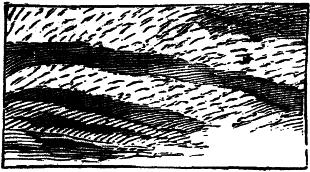
Fig. 79.
There were therefore 150×60, that is, 9,000, separate clouds in this one rank, or about 50,000 in the field of sight. Flocks of Admetus under Apollo’s keeping. Who else could shepherd such? He by day, dog Sirius by night; or huntress Diana herself—her bright arrows driving away the clouds of prey that would ravage her fair flocks. We must leave fancies, however; these wonderful clouds need close looking at. I will try to draw one or two of them before they fade.
§ 6. On doing which we find, after all, they are not much more like sheep than Canis Major is like a dog. They resemble more some of our old friends, the pine branches, covered with snow. The three forming the uppermost figure, in the Plate opposite, are as like three of the fifty thousand as I could get them, complex enough in structure, even this single group. Busy workers they must be, that twine the braiding of them all to the horizon, and down beyond it.
And who are these workers? You have two questions here, both difficult. What separates these thousands of clouds each from the other, and each about equally from the other? How can they be drawn asunder, yet not allowed to part? Looped lace as it were, richest point—invisible threads fastening embroidered cloud to cloud—the “plighted clouds” of Milton,—creatures of the element—
“That in the colors of the rainbow live And play in the plighted clouds.”
Compare Geraldine dressing:—
“Puts on her silken vestments white, And tricks her hair in lovely plight.”
And Britomart’s—
“Her well-plighted frock She low let fall, that flowed from her lanck side Down to her foot, with careless modesty.”
And, secondly, what bends each of them into these flame-like curves, tender and various, as motions of a bird, hither and thither? Perhaps you may hardly see the curves well in the softly finished forms; here they are plainer in rude outline, Fig. 80.1
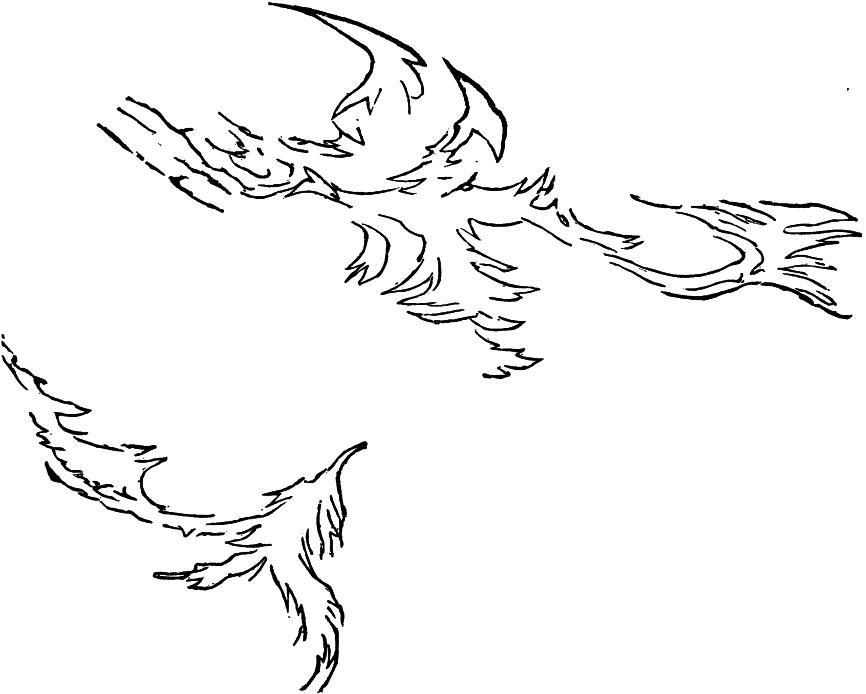
Fig. 80.
§ 7. What is it that throws them into these lines?
Eddies of wind?
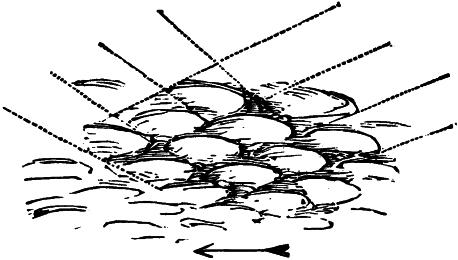
Fig. 81.
Nay, an eddy of wind will not stay quiet for three minutes, as that cloud did to be drawn; as all the others did, each in his place. You see there is perfect harmony among the curves. They all flow into each other as the currents of a stream do. If you throw dust that will float on the surface of a slow river, it will arrange itself in lines somewhat like these. To a certain extent, indeed, it is true that there are gentle currents of change in the atmosphere, which move slowly enough to permit in the clouds that follow them some appearance of stability. But how to obtain change so complex in an infinite number of consecutive spaces;—fifty thousand separate groups of current in half of a morning sky, with quiet invisible vapor between, or none—and yet all obedient to one ruling law, gone forth through their companies;—each marshalled to their white standards, in great unity of warlike march, unarrested, unconfused? “One shall not thrust another, they shall walk every one in his own path.”

Fig. 82.
§ 8. These questions occur, at first sight, respecting every group of cirrus cloud. Whatever the form may be, whether branched, as in this instance, or merely rippled, or thrown into shield-like segments, as in Fig. 81—a frequent arrangement—there is still the same difficulty in accounting satisfactorily for the individual forces which regulate the similar shape of each mass, while all are moved by a general force that has apparently no influence on the divided structure. Thus the mass of clouds disposed as in Fig. 81, will probably move, mutually, in the direction of the arrow; that is to say, sideways, as far as their separate curvature is concerned. I suppose it probable that as the science of electricity is more perfectly systematized, the explanation of many circumstances of cloud-form will be rendered by it. At present I see no use in troubling the reader or myself with conjectures which a year’s progress in science might either effectively contradict or supersede. All that I want is, that we should have our questions ready to put clearly to the electricians when the electricians are ready to answer us.
§ 9. It is possible that some of the loveliest conditions of these parallel clouds may be owing to a structure which I forgot to explain, when it occurred in rocks, in the course of the last volume.
When they are finely stratified, and their surfaces abraded by broad, shallow furrows, the edges of the beds, of course, are thrown into undulations, and at some distance, where the furrows disappear, the surface looks as if the rock had flowed over it in successive waves. Such a condition is seen on the left at the top in Fig. 17, in Vol. IV. Supposing a series of beds of vapor cut across by a straight sloping current of air, and so placed as to catch the light on their edges, we should have a series of curved lights, looking like independent clouds.
§ 10. I believe conditions of form like those in Fig. 82 (turn the book with its outer edge down) may not unfrequently be thus, owing to stratification, when they occur in the nearer sky. This line of cloud is far off at the horizon, drifting towards the left (the points of course forward), and is, I suppose, a series of nearly circular eddies seen in perspective.
Which question of perspective we must examine a little before going a step farther. In order to simplify it, let us assume that the under surfaces of clouds are flat, and lie in a horizontal extended field. This is in great measure the fact, and notable perspective phenomena depend on the approximation of clouds to such a condition.
§ 11. Referring the reader to my Elements of Perspective for statements of law which would be in this place tiresome, I can only ask him to take my word for it that the three figures in Plate 64 represent limiting lines of sky perspective, as they would appear over a large space of the sky. Supposing that the breadth included was one-fourth of the horizon, the shaded portions in the central figure represent square fields of cloud,2 and those in the uppermost figure narrow triangles, with their shortest side next us, but sloping a little away from us.
In each figure, the shaded portions show the perspective limits of cloud-masses, which, in reality, are arranged in perfectly straight lines, are all similar, and are equidistant from each other. Their exact relative positions are marked by the lines connecting them, and may be determined by the reader if he knows perspective. If he does not, he may be surprised at first to be told that the stubborn and blunt little triangle, b, Fig. 1, Plate 64, represents a cloud precisely similar, and similarly situated, to that represented by the thin triangle, a; and, in like manner, the stout diamond, a, Fig. 2, represents precisely the same form and size of cloud as the thin strip at b. He may perhaps think it still more curious that the retiring perspective which causes stoutness in the triangle, causes leanness in the diamond.3
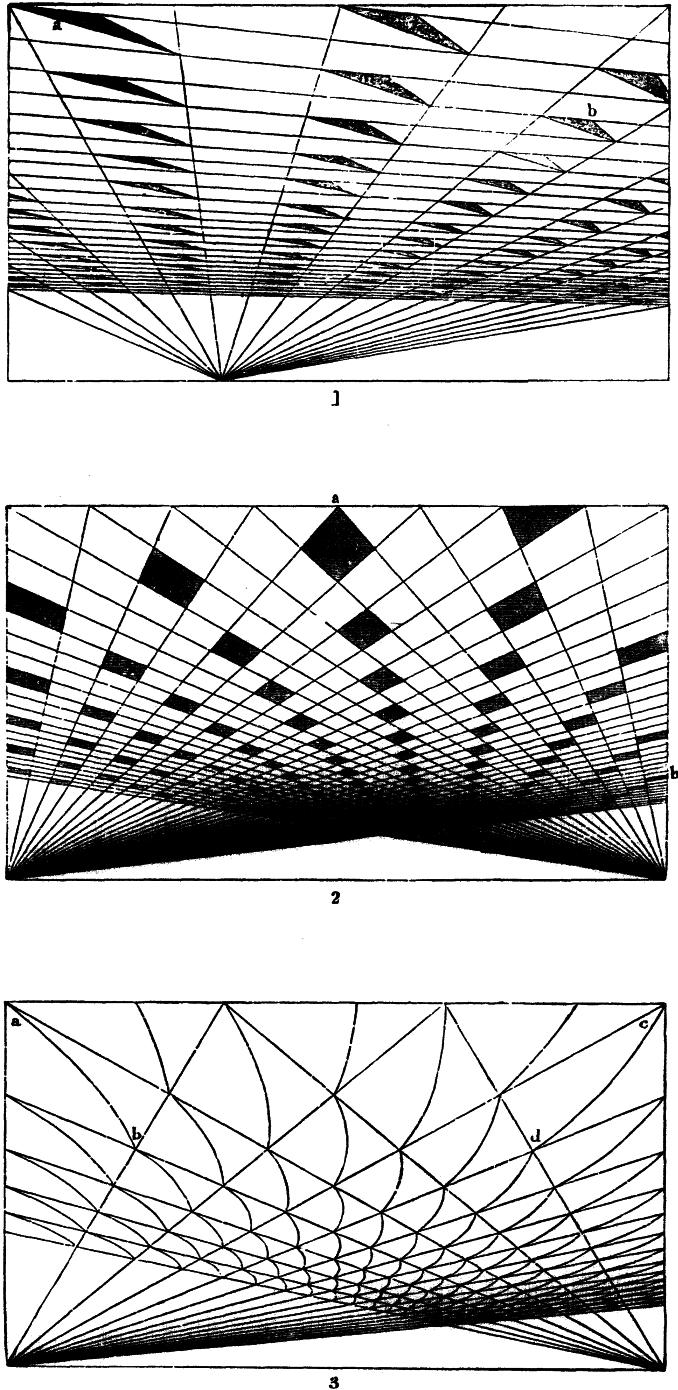
64. Cloud Perspective. (Rectilinear.)
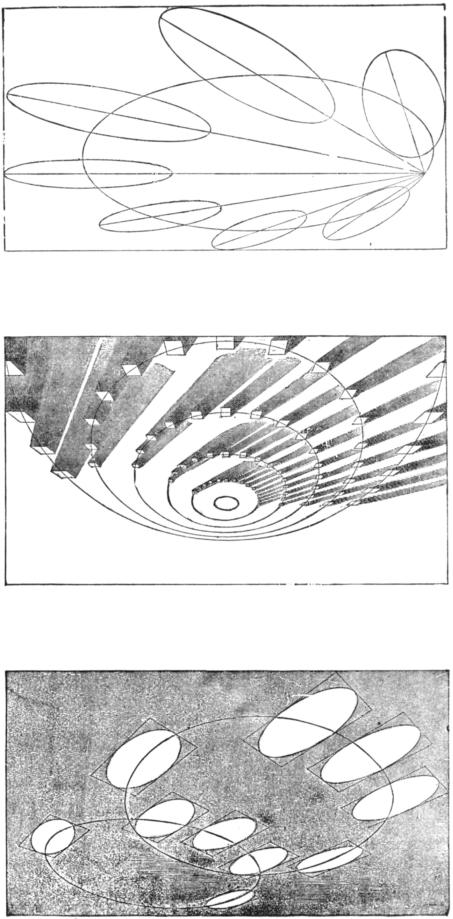
65. Cloud Perspective. (Curvilinear.)
§ 12. Still greater confusion in aspect is induced by the apparent change caused by perspective in the direction of the wind. If Fig. 3 be supposed to include a quarter of the horizon, the spaces, into which its straight lines divide it, represent squares of sky. The curved lines, which cross these spaces from corner to corner, are precisely parallel throughout; and, therefore, two clouds moving, one on the curved line from a to b, and the other on the other side, from c to d, would, in reality, be moving with the same wind, in parallel lines. In Plate 66, which is a sketch of an actual sunset behind Beauvais cathedral (the point of the roof of the apse, a little to the left of the centre, shows it to be a summer sunset), the white cirri in the high light are all moving eastward, away from the sun, in perfectly parallel lines, curving a little round to the south. Underneath, are two straight ranks of rainy cirri, crossing each other; one directed south-east; the other, north-west. The meeting perspective of these, in extreme distance, determines the shape of the angular light which opens above the cathedral. Underneath all, fragments of true rain-cloud are floating between us and the sun, governed by curves of their own. They are, nevertheless, connected with the straight cirri, by the dark semi-cumulus in the middle of the shade above the cathedral.
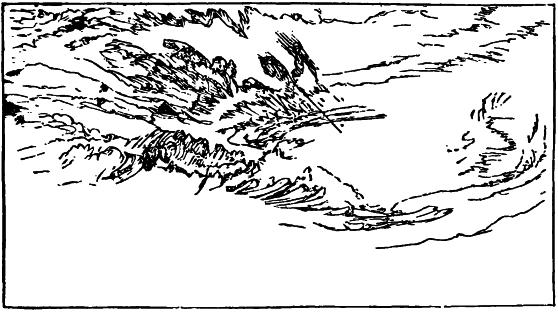
Fig. 83.
§ 13. Sky perspective, however, remains perfectly simple, so long as it can be reduced to any rectilinear arrangement; but when nearly the whole system is curved, which nine times out of ten is the case, it becomes embarrassing. The central figure in Plate 65 represents the simplest possible combination of perspective of straight lines with that of curves, a group of concentric circles of small clouds being supposed to cast shadows from the sun near the horizon. Such shadows are often cast in misty air; the aspect of rays about the sun being, in fact, only caused by spaces between them. They are carried out formally and far in the Plate, to show how curiously they may modify the arrangement of light in a sky. The woodcut, Fig. 83, gives roughly the arrangement of the clouds in Turner’s Pools of Solomon, in which he has employed a concentric system of circles of this kind, and thus lighted. In the perspective figure the clouds are represented as small square masses, for the sake of greater simplicity, and are so beaded or strung as it were on the curves in which they move, as to keep their distances precisely equal, and their sides parallel. This is the usual condition of cloud: for though arranged in curved ranks, each cloud has its face to the front, or, at all events, acts in some parallel line—generally another curve—with those next to it: being rarely, except in the form of fine radiating striæ, arranged on the curves as at a, Fig. 84; but as at b, or c. It would make the diagram too complex if I gave one of intersecting curves; but the lowest figure in Plate 65 represents, in perspective, two groups of ellipses arranged in equidistant straight and parallel lines, and following each other on two circular curves. Their exact relative position is shown in Fig. 2, Plate 56. While the uppermost figure in Plate 65 represents, in parallel perspective, a series of ellipses arranged in radiation on a circle, their exact relative size and position are shown in Fig. 3, Plate 56, and the lines of such a sky as would be produced by them, roughly, in Fig. 90, facing page 128.4

Fig. 84.
§ 14. And in these figures, which, if we look up the subject rightly, would be but the first and simplest of the series necessary to illustrate the action of the upper cirri, the reader may see, at once, how necessarily painters, untrained in observance of proportion, and ignorant of perspective, must lose in every touch the expression of buoyancy and space in sky. The absolute forms of each cloud are, indeed, not alike, as the ellipses in the engraving; but assuredly, when moving in groups of this kind, there are among them the same proportioned inequalities of relative distance, the same gradated changes from ponderous to elongated form, the same exquisite suggestions of including curve; and a common painter, dotting his clouds down at random, or in more or less equal masses, can no more paint a sky, than he could, by random dashes for its ruined arches, paint the Coliseum.
§ 15. Whatever approximation to the character of upper clouds may have been reached by some of our modern students, it will be found, on careful analysis, that Turner stands more absolutely alone in this gift of cloud-drawing, than in any other of his great powers. Observe, I say, cloud-drawing; other great men colored clouds beautifully; none but he ever drew them truly: this power coming from his constant habit of drawing skies, like everything else, with the pencil point. It is quite impossible to engrave any of his large finished skies on a small scale; but the woodcut, Fig. 85, will give some idea of the forms of cloud involved in one of his small drawings. It is only half of the sky in question, that of Rouen from St. Catherine’s Hill, in the Rivers of France. Its clouds are arranged on two systems of intersecting circles, crossed beneath by long bars very slightly bent. The form of every separate cloud is completely studied; the manner of drawing them will be understood better by help of the Plate opposite, which is a piece of the sky above the “Campo Santo,”5 at Venice, exhibited in 1842. It is exquisite in rounding of the separate fragments and buoyancy of the rising central group, as well as in its expression of the wayward influence of curved lines of breeze on a generally rectilinear system of cloud.
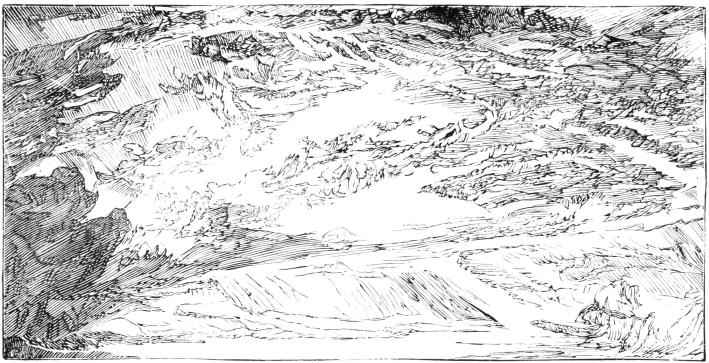
To face page 118.
Fig. 85.
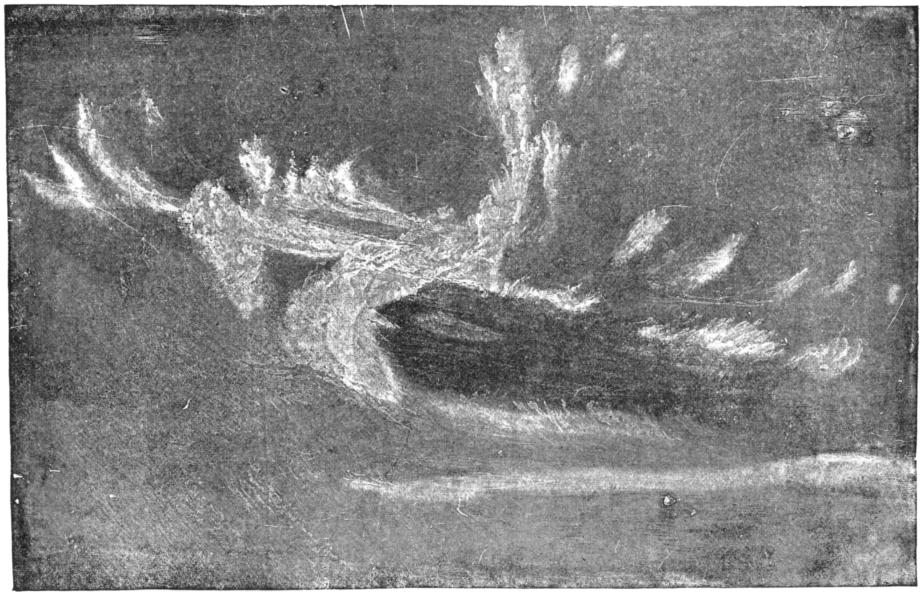
67. Clouds.
§ 16. To follow the subject farther would, however, lead us into doctrine of circular storms, and all kinds of pleasant, but infinite, difficulty, from which temptation I keep clear, believing that enough is now stated to enable the reader to understand what he is to look for in Turner’s skies; and what kind of power, thought, and science are involved continually in the little white or purple dashes of cloud-spray, which, in such pictures as the San Benedetto, looking to Fusina, the Napoleon, or the Temeraire, guide the eye to the horizon more by their true perspective than by their aërial tone, and are buoyant, not so much by expression of lightness as of motion.6
§ 17. I say the “white or purple” cloud-spray. One word yet may be permitted me respecting the mystery of that color. What should we have thought—if we had lived in a country where there were no clouds, but only low mist or fog—of any stranger who had told us that, in his country, these mists rose into the air, and became purple, crimson, scarlet, and gold? I am aware of no sufficient explanation of these hues of the upper clouds, nor of their strange mingling of opacity with a power of absorbing light. All clouds are so opaque that, however delicate they may be, you never see one through another. Six feet depth of them, at a little distance, will wholly veil the darkest mountain edge; so that, whether for light or shade, they tell upon the sky as body color on canvas; they have always a perfect surface and bloom;—delicate as a rose-leaf, when required of them, but never poor or meagre in hue, like old-fashioned water-colors. And, if needed, in mass, they will bear themselves for solid force of hue against any rock. Facing p. 339, I have engraved a memorandum made of a clear sunset after rain, from the top of Milan cathedral. The greater part of the outline is granite—Monte Rosa—the rest cloud; but it and the granite were dark alike. Frequently, in effects of this kind, the cloud is darker of the two.7 And this opacity is, nevertheless, obtained without destroying the gift they have of letting broken light through them, so that, between us and the sun, they may become golden fleeces, and float as fields of light.
Now their distant colors depend on these two properties together; partly on the opacity, which enables them to reflect light strongly; partly on a spongelike power of gathering light into their bodies.
§ 18. Long ago it was noted by Aristotle, and again by Leonardo, that vaporous bodies looked russet, or even red, when warm light was seen through them, and blue when deep shade was seen through them. Both colors may, generally, be seen on any wreath of cottage smoke.
Whereon, easy conclusion has sometimes been founded by modern reasoners. All red in sky is caused by light seen through vapor, and all blue by shade seen through vapor.
Easy, indeed, but not sure, even in cloud-color only. It is true that the smoke of a town may be of a rich brick red against golden twilight; and of a very lovely, though not bright, blue against shade. But I never saw crimson or scarlet smoke, nor ultramarine smoke.
Even granting that watery vapor in its purity may give the colors more clearly, the red colors are by no means always relieved against light. The finest scarlets are constantly seen in broken flakes on a deep purple ground of heavier cloud beyond, and some of the loveliest rose-colors on clouds in the east, opposite the sunset, or in the west in the morning. Nor are blues always attainable by throwing vapor over shade. Especially, you cannot get them by putting it over blue itself. A thin vapor on dark blue sky is of a warm gray, not blue. A thunder-cloud, deep enough to conceal everything behind it, is often dark lead-color, or sulphurous blue; but the thin vapors crossing it, milky-white. The vividest hues are connected also with another attribute of clouds, their lustre—metallic in effect, watery in reality. They not only reflect color as dust or wool would, but, when far off, as water would; sometimes even giving a distinct image of the sun underneath the orb itself;—in all cases becoming dazzling in lustre, when at a low angle, capable of strong reflection. Practically, this low angle is only obtained when the cloud seems near the sun, and hence we get into the careless habit of looking at the golden reflected light as if it were actually caused by nearness to the fiery ball.
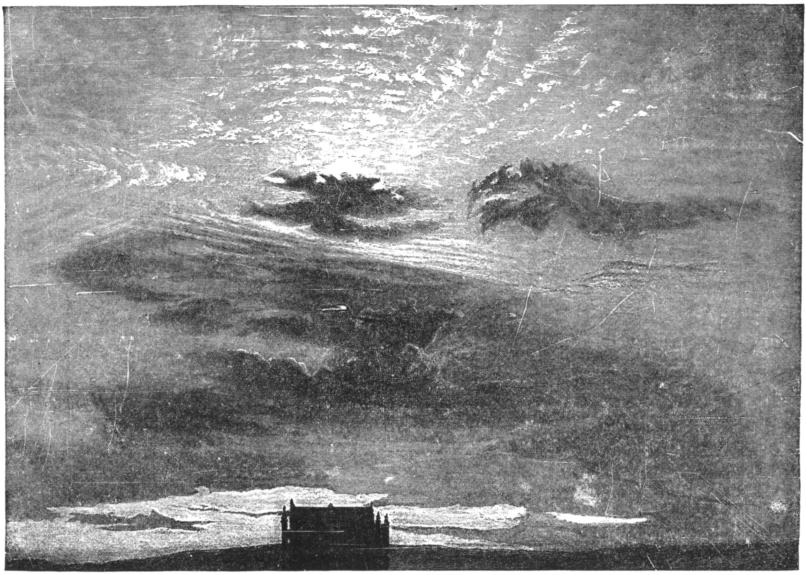
66. Light in the West, Beauvais.
§ 19. Without, however, troubling ourselves at all about laws, or causes of color, the visible consequences of their operation are notably these—that when near us, clouds present only subdued and uncertain colors; but when far from us, and struck by the sun on their under surfaces—so that the greater part of the light they receive is reflected—they may become golden, purple, scarlet, and intense fiery white, mingled in all kinds of gradations, such as I tried to describe in the chapter on the upper clouds in the first volume, in hope of being able to return to them “when we knew what was beautiful.”
The question before us now is, therefore, What value ought this attribute of clouds to possess in the human mind? Ought we to admire their colors, or despise them? Is it well to watch them as Turner does, and strive to paint them through all deficiency and darkness of inadequate material? Or, is it wiser and nobler—like Claude, Salvator, Ruysdael, Wouvermans—never to look for them—never to portray? We must yet have patience a little before deciding this, because we have to ascertain some facts respecting the typical meaning of color itself; which, reserving for another place, let us proceed here to learn the forms of the inferior clouds.
1 Before going farther, I must say a word or two respecting method of drawing clouds.
Absolutely well no cloud can be drawn with the point; nothing but the most delicate management of the brush will express its variety of edge and texture. By laborious and tender engraving, a close approximation may be obtained either to nature or to good painting; and the engravings of sky by our modern line engravers are often admirable;—in many respects as good as can be, and to my mind the best part of their work. There still exist some early proofs of Miller’s plate of the Grand Canal, Venice, in which the sky is the likest thing to Turner’s work I have ever seen in large engravings. The plate was spoiled after a few impressions were taken off by desire of the publisher. The sky was so exactly like Turner’s that he thought it would not please the public, and had all the fine cloud-drawing rubbed away to make it soft.
The Plate opposite page 118, by Mr. Armytage, is also, I think, a superb specimen of engraving, though in result not so good as the one just spoken of, because this was done from my copy of Turner’s sky, not from the picture itself.
But engraving of this finished kind cannot, by reason of its costliness, be given for every illustration of cloud form. Nor, if it could, can skies be sketched with the completion which would bear it. It is sometimes possible to draw one cloud out of fifty thousand with something like fidelity before it fades. But if we want the arrangement of the fifty thousand, they can only be indicated with the rudest lines, and finished from memory. It was, as we shall see presently, only by his gigantic powers of memory that Turner was enabled to draw skies as he did.
Now, I look upon my own memory of clouds, or of anything else, as of no value whatever. All the drawings on which I have ever rested an assertion have been made without stirring from the spot; and in sketching clouds from nature, it is very seldom desirable to use the brush. For broad effects and notes of color (though these, hastily made, are always inaccurate, and letters indicating the color do nearly as well) the brush may be sometimes useful, but, in most cases, a dark pencil, which will lay shade with its side and draw lines with its point, is the best instrument. Turner almost always outlined merely with the point, being able to remember the relations of shade without the slightest chance of error. The point, at all events, is needful, however much stump work may be added to it.
Now, in translating sketches made with the pencil point into engraving, we must either engrave delicately and expensively, or be content to substitute for the soft varied pencil lines the finer and uncloudlike touches of the pen. It is best to do this boldly, if at all, and without the least aim at fineness of effect, to lay down a vigorous black line as the limit of the cloud form or action. The more subtle a painter’s finished work, the more fearless he is in using the vigorous black line when he is making memoranda, of treating his subject conventionally. At the top of page 224, Vol. IV., the reader may see the kind of outline which Titian uses for clouds in his pen work. Usually he is even bolder and coarser. And in the rude woodcuts I am going to employ here, I believe the reader will find ultimately that, with whatever ill success used by me, the means of expression are the fullest and most convenient that can be adopted, short of finished engraving, while there are some conditions of cloud-action which I satisfy myself better in expressing by these coarse lines than in any other way.
2 If the figures are supposed to include less than one-fourth of the horizon, the shaded figures represent diamond-shaped clouds; but the reader cannot understand this without studying perspective laws accurately.
3 In reality, the retiring ranks of cloud, if long enough, would, of course, go on converging to the horizon. I do not continue them, because the figures would become too compressed.
4 I use ellipses in order to make these figures easily intelligible; the curves actually are variable curves, of the nature of the cycloid, or other curves of continuous motion; probably produced by a current moving in some such direction as that indicated by the dotted line in Fig. 3, Plate 56.
5 Now in the possession of E. Bicknell, Esq., who kindly lent me the picture, that I might make this drawing from it carefully.
6 I cannot yet engrave these; but the little study of a single rank of cirrus, the lowest in Plate 63, may serve to show the value of perspective in expressing buoyancy. It is not, however, though beautifully engraved by Mr. Armytage, as delicate as it should be, in the finer threads which indicate increasing distance at the extremity. Compare the rising of the lines of curve at the edges of this mass, with the similar action on a larger scale, of Turner’s cloud, opposite.
7 In the autobiography of John Newton there is an interesting account of the deception of a whole ship’s company by cloud, taking the aspect and outline of mountainous land. They ate the last provision in the ship, so sure were they of its being land, and were nearly starved to death in consequence.
CHAPTER III.
THE CLOUD-CHARIOTS.
§ 1. Between the flocks of small countless clouds which occupy the highest heavens, and the gray undivided film of the true rain-cloud, form the fixed masses or torn fleeces, sometimes collected and calm, sometimes fiercely drifting, which are, nevertheless, known under one general name of cumulus, or heaped cloud.
The true cumulus, the most majestic of all clouds, and almost the only one which attracts the notice of ordinary observers, is for the most part windless; the movement of its masses being solemn, continuous, inexplicable, a steady advance or retiring, as if they were animated by an inner will, or compelled by an unseen power. They appear to be peculiarly connected with heat, forming perfectly only in the afternoon, and melting away in the evening. Their noblest conditions are strongly electric, and connect themselves with storm-cloud and true thunder-cloud. When there is thunder in the air, they will form in cold weather, or early in the day.
§ 2. I have never succeeded in drawing a cumulus. Its divisions of surface are grotesque and endless, as those of a mountain;—perfectly defined, brilliant beyond all power of color, and transitory as a dream. Even Turner never attempted to paint them, any more than he did the snows of the high Alps.
Nor can I explain them any more than I can draw them. The ordinary account given of their structure is, I believe, that the moisture raised from the earth by the sun’s heat becomes visible by condensation at a certain height in the colder air, that the level of the condensing point is that of the cloud’s base, and that above it, the heaps are pushed up higher and higher as more vapor accumulates, till, towards evening, the supply beneath ceases; and at sunset, the fall of dew enables the surrounding atmosphere to absorb and melt them away. Very plausible. But it seems to me herein unexplained how the vapor is held together in those heaps. If the clear air about and above it has no aqueous vapor in it, or at least a much less quantity, why does not the clear air keep pulling the cloud to pieces, eating it away, as steam is consumed in open air? Or, if any cause prevents such rapid devouring of it, why does not the aqueous vapor diffuse itself softly in the air like smoke, so that one would not know where the cloud ended? What should make it bind itself in those solid mounds, and stay so:—positive, fantastic, defiant, determined?
§ 3. If ever I am able to understand the process of the cumulus formation,1 it will become to me one of the most interesting of all subjects of study to trace the connection of the threatening and terrible outlines of thunder-cloud with the increased action of the electric power. I am for the present utterly unable to speak respecting this matter, and must pass it by, in all humility, to say what little I have ascertained respecting the more broken and rapidly moving forms of the central clouds, which connect themselves with mountains, and may, therefore, among mountains, be seen close and truly.
§ 4. Yet even of these, I can only reason with great doubt and continual pause. This last volume ought certainly to be better than the first of the series, for two reasons. I have learned, during the sixteen years, to say little where I said much, and to see difficulties where I saw none. And I am in a great state of marvel in looking back to my first account of clouds, not only at myself, but even at my dear master, M. de Saussure. To think that both of us should have looked at drifting mountain clouds, for years together, and been content with the theory which you will find set forth in § 4, of the chapter on the central cloud region (Vol. I.), respecting the action of the snowy summits and watery vapor passing them. It is quite true that this action takes place, and that the said fourth paragraph is right, as far as it reaches. But both Saussure and I ought to have known—we both did know, but did not think of it—that the covering or cap-cloud forms on hot summits as well as cold ones;—that the red and bare rocks of Mont Pilate, hotter, certainly, after a day’s sunshine than the cold storm-wind which sweeps to them from the Alps, nevertheless have been renowned for their helmet of cloud, ever since the Romans watched the cloven summit, gray against the south, from the ramparts of Vindonissa, giving it the name from which the good Catholics of Lucerne have warped out their favorite piece of terrific sacred biography.2 And both my master and I should also have reflected, that if our theory about its formation had been generally true, the helmet cloud ought to form on every cold summit, at the approach of rain, in approximating proportions to the bulk of the glaciers; which is so far from being the case that not only (A) the cap-cloud may often be seen on lower summits of grass or rock, while the higher ones are splendidly clear (which may be accounted for by supposing the wind containing the moisture not to have risen so high), but (B) the cap-cloud always shows a preference for hills of a conical form, such as the Mole or Niesen, which can have very little power in chilling the air, even supposing they were cold themselves, while it will entirely refuse to form round huge masses of mountain, which, supposing them of chilly temperament, must have discomforted the atmosphere in their neighborhood for leagues. And finally (C) reversing the principle under letter A, the cap-cloud constantly forms on the summit of Mont Blanc, while it will obstinately refuse to appear on the Dome du Goûte or Aiguille Sans-nom, where the snow-fields are of greater extent, and the air must be moister, because lower.
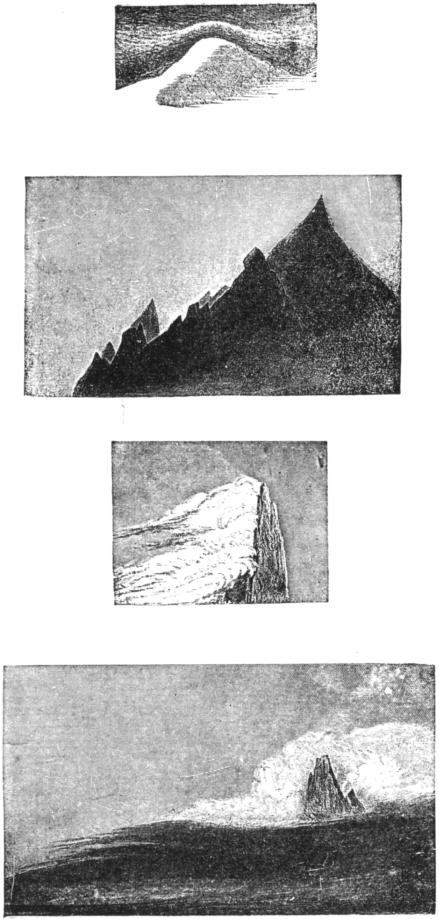
J. Ruskin. J. C. Armytage.
69. Aiguilles and their Friends.
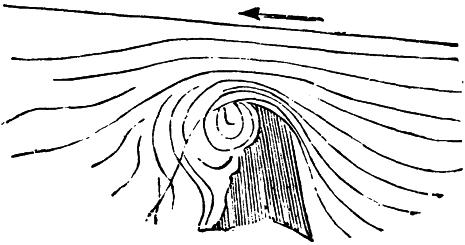
Fig. 86.
§ 5. The fact is, that the explanation given in that fourth paragraph can, in reality, account only for what may properly be termed “lee-side cloud,” slightly noticed in the continuation of the same chapter, but deserving most attentive illustration, as one of the most beautiful phenomena of the Alps. When a moist wind blows in clear weather over a cold summit, it has not time to get chilled as it approaches the rock, and therefore the air remains clear, and the sky bright on the windward side; but under the lee of the peak, there is partly a back eddy, and partly still air; and in that lull and eddy the wind gets time to be chilled by the rock, and the cloud appears as a boiling mass of white vapor, rising continually with the return current to the upper edge of the mountain, where it is caught by the straight wind, and partly torn, partly melted away in broken fragments. In Fig. 86 the dark mass represents the mountain peak, the arrow the main direction of the wind, the curved lines show the directions of such current and its concentration, and the dotted lines enclose the space in which cloud forms densely, floating away beyond and above in irregular tongues and flakes. The second figure from the top in Plate 69 represents the actual aspect of it when in full development, with a strong south wind, in a clear day, on the Aiguille Dru, the sky being perfectly blue and lovely around.
So far all is satisfactory. But the true helmet cloud will not allow itself to be thus explained away. The uppermost figure in Plate 69 represents the loveliest form of it, seen in that perfect arch, so far as I know, only over the highest piece of earth in Europe.
§ 6. Respecting which there are two mysteries:—First, why it should form only at a certain distance above the snow, showing blue sky between it and the summit. Secondly, why, so forming, it should always show as an arch, not as a concave cup. This last question puzzles me especially. For, if it be a true arch, and not a cup, it ought to show itself in certain positions of the spectator, or directions of the wind, like the ring of Saturn, as a mere line, or as a spot of cloud pausing over the hill-top. But I never saw it so. While, as above noticed, the lowest form of the helmet cloud is not white as of silver, but like Dolon’s helmet of wolf-skin,—it is a gray, flaky veil, lapping itself over the shoulders of a more or less conical peak; and of this, also, I have no word to utter but the old one, “Electricity,” and I might as well say nothing.
§ 7. Neither the helmet cloud, nor the lee-side cloud, however, though most interesting and beautiful, are of much importance in picturesque effect. They are too isolated and strange. But the great mountain cloud, which seems to be a blending of the two with independent forms of vapor (that is to say, a greater development, in consequence of the mountain’s action, of clouds which would in some way or other have formed anywhere), requires prolonged attention, as the principal element of the sky in noblest landscape.
§ 8. For which purpose, first, it may be well to clear a few clouds out of the way. I believe the true cumulus is never seen in a great mountain region, at least never associated with hills. It is always broken up and modified by them. Boiling and rounded masses of vapor occur continually, as behind the Aiguille Dru (lowest figure in Plate 69); but the quiet, thoroughly defined, infinitely divided and modelled pyramid never develops itself. It would be very grand if one ever saw a great mountain peak breaking through the domed shoulders of a true cumulus; but this I have never seen.
§ 9. Again, the true high cirri never cross a mountain in Europe. How often have I hoped to see an Alp rising through and above their level-laid and rippled fields! but those white harvest-fields are heaven’s own. And, finally, even the low, level, cirrus (used so largely in Martin’s pictures) rarely crosses a mountain. If it does, it usually becomes slightly waved or broken, so as to destroy its character. Sometimes, however, at great distances, a very level bar of cloud will strike across a peak; but nearer, too much of the under surface of the field is seen, so that a well-defined bar across a peak, seen at a high angle, is of the greatest rarity.
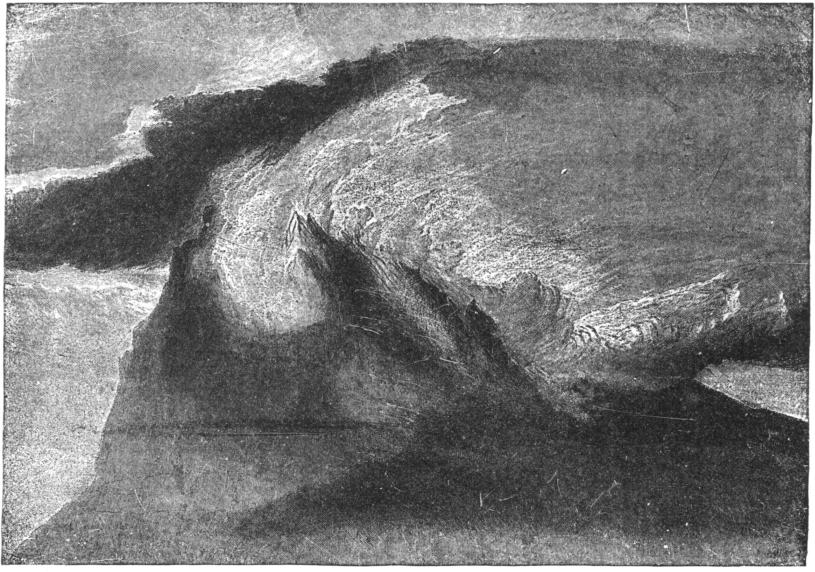
J. Ruskin. J. C. Armytage.
70. The Graiæ.
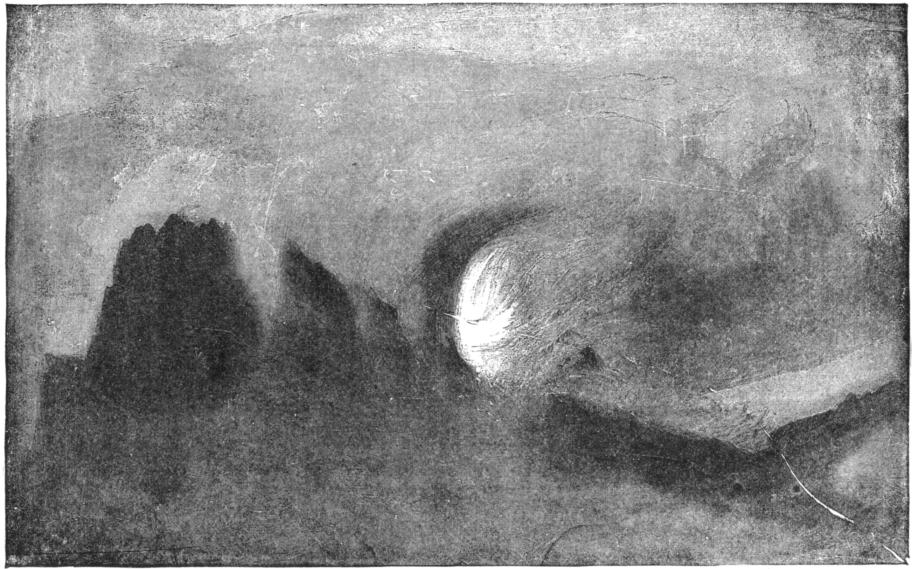
71. “Venga Medusa.”
To face page 127.
Fig. 87.
§ 10. The ordinary mountain cloud, therefore, if well defined, divides itself into two kinds: a broken condition of cumulus, grand in proportion as it is solid and quiet,—and a strange modification of drift-cloud, midway, as I said, between the helmet and the lee-side forms. The broken, quiet cumulus impressed Turner exceedingly when he first saw it on hills. He uses it, slightly exaggerating its definiteness, in all his early studies among the mountains of the Chartreuse, and very beautifully in the vignette of St. Maurice in Rogers’s Italy. There is nothing, however, to be specially observed of it, as it only differs from the cumulus of the plains, by being smaller and more broken.
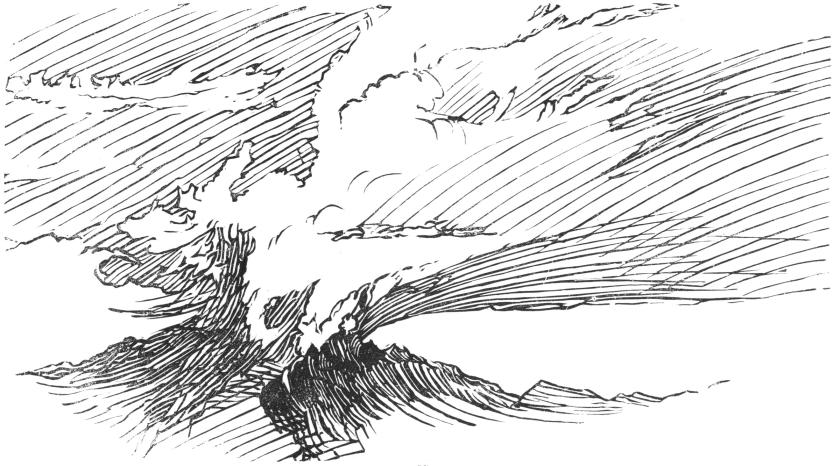
§ 11. Not so the mountain drift-cloud, which is as peculiar as it is majestic. The Plates 70 and 71 show, as well as I can express, two successive phases of it on a mountain crest; (in this instance the great limestone ridge above St. Michel, in Savoy.) But what colossal proportions this noble cloud assumes may be best gathered from the rude sketch, Fig. 87, in which I have simply put firm black ink over the actual pencil lines made at the moment, giving the form of a single wreath of the drift-cloud, stretching about five miles in a direct line from the summit of one of the Alps of the Val d’Aosta, as seen from the plain of Turin. It has a grand volcanic look, but I believe its aspect of rising from the peak to be almost, if not altogether, deceptive; and that the apparently gigantic column is a nearly horizontal stream of lee-side cloud, tapered into the distance by perspective, and thus rising at its apparently lowest but in reality most distant point, from the mountain summit whose shade calls it into being out of the clear winds.
Whether this be so or not, the apparent origin of the cloud on the peak, and radiation from it, distinguish it from the drift-cloud of level country, which arranges itself at the horizon in broken masses, such as Fig. 89, showing no point of origin; and I do not know how far they are vertical cliffs or horizontally extended fields. They are apt to be very precipitous in aspect, breaking into fragments with an apparently concentric motion, as in the figure; but of this motion also—whether vertical or horizontal—I can say nothing positive.
§ 12. The absolute scale of such clouds may be seen, or at least demonstrated, more clearly in Fig. 88, which is a rough note of an effect of sky behind the tower of Berne Cathedral. It was made from the mound beside the railroad bridge. The Cathedral tower is half-a-mile distant. The great Eiger of Grindelwald is seen just on the right of it. This mountain is distant from the tower thirty-four miles as the crow flies, and ten thousand feet above it in height. The drift-cloud behind it, therefore, being in full light, and showing no overhanging surfaces, must rise at least twenty thousand feet into the air.
§ 13. The extreme whiteness of the volume of vapor in this case (not, I fear, very intelligible in the woodcut3) may be partly owing to recent rain, which, by its evaporation, gives a peculiar density and brightness to some forms of clearing cloud. In order to understand this, we must consider another set of facts. When weather is thoroughly wet among hills, we ought no more to accuse the mountains of forming the clouds, than we do the plains in similar circumstances. The unbroken mist buries the mountains to their bases; but that is not their fault. It may be just as wet and just as cloudy elsewhere. (This is not true of Scottish mountain, by the way.) But when the wet weather is breaking, and the clouds pass, perhaps, in great measure, away from the plains leaving large spaces of blue sky, the mountains begin to shape clouds for themselves. The fallen moisture evaporates from the plain invisibly; but not so from the hill-side. There, what quantity of rain has not gone down in the torrents, ascends again to heaven instantly in white clouds. The storm passes as if it had tormented the crags, and the strong mountains smoke like tired horses.
§ 14. Here is another question for us of some interest. Why does the much greater quantity of moisture lying on the horizontal fields send up no visible vapor, and the less quantity left on the rocks glorify itself into a magnificent wreath of soaring snow?
First, for the very reason, that it is less in quantity, and more distributed; as a wet cloth smokes when you put it near the fire, but a basin of water not.
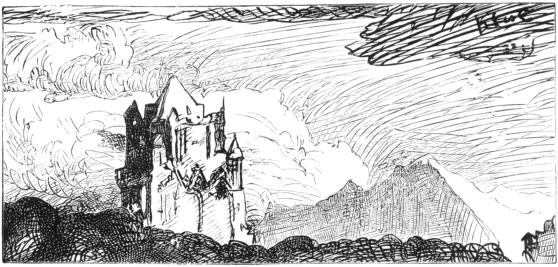
Fig. 88.
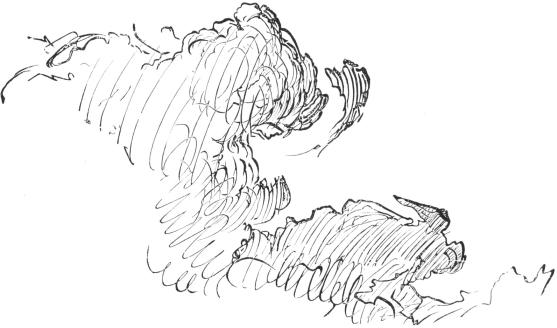
Fig. 89.
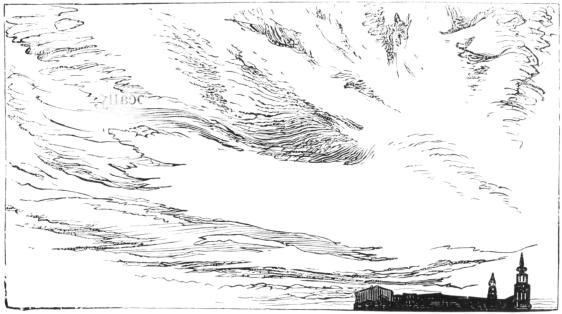
To face page 128.
Fig. 90.
The previous heat of the crags, noticed in the first volume, p. 249, is only a part of the cause. It operates only locally, and on remains of sudden showers. But after any number of days and nights of rain, and in all places exposed to returning sunshine and breezes, the distribution of the moisture tells. So soon as the rain has ceased, all water that can run off is of course gone from the steep hill-sides; there remains only the thin adherent film of moisture to be dried; but that film is spread over a complex texture—all manner of crannies, and bosses, and projections, and filaments of moss and lichen, exposing a vast extent of drying surface to the air. And the evaporation is rapid in proportion.
§ 15. Its rapidity, however, observe, does not account for its visibility, and this is one of the questions I cannot clearly solve, unless I were sure of the nature of the vesicular vapor. When our breath becomes visible on a frosty day, it is easily enough understood that the moisture which was invisible, carried by the warm air from the lungs, becomes visible when condensed or precipitated by the surrounding chill; but one does not see why air passing over a moist surface quite as cold as itself should take up one particle of water more than it can conveniently—that is to say, invisibly—carry. Whenever you see vapor, you may not inaccurately consider the air as having got more than it can properly hold, and dropping some. Now it is easily understood how it should take up much in the lungs, and let some of it fall when it is pinched by the frost outside; but why should it overload itself there on the hills, when it is at perfect liberty to fly away as soon as it likes, and come back for more? I do not see my way well in this. I do not see it clearly, even through the wet cloth. I shall leave all the embarrassment of the matter, however, to my reader, contenting myself, as usual, with the actual fact, that the hill-side air does behave in this covetous and unreasonable manner; and that, in consequence, when the weather is breaking (and sometimes, provokingly, when it is not), phantom clouds form and rise in sudden crowds of wild and spectral imagery along all the far succession of the hill-slopes and ravines.
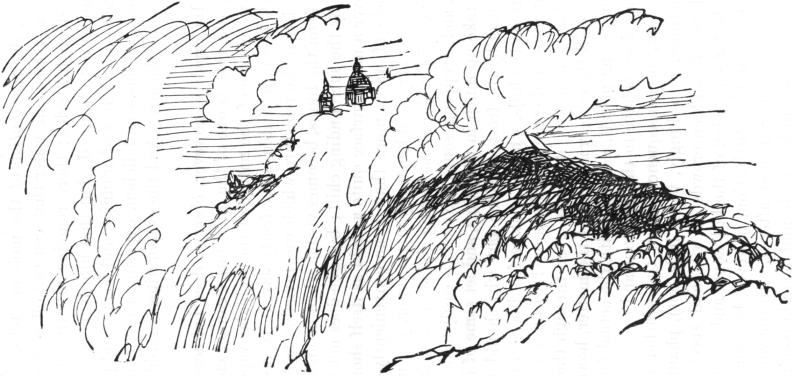
Fig. 91.
§ 16. There is this distinction, however, between the clouds that form during the rain and after it. In the worst weather, the rain-cloud keeps rather high, and is unbroken; but when there is a disposition in the rain to relax, every now and then a sudden company of white clouds will form quite low down (in Chamouni or Grindelwald, and such high districts, even down to the bottom of the valley), which will remain, perhaps, for ten minutes, filling all the air, then disappear as suddenly as they came, leaving the gray upper cloud and steady rain to their work. These “clouds of relaxation,” if we may so call them, are usually flaky and horizontal, sometimes tending to the silky cirrus, yet showing no fine forms of drift; but when the rain has passed, and the air is getting warm, forms the true clearing cloud, in wreaths that ascend continually with a slow circling motion, melting as they rise. The woodcut, Fig. 91, is a rude note of it floating more quietly from the hill of the Superga, the church (nearly as large as St. Paul’s) appearing above, and thus showing the scale of the wreath.
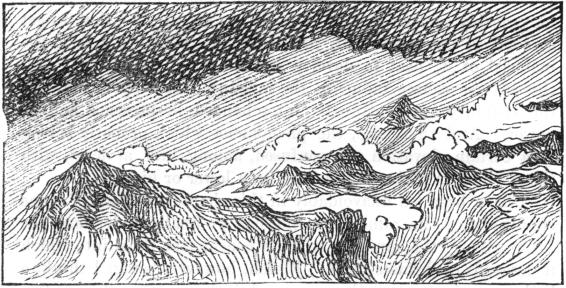
Fig. 92.
§ 17. This cloud of evaporation, however, does not always rise. It sometimes rests in absolute stillness, low laid in the hollows of the hills, their peaks emergent from it. Fig. 92 shows this condition of it, seen from a distance, among the Cenis hills. I do not know what gives it this disposition to rest in the ravines, nor whether there is a greater chill in the hollows, or a real action of gravity on the particles of cloud. In general, the position seems to depend on the temperature. Thus, in Chamouni, the crests of La Côte and Taconay continually appear in stormy weather as in Plate 36, Vol. IV., in which I intended to represent rising drift-cloud, made dense between the crests by the chill from the glaciers. But in the condition shown in Fig. 92, on a comparatively open sweep of hill-side, the thermometer would certainly indicate a higher temperature in the sheltered valley than on the exposed peaks; yet the cloud still subsides into the valleys like folds of a garment; and, more than this, sometimes conditions of morning cloud, dependent, I believe, chiefly on dew evaporation, form first on the tops of the soft hills of wooded Switzerland, and droop down in rent fringes, and separate tongues, clinging close to all the hill-sides, and giving them exactly the appearance of being covered with white fringed cloth, falling over them in torn or divided folds. It always looks like a true action of gravity. How far it is, in reality, the indication of the power of the rising sun causing evaporation, first on the hill-top, and then in separate streams, by its divided light on the ravines, I cannot tell. The subject is, as the reader perceives, always inextricably complicated by these three necessities—that to get a cloud in any given spot, you must have moisture to form the material of it, heat to develop it, and cold4 to show it; and the adverse causes inducing the moisture, the evaporation, and the visibility are continually interchanged in presence and in power. And thus, also, the phenomena which properly belong to a certain elevation are confused, among hills at least, with those which in plains would have been lower or higher.
I have been led unavoidably in this chapter to speak of some conditions of the rain-cloud; nor can we finally understand the forms even of the cumulus, without considering those into which it descends or diffuses itself. Which, however, being, I think, a little more interesting than our work hitherto, we will leave this chapter to its dulness, and begin another.
1 One of the great difficulties in doing this is to distinguish the portions of cloud outline which really slope upwards from those which only appear to do so, being in reality horizontal, and thrown into apparent inclination by perspective.
2 Pileatus, capped (strictly speaking, with the cap of liberty;—stormy cloud enough sometimes on men’s brows as well as on mountains), corrupted into Pilatus, and Pilate.
3 I could not properly illustrate the subject of clouds without numbers of these rude drawings, which would probably offend the general reader by their coarseness, while the cost of engraving them in facsimile is considerable, and would much add to the price of the book. If I find people at all interested in the subject, I may, perhaps, some day systematize and publish my studies of cloud separately. I am sorry not to have given in this volume a careful study of a rich cirrus sky, but no wood-engraving that I can employ on this scale will express the finer threads and waves.
4 We might say light, as well as cold; for it wholly depends on the degree of light in the sky how far delicate cloud is seen.
The second figure from the top in Plate 69 shows an effect of morning light on the range of the Aiguille Bouchard (Chamouni). Every crag casts its shadow up into apparently clear sky. The shadow is, in such cases, a bluish gray, the color of clear sky; and the defining light is caused by the sunbeams showing mist which otherwise would have been unperceived. The shadows are not irregular enough in outline—the sketch was made for their color and sharpness, not their shape,—and I cannot now put them right, so I leave them as they were drawn at the moment.
CHAPTER IV.
THE ANGEL OF THE SEA.
§ 1. Perhaps the best and truest piece of work done in the first volume of this book, was the account given in it of the rain-cloud; to which I have here little, descriptively, to add. But the question before us now is, not who has drawn the rain-cloud best, but if it were worth drawing at all. Our English artists naturally painted it often and rightly; but are their pictures the better for it? We have seen how mountains are beautiful; how trees are beautiful; how sun-lighted clouds are beautiful; but can rain be beautiful?
I spoke roughly of the Italian painters in that chapter, because they could only draw distinct clouds, or violent storms, “massive concretions,” while our northern painters could represent every phase of mist and fall of shower.
But is this indeed so delightful? Is English wet weather, indeed, one of the things which we should desire to see Art give perpetuity to?
Yes, assuredly. I have given some reasons for this answer in the fifth chapter of last volume; one or two, yet unnoticed, belong to the present division of our subject.
§ 2. The climates or lands into which our globe is divided may, with respect to their fitness for Art, be perhaps conveniently ranged under five heads:—
1. Forest-lands, sustaining the great mass of the magnificent vegetation of the tropics, for the most part characterized by moist and unhealthy heat, and watered by enormous rivers, or periodical rains. This country cannot, I believe, develop the mind or art of man. He may reach great subtlety of intellect, as the Indian, but not become learned, nor produce any noble art, only a savage or grotesque form of it. Even supposing the evil influences of climate could be vanquished, the scenery is on too large a scale. It would be difficult to conceive of groves less fit for academic purposes than those mentioned by Humboldt, into which no one can enter except under a stout wooden shield, to avoid the chance of being killed by the fall of a nut.
2. Sand-lands, including the desert and dry-rock plains of the earth, inhabited generally by a nomade population, capable of high mental cultivation and of solemn monumental or religious art, but not of art in which pleasurableness forms a large element, their life being essentially one of hardship.
3. Grape and wheat lands, namely, rocks and hills, such as are good for the vine, associated with arable ground forming the noblest and best ground given to man. In these districts only art of the highest kind seems possible, the religious art of the sand-lands being here joined with that of pleasure or sense.
4. Meadow-lands, including the great pastoral and agricultural districts of the North, capable only of an inferior art: apt to lose its spirituality and become wholly material.
5. Moss-lands, including the rude forest-mountain and ground of the North, inhabited by a healthy race, capable of high mental cultivation and moral energy, but wholly incapable of art, except savage, like that of the forest-lands, or as in Scandinavia.
We might carry out these divisions into others, but these are I think essential, and easily remembered in a tabular form; saying “wood” instead of “forest,” and “field” for “meadow,” we can get such a form shortly worded:—
Wood-lands Shrewd intellect No art.
Sand-lands High intellect Religious art.
Vine-lands Highest intellect Perfect art.
Field-lands High intellect Material art.
Moss-lands Shrewd intellect No art.
§ 3. In this table the moss-lands appear symmetrically opposed to the wood-lands, which in a sort they are; the too diminutive vegetation under bleakest heaven, opposed to the too colossal under sultriest heaven, while the perfect ministry of the elements, represented by bread and wine, produces the perfect soul of man.