THE SNEAKS, OR COMMON THIEVES. (continued 2)
Reading edition
Here a house was pointed out to us, No. 21, which was formerly let at a rent of 25l. per annum to a publican that resided in the neighbourhood. He let the same in rooms for 90l. a year, and these again receive from parties residing in them upwards of 120l. The house is still let in rooms, but they are occupied, like all others in the neighbourhood, by one family only.
At one house as we passed along we saw a woman selling potatoes, at the window, to persons in the street. On looking into the interior we saw a cheerful fire burning in the grate and some women sitting around it. We also observed several bushel baskets and sacks placed round the room, filled with potatoes, of which they sell a large quantity.
In Church Lane we found two lodging-houses, the kitchens of which are entered from the street by a descent of a few steps leading underground to the basement. Here we found numbers of people clustered together around several tables, some reading the newspapers, others supping on fish, bread, tea, and potatoes, and some lying half asleep on the tables in all imaginable positions. These, we were told, had just returned from hopping in Kent, had walked long distances, and were fatigued.
On entering some of these kitchens, the ceiling being very low, we found a large fire burning in the grate, and a general air of comfort, cleanliness, and order. Such scenes as these were very homely and picturesque, and reminded us very forcibly of localities of London in the olden time. In some of them the inmates were only half dressed, and yet appeared to be very comfortable from the warmth of the apartment. Here we saw a number of the poorest imbeciles we had noticed in the course of our rambles through the great metropolis. Many of them were middle-aged men, others more elderly, very shabbily dressed, and some half naked. There was little manliness left in the poor wretches as they squatted drearily on the benches. The inspector told us they were chiefly vagrants, and were sunk in profound ignorance and debasement, from which they were utterly unable to rise.
The next kitchen of this description we entered was occupied by females. It was about fifteen feet square, and belongs to a house with ten rooms, part of which is occupied as a low lodging-house. Here we found five women seated around a table, most of them young, but one more advanced in life. Some of them were good-looking, as though they had been respectable servants. They were busy at their tea, bread, and butcher’s meat. On the table stood a candle on a small candlestick. They sat in curious positions round the table, some of them with an ample crinoline. One sat by the fire with her gown drawn over her knees, displaying her white petticoat. As we stood beside them they burst out in a titter which they could not suppress. On looking round we observed a plate-rack at the back of the kitchen, and, as usual in these lodging-houses, a glorious fire burning brightly in the grate. An old chest of drawers, surmounted with shelves, stood against the wall. The girls were all prostitutes and thieves, but had no appearance of shame. They were apparently very merry. The old woman sat very thoughtful, looking observant on, and no doubt wondering what errand could have brought us into the house.
We then entered another dwelling-house. On looking down the stairs we saw a company of young women, from seventeen to twenty-five years of age. A rope was hung over the fireplace, with stockings and shirts suspended over it, and clothes were drying on a screen. A young woman, with her hair netted and ornamented, sat beside the fire with a green jacket and striped petticoat with crinoline. Another good-looking young woman sat by the table dressed in a cotton gown and striped apron, with coffee-pot in hand, and tea-cups before her. Some pleasant-looking girls sat by the table with their chins leaning on their hands, smiling cheerfully, looking at us with curiosity. Another coarser featured dame lolled by the end of the table with her gown drawn over her head, smirking in our countenance; and one sat by, her shawl drawn over her head. Another apparently modest girl sat by cutting her nails with a knife. On the walls around the apartment were suspended a goodly assortment of bonnets, cloaks, gowns, and petticoats.
Meantime an elderly little man came in with a cap on his head and a long staff in his hand, and stood looking on with curiosity. On the table lay a pack of cards beside the bowls, cups, and other crockery-ware. Some of the girls appeared as if they had lately been servants in respectable situations, and one was like a quiet genteel shop girl. They were all prostitutes, and most of them prowl about at night to plunder drunken men. As we looked on the more interesting girls, especially two of them, we saw the sad consequences of one wrong step, which may launch the young and thoughtless into a criminal career, and drive them into the dismal companionship of the most lewd and debased.
We then went to Short’s Gardens, and entered a house there. On the basement underground we saw a company of men, women, and children of various ages, seated around the tables, and by the fire. The men and women had mostly been engaged in hopping, and appeared to be healthy, industrious, and orderly. Until lately thieves used to lodge in these premises.
As we entered Queen Street we saw three thieves, lads of about fourteen years of age, standing in the middle of the street as if on the outlook for booty. They were dressed in black frock-coats, corduroy, and fustian trousers, and black caps. Passing along Queen Street, which is one of the wings of the Dials, we went up to the central space between the Seven Dials. Here a very lively scene presented itself to our view; clusters of labouring men, and a few men of doubtful character, in dark shabby dress, loitered by the corners of the surrounding streets. We also saw groups of elderly women standing at some of the angles, most of them ragged and drunken, their very countenances the pictures of abject misery. The numerous public-houses in the locality were driving a busy traffic, and were thronged with motley groups of people of various grades, from the respectable merchant and tradesman to the thief and the beggar.
Bands of boys and girls were gamboling in the street in wild frolic, tumbling on their head with their heels in the air, and shouting in merriment, while the policeman was quietly looking on in good humour.
Around the centre of the Dials were bakers’ shops with large illuminated fronts, the shelves being covered with loaves, and the baker busy attending to his customers. In the window was a large printed notice advertising the “best wheaten bread at 6d.” a loaf. A druggist’s shop was invitingly adorned with beautiful green and purple jars, but no customers entered during the time of our stay.
At the corner of an opposite dial was an old clothes store, with a large assortment of second-hand garments, chiefly for men, of various kinds, qualities, and styles, suspended around the front of the shop. There were also provision shops, which were well attended with customers. The whole neighbourhood presented an appearance of bustle and animation, and omnibuses and other vehicles were passing along in a perpetual stream.
The most of the low girls in this locality do not go out till late in the evening, and chiefly devote their attention to drunken men. They frequent the principal thoroughfares in the vicinity of Oxford Street, Holborn, Farringdon Street, and other bustling streets. From the nature of their work they are of a migratory character. The most of the men we saw in the houses we visited belong to the labouring class, men employed to assist in cleaning cabs and omnibuses, carriers of advertising boards, distributors of bills, patterers, chickweed sellers, ballad singers, and persons generally of industrious habits, along with a few of doubtful character. They are willing to work, but will steal rather than want.
The lodging-house people here have not been known of late years to receive stolen property, and the inhabitants generally are steadily rising in habits of decency, cleanliness, and morality.
The houses we visited in George Street, and the streets adjacent, were formerly part of the rookery of St. Giles-in-the-Fields, celebrated as one of the chief haunts of redoutable thieves and suspicious characters in London. Deserted as it comparatively is now, except by the labouring poor vagrants and low prostitutes, it was once the resort of all classes, from the proud noble to the beggar picking up a livelihood from door to door.
We have been indebted to Mr. Hunt, inspector of the lodging-houses of this district, for fuller information regarding the rookery of St. Giles and its inhabitants twenty years ago, before a number of these disreputable streets were removed to make way for New Oxford Street. We quote from a manuscript nearly in his own words:—“The ground covered by the Rookery was enclosed by Great Russell Street, Charlotte Street, Broad Street, and High Street, all within the parish of St. Giles-in-the-Fields. Within this space were George Street (once Dyott Street), Carrier Street, Maynard Street, and Church Street, which ran from north to south, and were intersected by Church Lane, Ivy Lane, Buckeridge Street, Bainbridge Street, and New Street. These, with an almost endless intricacy of courts and yards crossing each other, rendered the place like a rabbit-warren.
“In Buckeridge Street stood the ‘Hare and Hounds’ public-house, formerly the ‘Beggar in the Bush;’ at the time of which I speak (1844) kept by the well-known and much-respected Joseph Banks (generally called ‘Stunning Joe’), a civil, rough, good-hearted Boniface. His house was the resort of all classes, from the aristocratic marquis to the vagabond whose way of living was a puzzle to himself.
“At the opposite corner of Carrier Street stood Mother Dowling’s, a lodging-house and provision shop, which was not closed nor the shutters put on for several years before it was pulled down, to make way for the improvements in New Oxford Street.... The shop was frequented by vagrants of every class, including foreigners, who, with moustache, well-brushed hat, and seedy clothes—consisting usually of a frock-coat buttoned to the chin, light trousers, and boots gaping at each lofty step—might be seen making their way to Buckeridge Street to regale upon cabbage, which had been boiled with a ferocious pig’s head or a fine piece of salt beef. From 12 to 1 o’clock at midnight was chosen by these ragged but proud gentlemen from abroad as the proper time for a visit to Mrs. Dowling’s.
“Most of the houses in Buckeridge Street were lodging-houses for thieves, prostitutes, and cadgers. The charge was fourpence a night in the upper rooms, and threepence in the cellars, as the basements were termed. If the beds were occupied six nights by the same parties, and all dues paid, the seventh night (Sunday) was not charged for. The rooms were crowded, and paid well. I remember seeing fourteen women in beds in a cellar, each of whom paid 3d. a night, which, Sunday free, amounted to 21s. per week. The furniture in this den might have originally cost the proprietor 7l. or 8l. At the time I last visited it, it was not worth more than 30s.
“Both sides of Buckeridge Street abounded in courts, particularly the north side, and these, with the connected backyards and low walls in the rear of the street, afforded an easy escape to any thief when pursued by officers of justice. I remember on one occasion, in 1844, a notorious thief was wanted by a well-known criminal-officer (Restieaux). He was known to associate with some cadgers who used a house in the rear of Paddy Corvan’s, near Church Street, and was believed to be in the house when Restieaux and a serjeant entered it. They went into the kitchen where seven male and five female thieves were seated, along with several cadgers of the most cunning class. One of them made a signal, indicating that some one had escaped by the back of the premises, in which direction the officers proceeded. It was evident the thief had gone over a low wall into an adjoining yard. The pursuers climbed over, passed through the yards and back premises of eleven houses, and secured him in Jones Court. There were about twenty persons present at the time of the arrest, but they offered no resistance to the constables. It would have been a different matter had he been apprehended by strangers.
“In Bainbridge Street, one side of which was nearly occupied by the immense brewery of Meux & Co., were found some of the most intricate and dangerous places in this low locality. The most notorious of these was Jones Court, inhabited by coiners, utterers of base coin, and thieves. In former years a bull terrier was kept here, which gave an alarm on the appearance of a stranger, when the coining was suspended till the course was clear. This dog was at last taken away by Duke and Clement, two police officers, and destroyed by an order from a magistrate.
“The houses in Jones Court were connected by roof, yard, and cellar with those in Bainbridge and Buckeridge streets, and with each other in such a manner that the apprehension of an inmate or refugee in one of them was almost a task of impossibility to a stranger, and difficult to those well acquainted with the interior of the dwellings. In one of the cellars was a large cesspool, covered in such a way that a stranger would likely step into it. In the same cellar was a hole about two feet square, leading to the next cellar, and thence by a similar hole into the cellar of a house in Scott’s Court, Buckeridge Street. These afforded a ready means of escape to a thief, but effectually stopped the pursuers, who would be put to the risk of creeping on his hands and knees through a hole two feet square in a dark cellar in St. Giles’s Rookery, entirely in the power of dangerous characters. Other houses were connected in a similar manner. In some instances there was a communication from one back window to another by means of large spike nails, one row to hold by, and another for the feet to rest on, which were not known to be used at the time we refer to.
“In Church Street were several houses let to men of an honest but poor class, who worked in omnibus and cab-yards, factories, and such other places as did not afford them the means of procuring more expensive lodgings. Their apartments were clean, and their way of living frugal.
“Other houses of a less reputable character were very numerous. One stood at the corner of Church Street and Lawrence Street, occupied by the most infamous characters of the district. On entering the house from Lawrence Lane, and proceeding upstairs, you would find on each floor several rooms connected by a kind of gallery, each room rented by prostitutes. These apartments were open to those girls who had fleeced any poor drunken man who had been induced to accompany them to this den of infamy. When they had plundered the poor dupe, he was ejected without ceremony by the others who resided in the room; often without a coat or hat, sometimes without his trousers, and occasionally left on the staircase naked as he was born. In this house the grossest scenes of profligacy were transacted. In pulling it down a hole was discovered in the wall opening into a timber-yard which fronted High Street—a convenient retreat for any one pursued.
“Opposite to this was the “Rose and Crown” public-house, resorted to by all classes of the light-fingered gentry, from the mobsman and his “Amelia” to the lowest of the street thieves and his “Poll.” In the tap-room might be seen Black Charlie the fiddler, with ten or a dozen lads and lasses enjoying the dance, and singing and smoking over potations of gin-and-water, more or less plentiful according to the proceeds of the previous night—all apparently free from care in their wild carousals. The cheek waxed pale when the policeman opened the door and glanced round the room, but when he departed the merriment would be resumed with vigour.
“The kitchens of some houses in Buckeridge Street afforded a specimen of life in London rarely seen elsewhere even in London, though some in Church Lane do so now on a smaller scale. The kitchen, a long apartment usually on the ground-floor, had a large coke fire, along with a sink, water-tap, one or two tables, several forms, a variety of saucepans, and other cooking utensils, and was lighted with a gas jet. There in the evenings suppers were discussed by the cadgers an alderman might almost have envied—rich steaks and onions, mutton and pork chops, fried potatoes, sausages, cheese, celery, and other articles of fare, with abundance of porter, half-and-half, and tobacco.
“In the morning they often sat down to a breakfast of tea, coffee, eggs, rashers of bacon, dried fish, fresh butter, and other good things which would be considered luxuries by working people, when each discussed his plans for the day’s rambles, and arranged as to the exchange of garments, bandages, &c., considered necessary to prevent recognition in those neighbourhoods recently worked.
“Their dinners were taken in the course of their rounds, consisting generally of the best of the broken victuals given them by the compassionate, and were eaten on one of the door-steps of some respectable street, after which they would resort to some obscure public-house or beer-shop in a back street or alley to partake of some liquor.
“Heaps of good food were brought home and thrown on a side-table, or into a corner, as unfit to be eaten by those “professional” cadgers,—food which thousands of the working men of London would have been thankful for. It was given to the children who visited these lodging-houses. The finer viands, such as pieces of fancy bread, rolls, kidneys, mutton and lamb, the gentlemen of the establishment reserved for their own more fastidious palates.
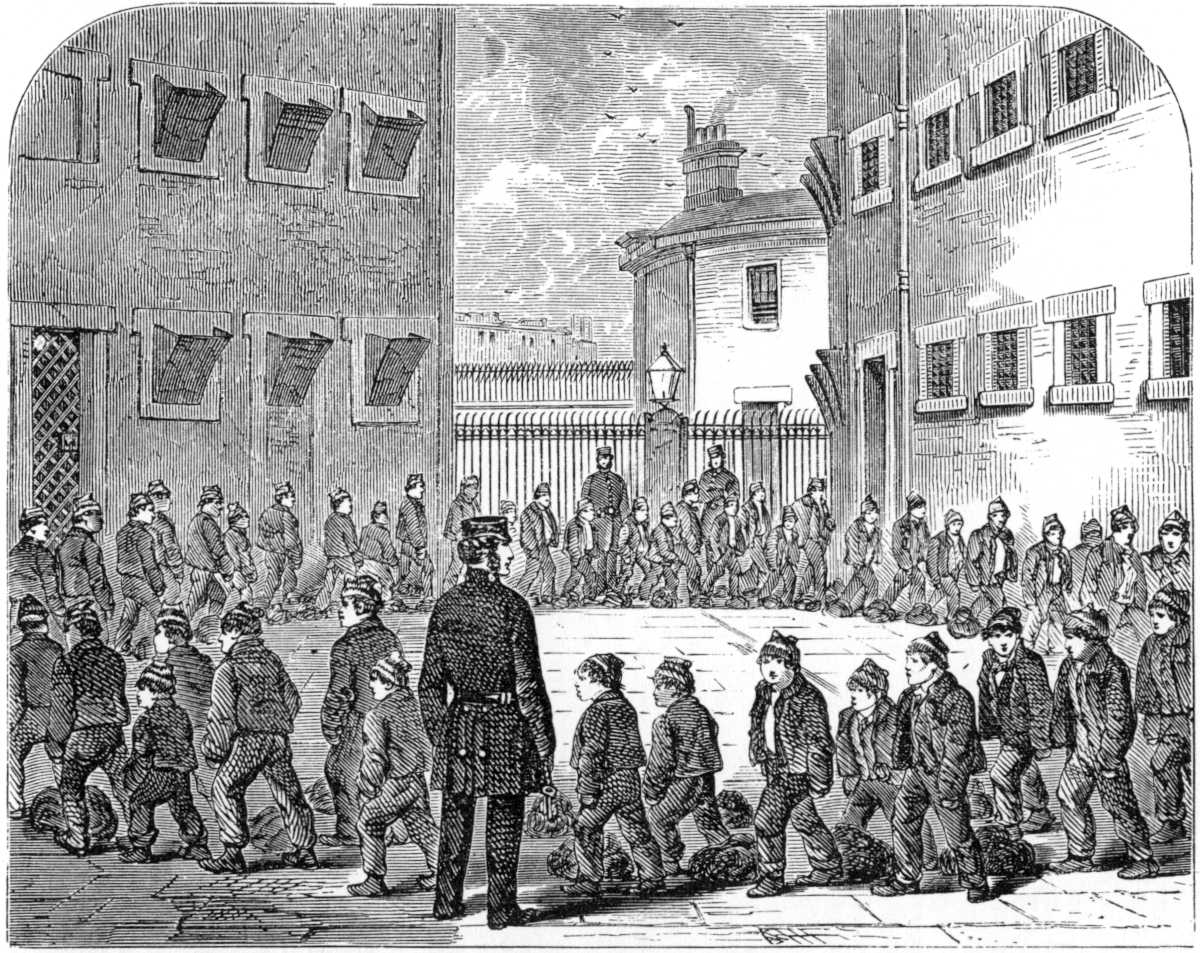
BOYS EXERCISING AT TOTHILL FIELDS PRISON.
“On Sundays many of the cadgers staid at home till night. They spent the day at cards, shove-halfpenny, tossing, and other amusements. Sometimes five or six shillings were staked on the table among a party of about ten of them at cards, although coppers were the usual stakes.... The life of a cadger is not in many instances a life of privation. I do not speak (says Mr. Hunt) of the really distressed, to whose wants too little attention is sometimes paid. I allude to beggars by profession, who prefer a life of mendicancy to any other. There are among them sailors, whose largest voyage has been to Tothill Fields prison, or to Gravesend on a pleasure trip. Cripples with their arms in slings, or feet, swathed in blood-stained rags, swollen to double the size, who may be seen dancing when in their lodging at their evening revels. You may see poor Irish with from five to thirty sovereigns in a bag hung round their necks or in the waistband of their trousers; women who carry hired babes, or it may be a bundle of clothing resembling a child, on their back and breast, and other such-like impostors.
“Between Buckeridge Street and Church Lane stood Ivy Lane, leading from George Street to Carrier Street, communicating with the latter by a small gateway. Clark’s Court was on its left, and Rats’ Castle on its right. This castle was a large dirty building occupied by thieves and prostitutes, and boys who lived by plunder. On the removal of these buildings, in 1845, the massive foundations of an hospital were found, which had been built in the 12th century by Matilda, Queen of Henry the First, daughter of Malcolm King of Scotland, for persons afflicted with leprosy.
“At this place criminals were allowed a bowl of ale on their way from Newgate to Tyburn.
“Maynard Street and Carrier Street were occupied by costermongers and a few thieves and cadgers. George Street, part of which still stands, consisted of lodging-houses for tramps, thieves, and beggars, together with a few brothels.”
From George Street to High Street runs a mews called Hampshire-Hog Yard, where there is an old established lodging-house for single men, poor but honest.
The portion of the rookery now remaining, consisting of Church Lane, with its courts, a small part of Carrier Street, and a smaller portion of one side of Church Street, is now more densely crowded than when Buckeridge Street and its neighbourhood were in existence. The old Crown public-house in Church Lane, formerly the resort of the most notorious cadgers, was in 1851 inhabited by Irish people, where often from twelve to thirty persons lodged in a room. At the back of this public-house is a yard, on the right-hand side of which is an apartment then occupied by thirty-eight men, women, and children, all lying indiscriminately on the floor.
Speaking of other houses in this neighbourhood in 1851, Mr. Hunt states: “I have frequently seen as many as sixteen people in a room about twelve feet by ten, these numbers being exceeded in larger rooms. Many lay on loose straw littered on the floor, their heads to the wall and their feet to the centre, and decency was entirely unknown among them.”
Now, however, the district is considerably changed, the inhabitants are rapidly rising in decency, cleanliness, and order, and the Rookery of St. Giles will soon be ranked among the memories of the past.
Narrative of a London Sneak, or Common Thief.
The following narrative was given us by a convicted thief, who has for years wandered over the streets of London as a ballad singer, and has resided in the low lodging-houses scattered over its lowest districts. He was a poor wretched creature, degraded in condition, of feeble intellect, and worthless character, we picked up in a low lodging house in Drury Lane. He was shabbily dressed in a pair of old corduroy trousers, old brown coat, black shabby vest, faded grey neckerchief, an old dark cap and peak, and unwashed shirt. For a few shillings he was very ready to tell us the sad story of his miserable life.
“I was born at Abingdon, near Oxford, where my father was a bricklayer, and kept the N——n public-house. He died when I was fourteen years of age; I was sent to school and was taught to read, but not to write. At this time I was a steady, well-conducted boy. At fourteen years of age I went to work with my uncle, a basket-maker and rag merchant in Abingdon, and lived with my mother. I wrought there for three years, making baskets and cutting willows for them. I left my uncle then, as he had not got any more work for me to do, and was living idle with my mother. At this time I went with a Cheap John to the fairs, and travelled with him the whole of that season. He was a Lancashire man, between fifty and sixty years of age, and had a woman who travelled the country with him, but I do not think they were married. He was a tall, dark-complexioned man, and was a ‘duffer,’ very unprincipled in his dealings. He sold cutlery, books, stationery, and hardware.
“When we were going from one fair to another, we would stop on the road and make a fire, and steal fowls and potatoes, or any green-stuff that was in season. We sometimes travelled along with gipsies, occasionally to the number of fifty or sixty in a gang. The gipsies are a curious sort of people, and would not let you connect with any of them unless they saw you were to remain among them.
“I assisted Cheap John in the markets when selling his goods, and handed them to the purchasers.
“The first thing I ever pilfered was a pair of boots and a handkerchief from a drunken man who lay asleep at a fair in Reading, in Berks. He was lying at the back of a booth and no one near him. This was about dusk in September. I pawned the boots at Windsor on the day of a fair for 3s., and sold the handkerchief for 1s.
“I was about seventeen years of age when I went with Cheap John, and remained with him about thirteen weeks, when I left, on account of a row I had with him. I liked this employment very well, got 2s. in the pound for my trouble, and sometimes had from 1l. to 25s. a week. But the fairs were only occasional, and the money I earned was very precarious.
“I left Cheap John at Windsor, and came to Slough with a horse-dealer, where I left him. He gave me 2s. for assisting him. I then came up to London, where I have lived ever since in the lodging-houses in the different localities. I remember on coming to this great city I was much astonished at its wonders, and every street appeared to me like a fair. On coming to London I had no money, and had not any friend to assist me. I went to Kensington workhouse, and got a night’s lodging, and lived for about a fortnight at different workhouses in London. They used to give the lodgers a piece of bread at night, and another in the morning, and a night’s lodging on straw and boards.
“I then went out singing ballads in the streets of London, and could get at an average from 2s. to 2s. 6d. a night, but when the evenings were wet, I could not get anything. In the winter I sang in the daytime, and in summer I went out in the evening. I have wandered in this way over many of the streets and thoroughfares of London. I sing in Marylebone, Somers Town, Camden Town, Paddington, Whitecross Street, City, Hammersmith, Commercial Road, and Whitechapel, and live at different lodgings, and make them my home as I move along. I sing different kinds of songs, sentimental and comic; my favourites are ‘Gentle Annie,’ ‘She’s reckoned a good hand at it,’ ‘The Dandy Husband,’ ‘The Week’s Matrimony,’ ‘The Old Woman’s Sayings,’ and ‘John Bull and the Taxes.’ I often sing ‘The Dark-eyed Sailor,’ and ‘The Female Cabin Boy.’ For many years now I have lived by singing in the public street, sometimes by myself, at other times with a mate. I occasionally beg in Regent Street and Bond Street on the ‘fly,’ that is, follow people passing along, and sometimes in Oxford Street and Holborn. Sometimes I get a little job to do from people at various kinds of handiwork, such as turning the wheel to polish steel, and irons, &c., and do other kinds of job work. When hard up I pick pockets of handkerchiefs, by myself or with one or two mates. [In the course of our interview we saw he was very clumsy at picking pockets.] I sometimes go out with the young dark-complexioned lad you saw down stairs, who is very clever at pocket picking, and has been often convicted before the criminal courts.
“I have spent many years living in the low lodging-houses of London. The worst I ever saw was in Keat Street, Whitechapel, about nine years ago, before they were reformed and changed. Numbers were then crowded into the different rooms, and the floors were littered with naked people of all ages, and of both sexes, men and women, and boys and girls sleeping alongside indiscriminately. It was very common to see young boys and girls sleeping together. The conversations that passed between them, and the scenes that were transacted, were enough to contaminate the morals of the young.
“In the morning they used to go to their different haunts over the city, some begging, and others thieving.
“On Sunday evenings the only books read were such as ‘Jack Sheppard,’ ‘Dick Turpin,’ and the ‘Newgate Calendar’ they got out of the neighbouring libraries by depositing 1s. These were read with much interest; the lodgers would sooner have these than any other books. I never saw any of them go to church on Sundays. Sometimes one or two would go to the ragged-school, such as the one in Field Lane near Smithfield.
“It often happened a man left his wife, and she came to the lodging-house and got a livelihood by begging. Some days she would glean 2s. or 3s., and at other times would not get a halfpenny.
“The thieves were seldom in the lodging-house, except to meals and at bedtime. They lived on better fare than the beggars. The pickpocket lives better than the sneaking thief, and the pickpocket is thought more of in the lodging-houses and prisons than the beggar.
“The lowest pickpockets often lived in these low lodging-houses, some of them young lads, and others middle-aged men. The young pickpockets, if clever, soon leave the lodging-houses and take a room in some locality, as at Somers Town, Marylebone, the Burgh, Whitechapel, or Westminster. The pickpockets in lodging-houses, for the most part, are stockbuzzers, i.e., stealers of handkerchiefs.
“I have often seen the boys picking each others’ pockets for diversion in the lodging-houses, many of them from ten to eleven years of age.
“There are a great number of sneaks in the lodging-houses. Two of them go out together to the streets, one of them keeps a look-out while the other steals some article, shoes, vest, or coat, &c., from the shop or stall. I sometimes go out with a mate and take a pair of boots at a shop-door and sell them to the pawnbroker, or to a labouring man passing in the street.
“Sometimes I have known the lodgers make up a packet of sawdust and put in a little piece of tobacco to cover an opening, leaving only the tobacco to be seen looking through, and sell it to persons passing by in the street as a packet of tobacco.
“When I am hard up I have gone out and stolen a loaf at a baker’s shop, or chandler’s shop, and taken it to my lodging. I have often stolen handkerchiefs, silk and cambric, from gentlemen’s pockets.
“I once stole a silver snuff-box from a man’s coat-pocket, and on one occasion took a pocket-book with a lot of papers and postage stamps. I burnt the papers and sold the stamps for about 1s. 6d.
“I never had clothes respectable enough to try purses and watches, and did not have nerve for it. I have seen young thieves encouraged by people who kept the lodging-houses, such as at Keat Street, Whitechapel, and at the Mint. They would ask the boys if they had anything, and wish them to sell it to them, which was generally done at an under-price. In these lodging-houses some lived very well, and others were starving. Some had steaks and pickles, and plenty of drink, porter and ale, eggs and bacon, and cigars to smoke. Some of the poorest go out and get a pennyworth of bread, halfpennyworth of tea, halfpennyworth of butter, and halfpennyworth of sugar, and perhaps not have a halfpenny left to pay for their lodging at night. When they do get money they often go out and spend it in drink, and perhaps the next night are starving again.
“I have been tried for stealing a quart pot and a handkerchief, at Bagnigge Wells police station, and was taken to Vine Street police station for stealing 2s. 6d. from a drunken woman respectably dressed. I took it out of her hand, and was seen by a policeman, who ran after me and overtook me, but the woman refused to prosecute me, and I was discharged. I was also brought before Marylebone police-court for begging.
“In my present lodging I am pretty comfortable. We spend our evenings telling tales and conversing to each other on our wanderings, and playing at games, such as ‘hunt the slipper.’ I have often been in great want, and have been driven to steal to get a livelihood.”