PROSTITUTION AMONG THE SEMI-CIVILIZED NATIONS. (continued 2)
Reading edition
Among the Hindus immorality is not a distinguishing characteristic, though many men of high grade pass their nights with dancers and prostitutes. In the temples of the south lascivious ceremonies still occur, but in Hindustan Proper such scenes are not often enacted. This decency of public manners appears of recent introduction, which is indeed a reasonable supposition, for the people have now aims in life, which they never enjoyed in security under their former rulers. It was for the interest of the princes that their subjects should be indolent and sensual. It is for the interest of the new government that they should be industrious and moral. Great efforts have been made with this object, and much good has resulted.
Towards the close of the last century an official report was made by Mr. Grant, and addressed to the Court of Directors. It was the result of an inquiry instituted into the morals of British India. India and Bengal were especially held in view. Much laxity of morals in private life then prevailed, and he believed that many intrigues were altogether concealed, while many that were discovered were hushed up. Receptacles for women of infamous character everywhere abounded, and were licensed. The prostitutes had a place in society, making a principal figure at all the entertainments of the great. They were admitted even into the zenanas to exhibit their dances. Lord Cornwallis, soon after his arrival in Bengal, was invited by the Nawab to one of these entertainments, but refused to go. The frightful punishments against adultery appeared enacted far more to protect the sanctity of caste than public or private virtue. A man committing the crime was threatened with the embraces, after death, of an iron figure of a woman made red hot. Connection, however, with prostitutes and dancing girls was permitted by the written law.
If that account was correct—and it is corroborated by many others—an immense amelioration must have taken place. The Hindus are now generally chaste, and the profligacy of their large cities does not exceed that of large cities in Europe. In Benares, in 1800, out of a population of 180,000, there were 1500 regular prostitutes, besides 264 Nach or dancing girls. They were all of the Sudra, which is a very low caste. In Dacca there were, out of a population of 35,238 Mohammedans and 31,429 Hindus, 234 Mohammedan and 539 Hindu prostitutes.
At Hurdwar it was one of the duties of the female pilgrims to the sacred stream to bathe stark naked before hundreds of men, which does not indicate any great modesty.
The better order of Nach girls are of the highest grace and fascination, with much personal charm, which they begin to lose at 20 years of age. They mostly dress in very modest attire, and many are decent in their manners.
The Gipsies of India, many of whom are Thugs, have numbers of handsome women in their camps, whom they send out as prostitutes to gain money, or seduce the traveller from his road.
It is said that many of the Europeans scattered over India encourage immorality, taking temporary companions. A large class of half-caste children has been certainly growing up in the country, whose mothers are not all the children of white men.
The institution of slavery in Malwa was principally confined to women. Almost all the prostitutes were of this class. They were purchased when children by the heads of companies, who trained them for the calling, and lived upon the gains of their prostitution. The system is even at present nearly similar, the girls being bargained away by their parents into virtual servitude. Many of the wealthy Brahmins, with from 50 to 200 slaves, employed them all day in the menial labours of the establishment, and at night dispersed them to separate dwellings, where they were permitted to prostitute themselves as they pleased. A large proportion of the profits, however, which accrued from this vile traffic formed the share of the master, who also claimed as slaves the children which might spring from this vile intercourse. The female slaves and dancing girls could not marry, and were often harshly used. Society was disorganized by the vast bastard breed produced by this system.
The Europeans at Madras, a few years ago, did not consider their liaisons with the native women so immoral as they would have been considered in England. The concubines were generally girls from the lower ranks, purchased from their mothers. Their conduct usually depends on the treatment they receive. Many of them become exceedingly faithful and attached, being bitterly jealous of any other native women interfering with their master’s affections, but never complaining of being superseded by an English wife. They are often, however, extravagant gamblers, and involve their “lovers” in heavy debts.
An Indian mother will sometimes dedicate her female child to prostitution at the temple; and those who are not appropriated by the Brahmins may go with any one, though the money must be paid into a general fund for the support of the establishment.
Some of the ceremonies performed in the temples of the south, by the worshippers of the female deities, were simply orgies of the impurest kind. When a man desired to be initiated into these rites, he went with a priest, after various preliminary rites, to some house, taking nine females (one a Brahmin) and nine men—one woman for himself, and another for his sacerdotal preceptor. All being seated, numerous ceremonies were performed until twelve o’clock at night, when they gratified their inflamed passions in the most libidinous manner. The women, of course, were prostitutes by habit or profession. Men and women danced naked before thousands of spectators at the worship of the goddess Doorga. The impurities originated usually with the priests. Many of the Brahmins persuaded their disciples to allow them to gratify their lust upon their young wives, declaring it was a meritorious sacrifice. At the temple of Juggernaut, during the great festivals, a number of females were paid to dance and sing before the god daily. These were all prostitutes. They lived in separate houses, not in the temple.
The daughters of Brahmins, until eight years old, were declared by the religious code to be objects of worship, as forms of goddesses. Horrid orgies took place at the devotions paid them. Other women might be chosen as objects of adoration. A man must select from a particular class—his own wife or a prostitute: she must be stripped naked while the ceremony is performed, and this is done in a manner too revolting to describe. The clothes of the prostitutes hired to dance before the idols are so thin that they may almost be said to have been naked. Thus the immorality of the Hindoos, as far as it extended, was encouraged by their religion.
In another way some classes of Brahmins contributed to demoralize the people. A man of this profession would marry from three to 120 wives, in different parts of the country. Many, indeed, earned a living in this manner; for as often as they visited any woman, her father was obliged to make a present. Some go once after their marriage, and never go again; while others visit their wives once in three or four years. Some of the more respectable Brahmins never hold sexual intercourse with any of their wives, who dwell at home, but treat them with great respect. These neglected women often take to prostitution. The brothels of Calcutta and other large cities are crowded with such cast-off mistresses of the Brahmins. They procure abortion when pregnant. In the city of Bombay a whole quarter is inhabited chiefly by prostitutes. Riding in the environs, the European resident is frequently assailed by men, or sometimes boys, who inquire by signs or words, whether he desires a companion; should he assent, the woman is privately brought to his house in a close palanquin, or he is taken to a regular place of resort, in one of these vehicles, which are contrived for secrecy.
Among the Nairs, on the coast of Malabar, the institution of marriage has never been strictly or completely introduced. Polyandrism is practised. A woman receives four or five brothers as her husbands, and a slipper left at the door is a signal that she is engaged with one of them. The mother is thus the only parent known, and the children inherit the property of the family in equal divisions. In some cases the Nairs marry a particular woman, who never leaves her mother’s home, but has intercourse with any men she pleases, subject to the sacred law of caste. In the mountain community of Tibet the same custom prevails. It is to be regretted that our information on this subject is not more explicit and full.
The venereal disease is known in most parts of Hindustan. Some, with little reason, suppose it was carried there after the discovery of America. Had it been so, its introduction would probably have been noticed in history or by some tradition. It is not, indeed, called by any Sanscrit word, but is known by a Persian name[73].
Of Prostitution in Ceylon.
In Ceylon the influence of Christianity, accompanied by the moral law of England, is working a reform in the manners of large classes among the people. Under the original institutions of the Singhalese, they never licensed public prostitution; and whatever effect the Buddhist religion produced, it produced in the cause of virtue. The temples were never made brothels; but the character of the people is naturally sensual, and the capital vices of society widely prevail among them. The Buddhist code, indeed, abounds with precepts inculcating not only chastity, but rigid continence. Profligacy, however, among the men, and want of chastity among the women, are general characteristics of all classes, from the highest to the humblest caste. To this day the disregard of virtue is a crying sin of the women, even of those who profess Christianity. Murders often occur from the jealousy of husbands or lovers detecting their wives or mistresses with a paramour.
In Ceylon, as in continental India, the division of castes is by the ancient and sacred law absolute, though custom sometimes infringes the enactments of the holy code. Marriage from a higher into a lower caste is peremptorily forbidden; though occasionally it is tolerated, but never approved, between a man of honourable and a woman of inferior rank. If a female of noble blood engage in a criminal intrigue with a plebeian, his life has on many occasions been sacrificed to wash out the stain, and formerly hers was also required to obliterate the disgrace. A recent and striking instance of this kind came to the knowledge of Mr. Charles Sirr. The daughter of a high-caste Kandian, enjoying the liberty which in Ceylon is allowed to women of all grades, became attached to a young man of lower caste, and entreated her parents’ consent to the match, begging them to excuse her for her affection’s sake, and declaring she could not live unless permitted to fulfil the design on which her heart was set. They refused, and, though the petition was again and again renewed, remained obdurate in their denial. The girl was some time after found to have sacrificed her honour to the man whom she loved, but dared not wed. He was all the while willing and desirous to marry her, and would have married her then, but her parents were inexorable. To preserve the honour of the family, the father slew his daughter with his own hand. The English authorities at once arrested the murderer, brought him to trial, and condemned him to death. He resolutely asserted his right to do as he pleased with the girl, protesting against any judicial interference of the English with his family arrangements. He was, nevertheless, executed, as a warning; and several of these examples have had a most salutary influence in restraining the passions of the natives in various parts of the island. It was undoubtedly the man’s sense of honour that impelled him to murder his daughter; and she was thus the victim of caste prejudices, which in Ceylon are so rigid that a man could not force his slave to marry into a rank below him, whether free-born or otherwise.
In Ceylon, as in most other parts of Asia, marriages are contracted at a very early age. A man, by the law, “attains his majority” when sixteen years old, and thenceforward is released from paternal control; all engagements, however, which he may form previous to that time, without the consent of his friends in authority, are null and void. A girl, as soon as she is marriageable according to nature, is marriageable according to law; and her parents, or, if she be an orphan, her nearest kindred, give a feast—grand or humble, according to their means—when she is introduced to a number of unmarried male friends. If she be handsome or rich, a crowd of suitors is sure to be attracted. Free as women are in Ceylon after their marriage, they are rarely consulted beforehand on the choice of a partner. That is settled for the girl. To this custom much of the immorality prevalent in the island, as well as in all parts of the East, may without a doubt be ascribed. Where the sexes are not free to form what lawful unions they please, it may be taken as an axiom that they will have recourse to irregular intrigues.
When the feast is given at which a young girl is introduced as marriageable—a custom very similar in form and object to that which obtains in our own country—numerous young unmarried men of the same caste are invited to the house. In a short time after, a relative or friend of any young man who may desire to take the maiden as his wife, calls upon her family, and insinuates that a rumour of the intended union is flying abroad. If this be denied, quietly or otherwise, the match-maker loses no time in withdrawing; but if it is answered in a jocular bantering strain, he takes his leave, with many compliments, to announce his reception to the father of the bridegroom. This personage, after a day or two, makes his call, inquires into the amount of the marriage dowry, and carries the negotiation a few steps further. Mutual visits are exchanged, and all arrangements made, with great precision. The mother of the young man, with several other matrons, take the girl into an inner room, where she is stripped, and her person examined, to see that it is free from any corporal defect, from ulcers, and from any cutaneous disease. Should this investigation prove satisfactory, numerous formalities succeed, and an auspicious day is fixed upon for the wedding. This takes place with much ceremony, the stars being in all things consulted. Should the bridegroom’s horoscope refuse to agree with that of the bride, his younger brother may wed her for him by a species of proxy. The whole is a tedious succession of formal observances, not so much the ordinance of religion as the details of an ancient ritual etiquette. This is the Buddhaical custom; but it is immensely expensive, and cannot be followed by the very poor classes. It is also forbidden to people of extremely low caste, even though they should be wealthy enough to afford, or sufficiently improvident to risk it. Among the humble and indigent the marriage is confirmed by the mutual consent of the parents and the young couple passing a night together.
One of the most remarkable features in the social aspect of Ceylon is the institution of polyandrism, which among the Kandians is permitted and practised to a great extent. A Kandian matron of high caste is sometimes the wife of eight brothers. The custom is justified upon various grounds. Sirr expressed to a Kandian chief of no mean rank his abhorrence of this revolting practice. The man was surprised at these sentiments, and replied that on the contrary it was an excellent custom. Among the rich it prevented litigation; it saved property from minute subdivision; it concentrated family influence. Among the poor it was absolutely necessary, for several brothers could not each maintain a separate wife, or bear the expense of a whole family, which jointly they could easily do. The offspring of these strange unions call all the brothers alike their fathers, though preference is given to the eldest, and are equal heirs to the family property; should litigation, however, arise concerning the inheritance, they often all claim the senior brother as a parent, and the Kandian laws recognise this claim.
Although, when a plurality of husbands is adopted, they are usually brothers, a man may, with the woman’s consent, bring home another, who enjoys all the marital rights, and is called an associated husband. In fact, the first may, subject to his wife’s pleasure, bring home as many strangers as he pleases, and the children inherit their property equally. It is rare, however, to meet one of these associated husbands among the Kandians of higher and purer caste, though two or more brothers continually marry the same woman. This revolting custom is now confined to the province of Kandy, though some writers assert that it was formerly prevalent throughout the maritime districts. In these, however, monogamy is at present practised, except by the Mohammedans, who are polygamists. Statements to the contrary have been laid before us; but Sirr positively asserts that he never saw a Kandian or Singhalese who had acknowledged himself to have more than a single wife. The Muslims, though long settled in the island, preserve their peculiar characteristics, their religion, habits, and manners, which they have not communicated to the rest of the population.
There are two kinds of marriage in Kandy, the one called “Bema,” the other “Deega.” In the first of these the husband goes to live at his wife’s residence, and the woman shares with her brothers the family inheritance. He, however, who is married after this fashion, enjoys little respect from his bride’s relations; and if he gives offence to her father, or the head of the household, may be at once ejected from the abode. In reference to this precarious and doubtful lodgement there is an ancient proverb still popular in Kandy. It says that a man wedded according to the Bema process should only take to his bride’s dwelling four articles of property—a pair of sandals to protect his feet, a palm-leaf to shield his head from the fiery rays of the sun, a walking staff to support him if he be sick, and a lantern to illuminate his path should he chance to be ejected during darkness. He may thus be prepared to depart at any hour of the day or night.
Deega, the other kind of marriage, is that in which the wife passes from underneath the parental roof to dwell in her husband’s own house. In this case she relinquishes all claim to a share in her family inheritance, but acquires a contingent right to some of her husband’s property. The man’s authority is, under this form of contract, far greater than under that of Bema. He cannot be divorced without his own consent, while, in the other case, separation, as we have seen, is a summary process, entirely depending on the caprice of the woman or her family. In a country where the female population is considerably less numerous than the male, and where women generally enjoy much freedom, a certain degree of indulgence will always be granted to the fickle quality in their character. In Ceylon this liberty in the one sex involves a certain kind of slavery in the other. Women frequently seek for divorces upon the most frivolous and trifling pretexts, and as these are too easily attainable by the simple return of the marriage gifts, they continually occur. Should a child be born within nine months from the day of the final separation, the husband is bound to maintain it for the first three years of its life, after which it is considered sufficiently old to be taken from its mother. If, however, while under the marriage pledge, the woman defiles herself by adultery, the husband, if with his own eyes he was the witness of her infidelity, might with his own hands, under the native law, take away the life of her paramour. Notwithstanding this terrible privilege, it is asserted with consistency by many authorities that, in all parts of Ceylon, from the highest to the lowest caste, the want of conjugal faith in the married, and chastity in the unmarried people, is frightful to consider. When a man puts away his wife for adulterous intrigue, he may disinherit her and the whole of her offspring, notwithstanding that he may feel and acknowledge them all to be his own children. When, however, he seeks a divorce from caprice, he renounces all claim to his wife’s inheritance or actual property, and must divide with her whatever may have been jointly accumulated during the period of their cohabitation. The men of Ceylon do not always, however, exercise their privileges. They are generally very indulgent husbands. Many of them, indeed, are uxorious to an offensive extreme, and forgive offences which, by most persons, are held unpardonable. A short time since a Kandian applied to the British judicial authorities to compel the return to him and his children of an unfaithful wife, who had deserted her home for that of a paramour. The husband pleaded his love for her, implored her for her children’s sake to come back, and promised to forgive her offence; but she turned away from him, and coolly asked the judge if he could force her to return. He answered that unfortunately he could not, but advised her to return to the home of her lawful partner, who was ready to forgive and embrace her. She disregarded equally the entreaties of the one and the exhortation of the other, and returned to her paramour, whom she shortly afterwards deserted for another.
The numerous instances of this kind which happen in the island have encouraged a swarm of satirical effusions upon the faithlessness of the female sex; but if the women were also poets, they might echo every note of the song. In illustration of the estimate formed of them, we may quote a few lines translated from the original by Sirr. They apply to the fraudulent disposition of women, and have become proverbial among the people.
“I’ve seen the adumbra tree in flower, white plumage on the crow, And fishes’ footsteps on the deep have traced through ebb and flow. If man it is who thus asserts, his words you may believe; But all that woman says distrust—she speaks but to deceive.”
The adumbra is a species of fig-tree, and the natives assert that no mortal has ever seen its bloom.
Under the native kings the Singhalese were forbidden to contract marriage with any one of nearer affinity than the second cousin; such an union was incestuous, and severely punished. Under the English government, however, many of these old restrictions have been modified. Among the Christian population, on the other hand—Catholic as well as Protestant—many traces of their old idolatry are still distinctly visible in the ceremony of marriage.
The Buddhist law allows to every man, whatever his grade, only one wife; but the ancient Kandian princes, of course, broke this law and took as many wives or concubines as they pleased.
We have alluded to the numerical difference between the sexes. The population of Ceylon is about 1,500,000, and the males exceed the females by nearly a tenth. In 1814 it was 476,000; there were 20,000 more males than females. In 1835 there was a population of 646,000 males, and 584,000 females. At both these periods the disparity was greatest in the poorest places. In the fishing villages, where wholesome food abounded, there were more females than males. The same circumstance is true at the present day. Some writers attribute this to a gracious provision of Nature, which checks the increase of the people; but Nature makes no provision against unnatural things, and starvation is a monstrous thing in a fertile country. We may with more safety assign as a cause the open or secret infanticide, which, under the old laws, was common. Female children, except the first born, born under a malignant star, were sure to be sacrificed. It was hardly considered an offence; but being, under the British rule, denounced as murder, has been gradually abolished. The easier means of life, which in Ceylon and throughout the rest of our Asiatic dominions are afforded to the people under English sway, take away the incentive of poverty to crime. The population has enormously increased, an unfailing sign of good government, if misery does not increase with it.
The social position of the Singhalese women is not so degraded as in many other parts of the East; the poor labouring hard, but as partners rather than as slaves. This superior condition does not, unhappily, elevate their moral character, for it is unaccompanied by other essential circumstances. Profligacy, we have said, is widely prevalent in Ceylon; yet prostitution, at least of the avowed and public kind, is not so. Under the Kandian dynasty it was peremptorily forbidden; a common harlot had her hair and ears cut off and was whipped naked. If, however, we accept the general definition of the word prostitution as any obscene traffic in a woman’s person, we shall find much of it clandestinely practised. The women are skilful in procuring abortion, and thus rid themselves of the consequences which follow their intrigues. Of course, in the sea-port towns prostitution exists, but we have no account of it. It is fair, however, to notice the opinions of Sir Emerson Tennent, that the morals of the people in these and in all other parts of the islands are rapidly improving, and that marriage is becoming a more sacred tie[74].
Of Prostitution in China.
In the immense empire of China, the civilization of which has been cast in a mould fashioned by despotism, a general uniformity of manners is prevalent. Singular as many of its customs are, they vary very little in the different provinces, for although the population be composed of a mixture of races, the iron discipline of the government forces all to bend to one universal fashion. The differences which are remarked between the practice of the people in one district, and those of another, spring only from the nature of circumstances. It is more easy, therefore, to take an outline view of this vast empire, than it is to sketch many smaller countries, where the uniformity of manners is not so absolute.
China affords a wide and interesting field for our inquiry. Were our information complete, there is perhaps no state in the world with reference to which so curious an account might be written as China, with its prostitution system. Unfortunately, however, the negligence or prudery of travellers has allowed the subject to be passed over. We know that a remarkable system of this kind does exist, that prostitutes abound in the cities of the Celestial Empire, and that they form a distinct order; we know something of the classes from which they are taken, how they are procured, in what their education consists, where and in what manner they live, and how and by whom they are encouraged. But this information is to be derived, not from any full account by an intelligent and observing inquirer, but from isolated facts scattered through a hundred books which require to be connected, and then only form a rough and incomplete view of the subject. Statistics we have positively none, though ample opportunities must be afforded travellers for arriving at something near the truth in such cities as Canton. However, from what knowledge we possess it is evident the social economy of the Chinese with respect to prostitution presents clear points of analogy with our own.
In conformity with the plan of this inquiry, we proceed first to ascertain the general condition of the female sex in China. Abundant information has been supplied us on this subject, as well by the written laws, and by the literature of the country, as by the travellers who have visited and described it.
As in all Asiatic, indeed in all barbarous, countries, women in China are counted inferior to men. The high example of Confucius taught the people—though their own character inclined them before, and was reflected from him—that the female sex was created for the convenience of the male. The great philosopher spoke of women and slaves as belonging to the same class, and complained that they were equally difficult to govern. That ten daughters are not equal in value to one son is a proverb which strongly expresses the Chinese sentiment upon this point, and the whole of their manners is pervaded by the same spirit. Feminine virtue, indeed, is severely guarded by the law, but not for its own sake. The well-being of the state, and the interest of the male sex, are sought to be protected by the rigorous enactments on the subject of chastity; but the morality, like the charity of that nation, is contained principally in its codes, essays, and poems, for in practice they are among the most demoralised on the earth.
The spirit of the Salic law might naturally be looked for in the political code of such a state. It is so. The throne can be occupied only by a man. An illegitimate son is held in more respect than a legitimate daughter. The constitution provides that if the principal wife fail to bear male children, the son of the next shall succeed, and if she be barren also, of the next, and so on, according to their seniority, the son of each has a contingent claim to the sovereignty. Thus in the most important department of their public economy the national sentiment is manifested. We may now examine the laws which regulate the intercourse of the sexes, and then inquire into the actual state of manners. It will be useful to remember the truth, which has already been stated, that no language is so full of moral axioms and honourable sentiments as the Chinese, while no nation is more flagitious in its practice.
The government of China, styled paternal because it rules with the rod, regulates the minutest actions of a man’s career. He is governed in everything—in the temple, in the street, at his own table, in all the relations of life. The law of marriage, for instance, is full, rigid, and explicit. The young persons about to be wedded know little or nothing of the transaction.
Parental authority is supreme, and alliances are contracted in which the man and wife do not see each others’ faces until they occupy the same habitation and are mutually pledged for life. Match-making in China is a profession followed by old women, who earn what we may term a commission upon the sales they effect. When a union between two families is intended, its particulars must be fully explained on either side, so that no deceit shall be practised. The engagement is then drawn and the amount of presents determined, for in all countries where women hold this position, marriage is more or less a mercantile transaction. When once the contract is made, it is irrevocable. If the friends of the girl repent and desire to break the match, the man among them who had authority to give her away is liable to receive fifty strokes of the bamboo, and the marriage must proceed. Whatever other engagements have been entered into are null and punishable, and the original bridegroom has in all cases a decisive claim. If he, on the other hand, or the friend who represents and controls him, desire to dissolve the compact, giving a marriage present to another woman, he is chastised with fifty blows, and compelled to fulfil the terms of his first engagement, while his second favourite is at liberty to marry as she pleases. If either of the parties is incontinent after the ceremony of betrothal, the crime is considered as adultery, and so punished. But if any deceit be practised, and either family represent the person about to marry under a false description, they become liable to severe penalties, and on the part of the man most strictly.
The husband, finding that a girl had been palmed off on him by fraud, is permitted to release himself from the tie. Such incidents, nevertheless, do occasionally occur. One of rather an amusing nature is alluded to by several writers. A young man who had been promised in marriage the youngest daughter of a large family was startled when, after the ceremony was complete, he unveiled his bride, to find the eldest sister, very ugly and deeply pitted with the small pox. The law would have allowed him to escape from such an union, but he submitted, and soon afterwards consoled himself with a handsome concubine.
Although the girl, when once betrothed, is absolutely bound to the husband selected for her, he dare not, under pain of the bastinado, force her away before the specified time. On the other hand, her friends must not, under similar penalties, detain her after that time. Thus the law regulates the whole transaction, and the parents dispose as they will of their children. Occasionally, however, a young man, not yet emancipated from paternal authority, contracts a marriage according to his own inclination, and if the rites have actually been performed, it cannot be dissolved; but if he be only betrothed, and his parents have in the meanwhile agreed upon an alliance for him, he must relinquish his own design and obey their choice.
Polygamy is allowed in China, but under certain regulations. The first wife is usually chosen from a family equal in rank and riches to that of the husband, and is affianced with as much splendour and ceremony as the parties can afford. She acquires all the rights which belong to the chief wife in any Asiatic country. The man may then take as many as he pleases, who are inferior in rank to the first, but equal to each other. The term inferior wife is more applicable than that of concubine, as there is a form of espousal, and their children have a contingent claim to the inheritance. The practice, however, brings no honour, if it brings no positive shame, though now sanctioned by long habit. Originally it appears to have been condemned by the stricter moralists, and it has been observed that the Chinese term to describe this kind of companion is, curiously enough, compounded of the words crime and woman. It is a derogatory position, and such as only the poor and humble will consent to occupy. One of the national sayings, and the feeling with many of the women, is, that it is more honourable to be a poor man’s wife than the concubine of an emperor. A man cannot, under the penalty of a hundred blows, degrade his first wife to this position, or raise an inferior wife to hers—no such act is valid before the law.
None but the rich can afford, and none but the loose and luxurious will practise, polygamy except when the first wife fails to bear a son. Unless some such reason exists, the opinion of moralists is against it. Men with too many wives lose the Emperor’s confidence, since he accuses them of being absorbed in domestic concerns. In this case it is usual to take an inferior wife, who is purchased from the lower ranks for a sum of money, that an heir may be born to the house. The situation of these poor creatures is aggravated or softened according to the disposition of their chief, for they are virtually her servants, and are not allowed even to eat in her presence. They receive no elevation by her decease, but are for ever the mere slaves of their master’s lust. At the same time their inferior position, and therefore inferior consequence, gains them some agreeable privileges. The principal wife is not allowed to indulge in conversation or any free intercourse with strangers—a pleasure which is sometimes enjoyed with little restraint by the others, as well as by the female domestics. Not much jealousy appears to be entertained by these women, who are easily to be procured. Their sons receive half as much patrimony as the sons of the mistress of the household.
The social laws of China inculcate the good treatment of wives; but the main solicitude of the legislator has been with respect to the fixity of the law, and the rights of the male or supreme sex. Leaving her parents’ home, the girl is transferred into bondage. Some men, however, go to the house of their bride’s father, which is contrary to the established form; but when once received across the threshold as a son-in-law, he cannot be ejected, and leaves only when he is inclined.
A man may not marry within a certain period of his chief wife’s death; but if he takes a woman who has already been his concubine, the punishment is two degrees milder. So also with widows, who cannot be forced by their friends to make any new engagement at all, but are protected by the law. Women left in this position have a powerful dissuasive against a fresh union, in the entire independence which they enjoy, and which they could enjoy under no other circumstances.
With respect to the laws relating to consanguinity, the Chinese system is particularly rigid. The prohibited limits lie very widely apart. In this a change appears to have been effected under the Mantchus, for among the traces of ancient manners which become visible at a remoter period, revealed only, however, by the twilight of tradition, a profligate state of public morals is indicated. We find parents giving both their daughters in marriage to one man, while the intercourse of the sexes was all but entirely unrestrained. The strictness of the modern law is attended with some inconvenient results, for in China the number of family names is very small, while it enacted that all marriages between persons of the same family names are not only null and void, but punishable by blows and a fine. All such contracts between individuals previously related by marriage within four degrees, are denounced as incestuous. A man may not marry his father’s or his mother’s sister-in-law, his father’s or mother’s aunt’s daughter, his son-in-law’s or daughter-in-law’s sister, his grandson’s wife’s sister, his mother’s brother’s or sister’s daughter, or any blood relations whatever, to any degree, however remote. Such offences are punished with the bamboo. Death by strangling is enacted against one who marries a brother’s widow, while with a grandfather’s or father’s wife it is more particularly infamous, and the criminal suffers the extreme disgrace of decapitation.
These regulations apply to the first wife, similar offences with regard to the inferior being visited with penalties two degrees less severe. Not only, however, are the degrees of consanguinity strictly defined, but the union of classes is under restriction. An officer of government within the third order marrying into a family under his jurisdiction, or in which legal proceedings are under his investigation, is subject to heavy punishment. The family of the girl, if they voluntarily aid him, incur the chastisement also; but if they have submitted under fear of his authority, they are exempt. To marry an absconded female, flying from justice, is prohibited. To take forcibly as a wife a freeman’s daughter, subjects the offender to death by strangulation. An officer of government, or the son of any high functionary with hereditary honours, who takes as his first or inferior wife a female comedian or musician, or any member of a disreputable class, is punished by sixty strokes of the bamboo. An equal punishment is inflicted on any priest who marries at all; and, in addition to this, he is expelled his order. If he delude a woman under false pretences, he incurs the penalty of the worst incest. Slaves and free persons are forbidden to intermarry. Any person, conniving at, or neglecting to denounce, such illegal contracts, are criminals before the law.
The union after the betrothal must be completed; but it may also be broken. Seven causes, according to the law, justify a man in repudiating his first wife. These are—barrenness, lasciviousness, disregard of her husband’s parents, talkativeness, thievish propensities, an envious suspicious temper, and inveterate infirmity. If, however, any of the three legal reasons against divorce can be proved by the woman, she cannot be put away—first, that she has mourned three years for her husband’s family; second, that the family has become rich after having been poor before and at the time of marriage; third, her having no father or mother living to receive her. She is thus protected, in some measure, from her husband’s caprice. If she commit adultery, however, he dare not retain, but must dismiss her. If she abscond against his will, she may be severely flogged; if she commit bigamy, she is strangled. When a man leaves his home, his wife must remain in it three years before she can sue for a divorce, and then give notice of her intention before a public tribunal. It is forbidden, under peremptory enactments, to harbour a fugitive wife or female servant.
A man finding his wife in the act of adultery may kill her with her paramour, provided he does it immediately, but only on that condition. If the guilty wife adds to her crime by intriguing against her husband’s life, she dies by a slow and painful execution. If even the adulterer slay her husband without her knowledge, she is strangled. The privilege of putting a wife to death is not allowed for any inferior offence. To strike a husband, is punishable by a hundred blows and divorce; to disable him, with strangulation. In all these circumstances the inferior wife is punished one degree more severely. Thus offences against them are less harshly, and offences by them more rigidly, chastised. In addition to these legal visitations the bamboo is at hand to preserve discipline among the women.
One of the laws of China exhibits a peculiar feature of depravity in the people. It is enacted, that whoever lends his wife or daughter upon hire is to be severely punished, and any one falsely bargaining away his wife or his sister is to be similarly dealt with. All persons consenting to the transaction share the penalty. Nor is this an obsolete enactment against an unknown crime. Instances do not unfrequently occur of poor men selling their wives as concubines to their wealthier neighbours. Others prostitute them for gain; but these instances of profligacy usually occur in the large and crowded cities. Sometimes the woman consents, but sometimes also opposes the infamous design.
In 1832 a woman was condemned to strangulation for killing her husband by accident, while resisting an adulterer whom he had introduced for her to prostitute herself to him. These incidents occur only in the lowest class. Some men are as jealous as Turks, and maintain eunuchs to guard their wives.
Under this system many restrictions are imposed on the women of China. They form no part of what is called society, enjoying little companionship, even with persons of their own sex. Those of the better class are instructed in embroidering and other graceful but useless accomplishments. They are seldom educated to any extent, though some instances have occurred of learned women and elegant poetesses, who have been praised and admired throughout the country. Fond of gay clothes, of gaudy furniture, and brilliant decoration, they love nothing so much as display; and though assuming a demure and timid air, cannot be highly praised on this account, for their bashfulness is, in such cases, more apparent than real. Still they are generally described as faithful partners. Religious services are performed for them in the temple, to which women are admitted. The wives of the poorer sort labour in the fields, and perform all the drudgery of the house, an occupation which is held as suited to their nature. “Let my daughter sweep your house” is the expression made use of in offering a wife. It should be mentioned, however, to relieve the darkness of this picture, that husbands often present offerings at the temples, with prayers to the gods for the recovery of their sick wives. The idea may indeed suggest itself, that this is with a view to economy, as girls are costly purchases; but no man is the greater philosopher for asserting that a whole nation exists without the commonest sentiments of human nature. Indeed, many instances occur even in China of husbands and wives living as dear friends together, especially when polygamy has not been adopted in the dwelling. The obedience to old habits is not to be confounded with characteristic harshness in the individual; nor does it seem impossible, when we examine the variety of manners in the world, to believe in a strong and tender attachment between a man and the woman whom, in adherence to ancient usage, he would not allow to eat at the same table with himself. A privilege belongs to the female sex here which it enjoys in no other barbarian country. A strong authority is recognised in the widow over her son. She is acknowledged to have the right to be supported by him, and it is a proverbial saying, that “a woman is thrice dependent—before marriage on her father, after marriage on her husband, when a widow on her son.”
From this view of the condition of women, and the regulations of marriage, we proceed to an important part of the subject—the infanticide for which China has been so infamously celebrated. It is impossible to conceive a more contradictory confusion of statements, than we have seen put forward with reference to this question. Weighing the various authorities, however, we are inclined to adopt a moderate view, rejecting the extravagant pictures of one, and the broad denials of the other set of writers. Infanticide, it cannot be disputed, is practised in the country, and to a considerable extent; but it is, and always will be impossible, to acquire the exact statistics, or even an approximation to the precise truth.
Two causes appear to have operated in encouraging this practice—the poverty of the lower classes, and the severity of the law with respect to the illicit intercourse of the sexes. The former is the principal cause. There is a strong maternal feeling in the woman’s breast, and children are only destroyed when the indigence of the parents allows no hope of rearing them well. It is invariably the female child which is, under these circumstances, slain; for the son can always, after a few years, earn his livelihood, and be an assistance, instead of a burden, to the family. The birth of a female child is regarded as a calamity, and brings mourning into the house. One of the national proverbs expresses this fact in a striking manner, exhibiting also the inferior estimation in which that sex is viewed. It says, that to a female infant a common tile may be given as a toy, while to a male a gem should be presented.
When it is determined to destroy the offspring thus born under the roof of poverty, a choice of method is open. It may be drowned in warm water; its throat may be pinched; it may be stifled by a wet cloth tied over its mouth; it may be choked by grains of rice. Another plan is to carry the child, immediately after its birth, and bury it alive. Captain Collins, of the Plover sloop-of-war, relates that some of his company, while visiting the coast of China, saw a boat full of men and women, with four infants. They landed and dug two pits, in which they were about to inter their living but feeble victims, when they were disturbed. They then made off rapidly, and passed round a headland, beyond which they, no doubt, accomplished their purpose without interruption. When the missionary Smith was in the suburbs of Canton, in 1844, he was presented by a native with a work written by a mandarin, and published gratuitously at the expense of government, to discourage the practice of infanticide. When questioned upon the actual prevalence of the custom, the native said that, taking a circle with a radius of ten miles from the spot they then occupied, the number of infanticides within the space thus included would not exceed five hundred in a year. It was confined to the very poor, and originated in the difficulty of rearing and providing for their female offspring. The rich never encouraged, and the poor were ashamed, of the practice. He knew men who had drowned their daughters, but would not confess the act, speaking of their children as though they had died of disease. In Fokien province, on the contrary, infanticides were numerous. At a place called Kea-King-Chow, about five days’ journey from Canton, there were computed to be 500 or 600 cases in a month. The comparative immunity of Canton from the contagion of this crime was the government foundling-hospital established there. About 500 female children, born of parents in poverty and want, were annually received, to have temporary provision and sustenance. From time to time, the more wealthy merchants and gentry visit the institution to select some of the children, whom they take home to educate as concubines or servants. The hospital has accommodation for at least 1000 infants, each of which is usually removed after three months, either to the house of some voluntary guardian, or to wet nurses in other districts. This is the only important institution of the kind in the province. Infanticide is still, even by the most favourable accounts, lamentably prevalent. The foundling-hospitals, of which there is one in every great town, do certainly oppose a check to the practice. That at Shanghae receives annually about 200 infants.
The villagers in the neighbourhood of Amoy confessed that female infanticide was generally practised among them, and their statements were expressed in a manner which left no doubt that they considered it an innocent and proper expedient for lightening the evils of poverty. Two out of every four, they said, were destroyed; but rich people, who could afford to bring them up never resorted to, because they never needed, such a means of relief. Some killed three, four, or even five out of six; it depended entirely on the circumstances of the individual. The object was effected immediately after the infant’s birth. If sons, however, were born in alternate succession, it was regarded as an omen of happy fortune for the parents, and the daughters were spared. None of the villagers denied to any of their questioners the generality of the custom, but few would confess personally to the actual fact. In some districts one-half was reported as the average destruction of the female population, and in the cities some declared the crime was equally prevalent, though we may take this as the exaggeration which always attends the loose statements of ignorant men, who, having little idea of figures, are required to furnish a number, and speak at random.
Infanticide, however, is not wholly confined to the poor. It is occasionally resorted to by the rich to conceal their illicit amours. In 1838 a proclamation against it was published, but the general perpetration of the crime rendered its repression impossible, with such machinery as the Emperor has at his command. Abeel calculated that throughout a large district, the average was 39 per cent. of the female children. It is evident, however, from all these facts, that under an improved government, the crime might be altogether extinguished, not by severe enactments or vigilant police, but by rendering infanticide unnecessary in the eyes of the people.
The second cause which induces parents to destroy their children is the stringency of the law against the illicit intercourse of unmarried people; its provisions are equally characteristic and severe. To render its enforcement easier, the separation of the sexes is rigidly insisted upon. Not only are servants, but even brothers and sisters, prohibited from mixing except under regulation. Intercourse by mutual consent is punished with 70 blows, while with married people the penalty varies from 80 to 100. Violation of a female, wedded or single, is punished by strangulation. An assault, with intent to ravish, by 100 strokes of the bamboo and perpetual banishment to a remote spot. Intercourse with children under twelve years of age is treated as rape. Should a child be born from one of these unlawful intrigues, its support devolves on the father; but if the transaction be thus far concealed, this evidence of it is usually sunk in the river, or flung out by the way-side. An unmarried woman found pregnant is severely punished, whether her accomplice can be discovered or not. The illicit intercourse of slaves with their masters’ wives or daughters is punished with death; while officers of government, civil and military, and the sons of those who hold hereditary rank, if found indulging in criminal intrigues with females under their jurisdiction, are subjected to unmerciful castigation with the stick.
One grace is accorded to the weaker sex in China. No woman is committed to prison, except in capital cases, or cases of adultery. In all others they remain, if married, in the custody of their husbands; if single, in that of their friends. No woman quick with child can be flogged, tortured, or executed, until a hundred days after her delivery.
Women, however, of the poorer orders, whose friends do not care, or are unable, to be responsible for them, are lodged under the care of female wardens, and in reference to this we may instance a curious fact illustrative of prison discipline in China. In 1805 one of the great officers of government made a report to the Emperor, that three female warders of the prison were in the habit of engaging with traders in an illicit and disgraceful intercourse with female servants, and hiring out the female prisoners, not yet sentenced or waiting for discharge, to gain money for them by prostitution.
Sensual as the Chinese are, the punishable breach of the moral law—the intercourse of unmarried persons—is checked by the system of early marriages. Children are often betrothed in the cradle. Men seldom pass the age of twenty, or girls that of fifteen, in celibacy. The Parsees, however, of all ages, are notorious for their abandoned mode of life.
Prostitution, however, prevails to a prodigious extent. There is throughout the country a regular traffic in females. “Seduction and adultery,” says Williams, “are comparatively unfrequent; but brothels and their inmates occur everywhere on land and water. One danger attending young girls going alone is, that they will be stolen for incarceration in these gates of hell.”
This is in allusion to a very extraordinary system prevalent in the great cities of China. In 1832 it was calculated there were between 8000 and 10,000 prostitutes having abodes in and about Canton. Of these the greater portion had been stolen while children, and compelled to adopt that course of life. Dressed gaily, taught to affect happiness, and trained in seductive manners, they were examples of their class in Europe. Many young girls were carried away, forcibly violated, and then consigned to a brothel.
Hundreds of kidnappers, chiefly women, swarmed in the city, gaining a livelihood by the traffic in young girls and children. Nor was this the only way in which such places were supplied. In times of general scarcity or individual want, parents have been seen leading their own daughters through the streets and offering them for sale. The selling of children, says Cunynghame, one of the most recent visitors to Canton, is an every-day occurrence, and is on the whole a check upon infanticide. The little victims are seen constantly passing on their way to the habitations of their purchasers gaily dressed out as though for some great ceremony or happy festival. Of these, indeed, some are disposed of as concubines, but many also are deliberately sold to be brought up as prostitutes. It is looked upon as a simple mercantile transaction, the children being transferred at once to the brothels, whence they are hired out for the profit of their masters. Some of those who are deserted or exposed to perish are reserved by the agents for these places; but the principal supply is brought by kidnappers. Proclamation after proclamation has been issued to complain of them, but with little effect. The system appears rather on the increase than otherwise.
The children thus purchased or picked up in the streets are educated with care, taught to play on various kinds of instruments, to dance, to sing, to perform in comedies or pantomimes, and to excel in many graceful accomplishments, which render them agreeable. They are often richly clothed, and adorned in such a way as to render them most attractive to the roués of Canton and Peking.
They do not often compress their feet, as it is a hindrance to their movements, but may be seen in the streets occasionally—though not often—with painted faces, looking boldly at the strangers who pass along. Of the houses they frequent we have no particular description; but they probably resemble much similar places of resort in civilized countries. A peculiar feature of China, however, is displayed in the floating brothels, which are the chief habitations of the prostitutes. Licentious as the native of that empire is in the general turn of his ideas, he makes a public display of his indulgence in those pleasures which in Europe men affect, at least, to conceal from general view. The floating brothels of the Pearl River are moored in conspicuous situations, and distinguished from the other boats by the superior style of their structure and decorations. The surface of the stream, indeed, is studded with beautiful junks, which are the first objects to attract the traveller’s eye as he approaches the provincial city of Canton. Comparatively few of the women parade the streets, except when they form part of a public procession, so that there is at least in the heart of the town an appearance of morality.
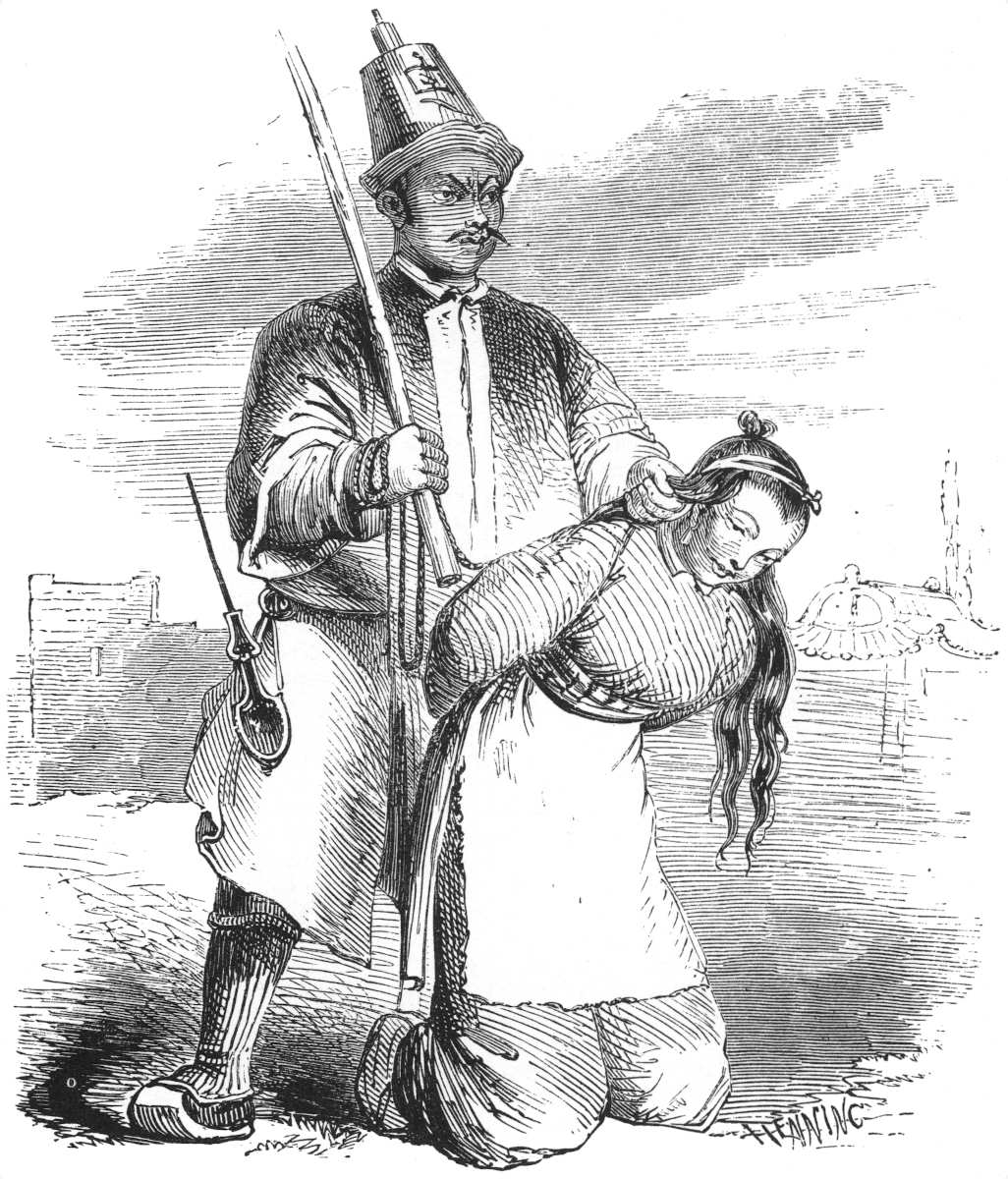
CHINESE WOMAN (Prostitute), ACCUSED OF DISORDERLY CONDUCT BEFORE A JUDGE.
[From Alexander’s “Illustrations of China.”]
Many of these brothel junks are called Flower Boats, and are resorted to by numbers of the class. They form, indeed, whole streets in the floating city on the Pearl River, which is one of the most remarkable features of Canton. The prostitutes themselves, like all women of the same sisterhood, lead a life of reckless extravagance—plunging while they can into all the exciting pleasures which are offered by their particular mode of life, careless of the future, and eagerly snatching at anything which may release them from the change of dulness or time for reflection. Diseases are very prevalent among them, and cause much havoc among the men who frequent their boats or houses. They endeavour to cure themselves by means of drugs and medicinal draughts, and by this means concentrate the malady upon some secret vital part, whence it shoots through the frame, but does not manifest itself until the victim is all but destroyed. With the exception of an unusual paleness and a heated appearance in the eyes, the prostitutes do not wear the aspect of disease; but they, indeed, paint themselves inordinately to mask the ravages of time or the maladies which afflict them.
The prostitutes of Canton are usually congregated in companies or troops, each of which is under the government of a man who is answerable for their conduct—if they rob, or disturb the peace, or commit any gross offence against decency, or perpetrate any other offence. National delicacy, however, has little to do with the prohibitions which restrain them from entering certain parts of the city, and forbid young men of rank and influence to hold intercourse with them. The brothel junks, of lofty build, brightly painted, and glittering with gaudy variegated flags, float in squadrons on the water, are seen and known by all, and are resorted to by numbers of the citizens. Persons pass to and from them without an attempt at disguise or concealment. Rich men, on festive occasions, make up a party of pleasure, embark in a gaily-decorated boat, send to one of the prostitute junks, engage as many of the women as they please, and spend the day in amusement with them. It is openly done, and no disgrace attaches to it. The junks themselves are fitted up in the interior—according to the class of prostitutes inhabiting them—with all the appurtenances of luxury, and on board them is a perpetual gala. It would be interesting to know how many of these boats are known to float on the Pearl River, with the average number of prostitutes in each.
But this is not the only, or the most offensive form which prostitution assumes in China. An incident which occurred at Shensee a few years ago illustrates another system, which is clandestine, though apparently carried on to a considerable extent. A young widow resided there with her mother-in-law, supporting herself and her companion by the wages of prostitution. At length her occupation failed her; she was deserted by her associates, and could procure no more rice or money by the pursuit of her vicious calling. The elder woman, however, would not hear of these excuses, ordered her daughter-in-law to obtain her usual supplies from the man she had last cohabited with, and on her declaring her inability, began to flog her. The prostitute defended herself, and at last, taking up a sickle, struck her relative dead. She was seized, tried, and condemned to be cut in pieces for the crime; but as her mother-in-law had been guilty of an illegal act in forcing her to prostitute herself, the sentence was changed to decapitation.
It is to be regretted that our sources of information on this subject are not more copious. Travellers have had opportunities of communicating more, but have refrained from doing so. We wait for a separate and full account of prostitution in China[75].
Of Prostitution in Japan.
Among the innumerable islands scattered over the southern and eastern oceans there are none more curious in their social aspects than Japan. We find there a kind of native civilization, influenced indeed by former intercourse with Europeans, but now complete within itself, and isolated from all other systems in the world. The mountainous, rocky, and arid country, has been fertilized from the centre to the sea by the persevering industry of a hardy race; they found it poor, and they have made it one of the richest agricultural regions in the globe. This fact serves to illustrate the national character.
The Japanese, upon whose institutions much light has been thrown by the learned and laborious researches of Mr. Thomas Rundall, of the Hakluyt Society, may be described as a punctilious, haughty, vindictive, and licentious people; but there is nothing vulgar in their composition. Truth is held in reverence, hospitality is viewed as sacred, and the bonds of friendship are regarded with extraordinary earnestness. St. Francis Xavier, the apostle of the Indies, declared “the Japans” to be the delight of his heart. There is, perhaps, more to admire than to love in their character. They are certainly elevated far above many of the nations who surround them, as well in the arts as in the amenities of life. Virtue is a recognised principle, and this indicates a phase of true civilization.
The character of the male is reflected by the female sex. Intelligent and agreeable in their manners, affectionate in their family relations, and faithful to their marriage vows, the women of Japan breathe all the pride of virtue. The man who attempts the honour of a matron sometimes encounters death in his adventure.
In illustration of this characteristic, Mr. Rundall relates an interesting anecdote. A noble, going on a journey, left his wife at home, and another man of rank made infamous proposals to her. Her scorn and indignation only inflamed him to his purpose, which he effected in spite of her denial. When her husband returned she received him with much reserve, and when he asked why, bade him wait until the morrow, when a grand feast was to be given. Among the guests was the noble who had wronged her. They sat down on the terraced roof of the house, and the festival began. After the repast the woman rose, declared the injury she had suffered, and passionately entreated to be slain, as a creature unfit to live. The guests, the husband foremost, besought her to be calm; they strove to impress her with the idea that she had done no wrong, that she was an innocent victim, though the author of the outrage merited no less punishment than death. She thanked them all kindly; she wept on her husband’s shoulder—she kissed him affectionately—then, suddenly escaping from his embraces, rushed precipitately to the edge of the terrace, and cast herself over the parapet. In the confusion that ensued, the author of the mischief, still unsuspected, for the hapless creature had not indicated the offender, made his way down the stairs. When the rest of the party arrived he was found weltering in his blood by the corse of his victim. He had expiated his crime by committing suicide in the national manner, by slashing himself across the abdomen with two slashes in the form of a cross.
The condition of women in Japan varies with different classes. Those of high rank have a separate suite of rooms assigned to them, beyond which they are seldom seen. Among the middle and lower orders they enjoy more liberty, though they are careful to seclude themselves, and are distinguished in general by extraordinary reserve. Men pay them a polite respect not common among semi-barbarians, as the Japanese will continue to be until they are forced to acknowledge the duty of intercourse with the rest of mankind.
The marriage laws of Japan are curious, and vary in different classes. Among the wealthy they are occasions of extravagant parade and long ceremonies, in which the minutest detail is regulated by a peremptory law. A full description of all the marriage ceremonial would fill a small volume. A man can only take one wife; he is united to her in the temple. In addition, however, he may take as many concubines as he chooses, who are not degraded by their position. He may separate from a woman when he pleases; but one who is known to have done so must pay a large sum for the daughter of any other person whom he may desire to have. Marriages are seldom contracted before the age of fifteen. The courtship and betrothal are conducted with much formality; but sufficient opportunity is allowed to the youth of the two sexes to become acquainted each with the other.
The Japanese are not so jealous as many other Asiatics: “Indeed,” says Captain Golovnin, “they are not more so than, considering the frailty of the sex, is reasonable.” Nevertheless, a man may put his wife to death for whispering to a stranger; while adultery is always capitally punished, sometimes by the hand of the injured husband.
In the northern parts, it is said, that in the beginning of the seventeenth century a curious custom prevailed. When a woman was convicted of infidelity, her head was shaved. Her paramour was exposed to an equally disgraceful, but more whimsical penalty. The friends of his victim, whenever they met him, might strip him naked, and deprive him of his property. But the modesty with which youth are inspired from the cradle tends much to protect female virtue. The intercourse of the sexes, it will thus be seen, is regulated by very natural laws; the condition of the sex is somewhat high. Its virtues are prized by the men, and consequently are generally faithfully preserved.
We have said, however, that the men of Japan are licentious; since, therefore, the wives and daughters of the respectable classes are difficult to corrupt, a numerous sisterhood of prostitutes is rendered necessary. Accordingly we find them from the earliest period associating with every rank of men. In one of William Adams’s letters, published under the editorship of Mr. Rundall, we find the king coming on board our countryman’s vessel, bringing with him a number of female comedians. These formed large companies, and travelled from place to place, with a great store of apparel for the several parts they played. They belonged to one man, who set a price upon their intercourse with others, above which he dared not charge under pain of death. It was left to his own discretion to set a value on a girl at first; but afterwards he could not raise, though he might abate his charge. All bargains were made with him, and the woman must go whither she was directed. Men of the highest rank, when travelling through the islands, and resting at houses of entertainment, sent, without shame, for companies of these prostitutes; but the pander was never received by them, however wealthy he might be; after death he was also consigned to infamy. Bridled with a rope of straw, he was dragged in the clothes he died in through the streets into the fields, and there cast upon a dunghill for dogs and fowls to devour.
In Kœmpfer’s account of the city of Nangasaki we find a curious description of the prostitute system. The part of the town inhabited by these women was called “the bawdy-house quarter,” and consisted of two streets, with the handsomest houses in Japan, situated on a rising hill. At these places the poor people of the town sold their handsome daughters while very young, that is, from ten to twenty years of age. Every bawd kept as many as she was able in one house; some had seven, others 30, who were commodiously lodged, taught to dance, sing, play on musical instruments, and write letters. The elder ones taught the younger, who in return waited on them; the most docile and accomplished were most sumptuously treated. The price of these women was regulated by law; and one wretched creature, having passed through all the degrees of degradation, occupied a small room near the door, where she acted as watch all night, and sold herself for a miserable coin. Others were set to this task as a punishment for ill behaviour. The infamy of this vile profession attached justly, not so much to the unhappy women themselves, as to their parents who educated them to it. Many, as they grew up, changed their mode of life, and were received again among the reputable and chaste. Generally well educated and politely bred, they often procured husbands, and passed from a life of daily prostitution to one of unswerving fidelity. The pander and the tanner of leather occupied the same position in society; which shows that the prejudice of class, rather than the abhorrence of an infamous calling, ruled the Japanese.
The historian classes the temples and brothels together, and not without justice. Prostitution was greatly encouraged by the priests. In their public spectacles, representing the adventures of gods and goddesses, young prostitutes, richly attired, were engaged to act. Their performances resembled those of the European ballet—dress, gesture, and action expressing that which in a drama language would represent.
Such was the prostitute system in the great cities; throughout the country a similar system prevailed. The houses of entertainment lining the main highways, with the tea-booths of the villages, were frequented by innumerable girls. These usually spent the morning in painting and dressing themselves, and about noon made their appearance standing before the door of the house, or sitting on benches, whence, with smiling face and coy address, they solicited the passengers. In some places their chattering and laughter were heard above all other sounds; two villages, called Akasaki and Goy, were celebrated on this account, all the houses being brothels, each containing from three to seven prostitutes. The Japanese seldom passed one of these “great storehouses of whores” without holding intercourse with some of these women. Kœmpfer asserts, in contradiction to Caras, who married a native, that there was in his time scarcely one house of entertainment in the islands which was not a brothel. When one inn had too many customers, it borrowed some girls from a neighbour who had some to spare. This profligate system is said, in the Japanese traditions, to have taken its rise at a remote period, during the reign of a certain martial emperor. That monarch, who was perpetually marching his armies to and fro, feared lest his soldiers should become weary of separation from their wives; he therefore licensed public and private brothels, which multiplied to such an extent that Japan came to be known as “the bawdy-house of China.” This was in allusion to a period when prostitution was made in that empire an unlawful calling, and suppressed by severe laws. The people, deprived of the resources they had formerly enjoyed at home, made Japan the place of resort; so that its prostitution system flourished far and wide.
These accounts appear extravagant, and doubtless are so in some degree; all writers, however, coincide in describing the prostitution system of Japan as very extensive and flagitious. The French historian, Charleroix, repeats the statement of Kœmpfer. We have before us extracts from the autograph “diary of occurrants” written by Captain Richard Cock, who was chief of the English factory at Firando, from the year 1613 to 1623. There are many passages corroborative of the representations we have given. Of these some examples follow, which are also interesting as illustrations of Japanese manners.
“A.D. 1616, Sept. 8th (at Edo).—We dyned or rather supped at a merchant’s house called Neyem Dono, where he provided caboques, or women players, who danced and sung; and when we returned home he sent every of them to lie with them that would have them all night.
“October 24 (at Yuenda, between Edo and Firando.)—We went to bed, and paid 3500 gins; and to the servants, 300 gins; and to the children, 200 gins, or about 200l. This extraordinary charge was for that we had extraordinary good cheer, being brought hither by a merchant of Edo, our friend, called Neyemon Edo, and every one a wench sent to him that would have her. I gave one of them an ichebo, but would not have her company.
“1617-18, January 27th (at Firando).—Skiezazon Dono set the masts of his junk this day, and made a feast in Japan fashion. 29th. Skiezazon Dono and his consorts had the feast of Baccus for their junk this day, dancing through the streets with caboques or women players, and entered into an English house in that order, most of their heads being heavier than their heels, that they could not find their way home without leading.
“March 29th (at Firando).—The kyng and the rest of the noblemen came to dyner (at the English house), and, as they said, were entertained to their own content, and had the dancing beares or caboques to fill their wine; Nifon Catanges, with a blind fiddler to sing, ditto.
“July 11th.—There came a company of players, or caboques, with apes and babons, sent from the tono, or king, to play at our house.
“December 6th (at Meaco).—Our host, Meaco’s brother-in-law, invited us to dyner to a place of pleasure without the city, where the dancing girls or caboques were with a great feast; and there came an antick dance of satyrs or wild men of other Japons, until whom I gave 1000 gins (about 10s.), and a bar of plate to the good man of the house, value about 1l. 1s. 6d. So the dancing girls were sent home after us.”
As not altogether inapplicable to the subject, the following passage, which shows how the courtezans of Japan proceed towards such as would cheat them, may be cited: “The caboques took Tane, an interpreter, prisoner, for fifteen tares (about 3l. 15s.) he owed them for lichery, and, not having to pay, set his body for sale, no one having the money for him.”
It would appear that in obtaining possession of a female of this class by clandestine means tragical consequences may ensue; while, if done fairly, considerable expense may be involved. Mr. Wickham, one of the English factors stationed at Mesco, writing on the 15th of April, 1616, to his chief, Captain Cock, gives an account of a soldier of high reputation who ran away with a prostitute, and, fearing she would be reclaimed, was seized with a fit of frenzy, during which he first cut the throat of the girl, and afterwards ripped himself up. The writer then communicates a piece of news:—“Micaonæcamo, the nobellman that gave me my cattan or sword, hath carried away a caboque, and hath payed her master 10,000 tares (2500l.). I would I had the money, and it makes no matter who hath the woman.” Replying to this communication, Captain Cock quaintly observes on one point, “Yf some will be so foolish as to cut their bellies for love (or rather lust) of whores, the worst end of the staff will be their owne;” and on the other point he agrees with his correspondent that he “had rather have the money than the ware.”
Vice of a more brutal kind is systematically practised by many of the Japanese nobility, as well as by the meanest orders; and houses are kept for this purpose similar to those inhabited by prostitutes.
Some parents apprentice out their daughters for a term of years to this abominable profession, and the girls then return to honourable life. The houses they frequent continually resound with music. At Jeddo, a later traveller was informed there was one brothel, or rather temple of prostitution, where 600 women were maintained. Notwithstanding this number, young men were nightly refused admittance, from the over-crowded state of the rooms. Passing through the streets of the brothel quarter Golovnin saw groups of girls standing about the doors; some of them were in the bloom of youth, and so handsome that they appeared fascinating even to the European eye.
Thus the system of professional prostitution flourishes more in Japan than in any other part of insular Asia; yet the women of other classes appear to hold a higher position, and to enjoy more respect from the men. It is remarked, however, by all writers, that the profligacy of the female sex is confined to those who are so by profession; but the male is generally licentious throughout the empire.
Of Prostitution in the Ultra-Gangetic Nations.
In this division we include what are commonly called the Hindu-Chinese nations, or the inhabitants of that immense tract lying between Hindustan and China. Geography makes several sections of them, and they present, it is true, some variety in laws, customs, and degrees of progress. But these are not more distinct than may be observed in every large country, whether called by one name or many. The same physical type is marked upon them all; and, speaking in general terms, their manners are uniform.
In one respect they are all similar. The condition of women is extremely low. A curious phenomenon is observable in relation to this subject. The Buddhists of the ultra-Gangetic countries, uninfluenced by the jealous spirit of the Hindu and Mohammedan codes, allow to the female sex great liberty; yet assign it less respect than it enjoys either in Hindustan or China, to both of which they are inferior in civilization. The freedom thus conceded to women fails to elevate them. They are held in contempt, they are taught to abase themselves in their own minds, and they employ their licence in degrading themselves still further. In few parts of the world is the effect of Asiatic despotism more plainly visible than in the countries lying between Hindustan and China. The peculiar system of government renders every one the king’s serf. The men labour for the benefit of their master, having no opportunity to profit themselves by their own industry. Their support, therefore, naturally devolves on the women, who in Cochin China especially, plough, sow, reap, fell wood, build, and perform all the offices which civilization assigns to the abler sex.
The marriage contract is a mere bargain. A man buys his wife from her parents. The first is usually the chief, but he may have as many others as he chooses to purchase. A simple agreement before witnesses seals the union. The band thus easily formed is as easily dissolved. In Cochin China a pair of chopsticks or a porcupine quill is broken in two before a third person, and the divorce is complete. When only one desires a separation it is more difficult, but the law allows a man to sell his inferior wives.
The unmarried women of this region are proverbially and almost universally unchaste. They may prostitute themselves without incurring infamy or losing the chance of marriage. A father may yield his daughter to a visitor whom he desires specially to honour, or he may hire her out for a period to a stranger who may reside for a short time in his neighbourhood. The girl has no power to resist the consummation of this transaction, though she cannot be married without her own consent.
The wife, however, is considered sacred, but rather as the property of her husband than for the sake of virtue. A man’s harem cannot be invaded, even by the king himself. This, at least, is the theory of the law; but absolutism never respects the high principles of a code which opposes its desires. Adultery is punished in Siam with a fine, in Cochin China with death. In Birmah, executions are very rare among females. “The sword,” they say, “was not made for women.” In all parts of the region, however, the bamboo is in requisition to discipline the women; and husbands are sometimes seen to fling their wives down in the open street, lay them on their faces, and flog them with a rattan.
It will thus be seen that, lying between two regions, in each of which a form of civilization has been introduced, the ultra-Gangetic, or Hindu-Chinese nations, differ from them both. Since no unmarried woman is required to be chaste, professional prostitutes do not form so large a class as might be expected. They do exist, however, and in considerable numbers. In Siam a common prostitute is incapable of giving evidence before a country justice, but this is by no means on account of her immorality. It is from other prejudices. The same disability attaches to braziers and blacksmiths[76].
Of Prostitution in Egypt.
Egypt, as the seat of a civilization among the most ancient and remarkable that have flourished on the earth, calls for particular attention. The inquiries of the curious have in all ages been directed as well to its people as to its monuments. It has, indeed, been the subject of infinite investigation. Travellers innumerable have explored its beautiful valley; year after year adds to their number and countless reports have been made to us of the ruins, the antiquities, the resources, the condition, the scenery, and the manners of Egypt. In all, consequently, except statistics, our knowledge is very considerable, though the inexhaustible interest of that celebrated country still leaves an open field for the romantic traveller. The dry hot climate is supposed to influence the character of the people. A remarkable system of politics also modifies the national features, so that we examine our subject, in reference to Egypt, with peculiar curiosity.
The population of Egypt is various, being composed of the four Mohammedan sects, of the Copts, the Greeks, the Armenians, Maronites, and Levantines. The mass, however, is formed of Arabs, while the general plan of manners has originated, in a great measure, from the spirit of the prophets’ civil and religious code. Of the system with respect to the female sex this is more especially true; but the history of manners before Mohammed’s age is too incomplete for us to know precisely how much was originated, and how much was adopted by him. Had his scheme opposed itself wholly to the previous habits of the East, it would never have been so universally or so readily accepted. It is one characteristic of Asiatic countries that women exercise less influence on manners than in Europe. The laws made by men would, in fact, isolate them within a sphere of their own; but agencies which are irresistible counteract this effort. The tendency of social legislation is to shut them out from a share in the government of society; but the tendency of nature is in the contrary direction.
The women of Egypt are naturally adapted for the position in which they are placed—unless we suppose that long discipline has subdued them to the level of their condition. They display every attraction for Mohammedans, with few of the characteristics which fascinate an European. In youth many of them are possessed of every charm—the bosom richly developed, the whole form gracefully rounded, the face full of bloom, and the eyes overflowing with brilliance; but all these beauties speedily fade, and nowhere is old age so unsightly. The figure approaches maturity at the ninth or tenth year, and at fifteen or sixteen has reached the perfection of the Oriental ideal. With rare exceptions they have passed the flower of their lives at 24, and in this short-lived loveliness we may find one cause of polygamy and frequent divorce, among a people with whom women are the mere unspiritual ministers to the senses of man. The Mohammedan peoples even his heaven with feminine creations destined for his animal gratification. When, therefore, we find religion itself thus impregnated with a gross element, we can only expect to find the female sex regarded in a degrading point of view. The opinion prevails with some Muslims, that Paradise has no place reserved for women; but this is by no means the universal idea among them.
Though by their tame spirits and submissive humility the women of Egypt appear moulded to suit the system in which they move, their character has not, on the whole, been entirely vitiated by the process. Modesty and virtue are frequent ornaments of the harem, and distinguish the sex throughout the valley. Even among the lower or labouring orders, though the maidens may sometimes be seen bathing in the Nile, or hurrying from hovel to hovel naked, and at all times with a light and scanty garment, a demure and retiring demeanour is general. Chastity is a very prevalent virtue, except in the cities, where a crowded population is immersed in that profligacy surely bred by despotism. With respect to their modesty, travellers appear to have been led astray by their prejudices. Many of them appear to carry among the necessaries for their journey an English measure of propriety, which they invariably apply to all nations with which they come in contact. Thus the remark is commonly made, that women in Egypt hide their faces in obedience to habit, but care not what other part of the person they expose. Consequently, it is inferred they are devoid of modesty. But this by no means follows. Custom, which is one of the most powerful among the laws which regulate society, has taught them that to display the features is disgraceful, but has made no regulation for more than that. Unless, therefore, we accept the doctrine of innate ideas—which meets a refutation in every quarter of the globe—we must not cite the women of Egypt before the tribunal of our own opinions, and condemn them on that charge. On the contrary, we must confess that they are naturally a virtuous race, though the influences of their government are sufficiently injurious. Any, indeed, but an excellent people would long ago have been irredeemably depraved.
There are, in Egypt, only two classes of females—those whose opulence allows them to be wholly indolent, and whose life is entirely dreamed away in the luxury of the harem; and those to whom poverty gives freedom, with the obligation of labour. To see the wife of a bey, to examine her tastes, her conduct, her private pleasures, and daily occupations, you have the beau ideal of a voluptuous woman literally cradled in one long childhood, with all the ease, the indulgence, and the trifling of infancy. Enter the habitation of a fellah or artizan, and the hardship of the man’s lot is exceeded by that of his wife. She has to do all that he can do; but if he be personally kind, her situation is morally superior to that of the petted toy nursed on the cushions of the harem. The same weakness, however, is paramount over both. The indolent lady satisfies herself with rich Eastern silks and shawls, and gems of fine water; while the poor drudge of the field adds to her toil, and stints herself in food, to purchase decorations for her person.
The polygamy which is practised in Egypt has, more than in many other countries, tended to the degradation of the female sex. It seems to be encouraged in some degree by the rigid separation of the sexes before marriage. A man takes with less scruple a wife whom he has never seen when he knows that if she disappoint him he may take another. The law allows four wives, with an unrestricted number of concubines. The Prophet, his companions, and the most devout of his descendants, so indulged themselves; but the idea is vulgar which supposes that Mohammed introduced the practice. On the contrary, he found it universal, and was the first to put a check upon it. Some of the higher moralists contend, that as four wives are sufficient for one man, so are four concubines; but few of the rich men who can afford to keep more allow themselves to be influenced by this opinion.
The Muslim lawgiver was wiser than the priestly legislators of India; for he insulted nature with less peremptory prohibitions against the union of sects. A Mohammedan may marry a Jewish or a Christian woman, when he feels excessive love for her, or cannot procure a wife of the true faith; but she does not inherit his property or impart her religion to her offspring. The children of a Jewish woman, if they are not educated to the Mohammedan, must embrace the Christian creed, which is considered better than their own. In this we find a privilege reserved by the male sex to itself, for a woman of the Prophet’s faith dare not marry an infidel, unless compelled so to do by actual force. This has given rise to many apostasies, which form the subject of numerous romances.
The degrees of consanguinity within which marriage is prohibited are strictly marked. A man may not marry his mother or any other relative in a direct ascending line; his daughter or any descendant; his sister, or half-sister; his aunt, his niece, or his foster-mother. The Hanafee code enacts that a man shall not take as his wife any woman from whose breast he has received a single drop of milk; but E. Shafæee allows it unless he has been suckled by her five times within the course of the first two years. Nature, in this respect, is the principal guardian of the law, for as women in Egypt age very quickly, the men endeavour to obtain more youthful brides. A man may not marry the mother, or daughter of his wife, or his father’s or his son’s wife; his wives must not be sisters, or his own unemancipated slaves—if he already have a free wife. Those women whom the Muslim is forbidden to marry it is lawful for him to see, but no others except his own wives or female servants.
The marriage engagement is merely a civil transaction. The man and woman having declared in the presence of two witnesses their mutual willingness, and part of the dowry being paid, their union is legal. The bride usually signifies her consent through a deputy. If, however, she be under the age of puberty, her assent is not necessary, and she is in the hands of her friends. A boy may also be thus disposed of; but he may divorce his wife if he be not contented with her. Usually, if rich, he neglects the first, and takes a second by way of solace after his disappointment.
In one feature of its manners, modern Egypt resembles the States of ancient Greece. The character of a bachelor is ridiculous, if not disreputable. As soon as a youth has attained a proper age, with sufficient means, his friends advise him to marry. His mother, or a professional match-maker, is usually left to choose the bride. When a girl has been fixed upon with his approval, some one goes to her father to effect an arrangement. The price is fixed, with the amount of dowry, and the future ceremonials depend on the resources of the two families. Sometimes a profusion of rites is insisted upon; sometimes the simplest agreement is all that is required, for the law exacts nothing but the plain convention we have before described. The giving of a dowry is, however, indispensable. With all who can afford it, also, the sanction of religion and the witness of the law add solemnity to the occasion. The rich choose it as an opportunity to display the pride of wealth, and the poor to indulge in a little show, with that idleness which is so essential to the happiness of most Asiatics.
The condition of wives in Egypt has been much misrepresented by some popular writers, to whom the imprisonment and slavery of women offer a fertile theme for declamation. The word harem, or harim, indeed, meaning sacred or prohibited, applies to the women as well as to the apartments in which they dwell; but considerable liberty is allowed them. Those of the upper classes are secluded, and go veiled in the streets. They are seldom seen on foot in public, and their costume is indicative of this detail in their manners. Though, however, they have a suite of apartments assigned to them, they are not prisoners. A few Turks, jealous to exaggeration, may immure the inmates of the harem, and shut them altogether from contact with the world; but, generally, they are allowed to go out, pay visits, and control the household. The theory of the Muslims is more rigid than their practice, which, were it consistent in all its features, would swathe the female sex with convention, as the ancient inhabitants used to swathe their mummies—until the form of humanity is lost amid the very devices which seek to preserve it. To such an extravagant height do some of them carry their ideas of the sanctity of the female sex, that their tombs are closed against strangers, while others will not permit a man and a woman to be buried in the same grave. Generally, however, husbands do not object to their wives mingling with the public throng so as they religiously veil their faces. The lower orders are, of course, the least restrained. Those of the wealthiest and proudest men are most strictly secluded; but the interchange of visits between the harems is constant. With this degree of freedom the Egyptian women are content. Time has trained them to their situation, until a relaxation in their discipline is viewed less as an indulgence than a right. The wife who is allowed too much liberty imagines she is neglected, and, if others are more narrowly watched, is jealous of the superior solicitude bestowed on them. Among the rich the harem supplies all the delights of life. Rose-water, perfumes, sherbet, coffee, and sweatmeats, constitute the supreme joys of existence, with precious silks, muslins, and jewels. Among the poor, though reduced to beasts of burden, their buoyant hearts are not depressed under the load, and they sing from infancy to old age. Nevertheless their lives are full of misery, but it is the misery of a class, not only of one sex.