OF PROSTITUTION IN CIVILIZED STATES. (continued 3)
Reading edition
Men frequent the houses in which women board and lodge for many reasons, the chief of which is secrecy; they also feel sure that the women are free from disease, if they know the house, and it bears an average reputation for being well conducted. Men in a certain position avoid publicity in their amours beyond all things, and dread being seen in the neighbourhood of the Haymarket or the Burlington Arcade at certain hours, as their professional reputation might be compromised. Many serious, demure people conceal the iniquities of their private lives in this way.
If Asmodeus were loquacious, how interesting and anecdotical a scandal-monger he might become!
Another woman told me a story, varying somewhat from that of the first I examined, which subsequent experience has shown me is slightly stereotyped. She was the victim of deliberate cold-blooded seduction; in course of time a child was born; up to this time her seducer had treated her with affection and kindness, but he now, after presenting her with fifty pounds, deserted her. Thrown on her own resources, as it were, she did not know what to do; she could not return to her friends, so she went into lodgings at a very small rental, and there lived until her money was expended. She then supported herself and her child by doing machine-work for a manufacturer, but at last bad times came, and she was thrown out of work; of course the usual amount of misery consequent on such a catastrophe ensued. She saw her child dying by inches before her face, and this girl, with tears in her eyes, assured me she thanked God for it. “I swear,” she added, “I starved myself to nourish it, until I was nothing but skin and bone, and little enough of that; I knew from the first, the child must die, if things didn’t improve, and I felt they wouldn’t. When I looked at my little darling I knew well enough he was doomed, but he was not destined to drag on a weary existence as I was, and I was glad of it. It may seem strange to you, but while my boy lived, I couldn’t go into the streets to save his life or my own—I couldn’t do it. If there had been a foundling-hospital, I mean as I hear there is in foreign parts, I would have placed him there, and worked somehow, but there wasn’t, and a crying shame it is too. Well, he died at last, and it was all over. I was half mad and three parts drunk after the parish burying, and I went into the streets at last; I rose in the world—(here she smiled sarcastically)—and I’ve lived in this house for years, but I swear to God I haven’t had a moment’s happiness since the child died, except when I’ve been dead drunk or maudlin.”
Although this woman did not look upon the death of her child as a crime committed by herself, it was in reality none the less her doing; she shunned the workhouse, which might have done something for her, and saved the life, at all events, of her child; but the repugnance evinced by every woman who has any proper feeling for a life in a workhouse or a hospital, can hardly be imagined by those who think that, because people are poor, they must lose all feeling, all delicacy, all prejudice, and all shame.
Her remarks about a foundling-hospital are sensible; in the opinion of many it is a want that ought to be supplied. Infanticide is a crime much on the increase, and what mother would kill her offspring if she could provide for it in any way?
The analysis of the return of the coroners’ inquests held in London, for the five years ending in 1860, shows a total of 1130 inquisitions on the bodies of children under two years of age, all of whom had been murdered. The average is 226 yearly.
Here we have 226 children killed yearly by their parents: this either shows that our institutions are defective, or that great depravity is inherent amongst Englishwomen. The former hypothesis is much more likely than the latter, which we are by no means prepared to indorse. This return, let it be understood, does not, indeed cannot, include the immense number of embryo children who are made away with by drugs and other devices, all of whom we have a right to suppose would have seen the light if adequate provision could have been found for them at their birth.
A return has also been presented to Parliament, at the instance of Mr. Kendal, M.P., from which we find that 157,485 summonses in bastardy cases were issued between the years 1845 and 1859 inclusive, but that only 124,218 applications against the putative fathers came on for hearing, while of this number orders for maintenance were only made in 107,776 cases, the remaining summonses, amounting to 15,981, being dismissed. This latter fact gives a yearly average of 1,141 illegitimate children thrown back on their wretched mothers. These statistics are sufficiently appalling, but there is reason to fear that they only give an approximate idea of the illegitimate infantile population, and more especially of the extent to which infanticide prevails.
Those who live in Low Lodging Houses.
In order to find these houses it is necessary to journey eastwards, and leave the artificial glitter of the West-end, where vice is pampered and caressed. Whitechapel, Wapping, Ratcliff Highway, and analogous districts, are prolific in the production of these infamies. St. George’s-in-the-East abounds with them, kept, for the most part, by disreputable Jews, and if a man is unfortunate enough to fall into their clutches he is sure to become the spoil of Israel. We may, however, find many low lodging-houses without penetrating so far into the labyrinth of east London. There are numbers in Lambeth; in the Waterloo Road and contiguous streets; in small streets between Covent Garden and the Strand, some in one or two streets running out of Oxford Street. There is a class of women technically known as “bunters,” who take lodgings, and after staying some time run away without paying their rent. These victimise the keepers of low lodging-houses successfully for years. A “bunter,” whose favourite promenade, especially on Sundays, was the New Cut, Lambeth, said “she never paid any rent, hadn’t done it for years, and never meant to. They was mostly Christ-killers, and chousing a Jew was no sin; leastways, none as she cared about committing. She boasted of it: had been known about town this ever so long as Swindling Sal. And there was another, a great pal of her’n, as went by the name of Chousing Bett. Didn’t they know her in time? Lord bless me, she was up to as many dodges as there was men in the moon. She changed places, she never stuck to one long; she never had no things for to be sold up, and, as she was handy with her mauleys, she got on pretty well. It took a considerable big man, she could tell me, to kick her out of a house, and then when he done it she always give him something for himself, by way of remembering her. Oh! they had a sweet recollection of her, some on ’em. She’d crippled lots of the —— crucifiers.” “Did she never get into a row?” “Lots on ’em, she believed me. Been quodded no end of times. She knew every beak as sot on the cheer as well as she knew Joe the magsman, who, she might say, wor a very perticaler friend of her’n.” “Did he pay her well?”
This was merely a question to ascertain the amount of remuneration that she, and others like her, were in the habit of receiving; but it had the effect of enraging her to a great extent. My informant was a tall, stout woman, about seven-and-twenty, with a round face, fat cheeks, a rather wheezy voice, and not altogether destitute of good looks. Her arms were thick and muscular, while she stood well on her legs, and altogether appeared as if she would be a formidable opponent in a street-quarrel or an Irish row.
“Did he pay well? Was I a-going to insult her? What was I asking her sich a ’eap of questions for? Why, Joe was good for a —— sight more than she thought I was!—“polite.” Then she was sorry for it, never meant to be. Joe worn’t a five-bobber, much less a bilker, as she’d take her dying oath I was.” “Would she take a drop of summut?” “Well, she didn’t mind if she did.”
An adjournment to a public-house in the immediate vicinity, where “Swindling Sal” appeared very much at home, mollified and appeased her.
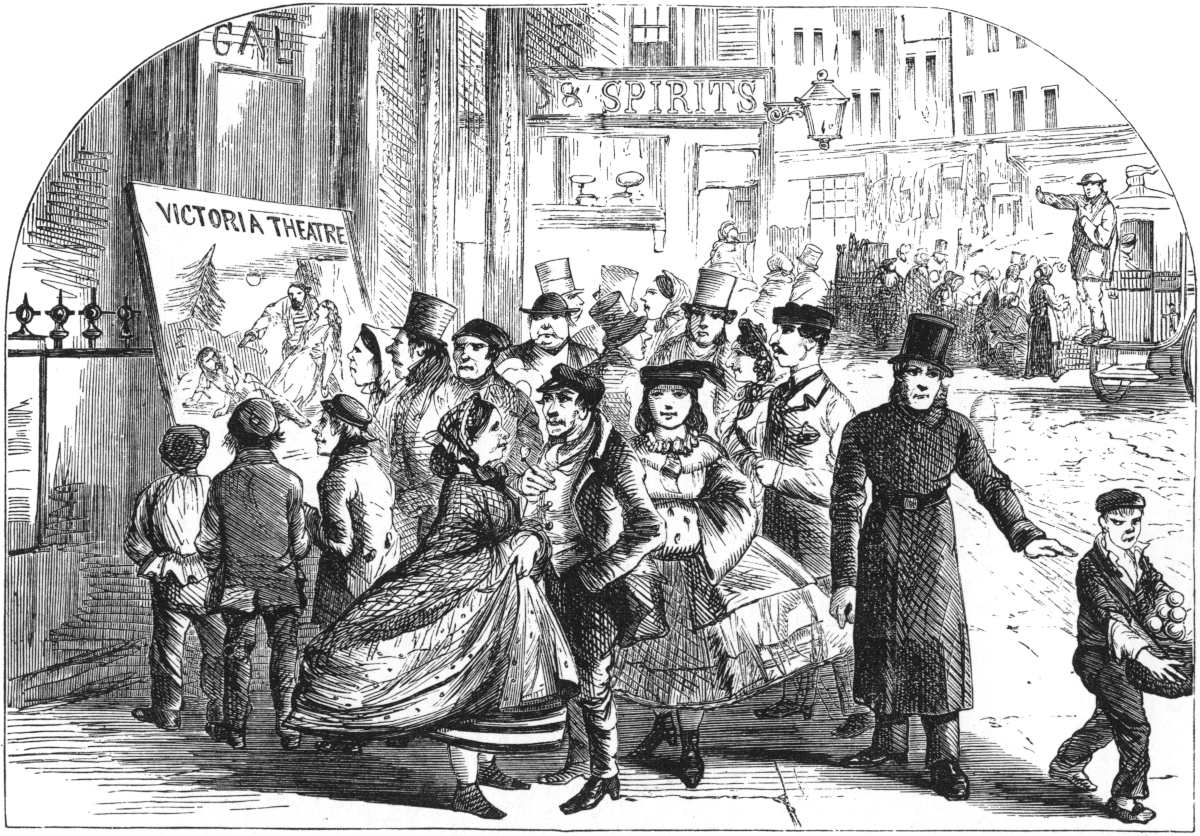
THE NEW CUT.—EVENING.
The “drop of summut short, miss,” was responded to by the young lady behind the bar by a monosyllabic query, “Neat?” The reply being in the affirmative, a glass of gin was placed upon the marble counter, and rapidly swallowed, while a second, and a third followed in quick succession, much, apparently, to the envy of a woman in the same compartment, who, my informant told me in a whisper, was “Lushing Lucy,” and a stunner—whatever the latter appellation might be worth. But the added “Me an’ ’er ’ad a rumpus,” was sufficient to explain the fact of their not speaking.
“What do you think you make a week?” at last I ventured to ask.
“Well, I’ll tell yer,” was the response: “one week with another I makes nearer on four pounds nor three—sometimes five. I ’ave done eight and ten. Now Joe, as you ’eered me speak on, he does it ’ansome, he does: I mean, you know, when he’s in luck. He give me a fiver once after cracking a crib, and a nice spree me an’ Lushing Loo ’ad over it. Sometimes I get three shillings, half-a-crown, five shillings, or ten occasionally, accordin’ to the sort of man. What is this Joe as I talks about? Well, I likes your cheek, howsomever, he’s a ’ousebreaker. I don’t do anything in that way, never did, and shant; it aint safe, it aint. How did I come to take to this sort of life? It’s easy to tell. I was a servant gal away down in Birmingham. I got tired of workin’ and slavin’ to make a livin’, and getting a —— bad one at that; what o’ five pun’ a year and yer grub, I’d sooner starve, I would. After a bit I went to Coventry, cut Brummagem, as we calls it in those parts, and took up with the soldiers as was quartered there. I soon got tired of them. Soldiers is good—soldiers is—to walk with and that, but they don’t pay; cos why, they aint got no money; so I says to myself, I’ll go to Lunnon, and I did. I soon found my level there. It is a queer sort of life, the life I’m leading, and now I think I’ll be off. Good night to yer. I hope we’ll know more of one another when we two meets again.”
When she was gone I turned my attention to the woman I have before alluded to. “Lushing Loo” was a name uneuphemistic, and calculated to prejudice the hearer against the possessor. I had only glanced at her before, and a careful scrutiny surprised me, while it impressed me in her favour. She was lady-like in appearance, although haggard. She was not dressed in flaring colours and meretricious tawdry. Her clothes were neat, and evidenced taste in their selection, although they were cheap. I spoke to her; she looked up without giving me an answer, appearing much dejected. Guessing the cause, which was that she had been very drunk the night before, and had come to the public-house to get something more, but had been unable to obtain credit, I offered her half-a-crown, and told her to get what she liked with it. A new light came into her eyes; she thanked me, and, calling the barmaid, gave her orders, with a smile of triumph. Her taste was sufficiently aristocratic to prefer pale brandy to the usual beverage dispensed in gin-palaces. A “drain of pale,” as she termed it, invigorated her. Glass after glass was ordered, till she had spent all the money I gave her. By this time she was perfectly drunk, and I had been powerless to stop her. Pressing her hand to her forehead, she exclaimed, “Oh, my poor head!” I asked what was the matter with her, and for the first time she condescended, or felt in the humour to speak to me. “My heart’s broken,” she said. “It has been broken since the twenty-first of May. I wish I was dead; I wish I was laid in my coffin. It won’t be long first. I am doing it. I’ve just driven another nail in, and ‘Lushing Loo,’ as they call me, will be no loss to society. Cheer up; let’s have a song. Why don’t you sing?” she cried, her mood having changed, as is frequently the case with habitual drunkards, and a symptom that often precedes delirium tremens. “Sing, I tell you,” and she began,
The first I met a cornet was In a regiment of dragoons, I gave him what he didn’t like, And stole his silver spoons.
When she had finished her song, the first verse of which is all I can remember, she subsided into comparative tranquillity. I asked her to tell me her history.
“Oh, I’m a seduced milliner,” she said, rather impatiently; “anything you like.”
It required some inducement on my part to make her speak, and overcome the repugnance she seemed to feel at saying any thing about herself.
She was the daughter of respectable parents, and at an early age had imbibed a fondness for a cousin in the army, which in the end caused her ruin. She had gone on from bad to worse after his desertion, and at last found herself among the number of low transpontine women. I asked her why she did not enter a refuge, it might save her life.
“I don’t wish to live,” she replied. “I shall soon get D. T., and then I’ll kill myself in a fit of madness.”
Nevertheless I gave her the address of the secretary of the Midnight Meeting Association, Red Lion Square, and was going away when a young Frenchmen entered the bar, shouting a French song, beginning
Vive l’amour, le vin, et le tabac,
and I left him in conversation with the girl, whose partiality for the brandy bottle had gained her the suggestive name I have mentioned above.
The people who keep the low lodging-houses where these women live, are rapacious, mean, and often dishonest. They charge enormously for their rooms in order to guarantee themselves against loss in the event of their harbouring a “bunter” by mistake, so that the money paid by their honest lodgers covers the default made by those who are fraudulent.
Dr. Ryan, in his book on prostitution, puts the following extraordinary passage, whilst writing about low houses:—
“An enlightened medical gentleman assured me that near what is called the Fleet Ditch almost every house is the lowest and most infamous brothel. There is an aqueduct of large dimensions, into which murdered bodies are precipitated by bullies and discharged at a considerable distance into the Thames, without the slightest chance of recovery.”
Mr. Richelot quotes this with the greatest gravity, and adduces it as a proof of the immorality and crime that are prevalent to such an awful extent in London. What a pity the enlightened medical gentleman did not affix his name to this statement as a guarantee of its authenticity!
When speaking of low street-walkers, the same author says:—
“These truly unfortunate creatures are closely watched whilst walking the streets, so that it is impossible for them to escape, and if they attempt it, the spy, often a female child, hired for the purpose, or a bully, or procuress, charges the fugitive with felony, as escaping with the clothes of the brothel-keeper, when the police officer on duty immediately arrests the delinquent, and takes her to the station-house of his division, but more commonly gives her up to the brothel-keeper, who rewards him. This inhuman and infamous practice is of nightly occurrence in this metropolis. When the forlorn, unfortunate wretch returns to her infamous abode, she is maltreated and kept nearly naked during the day, so that she cannot attempt to run away. She is often half starved, and at night sent again into the streets as often as she is disengaged, while all the money she receives goes to her keeper whether male or female. This is not an exaggerated picture, but a fact attested by myself. I have known a girl, aged fifteen years, who in one night knew twelve men, and produced to her keeper as many pounds.”
“Paucis horis, hæ puellæ sex vel septem hominibus congruunt, lavant et bibunt post singulum alcoholis paululum (vulgo brandy vel gin) et dein paratæ sunt aliis.”
With what a vivid imagination the writer of these striking paragraphs must have been gifted. The Arabian Nights and the Tales of the Genii that are so charmingly improbable, are really matter of fact in comparison. If we multiply 12 by 365, what is the result? We never took such interest in arithmetic before: 12 × 365 = 4380. This total of course represents pounds; why, it is nearly equal to the salary of a puisne judge! But perhaps the young lady whose interesting age is fifteen, is not so fortunate every night. Let us reduce it by one half; 4380 ÷ 2 = 2190. Two thousand one hundred and ninety pounds per annum is a very handsome income; and after such a calculation, can we wonder that a meretricious career is alluring and attractive to certain members of the fair sex, especially when “hæ puellæ” make it “paucis horis?” So lucrative a speculation cannot be included in the category of those who are “kept nearly naked during the day, and often half starved.” We suggest this on our own responsibility, for we have not been an “eye-witness” of such precocious profligacy; but we make the suggestion because it is something like nigger-keeping in the Southern States of America. A full-grown, hearty negro is a flesh and blood equivalent for a thousand or two thousand dollars. If he were “larruped” and bullied, he would perhaps die, or at any rate not work so well, and a loss to his owner would ensue that Pompey’s massa would not be slow to discover. By parity of reasoning the white slave of England must also be treated well, or it naturally follows that she will not be so productive, and the 12l. received from as many men in a few hours, may dwindle to as many shillings, gleaned with difficulty in a great number of hours.
Dr. Michael Ryan evidently possesses an extensive acquaintance among remarkable men. Let us examine the statement of “my informant, a truly moral character, a respectable citizen, the father of a family,” who gives the following account of bullies:—
“Two acquaintances of his, men of the world” (we submit with all humility that truly moral characters, respectable citizens, and fathers of families ought to be more select in their acquaintance, for birds of a feather, &c.), “were entrapped in one of the Parks by two apparently virtuous females, about twenty years of age, who were driving in a pony phaeton, to accompany them home to a most notoriously infamous square in this metropolis. All was folly and debauchery till the next morning. But when the visitors were about to depart, they were sternly informed they must pay more money. They replied they had no more, but would call again, when their vicious companions yelled vociferously. Two desperate-looking villains, accompanied by a large mastiff, now entered the apartment and threatened to murder the delinquents if they did not immediately pay more money. A frightful fight ensued. The mastiff seized one of the assaulted by the thigh, and tore out a considerable portion of the flesh. The bullies were, however, finally laid prostrate: the assailed forced their way into the street through the drawing-room windows; a crowd speedily assembled, and on learning the nature of the murderous assault, the mob attacked the house and nearly demolished it before the police arrived” (where were the police?). “The injured parties effected their escape during the commotion.”
What a surprising adventure! Haroun Alraschid would have had it written in letters of gold. The man of the world, who had a considerable portion of the flesh torn out of his leg by the terrible mastiff, must have been the model of an athlete to effect his escape and punish his bully after such a catastrophe, more particularly as he jumped out of the drawing-room window. Then that mob, that ferocious mob that nearly demolished the house before the police arrived! Mob more terrible than any that the faubourgs St. Antoine or St. Jacques could furnish during a bread riot in Paris, to harry the government, and erect barricades. What a horror truly moral characters must entertain of apparently virtuous females driving pony phaetons in the Parks! A little further on the same respectable citizen informs us, in addition, “that in a certain court near another notoriously profligate square, which was pulled down a few years ago, several skeletons were found under the floor, on which inquests were held by the coroner.” What ghastly ideas float through the mind and obscure the mental vision of that father of a family!
That rows and disturbances often take place in disorderly houses, is not to be denied. A few isolated instances of men being attacked or robbed when drunk may be met with; but that there are houses whose keepers systematically plunder and murder their frequenters our experience does not prove, nor do we for an instant believe it to be the case. Foreigners who write about England are only too eager to meet with such stories in print, and they transfer them bodily with the greatest glee to their own pages, and parade them as being of frequent occurrence, perhaps nightly, in houses of ill fame.
Prostitutes of a certain class do not hesitate to rob drunken men, if they think they can do so with safety. If they get hold of a gentleman who would not like to give the thief in charge, and bring the matter before the public, they are comparatively safe.
Sailors’ Women.
Many extraordinary statements respecting sailors’ women have at different times been promulgated by various authors; and from what has gone forth to the world, those who take an interest in such matters have not formed a very high opinion of the class in question.
The progress of modern civilization is so rapid and so wonderful, that the changes which take place in the brief space of a few years are really and truly incredible.
That which ten, fifteen, or twenty years might have been said with perfect truth about a particular district, or an especial denomination, if repeated now would, in point of fact, be nothing but fiction of the grossest and most unsubstantial character. Novelists who have never traversed the localities they are describing so vividly, or witnessed the scenes they depict with such graphic distinctness, do a great deal more to mislead the general public than a casual observer may at first think himself at liberty to believe.
The upper ten thousand and the middle-classes as a rule have to combat innumerable prejudices, and are obliged to reject the traditions of their infancy before they thoroughly comprehend the actual condition of that race of people, which they are taught by immemorial prescription to regard as immensely inferior, if not altogether barbarous.
It is necessary to make these prefatory remarks before declaring that of late years everything connected with the industrious classes has undergone as complete a transformation as any magic can effect upon the stage. Not only is the condition of the people changed, but they themselves are as effectually metamorphosed. I shall describe the wonders that have been accomplished in a score or two of years in and about St. Giles’s by a vigilant and energetic police-force, better parochial management, schools, washhouses, mechanics’ institutes, and lodging-houses that have caused to disappear those noisome, pestilential sties that pigs would obstinately refuse to wallow in.
The spread of enlightenment and education has also made itself visible in the increased tact and proficiency of the thief himself; and this is one cause of the amelioration of low and formerly vicious neighbourhoods. The thief no longer frequents places where the police know very well how to put their hands upon him. Quitting the haunts where he was formerly so much at home and at his ease, he migrates westwards, north, south, anywhere but the exact vicinity you would expect to meet him in. Nor is the hostility of the police so much directed against expert and notorious thieves. They of course do not neglect an opportunity of making a capture, and plume themselves when that capture is made, but they have a certain sort of respect for a thief who is professionally so; who says, “It is the way by which I choose to obtain my living, and were it otherwise I must still elect to be a thief, for I have been accustomed to it from my childhood. My character is already gone, no one would employ me, and, above all, I take a pride in thieving skilfully, and setting your detective skill at defiance.”
It is indeed the low petty thief, the area-sneak, and that genus that more especially excites the spleen, and rouses the ire of your modern policeman. The idle, lazy scoundrel who will not work when he can obtain it at the docks and elsewhere, who goes cadging about because his own inherent depravity, and naturally base instincts deprive him of a spark of intelligence, an atom of honest feeling, to point to a better and a different goal. Emigration is as a thing unexisting to them; they live a life of turpitude, preying upon society; they pass half their days in a prison, and they die prematurely unregretted and unmourned.
Whitechapel has always been looked upon as a suspicious, unhealthy locality. To begin, its population is a strange amalgamation of Jews, English, French, Germans, and other antagonistic elements that must clash and jar, but not to such an extent as has been surmised and reported. Whitechapel has its theatres, its music-halls, the cheap rates of admission to which serve to absorb numbers of the inhabitants, and by innocently amusing them soften their manners and keep them out of mischief and harm’s way.
The Earl of Effingham, a theatre in Whitechapel Road, has been lately done up and restored, and holds three thousand people. It has no boxes; they would not be patronized if they were in existence. Whitechapel does not go to the play in kid-gloves and white ties. The stage of the Effingham is roomy and excellent, the trap-work very extensive, for Whitechapel rejoices much in pyrotechnic displays, blue demons, red demons, and vanishing Satans that disappear in a cloud of smoke through an invisible hole in the floor. Great is the applause when gauzy nymphs rise like so many Aphrodites from the sea, and sit down on apparent sunbeams midway between the stage and the theatrical heaven.
The Pavilion is another theatre in the Whitechapel Road, and perhaps ranks higher than the Effingham. The Pavilion may stand comparison, with infinite credit to itself and its architect, with more than one West-end theatre. People at the West-end who never in their dreams travel farther east than the dividend and transfer department of the Bank of England in Threadneedle Street, have a vague idea that East-end theatres strongly resemble the dilapidated and decayed Soho in Dean Street, filled with a rough, noisy set of drunken thieves and prostitutes. It is time that these ideas should be exploded. Prostitutes and thieves of course do find their way into theatres and other places of amusement, but perhaps if you were to rake up all the bad characters in the neighbourhood they would not suffice to fill the pit and gallery of the Pavilion.
On approaching the play-house, you observe prostitutes standing outside in little gangs and knots of three or four, and you will also see them inside, but for the most part they are accompanied by their men. Sergeant Prior of the H division, for whose services I am indebted to the courtesy of Superintendent White, assured me that when sailors landed in the docks, and drew their wages, they picked up some women to whom they considered themselves married pro tem., and to whom they gave the money they had made by their last voyage. They live with the women until the money is gone, (and the women generally treat the sailors honourably). They go to sea again, make some more, come home, and repeat the same thing over again. There are perhaps twelve or fifteen public-houses licensed for music in St. George’s Street and Ratcliff Highway: most of them a few years ago were thronged, now they can scarcely pay their expenses; and it is anticipated that next year many of them will be obliged to close.
This is easily accounted for. Many sailors go further east to the K division, which includes Wapping, Bluegate, &c.; but the chief cause, the fons et origo of the declension is simply the institution of sailors’ savings banks. There is no longer the money to be spent that there used to be. When a sailor comes on shore, he will probably go to the nearest sailors’ home, and place his money in the bank. Drawing out again a pound or so, with which he may enjoy himself for a day or two, he will then have the rest of his money transmitted to his friends in the country, to whom he will himself go as soon as he has had his fling in town; so that the money that used formerly to be expended in one centre is spread over the entire country, ergo and very naturally the public-house keepers feel the change acutely. To show how the neighbourhood has improved of late years, I will mention that six or eight years ago the Eastern Music Hall was frequented by such ruffians that the proprietor told me he was only too glad when twelve o’clock came, that he might shut the place up, and turn out his turbulent customers, whose chief delight was to disfigure and ruin each other’s physiognomy.
Mr. Wilton has since then rebuilt his concert-room, and erected a gallery that he sets apart for sailors and their women. The body of the hall is filled usually by tradesmen, keepers of tally-shops, &c., &c.
And before we go further a word about tally-shops. Take the New Road, Whitechapel, which is full of them. They present a respectable appearance, are little two-storied houses, clean, neat, and the owners are reputed to have the Queen’s taxes ready when the collectors call for them. The principle of the tally business is this:—A man wants a coat, or a woman wants a shawl, a dress, or some other article of feminine wearing apparel. Being somewhat known in the neighbourhood, as working at some trade or other, the applicant is able to go to the tally-shop, certain of the success of his or her application.
She obtains the dress she wishes for, and agrees to pay so much a week until the whole debt is cleared off. For instance, the dress costs three pounds, a sum she can never hope to possess in its entirety. Well, five shillings a week for three months will complete the sum charged; and the woman by this system of accommodation is as much benefited as the tallyman.
The British Queen, a concert-room in the Commercial Road, is a respectable, well-conducted house, frequented by low prostitutes, as may be expected, but orderly in the extreme, and what more can be wished for? The sergeant remarked to me, if these places of harmless amusement were not licensed and kept open, much evil would be sown and disseminated throughout the neighbourhood, for it may be depended something worse and ten times lower would be substituted. People of all classes must have recreation. Sailors who come on shore after a long cruise will have it; and, added the sergeant, we give it them in a way that does no harm to themselves or anybody else. Rows and disturbances seldom occur, although, of course, they may be expected now and then. The dancing-rooms close at twelve—indeed their frequenters adjourn to other places generally before that hour, and very few publics are open at one. I heard that there had been three fights at the Prussian Eagle, in Ship Alley, Wellclose Square, on the evening I visited the locality; but when I arrived I saw no symptoms of the reported pugnacity of the people assembled, and this was the only rumour of war that reached my ears.
Ship Alley is full of foreign lodging-houses. You see written on a blind an inscription that denotes the nationality of the keeper and the character of the establishment; for instance Hollandsche lodgement, is sufficient to show a Dutchman that his own language is spoken, and that he may have a bed if he chooses.
That there are desperate characters in the district was sufficiently evidenced by what I saw when at the station-house. Two women, both well-known prostitutes, were confined in the cells, one of whom had been there before no less than fourteen times, and had only a few hours before been brought up charged with nearly murdering a man with a poker. Her face was bad, heavy, and repulsive; her forehead, as well as I could distinguish by the scanty light thrown into the place by the bulls-eye of the policeman, was low; her nose was short and what is called pudgy, having the nostrils dilated; and she abused the police for disturbing her when she wished to go to sleep, a thing, from what I saw, I imagined rather difficult to accomplish, as she had nothing to recline upon but a hard sort of locker attached to the wall, and running all along one side and at the bottom of the cell.
The other woman, whose name was O’Brien, was much better looking than her companion in crime; her hand was bandaged up, and she appeared faint from loss of blood. The policeman lifted her head up, and asked her if she would like anything to eat. She replied she could drink some tea, which was ordered for her. She had met a man in a public-house in the afternoon, who was occupied in eating some bread and cheese. In order to get into conversation with him, she asked him to give her some, and on his refusing she made a snatch at it, and caught hold of the knife he was using with her right hand, inflicting a severe wound: notwithstanding the pain of the wound, which only served to infuriate her, she flew at the man with a stick and beat him severely over the head, endangering his life; for which offence she was taken by the police to the station-house and locked up.
There are very few English girls who can be properly termed sailors’ women; most of them are either German or Irish. I saw numbers of German, tall brazen-faced women, dressed in gaudy colours, dancing and pirouetting in a fantastic manner in a dancing-room in Ratcliff Highway.
It may be as well to give a description of one of the dancing-rooms frequented by sailors and their women.
Passing through the bar of the public-house you ascend a flight of stairs and find yourself in a long room well lighted by gas. There are benches placed along the walls for the accommodation of the dancers, and you will not fail to observe the orchestra, which is well worthy of attention. It consists, in the majority of cases, of four musicians, bearded shaggy-looking foreigners, probably Germans, including a fiddle, a cornet, and two fifes or flutes. The orchestra is usually penned up in a corner of the room, and placed upon a dais or raised desk, to get upon which you ascend two steps; the front is boarded up with deal, only leaving a small door at one end to admit the performers, for whose convenience either a bench is erected or chairs supplied. There is a little ledge to place the music on, which is as often as not embellished with pewter pots. The music itself is striking in the extreme, and at all events exhilarating in the highest degree. The shrill notes of the fifes, and the braying of the trumpet in very quick time, rouses the excitement of the dancers, until they whirl round in the waltz with the greatest velocity.
I was much struck by the way in which the various dances were executed. In the first place, the utmost decorum prevailed, nor did I notice the slightest tendency to indecency. Polkas and waltzes seemed to be the favourites, and the steps were marvellously well done, considering the position and education of the company. In many cases there was an exhibition of grace and natural ease that no one would have supposed possible; but this was observable more amongst foreigners than English. The generality of the women had not the slightest idea of dancing. There was very little beauty abroad that night, at least in the neighbourhood of Ratcliff Highway. It might have been hiding under a bushel, but it was not patent to a casual observer. Yet I must acknowledge there was something prepossessing about the countenances of the women, which is more than could be said of the men. It might have been a compound of resignation, indifference, and recklessness, through all of which phases of her career a prostitute must go; nor is she thoroughly inured to her vocation until they have been experienced, and are in a manner mingled together. There was a certain innate delicacy about those women, too, highly commendable to its possessors. It was not the artificial refinement of the West-end, nothing of the sort, but genuine womanly feeling. They did not look as if they had come there for pleasure exactly, they appeared too business-like for that; but they did seem as if they would like, and intended, to unite the two, business and pleasure, and enjoy themselves as much as the circumstances would allow. They do not dress in the dancing-room, they attire themselves at home, and walk through the streets in their ball costume, without their bonnets, but as they do not live far off this is not thought much of. I remarked several women unattached sitting by themselves, in one place as many as half-a-dozen.
The faces of the sailors were vacant, stupid, and beery. I could not help thinking one man I saw at the Prussian Eagle a perfect Caliban in his way. There was an expression of owlish cunning about his heavy-looking features that, uniting with the drunken leer sitting on his huge mouth, made him look but a “very indifferent monster.”
I noticed a sprinkling of coloured men and a few thorough negroes scattered about here and there.
The sergeant chanced to be in search of a woman named Harrington, who had committed a felony, and in the execution of his duty he was obliged to search some notorious brothels that he thought might harbour the delinquent.
We entered a house in Frederick Street (which is full of brothels, almost every house being used for an immoral purpose). But the object of our search was not there, and we proceeded to Brunswick Street, more generally known in the neighbourhood and to the police as “Tiger Bay;” the inhabitants and frequenters of which place are very often obliged to enter an involuntary appearance in the Thames police court. Tiger Bay, like Frederick Street, is full of brothels and thieves’ lodging houses. We entered No. 6, accompanied by two policemen in uniform, who happened to be on duty at the entrance to the place, as they wished to apprehend a criminal whom they had reason to believe would resort for shelter, after the night’s debauch, to one of the dens in the Bay. We failed to find the man the police wanted, but on descending to the kitchen, we discovered a woman sitting on a chair, evidently waiting up for some one.
“That woman,” said the sergeant, “is one of the lowest class we have; she is not only a common prostitute herself, and a companion of ruffians and thieves, but the servant of prostitutes and low characters as debased as herself, with the exception of their being waited upon by her.”
We afterwards searched two houses on the opposite side of the way. The rooms occupied by the women and their sailors were larger and more roomy than I expected to find them. The beds were what are called “fourposters,” and in some instances were surrounded with faded, dirty-looking, chintz curtains. There was the usual amount of cheap crockery on the mantel-pieces, which were surmounted with a small looking-glass in a rosewood or gilt frame. When the magic word “Police” was uttered, the door flew open, as the door of the robbers’ cave swung back on its hinges when Ali Baba exclaimed “Sesame.” A few seconds were allowed for the person who opened the door to retire to the couch, and then our visual circuit of the chamber took place. The sailors did not evince any signs of hostility at our somewhat unwarrantable intrusion, and we in every case made our exit peacefully, but without finding the felonious woman we were in search of; which might cause sceptical people to regard her as slightly apocryphal, but in reality such was not the case, and in all probability by this time justice has claimed her own.
A glance at the interior of the Horse and Leaping Bar concluded our nocturnal wanderings. This public-house is one of the latest in the district, and holds out accommodation for man and beast till the small hours multiply themselves considerably.
Most of the foreign women talk English pretty well, some excellently, some of course imperfectly; their proficiency depending upon the length of their stay in the country. A German woman told me the following story:—
“I have been in England nearly six years. When I came over I could not speak a word of your language, but I associated with my own countrymen. Now I talk the English well, as well as any, and I go with the British sailor. I am here to-night in this house of dancing with a sailor English, and I have known him two week. His ship is in docks, and will not sail for one month from this time I am now speaking. I knew him before, one years ago and a half. He always lives with me when he come on shore. He is nice man and give me all his money when he land always. I take all his money while he with me, and not spend it quick as some of your English women do. If I not to take care, he would spend all in one week. Sailor boy always spend money like rain water; he throw it into the street and not care to pick it up again, leave it for crossing-sweeper or errand-boy who pass that way. I give him little when he want it; he know me well and have great deal confidence in me. I am honest, and he feel he can trust me. Suppose he have twenty-four pound when he leave his ship, and he stay six week on land, he will spend with me fifteen or twenty, and he will give me what left when he leave me, and we amuse ourself and keep both ourself with the rest. It very bad for sailor to keep his money himself; he will fall into bad hands; he will go to ready-made outfitter or slop-seller, who will sell him clothes dreadful dear and ruin him. I know very many sailors—six, eight, ten, oh! more than that. They are my husbands. I am not married, of course not, but they think me their wife while they are on shore. I do not care much for any of them; I have a lover of my own, he is waiter in a lodging and coffee house; Germans keep it; he is German and he comes from Berlin, which is my town also. I is born there.”
Shadwell, Spitalfields, and contiguous districts are infested with nests of brothels as well as Whitechapel. To attract sailors, women and music must be provided for their amusement. In High Street, Shadwell, there are many of these houses, one of the most notorious of which is called The White Swan, or, more commonly, Paddy’s Goose; the owner of which is reported to make money in more ways than one. Brothel-keeping is a favourite mode of investing money in this neighbourhood. Some few years ago a man called James was prosecuted for having altogether thirty brothels; and although he was convicted, the nuisance was by no means in the slightest degree abated, as the informer, by name Brooks, has them all himself at the present time.
There are two other well-known houses in High Street, Shadwell—The Three Crowns, and The Grapes, the latter not being licensed for dancing.
Paddy’s Goose is perhaps the most popular house in the parish. It is also very well thought of in high quarters. During the Crimean war, the landlord, when the Government wanted sailors to man the fleet, went among the shipping in the river, and enlisted numbers of men. His system of recruiting was very successful. He went about in a small steamer with a band of music and flags, streamers and colours flying. All this rendered him popular with the Admiralty authorities, and made his house extensively known to the sailors, and those connected with them.
Inspector Price, under whose supervision the low lodging-houses in that part of London are placed, most obligingly took me over one of the lowest lodging-houses, and one of the best, forming a strange contrast, and both presenting an admirable example of the capital working of the most excellent Act that regulates them. We went into a large room, with a huge fire blazing cheerily at the furthest extremity, around which were grouped some ten or twelve people, others were scattered over various parts of the room. The attitudes of most were listless; none seemed to be reading; one was cooking his supper; a few amused themselves by criticising us, and canvassing as to the motives of our visit, and our appearance altogether. The inspector was well known to the keeper of the place, who treated him with the utmost civility and respect. The greatest cleanliness prevailed everywhere. Any one was admitted to this house who could command the moderate sum of threepence. I was informed those who frequented it were, for the most part, prostitutes and thieves. That is thieves and their associates. No questions were asked of those who paid their money and claimed a night’s lodging in return. The establishment contained forty beds. There were two floors. The first was divided into little boxes by means of deal boards, and set apart for married people, or those who represented themselves to be so. Of course, as the sum paid for the night’s lodging was so small, the lodgers could not expect clean sheets, which were only supplied once a week. The sheets were indeed generally black, or very dirty. How could it be otherwise? The men were often in a filthy state, and quite unaccustomed to anything like cleanliness, from which they were as far as from godliness. The floors and the surroundings were clean, and highly creditable to the management upstairs; the beds were not crowded together, but spread over the surface in rows, being a certain distance from one another. Many of them were already occupied, although it was not eleven o’clock, and the house is generally full before morning. The ventilation was very complete, and worthy of attention. There were several ventilators on each side of the room, but not in the roof—all were placed in the side.
The next house we entered was more aristocratic in appearance. You entered through some glass doors, and going along a small passage found yourself in a large apartment, long and narrow, resembling a coffee-room. The price of admission was precisely the same, but the frequenters were chiefly working men, sometimes men from the docks, respectable mechanics, &c. No suspicious characters were admitted by the proprietor on any pretence, and he by this means kept his house select. Several men were seated in the compartments reading newspapers, of which there appeared to be an abundance. The accommodation was very good, and everything reflected great credit upon the police, who seem to have the most unlimited jurisdiction, and complete control over the low people and places in the East-end of London.
Bluegate fields is nothing more or less than a den of thieves, prostitutes, and ruffians of the lowest description. Yet the police penetrate unarmed without the slightest trepidation. There I witnessed sights that the most morbid novelist has described, but which have been too horrible for those who have never been on the spot to believe. We entered a house in Victoria Place, running out of Bluegate, that had no street-door, and penetrating a small passage found ourselves in a kitchen, where the landlady was sitting over a miserable coke fire; near her there was a girl, haggard and woe-begone. We put the usual question, Is there any one upstairs? And on being told that the rooms were occupied, we ascended to the first floor, which was divided into four small rooms. The house was only a two-storied one. The woman of the place informed me, she paid five shillings a-week rent, and charged the prostitutes who lodged with her four shillings a-week for the miserable apartments she had to offer for their accommodation; but as the shipping in the river was very slack just now, times were hard with her.
The house was a wretched tumble-down hovel, and the poor woman complained bitterly that her landlord would make no repairs. The first room we entered contained a Lascar, who had come over in some vessel, and his woman. There was a sickly smell in the chamber, that I discovered proceeded from the opium he had been smoking. There was not a chair to be seen; nothing but a table, upon which were placed a few odds-and-ends. The Lascar was lying on a palliasse placed upon the floor (there was no bedstead), apparently stupefied from the effects of the opium he had been taking. A couple of old tattered blankets sufficed to cover him. By his bedside sat his woman, who was half idiotically endeavouring to derive some stupefaction from the ashes he had left in his pipe. Her face was grimy and unwashed, and her hands so black and filthy that mustard-and-cress might have been sown successfully upon them. As she was huddled up with her back against the wall she appeared an animated bundle of rags. She was apparently a powerfully made woman, and although her face was wrinkled and careworn, she did not look exactly decrepit, but more like one thoroughly broken down in spirit than in body. In all probability she was diseased; and the disease communicated by the Malays, Lascars, and Orientals generally, is said to be the most frightful form of lues to be met with in Europe. It goes by the name of the Dry ——, and is much dreaded by all the women in the neighbourhood of the docks. Leaving this wretched couple, who were too much overcome with the fumes of opium to answer any questions, we went into another room, which should more correctly be called a hole. There was not an atom of furniture in it, nor a bed, and yet it contained a woman. This woman was lying on the floor, with not even a bundle of straw beneath her, wrapped up in what appeared to be a shawl, but which might have been taken for the dress of a scarecrow feloniously abstracted from a corn-field, without any very great stretch of the imagination. She started up as we kicked open the door that was loose on its hinges, and did not shut properly, creaking strangely on its rusty hinges as it swung sullenly back. Her face was shrivelled and famine-stricken, her eyes bloodshot and glaring, her features disfigured slightly with disease, and her hair dishevelled, tangled, and matted. More like a beast in his lair than a human being in her home was this woman. We spoke to her, and from her replies concluded she was an Irishwoman. She said she was charged nothing for the place she slept in. She cleaned out the water-closets in the daytime, and for these services she was given a lodging gratis.
The next house we entered was in Bluegate Fields itself. Four women occupied the kitchen on the ground-floor. They were waiting for their men, probably thieves. They had a can of beer, which they passed from one to the other. The woman of the house had gone out to meet her husband, who was to be liberated from prison that night, having been imprisoned for a burglary three years ago, his term of incarceration happening to end that day. His friends were to meet at his house and celebrate his return by an orgie, when all of them, we were told, hoped to be blind drunk; and, added the girl who volunteered the information, “None of ’em didn’t care dam for police.” She was evidently anticipating the happy state of inebriety she had just been predicting.
One of the houses a few doors off contained a woman well known to the police, and rather notorious on account of her having attempted to drown herself three times. Wishing to see her, the inspector took me to the house she lived in, which was kept by an Irishwoman, the greatest hypocrite I ever met with. She was intensely civil to the inspector, who had once convicted her for allowing three women to sleep in one bed, and she was fined five pounds, all which she told us with the most tedious circumstantiality, vowing, as “shure as the Almighty God was sitting on his throne,” she did it out of charity, or she wished she might never speak no more. “These gals,” she said, “comes to me in the night and swears (as I knows to be true) they has no place where to put their heads, and foxes they has holes, likewise birds of the air, which it’s a mortial shame as they is better provided for and against than them that’s flesh and blood Christians. And one night I let one in, when having no bed you see empty I bundled them in together. Police they came and I was fined five pounds, which I borrowed from Mrs. Wilson what lives close to—five golden sovereigns, as I’m alive, and they took them all, which I’ve paid back two bob a week since, and I don’t owe no one soul not a brass farthing, which it’s all as thrue as Christ’s holiness, let alone his blessed gospel.” The woman we came to see was called China Emma, or by her intimate associates Chaney Emm. She was short in stature, rather stout, with a pale face utterly expressionless; her complexion was blonde. There was a look almost of vacuity about her, but her replies to my questions were lucid, and denoted that she was only naturally slow and stupid.
“My father and mother,” she said, “kept a grocer’s shop in Goswell Street. Mother died when I was twelve years old, and father took to drinking. In three years he lost his shop, and in a while killed himself, what with the drink and one thing and another. I went to live with a sister who was bad, and in about a year she went away with a man and left me. I could not get any work, never having been taught any trade or that. One day I met a sailor, who was very good to me. I lived with him as his wife, and when he went away drew his half-pay. I was with him for six years. Then he died of yellow fever in the West Indies, and I heard no more of him. I know he did not cut me, for one of his mates brought me a silver snuff-box he used to carry his quids in, which he sent me when he was at his last. Then I lived for a bit in Angel Gardens; after that I went to Gravel Lane; and now I’m in Bluegate Fields. When I came here I met with a Chinaman called Appoo. He’s abroad now, but he sends me money. I got two pounds from him only the other day. He often sends me the needful. When he was over here last we lived in Gregory’s Rents. I’ve lived in Victoria Place and New Court, all about Bluegate. Appoo only used to treat me badly when I got drunk. I always get drunk when I’ve a chance to. Appoo used to tie my legs and arms and take me into the street. He’d throw me into the gutter, and then he’d throw buckets of water over me till I was wet through; but that didn’t cure; I don’t believe anything would; I’d die for the drink; I must have it, and I don’t care what I does to get it. I’ve tried to kill myself more nor once. I have fits at times—melancholy fits—and I don’t know what to do with myself. I wish I was dead, and I run to the water and throw myself in; but I’ve no luck; I never had since I was a child—oh! ever so little. I’s always picked out. Once I jumped out of a first-floor window in Jamaica Place into the river, but a boatman coming by hooked me up, and the magistrate give me a month. The missus here (naming the woman who kept the place) wants me to go to a refuge or home, or something of that. P’raps I shall.”
The Irishwoman here broke in, exclaiming—
“And so she shall. I’ve got three or four poor gals into the refuge, and I’ll get Chaney Emm, as shure as the Almighty God’s sitting on his throne.” (This was a favourite exclamation of hers.) “I keeps her very quiet here; she never sees no one, nor tastes a drop of gin, which she shouldn’t have to save her blessed life, if it were to be saved by nothink else; leastways, it should be but a taste. It’s ruined her has drink. When she got the money Appoo sent her the other day or two back, I took it all, and laid it out for her, but never a drop of the crater passed down Chaney Emm’s lips.”
This declaration of the avaricious old woman was easily credible, except the laying out the money for her victim’s advantage. The gin, in all probability, if any had been bought, had been monopolized in another quarter, where it was equally acceptable. As to the woman’s seeing no one, the idea was preposterous. The old woman’s charity, as is commonly the case, began at home, and went very little further. If she were excluded from men’s society she must have been much diseased.
I find the women who cohabit with sailors are not, as a body, disorderly, although there may be individuals who habitually give themselves up to insubordination. I take them to be the reverse of careful, for they are at times well off, but at others, through their improvidence and the slackness of the shipping, immersed in poverty. The supply of women is fully equal to the demand; but as the demand fluctuates so much I do not think the market can be said to be overstocked. They are unintelligent and below the average of intellectuality among prostitutes, though perhaps on a par with the men with whom they cohabit.
Soldiers’ Women.
The evil effects of the want of some system to regulate prostitution in England, is perhaps more shown amongst the army than any other class. Syphilis is very prevalent among soldiers, although the disease is not so virulent as it was formerly. That is, we do not see examples of the loss of the palate or part of the cranium, as specimens extant in our museums show us was formerly the case. The women who are patronized by soldiers are, as a matter of course, very badly paid; for how can a soldier out of his very scanty allowance, generally little exceeding a shilling a day, afford to supply a woman with means adequate for her existence? It follows from this state of things, that a woman may, or more correctly must, be intimate with several men in one evening, and supposing her to be tainted with disease, as many men as she may chance to pick up during the course of her peregrinations, will be incapacitated from serving her Majesty for several weeks.
The following quotation from Mr. Acton’s book will suffice to show what I mean. He is speaking of a particular regiment.
“In 1851, Dr. Gordon, surgeon to the 57th, read a paper before the Surgical Society of Ireland, in which he states, (see ‘Dublin Medical Press,’ February 26th, 1851,) that during the year ending 31st March, 1850, the following number, out of an average strength of 408 men, were treated for venereal diseases in the head-quarters hospital—
“Number admitted113
Number of days in hospital2519
Amount of soldiers’ pay£136 10 9
“At the first blush, the economist would be apt to imagine that a very large sum of money is lost to the state annually by the inroads of syphilis. It is but fair to state that this is not the case, as tenpence a day is stopped from each man’s pay while he is in hospital, so that about five-sixths of his wages are recovered. The actual loss to the country is his time, which, however, during peace, is non-productive.
“From the statistical reports on the sickness, mortality, and invaliding among the troops in the United Kingdom, the Mediterranean, and British America, presented to Parliament some years ago (1839), it would appear that syphilis is a fatal enemy to the British soldier.
“Total cases during seven and a quarter years8,072
Total aggregate strength for do.44,611
Annual mean strength for ditto6,153
“Thus 181 per 1000, or about one man in five appear to have been attacked.
“Let us compare this with the following statistics extracted from a report on army diseases from 1837 to 1847.
“Aggregate strength:
Cavalry54,374
Foot-guards40,120
Infantry160,103
Total254,597
“Extent of venereal disease:
Cavalry11,205
Foot-guards10,043
Infantry44,435
Total 65,683
Deaths17
“Number of men per 1000 of strength admitted during ten years:
“Cavalry206
Foot-guards250
Infantry277
“This report was drawn up by Dr. Balfour and Sir Alexander Tulloch, and the reason that a distinction is made between the line and the foot-guards, is that the line contains a large number of recruits and men returning from foreign service, whereas in the foot-guards, there is usually a much greater proportion of soldiers who have arrived at maturity, on the one hand, and who, on the other, have not served in foreign climates. As these circumstances were likely to have affected the amount of sickness and mortality, the returns of the two classes were kept distinct and separate in preparing the tables.
“Few infected soldiers escape notice, as health inspections are made once a week, which is the general rule in the service. If a soldier is found at inspection to be labouring under disease, he is reported for having concealed it to his superior officer, who orders him punishment drill on his discharge from hospital. In order to induce him to apply early for relief, the soldier is told that if he do so, he may probably be only a few days instead of several weeks under treatment.
“It is contrary to the rules of the service, to treat men out of hospital; even were it otherwise, the habits of the soldier, and the accommodation in barracks, would not favour celerity of cure.”[93]
In the brigade of Guards, though the average of syphilis primitiva is heavy, as above stated, only 11 per cent. of the cases are followed by secondary symptoms, which, however, follow 33 per cent. of the cases in the line. Dr. Balfour says a mild mercurial system is usually pursued in the army; and indeed mercury by many surgeons is held absolutely necessary for hard, or Hunterian chancres.
A woman was pointed out to me in a Music Hall in Knightsbridge, who my informant told me he was positively assured had only yesterday had two buboes lanced; and yet she was present at that scene of apparent festivity, contaminating the very air, like a deadly upas tree, and poisoning the blood of the nation, with the most audacious recklessness. It is useless to say that such things should not be. They exist, and they will exist. The woman was nothing better than a paid murderess, committing crime with impunity. She was so well known that she had obtained the soubriquet of the “hospital” as she was so frequently an inmate of one, and as she so often sent others to a similar involuntary confinement.
Those women who, for the sake of distinguishing them from the professionals, I must call amateurs, are generally spoken of as “Dollymops.” Now many servant-maids, nurse-maids who go with children into the Parks, shop girls and milliners who may be met with at the various “dancing academies,” so called, are “Dollymops.” We must separate these latter again from the “Demoiselle de Comptoir,” who is just as much in point of fact a “Dollymop,” because she prostitutes herself for her own pleasure, a few trifling presents or a little money now and then, and not altogether to maintain herself. But she will not go to casinos, or any similar places to pick up men; she makes their acquaintance in a clandestine manner: either she is accosted in the street early in the evening as she is returning from her place of business to her lodgings, or she carries on a flirtation behind the counter, which, as a matter of course, ends in an assignation.
Soldiers are notorious for hunting up these women, especially nurse-maids and those that in the execution of their duty walk in the Parks, when they may easily be accosted. Nurse-maids feel flattered by the attention that is lavished upon them, and are always ready to succumb to the “scarlet fever.” A red coat is all powerful with this class, who prefer a soldier to a servant, or any other description of man they come in contact with.
This also answers the soldier’s purpose equally well. He cannot afford to employ professional women to gratify his passions, and if he were to do so, he must make the acquaintance of a very low set of women, who in all probability will communicate some infectious disease to him. He feels he is never safe, and he is only too glad to seize the opportunity of forming an intimacy with a woman who will appreciate him for his own sake, cost him nothing but the trouble of taking her about occasionally, and who, whatever else she may do, will never by any chance infect. I heard that some of the privates in the Blues and the brigade of Guards often formed very reprehensible connections with women of property, tradesmen’s wives, and even ladies, who supplied them with money, and behaved with the greatest generosity to them, only stipulating for the preservation of secrecy in their intrigues. Of course numbers of women throng the localities which contain the Knightsbridge, Albany Street, St. George’s, Portman, and Wellington Barracks in Birdcage Walk. They may have come up from the provinces; some women have been known to follow a particular regiment from place to place, all over the country, and have only left it when it has been under orders for foreign service.
A woman whom I met with near the Knightsbridge barracks, in one of the beer-houses there, told me she had been a soldiers’ woman all her life.
“When I was sixteen,” she said, “I went wrong. I’m up’ards of thirty now. I’ve been fourteen or fifteen years at it. It’s one of those things you can’t well leave off when you’ve once took to it. I was born in Chatham. We had a small baker’s shop there, and I served the customers and minded the shop. There’s lots of soldiers at Chatham, as you know, and they used to look in at the window in passing, and nod and laugh whenever they could catch my eye. I liked to be noticed by the soldiers. At last one young fellow, a recruit, who had not long joined I think, for he told me he hadn’t been long at the depot, came in and talked to me. Well, this went on, and things fell out as they always do with girls who go about with men, more especially soldiers, and when the regiment went to Ireland, he gave me a little money that helped me to follow it; and I went about from place to place, time after time, always sticking to the same regiment. My first man got tired of me in a year or two, but that didn’t matter. I took up with a sergeant then, which was a cut above a private, and helped me on wonderful. When we were at Dover, there was a militia permanently embodied artillery regiment quartered with us on the western heights, and I got talking to some of the officers, who liked me a bit. I was a —— sight prettier then than I am now, you may take your dying oath, and they noticed me uncommon; and although I didn’t altogether cut my old friends, I carried on with these fellows all the time we were there, and made a lot of money, and bought better dresses and some jewellery, that altered me wonderful. One officer offered to keep me if I liked to come and live with him. He said he would take a house for me in the town, and keep a pony carriage if I would consent; but although I saw it would make me rise in the world, I refused. I was fond of my old associates, and did not like the society of gentlemen; so, when the regiment left Dover, I went with them, and I remained with them till I was five-and-twenty. We were then stationed in London, and I one day saw a private in the Blues with one of my friends, and for the first time in my life I fell in love. He spoke to me, and I immediately accepted his proposals, left my old friends, and went to live in a new locality, among strangers; and I’ve been amongst the Blues ever since, going from one to the other, never keeping to one long, and not particler as long as I get the needful. I don’t get much,—very little, hardly enough to live upon. I’ve done a little needlework in the day-time. I don’t now, although I do some washing and mangling now and then to help it out. I don’t pay much for my bed-room, only six bob a week, and dear at that. It ain’t much of a place. Some of the girls about here live in houses. I don’t; I never could abear it. You ain’t your own master, and I always liked my freedom. I’m not comfortable exactly; it’s a brutal sort of life this. It isn’t the sin of it, though, that worries me. I don’t dare think of that much, but I do think how happy I might have been if I’d always lived at Chatham, and married as other women do, and had a nice home and children; that’s what I want, and when I think of all that, I do cut up. It’s enough to drive a woman wild to think that she’s given up all chance of it. I feel I’m not respected either. If I have a row with any fellow, he’s always the first to taunt me with being what he and his friends have made me. I don’t feel it so much now. I used to at first. One dovetails into all that sort of thing in time, and the edge of your feelings, as I may say, wears off by degrees. That’s what it is. And then the drink is very pleasant to us, and keeps up our spirits; for what could a woman in my position do without spirits, without being able to talk and blackguard and give every fellow she meets as good as he brings?”
It is easy to understand the state of mind of this woman, who had a craving after what she knew she never could possess, but which the maternal instinct planted within her forced her to wish for. This is one of the melancholy aspects of prostitution. It leads to nothing—marriage of course excepted; the prostitute has no future. Her life, saving the excitement of the moment, is a blank. Her hopes are all blighted, and if she has a vestige of religion left in her, which is generally the case, she must shudder occasionally at what she has merited by her easy compliance when the voice of the tempter sounded so sweetly.
The happy prostitute, and there is such a thing, is either the thoroughly hardened, clever infidel, who knows how to command men and use them for her own purposes; who is in the best set both of men and women; who frequents the night-houses in London, and who in the end seldom fails to marry well; or the quiet woman who is kept by the man she loves, and who she feels is fond of her; who has had a provision made for her to guard her against want, and the caprice of her paramour.
The sensitive, sentimental, weak-minded, impulsive, affectionate girl, will go from bad to worse, and die on a dunghill or in a workhouse. A woman who was well known to cohabit with soldiers, of a masculine appearance but good features, and having a good-natured expression, was pointed out to me as the most violent woman in the neighbourhood. When she was in a passion she would demolish everything that came in her way, regardless of the mischief she was doing. She was standing in the bar of a public-house close to the barracks talking to some soldiers, when I had an opportunity of speaking to her. I did not allow it to pass without taking advantage of it. I told her I had heard she was very passionate and violent.
“Passionate!” she replied; “I believe yer. I knocked my father down and well-nigh killed him with a flat-iron before I wor twelve year old. I was a beauty then, an I aint improved much since I’ve been on my own hook. I’ve had lots of rows with these ’ere sodgers, and they’d have slaughter’d me long afore now if I had not pretty near cooked their goose. It’s a good bit of it self-defence with me now-a-days, I can tell yer. Why, look here; look at my arm where I was run through with a bayonet once three or four years ago.”
She bared her arm and exhibited the scar of what appeared to have once been a serious wound.
“You wants to know if them rowses is common. Well, they is, and it’s no good one saying they aint, and the sodgers is such —— cowards they think nothing of sticking a woman when they’se riled and drunk, or they’ll wop us with their belts. I was hurt awful onst by a blow from a belt; it hit me on the back part of the head, and I was laid up weeks in St. George’s Hospital with a bad fever. The sodger who done it was quodded, but only for a drag,[94] and he swore to God as how he’d do for me the next time as he comed across me. We had words sure enough, but I split his skull with a pewter, and that shut him up for a time. You see this public; well, I’ve smashed up this place before now; I’ve jumped over the bar, because they wouldn’t serve me without paying for it when I was hard up, and I’ve smashed all the tumblers and glass, and set the cocks agoing, and fought like a brick when they tried to turn me out, and it took two peelers to do it; and then I lamed one of the bobbies for life by hitting him on the shin with a bit of iron—a crow or summet, I forget what it was. How did I come to live this sort of life? Get along with your questions. If you give me any of your cheek, I’ll —— soon serve you the same.”
It may easily be supposed I was glad to leave this termagant, who was popular with the soldiers, although they were afraid of her when she was in a passion. There is not much to be said about soldiers’ women. They are simply low and cheap, often diseased, and as a class do infinite harm to the health of the service.
Thieves’ Women.
The metropolis is divided by the police into districts, to which letters are attached to designate and distinguish them. The head-quarters of the F division are at Bow Street, and the jurisdiction of its constabulary extends over Covent Garden, Drury Lane, and St. Giles’s, which used formerly to be looked upon as most formidable neighbourhoods, harbouring the worst characters and the most desperate thieves.
Mr. Durkin, the superintendent at Bow Street, obligingly allowed an intelligent and experienced officer (sergeant Bircher) to give me any information I might require.
Fifteen or twenty years ago this locality was the perpetual scene of riot and disorder. The public-houses were notorious for being places of call for thieves, pickpockets, burglars, thieving prostitutes, hangers-on (their associates), and low ruffians, who rather than work for an honest livelihood preferred scraping together a precarious subsistence by any disreputable means, however disgraceful or criminal they might be. But now this is completely changed. Although I patrolled the neighbourhood on Monday night, which is usually accounted one of the noisiest in the week, most of the public houses were empty, the greatest order and decorum reigned in the streets, and not even an Irish row occurred in any of the low alleys and courts to enliven the almost painful silence that everywhere prevailed. I only witnessed one fight in a public-house in St. Martin’s Lane. Seven or eight people were standing at the bar, smoking and drinking. A disturbance took place between an elderly man, pugnaciously intoxicated, who was further urged on by a prostitute he had been talking to, and a man who had the appearance of being a tradesman in a small way. How the quarrel originated I don’t know, for I did not arrive till it had commenced. The sergeant who accompanied me was much amused to observe among those in the bar three suspicious characters he had for some time “had his eye on.” One was a tall, hulking, hang dog-looking fellow; the second a short, bloated, diseased, red-faced man, while the third was a common-looking woman, a prostitute and the associate of the two former. The fight went on until the tradesman in a small way was knocked head over heels into a corner, when the tall, hulking fellow obligingly ran to his rescue, kindly lifted him up, and quietly rifled his pockets. The ecstasy of the sergeant as he detected this little piece of sharp practice was a thing to remember. He instantly called my attention to it, for so cleverly and skilfully had it been done that I had failed to observe it.
When we resumed our tour of inspection, the sergeant, having mentally summed up the three suspicious characters, observed: “I first discovered them in Holborn three nights ago, when I was on duty in plain clothes. I don’t exactly yet know rightly what their little game is; but it’s either dog-stealing or ‘picking up.’ This is how they do it. The woman looks out for a ‘mug,’ that is a drunken fellow, or a stupid, foolish sort of fellow. She then stops him in the street, talks to him, and pays particular attention to his jewellery, watch, and every thing of that sort, of which she attempts to rob him. If he offers any resistance, or makes a noise, one of her bullies comes up, and either knocks him down by a blow under the ear, or exclaims: ‘What are you talking to my wife for?’ and that’s how the thing’s done, sir, that’s exactly how these chaps do the trick. I found out where they live yesterday. It’s somewhere down near Barbican, Golden Lane; the name’s a bad, ruffianly, thievish place. They are being watched to-night, although they don’t know it. I planted a man on them.” Two women were standing just outside the same public. They were dressed in a curious assortment of colours, as the low English invariably are, and their faces had a peculiar unctuous appearance, somewhat Israelitish, as if their diet from day to day consisted of fried fish and dripping. The sergeant knew them well, and they knew him, for they accosted him. “One of these women,” he said, “is the cleverest thief out. I’ve known her twelve years. She was in the first time for robbing a public. I’ll tell you how it was. She was a pretty woman—a very pretty woman—then, and had been kept by a man who allowed her 4l. a week for some time. She was very quiet too, never went about anywhere, never knocked about at night publics or any of those places; but she got into bad company, and was in for this robbery. She and her accomplices got up a row in the bar, everything being concerted before hand; they put out the lights, set all the taps running, and stole a purse, a watch, and some other things; but we nabbed them all, and, strange to say, one of the women thieves died the next day from the effects of drink. All these women are great gluttons, and when they get any money, they go in for a regular drink and debauch. This one drank so much that it positively killed her slick off.”
At the corner of Drury Lane I saw three women standing talking together. They were innocent of crinoline, and the antiquity of their bonnets and shawls was really wonderful, while the durability of the fabric of which they were composed was equally remarkable. Their countenances were stolid, and their skin hostile to the application of soap and water. The hair of one was tinged with silver. They were inured to the rattle of their harness; the clank of the chains pleased them. They had grown grey as prostitutes.
I learnt from my companion that “that lot was an inexpensive luxury; it showed the sterility of the neighbourhood. They would go home with a man for a shilling, and think themselves well paid, while sixpence was rather an exorbitant amount for the temporary accommodation their vagrant amour would require.”
There were a good many of them about. They lived for the most part in small rooms at eighteen pence, two shillings, and half-a-crown a week, in the small streets running out of Drury Lane.
We went down Charles Street, Drury Lane, a small street near the Great Mogul public-house. I was surprised at the number of clean-looking, respectable lodging-houses to be seen in this street, and indeed in almost every street thereabouts. Many of them were well-ventilated, and chiefly resorted to by respectable mechanics. They are under the supervision of the police, and the time of a sergeant is wholly taken up in inspecting them. Visits are made every day, and if the Act of Parliament by the provisions of which they are allowed to exist, and by which they are regulated, is broken, their licences are taken away directly. Some speculators have several of these houses, and keep a shop as well, full of all sorts of things to supply their lodgers.
There is generally a green blind in the parlour window, upon which you sometimes see written, Lodgings for Travellers, 3d. a night; or, Lodgings for Gentlemen; or, Lodgings for Single Men. Sometimes they have Model Lodging-house written in large black letters on a white ground on the wall. There are also several little shops kept by general dealers, in contiguity, for the use of the inmates of the lodging-houses, where they can obtain two pennyworth of meat and “a haporth” of bread, and everything else in proportion.
There are a great number of costermongers about Drury Lane and that district, and my informant assured me that they found the profession very lucrative, for the lower orders, and industrial classes don’t care about going into shops to make purchases. They infinitely prefer buying what they want in the open street from the barrow or stall of a costermonger.
What makes Clare Market so attractive, too, but the stalls and barrows that abound there.
There are many flower-girls who are sent out by their old gin-drinking mothers to pick up a few pence in the street by the sale of their goods. They begin very young, often as young as five and six, and go on till they are old enough to become prostitutes, when they either leave off costermongering altogether, or else unite the two professions. They are chiefly the offspring of Irish parents, or cockney Irish, as they are called, who are the noisiest, the most pugnacious, unprincipled, and reckless part of the population of London. There is in Exeter Street, Strand, a very old established and notorious house of ill-fame, called the ——, which the police says is always honestly and orderly conducted. Married women go there with their paramours, for they are sure of secrecy, and have confidence in the place. It is a house of accommodation, and much frequented; rich tradesmen are known to frequent it. They charge ten shillings and upwards for a bed. A man might go there with a large sum of money in his pocket, and sleep in perfect security, for no attempt would be made to deprive him of his property.
There is a coffee-house in Wellington Street, on the Covent Garden side of the Lyceum Theatre, in fact adjoining the playhouse, where women may take their men; but the police cannot interfere with it, because it is a coffee-house, and not a house of ill-fame, properly so called. The proprietor is not supposed to know who his customers are. A man comes with a woman and asks for a bed-room; they may be travellers, they may be a thousand things. A subterranean passage, I am told, running under the Lyceum connects this with some supper-rooms on the other side of the theatre, which belongs to the same man who is proprietor of the coffee and chop house.
We have before spoken of “dress-lodgers:” there are several to be seen in the Strand. Any one who does not understand the affair, and had not been previously informed, would fail to observe the badly-dressed old hag who follows at a short distance the fashionably-attired young lady, who walks so gaily along the pavement, and who only allows the elasticity of her step to subside into a quieter measure when stopping to speak to some likely-looking man who may be passing. If her overtures are successful she retires with her prey to some den in the vicinity.
The watcher has a fixed salary of so much per week, and never loses sight of the dress-lodger, for very plain reasons. The dress-lodger probably lives some distance from the immoral house by whose owner she is employed. She comes there in the afternoon badly dressed, and has good things lent her. Now if she were not watched she might decamp. She might waste her time in public-houses; she might take her dupes to other houses of ill-fame, or she might pawn the clothes she has on, for the keeper could not sue her for a debt contracted for immoral purposes. The dress-lodger gets as much money from her man as she can succeed in abstracting, and is given a small percentage on what she obtains by her employer. The man pays usually five shillings for the room. Many prostitutes bilk their man; they take him into a house, and then after he has paid for the room leave him. The dupe complains to the keeper of the house, but of course fails to obtain any redress.
I happened to see an old woman in the Strand, who is one of the most hardened beggars in London. She has two children with her, but one she generally disposes of by placing her in some doorway. The child falls back on the step, and pretends to be asleep or half-frozen with the cold. Her naturally pale face gives her a half-starved look, which completes her pitiable appearance. Any gentleman passing by being charitably inclined may be imposed upon and induced to touch her on the shoulder. The child will move slowly and rub her eyes, and the man, thoroughly deceived, gives her an alms and passes on, when the little deceiver again composes herself to wait for the next chance. This occurred while I was looking on; but unfortunately for the child’s success the policeman on the beat happened to come up, and she made her retreat to a safer and more convenient locality.
Many novelists, philanthropists, and newspaper writers have dwelt much upon the horrible character of a series of subterranean chambers or vaults in the vicinity of the Strand, called the Adelphi Arches. It is by no means even now understood that these arches are the most innocent and harmless places in London, whatever they might once have been. A policeman is on duty there at night, expressly to prevent persons who have no right or business there from descending into their recesses.
They were probably erected in order to form a foundation for the Adelphi Terrace. Let us suppose there were then no wharves, and no embankments, consequently the tide must have ascended and gone inland some distance, rendering the ground marshy, swampy, and next to useless. The main arch is a very fine pile of masonry, something like the Box tunnel on a small scale, while the other, running here and there like the intricacies of catacombs, looks extremely ghostly and suggestive of Jack Sheppards, Blueskins, Jonathan Wilds, and others of the same kind, notwithstanding they are so well lighted with gas. There is a doorway at the end of a vault leading up towards the Strand, that has a peculiar tradition attached to it. Not so very many years ago this door was a back exit from a notorious coffee and gambling house, where parties were decoyed by thieves, blacklegs, or prostitutes, and swindled, then drugged, and subsequently thrown from this door into the darkness of what must have seemed to them another world, and were left, when they came to themselves, to find their way out as best they could.
My attention was attracted, while in these arches, by the cries and exclamations of a woman near the river, and proceeding to the spot I saw a woman sitting on some steps, before what appeared to be a stable, engaged in a violent altercation with a man who was by profession a cab proprietor—several of his vehicles were lying about—and who, she vehemently asserted, was her husband. The man declared she was a common woman when he met her, and had since become the most drunken creature it was possible to meet with. The woman put her hand in her pocket and brandished something in his face, which she triumphantly said was her marriage-certificate. “That,” she cried, turning to me, “that’s what licks them. It don’t matter whether I was one of Lot’s daughters afore. I might have been awful, I don’t say I wasn’t, but I’m his wife, and this ’ere’s what licks ’em.”
I left them indulging in elegant invectives, and interlarding their conversation with those polite and admirable metaphors that have gained so wide-spread a reputation for the famous women who sell fish in Billingsgate; and I was afterwards informed by a sympathising bystander, in the shape of a stable-boy, that the inevitable result of this conjugal altercation would be the incarceration of the woman, by the husband, in a horse-box, where she might undisturbed sleep off the effects of her potations, and repent the next day at her leisure. “Neo dulces amores sperne puer.”
Several showily-dressed, if not actually well-attired women, who are to be found walking about the Haymarket, live in St. Giles’s and about Drury Lane. But the lowest class of women, who prostitute themselves for a shilling or less, are the most curious and remarkable class in this part. We have spoken of them before as growing grey in the exercise of their profession. One of them, a woman over forty, shabbily dressed, and with a disreputable, unprepossessing appearance, volunteered the following statement for a consideration of a spirituous nature.
“Times is altered, sir, since I come on the town. I can remember when all the swells used to come down here-away, instead of going to the Market; but those times is past, they is, worse luck, but, like myself, nothing lasts for ever, although I’ve stood my share of wear and tear, I have. Years ago Fleet Street and the Strand, and Catherine Street, and all round there was famous for women and houses. Ah! those were the times. Wish they might come again, but wishing’s no use, it ain’t. It only makes one miserable a thinking of it. I come up from the country when I was quite a gal, not above sixteen I dessay. I come from Dorsetshire, near Lyme Regis, to see a aunt of mine. Father was a farmer in Dorset, but only in a small way—tenant farmer, as you would say. I was mighty pleased, you may swear, with London, and liked being out at night when I could get the chance. One night I went up the area and stood looking through the railing, when a man passed by, but seeing me he returned and spoke to me something about the weather. I, like a child, answered him unsuspectingly enough, and he went on talking about town and country, asking me, among other things, if I had long been in London, or if I was born there. I not thinking told him all about myself; and he went away apparently very much pleased with me, saying before he went that he was very glad to have made such an agreeable acquaintance, and if I would say nothing about it he would call for me about the same time, or a little earlier, if I liked, the next night, and take me out for a walk. I was, as you may well suppose, delighted, and never said a word. The next evening I met him as he appointed, and two or three times subsequently. One night we walked longer than usual, and I pressed him to return, as I feared my aunt would find me out; but he said he was so fatigued with walking so far, he would like to rest a little before he went back again; but if I was very anxious he would put me in a cab. Frightened about him, for I thought he might be ill, I preferred risking being found out; and when he proposed that we should go into some house and sit down I agreed. He said all at once, as if he had just remembered something, that a very old friend of his lived near there, and we couldn’t go to a better place, for she would give us everything we could wish. We found the door half open when we arrived. ‘How careless,’ said my friend, ‘to leave the street-door open, any one might get in.’ We entered without knocking, and seeing a door in the passage standing ajar we went in. My friend shook hands with an old lady who was talking to several girls dispersed over different parts of the room, who, she said, were her daughters. At this announcement some of them laughed, when she got very angry and ordered them out of the room. Somehow I didn’t like the place, and not feeling all right I asked to be put in a cab and sent home. My friend made no objection and a cab was sent for. He, however, pressed me to have something to drink before I started. I refused to touch any wine, so I asked for some coffee, which I drank. It made me feel very sleepy, so sleepy indeed that I begged to be allowed to sit down on the sofa. They accordingly placed me on the sofa, and advised me to rest a little while, promising, in order to allay my anxiety, to send a messenger to my aunt. Of course I was drugged, and so heavily I did not regain my consciousness till the next morning. I was horrified to discover that I had been ruined, and for some days I was inconsolable, and cried like a child to be killed or sent back to my aunt.