OF PROSTITUTION IN CIVILIZED STATES. (continued 5)
Reading edition
She listened to him for a moment, and then with a cry of astonishment recognized her husband’s voice. He, equally confused, discovered that he had accidentally met in a house of ill-fame the wife whom he had treated with unkindness and cruelty, and condemned to languish at home while he did as he chose abroad. This strange rencontre had a successful termination, for it ended in the reconciliation of husband and wife, who discovered that they were mutually to blame.
From the Divorce Court emanate strange revelations, to which the press gives publicity. It reveals a state of immorality amongst the upper and middle classes that is deplorable; but although this unveils the delinquencies of ladies of intrigue, they are not altogether the class we have under discussion. Those who engross our attention are ladies who, merely to satisfy their animal instincts, intrigue with men whom they do not truly love. But though we could multiply anecdotes and stories, it is not necessary to do more than say, they are a class far from numerous, and scarcely deserve to form a distinctive feature in the category of prostitution in London.
Cohabitant Prostitutes.
The last head in our classification is “Cohabitant Prostitutes,” which phrase must be understood to include—
1. Those whose paramours cannot afford to pay the marriage fees. This is a very small and almost infinitesimal portion of the community, as banns now cost so very little, that it is next to an absurdity to say “a man and woman” cannot get married because they have not money enough to pay the fees consequent upon publishing the banns, therefore this class is scarcely deserving of mention.
2. Those whose paramours do not believe in the sanctity of the ceremony.
There may be a few who make their religious convictions an objection to marriage, but you may go a very long journey before you will be able to discover a man who will conscientiously refuse to marry a woman on this ground. Consequently we may dismiss these with a very brief allusion.
3. Those who have married a relative forbidden by law. We know that people will occasionally marry a deceased wife’s sister, notwithstanding the anathemas of mother church are sure to be hurled at them. Yet ecclesiastical terrors may have weight with a man who has conceived an affection for a sister-in-law, for whom he will have to undergo so many penalties.
Perhaps parliamentary agitation may soon legitimatize these connections, and abolish this heading from our category of Cohabitant Prostitution.
4. Those who would forfeit their income by marrying,—as officers’ widows in receipt of pensions, and those who hold property only while unmarried.
This class is more numerous than any of those we have yet mentioned, but it offers nothing sufficiently striking or peculiar to induce us to dwell longer upon it, as it explains itself.
5. Those whose paramours object to marry them for pecuniary or family reasons. This is a subject upon which it has been necessary to dilate; for it includes all the lorettes in London, and the men by whom they are kept. By lorettes, I mean those I have before touched upon as prima donnas, who are a class of women who do not call going to night-houses in Panton Street walking the Haymarket, and feel much insulted if you so characterize their nocturnal wanderings. The best women go to three or four houses in Panton Street, where the visitors are more select than in the other places, where the door porters are less discriminating. Sometimes women who are violent, and make a disturbance, are kept out of particular houses for months.
Of course, the visits of kept women are made by stealth, as the men who keep them would not countenance their going to such places. Perhaps their men are out of town, and they may then go with comparative safety.
Women who are well kept, and have always been accustomed to the society of gentlemen, have an intense horror of the Haymarket women, properly so called, who promenade the pavement in order to pick up men.
And in reality there is a greater distinction between the two classes than would at first appear. Even if a good sort of woman has been thrown over by her man, and is in want of money, she will not pick up any one at a night-house who may solicit her; on the contrary, she will select some fellow she has a liking for: while, on the other hand, the Haymarket women will pick up any low wretch who she thinks will pay her. She will not even object to a foreigner, though all the best women have a great dislike to low foreigners.
Were I to dwell longer upon this subject it is clear I should merely be recapitulating what I have already said in a former portion of this work.
The following narrative was given me by a girl I met in the Haymarket, when in search of information regarding the prostitution of the West-end of London. Her tale is the usual one of unsuspecting innocence and virtue, seduced by fraud and violence. The victim of passion became in time the mistress of lust, and sank from one stage to another, until she found herself compelled to solicit in the streets to obtain a livelihood. She was about twenty-one years of age, beneath the ordinary height, and with a very engaging countenance. She appeared to be a high-spirited intelligent girl, and gave her sad tale with unaffected candour and modesty.
Narrative of a Gay Woman at the West End of the Metropolis.
“I was born in the county of ——, in England, where my father was an extensive farmer, and had a great number of servants. I have three brothers and one younger sister. I was sent to a boarding school at B——, where I was receiving a superior education, and was learning drawing, music, and dancing. During the vacations, and once every quarter, I went home and lived with my parents, where one of my chief enjoyments was to ride out on a pony I had, over the fields, and in the neighbourhood, and occasionally to go to M——, a few miles distant. On these occasions we often had parties of ladies and gentlemen; when some of the best people in the district visited us. I had one of the happiest homes a girl could have.
“When I was out riding one day at M——, in passing through the town, my pony took fright, and threatened to throw me off, when a young gentleman who was near rode up to my assistance. He rode by my side till we came to a hotel in town, when we both dismounted. Leaving the horses with the hostlers, we had some refreshment. I took out my purse to pay the expenses, but he would not let me and paid for me. We both mounted and proceeded towards my home. On his coming to the door of the house, I invited him to come in, which he did. I introduced him to my papa and mamma, and mentioned the kind service he had done to me. His horse was put up in our stables, and he remained for some time, and had supper with us, when he returned to M——. He was very wealthy, resided in London, and only visited M—— occasionally with his servants.
“I was then attending a boarding-school at B——, and was about fifteen years of age. A few days after this I left home and returned to B——. We corresponded by letter for nearly twelve months.
“From the moment he rode up to me at M—— I was deeply interested in him, and the attachment increased by the correspondence. He also appeared to be very fond of me. He sometimes came and visited me at home during my school holidays for the next twelve months. One day in the month of May—in summer—he came to our house in his carriage, and we invited him to dinner. He remained with us for the night, and slept with one of my brothers. We were then engaged to each other, and were to be married, so soon as I was eighteen years of age.
“The next day he asked my parents if I might go out with him in his carriage. My mamma consented. She asked if any of our servants would go with us, but he thought there was no occasion for this, as his coachman and footman went along with us. We proceeded to B—— Railway Station. He left his carriage with the coachman and footman, and pressed me to go with him to London. He pretended to my parents he was only going out for a short drive. I was very fond of him, and reluctantly consented to go with him to London.
“He first brought me to Simpson’s hotel in the Strand, where we had dinner, then took me to the opera. We went to Scott’s supper rooms in the Haymarket. On coming out we walked up and down the Haymarket. He then took me to several of the cafés, where we had wine and refreshments. About four o’clock in the morning he called a Hansom, and drove me to his house; and there seduced me by violence in spite of my resistance. I screamed out, but none of the servants in the house came to assist me. He told his servants I was his young wife he had just brought up from the country.
“I wanted to go home in the morning, and began to cry, but he would not let me go. He said I must remain in London with him. I still insisted on going home, and he promised to marry me. He then bought me a watch and chain, rings and bracelets, and presented me with several dresses. After this I lived with him in his house, as though I had been his wife, and rode out with him in his brougham. I often insisted upon being married. He promised to do so, but delayed from time to time. He generally drove out every day over the finest streets, thoroughfares, and parks of the metropolis; and in the evenings he took me to the Argyle Rooms and to the Casino at Holborn. I generally went there very well dressed, and was much noticed on account of my youthful appearance. We also went to the fashionable theatres in the West-end, and several subscription balls.
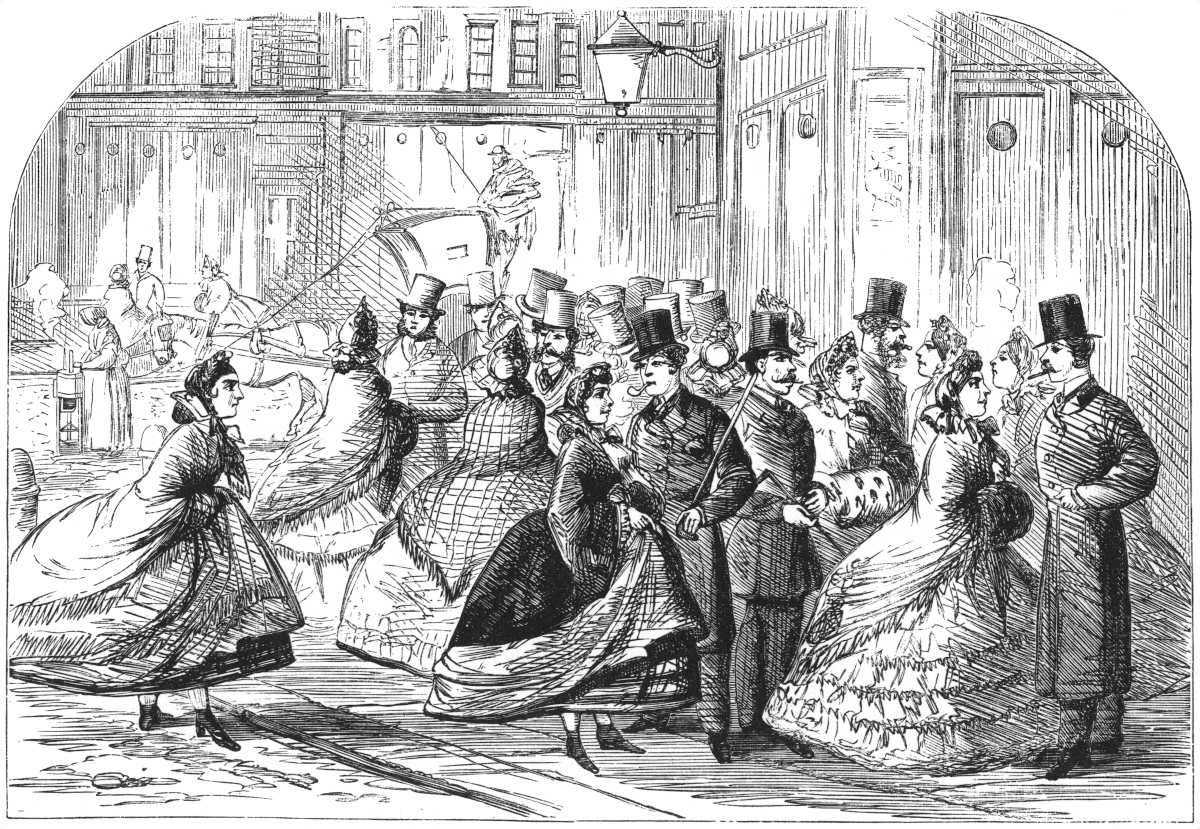
THE HAYMARKET.—MIDNIGHT.
“I often rode along Rotten Row with him, and along the drives in Hyde Park. We also went to the seaside, where we lived in the best hotels.
“This lasted for two years, when his conduct changed towards me.
“One evening I went with him to the Assembly Rooms at Holborn to a masked ball. I was dressed in the character of a fairy queen. My hair was in long curls hanging down my back.
“He left me in the supper-room for a short time, when a well-dressed man came up to me. When my paramour came in he saw the young man sitting by my side speaking to me. He told him I was his wife, and inquired what he meant by it, to which he gave no reply. He then asked me if I knew him. I replied no. He asked the gentleman to rise, which he did, apologising for his seating himself beside me, and thereby giving offence. On the latter showing him his card, which I did not see, they sat down and had wine together.
“We came out of the supper-room, and we had a quarrel about the matter. We walked up and down the ball-room for some time, and at last drove home.
“When we got home he quarrelled again with me, struck me, and gave me two black eyes. I was also bruised on other parts of the body, and wanted to leave him that night, but he would not let me.
“In the morning we went out as usual after breakfast for a drive.
“Next evening we went to the Casino at Holborn. Many of the gentlemen were staring at me, and he did not like it. I had on a thick Maltese veil to conceal my blackened eyes.
“The gentleman who had accosted me the previous night came up and spoke to me and my paramour (whom we shall call S.), and had some wine with us. He asked the reason I did not raise my veil. S. said because I did not like to do it in this place. The gentleman caught sight of my eyes, and said they did not look so brilliant as the night before.
“S. was indignant, and told him he took great liberty in speaking of his wife in this manner. The other remarked that no one could help noticing such a girl, adding that I was too young to be his wife, and that he should not take me to such a place if he did not wish me to be looked at. He told him he ought to take better care of me than to bring me there.
“When we got home we had another quarrel, and he struck me severely on the side.
“We did not sleep in the same bed that night. On coming down stairs to breakfast next morning I was taken very ill, and a medical man was sent for. The doctor said I was in a fever, and must have had a severe blow or a heavy fall. I was ill and confined to my bed for three months. He went out every night and left me with a nurse and the servants, and seldom returned till three or four o’clock in the morning. He used to return home drunk; generally came into my bedroom and asked if I was better; kissed me and went downstairs to bed.
“When I got well he was kind to me, and said I looked more charming than ever. For three or four months after he took me out as usual.
“The same gentleman met me again in the Holborn one night while S. had gone out for a short time, leaving me alone. He came up and shook hands with me, said he was happy to see me, and wished me to meet him. I told him I could not. S. was meanwhile watching our movements. The gentleman asked me if I was married, when I said that I was. He admired my rings. Pointing to a diamond ring on his finger, he asked me if I would like it. I said no. He said your rings are not so pretty. I still refused it; but he took the ring off his finger and put it on one of mine, and said, ‘See how well it looks,’ adding, ‘Keep it as a memento; it may make you think of me when I am far away.’ He told me not to mention it to my husband.
“Meantime S. was watching me, and came up when the man had gone away, and asked what he had been saying to me. I told him the truth, that the same man had spoken to me again. He asked me what had passed between us, and I told him all, with the exception of the ring.
“He noticed the ring on my finger, and asked me where I had got it. I declined at first to answer. He then said I was not true to him, and if I would not tell him who gave me the ring he would leave me. I told him the man had insisted on my having it.
“He thereupon rushed along the room after him, but did not find him. On coming back he insisted on my going home without him.
“He took me outside to his brougham, handed me in it, and then left me. I went home and sat in the drawing-room till he returned, which was about three o’clock in the morning. He quarrelled with me again for not being true to him. I said I was, and had never left his side for a moment from the time I rose in the morning till I lay down at night.
“I then told him I would go home and tell my friends all about it, and he was afraid.
“Soon after he said to me he was going out of town for a week, and wished me to stop at home. I did not like to remain in the house without a woman, and wished to go with him. He said he could not allow me, as he was to be engaged in family matters.
“He was absent for a week. I remained at home for three nights, and was very dull and wearied, having no one to speak to. I went to my bedroom, washed and dressed, ordered the carriage to be got ready, and went to the Holborn. Who should I see there but this gentleman again. He was astonished to see me there alone; came up and offered me his arm.
“I told him I was wearied at home in the absence of S., and came out for a little relaxation. He then asked to see me home, which I declined. I remained till the dancing was nearly over. He got into the brougham with me and drove to Sally’s, where we had supper, after which he saw me home. He bade me ‘good-bye,’ and said he hoped to see me at the Holborn again some other night.
“Meantime S. had been keeping watch over me, it appears, and heard of this. When he came home he asked me about it. I told him. He swore the gentleman had connexion with me. I said he had not. He then hit me in the face and shook me, and threatened to lock me up. After breakfast he went out to walk, and I refused to go with him.
“When he had gone away I packed up all my things, told the servant to bring a cab, wrote a note and left it on the table. I asked the cabman if he knew any nice apartments a long way off from C——, where I was living. He drove me to Pimlico, and took me to apartments in —— where I have ever since resided.
“When I went there I had my purse full of gold, and my dresses and jewellery, which were worth about 300l.
“One evening soon after I went to the Holborn and met my old friend again, and told him what had occurred. He was astonished, and said he would write to my relations, and have S. pulled up for it.
“After this he saw me occasionally at my lodgings, and made me presents.
“He met S. one day in the City, and threatened to write to my friends to let them know how I had been treated.
“I still went to the Holborn occasionally. One evening I met S., who wished me to go home with him again, but I refused, after the ill-usage he had given me.
“I generally spent the day in my apartments, and in the evening went to the Argyle, until my money was gone. I now and then got something from the man who had taken my part; but he did not give me so much as I had been accustomed to, and I used to have strange friends against my own wish.
“Before I received them I had spouted most of my jewellery, and some of my dresses. When I lived with S. he allowed me 10l. a week, but when I went on the loose I did not get so much.
“After I had parted with my jewellery and most of my clothes I walked in the Haymarket, and went to the Turkish divans, ‘Sally’s,’ and other cafés and restaurants.
“Soon after I became unfortunate, and had to part with the remainder of my dresses. Since then I have been more shabby in appearance, and not so much noticed.”
Criminal Returns.
It is very interesting to philanthropists and people who take an interest in seeing human nature improved, and to those who wish to see crime decrease, to notice the fluctuations of crime, its increase, its decrease, or its being stationary, especially among different classes.
Through the kindness of Sir Richard Mayne, and the obliging courtesy of Mr. Yardley, of the Metropolitan Police-Office, Whitehall, I am enabled to show the number of disorderly prostitutes taken into custody during the years 1850 to 1860. Mr. Yardley supplied me with the criminal returns of the Metropolitan Police for the last ten years, from which I have extracted much valuable and interesting information, besides what I have just mentioned.
Number of Disorderly Prostitutes taken into Custody during the years 1850 to 1860, and their Trades.
18502,502
18512,573
18523,750
18533,386
18543,764
18553,592
18564,303
18575,178
18584,890
18594,282
18603,734
After some search I have been enabled to give the trades and occupations of those women.
74 were Hatters and trimmers.
418„Laundresses.
646„Milliners, &c.
400„Servants.
249„Shoemakers.
58„Artificial flower-makers.
215„Tailors.
33„Brushmakers.
42„Bookbinders.
8„Corkcutters.
7„Dyers.
2„Fishmongers.
8„General and marine-store dealers.
24„Glovers.
18„Weavers.
The remainder described themselves as having no trade or occupation.
In ten years then 41,954 disorderly women, who had given themselves up to prostitution, either for their own gratification, because they were seduced, or to gain a livelihood, were arrested by the police. The word disorderly is vague, but I should think it is susceptible of various significations. In one case it may mean drunkenness, in another assaulting the police, in others an offence of a felonious nature may be intended, while in a fourth we may understand a simple misdemeanour, all subjecting the offender, let it be borne in mind, to a fine or incarceration.
Now, 41,954 is an enormous total for ten years. In an unreflective mood I should be inclined to say that prostitutes, taken collectively, were most abandoned, reckless, and wicked; but it is apparent, after a minute’s study, that they must not be taken collectively. This forty odd thousand should be understood to represent, for the most part, the very dregs, the lowest, most unthinking, and vilest of the class.
We must look for them in the East, in Whitechapel, in Wapping, in transpontine dens and holes, amongst sailors’ and soldiers’ women. In the Haymarket there is not much drunkenness, and the police are seldom interfered with. If a man, with whom a woman is walking, is drunk, and makes an assault upon the police, the woman will content herself with the innocent, and comparatively harmless amusement of knocking off the policeman’s hat, afterwards propelling it gracefully with her foot along the pavement. This pastime is of rather frequent occurrence in nocturnal street rows, and always succeeds in infusing a little comic element into the affray. Amongst the disorderly women of loose habits we see that milliners largely preponderate; 646 in ten years, who have broken the laws in some way, enables us to form, by comparison, a vague idea of the number of milliners, dressmakers, &c., who resort to prostitution; for if so many were disorderly, the number of well-behaved ones must be very large.
Another curious item is laundresses, of whom there were 418 in the hands of the police. Either the influence of their trade is demoralizing in the extreme; or they are underpaid, or else there are large numbers of them; I incline to the latter supposition.
That there should have been only 400 servants is rather a matter of surprise than otherwise, for they are exposed to great temptations, and form a very numerous body.
In our next statistics we are able to be more precise than in the former ones. Peculiar facilities are afforded prostitutes for committing larcenies from the person, and there are annually some hundreds taken into custody, and some few convicted. Only the other day I was passing through Wych Street, on my way from New Inn with a friend, and it so happened that we were instrumental in protecting a gentleman from the rapacity of some men and women of infamous character, by whom he had been entrapped.
In Wych Street there are five or six houses, contiguous to one another, that are nothing more or less than the commonest brothels. The keepers of these places do not in the least endeavour to conceal the fact of their odious occupation; at almost all hours of the day, and till twelve o’clock at night one may perceive the women standing at their doorways in an undress costume, lascivious and meretricious in its nature. Although they do not actually solicit the passer-by with words, they do with looks and gestures.
It might have been a little after twelve o’clock, when, as I was passing one of these houses, a gentleman, with his coat off, and without his hat, rushed out of the doorway and ran up the street. He held a small clasp-knife in his hand, which from his manner I guessed he would not hesitate to use if hard pressed. He was in an instant followed by a pack of men and women, perhaps four or five of each sex, in full cry. They were nearing him, when he turned suddenly round and doubled upon them, which manœuvre brought him in my direction. I saw, when near enough, that he was intoxicated. Directly he perceived me he implored my protection, saying, “For God’s sake keep those fellows off.” The noise attracted the attention of a policeman at the end of the street, who came up to see what the origin of the disturbance was, and the crowd fell back at his appearance.
The gentleman said he went into one of the houses to get a cigar, when he was set upon by some women, who attempted to rob him. Although drunk he was able to put his hand in his pocket and take out a small clasp-knife he always carried about with him. He brandished this in their faces, when some bullies descended from the upper regions, and the victim fortunately effected his escape into the street.
This man might have been robbed and subsequently drugged, without much fear of discovery, for the subjoined statistics will prove that such outrages are of frequent occurrence in the metropolis.
Larcenies from the Person by Prostitutes, during the years 1850 to 1860.
Larcenies.Convicted.Total loss.
1850684116£1,814
1851640981,890
1852639972,095
18536051121,578
18546071192,019
1855688963,017
1856780942,668
1857854792,928
1858777392,370
1859681931,743
1860692391,936
The first thing that strikes us in looking at these figures is the small amount of convictions that followed arrest. For instance in 1850 out of 684 arrested only 116 were convicted. Yet we must not forget the difficulty of proving a charge of this description, and the unwillingness of men to prosecute. It is only natural that a man should have a repugnance to appear in public and mix himself up in a disgraceful affair of this sort. Any one who cared for his character and reputation would at once refuse, and in this repugnance we must look for the cause of the escape of so many offenders.
Whenever an occurrence of this sort takes place in a brothel, one would imagine the police would have some grounds for prosecuting the keeper for harbouring thieves and persons who habitually break the public peace, but the criminal returns of the metropolitan police, from which we have before quoted, do not give one reason to think so.
Let us examine the number of arrests for keeping common brothels, during the last ten years.
Number of Persons taken into custody for keeping Common Brothels, during the years 1850 to 1860.
Females.Males.Total.
185044= 8
185112517
18524610
18539312
1854none.
18556410
185612719
18576814
185810818
18599918
186012517
143
The largest number (19) was in 1856, while in 1854 there were none at all. But we have already drawn attention to the difficulty the police have in dealing with these cases.
Of those arrested:
1 was a clerk,
1„sailor,
13 were servants,
3„tailors,
1 wasa printer,
1 wasa sawyer,
1„interpreter,
1„cabinet-maker,
1„brass-founder,
1„green-grocer,
1„butcher,
2 were milliners,
3„laundresses,
9„labourers,
2„smiths,
6„carpenters,
3„general and marine store-dealers,
1 wasa carver and gilder,
4 were shoemakers,
2„watch-makers,
2„painters,
3„bricklayers.
The rest were of no trade or occupation, and depended for a livelihood solely upon this disgraceful means of subsistence.
It is odd to see butchers, printers, tailors, carpenters, brass-founders, interpreters, bricklayers, and cabinet-makers combining this with their own legitimate trades, and if this is a common thing among the trades, how wide-spread the evil must be, for we have only an average of about 12 arrests annually, and this very small amount, with the perhaps light punishment awarded the offender by the sitting magistrate, or if committed by the judge, is evidently purely insufficient and ineffectual to act as a deterrent to others holding the same demoralizing views, and practising the same odious profession.
A few pages back, while commenting upon crime amongst bawds and prostitutes, we took the liberty of criticising some remarks of Dr. Ryan’s about the prevalence of murder in immoral houses. The best proof presumptive he could have adduced in support of his theory he utterly neglected to bring forward. I mean the returns of the metropolitan police of the number of persons reported to them annually as missing.
This return, so enormous, so mysterious, so startling, is certainly very alarming before it is analysed. But when with the eye of reflection we calmly and dispassionately look at it, our alarm diminishes as rapidly as it was excited.
Number of Persons reported to the Police as lost or missing, and the number found and restored by the Police, during the years 1841 to 1860.
Reported lost or Missing.Restored by the Police.
18411,000560
18421,179623
18431,218623
18441,111543
18452,2011,000
18462,4891,082
18472,2161,111
18481,8661,009
18491,473994
18502,2041,137
18511,876928
18522,1031,049
18532,034900
18542,286941
18552,178964
18562,3711,084
18572,1711,198
18582,4091,264
18592,3741,054
18602,5151,164
For twenty years the number of persons reported lost, stolen, strayed, and missing has been steadily increasing.
In 1841 it was 1,000
„18511,876
„18602,515
Of which
In 1841560 were restored by the police.
„1851928„„
„18601,164„„
Now unscrupulous statisticians and newsmongers would not hesitate to say that the “Fleet Ditch” Dr. Ryan is so fond of might unfold a tale that would elucidate the mystery.
It is surprising that in these enlightened days such monstrosities should be listened to.
How many, I should like to know, disappear from home and enlist in the army? How many run away to sea, and how many commit suicide?
A little reflection shows us that the tales of murder in immoral houses are only bugbears conjured up by moralists to frighten children. Not designedly perhaps, but more through ignorance than anything else.
Perhaps the number of suicides committed annually in London may be of some use in reducing the number of lost and missing.
Number of Suicides committed during the years 1841 to 1860.
Year.Suicides committed.Year.Suicides committed.
18411391851120
18421341852109
18431121853131
18441551854118
18451441855116
18461621856127
18471521857154
1848100185890
18491311859180
18501401860104
I find also that the number of suicides prevented by the police, or otherwise, is on an average nearly equal to the actual number of suicides committed.
Many attempted suicides may not be genuine attempts; for we often hear in the police courts of people endeavouring to make the public believe they wished to destroy themselves, with the sole object of exciting sympathy and drawing attention to their case. However, it is difficult to distinguish, and it is clear there are annually many unhappy wretches who do make away with their lives, and also numbers who are providentially prevented.
Rape is a crime that has not fluctuated to any great extent during the last ten years. I see that in 1850 there were 22 arrests for this offence, and the same number in 1860. Most of the prisoners were in a low station in life; 17 in 1850 only being able to read, or read and write imperfectly, and 15 in 1860 were in the same unintellectual position. In 1855, 21 individuals were given in charge, 16 of whom were imperfectly instructed. It must be remembered that not all those who were charged were convicted, or even committed for trial, because the charge of rape is one easy to trump up, and it requires very sound and unconflicting evidence to bring the charge home.
Concealing the births of infants is a crime I am glad to perceive of more frequent occurrence, than feloniously attempting to procure abortion; for of two evils it is better the less preponderate.
Year.Concealing Birth of their Infants.Feloniously attempting to procure Abortion.
1850121
1855101
1860170
In 1860 there were 2 cases of abduction, and in 1850 none at all; but in the latter year there were 61 cases of indecently exposing the person, which offence had in 1860 attained the dimensions of 103, three only, of which number were females, in the former instance eight.
Of course it is only natural to expect that as the population of the empire increases, crime also will increase; and will more especially show its hideous and unwelcome visage in the metropolis, the centre of a vast and densely-populated kingdom. Where masses of men congregate, there disorder, dissension, and crime will have a place. We have to thank an efficient police force for keeping them within reasonable dimensions.
I have already adverted to the difficulty experienced in even approximating to the actual number of prostitutes existing; but the magisterial authorities are enabled to catalogue and number those who are known to the police and those living in brothels.
The subjoined table will be found extremely interesting:
Division and Local Name.Number known to the Police.
Total.Well dressed who live in Brothels.Who walk the Streets.
Well dressed.All others.
A or WhitehallNone.None.None.None.
B or Westminster46917717275
C or St. James20858150 ..
D or St. Mary’bone428143133152
E or Holborn51117358280
F or Covent Garden42850204174
G or Finsbury2252433168
H or Whitechapel8117382656
K or Stepney1015 .. 310705
L or Lambeth657147207303
M or Southwark66153140468
N or Islington44190136215
P or Camberwell222449682
R or Greenwich570172124274
S or Hampstead3311456261
T or Kensington97 .. 592
V or Wandsworth1871440133
Totals7,2611,2321,7914,238
This is the latest return that the authorities at Whitehall are in possession of. It will be seen that the largest number of prostitutes are in Stepney; but the prostitution in this district, it would appear, is of a low description, and mostly ambulatory, as no evidence of any women living in brothels is given in the return.
The registered increase since 1857, is in most districts absolutely nothing, whilst the decrease in many localities contrasts very favourably indeed with the increase. For instance:—
Increase since last return, made in July, 1857.Decrease since last return, made in July, 1857.
ANoneANone
B..B55
C..C110
D..D98
E..E35
F..F52
G..G124
H..H992
K..K50
L..L145
M..M6
N..N4
P..P6
R169R..
S100S..
T..T9
V..V22
Total2691,708
The police have thought it necessary to make special arrangements in special localities, to prevent disorder and enforce the law.
Special Arrangements of Police made, and at what places, to prevent disorder and enforce the law.
Division and Local Name.
A or WhitehallCockspur Street—an additional constable occasionally. St. James’s, Green, and Hyde Parks—additional constables during summer months.
C—St. JamesRegent Street, Waterloo Place, Quadrant, Haymarket, and Coventry Street—four additional constables (and sometimes more) from 3 P.M. to 3 A.M., daily.
D—St. MaryleboneOxford Street, Edgeware Road. Harrow Road, and Paddington Green—one additional constable from 7 P.M. to 6 A.M., daily. Regent’s Park and Bayswater Road—two additional constables from 9 A.M. to 6 A.M., following day. Portland Place—an additional constable from 10 P.M. to 6 A.M.
E—HolbornLower Regent Street and Portland Place—one additional constable from 7 P.M. to 10 P.M.; one ditto from 7 P.M. till 2 A.M.; two additional constables from 10 P.M. till 2 A.M., and a sergeant in plain clothes.
F—Covent GardenStrand—a sergeant, and occasionally constables. Long Acre—a constable frequently.
H—WhitechapelSt. George’s Street and High Street, Whitechapel—a constable, and a short beat, each place.
L—LambethWaterloo Road, Herbert’s Buildings, and Granby Street—an additional sergeant and two constables patrolling.
S—HampsteadRegent’s Park—an additional constable to patrol. Primrose Hill—two additional constables for eight hours after Park constables go off duty.
Comparative Return of the Number of Prostitutes known to the Police, at four different periods, within the last seventeen years.
Division and Local Name.In 1841In 1850In 1857In 1858
A or Whitehall
B „ Westminster660524469
C „ St. James’s390318208
D „ St. Marylebone429526428
E „ Holborn461546511
F „ Covent Garden698480428
G „ Finsbury320349225
H „ Whitechapel4741803811
K „ Stepney8279651015
L „ Lambeth854802657
M „ Southwark531667661
N „ Islington457445441
P „ Camberwell152228222
R „ Greenwich288401570
S „ Hampstead216231331
T „ Kensington9210697
V „ Wandsworth157209187
Totals6598700686007261
Note.—The total number only for 1841 can now be given.
These are the only statistics relative to prostitution that I have been able to procure—indeed I may almost say they are the only ones procurable; and for them I am indebted to the courtesy of the authorities at Whitehall, who, during my researches, have most kindly afforded me every facility that I could wish for.
I dare say that few things contribute so much to the spread of immorality as the sale of indecent and obscene prints and books, which were until lately so widely disseminated over the country by book-hawkers and the filthy traders of Holywell Street. Even now this trade is not entirely suppressed, although the police restrictions are rigorous, and the punishments awarded severe.
Selling obscene prints and exposing for sale:—
In the year 18501
„„18514
„„18520
„„18530
„„18541
„„18550
„„18565
„„18574
„„18580
„„18593
„„18604
22
Recently a man called Dugdale, who has grown grey in this disgusting occupation, was brought before a magistrate for selling obscene prints, and also sending some to customers in the country. The magistrate committed him for trial, when he was sent to prison for two years.
It is always more or less interesting to know the extent of instruction among criminals, and with that idea in view I have put together the annexed table, in which I have included all the offences that bear directly and remotely upon the subject I am treating.
As regards the man Dugdale, and the sale of immoral publications, obscene prints, &c., a long account of the prisoner’s antecedents was given in the newspaper reports. He had been engaged in this infamous and diabolical traffic nearly forty years, and had spent a great number of them in prison at various times; tons weight of obscene books, pictures, and plates had been seized upon his premises, and he was well known to be the principal instrument for the dissemination of this sort of pollution all over the country. The prosecution was instituted by the meritorious Society for the Suppression of Vice. The judge made a few brief but impressive observations upon the inconceivable enormity of the prisoner’s offence, and the whole course of his life, which he said had been one of vice, wickedness, infamy, and villainy, the real extent of which words would fail to describe. From the records of public proceedings for years past the Court had a knowledge of the prisoner’s previous history, and it would be a waste of words and the public time to say any thing further to such a person. He was liable to three years’ hard-labour, but, considering his age, the Court would refrain from going to extremity, but in the discharge of their duty to society and the rising generation they felt bound to pass upon him a severe sentence, which was that he be kept to hard labour for two years.
TABLE showing the degree of Instruction of the Persons taken into Custody during a period of Ten Years—1850 to 1860.
OFFENCES.Years.Total.Neither Read nor Write.Read only, or Read and Write imperfectly.Read and Write well.Superior Instruction.
Concealing births of their infantsFrom 1850 to 1860.1672812415 ..
Feloniously attempting to procure abortion9 .. 342
Rape32444226971
Disorderly Prostitutes41,91410,13430,92178475
Indecently exposing the person1,15512978521226
Keeping common Brothels143228140 ..
Selling and exposing obscene prints for sale22 .. 166 ..
Whilst I am dilating upon statistics it may not be inappropriate to refer to certain figures and facts relating to the Midnight Meeting movement.
By the courtesy of Mr. Theophilus Smith, secretary to the Midnight Meeting movement, I have been furnished with the general statistical results.
20 meetings have been held.
4,000 friendless young women heard the gospel.
23,000 Scripture cards, books, tracts, and Mr. Noel’s address at the second meeting circulated.
89 females restored to friends.
75 placed in service.
81 in homes.
1 set up in business.
2 emigrated.
6 married.
1 sent to France.
1 to Holland.
1 to New-York.
30 left homes after a short residence.
287
Of this number (287) very many (upwards of thirty) have given evidence of a change of heart.
56 restored at Liverpool.
50„Manchester.
130„Edinburgh.
30„Dundee.
35„Dublin.
17„Cardiff.
10„Ramsgate.
358
A total of 645, besides a large number who through the influence of the movement have given up a life of sin, and sought a way of escape for themselves. The committee have heard of many.
I append a list of the metropolitan homes and refuges.
1. British Penitent Female Refuge. Cambridge Heath, Hackney, N.E.
2. Female Temporary Home. 218, Marylebone Road, N.W.
3. Guardian Society. 12, North side of Bethnal Green, N.E.
4. Home for Friendless Young Females of Good Character. 17, New Ormond Street, W.C.
5. Home for Penitent Females. White Lion Street, Islington, N.
6. Lock Asylum. Westbourne Green, Paddington.
7. London Diocesan Penitentiary. Park House, Highgate, N.
8. London Female Dormitory. 9, Abbey Road, St. John’s Wood.
9. London Female Penitentiary. 166, Pentonville Road, N.
10. London Female Preventive and Reformatory Institution. 200, Euston Road, N.W., and 18, Cornwall Place, Holloway Road, N.
11. London Society for Protection of Young Females. Asylum, Tottenham, N.; Office, 28, New Broad Street, E.C.
12. Magdalen Hospital. 115, Blackfriars Road, S.
13. Refuge for the Destitute. Manor House, Dalston, N.E.
14. Society for the Rescue of Young Women and Children. There are five homes; the office at 11, Poultry, E.C.
15. South London Institution.
16. St. Marylebone Female Protection Society. 157, Marylebone Road, N.W.
17. St. James’ Home. Whetstone, Finchley Common, W.
18. Trinity Home. 9, Portland Road, Portland Place, W.
19. Westminster Female Refuge. 44, Vincent Square, S.W.
From February 1860 to February 1861, by contributions and collections the Society, it appears from the balance sheet, received 2,924l. 7s. 4d.
Traffic in Foreign Women.
One of the most disgraceful, horrible and revolting practices (not even eclipsed by the slave-trade), carried on by Europeans is the importation of girls into England from foreign countries to swell the ranks of prostitution. It is only very recently that the attention of Mr. Tyrrwhit, at the Marlborough Police Court, was drawn to the subject by Mr. Dalbert, agent to the “Society for the Protection of Women and Children.”
It is asserted that women are imported from Belgium, and placed in houses of ill-fame, where they are compelled to support their keepers in luxury and idleness by the proceeds of their dishonour. One house in particular was mentioned in Marylebone; but the state of the law respecting brothels is so peculiar that great difficulty is experienced in extricating these unfortunate creatures from their dreadful position. If it were proved beyond the suspicion of a doubt, that they were detained against their will, the Habeas Corpus Act might be of service to their friends, but it appears they are so jealously guarded, that all attempts to get at them have hitherto proved futile, although there is every reason to believe that energetic measures will be taken by the above-mentioned Society to mitigate the evil and relieve the victims.
As this traffic is clandestine, and conducted with the greatest caution, it is impossible to form any correct idea of its extent. There are numbers of foreign women about, but it is probable that many of them have come over here of their own free-will, and not upon false pretences or compulsion. One meets with French, Spanish, Italian, Belgian, and other women.
The complaint made before the metropolitan magistrate a short while since was in favour of Belgian women. But the traffic is not confined to them alone. It would appear that the unfortunate creatures are deluded by all sorts of promises and cajolery, and when they arrive in this country are, in point of fact, imprisoned in certain houses of ill-fame, whose keepers derive considerable emolument from their durance. They are made to fetter themselves in some way or other to the trepanner, and they, in their simple-mindedness, consider their deed binding, and look upon themselves, until the delusion is dispelled, as thoroughly in the power of their keepers.
English women are also taken to foreign parts by designing speculators. The English are known to congregate at Boulogne, at Havre, at Dieppe, at Ostend, and other places. It is considered lucrative by the keepers of bawdy-houses at these towns to maintain an efficient supply of English women for their resident countrymen: and though the supply is inadequate to the demand, great numbers of girls are decoyed every year, and placed in the “Maisons de passé,” or “Maisons de joie,” as they are sometimes called, where they are made to prostitute themselves. And by the farm of their persons enable their procurers to derive considerable profit.
An Englishwoman told me how she was very nearly entrapped by a foreign woman. “I met an emissary of a French bawdy-house,” she said, “one night in the Haymarket, and, after conversing with her upon various subjects, she opened the matter she had in hand, and, after a little manœuvring and bush-beating, she asked me if I would not like to go over to France. She specified a town, which was Havre. ‘You will get lots of money’, she added, and further represented ‘that I should have a very jolly time of it.’ ‘The money you make will be equally divided between yourself and the woman of the house, and when you have made as much as you want, you may come back to England and set up a café or night-house, where your old friends will be only too glad to come and see you. You will of course get lots of custom, and attain a better future than you can now possibly hope for. You ought to look upon me as the greatest friend you have, for I am putting a chance in your way that does not occur every day, I can tell you. If you value your own comfort, and think for a moment about your future, you cannot hesitate. I have an agreement in my pocket, duly drawn up by a solicitor, so you may rely upon its being all on the square, and if you sign this—’
“‘To-night?’ I asked.
“‘Yes, immediately. If you sign this, I will supply you with some money to get what you want, and the day after to-morrow you shall sail for Havre. Madame —— is a very nice sort of person, and will do all in her power to make you happy and comfortable, and indeed she will allow you to do exactly as you please.’”
Fortunately for herself my informant refused to avail herself of the flattering prospect so alluringly held out to her. The bait was tempting enough, but the fish was too wary.
Now let us hear the recital of a girl who, at an early age, had been incarcerated in one of these “Maisons de passé.” She is now in England, has been in a refuge, and by the authorities of the charity placed in an occupation which enables her to acquire a livelihood sufficient to allow her to live as she had, up to that time, been accustomed to. Her story I subjoin:—
“When I was sixteen years old, my father, who kept a public-house in Bloomsbury, got into difficulties and became bankrupt. I had no mother, and my relations, such as they were, insisted upon my keeping myself in some way or other. This determination on their part thoroughly accorded with my own way of thinking, and I did not for an instant refuse to do so. It then became necessary to discover something by which I could support myself. Service suggested itself to me and my friends, and we set about finding out a situation that I could fill. They told me I was pretty, and as I had not been accustomed to do anything laborious, they thought I would make a very good lady’s maid. I advertised in a morning paper, and received three answers to my advertisement. The first I went to did not answer my expectations, and the second was moderately good; but I resolved to go to the third, and see the nature of it before I came to any conclusion. Consequently I left the second open, and went to the third. It was addressed from a house in Bulstrode-street, near Welbeck-street. I was ushered into the house, and found a foreign lady waiting to receive me. She said she was going back to France, and wished for an English girl to accompany her, as she infinitely preferred English to French women. She offered me a high salary, and told me my duties would be light; in fact by comparing her statement of what I should have to do with that of the others I had visited, I found that it was more to my advantage to live with her than with them. So after a little consultation with myself, I determined to accept her offer. No sooner had I told her so than she said in a soft tone of voice—
“‘Then, my dear, just be good enough to sign this agreement between us. It is merely a matter of form—nothing more, ma chère.”
“I asked her what it was about, and why it was necessary for me to sign any paper at all?
“She replied, ‘Only for our mutual satisfaction. I wish you to remain with me for one year, as I shall not return to England until then. And if you hadn’t some agreement with me, to bind you as it were to stay with me, why, mon Dieu! you might leave me directly—oh! c’est rien. You may sign without fear or trembling.’
“Hearing this explanation of the transaction, without reading over the paper which was written on half a sheet of foolscap, (for I did not wish to insult or offend her by so doing,) I wrote my name.
“She instantly seized the paper, held it to the fire for a moment or two to dry, and folding it up placed it in her pocket.
“She then requested me to be ready to leave London with her on the following Thursday, which allowed me two days to make my preparations and to take leave of my friends, which I did in very good spirits, as I thought I had a very fair prospect before me. It remained for what ensued to disabuse me of that idea.
“We left the St. Katherine’s Docks in the steamer for Boulogne, and instead of going to an hotel, as I expected, we proceeded to a private house in the Rue N— C—, near the Rue de l’Ecu. I have farther to tell you that three other young women accompanied us. One was a housemaid, one was a nursery governess, and the other a cook. I was introduced to them as people that I should have to associate with when we arrived at Madame’s house. In fact they were represented to be part of the establishment; and they, poor things, fully believed they were, being as much deluded as myself. The house that Madame brought us to was roomy and commodious, and, as I afterwards discovered, well, if not elegantly, furnished. We were shown into very good bedrooms, much better than I expected would be allotted to servants; and when I mentioned this to Madame, and thanked her for her kindness and consideration, she replied with a smile:—
“‘Did I not tell you how well you would be treated? we do these things better in France than they do in England.’
“I thanked her again as she was going away, but she said, ‘Tais toi, Tais toi,’ and left me quite enchanted with her goodness.”
I need not expatiate on what subsequently ensued. It is easy to imagine the horrors that the poor girl had to undergo. With some difficulty she was conquered and had to submit to her fate. She did not know a word of the language, and was ignorant of the only method she could adopt to insure redress. But this she happily discovered in a somewhat singular manner. When her way of living had become intolerable to her, she determined to throw herself on the generosity of a young Englishman who was in the habit of frequenting the house she lived in, and who seemed to possess some sort of affection for her.
She confessed her miserable position to him, and implored him to protect her or point out a means of safety. He at once replied, “The best thing you can do is to go to the British Consul and lay your case before him. He will in all probability send you back to your own country.” It required little persuasion on her part to induce her friend to co-operate with her. The main thing to be managed was to escape from the house. This was next to impossible, as they were so carefully watched. But they were allowed occasionally, if they did not show any signs of discontent to go out for a walk in the town. The ramparts surrounding the “Haute Ville” were generally selected by this girl as her promenade, and when this privilege of walking out was allowed her, she was strictly enjoined not to neglect any opportunity that might offer itself. She arranged to meet her young friend there, and gave him notice of the day upon which she would be able to go out. If a girl who was so privileged chanced to meet a man known to the Bonne or attendant as a frequenter of the house, she retired to a convenient distance or went back altogether. The plot succeeded, the consul was appealed to and granted the girl a passport to return to England, also offering to supply her with money to pay her passage home. This necessity was obviated by the kindness of her young English friend, who generously gave her several pounds, and advised her to return at once to her friends.
Arrived in England, she found her friends reluctant to believe the tale she told them, and found herself thrown on her own resources. Without a character, and with a mind very much disturbed, she found it difficult to do anything respectable, and at last had recourse to prostitution;—so difficult is it to come back to the right path when we have once strayed from it.
Perhaps it is almost impossible to stop this traffic; but at any rate the infamous wretches who trade in it may be intimidated by publicity being given to their acts, and the indignation of the public being roused in consequence. What can we imagine more dreadful than kidnapping a confiding unsuspecting girl, in some cases we may say child, without exaggeration, for a girl of fifteen is not so very far removed from those who come within the provisions of the Bishop of Oxford’s Act? I repeat, what can be more horrible than transporting a girl, as it were, by false representations from her native land to a country of strangers, and condemning her against her will to a life of the most revolting slavery and degradation, without her having been guilty of any offence against an individual or against the laws of the land?
It is difficult to believe that there can be many persons engaged in this white slave-trade, but it is undeniably true.
It is not a question for the legislature; for what could Parliament do? The only way to decrease the iniquity is to widely disseminate the knowledge of the existence of such infamy, that those whom it most nearly concerns, may be put upon their guard, and thus be enabled to avoid falling into the trap so cunningly laid for them.
Much praise is due to those benevolent societies who interest themselves in these matters, and especially to that which we have alluded to more than once—“The Society for the Protection of Women and Children,” over which Lord Raynham presides.
Much good may be done by this means, and much misery prevented. The mines of Siberia, with all their terrors, would be preferred—even with the knout in prospective—by these poor girls, were the alternative proffered them, to the wretched life they are decoyed into leading. For all their hopes are blasted, all their feelings crushed, their whole existence blighted, and their life rendered a misery to them instead of a blessing and a means of rational enjoyment.
The idea of slavery of any kind is repulsive to the English mind; but when that slavery includes incarceration, and mental as well as physical subjection to the dominant power by whom that durance is imposed, it becomes doubly and trebly repugnant. If it were simply the deprivation of air and exercise, or even the performance of the most menial offices, it might be borne with some degree of resignation by the sufferer, however unmerited the punishment. But here we have a totally different case: no offence is committed by the victim, but rather by nature, for what is her fault, but being pretty and a woman? For this caprice of the genius of form who presided over her birth she is condemned to a life of misery, degradation, and despair; compelled to receive caresses that are hateful to her, she is at one moment the toy of senile sensuality, and at others of impetuous juvenility, both alike loathsome, both alike detestable. If blandishments disgust her, words of endearment only make her state of desolation more palpable; while profusions of regard serve to aggravate the poignancy of her grief, all around her is hollow, all artificial except her wretchedness. When to this is added ostracism—banishment from one’s native country—the condition of the unfortunate woman is indeed pitiable, for there is some slight consolation in hearing one’s native language spoken by those around us, and more especially to the class from which these girls are for the most part taken. We must add “pour comble d’injustice,” that there is no future for the girl, no reprieve, no hope of mercy, every hope is gone from the moment the prison tawdry is assumed. The condemnation is severe enough, for it is for life. When her beauty and her charms no longer serve to attract the libidinous, she sinks into the condition of a servant to others who have been ensnared to fill her place. Happiness cannot be achieved by her at any period of her servitude; there must always be a restless longing for the end, which though comparatively quick in arriving is always too tardy.
The mind in time in many cases becomes depraved, and the hardness of heart that follows this depravity often prevents the girl from feeling as acutely as she did at first. To these religion is a dead letter, which is a greater and additional calamity. But to be brief, the victim’s whole life from first to last is a series of disappointments, combined with a succession of woes that excite a shudder by their contemplation, and which may almost justify the invocation of Death:—
“Death, Death, oh amiable lovely death! Thou odoriferous stench! sound rottenness! Arise forth from the couch of lasting night, Thou hate and terror to prosperity, And I will kiss thy detestable bones; And put my eyeballs in thy vaulty brows; And ring these fingers with thy household worms; And stop this gap of breath with fulsome dust, And be a carrion monster like thyself; Come, grin on me; and I will think thou smil’st, And kiss thee as thy wife! Misery’s love, O, come to me!” Shakespere, King John, Act iii. Scene 4.