OF PROSTITUTION AMONG THE BARBAROUS NATIONS. (continued 3)
Reading edition
These, however—the original inhabitants of the West-Indian Islands—have disappeared, and been succeeded by another race or compound of races, among which the Negroes only claim our notice at present. Among the blacks of Antigua, as an example of the rest, immorality is a characteristic which may be traced to the institution of slavery. Infanticide is frequently practised by them, especially since the Emancipation Act was passed. The reason of this circumstance, which at first seems strange, is very clear. Under the institution of slavery, negroes were not allowed to marry, or, at least, their marriages were never held as binding before the law. They therefore cohabited, and their unions lasted usually only so long as the caprice of affection, or the heat of a criminal appetite existed. Women, therefore, continually had five, six, seven, eight, or nine children by various fathers, and no disgrace was attached to the fact. A new system was introduced by the abolition of the slave system. The sentiments of shame and modesty have been cultivated in their minds; and the idea of female virtue has at least been awakened, so that they often seek to escape the consequences of an illicit amour by destroying the offspring.
One of the demoralizing effects of slavery was the encouragement of a species of concubinage. Rewards, indeed, were held out by some masters to such of the negroes as lived faithfully with a single partner; but the prevalence of vice was all but universal. A permanent engagement between a man and a woman was seldom formed. Two females frequently lived with one man, and of these one was considered his wife and the other his mistress.
When the negroes were emancipated, in 1834, many of them were anxious to be legally married. Numbers had been already united in wedlock by the missionary preachers; yet, though complete in its character, and regarded as a sacred tie, this act was not held as binding by the law, and many of the emancipated negroes, putting away the partners of their compulsory servitude, took new companions to their homes.
The offence of bigamy was not uncommon among them, and still continues to be so. It is prohibited under a severe enactment, but many devices are adopted to elude the law. Concubinage is less openly practised than formerly, but the tie of marriage is by no means generally respected. Chastity is indifferently regarded; and where the men do not prize it in women, women will be at little pains to preserve it for the men. Women are sometimes married who have been living in concubinage with several persons, and become the mothers of numerous children.
The condition of the free female negroes is by no means so degraded as in the original country of the blacks. Women enjoy an independent existence, and live as they please, though many of them labour. Their character is not distinguished by morality. Decency was entirely obliterated from their ideas, and they are only beginning to recover it. Women who were daily stripped and exposed to receive a whipping from the hands of men, could not be expected long to retain the sense of feminine shame; and this process, acting upon one generation after another, has left its impress on the character of the negro population. Human nature, also, was outraged by the gross tyranny of the planters. The intercourse of the sexes was regulated, not with a view to the morals of the negroes, but to the propagation of the species. They were coupled like beasts, to increase the number of slaves on the estate. In consequence of this the degradation of the negro population was so complete that, after it was emancipated, a woman considered it more honourable to become the mistress of a white, than the wife of a black man. In all the islands, indeed, this vile system was carried on. In St. Lucia, however, the intercourse was almost unrestrained, and consequently became in a degree promiscuous; for moral law there was none. The St. Lucia negro, in fact, is, even at this day, averse to matrimony, and inclined to support concubines, to none of whom is he faithful, even for an interval of time. Yet he is thoroughly attached to his children. It has been observed, that if any improvement in the morality of the island has taken place, it is more in the tone than in the temper, in the appearance than in the reality. Infanticide is never practised, or only as a rare and secret crime. It is prevented, however, not by moral restraint, but by the motherly feelings of the women—by the absence of reproach on bastardy, and the facility for rearing children.
In Santa Cruz the same low condition of manners is observable in the negro population; though in Jamaica the negroes are generally married, and are, on the whole, faithful to the engagement. This, however, is the result of the Emancipation Act. Previously to that mighty social reform, marriage, or a connubial contract of any kind, was rare; and the intercourse of the sexes was loose, profligate, and lewd. The men lived either with several concubines at once, or replaced one by another, as their inclination prompted. When the missionaries endeavoured to change this state of things, any couples which submitted to their teaching were sure to be ridiculed and jeered by the servile and demoralized populace. When slavery was abolished, so far had the corruption of manners proceeded, that numbers of the women, in the delirium of their new liberty, abandoned themselves to their vicious appetites, and became common prostitutes.
The example of Europeans has not by any means displayed to the negroes any instruction in morality; on the contrary, it has, to a great extent, encouraged their vices. This we shall show in a future division of the subject. We therefore leave at present the other islands which form the plantation colonies of England and Spain: we shall hereafter visit the native community which has recently made itself ridiculous by enacting the forms of an empire—we allude to Hayti, or St. Domingo. The brief notice we have given is intended to apply to the rude black population, but not in respect of its relation to the white communities[65].
Of Prostitution in Java.
In the island of Java, which is perhaps the most fertile and beautiful country in the world, a curious system of manners now prevails. Hindoos have been succeeded by Mohammedans, and these by Dutch: each of the conquering races has impressed some characteristic trait on the population, and, unfortunately, the stamp of vice is more easily set than any other. The character and condition of the female sex in Java indicate the whole state of manners there. The men are somewhat cold towards the women, a fact which some learned Theban has ascribed to their feeding more on vegetable than on animal substances, but they are neither cruel nor negligent towards them. The institution of marriage is universally known, if not universally practised or generally respected. The lot of women may be described as peculiarly fortunate; in general they are not ill-used at all, and when, as among some of the more opulent, they are secluded, they are rather withdrawn from the indiscriminate gaze of the people, than shut up in lonely secrecy, for they are by no means watched with that exaggerated jealousy which in some parts of the East renders the husband a continual spy on the actions of his wife. Though the man pays a price for his bride, he does not therefore disdain or abuse her.
The condition of the sex in Java is, indeed, an exception to the habitual custom of Asiatics. The women eat with the men, associate with them in all the offices and pleasures of life, and live on terms of mutual equality.
Many queens have, in different States, occupied the throne. The sex is nowhere in the island, as a rule, treated with coarseness, violence, or neglect. They are industrious, and hard-working, but they labour more through desire of praise than through fear of chastisement, and are admitted to the performance of many honourable tasks. Among the wealthier classes men sometimes act tyrannically in their households; but this must be taken as the characteristic not of the race, but of individuals. Those who seclude their wives do so only from the common eye; English gentlemen have often been introduced into the most private chambers of the harem, while the wives and daughters of the greatest chiefs have appeared at the entertainments given by the European residents in Batavia, Sumarang, and other cities, where they conduct themselves usually with modesty and good grace.
Polygamy and concubinage are tolerated, that is, they are practised among the nobility of Java, who do not allow public opinion to interfere with the gratification of their desires; both of these customs are looked upon, however, rather as vicious luxuries, than as established social institutions; yet, however limited their extent, they never fail to degrade the position and to vitiate the character of the female sex. Some circumstances in the feelings of the people prevent either practice from being generally adopted, and the evil is thus, in its moral influence, mitigated. The first wife is always mistress of the household, and the others are little more than her handmaids, who contribute to her husband’s gratification, but never share his rank or his wealth. No man of station will give his daughter as a second or third wife, unless to a chief of far higher nobility than himself; the inferior wives or concubines are therefore of an inferior class. Thus the artificial distinctions of classes vitiate the public morals, for a woman considers it dishonourable, not to prostitute herself, but to prostitute herself to a poor man of humble birth.
When we say that polygamy and concubinage are not general in Java, the reader must by no means infer a high state of manners to exist there. On the contrary, Java is the most immoral country in insular Asia. The woman who would be ashamed to become the second wife of a chief might not be ashamed to commit adultery with him; in general terms, both sexes are extremely profligate and depraved, though the poets and historians of the island boast of chastity as the distinguishing ornament of their women; because a married female shrieks when a strange man attempts to kiss her before her attendants and a large mixed company, they hold up their sex in Java as the standard of feminine purity and virtue.
In most islands of the Indian Archipelago, divorces are not easy to be obtained; but in Java the total separation of married people may be procured with the utmost freedom and facility. It is a privilege in which the women indulge themselves to a most wanton degree, and often so much as to fall little short of prostitution. A wife may turn away her husband by paying him a certain sum of money; he is not, indeed, absolutely bound to accept this, but usually does so, in conformity with the established opinion of society, that it is disreputable to live with a woman on such terms. Women often change their partners three or four times before they are thirty years of age; some have been seen boasting of a twelfth husband. In Java the means of subsistence abound, and are easy to be procured as well by females as by men; one sex is, therefore, in a great measure, independent of the other; women find no difficulty in living without husbands. They are not, consequently, forced to remain in a state of bondage through fear of being drifted destitute upon the world; but, unfortunately for the theories of our new female reformers, the sex in Java, though thus enfranchised, is proverbially dissolute and libertine.
This, nevertheless, in reality is no argument for those who attempt to show that the female sex, enjoying perfect liberty, makes use of its freedom to indulge in vicious pleasures. The women of Java are dissolute, not because they are free of control, but because the whole society of the island is profligate. Among the wealthier classes, especially, the utmost immorality prevails with respect to the intercourse of the sexes. In the great native towns the population is debauched to the last degree. Intrigues among the married women continually occur; and females of high rank have intercourse with paramours, to the knowledge, and almost before the faces, of their husbands. The men are tame and servile, often not daring to revenge their honour or assert the conjugal right, and they are by no means inspired with that fiery spirit of jealousy which among many Asiatics renders a wife sacred from all but her husband’s eye. Females of respectable rank are often the subject of conversation. An inquiry after a man’s family is held by no means insulting, but rather as a conventional act of courtesy.
Flagrant instances of the loose character of Javan manners have come to the notice of travellers. Before the island was absolutely conquered by the Dutch, one of its great princes, being desirous of purchasing the favour of the people, gave many public feasts and entertainments, at which the wives and daughters of the chiefs attended. He seduced one of his guests, a married woman, and was in the habit of passing the night with her, while her husband was engaged with his duty on the public guard. One morning, by chance, the chief returned home earlier than usual, and detected them together. He had, however, discovered the rank of the paramour, and discreetly coughed, that the prince might have an opportunity to escape. He then went into the chamber, and severely flogged his guilty wife. She fled, and complained to the king of the treatment she had received. He being in the critical position of making good his claim to a crown, dared not exercise the usual prerogative of a throne; but called for the man he had injured, made him many rich gifts, and offered him, as compensation, the handsomest woman in his own household. The husband accepted the peace-offerings, and was content to take back his adulterous wife. The relation of a subject to his prince must, at least when developed in this manner, be most unnatural.
Women in Java are usually married very young, though not before the age of puberty, which is speedily reached. The reason assigned by writers for this haste is, that their chastity is no longer safe after they have reached womanhood. Men wait for two or three years after that period, during which they may indulge in unbounded profligacy. At eighteen or twenty a girl is looked upon as verging towards the wane of life, and becomes a suspected character. No age, however, excludes a woman from the chance of a match; but scarcely any are unmarried after 22. Widows at 50 often procure husbands; for men at that period of life usually choose wives equal in years to themselves, and sometimes older.
The preliminary arrangements are made by the parents on both sides; for no intercourse could previously take place between the young people themselves without being, and often justly, the occasion of scandal. They are looked upon, as the natives themselves express it, as mere puppets in the performance. There are three kinds of connection. The first is when the rank of the parties is equal, or when the man is superior to the woman. The second is when the bride is above her husband, who is taken into the house, and adopted into the family, by his father-in-law. The third is a species of concubinage, without any rites whatever, and confirmed by the simple fact of recognised cohabitation. In such cases, as no formality is required to conclude, so none is necessary to dissolve the contract, which is, therefore, no more than a species of prostitution, for the changes of companions are extremely frequent.
In the other two, the ceremonies are similar. The young people are, in all cases, betrothed for a longer or a shorter period before their union—from one month to several years. The father of the youth, having made for his son what he considers a suitable choice, proceeds to the parents of the girl, and proposes for an alliance. If they accept the suit, a betrothal is ratified by some trifling present to the bride. Visits are made, that the intended nuptials may be publicly known. At the third stage in the progress of the transaction the price is arranged, and varies according to the rank and circumstances of the families. Sometimes it is plainly called the purchase-money; sometimes the act of sale is covered by a more delicate term—the deposit. It is usually considered, however, as a settlement or provision for the bride.
The only Mohammedan feature in the whole ceremony is the exchange of vows in a mosque. This is followed by many ritual observances, more of etiquette than religion, and great parade is affected. At length the married people eat rice from one vessel, to typify their common fortune; but in some places the bride washes her husband’s feet, as an acknowledgment of her subjection to him, or else he treads upon a raw egg, and she wipes his foot.
Though, as we have said, polygamy and concubinage are not generally practised, partly because too expensive, partly from a feeling against them—some of the rich chiefs indulge in them to an extravagant degree, and glory in a train of 60 children. The wives, however, as already noticed, can easily release themselves when their married state is deteriorated into real or fancied bondage. The fact of their early marriage, without knowing their future husband, or consenting to the union, causes a great number of divorces. A widow may marry again after three months and ten days have elapsed since her husband’s death.
Though the intercourse of the sexes is so free that vicious inclinations may be indulged without difficulty or peril, the Javans support a large class of women—prostitutes by profession. Adultery is not considered a very heinous crime, but rather an offence against the husband’s property and honour, yet it is attended sometimes with danger, and often with disagreeable results. The vocation of the trading prostitute is not, therefore, taken away. She unites in Java, as in India, the profession of a dancer with her infamous calling.
There is a large class of these dancers in the island. The people are passionately fond of this amusement, but no respectable woman will join in it. The sultans, indeed, used to have some of their most beautiful concubines trained to dance, and they were privileged in the performance of certain figures; but, otherwise, all its professors are prostitutes. Nevertheless, a Javan chief of high rank is not ashamed to be seen before a large mixed assembly tripping with one of these women.
The dancers may be found in all parts of Java, but chiefly in the north-west, towards the capital. They figure at most of the public and private entertainments. Their conduct is so dissolute that the words dancer and prostitute are, in the Javan language, synonymous; yet, on account of the wealth they often amass, petty chiefs occasionally marry them. In such cases they usually, after a few years, become tired of their quiet secluded life, divorce their husbands, and resume their old calling. The dress in which they appear to dance is very immodest, exposing almost the whole bosom, and the attitudes they assume are licentious in a high degree. Nevertheless, they seldom descend to the obscene and degrading postures practised by some of the Bayaderes in India.
The Europeans in Java have not certainly, up to a late period, at least, set to their native subjects an example of pure manners. The Dutch merchant had usually a Javan female at the head of his household, who served him as a mistress as well. Indeed, the marriage ceremony is seldom insisted on by the women; while, among the lower classes, simple cohabitation is the usual method in which the sexes are related. Yet they are by no means so gross and sensual as the wealthier sort of people. Altogether, however, the island is remarkable for the profligacy of its inhabitants. In every city prostitutes abound; and about the roads in their vicinity women may be seen straying, ready for hire. They mostly, as we have said, assume also the profession of dancers, and this, in a manner, covers the profligacy of those who employ them at their houses[66].
Of Prostitution in Sumatra.
The population of this extensive island is divided into several tribes, slightly differing in their manners and modes of life. The Rejangs, who may be supposed to represent its original habits, are still rude barbarians. With them, as with many people of the East, the scrupulous attention to external show is by no means accompanied by a similar spirit within. They drape their women from chin to foot, and dread lest a virgin should expose any part of her person; yet modesty is not at all a characteristic of the dwellers in villages and towns, to whom this description refers. Those who live in the rural communities, and are more easy in their costume, distinguish themselves by their decency and decorum. In this is exhibited a curious fact, which may be discovered in many parts of the world.
The civilization, if such it may be called, of Sumatra, is of a peculiar character. Its people are in that stage of their progress when great importance is ascribed to the multiplied formulas of etiquette. Ritual is with them more essential than principle—of which, indeed, they know little. It is wonderful to examine the intricate details of the Sumatran marriage contract. Nearly all the litigation in the country springs from that perplexing cause. Men in a barbarous state appear to be under the influence of some law which forces them into extremes. They must be at one pole or another. Either they dispense altogether with ceremonial usages, and satisfy themselves with obeying the simple dictates of nature, under plain rules for their own convenience, or they divide the sexes by a maze of convention, which prescribes a form for the most trivial occasions of life. True refinement appears to be in the medium; but this is a question still to be resolved. In some districts of Sumatra, Europeans, wearied with the endless legal quarrels arising from these complicated transactions, have prevailed on the people to simplify their code of marriage, and the result has proved beneficial.
Some have supposed that the system of procuring wives by purchase, which renders marriage difficult to the poor, has retarded the growth of population. Others, however, assert, and with much appearance of reason, that in Sumatra at least the contrary is true. Children being considered as property, and daughters being especially valuable for the price they command, powerful incentives to matrimony exist. The purchase-money obtained for the girls supplies wives for the sons, and in few islands are instances of celibacy more rare. It is certain, however, that the fostering, or rendering obligatory, thrifty habits on the young, has a tendency to check population, though it may be only so far as to keep it on a level with the means of subsistence. Various European countries illustrate that truth. In Sumatra, also, we have a wealthy region thinly and badly peopled; but misgovernment, war, and barbarism may be assigned as the chief causes. Besides, it is said the women are naturally unprolific; that they cease to bear children at an early age; that ignorance of the medical art causes thousands to perish of endemic complaints.
There are three modes of forming a marriage contract. The first is that, when one man pays to another a certain sum of money in exchange for his daughter, who becomes a virtual slave. There is usually, however, a certain amount—about five dollars—held back, and, so long as this remains unpaid, friendship is supposed to exist between the families, and the girl’s parents have a right to complain if she be ill-treated. If the husband wound her he is liable to a fine, and in other ways his absolute command is curtailed. When, however, on the occasion of a violent quarrel, the sum is paid, the bond of relationship is broken, and the woman is entirely in her master’s power. The regulations in regard to money are numerous and intricate; but need not be explained in detail. They give occasion, however, as we have said, to endless law-suits, which are bequeathed by one generation to another.
In other cases the marriage contract is an affair of barter. One virgin is given for another, and a man who has not one of his own sometimes borrows a girl, engaging to replace or pay for her when required. A man having a son and a daughter, may give the latter in exchange for a wife to the former. A brother may barter his sister for a wife, or procure a cousin instead. If, however, she be under age, a certain allowance is made until she becomes marriageable.
Another method is practised when a parent desires to get rid of a daughter suffering from some infirmity or defect. He sells her altogether without any reserve, and she has fewer privileges than other classes of wives.
Sometimes a girl evades these laws by an elopement, and a match is formed upon mutual affection. If the fugitive couple are overtaken on the road, they may be separated; but when once they have taken sanctuary, and the man declares his willingness to comply with all the necessary forms, his wife is safely secured to him.
Many persons have assigned to whole nations, in various parts of the world, a Jewish origin, partly because the custom prevails with them of a man marrying his brother’s widow. The Sumatrans, in this case, belong to them also, for the same rule is enforced by them; but if there be no brother surviving, the woman is taken by her husband’s nearest male relation—the father excepted. If any of her purchase-money remains unpaid, her new master is answerable for it.
When, under this system, adultery is committed—which is not frequently the case—the husband usually passes it over, or inflicts revenge with his own hand. It is seldom such an offence is brought before the law. When a man desires to divorce his wife thus married to him, he may claim back her purchase-money, with the exception of twenty-five dollars, as she is supposed, by cohabitation with him, to have diminished in value to that amount. If, having taken a woman, he be unable to pay the whole price, though repeatedly dunned for it, the girl’s parents may sue for a divorce, but they must restore all they have received. The old ceremony consisted merely in cutting a rattan cane in two, in the presence of the disunited couple, their friends, and the chiefs of the province. The woman is expected to take to her husband’s house effects to the value of ten dollars. If she take more, he is chargeable to the amount. Thus the whole transaction is carried on upon mercenary grounds.
The second kind of marriage is, when a virgin’s father chooses for her husband some young man whom he adopts into his family, making a feast on the occasion and receiving what we may term a premium of twenty dollars. The young man is thenceforward a property in his father-in-law’s family. They are answerable for the debts he may incur; but all he has and all he earns belong to them; he is liable to be divorced when they please, and to be turned away destitute. Under certain circumstances he may redeem himself from this bondage, but pecuniary considerations are so entangled with the whole agreement that infinite confusion is the result. Several generations are sometimes bound in this manner before the contract can be legally broken by the fulfilment of all the required conditions.
The Malays of Sumalda have generally adopted the third kind of marriage, which is called the free. It is a more honourable compact, in which the families approach each other on the natural level of equality. A small sum is paid to the girl’s parents, usually about twelve dollars, and an agreement is drawn up, that all property shall be common between husband and wife, and that, when divorce takes place by mutual consent, all shall be fairly divided. If the man only presses a separation, he gives half his effects, and loses the twelve dollars; if the woman, she then loses her right to any but her female paraphernalia. This description of contract, which is productive of most just dealing and felicity, has been adopted in many parts of the island.
The actual ceremony of marriage, though fenced about with so many ceremonial observances, is extremely simple. An entertainment is given, the couple join their hands, and some one pronounces them man and wife.
Where the female sex is a material for sale, little of what we term courtship can be expected. The manners of the country are opposed to it; strict separation is enforced between the youth of different sexes; and when a man pays the full price for a bride, he considers himself entitled to her without any manner of persuasion or solicitation to herself. Nevertheless, traces of gallantry—using that word in its proper, not its ridiculous sense—may be observed in the manners of the people. A degree of respect is shown to women, which may be favourably contrasted with the conduct of some polished nations. On the few occasions on which the young people meet, such as festivals and public gatherings in the village hall, they dance and sing, and behave with much delicacy; mutual attachments often spring out of such association, and the parents frequently promote the desire of union thus arising. In most countries, indeed, the barbarism of the law is mitigated in its influence by the universal operation of the natural human sentiments; it is no less true than strange, that mankind are usually better, not only than their rulers, but than their laws. The festivals are enlivened by dances and songs; the dances have been described as licentious and grotesque, but Marsden, the philosophical historian of Sumalda, only remarks that the figures displayed at English balls are often more immodest and absurd. The songs are usually extempore, and always turn on the subject of love.
The existence or flourishing of any sentiment among a people with whom marriage is a commercial transaction, and who allow a plurality of wives, may be considered incredible; but as, in the first instance, Nature often asserts herself and the law is accommodated to her will, so, in the second, the nature of things prevents any general extension of the practice. Polygamy is permitted; but only a few chiefs have more than one companion. The general indigence of the people is one cause of this, for the perpetual weight of necessity is more powerful than the irregular impulse of animal passion. To be a second wife is also considered by many below the dignity of a reputable person. A man sometimes prefers a divorce for his daughter when he hears that her husband is about to take another wife. In the contract which stipulates for a division of property, polygamy is impossible, for this obvious reason, that the wife must have half the husband’s effects, which more than one, of course, could not do. The origin of polygamy in Sumalda and other parts of Asia has been traced by various ingenious writers to different causes; but being, as it is, the indulgence which is a privilege of wealth, it appears to have grown up with the whole system of manners; no natural reason seems to exist for it. The proportion of the sexes is nearly equal, and all the theories grounded on a different assumption fall to pieces. Wherever polygamy exists, women are purchased, and where they are thus viewed as property, wealthy men will surely distinguish themselves from their neighbours by a plurality of wives; and this happens in Rajpooratan, where the women are far less numerous than the men, as well as in other countries where they out-number them to an equal extent.
In the country parts of Sumatra, chastity, says Marsden, exists more than among any other people with which he was acquainted. The same characteristic appears to distinguish them at the present day. Interest, as well as decency, renders the parents anxious to preserve the virtue of their daughters. The price of a virgin is so far above that of a woman who has been defiled, that the girls are jealously watched, lest their value deteriorate in this respect. But the truth of the Oriental idea is sometimes illustrated—that girls should marry as soon as they are marriageable, or they soon cease to be chaste. In Sumatra they remain single for some time after that period, and occasionally lose their chastity in consequence. In such cases the seducer, if discovered, may be forced to marry the girl, and pay her price, or make good the diminution he has occasioned in her value.
Regular prostitution is little known, except in the towns. There, especially in the bazaars, women following that calling may be found mixed up with the concourse of sailors and others who support them. In the seaports especially, where the population is not only floating, but mixed from various nations, there is a great deal of profligacy, and troops of professional prostitutes ply the streets for hire. Europeans, however, who represent the general manners of the island from the experience of short visits to the maritime cities, convey a false impression of the people. The Sumatran is, as a rule, contented to marry and be faithful to his wife. This proceeds, however, it would seem, rather from some peculiar tone of temperament, than from any principles of morality; for their ideas on this subject are, at any rate, widely different from ours. Incest they hold as an offence; but except it occurs within the first degree it is regarded rather as an infraction of the conventional, than the natural law. It is sometimes punished by a fine; but sometimes also the marriage is confirmed, and the parties remain together.
The chiefs of the cannibal nations of Batta have sometimes several concubines. A man once stole a woman of this kind—the favourite of her master—and was punished by being cut to pieces, roasted, and devoured. Among the people of Bulu China, on the east coast, a man may have four wives, and as many concubines as possible. Some of the chiefs possess one of these companions in each town or village of their country. Adultery is punished by death to both criminals.
The general treatment of the sex in Sumatra is of an average character. They are not absolutely degraded, nor do they enjoy an elevated position. The poorer classes labour, and all are subject to the men; but on the whole they are far superior to Java, and, in a considerable degree, to many other Eastern countries[67].
Of Borneo.
The splendid achievements in the cause of civilization which Sir James Brooke has performed, have directed an extraordinary attention to the immense island of Borneo. Like the rest of the Indian Archipelago, it is, nevertheless, little known to the English reader—no complete accounts having been yet published. Sir James Brooke, however, with Captain Keppel, Captain Mundy, Mr. Hugh Low, and others, have thrown a new light on the country, and enabled us to discern many striking features in the social system of the races which inhabit it. The uniformity of manners observable in Celebes does not exist in Borneo. The inhabitants of Borneo, for the most part, remain in an inferior stage of the barbarian state. There are, however, among them many varieties of the social law. Some are the purest savages, wandering unclothed in the depths of the forests, and subsisting alone on the spontaneous gifts of nature. Others cultivate the soil, dwell in comfortable villages, and traffic with their neighbours. The river communities are far more advanced than those who live far from the means of water-carriage; and the inhabitants of the maritime towns are more educated, and also more profligate, than any. They have been depraved by that bloody and destructive system of piracy, which was, until recently, the curse of the Archipelago; but when Sir James Brooke’s policy has been maturely developed, we may expect to see vast ameliorations in their manners.
The state of morals among the Sea Dyaks, or dwellers on the coast, is low, even in comparison with the average of other Asiatic races. There is no social law to govern the intercourse of the youths of both sexes before marriage. Even the authority of parents is not recognised to any extent. The Dyak girl is supposed capable of selecting a husband for herself; and before she is betrothed to a man she may cohabit, without disgrace, with any other with whom she may please to associate. The women appear to make liberal use of this privilege. Loose as their conduct is, however, before marriage, they are subject afterwards to a more stringent code. As a man is only allowed one wife, he requires strict fidelity in her, and if she break faith with him, she is punished by a severe beating and a heavy fine. On his part, moreover, he must be continent, for the penalty is the same for either sex. Cases of adultery are not frequent in times of peace, though during war more licence is allowed. The Dyak women seldom engage in intrigues with Malays or other foreigners.
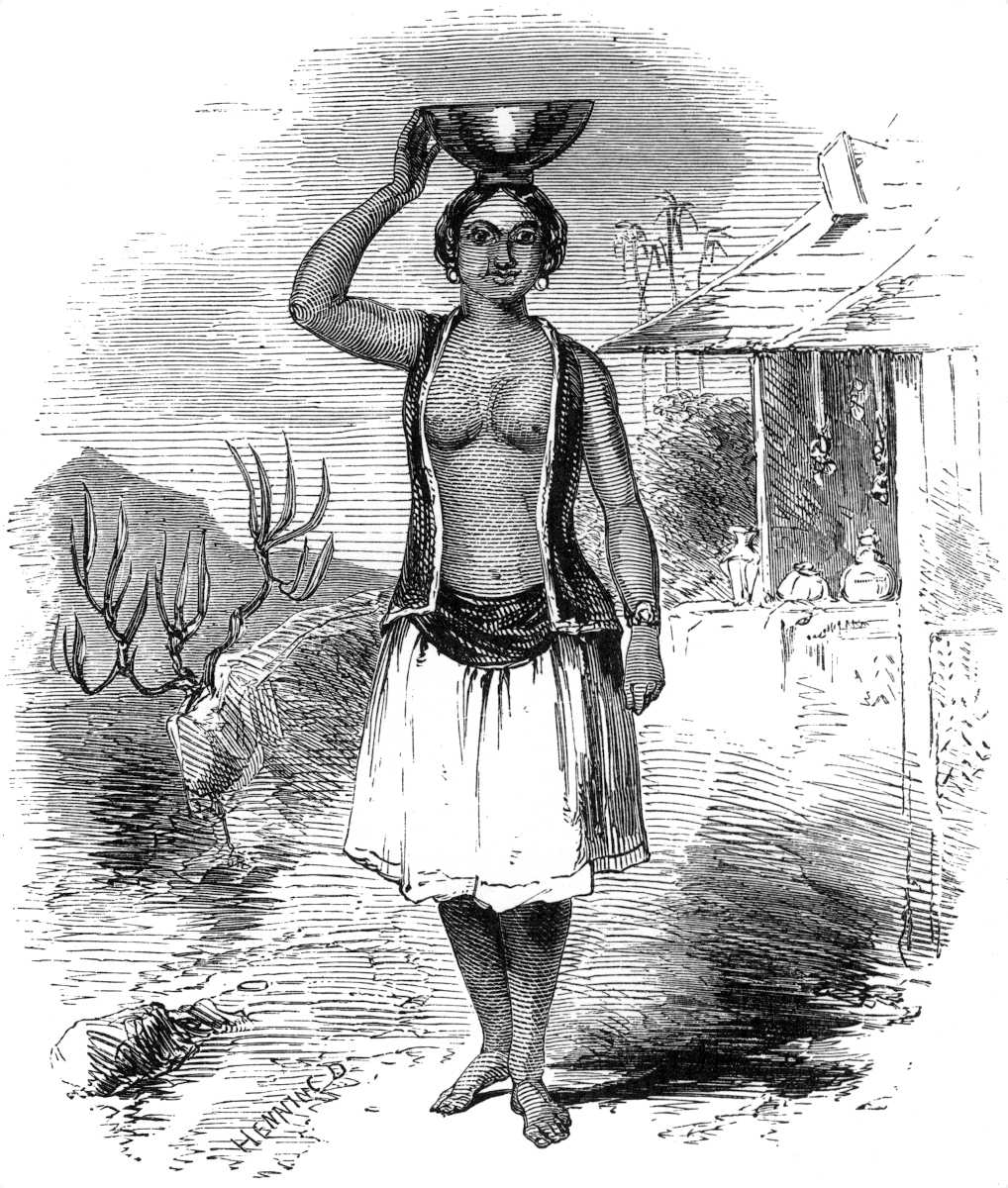
DYAK WOMAN—BORNEO.
[From Marryat’s “Indian Archipelago.”]
From their long intercourse with the Malays, who are all Mohammedans, the Dyaks might have been expected to borrow such of their customs as encourage the savage in the gratification of his animal appetites, and would enable him to live in lordly indolence on the labour of his wives. Monogamy, however, still prevails with all the tribes.
The ceremony of marriage—if such it can be called—is simple to the last degree with all except a few communities, who practise some particular rites. The consent of the woman is necessary to the match, which is made without the intervention of the parents, who, after the mutual willingness of the young people has been expressed, cannot refuse their sanction. The bride and bridegroom meet, a feast is given, and the transaction is concluded.
There are certain restrictions on the immoral intercourse of the young people, to which we have alluded. If a girl becomes pregnant, the father of her child must marry her. Such an occurrence often precedes a match. Men and women live with each other on trial, and if no signs of offspring appear, the acquaintance is discontinued. Constancy during such an intercourse is not rigidly required. Mr. Hugh Low was assured that, in some communities, the laxity of manners was carried so far, that when a chief was travelling from place to place, hospitality required that at every village he should be furnished with a girl as his companion while he rested. Such a practice is general among the Kyans who inhabit a large part of the interior of Borneo. The fear of not becoming the father of a family—a misfortune greatly dreaded by the Dyaks—is supposed to encourage the loose intercourse of the unmarried people, since, as we have said, a man always marries the woman by whom he has a child.
Among the Dyaks who dwell on the hills in the interior, a higher morality prevails. The licentious intercourse of the unmarried people is not permitted. The young and single men are obliged to sleep apart in a separate building, and the girls are carefully kept from them. Marriage is contracted at a very early age, and adultery is almost unknown. Polygamy is not allowed; but some of the chiefs indulge in a second wife or concubine—an infringement of the law which is held in great reprobation, though it cannot be prevented. The degrees of consanguinity within which marriage is prohibited extend beyond cousins. One man shocked the public feeling of his tribe by marrying his granddaughter—his wife and the girl’s mother, his own child, being still alive. The people affirmed that ruin and darkness had covered the face of the sun ever since the day when that incestuous union took place. Nevertheless, as they adhere almost constantly to the practice of marrying within their own tribe, the whole commonwealth comes, in the course of time, to be united by distant ties of blood, which has been assigned as a cause for the cases of insanity not uncommon among them. This may be true, since it is a fact that many royal families, constrained to perpetual intermarriage, have dwindled into a race of imbeciles in consequence. The women put faith in medicines to render them fruitful; but they never resort to the custom of procuring abortion adopted by the Malay prostitutes on the coast. These women eat large quantities of honey, largely mixed with hot spices, which produces the desired result. It is said that among the people of the south numerous public prostitutes are to be found, though this is on the equivocal authority of a German missionary, whose testimony is much to be suspected. No word for prostitution appears to exist in the Dyak language. Among the Malays such women are numerous.
The Sibnouan females present a fair average of the manners prevailing with the various divisions of that singular race. Their women are not concealed, nor are they shy before strangers. They will bathe naked in the presence of men; yet many of the decencies of life are observed. Though the unmarried people sleep promiscuously in a common room, married couples have separate chambers. The labour of the household, with all the drudgery, is allotted to the females; they grind rice, carry burdens, fetch water, catch fish, and till the fields, but are far from occupying the degraded condition of the wives of the North-American Indians; their situation may, indeed, be compared to that of women in the humblest classes in England. They eat with the men, and take part in their concerns as well as their festivals. This is an agricultural and fishing tribe.
Among the Kayans a naked woman cannot under any circumstances be killed, or a woman with child.
Among the Mohammedan Malays, as we have said, there is more civilization and corruption of manners in another form. They are polygamists, indulge in concubines, encourage prostitutes, and sometimes treat their wives with great tyranny. An English physician lately received a message from one of the wives of a chief—celebrated for fostering privacy—desiring a secret interview with him at a secluded spot in the jungle. He went with the high belief that the woman was enamoured of his good looks. He met her, found her young and pretty, but with an air of firmness and dignity which showed that it was no frivolous purpose which had led her to take so dangerous a step. She complained of her miserable life, of the despotism under which she suffered, declared she would endure it no longer, and requested the doctor to furnish her with a small dose of arsenic to poison, not herself, but her husband. Of course he refused, and the poor creature went away sorely disappointed.
The rich Malays allow their wives to keep female slaves for their service. The position of these captives is, under any circumstances, unenviable; should, however, one of them, by her personal qualities, excite the jealousy of her mistress; her case is miserable, until she can procure another owner. Sometimes the slaves are used as concubines, when by law they become free, though they seldom avail themselves of their liberty, preferring to be supported by their old masters, while prostituting themselves to others. The wealthy chiefs spend large sums in the purchase of concubines. The marriage ceremony is performed according to the ritual of the Koran, but is often neglected.
The prostitutes who congregate in the seaport towns have not been particularly described. They appear to be divided into classes: those who cohabit temporarily with the Malays, are paid a certain price, and exchange their residence; those who prostitute themselves indiscriminately to all comers; and those who are supported by the sailors, and profligate Chinese, who invariably create such a class wherever they settle. Of their numbers we have no account, nor of their modes of life; but it is certain they exist in considerable numbers[68].