OF PROSTITUTION AMONG THE BARBAROUS NATIONS. (continued 2)
Reading edition
Formerly many of the chiefs dwelling on the coast were known to derive a part of their revenue from the prostitution of young females. It was, indeed, converted into a regular trade, and to a great extent with the European ships visiting the group. The handsomest and plumpest women in the villages were chosen, and bartered for certain sums of money or articles of merchandise, some for a longer, some for a shorter period. The practice is now, if not abolished, at least held in great reprobation, as the following anecdote will show. It exhibits the depraved manners of the people in a striking light, and is an illustration of that want of affection between married people which has been remarked as a characteristic of the New Zealanders. A chief from Wallatani, in the Bay of Plenty, went on an excursion to the Bay of Islands, and was accompanied by his wife and her sister. There he met a chief of the neighbourhood, who possessed some merchandise which he coveted. He at once offered to barter the chastity of his wife for the goods, and the proposal was accepted. The woman told her sister of the transaction, and she divulged the secret. So much reproach was brought upon the chief among his people, that he shot his wife’s sister to punish her incontinent tongue.
Jerningham Wakefield describes the arrival of the whalers in port. He mentions as one of the most important transactions following this event, the providing of the company with “wives for the season.” Some had their regular helpmates, but others were forced to hire women. Bargains were formally struck, and when a woman failed to give satisfaction, she was exchanged for another. She was at once the slave and the companion of her master. This is neither more nor less than a regular system of prostitution; but it is gradually going out of fashion, and is only carried on in a clandestine manner in the colonies properly so called. Indeed this is, unfortunately, one of the chief products of imperfect civilization—that vice, which before was open, is driven into the dark; it is not extirpated, but is concealed. A man offered his wife to the traveller Earl, and the woman was by no means loth to prostitute herself for a donation. Barbarians readily acquire the modes of vice practised by Europeans. In the criminal calendar of Wellington for 1846, we find one native convicted and punished for keeping a house of ill-fame.
Extraordinary as it may appear, prostitution in New Zealand has tended to cure one great evil. It has largely checked the practice of infanticide. For, as the female children were usually destroyed, it was on the supposition that, instead of being valuable, they would be burdensome to their parents. This continued to be the case until the discovery was made that by prostituting the young girls considerable profits might be made. It is to Europeans that the introduction of this idea is chiefly owing. The females were then, in many cases, carefully reared, and brought up to this dishonourable calling without reluctance. No difficulty was ever experienced from their resistance, as they would probably have become prostitutes of their own free will, had they not been directed to the occupation. Slavery, which has from the earliest time existed in New Zealand, has supplied the materials of prostitution, female servants being consigned to it. When possessed of any attractions they are almost invariably debauched by their masters, and frequently suffer nameless punishments from the jealous head wife. Concubinage does not, as in some other countries, release a woman from servitude, but she enjoys a privilege which is denied to the chief wife—she may marry again after her master’s death.
Formerly the general custom, however, was for a wife to hang, drown, strangle, or starve herself on the death of her husband. Her relatives often gave her a rope of flax, with which she retired to a neighbouring thicket and died. It was not a peremptory obligation, but custom viewed it as almost a sacred duty. Sometimes three of the wives destroyed themselves, but generally one victim sufficed. Self-immolation is now, indeed, becoming very rare; but it is still the practice for the widow, whether she loved her husband or not, to lament him with loud cries, and lacerate her flesh upon his tomb. Whenever she marries again a priest is consulted to predict whether she will survive the second husband or not. Occasionally we find instances of real attachment between man and wife, such as would sanctify any family hearth; while examples have occurred of women hanging themselves for sorrow, on the death of a betrothed lover.
These, however, are only indications that humanity is not in New Zealand universally debased below the brute condition. The general colour of the picture is dark. Women are degraded; men are profligate; virtue is unknown in its abstract sense; chastity is rare; and prostitution a characteristic of female society. Fathers, mothers, and brothers—usually the guardians of a young woman—prostitute her for gain, and the women themselves delight in this vice. There is, nevertheless, some amelioration observable in the manners of the people, produced by the influence of the English colonies. Those colonies themselves, however, are not free from the stain, as will be shown when we treat of communities of that description in general[59].
Of Prostitution in the Islands of the Pacific.
Among the innumerable islands which are scattered over the surface of the Pacific, we discover various phases of manners developed under different influences. In some of the lonely groups lying out of the usual course of trade or travel, communities exist whose social habits remain entirely pure—that is, unchanged by intercourse with foreigners. In others continual communication through a long period, with white men, has wholly changed the characteristic aspects of the people—given them a new religion, a new moral code, new ideas of decency and virtue, new pleasures, and new modes of life. The same process appears likely, at a future day, to obliterate the ancient system of things. In all the islands of this class, indeed, the reform of manners is not so thorough as the florid accounts of the missionaries would induce us to believe; but those pioneers of civilization have done enough, without assuming more than their due, to deserve the praise of all Christendom. To have restrained the fiercest passions of human nature among ignorant and wilful savages; to have converted base libidinous heathens into decent Christians; to have checked the practice of polygamy; and in many places to have extinguished the crime of infanticide;—these are achievements which entitle the missionaries to the applause and respect of Europe; but it is no disparagement of their labours to show, where it is true, that immense things yet remain to be performed before the islanders of the Pacific are raised to the ordinary level of civilized humanity.
The main family of the Pacific—the Society, the Friendly, the Sandwich, the Navigators’, and the Marquesas Islands—present a state of society interesting and curious. Inhabiting one of the most beautiful regions on the face of the earth, with every natural advantage, the inhabitants of those groups were originally among the most degraded of mankind. Superior to the savage hordes of Africa and the wandering tribes of Australia, they are in physical and intellectual qualities inferior to the natives of New Zealand, though excelling them in simplicity and willingness to learn.
Tahiti may be considered the capital of Polynesia, as it is the head of its politics, trade, and general civilization. Before the settlement of the missionaries and the introduction of a new social scheme, its manners were barbarous and disgusting. The condition of the female sex corresponded to this order of things. It was humiliated to the last degree. Most of the men, by a sacred rite, were rendered too holy for any intercourse with the women except such as was pleasant to their own lusts. It was similar to the tapu of the New Zealanders, but was not, as among them, common to all. It was an exclusive privilege of the males. In consequence of this, women lived in a condition of exile from all the pleasures of life. They never sat at meals with their husbands, dared not eat the flesh of pigs, of fowls, of certain fish, or touch the utensils used by the men. They never entered the houses of their “tabooed” lords, dwelling in separate habitations, which these might enter when they chose. Those of the royal blood, however, were excepted from the action of this law. They might mingle with the other sex, might inherit the throne, and enjoy the advantages of society. With almost all others, beggary, toil, and degradation was the universal lot.
Marriage under such circumstances could not be looked upon as a sacred tie, or even a dignified state. It was held to serve only the purposes of nature and the pleasures of the men. With all, indeed, except the rich, it was a mere unceremonious bargain, in which the woman was purchased, though the parents usually made a present to their son-in-law. Among the nobler orders of society there was a little more parade, though an equal absence of sanctity. A person with a beautiful daughter brought her to some chief, saying, “Here is a wife for you.” If she pleased him he took her from her father’s hands, placed her under the care of a confidential servant, and had her fattened, until old and plump enough for marriage. All her friends assembled with his at the temple, and proceeded to the altar. The bride, with a rope hanging about her neck, was accompanied by a man bearing a bunch of the fragrant fern. Prayers were muttered, and blessing invoked upon the union. Then the names of their ancestors were whispered, and at each one of the leaves was torn. The nearest kinsman of the woman next loosened the rope from about her neck, and delivered her over to the bridegroom, bidding him take her home. Presents of various kinds were made to the newly-married pair, but, with all this ceremony, the tie was merely one of convenience. Within a month the man might tire of his partner and wish to be rid of her. All he had to do was to desire her departure, saying, “It is enough—go away.” She immediately left him, and almost invariably became a prostitute. This process might be repeated as often as he pleased. The caprice of the male sex thus threw numbers of the females into a necessity of supporting themselves by the public hire of their persons. For, although polygamy existed, it was practised only by the rich, since the facility of divorce rendered it more convenient to take one wife, dwell with her a short time, and abandon her for another, than to be troubled or burdened with several at the same time. The wealthy, however, took numerous concubines—indulging in this luxury more than any of the other islanders. In all their customs and national characteristics, if we desire to view them in their original form, we must contemplate the people of those islands as they were twenty years ago. A great change is now apparent among them. The accounts, therefore, published at that period, though improved by later inquiries, afford us the information we are in search of. We are not surprised to find an indolent licentious people, as they were, when under no restraint, addicted to the most odious forms of vice. One natural result of their manner of life was infanticide. It was practised to a frightful extent, and was encouraged by a variety of causes. In the first place, poverty and idleness often induced parents to destroy their children—choosing to suffer that short pang of natural sorrow than the long struggles with starvation which awaited the indigent—even in those prolific islands. Next the common licentiousness produced innumerable bastards, which were generally killed. Thirdly, the social institutions of the country, with the division of classes, contributed to increase the prevalence of the custom—for the fruit of all unequal matches was cast aside. Superstition also aided it, for the priests demanded for their gods frequent oblations of infant blood. The missionary Williams was informed that, from the constant occurrence of wars, women, being abandoned by their husbands, slew their children, whom they knew not how to support. When a man married a girl of inferior rank, two, four, or six of her children were sacrificed before she could claim equality with him, and should she bear any more they were spared. Vanity, too, exercised its influence, for, as nursing impaired the beauty of the women, they sought to preserve their attractions by sparing themselves the labour. Perhaps, however, we should not lay it to the charge of vanity. The miserable women of these islands found in the flower of their persons the only chance of attachment or respect from their husbands. When this had faded, nothing could save them from neglect.
Whatever the cause, the extent of the practice was fearful. Three-fourths of the children were destroyed, and sometimes in the most atrocious manner. A wet cloth placed on the infant’s mouth, the hands clenched round its throat, or the earth heaped over it while alive in a grave, were among the most humane. Others broke the infant’s joints, one by one, until it expired. This was usually the plan of the professional child-killers, of whom there was a class—male and female—though the parents often performed the office themselves. Before the establishment of Christianity, Williams declares he never conversed with a woman who had not destroyed one or two of her offspring. Many confessed to him, as well as to Wilmer, that they had killed, some three, some five, some nine, and one seventeen.
Connected with infanticide was one of the most extraordinary institutions ever established in a savage or a civilized country. This was the Areoi Society. It was at once the source of their greatest amusements and their greatest sorrow, and was strictly confined to the Society group, though indications of a similar thing have been discovered in the Ladrones. The delicacy of the missionary writers—in many instances extremely absurd—has induced them to neglect informing us in detail of the practices and regulations adopted by this society; but enough is known from them, and from less timid narrators, to allow of a tolerably full sketch.
From the traditions of the people it appears that the society was of very ancient date: they said there had been Areois as long as there had been men. Its origin is traced to two heroes—brothers, who, in consequence of some adventures with the gods, were deified, and made kings of the Areoi, which included all who would adhere to them as their lords in heaven. Living in celibacy themselves, they did not enjoin the same on their followers; but required that they should leave no descendants. Thus the great law of the Areois was that all their children should be slain. What the real origin of the institution was it is impossible to discover. This legend, however, indicates a part of its nature.
The Areois formed a body of privileged libertines, who spent their days travelling from province to province, from island to island, exhibiting a kind of licentious dramatic spectacle to the people, and everywhere indulging the grossest of their passions. The company located itself in a particular spot as its head-quarters, and at certain seasons departed on an excursion through the group. Great parade was made on the occasion of their setting out. They bore with them portable temples for the worship of their tutelar gods, and, wherever they halted, performed their pantomimes for the amusement of the people. The priests and others—all classes and things—were ridiculed by them in their speeches, with entire impunity, and they were entertained by the chiefs with sumptuous feasts. There were, however, seven classes of the Areois, of which the first was select and small, while the seventh performed the lower and more laborious parts in their entertainments. Numbers of servants followed them to prepare their food and their dresses, and were distinguished by the name of Fanannan; these were not obliged to destroy their children.
Every Areoi had his own wife, who was sacred from attack. Improper conduct towards her was severely punished, sometimes by death. Towards the wives of other persons, however, no respect was shown; for after one of their vile and obscene spectacles, the members of the fraternity would rush abroad, and commit every kind of excess among the humble people. At their grand feasts, to which the privileged orders only were admitted, numbers of handsome girls were introduced, who prostituted themselves for small gifts to any member of the association.
The practice of destroying all their children, which was compulsory among the Areois, licensed them to every kind of excess. The moment a child was born its life was extinguished—either strangled, stabbed with a sharp bamboo, or crushed under the foot. The professional executioner waited by the woman’s couch, and, immediately the infant came into the world, seized it, hurried it away, and in an instant flung it dead into some neighbouring thicket, or a pit prepared beforehand.
Infanticide was by no means confined to the Areois; it was an universal practice. Generally the sacrifice took place immediately after the birth; for, with the exception of those children demanded by the priests to offer in the temple, it was seldom that an infant allowed to live half an hour was destroyed. Whenever the execution was performed, it was previously resolved upon. The females were killed oftener than the males, and thus sprang up a great disproportion between the sexes, which was evidently owing to this and their often unnatural customs, as, since their abolition, the sexes are nearly equal.
Adultery was sometimes punished with death, but not under the public law. It was optional with the husband to pursue the criminal, or content himself with procuring another wife. A strange state of manners is exhibited by the account we have of the early missionaries arriving in Tahiti. The King Pomare came down to meet them with his wife Idia. This woman, though married to the prince, remaining on friendly terms with him, offering him advice, and influencing his actions by her counsel, was then cohabiting with one of her own servants, who had for some time been her paramour. The King, meanwhile, had taken his wife’s youngest sister as a concubine; but she had deserted him for a more youthful lover, whereupon he contented himself with a girl belonging to the poorer class. Women, indeed, and men of the royal blood, were above the law.
Abandoned wives, and girls who could find no husbands, usually became prostitutes, as distinguished from those who pursued a profligate life from sheer sensuality. They hired themselves out to the young men whom the monopoly of women by the rich constrained to be contented with such companions. We have no information whether they were subject to any especial regulations; what the terms of contract were between them and their temporary cohabitants; how they supported themselves in old age; or, indeed, of anything concerning them, except the general nature of their calling. A large class of these prostitutes dwelt near the ports and anchoring grounds, deriving their means of subsistence from open or clandestine intercourse with the sailors, who willingly paid them with little articles of ornament or utility from Europe.
One of the missionaries of the first company desired to marry a Tahiti woman. His brethren, however, strongly objected to the act; first, because she was a heathen, second, because she was a prostitute. There could not be then found on the island, as they declared themselves on belief, a single undebauched girl above twelve years of age; therefore, in accordance with the Scripture prohibition against marrying a “heathen harlot,” they forbade him forming the connection. Nevertheless he persisted, took the prostitute as wife, and is supposed to have been murdered with her connivance.
Inconstancy among wives, and profligacy among unmarried women, was then a characteristic almost universal in Tahiti. The wide-spread practice of procuring abortion concealed many of the intrigues which took place, and the last crime which began visibly to decrease was that of adultery. Nor could this be a matter of wonder. The education of the people was in a school of licentiousness. The most effective lessons in obscenity were afforded by the priests in the temples, and children of tender years indulged in acts of indescribable depravity. Thus in few parts of the world could be discovered a more corrupt system of manners, a more complete absence of morals, than in Tahiti.
Under the influence of the missionaries a great and beneficial change was produced. French priests have now in a measure superseded them; but even their exertions have not been able to neutralize the good effects of the new code of morals introduced by the English friends of civilization.
As to the actual amount, however, of the good which has been effected, the accounts are contradictory. From the missionaries themselves we learn that Christianity has been firmly established; that the female sex has been elevated to an honourable position; that the Christian rite of marriage is now generally observed; that infanticide is wholly abolished; and that the manners of the people have become comparatively pure. The picture, indeed, drawn by these artists, is vivid and full of charms. We cannot, however, accept it without reserve; for such writers have in many parts of the world been too eager to ring their peals of triumph over the appearance of reform, without inquiring into its substantial and durable nature.
Other accounts insist on the truth of a totally different view. A recent author, a merchant, many years resident in Tahiti, describes the result of missionary labour as a mere skinning over of the corruption which exists. “Even now,” he says, speaking of that island, “a people more ready to abandon themselves to sensuality cannot be found under the canopy of heaven.” And further, in noticing the state of the youthful population, he asserts, “It is a rare thing for a woman to preserve her chastity until the age of puberty.” Delicacy, he proceeds to tell us, is a thing unknown. There is hardly a man who would not wink at his wife’s prostitution, or even abet it, to support himself. The same system of corrupt manners is general throughout the islands. The missionaries, by making adultery and fornication offences punishable by fines—so many dollars each—have set up a species of licence for immorality. The penalty is either eluded or laughed at. Sometimes the woman’s paramour pays the penalty, and continues with her. The morals of the people, therefore, have not been radically reformed. Public decency is observed, but private manners are disgusting. The Tahitians have thus learned hypocrisy, for they now practise secretly what was formerly a recognised custom. The men are jealous of their own race, but will bargain for their wives with Europeans. One was asked the reason of this distinction. He instantly made answer, that when a white man took one of their wives he made her a present, passed on his way, and thought no more of her; but it was very different with their own people, for they would be continually hovering about the woman. The legal penalty for adultery by a single man is a fine of ten hogs to the husband. If it is committed by a married man he pays the ten hogs, while his paramour pays his wife another ten to compensate her for the injury she has suffered; thus the bargain is equal. Divorce is optional on either hand. For prostitution, or fornication of any kind, the missionaries enacted a fine. In a climate, however, where the girl ripens into puberty at the age of eight or nine, this becomes a licence, and immorality is very slightly checked. The depopulation of the group, which is still going on, is mainly owing, says the same author, to physical privations acting on moral depravity; for indigence is the lot of the people, and licentiousness now, as formerly, their besetting sin.
We believe this to be an unfair account of the state of things now existing in Tahiti. The writer[60] is possessed of a strong prejudice against the missionaries, and we are inclined to apply to him, with some modification, the observations of Commodore Wilkes, commander of the recent American exploring expedition in reference to that island. He tells us there is a class of traders who defame the missionaries, as well as a profligate class who hate them, because they forbid intoxicating liquors, have abolished lascivious dances, and prevent women going on board ship to prostitute themselves. One charge against the missionaries is, however, proved: they are guilty of a misjudging zeal amounting to fanaticism, forbidding the women to wear chaplets of flowers, because it is a sinful vanity; such a restriction is worse than ridiculous. The Commodore, however, whom we accept as a judicious and a trustworthy authority, already shows that much good has been effected. The population is now almost stationary—the births and deaths among all ages and both sexes were in 1839 naturally proportionate; Christian marriage is established as the national custom, and polygamy abolished; if infanticide be ever practised, it is as a secret crime; and as for immorality, though by no means extirpated, it has been considerably reduced. “Licentiousness,” says Wilkes, “does still exist among them, but the foreign residents and visitors are in a great degree the cause of its continuance, and an unbridled intercourse with them serves to perpetuate it. Severe laws have been enacted, but they cannot be put in force in cases where one of the parties is a foreigner.” He proceeds to deny that the island is conspicuous in this respect, and believes it would show advantageously in contrast with many countries usually styled civilized.
In the distant Sandwich group a similar system of manners existed before the abolition of idolatry in 1819. There was, however, one singular custom: children bore the rank of their mother, not their father, probably from the reason assigned by other savage races for different laws, that the parentage was never certain. Polygamy was practised, but if the king had a daughter by a noble wife she succeeded to the throne, though he should have numerous sons by the others; in fact, they were no more than concubines, though their offspring were not invariably destroyed, unless the mothers belonged to the humbler class of people; all the king’s illegitimate children, however, were immediately killed. Adultery was punished with death; but intrigues were frequent, and infanticide was practised to a terrible extent. Since the enactment of the laws restraining sexual intercourse, the crime has become comparatively rare, and the progress of depopulation has been arrested.
We must, however, first view the people as they were before these reforms occurred: there was little check upon the intercourse of the sexes, except with regard to married women; the young girls being abandoned almost entirely to a dissolute mode of life, the marriage contract was a loose tie, easily broken, without anything of a sacred or even honourable character. Husbands continually abandoned their wives, who invariably destroyed the children thus left to them in their virtual widowhood, and took to prostitution as a means of life. The practice of procuring abortion was also resorted to, even more than infanticide, and women were sometimes killed by the operation; nevertheless, bastard children are sometimes reared, and the language of the islanders supplies a delicate designation for one of this brood: it is called “one that comes.”
Although the condition of the female sex was degraded, and although the women were for the most part subjected to the will of the chiefs, a few remained to be wedded among the poor, and to follow their own inclinations in the choice of partners. The word “courting” is used among them, or at least a synonymous term, signifying, literally, “we must be crept to.” This indicates some elevation in their social intercourse, but appears to have been a recent introduction. When a man wished to marry a girl, some previous intimacy was supposed. According to their former customs he goes to her, and offers her a present. If she was willing to receive him, the gift was accepted; if not, he went his way. The parents were then consulted. When they consented he at once took home his bride, and all was consummated. When they refused he either abandoned his suit or persuaded his lover to elope with him; or, if possessed of sufficient property and power, forces her away. When once settled in union the wives were usually faithful, though previously they indulged in the utmost profligacy without any check.
The infanticide of the Sandwich Islands presented details still more horrible than the worst of those described in connection with Tahiti. Children six or seven years old, who so far had been carefully nursed, were sometimes sacrificed when their parents became desperate or indolent. An American traveller relates an affecting incident of a man who desired to be rid of his child, while the mother endeavoured to save it. Long altercations took place between them, until the father one day, to put an end to the debate, seized his little son, threw him over his knees, and with a single blow broke his back. The circumstance was related to the king, with a demand for punishment upon the offender. “Whose child was it?” he asked. They answered, “His own.” “Then that is nothing,” he said, “to you or to me.” Usually the office was performed by female child-stranglers, who made it their profession. In a country where marriage, especially among the rich, was simply a compact for temporary or permanent cohabitation, abundance of employment was naturally afforded to those people. The chiefs, it is true, married in the temple, but the addition of ceremonies added not a whit of sanctity or durability to the bond. The first Christian wedding took place in Oalm in 1822, and the rite has since that period been established by law. The edict of 1819, indeed, proclaimed a revolution in the social system of the group. But it is not easy to reform the manners of a whole people. It is a slight task to publish laws, but difficult to enforce them, especially when they assail the most deeply-rooted prejudices, the sentiments, the passions, the religions, and the pleasures, of a numerous community. Idolatry, infanticide, polygamy, concubinage, and prostitution were all prohibited by the declaration of 1819, but are still practised, though in secret, but by no means so extensively as in former times. The financial laws check infanticide. If a man has four children, he is exempt from labour taxes to the king and to his landlord; if five, from the poll-tax also; if six, from all taxes whatsoever. Indeed, the condition of the females has been considerably raised, so that, instead of being the slaves, they are now, at least in some degree, the companions of the men.
Of the actual state of the sex, and the characteristic of manners in the Sandwich group, a fair sketch may be gathered from the facts scattered through the large work of Commodore Wilkes; he went through many districts, and examined minutely the progress of the people under the new code. In one district of Dahu, a small island in the group, no instance of infanticide had occurred (1840) during ten years; the law against the illicit intercourse of the sexes had not tended to increase the practice, and the population, which had been almost swept away, was recovering. In the valley of Halalea the population had been decreasing at the rate of one per cent. for nine years. In 1837, it was 3024—1609 males, 1415 females; and in 1840, 2935—1563 males, 1372 females. The general licentiousness of manners, causing barrenness in the women, with the practice of infanticide and abortion, prevented any increase. In Waiaulea the population of 2640 decreased by 225 in four years; and instances were known of women having six, seven, or even ten children, in as many years, without rearing one of them; the bastards were almost always destroyed, but the new law operated very beneficially to check the intercourse of the sexes; and only one case was known of a woman destroying her child, through fear of the penalty attaching to fornication. It appears probable, however, that the regulation compelling all unmarried women, found pregnant, to work on the public roads, must encourage many unnatural practices; in Hawaii itself, the principal island, where large numbers of men and women formerly lived in promiscuous intercourse—as one woman common to several men—great improvement is visible, and public manners have undergone much change; licentiousness, notwithstanding, is still a prominent characteristic of the people. These observations may be applied generally to the whole of the Sandwich group.
Of the Tonga or Friendly Islands no description equals in completeness, and none exceeds in general accuracy, that by Mariner, compiled by John Martin. According to him, the female sex was not degraded there, old persons of both sexes being entitled to equal reverence; women in particular were respected as such, considered to form part of the world’s means of happiness, and protected by that law of manly honour which prohibits the strong from maltreating the weak. There were many regulations respecting rank which do not belong to this inquiry; but others of the same kind must be alluded to. The young girl, betrothed or set apart to be the wife or concubine of a noble, acquired on that account a certain position in the community. The rich women occupied themselves with various forms of elegant industry, not as professions, but accomplishments; while others made a trade of it.
The chastity of the Tonga people should be measured, in Mr. Martin’s opinion, rather by their own than by others’ ideas of that virtue. Among them it was held the positive duty of a married woman to be faithful to her husband. By married woman was meant one who cohabited with a man, lived under his roof and protection, and ruled an establishment of his. Her marriage was frequently independent of her own will, she being betrothed by her parents, while very young, to some chief or other person. About a third were thus disposed of, the rest marrying by their own consent. She must remain with her husband whether she pleased or not, until he chose to divorce her.
About two-thirds of the females were married, and of these about half continued with their husbands until death; that is, about a third remained married till either they or their partners died. Of the others two-thirds were married, and were soon divorced, marrying again two, three, or four times; a few never contracted any marriage at all; and a third were generally unmarried. Girls below puberty were not taken into this account.
During Mariner’s residence of four years in the islands, where he enjoyed privileges of social intercourse which no native was allowed, he made numerous inquiries, and was led to believe that infidelity among the married women was very rare. He remembered only three successful instances of planned intrigue, with one other which he suspected. Great chiefs might kill their wives taken in adultery, while inferior men beat them. They were under the surveillance of female servants, who continually watched their proceedings. Independently of this also, he considered them inclined to conjugal virtue.
A man desiring to divorce his wife, had to do no more than bid her go, when she became perfect mistress of herself, and often married again in a few days. Others remained single, admitting a man into their houses occasionally, or lived as the mistress of various men from time to time—that is to say, became wandering libertines or prostitutes. Unmarried women might have intercourse with whom they pleased without opprobrium, but they were not easily won. Gross prostitution was unknown among them. The conduct of the men was very different. It was thought no reproach, as a married man, to hold intercourse with other females; but the practice was not general. It was checked by the jealousy of the wife. Single men were extremely free in their conduct; but seldom made attempts on married women. Rape occasionally happened. Captives taken in war had, as a thing of course, to submit, and incurred no dishonour through it. Few of the young men would refuse to seduce an unmarried girl of their own nation, had they the opportunity. Nevertheless, in comparison with the islanders in the surrounding sea, they were rather a chaste than a libertine people.
Commodore Wilkes declares himself glad to confirm the account in “Mariner’s Tonga Islands” as an “admirable and accurate description.” The women are said to be virtuous, and the general state of morals superior far to that of Tahiti. The venereal disease is much less extensively prevalent.
In the Marquesas the curious social phenomenon of polyandrism exists—several men cohabiting with one woman. This is in consequence of the preponderance of the male over the female sex. A young girl may become attached to a youth, and live with him for a short time. A man may then become attached to her, and transfer her, with her lover, to his house, where he supports them both. Infanticide is unknown, but procuring abortion not uncommon. The marriage tie, though a mere private compact signified by an exchange of presents, is, in spite of polyandrism, distinct, binding, and enduring—the parties abiding by the agreement they have made, until another formal agreement to dissolve it. In other parts of the Pacific the contrary system is carried out to an extravagant extent. In the Isle of Rotumah the land is divided into various estates, the property of certain chiefs. Each of these lords of the soil has absolute control over all the women in his district, and not one can marry without his consent. Should he not desire her for himself he allows her to contract the engagement, on receiving a present from the bridegroom. Gifts are exchanged on either side, bowls of cava are drunk, and the ceremony is over. The wife, in this island, has singular power. She may, a few days after the marriage, desire her husband to leave her. He does so for three or four months, and then returns to spend two or three days in her society. She may then request him again to quit the house; and this is repeated until she consents to live with him permanently. Occasionally, when all the preliminaries of the match are arranged, the girl will suddenly revoke her resolution, and refuse to leave her parents’ house. The man may be equally desirous of leaving her at home, and in this case she is henceforward a privileged libertine, and usually lives well upon the gains of prostitution. But if, previously to the contract, she lose her virginity, the punishment is death, which is also inflicted for adultery.
A similar system with respect to the chief’s authority prevails in the Feejee group. All the young girls in his district are at his mercy; he may take them all as concubines if he pleases. When they are allowed to marry they become slaves, living in complete subjection to their husbands, who flog them at will. They are denied the privilege of entering a temple, and are bought, sold, and exchanged, like cattle. Inclined as they are to licentiousness, they have certain ideas of modesty, and wear a girdle round the loins; any girl seen without this covering is put to death.
In the wild isles of the Kingsmill group in the Western Pacific, polygamy prevails; but more consideration is paid to the female sex than in any other part of that great insular region. All the hard labour is performed by the men; the women pursuing only those occupations which are truly domestic and feminine. Men, indeed, beat their wives, but in a similar manner to the lower classes here. If she be vigorous or bold enough, she returns blow for blow, and there is no appeal for him against her retaliation. Chastity is scarcely esteemed a virtue, nor is it considered essential by a man requiring a wife. After marriage, however, continence is strictly required. The adulteress is either put to death or expelled; but, in spite of these punishments, offences of this class are not uncommon. They are encouraged by the laws which forbid the younger brothers of a chief, who are not holders of land, from marriage; for it may be laid down as an axiom that all restrictions upon lawful intercourse with women multiply illicit connections. The adulteress and the prostitute in the Kingsmill Isles, as elsewhere, form the resources of those to whom celibacy is enjoined.
A wife is not bought, but the parents of both contribute to the household stock of the newly-married pair. It would be indecent in the young man to inquire of the girl’s father what is the amount of her dowry. The marriage ceremony is only a feast, which is continued during three days. Children are sometimes betrothed during infancy, and in this case no marriage ceremony is required: as soon as they are sufficiently old they are sent to live together. When this is not the case, the young man makes an offer first to the girl, and, if accepted, next to her parents; but usually carries her off if they do not consent.
On the neighbouring isle of Maluni all the women who are married have been betrothed during childhood; the rest, without exception, being prostitutes, living with the single men, and receiving payment from them.
This is, as usual, in consequence of the rich men having so many wives that only a few women are left to live in common with the poorer sort. Infanticide is not practised, but abortion is continually procured. A woman has seldom more than two, and never more than three children. After the third is born she invariably calls in the aid of a woman to prevent another birth. This is not attended with any shame, but is, on the contrary, considered prudent; with the unmarried females it is invariable.
In the Samoan or Navigators’ group women now enjoy equal privileges with the men, and no indiscriminate intercourse of the sexes is permitted. Polygamy has been very much checked, but is generally regretted. The people say, with a simplicity which takes away its profanity from the expression, “Why should God be so unreasonable as to require them to give up all their wives for his convenience?” Among the unconverted tribes it still prevails as formerly. Girls are betrothed early, and tabooed until marriage, which preserves the general chastity. Infanticide never occurs. Adultery is severely punished, and seldom committed; the marriage ceremony is only a trifling form of exchanging presents. The power of divorce may be exercised by the husband under certain circumstances, but not by the wife. Altogether their morals are of a superior order; and their libertine disposition exercises itself chiefly in the performance of lascivious dances. Everywhere, however, in these seas, except where the power of the missionaries is supreme, the whaling ships, on arriving at a port, attract numbers of prostitutes, who offer themselves to the sailors at various prices. When Coulter made his voyage, not many years ago, the vessel was assailed at the Kingsmill Islands by dozens of these women, who came, some attended by their fathers, mothers, or brothers, to entice the sailors. Some of them were very beautiful, and nearly naked. When he was in bed, in a house on shore, several young girls came in with scarcely any clothing, and asked him to choose a companion, or “wife.” In other places hundreds of prostitutes swarmed down to the beach, performing the most obscene antics. It was so when La Perouse visited the region; it is so now. It was remarked by Cook, and it was remarked by the most recent voyager.
To pass up and down through that prodigious wilderness of sea, visiting each group in succession, and noticing the peculiar manners of all the various insular communities which there exist, would exceed the limits of an ordinary work. Nor would it continue to interest the reader; for there is an unavoidable monotony in the subject, when extended too greatly in reference to one region. What we have described will show that, among the innumerable islands of the Pacific, the original condition of women, before the partial establishment of Christianity, was pitifully degraded, and that the labours of the missionaries have been fruitful in good results. Wherever Christianity has been received, much outward improvement, at least, is visible. And there is something in this. When crime is perpetrated in secret, it is so because it is dangerous or disgraceful; and in proportion as it is either the one or the other the inducement to it will diminish. There is an immense field open in the Pacific; but the exertions of future missionaries may be encouraged by contemplating the good results which have sprung from the labours of those who have gone before them[61].
Of Prostitution among the North-American Indians.
Various as are the phases of civilization in different parts of the earth, no race is more peculiar than the North American Indian. It is alone. It stands apart from the rest of the human family. It resembles no other. In manners, customs, laws, ideas, and religion, the nation occupies its own ground, related by no tie with any of the innumerable tribes of the human family inhabiting the remaining divisions of the world. It has, indeed, exercised the ingenuity of ethnographical philosophers to trace among the North American Indians an identity of social institutions with the people of ancient Israel; but the comparison appears forced except in a few particulars, which seem rather matters of accident, and by no means the prominent characteristics of the Red or the Jewish race.
Until the complete establishment of a civilized society in North America, and before the settlement of peace, our knowledge of the Indian race was most imperfect. We depended on the relations of certain imaginative travellers, who wrote not so much to inform as to startle the reader—a practice not altogether abandoned at the present day. Carver, indeed, with a few others, brought home honest accounts of what he saw, but was not always careful to separate that from what he heard; and thus, even his picture is strangely coloured in some of its details. Later and more scrupulous travellers, however, have investigated the manners of the Indian race, and our acquaintance with it is gradually becoming familiar. Catlin and the various historians have added to our knowledge; so that a clear outline, at least of their social institutions, may be drawn. There are three classes of writers on the subject:—those who paint the red man as poetry incarnate; those who describe him as a vile and drunken barbarian; and those who have the sense to discriminate between the Indian of the seaport town corrupted in the dram-shop, and the Indian of the woods, displaying the original characteristics of his race. It is from such authorities we shall draw our view of the condition of women and the state of morals among them.
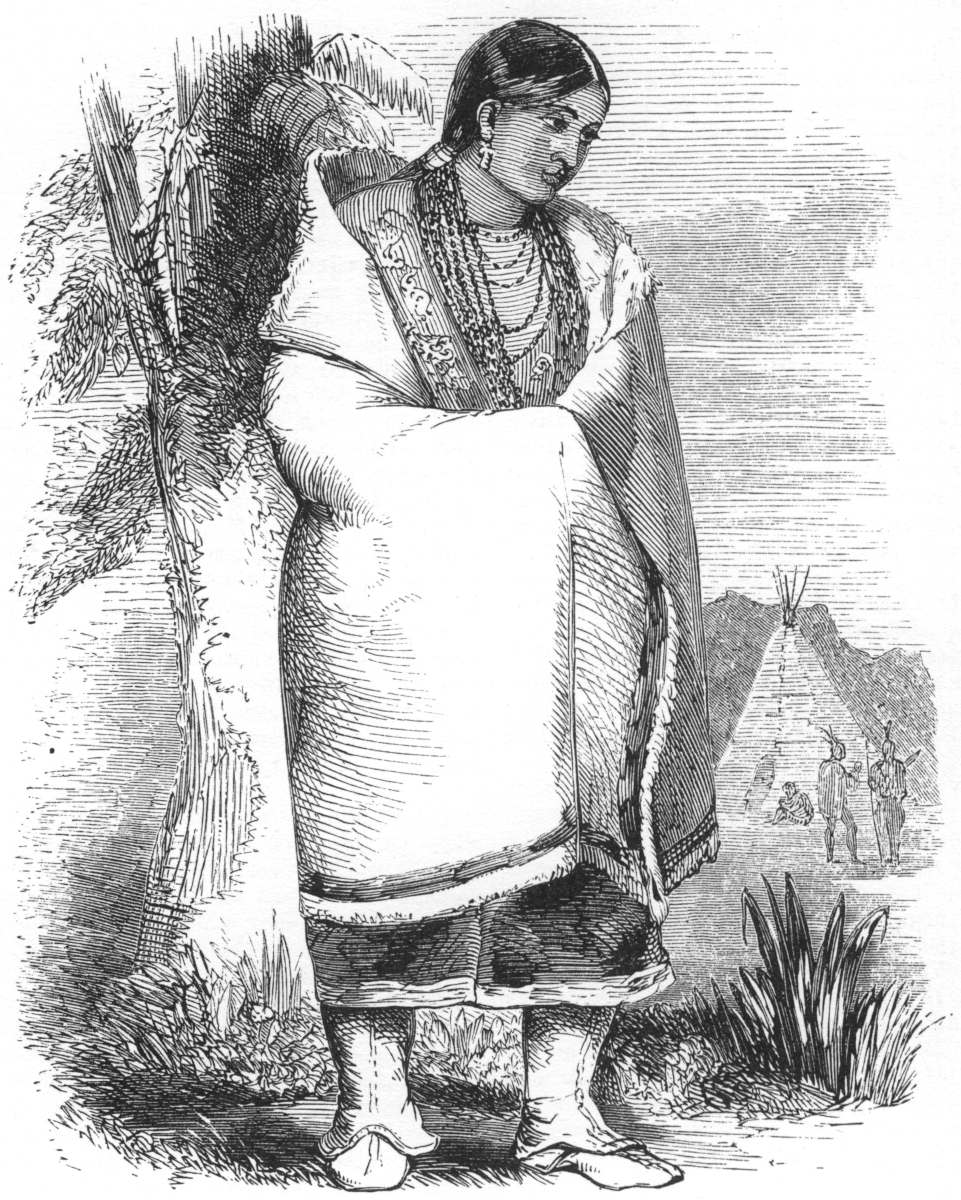
WOMAN OF THE SACS, OR “SÁU-KIES” TRIBE OF AMERICAN INDIANS.
[Copied, by permission, from a Portrait taken by Mr. Catlin, during his residence among the Red Indians.]
A race divided into several nations, and subdivided into innumerable tribes, might be supposed to present a similar diversity of manners. Not so, however. The social institutions of the North-American Indian are generally uniform, though of course there are many varieties of detail in their habits and customs. Yet these are neither so numerous nor so striking as to render it impossible to sketch the whole in a general view.
The Indian loves society. He is never found wandering alone. He is attached also to the company of women. Priding himself, however, on his stoicism, he never, at any period of his history, condescended to voluptuousness. His sense of manly pride prevented him from becoming immodest or indecent. This feeling at the same time inspired him with the idea that everything except the hunt and the war-path was below the dignity of man. The sentiments, therefore, which saved the female sex from becoming the mere food of lust, consigned it to an inferior position. The Indian women formed the labouring class. Such a result was inevitable. The warrior would only follow the chase or fight. There was labour to be performed. No men were to be employed for hire. Whatever, therefore, was to be done must be done by the females. The wife is, consequently, her husband’s slave. She plants the maize, tobacco, beans, and running vines; she drives the blackbird from the corn, prepares the store of wild fruits for winter, tears up the weeds, gathers the harvest, pounds the grain, dries the buffalo meat, brings home the game, carries wood, draws water, spreads the repast, attends on her husband, aids in canoe building, and bears the poles of the wigwam from place to place. Among the trading communities she is especially valuable,—joining in the hunt, preparing the skins and fur, and filling the wigwam with the riches of the prairie, which the men exchange for the means of a luxurious life. When the hunter kills game he leaves it under a tree, perhaps many miles from the “smokes” of his tribe, returns home, and sends his wife to fetch it. Making garments of skins, sewing them with sinews and thorns; weaving mats and baskets; embroidering with shells, feathers, and grass; preparing drugs and administering medicine; and building huts—are among the other offices of the sex. To educate them for this life of industry, the girls are trained by the severe discipline of toils; taught to undergo fatigue, to be obedient, and to suffer without complaining.
Considered as the slaves of the men, it is natural to find a plurality of wives allowed by the Indian social law; accordingly from Florida to the St. Lawrence polygamy is permitted, though some tribes further north have not adopted the practice. Elsewhere also, in other directions, more than one woman is taken into the chief’s wigwam. They are his servants, and he counts them as we count our horses and cattle; some of the great Mandan warriors have seven or eight; indeed, among all the communities which Catlin had an opportunity of visiting, polygamy was allowed, and it was no uncommon thing for him to find six, eight, ten, twelve, or even fourteen wives in the same lodge. The practice is of an antiquity too remote to fix, and is considered not only as necessary, but as honourable and just; they are servants, and a man’s wealth is partly measured by this standard. This is one of the man’s inducements to follow the custom, though it cannot be denied that some of these stoic warriors delight in a harem from the same motives as the Turk or the Hindu. It is allowed, we say, to all, but is principally confined to the great chiefs and medicine men, the others being too humble or too poor to obtain girls from their fathers: there are, indeed, few instances in which an ordinary man has more than one squaw, and it might be supposed that his wigwam was most peaceful; but it is not so. The jealousy of the Indian women is not of the same kind as with Europeans; it is watchful of strangers, not of regular wives, and six or seven of these dwell in great harmony under the same roof. So well established is this usage among them, that civilization meets more resistance in attempting to break it down, than in any other of its efforts; indeed, in overthrowing polygamy among the North-American Indians, or the remnant which is left of them, we shall overthrow their whole social economy and change their national character, and this it will be long before we are able to do. Probably the custom will continue as long as the race exists, and be only extinguished with it. Instances, indeed, have occurred, in which an Indian has sworn obedience to our social law, but many examples also are known of a return to the old habit. Sir George Simpson relates an anecdote of one who came into the settled parts, learned to read and write, adopted the principle of monogamy, and, returning among his countrymen, sought to persuade them to follow the same practice, and acquire the same accomplishments. They held long arguments with him upon the subject, debated gravely, and, in the end, instead of being converted by him, won him back to their ancient institution. He took a great number of wives, forswore books, and alluded no more to his designs of social reform. Some shame, however, possessed his mind, so that, when some Europeans were in the village, he kept in his wigwam and would not see them.
A chief named Five Crows, of the Cayux tribe, offered also to renounce polygamy, but it was from impulse only, and not from the discovery of any social principle. He had five wives, and great wealth in horses, cattle, and slaves. Falling in love, however, with a young Christian girl, the daughter of a gentleman in the service of the Hudson’s Bay Company, he dismissed his old companions, and with great parade and confidence presented himself, made the proposal, but, to his infinite astonishment as well as mortification, was rejected; in a transport of spite, he immediately married one of his own slave girls. Generally, however, the American Indians are far less susceptible of the sentiment of love, still less of sensuality, than natives of Asiatic blood, and women among them are usually viewed with indifference; instances of the contrary occur and will be alluded to.
Whether polygamists or otherwise, the American Indians universally recognise the marriage contract. There is no such thing among them as a tribe practising promiscuous intercourse; the reports of such are idle tales. Such a community would become extinct, in the inevitable course of nature. The circumstances of the contract vary, however, in different parts, and among different societies. In fertile districts polygamy is more common; in barren tracts most of the men of all classes have only one wife. In some communities the man takes his squaw for life, and only divorces her for a recognised cause; in others, no more than a temporary union is expected. Everywhere, however, the condition of the sex is humiliating, if not miserable, and marriage is no more than the conjunction of a master with his servant. Thus the noblest institution of society is perverted into a form of slavery. That polygamy is practised cannot, nevertheless, be lamented in a social view. The frequency of wars among the American Indians, in their original state, caused a disproportion of the sexes, which allowed many of the men to take several wives, without preventing all from having one. Had this custom not been prevalent, one alternative only would have remained to the superfluous women—they would have become common prostitutes.
The conditions and forms of the marriage contract are various only in the inferior details—the general tenour of them being that a man procures a woman from her father as a purchase, and acquires in her a property over which he has the control of a master. Some restrictions, however, are laid upon the intercourse of the sexes. Marriage cannot be contracted among any of the tribes which originally dwelt east of the Mississippi, or indeed anywhere between kindred of a certain degree. The Iroquois warrior may choose a partner from the same tribe, but not the same cabin, or group of wigwams. For it is to be recollected that, among the tribes, especially of the Algonquin race, the whole family, or clan of several families, dwell together, bearing a common designation. One of that nation must look for a wife beyond those who bear the same token or family symbol. The Cherokee would marry at once a mother and her daughter, but never a woman of his own immediate kindred. The Indians of the Red River frequently take two or more sisters to wife at once.
The manners of the Algonquin race are generally similar. The young man desiring a wife offers a gift—or, if he be poor, his friends do it for him—to the girl’s father. If this be accepted, the marriage is complete. He goes to dwell in the woman’s house for a year, surrendering the gains of one hunting season to her family, and then taking her away to a wigwam of his own.
The contract is, with all the other tribes, usually made with the girl’s father; she is virtually bought and sold. In many cases she is never consulted at all, and the whole is a mere mercenary transaction. Instances do occur, also, where the parties approach each other, express mutual affection, make arrangements, and swear vows, sacred and inviolable as vows can be; but the marriage is never consummated without payment to the bride’s father. In the interior of Oregon the permission of the chief is first asked, then the approval of the parents, then the assent of the girl; but if she object, her decision is conclusive. If she consent, the man gives from one to five horses to her father; they have a feast, and the ceremony is complete. Espousals often take place during infancy, but neither is absolutely bound by this engagement. The influence of the parents is, however, so powerful, that their will is seldom or never resisted; so that a bargain is often concluded, and a price paid; while the girl is a child. Occasionally the female courts the male—that is, proposes to become his squaw, and promises to be faithful, good-tempered, and obedient, if he will take her to his hut. He seldom refuses, for polygamy is permitted, and a husband may in this region put away his wife when he pleases. He usually allows each to have a separate fire.
The missionaries in Oregon have had some success, and have displayed more prudence than some of their brethren of the same profession in the island of Tahiti. Men who had a plurality of wives were required, on their conversion, to maintain them; while those who had only one were forbidden to take more.
On the Red River, when a young man desires a girl as wife, he addresses her father, and, if accepted by him, dwells in his wigwam for a year—as among the Algonquins—and then takes her home. This is only observed with the first; he adds to the number, if he is wealthy, as fast as he can. Few of the women are thus left single, and scarcely any common prostitutes are found. Some will occasionally bear children before marriage; and the zeal of the missionary West was displayed in somewhat of a fanatical spirit by his refusing to baptize a child not born in formal wedlock. We may, however, forgive this eccentric spirit for the motive which created it; and must admit that, as Sir George Simpson bears witness, the Indians of Oregon are vastly reformed, and chiefly by missionary influence.
Among the curious customs preceding marriage in other parts of North America, is that of the lover going at midnight into the tent of the woman he desires, and, lighting a splinter of wood, holding it to her face. If she wake and leave the torch burning, it is a sign for him to be gone; if she blow it, he is accepted, and we are told that this frequently leads to immoral intercourse. Catlin knew a young chief of the Mandans on the Upper Missouri, who took four wives in one day, paying for each a horse or two. They were from twelve to fifteen years old, and sat happily in his wigwam, perfectly contented to dwell under his commands. He was applauded for the act. This extreme youth in the bride is common among the tribes; children pass from infancy to womanhood by a single bound—we are assured, on good testimony, that mothers twelve years of age are not unfrequent. The youths are led by precept and example to adopt marriage; celibacy beyond the age of puberty being very rare, especially in those communities which have come into familiar contact with Europeans. It appears indeed that this plan is resorted to by the men to secure virgins as their wives, for among few barbarous nations is the chastity of unmarried woman safe very long after she has reached a marriageable age. To have no husband is esteemed by the females a misfortune and a disgrace, while to have no wife entails great discomfort on a man.
It has already been shown that, when married, the woman becomes her husband’s servitor; that she is, in many cases, the humiliated drudge, in all, the humble attendant on her master; that she waits on him in submissive silence while he eats, and approaches him with the deference due from an inferior to a superior being. Those who infer, however, from these circumstances that the sentiments of conjugal, filial, and parental affection are unknown to the Indian race, think erroneously of them. Strong and tender attachments continually spring up between the sexes. The lover sings of the girl he has chosen, and takes her home with the delight of gratified affection. The husband, too, when he devolves upon his wife all the labours of the wigwam, is no more conscious that he is using her harshly than she is that she occupies an unnatural position. Ideas and sentiments are often no more than things of habit, and with the Indian chief strong love is not inconsistent with his walking in lordly indolence along the forest path while she is bearing the heavy wigwam poles behind. Heckewelder relates a singular instance of indulgence, which, it must be confessed, is rare among the barbarians of North America. There was a scarcity in the district inhabited by a certain tribe, and an Indian woman, being sick, expressed a strong desire for a mess of Indian corn. Her husband having been told that a trader at Lower Sandarsky had a little, set off on horseback for that place, a hundred miles distant, gave his steed in exchange for a hatful of grain, returned home on foot, and gratified his wife by the treat he had thus procured. It is seldom that the most polished society presents a similar instance of kindliness. Many pictures of domestic happiness are exhibited among the Indians. The Blackfeet, Sanee, and Blood Indians, reckon it among their chief desires that their wives may live long and look young. Smoke sometimes rises for forty years from the same hearth, with one couple presiding over it. On the other hand, the husband’s infidelity or harshness sometimes drives his wife to suicide, for the woman has no protector. The life of hardship they lead soon strips them of all their personal beauty, when they are entirely consigned to toil. In spite of this, they are well fed, healthy, and robust, unlike the women of Australia who are stinted in food, and often deformed or crippled by the severity of their labour. Nature has been very indulgent to them. Scarcely any have more than five, and few more than three children. Easy travail takes away one affliction from their lot. The pains of delivery are seldom prolonged for more than a quarter of an hour, and she who groans under the acutest pang is prophesied, with a taunt, to be the mother of cowards. Death, however, occasionally ensues. The Indian mother loves her children dearly, never trusting it to a hireling nurse—which indeed could not be found; for no woman would put away her own infant to suckle another’s. Bearing the cradle on her back she performs her daily task, and if she die the nursling is laid in her grave. One curious and beautiful custom is that of carrying the cradle of a dead nursling child for a whole year, and all are familiar with the story of the Canadian mother bedewing the grave of her child with milk from her bosom. Infanticide is a rare and secret crime, not by any means to be enumerated among the characteristics of their manners.
Marriage among the North-American Indians is contracted for the happiness and comfort of the man. He is bound to live with his wife only so long as these are enjoyed. Adultery, indolence, intemperance, and sterility are among the causes of divorce. It takes place without formality by simple separation or desertion; and where there are no children is very easy. Their offspring forms their most powerful bond; for, where the mother is discarded, the unwritten law of the red man allows her to keep the children whom she has borne or nursed. The husband detecting his wife in adultery may cut off her nose, or take off part of her scalp. He sometimes kills her with her paramour at once; and the only blame attached to him on the occasion is, descending from his dignity to feel so strongly the loss of one woman, when another may easily be procured to supply her place.
The idea of chastity as a positive virtue is but feebly developed among them. With the men, indeed, it is a Spartan quality, as opposed to effeminacy; otherwise, the promiscuous sleeping of whole families in the same chamber, with various other circumstances, would tend much to immorality. Nevertheless, among some tribes, as that of the Mandans, the women are delicate and modest; and in the wigwams of the respectable families virtue is as cherished, and as unapproachable, as anywhere in the world. Generally the Indians are decent, and, with the exception of those customs which form the basis of their manners, and result directly from their national character, might be won over without difficulty to the amenities of civilized life. Many of the squaws, of course, in North America, as elsewhere, are immodest, and seek occasion to engage in an intrigue. With the unmarried girls the same is the case. A bastard child may be born without entailing great shame upon its mother, though the seducer is greatly despised; but such an occurrence is rare, not altogether, however, because the females are too chaste, but because they are too cautious, and employ means to procure abortion. This practice is sometimes resorted to by the squaws, though discountenanced by the men, except when they are on the march, or hotly pressed by an enemy.
From a notice of their punishments in Hunter’s narrative of his captivity, it would appear that the last act of depravity is not unknown among the Indians. Adultery, he tells us, where not perpetrated by the husband’s consent, is punishable with divorce. We might doubt the testimony of this writer, but that Wilkes found Indians in the far north, within the range of the Hudson’s Bay territories, who would gamble away their wives, and prostitute them for money. These men he believed to be degraded from their original condition, but various authors speak of a similar practice. Carver relates that, among the Manedowessis, it was a custom when a young woman could not get a husband, for her to assemble all the chief warriors of the tribe in a spacious wigwam, to give them a feast, and then, retiring behind a screen, to prostitute herself to each in succession. This gained her great applause, and always insured her a husband. It was, however, nearly obsolete when he wrote, and appears now to be altogether extinct.
Many of the Europeans dwelling on the Red River were accustomed to take concubines during the period of their residence there. The Indians, who are civilized, as it is called, in the provinces of Nova Scotia, New Brunswick, and Canada, have thus learned also the worst vices of Europe. Maclean, a very recent writer, declares that the Christianized tribes in the Hudson’s Bay territories have been deteriorated by intercourse with the whites, become drunken, sensual, and depraved. The venereal disease commits frightful ravages among them. Most of their diseases arise from excess of one kind or another. He says that the men employed by the Company are chiefly reconciled to their hard employment and poor remuneration by the immorality of the women, of whom large numbers follow the occupation of prostitutes, and sell themselves for the vilest price. On the north-west coast, chastity is scarcely even a name; indeed, there is no word in the language of the people to express that idea. The sea tribes are, indeed, in all cases, the most licentious; which appears to justify the remark, that intercourse with a strange unsettled population has demoralized them.
At some parts of the coast where the trading ships touch for supplies, hundreds of women come down, and, by an indecent display of their persons, endeavour to obtain permission to go on board. When Sir George Simpson arrived at one of these ports a man asked for the captain’s wife, and offered his own in exchange. In that part of the country the tyranny over the female sex is even more severe than in the interior. When a man takes a wife, he purchases her as his perpetual property; and if they separate, whether from an offence of hers or his, she must never marry again. She usually takes to clandestine prostitution as a means of living. But such instances as the foregoing are not confined to the coast. In the interior the traveller may observe, wherever a large concourse of Indians is assembled, a number of beautiful and voluptuous-looking women continually mixing in the throng, and throwing their glances upon strangers, or the single young men of the tribe. The Indians have now been removed to a territory beyond the Mississippi; and it is probable their corruption will rapidly increase in proportion to their congregation.
One peculiar feature of the system, introduced of course since Europeans visited the country, remains to be noticed. Many of the white traders, among the tribes of the Upper Missouri, find it good policy to connect themselves by marriage with powerful families, and they procure then the most beautiful girls of the noblest tribes, who aspire with delight to such a station, which usually elevates them above their servile occupations to a life of indolence, ease, and pleasure. These engagements, however, are scarcely marriages—at least in the European sense of the term—ceremonies of any kind being seldom performed. A large price in Indian estimation is paid for the girl, and she is transferred at once to the trader’s house; with equal facility he may annul the contract, leaving his companion to be candidate for another mate, for which her father is not sorry, as he may procure an additional horse again in exchange for her: this is no more than a system of virtual prostitution, in which the woman is hired out as a temporary companion, merely for the pecuniary gain. The trader may procure the handsomest girl in the tribe for two horses; for a gun with a supply of powder and ball; for five or six pounds of beads; for a couple of gallons of whiskey; or a handful of awls. Such is the price at which the Indian chief will prostitute his daughter. Occasionally, it must be added, the couple thus united live together permanently as man and wife, the possibility of which is, indeed, almost always supposed.
The Indians of New Caledonia, though not belonging to the same stock with the red race of North America, may be noticed here: they are extremely profligate; the venereal disease is common among them; and the blessing of a healthy climate is rendered nugatory by the intemperance of the people. Among them, nevertheless, women are held in more estimation than among the red tribes, for the men are not possessed by that sense of lordly dignity which disdains at once to become sensual, and to share the labours of the inferior sex. Women assist in the councils, and those of high rank are even admitted to the feasts. During the fishing season each sex is equally employed, and so in all their other tasks. Lewdness could not be carried to greater excess than it is among them: both men and women are addicted to the vilest crimes; they abandon themselves in youth to the indulgence of their most unbridled lust, and the country owes its rapid decrease of population to the universal depravity of the people. No man marries until his animal appetite is satiated upon the voluntary prostitutes who abound, and then his wife, if dissatisfied with the restraints of matrimony, may refuse to dwell with him; the union is consequently broken by mutual consent, for a certain time or for ever. Meanwhile they addict themselves to their former pleasures, but the woman is nominally prohibited, by law, under pain of death, from cohabiting with any man during this period of separation from her husband; he seldom cares, however, to enforce his right, and she seldom fails to break the law. Polygamy is allowed, but only one woman is actually a wife—the rest are mere concubines; the chief one may be supplanted by a new favourite, when the old one yields without a murmur, though occasionally a woman of violent passions will destroy herself.
To illustrate the general subject of the condition of women among the North-American Indians, we may notice an incident described by the observant traveller Catlin. When, among the Sioux, he proposed to paint the portrait of a woman, his condescension was regarded by the warriors of the community first as incredible and then as ridiculous. It appeared marvellous that he should think of conferring on the females the same honour he had conferred on the medicine men and braves; those whom he selected were laughed at by hundreds of others who were, nevertheless, jealous of the distinction. The men who had been painted said that if the artist was going to paint women and children the sooner he destroyed their portraits the better; the women had never taken scalps, never done anything but make fires and dress, with other occupations equally servile: at length, he explained that the portraits of the men were wanted to show the chiefs of the white nation who were great and worthy among the Sioux nation, while the women were only wanted to show how they looked and how they dressed: by this means he attained his object. Mr. Catlin considers that, on the whole, the Old World has no superior morality or virtue to hold up as an example to the American Indian races. The degradation of the women, however, is denied by none, though a woman of superior courage or contrivance sometimes places herself above the degrading laws which depress the rest of her sex. Thus one whom Catlin saw joined boldly in a dance—though females are only allowed to join in a few of these—played off great feats before the warriors, and for her audacity no less than for her skill was greeted with thundering peals of applause, besides a pile of gifts[62].
Of Prostitution among the Indians of South America.
The plan and purpose of this inquiry will by this time have become obvious to every reader. It is to afford a comparative view of the state of manners throughout the world, with reference to public morals, the condition and the character of the female sex. We have chosen to treat of the barbarians in a separate division of the inquiry, and for this reason have left a large portion of Africa, and by far the greatest portion of North America, for future pages. With respect to South America, its various states will be classed among those half-barbarous communities, which we shall take as the link between the savage and the civilized portions of the globe; for, in spite of the dreams in which some romantic travellers have indulged, Lima is only fit to be compared with Algiers, and Brazil with Morocco. Leaving, therefore, these half-caste societies, as we shall next turn to them in a separate notice, we may briefly treat of the Indian race which still, though in numbers awfully reduced, clings to its native soil in South America.
A very brief description will suffice. Remembering the difference of character between the Indian of the North and the Indian of the South, we may, in most respects, apply our last notices to the present subject. The barbarians with whom we have now to deal are not possessed by that rigid masculine vanity which inspires them with a contempt not only of the female sex, but of the pleasures they furnish to men of more sensual temperaments and more effeminate mould. They have less pride, but not more manliness than the Indians of the Red Race. There is no comparison, in point of mental and moral character, between the savage of the Brazilian forest and the stately Huron or Iroquois, or the warrior of the Algonquin race.
Two classes of Indians exist in South America—the pure native, and the breed corrupted by intercourse with Europeans, half-castes, and the rest of that variety of colours which have been produced between the white and the original tenant of the soil. The first is now an exceedingly small family, and some accounts have represented it as eminent for virtue and simplicity. We know that romantic pictures have been drawn of the golden days when Montezuma reigned in the Valley of Mexico, and gave laws to the free population of the country; but sober research has dissipated the idea that he was the governor of a civilized and polished nation. Superior, indeed, the Mexicans were to the savages who occupied so large a portion of the New World, but they were deficient in many of the arts, and gross in many of the manners which assist in comparing the standard of a people’s progress. This much has been ascertained, though it is little. At the present day, the great characteristics of the barbarian state are strongly exhibited in this as in other parts of South America. The miserable remnant of the Indian race grows yearly more debased, learning little from its European preceptors except profligacy and the coarsest arts of vice. Throughout the region women are degraded. The men generally sleep and lounge, or occupy themselves with easy tasks, but more from indolence than pride, while the women perform the labours of the house and of the field. Such is almost the universal practice of Indian manners in South America. Instances of the contrary, indeed, there are. King found among the Chedirrione tribes of the Argentine Republic, a primitive state of society, no less innocent than simple. The women were modest, the men kind to them, and labour was justly shared. All property was in common, and the members of the community lived in perfect brotherhood. This, however, is only one cheerful spot upon the surface of South-American manners. In the Central Region the females are degraded, and chastity a rare virtue. Women may bear children before marriage without shame, and the intercourse of the sexes is unrestrained.
Among the Indians of Brazil a curious system of manners existed before the establishment of European power, and many traces of it still exist. No man might marry until he had killed an enemy. When a girl reached the age of puberty her hair was cut off, her back tattooed, and she wore a necklace of the teeth of wild beasts until her hair grew again. Bands of cotton were fastened about her waist and the fleshy parts of her arms, to signify her maidenhood. It was said that if any but a pure virgin wore these emblems, the evil spirit would bear her away; but the national belief was not sufficiently strong to render this a defence of chastity, for it was lost without reproach or fear, and incontinence was regarded as no offence. Sleeping in crowds, in large common dormitories produced a pernicious effect on the people, destroyed all ideas of decency, and caused universal lewdness. When a man tired of his wife, he put her away and took another; indeed, as many as he pleased. Although unrestrained polygamy was allowed, the first wife, however, continued to enjoy some privileges, as having a separate berth to sleep in, and a separate plot of ground to cultivate for her own use. Nevertheless she was bitterly jealous of those who supplanted her, and frequently, when altogether neglected by her husband, abandoned herself altogether to vice, and became a clandestine prostitute to any of the young men who would flatter or pay her for the favour.
Being regarded, more or less, as property, a man’s wives formed part of his estate, and were bequeathed on his death to his brother or nearest kinsman. The women thus procured were seldom treated with any delicacy or consideration, yet they found sources of happiness, and were often lively and gay to the last degree. When utterly miserable the female sex does not delight to clothe itself in gaudy attire, or adorn itself with sparkling trinkets, as in Brazil, where masculine vanity ran so high that it declared certain ornaments to be the exclusive privilege of men.
In the neighbouring regions there was some variety among the different tribes. The Tyrinambas used their women fairly, though they somewhat overloaded them with employment. They were, however, generally happy, and were principally employed in spinning and weaving—for the industrial arts had reached that stage among them. They also cultivated the ground. On this subject a curious and not unpoetical idea prevailed among some of the Indians of South America. It was, that as females only bore children, so the grain planted by their hands would fructify in a more plentiful increase than that sown by men. Female porters, also, formed a considerable class.
In Paraguay the wars that spread havoc among the miserable people gave rise to a flagitious custom, which destroyed the population more rapidly than pestilence or the sword. No woman ever reared more than one child. The difficulty of subsistence was one cause which induced this custom. The practice of producing abortion was adopted in preference to infanticide, since it inflicted a less violent shock on the natural feelings of the woman. Remonstrated with upon the horror of the crime, one mother replied that an infant was a great incumbrance, that parturition took away from the grace of the figure, rendering her less attractive to the men, and moreover that abortion was easier than delivery. The manner of procuring it was singular. The woman lay down on her back, and was beaten by two aged crones till the result was certain. Many died in consequence of this barbarous process, while others contracted a disease which afflicted them through life. Men and women were equally debauched. Their gregarious habits afforded unlimited opportunities for intrigue, and husbands cared little to whom their wives prostituted themselves, though they regarded them as absolute property, branding them on the thigh or bosom with a hot iron as they did their horses. One peculiar custom obtained among them—the married spoke in a dialect different from that employed by the unmarried people.
Contrasted with this community was the Abifrone, a tribe inhabiting the same region, more long-lived, healthy, and numerous, because they were temperate and chaste. Morality was characteristic of them, and prudence also. The men seldom or never married before the age of thirty, or the women before that of twenty, and were usually continent before contracting that engagement. A wife was purchased from her parents, and was entirely at their disposal, unless bold enough to run away. There was some poetry in the rite of marriage. If the suit was accepted, eight maidens carried a canopy of fine tissue over the bride, who walked in silence, and with downcast eyes, to her husband’s tent. There he received her with signs of love; she then returned, bearing the few domestic articles necessary to their simple mode of life, and her new master dwelt in her father’s house with her until she had borne a child, or he had sufficiently proved his affection towards her. Women were obliged to suckle their children for three years, and forbidden to hold connubial intercourse during that period. This induced the practice of procuring abortion, for the wife feared her husband would forget and abandon her after the long interval. Depopulation was thus caused. Infanticide, also, was practised, but the boys were selected as victims rather than the girls, who were valuable to their parents. The intercourse of the sexes before marriage was rigidly watched; the maidens were educated in habits of industry, and taught to prize their virtue. When the missionaries came among them preaching against polygamy and divorce, the women of this tribe were eager listeners.
Transferring our attention to another part of the South-American Continent, we find among the Sambos of the Mosquito Shore some curious customs. They are not of the Indian race, but closely allied with them in their social habits: when a man commits adultery the injured husband shoots a beeve, takes a horse, or carries off something of value, no matter to whom it may belong, and the proprietor must obtain restitution from the adulterer. Polygamy is practised among them, but one wife is superior to the rest; they marry very young; the Indians of the same country have a plurality of wives, but each must have a separate hut; if the husband makes a present to one, he must make one of equal value to each of the others, and he must spend his time with them equally, week by week.
In Venezuela, among the native tribes, marriage is frequently dispensed with altogether, and cohabitation takes place for a temporary period, or permanently, as the sentiments of the man may incline. This is the case even among the Christianized people, but no blame can be attached to them, poor as they are; for the priests, grasping everywhere, charge such high fees, that marriage is a privilege of the rich.
The same characteristics prevail all over South America, in Chili, Peru, Mexico, and among the Araucanian tribes: the men idle, the women labour; and the national idea is, that one sex is born to command, the other to obey. The Araucanians carry this principle to excess, and do not allow their wives to eat until they are satisfied. When a man desires to have a girl as his wife, he proposes for her to the father; if the father consent, the girl, without being informed of the bargain, is sent out on some pretended errand, when she is seized by her purchaser and carried home to his tent or hut. There a feast is prepared; their friends assemble; her price is paid in horses, cattle, or money, and the ceremony is concluded by a debauch. Immorality among them is rather secret than recognised; in Peru it is affirmed that, among the native Indians, instances of infidelity between man and wife are very rare, for where polygamy is sanctioned and regulated by law, it is by no means inconsistent with chastity.
In New Andalusia the men and women go all but naked, wearing only slight girdles, and appearing strangers to the sentiment of decency. The condition of the female sex is that of privation and labour; yet, though overwhelmed with toil, they appear happier, because naturally more buoyant of heart than the squaws of North America. Even among the Indians on the banks of the Xingu, where the lordly husband lies all day in a hammock, and requires literally to be fed by his faithful wife, the women sing, dance, and seem to enjoy their lives most heartily. So, throughout the whole region, humiliation and slavery form their lot, but their spirit yields willingly to the yoke, which consequently does not pain them.
The regular prostitute class of South America belongs to the half-civilized communities, and will be noticed in our reference to them[63].
Of Prostitution in the Cities of South America.
When we visit the semi-civilized communities of South America, instead of the barbarian tribes still running wild in its deserts of forest, the state of morals we discover presents a contrast by no means favourable to the half-educated States, where a hybrid compromise seems to have been made between refinement and barbarism. The general characteristic of South-American society is profligacy. Almost every city on that continent is demoralized and debauched; Brazil, Mexico, Peru, Chili, all present features very similar, and differing only in the inferior details. Professional prostitutes, indiscriminate in their companionship, form only a small part of the system. Immorality takes many other forms. This, however, we learn only from the general terms in which traveller after traveller has described those regions, especially the cities. Absolute information we have none, except with respect to the station occupied by women, and their moral demeanour in society. Statistics are entirely wanting. All writers seem by mutual consent to have avoided our subject, and left us to conjecture the extent and character of prostitution in Mexico, Rio Janeiro, Lima, and the various other cities of South America.
In Mexico, the women of the upper or idle classes are described as elegant, polished, and fascinating, perfectly easy in society, and attached above all things to the gaieties of life. Their morals appear to be similar to those of the female sex in the older cities of Spain—that is, there are many profligates among them; but a large number are well-conducted, virtuous women, not very timid in society, but not immodest. Among the lower classes the average of Spain may also be adopted—if we may ground an opinion on the vague accounts we receive from travellers.
In Lima, society is far more profligate. The women are superior to the men in little more than affection for their children; in other respects their general conduct is loose. They are devoured with that passion for intrigue—not amounting in many cases to actual adultery—which has been a famous trait in the manners of that country in Europe whence South America has derived all its impress of civilization. One remark which is true of Lima, applies also to the other cities. The veil, which in some countries is worn as the guard of virtue, is here the screen of vice. It is inviolable. The woman so draped may pass her own husband unrecognised, so that she can play truant as she pleases. Two or three females of good station often pay visits at the houses of strange men, without being known. Men sometimes take up with their own wives in the streets, or at some place of public entertainment, or on the alameda, or city promenade, without being aware who their companions are.
The state of manners indicated by frequent allusions to these facts is far from pure. We have also a few other glimpses into the society of Mexico and Lima. In the former there were, in 1842, 491 persons—312 men, and 179 women—committed to prison for “prostitution, adultery, bigamy, sodomy, and incest;” besides 65 men, and 21 women, for “rape and incontinence.” So far for the capital of Mexico.
In Lima, the chief city of Peru, the number of illegitimate children annually born is about 860; and of new-born infants exposed and found dead, 460. Two-thirds of the former, and four-fifths of the latter, belong to the coloured population—which is, indeed, in a proportionate majority. A dead child is picked up without any sensation being excited among the inhabitants of the locality in which it is found. Frequently it is cast away unburied. Ischudi has seen these little carcasses dragged about by vultures, in the public streets.
The white creoles are noted for sensuality, as well as a brutal want of sentiment towards their offspring. The dances in which they indulge are some of them of indescribable obscenity, and the whole population is addicted to demoralizing pleasures. In Lima, however, though delicate modest women are rare, actual adultery is not often committed by that sex. The men seem to obey the exhortation of Cato, who encouraged prostitutes, while he abhorred unfaithful wives—“Courage, my friends; go and see the girls, but do not corrupt the married women.” Concubinage is more common, or rather, perhaps, more public than in Europe, and the father is usually very fond and careful of his natural children. Where marriage is contracted, it is, all over the Continent, fulfilled at an early age. In Brazil the neglect of this institution and the profligate intercourse of the sexes have diminished the population to an immense extent. In Rio Janeiro, however, we are told that the manners of the people have much improved since they have become more republican in their manners and ideas. The women there are shy and retired, but ignorance and awkwardness more than modesty may be assigned as the cause. While slavery was a public institution, which the government desired to abolish, the only restriction in the intercourse of the sexes was among the slaves. Procreation among them was as far as possible prevented; the women and the men in Janeiro were locked up at night in separate apartments, and carefully watched during the day.
In Chili, also, a reform of manners has commenced since the reduction of the military power, which is proverbially demoralizing. The higher classes of females have a character for modesty and virtue, but the men generally indulge themselves in vicious pleasures to a very considerable extent. It is, perhaps, in Brazil that society is most corrupt, for there the common decencies of life are, among the inferior orders, grossly disregarded. Matheson, the traveller, slept in the same room with a young married couple; girls are sold as concubines, and children are hired out by their mothers to prostitution. The youth of that sex bathe, while very young, entirely naked, and afterwards with scarcely any clothing, before the public eye, so that altogether the manners of the people are wanting in decency.
Travellers agree in assigning as one chief cause of this general demoralization, the profligate conduct of the Roman Catholic clergy; their lives are, in many cases—and of course there are many exceptions also—exceedingly scandalous. Numbers of them, bound by their vows to celibacy, live with concubines, and are not even faithful or constant to them. Where the priests have such influence, and indulge in such practices, we may expect to find a low state of morals. That this is the case in the cities of the South America most travellers agree in declaring; but unfortunately their notices are only vague generalities, and we have no positive information as to the extent and character of prostitution in those cities[64].
Of Prostitution in the West Indies.
A very slight notice of the West Indies will suffice, until we arrive at that division of our inquiry which includes the half-civilized communities, and the colonial societies related to Great Britain. Of the barbarous race scarcely a vestige remains, and of the negro population a general view is all that is required, except with reference to the prostitution carried on under the encouragement of the European settlers, which we shall hereafter describe. When Columbus first visited the beautiful islands of the West Indian group, he found two classes of people inhabiting them—the savage and cannibal Caribs, who delighted in war, and preyed upon the weaker and more effeminate tribes; and the comparatively innocent and simple communities, whose unwarlike habits rendered them victims to their more powerful neighbours. The characteristics of these distinct populations were strongly illustrated in their treatment of women. The mild and peaceful islanders admitted the female sex to a participation in the delights and enjoyments of life, allowed their women to mingle with them in the dance, to inherit power, to wear what ornaments they fancied; and shared, indeed, with them all the opportunities of happiness which belonged to their savage condition. Among the cannibal Caribs, on the other hand, a different fashion prevailed. The handsomest and youngest of female captives taken in war were preserved as slaves and companions, while their other prisoners were devoured. The lot of these exiles, however, was little superior to that of the Carib women themselves. The nation was low and barbarous, and accordingly treated its women with harshness and indignity. Proud of their superior power and courage, the men looked down on the females as on an inferior sex, whose degradation was natural and just. Although a wife was awarded as the prize of valour, she was regarded as property acquired. She was her husband’s slave. All the drudgery of his habitation fell on her. She bore his implements for war or for the chase. She carried home the game he had killed; and never sat down to a meal with him, or even dared to eat in his presence. She approached him with abject humility, and if she ever complained of ill usage, it was at the peril of her life. Nevertheless, the child born of this slave was loved and tended with wonderful care. This description, however, must apply to the weaker race of women, not to those Amazons described by Columbus, who, well-trained to war, rivalled in power of muscle and vigour of limb the bull-stranglers of Sparta.