Volume 3 — THE COAL-HEAVERS.
Reading edition
The transition from the artisan to the labourer is curious in many respects. In passing from the skilled operative of the west-end to the unskilled workman of the eastern quarter of London, the moral and intellectual change is so great, that it seems as if we were in a new land, and among another race. The artisans are almost to a man red-hot politicians. They are sufficiently educated and thoughtful to have a sense of their importance in the State. It is true they may entertain exaggerated notions of their natural rank and position in the social scale, but at least they have read, and reflected, and argued upon the subject, and their opinions are entitled to consideration. The political character and sentiments of the working classes appear to me to be a distinctive feature of the age, and they are a necessary consequence of the dawning intelligence of the mass. As their minds expand, they are naturally led to take a more enlarged view of their calling, and to contemplate their labours in relation to the whole framework of society. They begin to view their class, not as a mere isolated body of workmen, but as an integral portion of the nation, contributing their quota to the general welfare. If property has its duties as well as its rights; labour, on the other hand, they say, has its rights as well as its duties. The artisans of London seem to be generally well-informed upon these subjects. That they express their opinions violently, and often savagely, it is my duty to acknowledge; but that they are the unenlightened and unthinking body of people that they are generally considered by those who never go among them, and who see them only as “the dangerous classes,” it is my duty also to deny. So far as my experience has gone, I am bound to confess, that I have found the skilled labourers of the metropolis the very reverse, both morally and intellectually, of what the popular prejudice imagines them.
The unskilled labourers are a different class of people. As yet they are as unpolitical as footmen, and instead of entertaining violent democratic opinions, they appear to have no political opinions whatever; or, if they do possess any, they rather lead towards the maintenance of “things as they are,” than towards the ascendancy of the working people. I have lately been investigating the state of the coalwhippers, and these reflections are forced upon me by the marked difference in the character and sentiments of these people from those of the operative tailors. Among the latter class there appeared to be a general bias towards the six points of the Charter; but the former were extremely proud of their having turned out to a man on the 10th of April, 1848, and become special constables for the maintenance of law and order on the day of the great Chartist demonstration. As to which of these classes are the better members of the state, it is not for me to offer an opinion; I merely assert a social fact. The artisans of the metropolis are intelligent, and dissatisfied with their political position: the labourers of London appear to be the reverse; and in passing from one class to the other, the change is so curious and striking, that the phenomenon deserves at least to be recorded in this place.
The labourers, in point of numbers, rank second on the occupation-list of the metropolis. The domestic servants, as a body of people, have the first numerical position, being as many 168,000, while the labourers are less than one-third that number, or 50,000 strong. They, however, are nearly twice as many as the boot and shoemakers, who stand next upon the list, and muster 28,000 individuals among them; and they are more than twice as many as the tailors and breeches-makers, who are fourth in regard to their number, and count 23,500 persons. After these come the milliners and dressmakers, who are 20,000 in number.
According to the Criminal Returns of the metropolis (for a copy of which I am indebted to the courtesy of a gentleman who expresses himself most anxious to do all in his power to aid the inquiry), the labourers occupy a most unenviable pre-eminence in police history. One in every twenty-eight labourers, according to these returns, has a predisposition for simple larceny: the average for the whole population of London is one in every 266 individuals; so that the labourers may be said to be more than nine times as dishonest as the generality of people resident in the metropolis. In drunkenness they occupy the same prominent position. One in every twenty-two individuals of the labouring class was charged with being intoxicated in the year 1848; whereas the average number of drunkards in the whole population of London is one in every 113 individuals. Nor are they less pugnaciously inclined; one in every twenty-six having been charged with a common assault, of a more or less aggravated form. The labourers of London are, therefore, nine times as dishonest, five times as drunken, and nine times as savage as the rest of the community. Of the state of their education as a body of people I have no similar means of judging at present; nor am I in a position to test their improvidence or their poverty in the same conclusive manner. Taking, however, the Government returns of the number of labourers located in the different unions throughout the country at the time of taking the last census, I find that one in every 140 of the class were paupers; while the average for all England and Wales was one in every 159 persons: so that, while the Government returns show the labourers generally to be extraordinarily dishonest, drunken, and pugnacious, their vices cannot be ascribed to the poverty of their calling; for, compared with other occupations, their avocation appears to produce fewer paupers than the generality of employments.
Of the moral and prudential qualities of the coalwhippers and coalporters, as a special portion of the labouring population, the crude, undigested, and essentially unscientific character of all the Government returns will not allow me to judge. Even the Census affords us little or no opportunity of estimating the numbers of the class. The only information to be obtained from that document—whose insufficiency is a national disgrace to us, for there the trading and working classes are all jumbled together in the most perplexing confusion, and the occupations classified in a manner that would shame the merest tyro in logic—is the following:—
Of coal and colliery agents and factors there are in London16
Ditto dealers and merchants1541
Ditto labourers, heavers, and porters1700
Ditto meters136
Total in the coal trade in London3393
Deduct from this the number of merchants from the London Post Office Directory565
Hence the coal labourers in the metropolis amount to2828
But this is far from being an accurate result. There are at present in London upwards of 1900 (say 2000) registered coalwhippers, and as many more coalbackers or porters. These altogether would give as many as 4000 coal-labourers. Besides, there are 150 meters; so that, altogether, it may be safely said that the number engaged in the whipping and porterage of coals in London is 4000 and odd.
The following statistics, carefully collected from official returns, will furnish our readers with some idea of the amazing increase in the importation of coal:—
“About 300 years ago (say about 1550) one or two ships were sufficient for the demand and supply of London. In 1615, about 200 were equal to its demand; in 1705, about 600 ships were engaged in the London coal-trade; in 1805, 4856 cargoes, containing about 1,350,000 tons; in 1820, 5884 cargoes, containing 1,692,992 tons; in 1830, 7108 cargoes, containing 2,079,275 tons; in 1840, 9132 cargoes, containing 2,566,899 tons; in 1845, 2695 ships were employed in carrying 11,987 cargoes, containing 3,403,320 tons; and during the year 1848, 2717 ships, making 12,267 voyages, and containing 3,418,340 tons. The increase in the importation from the year 1838 to 1848, when the respective importations were 2,518,085 tons and 3,418,340 tons, is upwards of 90 per cent. Now, by taking 2700 vessels as the actual number now employed, and by calculating such vessels to average 300 tons burden per ship, and giving to a vessel of that size a crew of eight men, it will appear that at the present time 21,600 seamen are employed in the carrying department of the London coal-trade.”
Before visiting the district of Wapping, where the greater part of the coal labour is carried on, I applied to the Clerk and Registrar of the Coal Exchange for the statistics connected with the body of which he is an officer. Such statistics—as to the extent of their great traffic, the weekly returns of sales, in short, the ramifications of an inquiry embracing maritime, mercantile, mining, and labouring interests, are surely the weekly routine of the business of the Registrar’s office. I was promised a series of returns by the gentleman in question, but I did not receive and could not obtain them. Another officer, the Secretary of the Meters’ Office, when applied to, with the sanction of his co-officer, the Clerk and Registrar, required a written application which should be attended to! I do not allude to these gentlemen with the slightest inclination unduly to censure them. The truth is, with questions affecting labour and the poor they have little sympathy. The labourer, in their eyes, is but a machine; so many labourers are as so many horse-power. To deny, or withhold, or delay information required for the purposes of the present inquiry is, however, unavailing. The matter I have given in fulness and in precision, without any aid from the gentlemen referred to shows that it was more through courtesy than through necessity that I applied to them in the first instance.
Finding my time, therefore, only wasted in dancing attendance upon city coal officials, I made the best of my way down to the Coalwhippers’ Office, to glean my information among the men themselves. The following is the result of my inquiries:—
The coal-vessels are principally moored in that part of the river called the Pool.
The Pool, rightly so called, extends from Ratcliffe-cross, near the Regent’s-canal, to Execution-dock, and is about a mile long, but the jurisdiction of the Coal Commissioners reaches from the Arsenal at Woolwich to London-bridge. The Pool is divided into the Upper and Lower Pool; it is more commonly called the North and South side, because the colliers are arranged on the Ratcliffe and Shadwell side, in the Lower Pool, and on the Redriff and Rotherhithe side, in the Upper. The Lower Pool consists of seven tiers, which generally contain each from fourteen to twenty ships; these are moored stern to stern, and lie from seven to ten abreast. The Upper Pool contains about ten tiers. The four tiers at Mill-hole are equally large with the tiers of the Lower Pool. Those of Church-hole, which are three in number, are somewhat smaller; and those of the fast tiers, which are also three in number, are single, and not double tiers like the rest. The fleet often consists of from 200 to 300 ships. In the winter it is the largest, many of the colliers in the summer season going foreign voyages. An easterly wind prevents the vessels making their way to London; and, if continuing for any length of time, will throw the whole of the coalwhippers out of work. In the winter, the coalwhipper is occupied about five days out of eight, and about three days out of eight in the summer; so that, taking it all the year round, he is only about half of his time employed. As soon as a collier arrives at Gravesend, the captain sends the ship’s papers up to the factor at the Coal Exchange, informing him of the quality and quantity of coal in the ship. The captain then falls into some tier near Gravesend, and remains there until he is ordered nearer London by the harbour-master. When the coal is sold and the ship supplied with the coal-meter, the captain receives orders from the harbour-master to come up into the Pool, and take his berth in a particular tier. The captain, when he has moored his ship into the Pool as directed, applies at the Coalwhippers’ Office, and “the gang” next in rotation is sent to him.
There are upwards of 200 gangs of coalwhippers. The class, supernumeraries included, numbers about 2000 individuals. The number of meters is 150; the consequence is, that more than one-fourth of the gangs are unprovided with meters to work with them. Hence there are upwards of fifty gangs (of nine men each) of coalwhippers, or altogether 450 men more than there is any real occasion for. The consequence is, that each coalwhipper is necessarily thrown out of employ one-quarter of his time by the excess of hands. The cause of this extra number of hands being kept on the books is, that when there is a glut of vessels in the river, the coal-merchants may not be delayed in having their cargoes delivered from want of whippers. When such a glut occurs, the merchant has it in his power to employ a private meter; so that the 450 to 500 men are kept on the year through, merely to meet the particular exigency, and to promote the merchant’s convenience. Did any good arise from this system to the public, the evil might be overlooked; but since, owing to the combination of the coalfactors, no more coals can come into the market than are sufficient to meet the demand without lowering the price, it is clear that the extra 450 or 500 men are kept on and allowed to deprive their fellow-labourers of one-quarter of their regular work as whippers, without any advantage to the public.
The coalwhippers, previous to the passing of the Act of Parliament in 1843, were employed and paid by the publicans in the neighbourhood of the river, from Tower-hill to Limehouse. Under this system, none but the most dissolute and intemperate obtained employment; in fact, the more intemperate they were the more readily they found work. The publicans were the relatives of the northern shipowners; they mostly had come to London penniless, and being placed in a tavern by their relatives, soon became shipowners themselves. There were at that time seventy taverns on the north side of the Thames, below bridge, employing coalwhippers, and all of the landlords making fortunes out of the earnings of the people. When a ship came to be “made up,” that is, for the hands to be hired, the men assembled round the bar in crowds and began calling for drink, and out-bidding each other in the extent of their orders, so as to induce the landlord to give them employment. If one called for beer, the next would be sure to give an order for rum; for he who spent most at the public-house had the greatest chance of employment. After being “taken on,” their first care was to put up a score at the public-house, so as to please their employer, the publican. In the morning before going to their work, they would invariably call at the house for a quartern of gin or rum; and they were obliged to take off with them to the ship “a bottle,” holding nine pots of beer, and that of the worst description, for it was the invariable practice among the publicans to supply the coalwhippers with the very worst articles at the highest prices. When the men returned from their work they went back to the public-house, and there remained drinking the greater part of the night. He must have been a very steady man indeed, I am told, who could manage to return home sober to his wife and family. The consequence of this was, the men used to pass their days, and chief part of their nights, drinking in the public-house; and I am credibly informed that frequently, on the publican settling with them after leaving the ship, instead of having anything to receive they were brought in several shillings in debt; this remained as a score for the next ship: in fact, it was only those who were in debt to the publican who were sure of employment on the next occasion. One publican had as many as fifteen ships; another had even more; and there was scarcely one of them without his two or three colliers. The children of the coalwhippers were almost reared in the tap-room, and a person who has had great experience in the trade, tells me he knew as many as 500 youths who were transported, and as many more who met with an untimely death. At one house there were forty young robust men employed, about seventeen years ago, and of these there are only two living at present. My informant tells me that he has frequently seen as many as 100 men at one time fighting pell-mell at King James’s-stairs, and the publican standing by to see fair play. The average money spent in drink by each man was about 12s. to each ship. There were about 10,000 ships entered the Pool each year, and nine men were required to clear each ship. This made the annual expenditure of the coalwhippers in drink, 54,000l., or 27l. a-year per man. This is considered an extremely low average. The wives and families of the men at this time were in the greatest destitution, the daughters invariably became prostitutes, and the mothers ultimately went to swell the number of paupers at the union. This state of things continued till 1843, when, by the efforts of three of the coalwhippers, the Legislature was induced to pass an Act forbidding the system, and appointing Commissioners for the registration and regulation of coalwhippers in the port of London, and so establishing an office where the men were in future employed and paid. Under this Act, every man then following the calling of a coalwhipper was to be registered. For this registration 4d. was to be paid; and every man desirous of entering upon the same business had to pay the same sum, and to have his name registered. The employment is open to any labouring man; but every new hand, after registering himself, must work for twenty-one days on half-pay before he is considered to be “broken in,” and entitled to take rank and receive pay as a regular coalwhipper.
All the coalwhippers are arranged in gangs of eight whippers, with a basket-man or foreman. These gangs are numbered from 1 up to 218, which is the highest number at the present time. The basket-men, or foremen, enter their names in a rotation-book kept in the office, and as their names stand in that book so do they take their turn to clear the ship that is offered. On a ship being offered, a printed form of application, kept in the office, is filled up by the captain, in which he states the number of tons, the price, and time in which she is to be delivered. If the gang whose turn of work it is refuse the ship at the price offered, then it is offered to all the gangs, and if accepted by any other gang, the next in rotation may claim it as their right, before all others. In connexion with the office there is a long hall, extending from the street to the water-side, where the men wait to take their turn. There is also a room called the basket-men’s room, where the foremen of the gang remain in attendance. There is likewise a floating pier called a dépôt, which is used as a receptacle for the tackle with which the colliers are unloaded. This floating pier is fitted up with seats, where the men wait in the summer. The usual price at present for delivering the colliers is 8d. per ton; but in case of a less price being offered, and the gangs all refusing it, then the captain is at liberty to employ any hands he pleases. According to the Act, however, the owner or purchaser of the coals is at liberty to employ his own servants, provided they have been in his service fourteen clear days previous, and so have become what the Act terms bonâ fide servants. This is very often taken advantage of, for the purpose of obtaining labourers at a less price. One lighterman, who is employed by the gas companies to “lighter” their coals to their various destinations, makes a practice of employing parties whom he calls the bonâ fide servants of the gas companies, to deliver the coals at a penny per ton less than the regular price. Besides this, he takes one man’s pay to himself, and so stops one-tenth of the whole proceeds, thereby realizing, as he boasts, the sum of 300l. per annum. Added to this, a relative of his keeps a beer-shop, where the “bonâ fide servants” spend the chief part of their earnings, thereby bringing back the old system, which was the cause of so much misery and destitution to the work-people.
According to the custom of the trade, the rate at which a ship is to be delivered is forty-nine tons per day, and if the ship cannot be delivered at that rate, owing to the merchant failing to send craft to receive the coals, then the coalwhippers are entitled to receive pay at the rate of forty-nine tons per day, for each day they are kept in the ship over and above the time allowed by the custom of the trade for the delivery of the coals. The merchants, however, if they should have failed to send craft, and so keep the men idle on the first days of the contract, can, by the by-laws of the Commissioners, compel the coalwhippers to deliver the ship at the rate of ninety-eight tons per day: the merchants surely should be made to pay for the loss of time to the men at the same rate. The wrong done by this practice is rendered more apparent by the conduct of the merchants during the brisk and slack periods. When there is a slack, the merchants are all anxious to get their vessels delivered as fast as they can, because coals are wanting, and are consequently at a high price; then the men are taxed beyond their power, and are frequently made to deliver 150 to 200 tons per day, or to do four days’ work in one. On the contrary, when there is a glut of ships, and the merchants are not particularly anxious about the delivery of the coals, the men are left to idle away their time upon the decks for the first two or three days of the contract, and then forced to the same extra exertion for the last two or three days, in order to make up for the lost time of the merchant, and so save him from being put to extra expense by his own neglect. The cause of the injustice of these by-laws may be fairly traced to the fact of there being several coal-merchants among the Commissioners, who are entrusted with the formation of bye-laws and regulations of the trade. The coalfactors are generally ship-owners, and occasionally pit-owners; and when a glut of ships come in they combine together to keep up the prices, especially in the winter time, for they keep back the cargoes, and only offer such a number of ships as will not influence the market. Since the passing of the Act, establishing the Coalwhippers’ Office, and thus taking the employment and pay of the men out of the hands of the publicans, so visible has been the improvement in the whole character of the labourers, that they have raised themselves in the respect of all who know them.
Within the last few years they have established a Benefit Society, and they expended in the year 1847, according to the last account, 646l. odd, in the relief of the sick and the burial of the dead. They have also established a superannuation fund, out of which they allow 5s. per week to each member who is incapacitated from old age or accident. They are, at the present time, paying such pensions to twenty members. At the time of the celebrated Chartist demonstration, on the 10th of April, the coalwhippers were, I believe, the first class of persons who spontaneously offered their services as special constables.
Further than this they have established a school, with accommodation for six hundred scholars, out of their small earnings. On one occasion as much as 80l. was collected among the men for the erection of this institution.
The men are liable to many accidents; some fall off the plank into the hold of the vessel, and are killed; others are injured by large lumps of coal falling on them; and, indeed, so frequent are these disasters, that the Commissioners have directed that the indivisible fraction which remains, after dividing the earnings of the men into nine equal parts, should be applied to the relief of the injured; and although the fund raised by these insignificant means amounts in the course of the year to 30l. or 40l., the whole is absorbed by the calamities.
Furnished with this information as to the general character and regulations of the calling, I then proceeded to visit one of the vessels in the river, so that I might see the nature of the labour performed. No one on board the vessel (the ——, of Newcastle) was previously aware of my visit or its object. I need not describe the vessel, as my business is with the London labourers in the coal trade. It is necessary, however, in order to show the nature of the labour of coal-whipping, that I should state that the average depth of coal in the hold of a collier, from ceiling to combing, is sixteen feet, while there is an additional seven feet to be reckoned for the basketman’s “boom,” which makes the height that the coals have to be raised by the whippers from twenty-three to thirty feet. The complement of a gang of coalwhippers is about nine. In the hold are four men, who relieve each other in filling a basket—only one basket being in use with coal. The labour of these four men is arduous: so exhausting is it in hot weather that their usual attire is found to be cumbrous, and they have often to work merely in their trousers or drawers. As fast as these four men in the hold fill the basket, which holds 1¼ cwt., four whippers draw it up. This is effected in a peculiar and, to a person unused to the contemplation of the process, really an impressive manner. The four whippers stand on the deck, at the foot of what is called “a way.” This way resembles a short rude ladder: it is formed of four broken oars lashed lengthways, from four to five feet in height (giving a step from oar to oar of more than a foot), while the upright spars to which they are attached are called “a derrick.” At the top of this “derrick” is a “gin,” which is a revolving wheel, to which the ropes holding the basket, “filled” and “whipped,” are attached. The process is thus one of manual labour with mechanical aid. The basket having been filled in the hold, the whippers correctly guessing the time for the filling—for they never look down into the hold—skip up the “way,” holding the ropes attached to the basket and the gin, and pulling the ropes at two skips, simultaneously, as they ascend. They thus hoist the loaded basket some height out of the hold, and, when hoisted so far, jump down, keeping exact time in their jump, from the topmost beam of the way on to the deck, so giving the momentum of their bodily weight to the motion communicated to the basket. While the basket is influenced by this motion and momentum, the basketman, who is stationed on a plank flung across the hold, seizes the basket, runs on with it (the gin revolving) to “the boom,” and shoots the contents into the weighing-machine. The boom is formed of two upright poles, with a cross-pole attached by way of step, on to which the basket-man vaults, and rapidly reversing the basket, empties it. This process is very quickly effected, for if the basket-man did not avail himself of the swing of the basket, the feat would be almost beyond a man’s strength, or, at least, he would soon be exhausted by it.
The machine is a large coal-scuttle or wooden box, attached to a scale connected with 2½ cwt. When the weight is raised by two deposits in the machine, which hangs over the side of the ship, it discharges it, by pulling a rope connected with it down a sliding wooden plane into the barge below. The machine holds 2½ cwt., and so the meter registers the weight of coal unladen. This process is not only remarkable for its celerity but for another characteristic. Sailors, when they have to “pull away” together, generally time their pulling to some rude chant; their “Yo, heave, yo,” is thought not only to regulate but to mitigate the weight of their labour. The coalwhippers do their work in perfect silence: they do it indeed like work, and hard work, too. The basket-man and the meter are equally silent, so that nothing is heard but the friction of the ropes, the discharge of the coal from the basket into the machine, and from the machine into the barge. The usual amount of work done by the whippers in a day (but not as an average, one day with another) is to unload, or whip, ninety-eight tons! To whip one ton, sixteen basketfuls are required; so that to whip a single ton these men jump up and down 144 feet: for a day’s work of ninety-eight tons, they jump up and down 13,088 feet, more in some instances; for in the largest ship the way has five steps, and ten men are employed. The coalwhippers, therefore, raise 1¼ cwt. very nearly four miles high, or twice as high as a balloon ordinarily mounts in the air: and, in addition to this, the coalwhippers themselves ascend very nearly 1½ mile perpendicularly in the course of the day. On some days they whip upwards of 150 tons—200 have been whipped, when double this labour must be gone through. The ninety-eight tons take about seven hours. The basket-man’s work is the most critical, and accidents, from his falling into the hold, are not very unfrequent. The complement of men for the unlading of a vessel is, as I have said, nine: four in the hold, four whippers, and the basket-man—the meter forms a tenth, but he acts independently of the others. They seldom work by candlelight, and, whenever possible, avoid working in very bad weather; but the merchant, as I have shown, has great power in regulating their labour for his own convenience. The following statement was given to me by a coalwhipper on board this vessel:—
“We should like better wages, but then we have enemies. Now suppose you, sir, are a coal-merchant, and this gentleman here freights a ship of the captain—you understand me? The man who freights the ships that way is paid, by the captain, ninepence a-ton, for a gang of nine men, such as you’ve seen—nine coalwhippers—but these nine men, you understand me, are paid by the merchant (or buyer) only eightpence a ton; so that by every ton he clears a penny, without any labour or trouble whatsomever. I and my fellows is dissatisfied, but can’t help ourselves. This merchant, too, you understand me, finds there’s rather an opening in the Act of Parliament about whippers. By employing a man as his servant on his premises for fourteen days, he’s entitled to work as a coalwhipper. We call such made whipper ‘boneyfides.’ There’s lots of them, and plenty more would be made if we was to turn rusty. I’ve heard, you understand me, of driving a coach through an Act of Parliament, but here they drive a whole fleet through it.”
The coal whippers all present the same aspect—they are all black. In summer, when the men strip more to their work, perspiration causes the coal-dust to adhere to the skin, and blackness is more than ever the rule. All about the ship partakes of the grimness of the prevailing hue. The sails are black; the gilding on the figure-head of the vessel becomes blackened, and the very visitor feels his complexion soon grow sable. The dress of the whippers is of every description; some have fustian jackets, some have sailors’ jackets, some loose great coats, some Guernsey frocks. Many of them work in strong shirts, which once were white with a blue stripe: loose cotton neckerchiefs are generally worn by the whippers. All have black hair and black whiskers—no matter what the original hue; to the more stubbly beards and moustachios the coal-dust adheres freely between the bristles, and may even be seen, now and then, to glitter in the light amidst the hair. The barber, one of these men told me, charged nothing extra for shaving him, although the coal-dust must be a formidable thing to the best-tempered razor. In approaching a coal-ship in the river, the side has to be gained over barges lying alongside—the coal crackling under the visitor’s feet. He must cross them to reach a ladder of very primitive construction, up which the deck is to be reached. It is a jest among the Yorkshire seamen that every thing is black in a collier, especially the soup. When the men are at work in whipping or filling, the only spot of white discernible on their hands is a portion of the nails.
There are no specific hours for the payment of these men: they are entitled to their money as soon as their work is reported to be completed. Nothing can be better than the way in which the whippers are now paid. The basket-man enters the office of the pay-clerk of the coal commission at one door, and hands over an adjoining counter an amount of money he has received from the captain. The pay-clerk ascertains that the amount is correct. He then divides the sum into nine portions, and, touching a spring to open a door, he cries out for “Gang such a number.” The nine men, who, with many others, are in attendance in rooms provided for them adjacent to the pay-office, appear immediately, and are paid off. I was present when nine whippers were paid for the discharge of 363½ tons. The following was the work done and the remuneration received:—
Day.Tons.
Dec.14th1st35
„15th2nd56
Sunday intervenes.
„17th3rd84
„18th4th98
„19th5th90½
363½
These 363½ tons, at 8d. per ton, realized to each man, for five days’ work, 1l. 6s. 4¼d.; 10s. of which had been paid to each as subsistence money during the progress of the work. In addition to the work so paid to each, there was deducted a farthing in every shilling as office fees, to defray the expenses of the office. From this farthing reduction, moreover, the basket-man is paid 1½d. in the pound, as commission for bringing the money from the captain. Out of the sum to be divided on the occasion I specify there was an indivisible fraction of 1¼d. This, as it cannot be shared among nine men, goes to what is called “The Fraction Fund,” which is established for the relief of persons suffering from accidents on board coal-ships. These indivisible fractions realize between 30l. and 40l. yearly.
Connected with the calling of the whippers I may mention the existence of the Purlmen. These are men who carry kegs of malt liquor in boats, and retail it afloat, having a license from the Waterman’s Company to do so. In each boat is a small iron grating, containing a fire, so that any customer can have the chill off, should he require that luxury. The purlman rings a bell to announce his visit to the men on board. There are several purlmen, who keep rowing all day about the coal fleet; they are not allowed to sell spirits. In a fog the glaring of the fire in the purlmen’s boats, discernible on the river, has a curious effect, nothing but the fire being visible.
I was now desirous of obtaining some information from the men collectively. Accordingly I entered the basket-men’s waiting-room, where a large number of them were “biding their turn;” and no sooner had I made my appearance in the hall, and my object became known to the men, than a rush was made from without, and the door was obliged to be bolted to prevent the over-crowding of the room. As it was, the place was crammed so full, that the light was completely blocked by the men piled up on the seats and lockers, and standing before the windows. The room was thus rendered so dark that I was obliged to have the gas lighted, in order to see to take my notes; I myself was obliged to mount the opposite locker to take the statistics of the meeting.
There were eighty-six present. To show how many had no employment whatever last week, forty-five hands were held up. One had had no employment for a fortnight; twenty-four no work for eight days. Of those who had worked during the previous week, eight had received 20s.; sixteen between 15s. and seventeen between 10s. and 15s.; ten between 5s. and 10s.; one had received under 5s.; twelve had received nothing. The average of employment as to time is this:—None are employed for thirty weeks during the year; all for twenty-five weeks or upwards, realizing 12s. perhaps, yearly, per week—so many of the men said; but the office returns show 1s. 1½d. per day as the average for the last nine months. “Waterage” costs the whipper an average of 6d. a-week the year through. “Waterage” means the conveyance from the vessels to the shore. Fourteen of the men had wives or daughters who work at slop needlework, the husbands being unable to maintain the family by their own labour. A coalwhipper stated that there were more of the wives of the coalwhippers idle, because they couldn’t get work, than were at work. All the wives and daughters would have worked if they could have got it. “Why, your honour,” one man said, “we are better off in this office than under the old system. We were then compulsory drunkards, and often in debt to a publican after clearing the ship.” The men employed generally spent 12s. to 15s. a-week. Those unemployed had abundant credit at the publican’s. One man said, “I worked for a publican who was also a butcher; one week I had to pay 9s. for drink, and 11s. for meat, and he said I hadn’t spent sufficient. I was one of his constant men.” At the time a ship was cleared, the whipper had often nothing to take home. “Nothing but sorrow,” said one. The publican swept all; and some publicans would advance 2s. 6d. towards the next job, to allow a man to live. Many of the whippers now do not drink at all. The average of the drinking among the men, when at hard work, does not exceed three half-pints a-day. The grievances that once afflicted the coalwhipper, are still felt by the ballast-men. The men all stated the fact as to the 9d. allowed, and the 8d. per ton paid for whipping. They all represented that a lighterman, engaged by the gas companies, was doing them great injury, by employing a number of ‘bonafides,’ and taking the best ships away from the regular office, and giving them to the ‘bonafides’ who “whip” the vessel at a lower rate of wages—about 6d. a-ton. He is connected with a beer-shop, and the men are expected to buy his beer. If this man gets on with his system, (all this the men concurred in stating,) the bad state of things prevailing under the publican’s management might be brought back. Sixteen years ago each whipper received 11¼d. per ton, prices steady, and the men in union. “If it wasn’t for this office,” one man said, “not one man who worked sixteen years ago would be alive now.” The Union was broken up about twelve years ago, and prices fell and fluctuated down as low as 6d., and even 5½d., sometimes rising and falling 1¼d. a-week. The prices continued fluctuating until the present office was established, in 1844. The ship-owners and merchants agreed, at the commencement of the office, to give the whippers 9d. a-ton, and in three months reduced it to 8d. The publicans, it was stated, formed themselves into a compact body for the purpose of breaking down the present system, and they introduced hundreds of fresh hands to undersell the regular workers. In 1847 wages rose again to 9d.; the whippers appealing to the trade, urging the high price of provisions, and their appeal being allowed. This 9d. a-ton continued until the 1st of June last. At that time the ‘bonafides’ were generally introduced, and greatly increased, and getting three times the work the regular men did, they (the regular men) consented again to lower the prices. The ‘bonafides’ are no better off than the regular hands; for though they have much more work they have less per ton, and have to spend more in drink. The coalwhippers represented themselves as benefited by the cheapness of provisions. With dear provisions they couldn’t, at their present earnings, live at all. The removal of the backing system had greatly benefited the whippers. On being asked how many had things in pawn, there was a general laugh, and a cry of “All of us.” It is common to pawn a coat on Monday and take it out on Saturday night, paying a month’s interest. One man said, “I have now in pawn seven articles, all wearing apparel, my wife’s or my own, from 15s. down to 9d.” Four had in pawn goods to the amount of 5l. and upwards; five to 4l.; six to 3l.; thirteen to 2l.; thirteen to 1l.; under 1l. nineteen; five had nothing in pawn. When asked if all made a practice of pawning their coats during the week, there was a general assent. Some could not redeem them in time to attend church or chapel on a Sunday. One man said, that if all his effects were burnt in his absence, he would lose no wearing apparel. “Our children, under the old system, were totally neglected,” they said; “the public-house absorbed everything.” Under that system as many as 500 of the children of coalwhippers were transported; now that has entirely ceased; those charged with crime now were reared under the old system. “The legislature never did a better thing than to emancipate us,” said the man; “they have the blessing and prayers of ourselves, our wives, and children.”
After the meeting I was furnished with the following accounts of a basket-man, of which I have calculated the averages:—
First Quarter.—January 2, 1849, to March 28.
Employed50 days
Delivered2570¼ tons
Amount earned at 9d. per ton£10152½
Deduct expenses of office4s. 6d.01210
Ditto waterage8s. 4d.
£1024½
Average weekly earnings about0166
Second Quarter.—April 7 to June 30.
Employed44 days
Delivered2609 tons
Amount earned at 9d. per ton£10108
Deduct waterage7s. 4d.0118
Office expenses4s. 4d.
£9190
Average weekly earnings0153½
Third Quarter—July 4 to September 24.
Employed42 days
Delivered2485 tons
Amount earned at 8d. per ton£944¾
Deduct waterage7s. 0d.£01010¼
Office expenses3s. 10¼d.
£8136½
Average weekly earnings0142
Fourth Quarter—Oct. 4 to Dec. 20.
Employed49 days
Delivered2858½ tons
Amount earned at 8d. per ton£9164¾
Deduct waterage8s. 2d.0123¾
Office expenses4s. 1¾d.
£941
Average weekly earnings0141¾
First Quarter£1024¼
Second Quarter9190
Third Quarter8136½
Fourth Quarter941
£37190
Average weekly earnings0146
Employed—First Quarter50 days.
Second Quarter44„
Third Quarter42„
Fourth Quarter49„
185 days.
Idle180 days.
Second Account.
Coalwhippers.
Employed193 days
Delivered11,573¾ tons
Amount earned at 9d. per ton£461510¼
Deduct waterage1122
£4538¼
Average weekly earnings0174½
Third Account.
Employed168 days
Delivered9874½ tons
Amount earned£37190
Deduct waterage180
Gross earnings£36110
Average weekly earnings0140½
The above accounts are rather above than under the average.
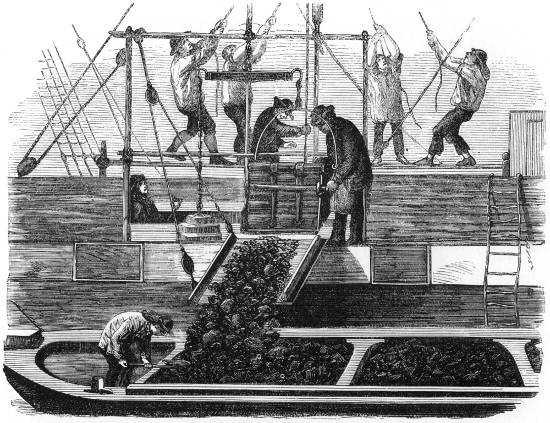
GANG OF COAL-WHIPPERS AT WORK BELOW BRIDGE.
[From a Sketch.]
I then proceeded to take the statement of some of the different classes of the men. The first was a coalwhipper, whom the men had selected as one knowing more about their calling than the generality. He told me as follows:—
“I am about forty, and am a married man with a family of six children. I worked under the old system, and that to my sorrow. If I had been paid in money, according to the work I then did, I could have averaged 30s. a-week. Instead of receiving that amount in money, I was compelled to spend in drink 15s. to 18s. per week, when work was good; and the publican even then gave me the residue very grudgingly, and often kept me from eleven to twelve on Saturday night, before he would pay me. The consequences of this system were, that I had a miserable home to go to: I would often have faced Newgate as soon. My health didn’t suffer, because I didn’t drink the liquor I was forced to pay for. I gave most of it away. The liquors were beer, rum, and gin, all prepared the night before, adulterated shamefully for our consumption, as we dursn’t refuse it,—dursn’t even grumble. The condition of my poor wife and children was then most wretched. Now the thing is materially altered, thank God; my wife and children can go to chapel at certain times, when work is pretty good, and our things are not in pawn. By the strictest economy, I can do middling well—very well when compared with what things were. When the new system first came into operation, I felt almost in a new world. I felt myself a free man; I wasn’t compelled to drink; my home assumed a better aspect, and keeps it still. Last Monday night I received 19s. 7d. for my work (five days) in the previous week. I shall now (Thursday) have to wait until Monday next before I can get to work at my business. Sometimes I get a job in idle times at the docks, or otherwise, and wish I could get more. I may make, one week with another, by odd jobs, 1s. a-week. Perhaps for months I can’t get a job. All that time I have no choice but to be idle. One week with another, the year through (at 8d. per ton), I may earn 14s. The great evil is the uncertainty of the work. We have all to take our rotation. This uncertainty has this effect upon many of the men—they are compelled to live on credit. One day a man may receive 19s., and be idle for eight days after. Consequently, we go to the dealer where we have credit. The chandler supplies me with bread, to be paid for next pay-day, charging me a halfpenny a loaf more. A man with a wife and family of six children, as I have, will consume sixteen or seventeen quartern loaves a-week; consequently, he has to pay 8d. a-week extra on account of the irregularity or uncertainty. My rotation would come much oftener but for the backing system and the ‘bonafides.’ I also pay the butcher from a halfpenny to a penny per pound extra for credit when my family requires meat, sometimes a bit of mutton, sometimes a bit of beef. I leave that to the wife, who does it with economy. I this way pay the butcher 6d. a-week extra. The additional cost to me of the other articles, cheese, butter, soap, &c., which I get on credit, will be 6d. a-week. Altogether that will be 3l. 18s. a-year. My rent for a little house with two nice little rooms is 3s. per week; so that the extra charge for credit would just pay my rent. Many coalwhippers deal with tallymen for their wearing apparel, and have to pay enormous prices. I have had dealings with a tallyman, and suffered for it, but for all that I must make application for a supply of blankets from him for my family this winter. I paid him 45s. for wearing apparel—a shawl for my wife, some dresses for the children, a blanket, and other things. Their intrinsic value was 30s. Many of us—indeed most of us, if not all of us—are always putting things in and out of the pawnshops. I know I have myself paid more than 10s. a-year for interest to the pawnbroker. I know some of my fellow-workmen who pay nearly 5l. a-year. I once put in a coat that cost me 3l. 12s. I could only get 30s. on it. I was never able to redeem it, and lost it. The articles lost by the coalwhippers pledged at the pawnshop are three out of four. There are 2000 coalwhippers, and I am sure that each has 50s. in pawn, making 5000l. in a-year. Interest may be paid on one half this amount, 2500l. The other half of the property, at least, is lost. As the pawnbroker only advances one-third of the value, the loss in the forfeiture of the property is 7500l., and in interest 2500l., making a total of 10,000l. lost every year, greatly through the uncertainty of labour. A coalwhipper’s life is one of debt and struggles—it is a round of relieving, paying, and credit. We very rarely have a halfpenny in the pocket when we meet our credit. If any system could possibly be discovered which would render our work and our earnings more certain, and our payments more frequent, it would benefit us as much as we have been benefited by the establishment of the office.”
I visited this man’s cottage, and found it neat and tidy. His children looked healthy. The walls of the lower room were covered with some cheap prints; a few old books, well worn, as if well used, were to be seen; and everything evinced a man who was struggling bravely to rear a large family well on small means. I took the family at a disadvantage, moreover, as washing was going on.
Hearing that accidents were frequent among the class, I was anxious to see a person who had suffered by the danger of the calling. A man was brought to me with his hand bound up in a handkerchief. The sleeve of his coat was ripped open and dangled down beside his injured arm. He walked lame; and on my inquiring whether his leg was hurt, he began pulling up his trousers and unlacing his boot, to show me that it had not been properly set. He had evidently once been a strong, muscular man, but little now remained as evidence of his physical power but the size of his bones. He furnished me with the following statement:—
“I was a coalwhipper. I had a wife and two children. Four months ago, coming off my day’s work, my foot slipped, and I fell and broke my leg. I was taken to the hospital, and remained there ten weeks. At the time of my accident I had no money at all by me, but was in debt to the amount of 10s. to my landlord. I had a little furniture, and a few clothes of myself and wife. While I was in the hospital, I did not receive anything from our benefit society, because I had not been able to keep up my subscription. My wife and children lived while I was in the hospital by pawning my things, and going from door to door to every one she knowed to give her a bit. The men who worked in the same gang as myself, made up 4s. 6d. for me, and that, with two loaves of bread that they had from the relieving officer, was all they got. While I was in the hospital the landlord seized for rent the few things that my wife had not pawned, and turned her and my two little children into the street. One was a boy three years old, and the other a baby just turned ten months. My wife went to her mother, and she kept her and my little ones for three weeks, till she could do so no longer. My mother, poor old woman, was most as bad off as we were. My mother only works on the ground, out in the country, at gardening. She makes about 7s. a-week in the summer, and in the winter she has only 9d. a-day to live upon; but she had at least a shelter for her child, and she willingly shared that with her daughter and her daughter’s children. She pawned all the clothes she had, to keep them from starving; but at last everything was gone from the poor old woman, and then I got my brother to take my family in. My brother worked at garden-work, the same as my mother-in-law did. He made about 15s. a-week in the summer, and about half that in the winter time. He had a wife and two children of his own, and found it hard enough to keep them, as times go. But still he took us all in, and shared what he had with us, rather than let us go to the workhouse. When I was told to leave the hospital—which I was forced to do upon my crutches, for my leg was very bad still—my brother took me in too. He had only one room, but he got in a bundle of straw for me, and we lived and slept there for seven weeks. He got credit for more than a pound’s worth of bread, and tea, and sugar for us; and now he can’t pay, and the man threatens to summon him for it. After I left my brother’s, I came to live in the neighbourhood of Wapping, for I thought I might manage to do a day’s work at coalwhipping, and I couldn’t bear to live upon his little earnings any longer—he could scarcely keep himself then. At last I got a ship to deliver; but I was too weak to do the work, and in pulling at the ropes my hands got sore, and festered for want of nourishment.” [He took the handkerchief off and showed that it was covered with plaster. It was almost white from deficient circulation.] “After this I was obliged to lay up again, and that’s the only job of work I’ve been able to do for these last four months. My wife can’t do anything; she is a delicate, sickly little woman as well, and has the two little children to mind, and to look after me likewise. I had one pennyworth of bread this morning. We altogether had half-a-quartern loaf among the four of us, but no tea nor coffee. Yesterday we had some bread, and tea, and butter; but wherever my wife got it from I don’t know. I was three days but a short time back without a taste of food.” [Here he burst out crying.] “I had nothing but water that passed my lips. I had merely a little at home, and that my wife and children had. I would rather starve myself than let them do so: indeed, I’ve done it over and over again. I never begged: I’ll die in the streets first. I never told nobody of my life. The foreman of my gang was the only one besides God that knew of my misery; and his wife came to me and brought me money and brought me food, and himself, too, many a time.” [“I had a wife and five children of my own to maintain, and it grieved me to my heart,” said the man who sat by, “to see them want, and I unable to do more for them.”] “If any accident occurs to any of us who are not upon the society, they must be as bad off as I am. If I only had a little nourishment to strengthen me, I could do my work again; but, poor as I am, I can’t get strength to do it, and not being totally incapacitated from ever resuming my labour, I cannot get any assistance from the superannuation fund of our men.”
I told the man I wished to see him at his own home, and he and the foreman who had brought him to me, and who gave him a most excellent character, led me into a small house in a court near the Shadwell entrance to the London Docks. When I reached the place I found the room almost bare of furniture. A baby lay sprawling on its back on a few rags beside the handful of fire. A little shoeless boy, with only a light washed-out frock to cover him, ran shyly into a corner of the room as we entered. There was only one chair in the room, and that had been borrowed down stairs. Over the chimney hung to dry a few ragged infant’s chemises that had been newly washed. In front of the fire, on a stool, sat the thinly-clad wife; and in the corner of the apartment stood a few old tubs. On a line above these were two tattered men’s shirts, hanging to dry, and a bed was thrown on some boxes. On a shelf stood a physic-bottle that the man had got from the parish doctor, and in the empty cupboard was a slice of bread—all the food, they said, they had in the world, and they knew not where on earth to look for more.
I next wished to see one of the improvident men, and was taken to the lodging of one who made the following statement:—
“I have been a coalwhipper for twenty years. I worked under the old publican’s system, when the men were compelled to drink. In those days 18s. didn’t keep me in drink. I have now been a teetotaler for five years. I have the bit of grub now more regular than I had. I earn less than 13s. a-week. I have four children, and have buried four. My rent is 1s. 6d.” [“To-night,” interrupted the wife, “if he won’t part with his coat or boots, he must go without his supper.”] “My wife,” the man continued, “works at bespoke work—stay-making, but gets very little work, and so earns very little—perhaps 1s. 6d. a week.”
This family resided in a wretched part of Wapping, called, appropriately enough, “the Ruins.” Some houses have been pulled down, and so an open space is formed at the end of a narrow airless alley. The wet stood on the pavement of the alley, and the cottage in which the whipper I visited lived, seemed with another to have escaped when the other houses were pulled down. The man is very tall, and almost touched the ceiling of his room when he stood upright in it. The ceiling was as wet as a newly-washed floor. The grate was fireless, the children barefoot, and the bedstead (for there was a bedstead) was bedless, and all showed cheerless poverty. The dwelling was in strong contrast with that of the provident whipper whom I have described.
The Coalbackers.
I conclude with the statement of a coalbacker, or coalporter—a class to which the term coalheaver is usually given by those who are unversed in the mysteries of the calling. The man wore the approved fantail, and well-tarred short smock-frock, black velveteen knee breeches, dirty white stockings, and lace-up boots.
“I am a coalbacker,” he said. “I have been so these twenty-two years. By a coalbacker, I mean a man who is engaged in carrying coals on his back from ships and craft to the waggons. We get 2¼d. for every fifth part of a ton, or 11¼d. per ton among five men. We carry the coals in sacks of 2 cwt., the sack usually weighs from 14lbs. to 20lbs., so that our load is mostly 238lbs. We have to carry the load from the hold of the ship, over four barges, to the waggon. The hold of a ship is from sixteen to twenty feet deep. We carry the coals this height up a ladder, and the ship is generally from sixty to eighty feet from the waggon. This distance we have to travel over planks, with the sacks on our backs. Each man will ascend this height and travel this distance about ninety times in a day; hence he will lift himself, with 2 cwt. of coals on his back, 1460 feet, or upwards of a quarter of a mile high, which is three times the height of St. Paul’s, in twelve hours. And besides this, he will travel 6300 feet, or 1¼ miles, carrying the same weight as he goes. The labour is very hard—there are few men who can continue at it.” My informant said it was too much for him; he had been obliged to give it up eight months back; he had overstrained himself at it, and been obliged to lay up for many months. “I am forty-five years of age,” he continued, “and have as many as eight children. None of them bring me in a sixpence. My eldest boy did, a little while back, but his master failed, and he lost his situation. My wife made slop-shirts at a penny each, and could not do more than three a-day. How we have lived through all my illness, I cannot say. I occasionally get a little job, such as mending the hats of my fellow-workmen: this would sometimes bring me in about 2s. in the week, and then the parish allowed four quartern loaves of bread and 2s. 6d. a-week for myself, wife, and eight children. Since I have overstrained myself, I have not done more than two days’ work altogether. Sometimes my mates would give me an odd seven tons to do for them, for I was not able to manage more.” Such accidents as overstraining are very common among the coalbackers. The labour of carrying such a heavy weight from the ship’s hold is so excessive, that after a man turns forty he is considered to be past his work, and to be very liable to such accidents. It is usually reckoned that the strongest men cannot last more than twenty years at the business. Many of the heartiest of the men are knocked up through the bursting of blood-vessels and other casualties, and even the strongest cannot continue at the labour three days together. After the second day’s work, they are obliged to hire some unemployed mate to do the work for them. The coalbackers work in gangs of five men, consisting of two shovel-men and three backers, and are employed to deliver the ship by the wharfinger. Each gang is paid 11¼d. per ton, which is at the rate of 2¼d. per ton for each of the five men. The gang will do from thirty to forty tons in the course of the day. The length of the day depends upon the amount of work to be done, according to the wharfinger’s orders. The coalbackers are generally at work at five o’clock in the morning, winter and summer. In the winter time, they have to work by the light of large fires in hanging caldrons, which they call bells. Their day’s work seldom ends before seven o’clock in the evening. They are paid every night, and a man after a hard day’s work will receive 6s. Strong, hearty men, who are able to follow up the work, can earn from 25s. to 30s. per week. But the business is a fluctuating one. In the summer time there is little or nothing to do. The earnings during the slack season are about one half what they are during the brisk. Upon an average, their earnings are 1l. a-week all the year round. The class of coalbackers is supposed to consist of about 1500 men. They have no provident or benefit society. Between seventeen and eighteen years ago, each gang used to have 1s. 0½d. per ton, and about a twelvemonth afterwards it fell to the present price of 11¼d. per ton. About six weeks back, the merchants made an attempt to take off the odd farthing; the reason assigned was the cheapness of provisions. They nearly carried it; but the backers formed a committee among themselves, and opposed the reduction so strongly that the idea was abandoned. The backers are paid extra for sifting, at the rate of 2d. per sack. For this office they usually employ a lad, paying him at the rate of 10s. per week. Upon this they will usually clear from 2s. to 4s. per week. The most injurious part of the backer’s work is carrying from the ship’s hold. That is what they object to most of all, and consider they get the worst paid for. They do a great injury to the coalwhippers, and the backers say it would be as great a benefit to themselves as to the coalwhippers, if the system was done away with. By bringing the ships up alongside the wharf, the merchant saves the expense of whipping and lightering, together with the cost of barges, &c. Many of the backers are paid at the public-house; the wharfinger gives them a note to receive their daily earnings of the publican, who has the money from the merchant. Often the backers are kept waiting an hour at the public-house for their money, and they have credit through the day for any drink they may choose to call for. While waiting, they mostly have two or three pots of beer before they are paid; and the drinking once commenced, many of them return home drunk, with only half their earnings in their pockets. There is scarcely a man among the whole class of backers, but heartily wishes the system of payment at the public-house may be entirely abolished. The coalbackers are mostly an intemperate class of men. This arises chiefly from the extreme labour and the over-exertion of the men, the violent perspiration and the intense thirst produced thereby. Immediately a pause occurs in their work, they fly to the public-house for beer. One coalbacker made a regular habit of drinking sixteen half-pints of beer, with a pennyworth of gin in each, before breakfast every morning. The sum spent in drink by the ‘moderate’ men varies from 9s. to 12s. per week, and the immoderate men on the average spend 15s. a-week. Hence, assuming the class of coalbackers to be 2000 in number, and to spend only 10s. a-week in drink each man, the sum that would be annually expended in malt liquors and spirits by the class would amount to no less than 52,000l. The wives and children of the coalbackers are generally in great distress. Sometimes no more than one quarter of the men’s earnings is taken home at night.
“When I was moderate inclined,” said one of them to me, “I used to have a glass of rum the first thing when I came out of a morning, just to keep the cold out—that might be as early as about five o’clock in the morning, and about seven o’clock I should want half a pint of beer with gin in it, or a pint without. After my work I should be warm, and feel myself dry; then I should continue to work till breakfast-time; then I should have another half pint with gin in it, and so I should keep on through the day, having either some beer or gin every two hours. I reckon that unless a man spent about 1s. 6d. to 2s. in drink, he would not be able to continue his labour through the day. In the evening, he is tired with his work, and being kept at the public-house for his pay, he begins drinking there, and soon feels unwilling to move, and he seldom does so until all his wages are gone.” My informant tells me that he thinks the class would be much improved if the system of paying the men at the public-house was done away, and the men paid weekly instead of daily. The hard drinking he thinks a necessity of the hard labour. He has heard, he says, of coalbackers being teetotalers, but none were able to keep the pledge beyond two months. If they drink water and coffee, it will rather increase than quench their thirst. Nothing seems to quench the thirst of a hard-working man so well as ale.
“The only difference between the pay of the basketman and the whipper is the 1½d. in the pound which the former receives for carrying the money from the captain of the ship to the clerk of the pay-office. He has also for this sum to keep a correct account of the work done by the men every day, and to find security for his honesty to the amount of 10l. To obtain this, they usually pay 2s. 6d. a-year to the Guarantee Society, and they prefer doing this to seeking the security of some baker or publican in the neighbourhood, knowing that if they did so, they would be expected to become customers of the parties.”
I now resume my inquiry whether stimulating drinks are necessary for the performance of severe labour.
I have already published the statement of a coalbacker, who declared that it was an absolute necessity of that kind of labour that the men engaged in backing coals from the hold of a ship should, though earning only 1l. per week, spend at least 12s. weekly in beer and spirits, to stimulate them for their work. This sum, the man assured me, was a moderate allowance, for 15s. was the amount ordinarily expended by the men in drink every week. Now if this quantity of drink be a necessity of the calling, it follows that the men pursuing the severest labour of all—doing work that cripples the strongest in from twelve to twenty years—are the worst paid of all labourers, their actual clear gains being only from 5s. to 8s. per week. This struck me as being so terrible a state of things that I could hardly believe it to be true, though I was assured by several coalwhippers who were present on the occasion, that the coalbacker who had made the statement had in no way exaggerated the account of the sufferings of his fellow-workmen. I determined, nevertheless, upon inquiring into the question myself, and ascertaining, by the testimony and experience of different classes of individuals engaged in this, the greatest labour, perhaps, performed by any men, whether drink was really a necessity or luxury to the working man.
Accordingly, I called a meeting of the coalwhippers, that I might take their opinion on the subject, when I found that out of eighty individuals only four were satisfied that fermented liquors could be dispensed with by the labouring classes. I was, however, still far from satisfied upon the subject, and I determined, as the question is one of the greatest importance to the working men,—being more intimately connected with their welfare, physical, intellectual, and moral, than any other,—to give the subject my most patient and unbiassed consideration. I was anxious, without advocating any opinion upon the subject, to collect the sentiments of the coal labourers themselves; and in order that I might do so as impartially as possible, I resolved upon seeing—1st, such men as were convinced that stimulating liquors were necessary to the labouring man in the performance of his work; 2ndly, such men as once thought differently, and, indeed, had once taken the pledge to abstain from the use of all fermented liquors, but had been induced to violate their vow in consequence of their health having suffered; and 3rdly, such men as had taken the pledge and kept it without any serious injury to their constitutions. To carry the subject out with the fulness and impartiality that its importance seemed to me to demand, I further determined to prosecute the inquiry among both classes of coal labourers—the coalwhippers and coalbackers as well. The result of these investigations I shall now subjoin. Let me, however, in the first place, lay before the reader the following
Comparative Table of Drunkenness of the different Trades in London.
Above the Average.
Button-makers, one individual in every7·2
Tool-makers10·1
Surveyors11·8
Paper-makers and Stainers12·1
Brass-founders12·4
Gold-beaters14·5
Millers16·6
French Polishers17·3
Cutlers18·2
Corkcutters19·7
Musicians22·0
Opticians22·3
Bricklayers22·6
Labourers22·8
General and Marine-store Dealers23·2
Brushmakers24·4
Fishmongers28·2
Coach and Cabmen28·7
Glovers29·4
Smiths29·5
Sweeps32·2
Hairdressers42·3
Tailors43·7
Tinkers and Tinmen45·7
Saddlers49·3
Masons49·6
Glassmakers, &c.50·5
Curriers50·6
Printers52·4
Hatters and Trimmers53·1
Carpenters53·8
Ironmongers56·0
Dyers56·7
Sawyers58·4
Turners59·3
Engineers59·7
Butchers63·7
Laundresses63·8
Painters66·1
Brokers67·7
Medical Men68·0
Brewers70·2
Clerks73·4
Shopkeepers77·1
Shoemakers78·0
Coachmakers78·8
Milliners81·4
Bakers82·0
Pawnbrokers84·7
Gardeners97·6
Weavers99·3
Drapers102·3
Tobacconists103·4
Jewellers104·5
Artists106·3
Publicans108·0
Average113·8
Below the Average.
Carvers and Gilders125·2
Artificial Flower Makers128·1
Bookbinders148·6
Greengrocers157·4
Watchmakers204·2
Grocers226·6
Clockmakers286·0
Parish officers373·0
Clergymen417·0
Servants585·7
The above calculations have been made from the Official Returns of the Metropolitan Police. The causes of the different degrees of intemperance here exhibited, I leave to others to discover.
After the meeting of coalwhippers just described, I requested some of the men who had expressed the various opinions respecting the necessity for drinking some kind of fermented liquor during their work to meet me, so that I might take down their sentiments on the subject more fully. First of all, came two of the most intelligent, who believed malt liquor to be necessary for the performance of their labour. One was a basketman or fireman, and the other an “up-and-down” man, or whipper; the first doing the lighter, and the second the heavier kind of work. The basketman, who I afterwards discovered was a good Greek and Latin scholar, said: “If I have anything like a heavy day’s work to do, I consider three pints of porter a-day necessary. We are not like other labouring men, having an hour to dinner. Often, to save tide, we take only ten minutes to our meals. One thing I wish to remark is, that what renders it necessary to have the three pints of beer in winter, and two pots in summer, is the coal-dust arising from the work, which occasions great thirst. In the summer time the basketman is on the plank all day, and continually exposed to the sun, and in the winter to the inclemency of the weather. What with the labour and the heat, the perspiration is excessive. A basketman with a bad gang of men has no sinecure. In the summer he can wear neither coat nor waistcoat; very few can bear the hat on the head, and they wear nightcaps instead. The work is always done, in summer time, with only the shirt and trousers on. The basketman never takes off his shirt, like the whippers. The necessity for drink in the summer does not arise so much from the extent of the labour, as from the irritation caused by the coal-dust getting into the throat. There is not so much dust from the coals in the winter as in the summer, the coals being more damp in wet than in fine weather. It is merely the thirst that makes the drink requisite, as far as the basketman is concerned. Tea would allay the thirst, but there is no opportunity of having this on board ship. If there were an opportunity of having tea at our work, the basketman might manage to do with it as well as with beer. Water I don’t fancy, especially the water of the river; it is very impure, and at the time of the cholera we were prohibited from drinking it. If we could get pure water, I do not think it would do as well for us, especially in winter time. In winter time it would be too cold, and too great a contrast to the heat of the blood. It would, in my opinion, produce stagnation in the circulation. We have had instances of men dying suddenly through drinking water when in a state of excitement.” [He distinguishes between excitement and perspiration: he calls the basketman’s labour an exciting one, and the whipper’s work a heating one.] “The men who died suddenly were whippers. I never heard of a basketman dying from drinking cold water when at his work; I don’t think they ever tried the experiment. The whippers have done so through necessity, not through choice. Tea is a beverage that I don’t fancy, and I conceive it to be equally expensive, so I prefer porter. When I go off to my work early in the morning, I take about a pint of coffee with me in a bottle, and warm it up on board at the galley-fire for my breakfast; that I find quenches my thirst for the time as well as porter. Porter would be too insipid the first thing in the morning; I never drank coffee through the day while at my work, so I cannot say what the effect would be. I drink porter when at my work, not as giving me greater strength to go through my labour, but merely as a means of quenching my thirst, it being as cheap as any other drink, with the exception of water, and less trouble to procure. Water I consider dangerous at our work, but I can’t say that it is so from my own experience. I was in the hospital about seven years ago, and the doctor there asked me how many pints of beer I was in the habit of drinking per day. This was before the office was established. I told him, on the lowest calculation, six or seven; it was the case then under the old system; and he then ordered me two pints of porter a-day, as I was very weak, and he said I wanted a stimulus. I am not aware that it is the habit of the publicans to adulterate their porter with salt and water. If such is the case, it would, without a doubt, increase rather than diminish the thirst. I have often found that the beer sold by some of the publicans tends more to create than allay thirst. I am confident, that if the working men generally knew that salt and water was invariably mixed with the porter by the publicans, they would no longer hold to the notion that it could quench their thirst; but, to convince them of that, it would be almost necessary that they should see the publican adulterating the beer with their own eyes. If it really is the case that beer is adulterated with salt and water, it must be both injurious and heating to the labouring man. Some of the men who are in the habit of drinking porter at their work, very probably attribute the thirst created by the salt and water in the porter to the thirst created by the coal-dust or the work, and continue drinking it from the force of habit. The habit of drinking is doubtlessly the effect of the old system, when the men were forced to drink by the publicans who paid them. A most miraculous change, and one unparalleled in history, has been produced by altering the old mode of employing and paying the men. The reformation in the morals and character of the men is positively wonderful. The sons are no longer thieves, and the daughters are no longer prostitutes. Formerly it was a competition who could drink the most, for he who could do so got the most work. The introduction for a job was invariably, ‘You know, Mr. So and So, I’m a good drinking man.’ Seeing the benefit that has resulted from the men not drinking so much as formerly, I am of opinion that, though I take my beer every day myself, a great good would ensue if the men would drink even less than they do now, and eat more; it would be more conducive to their health and strength. But they have not the same facility for getting food over their work as there is for getting beer. You see, they can have credit for beer when they can’t get a morsel of food on trust. There are no floating butchers or bakers, like there are floating publicans or purlmen. If there were, and men could have trust for bread and meat while at their work on the river, I am sure they would eat more and drink less, and be all the better for it. It would be better for themselves and for their families. The great evil of the drink is, that when a man has a little he often wants more, and doesn’t know where to stop. When he once passes the ‘rubi-can,’ as I call it, he is lost. If it wasn’t for this evil, I think a pint or two of porter would make them do their work better than either tea or water. Our labour is peculiar. The air is always full of coal-dust, and every nerve and muscle of the body is strained, and every pore of the body open, so that he requires some drink that will counteract the cold.”
The next two that I saw were men who did the heaviest work; that is, “up-and-down men,” or coalwhippers, as they are usually called. They had both of them been teetotalers. One had been so for eight years, and the other had tried it for three months. One who stood at least six feet and a half high, and was habited in a long blue great coat that reached to his heels, and made him look even taller than he was, said,—“I was a strict teetotaler for many years, and I wish I could be so now. All that time I was a coalwhipper at the heaviest work, and I have made one of a gang that have done as many as 180 tons in one day. I drank no fermented liquor the whole of the time; I had only ginger-beer and milk, and that cost me 1s. 6d. It was in the summer time. I didn’t ‘buff it’ on that day; that is, I didn’t take my shirt off. I did this work at the Regent’s Canal; and there was a little milk-shop close on shore, and I used to run there when I was dry. I had about two quarts of milk and five bottles of ginger-beer, or about three quarts of fluid altogether. I found that amount of drink necessary. I perspired very violently; my shirt was wet through, and my flannels wringing wet with the perspiration over the work. The rule among us is, that we do 28 tons on deck, and 28 tons filling in the ship’s hold. We go on in that way throughout the day, spelling at every 28 tons. The perspiration in the summer time streams down our foreheads so rapidly, that it will often get into our eyes before we have time to wipe it off. This makes the eyes very sore. At night, when we get home, we cannot bear to sit with a candle. The perspiration is of a very briny nature, for I often taste it as it runs down to my lips. We are often so heated over our work that the perspiration runs into the shoes; and often, from the dust and heat, jumping up and down, and the feet being galled with the small dust, I have had my shoes full of blood. The thirst produced by our work is very excessive; it is completely as if you had a fever upon you. The dust gets into the throat, and very nearly suffocates you. You can scrape the coal-dust off the tongue with the teeth; and do what you will it is impossible to get the least spittle into the mouth. I have known the coal-dust to be that thick in a ship’s hold, that I have been unable to see my mate, though he was only two feet from me. Your legs totter under you, both before and after you are a teetotaler. I was one of the strongest men in the business; I was able to carry 7 cwt. on my back for fifty yards, and I could lift nine half-hundreds with my right-arm. After finishing my day’s work I was like a child with weakness. When we have done 14 or 28 tons, we generally stop for a drop of drink, and then I have found that anything that would wet my mouth would revive me. Cold tea, milk, or ginger-beer, were refreshing, but not so much as a pint of porter. Cold water would give a pain in the inside, so that a man would have to lie down and be taken ashore, and, perhaps, give up work altogether. Many a man has been taken to the hospital merely through drinking cold water over his work. They have complained of a weight and coldness in the chest; they say it has chilled the fat of the heart. I can positively state,” continued the man, “that during the whole of eight years I took no fermented drink. My usual drink was cold tea, milk, ginger-beer, or coffee, whichever I could catch: the ginger-beer was more lively than the milk; but I believe I could do more work upon the milk. Tea I found much better than coffee. Cold tea was very refreshing; but if I didn’t take it with me in a bottle, it wasn’t to be had. I used to take a quart of cold tea with me in a bottle, and make that do for me all day, as well as I could. The ginger-beer was the most expensive, and would cost me a shilling, or more than that if I could get it. The milk would cost me sixpence or eightpence. For tea and coffee the expense would be about twopence the day. But often I have done the whole day’s work without any drink, because I would not touch beer, and then I was more fit to be carried home than walk. I have known many men scarcely able to crawl up the ladder out of the hold, they were so fatigued. For myself, being a very strong man, I was never so reduced, thank God. But often, when I’ve got home, I’ve been obliged to drink three pints of milk at a stretch, before I could touch a bit of victuals. As near as I can guess it used to cost me, when at work, a shilling a-day for ginger-beer, milk, and other teetotal drinks. When I was not at work my drink used to cost me little or nothing. For eight years I stuck to the pledge, but I found myself failing in strength and health; I found that I couldn’t go through a day’s work as clever as I used before I left off drink, and when first I was a teetotaler. I found myself failing in every inch of my carcase, my limbs, my body and all. Of my own free-will I gave it up. I did not do it in a fit of passion, but deliberately, because I was fully satisfied that it was injuring my health. Shortly after taking the pledge I found I could have more meat than I used to have before, and I found that I neither got strong nor weak upon it. After about five years my appetite began to fail, and then I found my strength leaving me; so I made up my mind to alter the system. When I returned to beer, I found myself getting better in health and stronger daily. Before I was a teetotaler I used to drink heavy, but after teetotalism I was a temperate man. I am sure it is necessary for a hard-working man that he should drink beer. He can’t do his work so well without it as he can with it, in moderation. If he goes beyond his allowance he is better without any. I have taken to drinking beer again within the last twelve months. As long as a man does not go beyond his allowance in beer, his drink will cost him quite as much when he is teetotaler as it will when he has not taken the pledge. The difference between the teetotal and fermented drinks I find to be this:—When I drank milk it didn’t make me any livelier; it quenched my thirst, but didn’t give me any strength. But when I drank a pint or a quart of beer, it did me so much good after a day’s labour, that after drinking it I could get up and go to my work again. This feeling would continue for a considerable time; indeed, I think the beer is much better for a hard-working man than any unfermented drink. I defy any man in England to contradict me in what I say, and that is—a man who takes his reasonable quantity of beer, and a fair share of food, is much better with it than without.”
Another man, who had been a teetotaler for three months at one time, and seven years at another, was convinced that it was impossible for a hard-working man to do his work as well without beer as with. “He had tried it twice, and he spoke from his own experience, and he would say that a little—that is, two pints, or three for a very hard day’s labour,—would never hurt no man. Beyond that a man has no right to go; indeed, anything extra only makes him stupid. Under the old system, I used to be obliged to buy rum; and, over and over again, I’ve had to pay fifteen-pence for half-a-pint of rum in a ginger-beer bottle; and have gone into the street and sold it for sixpence, and got a steak with the money. No man can say drink has ruined my constitution, for I’ve only had two pennyworth of antibilious pills in twenty-five years; and I will say, a little beer does a man more good than harm, and too much does a man more harm than good.”
The next two “whippers” that I saw were both teetotalers. One had taken the pledge eight months before, and the other four years; and they had both kept it strictly. One had been cellarman at a public-house, and he said, “I neither take spruce nor any of the cordials: water is my beverage at dinner.” The other had been an inveterate drunkard. The cellarman is now a basketman, and the other an up-and-down man, or whipper, in the same gang. The basketman said, “I can say this from my own experience,—that it is not necessary for a working man, doing the very hardest labour, to drink fermented liquors. I was an up-and-down man for two years, without tasting a drop of beer or spirits. I have helped to whip 189 tons of coal in one day, without any; and that in the heat of summer. What I had with me was a bottle of cocoa; and I took with that plenty of steak, potatoes, and bread. If the men was to take more meat and less beer, they would do much better. It’s a delusion to think beer necessary. Often, the men who say the beer is necessary will deliver a ship, aye, and not half-a-dozen half-pints be drank aboard. The injury is done ashore. The former custom of our work—the compulsory system of drinking that we were under,—has so imbedded the idea of drink in the men, that they think it is actually necessary. It’s not the least to be wondered at, that there’s so many drunkards among them. I do not think we shall ever be able to undo the habit of drinking among the whippers in this generation. As far as I am concerned, since I’ve been a teetotaler, I have enjoyed a more regular state of health than I used before. Now that I am a basketman, I drink only water with my dinner; and during my work I take nothing. I have got a ship in hands—going to work on Monday morning. I shall have to run backwards and forwards on a one-and-twenty-foot plank, and deliver 300 tons of coals: and I shall do that upon water. That man,” pointing to the teetotaler who accompanied him, “will be in it, and he’ll have to help to pull the coals twenty foot above the deck; and he’ll do it all upon water. When I was a coalwhipper myself, I used to drink cocoa. I took it cold with me of a morning, and warmed it aboard. They prophesied it would kill me in a week; and I know it’s done me every good in life. I have drunk water when I was a-working up-and-down, and when I was in the highest perspiration, and never found it injure me. It allays the thirst more than anything. If it didn’t allay the thirst I should want to drink often: but if I take a drink of water from the cask I find my thirst immediately quenched. Many of the men who drink beer will take a drink of water afterwards, because the beer increases their thirst, and heats them. That, I believe, is principally from the salt water in it: in fact, it stands to reason, that if beer is half brine it can’t quench thirst. Ah! it’s shocking stuff the purlmen make up for them on the river. When I was drinking beer at my employment, I used seldom to exceed three pints of beer a-day: that is what I took on board. What I had on shore was not, of course, to help me to do my labour. I know the beer used to inflame my thirst, because I’ve had to drink water after it over and over again. I never made a habit of drinking,—not since the establishment of the office. Previous to that, of course, I was obliged to drink. I’ve got ‘jolly’ now and then, but I never made a habit of it. It used to cost me about two shillings or two shillings and sixpence a-week, on the average, for drink, at the uttermost; because I couldn’t afford more. Since I’ve taken the pledge, I’m sure it hasn’t cost me sixpence a-week. A teetotaler feels less thirst than any other man. I don’t know what natural thirst is, except I’ve been eating salt provisions. I belong to a total abstinence society, and there are about a dozen coalwhippers, and about the same number of coalbackers, members of it. Some have been total abstainers for twelve years, and are living witnesses that fermented drinks are not necessary for working men. There are about two hundred to two hundred and fifty coalwhippers, I have been given to understand, who are teetotalers. Those coalwhippers who have been total abstainers for twelve years, are not weaker or worse in health for the want of beer.” [This statement was denied by a person present; but a gentleman, who was intimately acquainted with the whole body, mentioned the names of several men who had been, some ten years, and some upwards of twelve years, strict adherents to the principles of teetotalism.] “The great quantity of drinking is carried on ashore. I should say the men generally drink twice as much ashore as they do afloat. Those who drink beer are always thirsty. Through drinking over their work, a thirst is created aboard, which they set to drinking, when ashore, to allay; and, after a hard day’s labour, a very little overcomes a man. One or two pots of beer, and the man is loth to stir. He is tired; and the drink, instead of refreshing him, makes him sleepy and heavy. The next morning after drinking he is thirstier still; and then he goes to work drinking again. The perspiration will start out of him in large drops, like peas. You will see it stream down his face and his hands, with the coal-dust sticking to them, just like as if he had a pair of silk gloves on him. It’s a common saying with us, about such a man, that ‘he’s got the gloves on.’ The drunkards always perspire the most over their work. The prejudice existing among the men in favour of drink is such, that they believe they would die without it. I am quite astonished to see such an improvement among them as there is; and I do think that, if the clergymen of the neighbourhood did their duty, and exerted themselves, the people would be better still. At one time there were as many as five hundred coalwhippers total abstainers; and the men were much better clothed, and the homes and appearance of the whippers were much more decent. What I should do if I drank, I don’t know. I got 1l. for clearing a ship last week, and shan’t get any more till Monday night; and I have six children and a wife to keep out of that. For this last fortnight I have only made 10s. a-week, so I am sure I couldn’t even afford a shilling a-week for drink, without robbing my family.”