Volume 3 — I.—STREET EXHIBITORS. (continued 2)
Reading edition
(Joey’s a-thieving; don’t you see, he’s a robbing the landlord now?)
Would you like some for supper, eh, Punch?
Punch. Yes, to be sure.
Clown. Don’t make a noise; you’ll wake the landlord.
Punch (whispering as loud as he can bawl through the window). Hand ’em out here. (Punch pulls them out of the window.)
Clown. What are we to fry them in? I’ll go and see if I can find a fryingpan.
[Exaunt from window, and re-appears with fryingpan, which he hands out of window for Punch to cook sausages in, and then disappears for a moment; after which he returns, and says, with his head out of window, ‘Would you like something hot, Punch?’
Punch. Yes, to be sure.
(Punch is up to everything. He’s a helping him to rob the publican. One’s as much in the mud as the other is in the mire.)
Clown. (Thrusting red-hot poker out of window.) Here, lay hold—Here’s a lark—Make haste—Here’s the landlord a coming. (Rubs Punch with it over the nose.)
Punch. Oh my nose!—that is a hot ’un. [Takes poker.
Clown. (Re-enters, and calls in at window.) Landlord, here’s a fellow stole your sausages and fryingpan. (Wakes up Landlord and exaunts.)
Landlord. (Appears at window.) Here’s somebody been in my house and axually stole my sausages, fryingpan, and red-hot poker!
(Clown exaunts when he has blamed it all to Punch. Joey stole ’em, and Punch took ’em, and the receiver is always worse than the thief, for if they was never no receivers there wouldn’t never be no thieves.)
Landlord. Seizing the sausages in Punch’s hand, says, How did you get these here?
Punch. Joey stole ’em, and I took ’em.
Landlord. Then you’re both jolly thieves, and I must have my property. A scuffle ensues. Punch hollars out, Joey! Joey! Here’s the landlord a stealing the sausages!
(So you see Punch wants to make the landlord a thief so as to exempt himself. He’s a hypocrite there again, you see again—all through the piece he’s the master-piece. Oh a most clever man is Punch, and such an hypocrite.)
(Punch, seizing the fryingpan, which has been on the play-board, knocks it on the publican’s head; when, there being a false bottom to it, the head goes through it, and the sausages gets about the Publican’s neck, and Punch pulls at the pan and the sausages with veheminence, till the landlord is exhausted, and exaunts with his own property back again; so there is no harm done, only merely for the lark to return to those people what belongs to ’em—What you take away from a person always give to them again.)
Re-enter Clown.
Clown. Well, Mr. Punch, I shall wish you a pleasant good morning.
Punch. [Hits him with his cudgel.] Good morning to you, Joey.
Exaunt Joey.
Punch sits down by the side of the poker, and Scaramouch appears without a head.
Punch looks, and beholds, and he’s frightened, and exaunts with the poker.
Scaramouch does a comic dance, with his long neck shooting up and down with the actions of his body, after which he exaunts.
Punch re-enters again with the poker, and places it beside of him, and takes his cudgel in his hand for protection, while he is singing the National Anthem of “God save the Queen and all the Royal Family.”
Satan then appears as a dream (and it is all a dream after all), and dressed up as the Roossian Bear (leave Politics alone as much as you can, for Punch belongs to nobody).
Punch has a dreadful struggle with Satan, who seizes the red-hot poker and wants to take Punch away, for all his past misdeeds, and frolic and fun, to the bottomless pit.
By struggling with Satan, Punch overpowers him, and he drops the poker, and Punch kills him with his cudgel, and shouts “Bravo! Hooray! Satan is dead,” he cries (we must have a good conclusion): “we can now all do as we like!”—(That’s the moral, you see.) “Good-by, Ladies and Gentlemen: this is the whole of the original performance of Mr. Punch: and I remain still your most obedient and most humble servant to command. Good-by, good-by, good-by. God bless you all. I return you my most sincere thanks for your patronage and support, and I hope you’ll come out handsome with your gold and silver.”
There is one Punch in France, but far different to the English Punch; they exhibiting their figures in a different way by performing them with sticks, the same as Scaramouch is done. They has a performing Punch sitivated at the Boulevards, in Paris, where he has a certain piece of ground allotted for him, with seats attached, being his own freehold property; the passers-by, if they wish to see the performance, they take their seat with the juveniles, sits down, and he performs to them for what they think proper to give him. I never was over in France, but I’ve heard talk of him a deal from foreigners who has given us inflammation about it, vich they was so kind to do. They shows the difference between English and French you know.
The Fantoccini Man.
Every one who has resided for any time in London must have noticed in the streets a large roomy show upon wheels, about four times as capacious as those used for the performance of Punch and Judy.
The proprietor of one of these perambulating exhibitions was a person of some 56 years of age, with a sprightly half-military manner; but he is seldom seen by the public, on account of his habit of passing the greater part of the day concealed within his theatre, for the purpose of managing the figures. When he paid me a visit, his peculiar erect bearing struck me as he entered. He walked without bending his knees, stamped with his heels, and often rubbed his hands together as if washing them with an invisible soap. He wore his hair with the curls arranged in a Brutus, à la George the Fourth, and his chin was forced up into the air by a high black stock, as though he wished to increase his stature. He wore a frock coat buttoned at waist, and open on his expanded chest, so as to show off the entire length of his shirt-front.
I could not help asking him, if he had ever served in the army. He, however, objected to gratify my curiosity on that point, though it was impossible from his reply not to infer that he had been in her majesty’s service.
There was a mystery about his origin and parentage, which he desired should remain undisturbed. His relations were all of them so respectable, he said, that he did not wish to disgrace them by any revelations he might make; thus implying that he considered his present occupation a downfall in life.
“I followed it as my propensity,” he proceeded, “and though I have run through three fortunes, I follow it still. I never knew the value of money, and when I have it in my pocket I cannot keep it there. I have spent forty-five pounds in three days.”
He seemed to be not a little fond of exhibiting his dolls, and considered himself to be the only person living who knew anything of the art. He said orders were sent to him from all parts of the country to make the figures, and indeed some of them were so intricate, that he alone had the secret of their construction.
He hardly seemed to like the Marionettes, and evidently looked upon them as an interference with “the real original character” of the exhibition. The only explanation he could give of the difference between the Marionettes and the Fantoccini was, that the one had a French title, and referred to dolls in modern costume, whilst the other was an Italian word, and applied to dolls in fancy dresses.
He gave me the following interesting statement:—
“The Fantoccini,” he said, “is the proper title of the exhibition of dancing dolls, though it has lately been changed to that of the ‘Marionettes,’ owing to the exhibition under that name at the Adelaide Gallery.
“That exhibition at the Adelaide Gallery was very good in its way, but it was nothing to be compared to the exhibition that was once given at the Argyll Rooms in Regent-street, (that’s the old place that was burned down). It was called ‘Le petit Théâtre Matthieu,’ and in my opinion it was the best one that ever come into London, because they was well managed. They did little pieces—heavy and light. They did Shakespeare’s tragedies and farces, and singing as well; indeed, it was the real stage, only with dolls for actors and parties to speak for ’em and work their arms and legs behind the scenes. I’ve known one of these parties take three parts—look at that for clever work—first he did an old man, then an old woman, and afterwards the young man. I assisted at that performance, and I should say it was full twenty years ago, to the best of my recollection. After the Marionettes removed to the Western Institution, Leicester-square, I assisted at them also. It was a passable exhibition, but nothing out of the way. The figures were only modelled, not carved, as they ought to be. I was only engaged to exhibit one figure, a sailor of my own making. It was a capital one, and stood as high as a table. They wanted it for the piece called the ‘Manager in Distress,’ where one of the performers is a sailor. Mine would dance a hornpipe, and whip its hat off in a minute; when I had finished performing it, I took good care to whip it into a bag, so that they should not see how I arranged the strings, for they was very backwards in their knowledge. When we worked the figures it was very difficult, because you had to be up so high—like on the top of the ceiling, and to keep looking down all the time to manage the strings. There was a platform arranged, with a place to rest against.
“The first to introduce the Fantoccini into London—that is, into London streets, mind you, going about—was Gray, a Scotchman. He was a very clever fellow,—very good, and there was nothing but what was good that belonged to it—scenery, dresses, theatre and all. He had a frame then, no longer than the Punch frame now, only he had a labouring man to carry it for him, and he took with him a box no larger than a haberdasher’s box, which contained the figures, for they were not more than nine inches high. Now my figures are two feet high, though they don’t look it; but my theatre is ten feet high by six foot wide, and the opening is four feet high. This Gray was engaged at all the theatres, to exhibit his figures at the masquerades. Nothing went down but Mr. Gray, and he put poor Punch up altogether. When he performed at the theatres, he used to do it as a wind-up to the entertainment, after the dancing was over, and they would clear the stage on purpose for him, and then let down a scene with an opening in it, the size of his theatre. On these occasions his figures were longer, about two feet, and very perfect. There was juggling, and slack and tight rope-dancing, and Punches, and everything, and the performance was never less than one hour, and then it was done as quick as lightning, every morning, and no feat longer than two or three minutes. It didn’t do to have silly persons there.
“This Gray performed at Vauxhall when Bish, the lottery-man in Cornhill, had it, and he went down wonderful. He also performed before George the Fourth. I’ve heard say that he got ten pounds a-week when he performed at Vauxhall, for they snatched him out of the streets, and wouldn’t let him play there. It’s impossible to say what he made in the streets, for he was a Scotchman and uncommon close. If he took a hatfull, he’d say, ‘I’ve only got a few;’ but he did so well he could sport his diamond rings on his fingers,—first rate—splendid.
“Gray was the first to exhibit gratis in the streets of London, but he was not the first to work fantoccini figures. They had always been exhibited at theatres before that. Old Porsini knowed nothing about them—it was out of his business all together, for he was Punch and nothing more. Gray killed Porsini and his Punch; regular shut him up. A man of the name of Flocton from Birmingham was, to the best of my knowledge, the first that ever had a fantoccini exhibition in England; but he was only for theatres.
“At this time I had been playing in the orchestra with some travelling comedians, and Mr. Seawood, the master, used among other things to exhibit the dancing figures. He had a proscenium fitted up so that he could open a twenty-foot theatre, almost large enough for living persons. He had the splendidest figures ever introduced into this country. He was an artist as well, splendid scene and transparent painter; indeed, he’s worked for some of the first noblemen in Cheltenham, doing up their drawing-rooms. His figures worked their eyes and mouths by mechanism; according to what they had to say, they looked and moved their eyes and mouths according; and females, if they was singing, heaved their bosoms like Christians, the same as life. He had a Turk who did the tight-rope without anybody being seen. He always performed different pieces, and had a regular wardrobe with him—beautiful dresses—and he’d dress ’em up to their parts, and then paint their faces up with distemper, which dries in an hour. Somebody came and told me that Gray was in London, performing in the streets, and that’s what brought me out. I had helped Mr. Seawood to manage the figures, and I knew something about them. They told me Gray had a frame, and I said, ‘Well, it’s a bit of genius, and is a fortune.’ The only figures they told me he had—and it was true—was a sailor, and a Turk, and a clown, and what we calls a Polander, that’s a man that tosses the pole. I left Seawood directly, and I went to my father and got some money, and began instantly making my frame and figures. Mine was about sixteen inches high, and I had five of ’em. I began very strong. My fifth figure was a juggler. I was the second that ever came out in the streets of London. It was at the time that George the Fourth went to Scotland, and Gray went after him to try his luck, following the royal family. As the king went out of London I came in. I first of all put up at Peckham, just to lay to a bit and look about me. I’ll tell you the reason. I had no one to play, and I couldn’t manage the figures and do the music as well, consequently I had to seek after some one to do the pandean pipes. I didn’t like to make my first appearance in London without music. At last I met a party that used to play the pipes at Vauxhall. I met him one day, and he says, ‘What are you up to now?’ so I told him I had the fantoccini figures. He was a beautiful pipe player, and I’ve never heard any one like him before or since. He wouldn’t believe I had the figures, they was such a novelty. I told him where I was staying, and he and his partner came over to see me, and I performed the figures, and then we went on shares. He had worked for Gray, and he knew all his houses where he used to perform, and I knew nothing about these things. When Gray came back he found me performing before one of his houses in Harley-street, where he always had five shillings.
“They was a tremendous success—wonderful. If we had a call at a house our general price was two-and-sixpence, and the performance was, for a good one, twenty minutes. Then there was the crowd for the collection, but they was principally halfpence, and we didn’t care about them much, though we have taken four shillings. We never pitched only to houses, only stopping when we had an order, and we hadn’t occasion to walk far, for as soon as the tune was heard, up would come the servants to tell us to come. I’ve had three at me at once. I’ve known myself to be in Devonshire-place, when I was performing there, to be there for three hours and upwards, going from house to house. I could tell you how much we took a-day. It was, after taking expenses, from four to five pounds a-day. Besides, there was a labourer to whom we paid a guinea a-week to carry a frame, and he had his keep into the bargain. Where Punch took a shilling we’ve taken a pound.
“I recollect going down with the show to Brighton, and they actually announced our arrival in the papers, saying, that among other public amusements they had the Fantoccini figures from London. That’s a fact. That was in the paper. We did well in Brighton. We have, I can assure you, taken eighteen shillings and sixpence in half an hour, corner-pitching, as we call it; that is, at the corner of a street where there is a lot of people passing. We had such success, that the magistrates sent the head-constable round with us, to clear away the mob. If we performed before any gentleman’s place, there was this constable to keep the place clear. A nasty busy fellow he was, too. All the time we was at Brighton we made twenty pounds a-week clear, for we then took only shillings and sixpences, and there was no fourpenny pieces or threepenny bits in them times. We had gentlemen come up many a time and offer to buy the whole concern, clear. What an idea, wasn’t it? But we didn’t want to sell it, they couldn’t have given us our price.
“The crowd was always a great annoyance to us. They’d follow us for miles, and the moment we pitched up they’d come and gather about, and almost choke us. What was their ha’pence to us when we was taking our half-crowns? Actually, in London, we walked three and four miles to get rid of the mob; but, bless you! we couldn’t get rid of them, for they was like flies after honey.
“We used to do a great business with evening parties. At Christmas we have had to go three and four times in the same evening to different parties. We never had less than a guinea, and I have had as much as five pounds, but the usual price was two pounds ten shillings, and all refreshments found you. I had the honour of performing before the Queen when she was Princess Victoria. It was at Gloucester-house, Park-lane, and we was engaged by the royal household. A nice berth I had of it, for it was in May, and they put us on the landing of the drawing-room, where the folding-doors opened, and there was some place close by where hot air was admitted to warm the apartments; and what with the heat of the weather and this ’ere ventilation, with the heat coming up the grating-places, and my anxiety performing before a princess, I was near baked, and the perspiration quite run off me; for I was packed up above, standing up and hidden, to manage the figures. There was the maids of honour coming down the stairs like so many nuns, dressed all in white, and the princess was standing on a sofa, with the Duke of Kent behind her. She was apparently very much amused, like others who had seen them. I can’t recollect what we was paid, but it was very handsome and so forth.
“I’ve also performed before the Baroness Rothschild’s, next the Duke of Wellington’s, and likewise the Baron himself, in Grosvenor-place, and Sir Watkyn W. Wynne, and half the nobility in England. We’ve been in the very first of drawing-rooms.
“I shall never forget being at Sir Watkyn Wynne’s, for we was very handsomely treated, and had the best of everything. It was in St. James’s-square, and the best of mansions. It was a juvenile-party night, and there was a juggler, and a Punch and Judy, and our Fantoccini. One of the footmen comes up, and says he, ‘Would any of you men like a jelly?’ I told him I didn’t care for none, but the Punch-and-Judy man says—‘My missus is very partial to them.’ So the footman asks—‘How will you carry it home?’ I suggested he should put it in his hat, and the foolish fellow, half silly with horns of ale, actually did, and wrapped it up in his pocket-handkerchief. There was a large tumbler full. By and by he cries—‘Lord, how I sweat!’ and there was the stuff running down his hair like so much size. We did laugh, I can assure you.
“Fantoccini has fallen off now. It’s quite different to what it was. I don’t think the people’s tired of it, but it ain’t such a novelty. I could stop up a whole street if I liked, so that nothing could get along, and that shows the people ain’t tired of it. I think it’s the people that gave the half-crowns are tired of it, but those with the ha’pence are as fond of it as ever. As times go, the performance is worth two pounds a-week to me; and if it wasn’t, I couldn’t afford to stop with it, for I’m very clever on the violin, and I could earn more than thirty shillings a-week playing in bands. We still attend evening parties, only it isn’t to princesses, but gentry. We depend more upon evening parties. It isn’t street work, only if we didn’t go round they’d think I was dead. We go to more than thirty parties a-year. We always play according to price, whether it’s fifteen shillings, or ten shillings, or a guinea. We don’t get many five-guinea orders now. The last one was six months ago, to go twenty-eight miles into Kent, to a gentleman’s house. When we go to parties, we take with us a handsome, portable, fold-up frame. The front is beautiful, and by a first-rate artist. The gentleman who done it is at the head of the carriage department at a railway, and there’s the royal arms all in gold, and it stands above ten feet high, and has wings and all, so that the music and everything is invisible. It shuts up like a portfolio. The figures are first-rate ones, and every one dressed according to the country, whatever it may be, she is supposed to represent. They are in the best of material, with satin and lace, and all that’s good.
“When we perform in the streets, we generally go through this programme. We begins with a female hornpipe dancer; then there is a set of quadrilles by some marionette figures, four females and no gentleman. If we did the men we should want assistance, for four is as much as I can hold at once. It would require two men, and the street won’t pay for it. After this we introduces a representation of Mr. Grimaldi the clown, who does tumbling and posturing, and a comic dance, and so forth, such as trying to catch a butterfly. Then comes the enchanted Turk. He comes on in the costume of a Turk, and he throws off his right and left arm, and then his legs, and they each change into different figures, the arms and legs into two boys and girls, a clergyman the head, and an old lady the body. That figure was my own invention, and I could if I like turn him into a dozen; indeed, I’ve got one at home, which turns into a parson in the pulpit, and a clerk under him, and a lot of little charity children, with a form to sit down upon. They are all carved figures, every one of them, and my own make. The next performance is the old lady, and her arms drop off and turn into two figures, and the body becomes a complete balloon and car in a minute, and not a flat thing, but round—and the figures get into the car and up they go. Then there’s the tight-rope dancer, and next the Indian juggler—Ramo Samee, a representation—who chucks the balls about under his feet and under his arms, and catches them on the back of his head, the same as Ramo Samee did. Then there’s the sailor’s hornpipe—Italian Scaramouch (he’s the old style). This one has a long neck, and it shoots up to the top of the theatre. This is the original trick, and a very good one. Then comes the Polander, who balances a pole and two chairs, and stands on his head and jumps over his pole; he dresses like a Spaniard, and in the old style. It takes a quarter of an hour to do that figure well, and make him do all his tricks. Then comes the Skeletons. They’re regular first class, of course. This one also was my invention, and I was the first to make them, and I’m the only one that can make them. They are made of a particular kind of wood. I’m a first-rate carver, and can make my three guineas any day for a skull; indeed, I’ve sold many to dentists to put in their window. It’s very difficult to carve this figure, and takes a deal of time. It takes full two months to make these skeletons. I’ve been offered ten pounds ten shillings for a pair, if I’d make ’em correct according to the human frame. Those I make for exhibiting in the streets, I charge two pounds each for. They’re good, and all the joints is correct, and you may put ’em into what attitudes you like, and they walk like a human being. These figures in my show come up through a trap-door, and perform attitudes, and shiver and lie down, and do imitations of the pictures. It’s a tragic sort of concern, and many ladies won’t have ’em at evening parties, because it frightens the children. Then there’s Judy Callaghan, and that ’livens up after the skeletons. Then six figures jump out of her pockets, and she knocks them about. It’s a sort of comic business. Then the next is a countryman who can’t get his donkey to go, and it kicks at him and throws him off, and all manner of comic antics, after Billy Button’s style. Then I do the skeleton that falls to pieces, and then becomes whole again. Then there’s another out-of-the-way comic figure that falls to pieces similar to the skeleton. He catches hold of his head and chucks it from one hand to the other. We call him the Nondescript. We wind up with a scene in Tom and Jerry. The curtain winds up, and there’s a watchman prowling the streets, and some of those larking gentlemen comes on and pitch into him. He looks round and he can’t see anybody. Presently another comes in and gives him another knock, and then there’s a scuffle, and off they go over the watch-box, and down comes the scene. That makes the juveniles laugh, and finishes up the whole performance merry like.
“I’ve forgot one figure now. I know’d there was another, and that’s the Scotchman who dances the Highland fling. He’s before the watchman. He’s in the regular national costume, everything correct, and everything, and the music plays according to the performance. It’s a beautiful figure when well handled, and the dresses cost something, I can tell you; all the joints are counter-sunk—them figures that shows above the knee. There’s no joints to be seen, all works hidden like, something like Madame Vestris in Don Juan. All my figures have got shoes and stockings on. They have, indeed. If it wasn’t my work, they’d cost a deal of money. One of them is more expensive than all those in Punch and Judy put together. Talk of Punch knocking the Fantoccini down! Mine’s all show; Punch is nothing, and cheap as dirt.
“I’ve also forgot the flower-girl that comes in and dances with a garland. That’s a very pretty figure in a fairy’s dress, in a nice white skirt with naked carved arms, nice modelled, and the legs just the same; and the trunks come above the knee, the same as them ballet girls. She shows all the opera attitudes.
“The performance, to go through the whole of it, takes an hour and a half; and then you mustn’t stand looking at it, but as soon as one thing goes off the music changes and another comes on. That ain’t one third, nor a quarter of what I can do.
“When I’m performing I’m standing behind, looking down upon the stage. All the figures is hanging round on hooks, with all their strings ready for use. It makes your arms ache to work them, and especially across the loins. All the strength you have you must do, and chuck it out too; for those four figures which I uses at evening parties, which dance the polka, weighs six pounds, and that’s to be kept dangling for twenty minutes together. They are two feet high, and their skirts take three quarters of a yard, and are covered with spangles, which gives ’em great weight.
“There are only two of us going about now with Fantoccini shows. Several have tried it, but they had to knock under very soon. They soon lost their money and time. In the first place, they must be musicians to make the figures keep time in the dances; and, again, they must be carvers, for it won’t pay to put the figures out to be done. I had ten pounds the other day only to carve six figures, and the wood only come to three shillings; that’ll give you some idea of what the carving costs.
“Formerly I used to make the round of the watering-places, but I’ve got quite enough to do in London now, and travelling’s very expensive, for the eating and drinking is so very expensive. Now, at Ramsgate I’ve had to pay half-a-guinea for a bed, and that to a man in my position is more than I like. I always pays the man who goes along with me to play the music, because I don’t go out every day, only when it suits me. He gets as good as his twenty-three shillings a-week, according to how business is, and that’s on an average as good as four shillings a-day. If I’m very lucky I makes it better for him, for a man can’t be expected to go and blow his life away into pandean pipes unless he’s well paid for it.”
Guy Fawkeses.
Until within the last ten or twelve years, the exhibition of guys in the public thoroughfares every 5th of November, was a privilege enjoyed exclusively by boys of from 10 to 15 years of age, and the money arising therefrom was supposed to be invested at night in a small pyrotechnic display of squibs, crackers, and catherine-wheels.
At schools, and at many young gentlemen’s houses, for at least a week before the 5th arrived, the bonfires were prepared and guys built up.
At night one might see rockets ascending in the air from many of the suburbs of London, and the little back-gardens in such places as the Hampstead-road and Kennington, and, after dusk, suddenly illuminated with the blaze of the tar-barrel, and one might hear in the streets even banging of crackers mingled with the laughter and shouts of boys enjoying the sport.
In those days the street guys were of a very humble character, the grandest of them generally consisting of old clothes stuffed up with straw, and carried in state upon a kitchen-chair. The arrival of the guy before a window was announced by a juvenile chorus of “Please to remember the 5th of November.” So diminutive, too, were some of these guys, that I have even seen dolls carried about as the representatives of the late Mr. Fawkes. In fact, none of these effigies were hardly ever made of larger proportions than Tom Thumb, or than would admit of being carried through the garden-gates of any suburban villa.
Of late years, however, the character of Guy Fawkes-day has entirely changed. It seems now to partake rather of the nature of a London May-day. The figures have grown to be of gigantic stature, and whilst clowns, musicians, and dancers have got to accompany them in their travels through the streets, the traitor Fawkes seems to have been almost laid aside, and the festive occasion taken advantage of for the expression of any political feeling, the guy being made to represent any celebrity of the day who has for the moment offended against the opinions of the people. The kitchen-chair has been changed to the costermongers’ donkey-truck, or even vans drawn by pairs of horses. The bonfires and fireworks are seldom indulged in; the money given to the exhibitors being shared among the projectors at night, the same as if the day’s work had been occupied with acrobating or nigger singing.
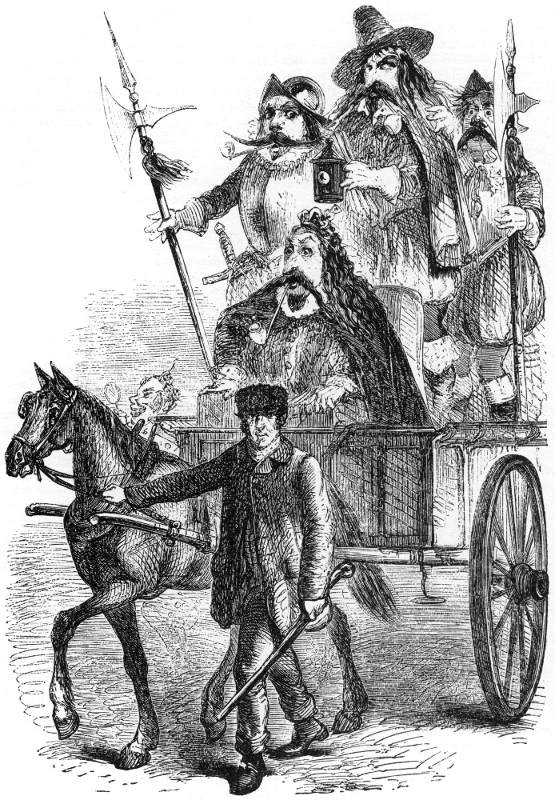
GUY FAWKES.
The first guy of any celebrity that made its appearance in the London streets was about the year 1844, when an enormous figure was paraded about on horseback. This had a tall extinguisher-hat, with a broad red brim, and a pointed vandyked collar, that hung down over a smock frock, which was stuffed out with straw to the dimensions of a water-butt. The figure was attended by a body of some half-dozen costermongers, mounting many coloured cockades, and armed with formidable bludgeons. The novelty of the exhibition ensured its success, and the “coppers” poured in in such quantities that on the following year gigantic guys were to be found in every quarter of the metropolis.
But the gigantic movement did not attain its zenith till the “No Popery” cry was raised, upon the division of England into papal bishoprics. Then it was no longer Fawkes, but Cardinal Wiseman and the Pope of Rome who were paraded as guys through the London thoroughfares.
The figures were built up of enormous proportions, the red hat of the cardinal having a brim as large as a loo-table, and his scarlet cape being as long as a tent. Guy Fawkes seated upon a barrel marked “Gunpowder” usually accompanied His Holiness and the Cardinal, but his diminutive size showed that Guy now played but a secondary part in the exhibition, although the lantern and the matches were tied as usual to his radishy and gouty fingers. According to the newspapers, one of these shows was paraded on the Royal Exchange, the merchants approving of the exhibition to such an extent that sixpences, shillings, and half-crowns were showered in to the hats of the lucky costers who had made the speculation. So excited was the public mind, that at night, after business was over, processions were formed by tradespeople and respectable mechanics, who, with bands of music playing, and banners flying, on which were inscribed anti-papal mottoes and devices, marched through the streets with flaming torches, and after parading their monster Popes and Cardinals until about nine o’clock at night, eventually adjourned to some open space—like Peckham-rye or Blackheath—where the guy was burned amid the most boisterous applauses.
Cardinal Wiseman and the Pope reappeared for several years in succession, till at length the Russian war breaking out, the Guy-Fawkes constructors had a fresh model to work upon. The Emperor of Russia accordingly “came out” in the streets, in all forms and shapes; sometimes as the veritable Nicholas, in jack-boots and leather breeches, with his unmistakable moustache; and often as Old Nick, with a pair of horns and a lengthy appendage in the form of a tail, with an arrow-headed termination; and not unfrequently he was represented as a huge bear crouching beneath some rude symbol of the English and French alliance.
On the 5th of November (1856) the guys were more of a political than a religious character. The unfortunate Pope of Rome had in some instances been changed for Bomba, though the Czar, His Holiness, and his British representative the Cardinal, were not altogether neglected. The want of any political agitation was the cause why the guys were of so uninteresting a character.
I must not, however, forget to mention a singular innovation that was then made in the recognised fashion of guy building—one of the groups of figures exhibited being (strange to say) of a complimentary nature. It consisted of Miss Nightingale, standing between an English Grenadier and a French foot-soldier, while at her feet lay the guy between two barrels marked “Gunpowder,” and so equivocally attired that he might be taken for either the Emperor of Russia or the Pope of Rome.
At Billingsgate, a guy was promenaded round the market as early as five o’clock in the morning, by a party of charity-boys, who appeared by their looks to have been sitting up all night. It is well known to the boys in the neighbourhood of the great fish-market, that the guy which is first in the field reaps the richest harvest of halfpence from the salesmen; and indeed, till within the last three or four years, one fish-factor was in the habit of giving the bearers of the first effigy he saw a half-crown piece. Hence there were usually two or three different guy parties in attendance soon after four o’clock, awaiting his coming into the market.
For manufacturing a cheap guy, such as that seen at Billingsgate, a pair of old trousers and Wellington boots form the most expensive item. The shoulders of the guys are generally decorated with a paper cape, adorned with different coloured rosettes and gilt stars. A fourpenny mask makes the face, and a proper cocked hat, embellished in the same style as the cape, surrounds the rag head.
The general characteristics of all guys consists in a limpness and roundness of limb, which give the form a puddingy appearance. All the extremities have a kind of paralytic feebleness, so that the head leans on one side like that of a dead bird, and the feet have an unnatural propensity for placing themselves in every position but the right one; sometimes turning their toes in, as if their legs had been put on the wrong way, or keeping their toes turned out, as if they had been “struck so” while taking their first dancing-lesson. Their fingers radiate like a bunch of carrots, and the arms are as shapeless and bowed as the monster sausage in a cook-shop window. The face is always composed of a mask painted in the state of the most florid health, and singularly disagreeing with the frightful debility of the body. Through the holes for the eyes bits of rag and straw generally protrude, as though birds had built in the sockets. A pipe is mostly forced into the mouth, where it remains with the bowl downwards; and in the hands it is customary to tie a lantern and matches. Whilst the guy is carried along, you can hear the straw in his interior rustling and crackling, like moving a workhouse mattrass. As a general rule, it may be added, that guys have a helpless, drunken look.
When, however, the monster Guy Fawkeses came into fashion, considerably greater expense was gone to in “getting up” the figures. Then the feet were always fastened in their proper position, and although the arrangement of the hands was never perfectly mastered, yet the fingers were brought a little more closely together, and approached the digital dexterity of the dummies at the cheap clothes marts.
For carrying the guys about, chairs, wheelbarrows, trucks, carts, and vans are employed. Chairs and wheelbarrows are patronised by the juvenile population, but the other vehicles belong to the gigantic speculations.
On the Surrey side a guy was exhibited in 1856 whose straw body was encased in a coachman’s old great coat, covered with different colours, as various as the waistcoat patterns on a tailor’s show-book. He was wheeled about on a truck by three or four young men, whose hoarse voices, when shouting “Please to remember the Guy,” showed their regular occupation to be street-selling, for they had the same husky sound as the “Eight a-groat fresh herrens,” in the Saturday night street-markets.
In the neighbourhood of Walworth, men dressed up as guys were dragged about on trucks. One of them was seated upon a barrel marked “Gunpowder,” his face being painted green, and ornamented with an immense false nose of a bright scarlet colour. I could not understand what this guy was meant to represent, for he wore a sugarloaf hat with an ostrich feather in it, and had on a soldier’s red coat, decorated with paper rosettes as big as cabbages. His legs, too, were covered with his own corduroy trowsers, but adorned with paper streamers and bows. In front of him marched a couple of men carrying broomsticks, and musicians playing upon a tambourine and a penny tin whistle.
The most remarkable of the stuffed figures of 1856 was one dressed in a sheet, intended to represent the Rev. Mr. Spurgeon in a surplice! It was carried about on a wooden stage by boys, and took very well with the mob, for no sooner did the lads cry out,—
“Remember, remember, The fifth of November, Old Spurgeon’s treason and plot!”
than a shout of laughter burst from the crowd, and the halfpence began to pour in. Without this alteration in the November rhyme, nobody would have been able to have traced the slightest resemblance between the guy and the reverend gentleman whose effigy it was stated to be.
Further, it should be added, that the guy exhibitors have of late introduced a new system, of composing special rhymes for the occasion, which are delivered after the well-known “Remember, remember.” Those with the figures of the Pope, for instance, sing,—
“A penn’orth of cheese to feed the pope, A twopenny loaf to choke him, A pint of beer to wash it down, And a good large fagot to smoke him!”
I heard a party of costermongers, who had the image of His Imperial Majesty the Emperor of all the Russias wabbling on their truck, sing in chorus this home-manufactured verse,—
“Poke an ingun in his eye— A squib shove up his nose, sirs; Then roast him till he’s done quite brown, And Nick to old Nick goes, sirs.”
With the larger guys little is usually said or done beyond exhibiting them. In the crowded thoroughfares, the proprietors mostly occupy themselves only with collecting the money, and never let the procession stop for a moment. On coming to the squares, however, a different course is pursued, for then they stop before every window where a head is visible and sing the usual “Remember, remember,” winding up with a vociferous hurrah! as they hold out their hats for the halfpence.
At the West-end, one of the largest guys of 1856 was drawn by a horse in a cart. This could not have been less than fourteen feet high. Its face, which was as big as a shield, was so flat and good-humoured in expression that I at once recognised it as a pantomime mask, or one used to hang outside some masquerade costumier’s shop door. The coat was of the Charles the Second’s cut, and composed of a lightish coloured paper, ornamented with a profusion of Dutch metal. There was a sash across the right shoulder, and the legs were almost as long as the funnel to a penny steamer, and ended in brown paper cavalier boots. As the costermongers led it along, it shook like a load of straw. If it had not been for the bull’s-eye lantern and lath matches, nobody would have recognised in the dandy figure the effigy of the wretched Fawkes.
By far the handsomest turn-out of the day, at this time, was a group of three figures, which promenaded Whitechapel and Bethnal-green. They stood erect in a van drawn by a blind horse, and accompanied by a “band” of one performer on the drum and pandean pipes. Four clowns in full costume made faces while they jumped about among the spectators, and collected donations. All the guys were about ten feet high. The centre one, intended for Fawkes himself, was attired in a flowing cloak of crimson glazed calico, and his black hat was a broad-brimmed sugarloaf, the pointed crown of which was like a model of Langham-place church steeple, and it had a profusion of black hair streaming about the face. The figures on either side of this were intended for Lords Suffolk and Monteagle, in the act of arresting the traitor, and accordingly appeared to be gently tapping Mr. Fawkes on either shoulder. The bodies of their lordships were encased in gold scale-armour, and their legs in silver ditto, whilst their heads were covered with three-cornered cocked hats, surmounted by white feathers. In the front of the van were two white banners, with the following inscriptions in letters of gold:—
“Apprehension of Guy Fawkes on the 5th of November, in the year 1605.”
And,—
“The Discovery of the Gunpowder Plot on the 5th of November, 1605.”
At the back of the van flaunted two flags of all nations. In addition to the four clowns, there were several other attendants; one in particular had the appearance of half a man and half a beast, his body being clad in a green frock-coat, whilst his legs and feet were shaggy, and made to imitate a bear’s.
The most remarkable part of this exhibition was the expression upon the countenances of the figures. They were ordinary masks, and consequently greatly out of proportion for the height of the figures. There was a strong family resemblance between the traitor and his arrestors; neither did Fawkes’s countenance exhibit any look of rage, astonishment, or disappointment at finding his designs frustrated. Nor did their lordships appear to be angry, disgusted, or thunderstruck at the conspirator’s bold attempt.
In the neighbourhood of Bond-street the guys partook of a political character, as if to please the various Members of Parliament who might be strolling to their Clubs. In one barrow was the effigy of the Emperor of the French, holding in his hands, instead of the lantern and matches, a copy of the Times newspaper, torn in half. I was informed that another figure I saw was intended to represent the form of Bomba.
In the neighbourhood of Lambeth Palace the guys were of an ecclesiastical kind, and such as it was imagined would be likely to flatter the Archbishop of Canterbury into giving at least a half-crown. One of these was drawn by two donkeys, and accompanied by drums and pipes. It represented Cardinal Wiseman in the company of four members of “the Holy Inquisition.” The Cardinal was dressed in the usual scarlet costume, while the Inquisitors were robed in black with green veils over their faces. In front of the cart was a bottle, labelled “Holy Water,” which was continually turned round, so that the people might discover that on the other side was printed “Whisky.”
The practice of burning guys, and lighting bonfires, and letting off fireworks, is now generally discontinued, and particularly as regards the public exhibitions at Blackheath and Peckham Rye. The greatest display of fireworks, we are inclined to believe, took place in the public streets of the metropolis, for up to twelve o’clock at night, one might occasionally hear reports of penny cannons, and the jerky explosions of crackers.
Guy Fawkes (Man).
“I’m in the crock’ry line, going about with a basket and changing jugs, and glass, and things, for clothes and that; but for the last eight years I have, every Fifth of November, gone out with a guy. It’s a good job for the time, for what little we lay out on the guy we don’t miss, and the money comes in all of a lump at the last. While it lasts there’s money to be made by it. I used always to take the guy about for two days; but this last year I took him about for three.
“I was nineteen year old when I first went out with a guy. It was seeing others about with ’em, and being out of work at the time, and having nothing to sell, I and another chap we knocked up one between us, and we found it go on pretty well, so we kept on at it. The first one I took out was a very first-rater, for we’d got it up as well as we could to draw people’s attention. I said, ‘It ain’t no good doing as the others do, we must have a tip-topper.’ It represented Guy Fawkes in black velvet. It was about nine feet high, and he was standing upright, with matches in one hand and lantern in the other. I show’d this one round Clerkenwell and Islington. It was the first big ’un as was ever brought out. There had been paper ones as big, but ne’er a one dressed up in the style mine was. I had a donkey and cart, and we placed it against some cross-rails and some bits of wood to keep him steady. He stood firm because he had two poles up his legs, and being lashed round the body holding him firm to the posts—like a rock. We done better the first time we went out than we do lately. The guy must have cost a sovereign. He had a trunk-hose and white legs, which we made out of a pair of white drawers, for fleshings and yellow boots, which I bought in Petticoat-lane. We took over 3l. with him, which was pretty fair, and just put us on again, for November is a bad time for most street trades, and getting a few shillings all at once makes it all right till Christmas.
“A pal of mine, of the name of Smith, was the first as ever brought out a big one. His wasn’t a regular dressed-up one, but only with a paper apron to hang down the front and bows, and such-like. He put it on a chair, and had four boys to carry it on their shoulders. He was the first, too, as introduced clowns to dance about. I see him do well, and that’s why I took mine in hand.
“The year they was chalking ‘No Popery’ all about the walls I had one, dressed up in a long black garment, with a red cross on his bosom. I’m sure I don’t know what it meant, but they told me it would be popular. I had only one figure, with nine bows, and that tidiwated all about him. As we went along everybody shouted out ‘No Popery!’ Everybody did. He had a large brimmed hat with a low crown in, and a wax mask. I always had wax ones. I’ve got one at home now I’ve had for five year. It cost two-and-sixpence. It’s a very good-looking face but rather sly, with a great horse-hair beard. Most of the boys make their’n devils, and as ugly as they can, but that wouldn’t do for Christians like as I represent mine to be.
“One year I had Nicholas and his adviser. That was the Emperor of Russia in big top-boots and white breeches, and a green coat on. I gave him a good bit of mustachios—a little extra. He had a Russian helmet hat on, with a pair of eagles on the top. It was one I bought. I bought it cheap, for I only gave a shilling for it. I was offered five or six for it afterwards, but I found it answer my purpose to keep. I had it dressed up this year. The other figure was the devil. I made him of green tinsel paper cut out like scale armour, and pasted on to his legs to make it stick tight. He had a devil’s mask on, and I made him a pair of horns out of his head. Over them was a banner. I was told what to do to make the banner, for I had the letters writ out first, and then I cut ’em out of tinsel paper and stuck them on to glazed calico. On this banner was these words:—
‘What shall I do next?’ ‘Why, blow your brains out!’
That took immensely, for the people said ‘That is wery well.’ It was the time the war was on. I dare say I took between 3l. and 4l. that time. There was three of us rowed in with it, so we got a few shillings a-piece.
“The best one I ever had was the trial of Guy Fawkes. There was four figures, and they was drawn about in a horse and cart. There was Guy Fawkes, and two soldiers had hold of him, and there was the king sitting in a chair in front. The king was in a scarlet velvet cloak, sitting in an old arm-chair, papered over to make it look decent. There was green and blue paper hanging over the arms to hide the ragged parts of it. The king’s cloak cost sevenpence a-yard, and there was seven of these yards. He had a gilt paper crown and a long black wig made out of some rope. His trunks was black and crimson, and he had blue stockings and red boots. I made him up out of my own head, and not from pictures. It was just as I thought would be the best way to get it up, out of my own head. I’ve seed the picture of Guy Fawkes, because I’ve got a book of it at home. I never was no scholar, not in the least. The soldiers had a breastplate of white steel paper, and baggy knee-breeches, and top boots. They had a big pipe each, with a top cut out of tin. Their helmets was the same as in the pictures, of steel paper, and a kind of a dish-cover shape, with a peak in front and behind. Guy was dressed the same kind as he was this year, with a black velvet dress and red cloak, and red boots turning over at top, with lace sewed on. I never made any of my figures frightful. I get ’em as near as I can to the life like.
“I reckon that show was the best as I ever had about. I done very well with it. They said it was a very good sight, and well got up. I dare say it cost me, with one thing and another, pretty nigh 4l. to get up. There was two of us to shove, me and my brother. I know I had a sovereign to myself when it was over, besides a little bit of merry-making.
“This year I had the apprehension of Guy Fawkes by Lord Suffolk and Monteagle. I’ve followed up the hist’ry as close as I can. Next year I shall have him being burnt, with a lot of faggits and things about him. This year the figures cost about 3l. getting up. Fawkes was dressed in his old costume of black velvet and red boots. I bought some black velvet breeches in Petticoat-lane, and I gave 1s. 9d. for the two pair. They was old theatrical breeches. Their lordships was dressed in gold scale-armour like, of cut-out paper pasted on, and their legs imitated steel. They had three-corner cock’d hats, with white feathers in. I always buy fierce-looking masks with frowns, but one of them this year was a smiling—Lord Monteagle, I think. I took the figures as near as I can form from a picture I saw of Guy Fawkes being apprehended. I placed them figures in a horse and cart, and piled them up on apple-chests to the level of the cart, so they showed all, their feet and all. I bind the chests with a piece of table-cover cloth. The first day we went out we took 2l. 7s., and the second we took 1l. 17s., and the last day we took 2l. 1s. We did so well the third day because we went into the country, about Tottenham and Edmonton. They never witnessed such a thing down them parts. The drummer what I had with me was a blind man, and well known down there. They call him Friday, because he goes there every Friday, so what they usually gave him we had. Our horse was blind, so we was obliged to have one to lead him in front and another to lead the blind drummer behind. We paid the drummer 16s. for the three days. We paid for two days 10s., and the third one most of it came in, and we all went shares. It was a pony more than a horse. I think we got about a 1l. a-piece clear, when we was done on the Friday night. It took me six weeks getting up in my leisure time. There was the Russian bear in front. He wore a monkey dress, the same as in the pantomimes, and that did just as well for a bear. I painted his face as near as I could get it, to make it look frightful.
“When I’m building up a guy we first gits some bags and things, and cut ’em out to the shape of the legs and things, and then sew it up. We sew the body and arms and all round together in one. We puts two poles down for the legs and then a cross-piece at the belly and another cross-piece at the shoulder, and that holds ’em firm. We fill the legs with sawdust, and stuff it down with our hands to make it tight. It takes two sacks of sawdust for three figures, but I generally have it give to me, for I know a young feller as works at the wood-chopping. We stand ’em up in the room against the wall, whilst we are dressing them. We have lots of chaps come to see us working at the guys. Some will sit there for many hours looking at us. We stuff the body with shavings and paper and any sort of rubbish. I sew whatever is wanted myself, and in fact my fingers is sore now with the thimble, for I don’t know how to use a thimble, and I feel awkward with it. I design everything and cut out all the clothes and the painting and all. They allow me 5s. for the building. This last group took me six weeks,—not constant, you know, but only lazy time of a night. I lost one or two days over it, that’s all.
“I think there was more Guy Fawkeses out this year than ever was out before. There was one had Guy Fawkes and Punch and a Clown in a cart, and another was Miss Nightingale and two soldiers. It was meant to be complimentary to that lady, but for myself I think it insulting to bring out a lady like that as a guy, when she’s done good to all.
“They always reckon me to be about the first hand in London at building a guy. I never see none like them, nor no one else I don’t think. It took us two quire of gold paper and one quire of silver paper to do the armour and the banner and other things. The gold paper is 6d. a-sheet, and the silver is 1d. a sheet. It wouldn’t look so noble if we didn’t use the gold paper.
“This year we had three clowns with us, and we paid them 3s. a-day each. I was dressed up as a clown, too. We had to dance about, and joke, and say what we thought would be funny to the people. I had a child in my arms made of a doll stuffed with shavings, and made to represent a little boy. It was just to make a laugh. Every one I went up to I told the doll to ask their uncle or their aunt for a copper. I had another move, too, of calling for ‘Bill Bowers’ in the crowd, and if I got into any row, or anything, I used to call to him to protect me. We had no time to say much, for we kept on moving, and it loses time to talk.
“We took the guy round Goswell-road and Pentonville the first day, and on the second we was round Bethnal-green way, among the weavers. We went that way for safety the second day, for the police won’t interrupt you there. The private houses give the most. They very seldom give more than a penny. I don’t suppose we got more than 3s. or 4s. in silver all the three days.
“Sometimes we have rough work with the Irish going about with guys. The ‘No Popery’ year there was several rows. I was up at Islington-gate, there, in the Lower-road, and there’s loads of Irish live up there, and a rough lot they are. They came out with sticks and bricks, and cut after us. We bolted with the guy. If our guy hadn’t been very firm, it would have been jolted to bits. We always nailed straps round the feet, and support it on rails at the waist, and lashed to the sides. We bolted from this Irish mob over Islington-green, and down John-street into Clerkenwell. My mate got a nick with a stone just on the head. It just give him a slight hurt, and drawed the blood from him. We jumped up in the donkey-cart and drove off.
“There was one guy was pulled out of the cart this year, down by Old Gravel lane, in the Ratcliff-highway. They pulled Miss Nightingale out of the cart and ran away with her, and regular destroyed the two soldiers that was on each side of her. Sometimes the cabmen lash at the guys with their whips. We never say anything to them, for fear we might get stopped by the police for making a row. You stand a chance of having a feather knocked off, or such-like, as is attached to them.
“There’s a lot of boys goes about on the 5th with sticks, and make a regular business of knocking guys to pieces. They’re called guy-smashers. They don’t come to us, we’re too strong for that, but they only manage the little ones, as they can take advantage of. They do this some of them to take the money the boys have collected. I have had regular prigs following my show, to pick the pockets of those looking on, but as sure as I see them I start them off by putting a policeman on to them.
“When we’re showing, I don’t take no trouble to invent new rhymes, but stick to the old poetry. There’s some do new songs. I usually sing out,—
‘Gentlefolks, pray Remember this day; ’Tis with kind notice we bring The figure of sly And villanous Guy, Who wanted to murder the king. By powder and store, He bitterly swore, As he skulk’d in the walls to repair, The parliament, too, By him and his crew, Should all be blowed up in the air. But James, very wise, Did the Papists surprise, As they plotted the cruelty great; He know’d their intent, So Suffolk he sent To save both kingdom and state. Guy Fawkes he was found With a lantern underground, And soon was the traitor bound fast: And they swore he should die, So they hung him up high, And burnt him to ashes at last. So we, once a-year, Come round without fear, To keep up remembrance of this day; While assistance from you May bring a review Of Guy Fawkes a-blazing away. So hollo, boys! hollo, boys! Shout and huzza; So hollo, boys! hollo, boys! Keep up this day! So hollo, boys! hollo, boys! And make the bells ring! Down with the Pope, and God save the Queen!’
“It used to be King, but we say Queen now, and though it don’t rhyme, it’s more correct.
“It’s very seldom that the police say anything to us, so long as we don’t stop too long in the gangway not to create any mob. They join in the fun and laugh like the rest. Wherever we go there is a great crowd from morning to night.
“We have dinner on Guy Fawkes’ days between one and two. We go to any place where it’s convenient for us to stop at, generally at some public-house. We go inside, and leave some of the lads to look after the guy outside. We always keep near the window, where we can look out into the street, and we keep ourselves ready to pop out in a minute if anybody should attack the guy. We generally go into some by-way, where there ain’t much traffic. We never was interrupted much whilst we was at dinner, only by boys chucking stones and flinging things at it; and they run off as soon as we come out.
“There’s one party that goes out with a guy that sells it afterwards. They stop in London for the first two days, and then they work their way into the country as far as Sheerness, and then they sells the guy to form part of the procession on Lord-mayor’s day. It’s the watermen and ferrymen mostly buy it, and they carry it about in a kind of merriment among themselves, and at night they burn it and let off fireworks. They don’t make no charge for coming to see it burnt, but it’s open to the air and free to the public.
“None of the good guys taken about on the 5th are burnt at night, unless some gentlemen buy them. I used to sell mine at one time to the Albert Saloon. Sometimes they’d give me 15s. for it, and sometimes less, according to what kind of a one I had. Three years, I think, I sold it to them. They used to burn it at first in the gardens at the back, but after they found the gardens fill very well without it, so they wouldn’t have any more.
“I always take the sawdust and shavings out of my guys, and save the clothes for another year. The clothes are left in my possession to be taken care of. I make a kind of private bonfire in our yard with the sawdust and shavings, and the neighbours come there and have a kind of a spree, and shove one another into the fire, and kick it about the yard, and one thing and another.
“When I am building the guy, I begin about six weeks before 5th of November comes, and then we subscribe a shilling or two each and buy such things as we wants. Then, when we wants more, I goes to my pals, who live close by, and we subscribe another shilling or sixpence each, according to how we gets on in the day. Nearly all those that take out guys are mostly street traders.
“The heaviest expense for any guy I’ve built was 4l. for one of four figures.”
Guy Fawkes (Boy).
“I always go out with a Guy Fawkes every year. I’m seventeen years old, and I’ve been out with a guy ever since I can remember, except last year; I didn’t then, because I was in Middlesex Hospital with an abscess, brought on by the rheumatic fever. I was in the hospital a month. My father was an undertaker; he’s been dead four months: mother carries on the trade. He didn’t like my going out with guys, but I always would. He didn’t like it at all, he used to say it was a disgrace. Mother didn’t much fancy my doing it this year. When I was a very little un, I was carried about for a guy. I couldn’t a been more than seven years old when I first begun. They put paper-hangings round my legs—they got it from Baldwin’s, in the Tottenham Court-road; sometimes they bought, and sometimes got it give ’em; but they give a rare lot for a penny or twopence. After that they put me on a apron made of the same sort of paper—showy, you know—then they put a lot of tinsel bows, and at the corners they cut a sort of tail like there is to farriers’ aprons, and it look stunnin’; then they put on my chest a tinsel heart and rosettes; they was green and red, because it shows off. All up my arms I had bows and things to make a show-off. Then I put on a black mask with a little red on the cheek, to make me look like a devil: it had horns, too. Always pick out a devil’s mask with horns: it looks fine, and frightens the people a’most. The boy that dressed me was a very clever chap, and made a guy to rights. Why, he made me a little guy about a foot high, to carry in my lap—it was piecings of quilting like, a sort of patch-work all sewn together,—and then he filled it with saw-dust, and made a head of shavings. He picked the shavings small, and then sewed ’em up in a little bag; and then he painted a face, and it looked wery well; and he made it a little tinsel bob-tail coat, and a tinsel cap with two feathers on the top. It was made to sit in a chair; and there was a piece of string tied to each of the legs and the arms, and a string come behind; and I used to pull it, and the legs and arms jumped up. I was put in a chair, and two old broom-handles was put through the rails, and then a boy got in front, and another behind, and carried me off round Holborn way in the streets and squares. Every now and then they put me down before a window; then one of ’em used to say the speech, and I used all the time to keep pulling the string of my little guy, and it amused the children at the winders. After they’d said the speech we all shouted hurrah! and then some of them went and knocked at the door and asked ‘Please to remember the guy;’ and the little children brought us ha’pence and pence; and sometimes the ladies and gentlemen chucked us some money out of the winder. At last they carried me into Russell-square. They put me down before a gentleman’s house and begun saying the speech: while they was saying it, up comes a lot o’ boys with sticks in their hands. One of our chaps knowed what they was after, and took the little guy out of my hand, and went on saying the speech. I kept all on sitting still. After a bit one of these ’ere boys says, ‘Oh, it’s a dead guy; let’s have a lark with it!’ and then one of ’em gives me a punch in the eye with his fist, and then snatched the mask off my face, and when he’d pulled it off he says, ‘Oh, Bill, it’s a live un!’ We was afraid we should get the worst of it, so we run away round the square. The biggest one of our lot carried the chair. After we’d run a little way they caught us again, and says, ‘Now then, give us all your money;’ with that, some ladies and gentlemen that see it all came up to ’em and says, ‘If you don’t go we’ll lock you up;’ and so they let us go away. And so we went to another place where they sold masks; and we bought another. Then they asked me to be guy again, but I wouldn’t, for I’d got a black-eye through it already. So they got another to finish out the day. When we got home at night we shared 2s. a-piece. There was five of us altogether; but I think they chisselled me. I know they got a deal more than that, for they’d had a good many sixpences and shillings. People usen’t to think much of a shilling that time a-day, because there wasn’t any but little guys about then; but I don’t know but what the people now encourage little guys most, because they say that the chaps with the big ones ought to go to work.
“Next year I was out with a stuffed guy. They wanted me to be guy again, because I wasn’t frightened easy, and I was lightish; but I told ’em ‘No, I’ve had enough of being guy; I don’t be guy any more: besides, I had such fine money for getting a whack in the eye!’ We got on pretty well that year; but it gets wus and wus every year. We got hardly anything this year; and next I don’t suppose we shall get anything at all. These chaps that go about pitchin’ into guys we call ‘guy smashers;’ but they don’t do it only for the lark of smashing the guys: they do it for the purpose of taking the boys’ money away, and sometimes the clothes. If one of ’em has a hole in his boots, and he sees a guy with a good pair on, he pretty soon pulls ’em of the guy and hooks it off with ’em.
“After I’d been out with guys for three or four years, I got big enough to go to work, and I used to go along with my brother and help him at a coal-shed, carrying out coals. I was there ten months, and then one night—a bitter cold night, it was freezing hard—we had a naphtha lamp to light in the shop; and as me and my brother was doing it, either a piece of the match dropped in or else he poured it over, I can’t say which, but all at once it exploded and blowed me across the road and knocked him in the shop all a-fire; and I was all a-fire, too—see how it’s burnt my face and the hand I held the lucifer in. A woman run out of the next shop with some wet sacks, and throw’d ’em upon me, but it flared up higher then: water don’t put it out, unless it’s a mass of water like a engine. Then a milkman run up and pulled off his cape and throwed it over me, and that put it out; then he set me up, and I run home, though I don’t know how I got there, and for two days after I didn’t know anybody. Another man ran into the shop and pulled out my brother, and we was both taken to the University Hospital. Two or three people touched me, and the skin came off on their hands, and at nine o’clock the next morning my brother died. When they took me to the hospital they had no bed for me, and so they sent me home again, and I was seven months before I got well. But I’ve never been to say well since, and I shall never be fit for hard work any more.
“The next year I went out with a guy again, and I got on pretty well; and so I’ve done every year since, except last. I’ve had several little places since I got burnt, but they haven’t lasted long.
“This year I made a stunning guy. First of all I got a pair of my own breeches—black uns—and stuffed ’em full of shavings. I tied the bottoms with a bit of string. Then I got a black coat—that belonged to another boy—and sewed it all round to the trousers; then we filled that with shavings, and give him a good corporation. Then we got a block, sich as the milliners have, and shoved that right in the neck of the coat, and then we shoved some more shavings all round, to make it stick in tight; and when that was done it looked just like a dead man. I know something about dead men, because my father was always in that line. Then we got some horsehair and some glue, and plastered the head all round with glue, and stuck the horse-hair on to imitate the hair of a man; then we put the mask on: it was a twopenny one—they’re a great deal cheaper than they used to be, you can get a very good one now for a penny—it had a great big nose, and it had two red horns, black eyebrows, and red cheeks. I like devils, they’re so ugly. I bought a good-looking un two or three years ago, and we didn’t get hardly anything, the people said, ‘Ah! it’s too good-looking; it don’t frighten us at all.’ Well, then, after we put on his mask we got two gloves, one was a woollen un, and the other a kid un, and stuffed them full of shavings, and tied ’em down to the chair. We didn’t have no lantern, ’cos it keeps on falling out of his hands. After that we put on an old pair of lace-up boots. We tied ’em on to the legs of the breeches. The feet mostly twistes round, but we stopped that; we shoved a stick up the leg of his breeches, and the other end into the boot, and tied it, and then it couldn’t twist round very easy. After that we put a paper hanging-cap on his head; it was silk-velvet kind of paper, and decorated all over with tinsel bows. His coat we pasted all over with blue and green tinsel bows and pictures. They was painted theatrical characters, what we buy at the shop a ha’penny a sheet plain, and penny a sheet coloured: we bought ’em plain, and coloured them ourselves. A-top of his hat we put a hornament. We got some red paper, and cut it into narrow strips, and curled it with the blade of the scissors, and stuck it on like a feather. We made him a fine apron of hanging-paper, and cut that in slips up to his knees, and curled it with the scissors, the same as his feather, and decorated it with stars, and bows, and things, made out of paper, all manner of colours, and pieces of tinsel. After we’d finished the guy we made ourselves cock’d hats, all alike, and then we tied him in a chair, and wrote on his breast, ‘Villanous Guy.’ Then we put two broomsticks under the chair and carried him out. There was four of us, and the two that wasn’t carrying, they had a large bough of a tree each, with a knob at the top to protect the guy. We started off at once, and got into the squares, and put him in front of the gentlemen’s houses, and said this speech:—
‘Pray, gentlefolks, pray Remember this day, At which kind notice we bring This figure of sly, Old, villanous Guy, He wanted to murder the king. With powder in store, He bitterly swore By him in the vaults to compare, By him and his crew, And parliament, too, Should all be blow’d up in the air. So please to remember The fifth of November, The gunpowder treason and plot, I see no reason Why gunpowder treason Should ever be forgot. So hollo, boys! hollo, boys! Shout out the day! Hollo, boys! hollo, boys! Hollo, Hurrah!’
“After we’d finished our speech in one of the squares, and hollowed Hurrah! the beadle come out, and said he’d give us the stick about our backs, and the guy too, if we didn’t go away. So we went away, and got into Russell-square and Bedford-square; but there was such a lot of small guys out, that we did worse than ever we’d done before. When we was in Southampton-street, Holborn, I finished the speech with ‘Down with the Pope, and God save the Queen;’ so four shoe-black boys come up, and says, says they, ‘What do you say, Down with the Pope and God save the Queen for?’ And I says, ‘I didn’t mean no harm of it.’ With that they makes use of some bad language, and told me they’d smash my head and the guy’s too; and they was going to do it, when up comes a boy that I knew, and I says to him, ‘They’re going to knock me about;’ so he says, ‘No they won’t;’ so then the boys made their reply, and said they would. So I told ’em they was very fast about fighting, I’d fight one of them; so with that they all got ready to pitch upon me: but when they see this other boy stuck to me, they went off, and never struck a blow. When we got home I opened the money-box and shared the money; one had 5d., and two had 4½d. each, and I had 7d. because I said the speech. At night we pulled him all to pieces, and burnt his stuffing, and let off some squibs and crackers. I always used to spend the money I got guying on myself. I used to buy sometimes fowls, because I could sell the eggs. There is some boys that take out guys as do it for the sake of getting a bit of bread and butter, but not many as I knows of.
“It don’t cost much to make a guy. The clothes we never burns—they’re generally too good: they’re our own clothes, what we wears at other times; and when people burn a guy they always pull off any of the things that’s of use fust; but mostly the guy gets pulled all to pieces, and only the shavings gets burnt.”
An Old Street Showman.
A short, thick-set man, with small, puckered-up eyes, and dressed in an old brown velveteen shooting-jacket, gave me an account of some bygone exhibitions of the galantee show.
“My father was a soldier,” he said, “and was away in foreign parts, and I and a sister lived with my mother in St. Martin’s workhouse. I was fifty-five last New-year’s-day. My uncle, a bootmaker in St. Martin’s-lane, took my mother out of the workhouse, that she might do a little washing, and pick up a living for herself; and we children went to live with my grandfather, a tailor. After his death, and after many changes, we had a lodging in the Dials, and there ——, the sweep, coaxed me with pudding one day, and encouraged me so well, that I didn’t like to go back to my mother; and at last I was ’prenticed to him from Hatton-Garden on a month’s trial, and I liked chimley-sweeping for that month; but it was quite different when I was regularly indentured. I was cruelly-treated then, and poorly fed, and had to turn out barefooted between three and four many a morning in frost and snow. In first climbing the chimleys, a man stood beneath me, and pushed me up, telling me how to use my elbows and knees, and if I slipped, he was beneath me and ketched me, and shoved me up again. The skin came off my knees and elbows; here’s the marks now, you see. I suffered a great deal, as well as Dan Duff, a fellow-sweep, a boy that died. I’ve been to Mrs. Montague’s dinner in the Square on the 1st of May, when I was a boy-sweep. It was a dinner in honour of her son having been stolen away by a sweep.” (The man’s own words.) “I suppose there were more than three hundred of us sweeps there, in a large green, at the back of her house. I run away from my master once, but was carried back, and was rather better used. My master then got me knee and ankle-pads, and bathed my limbs in salt and water, and I managed to drag on seven sorrowful years with him. I was glad to be my own man at last, and I cut the sweep-trade, bought pandean pipes, and started with an organ-man, as his mate. I saved money with the organ-man and then bought a drum. He gave me five shillings a-week, and my wittles and drink, washing and lodging; but there wasn’t so much music afloat then. I left the music-man and went out with ‘Michael,’ the Italy bear. Michael was the man’s name that brought over the bear from somewhere abroad. He was a Italy man; and he used to beat the bear, and manage her; they called her Jenny; but Michael was not to say roughish to her, unless she was obstropelous. If she were, he showed her the large mop-stick, and beat her with it—hard sometimes—specially when she wouldn’t let the monkey get a top on her head; for that was a part of the performance. The monkey was dressed the same as a soldier, but the bear had no dress but her muzzle and chain. The monkey (a clever fellow he was, and could jump over sticks like a Christian) was called Billy. He jumped up and down the bear, too, and on his master’s shoulders, where he set as Michael walked up and down the streets. The bear had been taught to roll and tumble. She rolled right over her head, all round a stick, and then she danced round about it. She did it at the word of command. Michael said to her, ‘Round and round again.’ We fed her on bread, a quartern-loaf every night after her work in half-a-pail of water, the same every morning; never any meat—nothing but bread, boiled ’tatoes, or raw carrots: meat would have made her savage. The monkey was fed upon nuts, apples, gingerbread, or anything. Besides them we had two dancing-dogs. The bear didn’t like them, and they were kept on one side in performing. The dogs jumped through hoops, and danced on their hind legs; they’re easyish enough trained. Sometimes the butchers set bull-dogs, two or three at a time, at Jenny; and Michael and me had to beat them off as well as the two other men that we had with us. Those two men collected the money, and I played the pipes and drum, and Michael minded the bear and the dogs and monkey. In London we did very well. The West-end was the best. Whitechapel was crowded for us, but only with ha’pence. I don’t know what Michael made, but I had seven shillings a-week, with my wittles and lodging. Michael done well. We generally had twenty to thirty shillings every night in ha’pence, and used to give twenty-one shillings of it for a one-pound note; for they was in then. When we’ve travelled in the country, we’ve sometimes had trouble to get lodgings for the bear. We’ve had to sleep in outhouses with her, and have sometimes frightened people that didn’t know as we was there, but nothing serious. Bears is well-behaved enough if they ain’t aggravated. Perhaps no one but me is left in England now what properly understands a dancing-bear.
“Jenny wasn’t ever baited, but offers was made for it by sporting characters.
“The country was better than London, when the weather allowed; but in Gloucester, Cheltenham, and a good many places, we weren’t let in the high streets.
“The gentlefolk in the balconies, both in town and country, where they had a good sight, were our best friends.
“It’s more than thirty years ago—yes, a good bit more now; at Chester races, one year, we were all taken, and put into prison: bear, and dogs, and musicianer, and all—every one—because we played a day after the races; that was Saturday.
“We were all in quod until Monday morning. I don’t know how the authorities fed the bear. We were each in a separate cell, and I had bread and cheese, and gruel.
“On Monday morning we were discharged, and the bear was shot by the magistrate’s orders. They wanted to hang poor Jenny at first, but she was shot, and sold to the hairdressers.
“I couldn’t stay to see her shot, and had to go into an alehouse on the road. I don’t know what her carcase sold for. It wasn’t very fat.
“Michael and me then parted at Chester, and he went home rich to Italy, taking his monkey and dogs with him, I believe.
“He lived very careful, chiefly on rice and cabbage, and a very little meat with it, which he called ‘manesta.’ He was a very old man. I had ‘manesta’ sometimes, but I didn’t like it much. I drummed and piped my way from Chester to London, and there took up with another foreigner, named Green, in the clock-work-figure line.
“The figures were a Turk called Bluebeard, a sailor, a lady called Lady Catarina, and Neptune’s car, which we called Nelson’s car as well; but it was Neptune’s car by rights.
“These figures danced on a table, when taken out of a box. Each had its own dance when wound up.
“First came my Lady Catarina. She, and the others of them, were full two feet high. She had a cork body, and a very handsome silk dress, or muslin, according to the fashion, or the season. Black in Lent, according to what the nobility wore.
“Lady Catarina, when wound up, danced a reel for seven minutes, the sailor a hornpipe, and Bluebeard shook his head, rolled his eyes, and moved his sword, just as natural as life. Neptune’s car went either straight or round the table, as it was set.
“We often showed our performances in the houses of the nobility, and would get ten or twelve shillings at a good house, where there were children.
“I had a third share, and in town and country we cleared fifty shillings a week, at least, every week, among the three of us, after all our keep and expenses were paid.
“At Doncaster races we have taken three pounds in a-day, and four pounds at Lincoln races.
“Country, in summer, is better than town. There’s now no such exhibition, barring the one I have; but that’s pledged. It cost twenty pounds at Mr. ——’s for the four figures without dress. I saved money, which went in an illness of rheumatic gout. There’s no bears at all allowed now. Times are changed, and all for the worser. I stuck to the clock-work concern sixteen years, and knows all parts of the country—Ireland, Scotland, Guernsey, Jersey, and the Isle of Wight.
“A month before Christmas we used to put the figures by, for the weather didn’t suit; and then we went with a galantee show of a magic lantern. We showed it on a white sheet, or on the ceiling, big or little, in the houses of the gentlefolk, and the schools where there was a breaking-up. It was shown by way of a treat to the scholars. There was Harlequin, and Billy Button, and such-like. We had ten and sixpence and fifteen shillings for each performance, and did very well indeed. I have that galantee show now, but it brings in very little.
“Green’s dead, and all in the line’s dead, but me. The galantee show don’t answer, because magic lanterns are so cheap in the shops. When we started, magic lanterns wasn’t so common; but we can’t keep hold of a good thing in these times. It was a reg’lar thing for Christmas once—the galantee shows.
“I can make, in a holiday time, twenty shillings a-week; but that’s only at holiday times, and is just a mere casualty a few times a year.
“I do other jobs, when I can get ’em—at other times, I delivers bills, carries boards, and helps at funerals.”
The Chinese Shades.
“The proper name of my exhibition,” said a showman of this class to me, “is Lez Hombres, or the shades; that’s the proper name for it, for Baron Rothschild told me so when I performed before him. We calls it the Chinese galantee show. It was invented over there with the Chinese, and some travellers went over there and see them doing it, and they come over here and tell us about it. They didn’t do it as we do, you know. As for doing pieces, we lick them out of the field. Them only did the shadows, we do a piece with ’em.
“I should say, sir,—let me calculate—it is about twenty-six years since the ombres first come out. Reduce it if you like, but that’s the time. Thomas Paris was the first as come out with them. Then Jim Macklin, and Paul Herring the celebrated clown, and the best showman of Punch in the world for pantomime tricks—comic business, you know, but not for showing in a gentleman’s house—was the next that ever come out in the streets with the Chinese galantee show. I think it was his own ingenuity that first gave him the notion. It was thoughts of mind, you know,—you form the opinion in your own mind, you know, by taking it from the Chinese. They met a friend of theirs who had come from China, and he told him of the shadows. One word is as good as fifty, if it’s a little grammatical—sound judgment. When it first come out, he began with the scene called ‘Mr. Jobson the Cobbler,’ and that scene has continued to be popular to the present day, and the best scene out. He did it just equally the same as they do it now, in a Punch-and-Judy frame, with a piece of calico stretched in front, and a light behind to throw the shadows on the sheet.
“Paul Herring did excellent well with it—nothing less than 30s. or 2l. a-night. He didn’t stop long at it, because he is a stage clown, and had other business to attend to. I saw him the first time he performed. It was in the Waterloo-road, and the next night I were out with one of my own. I only require to see a thing once to be able to do it; but you must have ingenuity, or it’s no use whatsumdiver. Every one who had a Punch-and-Judy frame took to it; doing the regular business in the day and at night turning to the shadows. In less than a week there were two others out, and then Paul Herring cut it. He only done it for a lark. He was hard up for money and got it.
“I was the first that ever had a regular piece acted in his show. I believe there’s nobody else as did, but only them that’s copied me. They come and follow me, you understand, and copied me. I am the author of ‘Cobbler Jobson,’ and ‘Kitty biling the Pot, or the Woodchopper’s Frolic.’ There’s ‘Billy Button’s journey to Brentford on horseback, and his favorite servant, Jeremiah Stitchem, in want of a situation.’ I’m the author of that, too. It’s adapted from the equestrian piece brought out at Astley’s. I don’t know who composed ‘the Broken Bridge.’ It’s too far gone by to trace who the first author is, but it was adapted from the piece brought out formerly at Drury-lane Theatre. Old ancient gentlemen has told me so who saw it, when it was first brought out, and they’re old enough to be my grandfather. I’ve new revised it.