Volume 3 — LONDON VAGRANTS. (continued 2)
Reading edition
“I am now eighteen,” she stated. “My father was a coloured man. He came over here as a sailor, I have heard, but I never saw him; for my mother, who was a white woman, was not married to him, but met him at Oxford; and she married afterwards a box-maker, a white man, and has two other children. They are living, I believe, but I don’t know where they are. I have heard my mother say that my father—that’s my own father—had become a missionary, and had been sent out to America from England as a missionary, by Mr. ——. I believe that was fifteen years ago. I don’t know who Mr. —— was, but he was a gentleman, I’ve heard my mother say. She told me, too, that my father was a good scholar, and that he could speak seven different languages, and was a very religious man. He was sent out to Boston, but I never heard whether he was to stay or not, and I don’t know what he was to missionary about. He behaved very well to my mother, I have heard her say, until she took up with the other man (the box-maker), and then he left her, and gave her up, and came to London. It was at Oxford that they all three were then; and when my father got away, or came away to London, my mother followed him (she told me so, but she didn’t like to talk about it), as she was then in the family way. She didn’t find him; but my father heard of her, and left some money with Mr. —— for her, and she got into Poland-street workhouse through Mr. —— I’ve heard. While there, she received 1s. 6d. a-week, but my father never came to see her or me. At one time, my father used to live by teaching languages. He had been in Spain, and France, and Morocco. I’ve heard, at any rate, that he could speak the Moors’ language, but I know nothing more. All this is what I’ve heard from my mother and my grandmother—that’s my mother’s mother. My grandfather and grandmother are dead. He was a sawyer. I have a great grandmother living in Oxford, now ninety-two, supported by her parish. I lived with my grandmother at Oxford, who took me out of pity, as my mother never cared about me, when I was four months old. I remained with her until I was ten, and then my mother came from Reading, where she was living, and took me away with her. I lived with her and my stepfather, but they were badly off. He couldn’t get much to do at his trade as a box-maker, and he drank a great deal. I was with them about nine months, when I ran away. He beat me so; he never liked me. I couldn’t bear it. I went to Pangbourne, but there I was stopped by a man my stepfather had sent—at least I suppose so—and I was forced to walk back to Reading—ten miles, perhaps. My father applied to the overseer for support for me, and the overseer was rather harsh, and my father struck him, and for that he was sent to prison for three months. My mother and her children then got into the workhouse, but not until after my stepfather had been some time in prison. Before that she had an allowance, which was stopped; I don’t know how much. I was in the workhouse twenty-one days. I wasn’t badly treated. My mother sweared my parish, and I was removed to St. James’s, Poland-street, London. I was there three weeks, and then I was sent to New Brentford—it was called the Juvenile Establishment—and I went to school. There was about 150 boys and girls; the boys were sent to Norwood when they were fifteen. Some of the girls were eighteen, kept there until they could get a place. I don’t know whether they all belonged to St. James’s, or to different parishes, or how. I stayed there about two years. I was very well treated, sufficient to eat; but we worked hard at scrubbing, cleaning, and making shirts. We made all the boys’ clothes as well, jackets and trousers, and all. I was then apprenticed a maid-of-all-work, in Duke-street, Grosvenor-square, for three years. I was there two years and a half, when my master failed in business, and had to part with me. They had no servant but me. My mistress was sometimes kind, pretty well. I had to work very hard. She sometimes beat me if I stopped long on my errands. My master beat me once for bringing things wrong from a grocer’s. I made a mistake. Once my mistress knocked me down-stairs for being long on an errand to Pimlico, and I’m sure I couldn’t help it, and my eye was cut. It was three weeks before I could see well. [There is a slight mark under the girl’s eye still.] They beat me with their fists. After I left my master, I tried hard to get a place; I’m sure I did, but I really couldn’t; so to live, I got watercresses to sell up and down Oxford-street. I stayed at lodging-houses. I tried that two or three months, but couldn’t live. My mother had been ‘through the country,’ and I knew other people that had, through meeting them at the lodging-houses. I first went to Croydon, begging my way. I slept in the workhouse. After that I went to Brighton, begging my way, but couldn’t get much, not enough to pay my lodgings. I was constantly insulted, both in the lodging-houses and in the streets. I sung in the streets at Brighton, and got enough to pay my lodgings, and a little for food. I was there a week, and then I went to the Mendicity, and they gave me a piece of bread (morning and night) and a night’s lodging. I then went to Lewes and other places, begging, and got into prison at Tunbridge Wells for fourteen days, for begging. I only used to say I was a poor girl out of place, could they relieve me? I told no lies. I didn’t pick my oakum one day, it was such hard stuff; three and a half pounds of it to do from nine to half-past three: so I was put into solitary for three days and three nights, having half a pound of bread and a pint of cold water morning and night; nothing else, and no bed to sleep on. I’m sure I tell you the truth. Some had irons on their hands if they were obstropolous. That’s about two months ago. I’m sorry to say that during this time I couldn’t be virtuous. I know very well what it means, for I can read and write, but no girl can be so circumstanced as I was. I seldom got money for being wicked; I hated being wicked, but I was tricked and cheated. I am truly sorry for it, but what could a poor girl do? I begged my way from London to Hastings, and got here on Saturday last, and having no money, came here. I heard of this asylum from a girl in Whitechapel, who had been here. I met her in a lodging-house, where I called to rest in the daytime. They let us rest sometimes in lodging-houses in the daytime. I never was in any prison but Tunbridge Wells, and in Gravesend lock-up for being out after twelve at night, when I had no money to get a lodging. I was there one Saturday night, and got out on Sunday morning, but had nothing given me to eat—I was in by myself. It’s a bad place—just straw to sleep on, and very cold. I told you I could read and write. I learnt that partly at Oxford, and finished my learning at the Juvenile Establishment at Brentford. There I was taught, reading, writing, sums, marking, sewing, and scrubbing. Once I could say all the multiplication table, but I’ve forgot most of it. I know how to make lace, too, because I was taught by a cousin in Oxford, another grandchild of my grandmother’s. I can make it with knitting-needles. I could make cushion-lace with pins, but I’m afraid I’ve forgot how now. I should like, if I could to get into service again, here or abroad. I have heard of Australia, where I have a cousin. I am sure I could and would conduct myself well in service, I have suffered so much out of it. I am sure of it. I never stole anything in my life, and have told all I have done wrong.”
Statement of a Returned Convict.
I shall now give the statement of a man who was selected at random from amongst a number such as himself, congregated in one of the most respectable lodging-houses. He proved, on examination, to be a returned convict, and one who had gone through the severest bodily and mental agony. He had lived in the bush, and been tried for his life. He was an elderly-looking man, whose hair was just turning grey, and in whose appearance there was nothing remarkable, except that his cheek-bones were unusually high, and that his face presented that collected and composed expression which is common to men exposed to habitual watchfulness from constant danger. He gave me the following statement. His dress was bad, but differed in nothing from that of a long-distressed mechanic. He said:—
“I am now 43 (he looked much older), and had respectable parents, and a respectable education. I am a native of London. When I was young I was fond of a roving life, but cared nothing about drink. I liked to see ‘life,’ as it was called, and was fond of the company of women. Money was no object in those days; it was like picking up dirt in the streets. I ran away from home. My parents were very kind to me; indeed, I think I was used too well, I was petted so, when I was between 12 and 13. I got acquainted with some boys at Bartlemy-fair a little before that, and saw them spending lots of money and throwing at cock-shies, and such-like; and one of them said, ‘Why don’t you come out like us?’ So afterwards I ran away and joined them. I was not kept shorter of money than other boys like me, but I couldn’t settle. I couldn’t fix my mind to any regular business but a waterman’s, and my friends wouldn’t hear of that. There was nine boys of us among the lot that I joined, but we didn’t all work together. All of ’em came to be sent to Van Dieman’s Land as transports except one, and he was sent to Sydney. While we were in London it was a merry life, with change of scene, for we travelled about. We were successful in nearly all our plans for several months. I worked in Fleet Street, and could make 3l. a-week at handkerchiefs alone, sometimes falling across a pocket-book. The best handkerchiefs then brought 4s. in Field-lane. Our chief enjoyments were at the ‘Free and Easy,’ where all the thieves and young women went, and sang and danced. I had a young woman for a partner then; she went out to Van Dieman’s Land. She went on the lift in London (shopping and stealing from the counter). She was clever at it. I carried on in this way for about 15 months, when I was grabbed for an attempt on a gentleman’s pocket by St. Paul’s Cathedral, on a grand charity procession day. I had two months in the Old Horse (Bridewell). I never thought of my parents at this time—I wouldn’t. I was two years and a half at this same trade. One week was very like another,—successes and escapes, and free-and-easies, and games of all sorts, made up the life. At the end of the two years and a half I got into the way of forged Bank-of-England notes. A man I knew in the course of business, said, ‘I would cut that game of ‘smatter-hauling,’ (stealing handkerchiefs), and do a little soft,’ (pass bad notes). So I did, and was very successful at first. I had a mate. He afterwards went out to Sydney, too, for 14 years. I went stylishly dressed as a gentleman, with a watch in my pocket, to pass my notes. I passed a good many in drapers’ shops, also at tailors’ shops. I never tried jewellers, they’re reckoned too good judges. The notes were all finnies, (5l. notes), and a good imitation. I made more money at this game, but lived as before, and had my partner still. I was fond of her; she was a nice girl, and I never found that she wronged me in any way. I thought at four months’ end of retiring into the country with gambling-tables, as the risk was becoming considerable. They hung them for it in them days, but that never daunted me the least in life. I saw Cashman hung for that gunsmith’s shop on Snow-hill, and I saw Fauntleroy hung, and a good many others, but it gave me no uneasiness and no fear. The gallows had no terror for people in my way of life. I started into the country with another man and his wife—his lawful wife—for I had a few words with my own young woman, or I shouldn’t have left her behind me, or, indeed, have started at all. We carried gambling on in different parts of the country for six months. We made most at the E. O. tables,—not those played with a ball, they weren’t in vogue then, but throwing dice for prizes marked on a table. The highest prize was ten guineas, but the dice were so made that no prize could be thrown; the numbers were not regular as in good dice, and they were loaded as well. If anybody asked to see them, we had good dice ready to show. All sorts played with us. London men and all were taken in. We made most at the races. My mate and his wife told me that at the last Newmarket meeting we attended, 65l. was made, but they rowed in the same boat. I know they got a deal more. The 65l. was shared in three equal portions, but I had to maintain the horse and cart out of my own share. We used to go out into the roads (highway robbery) between races, and if we met an ‘old bloke’ (man) we ‘propped him’ (knocked him down), and robbed him. We did good stakes that way, and were never found out. We lived as well as any gentleman in the land. Our E. O. table was in a tilted cart. I stayed with this man and his wife two months. She was good-looking, so as to attract people. I thought they didn’t use me altogether right, so at Braintree I gave another man in the same way of business 25l. for his kit—horse, harness, tilted-cart, and table. I gave him two good 5l. notes and three bad ones, for I worked that way still, not throwing much of a chance away. I came to London for a hawker’s stock, braces and such-like, to sell on the road, just to take the down off (remove suspicion). In the meantime, the man that I bought the horse, &c., of, had been nailed passing a bad note, and he stated who he got it from, and I was traced. He was in a terrible rage to find himself done, particularly as he used to do the same to other people himself. He got acquitted for that there note after he had me ‘pinched’ (arrested). I got ‘fullied’ (fully committed). I was tried at the ‘Start’ (Old Bailey), and pleaded guilty to the minor offence, (that of utterance, not knowing the note to be forged), or I should have been hanged for it then. It was a favourable sessions when I was tried. Thirty-six were cast for death, and only one was ‘topped’ (hanged), the very one that expected to be ‘turned up’ (acquitted) for highway robbery. I was sentenced to 14 years’ transportation. I was ten weeks in the Bellerophon hulk at Sheerness, and was then taken to Hobart Town, Van Dieman’s Land, in the Sir Godfrey Webster. At Hobart Town sixty of us were picked out to go to Launceston. There (at Launceston) we lay for four days in an old church, guarded by constables; and then the settlers came there from all parts, and picked their men out. I got a very bad master. He put me to harvest work that I had never even seen done before, and I had the care of pigs as wild as wild boars. After that I was sent to Launceston with two letters from my master to the superintendent, and the other servants thought I had luck to get away from Red Barks to Launceston, which was 16 miles off. I then worked in a Government potato-field; in the Government charcoal-works for about 11 months; and then was in the Marine department, going by water from Launceston to George Town, taking Government officers down in gigs, provisions in boats, and such-like. There was a crew of six (convicts) in the gigs, and four in the watering-boats. All the time I consider I was very hardly treated. I hadn’t clothes half the time, being allowed only two slop-suits in a year, and no bed to lie on when we had to stay out all night with the boats by the river Tamar. With 12 years’ service at this my time was up, but I had incurred several punishments before it was up. The first was 25 lashes, because a bag of flour had been burst, and I picked up a capfull. The flogging is dreadfully severe, a soldier’s is nothing to it. I once had 50 lashes, for taking a hat in a joke when I was tipsy; and a soldier had 300 the same morning. I was flogged as a convict, and he as a soldier; and when we were both at the same hospital after the flogging, and saw each other’s backs, the other convicts said to me, ‘D—— it, you’ve got it this time;’ and the soldier said, when he saw my back, ‘You’ve got it twice as bad I have.’ ‘No,’ said the doctor, ‘ten times as bad—he’s been flogged; but you, in comparison, have only had a child’s whipping.’ The cats the convicts were then flogged with were each six feet long, made out of the log-line of a ship of 500 tons burden; nine over-end knots were in each tail, and nine tails whipped at each end with wax-end. With this we had half-minute lashes; a quick lashing would have been certain death. One convict who had 75 lashes was taken from the triangles to the watch-house in Launceston, and was asked if he would have some tea,—he was found to be dead. The military surgeon kept on saying in this case, ‘Go on, do your duty.’ I was mustered there, as was every hand belonging to the Government, and saw it, and heard the doctor. When I was first flogged, there was inquiry among my fellow-convicts, as to ‘How did D—— (meaning me) stand it—did he sing?’ The answer was, ‘He was a pebble;’ that is, I never once said, ‘Oh!’ or gave out any expression of the pain I suffered. I took my flogging like a stone. If I had sung, some of the convicts would have given me some lush with a locust in it (laudanum hocussing), and when I was asleep would have given me a crack on the head that would have laid me straight. That first flogging made me ripe. I said to myself, ‘I can take it like a bullock.’ I could have taken the flogger’s life at the time, I felt such revenge. Flogging always gives that feeling; I know it does, from what I’ve heard others say who had been flogged like myself. In all I had 875 lashes at my different punishments. I used to boast of it at last. I would say, ‘I don’t care, I can take it till they see my backbone.’ After a flogging, I’ve rubbed my back against a wall, just to show my bravery like, and squeezed the congealed blood out of it. Once I would not let them dress my back after a flogging, and I had 25 additional for that. At last I bolted to Hobart Town, 120 miles off. There I was taken before Mr. H——, the magistrate, himself a convict formerly, I believe from the Irish Rebellion; but he was a good man to a prisoner. He ordered me 50, and sent me back to Launceston. At Launceston I was ‘fullied’ by a bench of magistrates, and had 100. Seven years before my time was up I took to the bush. I could stand it no longer, of course not. In the bush I met men with whom, if I had been seen associating, I should have been hanged on any slight charge, such as Brittan was and his pals.”
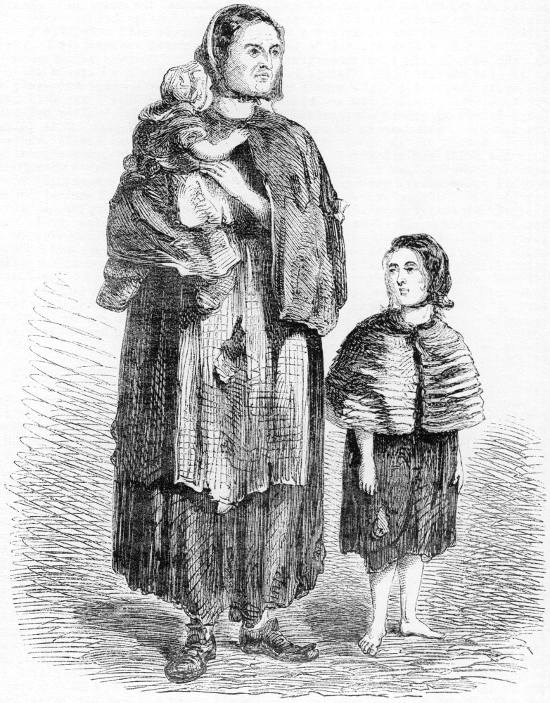
VAGRANTS IN THE CASUAL WARD OF WORKHOUSE.
[From a Sketch.]
I am not at liberty to continue this man’s statement at present: it would be a breach of the trust reposed in me. Suffice it, he was in after days tried for his life. Altogether it was a most extraordinary statement; and, from confirmations I received, was altogether truthful. He declared that he was so sick of the life he was now leading, that he would, as a probation, work on any kind of land anywhere for nothing, just to get out of it. He pronounced the lodging-houses the grand encouragements and concealments of crime, though he might be speaking against himself, he said, as he had always hidden safely there during the hottest search. A policeman once walked through the ward in search of him, and he was in bed. He knew the policeman well, and was as well known to the officer, but he was not recognised. He attributed his escape to the thick, bad atmosphere of the place giving his features a different look, and to his having shaved off his whiskers, and pulled his nightcap over his head. The officer, too, seemed half-sick, he said.
It ought also to be added, that this man stated that the severity of the Government in this penal colony was so extreme, that men thought little of giving others a knock on the head with an axe, to get hanged out of the way. Under the discipline of Captain Macconochie, however, who introduced better order with a kindlier system, there wasn’t a man but what would have laid down his life for him.
Lives of the Boy Inmates of the Casual Wards of the London Workhouses.
An intelligent-looking boy, of sixteen years of age, whose dress was a series of ragged coats, three in number—as if one was to obviate the deficiency of another, since one would not button, and another was almost sleeveless—gave me the following statement. He had long and rather fair hair, and spoke quietly. He said:—
“I’m a native of Wisbeach, in Cambridgeshire, and am sixteen. My father was a shoemaker, and my mother died when I was five years old, and my father married again. I was sent to school, and can read and write well. My father and step-mother were kind enough to me. I was apprenticed to a tailor three years ago, but I wasn’t long with him; I runned away. I think it was three months I was with him when I first runned away. It was in August—I got as far as Boston in Lincolnshire, and was away a fortnight. I had 4s. 6d. of my own money when I started, and that lasted two or three days. I stopped in lodging-houses until my money was gone, and then I slept anywhere—under the hedges, or anywhere. I didn’t see so much of life then, but I’ve seen plenty of it since. I had to beg my way back from Boston, but was very awkward at first. I lived on turnips mainly. My reason for running off was because my master ill-used me so; he beat me, and kept me from my meals, and made me sit up working late at nights for a punishment: but it was more to his good than to punish me. I hated to be confined to a tailor’s shopboard, but I would rather do that sort of work now then hunger about like this. But you see, sir, God punishes you when you don’t think of it. When I went back my father was glad to see me, and he wouldn’t have me go back again to my master, and my indentures were cancelled. I stayed at home seven months, doing odd jobs, in driving sheep, or any country work, but I always wanted to be off to sea. I liked the thoughts of going to sea far better than tailoring. I determined to go to sea if I could. When a dog’s determined to have a bone, it’s not easy to hinder him. I didn’t read stories about the sea then, not even ‘Robinson Crusoe,’—indeed I haven’t read that still, but I know very well there is such a book. My father had no books but religious books; they were all of a religious turn, and what people might think dull, but they never made me dull. I read Wesley’s and Watts’s hymns, and religious magazines of different connexions. I had a natural inclination for the sea, and would like to get to it now. I’ve read a good deal about it since—Clark’s ‘Lives of Pirates,’ ‘Tales of Shipwrecks,’ and other things in penny numbers (Clark’s I got out of a library though). I was what people called a deep boy for a book; and am still. Whenever I had a penny, after I got a bellyful of victuals, it went for a book, but I haven’t bought many lately. I did buy one yesterday—the ‘Family Herald’—one I often read when I can get it. There’s good reading in it; it elevates your mind—anybody that has a mind for studying. It has good tales in it. I never read ‘Jack Sheppard,’—that is, I haven’t read the big book that’s written about him; but I’ve often heard the boys and men talk about it at the lodging-houses and other places. When they haven’t their bellies and money to think about they sometimes talk about books; but for such books as them—that’s as ‘Jack’—I haven’t a partiality. I’ve read ‘Windsor Castle,’ and ‘The Tower,’—they’re by the same man. I liked ‘Windsor Castle,’ and all about Henry VIII. and Herne the hunter. It’s a book that’s connected with history, and that’s a good thing in it. I like adventurous tales. I know very little about theatres, as I was never in one.
“Well, after that seven months—I was kindly treated all the time—I runned away again to get to sea; and hearing so much talk about this big London, I comed to it. I couldn’t settle down to anything but the sea. I often watched the ships at Wisbeach. I had no particular motive, but a sort of pleasure in it. I was aboard some ships, too; just looking about, as lads will. I started without a farthing, but I couldn’t help it. I felt I must come. I forgot all I suffered before—at least, the impression had died off my mind. I came up by the unions when they would take me in. When I started, I didn’t know where to sleep any more than the dead; I learned it from other travellers on the road. It was two winters ago, and very cold weather. Sometimes I slept in barns, and I begged my way as well as I could. I never stole anything then or since, except turnips; but I’ve been often tempted. At last I got to London, and was by myself. I travelled sometimes with others as I came up, but not as mates—not as friends. I came to London for one purpose just by myself. I was a week in London before I knew where I was. I didn’t know where to go. I slept on door-steps, or anywhere. I used often to stand on London-bridge, but I didn’t know where to go to get to sea, or anything of that kind. I was sadly hungered, regularly starved; and I saw so many policemen, I durstn’t beg—and I dare not now, in London. I got crusts, but I can hardly tell how I lived. One night I was sleeping under a railway-arch, somewhere about Bishopsgate-street, and a policeman came and asked me what I was up to? I told him I had no place to go to, so he said I must go along with him. In the morning he took me and four or five others to a house in a big street. I don’t know where; and a man—a magistrate, I suppose he was—heard what the policeman had to say, and he said there was always a lot of lads there about the arches, young thieves, that gave him a great deal of trouble, and I was one associated with them. I declare I didn’t know any of the other boys, nor any boys in London—not a soul; and I was under the arch by myself, and only that night. I never saw the policeman himself before that, as I know of. I got fourteen days of it, and they took me in an omnibus, but I don’t know to what prison. I was committed for being a rogue and something else. I didn’t very well hear what other things I was, but ‘rogue’ I know was one. They were very strict in prison, and I wasn’t allowed to speak. I was put to oakum some days, and others on a wheel. That’s the only time I was ever in prison, and I hope it will always be the only time. Something may turn up—there’s nobody knows. When I was turned out I hadn’t a farthing given to me. And so I was again in the streets, without knowing a creature, and without a farthing in my pocket, and nothing to get one with but my tongue. I set off that day for the country. I didn’t try to get a ship, because I didn’t know where to go to ask, and I had got ragged, and they wouldn’t hear me out if I asked any people about the bridges. I took the first road that offered, and got to Greenwich. I couldn’t still think of going back home. I would if I had had clothes, but they were rags, and I had no shoes but a pair of old slippers. I was sometimes sorry I left home, but then I began to get used to travelling, and to beg a bit in the villages. I had no regular mate to travel with, and no sweetheart. I slept in the unions whenever I could get in—that’s in the country. I didn’t never sleep in the London workhouses till afterwards. In some country places there were as many as forty in the casual wards, men, women, and children; in some, only two or three. There used to be part boys, like myself, but far more bigger than I was; they were generally from eighteen to twenty-three: London chaps, chiefly, I believe. They were a regularly jolly set. They used to sing and dance a part of the nights and mornings in the wards, and I got to sing and dance with them. We were all in a mess; there was no better or no worse among us. We used to sing comic and sentimental songs, both. I used to sing ‘Tom Elliott,’ that’s a sea song, for I hankered about the sea, and ‘I’m Afloat.’ I hardly know any but sea-songs. Many used to sing indecent songs; they’re impudent blackguards. They used to sell these songs among the others, but I never sold any of them, and I never had any, though I know some, from hearing them often. We told stories sometimes; romantic tales, some; others blackguard kind of tales, about bad women; and others about thieving and roguery; not so much about what they’d done themselves, as about some big thief that was very clever at stealing, and could trick anybody. Not stories such as Dick Turpin or Jack Sheppard, or things that’s in history, but inventions. I used to say when I was telling a story—for I’ve told one story that I invented till I learnt it,—
[I give this story to show what are the objects of admiration with these vagrants.]
“‘You see, mates, there was once upon a time, and a very good time it was, a young man, and he runned away, and got along with a gang of thieves, and he went to a gentleman’s house, and got in, because one of his mates sweethearted the servant, and got her away, and she left the door open.’ [“But don’t,” he expostulated, “take it all down that way; it’s foolishness. I’m ashamed of it—it’s just what we say to amuse ourselves.”] ‘And the door being left open, the young man got in and robbed the house of a lot of money, 1000l., and he took it to their gang at the cave. Next day there was a reward out to find the robber. Nobody found him. So the gentleman put out two men and a horse in a field, and the men were hidden in the field, and the gentleman put out a notice that anybody that could catch the horse should have him for his cleverness, and a reward as well; for he thought the man that got the 1000l. was sure to try to catch that there horse, because he was so bold and clever, and then the two men hid would nab him. This here Jack (that’s the young man) was watching, and he saw the two men, and he went and caught two live hares. Then he hid himself behind a hedge, and let one hare go, and one man said to the other, ‘There goes a hare,’ and they both run after it, not thinking Jack’s there. And while they were running he let go the t’other one, and they said, ‘There’s another hare,’ and they ran different ways, and so Jack went and got the horse, and took it to the man that offered the reward, and got the reward; it was 100l.; and the gentleman said ‘D——n it, Jack’s done me this time.’ The gentleman then wanted to serve out the parson, and he said to Jack, ‘I’ll give you another 100l. if you’ll do something to the parson as bad as you’ve done to me.’ Jack said, ‘Well, I will;’ and Jack went to the church and lighted up the lamps, and rang the bells, and the parson he got up to see what was up. Jack was standing in one of the pews like an angel, when the parson got to the church. Jack said, ‘Go and put your plate in a bag; I’m an angel come to take you up to heaven.’ And the parson did so, and it was as much as he could drag to church from his house in a bag; for he was very rich. And when he got to the church Jack put the parson in one bag, and the money stayed in the other; and he tied them both together, and put them across his horse, and took them up hills and through water to the gentleman’s, and then he took the parson out of the bag, and the parson was wringing wet. Jack fetched the gentleman, and the gentleman gave the parson a horsewhipping, and the parson cut away, and Jack got all the parson’s money and the second 100l., and gave it all to the poor. And the parson brought an action against the gentleman for horsewhipping him, and they both were ruined. That’s the end of it.’ That’s the sort of story that’s liked best, sir. Sometimes there was fighting in the casual-wards. Sometimes I was in it, I was like the rest. We jawed each other often, calling names, and coming to fight at last. At Romsey a lot of young fellows broke all the windows they could get at, because they were too late to be admitted. They broke them from the outside. We couldn’t get at them from inside. I’ve carried on begging, and going from union to union to sleep, until now. Once I got work in Northampton with a drover. I kept working when he’d a job, from August last to the week before Christmas. I always tried to get a ship in a seaport, but couldn’t. I’ve been to Portsmouth, Plymouth, Bristol, Southampton, Ipswich, Liverpool, Brighton, Dover, Shoreham, Hastings, and all through Lincolnshire, Nottinghamshire, Cambridgeshire, and Suffolk—not in Norfolk—they won’t let you go there. I don’t know why. All this time I used to meet boys like myself, but mostly bigger and older; plenty of them could read and write, some were gentlemen’s sons, they said. Some had their young women with them that they’d taken up with, but I never was much with them. I often wished I was at home again, and do now, but I can’t think of going back in these rags; and I don’t know if my father’s dead or alive (his voice trembled), but I’d like to be there and have it over. I can’t face meeting them in these rags, and I’ve seldom had better, I make so little money. I’m unhappy at times, but I get over it better than I used, as I get accustomed to this life. I never heard anything about home since I left. I have applied at the Marine Society here, but it’s no use. If I could only get to sea, I’d be happy; and I’d be happy if I could get home, and would, but for the reasons I’ve told you.”
The next was a boy with a quiet look, rather better dressed than most of the vagrant boys, and far more clean in his dress. He made the following statement:—
“I am now seventeen. My father was a cotton-spinner in Manchester, but has been dead ten years; and soon after that my mother went into the workhouse, leaving me with an aunt; and I had work in a cotton factory. As young as I was, I earned 2s. 2d. a-week at first. I can read well, and can write a little. I worked at the factory two years, and was then earning 7s. a-week. I then ran away, for I had always a roving mind; but I should have stayed if my master hadn’t knocked me about so. I thought I should make my fortune in London—I’d heard it was such a grand place. I had read in novels and romances,—halfpenny and penny books,—about such things, but I’ve met with nothing of the kind. I started without money, and begged my way from Manchester to London, saying I was going up to look for work. I wanted to see the place more than anything else. I suffered very much on the road, having to be out all night often; and the nights were cold, though it was summer. When I got to London all my hopes were blighted. I could get no further. I never tried for work in London, for I believe there are no cotton factories in it; besides, I wanted to see life. I begged, and slept in the unions. I got acquainted with plenty of boys like myself. We met at the casual wards, both in London and the country. I have now been five years at this life. We were merry enough in the wards, we boys, singing and telling stories. Songs such as ‘Paul Jones’ was liked, while some sung very blackguard songs; but I never got hold of such songs, though I have sold lots of songs in Essex. Some told long stories, very interesting; some were not fit to be heard; but they made one laugh sometimes. I’ve read ‘Jack Sheppard’ through, in three volumes; and I used to tell stories out of that sometimes. We all told in our turns. We generally began,—‘Once upon a time, and a very good time it was, though it was neither in your time, nor my time, nor nobody else’s time.’ The best man in the story is always called Jack.”
At my request, this youth told me a long story, and told it very readily, as if by rote. I give it for its peculiarity, as it is extravagant enough, without humour.
“A farmer hired Jack, and instructed him over-night. Jack was to do what he was required, or lose his head. ‘Now, Jack,’ said the farmer, [I give the conclusion in the boy’s words,] ‘what’s my name?’ ‘Master, to be sure,’ says Jack. ‘No,’ said he, ‘you must call me Tom Per Cent.’ He showed his bed next, and asked, ‘What’s this, Jack?’ ‘Why, the bed,’ said Jack. ‘No, you must call that, He’s of Degree.’ And so he bid Jack call his leather breeches ‘forty cracks;’ the cat, ‘white-faced Simeon;’ the fire, ‘hot coleman;’ the pump, the ‘resurrection;’ and the haystack, the ‘little cock-a-mountain.’ Jack was to remember these names or lose his head. At night the cat got under the grate, and burned herself, and a hot cinder struck her fur, and she ran under the haystack and set it on fire. Jack ran up-stairs to his master, and said:—
‘Tom Per Cent, arise out of he’s of degree, Put on your forty cracks, come down and see; For the little white-faced Simeon Has run away with hot coleman Under the little cock-a-mountain, And without the aid of the resurrection We shall be damned and burnt to death.’
So Jack remembered his lesson, and saved his head. That’s the end. Blackguard stories were often told about women. There was plenty told, too, about Dick Turpin, Sixteen-string Jack, Oxford Blue, and such as them; as well as about Jack Sheppard; about Bamfylde Moore Carew, too, and his disguises. We very often had fighting and quarrelling among ourselves. Once, at Birmingham, we smashed all the windows, and did all the damage we could. I can’t tell exactly why it was done, but we must all take part in it, or we should be marked. I believe some did it to get into prison, they were so badly off. They piled up the rugs; there was no straw; and some put their clothes on the rugs, and then the heap was set fire to. There was no fire, and no light, but somebody had a box of lucifers. We were all nearly suffocated before the people of the place could get to us. Seventeen of us had a month a-piece for it: I was one. The rugs were dirty and filthy, and not fit for any Christian to sleep under, and so I took part in the burning, as I thought it would cause something better. I’ve known wild Irishmen get into the wards with knives and sticks hidden about their persons, to be ready for a fight. I met two young men in Essex who had been well off—very well,—but they liked a tramper’s life. Each had his young woman with him, living as man and wife. They often change their young women; but I never did travel with one, or keep company with any more than twelve hours or so. There used to be great numbers of girls in the casual wards in London. Any young man travelling the country could get a mate among them, and can get mates—partners they’re often called,—still. Some of them are very pretty indeed; but among them are some horrid ugly—the most are ugly; bad expressions and coarse faces, and lame, and disgusting to the eye. It was disgusting, too, to hear them in their own company; that is, among such as themselves;—beggars, you know. Almost every word was an oath, and every blackguard word was said plain out. I think the pretty ones were worst. Very few have children. I knew two who had. One was seventeen, and her child was nine months old; the other was twenty-one, and her child was eighteen months. They were very good to their children. I’ve heard of some having children, and saying they couldn’t guess at the fathers of them, but I never met with any such myself. I didn’t often hear them quarrel,—I mean the young men and young women that went out as partners,—in the lodging-houses. Some boys of fifteen have their young women as partners, but with young boys older women are generally partners—women about twenty. They always pass as man and wife. All beggar-girls are bad, I believe. I never heard but of one that was considered virtuous, and she was always reading a prayer-book and a testament in her lodging-house. The last time I saw her was at Cambridge. She is about thirty, and has traces of beauty left. The boys used to laugh at her, and say, ‘Oh! how virtuous and righteous we are! but you get your living by it.’ I never knew her to get anything by it. I don’t see how she could, for she said nothing about her being righteous when she was begging about, I believe. If it wasn’t for the casual wards, I couldn’t get about. If two partners goes to the same union, they have to be parted at night, and join again the morning. Some of the young women are very dirty, but some’s as clean. A few, I think, can read and write. Some boasts of their wickedness, and others tell them in derision it’s wrong to do that, and then a quarrel rages in the lodging-house. I liked a roving life, at first, being my own master. I was fond of going to plays, and such-like, when I got money; but now I’m getting tired of it, and wish for something else. I have tried for work at cotton factories in Lancashire and Yorkshire, but never could get any. I’ve been all over the country. I’m sure I could settle now. I couldn’t have done that two years ago, the roving spirit was so strong upon me, and the company I kept got a strong hold on me. Two winters back, there was a regular gang of us boys in London. After sleeping at a union, we would fix where to meet at night to get into another union to sleep. There were thirty of us that way, all boys; besides forty young men, and thirty young women. Sometimes we walked the streets all night. We didn’t rob, at least I never saw any robbing. We had pleasure in chaffing the policemen, and some of us got taken up. I always escaped. We got broken up in time,—some’s dead, some’s gone to sea, some into the country, some home, and some lagged. Among them were many lads very expert in reading, writing, and arithmetic. One young man—he was only twenty-five,—could speak several languages: he had been to sea. He was then begging, though a strong young man. I suppose he liked that life: some soon got tired of it. I often have suffered from cold and hunger. I never made more than 3d. a-day in money, take the year round, by begging; some make more than 6d.: but then, I’ve had meat and bread given besides. I say nothing when I beg, but that I am a poor boy out of work and starving. I never stole anything in my life. I’ve often been asked to do so by my mates. I never would. The young women steal the most. I know, least, I did know, two that kept young men, their partners, going about the country with them, chiefly by their stealing. Some do so by their prostitution. Those that go as partners are all prostitutes. There is a great deal of sickness among the young men and women, but I never was ill these last seven years. Fevers, colds, and venereal diseases, are very common.”
The last statement I took was that of a boy of thirteen. I can hardly say that he was clothed at all. He had no shirt, and no waistcoat; all his neck and a great part of his chest being bare. A ragged cloth jacket hung about him, and was tied, so as to keep it together, with bits of tape. What he had wrapped round for trousers did not cover one of his legs, while one of his thighs was bare. He wore two old shoes; one tied to his foot with an old ribbon, the other a woman’s old boot. He had an old cloth cap. His features were distorted somewhat, through being swollen with the cold. “I was born,” he said, “at a place called Hadley, in Kent. My father died when I was three days old, I’ve heard my mother say. He was married to her, I believe, but I don’t know what he was. She had only me. My mother went about begging, sometimes taking me with her; at other times she left me at the lodging-house in Hadley. She went in the country, round about Tunbridge and there, begging. Sometimes she had a day’s work. We had plenty to eat then, but I haven’t had much lately. My mother died at Hadley a year ago. I didn’t know how she was buried. She was ill a long time, and I was out begging; for she sent me out to beg for myself a good while before that, and when I got back to the lodging-house they told me she was dead. I had sixpence in my pocket, but I couldn’t help crying to think I’d lost my mother. I cry about it still. I didn’t wait to see her buried, but I started on my own account. I met two navvies in Bromley, and they paid my first night’s lodging; and there was a man passing, going to London with potatoes, and the navvies gave the man a pot of beer to take me up to London in the van, and they went that way with me. I came to London to beg, thinking I could get more there than anywhere else, hearing that London was such a good place. I begged; but sometimes wouldn’t get a farthing in a day; often walking about the streets all night. I have been begging about all the time till now. I am very weak—starving to death. I never stole anything: I always kept my hands to myself. A boy wanted me to go with him to pick a gentleman’s pocket. We was mates for two days, and then he asked me to go picking pockets; but I wouldn’t. I know it’s wrong, though I can neither read nor write. The boy asked me to do it to get into prison, as that would be better than the streets. He picked pockets to get into prison. He was starving about the streets like me. I never slept in a bed since I’ve been in London: I am sure I haven’t: I generally slept under the dry arches in West-street, where they’re building houses—I mean the arches for the cellars. I begged chiefly from the Jews about Petticoat-lane, for they all give away bread that their children leave—pieces of crust, and such-like. I would do anything to be out of this misery.”
Increase and Decrease of Number of Applicants to Casual Wards of London Workhouses.
The vagrant applying for shelter is admitted at all times of the day and night. He applies at the gate, he has his name entered in the vagrant book, and he is then supplied with six ounces of bread and one ounce of cheese. As the admission generally takes place in the evening, no work is required of them until the following morning. At one time every vagrant was searched and bathed, but in the cold season of the year the bathing is discontinued; neither are they searched unless there are grounds for suspecting that they have property secreted upon them. The males are conducted to the ward allotted to them, and the females to their ward. These wards consist each of a large chamber, in which are arranged two large guard-beds, or inclined boards, similar to those used in soldiers’ guard-rooms; between these there is a passage from one end of the chamber to the other. The boards are strewn with straw, so that, on entering the place in the daytime, it has the appearance of a well-kept stable. All persons are supplied with two, and in the cold season with three, rugs to cover them. These rugs are daily placed in a fumigating oven, so as to decompose all infectious matter. Formerly beds were supplied in place of the straw, but the habitual vagrants used to amuse themselves with cutting up the mattresses, and strewing the flock all over the place; the blankets and rugs they tore into shreds, and wound them round their legs, under their trousers. The windows of the casual ward are protected on the inside with a strong guard, similar to those seen in the neighbourhood of racket-grounds. No lights are allowed in the casual ward, so that they are expected to retire to rest immediately on their entrance, and this they invariably are glad to do. In the morning they are let out at eight in the winter, and seven in the summer. And then another six ounces of bread and one ounce of cheese is given to them, and they are discharged. In return for this, three hours’ labour at the hand corn-mill was formerly exacted; but now the numbers are so few, and the out-door paupers so numerous, and so different from the class of vagrants, that the latter are allowed to go on their road immediately the doors of the casual ward are opened. The labour formerly exacted was not in any way remunerative. In the three hours that they were at work, it is supposed that the value of each man’s labour could not be expressed in any coin of the realm. The work was demanded as a test of destitution and industry, and not as a matter of compensation. If the vagrants were very young, they were put to oakum-picking instead of the hand-mill. The women were very rarely employed at any time, because there was no suitable place in the union for them to pick oakum, and the master was unwilling to allow them, on account of their bad and immoral characters, as well as their filthy habits, to communicate with the other inmates. The female vagrants generally consist of prostitutes of the lowest and most miserable kind. They are mostly young girls, who have sunk into a state of dirt, disease, and almost nudity. There are few of them above twenty years of age, and they appear to have commenced their career of vice frequently as early as ten or twelve years old. They mostly are found in the company of mere boys.
The above descriptions apply rather to the state of the vagrants some two or three years back, than to things as they exist at present. In the year 1837, a correspondence took place between the Commissioners of Police and the Commissioners of the Poor-law, in which the latter declare that “if a person state that he has no food, and that he is destitute, or otherwise express or signify that he is in danger of perishing unless relief be given to him, then any officer charged with the administration of relief is bound, unless he have presented to him some reasonable evidence to rebut such statement, to give relief to such destitute person in the mode prescribed by law.” The Poor-law Commissioners further declare in the same document, that they will feel it their duty to make the officers responsible in their situations for any serious neglect to give prompt and adequate relief in any case of real destitution and emergency. The consequence of this declaration was, that Poor-law officers appeared to feel themselves bound to admit all vagrants upon their mere statement of destitution, whereas before that time parties were admitted into the casual wards either by tickets from the ratepayers, or else according to the discretion of the master. Whether or not the masters imagined that they were compelled to admit every applicant from that period my informant cannot say, but it is certain that after the date of that letter vagrancy began to increase throughout the country; at first gradually, but after a few years with a most enormous rapidity; so that in 1848, it appeared from the Poor-law Report on Vagrancy (presented to both Houses of Parliament in that year) that the number of vagrants had increased to upwards of 16,000. The rate of increase for the three years previous to that period is exhibited in the following table:—
I.—Summary of the Number of Vagrants in Unions and Places under Local Acts, in England and Wales, at different periods, as appears from the Returns which follow:—
Average number relieved in one night in 603 Unions, &c., in the week ending 20th December, 18451,791
Average number relieved in one night in 603 Unions, &c., in the week ending 19th December, 18462,224
Average number relieved in one night in 596 Unions, &c., in the week ending 18th December, 18474,508
Total number relieved, whether in or out of the workhouse in 626 Unions, &c., on the 25th March, 184816,086
Matters had reached this crisis, when the late Mr. C. Buller, President of the Poor-law Board, issued, in August 1848, a minute, in which—after stating that the Board had received representations from every part of England and Wales respecting the continual and rapid increase of vagrancy—he gives the following instructions to the officers employed in the administration of the Poor-law:—
“With respect to the applicants that will thus come before him, the relieving officer will have to exercise his judgment as to the truth of their assertions of destitution, and to ascertain by searching them whether they possess any means of supplying their own necessities. He will not be likely to err in judging from their appearance whether they are suffering from want of food. He will take care that women and children, the old and infirm, and those who, without absolutely serious disease, present an enfeebled or sickly appearance, are supplied with necessary food and shelter. As a general rule, he would be right in refusing relief to able-bodied and healthy men; though in inclement weather he might afford them shelter, if really destitute of the means of procuring it for themselves. His duties would necessarily make him acquainted with the persons of the habitual vagrants; and to these it would be his duty to refuse relief, except in case of evident and urgent necessity.
“It was found necessary by the late Poor-law Commissioners at one time to remind the various unions and their officers of the responsibility which would be incurred by refusing relief where it was required. The present state of things renders it necessary that this Board should now impress on them the grievous mischiefs that must arise, and the responsibilities that may be incurred, by a too ready distribution of relief to tramps and vagrants not entitled to it. Boards of guardians and their officers may, in their attempts to restore a more wise and just system, be subjected to some obloquy from prejudices that confound poverty with profligacy. They will, however, be supported by the consciousness of discharging their duty to those whose funds they have to administer, as well as to the deserving poor, and of resisting the extension of a most pernicious and formidable abuse. They may confidently reckon on the support of public opinion, which the present state of things has aroused and enlightened; and those who are responsible to the Poor-law Board may feel assured that, while no instance of neglect or hardship to the poor will be tolerated, they may look to the Board for a candid construction of their acts and motives, and for a hearty and steadfast support of those who shall exert themselves to guard from the grasp of imposture that fund which should be sacred to the necessities of the poor.”
Thus authorised and instructed to exercise their own discretion, rather than trust to the mere statements of the vagrants themselves, the officers immediately proceeded to act upon the suggestions given in the minute above quoted, and the consequence was, that the number of vagrants diminished more rapidly even than they had increased throughout the country. In the case of one union alone—the Wandsworth and Clapham—the following returns will show both how vagrancy was fostered under the one system, and how it has declined under the other:—
The number of vagrants admitted into the casual ward of Wandsworth and Clapham was,
In 18466,759
184711,322
184814,675
18493,900
In the quarter ending June 1848, previously to the issuing of the minute, the number admitted was 7325, whereas, in the quarter ending December, after the minute had been issued, the number fell to 1035.
The cost of relief for casuals at the same union in the year 1848 was 94l. 2s. 9½d.; in 1849 it was 24l. 10s. 1½d.
The decrease throughout all London has been equally striking. From the returns of the Poor-law Commissioners, as subjoined, I find that the total number of vagrants relieved in the metropolitan unions in 1847-48 was no less than 310,058, whereas, in the year 1848-49, it had decreased to the extent of 166,000 and odd, the number relieved for that year being only 143,064.
During the great prevalence of vagrancy, the cost of the sick was far greater than the expense of relief. In the quarter ending June 1848, no less than 322 casuals were under medical treatment, either in the workhouse of the Wandsworth and Clapham union or at the London Fever Hospital. The whole cost of curing the casual sick in 1848 was near upon 300l., whereas, during 1849 it is computed not to have exceeded 30l.
Another curious fact, illustrative of the effect of an alteration in the administration of the law respecting vagrancy, is to be found in the proportion of vagrants committed for acts of insubordination in the workhouses. In the year 1846, when those who broke the law were committed to Brixton, where the diet was better than that allowed at the workhouse—the cocoa and soup given at the treadmill being especial objects of attraction, and indeed the allowance of food being considerably higher there—the vagrants generally broke the windows, or tore their clothes, or burnt their beds, or refused to work, in order to be committed to the treadmill; and this got to such a height in that year, that no less than 467 persons were charged and convicted with disorderly conduct in the workhouse. In the year following, however, an alteration was made in the diet of prisoners sentenced to not more than fourteen days, and the prison of Kingston, of which they had a greater terror, was substituted for that of Brixton, and then the number of committals decreased from 467 to 57; while in 1848, when the number of vagrants was more than double what it had been in 1846, the committals again fell to 37; and in 1849, out of 3900 admissions, there were only 10 committed for insubordination.
VAGRANTS, OR TRAMPS, ADMITTED INTO THE WORKHOUSES OF THE METROPOLITAN DISTRICTS DURING THE YEARS 1847-8 AND 1848-9.
WORKHOUSES.Population.First Quarter, ending Christmas.Second Quarter, ending Lady-day.Third Quarter, ending Midsummer.Fourth Quarter, ending Michaelmas.TOTAL.
1847184818481849184818491848184918481849
Kensington26,8303,5022,6671,3691,2335,58074,1251014,8663,917
Chelsea40,1772,4804,5071,9854,1462,6045,1892,8491,3579,91815,199
Fulham22,7722,0141628051571,3524521,1372465,3089,017
St. George, Hanover-square66,45350...10...............60...
St. Margaret’s, Westminster56,4811,5142,5752,9731,8092,1001,8152,3391,2118,9267,410
St. Martin-in-the-Fields25,1953,8758473,6374282,718536...1210,2301,823
St. James, Westminster37,3989613912786104867961416371
Marylebone138,164..............................
Paddington25,173481,4505661,4551,4381,5251,1769483,2285,378
Hampstead10,093..............................
St. Pancras128,4793,7627,4272,9824,4396,0973,9117,4224,08220,26319,859
Islington55,6909449448233742,4392,5181,1487256,0794,561
Hackney42,2748921076123280308245192690833
St. Giles54,29210617410613210086244189556581
Strand43,894663621,06363,040...63...4,82968
Holborn53,0454,3091,8083,3462,2344,3022,7083,0721,19715,0297,947
Clerkenwell56,7561154342511526251429788
St. Luke’s49,8296915758411,0861,2581,2511,2934974,0833,409
East London39,6551,7209621,1161,3901,8631,9751,1765855,8754,912
West London33,6293,9152,4812,8732,2793,9662,9143,2642,10314,0189,777
London City55,9678,7035,7098,1811,47611,0903849,73225636,7066,825
Shoreditch83,4329591,5857211,2741,1211,9541,3991,1084,2005,921
Bethnal-green74,0872914413152274545385014151,5611,620
Whitechapel71,7584,6541,0744,4546124,5521,1233,74449517,4043,304
St. George-in-the-East41,3515,228314,572...7,977...5,713...23,29031
Stepney90,6574,2294,8014,3183,4286,5643,9846,2431,65621,35412,869
Poplar31,0912,8388353,4634745,0192782,51615013,8361,737
St. Saviour, Southwark32,98030778............3715
St. Olave18,427..............................
Bermondsey34,947..............................
St. George, Southwark46,6222722,6731,1762,3161,2401,8101,4849194,1726,918
Newington54,6062,1963,7964,0221,8415,0251324,21720615,4605,975
Lambeth115,88310,2214837,5306744,9178733,35848626,0262,516
Wandsworth39,8532,4447843,3741,2575,7301,3441,85846313,4063,848
Camberwell39,8679077687064631,6257931,122804,3602,104
Rotherhithe13,9163754451614393099173538261,2882,627
Greenwich80,8112,9772832,4363844,7614814,90825615,0821,404
Lewisham23,0131324...1874337812
Total76,23051,70070,18035,25599,84638,32577,19820,748310,058143,064
WORKHOUSES.Population.First Quarter, ending Christmas.Second Quarter, ending Lady-day.
1847184818481849
Kensington26,8303,5022,6671,3691,233
Chelsea40,1772,4804,5071,9854,146
Fulham22,7722,014162805157
St. George, Hanover-square66,45350...10...
St. Margaret’s, Westminster56,4811,5142,5752,9731,809
St. Martin-in-the-Fields25,1953,8758473,637428
St. James, Westminster37,3989613912786
Marylebone138,164............
Paddington25,173481,4505661,455
Hampstead10,093............
St. Pancras128,4793,7627,4272,9824,439
Islington55,690944944823374
Hackney42,2748921076123
St. Giles54,292106174106132
Strand43,894663621,0636
Holborn53,0454,3091,8083,3462,234
Clerkenwell56,75611543425
St. Luke’s49,8296915758411,086
East London39,6551,7209621,1161,390
West London33,6293,9152,4812,8732,279
London City55,9678,7035,7098,1811,476
Shoreditch83,4329591,5857211,274
Bethnal-green74,087291441315227
Whitechapel71,7584,6541,0744,454612
St. George-in-the-East41,3515,228314,572...
Stepney90,6574,2294,8014,3183,428
Poplar31,0912,8388353,463474
St. Saviour, Southwark32,98030778
St. Olave18,427............
Bermondsey34,947............
St. George, Southwark46,6222722,6731,1762,316
Newington54,6062,1963,7964,0221,841
Lambeth115,88310,2214837,530674
Wandsworth39,8532,4447843,3741,257
Camberwell39,867907768706463
Rotherhithe13,916375445161439
Greenwich80,8112,9772832,436384
Lewisham23,0131324...
Total76,23051,70070,18035,255
Third Quarter, ending Midsummer.Fourth Quarter, ending Michaelmas.TOTAL.
184818491848184918481849
5,58074,1251014,8663,917
2,6045,1892,8491,3579,91815,199
1,3524521,1372465,3089,017
............60...
2,1001,8152,3391,2118,9267,410
2,718536...1210,2301,823
104867961416371
..................
1,4381,5251,1769483,2285,378
..................
6,0973,9117,4224,08220,26319,859
2,4392,5181,1487256,0794,561
280308245192690833
10086244189556581
3,040...63...4,82968
4,3022,7083,0721,19715,0297,947
11526251429788
1,2581,2511,2934974,0833,409
1,8631,9751,1765855,8754,912
3,9662,9143,2642,10314,0189,777
11,0903849,73225636,7066,825
1,1211,9541,3991,1084,2005,921
4545385014151,5611,620
4,5521,1233,74449517,4043,304
7,977...5,713...23,29031
6,5643,9846,2431,65621,35412,869
5,0192782,51615013,8361,737
............3715
..................
..................
1,2401,8101,4849194,1726,918
5,0251324,21720615,4605,975
4,9178733,35848626,0262,516
5,7301,3441,85846313,4063,848
1,6257931,122804,3602,104
3099173538261,2882,627
4,7614814,90825615,0821,404
1874337812
99,84638,32577,19820,748310,058143,064
Of the character of the vagrants frequenting the unions in the centre of the metropolis, and the system pursued there, one description will serve as a type of the whole.
At the Holborn workhouse (St. Andrew’s) there are two casual wards, established just after the passing of the Poor-law Amendment Act in 1834. The men’s ward will contain 40, and the women’s 20. The wards are underground, but dry, clean, and comfortable. When there was a “severe pressure from without,” as a porter described it to me, as many as 106 men and women have been received on one night, but some were disposed in other parts of the workhouse away from the casual wards.
“Two years and a half ago, ‘a glut of Irish’” (I give the words of my informant) “came over and besieged the doors incessantly; and when above a hundred were admitted, as many were remaining outside, and when locked out they lay in the streets stretched along by the almshouse close to the workhouse in Gray’s-inn-lane.” I again give the statement (which afterwards was verified) verbatim:—“They lay in camps,” he said, “in their old cloaks, some having brought blankets and rugs with them for the purpose of sleeping out; pots, and kettles, and vessels for cooking when they camp; for in many parts of Ireland they do nothing—I’ve heard from people that have been there—but wander about; and these visitors to the workhouse behaved just like gipsies, combing their hair and dressing themselves. The girls’ heads, some of them, looked as if they were full of caraway seeds—vermin, sir—shocking! I had to sit up all night; and the young women from Ireland—fine-looking young women; some of them finer-looking women than the English, well made and well formed, but uncultivated—seemed happy enough in the casual wards, singing songs all night long, but not too loud. Some would sit up all night washing their clothes, coming to me for water. They had a cup of tea, if they were poorly. They made themselves at home, the children did, as soon as they got inside; they ran about like kittens used to a place. The young women were often full of joke; but I never heard an indecent word from any of them, nor an oath, and I have no doubt, not in the least, that they were chaste and modest. Fine young women, too, sir. I have said, ‘Pity young women like you should be carrying on this way’ (for I felt for them), and they would say, ‘What can we do? It’s better than starving in Ireland, this workhouse is.’ I used to ask them how they got over, and they often told me their passages were paid, chiefly to Bristol, Liverpool, and Newport, in Monmouthshire. They told me that was done to get rid of them. They told me that they didn’t know by whom; but some said, they believed the landlord paid the captain. Some declared they knew it, and that it was done just to get rid of them. Others told me the captain would bring them over for any trifle they had; for he would say, ‘I shall have to take you back again, and I can charge my price then.’ The men were uncultivated fellows compared to the younger women. We have had old men with children who could speak English, and the old man and his wife could not speak a word of it. When asked the age of their children (the children were the interpreters), they would open the young creatures’ mouths and count their teeth, just as horse-dealers do, and then they would tell the children in Irish what to answer, and the children would answer in English. The old people could never tell their own age. The man would give his name, but his wife would give her maiden name. I would say to an elderly man, ‘Give me your name.’ ‘Dennis Murphy, your honour.’ Then to his wife, ‘And your name?’ ‘The widdy Mooney, your honour.’ ‘But you’re married?’ ‘Sure, then, yes, by Father ——.’ This is the case with them still. Last night we took in a family, and I asked the mother—there was only a woman and three children—her name. ‘The widdy Callaghan, indeed, then, sir.’ ‘But your Christian name?’ ‘The widdy,’ (widow,) was the only answer. It’s shocking, sir, what ignorance is, and what their sufferings is. My heart used to ache for the poor creatures, and yet they seemed happy. Habit’s a great thing—second nature, even when people’s shook. The Irishmen behaved well among themselves; but the English cadgers were jealous of the Irish, and chaffed them, as spoiling their trade—that’s what the cadging fellows did. The Irish were quiet, poor things, but they were provoked to quarrel, and many a time I’ve had to turn the English rips out. The Irish were always very thankful for what they had, if it was only a morsel; the English cadger is never satisfied. I don’t mean the decent beat-out man, but the regular cadger, that won’t work, and isn’t a good beggar, and won’t starve, so they steal. Once, now and then, there was some suspicion about the Irish admitted, that they had money, but that was never but in those that had families. It was taken from them, and given back in the morning. They wouldn’t have been admitted again if they had any amount. It was a kindness to take their money, or the English rascals would have robbed them. I’m an Englishman, but I speak the truth of my own countrymen, as I do of the Irish. The English we had in the casual wards were generally a bad cadging set, as saucy as could be, particularly men that I knew, from their accent, came from Nottinghamshire. I’d tell one directly. I’ve heard them, of a night, brag of their dodges—how they’d done through the day—and the best places to get money. They would talk of gentlemen in London. I’ve often heard them say, ——, in Piccadilly, was good; but they seldom mentioned names, only described the houses, especially club-houses in St. James’s-street. They would tell just where it was in the street, and how many windows there was in it, and the best time to go, and ‘you’re sure of grub,’ they’d say. Then they’d tell of gentlemen’s seats in the country—sure cards. They seldom give names, and, I believe, don’t know them, but described the houses and the gentlemen. Some were good for bread and money, some for bread and ale. As to the decent people, we had but few, and I used to be sorry for them when they had to mix with the cadgers; but when the cadgers saw a stranger, they used their slang. I was up to it. I’ve heard it many a night when I sat up, and they thought I was asleep. I wasn’t to be had like the likes o’ them. The poor mechanic would sit like a lost man—scared, sir. There might be one deserving character to thirty cadgers. We have had gipsies in the casual wards; but they’re not admitted a second time, they steal so. We haven’t one Scotch person in a month, or a Welshman, or perhaps two Welshmen, in a month, among the casuals. They come from all counties in England. I’ve been told by inmates of ‘the casual,’ that they had got 2s. 6d. from the relieving officers, particularly in Essex and Suffolk—different unions—to start them to London when the ‘straw-yards’ (the asylums for the houseless) were opened; but there’s a many very decent people. How they suffer before they come to that! you can’t fancy how much; and so there should be straw-yards in a Christian land—we’ll call it a Christian land, sir. There’s far more good people in the straw-yards than the casuals; the dodgers is less frequent there, considering the numbers. It’s shocking to think a decent mechanic’s houseless. When he’s beat out, he’s like a bird out of a cage; he doesn’t know where to go, or how to get a bit—but don’t the cadgers!” The expense of relieving the people in the casual ward was twopence per head, and the numbers admitted for the last twelve months averaged only twelve nightly.
I will now give the statements of some of the inmates of the casual wards themselves. I chose only those at first who were habitual vagrants.
Estimate of Numbers and Cost of Vagrants.
Let me first endeavour to arrive at some estimate as to the number and cost of the vagrant population.
There were, according to the returns of the Poor-law Commissioners, 13,547 vagrants relieved in and out of the workhouses of England and Wales, on the 1st of July, 1848. In addition to these, the Occupation Abstract informs us that, on the night of the 6th of June, 1841, when the last census was taken, 20,348 individuals were living in barns and tents. But in order to arrive at a correct estimate of the total number of vagrants throughout the country, we must add to the above numbers the inmates of the trampers’ houses. Now, according to the Report of the Constabulary Commissioners, there were in 1839 a nightly average of very nearly 5000 vagrants infesting some 700 mendicants’ lodging-houses in London and six other of the principal towns of England and Wales. (See “London Labour,” Vol. I. p. 408.) Further, it will be seen by the calculations given at the same, that there are in the 3823 postal towns throughout the country (averaging two trampers’ houses to each town, and ten trampers nightly to each house), 76,400 other vagrants distributed throughout England and Wales.
Hence the calculation as to the total number of vagrants would stand thus:—
In the workhouses13,547
In barns and tents (according to census)20,348
In the mendicants’ houses of London, and six other principal towns of England and Wales, according to Constabulary Commissioners’ Report4,813
Ditto in 3820 other postal towns, averaging each two mendicants’ houses, and ten lodgers to each house76,400
115,108
Deduct five per cent for characters really destitute and deserving5,755
Total number of habitual vagrants in England and Wales109,353
The cost of relieving these vagrants may be computed as follows:—On the night of the 1st of July, 1848, there were 13,547 vagrants relieved throughout England and Wales; but I am informed by the best authorities on the subject, that one-third of this number only can be fairly estimated as receiving relief every night throughout the year at the different unions. Now, the third of 13,547 is 4515, and this, multiplied by 365, gives 1,647,975 as the total number of cases of vagrancy relieved throughout England and Wales during the year 1848. The cost of each of these is estimated at twopence per head per night for food, and this makes the sum expended in their relief amount to 13,733l. 7s. 8d.
In addition to this, we must estimate the sum given in charity to the mendicants, or carried off surreptitiously by the petty thieves frequenting the tramping-houses. The sums thus abstracted from the public may be said to amount at the lowest to 6d. per day for each of the trampers not applying for relief at the workhouses. In the Constabulary Report, p. 11, the earnings of the petty thieves are estimated at 10s. per week, and those of the beggars at 3s. 6d. per day (p. 24). Hence we have the following account of the total cost of the vagrants of England and Wales:—
Sum given in relief to the vagrants at the workhouses£13,73378
Sum abstracted by them, either by begging or pilfering on the road138,888118
£152,621194
As five per cent must be taken off this for the truly deserving7,63118
The total cost will be£144,990178
By this it appears that the total number of professional vagrants dispersed throughout England and Wales amounts to 47,669. These live at the expense of the industrious classes, and cost the country no less than 144,990l. 17s. 8d. per annum. And if the 13,000 and odd vagrants relieved in the workhouses constitute merely the twentieth dispersed throughout the country, we have in round numbers nearly 3,000,000l. for the cost of the whole.
There are, then, no less than 100,000 individuals of the lowest, the filthiest, and most demoralised classes, continually wandering through the country; in other words, there is a stream of vice and disease—a tide of iniquity and fever, continually flowing from town to town, from one end of the land to the other.
“One of the worst concomitants of vagrant mendicancy,” says the Poor-law Report, “is the fever of a dangerous typhoid character, which has universally marked the path of the mendicants. There is scarcely a workhouse in which this pestilence does not prevail in a greater or less degree, and numerous union officers have fallen victims to it.” Those who are acquainted with the exceeding filth of the persons frequenting the casual wards, will not wonder at the fever which follows in the wake of the vagrants. “Many have the itch. I have seen,” says Mr. Boase, “a party of twenty almost all scratching themselves at once, before settling into their rest in the straw. Lice exist in great numbers upon them.”
That vagrancy is the nursery of crime, and that the habitual tramps are first the beggars, then the thieves, and, finally, the convicts of the country, the evidence of all parties goes to prove. There is, however, a curious corroboration of the fact to be found, by referring to the period of life at which both crime and vagrancy seem to be in their youth. The ages of the vagrants frequenting the asylums for the houseless poor, are chiefly between fifteen and twenty-five years old; and the tables of the ages of the criminals, given in the Government Returns, show that the majority of persons convicted of crime are equally young.
The total number of vagrants in the metropolis may be calculated as follows:—There were 310,058 vagrants relieved at the metropolitan unions during the year 1848. (I take the metropolitan returns of 1848, because those for England and Wales published as yet only extend to that year.) As the vagrants never remain two days in the same place, we must divide this number by 365, in order to ascertain the number of vagrants resident at one and the same time in London. This gives us 849 for the average number relieved each night in the whole of the metropolitan unions. To this we must add the 2431 tramps residing in the 221 metropolitan mendicants’ lodging-houses (averaging 11 inmates each); and the sum of these must be further increased by the 750 individuals relieved nightly at the asylums for the houseless poor (including that of Market-street, Edgeware-road), for the majority of these seldom or never make their appearance in the casual wards of the metropolis, but are attracted to London solely by the opening of the asylums. Hence the account will stand as follows:—
Average number of vagrants relieved night in the metropolitan unions849
Average number of vagrants resident in the mendicants’ lodging-houses in London2431
Average number of individuals relieved at the metropolitan asylums for the houseless poor750
4030
Now, as 5 per cent of this amount is said to consist of characters really destitute and deserving, we arrive at the conclusion that there are 3829 vagrants in London, living either by mendicancy or theft.
The cost of the vagrants in London in the year 1848 may be estimated as follows:—
£s.d.
310,058 vagrants relieved at the metropolitan unions, at the cost of 2d. per head2,584130
67,500 nights’ lodgings afforded to the houseless poor at the metropolitan asylums, including the West-end Asylum, Market-street, Edgeware road3,13414½
2,431 inmates of the mendicants’ lodging-houses in London, gaining upon an average 1s. per day, or altogether per year44,365150
£59,08494½
Deduct 5 per cent for the cost of the relief of the truly deserving2,50445
The total will then be£47,580411½
It appears, then, that there are 3829 habitual vagrants in the metropolis, and the cost for their support annually amounts to 47,580l. 4s. 11½d.
The number of metropolitan beggars is considerably increased on the eve of any threatened disturbances, or any large open-air meeting in London. For several days previous to the Chartist display in 1848, there was an influx of 100 tramps over and above the ordinary quantity, each day, at one union alone in the suburbs of London; and the master assured me that on the night of the meeting on Kennington Common, he overheard the inmates of the casual ward boasting how they had assisted in pillaging the pawnbroker’s house that had been broken into that afternoon.
Well might the master of the Wandsworth and Clapham Union say, therefore, that the vagrants form one of the most restless, discontented, vicious, and dangerous elements of society. Of these we have seen that there are about 100,000 dispersed throughout the country, 4000 of whom, in round numbers, are generally located in London. These constitute, in the words of the same gentleman, the main source from which the criminals are continually recruited and augmented.
Routes of the Vagrants.
I was desirous of ascertaining some information concerning the routes of the vagrants, and the reason why they frequent one district or county more than another. It will be seen from the following table, computed from the Poor-Law Returns for the 1st July, 1848, that the vagrants were far from equally distributed over the country at that period.
NUMBER OF VAGRANTS RELIEVED IN THE DIFFERENT COUNTIES OF ENGLAND AND WALES ON THE 1st OF JULY, 1848.
Durham1425
Middlesex1393
Lincolnshire1355
West Riding1197
Cumberland1087
Lancashire673
Southampton648
Derbyshire541
Warwickshire509
Monmouthshire475
Staffordshire351
Surrey319
Glamorganshire244
Worcestershire227
Kent179
Berkshire175
Northumberland172
East Riding152
Sussex150
Essex147
Northamptonshire136
Wiltshire135
Westmoreland130
Nottinghamshire129
Norfolk128
North Riding105
Bedfordshire102
Hertfordshire100
Devonshire94
Cheshire92
Somersetshire88
Shropshire80
Huntingdonshire75
Leicestershire72
Cornwall63
Merionethshire54
Gloucestershire52
Herefordshire48
Oxfordshire46
Carmarthenshire46
Radnorshire46
Denbighshire45
Dorsetshire43
Cardiganshire39
Carnarvonshire38
Buckinghamshire28
Suffolk21
Cambridgeshire20
Brecknockshire17
Pembrokeshire15
Montgomeryshire14
Anglesea11
Flintshire10
Rutlandshire6
Total13,547
In order to discover the cause of this unequal distribution, I sought out a person, whom I knew to be an experienced tramper, and who had offered to give any information that I might require upon the subject. There was a strange mystery about the man. It was evident, both from his manner and his features, that he had once been well to do in the world. He was plainly not of the common order of vagrants, though his dress was as filthy and ragged as that of the generality of the class.
“I have been right through the country on the tramp,” he said, “about six or seven summers. What I was formerly I do not wish to state. I have been much better off. I was, indeed, in receipt of a very large income at one time; but it matters not how I lost it. I would rather that remained a secret. You may say that I lost it through those follies and extravagancies that are incident both to the higher and the lower classes; but let it pass. You want to know about the habits and characters of the vagrants generally, and there is no necessity for my going into my private history, further than saying, I was a gentleman once, and I am a vagrant now. I have been so for the last six years. I generally start off into the country about April or May. I stay, after the refuges are closed, until such time as I have tired out all the unions in and around London. I go into the country because I am known at all the casual wards in the metropolis, and they will not let a tramper in a second time if they know it, except at the City of London, and there I have been allowed to stay a month together. The best of the casual wards used to be in Bermondsey, but they are closed there now, I believe, as well as many of the others; however, the vagrants seldom think of going to the London unions until after the refuges are closed, because at the refuges the accommodation is better, and no work is required. I know that the vagrants come purposely to London in large bodies about the end of December, on purpose to sleep at the refuges for the winter. I myself always make it a point to come up to town every winter, so as to have my lodgings for nothing at the refuge, not being able to get it by any other means. There are at the refuges, of course, many worthy objects of charity. I have met with men who have become destitute, certainly not through any fault of their own; a good many of such persons I have found. But still the greater number at such places are persons who are habitual vagabonds and beggars, and many thieves. As the refuges are managed at present, I consider they do more harm than good. If there were no such places in London in the winter, of course I, and such as are like me, would have been driven to find shelter at our parishes; whereas the facilities they afford for obtaining a night’s shelter—to the vagabond as well as to the destitute—are such that a large number of the most depraved and idle classes are attracted to London by them. I believe some such places to be necessary, in order to prevent persons dying of cold and starvation in the streets, but they should be conducted on a different plan. You see I tell you the truth, although it may be against my own interest. After these refuges are closed, and the unions round the suburbs are shut against me, as far as Richmond, Kingston, Bromley, Romford, Stratford, Greenwich, and similar distances from the metropolis, I generally proceed upon my travels for the summer. Those who make a practice of sleeping at the casual wards are vagrants either by nature, by habit, or by force of circumstances. They generally support themselves by begging or thieving, and often by both. They are mostly boys, from about nine up to twenty years of age. The others are principally Irish beggars, and a very few are labourers and mechanics out of work. The youths I believe to be, with some exceptions, naturally bad, and almost irreclaimable. I know that many of them have been made vagrants by harsh treatment at home; they have run away. They have been threatened to be punished, generally for going to some place of amusement, as Greenwich fair, or ‘penny gaffs,’—that is, to the low theatres; and, being afraid to return, they have sought shelter, first at the low lodging-houses, and when they have had no money left, they have gone to the casual wards of the unions. Other boys have contracted bad habits from being allowed by their parents to run about the streets and pick up vagabond companions. These soon initiate them into their mode of life, and they then leave their homes in order to follow it. This is the way that most of the lads are depraved. I am sure that the fault lies more with the parents than with the boys themselves. The lads are either neglected or ill-treated in their youth. Some of the lads are left destitute; they are left orphans—probably to the care of some distant relation or friend—and the lads very soon find that they are not treated or cared for like the other members of the family, and they take to the streets. The majority of the vagrants are very sharp, intelligent lads, and I believe they are induced to take to a vagabond life by the low lodging-houses, the casual wards, and the refuges. These make shelter and provision so easy to them, that they soon throw off the restraint of their parents or guardians. Were there a greater difficulty of obtaining food and lodging, I am sure that there would certainly not be the number of juvenile vagrants that there are. The Irish people who resort to the casual wards are beggars at heart and soul. Many of them I know have lodgings of their own, and they will give them up at the time the refuges are open. Some I have known to go into the refuge with the whole of their family on the Saturday night, and stop all Sunday, till the Monday morning, for the express purpose of obtaining the bread and cheese which is given away there on the Sunday. The children have the same allowance as the parents, and the mother and father take all the young ones they can into the place, to get the greater quantity. This they take back home with them, and it serves to keep them the greater part of the week. The Irish, I think, do not make a point of travelling the country so much as the English vagrants. When they go into the provinces, it is generally to get work at harvesting, or ’tato getting, or hop-picking; not like the English, for the mere sake of vagabondising.
“The low Irish do better in London. They are the best beggars we have. They have more impudence and more blarney, and therefore they do much better than we can at it. A very large portion of the Irish beggars in London are in possession of money, which they have secreted about them in some way or other. I recollect seeing one Irishman have 8s. taken from him by the vagrant boys in the casual ward of St. George’s Workhouse, in the Borough. The boys generally suspect the Irish vagrants of having money on their persons; and I have often seen a number of them hold, or, as they call it, ‘small-gang,’ an Irish beggar in the darkness of the casual wards, while some of the other boys rifled the Irishman’s pockets. The labourers and mechanics are generally the only parties to be found in the casual wards who are driven there through destitution. I have known many an honest, industrious, working man, however, made a regular beggar and vagrant by continued use of the casual wards. They are driven there first by necessity, and then they learn that they can live in such places throughout the year without working for their livelihood. Many a hard-working man, I am convinced, is made idle and dishonest by such means: yes, that is the case. There are some that I know now, who have been going the round of the different refuges for not less than seven—ay, you may say for nine years. They were originally labouring men, or mechanics, and had given over all thoughts of working, finding that there was no necessity to do so in order to live.
“The regular vagrant leaves town every year about April, or the beginning of May. A very large portion of the wandering beggars and thieves would remain in town if they were allowed to remain longer in their nightly haunts; but after the closing of the refuges, the system of not permitting them more than one night in the same union forces them to be continually on the move: so they set off immediately they have made themselves known at all the workhouses. The boys will mostly go in small gangs of twos and threes. Before they start, they generally pick up from some other gang whom they meet in the London wards, the kind of treatment and relief they will receive at the country unions, and they regulate their journey accordingly; and they will very often go one or two days’ march out of their way, in order to avoid some union that has a bad character among them, or to get to some other union where the accommodation is good, and the work required of them very slight. Often they will go miles round to get to some gentleman’s seat or hall where provisions are known to be distributed. I have heard boys not twelve years of age tell every union between London and Newcastle. The majority of them seldom go further than there; some will go on to Edinburgh, but not many. They would know what kind of treatment and provision would be obtained at each union, and what form of application was necessary in order to gain admittance. Very many of them will go from London, first into Essex (the unions are good there, and the stages not long); then perhaps through Suffolk, keeping tolerably near the coast, because the shipping is attractive to most boys of their age; thence they will proceed, by long or short stages, according to the distance of the unions, through Lincolnshire and Yorkshire. Few of the vagrants miss Leeds, there being a Mendicity Asylum in the town, where a good night’s lodging is given to them, and threepence or fourpence, and in some cases sixpence (according to the apparent worthiness of the applicant) is bestowed upon each. I believe the habitual vagrants will go three or four stages out of the direct road to make Leeds in their way. From here they will go in different directions towards Durham and Northumberland, or, perhaps, to Manchester, where there is a society of the same kind as at Leeds, supported by the Quakers, where similar relief is afforded. At Northumberland, the body of vagrants generally turn back and begin to steer southwards. Some, indeed, will go as far as Berwick; but as the relief afforded in Scotland is not obtained so readily as in England, they seldom, as I have said, proceed northward beyond that point. The Scotch are ‘too far north’ for the regular English tramps. It is true they sometimes give them a little barley-cake, but, from all I have heard, the vagrants fare very poorly beyond Berwick. From Northumberland, they turn off towards Cumberland, Westmoreland, and Lancashire; and then many will go off through Cheshire into North Wales, and thence come round again into Shropshire. Others will wander through Staffordshire and Derbyshire, but most of them centre in Birmingham; that is a favourite meeting-place for the young vagrants. Here they make a point of tearing up their clothes, because for this offence they are committed to Warwick gaol for a month, and have a shilling on being discharged from the prison. It is not the diet of Warwick gaol that induces them to do this, but the shilling. Frequently they tear up their clothes in order to get a fresh supply. You see, sir, from continually sleeping in their clothes, and never washing their bodies, or changing their shirts—even if they have such things to change—they get to swarm with vermin, to such an extent that they cannot bear them upon their bodies. Oh! I have seen such sights sometimes—such sights as any decent, cleanly person would not credit. I have seen the lice on their clothes in the sunshine, as thick as blight on the leaves of trees. When their garments, from this cause, get very uncomfortable to them, they will tear them up, for the purpose of forcing the parish officers to give them some fresh ones. From Birmingham they will come up, generally through Northampton and Hertford, to London; for by this time either the refuges will be about opening, or the lads will have been forgotten at the unions in and around the metropolis. They say that London is fresh to them, when, owing either to long absence, or some alteration in their appearance, they are looked upon as strangers by the masters or porters of the workhouses. London, on the other hand, they say, is dead to them, when they have become too well known at such places. Some will make only a short turn out of London, going across the country through Sussex, Hampshire, or Wiltshire. Hampshire they are attracted to in large numbers, in consequence of the charity distributed at Winchester.” [It will be seen by the table above given, that Southampton stands very high among the places upon the vagrant list.] “In these parts the vagrants keep crossing the country to various ‘reliefs,’ as they call it, and so manage to spin out nearly two months in the autumn. The vagrants mostly go down with the fashionables to the sea-side in the latter part of the year—the practised beggars in particular. In the spring they generally make for the north of England. I believe there are more beggars and tramps in Durham, Lincolnshire, and Yorkshire, than in half of the other parts of England put together.”... “Begging is more profitable there than in any other quarter of the kingdom. A man may pick up more provisions in the day-time in those counties than anywhere else. The farmers are more liberal in those parts, which are great places for pudding, pies, and cakes; and of these the young tramps are remarkably fond. Round about these parts the tramps pass the summer. If the weather is fine and mild, they prefer ‘skippering it,’ that is, sleeping in an outhouse or hay-field, to going to a union. They have no trouble in getting ‘scran,’ or provisions there, and they object to the work connected with the casual wards. In the autumn, they are mostly in Sussex or Kent; for they like the hop-picking. It is not hard work, and there are a great many loose girls to be found there. I believe many a boy and man goes hop-picking who never does anything else during the year but beg. The female tramps mostly go down to Kent to pick up their ‘young chaps,’ as they call them; and with them they travel through the country as long as they can agree, or until either party meets with some one they are better pleased with, and then they leave the other, or bury them, as they term it.