Volume 3 — I.—STREET EXHIBITORS. (continued 4)
Reading edition
Acrobat, or Street-Posturer.
A man who, as he said, “had all his life been engaged in the profession of Acrobat,” volunteered to give me some details of the life led and the earnings made by this class of street-performers.
He at the present moment belongs to a “school” of five, who are dressed up in fanciful and tight-fitting costumes of white calico, with blue or red trimmings; and who are often seen in the quiet by-streets going through their gymnastic performances, mounted on each other’s shoulders, or throwing somersaults in the air.
He was a short, wiry-built man, with a broad chest, which somehow or another seemed unnatural, for the bones appeared to have been forced forward and dislocated. His general build did not betoken the great muscular strength which must be necessary for the various feats which he has to perform; and his walk was rather slovenly and loutish than brisk and springy, as one would have expected. He wore the same brown Chesterfield coat which we have all seen him slip over his professional dress in the street, when moving off after an exhibition.
His yellow hair reached nearly to his shoulders, and not being confined by the ribbon he usually wears across his forehead in the public thoroughfare, it kept straggling into his eyes, and he had to toss it back with a jerk, after the fashion of a horse with his nose-bag.
He was a simple, “good-natured” fellow, and told his story in a straightforward manner, which was the more extraordinary, as he prefaced his statement with a remark, “that all in his ‘school,’ (the professional term for a gang or troop,) were terribly against his coming; but that as all he was going to say was nothing but the truth, he didn’t care a fig for any of ’em.”
It is a singular fact, that this man spoke fluently both the French and German languages; and, as will be seen in his statement, he has passed many years of his life abroad, performing in several circuses, or “pitching” (exhibiting in the streets) in the various large towns of Sweden, Denmark, Prussia, Switzerland, and France.
The following is the history of his life, from his earliest remembrance,—from two years old, indeed,—down to his present age, thirty-six:—
“I am what is known as a street-posturer, or acrobat. I belong to a school of five, and we go about the streets doing pyramids, bending, juggling, and la perche.
“I’ve been at acrobating for these thirty-five years, in London and all parts of England, as well as on the Continent, in France and Germany, as well as in Denmark and Sweden; but only in the principal towns, such as Copenhagen and Stockholm; but only a little, for we come back by sea almost directly. My father was a tumbler, and in his days very great, and used to be at the theatres and in Richardson’s show. He’s acted along with Joe Grimaldi. I don’t remember the play it was in, but I know he’s acted along with him at Sadler’s Wells Theatre, at the time there was real water there. I have heard him talk about it. He brought me regular up to the profession, and when I first came out I wasn’t above two years old, and father used to dance me on my hands in Risley’s style, but not like Risley. I can just recollect being danced in his hands, but I can’t remember much about it, only he used to throw me a somersault with his hand. The first time I ever come out by myself was in a piece called ‘Snowball,’ when I was introduced in a snowball; and I had to do the splits and strides. When father first trained me, it hurt my back awfully. He used to take my legs and stretch them, and work them round in their sockets, and put them up straight by my side. That is what they called being ‘cricked,’ and it’s in general done before you eat anything in the morning. O, yes, I can remember being cricked, and it hurt me terrible. He put my breast to his breast, and then pulled my legs up to my head, and knocked ’em against my head and cheeks about a dozen times. It seems like as if your body was broken in two, and all your muscles being pulled out like India rubber.
“I worked for my father till I was twelve years of age, then I was sold for two years to a man of the name of Tagg, another showman, who took me to France. He had to pay father 5l. a-year, and keep me respectable. I used to do the same business with him as with father,—splits, and such-like,—and we acted in a piece that was wrote for us in Paris, called “Les deux Clowns anglais,” which was produced at the Porte St. Antoine. That must have been about the year 1836. We were dressed up like two English clowns, with our faces painted and all; and we were very successful, and had plenty of flowers thrown to us. There was one Barnet Burns, who was showing in the Boulevards, and called the New Zealand Chief, who was tattooed all over his body. He was very kind to me, and made me a good many presents, and some of the ladies were kind to me. I knew this Barnet Burns pretty well, because my master was drunk all day pretty well, and he was the only Englishman I had to speak to, for I didn’t know French.
“I ran away from Tagg in Paris, and I went with the ‘Frères de Bouchett,’ rope-dancers, two brothers who were so called, and I had to clown to the rope. I stopped with them three years, and we went through Belgium and Holland, and done very well with them. They was my masters, and had a large booth of their own, and would engage paraders to stand outside the show to draw the people; but they did all the performances themselves, and it was mostly at the fairs.
“From them I came to England, and began pitching in the street. I didn’t much like it, after being a regular performer, and looked upon it as a drop. I travelled right down by myself to Glasgow fair. I kept company with Wombwell’s show,—only working for myself. You see they used to stop in the towns, and draw plenty of people, and then I’d begin pitching to the crowd. I wasn’t lonely because I knew plenty of the wild-beast chaps, and, besides, I’ve done pretty well, taking two or three shillings a day, and on a Saturday and Monday generally five or six. I had a suit of tights, and a pair of twacks, with a few spangles on, and as soon as the people came round me I began to work.
“At Glasgow I got a pound a day, for I went with Mr. Mumford, who had some dancing dolls showing at the bottom of the Stone buildings. The fair is a week. And after that one of our chaps wrote to me that there was a job for me, if I liked to go over to Ireland and join Mr. Batty, who had a circus there. They used to build wooden circuses in them days, and hadn’t tents as now. I stopped a twelvemonth with him, and we only went to four towns, and the troupe did wonders. Mr. Hughes was the manager for Mr. Batty. There was Herr Hengler, the great rope-dancer among the troupe, and his brother Alfred, the great rider, as is dead now, for a horse kicked him at Bristol, and broke his arm, and he wouldn’t have it cut off, and it mortified, and he died.
“When I left Ireland I went back to Glasgow, and Mr. David Miller gave the school I had joined an engagement for three months. We had 6l. a-week between four of us, besides a benefit, which brought us 2l. each more. Miller had a large penny booth, and had taken about 12l. or 14l. a-night. There was acting, and our performances. Alexander, the lessee of the Theatre Royal, prevented him, for having acted, as he also did Anderson the Wizard of the North, who had the Circus, and acted as well, and Mumford; but they won the day.
“I left Glasgow with another chap, and we went first to Edinburgh and then to Hamburgh, and then we played at the Tivoli Gardens. I stopped abroad for fourteen years, performing at different places through France and Switzerland, either along with regular companies or else by ourselves, for there was four on us, in schools. After Hamburgh, we went to Copenhagen, and then we joined the brother Prices, or, as they call ’em there, Preece. We only did tumbling and jumping up on each other’s shoulders, and dancing the pole on our feet, what is called in French ‘trankr.’ From there we joined the brothers Layman,—both Russians they was,—who was very clever, and used to do the ‘pierrot;’ the French clown, dressed all in white,—for their clown is not like our clown,—and they danced the rope and all. The troupe was called the Russian pantomimists. There we met Herr Hengler again, as well as Deulan the dancer, who was dancing at the Eagle and at the theatres as Harlekin; and Anderson, who was one of the first clowns of the day, and a good comic singer, and an excellent companion, for he could make puns and make poems on every body in the room. He did, you may recollect, some few years ago, throw himself out of winder, and killed himself. I read it in the newspapers, and a mate of mine afterwards told me he was crazy, and thought he was performing, and said, “Hulloa, old feller! I’m coming!” and threw himself out, the same as if he’d been on the stage.
“In Paris and all over Switzerland we performed at the fairs, when we had no engagements at the regular theatres, or we’d pitch in the streets, just according. In Paris we was regular stars. There was only me and R——, and we was engaged for three months with Mr. Le Compte, at his theatre in the Passage Choiseul. It’s all children that acts there; and he trains young actors. He’s called the ‘Physician to the King;’ indeed, he is the king’s conjurer.
“I’m very fond of France; indeed, I first went to school there, when I was along with Tagg. You see I never had no schooling in London, for I was so busy that I hadn’t no time for learning. I also married in France. My wife was a great bender (used to throw herself backwards on her hands and make the body in a harch). I think she killed herself at it; indeed, as the doctors telled me, it was nothing else but that. She would keep on doing it when she was in the family way. I’ve many a time ordered her to give over, but she wouldn’t; she was so fond of it; for she took a deal of money. She died in childbed at St. Malo, poor thing!
“In France we take a deal more money than in England. You see they all give; even a child will give its mite; and another thing, anybody on a Sunday may take as much money as will keep him all the week, if they like to work. The most money I ever took in all my life was at Calais, the first Sunday cavalcade after Lent: that is the Sunday after Mardi-gras. They go out in a cavalcade, dressed up in carnival costume, and beg for the poor. There was me, Dick S——, and Jim C—— and his wife, as danced the Highland fling, and a chap they calls Polka, who did it when it first came up. We pitched about the streets, and we took 700 francs all in half-pence—that is, 28l.—on one Sunday: and you mustn’t work till after twelve o’clock, that is grand mass. There were liards and centimes, and half-sous, and all kinds of copper money, but very little silver, for the Frenchmen can’t afford it; but all copper money change into five-franc pieces, and it’s the same to me. The other chaps didn’t like the liards, so I bought ’em all up. They’re like button-heads, and such-like; and they said they wouldn’t have that bad money, so I got more than my share: for after we had shared I bought the heap of liards, and gave ten francs for the heap, and I think it brought me in sixty francs; but then I had to run about to all the little shops to get five-franc pieces. You see, I was the only chap that spoke French; so, you see, I’m worth a double share. I always tell the chaps, when they come to me, that I don’t want nothink but my share; but then I says, ‘You’re single men, and I’m married, and I must support my children;’ and so I gets a little out of the hôtel expenses, for I charges them 1s. 3d. a-day, and at the second-rate hôtels I can keep them for a shilling. There’s three or four schools now want me to take them over to France. They calls me ‘Frenchy,’ because I can talk French and German fluently—that’s the name I goes by.
“I used to go to all the fêtes in Paris along with my troupe. We have been four and we have been five in one troupe, but our general number is four, for we don’t want any more than four; for we can do the three high and the spread, and that’s the principal thing. Our music is generally the drum and pipes. We don’t take them over with us, but gets Italians to do it. Sometimes we gets a German band of five to come for a share, for you see they can’t take money as we can, for our performance will cause children to give, and with them they don’t think about it, not being so partial to music.
“Posturing to this day is called in France ‘Le Dislocation anglais;’ and indeed the English fellows is the best in the world at posturing: we can lick them all. I think they eat too much bread; for though meat’s so cheap in the south of France (2d. a-lb.), yet they don’t eat it. They don’t eat much potatoes either; and in the south they gives them to the pigs, which used to make me grumble, I’m so fond of them. Chickens, too, is 7d. the pair, and you may drink wine at 1d. the horn.
“At St. Cloud fête we were called ‘Les Quatre Frères anglais,’ and we used to pitch near the Cascade, which was a good place for us. We have shared our 30s. each a-day then easy; and a great deal of English money we got then, for the English is more generous out of England. There was the fête St. Germain, and St. Denis, and at Versailles, too; and we’ve done pretty well at each, as well as at the Champs Elysées on the 1st of May, as used to be the fête Louis-Philippe. On that fête we were paid by the king, and we had fifty francs a man, and plenty to eat and drink on that day; and every poor man in Paris has two pound of sausages and two pounds of bread, and two bottles of wine. But we were different from that, you know. We had a déjeûné, with fish, flesh, and fowl, and a dinner fit for a king, both brought to us in the Champs Elysées, and as much as ever we liked to drink all day long—the best of wine. We had to perform every alternate half-hour.
“I was in Paris when Mr. Macready come to Paris. I was engaged with my troupe at the Porte St. Martin, where we was called the Bedouin Arabs, and had to brown our faces. I went to see him, for I knew one of the actors. He was very good, and a beautiful house there was—splendid. All my other partners they paid. The price was half-a-guinea to the lowest place. The French people said he was very good, but he was mostly supported by the English that was there. An engagement at the Porte St. Martin was 1000 francs a-week for five of us; but of course we had to leave the streets alone during the four weeks we was at the theatre.
“I was in Paris, too, at the revolution in 1848, when Louis-Philippe had to run off. I was in bed, about two o’clock in the morning, when those that began the revolution was coming round—men armed; and they come into everybody’s bed-room and said, ‘You must get up, you’re wanted.’ I told them I was English; and they said, ‘It don’t matter; you get your living here, and you must fight the same as we fight for our liberty.’ They took us—four English as was in the same gang as I was with—to the Barrière du Trône, and made us pick up paving-stones. I had to carry them; and we formed four barricades right up to the Faubourg St. Antoine, close to the Bastille. We had sometimes a bit of bread and a glass of wine, or brandy, and we was four nights and three days working. There was a great deal of chaff going on, and they called me ‘le petit Supplier’ posturer, you know—but they was of all countries. We was put in the back-ground, and didn’t fire much, for we was ordered not to fire unless attacked; and we had only to keep ground, and if anything come, to give warning; but we had to supply them with powder and ammunition of one sort and another. There was one woman—a very clever woman—from Normandy, who used to bring us brandy round. She died on the barricade; and there’s a song about her now. I was present when part of the throne was burned. After that I went for a tour in Lorraine; and then I was confined in Tours for thirty-four days, for the Republicans passed a bill that all foreigners were to be sent home to their own countries; and, indeed, several manufactories where English worked had to stop, for the workmen was sent home.
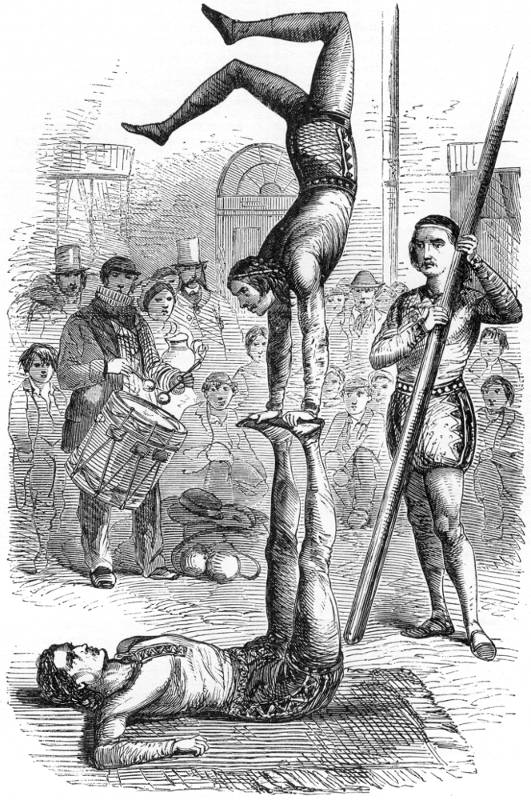
STREET ACROBATS PERFORMING.
“I came back to England in 1852, and I’ve been pitching in the streets ever since. I’ve changed gangs two or three times since then; but there’s five in our gang now. There’s three high for ‘pyramids,’ and ‘the Arabs hang down;’ that is, one a-top of his shoulders, and one hanging down from his neck; and ‘the spread,’ that’s one on the shoulders, and one hanging from each hand; and ‘the Hercules,’ that is, one on the ground, supporting himself on his hands and feet; whilst one stands on his knees, another on his shoulders, and the other one a-top of them two, on their shoulders. There’s loads of tricks like them that we do, that would a’most fill up your paper to put down. There’s one of our gang dances, an Englishman, whilst the fifth plays the drum and pipes. The dances are mostly comic dances; or, as we call them, ‘comic hops.’ He throws his legs about and makes faces, and he dresses as a clown.
“When it’s not too windy, we do the perch. We carry a long fir pole about with us, twenty-four feet long, and Jim the strong man, as they calls me, that is I, holds the pole up at the bottom. The one that runs up is called the sprite. It’s the bottom man that holds the pole that has the dangerous work in la perche. He’s got all to look to. Anybody, who has got any courage, can run up the pole; but I have to guide and balance it; and the pole weighs some 20 lbs., and the man about 8 stone. When it’s windy, it’s very awkward, and I have to walk about to keep him steady and balance him; but I’m never frightened, I know it so well. The man who runs up it does such feats as these; for instance, ‘the bottle position,’ that is only holding by his feet, with his two arms extended; and then ‘the hanging down by one toe,’ with only one foot on the top of the pole, and hanging down with his arms out, swimming on the top on his belly; and ‘the horizontal,’ as it is called, or supporting the body out sideways by the strength of the arms, and such-like, winding up with coming down head fust.
“The pole is fixed very tightly in a socket in my waistband, and it takes two men to pull it out, for it gets jammed in with his force on a-top of it. The danger is more with the bottom one than the one a-top, though few people would think so. You see, if he falls off, he is sure to light on his feet like a cat; for we’re taught to this trick; and a man can jump off a place thirty feet high, without hurting himself, easy. Now if the people was to go frontwards, it would be all up with me, because with the leverage and its being fixed so tight to my stomach, there’s no help for it, for it would be sure to rip me up and tear out my entrails. I have to keep my eyes about me, for if it goes too fur, I could never regain the balance again. But it’s easy enough when you’re accustomed to it.
“The one that goes up the pole can always see into the drawing-rooms, and he’ll tell us where it’s good to go and get any money, for he can see the people peeping behind the curtains; and they generally give when they find they are discovered. It’s part of his work to glance his eyes about him, and then he calls out whilst he is up, ‘to the right,’ or ‘the left,’ as it may be; and although the crowd don’t understand him, we do.
“Our gang generally prefer performing in the West-end, because there’s more ‘calls’ there. Gentlemen looking out of window see us, and call to us to stop and perform; but we don’t trust to them, even, but make a collection when the performance is half over; and if it’s good we continue, and make two or three collections during the exhibition. What we consider a good collection is 7s. or 8s.; and for that we do the whole performance. And besides, we get what we call ‘ringings’ afterwards; that’s halfpence that are thrown into the ring. Sometimes we get 10s. altogether, and sometimes more and sometimes less; though it’s a very poor pitch if it’s not up to 5s. I’m talking of a big pitch, when we go through all our ‘slang,’ as we say. But then we have our little pitches, which don’t last more than a quarter of an hour—our flying pitches, as we call them, and for them 5s. is an out-and-outer, and we are well contented if we get half-a-crown. We usually reckon about twenty pitches a-day, that’s eight before dinner and twelve after. It depends greatly upon the holidays as to what we makes in the days. If there’s any fairs or feasts going on we do better. There’s two days in the week we reckon nothing, that’s Friday and Saturday. Friday’s little good all day long, and Saturday’s only good after six o’clock, when wages have been paid. My share may on the average come to this:—Monday, about 7s. or 8s., and the same for Tuesday. Then Wednesday and Thursday it falls off again, perhaps 3s. or 4s.; and Friday ain’t worth much; no more is Saturday. We used to go to Sydenham on Saturdays, and we would find the gents there; but now it’s getting too late, and the price to the Palace is only 2s. 6d., when it used to be 5s., and that makes a wonderful difference to us. And yet we like the poor people better than the rich, for it’s the half-pence that tells up best. Perhaps we might take a half-sovereign, but it’s very rare, and since 1853 I don’t remember taking more than twenty of them. There was a Princess—I’m sure I’ve forgotten her name, but she was German, and she used to live in Grosvenor-square—she used to give us half-a-sovereign every Monday during three months she was in London. The servants was ordered to tell us to come every Monday at three o’clock, and we always did; and even though there was nobody looking, we used to play all the same; and as soon as the drum ceased playing, there was the money brought out to us. We continued playing to her till we was told she had gone away. We have also had sovereign calls. When my gang was in the Isle of Wight, Lord Y—— has often give us a sovereign, and plenty to eat and drink as well.
“I can’t say but what it’s as good as a hundred a-year to me; but I can’t say, it’s the same with all posturers: for you see I can talk French, and if there’s any foreigners in the crowd I can talk to them, and they are sure to give something. But most posturers make a good living, and if they look out for it, there are few but make 30s. a-week.
“Posturing as it is called (some people call it contortionists, that’s a new name; a Chinese nondescript—that’s the first name it came out as, although what we calls posturing is a man as can sit upon nothing; as, for instance, when he’s on the back of two chairs and does a split with his legs stretched out and sitting on nothing like)—posturing is reckoned the healthiest life there is, because we never get the rheumatics; and another thing, we always eat hearty. We often put on wet dresses, such as at a fair, when they’ve been washed out clean, and we put them on before they’re dry, and that’s what gives the rheumatism; but we are always in such a perspiration that it never affects us. It’s very violent exercise, and at night we feels it in our thighs more than anywhere, so that if it’s damp or cold weather it hurts us to sit down. If it’s wet weather, or showery, we usually get up stiff in the morning, and then we have to ‘crick’ each other before we go out, and practise in our bed-rooms. On the Sunday we also go out and practise, either in a field, or at the ‘Tan’ in Bermondsey. We used to go to the ‘Hops’ in Maiden-lane, but that’s done away with now.
“When we go out performing, we always take our dresses out with us, and we have our regular houses appointed, according to what part of the town we play in, if in London; and we have one pint of beer a man, and put on our costume, and leave our clothes behind us. Every morning we put on a clean dress, so we are obliged to have two of them, and whilst we are wearing one the other is being washed. Some of our men is married, and their wives wash for them, but them as isn’t give the dress to anybody who wants a job.
“Accidents are very rare with posturers. We often put our hip-bone out, but that’s soon put right again, and we are at work in a week. All our bones are loose like, and we can pull one another in, without having no pullies. One of my gang broke his leg at Chatham race-course, through the grass being slippery, and he was pitched down from three high; but we paid him his share, just the same as if he was out with us;—it wouldn’t do if we didn’t, as a person wouldn’t mount in bad weather. That man is getting on nicely,—he walks with a crutch though,—but he’ll be right in another month, and then he’ll only be put to light work till he’s strong. He ought not to be walking out yet, but he’s so daring there’s no restraining him. I, too, once broke my arm. I am a hand-jumper; that is, I a’most always light on my hands when I jump. I was on a chair on a top of a table, and I had to get into the chair and do what we call the frog, and jump off it, coming down on my hands. Everything depends upon how you hold your arms, and I was careless, and didn’t pay attention, and my arm snapped just below the elbow. I couldn’t work for three months. I was at Beauvais, in France, at the time, but the circus I was with supported me.
“My father’s very near seventy-six, and he has been a tumbler for fifty years; my children are staying with him, and he’s angry that I won’t bring them up to it: but I want them to be some trade or another, because I don’t like the life for them. There’s so much suffering before they begin tumbling, and then there’s great temptation to drink, and such-like. I’d sooner send them to school, than let them get their living out of the streets. I’ve one boy and two girls. They’re always at it at home, indeed; father and my sister-in-law say they can’t keep them from it. The boy’s very nimble.
“In the winter time we generally goes to the theatres. We are a’most always engaged for the pantomimes, to do the sprites. We always reckon it a good thirteen-weeks’ job, but in the country it’s only a month. If we don’t apply for the job they come after us. The sprites in a pantomime is quite a new style, and we are the only chaps that can do it,—the posturers and tumblers. In some theatres they find the dresses. Last winter I was at Liverpool, and wore a green dress, spangled all over, which belonged to Mr. Copeland, the manager. We never speak in the play, but just merely rush on, and throw somersaults, and frogs, and such-like, and then rush off again. Little Wheeler, the greatest tumbler of the day, was a posturer in the streets, and now he’s in France doing his 10l. a-week, engaged for three years.”
The Street Risley.
There is but one person in London who goes about the street doing what is termed “The Risley performance,” and even he is rarely to be met with.
Of all the street professionals whom I have seen, this man certainly bears off the palm for respectability of attire. He wore, when he came to me, a brown Chesterfield coat and black continuations, and but for the length of his hair, the immense size of his limbs, and the peculiar neatness of his movements, it would have been impossible to have recognized in him any of those characteristics which usually distinguish the street performer. He had a chest which, when he chose, he could force out almost like a pouter pigeon. The upper part of his body was broad and weighty-looking. He asked me to feel the muscle of his arm, and doubling it up, a huge lump rose, almost as if he had a cocoa-nut under his sleeve; in fact, it seemed as fully developed as the gilt arms placed as signs over the gold-beaters’ shops.
Like most of the street professionals, he volunteered to exhibit before me some of his feats of strength and agility. He threw his head back (his long hair tossing about like an Indian fly-whisk) until his head touched his heels, and there he stood bent backward, and nearly double, like a strip of whalebone. Then he promenaded round the room, walking on his hands, his coat-tails falling about his shoulders, and making a rare jingle of half-pence the while, and his legs dangling in front of him as limp as the lash of a cart-whip. I refused to allow him to experiment upon me, and politely declined his obliging offer to raise me from the ground, “and hold me at arm’s-length like a babby.”
When he spoke of his parents, and the brothers who performed with him, he did so in most affectionate terms, and his descriptions of the struggles he had gone through in his fixed determination to be a tumbler, and how he had worked to gain his parents’ consent, had a peculiarly sorrowful touch about them, as if he still blamed himself for the pain he had caused them. Farther, whenever he mentioned his little brothers, he always stopped for two or three minutes to explain to me that they were the cleverest lads in London, and as true and kind-hearted as they were talented.
He was more minute in his account of himself than my space will permit him to be; for as he said, “he had a wonderful rememoryation, and could recollect anything.”
With the omission of a few interesting details, the following is the account of the poor fellow’s life:—
“My professional name is Signor Nelsonio, but my real one is Nelson, and my companions know me as ‘Leu,’ which is short for Lewis. I can do plenty of things beside the Risley business, for it forms only one part of my entertainment. I am a strong man, and a fire-king, and a stone-breaker by the fist, as well as being sprite, and posturer, and doing ‘la perche.’
“Last Christmas (1855) I was, along with my two brothers, engaged at the Theatre Royal, Cheltenham, to do the sprites in the pantomime. I have brought the bill of the performances with me to show it you. Here you see the pantomime is called ‘THE IMP OF THE NORTH, or The Golden Bason; and Harlequin and the Miller’s Daughter.’ In the pantomimical transformations it says, ‘SPRITES—by the Nelson Family:’ that’s me and my two brothers.
“The reason why I took to the Risley business was this. When I was a boy of seven I went to school, and my father and mother would make me go; but, unfortunately, I was stubborn, and would not. I said I wanted to do some work. ‘Well,’ said they, ‘you shan’t do any work not yet, till you’re thirteen years old, and you shall go to school.’ Says I, ‘I will do work.’ Well, I wouldn’t; so I plays the truant. Then I goes to amuse myself, and I goes to Haggerstone-fields in the Hackney-road, and then I see some boys learning to tumble on some dung there. So I began to do it too, and I very soon picked up two or three tricks. There was a man who was in the profession as tumbler and acrobat, who came there to practise his feats, and he see me tumbling, and says he, ‘My lad, will you come along with me, and do the Risley business, and I’ll buy you your clothes, and give you a shilling a-week besides?’ I told him that perhaps mother and father wouldn’t let me go; but says he, ‘O, yes they will.’ So he comes to our house; and says mother, ‘What do you want along with my boy?’ and he says, ‘I want to make a tumbler of him.’ But she wouldn’t.
“My father is a tailor, but my uncle and all the family was good singers. My uncle was leader of the Drury-lane band, and Miss Nelson, who came out there, is my cousin. They are out in Australia now, doing very well, giving concerts day and night, and clearing by both performances one hundred and fifty pounds, day and night (and sooner, more than less), as advertised in the paper which they sent to us.
“One day, instead of going to school, I went along with this man into the streets, and then he did the Risley business, throwing me about on his hands and feet. I was about thirteen years old then. Mother asked me at night where I had been, and when I said I had been at school, she went and asked the master and found me out. Then I brought home some dresses once, and she tore them up, so I was forced to drop going out in the streets. I made some more dresses, and she tore those up. Then I got chucking about, à la Risley, my little brother, who was about seven years old; and says mother, ‘Let that boy alone, you’ll break his neck.’ ‘No, I shan’t,’ say I, and I kept on doing till I had learnt him the tricks.
“One Saturday night, father and mother and my eldest brother went to a concert-room. I had no money, so I couldn’t go. I asked my little brother to go along with me round some tap-rooms, exhibiting with me. So I smuggled him out, telling him I’d give him lots of cakes; and away we went, and we got about seven shillings and sixpence. I got home before father and mother come home. When they returned, father says, ‘Where have you been?’ Then I showed the money we had got; he was regular astonished, and says he ‘How is this? you can do nothing, you ain’t clever!’ I says, ‘Oh, ain’t I? and it’s all my own learning:’ so then he told me, that since he couldn’t do nothing else with me, I should take to it as my profession, and stick to it.
“Soon after I met my old friend the swallower again, in Ratcliffe highway. I was along with my little brother, and both dressed up in tights and spangled trunks. Says he, ‘Oh, you will take to tumbling will you? Well, then, come along with me, and we’ll go in the country.’ Then he took us down to Norwich (to Yarmouth); then he beat me, and would give me no clothes or money, for he spent it to go and get drunk. We not sending any money home, mother began to wonder what had become of me; so one night, when this man was out with a lot of girls getting drunk, I slipt away, and walked thirty miles that night, and then I began performing at different public-houses, and so worked my way till I got back to London again. My little brother was along with me, but I carried him on my shoulders. One day it came on to rain awful, and we had run away in our dresses, and then we was dripping. I was frightened to see little Johnny so wet, and thought he’d be ill. There was no shed or barn or nothing, and only the country road, so I tore on till we came to a roadside inn, and then I wrung his clothes out, and I only had fourpence in my pocket, and I ordered some rum and water hot, and made him drink. ‘Drink it, it’ll keep the cold out of you.’ When we got out he was quite giddy, and kept saying, ‘Oh, I’m so wet!’ With all these misfortunes I walked, carrying the little chap across my shoulders. One day I only had a halfpenny, and Johnny was crying for hunger, so I goes to a fellow in a orchard and say I, ‘Can you make me a ha’path of apples?’ He would take the money, but he gave a cap-full of fallings. I’ve walked thirty-eight miles in one day carrying him, and I was awfully tired. On that same day, when we got to Colchester, we put up at the Blue Anchor, and I put Johnny into bed, and I went out myself and went the round of the public-houses. My feet was blistered, but I had my light tumbling slippers on, and I went to work and got sixteen pence-halfpenny. This got us bread and cheese for supper and breakfast, and paid threepence each for the bed; and the next day we went on and performed in a village and got three shillings. Then, at Chelmsford we got eight shillings. I bought Johnny some clothes, for he had only his tights and little trunks, and though it was summer he was cold, especially after rain. The nearer we got to London the better we got off, for they give us then plenty to eat and drink, and we did pretty well for money. After I passed Chelmsford I never was hungry again. When we got to Romford, I waited two days till it was market-day, when we performed before the country people and got plenty of money and beer; but I never cared for the beer. We took four shillings and sixpence. I wouldn’t let Johnny take any beer, for I’m fond of him, and he’s eleven now, and the cleverest little fellow in England; and I learnt him everything he knows out of my own head, for he never had no master. We took the train to London from Romford (one shilling and sixpence each), and then we went home.
“When we got back, mother and father said they knew how it would be, and laughed at us. They wanted to keep us at home, but I wouldn’t, and they was forced to give way. In London I stopped still for a long time, at last got an engagement at two shillings a-night at a penny gaff in Shoreditch. It was Sambo, a black man, what went about the streets along with the Demon Brothers—acrobats—that got me the engagement.
“One night father and mother came to see me, and they was frightened to see me chucking my brother about; and she calls out, ‘Oh, don’t do that! you’ll break his back.’ The people kept hollaring out, ‘Turn that woman out!’ but she answers, ‘They are my sons—stop ’em!’ When I bent myself back’ards she calls out, ‘Lord! mind your bones.’
“After this I noticed that my other brother, Sam, was a capital hand at jumping over the chairs and tables. He was as active as a monkey; indeed he plays monkeys now at the different ballets that comes out at the chief theatres. It struck me he would make a good tumbler, and sure enough he is a good one. I asked him, and he said he should; and then he see me perform, and he declared he would be one. He was at my uncle’s then, as a carver and gilder. When I told father, says he, ‘Let ’em do as they like, they’ll get on.’ I said to him one day, ‘Sam, let’s see what you’re like:’ so I stuck him up in his chair, and stuck his legs behind his head, and kept him like that for five minutes. His limbs bent beautiful, and he didn’t want no cricking.
“I should tell you, that before that he done this here. You’ve heard of Baker, the red man, as was performing at the City of London Theatre; well, Sam see the cut of him sitting in a chair with his legs folded, just like you fold your arms. So Sam pulls down one of the bills with the drawing on it, and he says, ‘I can do that,’ and he goes home and practises from the engraving till he was perfect. Then he showed me, and says I, ‘That’s the style! it’s beautiful! you’ll do.’
“Then we had two days’ practice together, and we worked the double-tricks together. Then, I learned him style and grace, what I knowed myself; such as coming before an audience and making the obedience; and by and by says I to him, ‘We’ll come out at a theatre, and make a good bit of money.’
“Well, we went to another exhibition, and we came out all three together, and our salary was twenty-five shillings a-week, and we was very successful. Then we got outside Peter’s Theatre at Stepney fair, the last as ever was, for it’s done away with now; we did very well then; they give us twelve shillings a-day between us for three days. We did the acrobating and Risley business outside the parade, and inside as well. Sam got on wonderful, for his mind was up to it, and he liked the work. I and my brothers can do as well as any one in this business, I don’t care who comes before us. I can do upwards of one hundred and twenty-one different tricks in tumbling, when I’m along with those little fellows. We can do the hoops and glasses—putting a glass of beer on my forehead, and going through hoops double, and lying down and getting up again without spilling it. Then there’s the bottle-sprite, and the short stilts, and globe running and globe dancing, and chair tricks; perform with the chairs; and the pole trick—la perche—with two boys, not one mind you.
“We’ve been continuing ever since at this Risley business. I lay down on a carpet, and throw then summersets from feet to feet. I tell you what the music plays to it,—it’s the railway overtime, and it begins now and then quicker and quicker, till I throw them fast as lightning. Sam does about fifty-four or fifty-five of these summersets one after another, and Johny does about twenty-five, because he’s littler. Then there’s standing upright, and stand ’em one in one hand and one on the other. Then I throws them up in summersets, and catch ’em on my palm, and then I chuck ’em on the ground.
“The art with me lying on the ground is that it takes the strength, and the sight to see that I catch ’em properly; for if I missed, they might break their necks. The audience fancies that it’s most with them tumbling, but every thing depends upon me catching them properly. Every time they jump, I have to give ’em a jerk, and turn ’em properly. It’s almost as much work as if I was doing it myself. When they learn at first, they do it on a soft ground, so as not to hurt theirselves. It don’t make the blood come to the head lying down so long on my back—only at first.
“I’ve done the Risley business first at penny exhibitions, and after that I went to fairs; then I went round the country with a booth—a man named Manly it was; but we dropped that, ’cos my little brother was knocked up, for it was too hard work for the little fellow building up and taking down the booth sometimes twice in a-day, and then going off twenty miles further on to another fair, and building up again the next day. Then we went pitching about in the main streets of the towns in the country. Then I always had a drum and pipes. As soon as a crowd collected I’d say, ‘Gentlemen, I’m from the principal theatres in London, and before I begin I must have five shillings in the ring.’ Then we’d do some, and after that, when half was over, I’d say, ‘Now, gentlemen, the better part is to come, and if you make it worth my while, I go on with this here entertainment;’ then, perhaps, they’d give me two shillings more. I’ve done bad and done good in the country. In one day I’ve taken two pounds five shillings, and many days we’ve not taken eight shillings, and there was four of us, me and my two brothers and the drummer, who had two-and-sixpence a-day, and a pot of beer besides. Take one week with another we took regular two pounds five shillings, and out of that I’d send from twenty to thirty shillings a-week home to my parents. Oh, I’ve been very good to my parents, and I’ve never missed it. I’ve been a wild boy too, and yet I’ve always taken care of father and mother. They’ve had twelve in family and never a stain on their character, nor never a key turned on them, but are upright and honourable people.
“At a place called Brenford in Norfolk—where there’s such a lot of wild rabbits—we done so well, that we took a room and had bills printed and put out. We charged threepence each, and the room was crowded, for we shared twenty-five shillings between us. When the people see’d me and my brothers come on dressed all in red, and tumble about, they actually swore we were devils, and rushed out of the place; so that, though there was a room full, there was only two stopped to see the performances. One old man called out, ‘O wenches’—they call their wives wenches—‘come out, they be devils.’ We came out with red faces and horns and red dresses, and away they went screaming. There was one woman trampled on and a child knocked out of her arms. In some of these country towns they’re shocking strict, and never having seen anything of the kind, they’re scared directly.
“About six months ago I went to Woolwich with the boys, and there was a chap that wanted to fight me, because I wouldn’t go along with him. So, I says, ‘We won’t have no fighting;’ so I went along with him to Gravesend, and then we asked permission of the mayor, ’cos in country towns we often have to ask the mayor to let us go performing in the streets. There we done very well, taking twenty-five shillings in the day. Then we worked up by Chatham, and down to Herne-bay, and Ramsgate; and at Ramsgate we stopped a week, doing uncommon well on the sands, for the people on the chairs would give sixpence and a shilling, and say it was very clever, and too clever to be in the streets. We did Margate next, and then Deal, and on to Dover by the boat. At Dover, the mayor wouldn’t let us perform, and said if he catched us in the streets he’d have us took up. We were very hard up. So I said to Sam, ‘You must go out one way and I and Johnny the other, and busk in the public-house.’ Sam got eight shillings and sixpence and I four shillings. But I had a row with a sailor, and I was bruised and had to lay up. When I was better we moved to Folkestone. There was the German soldiers there, and we did very well. I went out one day with our carpet to a village close by, and some German officers made us perform, and gave us five shillings, and then we went the round of the beer-shops, and altogether we cleared five pounds before we finished that day. We also went up to the camp, where the tents was, and I asked the colonel to let me perform before the men, and he said, ‘Well it ain’t usual, but you may if you like.’ The officers we found was so pleased they kept on giving us two-shilling pieces, and besides we had a lot of foreign coin, which we sold to a jeweller for ten shillings.
“I worked my way on to Canterbury and Winchester, and then, by a deal of persuasion I got permission to perform in the back-streets, and we done very well. Then we went on to Southampton. There was a cattle fair, on—Celsey fair is, I think, the name of it; and then I joined another troupe of tumblers, and we worked the fair, and after that went on to Southampton; and when we began working on the Monday, there was another troupe working as well. After we had pitched once or twice, this other troupe came and pitched opposition against us. I couldn’t believe it at first, but when I see which was their lay, then says I, ‘Now I’ll settle this.’ We was here, as it was, and they came right on to us—there, as it may be. So it was our dinner-time, and we broke up and went off. After dinner we came out again, and pitched the carpet in a square, and they came close to us again, and as soon as they struck up, the people run away to see the new ones. So I said ‘I don’t want to injure them, but they shan’t injure us.’ So I walked right into the middle of their ring, and threw down the carpet, and says I, ‘Now, ladies and gentlemen, the best performance is the one that deserves best support, and I’ll show you what I can do.’ I went to work with the boys, and was two hours doing all my tumbling tricks. They was regularly stunned. The silver and the halfpence covered the carpet right over, as much as it would hold. I think there was three pounds. Then I says, ‘Now you’ve seen the tumbling, now see the perche.’ They had a perche, too; it was taller than mine; but, as I told them, it was because I couldn’t get no higher a one. So I went to work again, and cries I, ‘Now, both boys up;’ though I had only stood one on up to that time, and had never tried two of ’em. Up they goes, and the first time they come over, but never hurt theirselves. It was new to me, you see. ‘Up again, lads,’ says I; and up they goes, and did it beautiful. The people regular applauded, like at a theatre. Down came the money in a shower, and one gentleman took his hat round, and went collecting for us. Says I to this other school, ‘You tried to injure us, and what have you got by it? I beat you in tumbling, and if you can match the perche, do it.’ Then they says, ‘We didn’t try to injure you; come and drink a gallon of beer.’ So off we went, and the police told ’em to choose their side of the town and we would take ours. That settled the opposition, and we both done well.
“I’ve done the Risley in the streets of London, more so than at theatres and concerts. The stone paving don’t hurt so much as you would think to lie down. We don’t do it when it’s muddy. The boys finds no difference whatsumever in springing off the stones. It pays very well at times, you know; but we don’t like to do it often, because afterwards they don’t like to appreciate you in concerts and theatres, and likewise penny exhibitions.
“My brother Sam can jump like a frog, on his hands, through his legs, out of a one-pair window; and little Johnny throws out of a one-pair-of-stairs window a back summerset.
“It’s astonishing how free the bones get by practice. My brother Sam can dislocate his limbs and replace them again; and when sleeping in bed, I very often find him lying with his legs behind his neck. It’s quite accidental, and done without knowing, and comes natural to him, from being always tumbling. Myself, I often in my dreams often frighten my wife by starting up and half throwing a summersault, fancying I’m at the theatre, and likewise I often lie with my heels against my head.
“We are the only family or persons going about the streets doing the Risley. I’ve travelled all through England, Scotland, and Wales, and I don’t know anybody but ourselves. When we perform in the London theatres, which we do when we can get an engagement, we get six or seven pounds a-week between us. We’ve appeared at the Pavilion two seasons running; likewise at the City of London, and the Standard, and also all the cheap concerts in London. Then we are called ‘The Sprites’ by the Nelson family will appear; or, ‘The Sprites of Jupiter;’ or, ‘Sons of Cerea;’ or, ‘Air-climbers of Arabia!’
“Taking all the year round, I dare say my income comes to about thirty-five shillings or two pounds, and out of that I have to find dresses.”
The Strong Man.
“I have been in the profession for about thirteen years, and I am thirty-two next birthday. Excepting four years that I was at sea, I’ve been solely by the profession. I’m what is termed a strong man, and perform feats of strength and posturing. What is meant by posturing is the distortion of the limbs, such as doing the splits, and putting your leg over your head and pulling it down your back, a skipping over your leg, and such-like business. Tumbling is different from posturing, and means throwing summersets and walking on your hands; and acrobating means the two together, with mounting three stories high, and balancing each other. These are the definitions I make.
“I was nineteen before I did anything of any note at all, and got what I call a living salary. Long before that I had been trying the business, going in and out of these free concerts, and trying my hand at it, fancying I was very clever, but disgusting the audience, for they are mostly duffers at these free concerts; which is clearly the case, for they only do it for a pint every now and then, and depend upon passing the hat round after their performance. I never got much at collections, so I must have been a duffer.
“My father is an architect and builder, and his income now is never less than a thousand a-year. Like a fool, I wouldn’t go into his office: I wish I had. I preferred going to sea. I was always hankering after first one vessel and then another. I used to be fond of going down to the docks, and such-like, and looking at the vessels. I’d talk with the sailors about foreign countries, and such-like, and my ambition was to be a sailor. I was the scabby sheep of the family, and I’ve been punished for it. I never went into the governor’s office; but when I was about fourteen I was put to a stonemason, for I thought I should like to be a carver, or something of that sort. I was two years there, and I should have done very well if I had stayed, for I earned a guinea a-week when I left.
“Before I went to the stonemason I was at the Victoria, taking checks—when there was any. I had an uncle there who kept the saloon there. I was always very partial to going to the theatre, for all our people are chapel people, and that I never liked. My father’s parlour is always smothered with ministers, and mine with tumblers, and that’s the difference. I used to go and see my uncle at the Vic., so as to get to the theatre for nothing. I wasn’t paid for taking the checks, but I knew the check-taker, and he’d ask me to help him, and I was too glad to get inside a theatre to refuse the job. They were doing dreadful business. It was under Levi, and before Glossop’s time. It was before the glass curtain come out. The glass curtain was a splendid thing. It went straight up, never wound. You can even now see where the roof was highered to receive it. Levi has got the Garrick now. They say he’s not doing much.
“The first thing I did was at a little beer-shop, corner of Southwark-bridge-road and Union-street. I had seen Herbert do the Grecian statues at the Vic., in ‘Hercules, King of Clubs,’ and it struck me I could do ’em. So I knew this beer-shop, and I bought half-a-crown’s worth of tickets to be allowed to do these statues. It was on a boxing-night, I remember. I did them, but they were dreadful bad. The people did certainly applaud, but what for, I don’t know, for I kept shaking and wabbling so, that my marble statue was rather ricketty; and there was a strong man in the room, who had been performing them, and he came up to me and said that I was a complete duffer, and that I knew nothing about it at all. So I replied, that he knew nothing about his feats of strength, and that I’d go and beat him. So I set to work at it; for I was determined to lick him. I got five quarter-of-hundred weights, and used to practice throwing them at a friend’s back-yard in the Waterloo-road. I used to make myself all over mud at it, besides having a knock of the head sometimes. At last I got perfect chucking the quarter hundred, and then I tied a fourteen pound weight on to them, and at last I got up half-hundreds. I learnt to hold up one of them at arm’s length, and even then I was obliged to push it up with the other hand. I also threw them over my head, as well as catching them by the ring.
“I went to this beer-shop as soon as I could do, and came out. I wasn’t so good as he was at lifting, but that was all he could do; and I did posturing with the weights as well, and that licked him. He was awfully jealous, and I had been revenged. I had learnt to do a split, holding a half-hundred in my teeth, and rising with it, without touching the ground with my hands. Now I can lift five, for I’ve had more practice. I had tremendous success at this beer-shop.
“It hurt me awfully when I learnt to do the split with the weight on my teeth. It strained me all to pieces. I couldn’t put my heels to the ground not nicely, for it physicked my thighs dreadful. When I was hot I didn’t feel it; but as I cooled, I was cramped all to bits. It took me nine months before I could do it without feeling any pain.
“Another thing I learnt to do at this beer-shop was, to break the stone on the chest. This man used to do it as well, only in a very slight way—with thin bits and a cobbler’s hammer. Now mine is regular flagstones. I’ve seen as many as twenty women faint seeing me do it. At this beer-shop, when I first did it, the stone weighed about three quarters of a hundred, and was an inch thick. I laid down on the ground, and the stone was put on my chest, and a man with a sledge hammer, twenty-eight pounds weight, struck it and smashed it. The way it is done is this. You rest on your heels and hands and throw your chest up. There you are, like a stool, with the weight on you. When you see the blow coming, you have to give, or it would knock you all to bits.
“When I was learning to do this, I practised for nine months. I got a friend of mine to hit the stone. One day I cut my chest open doing it. I wasn’t paying attention to the stone, and never noticed that it was hollow; so then when the blow came down, the sharp edges of the stone, from my having nothing but a fleshing suit on, cut right into the flesh, and made two deep incisions. I had to leave it off for about a month. Strange to say, this stone-breaking never hurt my chest or my breathing; I rather think it has done me good, for I’m strong and hearty, and never have illness of any sort.
“The first time I done it I was dreadful frightened. I knew if I didn’t stop still I should have my brains knocked out, pretty well. When I saw the blow coming I trembled a good bit, but I kept still as I was able. It was a hard blow, for it broke the bit of Yorkshire paving, about an inch thick, into about sixty pieces.
“I got very hard up whilst I was performing at this beer-shop. I had run away from home, and the performances were only two nights a-week, and brought me in about six shillings. I wasn’t engaged anywhere else. One night, a Mr. Emanuel, who had a benefit at the Salmon Saloon, Union-street, asked me to appear at his benefit. He had never seen me, but only heard of my performances. I agreed to go, and he got out the bills, and christened me Signor C——; and he had drawings made of the most extravagant kind, with me holding my arms out with about ten fifty-six-pound weights hanging to them by the rings. He had the weights, hammers, and a tremendous big stone chained outside the door, and there used to be mobs of people there all day long looking at it.
“This was the first success I made. Mr. Emanuel gave five shillings for the stone, and had it brought up to the saloon by two horses in a cart to make a sensation. It weighed from four to five hundred weight. I think I had such a thing as five men to lift it up for me.
“I had forgotten all about this engagement, and I was at the coffee-house where I lodged. The fact was, I was in rags, and so shabby I didn’t like to go, and if he hadn’t come to fetch me I should not have gone. He drove up in his chaise on the night in question to this coffee-shop, and he says, ‘Signor C——, make haste; go and change your clothes, and come along.’ I didn’t know at first he was speaking to me, for it was the first time I had been Signor C——. Then I told him I had got my best suit on, though it was very ragged, and no mistake about it, for I remember there was a good hole at each elbow. He seemed astonished, and at last proposed that I should wear his great-coat; but I wouldn’t, because, as I told him, his coat would be as well known at the saloon as he himself was, and that it didn’t suit me to be seen in another’s clothes. So he took me just as I was. When we got there, the landlady was regularly flabbergastered to see a ragged fellow like me come to be star of the night. She’d hardly speak to me.
“There was a tremendous house, and they had turned above a hundred away. When I got into the saloon, Emanuel says, ‘What’ll you have to drink?’ I said, ‘Some brandy;’ but my landlord of the coffee-house, who had come unbeknown to me, he grumbles out, ‘Ask him what he’ll have to eat, for he’s had nothing since the slice of bread-and-butter for breakfast.’ I trod on his toe, and says, ‘Keep quiet, you fool!’ Emanuel behaved like a regular brick, and no mistake. He paid for the supper and everything. I was regularly ashamed when the landlord let it out though. That supper put life into me, for it almost had the same effect upon me as drink.
“It soon got whispered about in the saloon that I was the strong man, and everybody got handing me their glasses; so I was regularly tipsy when it was time to go on, and they had put me off to the last on purpose to draw the people and keep them there drinking.
“I had a regular success. When the women saw the five men put the stone on my chest, they all of them called out, ‘Don’t! don’t!’ It was a block like a curb, about a foot thick, and about a four feet six inches long. I went with Emanuel to buy it. I had never tried such a big one before. It didn’t feel so heavy on the chest, for, you see, you’ve got such out-and-out good support on your hands and heels. I’ve actually seen one man raise a stone and another a waggon. It’s the purchase done it. I’ve lifted up a cart-horse right off his legs.
“The stone broke after six blows with a twenty-eight pound sledge-hammer. Then you should have heard the applause. I thought it would never give over. It smashed all to atoms, just like glass, and there was the people taking away the bits to keep as a remembrance.
“As I went out the landlady asked me to have a bottle of soda-water. The landlady was frightened, and told me she had felt sure I should be killed. I was the second that ever done stone-breaking in England or abroad, and I’m the first that ever did such a big one. The landlady was so alarmed that she wouldn’t engage me, for she said I must be killed one of the nights. Her behaviour was rather different as I went out to when I came in.
“I, of course, didn’t go on in my rags. I had a first-rate stage dress.
“After this grand appearance I got engaged at Gravesend fair by Middleton, and there I had eight shillings a-day, and I stopped with him three weeks over the fair. I used to do my performances outside on the parade, never inside. I had to do the stone-breaking about nine or ten times a-day. They were middling stones, some larger and some smaller, and the smaller ones about half-a-hundred weight, I suppose. Any man might bring his stone and hammer, and break it himself. The one who struck was generally chosen from the crowd; the biggest chap they could find. I’ve heard ’em say to me, ‘Now, old chap, I’ll smash you all to bits; so look out!’ The fact is, the harder they strike the better for me, for it smashes it at once, and don’t keep the people in suspense.
“It was at Gravesend that I met with my second and last accident. With the cutting of the chest, it is the only one I ever had. The feller who came up to break the stone was half tipsy and missed his aim, and obliged me by hitting my finger instead of the stone. I said to him, ‘Mind what you are doing,’ but I popped my hand behind me, and when I got up I couldn’t make out what the people was crying out about, till I looked round at my back and then I was smothered in blood. Middleton said, ‘Good God! what’s the matter?’ and I told him I was hit on the finger. When the cry was given of ‘All in to begin,’ I went into a booth close by and had some brandy, and got a doctor to strap up the finger, and then I went on with the parade business just the same. It didn’t pain me nothing like what I should have thought. It was too hard a knock to pain me much. The only time I felt it was when the doctor dressed it, for it gave me pepper taking the plaster off.
“I was at Gravesend some time, and I went to work again stone-masoning, and I had a guinea a-week, and in the evening I used to perform at the Rose Inn. I did just as I liked there. I never charged ’em anything. I lived in the house and they never charged me anything. It was a first-rate house. If I wanted five shillings I’d get it from the landlord. I was there about eleven months, and all that time I lived there and paid nothing. I had a benefit there, and they wouldn’t even charge me for printing the bills, or cards, or anything. It was quite a clear benefit, and every penny taken at the doors was given to me. I charged a shilling admittance, and the room was crowded, and they was even on the stairs standing tip-toe to look at me. I wanted some weights, and asked a butcher to lend ’em to me, and he says, ‘Lend ’em to you! aye, take the machine and all if it’ll serve you.’ I was a great favourite, as you may guess.
“After Gravesend I came up to London, and went and played the monkey at the Bower Saloon. It was the first time I had done it. There was all the monkey business, jumping over tables and chairs, and all mischievous things; and there was climbing up trees, and up two perpendicular ropes. I was dressed in a monkey’s dress; it’s made of some of their hearth-rugs; and my face was painted. It’s very difficult to paint a monkey’s face. I’ve a great knack that way, and can always manage anything of that sort.
“From the Bower I went on to Portsmouth. I’d got hard up again, for I’d been idle for three months, for I couldn’t get any money, and I never appear under price. I walked all the way to Portsmouth, carrying a half-hundred weight, besides my dress, all the way; I played at the tap-rooms on the road. I did pretty middling, earned my living on the road, about two shillings a-day. When I got to Portsmouth I did get a job, and a good job it was, only one shilling and sixpence a-night; but I thought it better to do that than nothing. I only did comic singing, and I only knew two songs, but I set to and learnt a lot. I am very courageous, and if I can’t get my money one way, I will another. With us, if you’ve got a shilling, you’re a fool if you spend that before you have another. I stopped at this public-house for two months, and then a man who came from Portsea, a town close by, came one night, and he asked me what I was doing. He had heard of what I could do, and he offered me two pounds a-week to go with him and do the strong business. He kept the Star Inn at Portsea. I stopped there such a thing as two years, and I did well. I had great success, for the place was cramm’d every night. For my benefit, Major Wyatt and Captain Holloway gave me their bespeak, and permission for the men to come. The admission was sixpence. Half the regiment marched down, and there was no room for the public. I was on the stage for two hours during my performances. I was tired, and fainted away as dead as a hammer after the curtain fell.
“Among other things I announced that I should, whilst suspended from the ceiling, lift a horse. I had this horse paraded about the town for a week before my night. There was such a house that numbers of people was turned away, and a comic singer who was performing at a house opposite, he put out an announcement that he too would lift a horse, and when the time came he brought on a clothes-horse.
“The way I did the horse was this: I was hanging by my ankles, and the horse was on a kind of platform under me. I had two sheets rolled up and tied round the horse like belly-bands, and then I passed my arms through them and strained him up. I didn’t keep him long in the air, only just lifted him off his legs. In the midst of it the bandage got off his eyes, and then, what with the music and the applauding, the poor brute got frightened and begun plunging. I couldn’t manage him at all whilst he was kicking. He got his two hind legs over the orchestra and knocked all the float-lights out. They kept roaring, ‘Bring him out! bring him out!’ as if they thought I was going to put him under my arm—a thundering big brute. I was afraid he’d crack his knees, and I should have to pay for him. The fiddler was rather uneasy, I can tell you, and the people began shifting about. I was frightened, and so I managed to pop part of the sheet over his head, and then I gave a tremendous strain and brought him back again.
“How the idea of lifting a horse ever came into my head, I don’t know. It came in a minute; I had never tried it before. I knew I should have a tremendous purchase. The fact is, I had intended to do a swindle by having lines passed down my dress, and for somebody behind to pull the ropes and help me. The town was in an uproar when I announced I should do it.
“It was at my benefit that I first broke stones with my fist. I don’t know whose original notion it was. I was not the first; there’s a trick in it. It’s done this way: anybody can do it. You take a cobbler’s lapstone, and it’s put on a half-hundred weight; you must hold it half an inch above, and then the concussion of the fist coming down smashes it all to bits. Any one can do it.
“I cleared about eight pounds by my benefit. I was a regular swell in those days. The white coats had just come up, and I had one made with two-shilling pieces for buttons, and with polished-leather Wellington’s I’d walk about the town, the king of the place.
“I’ve been down to Manchester performing. I’ve been, too, to the Standard Theatre as well as the Victoria and the Marylebone. People won’t believe I really do break the stone on my chest. Some ask me what I wear under my dress, though the fact is, that if I had anything hard there, it would just about kill me, for it’s by yielding to the blow that I save myself. I actually gammoned one chap that the stones were made of small pieces stuck together with paste, and he offered to give me any sum to tell him what the paste was made of.
“When I’m engaged for a full performance I do this. All the weights, and the stone and the hammer, are ranged in front of the stage. Then I come on dressed in silk tights with a spangled trunk. Then I enter at the back of the stage, and first do several feats of posturing, such as skipping through my leg or passing it down my back, or splits. Then I take a ladder and mount to the top, and stand up on it, and hold one leg in my hand, shouldering it; and then I give a spring with the other leg, and shoot off to the other side of the stage and squash down with both legs open, doing a split. It’s a very good trick, and always gets a round. Then I do a trick with a chair standing on the seat, and I take one foot in my hand and make a hoop of the leg, and then hop with one leg through the hoop of the other, and spring over the back and come down in a split on the other side. I never miss this trick, though, if the chair happens to be ricketty, I may catch the toe, but it doesn’t matter much.
“Then I begin my weight business. I take one half-hundred weight and hold it up at arm’s-length; and I also hold it out perpendicularly, and bring it up again and swing it two or three times round the head, and then throw it up in the air and catch it four or five times running; not by the ring, as others do, but in the open hand.
“The next trick is doing the same thing with both hands instead of one, that is with two weights at the same time; and then, after that, I take up a half-hundred by the teeth, and shouldering the leg at the same, and in that style I fall down into the splits. Then I raise myself up gradually, till I’m upright again. After I’m upright I place the weight on my forehead, and lay down flat on my back with it, without touching with the hands. I take it off when I’m down and place it in my mouth, and walk round the stage like a Greenwich-pensioner, with my feet tucked up like crossing the arms, and only using my knees. Then I tie three together, and hold them in the mouth, and I put one in each hand. Then I stand up with them and support them. It’s an awful weight, and you can’t do much exhibiting with them.
“When I was at Vauxhall, Yarmouth, last year, I hurt my neck very badly in lifting those weights in the mouth. It pulled out the back of my neck, and I was obliged to give over work for months. It forced my head over one shoulder, and then it sunk, as if I’d got a stiff neck. I did nothing to it, and only went to a doctor-chap, who made me bathe the neck in hot water. That’s all.
“One of my most curious tricks is what I call the braces trick. It’s a thing just like a pair of braces, only, instead of a button, there’s a half-hundred weight at each end, so that there are two behind and two in front. Then I mount on two swinging ropes with a noose at the end, and I stretch out my legs into a split, and put a half-hundred on each thigh, and take up another in my mouth. You may imagine how heavy the weight is, when I tell you that I pulled the roof of a place in once at Chelsea. It was a exhibition then. The tiles and all come down, and near smothered me. You must understand, that in these tricks I have to put the weights on myself, and raise them from the ground, and that makes it so difficult.
“The next, and the best, and most difficult trick of all is, I have a noose close to the ceiling, in which I place one of my ankles, and I’ve another loose noose with a hook at the end, and I place that on the other ankle. Two half-hundreds are placed on this hook, and one in each hand. The moment these weights are put on this ankle, it pulls my legs right apart, so that they form a straight line from the ceiling, like a plumb-line, and my body sticks out at the side horizontally, like a T-square sideways. I strike an attitude when I have the other weights in my hand, and then another half-hundred is put in my mouth, and I am swung backwards and forwards for about eight or twelve times. It don’t hurt the ankle, because the sling is padded. At first it pulls you about, and gives you a tremendous ricking. After this rope-performance I take a half-hundred and swing it round about fifty times. It goes as rapidly as a wheel, and if I was to miss my aim I should knock my brains out. I have done it seventy times, but that was to take the shine out of an opposition fellow.
“I always wind up with breaking the stone, and I don’t mind how thick it is, so long as it isn’t heavy enough to crush me. A common curb-stone, or a Yorkshire-flag, is nothing to me, and I’ve got so accustomed to this trick, that once it took thirty blows with a twenty-eight pound sledge-hammer to break the stone, and I asked for a cigar and smoked it all the while.
“I’ll tell you another trick I’ve done, and that’s walking on the ceiling. Of course I darn’t do it in the Professor Sands’ style, for mine was a dodge. Professor Sands used an air-exhausting boot, on the model of a fly’s foot, and it was a legitimate performance indeed; he and another man, to whom he gave the secret of his boots, are the only two who ever did it. The chap that came over here wasn’t the real Sands. The fact is well known to the profession, that Sands killed himself on his benefit night in America. After walking on the marble slab in the Circus, somebody bet him he couldn’t do it on any ceiling, and he for a wager went to a Town-hall, and done it, and the ceiling gave way, and he fell and broke his neck. The chap that came over here was Sands’ attendant, and he took the name and the boots, and came over as Professor Sands.
“The first who ever walked on the ceiling, by a dodge, was a man of the name of Herman, a wizard, who wound up his entertainment at the City of London by walking on some planks suspended in the air. I was there, and at once saw his trick. I knew it was a sleight-of-hand thing. I paid great attention and found him out.
“I then went to work in this way. I bought two planks about thirteen foot long, and an inch thick. In these planks I had small traps, about two inches long by one inch wide, let into the wood, and very nicely fitted, so that the cracks could not be seen. The better to hide the cracks, I had the wood painted marble, and the blue veins arranged on the cracks. These traps were bound on the upper side with iron hooping to strengthen them. Then I made my boots. They were something like Chinese boots, with a very thick sole, made on the principle of the bellows of an accordion. These bellows were round, about the size of a cheese-plate, and six inches deep. To the sole of the boot I had an iron plate and a square tenter-hook riveted in.
“Then came the performance. There was no net under me, and the planks was suspended about twenty feet from the stage. I went up on the ladder and inserted the hook on one boot into the first trap. The sucker to the boot hid the hook, and made it appear as if I held by suction. The traps were about six inches apart, and that gave me a very small step. The hooks being square ones—tenter-hooks—I could slip them out easily. It had just the same appearance as Sands, and nobody ever taught me how to do it. I did this feat at the Albion Concert-rooms, just opposite the Effingham Saloon. I had eighteen shillings a-week there for doing it. I never did it anywhere else, for it was a bother to carry the planks about with me. I did it for a month, every night three times. One night I fell down. You see you can never make sure, for if you swung a little, it worked the hook off. I always had a chap walking along under me to catch me, and he broke my fall, so that I didn’t hurt myself. I ran up again, and did it a second time without an accident. There was tremendous applause. I think I should have fallen on my hands if the chap hadn’t been there.
“If the Secretary of State hadn’t put down the balloon business, I should a made a deal of money. There is danger of course, but so there is if you’re twenty or thirty feet. They do it now fifty feet high, and that’s as bad as if you were two hundred or a mile in the air. The only danger is getting giddy from the height, but those who go up are accustomed to it.
“I sold the ceiling-walking trick to another fellow for two pounds, after I had done with it, but he couldn’t manage it. He thought he was going to do wonders. He took a half-hundred weight along with him, but he swung like a pendulum, and down he come.
“Why this walking on the ceiling of mine was very near the same as what Harvey Leach did at the Surrey as the gnome fly. He was a tremendous clever fellow. His upper part of the body was very perfectly made, but his legs was so short, they weren’t more than eighteen inches long. That’s why he walked as much on his hands as his legs. That ‘What is It,’ at the Egyptian Hall killed him. They’d have made a heap of money at it if it hadn’t been discovered. He was in a cage, and wonderfully got up. He looked awful. A friend of his comes in, and goes up to the cage, and says, ‘How are you, old fellow?’ The thing was blown up in a minute. The place was in an uproar. It killed Harvey Leach, for he took it to heart and died.
“I reckon Astley’s is the worst money for any man. If a fellow wants to be finished up, let him go there. It doesn’t pay so well as the cheap concerts, unless a man is a very great star, and they must give him his money.
“There are six men, including myself, who do the strong business. That’s all I’m beware of in London, or England. Sometimes they change their names, and comes out as Herrs, or Signors, or Monsieurs, but they are generally the same fellows. Most of our foreigners in England come out of Tower-street. There was a house of call there for professionals of all nations, but that ‘public’ is done up now, and they mostly go to the Cooper’s Arms now.
“If a strong man properly understands his business, and pays attention to his engagements, his average earnings will be about two pounds ten shillings a-week. As it is, they now make less than thirty shillings, but they spend it so readily that it doesn’t go so far as a working man’s pound. There’s plenty of people to ask you, ‘What’ll you have?’ but if you’re anything of a man you’re obliged to return the compliment at some time. The swells get hold of you. Perhaps a bottle of wine is called for, and then another; well, then a fellow must be no good if he doesn’t pay for the third when it comes, and the day’s money don’t run to it, and you’re in a hole.”
The Street Juggler.
The juggler from whom I received the following account, was spoken of by his companions and friends as “one of the cleverest that ever came out.” He was at this time performing in the evening at one of the chief saloons on the other side of the water.
He certainly appears to have been successful enough when he first appeared in the streets, and the way in which he squandered the amount of money he then made is a constant source of misery to him, for he kept exclaiming in the midst of his narrative, “Ah! I might have been a gentleman now, if I hadn’t been the fool I was then.”
As a proof of his talents and success he assured me, that when Ramo Samee first came out, he not only learned how to do all the Indian’s tricks, but also did them so dexterously, that when travelling “Samee has often paid him ten shillings not to perform in the same town with him.”
He was a short man, with iron-grey hair, which had been shaved high upon the temples to allow him to assume the Indian costume. The skin of the face was curiously loose, and formed deep lines about the chin, whilst in the cheeks there were dimples, or rather hollows, almost as deep as those on a sofa cushion. He had a singular look, from his eyebrows and eyes being so black.
His hands were small and delicate, and when he took up anything, he did it as if he were lifting the cup with the ball under it.
“I’m a juggler,” he said, “but I don’t know if that’s the right term, for some people call conjurers jugglers; but it’s wrong. When I was in Ireland they called me a “manulist,” and it was a gentleman wrote the bill out for me. The difference I makes between conjuring and juggling is, one’s deceiving to the eye and the other’s pleasing to the eye—yes, that’s it—it’s dexterity.
“I dare say I’ve been at juggling 40 years, for I was between 14 and 15 when I begun, and I’m 56 now. I remember Ramo Samee and all the first process of the art. He was the first as ever I knew, and very good indeed; there was no other to oppose him, and he must have been good then. I suppose I’m the oldest juggler alive.
“My father was a whitesmith, and kept a shop in the Waterloo-road, and I ran away from him. There was a man of the name of Humphreys kept a riding-school in the Waterloo-road (there was very few houses there then, only brick-fields—aye, what is the Victoria theatre now was then a pin-factory and a hatter’s; it wasn’t opened for performance then), and I used to go to this riding-school and practise tumbling when the horse-dung was thrown out, for I was very ambitious to be a tumbler. When I used to go on this here dung-heap, sometimes father would want me to blow the fire or strike for him, and he’d come after me and catch me tumbling, and take off his apron and wallop me with it all the way home; and the leather strings used to hurt, I can tell you.
“I first went to work at the pin-factory, where the Coburg’s built now, and dropped tumbling then. Then I went to a hatter’s in Oakley-street, and there I took to tumbling again, and used to get practising on the wool-packs (they made the hats then out of wool stuff and hare-skins, and such-like, and you couldn’t get a hat then under 25s.); I couldn’t get my heart away from tumbling all the time I was there, for it was set on it. I’d even begin tumbling when I went out on errands, doing hand-spring, and starts-up (that’s laying on your back and throwing yourself up), and round-alls (that’s throwing yourself backwards on to your hands and back again to your feet), and walking on my hands. I never let any of the men see me practise. I had to sweep the warehouse up, and all the wool was there, and I used to have a go to myself in the morning before they was up.
“The way I got into my professional career was this: I used to have to go and get the men’s beer, for I was kept for that. You see, I had to go to the men’s homes to fetch their breakfasts, and the dinners and teas—I wish I had such a place now. The men gave me a shilling a-week, and there was twelve of them when in full work, and the master gave me 4s. 6d. Besides that they never worked on a Monday, but I was told to fetch their food just the same, so that their wives mightn’t know; and I had all their twelve dinners, breakfasts, and so on. I kept about six of the boys there, and anybody might have the victuals that liked, for I’ve sometimes put ’em on a post for somebody to find.
“I was one day going to fetch the men’s beer when I meets another boy, and he says, ‘You can’t walk on your hands.’ ‘Cant I!’ says I, and I puts down the cans and off I started, and walked on my hands from one end of the street to the other, pretty nigh. Mr. Sanders, the rider, one of the oldest riders that was (before Ducrow’s time, for Ducrow was a ’prentice of his, and he allowed Sanders 30s. a-week for all his lifetime), was passing by and he see me walking on my hands, and he come up and says, ‘My boy, where do you belong to?’ and I answers, ‘My father;’ and then he says, ‘Do you think he’d let you come along with me?’ I told him I’d go and ask; and I ran off, but never went to father—you’ll understand—and then in a minute or two I came back and said, ‘Father says yes, I may go when I thinks proper;’ and then Mr. Sanders took me to Lock’s-fields, and there was a gig, and he drove me down to Ware, in Hertfordshire.