Volume 3 — I.—STREET EXHIBITORS. (continued 6)
Reading edition
“I have been a clown for sixteen years,” he said, “having lived totally by it for that time. I was left motherless at two years of age, and my father died when I was nine. He was a carman, and his master took me as a stable-boy, and I stayed with him until he failed in business. I was then left destitute again, and got employed as a supernumerary at Astley’s, at one shilling a-night. I was a ‘super’ some time, and got an insight into theatrical life. I got acquainted, too, with singing people, and could sing a good song, and came out at last on my own account in the streets, in the Jim Crow line. My necessities forced me into a public line, which I am far from liking. I’d pull trucks at one shilling a-day, rather than get twelve shillings a-week at my business. I’ve tried to get out of the line. I’ve got a friend to advertise for me for any situation as groom. I’ve tried to get into the police, and I’ve tried other things, but somehow there seems an impossibility to get quit of the street business. Many times I have to play the clown, and indulge in all kinds of buffoonery, with a terrible heavy heart. I have travelled very much, too, but I never did over-well in the profession. At races I may have made ten shillings for two or three days, but that was only occasional; and what is ten shillings to keep a wife and family on, for a month maybe? I have three children, one now only eight weeks old. You can’t imagine, sir, what a curse the street business often becomes, with its insults and starvations. The day before my wife was confined, I jumped and labour’d doing Jim Crow for twelve hours—in the wet, too—and earned one shilling and threepence; with this I returned to a home without a bit of coal, and with only half-a-quartern loaf in it. I know it was one shilling and threepence; for I keep a sort of log of my earnings and my expenses; you’ll see on it what I’ve earn’d as clown, or the funnyman, with a party of acrobats, since the beginning of this year.”
He showed me this log, as he called it, which was kept in small figures, on paper folded up as economically as possible. His latest weekly earnings were, 12s. 6d., 1s. 10d., 7s. 7d., 2s. 5d., 3s. 11½d., 7s. 7½d., 7s. 9¼d., 6s. 4½d., 10s. 10½d., 9s. 7d., 6s. 1½d., 15s. 6¼d., 6s. 5d., 4s. 2d., 12s. 10¼d., 15s. 5½d., 14s. 4d. Against this was set off what the poor man had to expend for his dinner, &c., when out playing the clown, as he was away from home and could not dine with his family. The ciphers intimate the weeks when there was no such expense, or in other words, those which had been passed without dinner. 0, 0, 0, 0, 2s. 2½d., 3s. 9¼d., 4s. 2d., 4s. 5d., 5s. 8¼d., 5s. 11¼d., 4s. 10½d., 2s. 8¾d., 3s. 7¾d., 3s. 4¼d., 6s. 5¼d., 4s. 6¾d., 4s. 3d. This account shows an average of 8s. 6½d. a-week as the gross gain, whilst, if the expenses be deducted, not quite six shillings remain as the average weekly sum to be taken home to wife and family.
“I dare say,” continued the man, “that no persons think more of their dignity than such as are in my way of life. I would rather starve than ask for parochial relief. Many a time I have gone to my labour without breaking my fast, and played clown until I could raise dinner. I have to make jokes as clown, and could fill a volume with all I knows.”
He told me several of his jests; they were all of the most venerable kind, as for instance:—“A horse has ten legs: he has two fore legs and two hind ones. Two fores are eight, and two others are ten.” The other jokes were equally puerile, as, “Why is the City of Rome,” (he would have it Rome), “like a candle wick? Because it’s in the midst of Greece.” “Old and young are both of one age: your son at twenty is young, and your horse at twenty is old: and so old and young are the same.” “The dress,” he continued, “that I wear in the streets consists of red striped cotton stockings, with full trunks, dotted red and black. The body, which is dotted like the trunks, fits tight like a woman’s gown, and has full sleeves and frills. The wig or scalp is made of horse-hair, which is sown on to a white cap, and is in the shape of a cock’s comb. My face is painted with dry white lead. I grease my skin first and then dab the white paint on (flake-white is too dear for us street clowns); after that I colour my cheeks and mouth with vermilion. I never dress at home; we all dress at public-houses. In the street where I lodge, only a very few know what I do for a living. I and my wife both strive to keep the business a secret from our neighbours. My wife does a little washing when able, and often works eight hours for sixpence. I go out at eight in the morning and return at dark. My children hardly know what I do. They see my dresses lying about, but that is all. My eldest is a girl of thirteen. She has seen me dressed at Stepney fair, where she brought me my tea (I live near there); she laughs when she sees me in my clown’s dress, and wants to stay with me: but I would rather see her lay dead before me (and I had two dead in my place at one time, last Whitsun Monday was a twelvemonth) than she should ever belong to my profession.”
I could see the tears start from the man’s eyes as he said this.
“Frequently when I am playing the fool in the streets, I feel very sad at heart. I can’t help thinking of the bare cupboards at home; but what’s that to the world? I’ve often and often been at home all day when it has been wet, with no food at all, either to give my children or take myself, and have gone out at night to the public-houses to sing a comic song or play the funnyman for a meal—you may imagine with what feelings for the part—and when I’ve come home I’ve call’d my children up from their beds to share the loaf I had brought back with me. I know three or more clowns as miserable and bad off as myself. The way in which our profession is ruined is by the stragglers or outsiders, who are often men who are good tradesmen. They take to the clown’s business only at holiday or fair time, when there is a little money to be picked up at it, and after that they go back to their own trades; so that, you see, we, who are obliged to continue at it the year through, are deprived of even the little bit of luck we should otherwise have. I know only of another regular street clown in London besides myself. Some schools of acrobats, to be sure, will have a comic character of some kind or other, to keep the pitch up; that is, to amuse the people while the money is being collected: but these, in general, are not regular clowns. They are mostly dressed and got up for the occasion. They certainly don’t do anything else but the street comic business, but they are not pantomimists by profession. The street clowns generally go out with dancers and tumblers. There are some street clowns to be seen with the Jacks-in-the-greens; but they are mostly sweeps, who have hired their dress for the two or three days, as the case may be. I think there are three regular clowns in the metropolis, and one of these is not a professional: he never smelt the sawdust, I know, sir. The most that I have known have been shoemakers before taking to the business. When I go out as a street clown, the first thing I do is a comic medley dance; and then after that I crack a few jokes, and that is the whole of my entertainment. The first part of the medley dance is called ‘the good St. Anthony’ (I was the first that ever danced the polka in the streets); then I do a waltz, and wind up with a hornpipe. After that I go through a little burlesque business. I fan myself, and one of the school asks me whether I am out of breath? I answer, ‘No, the breath is out of me.’ The leading questions for the jokes are all regularly prepared beforehand. The old jokes always go best with our audiences. The older they are, the better for the streets. I know, indeed, of nothing new in the joking way; but even if there was, and it was in anyway deep, it would not do for the public thoroughfares. I have read a great deal of ‘Punch,’ but the jokes are nearly all too high there; indeed, I can’t say I think very much of them myself. The principal way in which I’ve got up my jokes is through associating with other clowns. We don’t make our jokes ourselves; in fact, I never knew one clown who did. I must own that the street clowns like a little drop of spirits, and occasionally a good deal. They are in a measure obligated to it. I can’t fancy a clown being funny on small beer; and I never in all my life knew one who was a teetotaller. I think such a person would be a curious character, indeed. Most of the street clowns die in the workhouses. In their old age they are generally very wretched and poverty-stricken. I can’t say what I think will be the end of me. I daren’t think of it, sir.”
A few minutes afterwards I saw this man dressed as Jim Crow, with his face blackened, dancing and singing in the streets as if he was the lightest-hearted fellow in all London.
The Penny-Gaff Clown.
The “professional” from whom I elicited my knowledge of penny-gaff clowning is known among his companions as “Funny Billy.” He appeared not a little anxious to uphold the dignity of the penny theatre, frequently assuring me that “they brought things out there in a style that would astonish some of the big houses.” His whole being seemed wrapped up in these cheap dramatic saloons, and he told me wonderful stories of first-class actors at “The Effingham,” or of astonishing performers at “The Bower,” or “Rotunda.” He was surprised, too, that the names of several of the artistes there were not familiar to me, and frequently pressed me to go and see so-and-so’s “Beadle,” or hear so-and-so sing his “Oh! don’t I like my Father!”
Besides being a clown, my informant was also “an author,” and several of the most successful ballets, pantomimes, and dramas, that of late years have been brought out at the City gaffs, have, I was assured, proceeded from “his pen.”
In build, even in his every-day clothes, he greatly resembles a clown—perhaps from the broadness of his chest and high-buttoned waistcoat, or from the shortness and crookedness of his legs; but he was the first I had seen whose form gave any indication of his calling.
Since the beginning of this year (1856) he has given up clowning, and taken to pantalooning instead, for “on last boxing-day,” he informed me, “he met with an accident which dislocated his jaw, and caused a swelling in his cheek as if he had an apple inside his mouth.” This he said he could conceal in his make-up as a pantaloon, but it had ruined him for clown.
His statement was as follows:—
“I’m a clown at penny gaffs and the cheap theatres, for some of the gaffs are twopence and threepence—that’s as high as they run. The Rotunda in the Blackfriars’-road is the largest in London, and that will hold one thousand comfortably seated, and they give two in one evening, at one penny, twopence, and threepence, and a first-class entertainment it is, consisting of a variety of singing and dancing, and ballets, from one hour and a-half to two hours. There are no penny theatres where speaking is legally allowed, though they do do it to a great extent, and at all of ’em at Christmas a pantomime is played, at which Clown and Pantaloon speaks.
“The difference between a penny-gaff clown and a fair, or, as we call it, a canvas clown, is this,—at the fairs the principal business is outside on the parade, and there’s very little done (seldom more than two scenes) inside. Now at the penny gaffs they go through a regular pantomime, consisting of from six to eight scenes, with jumps and all complete, as at a regular theatre; so that to do clown to one of them, you must be equal to those that come out at the regular theatres; and what’s more, you must strain every nerve; and what’s more still, you may often please at a regular theatre when you won’t go down at all at a penny gaff. The circus clown is as different from a penny-gaff clown as a coster is from a tradesman.
“What made me turn clown was this. I was singing comic songs at the Albion Saloon, Whitechapel, and playing in ballets, and doing the scene-painting. Business was none of the best. Mr. Paul Herring, the celebrated clown, was introduced into the company as a draw, to play ballets. The ballet which he selected was ‘The Barber and Beadle;’ and me being the only one who played the old men on the establishment, he selected me to play the Beadle to his Barber. He complimented me for what I had done, when the performance was over, for I done my uttermost to gain his applause, knowing him to be such a star, and what he said was—I think—deserved. We played together ballets for upwards of nine months, as well as pantomimes, in which I done the Pantaloon; and we had two clear benefits between us, in which we realised three pounds each, on both occasions. Then Mr. Paul Herring was engaged by Mr. Jem Douglass, of the Standard, to perform with the great clown, Mr. Tom Matthews, for it was intended to have two clowns in the piece. He having to go to the Standard for the Christmas, left about September, and we was without a clown, and it was proposed that I should play the clown. I accepted the offer, at a salary of thirty-five shillings a-week, under Hector Simpson, the great pantomimist—who was proprietor. This gentleman was well known as the great dog-and-bear man of Covent Garden, and various other theatres, where he played Valentine and Orson with a living bear. He showed me various things that I were deficient in, and with what I knew myself we went on admiringly well; and I continued at it as clown for upwards of a year, and became a great favourite.
“I remember clowning last Christmas (1856) particularly, for it was a sad year for me, and one of the busiest times I have ever known. I met with my accident then. I was worked to death. First of all, I had to do my rehearsals; then I had the scene-painting to go on with, which occupied me night and day, and what it brought me in was three shillings a-day and three shillings a-night. The last scene, equal to a pair of flats, was only given to me to do on Christmas-eve, to accomplish by the boxing-day. I got them done by five o’clock at Christmas morning, and then I had to go home and complete my dress, likewise my little boy’s, who was engaged to sing and play in ballets at two shillings a-night; and he was only five years old, but very clever at singing, combating, and ballet performing, as also the illustrations of the Grecian statues, which he first done when he was two and a half years old.
“The pantomime was the original Statue Blanche, as performed by Joe Grimaldi, as Mr. Hector Simpson had produced it—for it was under his superintendence—at Covent Garden Theatre. It’s title was, ‘The Statue Blanche, or Harlequin and the Magic Cross.’ I was very successful on the boxing-night, but on the second occasion of my acting in it I received an accident, which laid me up for three months, and I was not off my bed for ten weeks.
“I had, previous to this, played clown very often, especially on the Saturday evenings, for the Jews, for I was a great favourite with them; so far, that I knew they would go far and near to serve me. I had performed in ‘Harlequin Blue Beard,’ and ‘Harlequin Merry Milliners, or The Two Pair of Lovers,’ and several others, from eight to ten of them; but that was during the summer season. But I had never had a chance of coming out at Christmas before, and to me it was quite an event, and there’s no doubt I should have prospered in it only for my accident.
“This accident was occasioned by this. During the comic scene—the scene of the stripping of the child—they allowed an inexperienced person to play the part of the Beadle, and the doll for the child was stuffed with oak sawdust, and weighed twenty-six pounds. He took it up by the leg and struck me a blow in the face, which dislocated the jaw-bone, and splintered it all to pieces. I went through the pantomime with the remnants of the broken jaw still in my face, having then four hours to perform, for we played sixteen houses that boxing-day, to upwards of from three to four thousand people, and we began at half-past eleven in the day, and terminated at twelve at night. I had met with great approbation the whole of the time, and it was a sad event for me. It was quite accidental was my accident, and of course I bore the man no malice for one, but more blamed the manager for letting him come on.
“When I had done that night, after my blow, I felt very fatigued, and my face was very sore. I was completely jaw-locked, and I imagined I had caught a cold. It hurt me awfully every time I closed my teeth, but I drowned my feelings in a little brandy, and so forth; and the next night I resumed my clowning. After I had done that evening, I found I was so very bad I could hardly move; and going home with my wife and children, I was obliged to sit down every other yard I took, which occupied me very near two hours to do the mile and a quarter. I went to bed, and never got up again for ten weeks, for it brought on fever again. Ah! what I have suffered, God, and God only, knows! When the doctor came, he said I were under a very severe fever, and he thought I had caught a cold, and that I had the erysiphilas, my face being so swollen that it hung on my shoulders as they propped me up with pillows. He knew nothing about it. He made ’em bathe my face with poppy-heads, and wash my mouth out with honey, which drove me out of my mind, for I was a fortnight deranged. My wife told me, that whilst I was mad I had behaved very ill to her—poor thing!—for I wouldn’t let anybody come near me but her; and when she’d come I’d seize her by the hair, and fancy she was the man who had broke my jaw; and once I near strangled her. I was mad, you know. Ah! what I suffered then, nobody knows. Through that accident my wife and children has had many a time to go without victuals. Everything was sold then to keep me from the workhouse—even my poor little children’s frocks. My poor wife saved my life, if anybody did, for three doctors gave me up. I don’t believe they knew what I had. The teeth was loose, but the mouth was closed, and I couldn’t open it. They thought I had an abscess there, and they cut me three or four times in the neck to open the gathering. At last they found out the jaw-bone was smashed. When I got better, the doctor told me he could do nothing for me, but give me a letter to Dr. Fergusson, at the King’s College Hospital. I went to him, and he examined and probed the jaw through the incision under the gland of the neck, and then he said he must take the jaw out. I said I would consult my friends and hear what they said first; and with the idea of such an operation, and being so weak, I actually fainted down in the passage as I was leaving.
“Ah! fancy my distress to make such a hit, and everybody to compliment me as they did, and to see a prospect of almost coining money, and then suddenly to be thrown over, and be told it was either life or death for me!
“I wouldn’t undergo the operation. So I went home, and here comes fortitude. I pulled out the teeth with a pair of cobbler’s pincers, and cut open my face with a penknife to take out the bits of bone. If I hadn’t been a prudent, sober man, I should have died through it.
“There was a friend of mine who was like a brother to me, and he stuck to me every inch. There was lots of professionals I had supported in their illness, and they never come near me; only my dear friend, and but for him I should have died, for he saved up his money to get me port wine and such things.
“Many a time I’ve gone out when I was better to sing comic songs at concerts, when I could feel the bits of bone jangling in my mouth. But, sir, I had a wife and family, and they wanted food. As it was, my poor wife had to go to the workhouse to be confined. At one time I started off to do away with myself. I parted with my wife and children, and went to say good-by to my good friend, and it was he who saved my life. If it hadn’t been for him it would have been a gooser with me, for I was prepared to finish all. He walked about with me and reasoned me out of it, and says he, ‘What on earth will become of the wife and the children?’
“I’m sufficiently well now to enable me to resume my old occupation, not as Clown but as Pantaloon.
“Altogether—taking it all in all—I was three years as clown, and very successful and a great favourite with the Jews. My standing salary for comic singing and clown was eighteen shillings a-week; but then at Christmas it was always rose to thirty shillings or thirty-five shillings. Then I did the writing and painting, such as the placards for the outside; such as, ‘This saloon is open this evening,’ and such-like; and that, on the average, would bring me in eight shillings a-week.
“There was seven men and three females in my company when we played ‘Harlequin Blue Beard,’ for that’s the one I shall describe to you, and that we played for a considerable time. I was manager at the time, and I always was liked by the company, for I never fined them or anything like that; for, you see, I knew that to take sixpence from a poor man was to take a loaf of bread from the children.
“This pantomime was of my own writing, and I managed the chorus and the dances, and all. I painted the scenery, too, and moulded the masks—about six altogether—and then afterwards played clown. All this was included in my salary of eighteen shillings a-week, and that was the top price of the company.
“The first scene was with a cottage on the left hand and with the surrounding country in the back; three rows of waters, with the distant view of Blue Beard’s castle. Enters the lover (he’s the Harlequin) in a disguise dressed as a Turk; he explains in the pantomime that he should like to make the lady in the cottage his bride (which is Fatima, and afterwards Columbine). He goes to the cottage and knocks three times, when she appears at the window. She comes out and dances with him. At the end of the dance the old man comes in, to the tune of ‘Roast Beef of Old England.’ He wears a big mask, and is the father to Fatima, and afterwards Pantaloon. He drives lover off stage, and is about to take Fatima back to cottage, when castle gates at back opens and discovers Blue Beard in gondola, which crosses the stage in the waters. Blue Beard wears a mask and a tremendous long sword, which takes two men to pull out. He’s afterwards Clown, and I played the part.
“Several other gondolas cross stage, and when the last goes off the chorus begins in the distance, and increases as it approaches, and is thus:
‘In fire or in water, in earth or in air: Wake up, old Blue Beard, these good things to share: Wake up! wake up! wake up old Blue Beard, these good things to share.’
“Then comes Blue Beard’s march, and enter troops, followed by Shackaback in a hurry. He’s Blue Beard’s servant. He bears on his shoulder an immense key, which he places in the middle of stage. He then comes to the front with a scroll, which he exhibits, on which is written:
‘Blue Beard comes this very day, A debt of gratitude to pay: Aye, you needn’t trouble, it is all right, He intends to wed Fatima this very night.’
At which they all become alarmed, and in an immense hurry of music enters Blue Beard majestically. He sings, to the tune of ‘The Low-back Car:’
‘When first I saw that lady, As you may plainly see, I thought she was the handsomest girl As ever there could be; Such a cheerful chubby girl was she, With such a pair of eyes, With such a mouth, and such a nose, That she did me so surprise: Which made me cry out, Ha! Ha!’
“The lover from the side says:
‘You’re no credit to your dada.’
“Then Blue Beard looks round fiercely, and his mask is made with eyes to work with strings:
‘But I shall him surprise When I opens my eyes,’
(and he opens a tremendous pair of saucer eyes),
‘That talks of my dear dada.’
Then the music goes ‘Ha! ha!’ As he draws his sword into the army of four men, Shackaback gets it on the nose.
“Then Blue Beard goes direct to the old man and embraces him, and shows him a big purse of money. He then goes to the young lady, but she refuses him, and says she would sooner wed the young trooper. The old man gets in a rage, when enters Demon unseen by all; he waves over their heads; they then catch hold of hands and dance round the key again, to the tune of ‘The Roast Beef of Old England.’ Then begins a chorus which is thus, to the tune of ‘Stoney Batter:’
‘Round this magic key Gaily let us trudge it; Hoping something new Will be brought to our Christmas budget. But a song about a key, Is but a doleful matter, So we’ll sing one of our own, And we’ll call it Stoney Batter. Ri too loo ral loo.’
(Fairies from the side:)
‘Ri too loo ral rido.’
(Others:)
‘Ri too loo ral roo, loo ral lido.’
“After dancing round key, Blue Beard orders two of the troops to seize the girl and carry her to the castle. Then they catch hands and begin singing, to the time of ‘Fine Young Bachelors:’
‘Here’s a jolly lot of us, Fine Turkish gentlemen; With plenty of money in our purse, Fine Turkish gentlemen,’ &c. &c.
“And the scene closes on this. Then the lover just crosses, so as to give time to arrange the back scene. He vows vengeance on Blue Beard. Then scene opens, and discovers a chamber with Fatima on couch, and Demon behind with a large heart, on the scene over which is in illuminated letters:
‘Whosoe’er this dagger takes, The magic spells of Blue Beard breaks.’
The large key is placed at the foot of the couch on which she is laying. We don’t introduce the haunted chamber scenes, as it would have been too lengthened; but it was supposed that she had been there and examined it, and terror had overcome her and she had swooned. That’s when the audience sees her. We couldn’t do all the story at a penny gaff, it was too long. To return to the plot.
“Enter Fairy, who dances round the stage, and sees the heart. She goes and snatches the dagger; then a loud crash, and the key falls to pieces on the stage.
“I had five shillings given me as a present for that scene, for I had painted the scene all arches, and round every pillar was a serpent with fire coming from the mouth. I produced that pantomime, so that altogether it did not cost thirty shillings, because each man found his own dress, don’t you see.
“After the crash enters Blue Beard. He says the lady has broken the key, and he is about to kill her; when enter lover, and he has a terrific combat, in which they never hit a blow (like a phantom-fight); but the lover is about to be struck to the ground, when enters Fairy, who speaks these words:
‘Hold! turn and turn is the Yorkshire way. You think ours. Now your dog shall have its day. Behold!’
“Then the scene falls, and discovers a fairy palace at back, with fairies, who sing:
‘Come, listen, gentle lover, Come, listen unto me; Be guided by our fairy queen, Who gained your liberty.’
“They all look dismayed at one another, and go to the sides ready for changing their dresses for the comic work.
“The Fairy Queen then says:
‘You, the true lover, I think knows no sin, Therefore grace our pantomime as Harlequin.’
“And turning to the lady she adds:
‘Nay, young lady, do not pine, But attend him as his faithful Columbine.’
“Turning to Blue Beard:
‘You, Blue Beard, a man of great renown, Shall grace our pantomime as Christmas Clown.’
“Then Clown comes forward, and cries: ‘Halla! ha, ha, ha! here we are! Shobbus is out;’ (that’s the Jewish Sunday); and, oh dear! how they used to laugh at that!
“Then she turns to the old man:
‘You, old man, you’ve been a silly loon, Attend him as slippery fidgetty Pantaloon!’
“Then as she’s going off she says:
‘Ah! I’d almost forgotten; Never mind, it is all right; Demon of the magic key, Attend as Sprite.’
“Then the fairies sing:
‘We fairies dance, we fairies sing, Whilst the silver moon is beaming; We fairies dance, we fairies sing, To please our Fairy Queen.’
“Then there is blue fire, and the scene closes, and the comic business begins.
“Clown dances first with Harlequin, and at the end of trip hollars out: ‘Ha, here we are!’ Then he sings out, each time Harlequin beats him, ‘A, E, I,’ (Pantaloon drops in and gets a blow, O!); and Clown says, ‘Tuppence! all right, you owe me nothing; I shan’t give you no change.’
“Then there’s a photography scene, and Clown comes on and says, ‘Here, I say, what shall we do for a living?’ Then Pantaloon says, ‘We’ll become dancing-masters.’ The Clown says, ‘They’ll take likenesses.’
“‘Ah, here’s somebody coming!’
“Enter a swell with white ducks, and a blacking-boy follows, says, ‘Clean your boots, sir?’ Clown asks him to clean his. As the boy is beginning, Harlequin bangs him, and he knocks the boy over. Next bang he gets he hits Pantaloon, and says he did it. Pantaloon says, ‘I never touched you;’ and Clown replies, ‘Then don’t do it again.’ Then I’d give ’em a rub up on the smoking mania. I’d say to boy, ‘Here, boy, take this farden to get yourself a pipe of tobacco, little boys is fond of smoking;’ and Pantaloon would add, ‘Yes, men’s left off.’ Boy goes off to buy the tobacco, and leaves his blacking-box, which Clown promises to take care of and clean the boots. He hollows out, ‘Clean your boots?’ and Pantaloon puts his foot down, and gets his toes rapped. Enter a lady, who asks where she can have her portrait taken,—Yes, marm; over there,—Clown steals parcel. When lady is gone, Clown discovers parcel to contain blank cards. This is what he takes the portraits on, and it was at a time when they was all the rage at a shilling. Clown then says, he’s taking portraits, and makes a camera out of the blacking-box. He cuts a hole in the box, and sticks the blacking-bottle for a lens. Then he places the box on Pantaloon’s back for a stand. Then, of course, Clown knocks him over, and he asks what that’s for. ‘Why, if you’re a stand, what do you fall for? I never see such a stand.’ Then ladies and gentlemen come in to have their portraits taken, and Clown smears the cards with blacking and gives it, and asks a shilling; when they grumble and won’t pay, he rubs the blacking in their faces. General row, and the scene changes to a street-scene. There’s another trip by Harlequin and Columbine, and enters Clown in a hurry with six fish, and he meets Pantaloon. ‘Look’ee here, what I’ve found!’ ‘Oh, fair halves!’ ‘All right! sit down, and you shall have them.’ Pantaloon declines, and Clown knocks him down, and they begin sharing fish. ‘There’s one for you and one for me, another for you and another for me, another for you and another for me.’ ‘How many have you got?’ asks Clown, and Pantaloon says, ‘One—two—three.’ Clown says, ‘No! you’ve got more than three.’ Then, taking one up, he asks, ‘How many is that?’—‘One.’ Taking another up, ‘How many’s that?’ Pantaloon exclaims, ‘Two!’ Clown says, ‘Then two and one is three,’ and takes up another, and asks how many that is. Pantaloon exclaims, ‘Three!’ Clown says, ‘Then three and three makes six.’ Clown then counts his own, and says, ‘I’ve only got three; you must give me these three to make me six. That’s fair halves. Ain’t you satisfied?’ ‘No!’ ‘Then take that,’ and he knocks him over with a fish.
“The next scene is a public-house—‘The Freemasons’ Arms, a select club held here.’ After trip by Harlequin and Columbine, enters Clown and Pantaloon. ‘Look’ee here! it’s a public-house! let’s have half a pint of half-and-half.’ Clown hollows, ‘Now ramrod!’ meaning landlord, and he comes on. ‘Why don’t you attend to gentlemen?’ ‘What’s your pleasure, sir?’ ‘Half a pint of half-and-half for me and my friend.’ He brings a tumbler, which Harlequin breaks, and it comes in half. ‘Hallo!’ cries Clown; ‘this is rum half-and-half! Here’s half for you and half for me.’
“Then they say, ‘I say, here’s somebody coming.’ Enter two Freemasons, who give each other the sign by shaking both hands, bumping up against each other, whispering in each other’s ear, and going into the public-house. Clown then calls the landlord, and says he belongs to the club. Landlord asks him for the sign. Clown says he’s got it over the door. He then takes Pantaloon and shakes his hands, and bumps him, and asks if that is the sign. The landlord says ‘No.’ ‘Is that it?’ ‘No, this is,’ and he gives Clown a spank; and he passes it to Pantaloon, and knocks him down. ‘That’s the sign; now we’ve got it between us.’ ‘Yes, and I’ve got the best half.’
“Clown says, ‘Never mind, we will get in;’ and he goes to the door and knocks, when the club descends and strikes them on the head. Clown then tells Pantaloon to go and knock, and he’ll watch and see where it comes from. The club comes down again, and knocks Pantaloon on the head; but Clown sees from whence it comes and pulls a man in fleshings out of the window. Clown and Pantaloon pursues him round stage, and he knocks them both over, and jumps through a trap in the window with a bottle on it, marked ‘Old Tom,’ and a scroll falls down, written ‘Gone to blazes.’ Pantaloon follows, and flap falls, on which is written, ‘To be left till called for.’ Clown is about to follow, when gun fires and scroll falls with ‘Dead letter’ on it. Pantaloon is bundled out by landlord and others; general row; policemen springing rattles, fireworks, &c.
“There are from four to five comic scenes like this. But it would take too long to describe them. Besides, we don’t do the same scenes every evening, but vary them each night.
“Then comes the catch, or the dark scene, in which Clown, Pantaloon, Harlequin, and Columbine are in the dark, and seize one another.
‘Hold! you’ve done your best with all your might, And we’ll give our friends a charge another night.’
“You see the poetry is always beautifully adapted to ourselves. They’ve very clever fairies.
“We in generally finale with that there:
‘We fairies dance, we fairies sing, Whilst the silver moon is beaming; We fairies dance, we fairies sing, And we have pleased our Fairy Queen.’
“Then the bell rings, and the man who keeps order cries out, ‘Pass out! pass out!’
“The performance generally takes from one hour and a half to an hour and three-quarters, and we do three of ’em a night. It makes the perspiration run off you, and every house I have a wet shirt. The only rest I have is with my boy singing ‘Hot codlins.’ When they call for the song I say, ‘Yes, yes; all right; you shall have them; only there’s a chip of mine will sing it for me,’ and I introduce my little boy—of four then—to sing.
“The general pay for Clowns at penny exhibitions is averaging from twenty to twenty-five shillings a-week. You can say without exaggeration, that there are twenty of these penny exhibitions in London. They always produce a new pantomime at Christmas; and all the year round, in summer as well as winter, they bring ’em out, when business is shy, for a draw, which they always find them answer.
“A Clown that can please at a penny gaff, is capable of giving satisfaction at any theatre, for the audience is a very difficult one to entertain. They have no delicacy in ’em, and will hiss in a moment if anything displeases them.
“A pantomime at a penny exhibition will run at Christmas three weeks or a month, if very successful; and during that time it’s played to upwards of twelve hundred persons a-night, according to the size of the house, for few penny ones hold more than four hundred, and that’s three times a-night. The Rotunda in the Blackfriars’-road, and the Olympic Circus in the Lower Marsh, Lambeth, do an immense business, for they hold near a thousand each, and that’s three thousand spectators the night.
“When the pantomime is on we only do a little comic singing before it begins playing.”
The Canvas Clown.
A tall, fine-looking young fellow, with a quantity of dark hair, which he wore tucked behind his ears, obliged me with his experience as a clown at the fairs. He came to me dressed in a fashionable “paletot,” of a gingerbread colour, which, without being questioned on the subject, he told me he had bought in Petticoat Lane for three shillings.
I have seldom seen a finer-built youth than this clown, for he was proportioned like a statue. The peculiarity of his face was that, at the junction of the forehead with the nose there was a rising, instead of a hollow, somewhat like that which is seen in Roman antiquities.
His face, whilst talking, was entirely without emotion, and he detailed the business outside the show, on the parade, in a sing-song voice, like a child saying its lesson; and although he often said “This makes ’em shout with laughter,” his own face remained as solemn as a parish clerk’s.
He furnished me with the following particulars of his life:—
“On and off, I’ve been clowning these twelve year. Previous to that time, I have done busking in public-houses, and comic singing, and ballet performing at penny exhibitions; as well as parading outside shows at fairs. I’ve done clowning at near every place, at fairs and in the streets, along with a school of acrobats, and at circuses, and at penny gaffs, and at the Standard, and such-like. I first commenced some twelve years ago, at Enfield fair. It was a travelling concern I was with,—the ‘Thespian Temple,’ or Johnson’s Theatre,—where I was engaged to parade on the outside as a walking gentleman. There was no clown for the pantomime, for he had disappointed us, and of course they couldn’t get on without one; so, to keep the concern going, old Johnson, who knew I was a good tumbler, came up to me, and said ‘he had nanti vampo, and your nabs must fake it;’ which means,—We have no clown, and you must do it. So I done the clowning on the parade, and then, when I went inside, I’d put on a pair of Turkish trousers, and a long cloak, and hat and feathers, to play ‘Robert, duke of Normandy,’ in the first piece.
“You see the performances consisted of all gag. I don’t suppose anybody knows what the words are in the piece. Everybody at a show theatre is expected to do general business, and when you’re short of people (as we was at Johnson’s, for we played ‘Robert, duke of Normandy,’ with three men and two girls), Clown is expected to come on and slip a cloak over his dress, and act tragedy in the first piece. We don’t make up so heavy for the clown for fairs, only a little dab of red on the cheeks, and powder on the face; so we’ve only just got to wipe off the ‘slop’ when it’s in the way. You looks rather pale, that’s all. The dress is hidden by the one we put over it.
“The plot of ‘Robert, duke of Normandy,’ is this: He and his slave Piccolo come in; and after a little business between them, all gagging, he says, ‘Slave! get back to the castle!’ he answers, ‘Your orders shall be attended to!’ Then he says, ‘At the peril of your life, and prevent the fair Angeline to escape!’ That’s the first scene. In the second, two of Robert’s slaves attack his rival, and then Robert rushes in and pretends to save him. He cries ‘Hold! two to one!’ The men go off, saying, ‘Well, we part as friends! when next we meet, we meet as foes!’ As soon as Robert leaves the rival the lady comes in, and tells him she is flying from Robert’s castle, and that Robert has seduced her, and seeks her life. She tells him that the man who just left him is he. ‘It is false!’ he says; ‘that is my friend!’ She cries, ‘Test him!’ ‘But how?’ he asks. She replies, ‘Follow me to the statue, at the bottom of the grove, and then I will tell you!’ Then the third comes on. Enter Robert and slave, and the marble statue discovered: that is, it is supposed to be, but it is only Angeline dressed up. He gives the slave instructions to put a ring on the finger of the statue—for he is supposed to have dealings with Old Nick, and that every time he put a ring on the statue he can demand a victim. He tells the slave to place a ring on the finger, and pronounce these words: ‘When it may please your most gracious majesty to seek your husband, to find a victim, you will find him here!’ ‘No, no, not here—there!’ pointing to Robert. The Duke half draws his sword, and exclaims, ‘Slave! what ho!’ without touching him. Enters the rival, who demands satisfaction of Robert; who says, ‘What can I do to satisfy you?’ for he’s in a deuce of a go now. He then tells him to kneel to the statue, and swear he is not Robert, duke of Normandy. Instead of that he calls to the servant, and tells him to put the ring on; but Robert, the Duke, is in a deuce of a way, tearing his hair. The servant does it, and exclaims, ‘I have done it; but would you believe it, when I placed it on the finger, the finger became collapsed!’ Robert cries, ‘Slave, thou art a liar! if I find that it is false I will cleave thee to the earth!’ Robert examines the finger, and exclaims, ‘Alas! it is too true!’ and he kneels to the statue and says, ‘I swear that I am’—and he’s going to say, ‘not duke of Normandy,’ but the statue is too quick for him, and adds, ‘Robert, duke of Normandy!’ And then the comic slave pops his head round, and pronounces, ‘Oh, the devil!’ Then the rival stabs him, and he falls down wounded, and then he’s triumphant; and a pen’orth of blue fire finishes the piece; and then ding! ding! dong! and down goes the curtain. We always have blue fire,—a pen’orth each house,—and that makes it go. Sometimes there are two friends in the piece; but it all depends upon whether the piece is powerfully cast or not. We usually knocks the two friends into one, or does away with ’em all together. ‘Robert, duke of Normandy,’ is a never-failing fair piece, and we always does it every year. That and ‘Blue Beard, or Female Curiosity,’ and ‘Fair Rosamond, or the Bower of Woodstock,’ are our stock pieces. After the curtain has been down three minutes it goes up again, and the heavy goes in and says,—
‘Elves of the mountain, dale, and dell, This young maid to please within her cell, Attend unto us, one and all— Listen to your potent master’s call.’
“Then all of us at the sides put their fingers in their mouths and howl like Indians. There’s generally a cue given of ‘Now, demons.’ After that the heavy man says:—
‘You, young man, that knows no sin, Appear as russet-booted Harlequin.’
We called him russet-booted, because he had been playing the lover in the first piece. At Richardson’s they called him ‘Spangled Harlequin,’ but old Johnson couldn’t do that, he hadn’t no wardrobe. Then the heavy man continues:—
‘And you, young maid, no longer pine, Attend him as his faithful Columbine.’
Then he goes on:—
‘Two more slaves will I rise from out the unfathomable deep, Who for a long time have been in perpetual sleep; They, too, shall share my boon— Appear as Clown and tottering Pantaloon. Now away! begin your magic sport, And bring me back a good report.’
Then I cried, ‘Hulloa! here we are!’ and the sports begin.
“The first trip, as we calls it—a dance, to use your terms—is Harlequin comes in with Columbine for a hornpipe. If he can’t dance, Clown, as soon as he begins, cries, ‘Here we are!’ and rushes in and drives them off.
“After that, Clown runs on and says, ‘Here we are!’ and knocks Pantaloon down; who exclaims, ‘Oh! ain’t I got the tooth-ache!’ Clown says, ‘Let me feel your tooth. Oh, it’s quite loose! I’ll get a bit of string and soon have it out.’ Clown goes off for string, Pantaloon singing out, ‘Murder! murder!’ Clown returns with string and a pistol, and then ties the string, and cries, ‘Here goes one, and now it’s two, and here goes three,’ and fires and pulls a wooden tooth, as big as your fist, with four sharp prongs to it. I’ve had these teeth often as big as a quartern loaf, but I’m talking of my first appearance. Pantaloon says, ‘Here, that’s my tooth!’ and Clown replies, ‘So it is,’ and hits him on the head with it. Then he asks Pantaloon if he’s better; but he answers, ‘No, I’m worse. Oh! oh! I’ve got a cold in my gum!’ Then a red-hot poker is introduced, and he burns him with it all round the stage. That concludes the first scene. Then there’s another trip, a would-be polka or so; and then comes the bundle-scene. Enter a Yorkshireman—it’s mostly Harlequins do this, because most of the others are outside parading, to keep the crowd together—he’s got a smockfrock on and russet boots at Johnson’s, and he says, ‘I’ve coome up here to Lunnon to see my Dolly. I feel rather dry, and I’ll just gi’ in here to get half-a-point of yale. I’ll just leave my bunnel outside, and keep a strict eye on it, for they say as how Lunnon has plenty of thieves in it.’ Enter Clown, very cautiously. He sees the bundle, and calls Pantaloon. He tells Pantaloon, ‘I must have it, because I want it.’ He goes and picks up the bundle, and says to Pantaloon, ‘I shouldn’t wonder but what this bundle belongs to——’ ‘Me,’ the Yorkshireman says, and the Clown says, ‘Ah, I thought so;’ and then he takes Pantaloon’s hand, and says, ‘Come along, little boy, we shall get into trouble,’ and leads him off. They come on again, and this time Clown tells Pantaloon to get it; so he goes and picks up the bundle, and Yorkshireman knocks him down. Clown runs off and Pantaloon after. Clown then returns on his belly, drawing himself on with his hands. He gets the bundle in his mouth, and is just going off when Yorkshireman turns round, and Clown seeing him, gives the bundle to Pantaloon, and says, ‘Hold this.’ Yorkshireman seizes Clown and tells him he wants his bundle. Pantaloon having run away with it, Clown says, ‘I haven’t got it, starch me’ (that means, ‘search me’); and there is a regular run over the stage crying ‘Hot beef! hot beef!’ (instead of ‘Stop thief!’) The Yorkshireman collars Pantaloon, and says, ‘I’ll take you to the station-house,’ and Clown exclaims, ‘Yes, and I’ll take this bundle down the lane’ (meaning Petticoat-lane, because there is a sale for anything there). Then comes the catch-scene as we call it; that is, they all come on in the dark, Clown singing, ‘Puss, puss! have you seen my pussy?’ Then in pops the fairy, and cries, ‘Hold! your magic sports is run, and thus I step between.’ Pantaloon adds, ‘Aye, it’s all so gay;’ and Clown cries, ‘Yes, and all serene;’ and the fairy says, ‘And with my magic wand I change the scene.’ Then everybody sings:—
‘Now our pantomime’s done, Here’s an end to our fun, We shall shortly commence again: Our tricks are o’er, And we’re friends once more, We shall shortly commence again.’
“Then the curtain falls, and Clown puts his head out on one side and exclaims, ‘It’s all,’ and Pantaloon pops out at the other side and adds, ‘over.’
“The handing man, who has done Robert, then shouts out from the top, ‘Pass out!’ in a sepulchral voice, and a door opens in the side of the stage for the people to leave by. That day I was with old Johnson—we used to call him ‘Snuffy Johnson,’ ’cos he carried a lot of snuff in his waistcoat pocket—we were very busy, and there was a good many people waiting on the outside to come in, so we only did about two of them regular performances; and then about six o’clock in the evening the crowd got so great, old Johnson used to hollow through the parade-door, over people’s heads, ‘John Aderley,’ just as we had commenced playing, and that meant ‘Cut it short.’ We used to finish it up sharp then, and finish all up in six or seven minutes. We used to knock Robert the Devil into a very little space, doing the scenes, but cutting them short; and as for the pantomime, we had scarcely commenced with ‘Two more slaves will I rise from out the unfathomable deep,’ than we were singing, ‘Our pantomime’s done, here’s an end to our fun.’ Sometimes the people would grumble awful, and at others they laughed to see how they was swindled.
“I got on very fair on my first appearance as Clown, considering the circumstances, but I had, you see, four of the best parading comic men opposing me. There was Teddy W—— as Silly Billy, and Black Sambo as Black Fop, and Funny Felix as ring clown, and Steve Sanderson, another clown, at Frazier’s Circus, next door to us; and we didn’t stand much chance at clowning alongside of them, as they’re the best paraders out. Besides, Frazier’s booth took nearly all the ground up; and as we drawed up on the ground (that is, with the parade-carriages) late on Sunday evening, we were obliged to have a plot next to the Circus, and we had the town pump right in the audience part, close to the first seat in the gallery, and the Obelisk—or rather a cross it is—took up one side of the stage, which next day we used as the castle in Blue Beard, when the girl gets up on a ladder to the top of the railings, which had a shutter on ’em, and that was Fatima looking out from the spire of the castle for her Salem. Ah! ’twas a great hit, for we put an old scene round it, and it had a capital effect.
“What we do when we go out clowning to a travelling theatre is this. This is what I did at Enfield: we arrived late and drawed up the parade-carriages on the ground, which the gov. had gone on a-head to secure. Then we went to sleep for awhile—pitched on a shutter underneath the parade-carriages, for it had been wet weather, and we couldn’t sleep on the canvas for the booth, for it had been sopped with rain at Edmonton fair. As soon as it was break of day we begun getting up the booth, and being short-handed it took us till three o’clock before we was ready. First we had to measure our distances and fix the parade-waggons. Then we planted our king pole on the one in the centre; then we put our back-pole on the one near the parade; then we put on our ridge at top, and our side-rails; and then we put our side-ridges, and sling our rafters. We then roll the tilt up, which is for the roof, and it gets heavy with dirt, and we haul it up to the top and unroll it again and fasten it again; then we fix the sides up, with shutters about six feet square, which you see on the top of the travelling parade-carriages. We fixes up the theatre and the seats which we take with us. All the scenes roll up, and is done up in bundles. The performers drop under the parade-waggons, and there’s a sacking up to divide the men’s part from the women. There’s a looking-glass—sometimes an old bit or a two-penny one starred, or any old thing we can get hold of—and the gov. gives you out your dress. We always provide our own slips and such-like.
“When we parade outside, it all depends upon what kind of Pantaloon you’ve got with you, as to what business you can make. When we first come out on the parade all the company is together, and we march round, form a half-circle, or dress it, as we say, while the band plays ‘Rule Britannia,’ or some other operatic air. Then the manager generally calls out, ‘Now, Mr. Merryman, state the nature of the performances to be given here to-day.’ Then I come forward, and this is the dialogue: ‘Well, Mr. Martin, what am I to tell them?’ ‘The truth, sir! what they’ll see here to-day.’ ‘Well, if they stop long enough they’ll see a great many people, I shouldn’t wonder.’ ‘No, no, sir, I want you to tell them what they’ll see inside our theatre.’ ‘Well, sir, they’ll see a splendid drama by first-rate performers, of Robert Dooke of Normandy, with a variety of singing and dancing, with a gorgeous and comic pantomime, with new dresses and scenery, and everything combined to make this such an entertainment as was never before witnessed in this town, and all for the small charge of three shillings.’ ‘No, no, Mr. Merryman, threepence.’ ‘What! threepence? I shan’t perform at a threepenny show.’ And then I pretend to go down the steps as if leaving; he pulls me back, and says, ‘Come here, sir; what are you going to do?’ ‘I shan’t spoil my deputation playing for threepence.’ ‘But you must understand, Merryman, we intend giving them one and all a treat, that the working-classes may enjoy theirselves as well as noblemen.’ ‘Then if that’s the case I don’t mind, but only for this once.’
“Then I begin spouting again and again, always ending up with ‘to be witnessed for the low charge of threepence.’ Then Pantaloon comes up to say what he’s going to do, and I give him the ‘nap,’ and knock him on his back. He cries ‘I’m down,’ and I turn him over and pick him up, and say, ‘And now you’re up.’ Then the company form a half set and do a quadrille. When they have scrambled through that, Clown will do a comic dance, and then some burlesque statues. This is the way them statues are done: I go inside and get a birch-broom, and put a large piece of tilt or old cloth round me, and stand just inside the curtains at the entrance from the parade, ready to come out when wanted. Then the male portion of the company get just to the top of the steps, and Pantaloon says to one of them, ‘Did you speak?’ He says, ‘When?’ and Pantaloon says, ‘Now;’ and the whole lot make a noise, hollowing out, ‘Oh, oh, oh!’ as if they was astonished, but it’s only to attract attention. Then the gong strikes, and the trumpets flourishes, and everybody shouts, ‘Hi, hi! look here!’ Then, naturally, all the people turn towards the caravan to see what’s up. Then they clear a passage-way from the front to the entrance and back, and bring me forth with this bit of cloth before me. The music flourishes again, and they make a tremendous tumult, crying out, ‘Look here! look here!’ and when all are looking I drop the cloth, and then I stand in the position of Hercules, king of Clubs, with a birch-broom across my shoulders, and an old hat on a-top of my wig. Then the band strikes up the statue music, and I goes through the statues; such as Ajax defying the lightning, and Cain killing his brother Abel; and it finishes up with the fighting and dying Gladiator. As a finale I do a back-fall, and pretend to be dead. The company then picks me up and carry me, lying stiff, on their shoulders round the parade. They carry me inside, and shout out, ‘All in to begin; now we positively commence.’ Then they drive everybody in off the parade. When the public have taken their seats then we come strolling out, one at a time, till we all get out on the parade again, because the place isn’t sufficiently full. It’s what we call ‘making a sally.’ The checktakers at the door prevent anybody leaving if they want to come out again.
“Then I get up to some nonsense again. Perhaps I’ll get up a lot of boys out of the fair, and make ’em sit on the parade in a row, and keep a school, as I call it. I get an old property fiddle, and I tell them, when I play they must sing. Then I give out a hymn. The bow has a lot of notches in it, and there’s a bit of wood sticking up in the fiddle; so that when I plays it goes ‘ricketty, ricketty,’ like. This is the hymn I gives out:—
‘When I can shoot my rifle clear At pigeons in the skies, I’ll bid farewell to pork and peas, And live on pigeon pies.’
“Of course, when they sings, they make a horrible noise, or even if they dont, I begin to wallop them with my bow. I then tell them I must teach them something easier first. Then I give them—
‘Alas! old Grimes is dead and gone, We ne’er shall see him more; He used to wear a old great coat All buttoned down before.’
Then I finish up by putting on the boys a lot of masks, and some have old soldiers’ coats; and I give them implements of war, such as old brooms or sticks, and then I put them through their military exercises. I stand in front, with the birch-broom as my gun, and I tell them they must do as I do. Then I cry, ‘File arms,’ and all mark their own muskets. I tell them to lay them all down; and after they have laid down their arms I tell them to shoulder arms, which makes a shout, because they haven’t got no arms. One boy, who is put up to it, says, ‘I’ve got no arms;’ I go up to him and catch hold of his arms, and ask him what he calls ‘these here.’ Then I make him put them on his shoulders, and tell him, that’s ‘shoulder arms.’ Then I tell them to ground arms, and I do it at the time, stooping down and putting my arms on the ground. I then call them to attention, and up comes the Pantaloon on a basket-horse, and I tell them they are going to be reviewed by the Duke. I give them all the implements again, and put them to stand attention. Pantaloon gallops round them, reviewing. He wears a large flap cocked-hat and soldier’s old coat. He makes a bit of fun with his horse, making it kick, and breaking the ranks of my soldiers. Then I quarrel with him about that, and he says, ‘He’s a right to do as he likes, because he’s my superior horse-ifer.’ Then he orders me to the other end of the parade, to stand attention, with my back towards the boys. Then he tells them to ride about face and charge, and they all run and charge me in behind. They run two or three times round the parade, still charging me, until I run inside to the theatre, and all the company shout out, ‘All in to begin; we are now positively to commence.’ We then get them in off the parade again, and if the place is full begin; if not, we gradually crawl out again one by one, and one of the girls dances a hornpipe or a Highland fling. We then make a sally, ‘All in again,’ and by that time we generally begin.
“This is the parade business that is most popular at fairs; we do a few other things, but they are all much of a muchness. It’s very hard work; and I have worked, since being with Snuffy Johnson, seventeen hours of a-day; but then we have not had so much to do on the outside. Sometimes I’ve been so tired at night, that I’ve actually laid down in my dress and never washed, but slept like that all night.
“The general pay for a clown, during fair-time, is 5s. or 6s. a-day, but that usually ends in your moving on the first day; then 4s. on the second, and, perhaps, 3s. on the third. The reason is, that the second and third day is never so good as the first. The excuse is, that business is not so good, and expenses are heavy; and if you don’t like it, you needn’t come again. They don’t stand about what you agree for; for instance, if it’s a wet day and you don’t open, there’s no pay. Richardson’s used, when the old man was alive, to be more money, but now it’s as bad as the rest of ’em. If you go on shares with a sharing company it averages about the same. We always share at the drum-head at night, when all’s over. It’s usually brought out between the stage and the bottom seat of the gallery. The master or missus counts out the money. The money on the drum-head may, if it’s a good fair, come to 16l. or 18l., or, as it most usually is, 9l. or 10l. I have known us to share 1l. a-piece afore now; and I’ve known what it is to take 10d. for a share. We usually take two fairs a-week, or we may stay a night or two after the fair’s over, and have a bespeak night. The wages of a clown comes to—if you average it—1l. a-week all the year round, and that’s puffing it at a good salary, and supposing you to be continually travelling. Very likely, at night we have to pull down the booth after performing all day, and be off that night to another fair—15 or 16 miles off it may be—and have to build up again by the next afternoon. The women always ride on the top of the parade carriages, and the men occasionally riding and shoving up behind the carriages up hill. The only comfort in travelling is a short pipe, and many a time I’ve drowned my woes and troubles in one.
“The scene of sharing at the drum-head is usually this,—while the last performance is going on the missus counts up the money; and she is supposed to bring in all the money she has taken, but that we don’t know, and we are generally fiddled most tremendous. When the theatre’s empty, she, or him, generally says, ‘Now lads, please, now ladies! it’s getting late;’ and when they have all mustered it’s generally the cry, ‘We’ve had a bad fair!’ The people seldom speak. She then takes the number of the company,—we generally averages some sixteen performers,—and after doing so she commences sharing, taking up two or three shares, according to the ground-rent; one then to herself for taking money; then for the husband being there, (for they don’t often perform); then they takes shares for the children, for they makes them go on for the fairies, and on our parade. Snuffy Johnson used to take two shares for the wardrobes and fittings, and that is the most reasonable of any of ’em, for they mostly take double that; indeed, we always took six. Then there are two shares for ground-rent, and two for travelling expenses. The latter two shares depend entirely upon the fair; for the expenses are just the same whether we takes money or not, so that if it’s a bad fair, more has to be deducted, and that’s the worse for us, on both sides. That makes twelve or thirteen shares to be deducted before the men touch a penny for themselves. Any strolling professional who reads that will say, ‘Well, ’tis very considerate; for it’s under the mark, and not over.’
“When we have finished at one fair, if we want to go to another the next day, as soon as the people have gone in for the last performance we commence taking down the pay-box, and all the show-fittings on the outside, and all that isn’t wanted for the performance. As soon as the mummers have done their first slang, if they are not wanted in the pantomime they change themselves and go to work pulling down. When the pantomime’s over, every one helps till all’s packed up; then sharing takes place, and we tramp on by night to the next fair. We then camp as well as we can till daylight, if it isn’t morning already, and to work we go building for the fair; and in general, by the time we’ve done building, it’s time to open.
“I’ve travelled with ‘Star’s Theatre Royal,’ and ‘Smith and Webster’s,’ (alias Richardson’s), and ‘Frederick’s Theatre,’ and ‘Baker’s Pavilion,’ and ‘Douglass’s travelling Shakspearian Saloon;’ (he’s got scenes from Shakspear’s plays all round the front, and it’s the most splendid concern on the road), and I’ve done the comic business at all of them. They are all conducted on the same principle, and do the same kind of business, as that I’ve described to you.
“When we’re travelling it depends upon the business as to what we eat. They talk of strolling actors living so jollily and well, but I never knew it fall to my share. What we call a mummer’s feed is potatoes and herrings, and they always look out for going into a town where there’s plenty of fresh herrings. A fellow we called Nancy Dawson was the best hand at herrings. I’ve known him go into a tavern and ask for the bill of fare, and shout out, ‘Well, Landlord, what have you got for dinner?’ Perhaps he’d say, ‘There’s beef and veal, sir, very nice—just ready;’ and then he’d say, ‘No, I’m sick of meat; just get me a nice bloater!’ and if it came to much more than a penny there was a row. If we are doing bad business, and we pass a field of swedes, there’s a general rush for the pull. The best judges of turnips is strolling professionals. I recollect, in Hampshire, once getting into a swede field, and they was all blighted: we pulled up a hundred, I should think, but when we cut them open they was all flaxy inside, and we, after all, had to eat the rind. We couldn’t get a feed. Sausages and fagots (that’s made of all the stale sausages and savaloys, and unsightly bits of meat what won’t sell) is what we gets hold of principally. The women have to make shifts as we do. We always get plenty of beer, even when we can’t get money; for we can sing a song or so, and then the yokels stand something: besides, there’s hardly a town we go into without some of the yokels being stage-struck, and they feel quite delighted to be among the professionals, and will give us plenty of beer if we’ll talk to them about acting.
“It’s impossible to say how many clowns there are working at canvas theatres. There’s so many meddling at it,—not good uns, but trying to be. I can mention fifty, I am sure, by name. I shouldn’t think you would exaggerate, if you was to say there was from one hundred and fifty to two hundred who call themselves clowns. Many of the first-rate clowns now in London have begun at strolling. There’s Herring, and Lewis, and Nelson, and plenty more, doing well now.
“It’s a hard life, and many’s the time we squeedge a laugh out, when it’s like killing us to do it. I’ve never known a man break down at a fair, done up, for, you see, the beer keeps us up; but I’ve known one chap to faint on the parade from exhaustion, and then get up, as queer as could be, and draw twopence and go and have a fish and bread. A woman at an oyster-stall alongside of the theatre give him a drop of beer. He was hearty and hungry, and had only joined lately,—regular hard up; so he went two days without food. When we shared at night he went and bought a ham-bone, and actually eat himself asleep, for he dropped off with the bone in his hand.”
The Penny-Circus Jester.
A man who had passed many years of his life as jester at the cheap circuses, or penny equestrian shows frequenting the fairs in the neighbourhood of London, obliged me with the following details:—
“There are only two kinds of clowns, the stage and the circus clown, only there is different denominations: for instance, the clown at the fair and the clown at the regular theatre, as well as the penny gaff (when they give pantomimes there), are one and the same kind of clown, only better or worse, according to the pay and kind of performance; but it’s the same sort of business. Now the circus clown is of the same kind as those that go about with schools of acrobats and negro serenaders. He is expected to be witty and say clever things, and invent anything he can for the evening’s performance; but the theatre clown is expected to do nothing but what enters into the business of the piece. Them two are the main distinctions we make in the perfession.
“I’ve travelled along with only two circuses; but then it’s the time you stop with them, for I was eighteen months along with a man of the name of Johnson, who performed at the Albion, Whitechapel, and in Museum-street, opposite Drury-lane (he had a penny exhibition then), and for above two years and a half along with Veale, who had a circus at the Birdcage, Hackney-road, and at Walworth.
“At Museum-street we only had one ‘prad,’ which is slang for pony, although we used to introduce all the circus business. We had jugglers, and globe-runners, and tight-rope dancers also. We never had no ring built, but only sawdust on the stage, and all the wings taken out. They used to begin with a chant and a hop (singing and dancing), after which there was tight-rope hopping. As soon as ever the rope was drawn up, Johnson, who had a whip in his hand, the same as if it was a regular circus, used to say, ‘Now, Mr. Merryman.’ Then I’d run on and answer, ‘Here I am, sir, all of a lump, as the old man said what found the sixpence. I’m up and dressed, like a watchbox. What shall I have the pleasure for to come for to go, for to go for to fetch, for to fetch for to carry, to oblige you?’ I usually wore a ring dress, with red rings round my trunks, and a fly to correspond. The tights had straight red lines. My wig was a white one with a red comb. Then Johnson would say, ‘Have the pleasure to announce Madame Leone.’ Then I give it: ‘Ladies and gentlemen, this is Madame Leone, a young lady that threw her clothes into bed and hung herself upon the door-nail.’ Then she just gets up on the rope, and I go and sit down as if I was going to sleep. Mr. Johnson then says, ‘Come, sir, you’re going to sleep; you’ve got your eyes shut.’ I answer, ‘I beg your pardon, sir, I was not asleep.’ And then he says I was, and I contradict him, and add, ‘If I had my eyes shut, I am the first of the family that went to sleep so.’ Then he asks how that is? and I reply, ‘Because they were afraid of having their pockets picked;’ and he says, ‘Nonsense! all your family was very poor, there was nothing in their pockets to pick;’ and I add, ‘Yes, but there was the stitches though.’ All these puns and catches goes immense. ‘Now, sir,’ he continues, ‘chalk the rope.’ I say, ‘Whose place is it?’ and he replies, ‘The fool’s.’ ‘Then do it yourself,’ I answer. And then we go on in this style. He cries, ‘What did you say, sir?’ ‘I said I’d do it myself.’ ‘Now, Madame Leone, are you ready?’ and she nods; and then I tell the music to toodelloo and blow us up. She then does a step or two—a little of the polka—and retires, and I am told to chalk the rope again, and this is our talk: ‘Oh dear, oh dear! there’s no rest for the wicked. Sir, would you be so kind, so obliging, as to inform me why I chalk the top of the rope?’ ‘To prevent the young lady from slipping down, sir.’ ‘Oh, indeed! then I’ll chalk underneath the rope.’ He then asks, ‘What are you doing of, sir?’ ‘Why didn’t you tell me when I chalked the top it’s to prevent the young lady from slipping down?’ ‘Yes, sir.’ ‘Then I chalked underneath, to prevent her from slipping up again. Would you oblige me with your hand?’ Then I look at it and say, ‘Plenty of corns in it; you’ve done some hard work in your time.’ ‘I have, sir.’ ‘Beautiful nails, too;’ and then I rub the chalk on his hand, and when he asks what I’m doing of, I say ‘Chalking it.’ ‘What for, sir?’ ‘Why, sir, to keep it from slipping into other people’s pockets.’ Then he gives me a click of whip and says, ‘Out of the way, sir! Now, Madame Leone, proceed.’
“When she’s finished the dance I cry, ‘Now I’ll get on the rope and have a try,’ and I mount very courageously, crying,
‘I’d be a butcher’s boy, Born in the Borough, Beef-steaks to-day And mutton chops to-morrow.’
“Then I find the rope move, and pretend to be frightened, and cry, ‘O Lord, don’t! it shakes.’ Then I ask, ‘Mr. Johnson, will you chalk my pulse and hand me up the barber’s-pole?’ and when I’ve got it I say, ‘Here’s a nice ornament on a twelfth-cake.’ I also ask him, ‘I say, sir, did you ever know some of my friends was first-rate rope-dancers?’ ‘No, sir.’ ‘Oh yes, sir, they danced to some of the large houses.’ ‘What house was that, sir? was it Victoria?’ ‘I know nothing about Victoria, sir; you must ask Albert.’ ‘Perhaps, sir, it was the Garrick.’ ‘Oh, catch my brother dancing in a garret.’ ‘Perhaps, sir, it was Covent Garden.’ ‘No, sir, he never danced in no garden, nor a lane neither.’ ‘Perhaps, sir, it was the Haymarket.’ ‘No, sir; nor the Corn-market.’ ‘I see, sir, you can’t remember the house.’ ‘No, sir; I’ll tell you, sir, it’s a high stone building between Holborn and Newgate-market.’ ‘Oh, you mean Newgate.’ ‘Yes, sir; don’t you remember we were both in there for pot stealing?’ ‘Come down here, sir, and I’ll give you a flogging.’ ‘You mean to say, sir, you’ll give me a flogging if I come down?’ ‘Yes, sir.’ ‘Then, sir, I shall remain where I am.’ I then tell the music to toodelloo and blow us up, and I attempt to dance, and he lets the rope down, which throws me on to my back. He asks, ‘Are you hurt?’ and I reply, ‘No, I’m killed.’ ‘Get up, sir.’ ‘I’ll not move, sir.’ ‘I’ll give you the whip, sir.’ ‘That’s no use, sir; I’ve made a bargain with it, that if I don’t touch it it won’t touch me. Oh, ain’t I bad! I’ve got the cobbler’s marbles, or else the hen-flew-out-of-the-window.’ ‘Here’s a policeman coming!’ and then I jumps up in a minute, and ask, ‘Where?’
“Then I go to his whip, and touch it. ‘What’s this, Mr. Johnson?’ ‘My whip, sir.’ ‘I’ll tell you what it is, Mr. Johnson, I’ll bet you a bottle of blacking and a three-out brush, that you can’t say ‘my whip’ to three questions that I shall put to you.’ ‘I’ll take you, sir.’ I then take the whip from him, and say, ‘Providing, sir, you was to meet a poor blind old man, and you was to give him a ha’penny, and you was to meet me and make me a present of a 5l. note, what would you deserve?’ He says, ‘My whip, sir.’ ‘Yes, sir; that’s one to you. I say, sir, you’ve got a daughter, and if she was to marry and get a great deal of money, what would you deserve?’ ‘My whip, sir.’ ‘Certainly, sir; that’s two to you. Now, sir, providing you was a top of that rope, and I was to undo the rope and let you down, and I was to give you the cobbler’s marbles with the hen-flew-out-of-the-window, and tell you that a policeman was a-coming, what should I deserve?’ Then he don’t like to say, ‘My whip,’ and stammers out; at last he says it, and then I beat him round the stage till he runs off. Then I lay it down and cry cock-a-doodle-do, crowing for victory, and he creeps in and gets the whip again, and then lashes me.
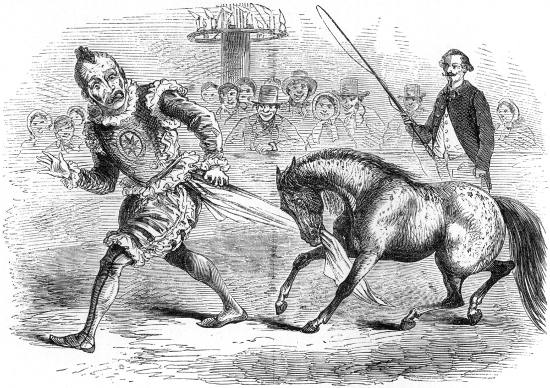
CIRCUS CLOWN AT FAIR.
“After juggling and globes, we always did ‘a laughable sketch entitled Billy Button’s ride to Brentford,’ and I used to be Jeremiah Stitchem, a servant of Billy Button’s, that comes for a ‘sitiation.’ It opens this way. Jeremiah makes applications for this situation. He asks, ‘What can you do?’ ‘Everythink and nothink.’ ‘Can you clean plates?’ ‘I can break ’em.’ ‘Can you run errands?’ ‘All ways.’ He is engaged at 4s. a-week and his board; and then comes some comic business about a letter coming by post. Billy tells him to bring him a light to read this letter, and he sets fire to it. This letter is from Brentford, saying that his sister’s ill and that he’s wanted directly. He goes to a livery stable and asks for a lady’s pony, at the same time saying he wants it quiet. The man says he’s got three: one that is blind, and threw the last gentleman that rode it into a ditch, and Billy won’t have that. The other is lame of one leg, and he don’t like that, for he wants a lady’s pony that is very quiet. Then this stable-keeper recommends this pony, saying it’s very quiet, but it’s a kicker. Then first he gets up the wrong way, and the head comes round to the tail of the horse; Jerry then tells him he’s wrong, and then offers to give him a ‘bung up,’ and chucks him right over the pony’s back on to the ground on the other side. He then gets on properly, ready for starting, and tells Jerry he may expect him home in a day or two. He tries to start the pony, but it won’t go. Jerry takes a needle and pretends to stick it into the pony’s flank, which causes it to kick and rear until he throws Billy Button off; and then the pony chases Jerry round the stage with his mouth open to bite him. Then there’s a regular confusion, and that winds it up.
“If that pony catched you he’d give it you, too. He caught hold of me one night by my trousers, and nearly shook my life out of me. It hurt me, but everybody roared and thought it all right. After that I hit upon a dodge. I used to have a roll of calico tacked on to my back, and the pony would catch hold of it and pull out about four yards of what looked like a shirt. Those ponies are very playful, and may be taught anything.
“The stage-clown’s dress is what we term full dresses, with a wig and a tail, but the circus clown’s is merely the top-knot, and the ring dress, as if they are spangled they are always on the twist, something in the style of the serpent. They don’t do the red half-moon on the cheek, like stage clowns, but they have just a dab, running up to the cheek-bone. A stage-clown’s dress costs from 5l. to 10l.; but a circus clown can make a suit complete, with pumps and all, for from 30s. to 35s. There’s such a thing as fourteen or fifteen yards of canvas in a stage-clown’s full dress; and that’s without exaggerating.
“Veal’s was the best circus I was at; there they had six prads (horses) and two ponies, and the performers were the best then of the day; for they had Monsieur Ludowic, a Frenchman, and the best bare-back juggler about. Mr. Moffat’s troupe, and Mr. Emery’s, was there also. Mr. Douglas was clown along with me, and little Ned and Sam was the tumblers. We had a large tent and regular circus, and could accommodate 1500 or 1600 people. I had 35s. a-week all the time I was there, (near 2½ years), and it wasn’t much, considering the work, for I had to produce all the pantomimes and act as ballet-master as well.
“It is, and it ain’t, difficult to ride round a circus standing up. I’ve known one man, who had never rode before in all his life, and yet went on one night, when they were short of hands, and done the Olympians to the best of his abilities, without falling off, though he felt very nervous. For these scenes they go slowly. You have to keep your eye fixed on the horse’s head. I’ve been in a circus so long, and yet I can’t ride. Even following the horse round the ring makes me feel so giddy at times, that I have had to catch hold of the tent-pole in the middle just to steady myself.
“I wasn’t the regular principal clown at Veal’s—only on occasions; I was the speaking clown and jester. I used to do such things as those:—For instance, there is a act—which is rode—called ‘The Shipwrecked Sailors,’ where he rides round the ring, introducing the shipwreck hornpipe, and doing a pantomime of giving a imitation of the sinking of the ship, and his swimming and returning safe on shore. Between the parts I used to say to the ring-master, ‘Are you aware, sir, that I’ve been to sea?’ He’d say, ‘No, sir.’ Then we’d go on: ‘Yes, sir; I once took a voyage to the Ickney Nockney Islands, off Bulbusen, just by the Thames Tunnel, in the mud.’ ‘Indeed, sir!’ ‘Yes, sir; and I’ve seen some wonderful sights, sir, in my time.’ ‘Indeed, sir!’ ‘Yes, sir: on this occasion it come so cold, that as the captain was on the quarter-deck, as he gave the word of command to the men, the words dropped out of his mouth lumps of ice on the deck. The ship would have been lost, had I not had the presence of mind to pick the words up, put them into a fryingpan, and warm them over the galley-fire: and as they thawed, so I gave the word of command to the men.’ ‘Dear me, sir! that was a wonderful sight!’ ‘It was indeed, sir!’ ‘I don’t believe a word of it.’ ‘Ah, sir, if you’d have been there, you’d have seen it yourself.’ ‘I don’t believe a word of it, Mr. Merryman.’ ‘Oh! come, sir, you must believe some.’ ‘Well, I believe a part it.’ ‘Then I believe the other part, sir, and so that makes the lot.’ ‘That’s right, sir.’ ‘Well, sir, I went for another voyage; and going through the Needles our vessel sprung a leak; not an onion, a leak; and she got a hole in her side.’ ‘She, sir?’ ‘Yes, sir, the ship; so the pumps was put to work; but as fast as they pumped the water out it came in at the hole, and the ship was sinking, when the captain came on deck and asked if there was any man courageous enough to stop the hole. Of course, sir, I was there.’ ‘But you’re not courageous.’ ‘Ain’t I, sir? try me.’ ‘Now,’ says he, ‘if there’s any man will stop this hole, to him will I give the hand of my daughter and 150l.’ So away I went down in the hold, and there was more than about 15 foot of water, and I pops my head in the hole until they got the vessel ashore. So you see, sir, I had the hand of his daughter and the 150l. ‘That was a good job for you, Mr. Merryman.’ ‘No, sir; it was a bad job.’ ‘How was that, sir?’ ‘Because when I was married I found that she was a cream of tartar.’ ‘Then, sir, you had the money; that was a good job for you.’ ‘No, sir; that was a bad job, sir.’ ‘How so?’ ‘I bought some sheep and oxen, and they died of the rot.’ ‘Ah! that was a bad job, Mr. Merryman.’ ‘No, sir; it was a good job; for shoes were very dear, and I sold the hides for more than I gave for the cattle.’ ‘Well, that was a good job.’ ‘No, sir, that was a bad job: for I built houses with the money and they got burned down.’ ‘Indeed, sir! that was a very bad job for you.’ ‘Oh no, sir; it was a very good job, because my wife got burnt in them, and, you see, I got rid of a tormenting wife.’
“There’s another famous gag ring-jesters always do, and I was very successful with it. After the act of horsemanship is over, when the ring-master is about leaving the ring, I say, ‘Allow me to go first, sir;’ and he replies, ‘No, sir, I never follow a fool.’ Then we go on:—‘I always do,’ meaning him. ‘What did you say, sir?’ ‘That’s quite true, sir.’ ‘I say, sir, did ever you see my sweetheart?’ ‘No, sir.’ ‘There she is, sir; that nice young girl sitting there.’ ‘I don’t see her.’—‘Yes, there, sir, a-winking at me now. Ah! you little ducksey, ducksey, ducksey!’ ‘I don’t see her, sir.’ Then I gets him to the middle of the ring, and whilst he is pretending to stare in the direction I pointed to, I bolt off, saying, ‘I never follows a fool.’
“At fairs we do pretty well, and a circus always pays better than an acting-booth. We are always on salaries, and never go upon shares. The actors often say we look down upon them, and think them beneath our notice; and I dare say it’s true, to a great extent. I’ve heard our chaps cry out, ‘Won’t you be glad when herrings are cheap?’ or, ‘How were you off for bits of candle and lumps of coke last night at sharing?’ Then, no doubt, we live better at circuses, for we do our steaks and onions, and all that sort of thing; and, perhaps, that makes us cheeky.
“Some jesters at circuses get tremendous engagements. Mr. Barry, they say, had 10l. a-week at Astley’s; and Stonalfe, with his dogs, is, I should think, equal to him. There’s another, Nelson, too, who plays on the harmonicon, and does tunes on bits of wood—the same as went on the water in a tub drawn by geese, when the bridge broke down at Yarmouth—he’s had as much as 15l. a-week on a regular travelling engagement.
“There ain’t so many jesters as tumbling clowns. I think it’s because they find it almost too much for them; for a jester has to be ready with his tongue if anything goes wrong in the ring. I shouldn’t think there was more than from thirty to forty jesters in England. I reckon in this way. There are from ten to fifteen circuses, and that’s allowing them two jesters each. In the threepenny circus, such as Clarke’s or Frazier’s, the salary for a jester is about 2l. a-week, take the year round.”
Silly Billy.
The character of “Silly Billy” is a kind of clown, or rather a clown’s butt; but not after the style of Pantaloon, for the part is comparatively juvenile. Silly Billy is supposed to be a schoolboy, although not dressed in a charity-boy’s attire. He is very popular with the audience at the fairs; indeed, they cannot do without him. “The people like to see Silly Billy,” I was told, “much more than they do Pantaloon, for he gets knocked about more though, but he gives it back again. A good Silly,” said my informant, “has to imitate all the ways of a little boy. When I have been going to a fair, I have many a time stopped for hours watching boys at play, learning their various games, and getting their sayings. For instance, some will go about the streets singing:
‘Eh, higgety, eh ho! Billy let the water go!’
which is some song about a boy pulling a tap from a water-butt, and letting the water run. There’s another:
‘Nicky nickey nite, I’ll strike a light!’
I got these both from watching children whilst playing. Again, boys will swear ‘By the liver and lights of a cobbler’s lapstone!’ and their most regular desperate oath is,
‘Ain’t this wet? ain’t it dry? Cut my throat if I tells a lie.’
They’ll say, too ‘S’elp my greens!’ and ‘Upon my word and say so!’ All these sayings I used to work up into my Silly Billy, and they had their success.
“I do such things as these, too, which is regularly boyish, such as ‘Give me a bit of your bread and butter, and I’ll give you a bit of my bread and treacle.’ Again, I was watching a lot of boys playing at pitch-button, and one says, ‘Ah, you’re up to the rigs of this hole; come to my hole—you can’t play there!’ I’ve noticed them, too, playing at ring-taw, and one of their exclamations is ‘Knuckle down fair, and no funking.’ All these sayings are very useful to make the character of Silly Billy perfect. Bless you, sir, I was two years studying boys before I came out as Silly Billy. But then I persevere when I take a thing in hand; and I stick so close to nature, that I can’t go far wrong in that line. Now this is a regular boy’s answer: when somebody says ‘Does your mother know you’re out?’ he replies, ‘Yes, she do; but I didn’t know the organ-man had lost his monkey!’ That always went immense.
“It’s impossible to say when Silly Billy first come out at fairs, or who first supported the character. It’s been popular ever since a fair can be remembered. The best I ever saw was Teddy Walters. He’s been at all the fairs round the universe—England, Ireland, Scotland, Wales, and France. He belonged to a circus when he went abroad. He’s done Silly Billy these forty year, and he’s a great comic singer beside. I was reckoned very clever at it. I used to look it by making up so young for it. It tires you very much, for there’s so much exertion attached to it by the dancing and capering about. I’ve done it at the fairs, and also with tumblers in the street; only, when you do it in the street, you don’t do one-half the business.
“The make-up for a Silly Billy is this: Short white trousers and shoes, with a strap round the ankle, long white pinafore with a frill round the neck, and red sleeves, and a boy’s cap. We dress the head with the hair behind the ears, and a dab of red on the nose and two patches of black over the eyebrows. When I went to the fair I always took three pairs of white trousers with me. The girls used to get up playing larks with me, and smearing my white trousers with gingerbread. It’s a very favourite character with the women—they stick pins into you, as if you were a pin-cushion. I’ve had my thighs bleeding sometimes. One time, during Greenwich, a ugly old woman came on the parade and kissed me, and made me a present of a silver sixpence, which, I needn’t say, was soon spent in porter. Why, I’ve brought home with me sometimes toys enough to last a child a fortnight, if it was to break one every day, such as carts and horses, cock and breeches, whistles, &c. You see, Silly Billy is supposed to be a thievish sort of a character, and I used to take the toys away from the girls as they were going into the theatre, and then I’d show it to the Clown and say, ‘Oh, look what that nice lady’s give me! I shall take it home to my mother.’