Volume 3 — I.—STREET EXHIBITORS. (continued 5)
Reading edition
“You may as well say this here. The circusses at that time wasn’t as they are now. They used to call it in the profession moulding, and the public termed it mountebanking. Moulding was making a ring in a field, for there was no booths then, and it comes from digging up the mould to make it soft for the horses’ feet. There was no charge for seeing the exhibition, for it was in a field open to the public; but it was worked in this way: there was prizes given away, and the tickets to the lottery were 1s. each, and most of the people bought ’em, though they weren’t obligated to do so. Sometimes the prizes would be a five-pound note, or a silver watch, maybe, or a sack of flour, or a pig. They used to take the tickets round in a hat, and everybody saw what they drawed. They was all prizes—perhaps a penny ring—but there was no blanks. It was the last night that paid best. The first and second nights Sanders would give them a first-rate prize; but when the last night came, then a half-crown article was the highest he’d give away, and that helped to draw up. I’ve know’d him give 4l. or 5l. away, when he’d not taken 2l. Mr. Sanders put me to tumbling in the ring. I could tumble well before I went with him, for I’d practised on this dung-heap, and in this hatter’s shop. I beat all his apprentices what he had. He didn’t give me anything a-week, only my keep, but I was glad to run away and be a showman. I was very successful in the ring-tumbling, and from that I got to be clever on the stilts and on the slack-rope, or, as they call it in the profession, the waulting-rope. When I was ragged I used to run home again and get some clothes. I’ve many a time seen him burst out into tears to see me come home so ragged. ‘Ah,’ he’d say, ‘where have you been now?—tumbling, I suppose.’ I’d answer, ‘Yes, father;’ and then he’d say, ‘Ah, your tumbling will bring you to the gallows.’ I’d stop with him till he gave me some fresh clothes, and then I’d bolt again. You see I liked it. I’d go and do it for nothing. Now I dread it; but it’s too late, unfortunately.
“I ran away from Sanders at last, and went back to father. One night I went to the theatre, and there I see Ramo Samee doing his juggling, and in a minute I forgot all about the tumbling, and only wanted to do as he did. Directly I got home I got two of the plates, and went into a back-room and began practising, making it turn round on the top of a stick. I broke nearly all the plates in the house doing this—that is, what I didn’t break I cracked. I broke the entire set of a dozen plates, and yet couldn’t do it. When mother found all her plates cracked, she said, ‘It’s that boy;’ and I had a good hiding. Then I put on my Sunday suit and bolted away again. I always bolted in my best clothes. I then went about tumbling in the public-houses, till I had got money enough to have a tin plate made with a deep rim, and with this tin plate I learnt it, so that I could afterwards do it with a crockery one. I kept on my tumbling till I got a set of wooden balls turned, and I stuck brass coffin-nails all over them, so that they looked like metal when they was up; and I began teaching myself to chuck them. It took a long time learning it, but I was fond of it, and determined to do it. I was doing pretty well with my tumbling, making perhaps my 3s. or 4s. a-night, so I was pretty well off. Then I got some tin knives made, and learnt to throw them: and I bought some iron rings, and bound them with red and blue tape, to make them look handsome; and I learnt to toss them the same as the balls. I practised balancing pipes, too. Every time I went into a public-house I’d take a pipe away, so it didn’t cost me anything. I dare say I was a twelvemonth before I could juggle well. When I could throw the three balls middling tidy I used to do them on the stilts, and that was more than ever a man attempted in them days; and yet I was only sixteen or seventeen years of age. I must have been summut then, for I went to Oxford fair, and there I was on my stilts, chucking my balls in the public streets, and a gentleman came up to me and asked me if I’d take an engagement, and I said ‘Yes, if it was a good un’—for I was taking money like smoke; and he agreed to give me a pound a-day during the fair; it was a week fair. I had so much money, I didn’t know what to do with it. I actually went and bought a silk neckerchief for every day in the week, and flash boots, and caps, and everything I could see, for I never had so much money as in them days. The master, too, made his share out of me, for he took money like dirt.
“From Oxford I worked my way over to Ireland. I had got my hand into juggling now, but I kept on with my old apparatus, though I bought a new set in Dublin. I used to have a bag and bit of carpet, and perform in streets. I had an Indian’s dress made, with a long horse-hair tail down my back, and white bag-trousers, trimmed with red, like a Turk’s, tied right round at the ankles, and a flesh-coloured skull-cap. My coat was what is called a Turkish fly, in red velvet, cut off like a waistcoat, with a peak before and behind. I was a regular swell, and called myself the Indian Juggler. I used to perform in the barracks twice a-day, morning and evening. I used to make a heap of money. I have taken, in one pitch, more than a pound. I dare say I’ve taken 3l. a-day, and sometimes more indeed; I’ve saved a waggon and a booth there,—a very nice one,—and the waggon cost me 14l. second-hand; one of Vickry’s it was, a wild-beast waggon. I dare say I was six months in Dublin, doing first-rate. My performances was just the same then as they is now; only I walked on stilts, and they was new then, and did the business. I was the first man ever seed in Ireland, either juggling or on the stilts.
“I had a drum and pipes, and I used to play them myself. I played any tune,—anythink, just what I could think of, to draw the crowd together; then I’d mount the stilts and do what I called ‘a drunken frolic,’ with a bottle in my hand, tumbling about and pretending to be drunk. Then I’d chuck the balls about, and the knives, and the rings, and twirl the plate. I wound up with the ball, throwing it in the air and catching it in a cup. I didn’t do any balancing pipes on my nose, not whilst on the stilts.
“I used to go out one day on the stilts and one on the ground, to do the balancing. I’d balance pipes, straws, peacocks’ feathers, and the twirling plate.
“It took me a long time learning to catch the ball in the cup. I practised in the fields or streets; anywhere. I began by just throwing the ball a yard or two in the air, and then went on gradually. The first I see do the ball was a man of the name of Dussang, who came over with Ramo Samee. It’s a very dangerous feat, and even now I’m never safe of it, for the least wind will blow it to the outside, and spoil the aim. I broke my nose at Derby races. A boy ran across the ring, and the ball, which weighs a quarter of a pound, was coming right on him, and would have fallen on his head, and perhaps killed him, and I ran forward to save him, and couldn’t take my aim proper, and it fell on my nose, and broke it. It bled awfully, and it kept on for near a month. There happened to be a doctor looking on, and he came and plastered it up; and then I chucked the ball up again, (for I didn’t care what I did in them days), and the strain of its coming down made it burst out again. They actually gived me money not to throw the ball up any more. I got near a sovereign, in silver, give me from the Grand Stand, for that accident.
“At Newcastle I met with another accident with throwing the ball. It came down on my head, and it regularly stunned me, so that I fell down. It swelled up, and every minute got bigger, till I a’most thought I had a double head, for it felt so heavy I could scarce hold it up. I was obliged to knock off work for a fortnight.
“In Ireland I used to make the people laugh, to throw up raw potatoes and let them come down on my naked forehead and smash. People give more money when they laugh. No, it never hurt my forehead, it’s got hardened; nor I never suffered from headaches when I was practicing.
“As you catch the ball in the cup, you are obliged to give, you know, and bend to it, or it would knock the brains out of you pretty well. I never heard of a man killing himself with the ball, and I’ve only had two accidents.
“I got married in Ireland, and then I started off with the booth and waggon, and she used to dance, and I’d juggle and balance. We went to the fairs, but it didn’t answer, and we lost all; for my wife turned out a very bad sort of woman. She’s dead now, through drink. I went to the Isle of Man from Ireland; I had practised my wife in the stilts, and learnt her how to use them, and we did well there. They never see such a thing in their lives, and we took money like dirt. They christened us the ‘Manx Giants.’ If my wife had been like my present one, I should be a made gentleman by this time; but she drank away my booth, and waggon, and horse, and all.
“I saved up about 20l. in the Isle of Man; and from there we went to Scotland, and there my wife died,—through drink. That took away all the money I had saved. We didn’t do much in Scotland, only in one particular town,—that’s Edinburgh,—on New-year’s day. We took a good deal of money, 2l. I think; and we carried coppers about in a stocking with me.
“I travelled about in England and Wales when I married my second wife. She’s a strong woman, and lifts 700 lbs. by the hair of her head.
“When I got back to London I hadn’t a shilling in my pocket, though my wife was very careful of me; but times got bad, and what not. We got a situation at 12s. a day, and all collections, at Stepney fair, which would sometimes come to a pound, and at others 30s.; for collections is better than salary any days: that set us up in a little house, which we’ve got now.
“I’m too old now to go out regularly in the streets. It tires me too much, if I have to appear at a penny theatre in the evening. When I do go out in the streets, I carry a mahogany box with me, to put my things out in. I’ve got three sets of things now, knives, balls, and cups. In fact, I never was so well off in apparatus as now; and many of them have been given to me as presents, by friends as have gi’n over performing. Knives, and balls, and all, are very handsome. The balls, some a pound, and some 2 lbs. weight, and the knives about 1½ lbs.
“When I’m out performing, I get into all the open places as I can. I goes up the Commercial-road and pitches at the Mile-end-gate, or about Tower-hill, or such-like. I’m well known in London, and the police knows me so well they very seldom interfere with me. Sometimes they say, ‘That’s not allowed, you know, old man!’ and I say, ‘I shan’t be above two or three minutes,’ and they say, ‘Make haste, then!’ and then I go on with the performance.
“I think I’m the cleverest juggler out. I can do the pagoda, or the canopy as some calls it; that is a thing like a parasol balanced by the handle on my nose, and the sides held up by other sticks, and then with a pea-shooter I blow away the supports. I also do what is called ‘the birds and bush,’ which is something of the same, only you knock off the birds with a pea-shooter. The birds is only made of cork, but it’s very difficult, because you have to take your balance agin every bird as falls; besides, you must be careful the birds don’t fall in your eyes, or it would take away your sight and spoil the balance. The birds at back are hardest to knock off, because you have to bend back, and at the same time mind you don’t topple the tree off.
“These are the only feats we perform in balancing, and the juggling is the same now as ever it was, for there ain’t been no improvements on the old style as I ever heerd on; and I suppose balls and knives and rings will last for a hundred years to come yet.
“I and my wife are now engaged at the ‘Temple of Mystery’ in Old Street-road, and it says on the bills that they are ‘at present exhibiting the following new and interesting talent,’ and then they calls me ‘The Renowned Indian Juggler, performing his extraordinary Feats with Cups, Balls, Daggers, Plates, Knives, Rings, Balancing, &c. &c.’
“After the juggling I generally has to do conjuring. I does what they call ‘the pile of mags,’ that is, putting four halfpence on a boy’s cap, and making them disappear when I say ‘Presto, fly!’ Then there’s the empty cups, and making ’taters come under ’em, or there’s bringing a cabbage into a empty hat. There’s also making a shilling pass from a gentleman’s hand into a nest of boxes, and such-like tricks: but it ain’t half so hard as juggling, nor anything like the work.
“I and my missis have 5s. 6d. a-night between us, besides a collection among the company, which I reckon, on the average, to be as good as another pound a-week, for we made that the last week we performed.
“I should say there ain’t above twenty jugglers in all England—indeed, I’m sure there ain’t—such as goes about pitching in the streets and towns. I know there’s only four others besides myself in London, unless some new one has sprung up very lately. You may safely reckon their earnings for the year round at a pound a-week, that is, if they stick to juggling; but most of us joins some other calling along with juggling, such as the wizard’s business, and that helps out the gains.
“Before this year, I used to go down to the sea-side in the summer, and perform at the watering-places. A chap by the name of Gordon is at Ramsgate now. It pays well on the sands, for in two or three hours, according to the tides, we picks up enough for the day.”
The Street Conjurer.
“I call myself a wizard as well; but that’s only the polite term for conjurer; in fact, I should think that wizard meant an astrologer, and more of a fortune-teller. I was fifteen years of age when I first began my professional life; indeed I opened with Gentleman Cooke at the Rotunda, in Blackfriars’-road, and there I did Jeremiah Stitchem to his Billy Button.
“My father held a very excellent situation in the Customs, and lived at his ease, in very affluent circumstances. His library alone was worth two hundred pounds. I was only ten years of age when my father died. He was a very gay man, and spent his income to the last penny. He was a very gay man, very gay. After my mother was left a widow, the library was swept off for a year’s rent. I was too young to understand it’s value, and my mother was in too much grief to pay attention to her affairs. Another six-months’ rent sold up the furniture. We took a small apartment close in the neighbourhood. My mother had no means, and we were left to shift for ourselves. I was a good boy, and determined to get something to do. The first day I went out I got a situation at four shillings a-week, to mind the boots outside a boot-maker’s shop in Newington Causeway. The very first week I was there I was discharged, for I fell asleep on my stool at the door, and a boy stole a pair of boots. From there I went to a baker’s, and had to carry out the bread, and for four years I got different employments, as errand boy or anything.
“For many years the mall opposite Bedlam was filled with nothing else but shows and show-people. All the caravans and swing-boats, and what not, used to assemble there till the next fair was on. They didn’t perform there, it was only their resting-place. My mother was living close by, and every opportunity I had I used to associate with the boys belonging to the shows, and then I’d see them practising their tumbling and tricks. I was so fond of this that I got practising with these boys. I’d go and paint my face as clown, and although dressed in my ordinary clothes I’d go and tumble with the rest of the lads, until I could do it as well as they could. I did it for devilment, that’s what I call it, and that it was which first made me think of being a professional.
“From there I heard of a situation to sell oranges, biscuits, and ginger-beer, at the Surrey Theatre. It was under Elliston’s management. I sold the porter up in the gallery, and I had three-halfpence out of every shilling, and I could make one shilling and sixpence a-night; but the way I used to do it at that time was this: I went to fetch the beer, and then I’d get half-a-gallon of table-beer and mix it with the porter; and I tell you, I’ve made such a thing as fifteen shillings of a boxing-night. I alone could sell five gallons of a night; but then their pints at that time was tin measures, and little more than half-a-pint: besides, I’d froth it up. It was threepence a pint, and a wonderful profit it must have been. From there I got behind the scenes as supernumerary, at the time Nelson Lee was manager of the supers.
“At this time the Rotunda in the Blackfriars’-road was an hotel kept by a Mr. Ford. Mr Cook rented certain portions of the building, and went to a wonderful expense building a Circus there. The history of the Rotunda is that at one time it was a museum, and the lecture-hall is there to the present day. It’s a beautiful building, and the pillars are said to be very valuable, and made of rice. It’s all let to one party, a Frenchman, but he keeps the lecture-hall closed. When Cook took the Rotunda I asked him for an engagement, and he complied. I was mad for acting. I met with great success as Jeremiah Stitchem; and the first week he gave me one pound. Cook didn’t make a good thing of it. Nobody could get their money, and the circus was closed. Then a Mr. Edwards took it. He was an optician, and opened it as a penny exhibition, with a magic lantern and a conjurer. Now comes how I became a conjurer. I couldn’t tear myself away from the Rotunda. I went there and hovered about the door day and night. I wanted to get a situation there. He knew me when I was in the circus, and he asked me what I was a-doing of. I said, ‘Nothing, sir.’ Then he offered to give me one of the door-keeper’s places, from ten in the morning till eleven at night, for three shillings a-day, and I took it. One day the conjurer that was there didn’t come, but they opened the doors just the same, and there was an immense quantity of people waiting there. They couldn’t do nothing without the conjurer. He always left his apparatus there of a night, in a bag. Well, this Edwards, knowing that I could do a few tricks, he came up to me and asks whether I knew where the wizard lived. I didn’t, and Edwards says, ‘What am I to do? I shall have to return this money: I shall go mad.’ I said I could do a few tricks; and he says, ‘Well, go and do it.’ The people was making a row, stamping and calling out, ‘Now then, is this here wizard coming?’ When I went in, I give great satisfaction. I went and did all the tricks, just as the other had done it. At that time it was the custom to say after each performance, ‘Ladies and gentlemen, allow me to inform you that I get no salary here, and only have to rely upon your generosity for a collection.’ When the plate went round I got one shilling and sixpence. ‘Hulloa!’ I said to myself, ‘is this the situation?’ Then I sold some penny books, explaining how the tricks was done, and I got sixpence more. That was two shillings. I had four shillings a-day besides, and they would have sometimes twenty houses of a day, and I have seen thirty. The houses were not always very good. Sometimes we’d perform to seven or to twenty. It all told up. It was at night we did the principal work,—crowded upwards of two hundred there. We weren’t in the Circus, but in the Rotunda. I’d make fifteen shillings a-night then. I got a permanent engagement then. I made too much money. I went and bought a pack of cards and card-boxes, and a pea-caddy for passing peas from a handkerchief to a vase, and linking-rings, and some tape. That, with tying knots in a silk handkerchief, concluded the whole of my performances. In fact, it was all I knew. My talking helped me immensely, for I could patter well to them, and the other wizard couldn’t.
“I left the Rotunda in consequence of the party having other novelties. He had Ambrosini, who done the sticks and string balls; but I was there three or four years, and that’s a long time to be at one place. Then I joined a street-performer. He used to do the fire-proof business, such as eating the link, and the burning tow, and so on. Then I manufactured a portable table: it folded up, and I could carry it under my arm. It was as large as an ordinary dressing-table. We went in equal shares. I was dressed with ballet shirt, and braces, with spangled tights and fleshings. We pulled our coats off when we begun to perform. All the tricks we carried in a bag.
“The first pitch we made was near Bond-street. He began with his part of the performance whilst I was dressing up the table. It was covered with black velvet with fringe, and the apparatus ranged on it. After him I began my performance, and he went round for the nobbings. I did card tricks, such as the sautez-le-coup with the little finger. It’s dividing the pack in half, and then bringing the bottom half to the top; and then, if there’s a doubt, you can convey the top card to the bottom again; or if there’s any doubt, you can bring the pack to its original position. It was Lord de Roos’ trick. He won heaps of money at it. He had pricked cards. You see, if you prick a card at the corner, card-players skin their finger at the end, so as to make it sensitive, and they can tell a pricked card in a moment. Besides sautez-le-coup, I used to do innumerable others, such as telling a named card by throwing a pack in the air and catching the card on a sword point. Then there was telling people’s thoughts by the cards. All card tricks are feats of great dexterity and quickness of hand. I never used a false pack of cards. There are some made for amateurs, but professionals never use trick cards. The greatest art is what is termed forcing, that is, making a party take the card you wish him to; and let him try ever so well, he will have it, though he’s not conscious of it. Another feat of dexterity is slipping the card, that is, slipping it from top, bottom, or centre, or placing one or two cards from the top. If you’re playing a game at all-fours and you know the ace of clubs is at the bottom, you can slip it one from the top, so that you know your partner opposite has it. These are the only two principal things in card tricks, and if you can do them dexteriously you can do a great part of a wizard’s art. Sautez-le-coup is the principal thing, and it’s done by placing the middle finger in the centre of the pack, and then with the right hand working the change. I can do it with one hand.
“We did well with pitching in the streets. We’d take ten shillings of a morning, and then go out in the afternoon again and take perhaps fifteen shillings of nobbings. The footmen were our best customers in the morning, for they had leisure then. We usually went to the squares and such parts at the West-end. This was twenty years ago, and it isn’t anything like so good now, in consequence of my partner dying of consumption; brought on, I think, by fire eating, for he was a very steady young fellow and not at all given to drink. I was for two years in the streets with the fire-eating, and we made I should say such a thing as fifty shillings a-week each. Then you must remember, we could have made more if we had liked; for some mornings, if we had had a good day before, we wouldn’t go out if it was raining, or we had been up late. I next got a situation, and went to a wax-works to do conjuring. It was a penny exhibition in the New Cut, Lambeth. I had four shillings a-day and nobbings—a collection, and what with selling my books, it came to ten shillings a-day, for we had never less than ten and often twenty performances a-day. They had the first dissecting figure there—a Samson—and they took off the cranium and showed the brains, and also the stomach, and showed the intestines. It was the first ever shown in this country, and the maker of it had (so they say) a pension of one hundred pounds a year for having composed it. He was an Italian.
“We were burnt down at Birmingham, and I lost all my rattle-traps. However, the inhabitants made up a subscription which amply repaid me for my loss, and I then came to London, hearing that the Epsom races was on at the time, which I wouldn’t have missed Epsom races, not at that time, not for any amount of money, for it was always good to one as three pounds, and I have had as much as seven pounds from one carriage alone. It was Lord Chesterfield’s, and each gentleman in it gave us a sov. I went down with three acrobats to Epsom, but they were dealing unfair with me, and there was something that I didn’t like going on; so I quarrelled with them and joined with another conjurer, and it was on this very occasion we got the seven pounds from one carriage. We both varied in our entertainments; because, when I had done my performance, he made a collection; and when he had done I got the nobbings. We went to Lord Chesterfield’s carriage on the hill, and there I did the sovereign trick. ‘My Lord, will you oblige me with the temporary loan of a sovereign?’ ‘Yes, old fellow: what are you going to do with it?’ I then did passing the sovereign, he having marked it first; and then, though he held it tightly, I changed it for a farthing. I did this for Lord Waterford and Lord Waldegrave, and the whole of them in the carriage. I always said, ‘Now, my Lord, are you sure you hold it?’ ‘Yes, old fellow.’ ‘Now, my Lord, if I was to take the sovereign away from you without you knowing it, wouldn’t you say I was perfectly welcome to it?’ He’d say, ‘Yes, old fellow; go on.’ Then, when he opened the handkerchief he had a farthing, and all of them made me a present of the sovereign I had performed with.
“Then we went to the Grand Stand, and then after our performance they’d throw us halfpence from above. We had our table nicely fitted up. We wouldn’t take halfpence. We would collect up the coppers, perhaps five or six shillings worth, and then we’d throw the great handful among the boys. ‘A bit of silver, your honours, if you please;’ then sixpence would come, and then a shilling, and in ten minutes we would have a sovereign. We must have earned our six pounds each that Epsom Day; but then our expenses were heavy, for we paid three shillings a-night for our lodging alone.
“It was about this time that I took to busking. I never went into tap-rooms, only into parlours; because one parlour would be as good as a dozen tap-rooms, and two good parlours a-night I was quite satisfied with. My general method was this: If I saw a good company in the parlour, I could tell in a moment whether they were likely to suit me. If they were conversing on politics it was no good, you might as well attempt to fly. I have many a-time gone into a parlour, and called for my half-quartern of gin and little drop of cold water, and then, when I began my performances, it has been ‘No, no! we don’t want anything of that kind,’ and there has been my half hour thrown away. The company I like best are jolly-looking men, who are sitting silently smoking, or reading the paper. I always got the privilege of performing by behaving with civility to my patrons. Some conjurers, when the company ain’t agreeable, will say, ‘But I will perform;’ and then comes a quarrel, and the room is in future forbid to that man. But I, if they objected, always said, ‘Very well, gentlemen, I’m much obliged to you all the same: perhaps another time. Bad to-night, better next night.’ Then when I came again some would say, ‘I didn’t give you anything the other night, did I? Well, here’s a fourpenny bit,’ and so on.
“When I went into a parlour I usually performed with a big dice, three inches square. I used to go and call for a small drop of gin and water, and put this dice on the seat beside me, as a bit of a draw. Directly I put it down everybody was looking at it. Then I’d get into conversation with the party next to me, and he’d be sure to say, ‘What the deuce is that?’ I’d tell him it was a musical box, and he’d be safe to say, ‘Well, I should like to hear it, very much.’ Then I’d offer to perform, if agreeable, to the company; often the party would offer to name it to the company, and he’d call to the other side of the room, (for they all know each other in these parlours) ‘I say, Mr. So-and-so, have you any objection to this gentleman showing us a little amusement?’ and they are all of them safe to say, ‘Not in the least. I’m perfectly agreeable if others are so;’ and then I’d begin. I’d pull out my cards and card-boxes, and the bonus genius or the wooden doll, and then I’d spread a nice clean cloth (which I always carried with me) on the table, and then I’d go to work. I worked the dice by placing it on the top of a hat, and with a penknife pretending to make an incision in the crown to let the solid block pass through. It is done by having a tin covering to the solid dice, and the art consists in getting the solid block into the hat without being seen. That’s the whole of the trick. I begin by striking the block to show it is solid. Then I place two hats one on the other, brim to brim. Then I slip the solid dice into the under hat, and place the tin covering on the crown of the upper one. Then I ask for a knife, and pretend to cut the hat-crown the size of the tin-can on the top, making a noise by dragging my nail along the hat, which closely resembles cutting with a knife. I’ve often heard people say, ‘None of that!’ thinking I was cutting their hat. Then I say, ‘Now, gentlemen, if I can pass this dice through the crown into the hat beneath, you’ll say it’s a very clever deception,’ because all conjurers acknowledge that they deceive; indeed, I always say when I perform in parlours, ‘If you can detect me in my deceptions I shall be very much obliged to you by naming it, for it will make me more careful; but if you can’t, the more credit to me.’ Then I place another tin-box over the imitation dice; it fits closely. I say, ‘Presto—quick—begone!’ and clap my hands three times, and then lift up the tin-cases, which are both coloured black inside, and tumble the wooden dice out of the under hat. You see, the whole art consists in passing the solid block unseen into the hat.
“The old method of giving the order for the things to pass was this: ‘Albri kira mumma tousha cocus co shiver de freek from the margin under the crippling hook,’ and that’s a language.”
Statement of another Street Conjurer.
“In London I had a great quantity of parlours where I was known and allowed to perform. One night I’d take the West-end, and another the East-end. Sometimes I have done four or five houses of an evening, and I have had to walk miles for that—to Woolwich and back for instance, or to Edmonton and back—and occasionally I’d only come home with 1s. 6d. I have also had 8s. from one parlour only, and then I’d consider that a night’s performance, and come home again.
“I remember one very peculiar circumstance which happened to me whilst I was out busking. There is a house at the bottom of York-street, Westminster, where they wouldn’t allow any other conjurer but me. I was very friendly with the landlord, and I went there regularly every week, and I’d invariably take such a thing as 2s. or 3s. out of the room. If I found only a small muster in the parlour, I’d say, ‘I’ll come another evening,’ and go off to another parlour in Pimlico. One night the company in the parlour said, after I had been performing, ‘What a pity it is that one of your talent doesn’t take a large room somewhere, and we’d patronise you.’ ‘Why,’ says the landlord, ‘he can have my large room up-stairs if he likes.’ I agreed to it, and says, ‘Well, gentlemen, we’ll have it next Wednesday evening, if you think proper.’ The landlord didn’t tell his wife that there was a performance to take place on the Wednesday evening. When I went to this house to the appointment, there were about thirty assembled. The landlord was out. When we asked the landlady for the room, she wouldn’t, and we had all the difficulty in the world before we got the apartment. I wanted a large table-cloth to dress up my stand, for I have, in order to perform some of my tricks, to make a bag with the end of the table-cloth to drop things into. We sent the waiter to ask for this cloth, and says she, ‘I ain’t going to lend no conjurers table-cloths.’ Then a gentleman says, ‘Oh, nonsense, I’ll soon get you a table-cloth. She’ll lend me one in a minute.’ He goes to the bar, but the reply she made was, ‘I’m surprised at Mr. W. having such a performance up there, and no table-cloth shall you have from me.’ He came up-stairs, and said he had been grossly insulted at the bar; and then another gentleman said, ‘Well, this young man shan’t be disappointed, and we’ll see if we can’t find another house down the street, and move it to there, and we’ll all go.’ One went out, and came back and said he’d not only got a very large room and everything required, but the landlord had four friends in the bar who’d join our company. I made altogether about 1l. that night, for I made no charge, and it was altogether contribution. None of that company ever returned to that house again, so he lost the whole of his parlour customers. I could never go into that house again, and I really was sorry for the landlord, for it wasn’t his fault. This is a very good proof that it is to the advantage of landlords to allow respectable performers to visit their parlours.
“At others times I have sometimes gone into a parlour and found the customers talking politics. If it was a very good company, and I saw good business, I’d try to break the thread of the discussion by saying when there was a pause in the debate, ‘Gentlemen, would you like to see some of my performances, such as walking round the ceiling with my head down?’ Then they’d say, ‘Well, that’s very curious; let’s see you.’ Of course I couldn’t do this, and I only said it to attract notice. Then I’d do my card-tricks, and make a collection, and, after that, remark that as the ceiling-walking performance was a dangerous one, I must have a sovereign; of course they wouldn’t give this, and I’d take my leave.
“One night, in Oxford-street, I met a singer, and he says, ‘Where are you going?’ I told him I was hunting for a good parlour, and he told me he had just left a good company at such and such a house. I thanked him, and I went there. It was up a long passage, and I entered the room without asking the landlord’s permission, and I called for a glass of porter. As soon as I saw the waiter out of the room I made my appeal to the company. They were all of them agreeable and most happy to see my performances. After I’d done my performance I went to make a collection, and they said, ‘Oh, certainly not; we thought you’d done it for your own amusement; we never give anything to anybody.’ I lost one hour of the best time of the night. I said, ‘Very good, gentlemen, I’m satisfied if you are.’ It was an agreed plan with the landlord, for he came into the room; and he says, ‘What, another one!’ and he seized me by the neck and pushed me out. As soon as I got outside I met another conjurer, and he asked where I’d been. I thought I’d let him be served the same as I was, so I showed him the house, and told him he could make a second ‘nobbings’ as we term it. I stopped outside peeping over the glass, and presently I see him being pushed out by the landlord as I had been. We had a hearty laugh, and then we started off to Regent-street, to one of our principal houses, but there wasn’t a soul in the room. It was a house in a back-street, where none but grooms and footmen resort to. But we was determined to have some money that night, as both our families wanted it—both him and me did.
“Passing a tobacconist’s shop in Regent-street, we saw three gents conversing with the lady behind the counter. I told him I’ll go in, get a pickwick here, and see if I can’t have a performance in the front of this counter. These things only wants an introduction; so I looks at my pickwick, and says I, ‘This a pickwick? why I swallows such as these;’ and I apparently swallowed it. One of them says, ‘You don’t mean to say you swallowed it?’ ‘Certainly I did, sir,’ I replied; and then he makes me do it again. Then I told them I’d show them something more wonderful still, so I said, ‘Have you gentlemen such a thing as a couple of half-crowns about you?’ they gave me the money, and I did the trick of passing the money from hand to hand. I said to them, ‘Can you tell me which hand the money’s in?’ says he, ‘Why, anybody can see it’s in that one.’ ‘No, sir,’ says I, ‘I think not.’ ‘If it ain’t,’ says he, ‘you may keep ’em.’ Then I opened both hands, and they were in neither, and he asked where they was then; so I told him I’d given him them back again, which of course he denied, and appeared much surprised. Then I took ’em out of his cravat. It’s a very clever trick, and appears most surprising, though it’s as simple as possible, and all done by the way in which you take them out of the cravat; for you keep them palmed, and have to work ’em up into the folds. Of course I returned the half-crowns to him, but when I heard him say you may keep them I did feel comfortable, for that was something to the good. My friend outside was looking through the window, and I could see him rubbing his hands with glee; I got another half-crown out of them gentlemen before I’d done with them, for I showed ’em a trick with some walking-sticks which were lying on the counter, and also cut the tape in two and made it whole again, and such-like performances. When a fellow is on his beam-ends, as I was then, he must keep his eyes about him, and have impudence enough for anything, or else he may stop and starve. The great art is to be able to do tricks with anything that you can easily get hold of. If you take up a bit of string from a counter, or borrow a couple of shillings of a gentleman, your tricks with them startles him much more than if you had taken them out of your own pocket, for he sees there’s been no preparation. I got ten shillings out of these two gents I spoke of, and then I and my mate went and busked in a parlour, and got fivepence more; so that we shared five and twopence-ha’penny each.
“I have often made a good deal of money in parlours by showing how I did my little tricks, such as cutting the tape and passing the half-crowns. Another thing that people always want to know is the thimble-rig trick. Of course it doesn’t matter so much showing how these tricks are done, because they depend upon the quickness and dexterity of handling. You may know how an artist paints a picture, but you mayn’t be able to paint one yourself.
“I never practised thimble-rigging myself, for I never approved of it as a practice. I’ve known lots of fellows who lived by it. Bless you! they did well, never sharing less than their 4l. or 5l. every day they worked. This is the way it’s done. They have three thimbles, and they put a pea under two of ’em, so that there’s only one without the pea. The man then begins moving them about and saying, ‘Out of this one into that one,’ and so on, and winds up by offering to ‘lay anything, from a shilling to a pound,’ that nobody can tell which thimble the pea is under. Then he turns round to the crowd, and pretends to be pushing them back, and whilst he’s saying, ‘Come, gentlemen, stand more backwarder,’ one of the confederates, who is called ‘a button,’ lifts up one of the thimbles with a pea under it, and laughs to those around, as much as to say, ‘We’ve found it out.’ He shows the pea two or three times, and the last time he does so, he removes it, either by taking it up under his forefinger nail or between his thumb and finger. It wants a great deal of practice to do this nicely, so as not to be found out. When the man turns to the table again the button says, ‘I’ll bet you a couple of sovereigns I know where the pea is. Will any gentleman go me halves?’ Then, if there’s any hesitation, the man at the table will pretend to be nervous and offer to move the thimbles again, but the button will seize him by the arm, and shout as if he was in a passion, ‘No, no, none of that! It was a fair bet, and you shan’t touch ’em.’ He’ll then again ask if anybody will go him halves, and there’s usually somebody flat enough to join him. Then the stranger is asked to lift up the thimble, so that he shouldn’t suspect anything, and of course there’s no pea there. He is naturally staggered a bit, and another confederate standing by will say calmly, ‘I knew you was wrong; here’s the pea;’ and he lifts up the thimble with the second pea under it. If nobody will go shares in the ‘button’s’ bet, then he lifts up the thimble and replaces the pea as he does so, and of course wins the stake, and he takes good care to say as he pockets the sovereign, ‘I knew it was there; what a fool you was not to stand in.’ The second time they repeat the trick there’s sure to be somebody lose his money. There used to be a regular pitch for thimble-riggers opposite Bedlam, when the shows used to put up there. I saw a brewer’s collector lose 7l. there in less than half-an-hour. He had a bag full of gold, and they let him win the three first bets as a draw. Most of these confederates are fighting-men, and if a row ensues they’re sure to get the best of it.
“A very good place where I used to go busking was at Mother Emmerson’s in Jermyn-street. There used to be all sorts of characters there, jugglers, and singers, and all sorts. It was a favourite house of the Marquis of Waterford, and he used to use it nearly every night. I’ve seen him buy a pipe of port, and draw tumblers of it for any body that came in, for his great delight was to make people drunk. He says to Mrs. Emmerson, ‘How much do you want for that port, mother?’ and then he wrote a cheque for the amount and had it tapped. He was a good-hearted fellow, was my Lord; if he played any tricks upon you, he’d always square it up. Many a time he’s given me half-a-pint of brandy, saying, ‘That’s all you’ll get from me.’ Sometimes I’d say to him, ‘Can I show you a few tricks, my Lord?’ and then, when I’d finished, I knew he never gave money if you asked him for it, so I’d let him abuse me, and order me out of the house as a humbug; and then, just as I’d got to the door, he’d call me back and give me half-a-sovereign. I’ve seen him do some wonderful things. I’ve seen him jump into an old woman’s crockeryware-basket, while she was carrying it along, and smash everything. Sometimes he’d get seven or eight cabs and put a lot of fiddlers and other musicians on the roofs, and fill ’em with anybody that liked, and then go off in procession round the streets, he driving the first cab as fast as he could and the bands playing as loud as possible. It’s wonderful the games he’d be up to. But he always paid handsomely for whatever damage he did. If he swept all the glasses off a counter, there was the money to make ’em good again. Whenever I did any tricks before him, I took good care not to produce any apparatus that I cared for, or he’d be sure to smash it.
“One night I hadn’t a penny in the world, and at home I knew they wanted food; so I went out to busk, and I got over in the Old Kent-road, and went to a house there called the Green Man. I walked into the parlour; and though I hadn’t a penny in my pocket, I called for four pen’orth of rum and water. I put my big dice down upon the table by the side of me, and begun sipping my rum, and I could see everybody looking at this dice, and at last, just as I expected, somebody asked what it was. So I says—‘Gentlemen, I get my living this way, and if you like, I shall be happy to show you a few of my deceptions for your entertainment.’ They said, ‘Certainly, young man, we are perfectly agreeable.’ Ah! I thought to myself, thank heaven that’s all right, for I owed for the rum and water you see, and if they’d refused, I don’t know what I should have done. I pulled out my nice clean cloth and laid it upon the table, and to work I went. I had only done one or two tricks, when in comes the waiter, and directly he sees me he cries out, ‘We don’t allow no conjurers or anything of that kind here,’ and I had to pack up again. When he’d gone the company said, ‘Go on, young man, it’s all right now;’ so I out with my cloth again; then in came the landlord, and says he, ‘You’ve already been told we don’t allow none of you conjurer fellows here,’ and I had to put up a second time. When he’d gone, the gents told me to begin again. I had scarcely spread my cloth when in comes the landlord again, in a towering rage, and shouts out, ‘What, at it again! Now you be off;’ so I said, ‘I only did it to oblige the company present, who were agreeable, and that I hadn’t yet finished my rum and water, which wasn’t paid for.’ ‘Not paid for?’ says he; ‘No,’ says I: ‘but I’m waiting here for a friend, and he’ll pay for it.’ You may imagine my feelings, without a penny in my pocket. ‘Don’t let me catch you at it again, or I’ll give you in charge,’ says he. Scarcely had he left again when the company began talking about it, and saying it was too bad to stop me; so one of them rings the bell, and when the landlord comes in he says, ‘Mr. Landlord, this young person has been very civil, and conducted himself in a highly respectable manner, and has certainly afforded us a great deal of amusement; now why should you object to his showing us some tricks?’ ‘Thank heavens,’ thought I to myself, ‘I’m saved, and the rum will be paid for.’ The landlord’s manner altered all of a sudden, and says he, ‘Oh, certainly, gentlemen! certainly! if it’s your wish, I don’t mind the young man’s being here; though I make it a rule to keep my parlour select.’ Then I set to work and did all my tricks comfortably, and I made a collection of 7s. 6d. Then I rang the bell like a lord, and I put down a shilling to pay for the rum and water, and saying, ‘Gentlemen, I’m very much obliged to you for your patronage,’ to which they replied, ‘Not at all, young man,’ I walked past the bar to leave. Then the landlord comes up to me and says, shaking his fist, and blue in the face with rage, ‘If ever I catch you here again, you d—— rogue, I’ll give you to a policeman.’ So, without more ado, I walks round to the other door, and enters the parlour again and tells the company, and they had in the landlord and blowed him well up. This will just show you the risks we have to run when out busking for a living, and what courage is wanted to speculate upon chances.
“There are very few conjurers out busking now. I don’t know above four; one of ’em has had the best chances in the world of getting on; but he’s a very uneducated man, and that has stood in his way, though he’s very clever, and pr’aps the best hand at the cups and balls of any man in England. For instance, once he was at a nobleman’s party, giving his entertainment, and he says such a thing as this:—‘You see, my lords and ladies, I have a tatur in this hand, and a tatur in that; now I shall pass ’em into this handkercher.’ Of course the nobleman said to himself, ‘Tatur! handkercher! why, who’s this feller?’ You may depend upon it he was never asked there any more; for every thing in a wizard’s business depends upon graceful action, and his style of delivery, so that he may make himself agreeable to the company.
“When a conjurer’s out busking, he may reckon upon making his 20s. a-week, taking the year round; pr’aps, some weeks, he won’t take more than 12s. or 15s.; but then, at other times, he may get 6s. or 8s. in one parlour alone, and I have taken as much as 1l. by teaching gentlemen how to do the tricks I had been performing. I have sometimes walked my twenty miles a-day, and busked at every parlour I came to, (for I never enter tap-rooms,) and come home with only 1s. 6d. in my pocket. I have been to Edmonton and back and only earned 1s., and then, pr’aps, at eleven the same night, when I was nearly done up, and quite dispirited with my luck, I’ve turned into one of the parlours in town and earned my 6s. in less than an hour, where I’d been twelve only earning one.”
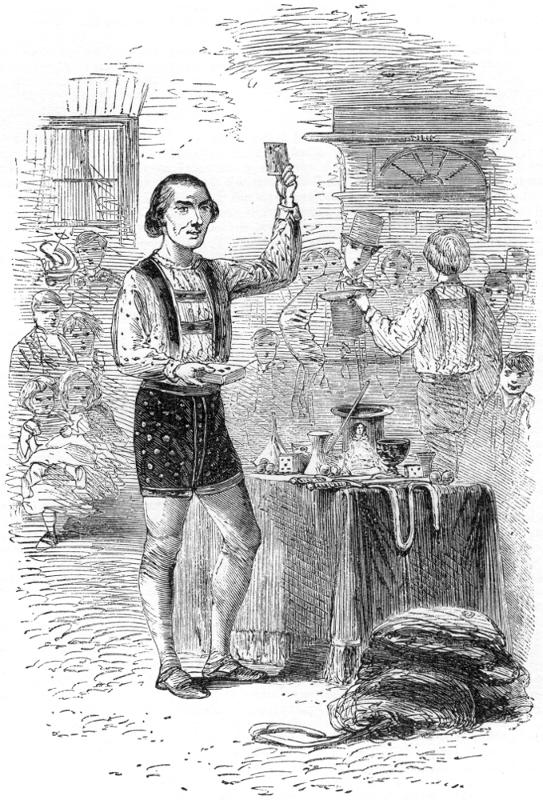
STREET CONJURER PERFORMING.
The Street Fire-King, or Salamander.
This person came to me recommended by one of my street acquaintances as the “pluckiest fire-eater going,” and that as he was a little “down at heel,” he should be happy for a consideration to give me any information I might require in the “Salamander line.”
He was a tall, gaunt man, with an absent-looking face, and so pale that his dark eyes looked positively wild.
I could not help thinking, as I looked at his bony form, that fire was not the most nutritious food in the world, until the poor fellow explained to me that he had not broken his fast for two days.
He gave the following account of himself:—
“My father was a barber—a three-ha’penny one—and doing a good business, in Southwark. I used to assist him, lathering up the chins and shaving ’em—torturing, I called it. I was a very good light hand. You see, you tell a good shaver by the way he holds the razor, and the play from the wrist. All our customers were tradesmen and workmen, but father would never shave either coalheavers or fishermen, because they always threw down a penny, and said there was plenty of penny barbers, and they wouldn’t give no more. The old man always stuck up for his price to the day of his death. There was a person set up close to him for a penny, and that injured us awful. I was educated at St. George’s National and Parochial School, and I was a national lad, and wore my own clothes; but the parochials wore the uniform of blue bob-tailed coats, and a badge on the left side. When they wanted to make an appearance in the gallery of the church on charity-sermon days, they used to make all the nationals dress like the parochials, so as to swell the numbers up. I was too fond of entertainments to stick to learning, and I used to step it. Kennington common was my principal place. I used, too, to go to the outside of the Queen’s-bench and pick up the racket-balls as they was chucked over, and then sell them for three-ha’pence each. I got promoted from the outside to the inside; for, from being always about, they took me at threepence a-day, and gave me a bag of whitening to whiten the racket-balls. When I used to hop the wag from school I went there, which was three times a-week, which was the reg’lar racket-days. I used to spend my threepence in damaged fruit—have a pen’orth of damaged grapes or plums—or have a ha’porth of wafers from the confectioner’s. Ah, I’ve eat thousands and thousands of ha’porths. It’s a kind of a paste, but they stick like wafers—my father’s stuck a letter many a time with ’em. They goes at the bottom of the russetfees cake—ah, ratafees is the word.
“I got so unruly, and didn’t attend to school, so I was turned out, and then I went to help father and assist upon the customers. I was confined so in the shop, that I only stopped there three months, and then I run away. Then I had no home to go to, but I found a empty cart, situated in Red-cross-street, near the Borough-market, and there I slept for five nights. Then Greenwich fair came on. I went round the fair, and got assisting a artist as was a likeness-cutter, and had a booth, making black profiles. I assisted this man in building his booth, and he took a great fancy to me, and kept me as one of his own. He was a shoemaker as well, and did that when fair was over. I used to fetch his bristles and leather, and nuss the child. He lived near the Kent-road; and one day as I was going out for the leather, I fell upon mother, and she solaced me, and took me home; and then she rigged me out, and kept me, till I run away again; and that was when Greenwich fair came on again, for I wanted to go back then. At the fair I got to be doorsman and grease-pot boy inside a exhibition, to let the people out and keep the lamps. I got a shilling a-day for my attendance during fair time, and I travelled with them parties for five months. That was Peterson’s, the travelling comedian, or what we call a ‘mumming concern.’ When we got to Bexley, I thought I should like to see a piece called ‘Tricks and Trials,’ then being performed at the Surrey Theatre, so I cut away and come up to London again. There I got employment at a japanner, boiling up the stuff. I made a little bit of an appearance, and then I went home. I had learnt three or four comic songs, and I used to go singing at consart-rooms. I was a reg’lar professional. I went a busking at the free consart-rooms, and then go round with the cap. I principally sing ‘The Four-and-nine,’ or ‘The Dark Arches,’ or ‘The Ship’s Carpenter,’ and ‘The Goose Club.’
“It was at one of these free consart-rooms that I first saw a chap fire-eating. You see, at a free consart-room the professionals ain’t paid, no more do the audience to come in, but the performers are allowed to go round with a cap for their remuneration. They are the same as the cock-and-hen clubs. This fire-eater was of the name of West, and I know’d him afore, and he used to ask me to prepare the things for him. His performance was, he had a link a-light in his hand, and he used to take pieces off with a fork and eat it. Then he would get a plate with some sulphur, light it, place it under his nose, and inhale the fumes that rose from it; and then he used to eat it with a fork whilst a-light. After that he’d get a small portion of gunpowder, put it in the palm of his hand, and get a fusee to answer for a quick-match, to explode the powder, and that concluded the performance—only three tricks. I was stunned the first time I see him do it; but when I come to prepare the things for him, I got enlightened into the business. When his back was turned, I used to sniff at the sulphur on the sly. I found it rather hard, for the fumes used to get up your head, and reg’lar confuse you, and lose your memory. I kept on the singing at consarts, but I practised the fire-eating at home. I tried it for the matter of two months, before I found the art of it. It used to make me very thick in my voice; and if I began it before breakfast it used to make you feel ill: but I generally began it after meals. I tried the link and sulphur till I got perfect in these two. It blistered my mouth swallowing the fire, but I never burnt myself seriously at it.
“After I learnt those, I got travelling again with a man that swallowed a poker, of the name of Yates. One of his tricks was with tow. He’d get some, and then get a fryingpan, and he’d put the tow in the fire-pan, and he’d get some ground rosin and brimstone together and put them on top of the tow in the pan. Then, when he’d set light to it, he used to bring it on the outside of the show and eat it with a knife and fork, while I held the pan. I learnt how to do the trick; this was when he had done with it, and I’d take it away. Then I used to eat the portion that was left in the pan, till I became the master of that feat.
“When I left Yates I practised again at home until I was perfect, and then I went about doing the performance myself. The first place that I attempted was at the Fox and Cock, Gray’s-inn-lane, and I was engaged there at three shillings a-night, and with collections of what people used to throw to me I’d come away with about seven shillings and sixpence. I was very successful indeed, and I stopped there for about seven months, doing the fire-business; and I got another job at the same place, for one of the potmen turned dishonest, and the master gave me eight shillings a-week to do his work as well. I have continued ever since going to different concert-rooms, and giving my performances. My general demand for a night’s engagement is four shillings and six pen’orth of refreshment. When I perform I usually have a decanter of ale and two glasses upon the table, and after every trick I sit down whilst an overture is being done and wash my mouth out, for it gets very hot. You’re obliged to pause a little, for after tasting one thing, if the palate doesn’t recover, you can’t tell when the smoke is coming.
“I wore a regular dress, a kind of scale-armour costume, with a red lion on the breast. I do up my moustache with cork, and rouge a bit. My tights is brown, with black enamel jack-boots. On my head I wears a king’s coronet and a ringlet wig, bracelets on my wrists, and a red twill petticoat under the armour dress, where it opens on the limps.
“For my performances I begin with eating the lighted link, an ordinary one as purchased at oil-shops. There’s no trick in it, only confidence. It won’t burn you in the inside, but if the pitch falls on the outside, of course it will hurt you. If you hold your breath the moment the lighted piece is put in your mouth, the flame goes out on the instant. Then we squench the flame with spittle. As we takes a bit of link in the mouth, we tucks it on one side of the cheek, as a monkey do with nuts in his pouch. After I have eaten sufficient fire I take hold of the link, and extinguish the lot by putting the burning end in my mouth. Sometimes, when I makes a slip, and don’t put it in careful, it makes your moustache fiz up. I must also mind how I opens my mouth, ’cos the tar sticks to the lip wherever it touches, and pains sadly. This sore on my hand is caused by the melted pitch dropping on my fingers, and the sores is liable to be bad for a week or eight days. I don’t spit out my bits of link; I always swallow them. I never did spit ’em out, for they are very wholesome, and keeps you from having any sickness. Whilst I’m getting the next trick ready I chews them up and eats them. It tastes rather roughish, but not nasty when you’re accustomed to it. It’s only like having a mouthful of dust, and very wholesome.
“My next trick is with a piece of tow with a piece of tape rolled up in the interior. I begin to eat a portion of this tow—plain, not a-light—till I find a fitting opportunity to place the tape in the mouth. Then I pause for a time, and in the meantime I’m doing a little pantomime business—just like love business, serious—till I get the end of this tape between my teeth, and then I draws it out, supposed to be manufactured in the pit of the stomach. After that—which always goes immensely—I eat some more tow, and inside this tow there is what I call the fire-ball—that is, a lighted fusee bound round with tow and placed in the centre of the tow I’m eating—which I introduce at a fitting opportunity. Then I blows out with my breath, and that sends out smoke and fire. That there is a very hard trick, for it’s according how this here fire-ball bustes. Sometimes it bustes on the side, and then it burns all the inside of the mouth, and the next morning you can take out pretty well the inside of your mouth with your finger; but if it bustes near the teeth, then it’s all right, for there’s vent for it. I also makes the smoke and flame—that is, sparks—come down my nose, the same as coming out of a blacksmith’s chimney. It makes the eyes water, and there’s a tingling; but it don’t burn or make you giddy.
“My next trick is with the brimstone. I have a plate of lighted sulphur, and first inhale the fumes, and then devour it with a fork and swallow it. As a costermonger said when he saw me do it, ‘I say, old boy, your game ain’t all brandy.’ There’s a kind of a acid, nasty, sour taste in this feat, and at first it used to make me feel sick; but now I’m used to it, and it don’t. When I puts it in my mouth it clings just like sealing-wax, and forms a kind of a dead ash. Of a morning, if I haven’t got my breakfast by a certain time, there’s a kind of a retching in my stomach, and that’s the only inconvenience I feel from swallowing the sulphur for that there feat.
“The next is, with two sticks of sealing-wax and the same plate. They are lit by the gas and dropped on one another till they are bodily a-light. Then I borrow either a ring of the company, or a pencil-case, or a seal. I set the sealing-wax a-light with a fork, and I press the impression of whatever article I can get with the tongue, and the seal is passed round to the company. Then I finish eating the burning wax. I always spits that out after, when no one’s looking. The sealing-wax is all right if you get it into the interior of the mouth, but if it is stringy, and it falls, you can’t get it off, without it takes away skin and all. It has a very pleasant taste, and I always prefer the red, as it’s flavour is the best. Hold your breath and it goes out, but still the heat remains, and you can’t get along with that so fast as the sulphur. I often burn myself, especially when I’m bothered in my entertainment; such as any person talking about me close by, then I listen to ’em perhaps, and I’m liable to burn myself. I haven’t been able to perform for three weeks after some of my burnings. I never let any of the audience know anything of it, but smother up the pain, and go on with my other tricks.
“The other trick is a feat which I make known to the public as one of Ramo Samee’s, which he used to perform in public-houses and tap-rooms, and made a deal of money out of. With the same plate and a piece of dry tow placed in it, I have a pepper-box, with ground rosin and sulphur together. I light the tow, and with a knife and fork I set down to it and eat it, and exclaim, ‘This is my light supper.’ There isn’t no holding the breath so much in this trick as in the others, but you must get it into the mouth any how. It’s like eating a hot beef-steak when you are ravenous. The rosin is apt to drop on the flesh and cause a long blister. You see, we have to eat it with the head up, full-faced; and really, without it’s seen, nobody would believe what I do.
“There’s another feat, of exploding the gunpowder. There’s two ways of exploding it. This is my way of doing it, though I only does it for my own benefits and on grand occasions, for it’s very dangerous indeed to the frame, for it’s sure to destroy the hair of the head; or if anything smothers it, it’s liable to shatter a thumb or a limb.
“I have a man to wait on me for this trick, and he unloops my dress and takes it off, leaving the bare back and arms. Then I gets a quarter of a pound of powder, and I has an ounce put on the back part of the neck, in the hollow, and I holds out each arm with an orange in the palm of each hand, with a train along the arms, leading up to the neck. Then I turns my back to the audience, and my man fires the gunpowder, and it blew up in a minute, and ran down the train and blew up that in my hands. I’ve been pretty lucky with this trick, for it’s only been when the powder’s got under my bracelets, and then it hurts me. I’m obliged to hold the hand up, for if it hangs down it hurts awful. It looks like a scurvy, and as the new skin forms, the old one falls off.
“That’s the whole of my general performance for concert business, when I go busking at free concerts or outside of shows (I generally gets a crown a-day at fairs). I never do the gunpowder, but only the tow and the link.
“I have been engaged at the Flora Gardens, and at St. Helena Gardens, Rotherhithe, and then I was Signor Salamander, the great fire-king from the East-end theatres. At the Eel-pie-house, Peckham, I did the ‘terrific flight through the air,’ coming down a wire surrounded by fire-works. I was called Herr Alma, the flying fiend. There was four scaffold-poles placed at the top of the house to form a tower, just large enough for me to lie down on my belly, for the swivels on the rope to be screwed into the cradle round my body. A wire is the best, but they had a rope. On this cradle were places for the fire-works to be put in it. I had a helmet of fire on my head, and the three spark cases (they are made with steel-filings, and throw out sparks) made of Prince of Wales feathers. I had a sceptre in my hand of two serpents, and in their open mouths they put fire-balls, and they looked as if they was spitting fiery venom. I had wings, too, formed from the ankle to the waist. They was netting, and spangled, and well sized to throw off the fire. I only did this two nights, and I had ten shillings each performance. It’s a momentary feeling coming down, a kind of suffocation like, so that you must hold your breath. I had two men to cast me off. There was a gong first of all, knocked to attract the attention, and then I made my appearance. First, a painted pigeon, made of lead, is sent down the wire as a pilot. It has moveable wings. Then all the fire-works are lighted up, and I come down right through the thickest of ’em. There’s a trap-door set in the scene at the end, and two men is there to look after it. As soon as I have passed it, the men shut it, and I dart up against a feather-bed. The speed I come down at regularly jams me up against it, but you see I throw away this sceptre and save myself with my hands a little. I feel fagged for want of breath. It seems like a sudden fright, you know. I sit down for a few minutes, and then I’m all right.
“I’m never afraid of fire. There was a turner’s place that took fire, and I saved that house from being burned. He was a friend of mine, the turner was, and when I was there, the wife thought she heard the children crying, and asked me to go up and see what it was. As I went up I could smell fire worse and worse, and when I got in the room it was full of smoke, and all the carpet, and bed-hangings, and curtains smouldering. I opened the window, and the fire burst out, so I ups with the carpet and throw’d it out of window, together with the blazing chairs, and I rolled the linen and drapery up and throw’d them out. I was as near suffocated as possible. I went and felt the bed, and there was two children near dead from the smoke; I brought them down, and a medical man was called, and he brought them round.
“I don’t reckon no more than two other fire-kings in London beside myself. I only know of two, and I should be sure to hear of ’em if there were more. But they can only do three of the tricks, and I’ve got novelties enough to act for a fortnight, with fresh performances every evening. There’s a party in Drury-lane is willing to back me for five, fifteen, or twenty pounds, against anybody that will come and answer to it, to perform with any other man for cleanness and cleverness, and to show more variety of performance.
“I’m always at fire-eating. That’s how I entirely get my living, and I perform five nights out of the six. Thursday night is the only night, as I may say, I’m idle. Thursday night everybody’s fagged, that’s the saying—Got no money. Friday, there’s many large firms pays their men on, especially in Bermondsey.
“I’m out of an engagement now, and I don’t make more than eleven shillings a-week, because I’m busking; but when I’m in an engagement my money stands me about thirty-five shillings a-week, putting down the value of the drink as well—that is, what’s allowed for refreshment. Summer is the worst time for me, ’cos people goes to the gardens. In the winter season I’m always engaged three months out of the six. You might say, if you counts the overplus at one time, and minus at other time, that I makes a pound a-week. I know what it is to go to the treasury on a Saturday, and get my thirty shillings, and I know what it is to have the landlord come with his ‘Hallo! hallo! here’s three weeks due, and another week running on.’
“I was very hard up at one time—when I was living in Friar-street—and I used to frequent a house kept by a betting-man, near the St. George’s Surrey Riding-school. A man I knew used to supply this betting-man with rats. I was at this public-house one night when this rat-man comes up to me, and says he, ‘Hallo! my pippin; here, I want you: I want to make a match. Will you kill thirty rats against my dog?’ So I said, ‘Let me see the dog first;’ and I looked at his mouth, and he was an old dog; so I says, ‘No, I won’t go in for thirty; but I don’t mind trying at twenty.’ He wanted to make it twenty-four, but I wouldn’t. They put the twenty in the rat-pit, and the dog went in first and killed his, and he took a quarter of an hour and two minutes. Then a fresh lot were put in the pit, and I began; my hands were tied behind me. They always make an allowance for a man, so the pit was made closer, for you see a man can’t turn round like a dog; I had half the space of the dog. The rats lay in a cluster, and then I picked them off where I wanted ’em, and bit ’em between the shoulders. It was when they came to one or two that I had the work, for they cut about. The last one made me remember him, for he gave me a bite, of which I’ve got the scar now. It festered, and I was obliged to have it cut out. I took Dutch drops for it, and poulticed it by day, and I was bad for three weeks. They made a subscription in the room of fifteen shillings for killing these rats. I won the match, and beat the dog by four minutes. The wager was five shillings, which I had. I was at the time so hard up, I’d do anything for some money; though, as far as that’s concerned, I’d go into a pit now, if anybody would make it worth my while.”
The Snake, Sword, and Knife-Swallower.
He was quite a young man, and, judging from his countenance, there was nothing that could account for his having taken up so strange a method of gaining his livelihood as that of swallowing snakes.
He was very simple in his talk and manner. He readily confessed that the idea did not originate with him, and prided himself only on being the second to take it up. There is no doubt that it was from his being startled by the strangeness and daringness of the act that he was induced to make the essay. He said he saw nothing disgusting in it; that people liked it; that it served him well in his “professional” engagements; and spoke of the snake in general as a reptile capable of affection, not unpleasant to the eye, and very cleanly in its habits.
“I swallow snakes, swords, and knives; but, of course, when I’m engaged at a penny theatre I’m expected to do more than this, for it would only take a quarter of an hour, and that isn’t long enough for them. They call me in the perfession a ‘Sallementro,’ and that is what I term myself; though p’raps it’s easier to say I’m a ‘swallower.’
“It was a mate of mine that I was with that first put me up to sword-and-snake swallowing. I copied off him, and it took me about three months to learn it. I began with a sword first—of course not a sharp sword, but one blunt-pointed—and I didn’t exactly know how to do it, for there’s a trick in it. I see him, and I said, ‘Oh, I shall set up master for myself, and practise until I can do it.’
“At first it turned me, putting it down my throat past my swallow, right down—about eighteen inches. It made my swallow sore—very sore, and I used lemon and sugar to cure it. It was tight at first, and I kept pushing it down further and further. There’s one thing, you mustn’t cough, and until you’re used to it you want to very bad, and then you must pull it up again. My sword was about three-quarters of an inch wide.
“At first I didn’t know the trick of doing it, but I found it out this way. You see the trick is, you must oil the sword—the best sweet oil, worth fourteen pence a pint—and you put it on with a sponge. Then, you understand, if the sword scratches the swallow it don’t make it sore, ’cos the oil heals it up again. When first I put the sword down, before I oiled it, it used to come up quite slimy, but after the oil it slips down quite easy, is as clean when it comes up as before it went down.
“As I told you, we are called at concert-rooms where I perform the ‘Sallementro.’ I think it’s French, but I don’t know what it is exactly; but that’s what I’m called amongst us.
“The knives are easier to do than the sword because they are shorter. We puts them right down till the handle rests on the mouth. The sword is about eighteen inches long, and the knives about eight inches in the blade. People run away with the idea that you slip the blades down your breast, but I always hold mine right up with the neck bare, and they see it go into the mouth atween the teeth. They also fancy it hurts you; but it don’t, or what a fool I should be to do it. I don’t mean to say it don’t hurt you at first, ’cos it do, for my swallow was very bad, and I couldn’t eat anything but liquids for two months whilst I was learning. I cured my swallow whilst I was stretching it with lemon and sugar.
“I was the second one that ever swallowed a snake. I was about seventeen or eighteen years old when I learnt it. The first was Clarke as did it. He done very well with it, but he wasn’t out no more than two years before me, so he wasn’t known much. In the country there is some places where, when you do it, they swear you are the devil, and won’t have it nohow.
“The snakes I use are about eighteen inches long, and you must first cut the stingers out, ’cos it might hurt you. I always keep two or three by me for my performances. I keep them warm, but the winter kills ’em. I give them nothing to eat but worms or gentles. I generally keep them in flannel, or hay, in a box. I’ve three at home now.
“When first I began swallowing snakes they tasted queer like. They draw’d the roof of the mouth a bit. It’s a roughish taste. The scales rough you a bit when you draw them up. You see, a snake will go into ever such a little hole, and they are smooth one way.
“The head of the snake goes about an inch and a half down the throat, and the rest of it continues in the mouth, curled round like. I hold him by the tail, and when I pinch it he goes right in. You must cut the stinger out or he’ll injure you. The tail is slippery, but you nip it with the nails like pinchers. If you was to let him go, he’d go right down; but most snakes will stop at two inches down the swallow, and then they bind like a ball in the mouth.
“I in generally get my snakes by giving little boys ha’pence to go and catch ’em in the woods. I get them when I’m pitching in the country. I’ll get as many as I can get, and bring ’em up to London for my engagements.
“When first caught the snake is slimy, and I have to clean him by scraping him off with the finger-nail as clean as I can, and then wiping him with a cloth, and then with another, until he’s nice and clean. I have put ’em down slimy, on purpose to taste what it was like. It had a nasty taste with it—very nasty.
“I give a man a shilling always to cut the stinger out—one that knows all about it, for the stinger is under the tongue. It was this Clark I first see swallow a snake. He swallowed it as it was when he caught it, slimy. He said it was nasty. Then he scraped it with his nail and let it crawl atween his hands, cleaning itself. When once they are cleaned of the slime they have no taste. Upon my word they are clean things, a’most like metal. They only lives on worms, and that ain’t so nasty; besides, they never makes no mess in the box, only frothing in the mouth at morning and evening: but I don’t know what comes from ’em, for I ain’t a doctor.
“When I exhibit, I first holds the snake up in the air and pinches the tail, to make it curl about and twist round my arm, to show that he is alive. Then I holds it above my mouth, and as soon as he sees the hole in he goes. He goes wavy-like, as a ship goes,—that’s the comparison. You see, a snake will go in at any hole. I always hold my breath whilst his head is in my swallow. When he moves in the swallow, it tickles a little, but it don’t make you want to retch. In my opinion he is more glad to come up than to go down, for it seems to be too hot for him. I keep him down about two minutes. If I breathe or cough, he draws out and curls back again. I think there’s artfulness in some of them big snakes, for they seem to know which is the master. I was at Wombwell’s menagerie of wild beasts for three months, and I had the care of a big snake, as thick round as my arm. I wouldn’t attempt to put that one down my throat, I can tell you, for I think I might easier have gone down his’n. I had to show it to the people in front of the carriages to draw ’em in, at fair time. I used to hold it up in both hands, with my arms in the air. Many a time it curled itself three or four times round my neck and about my body, and it never even so much as squeeged me the least bit. I had the feeding on it, and I used to give it the largest worms I could find. Mr. Wombwell has often said to me, ‘It’s a dangerous game you’re after, and if you don’t give the snake plenty of worms and make it like you, it’ll nip you some of these times.’ I’m sure the snake know’d me. I was very partial to it, too. It was a furren snake, over spots, called a boa-constructor. It never injured me, though I’m told it is uncommon powerful, and can squeege a man up like a sheet of paper, and crack his bones as easy as a lark’s. I’m tremendous courageous, nothing frightens me; indeed, I don’t know what it is to be afraid.
“The one I was speaking of I have often held up in the air in both hands, and it was more than four yards long, and let it curl round my neck in five or six twirls. It was a boa-constructor, and I believe it know’d me, and that’s why it didn’t hurt me, for I feed him. He had nothing but long great worms, and he grew to know me.
“My performance with the snake is always very successful. The women is frightened at first, but they always stop to see, and only hide their eyes. There’s no danger as long as you keep hold.
“I generally perform at concert-rooms, and penny theatres, and cheap circuses, and all round the country, such as in the street, or at farm-houses, or in tap-rooms. I have done it in the streets of London too, and then I’m dressed-up in fleshing tights, skin dress, and trunks. I carry the snake in a box. When I swallow it some holloa out, ‘O my God, don’t do that!’ but when I’m finished, they say, ‘It’s hardly wonderful to be believed,’ and give money.
“I generally mix up the sword-and-snake performances with my other ones; and it’s the same in the streets.
“Sometimes I go out to tap-rooms in my every-day dress, with the snake in my pocket, and a sword. Then I go and offer to show my performance. First I’ll do some tumbling, and throw a somerset over a table. Then I takes out the snake and say, ‘Gentlemen, I shall now swallow a live snake, anybody is at liberty to feel it.’ I have—according to the company, you know—made such a thing as five shillings, or one shilling and sixpence, or whatever it may be, by snake-swallowing alone.
“I’m the only one in London who can swallow a snake. There’s nobody else besides me. It requires great courage. I’ve great courage. One night I was sleeping in a barn at a public-house, called the Globe, at Lewes, seven miles from Brighton. A woman who had cut her throat used to haunt the place. Well, I saw her walking about in a long white shroud, the doors opening and shutting before her. A man who was in the room with us jumped up in his bed and cried, ‘Tumblers!’
“I must tell you one thing before you finish, just to prove what tremendous courage I’ve got. I was out showing the sword-and-snake swallowing in the country, and I travelled down to near Lewes, which is seven miles from Brighton, and there I put up at a house called the Falcon. We slept in a barn, and at night, when all was asleep except myself, I see a figure all in white come into the room with her throat cut, and her face as white as chalk. I knowed she was a apperition, ’cos I’d been told the house was haunted by such. Well, in she come, and she stopped and looked at me, seeing that I was awake. The perspiration poured out of me like a shower; but I warn’t afeard, I’ve that courage. I says, ‘God help me!’ for I knew I’d done no harm as I could call to mind; so I hadn’t no fear of ghosts and such-like spirits. No, I’m certain it wern’t no fancy of mine, ’cos others see it as well as me. There was a mate in the same room, and he woke up and sees the ghosts, and up he jumps in bed and cries out: ‘Tumblers! Tumblers! here’s a woman haunting us!’ I told him to lie down and go to sleep, and hold his noise. Then I got out of bed, and it wanished past me, close as could be,—as near as I am to this table. The door opened itself to let her out, and then closed again. I didn’t feel the air cold like, nor nothing, nor was there any smell or anythink. I’m sure I wasn’t dreaming, ’cos I knows pretty well when I’m awake. Besides the doors kept bouncing open, and then slamming-to again for more than an hour, and woke everybody in the room. This kept on till one o’clock. Yet, you see, though the sweat run down me to that degree I was wetted through, yet I had that courage I could get out of bed to see what the spirit was like. I said, ‘God help me! for I’ve done no harm as I knows of,’ and that give me courage.”
Whilst the “Salamentro” told me this ghost story, he spoke it in a half voice, like that of a nervous believer in such things. When he had finished he seemed to have something on his mind, for after a moment’s silence he said, in a confidential tone, “Between ourselves, sir, I’m a Jew.” I then asked him if he thought the ghost was aware of it, and had visited him on that account, and the following was his reply: “Well, it ain’t unlikely; for, you see, some of our scholars know what to say to the poor things, and they know what to do to rest ’em. Now, pr’aps she thought I knew these secrets,—but, I’m no scholard—for, you see, we Jews always carry prayers about with us to keep off evil spirits. That’s one reason why I was so bold as to go up to her.”
Street Clown.
He was a melancholy-looking man, with the sunken eyes and other characteristics of semi-starvation, whilst his face was scored with lines and wrinkles, telling of paint and premature age.
I saw him performing in the streets with a school of acrobats soon after I had been questioning him, and the readiness and business-like way with which he resumed his professional buffoonery was not a little remarkable. His story was more pathetic than comic, and proved that the life of a street clown is, perhaps, the most wretched of all existence. Jest as he may in the street, his life is literally no joke at home.